
The first I ever heard of Judge Dee ( , 狄) was from a TV movie I saw when I was living in Hawaii in 1974, Judge Dee and the Monastery Murders. The script for this was written by Nicholas Meyer, who would later write a series of Sherlock Holmes stories. The Judge Dee movie starred Khigh Dhiegh (1910-1991) in the title role and was intended as the pilot for a TV series. The series was called Khan, but it moved Khigh Dhiegh from the T'ang Dynasty to the present. It was not about Judge Dee. Nor was it successful.
I did not realize until two or three years later, when I started finding Judge Dee books in Austin, that the TV movie was based on The Haunted Monastery, one of many Judge Dee stories by the Dutch diplomat and scholar, Robert van Gulik (1910-1967).
In the course of his research, and then while working at diplomatic posts in Japan and China before and during World War II, van Gulik had gotten interested in the long tradition of Chinese detective and crime literature, the existence of which most Westerners were and probably are unaware. Many people even in China and Japan, however, were also unaware of the literature, since it was no longer being produced. Thus, after the war, van Gulik sought first of all to bring its existence to the notice of both Eastern and Western audiences; and he hoped to inspire Chinese and Japanese writers to revive the tradition, rather than just imitate or translate Western detective stories.
His first effort in that direction was to translate and publish in 1949 one of the old stories, the Celebrated Cases of Judge Dee or the Dee Goong An:  , 狄公案, Ti Kung An in Wade-Giles or Dí Gōng Àn in Pinyin -- the "Cases of Judge Dee." The title is somewhat ambiguous since
  , the familiar kōan in Japanese Zen Buddhism, can mean a legal case, so that the title could be Dí Gōngàn, "Legal Cases of Dee"; or gōng can mean "official" or "judge" (or the feudal rank of "Duke") and
  , "case," all by itself, so that the title would be be the "Cases," Àn, of "Judge Dee," Dígōng. The second reading looks like the right one, as discussed further below.
We see 
 (公正) as "just; fair; equitable; even-handed; impartial," literally "public" or "legal uprightness." "Justice" can also be
  (正義), "upright righteousness." For this, we want to see Judge Dee in action.
The publication of the Dee Goong An did not have quite the effect van Gulik wished, since it did not inspire a revival of the literature. So, he decided to revive the literature himself, by writing the The Chinese Maze Murders. This was published in Japanese in 1951 and in Chinese in 1953. These books were successful, and van Gulik wrote two more, The Chinese Bell Murders and The Chinese Lake Murders.
These all used the character of the same T'ang,  , Dynasty (618-907) statesman and jurist as was found in the Dee Goong An, a real person, Ti Jen-chieh,
  (狄仁杰, or 狄仁傑), who lived from 630 to 700. Van Gulik mentions that biographies of Dee can be found in the Old History of the T'ang Dynasty (the Jiu Tangshu of 945, chapter 89) and the New History of the T'ang Dynasty (the Xin Tangshu, by Ou-yang Hsiu and Sung Ch'i, of 1060, chapter 115). The biographies, however, only cover his later career, as a major official in the T'ang Court.
| Provinces | ||||
|---|---|---|---|---|
 | ||||
| Prefectures | Prefectures | 2nd Class Prefectures | ||
 | |  | ||
| Districts | Districts | Districts | Districts | 1 District |
 | | | | |
Earlier, Dee had begun as a District Magistrate,  (縣令, xiànlìng), the person who was the judge, police chief, and administrator in the smallest unit of the Empire of China, usually just one city and the surrounding countryside [note].
Van Gulik's stories were completely fictional in filling in the details of this early life of Judge Dee, his cases, official postings, family, etc. They were also deliberately anachronistic in using Ming Dynasty (1368-1644) clothing, customs, and culture in describing events in the T'ang Dynasty, seven hundred years earlier. This anachronism, however, reflected the habit of the Chinese literature. It also made it easier to write the stories, since much more was known about Ming daily life than about T'ang.
Van Gulik had actually written his stories first in English, and he soon decided to proceed with their publication in that language also. The English preface of The Chinese Maze Murders is dated 1956 -- after the 1951 Japanese and the 1953 Chinese editions. Van Gulik evidently rewrote the three books slightly for the editions in English, since there is a reference in the Maze Murders to the Bell Murders and a reference in the Bell Murders to the Lake Murders, even though the latter books were written subsequent, not prior, to the former ones. In the chronology of Judge Dee's life, van Gulik at first wrote books from his later life and then moved forward.
Van Gulik continued to write Judge Dee stories until his death in 1967. The earlier books were elaborate affairs that, like The Chinese Maze Murders, etc., covered cases that occured as Judge Dee assumed each of his five successive offices as a District Magistrate. Later stories fill in the details of Dee's career and also gravitate towards a more familiar decective story format, as Judge Dee is not always solving cases in the course of his regular adminstrative duties, operating with his full staff out of his District Tribunal and its Court. This process of simplification culminated with Judge Dee at Work in 1967, which is simply a set of eight short stories from different times in Dee's life.
Judge Dee at Work also happily provided a chronology and bibliography of the stories that van Gulik had written up to that point. A version of that chronology is reproduced below. Gulik subsequently wrote only two more books, Necklace and Calabash (1967) and Poets and Murder (1968), which have been placed in the appropriate period, though it was not clear to me exactly where van Gulik himself would have fit them into the sequence of the other stories -- though Arthur Yin, as discussed below, has worked this out.
When I began finding Judge Dee stories in Austin, the books were scattered around among three different publishers. The Dee Goong An and a combined edition of The Chinese Maze Murders and The Haunted Monastery were put out by Dover Books. The Gold, Lake, Bell, and Nail Murders were all published by the University of Chicago Press. The rest of the stories were issued by Charles Scribner's Sons.
I think that the Dover edition of the Dee Goong An is still in print, but everything else is now handled by the University of Chicago Press (from which they may be ordered on line), which has all the books out in new editions. A recently as 2004 and 2005, Harper has also begun issuing some of the books.
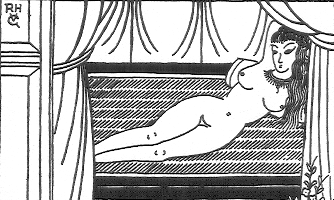 The appeal of the Judge Dee stories is not only that they are good detective fiction but that they also draw on all of van Gulik's vast knowledge about Chinese life, history, literature, and jurisprudence. Part of this involved van Gulik's own unique research into Chinese pornography. Indeed, when van Gulik showed another talent by beginning to illustrate his own stories, in the Ming style familiar to him, he usually worked in a least one nude! It is thus altogether an unexpected, charming, and extraordinary achievement in cross-cultural literature. Shown is van Guluk's sketch of the "smaragdine dancer" of Murder in Canton (p. 79), the tragic and fatal true love of Judge Dee's assistant, Chiao Tai.
The Judge Dee stories have recently been continued by new authors. Frédéric Lenormand has published Le château du lac Tchou-an and La nuit des juges [both from Fayard publisher, Paris, 2004]. In 2006 we also had the wonderful Tales of Judge Dee from Zhu Xiao Di (Zhū Xiǎodì) [iUniverse, New York, Shanghai]. Mr. Zhu at the time was a researcher in city planning at Harvard University's Joint Center for Housing Studies. The Tales uses the framework of van Gulik's stories, captures much of his style in English, and occurs during Judge Dee's time as Magistrate of Poo-yang. I have inserted the book at the appropriate place in the table below. The Tales consists of ten chapters that are each independent stories of particular cases, but the whole is a chronological sequence, unlike van Gulik's otherwise similar collection of stories in Judge Dee at Work. The tenth capter ends as The Chinese Maze Murders Begins, with the Judge on the way to his new posting at Lan-fang.
Mr. Zhu has suggested that there is a reason why the Dí Gōng Àn, although ambiguous, should be read Dígong Àn, and that is because it would be rude to use Judge Dee's surname alone without a title. If we are to be as good Confucians as Judge Dee himself, we would want to observe good manners,  , and respect his dignity. This, I now see, is van Gulik's own interpretation. In the Preface and Postcript to the Dee Goong An van Gulik uses kung to mean "judge" and at one point even gives
  in characters in a footnote (p.iv -- I do not believe characters are ever given in the later stories, except in the illustrations) to mean "Judge Dee." Even better, the frontispiece of the Dee Gong An names him
  , with the title Liáng Gong translated "Duke of Liang" -- more fully "Duke Wenhui of Liang," 梁文惠公, Liáng Wénhuì Gōng. Here gōng has risen to its meaning in the terms of Chinese feudal hierarchy, perhaps the reward of Dee's later career. The earlier Liang Dynasty (502-557) was one of the Six Southern Dynasties.
In 2021/2022 we have a new Judge Dee book from a new author. This is The Shadow of the Empire, by Qiu Xiaolong (Qiú Xiǎolóng) [Severan House, 2022]. Mr. Qiu has previously written no less than thirteen detective stories featuring his "Inspector Chen." Indeed, in his Postscript, Qiu says that this book "is conceived as being written by Inspector Chen during Inspector Chen and the Private Kitchen Murder." Qiu also says that the book is inspired by van Gulik's Poets and Murder, which was itself based in part on the real case of the poetess Yú Xuánjī (魚玄機, Yü Hsüan-chi, 844-871), who was executed for beating (or strangling) a maid to death. Van Gulik says he used her "as a model" for the character "Yoo-lan" in his book. There is an anachronism involved, more for Qiu than for van Gulik, since the historical Yu Xuanji lived many years after Judge Dee.
The Shadow of the Empire features Judge Dee during his period of service to the Empress Wu. He is not out of favor as we find him in the movie Detective Dee and the Mystery of the Phantom Flame discussed below; but Qiu does not provide dates for the incident recounted in the book. The Empress has appointed Dee to a judicial Circuit, perhaps to get him out of the Capital, as things have become tense on the issue of the Succession, since Wu has considered disinheriting her own sons, whom she has already deposed from the Throne once.
On his way out of the Capital, Dee is drawn into the legal case of the poetess Yu Xuanji, who is held in jail nearby. He realizes that this is related to the politics of the Succession controversy, and that forces may be trying to trap him into discrediting his own cause, which is for the legitimate princes.
I find Mr. Qiu's book disappointing. For one thing, we get quibbles about calling Dee a "judge." As we have seen, of course, means "official," if not "duke," more than "judge." Since Qiu correctly points out that there is no independent judiciary in Imperial China, it cannot be denied that a District Magistrate functions equally as the District Judge. He is both. Van Gulik's stories feature Dee principally in his investigative and judicial functions. We don't really get a lot of him doing administrative paperwork. In Qiu's own story, Dee is traveling to what is essentially a judicial appointment. So I don't see why he makes an issue of it.
More serious is what I think are a couple of misrepresentations of the Chinese Imperial judicial system. Van Gulik, who made a particular study of the matter, reminds us continually that defendants can only be questioned, and can only be tortured, in open court, where the public presence functions as a check on the behavior of the Magistrate -- never back where they are being held in a prison cell. But Qiu has Yu Xuanji questioned, tortured, and delivering confessions back in her cell. Of course, we might suspect that Magistrates do not always obey the rules; but, if so in this case, Qiu would need to at least note that this was improper, and that it might well be grounds for throwing out the confessions and sanctioning the Magistrate, especially when the misconduct is discovered by Judge Dee. But we hear nothing of the sort.
Simiarly, van Gulik informs us that a woman cannot have her full nakedness exposed in Court, even while she is being tortured. That can only be done on the execution ground. But Qiu tells us that this is exactly what was done to Yu Xuanji when she was being questioned in Court. Again, we do not hear from Judge Dee or anyone else that this was done improperly. If Qiu thinks that van Gulik was wrong about the matter, his Postscript was the place to say so. But he doesn't.
The story itself of The Shadow of the Empire, however, is the principal matter of disappointment for me. Judge Dee does not solve the case. He has his suspicions, which we take to be accurate, but we get no details and nothing comes of it. The problem is that Yu Xuanji was having an affair with one of the Imperial heirs, which, one way or another, led to the death of the maid. The exposure of this could discredit the prince and determine the Succession to pass out of the legitimate T'ang Dynasty. Neither Dee or Yu Xuanji want this to happen; so she is willing to die, and Dee is willing to conceal the truth.
In the course of Dee's own invesgitations, two other murders occur. One is of another lover of Yu Xuanji, Wei, and another of a local flower girl whom Yu Xuanji patronized. So Wei gets blamed for the murder, or the cover-up of the murder, of the maid. But we never learn who killed Wei or the flower girl, leaving nothing but suspicion about why. Other events are also left unsolved.
Nothing like this happens in any of van Gulik's stories, and Judge Dee is left to sadly reflect that sometimes politics must override justice -- unlike the time Judge Dee endangered his career by exposing a corrupt Buddhist temple. But we never do actually learn what the justice here would consist of. Did Yu Xuanji actually kill the maid? It looks like it; but we are never actually told so.
Some people like stories like that. I don't. In a director's commentary to a movie I was watching, the director remarked about endings that "writers love but audiences hate." This seems to be one of those. In life, there are many times where issues do not get clearly resolved; but as Woody Allen says in Annie Hall [1977] -- someone with his own unresolved criminal issues -- art is where you can fix those things up. But some artists don't want to fix it up. Perhaps they want art to reflect life, but even tragic art can be expected to present edifying lessons, as Greek tragedy generally exposed the hybris of the protagonist. The lesson of The Shadow of the Empire seems to be nothing more than "failure."
In crime mysteries, the point of the story is that there is a puzzle, a mystery, that must be solved. The ideal story gives the reader sufficient clues that, in retrospect, the crime could be solved. When the crime is solved, the challenge for the author is to have this happen in such a natural but clever way that the reader will be impressed, both with the intelligence of the (fictional) detective and with the creativity of the (real) author.
On the other hand, if the crime is not solved, and there are not sufficient clues to do so, the reader will feel cheated, not so much about the (fictional) detective, but about the (real) author, who obviously has not taken the trouble to work out the puzzle of the crime in an entertaining and convincing way. The failure of the story is a disappointment with the author, who apparently has no tried very hard. That does not happen with van Gulik's stories; but it does happen here with Mr. Qiu. One might well think, "Why did he bother?"
I have now incorporated dates for each Judge Dee story as determined by Arthur Yin in his essay, the "Fictitious Judge Dee Chronology." This is based on van Gulik's own chronological framework and various references that he makes in the stories, including seasonal foods and clothing and other clues. The principal difficulty in the dating, what Mr. Yin calls the "Key Issue," concerns his tenure at Poo-yang. His discussion of the problem is included here in a footnote.
| The Judge Dee Chronology (date of first editions in English) | dates according to Arthur Yin | |
|---|---|---|
| 663 Magistrate of Peng- lai, on the north- east coast of China in Shantung Province |
The Chinese Gold Murders (1959) | Spring 663 |
| Judge Dee at Work (1967), "Five Auspicious Clouds" | Summer 663 | |
| Judge Dee at Work (1967), "The Red Tape Murder" | Summer 663 | |
| Judge Dee at Work (1967), "He Came with the Rain" | Mid-summer 663 | |
| The Lacquer Screen (1962) | Summer 664 | |
| 666 Magistrate of Han-yuan, on a lake near the capital (van Gulik never mentions the Imperial Capital but the T'ang Dynasty capital was Ch'ang-An, near the modern Xian) |
The Chinese Lake Murders (1960) | Summer 666 (665 in preface to Gold Murders) |
| The Monkey and the Tiger (1965), "The Morning of the Monkey" | Summer 667 | |
| Judge Dee at Work (1967), "The Murder on the Lotus Pond" | Mid-summer 667 | |
| The Haunted Monastery (1961) | Autumn 667 | |
| 668 Magistrate of Poo-yang, in Kiangsu Province on the Grand Canal, which had been built in the Sui Dynasty (590-618) |
The Chinese Bell Murders (1958) | Autumn 668 |
| The Emperor's Pearl (1963) | 5th day 5th month 669, Dragon Boat Festival | |
| Necklace and Calabash (1967 on the copyright page of the Chicago edition) | Summer 669 | |
| Judge Dee at Work (1967), "The Wrong Sword" | probably Autumn 669 | |
| The Red Pavilion (1964, but 1961 on the copyright page of the Chicago edition) | 28th day 7th month 669, Festival of the Dead | |
| Poets and Murder (1968 on the copyright page of the Chicago edition) | 14th day 8th month 670, 1 day before Mid-Autumn Festival | |
| Judge Dee at Work (1967), "The Two Beggars" | 15th day 1st month 670, Feast of Laterns | |
| 669-670, Tales of Judge Dee, by Zhu Xiao Di [iUniverse, New York, Shanghai, 2006] | ||
| 670 Magistrate of Lan-fang, on the extreme western frontier of China |
The Chinese Maze Murders (Tokyo, 1951, as Meiro-no-satsujin; Singpore, 1953, as Ti-jen-chieh-chi-an; in English, London, 1952, but The Hague, 1957 on the copyright page of the Chicago edition) | Summer 670, half year before Phantom |
| The Phantom of the Temple (1966) | Summer 670 | |
| Judge Dee at Work (1967), "The Coffins of the Emperor" | Winter, early 672 | |
| Judge Dee at Work (1967), "Murder on New Year's Eve" | Winter, early 674; Judge Dee at Work says late 674, which would be Western, not Chinese, New Year | |
| 676 Magistrate of Pei-chow, a "desolate district up in the barren north" |
The Chinese Nail Murders (1961) | Winter, early 676 |
| The Monkey and the Tiger (1965), "The Night of the Tiger" | Winter, early 676 | |
| 677 Lord Chief Justice, in the Imperial Capital |
The Willow Pattern (1965) | Summer 677 |
| 681 Lord Chief Justice, on assignment in Canton |
Murder in Canton (1966) | Summer 680; Judge Dee at Work says 681 |
| The Shadow of the Empire, by Qiu Xiaolong [Severan House, 2022] | ||
| 689 Recalled by the Empress Wu to investigate mysterious deaths |
Di Renjie zhi Tongtian Diguo, "Detective Dee and the Mystery of the Phantom Flame" (2010 movie) | |
| Judge Dee serves in T'ang Court until his death in 700, during the reign of the Empress Wu (690-705) | ||
In The Chinese Nail Murders, van Gulik describes a home where the bed is made on top of a brick oven. This is something in many traditional Chinese homes, the  , "a brick-bed warmed by a fire." I have not noticed any other references to kangs in the Judge Dee stories, but there are frequent references to them, because of its focus on domestic life (and, probably, its location in the North of China), in the classic Chinese novel, A Dream of Red Mansions,

 [Cao Xueqin & Gao E, Foreign Languages Press, Beijing, 1994, 2005]. If Judge Dee had spent more time in his bedroom, we might have heard more about a kang, since even wealthy homes (as in Red Mansions) used them. As it is, I don't remember a scene where van Gulik ever has Judge Dee in his own bedroom.
A detail in Tales of Judge Dee merits a note. The Judge has an heirloom sword, which we've seen in many stories, called "Rain Dragon" (
 ). His young son makes a wooden sword he calls "Fire Dragon" (
 ). The explanation of the name is that he doesn't want it to imply that his sword could overcome his father's sword. The background here is the theory of the "mutually overcoming" cycle in the system of the Chinese five elements. Water overcomes fire, as explained at that link.
Van Gulik mentions in The Chinese Maze Murders that the Chinese gavel is an "oblong, square piece of hardwood of about one foot long" (Chicago, p.315). This is called the  , or, evocatively, the "wood that frightens the hall [or court]" (Wade-Giles ching-t'ang-mu). Zhu Xiao Di enjoys repeating this meaning several times. The device reminds me of a teacher in my Junior High School who silenced the class by slapping a yardstick on his desk. Eventually, the infamous "ruler" began to break apart, and the pieces were distributed as souvenirs at the end of the semester.
In the judicial system of Imperial China, torture was technically illegal but tolerated because no one could be convicted without a confession. It could then be used with these provisions:
 (反坐, fan-tso), "reversed judgment." The principle is discussed and illustrated by van Gulik in several books, especially the Dee Gong An and The Chinese Nail Murders.
Curiously, Mathews' Chinese-English Dictionary [Harvard University Press, 1972, character #1781, binome or digraph #30, p.255] only gives the meaning of fan-tso as "retribution." In turn, the ABC Chinese-English Dictionary, edited by John DeFrancis [University of Hawai'i Press, 1996, 1999], gives the meaning of fǎnzuò as "sentence an accuser to the punishment facing [somebody] he falsely accused." This is closer to what we see with Judge Dee, but not quite the same thing -- the judge would also count as an accuser.
In the American judicial system, misconduct by the police, prosecutors, and judges is rarely sanctioned. Prosecutors, especially, often attempt to withhold exculpatory evidence, which is illegal. While convictions can be overturned on such grounds (if the misconduct is discovered), I have never heard of prosecutors actually suffering any consequences themselves for it. Judges, in turn, routinely prohibit defense arguments concerning lack of criminal intent. This is a larger problem in the legal system, where laws now commonly ignore the ancient requirement for mens rea.
In 2010 a movie about Judge Dee came out of China, directed by Tsui Hark. It was shown at the Venice Film Festival. The title was given in Daily Variety and elsewhere as Di ren jie zhi tong tian di guo and translated as "Detective Dee and the Mystery of the Phantom Flame." I was not at first able to find the name in Chinese characters; but, even so, the name in Pinyin did not look like it would have the meaning provided. My guess was that the title is 


 , which means "The Great Empire of Renjie Di." My question here was about the syllable tong, which could be the name of the T'ang Dynasty in Cantonese (the language in which the movie was shot); but then the title otherwise seemed to be in Mandarin. My wife pointed out that means "all powerful" or "great," which looks reasonable.
  Soon I saw that these are indeed the correct characters, as in the movie poster at right [note].
This movie title curiously recalls van Gulik's own title of The Chinese Maze Murders for the Chinese edition that he prepared in 1953, which he cites as Ti-jen-chieh-chi-an [The Chinese Maze Murders, 1956 Foreword, Chicago, 1997, p.vi]. This reads as , "The Cases of Renjie Di." I would wonder if the form of the one title suggested the other.
In any case, the story is that Judge Dee has been imprisoned because of his opposition to the Empress Wu assuming the Regency. The movie says that this was eight years earlier, but the Regency was actually just five years (684) before the movie is supposed to begin (689). The movie does not mention that Wu deposed one of her sons (Chung Tsung, Zhongzong) to assume the Regency and will depose another (Jui Tsung, Ruizong) to assume sole rule as Emperor in her own right. The sons are never mentioned in the movie. Be that as it may, Court officials have mysteriously been bursting into flame, and the Empress releases Dee, who had been chief of the Metropolitan Court since 677, because of his reputation at solving crimes, even if this one initially looks to be of supernatural origin. It turns out that it isn't, but that is as much as we knew about the movie from the reviews. In 2011, the Chinese version of movie is out on DVD, and, as with Red Cliff [2008], I have been able to obtain a copy and see it.
The nicest thing about such a movie is that it could give us some hint of the life of Judge Dee after all the stories written by van Gulik about him as a judge. Since there are actual historical records about Dee's doings at Court, van Gulik viewed that part of his life as accounted for. But the casual reader certainly knows nothing about it. So, there is nothing wrong with some historical fiction to give us the flavor of Dee's dealings with the Empress Wu, who represents events in Chinese history of great intrinsic interest, and about which van Gulik gives few details -- I have only noticed two: van Gulik says, "it was because of his energetic protests that the Empress Wu who was then in power abandoned her plans to appoint to the Throne a favourite instead of the rightful Heir Apparent," and, "It is an historic fact that at one time in his career he had a large number of temples where evil practices prevailed destroyed" [The Chinese Bell Murders, Chicago, 1977, pp.285 & 287]. "At one time in his career" could only mean during his years at Court, since "a large number of temples" could not be "destroyed" just on his authority as a Magistrate.
Unfortunately, the movie only gives us the vaguest indications of Dee's actual career at court, with Dee making the Empress promise that the Throne will succeed to members of the dynasty. Again, we aren't told that this will be her own sons. Otherwise, we get a Dee who is far too young -- he would have been 59 in 689 -- doesn't seem to have any family, and has now become an action hero, flying around the landscape like everyone in Crouching Tiger, Hidden Dragon [2000], or Hero [2002]. This may be de rigueur for recent Chinese movies, but it has nothing to do with the Dee that we know either from history or from Robert van Gulik. So the effort does not make much of a contribution to Dee lore, although it is nice they used his name.
 In 2013 there is a new Judge Dee movie, Young Detective Dee and the Rise of the Sea Dragon. This also has nothing to do with van Gulik's Dee, nor does it have anything to do with the historical Judge Dee either -- it is supposed to be from Dee's early days as a detective, which we know would be as a District Magistrate, but in the movie is already in the Imperial Capital. The title of the movie in Chinese again is a matter of interest.
 , literally the "Capital City Dragon King of Di Renjie." A striking thing about the characters in the movie poster is that now the simplified character is used in Judge Dee's name, but that the traditional character is used for "dragon," which is not how the name is given, for instance, in the Wikipedia article about the movie. The "Sea Dragon" in the translated title is the , "dragon king," which is a class, not just one, of rain gods. Which rain god seems to be specified by , which is the "sacred" or Imperial "capital." This rain god does figure in the movie, adding the sort of supernatural element evident in the first movie, but that figures in the Judge Dee stories only in rare and small ways. Otherwise, there is no word in Chinese that would correspond to "rise" in the translated title. Nevertheless, this translated title has a lot more to do with the Chinese title than was the case in the first movie.
This all now looks like a series of movies is planned, with no prospect that they will bear much resemblance to van Gulik's books or to the actual T'ang official. Dee is just a convenient and familiar name around which to build fantasy action films.
Ti Jen-chieh, or Di Renjie, Judge Dee (630-700), Note 1
| Provinces | |||
|---|---|---|---|
| |||
| Prefectures | Prefectures | ||
| | ||
| Districts | Districts | Districts | Districts |
| | | |
or Province; (3) the government of the or Prefecture; and (4) the government of the hsien or District. A District is now frequently called a "County," but this implies too large a territory. Since a District was usually just a single city with its surrounding countryside, this would be more like a "Township," the division of a County in many American States.
Although van Gulik gives us no hint about any variations in this system, it did vary greatly over Chinese history. Originally, the level of administrative organization above the District level was that of the "Commanderies," chün,  , which were at first feudal fiefs of the Chou Dynasty.
| Provinces | |||
|---|---|---|---|
| |||
| Commanderies | Commanderies | ||
| | ||
| Districts | Districts | Districts | Districts |
| | | |
. As time went on, there were about 200 Provinces, 600 Commanderies, and 1000 Districts. In the Sui, the Commanderies were abolished, and then in the T'ang they were replaced by Prefectures, . Under the Yüan Dynasty, the number of Provinces was greatly reduced. These became the familiar Provinces of subsequent history.
The term , which would have still been used for the Provinces in Judge Dee's time, came to used for "Second Class Prefectures" or "Departments." These are said by Mathews' Chinese-English Dictionary [Harvard, 1972, character #1289, p.181] to be "an independent District... not under a prefecture, directly governed by provincial authorites." They thus would contain a single District and would fall directly under the authority of a . But the term continued as the character for Provinces, Shû, in Japan -- battleships were named after them. The Departments otherwise functioned like Districts, with their own first level examinations and schools.
| Province | Circuit | Prefecture | Sub- Prefecture | Department/ 2nd Class Prefecture | District/ County/ Township |
|---|---|---|---|---|---|
|  | |  | | |
or "Circuit" and the or "Sub-Prefecture." The of course is the Tao, the "Way" of Taoism, but Mathews' does identify it as "A district; a political division of a province" [p.884], with the binome or digraph  defined as "the former intendant of a circuit." We do not know from this when the Circuit was an active division of government. Calling it a "Circuit" would tend to imply that there was not a permanent seat of government involved, but that the "intendant" traveled a round of inspection in the Province, like a
 , a Censor (cf. Judge Dee's terrifying encounter with an Imperial Censor in The Chinese Lake Murders). The is defined by Mathews' as "A hall; a court; a lodge; a room. A Sub-Prefecture" [character #6403, p.931] but gives no more information; so I don't know either when this was an active level of government or if it involved a permanent seat. Since the notes to Strange Tales from a Chinese Studio describe the culture and government of the Ch'ing Dynasty, when the book was written, that may answer the former question.
I notice at Wikipedia that The most curious thing here, however, may be that the characters in the movie poster are all in the most traditional form. This is certainly not for the benefit of Western audiences, who can't read any of this anyway. It may be for the benefit of Chinese audiences who do not live in the PRC. But that would leave me with the question whether this poster is also used in the PRC, without a simplified version being provided. My impression, indeed, is that the rigors of the "simplified" character regime may have been relaxed, and traditional characters have become more common.
Ti Jen-chieh, or Di Renjie, Judge Dee (630-700), Note 2
In the movie poster, one sees a different character from the third one that I have used here in Judge Dee's name, . Insead, we get 
 . In either form, Judge Dee's given name means "Benevolent Hero."
 is given as a "simplified" character. It is indeed simpler than , but it is not really a "simplied" character in the sense of being introduced by the character reform program of the People's Republic of China to replace the traditional character. Instead, is an alternate traditional character [Mathews' Chinese-English Dictionary, character #774, p.105]. Sometimes the new "simplified" characters actually are alternate traditional characters (as I have noted elsewhere in relation to the characters for "air"). On the other hand, I am puzzled about why I have been using this alternate character, when van Gulik himself uses the more complex traditional one (cf. Dee Goong An, p.227). I may have gotten the character off a website about Judge Dee, without consulting van Gulik; but I don't remember.