
The idea that there were ultimate, elemental constituents of matter developed independently in three different philosophical traditions. There were This development may have actually been a response to influence from Greek philosophy in the Hellenistic Age, when the earth, air, fire, and water of Empedocles were expanded to five by Aristotle's addition of aether, αἰθήρ, the air or fire of the heavens. All ended up as Indian elements. Greeks arrived in India with Alexander the Great and remained nearby in the Kingdom of Bactria, where they even converted to Buddhism. In turn, we see some influence from Indian philosophy on Greek in the form of the Skepticism of Pyrrho of Elis, who was in India with Alexander.
In the Buddhist version of the five elements, aether, Sanskrit Introduction
 Greek elements, Indian and Buddhist Elements, and Chinese Elements. The system of Indian elements underwent the most development, beginning with three -- fire, water, and earth -- and ending with five -- fire, water, earth, air, and aether.
 , became the Void, Sanskrit
  , shûnyatâ, "Emptiness," or Chinese
  , in line with Buddhist metaphysics. When the Buddhist system was exported to East Asia, it rested up against the original five elements of the Chinese system -- earth, fire, water, wood, and metal. Although I have imagined a combination of Buddhist and Chinese elements in the "Fantasy Seven Element Theory," such a combination was never carried out in either Buddhist or Chinese philosophy.
| The Metals | |||||
|---|---|---|---|---|---|
| Ag | Silver |  | Moon | Monday | |
| Hg | Mercury |  | Mercury | Wednesday | |
| Cu | Copper |  | Venus | Friday | |
| Au | Gold |  | Sun | Sunday | |
| Fe | Iron |  | Mars | Tuesday | |
| Sn | Tin |  | Jupiter | Thursday | |
| Pb | Lead |  | Saturn | Saturday | |
All these metals had been known since antiquity. Gold, silver, and copper had been worked since the beginning of Middle Eastern Civilization. Tin was added to copper to make bronze. It was learned that by adding some charcoal to iron, it could be made very hard -- i.e. steel. Roman plumbing used lead, after which, plumbum, it is named. Mercury, "quick silver," became particuarly intriguing to Mediaeval alchemists, whose interest otherwise was trying to convert other metals, or anything, into gold.
"Alchemy" comes from Arabic  , al-kîmîyah, "chemistry," itself from Greek, Χημία, itself from the Egyptian name for Egypt,
  or
or  . This traces the evolution of the practice from the Greeks, who figured it was from Egypt, through the Arabs. The efforts of the alchemists, curiously, paid off with the discovery and manipulation of other elements, such as Sulfur, Arsenic, Antimony, Bismuth, and
 ) Phosphorus. At right, we see a detail of the dramatic depiction of Hennig Brand (c.1630-c.1692/1710) discoverying Phosophorus in 1669, in The Alchymist, In Search of the Philosopher’s Stone, 1771, by Joseph Wright of Derby (1734-1797) -- click on the image for a popup of the full painting. And it turned out that that the charcoal used with iron, almost pure Carbon, was itself an element. So Carbon, like Sulfur and the metals, had occurred naturally without being recognized for what it was.
Phosphorus. At right, we see a detail of the dramatic depiction of Hennig Brand (c.1630-c.1692/1710) discoverying Phosophorus in 1669, in The Alchymist, In Search of the Philosopher’s Stone, 1771, by Joseph Wright of Derby (1734-1797) -- click on the image for a popup of the full painting. And it turned out that that the charcoal used with iron, almost pure Carbon, was itself an element. So Carbon, like Sulfur and the metals, had occurred naturally without being recognized for what it was.
The laboratory equipment of the alchemists led to modern chemistry; and in the 18th century it was finally determined that fire had never been elemental, but was no more than a chemical process -- as determined by Antoine-Laurent de Lavoisier (1743-1794), at left, who also established that Sulfur was indeed an element (1777). And, by Lavoisier again, water was broken down into new elements, gases, which he named hydrogen ("water making") and oxygen ("sharp making").  Air was a mixture of a number of gases. A new one, carbon dioxide, was identified, with its miraculous healing properties immediately recognized -- which is why carbonated drinks, invented by Joseph Priestley (1733-1804), were sold in drug stores, at the "soda fountain," for a very long time -- and the naturally carbonated waters of hot springs are still viewed as healing, or at least relaxing. This was harmless enough; but the later discovery of the miraculous healing properties of Radium -- discovered by Marie Curie and her husband in 1898 -- led to many unnecessary deaths.
The dam burst in the 19th century, as one new element after another was identified, now with often obscure or whimsical names. In 1869 Dmitri Mendeleev detected a pattern. There was a periodicity in the properties of the elements, i.e. they repeated themselves in a regular περίοδος, períodos, i.e. a "way around" (originally used for the circuit of the Greek Stephanitic Games). Hence the idea of the "periodic table." Mendeleev made some predictions about new elements, their weights and properties; and he turned out to be right. He didn't have a clue, of course, why this was happening. Nor did anyone else for a long time.
The structure of the table, and the periodicity of the elements, is due to the features of  quantacized angular momentum. How this worked was first appreciated by Niels Bohr. As it is, we can detect a simple numerical series in the structure of the columns, like a chemical version of Bode's Law: 2, 6, 10, 14. If we divide by 2, because electrons can be left-handed or right-handed, we get: 1, 3, 5, 7, a simple sequence of odd numbers. This happens because of the values of angular momentum quanta: 0, 1, 2, 3 (orbitals identified as S, P, D, & F, respectively), which range as "magnetic substates" -- i.e. quantacized orientations in space in a magnetic field -- from positive to negative substates, e.g. for 3 we get +3, +2, +1, 0, -1, -2, -3 = 7.
  The diagram at left is actually for an angular momentum (L) of 4, which we do not see for electrons (it would be G Orbitals, which occur for protons and neutrons). As the "shells" of electrons fill up, we end up achieving both electrically neutral and extremely stable configurations, which we find in the "magic numbers" characteristic of the inert gases.
There is thus a tremendous simplicity, elegance, and beauty to this. Just what a physicist likes to see. The way electrons work in their actual atoms, however, often involves irregularities that current physics is not always able to explain.
Having discovered this wealth of elements, they turn out not to be elemental after all. The atoms of each element consist of sub-atomic particles, with the number of protons determining the atomic number of the element. Although the atomic character of the chemical elements was recognized, for the right reasons,  by John Dalton (1766-1844) at the beginning of the 19th century, the validity of this discovered was hotly disputed by many, since the individual atoms could not be observed. Ernst Mach most thoroughly made a fool of himself in this respect, but features of his extreme empiricism, discussed elsewhere at this site because of his promotion of Leibniz's theory of space, remain popular with many philosophers and scientists. Today, individual atoms of the heaviest, artificial elements, created in the lab, can be detected and studied.
A few atoms of every element up to 118 have now been observed, but the highest ones exist too briefly for much information to be gleaned about them -- so far. Physicists still hope for an "island of stablity," where more long lived atoms will be found. Originally it was thought that might occur around 114; but the actual 114 has disappointed -- although with a half-life of 30 seconds, that actually seems pretty long. But everyone had their hopes on minutes or longer. Now hopes rest on 120 or 122. Actual super-heavy stable elements are unlikely, but they do supply material for interesting science fiction.
The names of the elements derive from vasty differences sources. And the names of common elements, of course, differ from language to language -- something easily disambiguated by the internationally established symbols, although sometimes there are disputes or problems and a few symbols have gotten changed. Quite a few places have gotten elements named after them, often for obscure locations in Germany, Sweden, or Russia. The origins of such names are not always obvious, as Hassium (108 Hs) is named after the German State of Hesse. We also get the exceeding obscure Ruthenium (44 Ru), which is actually named with an archaic name for Russia itself, namely Ruthenia. Americans have no difficulty recognizing the origins of Berkelium (97 Bk) and Californium (98 Cf); but Livermorium (116 Lv), named after the Lawrence Livermore Laboratory (founded by Edward Teller, father of the hydrogen bomb, amid intense political controversy -- Teller did want to escape the politics at Berkeley), will probably not ring a bell for most. Recent place names, as in that case, usually reflect the existence of labs where elements have been discovered, particularly for the United States, Russia, and Germany. Curiously, Britain, where so much basic laboratory physics was done, including the discovery of the atomic nucleus by Rutherford, and where the Latin name of London, Londinium, already sounds like the name of an element, has contributed no place names to elements.
A good number of elements are now named after scientists. I've tried to put together a complete list:
These names are heavy with experimental physicists, particularly those associated with the actual discovery of new elements, like Marie Curie and Ernest Lawrence. We do get Albert Einstein and Niels Bohr of purely theoretical physicsts, but other theoreticians, like Schrödinger, Heisenberg, and Dirac, are missing. And Bohr, of course, although a theoretician, was the one who provided the physics to understand the structure of the table. Otherwise, experimentalists like J. J. Thomson, who discovered the electron (1896), or Robert A. Millikan, who determined its charge (1910), are missing. Dmitri Mendeleev, who recognized regularities in the chemical elements and first constructed a periodic table, could not be overlooked, and wasn't; but John Dalton, who realized that the chemical elements were atomic, also could not be overlooked, but was (and is). Otherwise, we get Nicolaus Copernicus, whose contributions, although epic, had nothing to do with chemistry, the elements, or even the kind of physics involved here. Equally tangential might be Alfred Nobel, whose status as a chemist is probably overshadowed by his establishment of the Nobel Prizes. New elements, of course, like new asteroids, are named by their discoverers. Individuals associated with particular labs are (usually) only named posthumously, while living discoverers use the place names of the labs for self-reference, or perhaps self-congratulation. Living scientists Glenn Seaborg and Yuri Oganessian, both involved in the discovery of new elements, have now had elements named after them, Oganessian most recently (2016).
It is not difficult to find periodic tables of the chemical elements. What is provided here, however, is a table with information drawn from different sources that may not always be found together (though there is the massive Handbook of Chemistry and Physics, edited by Robert C. Weast and Melvin J. Astle, of which I have the 62nd edition, 1981-1982, CRC Press, Inc. -- and now the 88th Edition, CRC Handbook of Chemistry and Physics, 2007-2008, Editor-in-Chief David R. Lide, Ph.D.). Thus, atomic isotopes, half-lives, and decay modes are largely taken from Subatomic Physics, by Hans Frauenfelder and Ernest M. Henley (Prentice-Hall, Inc. 1974). Cosmic abundance of elements is taken from the Realm of the Universe, by George O. Abell (Holt, Rinehart, and Winston, Inc. 1976 -- Abell's catalogue of galaxy clusters has now enshrined his name to the far reaches of the universe). Some minerological information comes from An Introduction to Minerology for Geologists, by W.J. Phillips and N. Phillips (John Wiley & Sons, 1980), and the Manual of Minerology by Cornelius S. Hurlbut, Jr. and Cornelis Klein (John Wiley & Sons, 1977). Such an attempt at a comprehensive picture of the elements in nuclear, chemical, and minerological forms I have also found in a couple of laminated, single-sheet periodic tables published for students, the "Chemical Periodic Table," edited by C. Bello (Papertech Marketing Group, Inc., 1988), and the "Table of Periodic Properties of the Elements," by the Sargent-Welsh Scientific Company (1980), from which some information here is derived -- now especially the neutral atomic radii. In some respects those single-sheet tables are more comprehensive than the following; and now I have been derived some new information from a laminated "Periodic Table of the Elements" from "Innovating Science" by the Aldon Corporation (2012).
In 2003 I updated some of the data here from Nature's Building Blocks, An A-Z Guide to the Elements by John Emsley [Oxford, 2001]. Emsley, unfortunately, doesn't exhaustively give things like isotopes and decay modes. I don't know why one would want to publish a book on the elements without such things. A nice new treatment of the elements, with a wealth of information, unfortunately often in a cryptic graphic form, is The Elements, A Visual Exploration of Every Known Atom in the Universe, by Theodore Gray (Black Dog & Leventhal Publishers, Inc., New York, 2009). This has been updated in 2012, but again with a kind of cryptic presentation of the data -- for instance with images for the crystal structure, without any explanation of what these are all about, or even their names. This page supplies these difficiences in a footnote, and without too much figuring Gray's images can be matched with the various space lattices. Gray's treatment is also missing things like isotopes and decay modes; and Gray, an enthusiastic for collecting examples of all the elements, doesn't mention things like the derivation of the names of the elements. As it happens, Wikipedia pages on the elements now usually have everything anyone would want to know about any elements, including isotopes, decay modes, names, history, compounds, etc. But I have also spotted some errors.
Many of the sources above may seem somewhat out of date, but they reflect the period when I was studying these matters, and when I was especially intrigued to supplement a chemical view of the elements with a picture of the variety of nuclear isotopes. Although I have done some updating, this table is not intended, therefore, as a resource for chemistry, physics, or minerology students. It is a resource for philosophy of science, illustrating basic ideas and information, where the most up to date data and the provision of all chemically useful information may not be not necessary: Data for reflection and theory, not for application and experiment. However, it is hard not to return here occasionally and to update some things, often with information from Wikipedia and elsewhere, where the purposes are more thorough and exhaustive than I have any interest in doing. Compared to some popular treatments, like Gray's The Elements, I think this page comes off favorably. The most recent updates and discussions were actually occasioned by buying "The Periodic Table of the Elements" shower curtain ("SMART by Simple Memory Art"), which has been featured on The Big Bang Theory television show for years.
Where to put Hydrogen and Helium in the Periodic Table is a nice question. In the following diagram they are in Groups 1 and 2, despite not being Alkali Metals or Alkaline Earths. However, they do belong with the s-block, where the S Orbitals are filling up. Hydrogen is generally put in Group 1, perhaps for that reason. In the main tables below, however, Hydrogen is put with the Halogens and Helium with the Inert Gases, which is where it is generally placed, since it really is an inert gas, for the same reason as the others. And Hydrogen is rather more like the Halogens than like the Alkali Metals. But Hydrogen is really sui generis and might sensibly be placed entirely on its own.
Elements marked radioactive, Some elements are marked poisonous, The neurological damage resulting from Mercury exposure is what made the "Mad Hatter" mad, since Mercury was used and absorbed in the traditional making of hats. When I was a child, no one worried much about playing around a bit with Lead or Mercury. Now people flee in panic. On the other hand, Lead poisoning has been a chronic problem through recorded history. Lead compounds can taste sweet, to the point that the Romans used Lead-based sweeteners. Bad idea. Similarly, Lead based paints could produced vividly white color. For a long time Lead would then be found used in white makeup, especially for actors. This would then produce skin lesions and lead poisoning. Since actors were socially inferior, not much notice was taken if they tended to die young.
On the other hand, Lead based paints persisted. This posed a hazard when the paint would get old and flake off into the environment. Also, children might discover that old painted wood might have a sweet taste, leading to ingestion, where even low doses might be damaging to infantile nerves and brains. This led to bans on Lead based paints, with the small attendant problem that subsitutes for Lead were not as durable.
The Romans also used Lead, Plumbum, for plumbing, from which the name is derived. This used to worry Classicists, that the Romans were being poisoned by their pipes, just as with their sweetener. However, the Lead pipes would develop an oxidized surface which prevented the water from being poisoned, so in that respect, at least, the Romans seem to have been safe. Modern plumbing, however, does not use Lead.
Another dangerous category are the elements, like the Alkalis and Halogens, that are so chemically reactive that they cause burns and damage on immediate contact. This is also a kind of poison, but of an overt and more obvious character, like the danger of fire and acids. I have labelled some Halogens but no Alkalis poisonous, mainly because Chlorine was used as a poison gas in World War I. By the same reasoning, Polonium should be marked poisonous, since Vladimir Putin's Russia assassinated a dissident in London by poisoning him with Polonium, which killed him by radiation poisoning.
The atomic weight, experimentally determined, is the number of grams in one "mole" of the material, which here means the number of atoms given by Avogadro's Number, 6.022140857(74) x 1023. Carbon 12 is the isotope taken as the benchmark, so that the atomic weight of C 12 is exactly 12. More nuanced definitions treat of "Avogadro's Constant." Atomic weight is an average of all the naturally occurring isotopes, and there is also the factor that energy has mass, with nuclei up to Iron (Fe 26) having less energy(/mass) than the independent particles and nuclei above Iron having more energy(/mass). This is why the fusion of Hydrogen atoms releases energy, but the fission of Uranium atoms also releases energy.
The integer mass number of an element is the sum of protons and neutrons in the nucleus of a particular isotope. In this table, "atomic weights" in parentheses are the average of the mass numbers of the most stable isotopes for elements that either do not occur naturally or that are too short lived to have easily been detected in Nature. Other tables of the elements may only give an integer mass number for the most stable isotope.
Sometimes atomic weights are misidentified as mass numbers. This is curiously the case on a shower curtain showing a periodic table of the elements that used to be featured on the television show The Big Bang Theory [2007-2019]. Having obtained my own such shower curtain, I noticed that the atomic weights of the elements were improperly defined as the "relative atomic mass" in terms of mass number, not actual atomic weight.
Names of the Elements
Sources and Uses
Index and Explanation
 , have no stable isotopes and will decay into other elements. No element heavier than Bismuth (Bi 83) has a stable isotope. Some of these occur in Nature, such as Uranium (92 U), and some have only been made in the laboratory, such as Nobelium (102 No). Others occur in Nature but only because they are decay products of longer lived elements. They have short enough half-lives that they would have disappeared if not continually renewed by such decays. Thus, they exist in small enough quantities that they were not identified until radiation was discovered. So, Radium 226 (226Ra) has a half-life of 1600 years and was only discovered by Marie Curie in 1898. Nevertheless, these elements can be trouble. Radon, whose longest lived isotope, 222Rn, a decay product of Radium, only has a half-life of 3.8 days, can accumulate dangerously in people's basements, if those are sunk into rocks emitting the gas. Polonium, also discovered by Curie, and rather longer lived, was apparently used by the Russians to assassinate a political dissident in London. To the other recent aggressions of Putin's Russia, radiological warfare thus must be added.
 . I have tried to restrict these to the ones that are chemically poisonous, even as most radioactive elements will cause radiation poisoning. Even though some radioactive elements are only mildly radioactive and are relatively harmless, the number of elements that could be responsible for radiation poisoning is now so large that it seems reasonable to avoid all the duplication with the icons. Just assume that radioactive elements are dangerous. On the other hand, some of the chemically poisonous elements are acutely poisonous, like Thallium, while others, like Lead, are only poisonous as the result of chronic ingestion. Thus, if Lead is used carefully, casual contact is not dangerous. The same does not quite hold for Mercury, which is not acutely poisonous but is more dangerous than Lead because its vapor can be breathed and because, as a liquid, Mercury can enter the body through cuts in the skin.
| Alkali Metals | ||
|---|---|---|
| Alkaline Earths (Metals) | ||
| Metals | Rare Earths (Metals) | |
| Metalloids/ Semi-Metals | Observed but Unnamed | |
| Non- Metals | ||
| Halogens | ||
| Inert/ Noble Gases | ||
Periodic tables typically color-code parts of the table to group chemically similar elements together. There is some variation in this. "Metals" is really the largest category, which here combines the Transition Metals of the d-block with other metals of the  p-block. Sometimes these are distinguished. However, all the Alkalis and the Rare Earths are also metals. And the Non-Metals also really include the Halogens and Inert Gases. Since the Alkaline Earths and Rare Earths are actually Metals, the terminology has come to reflect this.
The Metalloids or Semi-Metals are sometimes not distinguished from the Non-Metals, and Polonium (named for Marie Curie's native Poland) may or may not be identified as a Metal. The Lanthanide and Actinide Series of Rare Earths, the whole f-block, are sometimes distinguished, although it is not clear why this needs to be done. All but one of the Lanthanides occur naturally, and they have now become economically important, especially for powerful magnets. The Actinides, in turn, are all radioactive and are mostly artificial.
Uranium and Plutonium have ominous uses that speak for themselves. The Inert Gases are "Noble" for not forming compounds with other elements -- the electron shells have filled up and are stable. Purple is used here for its Imperial associations. The most reactive elements, are those an electron short, the Halogens, or an electron beyond, the Alkalis, the Inert Gases.
Scientific sources in physics and chemistry have begun to avoid units like Angstroms, Å, 10-10m, and Fermis, 10-15m, in favor of nanometers, nm, 10-9m, and picometers, pm, 10-12m -- although the Fermi is actually equivalent to the femtometer, fm, 10-15m. This is being done because Angstroms are not are part of the "Basic" and official SI (Système International d'Unités) metric system. But this is not right.
Measurement ought to be done in appropriate units, which means that milliliters (ml) really don't fit in the kitchen; and in fact the liter is now no more a part of the SI than is the Angstrom -- although every European country still dispenses gasoline and beer in liters (as does the United States, where a "quart" of alcohol is now a liter and a "fifth" [i.e. 4/5 of a quart] is 750ml).
Where the metric paradigm has really broken up, however, is with computers, where binary and hexadecimal numbers have effectively sabotaged the whole decimal principle of the metric system. This is not going to go away any time soon. If a little common sense returns, Ångstroms are perfectly convenient and appropriate units for the sizes of atoms and ions; and the difference in magnitude between the Ångstrom and the Fermi nicely illustrates the difference in scale -- 105 = 100,000 -- between atoms and nuclei.
The worse sin against "appropriate units," however, is with temperature. None of the rationales for the metric system apply to the Celsius scale of temperature. Instead, since a degree Celsius is almost twice as large as a degree Fahrenheit, it is a clumsy scale to use for the common integers of daily meteorologial temperature. Common sense is not likely to return in this area any time soon, but Americans should realize that the Fahrenheit scale is worth defending against metric Nazis.
1  Period
 Group
Group 2 3 4 5 6 7 6 7 
1, IA
Alkali
MetalsLi 3 Na 11 K 19 Rb 37 Cs 55 Fr
87s-block;
S Orbitals;
L=02, IIA
Alkaline EarthsBe 4 Mg 12 Ca 20 Sr 38 Ba 56 Ra 88 Rare Earths; f-block Transition
Metals;
d-block;
D Orbitals:
L=23, IIIB Sc 21 Y 39 Lu 71 Lr 103 La 57 Ac 894, IVB Ti 22 Zr 40 Hf 72 Rf 104 Ce 58 Th 905, VB V 23 Nb 41 Ta 73 Db 105 Pr 59 Pa 916, VIB Cr 24 Mo 42 W 74 Sg 106 Nd 60 U 927, VIIB Mn 25 Tc 43Re 75 Bh 107 Pm 61Np 93VIIIB 8 Fe 26 Ru 44 Os 76 Hs 108 Sm 62 Pu 949 Co 27 Rh 45 Ir 77 Mt 109 Eu 63 Am 9510 Ni 28 Pd 46 Pt 78 Ds 110 Gd 64 Cm 9611, IB Cu 29 Ag 47 Au 79 Rg 111 Tb 65 Bk 9712, IIB Zn 30 Cd 48  Hg 80Cn 112
 Dy 66 Cf 98p-block;
P Orbitals;
L=113, IIIA
Boron
FamilyB 5 Al 13 Ga 31 In 49 Tl 81 Nh 113 Ho 67 Es 9914, IVA
Carbon FamilyC 6 Si 14 Ge 32 Sn 50 Pb 82 Fl 114 Er 68 Fm 10015, VA
Nitrogen FamilyN 7P 15 As 33 Sb 51 Bi 83 Mc 115 Tm 69 Md 10116, VIA
Oxygen FamilyO 8S 16 Se 34 Te 52 Po 84Lv 116 Yb 70 No 10217, VIIA
HalogensF 9Cl 17Br 35I
53At 85Ts 117 Rare Earths;
f-block;
F Orbitals;
L=318, VIIIA
Inert
GasesNe 10Ar
18Kr 36Xe 54Rn 86Og 1181  Group Period
 2 3 4 5 6 7 6 7 Hydrogen
| Standard Entry: |
|---|
| Z=atomic number: symbol Name of Element gas at room temp = atomic weight in grams/mole melting/boiling point, oC {electrons in shells} electronegativity/crystal structure Atoms & Ions=radius in Angstroms (Å) [cosmic abundance/1012 Hydrogen atoms] A/B=mass number of isotope, spin & parity relative isotope abundance (%) T=half life decay mode (date of discovery) |
| Z=0: n neutron {0} n=c.10-5 [*] B=1 1/2+ T=15.3m  (1932) |
|
Z=1: H Hydrogen 1.008g -259.34/-252.88 {1} {1S=1} 2.20/hcp H=0.79 H+=c.10-5 [1x10¹²] A=1 1/2+ 99.985% Deuterium A=2 1+ 0.015% Tritium B=3 1/2+ T=12.33y (1766) |
 ). Although gravity is much, weaker than any of the forces within an atom, neutronium is created by the force of gravity collapsing the volume created by electrons in ordinary atoms. Since there are going to be many neutron stars in the universe, the number of free neutrons is liable to be considerable. Stars that are less massive form White Dwarves, where the atoms are not quite crushed; and stars that are more massive may collapse into Black Holes, where none of the other forces of nature can withstand gravity and neutrons themselves are collapsed down to a geometrical point. As a member of unstable atoms, neutrons can also decay, releasing an electron, as a beta particle, , and the anti-neutrino, , again. This adds a proton and increases the atomic number of the nucleus by one.
Hydrogen is the most abundant element in the universe. Its positive ion, H+, is simply a bare proton, whose size is no more than a Fermi, 10-15m (like the neutron), rather than the approximate size of most atoms, which is an Angstrom, Å, or 10-10m. But Hydrogen forms many non-ionic compounds, unlike either the Alkalis or Halogens with which it may be grouped. Instead, covalent bonds characterize important Hydrogen compounds, such as water, H2O, ammonia, NH3, or methane, CH4. These are among the most important compounds in the universe for the origin of life. Free Hydrogen molecules, H2, are not as reactive as Alkalis or Halogens, but they are easily flammable, as the Hindenberg learned to its loss (literally).
| pH+ | ions | pOH- |
|---|---|---|
| 14 | drain cleaner, basic | 0 |
| 13 | NaOH, Lye | 1 |
| 12 | 2 | |
| 11 | NH3, Ammonia | 3 |
| 10 | 4 | |
| 9 | baking soda | 5 |
| 8 | sea water | 6 |
| 7 | H2O, water, neutral | 7 |
| 6 | milk | 8 |
| 5 | coffee, acidic | 9 |
| 4 | grapefruit, tomato juice | 10 |
| 3 | 11 | |
| 2 | vinegar, lemon juice | 12 |
| 1 | 13 | |
| 0 | HCl, Hydro- chloric acid | 14 |
| pH+ | ions | pOH- |
In acids, such as hydrochloric acid, HCl, Hydrogen does have a strong ionic character. The opposite of acids, however, bases (or alkalines), also contain a hydrogen element, the OH- anion, as in sodium hydroxide, lye, NaOH -- my high school chemistry teacher, Mr. Falb, warned us that a piece of lye felt slippery, "because it is dissolving your skin." We add HCl to NaOH and we end up with water, H2O, and table salt, NaCl. Salt retains its ionic character, while water does not; although the acids and salts are in turn soluable in water, which reflects their ionic character. Hydrogen thus seems to play, not just on both teams, but on the neutral ground as well. Since there are weak acids (e.g. carbonic acid, H2CO3) and strong acids, there is actually a continuum between Hydrogen having an ionic or a covalent bond. This is measured by the pH test, which gives the concentration of effective H+ ions. Thus, in weaker acids, the bond of the Hydrogen atoms is less ionic, and fewer of them leave their molecules to circulate in a solution and to react when other substances encounter the solution.
At right is the table of pH and the opposite pOH numbers, zero through 14. I have reversed the usual colors used here, which conventionally have been red for acids and blue for bases. However, the reversal is just to conform to the color scheme of the periodic table on this page, with red for the Alkalis and blue for the Halogens. I have made Hydrogen blue for the Halogens, even though in the table above it is indexed with the Alkalis. Go figure. But the impression that bases are blue because they are cooler or milder than acids is something that should be strongly contradicted. You want no more contact with drain cleaner or lye, which are bases, than with battery acid. You'll get burned from both. Mild acids, however, contribute certain tastes to food, especially the sour taste of citrus and vinegar.
The rough definition of "pH" is that it is the "negative of the base 10 logarithm of the molar concentration, measured in units of moles per liter, of hydrogen ions." A negative logarithm is a reciprocal (i.e. 1/10 for 10), which means that large concentrations of ions results in a smaller number. This why a pH of "0" means a lot of ions and a very strong acid. This always seemed very counter-intuitive to me. And it also seems quite arbitrary that a pH of "7" would mean an absolutely neutral solution, like water, with the larger pH numbers for bases. But we can play the same trick of reciprocal numbers of bases by using the "pOH" number, which measures of the concentration of OH- anions. Note that a "mole" of any ion, atom, or molecule is Avogadro's number (6.02 x 10²³) of ions, atoms, or molecules. The "Atomic Weight" of all our elements in all these tables is the weight in grams of Avogadro's Number of atoms, or a single of mole of the atoms. That grams are used is an artifact of the old "CGS" (centimeter-gram-second) system of Units, which has now been officially replaced by the "MKS" (meter-kilogram-second) system.
| Standard Entry: |
|---|
| Z=atomic number: symbol Name of Element no stable isotopes; all radioactive = atomic weight in grams/mole melting/boiling point, oC {electrons in shells} electronegativity/crystal structure Atoms & Ions=radius in Angstroms (Å) [cosmic abundance/1012 Hydrogen atoms] A/B=mass number of isotope, spin & parity relative isotope abundance (%) T=half life decay mode (date of discovery) |
| Group 1, IA | |||||
|---|---|---|---|---|---|
| 3: Li Lithium 6.941g 180.6/1342 {2 1} {1S=2} {2S=1} 0.98/bcc Li=2.05 Li+=0.68 [<3] A=6, 1+ 7.5% A=7, 3/2- 92.5% (1817) |
11: Na Sodium 22.989768g 97.8/883 {2 8 1} {1S=2} {2S=2+1P=6} {3S=1} 0.93/bcc Na=2.23 Na+=0.97 [1.9x10⁶] B=22 T=2.602y  EC ECA=23, 3/2+ 100% B=24 T=15.02h (1807) |
19: K Potassium 39.0983g 63.71/759 {2 8 8 1} {1S=2} {2S=2+2P=6} {3S=2+3P=6} {4S=1} 0.82/bcc K=2.77 K+=1.33 [120x103] A=31, 1/2+ 100% B=40 /EC T=1.28Gy B=42 T=12.36h (1807) |
37: Rb Rubidium 85.4678g 39.48/688 {2 8 18 8 1} {1S=2} {2S=2+2P=6} {3S=2+3P=6 +3D=10} {4S=2+4P=6} {5S=1} 0.82/bcc Rb=2.98 Rb+=1.47 [410] A=85, 5/2- 72.17% B=86 T=18.7d A=87, 3/2- 27.83% T=50Gy (1861) |
55: Cs Cesium 132.90543g 28.39/671 {2 8 18 18 8 1} {1S=2} {2S=2+2P=6} {3S=2+3P=6 +3D=10} {4S=2+4P=6 +4D=10} {5S=2+5P=6} {6S=1} 0.79/bcc Cs=3.34 Cs+=1.67 [16] A=133, 7/2+ 100% B=134 T=2.06y B=135, 7/2+ T=2.8My B=137 T=30.17y (1860) |
87: Fr Francium (233.0197) 27/677 {2 8 18 32 18 8 1} {1S=2} {2S=2+2P=6} {3S=2+3P=6 +3D=10} {4S=2+4P=6 +4D=10 +4F=14} {5S=2+5P=6 +5D=10} {6S=2+6P=6} {7S=1} 0.7/bcc Fr+=1.80 B=212 T=19.3m EC  B=222 T=15m A=223, 3/2+ T=22m (1939) |
| Standard Entry: |
|---|
| Z=atomic number: symbol Name of Element no stable isotopes; all radioactive = atomic weight in grams/mole melting/boiling point, oC {electrons in shells} electronegativity/crystal structure Atoms & Ions=radius in Angstroms (Å) [cosmic abundance/1012 Hydrogen atoms] A/B=mass number of isotope, spin & parity relative isotope abundance (%) T=half life decay mode (date of discovery) |
 , al-qilî, "the base, alkali, lye." The root here,
  , qlw, or
  , qly, means "fry, bake, roast," so that the term appears to refer to alkaline ashes from burnt plants. Without the article, "base, alkali, lye" alternatively can be
  , qilw,
  , qily, or
  , qilan. The weak final consonant in the root, "w" or "y," is what generates this variety, since from inflected forms one cannot always tell what the root had been. The adjective, "alkaline, basic," is
  , qilwî. Examining this is a nice reminder of Mediaeval Islamic science, which has contributed enduring Arabic terminology in chemistry, astronomy, and mathematics.
The Alkaline Earths are, of course, metals, but like the Alkali Metals they oxidize quickly and do not occur naturally in metalic form. The most abundant elements here, Magnesium and Calcium, occur in key ways in both geology and biology. Calcium, like Sodium and Potassium above, is a defining element in Feldspars, specifically in the Plagioclase Series (CaAl2Si2O8). While the Calcium ion, Ca+2, seems significantly different in charge from Sodium, Na+, they share the Plagioclase Series because of the similar size of the ions. Otherwise, Calcium turns up in living things, particularly in bones and other kinds of skeletons. The key substance there is calcium carbonate, Calcite, CaCO3. This mostly constitutes limestone, which consists of the skeletons of invertebrates deposited in the sea, most conspicuously the Cretaceous seas that gave us both the White Cliffs of Dover and limestone formations in West Texas exposed by road cuts on Interstate 10 (geologists love road cuts, even if they are not as scenic as White Cliffs -- but West Texas is also a lot larger than Dover).
Magnesium is a slightly different story. This turns up in geology in the dark basaltic rocks of volanoes, particulary in the Olivine mineral Forsterite, Mg2SiO4, which we find in the lavas of Hawai'i. Geologically this is a very different province than where we find the Feldspars, with Sodium, Potassium, and Calcium, which are in light, continental rocks like granites. Magnesium shares its work with Iron (in Fayalaite, Fe2SiO4), which here looks like a kind of exogamy, as it has forsaken its Alkali fellows for a distant and very different metal. Why things work this was is an intriguing question, and the answer again would seem to be the size of the respective ions. The ion Mg+2, at 0.66 Å is smaller than the ions of Sodium, Potassium, or Calcium, but almost identical in size to Fe+3 at 0.64 Å -- and close to Fe+2 at 0.74 Å. I for one was enchanged to discover that much of the chemistry and crystallography of minerals depends on size rather than some other physical property.
| Group 2, IIA | |||||
|---|---|---|---|---|---|
|
4: Be Berylium 9.012182g 1289/2472 {2 2} {1S=2} {2S=2} 1.57/hcp Be=1.40 Be+2=0.35 [12] B=7 T=53.3d EC A=9 3/2- 100% B=10 0+ T=2.7My (1798) |
12: Mg Magnesium 24.3050g 648.8/1089.8 {2 8 2} {1S=2} {2S=2+1P=6} {3S=2} 1.31/hcp Mg=1.72 Mg+2=0.66 [32x106] A=24 0+ 78.99% A=25 5/2+ 10% A=26 0+ 11.01% B=28 T=20.9h (1775) |
20: Ca Calcium 40.078g 842/1494 {2 8 8 2} {1S=2} {2S=2+2P=6} {3S=2+3P=6} {4S=2} 1.00/fcc Ca=2.23 Ca+2=0.99 [2.5x10⁶] A=40 0+ 96.94% B=41 7/2- T=80ky A=42 0+ 0.65% A=43 7/2- 0.14% A=44 0+ 2.08% B=45 T=165d A=46 0+ 0.003% A=48 0+ 0.19% (1808) |
38: Sr Strontium 87.62g 769/1382 {2 8 18 8 2} {1S=2} {2S=2+2P=6} {3S=2+3P=6 +3D=10} {4S=2+4P=6} {5S=2} 0.95/fcc Sr=2.45 Sr+2=1.12 [760] A=84 0+ 0.56% A=86 0+ 9.9% A=87 9/2+ 7% A=88 0+ 82.6% B=90 0+ T=28.9y (1790) |
56: Ba Barium 137.327g 729/1805 {2 8 18 18 8 2} {1S=2} {2S=2+2P=6} {3S=2+3P=6 +3D=10} {4S=2+4P=6 +4D=10} {5S=2+5P=6} {6S=2} 0.89/bcc Ba=2.78 Ba+2=1.34 [130] A=130 0+ 0.1% A=132 0+ 0.095% A=134 0+ 2.4% A=135 3/2+ 6.5% A=136 0+ 7.8% A=137 3/2+ 11.2% A=138 0+ 71.9% B=140 T=12.8d (1808) |
88: Ra Radium 226.0254g 700/1536 {2 8 18 32 18 8 2} {1S=2} {2S=2+2P=6} {3S=2+3P=6 +3D=10} {4S=2+4P=6 +4D=10 +4F=14} {5S=2+5P=6 +5D=10} {6S=2+6P=6} {7S=2} 0.9/bcc Ra+2=1.43 A=226 0+ T=1600y B=228 0+ T=5.75y (1898) |
| Standard Entry: |
|---|
| Z=atomic number: symbol Name of Element liquid at room temp = poisonous = no stable isotopes; all radioactive = atomic weight in grams/mole melting/boiling point, oC {electrons in shells} electronegativity/crystal structure Atoms & Ions=radius in Angstroms (Å) [cosmic abundance/1012 Hydrogen atoms] A/B=mass number of isotope, spin & parity relative isotope abundance (%) T=half life decay mode (date of discovery) |
One of the more intriguing names with a Greek connection is that for Palladium. This is simply the Latin version of Greek Παλλάδιον, Palládion. The Palladium was a statue or fetish object of the goddess Athena, otherwise called Πάλλας, Pallas, upon which the safety of the City of Troy was supposed to depend. The Romans came to believe that the Palladium had been brought to Rome by Aeneas, who fled from Troy. This seems to mean that the Romans had something, apparently a small wooden statue of Athena, which they regarded as the original Palladium. But then we enter the realm of legend again. The story came to be told that the Emperor Constantine I took the Palladium to Constantinople, where it was buried under the porphyry pillar that was erected in the Forum of Constantine, upon which stood a statue of Constantine until it was thrown down by a storm on 5 April 1106 AD. The column, however, somewhat the worse for wear and called the "Burnt" pillar, still stands. No acknowledged effort appears to have been made to find anything under it. Meanwhile, Athena was also the patron goddess of the City of Athens, and apparently there was a Palladium associated with her there too, although we hear very little about it. That is not surprising, since such an object out to be kept secret and hidden.
| Group | Period 4 | Period 5 | Period 6 | Period 7 | |
|---|---|---|---|---|---|
| 3 IIIB |
21: Sc Scandium 44.9559g 1541/2831 {2 8 9 2} {1S=2} {2S=2+2P=6} {3S=2+3P=6 +3D=1} {4S=2} 1.36/hcp Sc=2.09 Sc+3=0.81 [1.1x10³] A=45 7/2- 100% B=46 T=83.8d (1879) |
39: Y Yttrium 88.9059g 1522/3338 {2 8 18 9 2} {1S=2} {2S=2+2P=6} {3S=2+3P=6 +3D=10} {4S=2+4P=6 +4D=1} {5S=2} 1.22/hcp Y=2.27 Y+3=0.92 [210] B=88 T=106.6d ECA=89 1/2- 100% (1794) |
71: Lu Lutetium 174.97g 1663/3395 {2 8 18 32 9 2} {1S=2} {2S=2+2P=6} {3S=2+3P=6 +3D=10} {4S=2+4P=6 +4D=10 +4F=14} {5S=2+5P=6 +5D=1} {6S=2} 1.27/hcp Lu=2.25 Lu+3=0.85 [7] A=175 7/2+ 97.4% A=176 7- 2.6% T=37Gy (1907) |
103: Lr Lawrencium (260.105) (1627)/-- {2 8 18 32 32 8 3} {1S=2} {2S=2+2P=6} {3S=2+3P=6 +3D=10} {4S=2+4P=6 +4D=10 +4F=14} {5S=2+5P=6 +5D=10 +5F=14} {6S=2+6P=6} {7S=2+7P=1} B=256 T=35s B=260 T=3m (1961) | |
| 4 IVB |
22: Ti Titanium 47.90g 1670/3289 {2 8 10 2} {1S=2} {2S=2+2P=6} {3S=2+3P=6 +3D=2} {4S=2} 1.54/hcp Ti=2.00 Ti+3=0.76 Ti+4=0.68 [56x103] A=46 0+ 8% A=47 5/2- 7.5% A=48 0+ 73.7% A=49 7/2- 5.5% A=50 0+ 5.3% (1791) |
40: Zr Zirconium 91.22g 1855/4409 {2 8 18 10 2} {1S=2} {2S=2+2P=6} {3S=2+3P=6 +3D=10} {4S=2+4P=6 +4D=2} {5S=2} 1.33/hcp Zr=2.16 Zr+4=0.79 [600] A=90 0+ 51.4% A=91 5/2+ 11.2% A=92 0+ 17.1% B=93 5/2+ T=950ky A=94 0+ 17.5% B=95 T=64d A=96 0+ 2.8% (1789) |
72: Hf Hafnium 178.49g 2231/4603 {2 8 18 32 10 2} {1S=2} {2S=2+2P=6} {3S=2+3P=6 +3D=10} {4S=2+4P=6 +4D=10 +4F=14} {5S=2+5P=6 +5D=2} {6S=2} 1.3/hcp Hf=2.16 Hf+4=0.78 [8] A=174 0+ 0.18% T=2Py A=176 0+ 5.2% A=177 7/2- 18.5% A=178 0+ 27.2% A=179 9/2+ 13.8% A=180 0+ 35.1% B=182 0+ T=9My (1923) |
104: Rf Rutherfordium (261.11) {2 8 18 32 32 10 2} {1S=2} {2S=2+2P=6} {3S=2+3P=6 +3D=10} {4S=2+4P=6 +4D=10 +4F=14} {5S=2+5P=6 +5D=10 +5F=14} {6S=2+6P=6 +6D=2} {7S=2} B=257 T=4.5s B=261 T=65s (1964/1969) | |
| 5 VB |
23: V Vanadium 50.9414g 1910/3409 {2 8 11 2} {1S=2} {2S=2+2P=6} {3S=2+3P=6 +3D=3} {4S=2} 1.63/bcc V=1.92 V+2=0.88 V+3=0.74 V+4=0.63 V+5=0.59 [10x103] A=50 6+ 0.25% T=40Py A=51 7/2- 99.75% (1830) |
41: Nb Niobium 92.9064g 2469/4744 {2 8 18 12 1} {1S=2} {2S=2+2P=6} {3S=2+3P=6 +3D=10} {4S=2+4P=6 +4D=4} {5S=1} 1.6/bcc Nb=2.08 Nb+4=0.74 Nb+5=0.69 [200] B=91 9/2+ T=LONG B=92 7+ T=20My A=93 9/2+ 100% B=94 6+ T=20ky B=95 T=35.15d (1801) |
73: Ta Tantalum 180.9479g 3020/5458 {2 8 18 32 11 2} {1S=2} {2S=2+2P=6} {3S=2+3P=6 +3D=10} {4S=2+4P=6 +4D=10 +4F=14} {5S=2+5P=6 +5D=3} {6S=2} 1.5/bcc Ta=2.09 Ta+5=0.68 [1] A=180 8+ 0.012% A=181 7/2+ 99.988% B=182 T=115d (1802) |
105: Db Dubnium (262.114) {2 8 18 32 32 11 2} {1S=2} {2S=2+2P=6} {3S=2+3P=6 +3D=10} {4S=2+4P=6 +4D=10 +4F=14} {5S=2+5P=6 +5D=10 +5F=14} {6S=2+6P=6 +6D=3} {7S=2} B=262 T=40s (1968) | |
| 6 VIB |
24: Cr Chromium 51.996g 1863/2672 {2 8 13 1} {1S=2} {2S=2+2P=6} {3S=2+3P=6 +3D=5} {4S=1} 1.66/bcc Cr=1.85 Cr+3=0.63 Cr+6=0.52 [690x103] A=50 0+ 4.35% B=51 T=27.7d EC A=52 0+ 83.79% A=53 3/2- 9.5% A=54 0+ 2.36% (1797) |
42: Mo Molybdenum 95.94g 2623/4639 {2 8 18 13 1} {1S=2} {2S=2+2P=6} {3S=2+3P=6 +3D=10} {4S=2+4P=6 +4D=5} {5S=1} 2.16/bcc Mo=2.01 Mo+4=0.70 Mo+6=0.62 [150] A=92 0+ 14.8% B=93 5/2+ T=3ky A=94 0+ 9.1% A=95 5/2+ 15.9% A=96 0+ 16.7% A=97 5/2+ 9.5% A=98 0+ 24.4% B=99 T=66.02h A=100 0+ 9.6% (1778) |
74: W Tungsten 183.85g 3422/5730 {2 8 18 32 12 2} {1S=2} {2S=2+2P=6} {3S=2+3P=6 +3D=10} {4S=2+4P=6 +4D=10 +4F=14} {5S=2+5P=6 +5D=4} {6S=2} 2.36/bcc W=2.02 W+4=0.70 W+6=0.62 [300] A=180 0+ 0.13% B=181 T=140d EC A=182 0+ 26.3% A=183 1/2- 14.3% A=184 0+ 30.7% B=185 T=75.1d A=186 0+ 28.6% B=188 T=69d (1783) |
106: Sg Seaborgium (263.118) {2 8 18 32 32 12 2} {1S=2} {2S=2+2P=6} {3S=2+3P=6 +3D=10} {4S=2+4P=6 +4D=10 +4F=14} {5S=2+5P=6 +5D=10 +5F=14} {6S=2+6P=6 +6D=4} {7S=2} B=263 T=0.9s B=266 T=21s (1974) | |
| 7 VIIB |
25: Mn Manganese 54.9380g 1246/2062 {2 8 13 2} {1S=2} {2S=2+2P=6} {3S=2+3P=6 +3D=5} {4S=2} 1.55/cub Mn=1.79 Mn+2=0.80 Mn+3=0.66 Mn+4=0.60 Mn+7=0.46 [260x103] A=53 7/2- T=11My EC A=54 T=313d EC A=55 5/2- 100% B=56 T=2.58h (1774) |
43: Tc Technetium 98.9062g 2204/4265 {2 8 18 13 2} {1S=2} {2S=2+2P=6} {3S=2+3P=6 +3D=10} {4S=2+4P=6 +4D=5} {5S=2} 1.9/hcp Tc=1.95 Tc+7=0.56 A=97 9/2+ T=2.6My EC B=98 7 6+ T=1.5My B=99 9/2+ T=210ky (1937) |
75: Re Rhenium 186.2g 3186/5596 {2 8 18 32 13 2} {1S=2} {2S=2+2P=6} {3S=2+3P=6 +3D=10} {4S=2+4P=6 +4D=10 +4F=14} {5S=2+5P=6 +5D=5} {6S=2} 1.9/hcp Re=1.97 Re+4=0.72 Re+7=0.56 [2] A=185 5/2+ 37.5% A=187 5/2+ 62.5% T=50Gy (1925) |
107: Bh Bohrium (262.12) {2 8 18 32 32 13 2} {1S=2} {2S=2+2P=6} {3S=2+3P=6 +3D=10} {4S=2+4P=6 +4D=10 +4F=14} {5S=2+5P=6 +5D=10 +5F=14} {6S=2+6P=6 +6D=5} {7S=2} B=267 T=17s B=270 (1981) | |
| VIII B | 8 |
26: Fe Iron 55.847g 1538/2862 {2 8 14 2} {1S=2} {2S=2+2P=6} {3S=2+3P=6 +3D=6} {4S=2} 1.83/bcc Fe=1.72 Fe+2=0.74 Fe+3=0.64 [25x106] A=54 0+ 5.8% A=56 0+ 91.7% A=57 1/2- 2.14% A=58 0+ 0.31% B=59 T=44.6d A=60 0+ T=100ky (ancient) |
44: Ru Ruthenium 101.07g 2334/4150 {2 8 18 15 1} {1S=2} {2S=2+2P=6} {3S=2+3P=6 +3D=10} {4S=2+4P=6 +4D=7} {5S=1} 2.2/hcp Ru=1.89 Ru+4=0.67 [66] A=96 0+ 5.5% A=98 0+ 1.9% A=99 5/2+ 12.7% A=100 0+ 12.6% A=101 5/2+ 17.1% A=102 0+ 31.6% A=104 0+ 18.6% B=106 T=367d (1844) |
76: Os Osmium 190.2g 3033/5012 {2 8 18 32 14 2} {1S=2} {2S=2+2P=6} {3S=2+3P=6 +3D=10} {4S=2+4P=6 +4D=10 +4F=14} {5S=2+5P=6 +5D=6} {6S=2} 2.2/hcp Os=1.92 Os+6=0.69 [6] A=184 0+ 0.02% A=186 0+ 1.6% A=187 1/2- 1.6% A=188 0+ 13.3% A=189 3/2- 16.1% A=190 0+ 26.4% A=192 0+ 41.0% B=194 T=6y (1804) |
108: Hs Hassium {2 8 18 32 32 14 2} {1S=2} {2S=2+2P=6} {3S=2+3P=6 +3D=10} {4S=2+4P=6 +4D=10 +4F=14} {5S=2+5P=6 +5D=10 +5F=14} {6S=2+6P=6 +6D=6} {7S=2} B=273 T=20s B=277 (1984) |
| 9 |
27: Co Cobalt 58.9332g 1495/2928 {2 8 15 2} {1S=2} {2S=2+2P=6} {3S=2+3P=6 +3D=7} {4S=2} 1.88/fcc Co=1.67 Co+2=0.72 Co+3=0.63 [32x103] B=56 T=78.8d ECB=57 T=270d EC B=58 T=71.3d ECA=59 7/2- 100% A=60 T=5.27y (1735) |
45: Rh Rhodium 102.9055g 1963/3697 {2 8 18 16 1} {1S=2} {2S=2+2P=6} {3S=2+3P=6 +3D=10} {4S=2+4P=6 +4D=8} {5S=1} 2.28/fcc Rh=1.83 Rh+3=0.68 [26] B=101 T=3.3y EC A=103 1/2- 100% (1803) |
77: Ir Iridium 192.2g 2447/4428 {2 8 18 32 15 2} {1S=2} {2S=2+2P=6} {3S=2+3P=6 +3D=10} {4S=2+4P=6 +4D=10 +4F=14} {5S=2+5P=6 +5D=7} {6S=2} 2.20/fcc Ir=1.87 Ir+4=0.68 [160] A=191 3/2+ 37.4% B=192 T=74.2d EC A=193 3/2+ 62.6% (1804) |
109: Mt Meitnerium {2 8 18 32 32 15 2} {1S=2} {2S=2+2P=6} {3S=2+3P=6 +3D=10} {4S=2+4P=6 +4D=10 +4F=14} {5S=2+5P=6 +5D=10 +5F=14} {6S=2+6P=6 +6D=7} {7S=2} B=276 B=268 T=0.07s (1982) | |
| 10 |
28: Ni Nickel 58.71g 1455/2914 {2 8 16 2} {1S=2} {2S=2+2P=6} {3S=2+3P=6 +3D=8} {4S=2} 1.91/fcc Ni=1.62 Ni+2=0.69 [2.1x10⁶] B=57 T=36h ECA=58 0+ 68% B=59 3/2- T=80ky EC A=60 0+ 26.1% A=61 3/2- 1.1% A=62 0+ 3.6% B=63 T=92y A=64 0+ 0.9% (1751) |
46: Pd Palladium 106.4g 1555/2964 {2 8 18 18} {1S=2} {2S=2+2P=6} {3S=2+3P=6 +3D=10} {4S=2+4P=6 +4D=10} 2.20/fcc Pd=1.79 Pd+2=0.80 Pd+4=0.65 [20] A=102 0+ 1% B=103 T=17d EC A=104 0+ 11% A=105 5/2+ 22.2% A=106 0+ 27.3% B=107 5/2+ T=6.5My A=108 0+ 26.7% A=110 0+ 11.8% (1803) |
78: Pt Platinum 195.09g 1769.0/3827 {2 8 18 32 16 2} {1S=2} {2S=2+2P=6} {3S=2+3P=6 +3D=10} {4S=2+4P=6 +4D=10 +4F=14} {5S=2+5P=6 +5D=8} {6S=2} 2.28/fcc Pt=1.83 Pt+2=0.80 Pt+4=0.65 [100] A=190 0+ 0.013% T=700Gy A=192 0+ 0.78% A=194 0+ 32.9% A=195 1/2- 33.8% A=196 0+ 25.3% A=198 0+ 7.2% (16 cent.) |
110: Ds Darmstadtium {2 8 18 32 32 17 1} {1S=2} {2S=2+2P=6} {3S=2+3P=6 +3D=10} {4S=2+4P=6 +4D=10 +4F=14} {5S=2+5P=6 +5D=10 +5F=14} {6S=2+6P=6 +6D=9} {7S=1} B=281 T=1.6m (1984) | |
| 11 IB |
29: Cu Copper 63.546g 1085/2563 {2 8 18 1} {1S=2} {2S=2+2P=6} {3S=2+3P=6 +3D=10} {4S=1} 1.90/fcc Cu=1.57 Cu+=0.96 Cu+2=0.72 [11x103] A=63 3/2- 69.1% B=64 / EC T=12.7h A=65 3/2- 30.9% B=67 T=61.88h (ancient) |
47: Ag Silver 107.868g 961.93/2163 {2 8 18 18 1} {1S=2} {2S=2+2P=6} {3S=2+3P=6 +3D=10} {4S=2+4P=6 +4D=10} {5S=1} 1.93/fcc Ag=1.75 Ag+=1.26 Ag+2=0.89 [7] A=107 1/2- 51.83% B=108 T=127y EC A=109 1/2- 48.17% B=110 T=252d B=111 T=7.45d (ancient) |
79: Au Gold 196.9665g 1064.43/2857 {2 8 18 32 18 1} {1S=2} {2S=2+2P=6} {3S=2+3P=6 +3D=10} {4S=2+4P=6 +4D=10 +4F=14} {5S=2+5P=6 +5D=10} {6S=1} 2.54/fcc Au=1.79 Au+=1.37 Au+3=0.85 [5] B=195 T=183d EC B=196 T=6.18d EC A=197 3/2+ 100% B=198 T=2.696d B=199 T=3.15d (ancient) |
111: Rg Roentgenium {2 8 18 32 32 17 2} {1S=2} {2S=2+2P=6} {3S=2+3P=6 +3D=10} {4S=2+4P=6 +4D=10 +4F=14} {5S=2+5P=6 +5D=10 +5F=14} {6S=2+6P=6 +6D=9} {7S=2} B=280 B=272 T=1.5ms (1994) | |
| 12 IIB |
30: Zn Zinc 63.37g 419.58/907 {2 8 18 2} {1S=2} {2S=2+2P=6} {3S=2+3P=6 +3D=10} {4S=2} 1.65/hcp Zn=1.53 Zn+2=0.74 [28x103] A=64 0+ 48.9% B=65 T=244.1d ECA=66 0+ 27.8% A=67 5/2- 4.1% A=68 0+ 18.6% A=70 0+ 0.62% (16th cent) |
48: Cd Cadmium 112.40g 321.108/767 {2 8 18 18 2} {1S=2} {2S=2+2P=6} {3S=2+3P=6 +3D=10} {4S=2+4P=6 +4D=10} {5S=2} 1.69/hcp Cd=1.71 Cd+2=0.97 [72] A=106 0+ 1.2% A=108 0+ 0.9% B=109 T=453d EC A=110 0+ 12.4% A=111 1/2+ 12.8% A=112 0+ 24.0% A=113 1/2+ 12.3% A=114 0+ 28.8% A=116 0+ 7.6% (1817) |
80: Hg Mercury 200.59g -38.836/356.66 {2 8 18 32 18 2} {1S=2} {2S=2+2P=6} {3S=2+3P=6 +3D=10} {4S=2+4P=6 +4D=10 +4F=14} {5S=2+5P=6 +5D=10} {6S=2} 2.00/rhm Hg=1.76 Hg+2=1.10 [<100] A=196 0+ 0.15% A=198 0+ 10.1% A=199 1/2- 16.9% A=200 0+ 23.1% A=201 3/2- 13.2% A=202 0+ 29.7% B=203 T=46.8d A=204 0+ 6.8% (ancient) |
112: Cn Copernicium {2 8 18 32 32 18 2} {1S=2} {2S=2+2P=6} {3S=2+3P=6 +3D=10} {4S=2+4P=6 +4D=10 +4F=14} {5S=2+5P=6 +5D=10 +5F=14} {6S=2+6P=6 +6D=10} {7S=2} B=285 T=0.28ms (1996) | |
| Standard Entry: |
|---|
| Z=atomic number: symbol Name of Element poisonous = no stable isotopes; all radioactive = atomic weight in grams/mole melting/boiling point, oC {electrons in shells} electronegativity/crystal structure Atoms & Ions=radius in Angstroms (Å) [cosmic abundance/1012 Hydrogen atoms] A/B=mass number of isotope, spin & parity relative isotope abundance (%) T=half life decay mode (date of discovery) |
 , bauraq, "borax." In Arabic, this is treated like a foreign word, and it is said to be derived from Persian. This is one of the many substances known to the Greeks and Arabs from the evaporite deposits in North Africa and other desert climates. Thus, borax was found in Death Valley because it is a desert basin where minerals wash in, do not wash out, and then are concentrated in dry lakes. A similar phenomenon is seen in the sand of White Sands, New Mexico, which is all gypsum, a hydrous calcium sulphate, CaSO4*2H2O.
The only really abundant element here is Aluminum -- the British version is indeed Aluminium -- which is, geologically and mineralogically, one of the most important elements of all. Because of its presence in Feldspars, the most common mineral in the crust of the Earth, Aluminum is one of the most abundant elements on earth; but recovering the Aluminum was never an easy matter, and bauxite ores (named after Baux, France) of weathered Aluminium oxides, which are not just everywhere, eventually made its production economical. Before then, Aluminum was extremely valuable; and the little pyramid of Aluminum on the top of the Washington Monument was a precious wonder of the age. Now, Aluminum fills the skies as the bodies of aircraft and fills the kitchen with Aluminum foil -- previously Tin foil. The name "Aluminium" comes from alum, an astringent variety of sulfates of Aluminum, from Latin alumen (genitive aluminis) but also cognate, oddly, to English "ale." This also has a cognate in Greek, ἀλύδοιμος, alýdoimos, which is glossed is the equivalent of πικρός, pikrós, "pointed, sharp, pungent, bitter." The semantic range of "bitter" can easily encompass alum and kinds of beer or ale.

The newest element here is Nihonium, named by the Japanese research group "RIKEN" (the Rikagaku Kenkyûsho), which was credited with the discovery, after Japan itself,  . This is the first element given a name based originally on Chinese characters. The name became official in November 2016, along with three other new elements (Moscovium, Tennessine, and Oganesson), which filled out the 7th Period of the periodic table.
| Group 13, IIIA | |||||
|---|---|---|---|---|---|
|
5: B Boron 10.81g 2092/4002 {2 3} {1S=2} {2S=2 +2P=1} 2.04/tet B=1.17 B+=0.23 [<160] A=10 3+ 19.8% A=11 3/2- 80.2% (1808) |
13: Al Aluminum 26.981 660.452/2520 {2 8 3} {1S=2} {2S=2+1P=6} {3S=2+3P=1} 1.61/fcc Al=1.82 Al+3=0.51 [3.3x10⁶] B=26 5+ /EC T=740ky A=27 5/2+ 100% (1827) |
31: Ga Gallium 69.72g 29.7741/2205 {2 8 18 3} {1S=2} {2S=2+2P=6} {3S=2+3P=6 +3D=10} {4S=2+4P=1} 1.81/orh Ga=1.81 Ga+2=0.62 [630] A=67 T=78.2h EC A=69 3/2- 60.2% A=71 3/2- 40% B=72 T=14.1h (1875) |
49: In Indium 114.82g 156.634/2073 {2 8 18 18 3} {1S=2} {2S=2+2P=6} {3S=2+3P=6 +3D=10} {4S=2+4P=6 +4D=10} {5S=2+5P=1} 1.78/tet In=2.00 In+3=0.81 [40] A=113 9/2+ 4.3% B=114 T=49.51d IT A=115 9/2+ 95.7% T=500Ty (1863) |
81: Tl Thallium 204.37g 304/1473 {2 8 18 32 18 3} {1S=2} {2S=2+2P=6} {3S=2+3P=6 +3D=10} {4S=2+4P=6 +4D=10 +4F=14} {5S=2+5P=6 +5D=10} {6S=2+6P=1} 2.04/hcp Tl=2.08 Tl+=1.47 Tl+3=0.95 [8] A=203 1/2+ 29.5% B=204 T=3.77y A=205 1/2+ 70.5% (1861) |
113: Nh Nihonium (286) {2 8 18 32 32 18 3} {1S=2} {2S=2+2P=6} {3S=2+3P=6 +3D=10} {4S=2+4P=6 +4D=10 +4F=14} {5S=2+5P=6 +5D=10 +5F=14} {6S=2+6P=6 +6D=10} {7S=2+7P=1} B=278 T=0.24ms B=282 T=70ms B=283 T=0.10s B=284 T=0.48s ECB=285 T=5.5s B=286 T=20s (2004) |
| Standard Entry: |
|---|
| Z=atomic number: symbol Name of Element poisonous = no stable isotopes; all radioactive = atomic weight in grams/mole melting/boiling point, oC {electrons in shells} electronegativity/crystal structure Atoms & Ions=radius in Angstroms (Å) [cosmic abundance/1012 Hydrogen atoms] A/B=mass number of isotope, spin & parity relative isotope abundance (%) T=half life decay mode (date of discovery) |
The Greek word turns up in a striking historical instance, as the epithet of the Empress Zoë Carbonopsina, the fourth wife of the Emperor Leo VI the Wise (886-912) and the mother of the Emperor Constantine VII Porphyrogenitus (913-959). Leo outlived three wives, none of whom produced a male heir. Unlike Henry VIII, he didn't divorce or execute any of them; but, unlike Henry VIII, the Church had objected to his third marriage and absolutely prohibited a fourth one, regarding it as the equivalent of prostitution. Usually, Churches make provisions for political necessity, but the Greek Church, and the Patriarch of Constantinople, were made of sterner stuff. So Leo fathered a son on his mistress, Zoë. The Patriarch agreed to baptize the son if Zoë were excluded from the Palace. So Constantine, known as Πορφυρογέννητος, "Porphyrogenitus," "Born in the Purple," which, as a bastard, he wasn't, was baptized and legitimized [see discussion]. Leo then found a pliable priest to marry him to Zoë. The Patriarch was furious, but, after all, a marriage is a marriage. So Leo got Zoë as well as an heir. And Zoë apparently was beautiful, called Καρβωνοψίνα, Karbônopsína, "Coal Black Eyes." She then served as Regent for her son until 919.
Life on Earth consists of carbon based compounds -- proteins, amino acids, etc. Carbon works its way into living things by way of carbon dioxide, CO2, which is ultimately added by volcanoes to the atmosphere. Plants then metabolize the CO2, through photosynthesis or chemosynthesis, producing nutrients and Oxygen that are the basis of all other life. Plants and animals then deposit Carbon in the crust of the Earth by way of fossils, coal, oil, and the calcium carbonate of limestone, CaCO3. This means that all life on Earth is essentially a precipitate of carbon dioxide.
Nevertheless, the so-called Environmental Protection Agency (EPA) of the United State, a lawless agency without Constitutional basis, has declared that carbon dioxide is a "pollutant," because it is thought to contribute to Global Warming. The Courts have let this stand because the Courts have generally allowed irresponsible and unaccountable administrative agencies to do whatever they want. What is behind this is an ideology that regards human life as evil, as itself the "pollutant," and wants to depopulate the Earth as much as posssible, leaving most remaining humans (except the ideological elite, like Al Gore and Leonardo DiCaprio) living in conditions of Ice Age poverty -- something already achieved, except for the mass death part, in Cuba, their ideal of government -- although the mass death part has been tried, as in Cambodia, which was idolized until the Vietnamese, for their own purposes, showed the literal mountains of skeletons to the world. Many people, of course, are deceived about these goals and may even believe that "de-development" will leave them as well off as they are. Or they agree with the goals and simply don't understand their significance and consequences. Or they wish to impoverish or kill everyone and haven't the courage to tell the rest of us this to our faces.
Science fiction likes the idea that Silicon could as well be a basis of life as Carbon. They both can form four covalent bonds. However, while CO2 is a gas at temperatures on the surface of the Earth, silicon dioxide, SiO2, is a mineral and a rock: Quartz. This is unpromising. Perhaps Silicon would behave like Carbon at much higher temperatures, but then this greatly restricts the environments in which that could happen. Indeed, as lava, Silicon commonly rises to the surface of the Earth from just such high temperature conditions; and even on the surface the lavas may have temperatures of 2000 degrees Celsius. But no Silicon based life forms come up with the lava -- although, again, that would make for good science fiction stories. Instead, Silicon based minerals constitute most of the crust of the Earth, as I have considered elsewhere. Peridotite, the rock that appears to rise from the Mantle of the Earth and retain its composition, seems to evolve into all other other silicate rocks, but it shows no evidence of life.
Tin and Lead have been known since Antiquity, but they actually seem to be surprisingly rare as elements. Lead, which the Romans used as a sweetener and fashioned into plumbing, and which recently was used to strengthen paints, has now become a source of fear and panic because of the possibility of poisoning, both acute and chronic. Indeed, the possible insanity of Roman Emperors like Caligula, and the seeming sterility of Roman elites, may have been the result of lead poisoning; and the white, lead-based makeup of early modern stage actors, as in Shakespeare's day, seems to have destroyed their skin and led to deaths that were premature even by the standards of the time. Nevertheless, the amount of lead slowly grows, since it is often the final decay product of heavier, unstable elements.
Not just Roman tin, but the source of tin for many centuries, was Cornwall in Britain. While tin had been mined in Cornwall and Devonshire for many hundreds, if not thousands, of years, 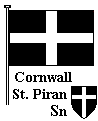 the Phoenicians may have pioneered the development of seaborn transport between Britain and the Mediterranean. This was part of a technological sea change in civilization. An alloy of tin and copper was bronze, which made for harder tools and weapons than copper,
  and thus provided the name for the "Bronze Age."
Today, bronze, with an appealing color, tends to be used for statuary and bells, as it weathers also into a green patina. By the mid-19th century, bronze was used for "copper" coins. Resistant to corrosion, it can also be used for ship parts, like propellers and bearings, which would be under water. For other uses, bronze has often been replaced by brass, which is an alloy of copper and zinc. In color, this is more yellow, i.e. "brassier"; and a "brass band" bespeaks the composition of various musical instruments.
The patron Saint of Cornwall, St. Piran (Pyran, Cornish Peran, Latin Piranus, Irish Ciarán; d.c. 480), became the patron saint of tin-miners, which only seems appropriate. The Cornish flag, with Piran's white cross on black, now joins the ranks of other forms of Celtic nationalism. I have recently become intrigued that the Emperor Justinian had trade, diplomatic, and financial connections to Cornwall in the age of King Arthur.
| Group 14, IVA | |||||
|---|---|---|---|---|---|
|
6: C Carbon 12.011g 3826/3827 {2 4} {1S=2} {2S=2 +2P=2} 2.55/hex C=0.91 C+4=0.16 [420x106] B=11 T=20.4m A=12 0+ 98.892% A=13 1/2- 1.108% B=14 0+ T=5692y (ancient) |
14: Si Silicon 28.0855g 1414/3267 {2 8 4} {1S=2} {2S=2+1P=6} {3S=2+3P=2} 1.90/fcc Si-4=1.98 Si=1.46 Si+4=0.39 [40x106] A=28 0+ 92.2% A=29 1/2+ 4.7% A=30 0+ 3.1% (1823) |
32: Ge Germanium 72.59g 938.3/2834 {2 8 18 4} {1S=2} {2S=2+2P=6} {3S=2+3P=6 +3D=10} {4S=2+4P=2} 2.01/fcc Ge=1.52 Ge+2=0.73 Ge+4=0.53 [3.2x10³] B=68 T=275d EC A=70 0+ 20.7% A=72 0+ 27.5% A=73 9/2+ 7.7% A=74 0+ 36.4% A=76 0+ 7.7% (1886) |
 50: Sn 50: Sn Tin 118.69g 231.9681/2603 {2 8 18 18 4} {1S=2} {2S=2+2P=6} {3S=2+3P=6 +3D=10} {4S=2+4P=6 +4D=10} {5S=2+5P=2} 1.96/fcc Sn-4=2.15 Sn=1.72 Sn+2=0.93 Sn+4=0.71 [25] A=112 0+ 1.0% A=114 0+ 0.66% A=115 1/2+ 0.35% A=116 0+ 14.4% A=117 1/2+ 7.6% A=118 0+ 24.1% A=119 1/2+ 8.6% A=120 0+ 32.8% B=121 T=76y A=122 0+ 4.7% A=124 0+ 5.8% B=126 0+ T=100ky (ancient) |
82: Pb Lead 207.2g 327.502/1750 {2 8 18 32 18 4} {1S=2} {2S=2+2P=6} {3S=2+3P=6 +3D=10} {4S=2+4P=6 +4D=10 +4F=14} {5S=2+5P=6 +5D=10} {6S=2+6P=2} 2.33/fcc Pb=1.81 Pb+2=1.20 Pb+4=0.84 [71] B=202 0+ T=300ky EC A=204 0+ 1.4% T=140Py B=205 5/2- T=14My EC A=206 0+ 24.1% A=207 1/2- 22.1% A=208 0+ 52.4% A=210 0+ 22.3% T=22.3y (ancient) |
114: Fl Flerovium {2 8 18 32 32 18 4} {1S=2} {2S=2+2P=6} {3S=2+3P=6 +3D=10} {4S=2+4P=6 +4D=10 +4F=14} {5S=2+5P=6 +5D=10 +5F=14} {6S=2+6P=6 +6D=10} {7S=2+7P=2} B=289 T=30.4s (1998) |
| Standard Entry: |
|---|
| Z=atomic number: symbol Name of Element gas at room temp = poisonous = no stable isotopes; all radioactive = atomic weight in grams/mole melting/boiling point, oC {electrons in shells} electronegativity/crystal structure Atoms & Ions=radius in Angstroms (Å) [cosmic abundance/1012 Hydrogen atoms] A/B=mass number of isotope, spin & parity relative isotope abundance (%) T=half life decay mode (date of discovery) |
 , naṭrûn.
Extraordinarily, the Greek and/or the Arabic words appear to come from Egyptian  , "divine" (the adjective from
  , "god"). Natron, which is a Sodium or Potassium Nitrate, NO3- or Nitrite, NO2-2, seems to have been called "divine" in Egyptian because it was used to mummify bodies, which prepares them for the afterlife. Such a substance could only be obtained from environments in which evaporites develop in closed basins of generally arid places. Thus, we find borax in Death Valley and natron in Egypt. Where the Egyptians could obtain a lot of their natron, northwest of Cairo in Lower Egypt, is still called the Wadi Natrun,
  .
.
Natron was used in the manufacture of Roman glassware, where it figures as a "flux," which lowers the melting point of the Silica, SiO2, in sand. Glass was manufactured on an industrial scale and shipped all over the Mediterranean world. Beginning in the 8th century, however, obviously after the Arab Conquests, ash from burned plants begins to be used as a flux. Even in Egypt, this replaces natron in the 9th century, ending "a process that had endured for two millennia" [New Rome, the Empire of the East, Paul Stephenson, Belknap Press, Harvard, 2022, pp.92-93]. If we are looking for signs of technological decline in the Dark Ages, even under Arab rule, this looks like a good example. The later 9th century would have been the time of the Ṭûlûnid amîrs of Egypt.
Even more intriguing is the derivation of the name of one of the most important basic compounds of Nitrogen, ammonia, NH3. This is from sal ammoniac, Latin sal ammoniacus, the "ammoniac" salt. This was something else obtained from Egypt, apparently from the Siwa Oasis, northwest of Cairo again, where there was an Oracle of the god Amon,  , that was visited by Alexander the Great while in Egypt. Thus, Latin ammoniacus is from Greek Ἀμμωνιακός, ammoniakos, an adjective of Ἄμμων, the god Amon. Evaporite substances were not obtainable in Greece, where even getting salt from evaporating sea water will not concentrate minerals in the same way that they accumulate over millennia in desert basins and their dry lakes. With no one having much of an idea of what chemistry or even alchemy would eventually involve, Egypt as the source of various evaporite substances was enough to lend its name to the use or study of such things.
But there's more. Compounds of both Arsenic and Antimony have been known since Antiquity and were identified in purified state by alchemists. Like natron and ammonia, Antinomy carries us back to the Egyptians. The Egyptians, with no sun glasses, used a black eye shadow, an Antimony compound, as protection against sunlight (much as football players do today). This is best known by its Arabic name,  , kuḥl, or "kohl"; but it was known to the Egyptians as
  or, with several other variants,
  . The interesting determinatives here include three grains of sand, to indicate powdered preparations, or a single grain of sand with a plural sign, to the same effect. Losing the initial "m," as some variants have it in Egyptian, the same word turns up in Greek as στίμμι, stímmi or, addapted to Greek morphology, στίμμις, stímmis (and other variations), meaning the same thing. This is close enough to the Egyptian that it certainly gives us the original central vowel, and of course the "t" is missing because, as in Hebrew and Arabic, this is a feminine ending not normally pronounced in full. The Greek word turns up in Latin as stibium, from which the Sb symbol of Antinomy derives; but the next step is a little mysterious, since Latin antimonium looks like it retains the -tim- center of the Greek word, but with additions. I have not seen these explained.
While Antimony adds to our roster of substances and names from Egypt, Arsenic is a different story. The Latin arsenicum and Greek ἀρσενικόν, arsenikón, clearly give the modern word and the chemical symbol, As, for Arsenic. Greek is said to have borrowed the word from Syriac, but then Syriac is supposed to have gotten it from Persian, and it has Indo-European cognates (including "yellow" in English). The word quoted in Persian, however, may be given as  , zarnikh, in the Arabic alphabet. But Persian was not written in the Arabic alphabet until after the era when Greek would probably have have been borrowing from Syriac, and the identical word occurs this way in Arabic itself. Treated as a foreign word, the Arabic word would have been borrowed from Persian, but not from the New Persian written in the Arabic alphabet, but from Middle Persian, or Pahlavi, for which the Internet probably doesn't have either a font (from Aramaic) or many experts in the language. From Pahlavi, the trail to Syriac and Greek, as well as independently to Arabic, is reasonable.
| Group 15, VA | |||||
|---|---|---|---|---|---|
|
7: N Nitrogen 14.0067g -210.0042/ -195.80 {2 5} {1S=2} {2S=2+2P=3} 3.04/hex N=0.75 N+3=0.16 N+5=0.13 [87x106] A=14 1+ 99.64% A=15 1/2- 0.36% (1772) |
15: P Phosphorus 30.9738g 44.14/277 {2 8 5} {1S=2} {2S=2+1P=6} {3S=2+3P=3} 2.19/cub P=1.23 P+3=0.44 P+5=0.35 [390x103] A=31 1/2+ 100% B=32 T=14.26d (1669) |
33: As Arsenic 74.9216g 603/603 {2 8 18 5} {1S=2} {2S=2+2P=6} {3S=2+3P=6 +3D=10} {4S=2+4P=3} 2.18/rhm As=1.33 As+3=0.58 As+5=0.46 [260] B=73 T=80.3d EC B=74 T=17.9d ECA=75 3/2- 100% (c.1250) |
51: Sb Antimony 121.75g 630.755/1587 {2 8 18 18 5} {1S=2} {2S=2+2P=6} {3S=2+3P=6 +3D=10} {4S=2+4P=6 +4D=10} {5S=2+5P=3} 2.05/rhm Sb=1.53 Sb+3=0.76 Sb+5=0.62 [8] A=121 5/2+ 57.3% A=123 7/2+ 42.7% B=124 T=60.2d B=125 T=2.7y (1540) |
83: Bi Bismuth 208.9806g 271.422/1564 {2 8 18 32 18 5} {1S=2} {2S=2+2P=6} {3S=2+3P=6 +3D=10} {4S=2+4P=6 +4D=10 +4F=14} {5S=2+5P=6 +5D=10} {6S=2+6P=3} 2.02/rhm Bi=1.63 Bi+3=0.96 Bi+5=0.74 [<80] B=207 T=38y EC B=208 5+ T=368ky EC A=209 9/2- 100% T=1.9x10¹⁹y B=210 T=3My/5d (c.1450) |
115: Mc Moscovium (289) {2 8 18 32 32 18 5} {1S=2} {2S=2+2P=6} {3S=2+3P=6 +3D=10} {4S=2+4P=6 +4D=10 +4F=14} {5S=2+5P=6 +5D=10 +5F=14} {6S=2+6P=6 +6D=10} {7S=2+7P=3} B=287 T=32ms B=288 T=87ms B=289 T=220ms B=290 T=16ms (2003) |
| Standard Entry: |
|---|
| Z=atomic number: symbol Name of Element gas at room temp = poisonous = no stable isotopes; all radioactive = atomic weight in grams/mole melting/boiling point, oC {electrons in shells} electronegativity/crystal structure Atoms & Ions=radius in Angstroms (Å) [cosmic abundance/1012 Hydrogen atoms] A/B=mass number of isotope, spin & parity relative isotope abundance (%) T=half life decay mode (date of discovery) |
Like Oxygen, Sulfur and Selenium are both essential and dangerous to life. Sulfur tends to fall into the category of chemically dangerous without being the sort of thing that is deliberately or accidentally ingested. Instead, Sulfur can occur pure in nature, at the vents of volcanoes. This is what the Bible called "brimstone," and no one thought that it was a very good thing -- God rains it down on Sodom and Gomorrah. At the same time, the pure Sulfur is liable to occur with hydrogen sulfide, H2S, which is the smell of rotten eggs. Both Sulfur and Selenium occur in organic substances; but concentrations of Selenium becomes poisonous. The southern part of the San Juaquin Valley in California is actually a basin, and the waters of the Kern River, especially when drawn off for agriculture, dry up without draining to the ocean. As in desert dry lakes, this concentrates minerals from the river, which includes toxic levels of Selenium. Otherwise, it is hard to know what about this element warrants its name, which is from the Greek word for "Moon," Σελήνη, Selénê. It is thus the counterpart of Helium, which is named after the Sun, Ἥλιος, Hélios. Selenium then seems to have no more connection to Helium that it does to Selene, the vampire character played by stunning beauty Kate Beckinsale in the Underworld movies [2003, 2006, 2012].
Polonium is named by its discoverer, Marie Curie (1867-1934), after her native Poland, which at the time was held as a possession of the Russian Empire, which received it as spoils at the Congress of Vienna in 1815. More recently, in 2006 Russian defector Alexander Litvinenko was apparently assassinated in England by Russian agents through poisoning with Polonium-210. There is now a history of the Russians assassinating people with poisons, including a number of such assassinations, or suspected assassinations, on British soil. This has been going on for some time. Apart from sanctions and harsh letters, there seems to be little anyone can do about this. The drawback of using Polonium, although only very small amounts are needed, is that it leaves traces of radioactivity on people who have handled it, providing evidence, as the British have discovered.
| Group 16, VIA | |||||
|---|---|---|---|---|---|
|
8: O Oxygen 15.9994g -218.789/ -182.97 {2 6} {1S=2} {2S=2 +2P=4} 3.44/mon O-2=1.40 O=0.65 O+6=0.10 [690x106] A=16 0+ 99.756% A=17 5/2+ 0.039% A=18 0+ 0.205% (1774) |
16: S Sulfur 32.06g 115.22/444.60 {2 8 6} {1S=2} {2S=2+1P=6} {3S=2+3P=4} 2.58/orh S-2=1.74 S=1.09 S+4=0.37 S+6=0.30 [16x106] A=32 0+ 95.0% A=33 3/2+ 0.75% A=34 0+ 4.2% B=35 T=87.2d A=36 0+ 0.015% (ancient) |
34: Se Selenium 78.96g 221/685 {2 8 18 6} {1S=2} {2S=2+2P=6} {3S=2+3P=6 +3D=10} {4S=2+4P=4} 2.55/hex Se-2=1.93 Se=1.22 Se+4=0.50 Se+6=0.42 [2.7x10³] A=74 0+ 0.9% B=75 T=118.5d A=76 0+ 9.0% A=77 1/2- 7.5% A=78 0+ 23.5% B=79 7/2+ T=65ky A=80 0+ 50% A=82 0+ 9.0% (1817) |
52: Te Tellurium 127.60g 449.57/988 {2 8 18 18 6} {1S=2} {2S=2+2P=6} {3S=2+3P=6 +3D=10} {4S=2+4P=6 +4D=10} {5S=2+5P=4} 2.1/hcp Te-2=2.11 Te=1.42 Te+4=0.70 Te+6=0.56 [260] A=120 0+ 0.09% B=121 T=154d IT A=122 0+ 2.4% A=123 1/2+ 0.87% T=12Ty IT A=124 0+ 4.6% A=125 1/2+ 7.0% A=126 0+ 18.7% B=127 T=109d IT A=128 0+ 31.8% A=130 0+ 34.5% (1782) |
84: Po Polonium (208.9824) 254/962{2 8 18 32 18 6} {1S=2} {2S=2+2P=6} {3S=2+3P=6 +3D=10} {4S=2+4P=6 +4D=10 +4F=14} {5S=2+5P=6 +5D=10} {6S=2+6P=4} 2.0/cub Po=1.53 Po+6=0.67 B=208 T=2.9y B=209 1/2- T=102y B=210 138.38d (1898) |
116: Lv Livermorium {2 8 18 32 32 18 6} {1S=2} {2S=2+2P=6} {3S=2+3P=6 +3D=10} {4S=2+4P=6 +4D=10 +4F=14} {5S=2+5P=6 +5D=10 +5F=14} {6S=2+6P=6 +6D=10} {7S=2+7P=4} B=293 T=61ms (2000) |
| Standard Entry: |
|---|
| Z=atomic number: symbol Name of Element gas at room temp = liquid at room temp = poisonous = no stable isotopes; all radioactive = atomic weight in grams/mole melting/boiling point, oC {electrons in shells} electronegativity/crystal structure Atoms & Ions=radius in Angstroms (Å) [cosmic abundance/1012 Hydrogen atoms] A/B=mass number of isotope, spin & parity relative isotope abundance (%) T=half life decay mode (date of discovery) |
Speaking of Hydrogen. This element has already been treated separately, but it could arguably be included with the Halogens -- as I have previously done here before needing the room in the table for Tennessine. Like the Alkalis, Hydrogen will lose an electron to become a positive ion, H+. This makes it seem out of place with the Halogens, but then gaining an electron is all it needs to become the electrical equivalent of Helium, which is characteristic of the Halogens. But it is fairly casual about doing either. We must go all the way down to Astatine to find a Halogen whose electronegativity is as low as Hydrogen, but it is still far higher than the Alkalis. It is just not as reactive as any of the common Halogens or Alkalis. So Hydrogen can have a strongly ionic character in an acid like hydrochloric acid, HCl, but then be the very definition of acidic neutrality in water, H2O.
Fluorine and Chlorine are reactive enough to be chemically dangerous. The most disturbing evidence of this was the use of Chlorine as a poison gas in World War I. Breathing it severely damages the lungs. Many soldiers died horribly from it. On the other hand, we get down to Iodine, and it is something that used to be found in every medicine cabinet as a antiseptic.
The name of Chlorine is from Greek χλωρός, chlorós, which can mean "yellow-green," "green," "yellow," or "pale, pallid." Since the gas is yellow-green, this must be the reason for the name. Chlorine as a poisonous gas, however, reminds us of Revelation 6:8, discussed elsewhere, where we find the ἵππος χλωρός, the "pale horse," upon which rides Death. The "pale" gas was death for many of those soldiers in World War I.
The newest element here is Tennessine, which was only officially named in November 2016. The name derives from the State of Tennessee, which became the 16th State of the United States under President George Washington. This name was chosen apparently because of the Oak Ridge National Laboratory, near Knoxville in Tennessee, where 235U was purified for use in the first atomic bombs. Richard Feynman relates the story of when he was sent from Los Alamos to Oak Ridge to report on the progress of the project there. He was alarmed to find that when quantities of 235U were purified, they were all being put into the same safe. No one at Oak Ridge had been told that a sufficient amount of 235U, packed together, would result in a nuclear explosion. They needed to be warned, as Feyman did when he received permission from Los Alamos.
The form of the name "Tennessine" is anomalous, lacking the Latin neuter -ium ending that is characteristic of the names of elements that have been given modern, internationally recognizable names, especially those produced artificially. The "-ine" ending, however, is characteristic of all the other Halogens and must have been chosen for that reason.
| Group 17, VIIA | |||||
|---|---|---|---|---|---|
|
9: F Fluorine 18.9984g -219.67/ -188.20 {2 7} {1S=2} {2S=2+2P=5} 3.98/mon F-=1.33 F=0.57 F+7=0.08 [36x103] B=18 T=109.8m A=19 1/2+ 100% (1771) |
17: Cl Chlorine 35.453g -100.97/ -34.05 {2 8 7} {1S=2} {2S=2+1P=6} {3S=2+3P=5} 3.16/tet Cl-=1.81 Cl=0.97 Cl+5=0.34 Cl+7=0.27 [220x103] A=35 3/2+ 75.77% B=36 2+ T=300ky A=37 3/2+ 24.23% B=38 T=37.2m (1774) |
35: Br Bromine 79.904g -7.25/59.10 {2 8 18 7} {1S=2} {2S=2+2P=6} {3S=2+3P=6 +3D=10} {4S=2+4P=5} 2.96/orh Br-=1.96 Br=1.12 Br+5=0.47 Br+7=0.39 [540] A=79 3/2- 50.69% A=81 3/2- 49.31% B=82 T=35.3h (1826) |
53: I Iodine 126.9045g 113.6/185.25 {2 8 18 18 7} {1S=2} {2S=2+2P=6} {3S=2+3P=6 +3D=10} {4S=2+4P=6 +4D=10} {5S=2+5P=5} 2.66/orh I-=2.20 I=1.32 I+5=0.62 I+7=0.50 [44] A=127 5/2+ 100% B=129 7/2+ T=16My B=131 T=8.04d (1811) |
85: At Astatine (209.9871) 302/337 {2 8 18 32 18 7} {1S=2} {2S=2+2P=6} {3S=2+3P=6 +3D=10} {4S=2+4P=6 +4D=10 +4F=14} {5S=2+5P=6 +5D=10} {6S=2+6P=5} 2.2/-- At=1.43 At+7=0.62 B=209 T=5.4h EC B=210 5+ T=8.1h EC B=211 T=7.21h EC (1940) |
117: Ts Tennessine (294) {2 8 18 32 32 18 7} {1S=2} {2S=2+2P=6} {3S=2+3P=6 +3D=10} {4S=2+4P=6 +4D=10 +4F=14} {5S=2+5P=6 +5D=10 +5F=14} {6S=2+6P=6 +6D=10} {7S=2+7P=5} B=293 T=22ms B=294 T=51ms (2010) |
| Standard Entry: |
|---|
| Z=atomic number: symbol Name of Element gas at room temp = no stable isotopes; all radioactive = atomic weight in grams/mole melting/boiling point, oC {electrons in shells} electronegativity/crystal structure Atoms & Ions=radius in Angstroms (Å) [cosmic abundance/1012 Hydrogen atoms] A/B=mass number of isotope, spin & parity relative isotope abundance (%) T=half life decay mode (date of discovery) |
Part of its significance for us is that the discovery of Helium teaches an important lesson in the history of philosophy and the philosophy of science. The founder of Positivism, Auguste Comte (1798-1857), had said that we would never know what the Sun was made of. This is right up there with the statement of David Hume, "Our senses inform us of the colour, weight, and consistence of bread; but neither sense nor reason can ever inform us of those qualities which fit it for the nourishment and support of a human body" [Enquiry Concerning Human Understanding, Oxford, 1902, 1972, p.33]. Hume would be confounded by most of modern chemistry, let alone the organic chemistry that describes nutrients. What Comte could not anticipate was that the elements, when excited, emit characteristic spectra of light.
|
2: He Helium 4.00260g -272.38/ -268.93 {2} {1S=2} --/hcp He=0.49 [80x109] A=3 1/2+ 10-4% A=4 0+ 100% (1868) |
Coming from the Sun, there was the spectrum of an element that had not otherwise been observed in the lab. So it was named after the Sun, which is Ἥλιος, Hêlios in Greek -- Helium in the neuter gender in Latin. So Comte was refuted by an element actually discovered on the Sun, sort of adding insult to injury. The problem with both Comte and Hume was their Empiricism, which could not allow imagination, abstract mathematics, and the invisible as part of proper science. We also see trouble from this with Ernst Mach (1838-1916), who kept denying the atomic theory of matter but is still widely regarded as an important philosopher of science. There is no telling why Edgar Rice Burroughs chose "Helium" as the name for his capital city of Mars (cf. A Princess of Mars, 1912). He must have just liked the word.
Helium might be included with the Alkaline Earths, which is where it is listed in the index table above. The reason for putting it there is that its electrons fill S Orbitals. But Helium is not in the least bit as reactive as those elements, with whom it is listed only for convenience, and so chemically it absolutely belongs with the Inert Gases.
What Mendeleev could not have known is that the inert gases would reveal and confirm the whole prinicple of the periodic table. They have the most conistently similar properties of any other Group on the table. And those properties principally follow from their inability to form compounds with other elements, or even molecules with each other (as with H2 or O2). All this is because the electron Orbitals have all filled up, leaving no dearth or excess of electrons to be attracted or lost. The stability of this is what makes the elements unreactive. They are thus just what is needed when something needs to be kept in a non-reactive atmosphere; and they all can be electrically stimulated, as in Neon signs, without anything happening to them. The inert gases are also called the "noble gases," because they are "above their company," as Jane Austin would say. So I have used purple for the background color here, to recall the statement of the Empress Theodora about the "purple."
Based on the name of Yuri Oganessian, the form of the name "Oganesson" is anomalous, lacking the Latin neuter -ium ending that is characteristic of the names of elements that have been given modern, internationally recognizable names, especially those produced artificially. The "-on" ending, however, the Greek neuter singular, is characteristic of all the other Inert Gases, except Helium, and must have been chosen for that reason. Indeed, Helium itself could be put in the Greek rather than the Latin neuter, as Ἥλιον, Helion, to conform to this convention. Whether Oganesson is itself a gas or a semi-metal, as we might otherwise expect from the periodic table, is a matter of dispute. It is too short-lived to make out whether its atoms would react as a gas, a liquid, or a solid.
| Group 18, VIIIA | |||||
|---|---|---|---|---|---|
|
10: Ne Neon 20.179g -248.59/ -246.05 {2 8} {1S=2} {2S=2+2P=6} --/fcc Ne=0.51 [37x106] A=20 0+ 90.5% A=21 3/2+ 0.27% A=22 0+ 9.2% (1898) |
18: Ar Argon 39.948g -189.35/ -185.9 {2 8 8} {1S=2} {2S=2+2P=6} {3S=2+3P=6} --/fcc Ar=0.88 [1.0x10⁶] A=36 0+ 0.34% B=37 T=35.02d EC A=38 0+ 0.07% B=39 T=265y A=40 0+ 99.59% (1894) |
36: Kr Krypton 83.80g -157.4/-153 {2 8 18 8} {1S=2} {2S=2+2P=6} {3S=2+3P=6 +3D=10} {4S=2+4P=6} --/fcc Kr=1.03 [1.9x10³] A=78 0+ 0.35% A=80 0+ 2.25% B=81 7/2+ T=210ky EC A=82 0+ 11.6% A=83 9/2+ 11.5% A=84 0+ 57.0% B=85 T=10.7y A=86 0+ 17.3% (1898) |
54: Xe Xenon 131.30g -111.8/-108.1 {2 8 18 18 8} {1S=2} {2S=2+2P=6} {3S=2+3P=6 +3D=10} {4S=2+4P=6 +4D=10} {5S=2+5P=6} --/fcc Xe=1.24 [214] A=124 0+ 0.10% A=126 0+ 0.09% A=128 0+ 1.9% A=129 1/2+ 26.4% A=130 0+ 3.9% A=131 3/2+ 21.2% A=132 0+ 27% B=133 T=5.25d A=134 0+ 10.5% B=135 T=9.1h A=136 0+ 8.9% (1898) |
86: Rn Radon (222.0176) -71/-62 {2 8 18 32 18 8} {1S=2} {2S=2+2P=6} {3S=2+3P=6 +3D=10} {4S=2+4P=6 +4D=10 +4F=14} {5S=2+5P=6 +5D=10} {6S=2+6P=6} --/fcc Rn=1.34 A=222 0+ T=3.824d (1900) |
118: Og Oganesson (294) {2 8 18 32 32 18 8} {1S=2} {2S=2+2P=6} {3S=2+3P=6 +3D=10} {4S=2+4P=6 +4D=10 +4F=14} {5S=2+5P=6 +5D=10 +5F=14} {6S=2+6P=6 +6D=10} {7S=2+7P=6} B=294 T= ˜ 0.89ms SF(2002) |
| Standard Entry: |
|---|
| Z=atomic number: symbol Name of Element no stable isotopes; all radioactive = atomic weight in grams/mole melting/boiling point, oC {electrons in shells} electronegativity/crystal structure Atoms & Ions=radius in Angstroms (Å) [cosmic abundance/1012 Hydrogen atoms] A/B=mass number of isotope, spin & parity relative isotope abundance (%) T=half life decay mode (date of discovery) |
| Period 6 Lanthanides | Period 7 Actinides |
|---|---|
|
57: La Lanthanum 138.9055g 918/3457 {2 8 18 18 9 2} 1.10/hex La=2.74 La+3=1.14 [66] B=137 7/2+ T=60ky EC A=138 5- 0.09% T=110Gy A=139 7/2+ 99.91% B=140 T=40.3h (1839) |
89: Ac Actinium (227.0278) 1051/3200 {2 8 18 32 18 9 2} 1.1/fcc Ac+3=1.18 A=227 3/2- T=21.772y (1899) |
|
58: Ce Cerium 140.12g 798/3426 {2 8 18 20 8 2} 1.12/fcc Ce=2.70 Ce+3=1.07 Ce+4=0.94 [76] A=136 0+ 0.19% A=138 0+ 0.26% A=140 0+ 88.5% A=142 0+ 11.1% T=50Py B=144 T=284d (1803) |
90: Th Thorium 232.0381g 1755/4788 {2 8 18 32 18 10 2} 1.3/fcc Th=1.80 Th+4=1.02 [7] B=228 T=1.913y B=229 5/2+ T=7340y B=230 0+ T=77ky A=232 0+ 100% T=14.1Gy (1828) |
|
59: Pr Praseodymium 140.0977g 931/3512 {2 8 18 21 8 2} 1.13/hex Pr=2.67 Pr+3=1.06 Pr+4=0.92 [35] A=141 5/2+ 100% B=142 T=19.1h (1885) |
91: Pa Protactinium 231.0359g 1572/-- {2 8 18 32 20 9 2} 1.5/bct Pr+3=1.13 Pr+4=0.98 Pr+5=0.89 A=231 3/2 T=32.5ky (1917) |
|
60: Nd Neodymium 144.24g 1021/3068 {2 8 18 22 8 2} 1.14/hex Nd=2.64 Nd+3=1.04 [71] A=142 0+ 27.1% A=143 7/2- 12.2% A=144 0+ 23.9% T=2.1Py A=145 7/2- 8.3% A=146 0+ 17.2% B=147 T=11.1d A=148 0+ 5.7% A=150 0+ 5.6% (1885) |
92: U Uranium 238.0508g 1132.3/3818 {2 8 18 32 21 9 2} 1.38/bcc U=1.38 U+4=0.97 U+6=0.80 [<4] B=232 0+ T=72y B=233 5/2+ T=159ky A=234 0+ 0.0055% T=244ky A=235 7/2- 0.72% T=710My B=236 0+ T=24My A=238 0+ 99.28% T=4.49Gy (1789) |
|
61: Pm Promethium (144.9127) 1042/3512 {2 8 18 23 8 2} 1.13/dcp Pm=2.62 B=145 5/2+ T=17.7y EC B=147 7/2+ T=2.623y (1947) |
93: Np Neptunium (237.0482) 639/-- {2 8 18 32 22 9 2} 1.36/orh Np+3=1.10 Np+4=0.95 Np+7=0.71 B=236 6- T=5000y EC B=237 5/2+ T=2.14My B=239 T=2.346d (1940) |
|
62: Sm Samarium 150.36g 1074/1791 {2 8 18 24 8 2} 1.17/rhm Sm=2.59 Sm+3=1.00 [63] A=144 0+ 3.1% B=146 0+ T=100My A=147 7/2- 15.0% T=110Gy A=148 0+ 11.2% T=8Py A=149 7/2- 13.8% T=10Py A=150 0+ 7.4% B=151 T=93y A=152 0+ 26.7% A=154 0+ 22.8% (1879) |
94: Pu Plutonium (244.0642) 640/3230 {2 8 18 32 24 8 2} 1.28/mcl Pu+3=1.08 Pu+4=0.93 B=238 0+ T=87.75y A=239 1/2+ T=24390y B=240 0+ T=6540y B=242 0+ T=387ky B=244 0+ T=83My (1940) |
|
63: Eu Europium 151.96g 822/1597 {2 8 18 25 8 2} 1.2/bcc Eu=2.56 Eu+3=0.98 [5] A=151 5/2+ 47.8% B=152 T=13y EC A=153 5/2+ 52.2% B=154 T=8.5y (1896) |
95: Am Americium (243.0614) 1176/2607 {2 8 18 32 25 8 2} 1.3/hcp Am+3=1.07 Am+4=0.92 B=241 5/2- T=433y B=243 5/2- T=7370y (1944) |
|
64: Gd Gadolinium 157.25g 1313/3266 {2 8 18 25 9 2} 1.20/hcp Gd=2.54 Gd+3=0.97 [13] B=150 0+ T=1.8My A=152 0+ 0.20% T=110Ty A=154 0+ 2.2% A=155 3/2- 14.9% A=156 0+ 20.6% A=157 3/2- 15.7% A=158 0+ 24.7% A=160 0+ 21.7% (1880) |
96: Cm Curium (247.0703) 1345/-- {2 8 18 32 25 9 2} 1.3/dcp B=242 T=163.2d B=244 T=18.12y B=245 7/2+ T=8700y B=246 0+ T=4650y B=247 9/2- T=15.4My B=248 0+ T=340ky SFB=250 0+ T=11ky (1944) |
|
65: Tb Terbium 158.9254g 1356/3223 {2 8 18 27 8 2} 1.2/hcp Tb=2.51 Tb+3=0.93 Tb+4=0.81 [2] B=158 T=1.2ky EC A=159 3/2+ 100% B=160 T=72.3d (1843) |
97: Bk Berkelium (247.0703 1050/-- {2 8 18 32 27 8 2} 1.3/dcp B=247 3/2- T=1400y B=248 8- T=9y (1949) |
|
66: Dy Dysprosium 162.50g 1412/2562 {2 8 18 28 8 2} 1.22/hcp Dy=2.49 Dy+3=0.92 [13] A=156 0+ 0.06% T=200Ty A=158 0+ 0.10% A=160 0+ 2.3% A=161 5/2+ 18.9% A=162 0+ 25.5% A=163 5/2- 24.9% A=164 0+ 28.2% (1886) |
98: Cf Californium (242.0587) 900/-- {2 8 18 32 28 8 2} 1.3/-- B=249 9/2- T=352y B=251 1/2+ T=900y (1950) |
|
67: Ho Holmium 164.9303g 1474/2695 {2 8 18 29 8 2} 1.23/hcp Ho=2.47 Ho+3=0.91 [3] A=165 7/2- 100% B=166 T=1.2ky (1879) |
99: Es Einsteinium (252.083) 860/-- {2 8 18 32 29 8 2} 1.3/-- B=252 T472d B=253 T=20.47d B=254 7+ T=276d (1952) |
|
68: Er Erbium 167.26g 1529/2863 {2 8 18 30 8 2} 1.24/hcp Er=2.45 Er+3=0.89 [7] A=162 0+ 0.14% A=164 0+ 1.6% A=166 0+ 33.4% A=167 7/2+ 22.9% A=168 0+ 27.0% A=170 0+ 15.0% (1843) |
100: Fm Fermium (257.0951) (1527)/-- {2 8 18 32 30 8 2} 1.3/-- B=253 1/2+ T=3.0d B=255 T=20.1h B=257 9/2+ T=82d (1953) |
|
69: Tm Thulium 168.9342g 1545/1947 {2 8 18 31 8 2} 1.25/hcp Tm=2.42 Tm+3=0.87 [4] A=169 1/2+ 100% B=170 T=128.6d B=171 T=1.92y (1879) |
101: Md Mendelevium (258.10) (827)/-- {2 8 18 32 31 8 2} 1.3/-- B=256 0- T=77m B=258 T=55d (1955) |
|
70: Yb Ytterbium 173.04g 819/1194 {2 8 18 32 8 2} 1.1/fcc Yb=2.40 Yb+3=0.86 [6] A=168 0+ 0.14% B=169 T=32d EC A=170 0+ 3.0% A=171 1/2- 14.3% A=172 0+ 21.9% A=173 5/2- 16.2% A=174 0+ 31.8% B=175 T=4.19d A=176 0+ 12.7% (1907) |
102: No Nobelium (259.1009) (827)/-- {2 8 18 32 32 8 2} 1.3/-- B=253 9/2- T=1.6m B=255 1/2+ T=3.2m B=259 T=58m (1958) |
Philosophy of Science, Physics
The Indian & Buddhist Elements
The Chinese Elements and Associations

| Crystal Structure | ||
|---|---|---|
 |  | |
 |  | |
 |  |  |
 |  | |
 |  | |
This is a facinating area of science where chemistry and geometry meet, recalling Plato's geometric theory of the four elements. More basic lattices occur in general minerology. These are the forms cited for cyrstals of the pure elements. The codes used in the table are the bold three letter abbreviations.
Hit "Back" button to return to text. Mass number A is given for natural isotopes.
Mass number B (= Baryon number) is given for short lived or artificial isotopes.
Hit "Back" button to return to text.
The Periodic Table of the Elements, Note 4
|
As an element, "neutronium," neutrons only exist free in neutron stars. Otherwise they decay into, an electron (e-), a proton (p+) -- a Hydrogen atom -- and an anti-neutrino ().
|
The size of atoms and ions is an important element in both crystal structure and chemistry.
Atoms or ions of the same size pack hexgonally, with either hexagonal or cubic close packing.
When some atoms or ions are smaller than others, they may be surrounded by the larger atoms. As they get smaller, fewer surrounding atoms can come into contact with them. The "coordination" number thus gets smaller, and the geometrical shape of the arranged atoms changes.
Hit "Back" button to return to text.
The Periodic Table of the Elements, Note 7

 One consquence of such differences in size can be seen in the system of the mineral feldspar, the most common mineral in the crust of the earth and the moon. Feldspar is basically quartz (SiO2) where some Silicon atoms are replaced by Aluminum atoms. Since Aluminum ions will only have a +3 charge instead of the +4 charge of Silicon ions, the -2 Oxygen ions will result in a net surplus negative charge. This then atrracts positively charged ions.
  In Feldspar, these will be Potassium, Sodium, or Calcium. Since Potassium and Sodium are chemically similar and tend to form singly charged ions (K+ & Na+), while Calcium is chemically somewhat different and forms doubly charged ions (Ca+2), we might expect Potassium and Sodium feldspars to be chemically different from Calcium feldspar. However, this is not the case.
  Potassium feldspar (KAlSi3O8) is relatively distinct as Orthoclase, while Sodium (NaAlSi3O8) and Calcium (CaAl2Si2O8) feldspars form the Plagioclase Series, where a smooth transition occurs from pure sodium to pure calcium, with similar cyrstal structure. The key to this peculiarity is the size of the ions. The Potassium ion is very large, at 1.33 Angstroms, while the Sodium and Calcium ions are not only smaller, but of similar size, 0.93 and 0.99 Angstroms, respectively.
  With the O-2 ion (dominant in the silicates like quartz and feldspar) at 1.40 Angstroms, Potassium ions will form cubic (8x) coordination, but Sodium and Calcium ions will form octohedral (6x) coordination. Silicon +4 ions themselves are only 0.39 Angstroms, and Aluminum +3 ions 0.51 Angstroms, both of which make for tetrahedral (4x) coordination with Oxygen.
 The coordination of atom and ion sizes is thus another element in the geometry of chemistry and minerology.
 (earth), liquid,
  (fire) -- except, of course, for aether, which is not directly encountered. While this had an intuitive appeal, there was little future in it. Instead, the theory of the modern elements begins with the largely Mediaeval system of the seven metals -- gold, silver, copper, iron, tin, lead, and mercury. In the European tradition, where, unlike China, metal was not an element in its own right,
)
)