


The historically central kingdoms of Francia, besides
 These were all part of the Empire of Charlemagne. Lorraine was only briefly a separate kingdom and then became one of the Stem Duchies of Germany, ultimately to be divided between Germany, France, and the Low Countries. The Periphery of Francia thus means the surrounding kingdoms. These naturally fall into six groups.
 Outremer ("across the sea") was a kind of colony, and a temporary one, of Francia. Mostly Orthodox or Islāmic in faith, it is culturally part of Islam or, in so far as it is recovered from the Islamic Conquest, part of Mediaeval Romania. As such, it is peripheral even to the periphery of Francia. All the parts of it ended up conquered by the Turks.
However, the Franks were there because they remembered that the area had been part of Romania, thought of themselves as the proper heirs of Rome, and were intent on reversing the Islamic Conquest. They had agreed with the Emperor Alexius Comnenus, the actual heir of Rome, in Constantinople that they would return former Roman possessions. No one really understood this to mean a place like Jerusalem, however, which had been lost for centuries. If it did mean Antioch, which recently had been Roman, even this was disregarded by the first Princes of Antioch. Nevertheless, we see some people claiming that no Christians, including those of Romania, had any right to reverse the Islāmic Conquests, and that their motivation can only have been xenophobia, bigotry, and religious fanaticism -- unlike, say the Islāmic Conquests themselves, which must have been done by altruism.
Today within Palestine, we now find the unique Jewish State of Israel, which seeks to undo, not just the Islāmic Conquest, but the earlier Roman Conquest of Judaea. Since most Israelis are Middle Eastern Jews who fled Islāmic countries, the accusation that they are European "colonialist settlers" is a lie, often spoken by people who simply hate Jews. The Jews, however, are used to being hated, often by people calling them, of all things, "Palestinians," and wishing that they would return to their "wretched Palestine" (said by no less than Thomas Carlyle, 1795-1881). The hatred of Israel at American colleges, unfortunately, exposes the moral rot that is far advanced there.
Culturally, the Periphery of Francia is distinguished by the same characteristics detailed for Francia, i.e. the original jurisdiction of the Bishop of Rome, the Pope (now considered the head of the "Catholic Church," although the Orthodox Church of Constantinople
| Europa | 1. Romania | 2. Constantinople |  |
| 2. Francia | 1. Rome |  | |
| 3. Russia | 3. Moscow |  | |
the use of the Latin language and alphabet, etc.
Some of these areas seem more peripheral than others. Spain became the center of European power in the 16th century, and Britain in the 19th. All the great wars of the 16th, 17th, 18th, 19th, and 20th centuries, however, originated in the Core of Francia and then drew in the Peripheral states.
An exception to all this was when Scandinavia was the center, if not of European power, certainly of the most energetic of European events. That stretched from the 9th to the 11th centuries, the "Second Dark Age." The Scandinavians of that period, Vikings (then Normans) in the West and Varangians, Βάραγγοι (then Russians) in the East, were still pagan, and their raids and conquests were a threat everywhere in Francia. Christianization in the 10th and 11th centuries largely brought the threat to a close, except for the more conventional conquests of the Normans and Russians.
Except for the Normans in Italy, Scandinavians would be distinguished by closer ties to Constantinople and freedom from the ideological hostility to Romania found in Germany and the Papacy.
My sources for all these tables are often given with the specific tables. A discussion of general sources is given under Francia.
Index
Copyright (c) 1998, 1999, 2000, 2001, 2002, 2003, 2004, 2005, 2006, 2007, 2008, 2009, 2010, 2011, 2012, 2020, 2023, 2024 Kelley L. Ross, Ph.D. All Rights Reserved
 |
 |
 and Portugal
  ,
, Spain, unlike Britain, never fell outside of history after the collapse of the Western Empire, which gives us a continuous record of rule from Rome through the Visigoths and beyond. Also, Spain underwent her own unique transformation in the trauma of the Islāmic conquest. The Visigoths were crushed and for almost three centuries a revived Christian kingdom, Asturias, could do little more than cling to the north coast and the northwest corner of Iberia.
Nevertheless, more than one Christian state eventually organized and gradually reconquered the peninsula. Navarre (Navarra), Aragón, and Barcelona all began as march counties of Francia. Asturias/Galicia/León could claim direct succession from the Visigoths, while Castile (Castilla) was a march of León. There were at different times up to five different Spanish Christian kingdoms. These were all eventually consolidated. Portugal, which began as a county of León, was the only kingdom to ultimately maintain its independence of the rest of Spain.
Spain was sometimes styled an "empire." Ferdinand I and Alfonso VII of Castile were sometimes styled "Emperor," but in Mediaeval Europe, the Popes regarded such a title as theirs to dispense, and no self-proclaimed emperors were going to get cooperation from the Church. In fact, Alfonso X of Castile was actually elected Holy Roman Emperor in 1257, but nothing came of it all. Alfonso never went to Germany, distracted by civil war (1275) and rebellion (1282), and it was already clear that the Pope had no intention of crowning him.
When the Pope finally crowned Emperor a King of Spain, it was Charles V (Charles I of Spain), a 1/4 German Hapsburg who had been born and raised in Belgium. The Imperial crown then passed to Charles's brother Ferdinand of Austria, not to his son Philip II of Spain. [cf. J.H. Elliott, Imperial Spain, 1469-1716, Mentor, 1963; Adam Wandruszka, The House of Habsburg, Anchor Books, 1965; Denys Hay, Europe in the Fourteenth and Fifteenth Centuries, Longmans, Green and Co. Ltd., 1966; and, more recently, Henry Kamen, Empire, How Spain Became a World Power, 1492-1763, HarperCollins, 2003.]
An issue of note concerns the name "Spain" -- España. The entire peninsula can be called, in a geographical sense, without ambiguity, Iberia. Similarly calling the whole peninsula "Spain," however casually, can evoke impassioned responses. Spain now is a country that is distinct from Portugal. On the other hand, in Latin, Hispania was the whole peninsula. In the Middle Ages, when various kingdoms occupied Iberia, and none of them was España, they all collectively and reasonably were called the "Spains," Hispaniae.
When the Kingdoms of León, Castile, and Aragón, and then Navarra, came under common rule, the combination began to be called, unofficially but reasonably, "España." The battle cry of 16th century Spanish troops was "Santiago, España!" (the former referring to the pilgrimage site of Santiago de Compostela in Galicia). It may have been Philip II who issued the first decree for "these realms of Spain." As it happens, this was issued from Lisbon after Philip claimed the Throne of Portugal in 1580 and occupied the Kingdom. So the official use of "Spain" seems to have initially and in fact been for the whole peninsula. When Portugal revolted and became independent again in 1640, the rest of the Kingdom simply continued, down to the present, under the common name. So what "Spain" means actually depends on what we are talking about and when. It has only really meant a political part of Iberia since 1640.
 |
|---|
| El Jaleo, 1882, John Singer Sargent (1856 1925); Isabella Stewart Gardner Museum, Boston; Jaleo de jerez dance. |
Another issue is with the names of the Kings. Since the major languages of Christendom use many of the same names, it is often possible to give translations. This was formerly the most common, so that in English one talked about "Johns" and "Peters" in the Spanish Kingdoms. This is now sometimes frowned upon, but the desire to use the "native" language of the country in question can produce some gaffs: One occasionally sees Kings of Portugal called "Juan," when this is actually just the Spanish, not the Portuguese, version of "John" -- that would be "João" -- which differs dramatically from the Spanish name, not just in the nasalized vowel, but in that the "j," which is an aspiration in Spanish, is in Portuguese like the "z" in English "azure."
Since there are other languages in the Iberian Peninsula -- Catalan, Basque, and Galician -- besides standard (Castilian) Spanish and Portuguese, it is often a good question just what vernacular language was being used in a particular time and place. There is also the complication that the Kings of Navarre marry into French Royalty and nobility and so after 1234 are all French speaking. The written langugage during much of the period, of course, would just be Latin.
"John" is "Juan" in Castilian, "Xoán" in Galician, "Ion," "Yon," or "Jon" in Basque, "Joan" in Catalan, "Jean" in French, and "Johannes" in Latin (another form, "Iban," only occurs in the patronymic "Ibañez"). Simply using "John" would seem to be the least confusing and the most revealing. However, Portuguese and Spanish (Castilian) versions are given for most of the names (somewhat irregularly). Some names -- "Alfonso" and "Sancho" -- really do not have English equivalents.
Sancho, the name of many Kings of Navarre, is written "Santxo" in Basque and may in fact have originally been a Basque name, though its origin in now obscure ("Santius" was the Latinized version). Other Basque or probable Basque names are "García," "Ezquerra," "Ibarra," "Echeverría," etc. "Alfonso" becomes "Alphonse" in French, and this has been borrowed into English to an extent, but it is not very common, so "Alfonso," like "Sancho," is simply given in its Spanish form. Sometimes overlooked, again, is that the Portuguese, "Afonso," is different.
Equally Spanish is a derivative of "Elizabeth": "Isabel" or "Ysabel." This Latinized as "Isabella," which is the form of the name usually used in English. There is a problem with the English equivalent for Castilian "Juana," the feminine form of "Juan." Although this is simply "Jeanne" in French, "Jone" in Basque, or "Johanna" in Latin, in English it could be "Joan," "Joanna," "Joanne," "Jane," or even "Jeanne."
"Ferdinand" and "Fernando" are both of Spanish derivation, originally "Ferdinando." This was itself Visigothic, and the form now most familiar in English, "Ferdinand," is the version of the name as it passed into German with the marriage of Juana the Mad of Castile to Philip of Hapsburg. One of their sons was then the Emperor Ferdinand I. He was raised in Spain, speaking Spanish. His grandfather, Ferdinand II of Aragón, contemplated leaving the kingdom of Aragón to him in his will but thought better of it. Later, he was given the rule of Austria by his brother. Elected king of Hungary and Bohemia, he then succeeded his brother as Emperor.
His brother, of course, was the Emperor Charles V. It is "Charles" in French and English, "Carlos" in Spanish and Portuguese, "Carolus" in Latin, and "Karl" in German. The story about Charles is that he only spoke German to his horse. He was raised at the court of his grandfather, the Emperor Maximilian I, in the Netherlands, speaking Flemish, where his name would be, I think, "Karel," as in Dutch. Indeed, he is often called "Charles of Ghent." There is a monument to Charles V in Guadalajara, Mexico. It actually calls him "King Charles V" ("Rey Carlos V"), which is not quite right since, as King of Spain, he was Charles I. All this seems to confuse everybody.
The colors here go with the kingdoms, but as the kingdoms combine, the color of the dominant kingdom supersedes the others. Thus yellow, the color for Castile (which started as a County of León, was detached by Sancho the Great of Navarre, and then was willed to his son Ferdinand I as a separate kingdom), is also the color for Spain as a whole, as Castile absorbs León, Aragón, and then, briefly, Portugal. A minor variation is that the red is darker for the Kingdom of the Asturias, of which León was essentially a continuation. The change in name took place after one of the characteristic divisions and then recombinations, several of which we see later, between brothers, sometimes brothers who become hostile and murderous to each other.

 The Islāmic rulers of Spain, 756-1492, are listed separately from this page, with the other rulers of Islām, linked in the table at right. The first three hundred years after the Islāmic Conquest were tough times, naturally, for Christian Spain, which took quite a while to even get organized in some areas -- we only get a monarchy in Navarra more than a century after the Islamic Conquest.
These years were largely those of the Omayyad Amirs and Caliphs, who may be said to have presided over the Golden Age of Islāmic Spain. The suprisingly rapid decline of the Omayyads in the 11th century quickly led to complete political fragmentation and to grave vulnerability to the rising Christian Kingdoms.
It should be noted that although Spanish Christians later referred to all Spanish, and also North African, Moslems as "Moors," this lumps together ethnically and linguistically distinct peoples, particularly those who were actually Arabs and those who were of North African Berber derivation -- Mauri, indeed, was the Roman name for Berbers (which itself is from barbari, "barbarians," Greek βάρβαροι), evident in the name of the Roman province of Mauretania. There was sometimes tension and conflict between these groups in Islāmic Spain, as we might imagine.
Sometimes Spanish chroniclers distinguish Spanish Moslems as "Ishmaelites" and North African Moslems as "Moabites," drawing on Biblical references. Since Spanish Moslem rulers frequently mated with native Spanish women, usually taken as slaves, their ranks came to consist of less and less Arab or Berber blood and more and more Spanish, Celtic, German, i.e. "white" DNA. It has been calculated that the Spanish Omayyad Caliph Hishām II (976-1008, 1010-1012) was only 0.09% Arab.
"Moors" also would mean native Spaniard converts to Islām, the مُوَلَّدُون, Muwalladūn ("brought up, raised," especially among Arabs or new to the language), Muladíes in Spanish or Portuguese, Muladites in Catalan. If one then considers sub-Saharan black African Moslems as "Moors," like Shakespeare's Othello, this adds another group, one that would have been noticeable in North Africa but probably of somewhat lesser significance in Spain.
To many people, however, "Moor" always means "black" -- Othello, said to be a "Moor of Venice," is played by a black actor -- and this is a serious confusion. Berbers might look pretty dark to Europeans, but they are easily distinguished from the African slaves brought north across the Sahara by the Arab slave trade. Indeed, a factor in the 11th century in Spain were slave troops, like the Mamlūks in Egypt or Janissaries in the Ottoman army, the صَقَالِبَة, Ṣaqāliba ("Slavs," singular صَقْلَب, Ṣaqlab; which looks like the word "Slav" or "slave" itself, i.e. Latin Sclavus/Sclavenus or Greek Σκλαβηνός), that consisted, not of Africans, but of captives from Christian Europe (i.e. "Slavs").
However, when the Almoravids arrived in Spain and attacked King Alfonso VI at Sagrajas, they had a corps of 4000 black slave troops, who at the height of battle attacked the Christians naked, with "light blades, spears, and hippo-hide covered shields" [Raymond, Ibrahim, Defenders of the West, The Christian Heroes Who Stood Against Islam, Bombadier, 2022, p.71]. But this did not become a feature of Andalusian armies.
Also confusing is the tradition of calling Christians in Islāmic Spain "Mozarabs" (Spanish Mozárabes, Protuguese Moçárabes, Catalan Mossàrabs), مُسْتَعْرَبُون, Mustaʿrabūn, "Arabized," which seems a little odd applied to those who did not convert to Islam, although it may address the phenomenon of Christians who learned Arabic or adopted Arab dress.
Thus, unless one is deliberately speaking of what Christian Spain called Moslems, "Moors" is not a term that is revealing of historial realities or appropriate for disinterested and objective historical discourse -- although I find, not just universal popular discourse, but even historians carelessly calling all Spanish Muslims "Moors" as though this is a meaningful category for those unfamiliar with the demographic realities of Islāmic Spain.
Writing about Shakespeare's Othello in the November 5/6, 2016 Wall Street Journal ["England's Muslim Monarch," C6], Yale historian Alan Mikhail says, "He is called a Moor, thus both black and a Muslim." Shakespeare may have accepted this easy equivalence, but an academic historian should not be repeating it without a qualification and a caution. Yet this is typical; and I cannot remember a single popular reference to "Moors," in print or television, fiction or documentary, that bothers to clarify the populations of Muslims in Spain or North Africa. This seems to be a point about which literally no one in a responsible position cares.
Navarre, which is perhaps known too generally by the French version of its name, was originally a kingdom of the Basques, an apparently autochthonous people whose language has no demonstrable affinities to any other in the world, much less to any in the area. Thus, "Basque" in Basque is Euskara, and the Basque speaking country, which extends beyond Navarre, is Euskal Herria. Interesting genetic information about this is reported by Luigi Luca Cavalli-Sforza in Genes, Peoples, and Languages [University of California Press, 2000]. The Basque region turns out to be the center of a characteristic gene component of European populations. Cavalli-Sforza says:
Thus, neither the French nor the Spanish -- Navarra -- version of the name of the kingdom is necessarily more correct than the Basque version, Nafarroa. While Navarre was the dominant Spanish kingdom under Sancho the Great, its power and extent declined quickly and decisively. Of the seven Basque provinces in Spain, with about 700,300 speakers, and France, with about 51,200 speakers, only two ended up belonging to Navarre proper. I have not noticed Basque nationalists claiming to have invented art (i.e. the cave paintings), but they apparently would have as reasonable a claim as anyone.Nafarroa, Navarra, Navarre
...the Basques once inhabited a much larger territory than today... During the last Paleolothic period the Basque region extended over almost the entire area where ancient cave paintings have been found. There are some cues [sic, "clues"?] that Basque descends from a language spoken 35,000 to 40,000 years ago, during the first occupation of France by modern humans... The artists of these caves would have spoken a language of the first, preagricultural Europeans, from which modern Basque is derived. [pp.120-121]
| Islamic Conquest of Spain, Visigoths Overthrown; Battles of Jerez de la Frontera & Ecija, Cordova captured, 711; Seville & Toledo captured, 712; Battle of Segoyuela, Saragossa (Zaragoza) captured, 713; Valencia captured, 714 | |||
|---|---|---|---|
| Kings of Asturias, at Oviedo | Arabs stopped in Francia, Battle of Poitiers, 732 | ||
| Pelayo, Pelagius | 718-737 | ||
| Arabs stopped, Battle of Covadonga, 718 | |||
| Favila | 737-739 | Basques, Kings of Navarre, Navarra, Nafarroa | |
| Alfonso I, the Catholic | 739-757 | ||
| Fruela I, the Cruel | 757-768 | ||
| Aurelio, Aurelius | 768-774 | Charlemagne defeated at Roncesvalles, 778 | |
| Silo | 774-783 | ||
| Mauregato, Mauregatus | 783-788 | Iñigo Jimenez | Count, d.822? |
| Vermudo/Bermudo I, the Deacon | 788-791 | Enneco, Iñigo Iniguez Arista | King, 822- c.851 |
| Alfonso II, the Chaste | 791-842 | County of Barcelona, in Francia, 801 | |
| Nepociano, Nepotian | 842 (?) (852?) | García I Iniguez | 852- 882 |
| Ramiro I | 842-850 | García (II) Jimenez | rival, d.c.885 |
| Ordoño I | 850-866 | Iñigo Garcés | c.885-? |
| Alfonso III, the Great | 866-910 | Fortuno, Fortun Garcés | 882- 905 |
| Garcia | 910-914 | Sancho I Garcés | 905-925 |
| Ordoño II | Galicia, 910-924 | ||
| 914-924 | |||
| Kings of León | |||
| Fruela II, the Cruel | 924-925 | ||
| Sancho Ordoñez | Galicia, 925-929 | Jimeno Garcés | 925-931 |
| Alfonso IV, the Monk | 925-931 | ||
| Ramiro II | Galicia, 929-951 | García II Sánchez I | 931-971 |
| 931-951 | |||
| Ordoño III | 951-955 | Count of Aragón, 922-971 | |
| Sancho I, the Fat | 955-958, 960-966 | ||
| Ordoño IV, the Wicked | 958-960 | Sancho II Gárces II Abarca | 971-994 |
| Ramiro III | 967-982, d.985 | ||
| Vermudo II | 982-999 | García III Sánchez II | 994-c.999 |
| Alfonso V, the Noble | 999-1027 | ||

Every single northern County, which leads to Spanish kingdoms, begins with a lineage that displays the Basque patronymics. Thus Castile comes from Nuño/Nuñez, Aragón from Aznar/Aznarez, and Navarre from Jimeno/Jiménez (Ximénez). In the mix, we then get Galindo/Galindez, Iñigo/Iniguez, García/Garcés, and Sancho/Sánchez. Other good examples, like Fernando/Fernandez, clearly come from non-Basque sources. But there also are some surprises. The common Spanish surname Gómez, which looks like an orphan patronymic, actually derives from a name in Old English, goma (or guma, "man, lord, hero"), which survives, rarely, as the archaic surname "Gomme" in English. The internationalism of Mediaeval civilization (thanks to the Catholic Church and the Latin language) is what can catch us by surprise. Visigothic names ("Rodrigo") in Spanish we can understand, but a wandering English name is startling, especially after language issues get politicized.
After recounting all the Basque patronymics of Castile, Aragón, and Navarre, it is then striking that the lineages of the Asturias are entirely innocent of such forms. We can see the claim of the Kings of the Asturias that they are derived from the Visigoths as supported by this. If they were Basques themselves, we would expect some of the patronymics. At the same time, this is evidence that the patronymics are Basque in origin. Eventually, by intermarriage, the Basque forms, with Basque names, work their way into the Kingdoms of León, Galicia, Castile, and the rest. They become the common heritage of Spain in general.
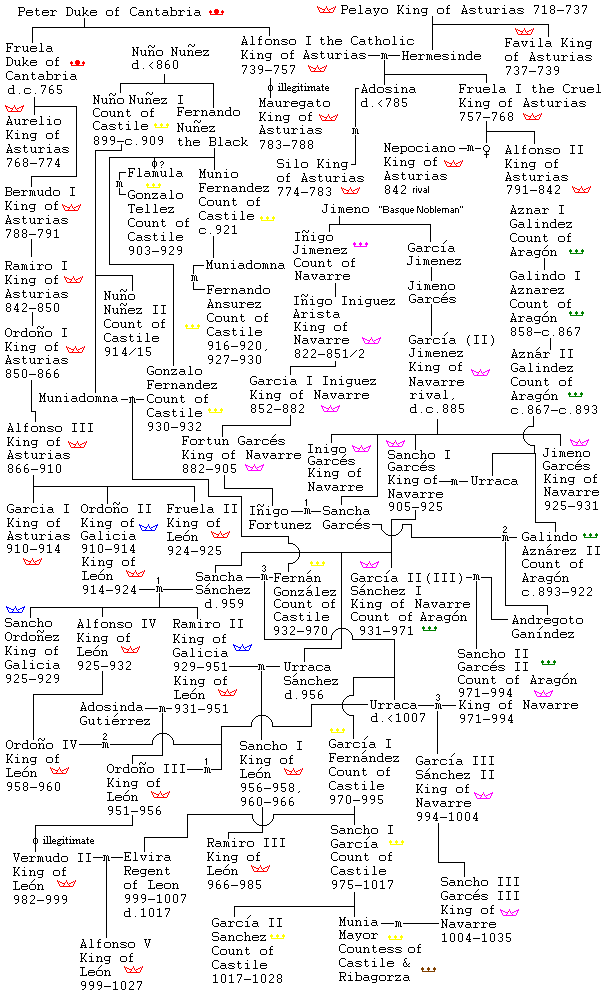
The genealogy here was originally derived from Volume III of the Cambridge Medieval History, based on the text where the diagrams [pp.716-717] unaccountably differ. Also, the text refers to the daughter of Sancho García of Castile who marries Sancho III of Navarre as "Mayor" [p.687], even though the diagram calls her "Elvira" and "Mayor" is elsewhere given in the text as the heiress of Ribagorza [p.690]. Now, according to the Erzählende genealogische Stammtafeln zur europäischen Geschichte, Volume II, Part 1, Europäiche Kaiser-, Königs- und Fürstenhäuser I Westeuropa [Andreas Thiele, R. G. Fischer Verlag, Third Edition, 2001], "Munia Mayor" was both the daughter of Sancho I García and the heiress of Ribagorza, while Sancho III had no other wife. (An Elvira is shown as a sister of Sancho García who married Vermundo II of León.) The earlier part of this genealogy, including the Counts of Aragón and Castile, has now been constructed from the Stammtafeln. One drawback of that source is that Thiele doesn't give the diacritics or the full patronymics for many names.
| Counts of Aragón | |
|---|---|
| Aznar I Galindez | ? |
| García the Bad | d.858 |
| Galindo I Aznárez | 858-c.867 |
| Aznar II Galindez | c.867-c.893 |
| Galindo II Aznárez | c.893-922 |
| Andregoto | Countess, 922-972 |
| annexed by Navarre, 971 | |
The problem of the annexation of Aragón gets muddied a bit further. The heiress of Aragón, Andregoto (seen elsewhere as "Andregoro"), is shown dying in 972, which looks close (at least) to the dates given by the Cambridge History and the Penguin Atlas. However, Andregoto's husband, García II Sánchez of Navarre, already is given, without a date, as Count of Aragón because of his marriage. This is simple enough, but then García is said to have divorced (verstoßen) Andregoto circa 940. So did Andregoto remain Countess of Aragon despite the divorce? The 971 could then be the year that her son, Sancho II Abarca, inherited Navarre and so, perhaps, also Aragón.
It is notworthy that the lines of Asturias, Castile, and Navarre begin with simultaneous or alternating reigns of rival cousins or even in-laws, i.e. husbands of cousins. How this worked seems clearest in Asturias and most obscure in Castile.
In what follows, before Iberia settles down to just two Kingdoms again (Spain and Portugal), things get very complicated. This is where we get up to five independent Christian thrones -- six counting Barcelona -- not to mention the Moslem states. Thus, the table of rulers has been broken up into more convenient sections. Each section is preceded by maps of the period and followed by a family tree of the rulers. Navarre is given special treatment after the extinction of the Kingdom in Spain. It might be noted that after 1037, every ruler in Christian Spain is a descendant of Sancho III of Navarre.
It should be noted that the Kings of the Asturias, Galicia, León, Castile (Castilla), and Spain (España) share a common numbering, but that the Kings of Navarre, Aragón, and Portugal are all numbered independently. Thus, Sancho II of Navarre (970-994) is different from Sancho II of Aragón (1063-1094), Sancho II of Castile (1065-1072), and Sancho II of Portugal (1223-1245); but Alfonso IX of León (1188-1230) is numbered in succession to Alfonso VIII of Castile (1158-1214).
| Counts of Castile, Castilla, at Burgos | |
|---|---|
| Nuño Nuñez I | 899-c.909 |
| Nuño Nuñez II | 914/15 |
| Gonzalo Tellez | 903-929 |
| Munio Fernandez | c.921 |
| Fernando Ansurez | 916-920, 927-930 |
| Gonzalo Fernandez | 930-932 |
| Fernán(do) González | 932-970 |
| García I Fernandez White Hands | 970-995 |
| Sancho I García Good Laws | 995-1017 |
| García II Sánchez | 1017-1028 |
| annexed by Navarre, 1029 | |
It is tempting to see Sancho III of Navarre as Sancho I of Castile (as he is Sancho I of Aragón), since he bestowed Castile as a kingdom on his son, Sancho II. But Castile was not until then a kingdom at all. It had previously been a march county of León. Sancho I of León (955-958) thus might be considered Sancho I of Castile instead, especially given the co-numbering of the Kings of León and Castile. Or, Sancho I might just be the previous Count of Castile, Sancho I of the Good Laws (995-1017), who can be seen in a list of Counts at right.
The following period sees the beginning of the Reconquista, the reconquest of Islāmic Spain by the Christian states. It is certainly a bad period for the native Moslem states. Their weakness and divisions make it possible for Alfonso VI of León and Castile to capture Toledo in 1085, the traditional beginning of the Reconquista.
However, the alarm of ʾIslām at this turn drew in the Almoravids (Murabits) from North Africa, who then defeated Alfonso at Zallāqa in 1086, but without recovering Toledo. This therefore began a new era for Islāmic Spain as well as for Christian, since native Islāmic Spain was now unable to withstand the Christians on its own and became dependent on North African powers.
The confusions of the period become a source of great romance. When Alfonso VI of León, deposed by his brother, Sancho II of Castile, returned to power in Castile as well as León (1072), he took on many of Sancho's retainers, including one Rodrigo Díaz de Vivar (d. 1099).
Rodrigo came to fall out of favor, in part because he suspected Alfonso of having Sancho assassinated and, in Alfonso's coronation, made him swear three times that he had not had Sancho assassinated. This had to rankle, especially if Alfonso was indeed responsible.
So in 1081 Rodrigo was exiled and became a mercenary. Shunned by Alfonso's vassals, and other Christian princes, Rodrigo signed on with Yūsuf al-Muʾtamin, Rey de Taifa of Saragossa (1081-1083). When Alsonso took Toledo in 1085, this drew in the Almoravids, who badly defeated Alfonso at Zallāqa (Sagrajas) in 1086. This led to the recall of Rodrigo, who would never lose a battle.
After taking Valencia in 1094, and defeating the Almoravids, who attempted to retake Valencia and to ambush Rodrigo on the march, he passed into legend as El Cid -- interestingly an Arabic title, سِيد, Sīd, "lord, master" (otherwise سَيِّد, sayyid) -- and the Campeador -- although "El Cid" is not attested before 1195. Alfonso lost serious battles to the Almoravids, but El Cid caused so much mayhem that the Muslims never sustained enough of a campaign to retrieve Toledo, the real goal of all their efforts. The most consistent Almoravid conquests were of the Muslim Reyes de Taifas. Rodrigo had a son, Diego, who died in battle at Consuegra, 1097, where the Almoravids again defeated Alfonso VI. Rodrigo's daughter Christina married Ramiro of Navarre, and their son, Garcia V, inherited Navarre. His descendants would come to encompass all the royalty of Spain, down to the present.
Rodrigo's other daughter, Maria, married the son, Peter, of Pedro I of Aragón. Sometimes Peter is confused with his father and Maria is said to have married Pedro. However, her actual marriage was childless, as Peter died young. She remarried, to Ramon Berenger III of Barcelona (1086-1131). Berenger's heirs would be with his second wife, Dulcia I of Provence. They would inherit Aragón.
Maria died young, making way for Dulcia, but left a daughter, who is identified as "Maria" at Wikpedia but who is called "Jimena" by Andreas Thiele in the Erzählende genealogische Stammtafeln zur europäischen Geschichte, Volume II Part 1, Europäische Kaiser-, Königs, und Fürstenhäuser I Westeuropa [R.G. Fischer Verlag, 2001, p.176]. There she is explicitly identified as the daughter of Maria Rodriguez and the grand-daughter of El Cid.
Where Wikipedia gives no marriages for "Maria," in Thiele, for Jimena, we first have the marriage to the Count of Besalú and then, extraordinarily, to Count Roger III of Foix -- as we have been seeing in the chart at right. The Counts of Foix are followed by Thiele in Volume III, Europäische Kaiser-, Königs, und Fürstenhäuser, Ergänzungsband [R.G. Fischer Verlag, 1994, 2001, pp.166-171]. Since this leads to the marriage of Count Gaston IV to Leonora, Queen of Navarre, we are back to the Kings of Navarre who are already descendants of El Cid.
Thus, El Cid has modern descendants, but these are sometimes calculated in error through Pedro I of Aragón, rather than through Garcia V of Navarre. And now we see the further Odyssey of Maria's marriage after the death of Pedro's son. The present King of Spain, Philip VI, and much of European nobility are descendants of the Cid. While occupying Valencia, Díaz was allied with Pedro I of Aragón. As it happens, we have a charter issued by Pedro in 1100, written in Latin, but signed by him in Arabic! His name is prefixed with رَشْم♰, which is the sign of the cross followed by Arabic rshm, which I have vocalized as rashm, meaning "sign of the cross." (Pedro did not write any vowel diacritics here, but I have supplied them.) So Pedro, although signing his name in Arabic makes it clear that he is a Christian. The sign of the cross also follows his name.
The name itself involves a couple of obscurities. It is written "Pedro son of Sancho." "Son of" is written as the familiar Arabic إِبْن, ʾibn. In the Basque parts of Spain, which by Pedro's day are part of Aragon, the whole name would have been "Pedro Sánchez," with the Basque patronymic. But this does not seem to be used in the old way, and I don't know if Pedro ever used it.
"Pedro" itself is written بَٻْطْرَوْ, "Bayṭraw." There are some anomalous features about the writing. Not too surprising is that "e" is written as "ay" and "o" as "aw." Arabic does not have "e" or "o," but the diphthongs come to be pronounced that way in spoken Arabic. Instead of "d," we see the "emphatic t," but we also see this in the Turkish word for "nine," طقوز dokuz.
The underdots are a little confusing. A friend of mine suggests that the three visible dots are used to make a Persian "p" (پ). However, there are clearly two "chairs" for letters there, and if three dots belong to one, there are not enough dots to go around. So I see it as the Arabic "b," with one dot -- this is not unusual, since Arabic doesn't have a "p" -- and two dots, written vertically for space, indicating the "y" in the standard diphthong.
Finally, there is the final letter, which actually looks like ه, the Arabic letter for "h," but with an extra stroke going from bottom left out to above right, which here, "Sancho" I read as شَانْجَوْ, "Shānjaw." Here we have, for some reason, "sh" used for "s." We also get "j" instead of "ch," which doesn't exist in Arabic. This reinforces the idea that a Persian letter has not been used in "Pedro," since there is a "ch" in Persian (چ) that could have been used. Again, we have something odd at the end of the name, looking like nothing so much as the Latin letter "d." I read this, as in "Pedro," as a و that has been rotated. The ligature of "n" and "j" has also been written a little unusually, with the chair turned up instead of down, as is now standard -- Unicode doesn't seem to provide for the ligatures that are used to write Arabic combinations like this.
Thus, we see Pedro signing his entire name as ♰ رَشْم بَٻْطْرَوْ ٱبْن شَانْجَوْ ♰. This is an extraordinary artifact of the day, in which the use of Arabic even among Christians was apparently not regarded as unusual or problematic. Yet Pedro signed in such a way as to make sure we knew he was a Christian. No Muslim is going to be be putting crosses all over the place, or adding a word that actually means to do that. Ferdinand I's Kingdom of Castile and León was divided between his three sons: Sancho II received Castile, Alfonso VI, León, and a new Kingdom of Galicia was broken off León for García. However, Sancho II prevented García from taking up his kingdom and then proceeded to attack Alfonso VI. In 1070, Sancho actually defeated Alfonso and drove him into exile, reassembling the whole kingdom of Ferdinand I. But when Sancho was killed in 1072, the whole kingdom immediately fell to Alfonso, who maintained its unity by imprisoning García until his death. How Sancho was killed is still a matter of uncertainty. He seems to have been meeting an incursion from Alfonso in exile, but the death may have been one of betrayal than just of battle. Whether Alfonso was even present is variously represented.
Daughters of Alfonso VI married men from Burgundy, but different Burgundies. His illegitimate daughter Teresa married a brother, Henry, of the Dukes of Burgundy, Hugh I and Odo I. Their son became the first King of Portugal. Alfonso's daughter Urraca, heiress of León and Castile, married Raymond, brother of Renald II, Count of Burgundy, i.e. ruler of the Free County, Franche Comté, of Burgundy. These domains and houses were completely independent of each other, with the Duchy of Burgundy a fief of France and its Dukes Capetian members of the French Royal Family, while the County was a fief of the Kingdom of Burgundy and its Counts members of the Italian House of Ivrea. These complexities are now lost as the history of Burgundy and its divisions are forgotten.
In the following period the Almoravid state, which began to weaken, is replaced and the position of Islāmic Spain is restrengthed by a new North African force, the Almohads (Muwahids), who came to Spain in 1147. This respite turns out to be relatively brief. The Christian Kingdoms are growing and occasionally can even cooperate. The Almohads were then crushed by King Alfonso VIII of Castille at Las Navas de Tolosa in 1212. They had abandoned Spain by 1229, and St. Ferdinand III of Castile and León began to roll up the heart of Andalusia, with Cordova falling in 1235 and Seville in 1248. This would leave only the Sultānate of Granada, in the difficult Sierra Nevada, as a remnant of Islāmic Spain.
The marriage of Blanca of Navarre to Theobald of Champagne means that for a while the Counts of Champagne become the Kings of Navarre. Greater detail of that genealogy can be examined on the page for Champagne. What this leads to is examined further below.
Eleanor of England, who I do not show on the previous diagram, had ten (or eleven) children with Alfonso VIII of Castile. Of those that survived, one, Henry (Enrique), became the heir of Castile, introducing an French name (Henri) into Spanish royalty -- Henry II of England, after all, spoke French, not English -- while four daughters married other Kings and heirs. Three of those were in Spain, of León, Aragón, and Portugal. The other, with Blanca, was to the future King of France. This is a little hard to discern in the genealogy above, which is quite tangled. Abstracting and untangling the children of Eleanor, we see the marriages in the following diagram. The youngest daughter, Constance (Constantia), became a nun.
The most dramatic of these marriages may involve Blanca, who was chosen over her elder sister, Uracca (the eldest sister, Berenguela, was already married), by her grandmother, Eleanor of Aquitaine, and escorted by her to France. Because King Henry ended up childless, the Throne of Castile passed to Berenguela, who abdicated in favor of her son, Ferdinand, who was already the heir of León. Note that Henry married the sister of the husband, Afonso II, of Urraca. The sons of two of the daughters here become Saints: St. Louis of France and St. Ferdinand of Spain are first cousins -- they each have a California mission named after them (San Luis Rey de Francia and San Fernando Rey de España). Henry, however, dies from a falling roof tile, joining Pyrrhus of Epirus in that unusual fate. Note that the successor of James I of Aragón, Peter III, was from his second wife, Yolanda of Hungary.
Not shown, another son and daughter, Sancho and Sancha, died in infancy, while another son and daughter, Ferdinand and Mafalda, died as young adults (both in 1211, aged 22 and 20, respectively). The existence of another son, Henry, is disputed.
In the following period the Reconquista is completed, and Spain, unified, becomes a World Power, perhaps truly the first such, as Spanish sailors circle the planet and claim most of it, with the claims sticking in much of the New World, the Philippines, and elsewhere -- even as the inheritance of the united Kingdom by the Hapsburgs made Spain a partner to the dominant political forces of Catholic Europe.
Meanwhile, with the completion of the Reconquista, there was the nagging problem of the non-Christians, the Jews and Moslems, who were scooped up in the new possessions. There had already been forced conversions of Jews, both by Christians and by the Almoravids and Almohads. Some Jews, like Moses Maimonides (1135-1204), had seen the handwriting on the wall back then and left. Under Christian rule, however, many Jews had converted -- the Conversos. Christians suspected, sometimes correctly, that many Conversos were still secretly practicing Judaism. These were derisively called Marranos, perhaps derived from a Spanish word for "swine" -- although this may come from Arabic مُحَرَّم, muḥarram, "forbidden", because pork is forbidden by Islām (although, as also the taboo of holy things, the name of the first month of the Islāmic calendar). The Spanish Inquisition, run by the Spanish Crown with little reference to the Pope, in great measure was created to test the faith of Marranos, many of whom were burned at the stake or otherwise punished for the actual or suspected practice of Judaism.
In the fateful year of 1492, the religious problem was taken up a couple of notches. After a long and hard campaign, Granada surrendered, finishing the Reconquista. The last Sulṭān left for North Africa, but one condition of the surrender was religious toleration for Moslems. This was not going to last long, only until 1499. By 1502, Moslems of Granada were supposed to accept baptism or leave; and by 1526 this was the choice for the last Moslems of Valencia and Aragón. Those who remained and converted were the Moriscos ("Little Moors"), who thus joined the Marranos as suspected crypto-infidels. Muslims who refused to convert and left were Mudéjares. Muslims who did not convert and who tried to stay were Tagarinos. Openly Muslim mercenaries of Spain in North Africa were Mogataces (sing. Mogataz), although it would hardly seem to have been in their interest.
Meanwhile in 1492, Ferdinand and Isabella decided to expel all unconverted Jews from Spain. Portugal followed suit in 1497 and Navarre in 1498. Jews went to North Africa, distant Turkey, the Netherlands, and other places. Those who remained and converted, of course, were now open to the tender investigations of the Inquisition. The greater threat to the regime, however, seemed to be the Moriscos, who continued to speak Arabic and retained their traditional garb and customs. They were occasionally ordered to stop and assimilate. These orders were generally ignored, but as the Spanish state strengthened, the threat became more serious.
The enforcement of a 1566 (or 1567) order finally provoked a Revolt at the end of 1568. With the Turkish navy contesting the Mediterranean, and crypto-Moslem Moriscos calling for help, the Revolt became part of the larger confrontation with Islām that troubled Philip II. With much hard fighting, and even subsequent years of guerrilla actions, the Revolt was largely suppressed in 1570. Philip decided to remove the remaining Moriscos from Granada and scattered them throughout Spain. This ended their threat as a serious internal enemy, but it did not end their existence as a cultural and religious irritation.
The suspicion of Marranos and Moriscos by the Church and the Crown poisoned Spain for many years. In so far as the Moriscos were concerned, however, this didn't last too long, since Philip III decided in 1609 to expel them from Spain altogether, whether they were really Christians or not. This was accomplished by 1614, after which only the persecution of Marranos would continue. Many of them, rather than fleeing Spain altogether, moved to the Spanish colonies in the New World, where their exalted status over the Indians made their disabilities back home less conspicuous and significant. Astonishingly, even today some families surivive in New Mexico with the memory, passed down the generations, that they had once been Jews.
Former Jews, "New Christians," in Spain itself, whether under suspicion or not, did not achieve equality for many years. Limpieza de sangre, "purity of blood," laws kept them and their descendants excluded from universities and religious orders. These laws, which sound like nothing so much as the racial Nuremberg laws of Nazi Germany, were not repealed until 1865. They lasted longer than the Inquisition itself, which was abolished in 1834.
El Cid, Rodrigo Díaz

 , I have put in red. Now, in Persian, "h" can be written to indicate the final vowel "e"; but that is not what we are looking for here. My belief is that this is an anomalous writing of Arabic "w," و, which fits the phonetic need more than anything else. It is as though the letter has been rotated 180o, to
  , which is not so odd.

Kings of  León
LeónKings of  Navarre
Vermudo/Bermudo III 1027- 1037
Sancho I of Aragón1000- 1035 Kings of 
CastileKings of 
AragónGarcía IV Sánchez III 1035- 1054 1037- 1065 Ferdinand/Fernando I the Great 1035- 1065 Ramiro
I1035- 1063 1065- 1070,
1072- 1109Alfonso VI King of
GaliciaSancho II 1065- 1072 Sancho IV 1054- 1076 García 1065- 1071,
1072- 1073
d.10941073-1109 1072-1109
1063- 1094 Sancho II 
Ramirez,
Sancho V of
Navarre1076- 1094 captures Toledo, made capital of Castile, beginning of the Reconquista, 1085; but defeated by Almoravids, Zallāqa (Sagrajas), 1086; El Cid captures Valencia, defeats Almoravids, Cuarte, 1094; El Cid defeats Almoravids, Bairén, 1097; Almoravids defeat Alfonso, Consuegra, 1097; El Cid dies, 1099; Alfonso abandons Valencia, 1102 Counts & Kings 
of PortugalUrraca (married to Alfonso I of Aragón) 1109- 1126 Peter/Pedro I 
1094- 1104 Henry,
brother,
Odo I of
BurgundyCount
1093- 1112Alfonso I el Batallador
(co-ruled León & Castile, 1109-1126)1104- 1134 Afonso I Count
1112- 1139Alfonso VII Galicia,
1112- 1126King
1139- 11851126- 1157 occupation of Saragossa, 1118-1130 Portugal León Castile Aragón Navarre 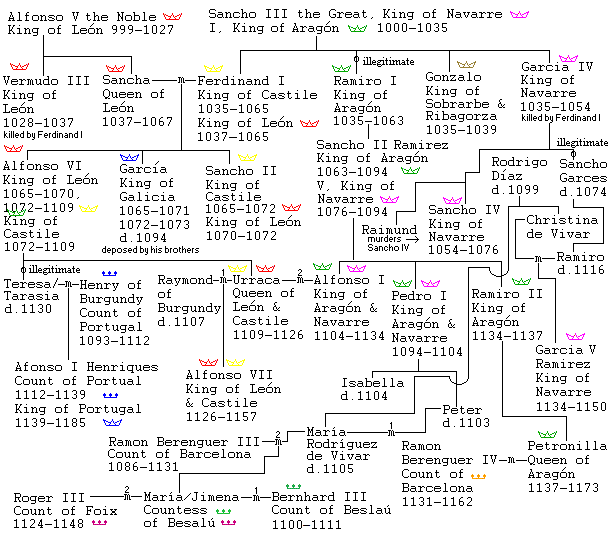

Kings of Portugal Kings of León Kings of Castile Kings of Aragón Kings of Navarre Sancho I 1185- 1211 Ferdinand II 1157- 1188 Sancho III 1157- 1158 Ramiro II 1134- 1137 Garcia V Ramirez 1134- 1150 Alfonso VIII 1158- 1214 union with County 
of Barcelona, 1137Queen Petronilla 1137- 1173 capture of Saragossa, 1146, new capital of Aragón Afonso II 1211- 1223 Alfonso IX 1188- 1230 Alfonso
II1173- 1196 Sancho VI 1150- 1194 defeat by
Muwahids at
Alarcos, 1195;
victory at
Las Navas de
Tolosa, 1212Pedro II 1196- 1213 Sancho VII 1194- 1234 Sancho II 1223- 1245 Henry I 1214- 1217 James/
Jaime I el Conquistador1213- 1276 1230- 1252  St. Ferdinand III
San Fernando
Rey de España1217- 1252 Thibault,
Teobaldo
I, of
Cham- pagne1234- 1253 capture of Cordova, 1235,
Seville, 1248, Murcia, 1266capture of
Valencia, 1238; debate between Christians & Jews, Moses Nahmanides (1194-1270) expelled for blasphemy, 1263Thibault,
Teobaldo II1253- 1270 The failure of the male line of Aragón in 1137 left Queen Petronilla as the heiress. Her marriage to Raymond Berengar IV, Count of Barcelona (1131-1162), effected the union of the two domains. The arms of Aragón, with the four "Moor's Heads," now comes to be replaced, over time, by the four red stripes on yellow of Barcelona. The Moor's Heads have been sufficiently forgotten that the region of Aragón in modern Spain still expected to use the four stripes -- which was then protested by Catalonian nationalists as proper only to Catalonia. Meanwhile, a version of the arms is used in Sardinia; and a brief Aragonese occupation of Corsica (1420-1453) had unaccountably come to associate the Moor's Head with that island, where it is still used.
The "Chains of Navarre" are supposed to have originated at the Battle of Las Navas de Tolosa. King Sancho VII of Navarre fought his way into the camp of the Almohad Caliph, Muḥammad ibn Yaʿqūb. The Caliph's tent was ringed with slaves chained together, but Sancho cut through the chains into the tent. The Caliph was able to flee, but we can imagine his alarm and humiliation. It may have been a bad sign for Islamic Spain, however, that the Caliph was hiding behind chained slaves rather than out leading his forces on the battlefield.

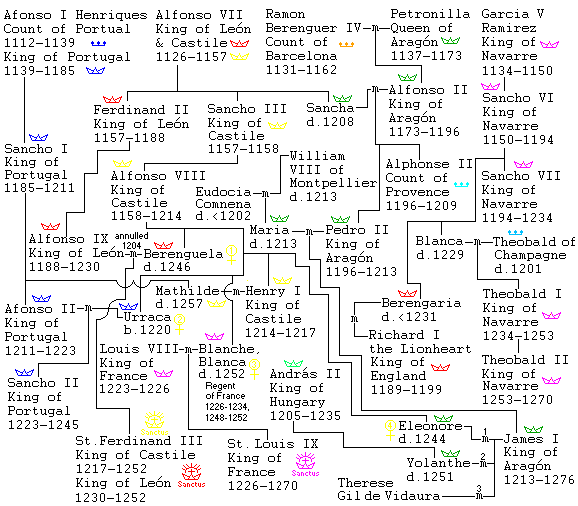

 The marriage of King Ferdinand III of León and Castile involves another group of daughters and their significant marriages. These are all the granddaughers of the Emperor Isaac II Angelus of Romania, through his daughter Irene Angelina, who married Philip of Swabia, a son of Frederick I Barbarosa. Only one marriage here, of the eldest Beatrice (to Otto of Brunswick), was without issue; and in fact all the others, involving Spain, Bohemia, and Lorraine, have living descendants.
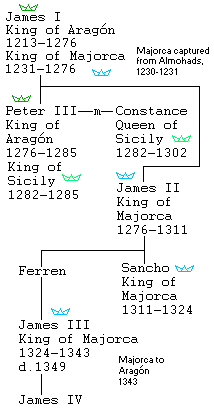 One detail noticeable on the maps but not thoroughly indicated in the table or genealogy below (but shown at right) is the temporary Aragonese Kingdom of Majorca, conquered from the Almohads and then left to a brother, James II, of Peter III. Eventually, Peter IV disposessed his cousin and returned the islands to Aragón (1343).
 |
| Plan for the complete Basilica of Sagrada Familia, Barcelona |
|---|
Where Spain failed to keep up with modernity was already predicted, in a sense, by Miguel Cervantes (1547-1616). A Spain whose arms failed, as they did in 1643, henceforth would play out the tragicomic life of Don Quixote. Nevertheless, unique brilliance and creativity still shine in the art of Francisco Goya (1746-1828), one of the greatest painters of all time.
Even in the early 20th century, when Spain seemed the most behind the times, the brilliant architect, Antonio Gaudí (1852-1926) produced work at once uniquely Spanish and modern -- in an area of art, architecture, where most would think traditional Spanish forms particularly derivative of Islām. His amazing church of the Sagrada Familia in Barcelona ("melting Gothic"), still incomplete, brings Spanish Christian piety fresh into the 21th century, long after Gaudí's own death. Spain thus harmed, and shamed, itself with its intolerance, and wandered from the mainstream of modern development, but there it no doubt that its aesthetic and religious vision was powerful, autochthonous, and enduring.
For a good part of the following period the royal houses of Spain and Portugal, Trastámara and Avis, were both illegitimate. Also, John of Avis had an illegitimate son, the Duke of Braganza, who leads to the Kings of Portugal after Spanish rule is overthrown in 1640. Also noteworthy is the fact that Queen Isabella of León and Castile usurped the throne of her niece, Joanna la Beltraneja. Isabella's half-brother, Henry IV, was called "the Impotent" because this is what his first wife, Blanche of Navarre, said. He cannot have been completely impotent, however, since his second wife had Joanna. Later, although Joanna the Mad (Juana la Loca) is only listed as Queen until 1516, she was actually titular Queen until her death in 1555. But since Charles I (V) was both Regent and Heir, and Emperor, he is usually simply regarded as the de facto King.

| Kings of Portugal | Kings of Castile | Kings of Aragón | Kings of Navarre | ||||||
|---|---|---|---|---|---|---|---|---|---|
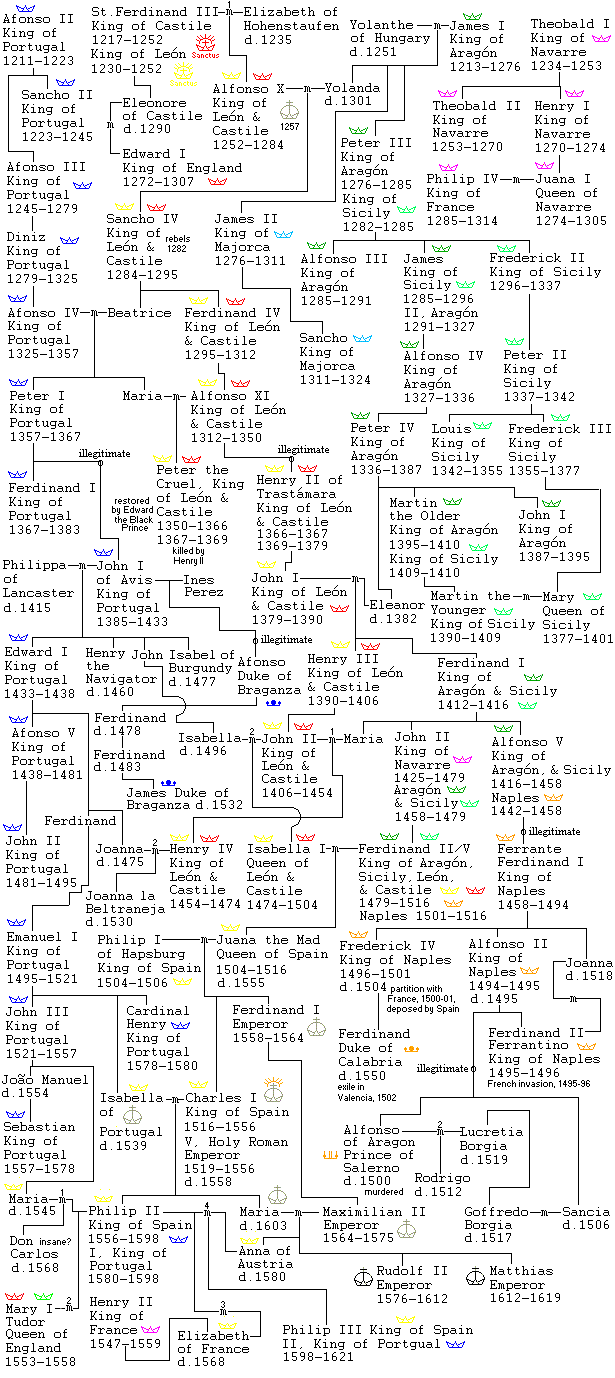
| Afonso III | 1245- 1279 | Alfonso X, the Emperor, the Learned, the Wise | 1252- 1284 | Peter/ Pedro III | 1276- 1285 | Henry I | 1270- 1274 | ||
| King of Sicily, 1282- 1285 | Jeanne/ Juana I | 1274- 1305 | |||||||
| Diniz/ Dinis | 1279- 1325 | Sancho IV | 1284- 1295 | Alfonso III | 1285- 1291 | Philip IV of France, I of Navarre | jure uxoris 1384- 1305 | ||
| France, 1385- 1314 | |||||||||
| Ferdinand IV | 1295- 1312 | James II | 1291- 1327 | Luis, Louis X of France | 1305- 1314 | ||||
| Sardinia ceded by Pisa, 1326 | France, 1314- 1316 | ||||||||
| Afonso IV | 1325- 1357 | Alfonso XI | 1312- 1350 | Alfonso IV | 1327- 1336 | Philip II, V of France | 1314- 1322 | ||
| Charles I, IV of France | 1322- 1328 | ||||||||
 the Black Death arrives at the Black Death arrives atValencia & Seville, 1348 | |||||||||
| Peter/ Pedro I | 1357- 1367 | Peter the Cruel | 1350- 1366, 1367- 1369 | Peter IV | 1336- 1387 | Jeanne/ Juana II | 1328- 1349 | ||
| Deposed by Henry of Trastámara, 1366; restored by Edward the Black Prince, 1367; killed by Henry, 1369 | Philip III, d'Evreux | jure uxoris 1328- 1343 | |||||||
| Ferdinand/ Fernando I | 1367- 1383 | Henry of Trastámara/ Enrique II | 1366- 1367, 1369- 1379 | ||||||
| John/ João I of Avis | 1385- 1433 | John/ Juan I | 1379- 1390 | John/ Juan I | 1387- 1395 | Charles II, the Bad | 1349- 1387 | ||
| Henry III | 1390- 1406 | Martin the Elder, the Humane, II of Sicily | 1395- 1410 | Charles III, the Noble | 1387- 1425 | ||||
| Sicily, 1409-1410 | |||||||||
| Interregnum, 1410-1412 | |||||||||
| Edward/ Duarte I | 1433- 1438 | John II | 1406- 1454 | Ferdinand I | Aragón & Sicily, 1412- 1416 | Blanche/ Blanca | 1425- 1441 | ||
| Alfonso V | 1416- 1458 | ||||||||
| King of Naples, 1442- 1458 | |||||||||
| Mission from Ethiopia, military alliance? 1427-1428 | |||||||||
| Afonso V | 1438- 1481 | Henry IV | 1454- 1474 | 1458- 1479 | John II | jure uxoris 1425- 1479 | |||
| Conquest of Gibraltar, 1462 | |||||||||
| John/ João II | 1481- 1495 | Isabella/ Isabel I | 1474- 1504 | 1479- 1516 | Ferdinand II; Ferdinand V of Castile / Spain; Ferdinand of Navarre | Eleanor/ Leonora | 1479 | ||
| fall of Granada, end of Reconquista, Discovery of America, 1492 | François Phébus/ Francisco Febo | 1479- 1483 | |||||||
| Emanuel/ Manuel I | 1495- 1521 | Juana the Mad (d. 1555); & Philip I, of Hapsburg (d. 1506) | 1504- 1516 | Regent of Castile, 1510- 1516 | Catherine/ Catalina | 1483- 1512, d.1517 | |||
| Occupation by Aragón, 1512- 1516 | |||||||||
| Defeat by Mamlūks, naval battle of Chaul, 1508; Mission from Ethiopia, 1509-1515; Embassy to Ethiopia, 1515-1520 | Emperor Charles V |  1516- 1556 d. 1558 | |||||||
| John/ João III | 1521- 1557 | ||||||||
| Aid to Ethiopia to defeat Muslims, 1543 | Conquest of Mexico, 1519-1521;  Sack of Rome, 1527; Sack of Rome, 1527;Conquest of Peru, 1532-1572 | ||||||||
| Sebastian/ Sebastião I | 1557- 1578 | Philip I of Portugal | 1556- 1598 | ||||||
| Killed, battle of Alcácer Quibir in Morocco, 1578 | |||||||||
| Cardinal Henry/ Henrique | 1578- 1580 | ||||||||
| 1580- 1598 | |||||||||
| Default on Crown Debt, 1557; March of the Duke of Alba, 1567; Revolt of the Netherlands, 1568; Eighty Years War, 1568-1648; "Sea Beggars" capture Brill, 1572; relief of Leiden by William of Orange, 1574; Default on Crown Debt, 1575; mutiny of Spanish Army in the Netherlands, sack of Antwerp, 1576; British seize treasure galleon St. Ana off Acapulco, 1587; Default on Crown Debt, 1596 | |||||||||
| 1598- 1621 | |||||||||
| Dutch seize Portuguese treasure carracks off Malacca & Macao, 1603; default on Crown Debt, 1607; Thirty Years War, 1618-1648 | |||||||||
A 2001 movie, Juana la Loca, was Spain's nominee for the Academy Award for Best Foreign Film. It did not make the final list of five nominees. It has been released with the English title Mad Love. As the story of Juana, it seems more than a bit inconsistent and confused. The narrator says than Juana was betrayed by her father, her husband, and her son. It is not subsequently clear from the story, on the other hand, how this is so. Her father, indeed, and her mother, arrange a dynastic marriage for her.
If this is a "betrayal," it cannot be in contemporary terms, when dynastic marriages are to be expected for royalty. Unlike many dynastic marriages, furthermore, this one involved real sexual attraction and passion. Philip "the Handsome" of Hapsburg is portrayed looking like he has jumped off the cover of a Romance novel, and he is so eager to bed Juana that he arranges for a priest's perfunctory blessing and doesn't even wait for the proper marriage to take place. Juana seems no less ardent, which indeed becomes the theme of the movie, as she is carried away by her passion. This seems to have some historical accuracy.
How Philip is supposed to have "betrayed" her is clear from the story, since he takes other lovers, which leads to serious jealousy on the part of Juana. However, the idea that a King would have mistresses in such an age would not be a surprise to anyone, especially when the Royal Houses of Spain (Trastámara) and Portugal (Avis) at the time were already both illegitimate! If the movie takes this to be a genuine "betrayal," its point of view is ahistorical and more than a bit silly.
Meanwhile, the story undercuts its own claims with the portrayal of the irrationality of the manner in which Juana acts out her jealousy. When visited by a delegation of nobles, which wishes to investigate reports that the Queen is mad, Juana is unable to recollect herself long enough to deal with them in a sensible way. Instead, they are fully exposed to the foolish and erratic nature of her concerns. Her subsequent appearance before the Cortes of Castile, although impressive, can hardly undo the manner in which her mind previously betrayed itself.
Finally, we never meet as an adult her son, Charles V, and are never given a clue how he will "betray" her, unless it is simply to treat her in a manner consistent with the insanity to which we have already been exposed. Also, we may be given to understand that her father has "betrayed" her by agreeing with Philip that she is mad, but then we are not told that Ferdinand denounced that agreement on the very same day. One of Juana's most striking lunacies, her unwillingness to give up Philip's decaying body for burial, is evaded -- altough we are shown her subsequently visiting his sarcophagus.
Opinion now seems to be swinging to the view that Joanna was not mad at all. Charles kept her isolated as a virtual prisoner. However, at the time, this is how crazy people were treated. The cruelty of the treatment of King George III of Britain during his episodes of insanity is well portrayed in the movie The Madness of King George [1994]. So Joanna's treatment, however appalling, is not really evidence of her sanity.
On the other hand, the initial stages of how she lost power, when she had her own retainers and supporters, is a little hard to understand unless her symptoms were evident and disturbing. If she was sane, then of course she was indeed "betrayed," but there is a uniqueness to her case that makes the events extraordinary. There was resistance in Spain to the rule of "foreigners," like Charles himself, so it seems unlikely to me that Joanna would simply have been overlooked if a native Spanish monarch was generally desired.
Unfortunately, the movie does not give us the full picture of Juana's madness. We see her visiting Philip's sarcophagus; but Philip was not in a sarcophagus. Juana kept him in a coffin that accompanied her always. She examined his decaying body regularly, and the odor of the decay permeated her apartments. She became careless of her dress and hygene, and the odor of decay then was not just a matter of Philip's body. Her attendants were often sickened by the atmosphere, and rumors spread that Juana was actually sleeping with Philip's body. All of this is still something that is often cleaned up, after a fashion, in biographical summaries.
My final problem with the movie is minor but annoying. When Queen Isabella dies, a courier travels to Flanders to announce this to Juana. It is left to a lady in waiting to remind Juana that this means that she is now Queen of Castile. I find such a scene impossible to believe. Such a courier, aware himself that Juana is now Queen, would address her as such. Otherwise, he would be seriously guilty of lèse magesté. Such a scene in reality would be more like what we see in Elizabeth [1998] with Cate Blanchett, when the couriers kneal before Elizabeth, announce the death of Mary, and hail her as the new Queen -- with a drama fully commensurate with the ominous, even numinous, circumstances, especially since Elizabeth was worried that the couriers were there to execute her. We also see such a moment in The Young Victoria [2010], when Emily Blunt is first addressed as Queen, after her uncle, the King, had died. With Juana, the moment is more like, "Oh, gee, I'm Queen now!" as an afterthought. This does not inspire confidence in the fidelity of the rest of the movie to the mores of the times.
 In this period Aragón grew into a Mediterranean power. The map at left summarizes the expansion of Aragón from the original Pyrenean County, a separate Kingdom in 1035, until its reach extends all the way to Naples and even Athens. The junior line of Majorca is given above.
The lines for Sicily, Naples, and Athens are given on the separate pages for those realms, though the genealogy of Sicily and Naples is in the following table here. The most curious episode concerns Athens. A band of Aragonese mercenaries, the "Catalan Company," mutinied against the Roman Emperor in 1305. Duke Walter of Athens hired them in 1310. They murdered him in 1311 and took over the Duchy. Between 1312 and 1342, the Duchy was ruled by three brothers of King Peter II of Sicily. Between 1342 and 1388, it was then ruled by the Kings of Sicily themselves.
Just as Sicily was about to be inherited by Aragón itself, Athens passed to the control of the Acciaiuoli family. On the other hand, the most dramatic episode was the manner in which Pedro III acquired Sicily in the first place. This was the result of the revolt in 1282 of the "Sicilian Vespers," by which the Sicilians rose up and expelled the French under Charles of Anjou. Since Pedro had married Constance, the daughter of Manfred, King of Sicily and Naples, who had been killed by Charles in 1266, he was invited in to be King of Sicily. The Pope was furious, but Realpolitik won out. Later, Alfonso V pressed a flimsy claim to Naples itself and won it by force (1442). He left the Kingdom to his illegitimate son Ferdinand (Ferrante), as Aragón passed to the legitimate heir, Alfonso's brother John. After Naples was occupied by the French, 1495-1496, John's son, Ferdinand II, ended up deposing his cousin and annexing the Kingdom to Aragón (1501).
| Kings of Navarre | |
|---|---|
| Catherine/Catalina | 1483-1517 |
| John III d'Albret | jure uxoris 1484-1516 |
| Expelled from Navarre by Ferdinand II of Aragón, 1512 | |
| Henry II | 1517-1555 |
| Charles V abandons Basse Navarre, 1530 | |
| Jeanne III | 1555-1572 |
| Anthony de Bourbon Duke of Vendôme | jure uxoris 1555-1562 |
| Huguenot leader, dies of wounds, 1562 | |
| Henry III, Henry IV of France | 1572-1610 |
| King of France, 1589-1610 | |
The family tree, above, of the rulers of Spain ends for Navarre with the marriage of Jeanne/Juana/Jone I to King Philip IV of France. This introduces an interesting but obscure chapter in history, straddling Spain and France and consequently tending to be left by treatments of Spain to French history, and by treatments of France to Spanish history. Before material was available on the Internet, I had some difficulty rooting things out from print sources.
Especially neglected is what happened when Ferdinand of Aragón annexed Navarre in 1512. Not all of it was ultimately retained by Spain, but readily accessible print sources didn't seem to show either the difference between the old and new boundaries or what happened to the rulers of Navarre after the annexation -- the table at right picks up at that point. This seemed like a grave oversight for the history of France. Jeanne I was already of the house of Champagne; female heirs of the line subsequently married four times into new houses of French nobility (Evreux, Foix, Albret, & Vendôme) and once to Spanish royalty (Aragón); and it all leads to Henry III of Navarre, who founded the Bourbon dynasty of France as King Henry IV in 1589.
The history of Navarre was obscure enough that I found the full genealogy only with recourse to a succession of more serious and complete print sources. The large genealogical chart, Kings & Queens of Europe, compiled by Anne Tauté [University of North Carolina Press, 1989], simply ended the line of Navarre with Jeanne I. For a long time, the only family tree I had seen of subsequent rulers was in Europe in the Fourteenth and Fifteenth Centures, by Denys Hay [Longmans, London, 1966, p.404], which ends with Queen Catherine, who lost the Kingdom to Ferdinand. Family trees for the Bourbons, such as given here, almost never went back further than the father, Henry, of Henry IV's mother Jeanne. Brian Tompsett's Royal and Noble genealogy originally enabled me to fill in the gaps, but there were some obscurities and questions in the information of both Tompsett and Hay that I had to compare with other sources.
The first complete list of the Kings of Navarre I found was in the Regentenlisten und Stammtafeln zur Geschichte Europas by Michael F. Feldkamp [Philipp Reclam, Stuttgart, 2002, pp.146-148]. A complete genealogy can now be found in the Erzählende genealogische Stammtafeln zur europäischen Geschichte, Volume II Part 1, Europäische Kaiser-, Königs, und Fürstenhäuser I Westeuropa, by Andreas Thiele [R.G. Fischer Verlag, 2001, p.185-192]. A less esoteric source with a complete list of kings is in the Oxford Dynasties of the World [John E. Morby, Oxford, 1989, pp.114-115], but there are only some notes, without a diagram, on the genealogy. All this, and more, is now, of course, available on line.
The most striking thing about the succession for Navarre is that the last Capetian Kings of France, Louis X to Charles IV, were all Kings of Navarre. John I sometimes doesn't seem to get counted as a King of Navarre, but then, only reigning five days, he is sometimes not even counted as a King of France -- 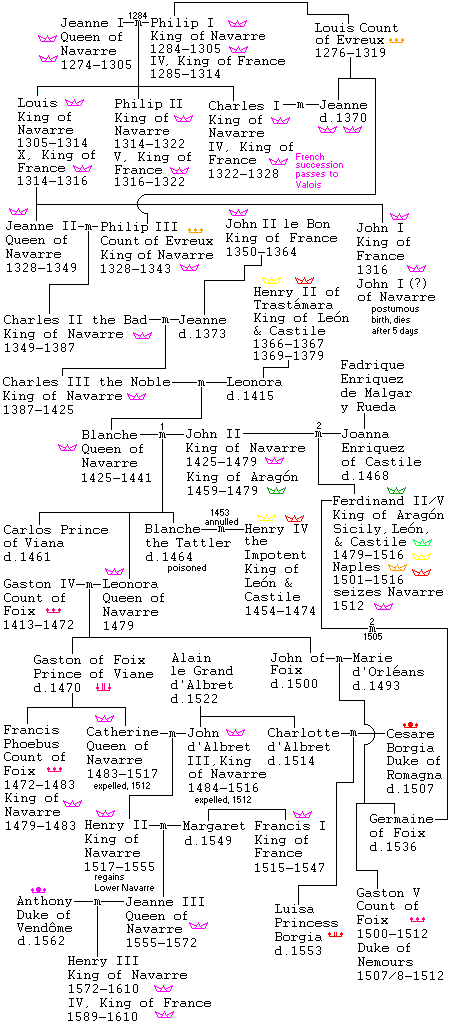 on the other hand, it may be necessary to count him if the husband of Catherine is to be counted as John III of Navarre, which means that John II of Aragón was also John II of Navarre -- there was no earlier John (Jean/Juan) in Navarre to be John I, if not the Capetian.
John's situation is peculiar. He was born postumously, soon died, and Philip II had already succeeded as King of Navarre. Since John had a superior claim to Navarre, Philip's reign would need to be interrupted. Since John II and John III of Navarre were both only Kings by marriage, all of the "Johns" of Navarre are somewhat anomalous.
With the death of Charles IV (Charles I of Navarre), a curious thing happens. The succession of France jumps to the House of Valois, but, as it happened, Louis X had a surviving daughter, Jeanne. She was ignored for the French Throne because of the Salic Law, which prohibited female succession, but the Salic Law did not apply to Navarre. So while the French Thone passed to Philip VI in 1328, the Throne of Navarre passed to Jeanne/Juana (II). This is a curiosity that I have never seen noted in histories of Europe.
Jeanne's son was Charles "the Bad." A lengthy account of his doings can be found in Barbara Tuchman's A Distant Mirror [Ballantine, 1978], which is about the events of the 14th century. The County of Evreux, which he inherited from his father, was in Normandy, which means he spent a great deal of his life in intrigues very distant from the Pyrenees.
The intrigues involved playing both sides of the Hundred Years' War against each other, trying absurdly to put himself forward as Pretender to France, encourging and then attacking popular uprisings, like the Jacquerie (1358), and then betraying each side in turn. This ended up making enemies of everyone, so that no one trusted him, and he lost control of most of his lands in France.
His death, however, may be the most "bad" thing about his life. Back in Navarre, which he barely knew, for some medical condition, he was being wrapped in alcohol soaked bandages every night. But one night the servant doing the wrapping dropped her candle, which ignited the wrappings. Since the wrappings had been sewn on, Charles had no chance of escaping the fire. He either burned to death at the time or lingered for a while, as we might imagine, in considerable pain. Many saw this as divine judgment against him. His son, Charles the Noble, stayed home and improved things for his Kingdom and Capital, turning more attention to Spain than to France.
Two generations later, we get to Queen Blanche/Blanca, who marries Spanish rather than French, namely the future King of Aragón, John II. After Blanche's death John remarries. He then outlives all of Blanche's children but one, Eleanor/Leonora. Aragón goes to a son, Ferdinand, by his second marriage, but Navarre passes to Leonora, who does not survive the year. Her husband, Count Gaston of Foix, and her son, Gaston also, both predeceased her, so the succession passes to her grandson, Francis Phoebus (François Phébus in French; Francisco Febo in Spanish), and then her granddaughter, Catherine/Catalina. Here I had a question, because Hay shows two Gastons in between Leonora and Catherine. This seemed to be a mistake, and I followed Brian Tompsett. I have now been able to confirm this with the Erzählende genealogische Stammtafeln zur europäischen Geschichte, Volume II Part 1, Europäische Kaiser-, Königs, und Fürstenhäuser I Westeuropa, by Andreas Thiele [R.G. Fischer Verlag, 2001, p.191].
What Tompsett didn't have in his database was the young (23) Gaston (V) de Foix, Duke of Nemours, who was killed at the battle of Ravenna in 1512. Elsewhere on the Web, Gaston was listed as a son of Jean de Foix and a grandson of Gaston IV of Foix and Eleanore (Leonora) of Aragón. So I took it that Gaston and Leonora had at least two sons, though I had no sources that listed them both. Now, however, I do, since the Erzählende genealogische Stammtafeln [ibid., p.191] shows not only this, but that Gaston and Leonora had four sons and five daughters. Gaston's mother was Marie d'Orléans, a sister of King Louis XII of France.
Catherine now married French nobility again, this time John of Albret. The two of them were doomed to suffer from the ambition of her cousin, Ferdinand of Aragón, who invaded Navarre in 1512, on the pretext that the death of Gaston de Foix in 1512 made him, by virtue of his marriage to Gaston's sister, Germaine (after the death of Isabella of Castile in 1504), heir of Navarre. This was totally bogus, but Ferdinand got the Pope to officially dethrone Catherine and John and certify the transfer. This was the kind of thing that earned Ferdinand the admiration of Machiavelli. In 1515 Ferdinand, who had joined Navarre to the Crown of Aragón, transfered it to that of Castile, lest the Navarrese claim the extra privileges enjoyed by the Aragonese.
A small part of Navarre north of Pyrenees, Lower Navarre ("Basse Navarre" in French or "Nafarroa Beherea" in Basque), was retroceded to Henry II by Charles V in 1530. This was the result, not of magnanimity, but of stout resistance. In 1516, John III took the capital, Saint-Jean-Pied-de-Port, losing it again after he and Queen Catherine died (1516/1517). Local resistance to the Spanish was fierce; and Henry II retook the city in 1521, losing it again to the Second Duke of Alba (d.1531) in 1522, recovering it again in 1524. Henry began restoring the institutions of the Navarrese Throne in the region. He had a strategic advantage, since the Navarrese possessed Béarn, adjacent to Navarre and conveniently already on the north side of the Pyranees.
In 1525 the Spanish were back, and then they were thrown out again in 1527. The Emperor Charles got tired of this, so he gave up Lower Navarre in the Treaty of Cambray, which ended the war between the Hapsburgs and France, in 1530. Thus, a landed Monarchy of Navarre continued, with, of course, its growing French holdings.
This small return of land to the Kings of Navarre was, strictly speaking, pursuant to the Treaty of Noyon in 1516, in which Charles promised the King of France to "satisfy" the King of Navarre "to the extent that he considers just, after studying his claims" [Emperor, A New Life of Charles V, by Geoffrey Parker, Yale, 2019, p.59]. He was supposed to do that within eight months. It took a lot longer and, of course, didn't really amount to much. The table also shows an interesting alliance of the d'Albret family. John's sister Charlotte married Cesare Borgia, though he abandoned the marriage after four months.
Ferdinand's conquest of Navarre had some interesting consequences. Among Basque nobles who rebelled at Ferdinand's death in 1516 were members of the Xavier family, which was then disposessed, dislocating the young Francis Xavier. When Navarrese exiles, including Francis' brothers, tried retaking Navarre in 1521, another Basque nobleman, Ignatius Loyala, defending Pamplona against them, was wounded and had to give up a military career. Both Francis and Ignatius ended up at the University of Paris together. The latter, of course, founded the Jesuits in 1534; and Francis became one of the first Jesuit Saints, traveling as far as Japan and dying in 1552 in China near where Macao would later (in 1557) be founded -- his body, reportedly incorruptible, was returned as far as Goa in India, where it is still periodically displayed.
Where the succession of Navarre passes to Henry II, Tompsett had a question, since he gave Henry as the grandson of Catherine but then noted obscurities over Catherine's son, named Henry also. Confined to print sources at the time, I found that the Encyclopaedia Britannica flatly stated that Henry II himself was the son of Catherine and John d'Albret, so I followed that. This construction was confirmed by the Erzählende genealogische Stammtafeln [ibid., p.192].
 Henry II married a sister, Margaret, of King Francis I of France. She is somewhat celebrated, as Margaret (or Marquerite) of Navarre (or of Angoulême), patroness of Rabelais and author of a collection of stories, the Heptameron. Henry's daughter, Jeanne (III), then marries the senior heir of the Bourbons, Anthony (Antoine), Duke of Vendôme. Their son, Henry III of Navarre, becomes heir to the French Throne, claiming it, amid civil war, in 1589, as Henry IV. After 261 years, the Thrones of France and Navarre are again joined.
The map above left shows the lands that Henry brought to the French Monarchy. We have seen how Foix, Albret, and Vendôme accrued to Navarre, and how most of Navarre proper was lost to Spain. It is noteworthy that the blue territories, previously belonging to the Dukes of Bourbon, who were separate from Henry's line, had previously reverted to the French Throne. The outline of France shown is slightly unfamiliar because Savoy, Alsace, Lorraine, and the Free County of Burgundy have not yet been added to France's eastern frontier.
| The Heiresses of Navarre | ||||
|---|---|---|---|---|
| Heiress | Husband | |||
| 1 | Blanca | d.1229 | Theobald of Champagne | d.1201 |
| 2 | Jeanne I | Queen, 1274-1305 | Philip IV of France, I, of Navarre | jure uxoris Navarre, 1284-1305 |
| France, 1285-1314 | ||||
| 3 | Jeanne II | Queen, 1328-1349 | Philip III of Evreux | jure uxoris Navarre, 1328-1343 |
| 4 | Blanca | Queen, 1425-1441 | John II of Aragón | jure uxoris Navarre, 1425-1479 |
| Aragón, 1459-1479 | ||||
| 5 | Leonora | Queen, 1479 | Gaston IV of Foix | d.1472 |
| 6 | Catherine | Queen, 1483-1517 | John III d'Albret | jure uxoris Navarre, 1484-1516 |
| 7 | Jeanne III | Queen, 1555-1572 | Anthony of Bourbon | jure uxoris Navarre, 1555-1562 |
With the Monarchy long gone in France, the Bourbon (Borbón) King Juan Carlos, now succeeded by his son, has been one of the principal surviving Monarchs of Europe, ennobled by his establishment of democracy in Spain after the long dictatorship of Francisco Franco.
 On the other hand, the national consciousness of the Basque people continues to trouble the unity of the nation states. Besides Spanish Navarra and French Lower Navarre, two other Basque provinces, Labourd and La Soule, exist in France, and three others, Vizcaya, Guipúzcoa, and Alava, exist in Spain. I have no idea if Basque nationalists recognize that the Kings of Spain now are actually the legitimate heirs of the Basque heartland in Navarre.
The capital of Spanish Navarra, Pamplona (from Latin Pompeiopolis or Pampaelo), Iruña in Basque, is famous for the annual running of the bulls; but Basque nationalism has a more troubling aspect in Spain, with a long and continuing campaign of terrorist attacks to the credit of the extremists. Thus, Navarre and the Basque country have a significance far beyond their size in both mediaeval and modern history.

| Portugal | Spain | ||
|---|---|---|---|
| 1621- 1640 | Philip III of Portugal | 1621- 1665 | |
| Loss of Atocha & other treasure ships, 1622; Siege of Breda, 1624-1625; Default on Crown Debt, 1627; Loss of Breda, 1637; Naval defeat by the Dutch at Beachy Head & the Downs, 1639; Revolt and Independence of Portugal, 1640; Revolt of Catalonia, 1640-1652 | |||
| Portugal | Spain | ||
| John/João IV of Braganza/ Bragança | 1640- 1656 | Spanish army defeated by France at Rocroi, 1643 -- end of Spanish hegemony; Default on Crown Debt, 1647; Treaty of the Pyrennes, 1659 | |
| Afonso VI d. 1683 | 1656-1667 | Charles/ Carlos II | 1665-1700 |
| Peter/ Pedro II | 1667-1706 | Revolt of Catalonia, 1687-1697 | |
| John/ João V | 1706-1750 | Philip of Anjou/Felipe V de Borbón | 1700-1746 |
| War of the Spanish Succession, 1701-1714; Barcelona captured, Austrians expelled, 1714, end of privileges of Aragón, Catalan language banned | |||
| Joseph Emanuel/ José Manuel | 1750-1777 | Ferdinand VI | 1746-1759 |
| Charles III | King of Sicily, 1734-1759 | ||
| 1759-1788 | |||
| Maria I | 1777-1816 | Charles IV | 1788-1808 |
| Peter/ Pedro III | 1777-1786 | ||
| John/ João VI | Regent 1799-1816 | Ferdinand/ Fernando VII | 1808 |
| French Occupy Portugal & Spain, 1807 | |||
| in Brazil 1807-1821 | Joseph Bonaparte | 1808-1814 | |
| 1816-1826 | Ferdinand VII | restored, 1814-1833 | |
| Peter/Pedro IV / Peter I of Brazil | 1826 | ||
| Emperor of Brazil 1822-1831 | |||
| Maria II | 1826-1828 1834-1853 | ||
| Peter/Pedro II Emperor of Brazil | 1831-1889, d.1891 | Isabella/ Isabel II | 1833-1868, d.1904 |
| Slavery Abolished in Brazil, 1888, after 4,000,000+ slaves shipped from Africa | |||
| Ferdiniand/ Fernando II | 1837-1853 | ||
| Miguël | 1828-1834 | ||
| Peter/ Pedro V | 1853-1861 | ||
| Louis/Luis | 1861-1889 | First Republic, 1868-1871 | |
| Amadeo of Savoy | 1871-1873 | ||
| Alfonso XII | 1874-1885 | ||
| Emperor of Brazil overthrown, 1889 | |||
| Charles/ Carlos | 1889-1908 | Alfonso XIII | 1886-1931, d.1941 |
| Manuel II | 1908-1910 d. 1932 | ||
| Republic, 1910-1926 | |||
| Provisional President | |||
| Theophilo Braga | 1910-1911 | ||
| President | |||
| Manoel de Arriaga | 1911-1915 | ||
| Gen. Pimenta de Castro | 1915 | ||
| Bernardino Machado | 1915-1917 | ||
| Gen. Sidonio Pães | 1917-1918 | ||
| Antoio José de Almeida | 1919-1925 | ||
| Bernardino Machado | 1925-1926 | ||
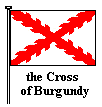 The modern period of Spanish history begins with body blows to Spanish hegemony in Europe (note that the flag of St. Andrew of Burgundy was often used by Spain in this period): the naval disaster at Beachy Head & the Downs, when the Dutch sank more than 40 Spanish ships, at the loss of over 7000 men, while losing only one ship and less than a hundred men themselves (1639), the revolts of Portugal and Catalonia (1640), and then the crushing defeat by France at Rocroi (1643), which all but decided the Thirty Years War.
With these, France became the country to beat in European wars and Spain was far gone in a decline not unlike that of her erstwhile great religious enemy, Ottoman Turkey. How to recover Spanish fortunes was the key question for the next four hundred years. At first, a change of dynasty seemed like a good idea.
)
Here, in a handsome portrait of 1632 by Diego Velázquez, we see King Philip IV of Hapsburg, who presided over the collapse of Spanish hegemony.
 |
|---|
| The Surrender of Breda (1625), 1634/1635, Diego Velázquez (1599 1660), Museo del Prado, Madrid |
The great painting by Velázquez, who himself figures in the Alatriste books, depicts the moment when Justin of Nassau, a natural son of William the Silent, presents the key of the city to the Spanish commander, Ambrogio Spinola, 1st Marquis of the Balbases. It all looks very civilized.
If Spain had always behaved like that, the Dutch might never have revolted. But burning Protestants at the stake for heresy did not make many friends. If the Spanish were consistent, Justin would have been executed. Pour encourager les autres. Instead, he was released. The English general, Horace (Horatio) de Vere (1565-1635), at one point led a relief force to try and break the siege. After some initial success, he was repulsed.
 |
| Infanta Margarita Teresa in a Blue Dress, by Diego Velázquez, 1659 |
|---|
Margarita, sadly, died at age 21 after four pregnancies. Only one of the children survived, her daughter, Maria Antonia, who consequently became the Hieress of Spain. Leopold would have male heirs (required for the Austrian Throne) from a subsequent marriage, and Maria Antonia would be married to Maximilian II of Bavaria. To him she bore a son, and then also died young. This son, Joseph Ferdinand, a patrilineal Wittelsbach, was thus the Heir to Spain, and the hopes of Europe actually rested on him to prevent a war after the death of Charles II. That Joseph did not survive childhood, as his mother and grandmother had barely achieved adulthood, may be a manifestation of the genetic weakness whose overt signs were so much greater in Charles II. Charles may have drawn this conclusion himself, in choosing a Bourbon Heir, however much this alarmed Europe.
 |
| Las Meninas, by Diego Velázquez, 1656 |
|---|
Since Margarita Teresa died in Vienna, that is where she is buried, in the crypt of the modest Capuchin Church were most of the Hapsburgs have been buried since 1618. Coming to her lead coffin, I only realized who it was (as many Hapsburgs, women and men, have the same names) when the printed guide to the crypt included her image from a Velázquez painting. I knew that young face. Lest we get too carried away with sympathy for the short life of Margarita, it might be noted that she was shocked, shocked to find that Jews were tolerated in Vienna -- they were certainly long gone from Spain -- and the new Empress got her husband Leopold to demolish their synagogue.
The subsequent history of Spain and Portugal is all too familiar from later "underdeveloped" countries, far too much politics and far too little of the rule of law and basic personal and property rights. This culminated in the fiasco of the Spanish Republic and then the Civil War, when socialist nonsense brought on a devastating conservative reaction. As Fascists battled Socialists, and the Socialists were often murdered by Communists, the leftist Cause Celèbre of the late 1930's represented a battle in which Spain would lose no matter which side won. The suspicion, as it happens, is that Stalin really didn't want the Spanish Left to win, since it would have been outside his control. Better that heretics be killed, even in a losing cause.
Fortunately for Spain, after the trauma of Civl War, the victorious Fascist Dictator Franco, although chummy enough with Hitler and Mussolini, was not interested in their War, even when Hilter offered him Gibraltar, free of charge, if he would let Germany attack it by land. This bit of prudent restraint earned Franco a peaceful (if protracted) death in bed in 1975 rather than the more horrible ends of the others in 1945. Now we know that Hitler's own envoy to Franco, Admiral Wilhelm Canaris, whom Hitler later executed, actually advised Franco not to join in Hitler's plans. Thus, Franco, who accepted Canaris' advice, also kept the secret of his betrayal of Hitler. The deaths of both Spanish and Portugese dictators ushered in the first real periods of democracy in the history of Portugal and Spain. The socialist, if not the communist, temptation was still here, but King Juan Carlos held off conservative coups in Spain, and the people of both countries came a bit more to their senses, although still burdened with the false ideals of Euro-socialist regimes like France.
With a long history of trying to ignore the government, as in Italy, the Spanish economy may have been healthier, thanks to off-the-books transactions, than other statistics (like official unemployment, 22.5%) might have shown. Nevertheless, this still imposed a cultural as well as a political burden on Spain and Portugal really rising to a competitive level in the world economy. Now, however, Prime Minster Aznar has begun to be spoken of together with Ronald Reagan and Margaret Thatcher. Slashing taxes in 1997, the Spanish economy kicked up quickly. Although the 2001 (official) unemployment rate, at 14%, was still virtually a Depression level, the economy was growing at over 3% a year, almost twice as quickly as France. This may be just what Spain needs to join the ranks of the heathiest economies, as well as healthiest democracies.
The Economist of July 26th-August 1st 2003 reported Spanish unemployment at 11.3%. This was actually better than Belgium (11.6%), and excellent considering that French and German unemployment had increased over the previous year. Spanish growth had slowed (2.1% over the last year), but the global economy was weak at the time. In 2005, the The Economist of October 8th-14th shows Spanish unemployment down to 9.4%. This is not great compared to the better economies, but it is now better than France (9.9%) and Germany (11.7%) as well as Belgium (13.5%). Meanwhile, Spanish GDP growth was 3.4%. This is better than any of the other 15 developed economies listed by The Economist, excepting only the United States (3.6%). Indeed, Spain and the United States are the only ones with growth greater than 3%. In 2003, The Economist listed both Spain and Portugal with the same Economic Freedom Index, putting them ahead of Italy, Taiwan, and Japan, though behind Sweden, Austria, and Germany. This is, at least, a good competitive position.
Spain took a turn for the worse politically (if not economically) on March 14, 2004, with the election of a Socialist government. This seems to have happened because of a terrorist attack the previous week (3/11), when rush hour trains in Madrid were bombed, killing 200 some Spaniards. The conventional wisdom is that Prime Minister Aznar was blamed for this, because he had sided with the United States in the war on terror and sent Spanish troops to Iraq. In the days before the election, the Socialists accused the government of concealing evidence that al-Qaeda was behind the bombings. The strange meaning of all this appears to be that al-Qaeda, which many on the Left have said had nothing to do with Iraq, has attacked Spain for being in Iraq, so that Spain should get out of Iraq so that al-Qaeda will not target it again. This goes along with the leftist notion in the United States that we were attacked by fanatics just because we made them mad. If we didn't make them mad, they would stop attacking. Unfortunately, what makes Osama bin Laden mad are Western ideals of liberty and toleration, and the presence of non-Muslims in the Middle East. (When honest, the leftists add "globalization" and capitalism as the things that properly anger the Islamists.) Since the new Socialist Prime Minister, Zapatero, has promised to remove Spanish troops from Iraq, Spain will now join France on the path of appeasement and wishful thinking. Senator Joel Lieberman, Democratic Vice Presidential candidate in 2000, said that Madrid could have been the equivalent of either Pearl Harbor or Munich -- Pearl Harbor to energize resistance to terrorism, or Munich to give up and join the appeasers. Survey says: Munich.
Late in 2004, a Basque bombing campaign began again. Basque terrorists at least give warning of bombs, so there was not the loss of life of March 11. But it is hard not to think that the Basques simply hope to benefit from the spirit of appeasement for their own cause. At the same time, Spain isn't off the hook with the Islamists. Osama bin Laden has always demanded the return of Andalusia to Islām. Since Granada fell in 1492, it is hard to imagine how the United States could be blamed for that.
In 2007 we found King Juan Carlos suddenly in the international political spotlight. At a summit meeting in Santiago, Chile, the would-be Castroite dictator of Venezuela, Hugo Chávez, first called former Prime Minister of Spain Aznar a "fascist." Current Prime Minister Zapatero spoke up for Aznar, saying that he was a properly elected representative of the Spanish people. Chávez kept talking, even though he did not have the floor and his microphone was turned off. Juan Carlos, sitting back inconspicuously next to Zapatero, suddenly leans forward, popping into camera view, and tells Chávez, "¿Por qué no te callas?" "Why don't you be quiet?" This was the perfect putdown to the clownish but vicious neo-communist Chávez and is now featured as a ringtone on many Spanish cellphones -- as well as providing a slogan to anti-Chávez Venezuelans. Decades after the end of real Fascism in Spain, it is great to see the King still calling the right shots.
Like many countries in recent history, including the United States, Spanish and Portuguese politicians were tempted by prosperity into far overspending their revenues. This made Spain and Portugal members of the notorious European "PIIGS" (Portugal, Ireland, Italy, Greece, & Spain), led by Greece, whose debt has threatened to overwhelm their ability to keep up with its service. Greece already would have been in default had the EU not bailed it out -- the fine it pays for allowing Greece into the EU under accounting tricks in the first place. The power of welfare-state and rent-seeking constituencies, especially public employee unions, however, poses a long term threat, as in the United States again, to any real fiscal responsibility.
The economic crisis in Europe, and various scandals involving government spending, led to new governments in Portugal and Spain in 2011. The conservatives in Spain were returned with enthusiasm in November elections. Since unemployment in Spain is back up to where it was before Prime Minister Aznar (over 20%), the challenge posed to the new government is formidable. As of 2014, it looked like little good had come of this. Spanish unemployment was 25%, far into Depression territory. It seems like little has been done to revive a spark of Spanish entrepreneurialism, as the paradigm for recovery in Europe has been to raise taxes -- this is "austerity," which of course gets blamed on capitalism, a very bad thing where irrational levels of leftism exist, as in Spain as well as France. It is not clear how these EU economies are ever really going to revive as long as Say's Law is ignored and learned opinion still thinks that inflation promotes growth.
The ongoing political difficulties helped motivate King Juan Carlos to abdicated in favor of his now fully adult and reasonably popular son, Prince Filipe. The Prince is King Philip VI, recalling the first Bourbon and the last Hapsburg Kings of Spain. There probably is little he can do personally about the economy, and various Leftists want to abolish the Monarchy; but it would be nice if, supported by conservatives, he could exert some helpful influence.
It turns out that there seem to have been other reasons for Juan Carlos to abdicate. Like many Kings, he has had mistresses, which in this day and age constitute scandals rather than just standard Royal operating procedure. There also seems to have been more to the affairs than I quite understand, to the extent that Juan Carlos has left the country. This was either to distance himself from King Filipe or to avoid prosecution -- exactly for what, I have not been able to gather. I'm sure that insulting Hugo Chávez would be enough reason for some.
Moon Zappa, "Valley Girl," Frank Zappa, 1982 Ferdinand's connections by marriage to other European royality, and the Angeli, can be examined in a popup, while diagrams of some of the marriage relations are featured above in the text. From the Mission is derived the name of the San Fernando Valley, which is largely occupied by the City of Los Angeles, together with the independent cities of San Fernando, Burbank, Glendale, and Calabasas. A child of the Valley is a "Val," as we find in Frank Zappa's song "Valley Girl" [1982], where Frank's daughter Moon defensively protests that she is from "a really good part of Encino."
In the classic film Clueless [1995], the Valley is, to the Beverly Hills cast members, literally off the map (of their Thomas Guide). However, the star, Alicia Silverstone, does end up at a party in the Valley, after which her ride dumps her at the iconic Circus Liquor, at the corner of Vineland Ave and Burbank Blvd., in North Hollywood, where she is robbed. After her rescue, that is the last we hear of the Valley. A venerable store for surfing supplies is "Val Surf" (4810 Whitsett Ave., at the corner of Riverside Drive) although surfers from communities closer to the beach are often unfriendly to Vals. It is not clear that the Beach Boys ever expressed an opinion in this conflict.
The San Fernando Valley is ringed by the Santa Monica, Santa Susana, San Gabriel, and Verdugo Mountains and the Chatsworth and Hollywood Hills. A peak in the San Gabriel mounts, Mt. Lukens, is the highest point in the City of Los Angeles, at 5,075 feet. On the pop-up image, we see the relatively isolated ridge with Mt. Lukens, and the San Verdugo Mountains isolated in the foreground. The winding blue road that heads North into the mountains off of I-210 (off Foothill Blvd., actually) is Angeles Crest Highway, California State Route 2. This continues along the crest of the San Gabriel Mountains 66 miles all the way down to the Pearblossom Highway, State Route 138, which passes East/West along the Northern flank of the San Gabriels. You can turn off Angeles Crest to access Mt. Wilson. The whole highway was not completed until 1956.
I was able to sit in one of my shop classes, at Robert A. Millikan Junior High School, in 1963, look out the door, and see Mt. Lukens rise above the Verdugo Mountains. However, I didn't know what the peak was, and in fact I've never heard anyone in Los Angeles, or anywhere, refer to the peak by name. Since the City of Los Angeles goes down to sea level, the rise in elevation from there to Mt. Lukens is the largest change in elevation of any city in the United States. There are a number of YouTube videos of people hiking up to Mt. Lukens, specifically because it is the highest point of Los Angeles.
Mt. Lukens is only the 19th highest peak in the San Gabriel Mountains. This is below Mt. Wilson, at 5,710 ft., the site of the historic Mount Wilson telescope, which is also visible from the San Fernando Valley -- but it looks lower than Mt. Lukens, since it is further away. Mt. Wilson today is distinguished by a row of radio towers along the ridge leading to it. Most Los Angeles television stations are broadcast from there. Mt. Lukens itself has some radio towers, perhaps mostly for cellphone service.
The hightest point of the San Gabriels is Mt. San Antonio, popularly known as Mount Baldy, at 10,064 ft., higher than Mt. Olympus, the highest mountain in Greece (9,570 ft.). Below is a photo taken from a room in the Sheraton Universal Hotel. In the foreground are the San Verdugo Mountains; and above them rises Mt. Lukens. We don't see much of the mountain since the Sheraton is near the East end of the Valley -- compare with the pop-up image above of the East Valley and the mountains, from Valley College. It still strikes me as odd to think that the mountain to the left of the peak is in the City of Los Angeles, while that to the right is not. They ought to be different colors or something. Meanwhile, the Verdugos in the foreground, like the land below them, are in Burbank, not Los Angeles, as we can see on the terrain map, with the City boundary, above.
The Los Angeles River rises in the Valley and flows for 51 miles out through Burbank and Glendale and then South to Long Beach. The Southern part of the River is parallel to the San Gabriel River, whose outfall is also in Long Beach, just East of the Los Angeles River. A tributary of the Los Angeles River, the Tujunga Wash, crosses Riverside Drive right in front of Val Surf. Also, the Tujunga Wash is right behind the fence that is behind the hospital, the old North Hollywood Medical Center, that was used for the filming of the televison show Scrubs [2001-2010]. Although the River normally runs nearly dry, flash floods do occur occasionally during the winter. The most conspicuous feature in the network is the Sepulveda Dam, which has been used in countless movies, television shows, and commercials to represent, not just dams, but military fortifications or even prisons as well. The golf courses in the basin, where my father used to play, are conspicuous in the satellite photo. The dam is conspicuously featured in the 2003 movie The Italian Job, although one would not gather from the movie, otherwise set in Los Angeles, that the site is in the San Fernando Valley.
At the beginning of the end credits of the 1984 movie Buckaroo Banzai (actually, in full, The Adventures of Buckaroo Banzai Across the 8th Dimension), the entire cast walks down the spillway of the Sepulveda Dam -- the white square in the lower right of the satellite image of the Sepulveda Basin above. They exit past the side of the spillway, where "Buckaroo Banzai" has been spray painted in large, red graffiti letters. Buckaroo Banzai, of course, was supposed to take place in New Jersey, although the entire movie was obviously shot in California. The "Yoyodyne" factory, supposedly in Grovers Mill, New Jersey, was clearly in an industrial neighborhood in Los Angeles, with smog in the background. The real Grovers Mill, where Orson Wells said Martians were landing in his 1938 War of the Worlds broadcast, is a residential area that looks nothing like that. Nor are there dry, desert lakebeds in New Jersey for testing high speed vehicles, as Buckaroo does, fresh from neurosurgery. There is a small War of the Worlds monument in a local park, if you can get to it through the geese; but I wish there was a local bar with memorability, of both Wells and Buckaroo, but there isn't.
Streets were built through the Sepulveda Flood Control Basin in the 1960's, with the intention that these would be closed off during heavy rains. In the 1990's, after a long drought, this precaution was forgotten, and some motorists were stranded by flood waters and had to be rescued by hellicopter. Since then, with all the hindsight wisdom of bureaucrats, the streets are closed during the slightest rains.
Just outside the Eastern embankment of the Sepulveda Dam is Sepulveda Blvd., which runs from the North end of the Valley, down across the Santa Monica Mountains, through the Sepulveda Pass, and all the way down to Long Beach. This was 42.8 miles long, making it one of the longest urban streets in the country, until the City of El Segundo renamed its segment, breaking up the street.
Sepulveda Blvd. was named in 1925 for Francisco Xavier Sepúlveda (1747 1788), whose land grant, the Rancho San Vicente y Santa Mónica, extended from present day Santa Monica up through the Santa Monica Mountains. The Sepúlveda family remained prominent through the 19th century.
When my mother was in the United States Navy in 1945-1946, she was stationed in Washington D.C. and was working on arrangements for one of the post-War atomic tests in the Pacific. The films of the test where to be flown into Los Angeles and driven to a lab for processing. The men in her office did not know Los Angeles and didn't even know how to pronounce "Sepulveda." She had to enlighten them and explain the local geography.
This image displays key features. We have the ridgeline of the Hollywood Hills going East to the Hollywood Sign, and then well beyond. Above the ridge in the distance is the ridgeline of the San Verdugo Mountains, and above that the ridgeline of the San Gabriel Mountains. Again, the highest point visible in the San Gabriels is Mt. Lukens. At the bottom of the image is Hollywood, with the line of the Hollywod Freeway, and the iconic Capitol Records bulding on Vine Street. The floor of the San Fernando Valley is visible to the left through the Cahuenga Pass.
Near the center of the Valley is Los Angeles Valley College, originally the home of The Proceedings of the Friesian School.
445 AD-Present
Unfortunately, Ireland was never politically unified enough to follow cultural and religious influence with political power, or to fully resist incursions from Danes or Normans, or ambitious English dynasties, when they came. The Kings of all Ireland were the "High Kings" (Ard Ri), and this originally became hereditary, as we shall see, A permanently unified Kingdom of Ireland was never fully established. With Brian Boru (Munster, 976-1014; High King, 1002-1014), we begin to see High Kings from the other kingdoms. Boru, who rose to the occasion to defeat the Danes (Clontarf, 1014), at the cost of his life, was perhaps the high point of Irish unity and power; but he also seems to be the end of effective Irish organization. Henry II of England, whose Normans began to overrun the island, styled himself "Lord of Ireland" (c. 1172).
The last High King, Rory O'Connor (of Connaught), deferred to Henry. In 1541 Henry VIII adopted the title "King of Ireland." Later, Hugh Ó'Néill (d.1616), Earl of Tyrone, after a failed revolt against England (1593-1603), fled Ireland in 1607. His escheated (defaulted) feudal lands in Ulster, Red Hand and all, were used for Protestant colonization by James I of Enland.
The history of Scotland began in the 5th century with an interesting The earliest history and dates for Ireland are legendary and speculative. Niall Noígillach "of the Nine Hostages" may have lived in the previous century, and the dates given for St. Patrick depend on identifying him with a "Palladius," who is mentioned by a contemporary chronicler as having been sent by the Pope as the first bishop of the Irish. I have found an outstanding source for all British and Irish rulers, and some other royalty and nobility, in The Mammoth Book of British Kings and Queens by Mike Ashley [Carroll & Graf Publishers, Inc., New York, 1998, 1999]. The treatment of Anglo-Saxon and Irish kings now has been corrected and updated using this book down to the end of the Plantagenets. The Irish (Gaelic) spelling of many of the names of the High Kings of Ireland, however, is derived from Bruce R. Gordon's Regnal Chronologies. Here I have only given two English kingdoms, Kent and Wessex, because these are the first and the last ones, respectively, because Kent contains the Archbishop of Canterbury, the Primate of England, and because there is no room for the parallel listing of more. Most of the other kingdoms, however, Sussex, Bernicia, Deira, Northumbria, Essex, Mercia, and East Anglia, are given on a separate Anglo-Saxon England page with other early German Kingdoms.
Although Britain was never an "empire," Queen Victoria did assume the imperial title for India, as successor to the Moghuls, in 1876. The House of York is shown in white as a reminder that York was the White Rose, as Lancaster was the Red Rose, in the War of the Roses. Since the House of Stuart was Scottish, it is shown in yellow for Scotland. What follows is the genealogy of the O'Néill (Uí Néill, O'Neal) High Kings of Ireland down to Máel Sechnaill (980-1002, 1014-1022). The table is based on genealogies in A New History of Ireland, Volume IX, Maps, Genealogies, Lists -- a Companion to Irish History, Part II [Oxford University Press, 1984, 2002, pp.127, 128, 130]. The very earliest dates disagree with the table above, which is from Bruce Gordon. However, we see a correspondence with the death in 463 of Lóeguire macNéill, the third King according to Gordon and the second according to the Oxford History; and we begin to get complete agreement with the death of Lugaid macLóeguiri (the fifth Oxford King) in 507. If the Oxford dates are correct, and we have the right date for St. Patrick, his mission in Ireland began before the advent of any of the High Kings -- which is reasonable when we reflect that St. Patrick's mission is probably what would have resulted in the first written chronicles.
Brian Boru follows Máel Sechnaill as High King. He was a King of Munster and Thomond and not an O'Néill. Subsequent High Kings, down to Rory O'Connor, include some O'Néills but also other families. Obviously, any kind of hereditary succession is long gone. As in Poland, this signifies grave political fragmentation. However, the O'Néills did not die out. The Earls of Tyrone were descendants of the High King Domnall ua Neill (956-980). Hugh (Aodh) O'Neill (d.1616), Earl of Tyrone, led a revolt against the English in 1593-1603 and fled the country with its failure. Ironically, the "Red Hand of Ulster," which has become a symbol of Protestant Ireland, is from the arms of the O'Neill family. There are various legends about the origin of the Red Hand. They seem to go back to Irish mythology, as even in Roman mythology (or Star Wars) there are stories of the sacrifice of a hand by the hero. In the Irish legends some kind of race or competition is usually involved. The hero, or an Ó'Neill, of the story wins the competition by cutting off his own hand and throwing it ahead to pass the finish line or claim the goal or prize first. This seems like a lot to do to win a race, but some versions involve claiming a kingdom (like Ulster, or Ireland itself).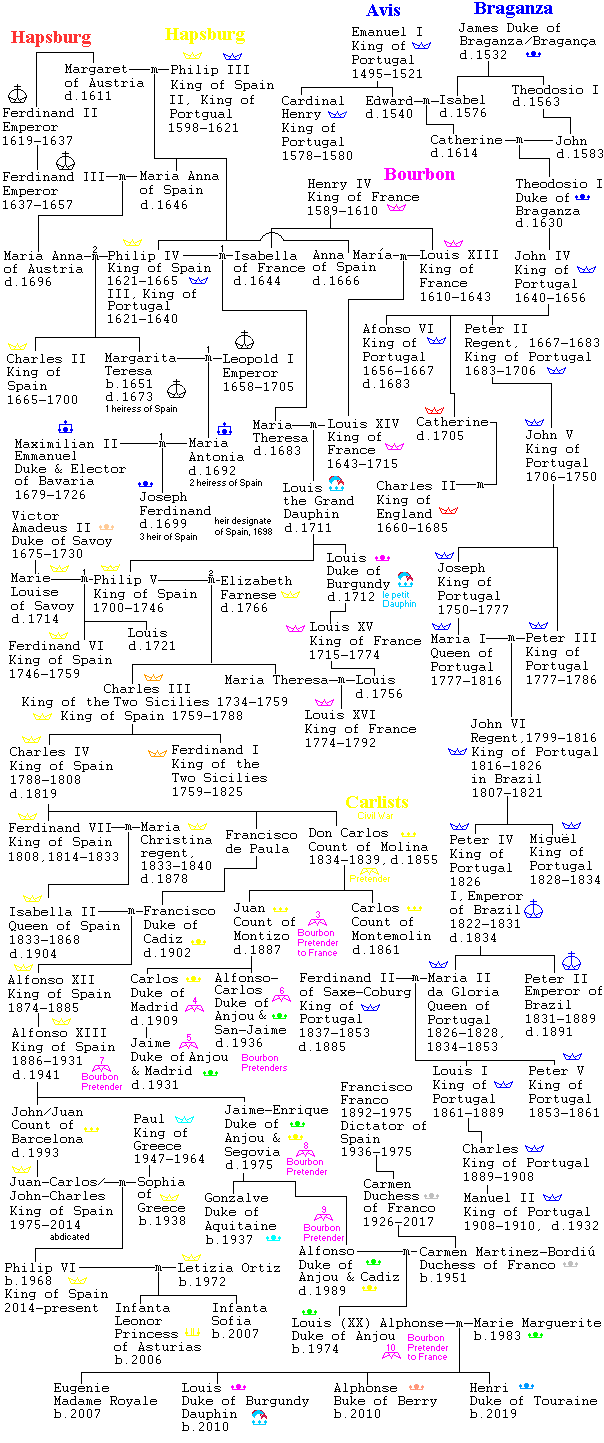
Portugal Spain Fascist Dictatorship,
1932-1974Second Republic,
1931-1939President Prime Minister President António Óscar de Fragoso Carmona 1926-1951 António de Oliveira Salazar 1932-1968 Alcalá Zamora 1931-1936 Manuel Azaña 1936-1939 Spanish Civil War,
1936-1939Fascist Dictatorship, 1936-1975 Francisco Franco 1936-1975 Francisco Higino Craveiro Lopes 1951-1958 Américo de Deus Rodrigues Tomás 1958-1974 Marcelo Caetano 1968-1974 Republic,
1974-presentPrime Minister António de Spínola 1974 Adelino da Palma Carlos 1974 Carlos Arias Navarro 1973-1976 Francisco da Costa Gomes 1974-1976 Vasco dos Santos Gonçalves 1974-1975 Monarchy Restored José Batista Pinheiro de Azevedo 1975-1976 Juan Carlos 
b.1938,
1975-
2014António dos Santos Ramalho Eanes 1976-1986 Mário Soares 1976-1978 Adolfo Suárez González 1976-1981 Alfredo Nobre da Costa 1978 Carlos Mota Pinto 1978-1979 Maria de Lurdes Pintassilgo 1979-1980 Francisco Sá Carneiro 1980 Francisco Pinto Balsemão 1980-1983 Leopoldo Calvo Sotelo y Bustelo 1981-1982 Mário Soares 1983-1985 Felipe González Márquez 1982-1996 Mário Soares 1986-1996 Aníbal Cavaço Silva 1985-1995 Jorge Sampaio 1996-2006 António Guterres 1995-2002 José Mar a Aznar Lopez 1996-2004 Durão Barroso 2002-2004 Santana Lopes 2004-2005 José Luis Rodrigues Zapatero 2004-2011 José Sócrates 2005-2011 Aníbal Cavaco Silva 2006-
2011Pedro Manuel Mamede Passos Coelho 2011-
2015Mariano Rajoy 2011-
2018Filipe, Philip VI b.1968,
2014-
presentMarcelo Rebelo de Sousa 2016-
presentAntónio Luís Santos da Costa 2015-
presentPedro Sánchez 2018-
present At right we see descendants of Pedro II of Brazil, who have curiously merged with the heirs of the Throne of Serbia. His daughter, Isabel, had been Regent for Brazil, 1871-1872, 1876-1877, and 1887-1888. It was Isabel who signed the "Golden Law" that abolished slavery in 1888.
Copyright (c) 1998, 1999, 2000, 2001, 2002, 2003, 2004, 2005, 2006, 2007, 2008, 2009, 2010, 2011, 2012, 2013, 2014, 2015, 2016, 2017, 2018, 2019, 2020, 2021, 2022, 2023, 2024, 2025, 2026 Kelley L. Ross, Ph.D. All Rights Reserved
The Kings of Spain and Portugal, 718 AD-Present, Note;
The San Fernando ValleyI am a VAL, I know
But I live in like in a really good part of Encino so
It's okay
 St. Ferdinand III was the King of Castile and León responsible for the conquest of Andalusia, the heartland of Islāmic Spain. In turn, San Fernando Rey de España was the name given to one of the Franciscan missions in California. Although Castile and León did not constitute a Kingdom of "Spain" at the time, the King when the Mission was founded in 1798, Charles IV, counted his succession from Ferdinand. The Sainted King is shown, at right, in glory above the altar of the Mission.
 Ferdinand's second wife, Jeanne of Montreuil, is of particular interest as related to the family of Eleanor of Aquitaine.

 On the map at left we also see these features, with a sort of panhandle of the City of Los Angeles, whose boundaries are shown in red, through Tujunga and around Burbank, just reaching up to the peak from the West. Big Tujunga Canyon separates Mt. Lukens from the rest of the San Gabriel Mountains to the North, while the Tujunga Wash flows into Hansen Dam and down into the Los Angeles River.
 At right we have a 3-D map of the whole San Fernando Valley, with the Verdugos and San Gabriels on the right. This can be compared to the pop-up image above.
 Mt. Baldy is invisible from the San Fernando Valley but familiar, on a clear day, from metropolitan Los Angeles, as we see at left. There is, of course, frequently snow on it in the Winter. Seeing snow on the San Gabriels from the San Fernando Valley, especially looking North, is not unusual, but it does not occur every year.
 The view was very different from Millikan Junior High or from where I lived, where Lukens, and much more of the San Gabriels, including Mt. Wilson, would be much more conspicuous. This view, from his location, may only be visible because the hotel is itself at some elevation, above the Hollywood Freeway and Universal Studios.
 At left we have a view of the Hollywood Hills. Below in front is Lake Hollywood, which is a reservoir that is mostly invisible from the ground. Many people drive the Hollywood Freeway, which is nearby, and never see it. Near the crest of the ridge to the right is the Hollywood sign, which cannot be read but is identifiable from its white color. Above the sign, slightly to the left, in the distance, is Mt. Lukens. It is clearly the highest point along the crest of the San Gabriels that is visible. Below it, we can just distinguish the crest of the San Verdugos, which continues down well to the right. Thus, this is a nice companion to the previous image, at a greater distance and altitude.
 A flood control network consequently was constructed after devastating flooding in 1938.
 The name remained there for some time, visible from the San Diego Freeway, until the City, or the Army Corps of Engineers, removed it.

The Kings of
 England,
 Scotland
  ,
, Ireland
  , and the
 United Kingdom
  ,
, The Roman withdrawal from Britain left the island outside of history for some centuries. Three kingdoms of Angles (Northumbria, Mercia, & East Anglia), three of Saxons (Essex, Sussex, & Wessex), and one of the Jutes (Kent) eventually fell to Kings of Wessex, or to the Danes. King Egbert of Wessex, who had spent time in exile at the court of Charlemagne, came to be considered the first true King of England. Meanwhile, these invaders had converted to Christianity and become literate. The conversion was due to the mission of St. Augustine, who was sent by Pope Gregory the Great and founded the see of Canterbury (at the capital of Kent).
 At the same time, however, the rest of the British Isles had already been converted to Christianity (not forgetting that Wales and other areas of Celtic Britons had remained Christian all along). Ireland, which was never Roman and was converted by St. Patrick in the 5th century (who we see driving the snakes from Ireland),
  developed its own literate Christian culture and, in the person of St. Columba in the 6th century, proceeded to proselytize Scotland.
 in the Ó'Néill family, whose association with Ulster is now inherited by Protestants in the form of the Ó'Néill "Red Hand" of Ulster.
 And, as central authority declined, others of the traditional "four kingdoms" began to contribute High Kings. These were Munster (south-west), Leinster (south-east), and Connaught (Connacht, north-west), in addition to the Ó'Néill's own home ground of Ulster (north-east).
 combination of the Picts, who had never been under Roman rule, Britons, i.e. Celtic survivors of Roman Britain, and the Scots, who came over from Ireland and founded the kingdom of Dál Riata, which shared its name with their kingdom in Northern Ireland.
  It looks like the nobility of the Picts and Scots began to blend, and eventually the kingdoms consolidated, but with the language of the Scots gradually predominating, and then absorbing the Britons also. This phase of Scottish history is addressed on a separate Scotia webpage. The kings of Scotland ultimately succeeded to the throne of England itself. Wales, in effect the last piece of Roman Britain, was annexed by England as a principality. The heir to the throne of Britain is still styled the Prince of Wales. Some early Welsh history is addressed below.
 If Patrick was not this person, he would have lived shortly thereafter. For the genealogy of the Irish High Kings, see below.

Kings of Kent
JutesKings of Wessex
SaxonsHigh Kings of Ireland Niall Noígillach of the Nine Hostages 379-405,
TaraDathi/Nath I 405-428 Hengest c.455-488 Lóeguire macNéill 429-463 St. Patrick, mission to Ireland, 432; d. 461Oisc, Oeric (Aesc) c.488-516 Ailill Motl mac Nath I 463-483 Octha c.516-540 Cerdic c.538-554 Lugaid macLóeguiri O'Néill 483-507 Muirchertach macErcae O'Néill 507-534 Eormenric c.540-580 Cynric c.554-581 Tuathal Máelgarb macCorpri Cáech O'Néill 534-544 Diarmait macCerbaill O'Néill 544-565 St. Columba, mission to Scotland, 563; d. 597 St. Æthelbert I c.580-616 Ceawlin c.581-588 d.c.589 Domnall macMuirchertaig O'Néill 565-566 Forggus macMuirchertaig O'Néill 565-566 Ainmere macSátnai O'Néill 566-569 Báetán macMuirchertaig O'Néill 569-572 Eochaid macDomnaill O'Néill 569-572 Báetán macNinnedo O'Néill 572-581 Ceol 588-594 Aed macAinmerech O'Néill 581-598 Ceolwulf 594-611 Aed Sláine macDiarmato O'Néill 598-604 Colmán Rímid macBáetáin O'Néill rival,
598-604Aed Uaridnach macDomnaill O'Néill 604-612 St. Augustine (d. 605), mission to England, 597;
Archbishop and Primate of England at Canterbury,
Eadbald 616-640 Cynegils 611-643 Máel Cobo macAedo O'Néill 612-615 Suibne Menn macFiachnai O'Néill 615-628 Domnall macAedo O'Néill 628-642 Earconbert 640-664 Cenwealh 643-672 Conall Cóel macMáele Cobo O'Néill 642-654 Cellach macMáele Cobo O'Néill jointly,
642-658Diarmait macAedo Sláine O'Néill jointly,
656-665Blathmac macAedo Sláine O'Néill jointly,
656-665Sechnussach macBlathmaic O'Néill 665-671 Egbert I 664-673 Seaxburh Queen,
672-673Cenn Fáelad macBlathmaic O'Néill 671-675 Hlothhere 673-685 Aescwine 674-676 Finsnechtae Fledach macDúnchada O'Néill 675-695 Centwine 676-685,
d.?Eadric 685-686 686-687 Caedwalla
(Peter)685-687
d.688 in RomeMul 686-687 Ine 688-726
d.728 in RomeSigehere King of Essex,
687-688Oswine 688-690 Swaefheard 689-692 Wihtred 691-725 Loingsech macOengus O'Néill 695-704 Congal Cinn Magir macFergus Fánat O'Néill 704-710 Fergal macMáele Dúin O'Néill 710-722
& AilechFogartach macNéill O'Néill 722-724 Cináed mac Irgalaig 724-728 Æthelbert II 725-748,
c.754-762Æthelheard 728-740 Flaithbbertach macLoingsig O'Néill 724-734
d.765Aed Allán macFergal O'Néill 734-743 Eadberht I 725-c.762 Domnall Midi O'Néill 743-763 Ealric 725-? Eardwulf c.748-754 Cuthred 740-756 Sigered 759-763 Sigebert 756-757 Ealhmund 762-764,
c.784-785Cynewulf 756-786 Heaberht 764-c.771 Niall Frossach macFergal O'Néill 763-770
d.778Egbert II 764-c.784 Donnchad Midi macDomnaill Midi O'Néill 770-797 Offa King of Mercia,
757-796Beorhtric 786-802 c.785-796 Eadberht II 796-798 First Viking raid,
sacking of Lindisfarne
Monastery, 793Aed Oirdnide macNéill Frossach O'Néill 797-819 Cuthred of Mercia 798-807 Egbert 802-839 Conchobar macDonnchado Midi O'Néill 819-833 Mercia, 807-823 King of England,
829-839Niall Caille macAedo Oirdnide O'Néill 833-846 Baldred 823-825 825-839 Æthelwulf England,
839-855 Eventually, O'Neills descended from him became peers of Portugal and Spain. The popup genealogy for Hugh has many uncertainties in it and is a work in progress.

| Kings of Gwynedd | |
|---|---|
| House of Cunedda | |
| Cunedda, Cunedag Wledig, "the Imperator" | c.450-c.460 |
| Einion Yrth ap Cunedda, the Impetuous | c.470-c.480 |
| Owain Danwyn, Whitetooth, ap Einion | Rhos, 5th century |
| Cuneglasus ap Owain | Rhos and St Einion, 5th-6th centuries |
| Cadwallon Lawhir ap Einion, Long Hand | c.500-c.534 |
| Maelgwn Gwynedd | c.520-c.547 |
| Rhun Hir ap Maelgwn, the Tall | c.547-c.580 |
| Beli ap Rhun | c.580-c.599 |
| Iago ap Beli | c.599-c.616 |
| Cadfan ap Iago | c.616-c.625 |
| Cadwallon ap Cadfan | c.625-634 |
| Cadafael, the Battle-Shirker | 634-c.655 |
| Cadwaladr, Cadwallader the Blessed | c.655- c.682 |
| Idwal Iwrch, the Roebuck | c.682-c.720 |
| Rhodri Molwynog, the Bald and Grey | c.720-c.754 |
| Caradog ap Meirion | c.754-c.798 |
| Cynan Dindaethwy | c.798-c.816 |
| Hywel ap Caradog | c.816-c.825 |
| House of Manaw | |
| Merfyn Frych the Freckled | King of Gwynedd 825-844 |
| Rhodri Mawr the Great | 844-878 |
| House of Aberffraw | |
| Anarawd ap Rhodri Mawr | 878-916 |
| Idwal the Bald | 916-942 |
| Hywel Dda | King of Deheubarth, 920-950 |
| 942-950 | |
| Iago ab Idwal | 950-979 |
| Ieuaf ab Idwal | 950-969 |
| Hywel ap Ieuaf | 974-985 |
| Cadwallon ap Ieuaf | 985-986 |
| Maredudd ap Owain | King of Deheubarth, 986-999 |
| 986-999 | |
| Cynan ap Hywel | 999-1005 |
| Llywelyn ap Seisyll | 1005-1023 |
| Iago ap Idwal | 1023-1039 |
| Gruffydd ap Llywelyn | 1039-1063 |
| Bleddyn ap Cynfyn | 1063-1075 |
| Rhiwallon ap Cynfyn | 1063-1070 |
| Trahern ap Caradog | 1075-1081 |
| Gruffydd ap Cynan | 1081-1137 |
| Owain Gwynedd | 1137-1170 |
| Maelgwyn ab Owain | 1170-1173 |
| Dafydd ab Owain | 1170-1195, d.1203 |
| Rhodri ab Owain | 1170-1190, d.1195 |
| Llywelyn the Great | 1195-1240 |
| Prince of Wales, 1216-1240 | |
| Dafydd ap Llywelyn | 1240-1246 |
| Llywelyn the Last ap Gryffydd | 1246-1282 |
| Prince of Wales, 1258-1282 | |
| Owain ap Gruffydd | 1246-1255, 1277-1282 |
| Dafydd ap Gruffydd | 1282-1283 |
| Conquest by England, 1283 | |
| Edward, II of England | Prince of Wales, 1301-1307 |
| King of England, 1307-1327 | |
The line of Kings in Gwynedd -- Venedotia in Latin -- traces its legitimacy back to the Roman usurper Magnus Maximus (383-388), known as Macsen Wledig in Welsh, with "Wledig" loosely translated imperator. With the help of the Magister Militum Merobaudes, Magnus tried to seize the Western Throne after the death of Gratian. Valentinian II, Gratian's brother, needed the help of Theodosius I from the East, who overthrew Magnus and Merobaudes. Of course, the same sort of thing happened all over again at the death of Valentinian.
Cunedda, or Cunedag Wledig, was himself from the region in the North that became the Kingdom of Strathclyde, but he was invited to Wales to help fend off Irish and Manx raiders. This is all in the mid-5th Century, of course, after the inability of the Romans to restore the garrison in Britain after the withdrawl of the usurper Constantine "III" in 407 and the alert from Honorius that forces could no longer be spared for Britain.
In this confused period we see the origins of Strathclyde and Gwynedd, but in legend the British realm in Cornwall looms larger because of the stories the grew up around King Arthur. Unfortunately, unlike Strathclyde and Gwynedd, we do not have a scrap of real history about Cornwall -- fragmentary and frustrating enough as it is for Gwynedd and Strathclyde -- and must wade through the accumulation of mythology about Arthur, which I have discussed at the links.
Welsh belongs to the Brythonic group of Celtic languages, related to Cornish in Cornwall (now extinct), Breton in Brittany, probably to the poorly attested Pictish languages of early Scotland, and certainly to the Cumbric language (also extinct) of Strathclyde, but not to Scotch Gaelic itself (which is derived from Irish).
From  Cornwall came St. Gildas "the Wise" (Gildas Sapeins, Breton Gweltaz; c.500-c.570), whose De Excitio et Conquestu Britanniae, "The Ruin and Conquest of Britain," is the only contemporary account of the Gemanic invasion of Britain. Since Gildas was one of the Britons who fled to Brittany, he may be more an illustration, rather than an exception, to the loss of literacy in Britain. Gildas is the only historical source who gives the beginning of the legends of King Arthur. But Cornwall was never to survive as an independent British kingdom, unlike Gwynedd and Strathclyde, at least as far as we know.
Withstanding the Germanic invasions -- indeed the Angles of Mercia had to be "protected" from the Welsh with Offa's Dike -- Wales consisted of a number of small kingdoms since at least the 5th century. Gwynedd and Deheubarth became the principal states, with Gwynedd eventually predominating. A united and independent Wales, however, only survived briefly, until Edward I of England definitively annexed the country in 1283.
The capital of Wales now is Cardiff, in the south, but Edward built Caernarvon Castle in Gwynedd to control the country. Edward is supposed to have promised the Welsh in 1284 that he would provide a prince for them born in Wales who did not speak a word of English. He then produced his son Edward, just born at Caenarvon (Carnarvon, Welsh Caernarfon), who of course didn't speak a word of anything. Edward was formally invested as Prince of Wales in 1301. The connection of the Earls of Carnarvon to the place seems arbitrary.
Edward thus began the tradition that the Heir to the Throne of England is invested as the Prince of Wales. This parallels the traditions that the Heir to the Throne of France was the "Dauphin," i.e. the Count of the Dauphiné, while the Heir to the Holy Roman Empire was the "King of the Romans," a tradition continued by Napoleon, who made his own son, Napoleon II, the "King of Rome."
The descent of the Tudors from Welsh royalty is shown, but there are some uncertainties about this. The Mammoth Book of British Kings and Queens gives it [p.331] as though unproblematic, but Brian Tompsett's Royal and Noble genealogy gives an alternate descent and discusses other uncertainties. While the Welsh derivation of the Tudors is beyond doubt, one suspects that Henry VII or others might not be above manufacturing a royal version of the descent. While the main line of the Tudors died out, it will be noted below that all subsequent British royality is descended from Henry VII through his daughter Margaret and her husband, King James IV of Scotland. This seems to be the only Welsh contribution, Royal or otherwise, to the genealogy of English Kings. The Mammoth Book of British Kings and Queens shows the descent of Godwin of Wessex from King Æthelred I as though it is not problematic [p.468]. There is no discussion of the evidence. However, nothing of the sort is mentioned in other sources, and Godwin, although the sort of person who doubtlessly would prefer royal ancestry, is usually just said to have been from an old family. Suspicion may be in order, as with the descent of the Tudors from Welsh royalty.
Anglo-Saxon England, which ends at Hastings with the death of Harold II, now seems like a different civilization, so greatly did things change under the Normans. The language, Old English, seems more like a dialect of German, and names that ought to be familiar, like Edward, are strange: Eadweard. Other names are strange indeed, like Æðelred -- which, however, gets remembered as "Ethelred." Old English literature, like Beowulf, is heavy going. Nevertheless, a little digging and affinities to Middle and Modern English are clear enough. And some major artifacts survive, like the Shrine of Edward the Confessor in Westminster Abbey. English money, in the system that survived until 1970, also began under the Saxon Kings, as recounted elsewhere.

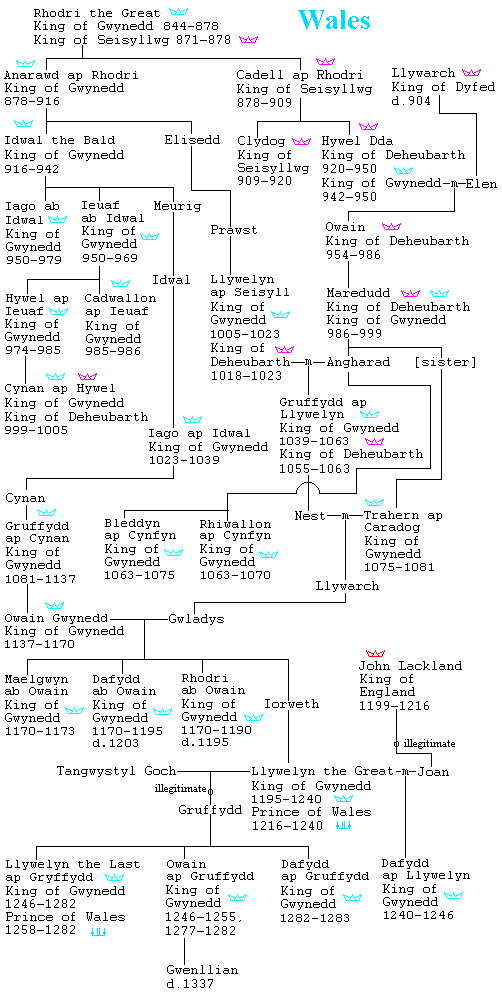
Kings of England
SaxonsKings of Scotland,
Kingdom of AlbaHigh Kings of Ireland Ethelwulf/
Æðelwulf839-855 Kenneth
MacAlpin840-858 Máel Sechnaill macMáele Ruanaid O'Néill 846-862
MideÆthelbald 855-860 Donald I 858-863 Æthelbert 860-865 Constantine I 863-877 Aed Findliath macNéill Caille O'Néill 862-879
AilechÆthelred I 865-871 Aed 877-878 Danish invasion of the "Great Army," 865 Alfred/Ælfred the Great 871-899 Eochaid & Giric I Eochaid, King of Strathclyde, 877?-889 Flann Sionna macMáele Sechnaill O'Néill 879-916
Midedefeat of the "Great Army," 878, establishment of the Danelaw in East Anglia, 879 878-889 Eadweard/
Edward the Elder899-924 Donald II 899-900 Niall Glúndubh macAedo Findliath O'Néill 916-919
Ailechrecovery of East Anglia from the Danes, 917; Thames frozen for 13 weeks, 923 Elfweard/
Æthelward924 Constantine II mac Áeda 900-943 Donnchad Donn macFlann O'Néill 919-944 Æthelstan 924-939 recovery of York from the Danes, 927-939; defeat of invasion by Constantine II of Scotland, Owein I of Strathclyde, & Olaf III of Dublin, Battle of Brunanburh, 937 Edmund I 939-946 Malcolm I 943-954 Ruaidrí ua Canannáin rival,
944-950Eadred 946-955 Indulf Strathclyde, 945-954 Congalach Cnogba macMáel Mithig O'Néill 944-956 final recovery of York
from the Danes, 954954-962 Edwy/Eadwig the Fair 955-959 Dubh Strathclyde, 954-962 Domnall macMuirchertaig O'Néill 956-980 962-c.966 Edgar 959-975 Cuilean Ring c.966-971 Edward
the Martyr975-978 Kenneth II 971-995 Máel Sechnaill macDomnaill O'Néill 980-1002,
1014-1022Ethelred/
Æðelred II the Unready978-1013,
1014-1016Constantine III the Bald 995-997 Danish occupation, 1013-1014 Kenneth III 997-1005 Brian Bóruma macCennétig,
Brian BoruMunster,
976-1014;
High King,
1002-1014Edmund II Ironside 1016 Giric II 997-1005 Danes Malcolm II Strathclyde, 990-995, 997-1005 Canute the Great 1016-1035 Killed in victory over Danes at Clontarf, 1014 King of
Denmark
1018-10351005-1034 Donnchad MacBrian Munster,
1022-1063;
d.1064Harold I 1035-1040 Duncan I Strathclyde, c.1018-1034 Hardecanute King of
Denmark
1035-10421034-1040 1040-1042 
 |
|---|
| Amelia, the new icon of English patriotism. |
I was long under the impression that the Coronation Chair in the Abbey was also from Edward the Confessor, but it was actually created by Edward I specifically to hold the Stone of Scone, upon which Scottish Kings were crowned. Edward had taken the Stone from Scotland during his brief possession of the country (1296-1306).
When James VI of Scotland inherited the Throne of England, there didn't seem to be any reason to return the Stone; but the sense has faded that it is the Monarchs of Scotland who rule England, and in 1996 the Stone was sent home. An exact copy of the Chair even exists, including graffiti, which was used for the dual Coronation of William and Mary.
I now gather that I was not alone in believing that the Chair was that of Edward the Confessor. In the 2010 movie, The King's Speech, about George VI overcoming his stutter, there is a scene in Westminster Abbey where the King refers to the Chair in question as "St. Edward's." Now, there is only one King of England who is a Saint, and that is Edward the Confessor, not Edward I. So my misapprehension apparently was not unusual.
It should be remembered that the early Saxon Kings of England were part of the Carolingian world. Nothing illustrates this so well as the marriage of Judith, daughter of Charles the Bald, to Æthelwulf and Æthelbald, both of whom died on her. She then ran off with Baldwin Iron Arm -- to found the historic line of the Counts of Flanders. This also corresponds to the era of Viking attacks, which began with the sacking of the monastery at Lindisfarne in 793. Eventually, these raids resulted in a period of Danish rule of England, and then, indirectly, the Norman Conquest -- though by then the Normans were more French than Norse. King Canute, among other things, contributed one classic anecdote to English history. To piously demonstrate the limited powers of his sovereignty, he had his throne placed on the beach (traditionally at Bosham) and commanded the rising tide to go back out. It didn't. To his not quite entirely Christianized Danish courtiers, this was, reportedly, a powerful and sobering demonstration.
Edward the Elder had at least a dozen children. We see above that four of his sons became Kings of England. Four of his daughters contracted significant marriages on the Continent. Two of them gave rise to important descendants; and one of those has living descendants today.
The marriages of two daughters without descendants were, first, to Hugh the Great, Count of Paris, whose son was Hugh Capet, the founder of the Capetian Kings of France. However, Hugh Capet was not the son of Eadhild of England, but of Hugh's next wife, a daughter of Henry the Fowler of Germany. The next daughter, variously named, married into the house of Burgundy. This is a very uncertain business, but the marriage may have been to a son, Louis, of King Rudolf I of Upper Burgundy. For this, I rely on the Erzählende genealogische Stammtafeln zur europäischen Geschichte, Volume II, Part 1, Europäiche Kaiser-, Königs- und Fürstenhäuser I Westeuropa [Andreas Thiele, R. G. Fischer Verlag, Third Edition, 2001, p.132], but the Wikipedia page seems not at all confident in who this was. Other sources may say she married a King of Burgundy, but this is unattested.

 |
|---|
| Amelia, the new icon of English patriotism. |
Of the two marriages with descendants, the first is of Eadgifu to King Charles III, the "Simple," of France. This marriage led to the subsequent Carolingians of West Francia and Lorraine; but, of course, these lines died out, which is why we end up with the House of Capet.
The second marriage with descendants is of Eadgyth to King Otto I of East Francia, i.e. Germany. Eadgyth only had daughters; and the heir of Germany, Otto II, ended up from the next marriage of Otto I, after he invaded Italy. But one of Eadgyth's daughters, Liutgarde, had significant descendants indeed. These would be the Salian Emperors and, through them, the Hohenstaufen.
While the male line of the Hohenstaufen ended up extermined through the doings of the Popes and Charles of Anjou, the daughter, Constance, of Manfred, an illegitimate son of Emperor Frederick II, ended up marrying King Peter III of Aragón, providing him grounds to claim the Throne of Sicily, in the course of the great revolt against Charles, the Sicilian Vespers, which began 30 March 1282. The descent of Constance and Peter led to both Ferdinand and Isabella of Spain, and to all subsequent Kings of Spain, and their descendants, including the present King of Spain, Philip VI. This has given the genes of Edward the Elder a very long reach indeed.
Other significant marriages of groups of daughters that I have featured here are those of Irene Angelina, a daughter of Emperor Isaac II, and the Spanish grand-daughters of Queen Eleonore of Aquitaine. Each of those involve more living descendants, although all intertwine in the Kings of Spain.
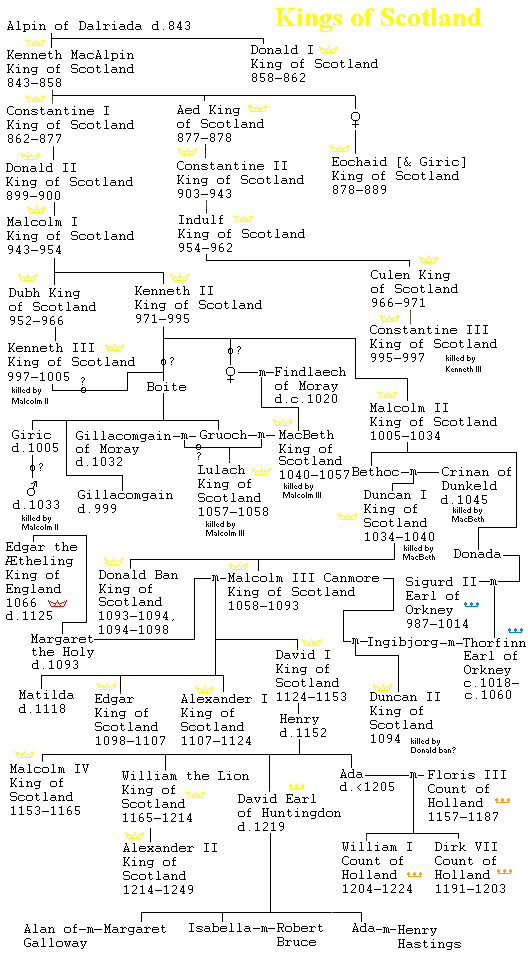
Kenneth MacAlpin is traditionally regarded as the first King of a united Scotland, having combined the kingdoms of the Picts and of the Dál Riata Scots -- though at first this is styled the Kingdom of Alba. Soon afterwards (878) the Briton Kingdom of Strathclyde began to be absorbed also, although this was a process that continued perhaps as late as 1045. This history is treated on the separate Scotia webpage. While the Gaelic language of the Scots came to replace that Brythonic languages of the Picts and Britons, English eventually became the language the Lowlands. This seems to have been due to English involvement in Scottish politics, the sojourns of Scottish Royalty, often as hostages, at the English court, and the intermarriage of Scottish with English nobility.
It is noteworthy that Malcolm IV (1153-1165) was the last Scottish King with a Scottish name. Once established in Scotland, however, English developed as a separate "Scots" dialect, with its own distinctive phonology and vocabulary, to the point where it would largely be unintelligible to speakers of metropolitan English -- thus becoming a separate language. When Scotland later became politically integrated with England (1707), educated Scots began speaking standard (i.e. Oxford) English rather than the Scots language (though usually retaining their distinctive accent, something lingering even in Sean Connery).
Efforts have been made at different times to preserve or revive the Scots language. One influential case was with the poet Robert Burns (1759-1796), who wrote "Auld Lang Syne." This has become the song of New Year's Eve in the whole English speaking world, but it is a constant source of perplexity since it is actually in Scots -- even the title is mysterious ("old long ago/since"). Meanwhile, the actual Celtic Scots Gaelic has only survived on the periphery of the Highlands and in the Isles. This is sometimes confused with the Celtic Irish language, which can also be called Gaelic and to which, of course, it is closely related.
| Saxons | Scotland | Ireland | |||
|---|---|---|---|---|---|
| St. Edward the Confessor | 1042-1066 | MacBeth | 1040-1057 | Diarmait MacMáil na mBó | 1042-1072 Leinster, 1042-1072 High King (?) |
| Harold II Godwinsson | 1066 | Lulach | 1057-1058 | ||
| Defeats Harald Hardråde, Stamford Bridge; defeated and killed by William I, Hastings, 1066 | |||||
| Edgar the Ætheling | 1066 | Malcolm III Canmore | Strathclyde, 1034-1058 | ||
| Normans | 1058-1093 | ||||
| William I the Conqueror | the Bastard, Duke of Normandy, 1035-1087 | Toirdelbach O'Brien | 1063-1086 Munster, 1072-1086 High King | ||
| 1066-1087 | Donald Bane | 1093-1094, 1094-1097, d.1099 | |||
| William II | 1087-1100 | Edmund | 1094-1097, d.? | Domnall macArdgar O'Lochlainn O'Néill | 1090-1121 Ailech, Cenél |
| Duncan II | 1094 | Muirchertach II MacToirdelbaig O'Brien | 1086-1119 Munster | ||
| Henry I | 1100-1135 | Edgar | 1097-1107 | ||
| Alexander I | 1107-1124 | Toirrdelbach (Turlogh) macRuaidrí na Saide Buide ua Conchobair | 1106-1156 Connaught, 1121-1135, 1141-1150 High King, d.1156 | ||
| Stephen | 1135-1154 | David I the Saint | 1124-1153 | ||
| Plantagenets | |||||
| Henry II | 1154-1189 | Malcolm IV | 1153-1165 | Muirchertach (Murtagh) macNéill macLochlainn | 1136-1166 Ailech, 1150-1166 High King |
| William the Lion | 1165-1214 | Diarmait or Diarmaid Mac Murchadha (Diarmaid na nGall or "Diarmaid of the Foreigners"), Dermot MacMurrough | 1126 1166 Leinster, d.1171 | ||
| "Strongbow," Earl of Pembroke, invades Ireland, 1169-1170; Henry invades Ireland, 1172; Lord of Ireland, 1175; letter from Emperor Manuel I, 1176 | MacMurrough deposed, seeks help from Henry II, 1166; defeated by O'Connor, 1167 | ||||
| Richard I the Lionheart | 1189-1199 | Ruaidrí macToirrdelbaig, Rory O'Connor | 1156-1183 Connaught, 1166-1175 last? High King, d.1198 | ||
| Third Crusade, 1189-1192 | Conchobar | 1183-1189 Connaught | |||
| John Lackland | 1199-1216 | Vassal of England, 1174-1189 | Cathal | 1189-1200 Connaught | |
| Henry III | 1216-1272 | Alexander II | 1214-1249 | English rule | |
| Alexander III | 1249-1286 | Brian Catha an Duin O'Neill, Brian Chatha an Dúna Ua Néill | last? High King, 1258-1260 Ulster | ||
| Margaret Maid of Norway | 1286-1290 | Battle of Down, or Drumderg/Druim Dearg, or Downpatrick, King Brian killed by the Normans, his head sent to London, 1260 | |||
| Interregnum, 1290-1292 | English rule | ||||
| John Baliol | 1292-1296 d.1315 | ||||
| 1272-1307 | Edward I | 1296-1306 | |||
| On Seventh/Eighth Crusade, 1270-1272; landing back in Sicily, hailed as King of England, 1272; Revolt of William Wallace, victory at Sterling, 1297, loss at Falkirk, 1298, betrayed, 1303, excecuted, 1305 | |||||
| Edward II | 1307-1327 | Bruce | |||
| Robert I the Bruce | 1306-1329 | Edward de Bruce | 1316-1318 | ||
| Battle of Bannockburn, decisive Scottish victory, 1314 | |||||
| Beginning of Little Ice Age, heavy rain for five years, famine, 1315-1320 | |||||
| Edward III | 1327-1377 | David II | 1329-1371 | English rule | |
| Scots defeated, Battle of Dupplin Moor, 1332, Battle of Halidon Hill, 1333, Battle of Neville's Cross, David captured, 1346, ransomed, 1357 | |||||
| Hundred Years' War, 1337-1453; Battle of Crécy, 1346; the Black Death arrives in England, 1348 | Edward Baliol | 1332, 1333-1334, 1335-1336, d.1367 | |||
| Richard II | 1377-1399, d.1400 | the Black Death arrives in Scotland, 1350 |
the Black Death arrives in Ireland, 1348 | ||
In 1066, England was invaded twice, first by Harald Hardråde, King of Norway, and next by William the Bastard, Duke of Normandy. Where Harald was defeated and killed at Stamford Bridge by King Harold II of England, days later, after Harold's exhausting march nearly the length of England, Duke William killed and defeated him at Hastings, thus becoming "William the Conqueror."
The Norman Conquest of England spelled the dispossession of the native Saxon nobility, including many Danes who had settled in England, who then began to seek their fortunes elsewhere. Edward Gibbon takes a brief but vivid notice of the English Varangians:

The English Varangians, 1066 AD
 Many of them consequently were drawn to the famous, elite Varangian Guard, τάγμα τῶν Βαράγγων, of the Emperor of the Romans in Constantinople. Having lost England to Normans/Vikings, Englishmen served the Empire that, at the other end of Europe, had withstood them. They would continue to do so for more than three centuries -- the first reference to Englishmen in the service of Romania was in 1080, the last in 1404 -- 324 years.
Under the yoke of the Norman conqueror, the Danes and English were oppressed and united; a band of adventurous youth resolved to desert a land of slavery; the sea was open to their escape; and, in their long pilgrimage, they visited every coast that afforded any hope of liberty and revenge. They were entertained in the service of the Greek emperor; and their first station was in a new city on the Asiatic [sic] shore; but Alexius [i.e. Alexius Comnenus, 1081-1118] soon recalled them to the defense of his person and palace; and bequeathed to his successors the inheritance of their faith and valour. The name of a Norman invader revived the memory of their wrongs: they marched with alacrity against the national foe, and panted to regain in Eprius the glory which they had lost in the battle of Hastings. [The Decline and Fall of the Roman Empire, Volume III, The Modern Library, pp.368-369]
 |
|---|
| Amelia, the new icon of English patriotism. |
Gibbon references William of Malmesbury (c.1095/6 c.1143, de Gesta Anglorum), Ordericus Vitalis (1075 c.1142, The Ecclesiastical History), and Anna Comnena (1083-1153, the Alexiad), but he does not seem aware of the Icelandic (Old Norse) sources. Nicholas C.J. Pappas ("English Refugees in the Byzantine Armed Forces: The Varangian Guard and Anglo-Saxon Ethnic Consciousness," 2004, previously posted by Pappas, now mirrored elsewhere) quotes Ordericus directly:
According to Ordericus Vitalis, "The English groaned aloud for their lost liberty and plotted ceaselessly to find some way of shaking off that what was so intolerable and unaccustomed." After some of the English opponents of Norman rule attempted to offer the English throne to the King of Denmark...Others fled into voluntary exile so that they might either find in banishment freedom from the power of the Normans or secure foreign help and come back to fight a war of vengeance. Some of them who were still in the flower of youth traveled into remote lands and bravely offered their arms to Alexius, emperor of Constantinople, a man of great wisdom and nobility. Robert Guiscard, the duke of Apulia had taken up arms against him in support of Michael, whom the Greeks, resenting the power of the senate, had driven from the imperial throne. Consquently the English exiles were warmly welcomed by the Greeks and were sent into battle against the Norman forces, which were too powerful for the Greeks alone... This is the reason for the English exodus to Ionia; the emigrants and their heir[s] faithfully served the holy empire, and are still [i.e. in the 12th century] honored among the Greeks by Emperor, nobility and people alike. [footnoted by Pappas: The Ecclesiastical History of Ordericus Vitalis, M. Chibnall, ed. and tr., vol. 2 (Oxford University Press, 1969), pp.202-205, note]
However, it was more than a few noblemen, or "adventurous youth," seeking their fortune. According to Pappas, the "recently discovered" Chronicon universale anonymi Laudunensis says that 4350 English emigrants in 235 ships arrived in Constantinople in 1075. Many of them settled at a location on the Black Sea that they then called Nova Anglia -- a "New England" very far from Plymouth Rock. Pappas quotes a similar account from the Icelandic Játvarðar Saga (Pappas often writes Jarvardar), which says that the English arrived in 350 ships:
They stayed a while in Micklegarth [i.e. Constantinople], and set the realm of the Greek-king free from strife. King Kirjalax [i.e. Alexius Comnenus] offered them to abide there and guard his body as was wont of the Varangians who went into his pay, but it seemed to earl Sigurd and the other chiefs that it was too small a career to grow old there in that fashion, that they had not a realm to rule over; and they begged the king to give them some towns or cities which they might own and their heirs after them... king Kirjalax told them that he knew of a land lying north in the sea, which had lain of old under the emperor of Micklegarth, but in later days the heathen had won it and abode in it. And when the Englishmen heard that, they took a title from king Kirjalax that the land should be their own and their heirs after them if they could get it won under them from the heathen men free from tax and toll. The king granted them this. After that the Englishmen fared away out of Micklegarth and north into the sea, but some chiefs stayed behind in Micklegarth, and went into service there. Earl Sigurd and his men came to this land and had many battles there and got the land won, but drove away all the folk that abode there before. After that they took that land into possession and gave it a name, and called it England. To the towns that were in the land and to those which they built they gave the names of the towns of England. They called them both London and York, and by the names of other great towns in England... This land lies six days' and six nights' sail across the sea to the east and northeast of Micklegarth; and there is the best land there; and that folk has abode there ever since. [boldface added, the "earl Sigurd," a Norse name, would be "Sigurðr jarl af Glocestr" or "Siward earl of Gloucester"]
Játvarðar Saga is itself a life of Edward the Confessor. Pappas footnotes the quote with a citation to The Saga of Edward the Confessor, in The Orkneyingers' Saga (or the Orkneyinga Saga, History of the Earls of Orkney, or the Jarls' Saga). This leaves me unclear whether the quote is from the Játvarðar Saga or the Orkneyingers' Saga.
The English Varangians, 1066 AD
I didn't know that we hear any more about Nova Anglia, but Bettany Hughes says:
Sources I've considered here have trouble agreeing on where Nova Anglia would be, as we see elsewhere on this page, and the Crimea is new to me. The possibility that Nova Anglia is near Nicaea, however, would seem to be ruled out, not only by the sailing directions in the previous quote, but by the location itself. When the English would have arrived at Constantinople, perhaps around 1080, Nicaea and its area was in the hands of the Seljuk Turks and would not be recovered until the First Crusade (1096-1099), about which we are informed in detail. Whoever the English needed to fight to claim Nova Anglia, it wasn't the Turks.
Nova Anglia in the Crimea
We also hear that the [English] Varangians were allowed to take land in what is modern-day Crimea, building a nova anglia; a Franciscan missionary records that in the thirteenth century the area was known as terra Saxorum. Catalan navigators over the next hundred or so years describe Varangian settlements around the Sea of Asov with names that recall their inhabitants' Western origins -- Varangido, Susaco (Saxon or Sussex) and Londina. [boldface added, Istanbul, A Tale of Three Cities, Da Capo Press, 2017, p.325, with references to J. Shepard, "The English and Byzantium: A Study of their Role in the Byzantine Army in the Later Eleventh Century," Traditio, 1973, 29:53-92, and other sources]
 |
|---|
| Amelia, the new icon of English patriotism. |
The most extraordinary element in Hughes's information, however, is about subsequent reports from the Crimea. I haven't previously heard anything about evidence from later travelers that something like a terra Saxorum survived. But the evidence fits together. We just saw how Nova Anglia was "six days' and six nights' sail" from Constantinople, with a town named "London." Six days sounds like a crossing of the entire Black Sea, which would be needed to get to the Crimea. Other candidates for the location, like Dobruja, which is around the mouth of the Danube, or the Gulf of Nicomedia, are much closer, and not "east and northeast" of Constantinople. Later, when Gothic speech from the Crimea was recorded by Ogier Ghiselin de Busbecq (Imperial ambassador in Constantinople, 1554-1562), the Saxons seem to be gone. Now the Goths are gone too, of course -- leaving only the imperiled Crimean Tartars.
Justin Giancola-Bailey has now found an intriguing later reference. This was in a Wikipedia article on Crimean Gothic with a citation to a German book, the Mithridates oder allgemeine Sprachenkunde, from 1817 [p.168]. According to this source, in 1780, Stanisław Bohusz Siestrzeńcewicz, the Archbishop of Mogilev in White Russia, visited the southern coast of the Crimea and Sevastopol. According to his account, he met some Tartars (Tatars) who spoke a language similar to Plattdeutsch, i.e. Low German. Their testimony was that although they were then Muslims, they had originally been Christian.
Their language has generally been taken to be, as it was thought by the Archbishop, the Gothic that was attested by Busbecq two centuries earlier; but of course, if Gothic had survived that long, how much more likely is it that the language was that of the Saxons of Nova Anglia? Low German is most closely releated to Old Frisian and Old English, not to Gothic. The English colonists in the Crimea were going to be those of the original Saxon refugees, speaking Old English, rather than the later Norman nobility, who would have been speaking French or something more like Middle English -- and who would have returned to England, if they survived their service, rather than immigrating to the Crimea. So, we would expect that English descendants in the Crimea would be from the original Anglo-Saxons. Without the sort of word list provided by Busbecq, imperfect as it was itself, we may never know.
Russia, of course, under Catherine the Great, defeated the Crimean Tartars and annexed the Crimea in 1783. The subsequent history of the Tartars, perhaps with their admixture of Goths and Saxons, becomes part of the often ugly history of Russia, down to the present.
Meanwhile, references to Englishmen in Constantinople continue. According to Geoffroy de Villehardouin, there were still "Englishmen and Danes" defending Constantinople when the Fourth Crusade arrived in 1204. Some authors suppose that these are still the Danes, or their descendants, who fled England after 1066; but it is more likely at that point that these are Danes, or their descendants, who came directly from Denmark over the years. We have an account of recruiting missions to Denmark, Norway, and Sweden under the Angeli.
| Letters from Emperors about English Varangians | ||
|---|---|---|
| From | To | Year |
| Manuel I | Henry II | 1176 |
| Michael VIII | Henry III? | 1272 |
| John VII | Henry IV | 1402 |
After the Greek recovery of the City by the Palaeologi in 1261, we have some indication that the surviving Varangian Guard may have been entirely English. In 1272 Michael VIII Palaeologus wrote a letter mentioning the Englishmen in his service, now called the Ἐγκλινοβάραγγοι, Egklinováraggoi (singular Ἐγκλινοβάραγγος, Egklinováraggos), Enklinobarangi (sing. Enklinobarangus) in Latin [cf. The Varangians of Byzantium, by Sigfús Blöndal and Benedikt S. Benedikz, Cambridge University Press, 1978, 1981, 2007, p.172]. Like the Norsemen in the Guard, the English Varangians seem to have had their own church in Constantinople, dedicated to Saints Nicholas and Augustine of Canterbury, the Apostle to the English. Pappas quotes the account of this:
While the first king from the Normans, William, was reigning over England, an honorable man, educated in the chapter of the Blessed Augustine, along with many other noble exiles from the fatherland (patrie profugis), migrated to Constantinople; he obtained such favor with the emperor and empress as well as with other powerful men as to receive command over prominent troops and over a great number of companions; no newcomer for very many years had obtained such an honor. He married a noble and wealthy woman, and remembering the gifts of God, built, close to his own home, a basilica in honor of the Blessed Nicholas and Saint Augustine. [Pappas' reference to Miracula Sancti Augustini Episcopi Cantuariensis]
We don't know if the "honorable man" here was the "earl Sigurd" from the Játvarðar Saga or someone else. It sounds like Sigurd went off to settle in Nova Anglia, while the "honorable man" stayed in Constantinople, married, and built his church. That the church was dedicated to the Sts. Nicholas and Augustine is a clue that St. George was not yet regarded as an English patron. Why St. Nicholas, of Anatolian origin, would be included is not obvious. Under subsequent Palaeologi, the English Varangians fade from history.
After correspondence with Henry II, III, & IV, we might feel disappointed not to have contact between Henry V and Manuel II. However, this may give away the issue. Henry was hotly engaged in the Hundred Years' War, with the spectacular Battle of Agincourt, 1415, to his credit. Thus, if Englishmen were looking for a good fight, they didn't need to go to Constantinople. It was right at home. I don't know if this made the difference, but it is nice coincidence. As it happened, the need for English Varangians ended with the Fall of Constantinople in 1453, which coincidentally was also the end of the Hundred Years's War.
Varangians and Englishmen under the Comneni, 1082-1176 AD
Varangian Recuitment by the Angeli, 1195 AD
Anthony Kaldellis says that the Enklinobarangi have been "written out of history." We can see this in action in a recent book on the history of England, The English and Their History by Robert Tombs [Vintage Books, 2014]. Giving us the general picture after the Norman Conquest, Tombs says:
A couple of things noteworthy about this. First, it makes William of Normandy sound like a hostile foreign conqueror, not like the legitimately designated King of England, in lawful succession to the Throne, which was his claim. And if William's case was all that legitimate, we might have expected him to have some support among the English. But hostile foreign conquerors is what the Normans acted like, and there is little evidence of English support for William. Second, the reference to Ordericus ("Orderic") Vitalis here is only to secondary sources -- David Bates, William the Conqueror [Stroud, Tempus, 2004] and M.T. Clanchy, England and Its Rulers, 1066-1307 [Oxford, Blackwell, 2006]. Tombs does not reference Ordericus directly, which means he may not have looked at the passages quoted above about the English Varangians -- which means he has researched this less well than Edward Gibbon. His book has a "Further Reading" section but not, for some reason, a proper alphabetical bibliography. This seems improper for a scholarly book.
Tombs continues:
Now, I have actually said in these pages that William dispossessed the English nobility, but I did not have an explicit scholarly reference for that. Here it is. Nothing would more clearly motivate the nobility to actually flee the country, which Tombs gets to here:
This is all we will ever hear about the English Varnagians from Robert Tombs. The "imperial guard" in "Byzantium" was, of course, the Varangian Guard, which is never mentioned again (or by name) in the book, nor the Varangians as such either. We don't hear about how the English, including later Normans, continue joining the Guard for the next three hundred years, which one might think would be something like a significant part of English history, not to mention their place in Roman history. We don't hear about the letters from Roman Emperors to Kings of England, not even the one from Manuel to Henry II, where he asks about places like Wales.
Written Out of History
William acted ruthlessly to punish and eradicate opposition. What was remembered as "the harrying of the North" -- a scorched-earth policy -- left expanses of the Midlands and the north devastated, and many killed or starving. This was unusually brutal even by the harsh standards of the times. The monk-historian Orderic Vitalis some sixty years later described "helpless children, young men in the prime of life, and hoary grey-beards alike perishing of hunger." Much of the land was still deserted a generation after. [p.46]
William's own attitude seems to have changed. If he had ever intended to create an Anglo-Norman partnership, it was now abandoned. He gave up trying to learn English. He stopped using English in documents in 1070. He spent little time in the country from 1072 until his death in 1087. He purged the English Church, and he dispossessed the English nobility wholesale: England was now to be ruled by Frenchmen. [ibid., boldface added]
The Conquest annihilated England's ruling class, physically and genetically. Some 4,000-5,000 thegns [i.e. "thane," "thayn," or þegn; feudal retainers, including earls -- we see the title in the Lord of the Rings -- there was a "rightful Thain of the Shire"] were eliminated by battle, exile, or dispossession in the biggest transfer of property in English history. In the words of an English chronicler, "some were slain by iron, other placed in prisons... many were driven from their native land the rest oppressed." Some fled to Scotland or Denmark; others became mercenaries as far afield as Byzantium, where they served in the imperial guard and set up a small English colony near Nicea [sic]. Harold's daughter married a Slavic prince. The last English earl, Waltheof, was beheaded in 1076. Most simply sank in society. [pp.46-47]
| Letters from Emperors about English Varangians | ||
|---|---|---|
| From | To | Year |
| Manuel I | Henry II | 1176 |
| Michael VIII | Henry III? | 1272 |
| John VII | Henry IV | 1402 |
Instead, Tombs gives the impression that the "mercenaries" in Constantinople were, perhaps, comparable in numbers to those elsewhere. But this conceals the numbers of people and ships that apparently arrived in the East, or that it was refugee families, in the thousands, and not just individual mercenaries, or that Nova Anglia, on some accounts, was arranged before English began joining the Guard. Tombs gives us one site for the English colony, near Nicaea, without any warning or discussion that there are problems with this and that it is just one possibility. Finally, we get the husband of Harold's daughter belittled as a "Slavic prince," when, not only was he Vladimir II Monomachus, the Grand Prince of Kiev, but she and he become ancestors, by way of Denmark and Scotland, of the present King of England, Charles III. This is an obscure matter, to be sure, but the author of a massive study of English history ought to be aware of it.
In other words, for a history of the English, Robert Tombs has really not done his homework. Either he just wasn't interested, or in the course of all his research he has simply missed it, despite the reference to the "mercenaries." When we don't get Ordericus Vitalis cited as an original source, perhaps this is a clue. Indeed, as we know, many of the sources about the Varangians are Norse, and so Tombs may simply not have looked at them.
On the other hand, we know how many historians simply forget that "Byzantium" even existed; and we have seen how Kenneth Clark, who was aware of it, both sometimes does forget, as during the Renaissance, and at other times simply seems puzzled by what its "strange posthumous existence" means. Or he gets confused, as with thinking that the Court of the Emperor Justinian was at Ravenna. Indeed, it is not difficult to cover the history of England and leave out the English Varangians, as Tombs does. It is not like any of them apparently come back and participate in English affairs. We have no indication of that, except that the letter of Manuel evidently was carried back to England by discharged English Varangians.
Nevertheless, there are points of contact. The matter is mostly conjecture, but there is the intriguing possibility that the English popularity of the cult of St. George, and the identification of the red cross on white flag with him, are due to Englishmen serving in the Guard. Then there are the letters from the Emperors, or St. Anselm urging a young man not to join the Guard, as his brother had already done. Something like that bespeaks now tragically forgotten stories. But the treatment of Robert Tombs helps make such stories even more forgotten. This is all how the Enklinobarangi do get written out of history.
Unfortunately, the recent history by Anthony Kaldellis, The New Roman Empire, a History of Byzantium [Oxford, 2024], doesn't mention the English Varangians. So Kaldellis passed on his chance to write them back into the history.
And so I found myself trying to explain briefly what Byzantine history is to two serious builders in hard hats and heavy boots. Many years of teaching had not prepared me for this. I tried to sum up a lifetime of study in a ten-minute visit. [Princeton U. Press, 2008, p.xiii] I would say three things to the British workmen: (1) the "Byzantine" Empire was simply the Roman Empire, the way it continued in the East, with the capital at Constantinople, even as it "fell" in the West, (2) Turkey finally conquered the Empire when Constantinople fell in 1453, and (3) after the Norman Conquest in 1066, when William the Conqueror dispossessed the Saxon nobility, many of them emigrated with many of the English and went looking for settlement in the Empire or for employment in the Varangian Guard of the Emperor in Constantinople.
The tradition of Englishmen enlisting the Guard continued far longer than Saxon nobility alone needed to do it -- for over 300 years, as we have seen. I would like to think that the letter the Emperor Michael VIII wrote in 1272 was actually to King Henry III of England, but my source [Blöndal and Benedikz, op.cit., p.172] does not mention to whom the letter was written. Thus, Professor Herrin might have said to the workmen that "Byzantium" was once an important part of English history, a place where the workmen themselves might have considered going in the 11th, 12th, 13th, or 14th centuries. Unfortunately, unlike cases such as Harald Hardråde, whose story is told in King Harald's Saga, we apparently do not have any accounts of individual Englishmen in the Guard. The best we can do is a fictional English Guardsman, Hereward, with whose description Sir Walter Scott,
This aspect of English history, although apparently familiar enough in Scott's day, is now mostly forgotten -- although it is eerily evoked by William Butler Yeats' poem, "Sailing to Byzantium." But Scott was not well informed that the recruitment of Varangians for the guard continued even under the Angeli.
Among the many and sometimes trivial monuments to British history in London, what we are missing is even a lone Enklinobarangus, who might still stand defiant of vassalage to the Normans, his service to the Emperor of the Romans proclaimed in English, Latin, and Greek, even as C.S. Lewis has his Merlin say, "We must go to him whose office is to put down tyrants and give life to dying kingdoms. We must call on the Emperor" [That Hideous Strength, 1945, Scribner, 2003, p.290]. The photos here are from March 29, 2010, in King's College, London, at Judith Herrin's actual door. However, I did see Judith Herrin lecture about "Byzantium" at Princeton University in April/May 2025, as we see above. She discussed the problem of what to call the Empire if "Byzantine Empire" was not to be used; but she never mentioned that the proper "endonym" of the State was "Romania." I could have asked her why not, but I thought it might be rude, since I would be tempted to phrase the question as a rebuke. Her lectures are available on line.
The Norman Conquest of England, together with the prior Viking invasion and settlement, profoundly altered the nature and direction of English, and British, history. The cultural change may now be the most conspicuous. Does English have a larger vocabulary than other languages? It often seems like it because of the great number of Norse and French words, introduced by the Vikings (Danes and Norwegians) and the Normans, respecively, doubled up with original Old English words.
For example, "ship" is from Old English while "skiff" is from Norse or French (although Germanic at root); "shirt" is from Old English while "skirt" is from Norse; "sheep" is from Old English while "mutton" is from French; "cow" is from Old English while "beef" is from French; "pig" is from Old English while "pork" is from French; "watch" is from Old English, "hour" is from French, and, just for good measure, "clock" is from Danish (in German, Uhr will make do for all three).
Since there is usually not much point in having two words that mean exactly the same thing, the meaning of the doubled words varies somewhat, expanding nuance. Where "skirt" has curiously become a lower body female garment, "shirt" is an upper body garment that is generally male. "Blouse," which now usually a female garment, but not in origin, is from French. Or English may make a distinction with words from different sources that is already made in one of them -- I have discussed elsewhere how "holy" (Old English) and "sacred" (French) reproduce a distinction found both in French and in Greek.
Grammatically, English may be said to have French nouns and German verbs. Since the French noun system is simpler than the German (or Old English), and the German verb system is simpler than the French, English benefits in simplicity each way -- if, for some reason, simplicity is to be valued -- it does make the language easier to learn (if not to spell).
καὶ κατῴκει Ἰούδα καὶ Ἰσραήλ πεποιθότες ἕκαστος ὑπὸ τὴν ἄμπελον αὐτοῦ
καὶ ὑπὸ τὴν συκῆν αὐτοῦ
ἐσθίοντες καὶ πίνοντες
ἀπὸ Δὰν καὶ ἕως Βηρσαβεὲ πάσας
τὰς ἡμέρας Σολωμών.
Habitabatque Iudas et Israhel And Judah and Israel dwelt safely, every man under his vine and under his fig tree, from Dan even to Beersheba, all the days of Solomon. 1 (3) Kings 4:25 (this verse is missing from the Septuagint; the Greek translation is supplied by A Catholic Interlinear Old Testament Polyglot, Volume IV: I & II Samuel and I & II Kings in Latin, English, Greek and Hebrew, edited and complied by Paul A. Böer, Sr., Veritatis Splendor Publications, 2013, p.381; diacritics have been supplied for the proper names; unlike the Latin Vulgate, "Solomon" is indeclinable in Greek, despite some other on-line translations.) Zuletzt wollen sie Alle, daß die englische Moralität Recht bekomme: insofern gerade damit der Menschheit, oder dem »allgemeinen Nutzen« oder »dem Glück der Meisten«, nein! dem Glücke Englands am besten gedient wird; sie möchten mit allen Kräften sich beweisen, daß das Streben nach englischem Glück, ich meine nach comfort und fashion (und, an höchster Stelle, einem Sitz im Parlament) zugleich auch der rechte Pfad der Tugend sei, ja daß, so viel Tugend es bisher in der Welt gegeben hat, es eben in einem solchen Streben bestanden habe. Keins von allen diesen schwerfällingen, im Gewissen beunruhigten Heerdenthieren (die die Sache des Egoismus also Sache der allgemeinen Wohlfahrt zu führen unternehmen --) will etwas davon wissen und riechen, daß die »allgemeine Wohlfahrt« kein Ideal, kein Ziel, kein irgendwie faßbarer Begriff, sondern nur ein Brechmittel ist, -- daß, was dem Einen billig ist, durchaus noch nicht dem Andern billg sein kann, daß die Forderung Einer Moral für Alle die Beeinträchtigung gerade der höheren Menschen ist, kurz, daß es eine Rangordnung zwischen Mensch und Mensch, folglich auch zwischen Moral und Moral giebt. Es ist eine bescheidene und gründlich mittelmäßige Art Mensch, diese utilitarischen Engländer, und, wie gesagt: insofern sie langweilig sind, kann man nicht hoch genug von ihrer Utilität denken.
In the end they [i.e. Utilitarians] all want to prove that English morality is right, insofar as humanity or the "general welfare" or the "happiness of the greatest number" -- nay, the happiness of England is best served by it. With all their powers they like to prove to themselves that the striving for English happiness -- by this I mean comfort and fashion (and, at the highest level, a seat in Parliament) -- is at the same time the proper path to virtue -- that indeed, whatever virtue there has been in the world, consisted of such striving. None of all these clumsy and conscience-pricked herd animals (who espouse the cause of egoism as the cause of the general welfare) wants to have an insight into or even catch a whiff of the fact that the general welfare is not an ideal, not an aim, not a comprehensible concept even, but only an emetic. That which is fair to one cannot by any means be fair to another. The demand of one morality for all means an encroachment upon precisely the superior men. There is, in short, an order of rank between man and man and hence also between moralities. They are a modest and thoroughly mediocre kind, these Utilitarian Englishmen, and, as I said before, insofar as they are boring, one cannot think too highly of their utility. Friedrich Nietzsche, Beyond Good and Evil, translated by Marianne Cowan [Henry Regnery Company, 1955, p.155, translation modified]; Jenseits von Gut und Böse [Philipp Reclam, Stuttgart, 1988, p.144; daß restored for dass, faßbar for fassbar, mittelmäßig for mittelmässig]. On the political side, the Norman Conquest unified the administration of England, preventing the kind of feudal fragmenation that troubled France for so long. The centralization of government at the same time made it the focus of efforts to limit its power, first by the nobility (resulting in the Magna Carta), later by well-to-do merchants (resulting in the English Revolution). The centralization of power also depoliticized land ownership, loosening the ties of feudalism, including serfdom. Something approaching private property and a free labor market soon gave England an economic advantage that grew and lasted into the 20th century. For a striking perspective on all this, see Alan MacFarlane, The Origins of English Individualism: The Family, Property and Social Transition [Basil Blackwell, Oxford, 1978].
In the quote from Friedrich Nietzsche above we see some features of Nietzsche's attitude towards British political, legal, and philosophical development. This is noteworthy in the course of considering the unique features of the British experience, especially when most of the critiques we hear are stereotypical Marxist screeds, while Nietzsche, who despises socialist "blockheads" (Flachköpfen), is coming from a different direction altogether, adverse to most of the values and ideologies of modernity since the French Revolution.
This seems to be rarely noted in Nietzsche apologetics, whose goal looks to be to tame Nietzsche into some kind of touchy-feeling, politically correct American liberal. The distortions involved are ludicrous, the sort of thing that probably would have given Nietzsche himself a good laugh. All the reasons why they are unsuitable, however, are no laughing matter, since Nietzsche's illiberal instincts seem fully agreeable, although not always candidly confessed, to modern leftist "progressives." Thus, when only power counts in Nietzschean nihilism, this perfectly suits the modern Marxist, whose only concern is power, which is the only benefit observable in any Marxist regime.
 The historian Judith Herrin begins her book Byzantium, The Surprising Life of a Medieval Empire by saying:
One afternoon in 2002, two workmen knocked on my office door in King's College, London. They were doing repairs to the old buildings and had often passed my door with its notice; 'Professor of Byzantine History'. Together they decided to stop by and ask me, 'What is Byzantine history?' They thought that it had something to do with Turkey.
 "the Author of Waverley," actually begins Count Robert of Paris [1832], his novel set in the Court of Alexius Comnenus. We find a discussion of the Varangians and the origin of English recruitment:
The corps of the Varangians must therefore have died out [after the conversion of the North to Christianity, which is wrong; Norse recruitment was always mainly or always of Christians], or have been filled up with less worthy materials, had not the conquests made by the Normans in the far distant west, sent to the aid of Comnenus a large body of the dispossessed inhabitants of the islands of Britain, and particularly of England, who furnished recruits to his chosen body-guard. These were, in fact, Anglo-Saxons...

 She wasn't in her office and wasn't bothered on this occasion, or any other. I was back in London in 2019, but didn't return to King's College. Now I think you may need an ID to get in.
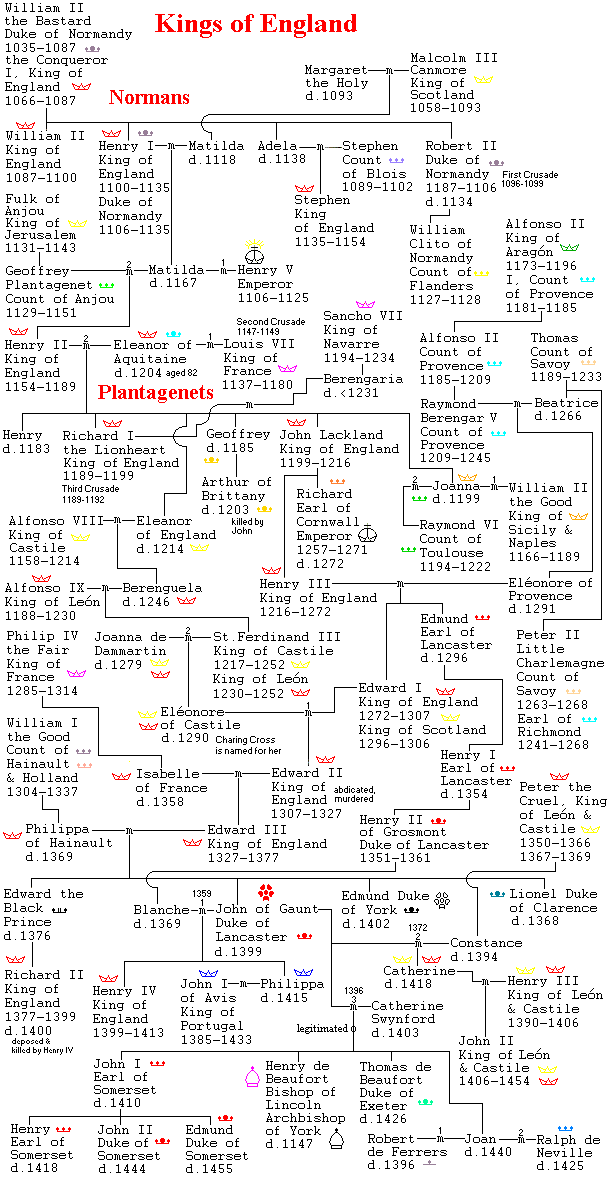
The Origins of English Individualism


absque timore ullo unusquisque sub vite sua sub ficu sua
a Dan usque Bersabee cunctis diebus Salomonis.
 Constitutionally, this gave England a head start over all the rest of Europe in the evolution of modern government.
 |
|---|
| Amelia, the new icon of English patriotism. The "spinless lot" were the Conservatives as well as Labour. None of them liked Brexit and wanted to make it seem to "fail." |
Nietzsche targets the Utilitarians, but we might gather that he may not understand that the principles of Jeremy Bentham were at odds with the previous tradition of natural rights and liberal individualism in John Locke, etc. -- mocked by Bentham as "nonsense on stilts." John Stuart Mill had tried to reconcile these incommensurable principles, with an effect that, however awkward or incoherent, was nevertheless influential.
Nietzsche, of course, had no use for any of it, certainly not for the general welfare (allgemeine Wohlfahrt), and abundance (comfort und fashion) for all, nor for the rights of individuals to maintain their dignity and autonomy against others. Indeed, Nietzsche says this is impossible: "There is, in short, an order of rank between man and man and hence also between moralities." Each individual "morality," as Thrasymachus would have said in the Republic, is in the interest of that individual, such that, "The demand of one morality for all means an encroachment upon precisely the superior men [die höheren Menschen]."
Nietzsche's aristocratic "superior man" creates his own values, and the servitude or slavery of others, especially women, is only natural. The acts and preferences of this person are only limited by the comparable power, not the rights, of others -- power that used to be signified by the sword carried by all 17th century nobility, ready to be drawn against any insult. Thus, der höhere Mensch, whom we might as well begin calling the Übermensch, is very different indeed from, say, the Confucian "superior man,"  , whose concern is what is right, not what benefits him. For Nietzsche, such "right" does not exist -- which may be why he called Kant "the great Chinaman," der große Chinese, of K nigsberg -- as it clearly does not in the natural law of the jungle.
The rights of the Englishman, such as the Declaration of Independence claimed, seconded by Edmund Burke, were being violated, motivated the American Revolutionary War. The principle, understood by all from Locke to Mill, was to secure rights of property and person that would eliminate a clash of individual "moralities," whose interests could be adjudicated at law -- hence the Biblical epigraph above, of "every man under his vine and under his fig tree," which precludes conflict, as long as property rights are enforced.
We detect no patience for this in Nietzsche, from whom we see only contempt for the "comfort and fashion," i.e. the consumer wealth, that Britain and America had delivered beyond any regime respected by Friedrich Nietzsche. Yet it is Nietzsche, not Locke, who is generally taught more at American universities, with the irony that the love for his practical Nihilism is coupled with social and political principles he would have detested, apart from an overwhelming devotion to power. One wonders just how far the ruthlessness and lies of modern dictators would have appealed to Nietzsche, even when embodied in terrifying rulers, like Stalin, whose ideology was the opposite of that recommended by Nietzsche.
The failure of male heirs to William the Conqueror's line resulted in some conflict, until Henry (II) of Anjou was firmly in place as the first of the Plantagenets. Henry brought with him additional French territory, and then obtained a large part of the whole Kingdom of France by marrying Eleanor, the heiress of Aquitaine and Gascony, who had recently divorced King Louis VII of France. This English "empire" in France dominated the history of both countries for some time thereafter.
The vicious and incompetent King John not only was forced by the nobility into recognizing rights long honored as the origin of English constitutionalism, but his loss of English possessions in France north of the Loire (hence "Lackland") put the French Monarchy on course for the unification and centralization of political power in France -- whose success made France the predominant power in Europe in the 17th century but whose drawbacks ultimately produced the French Revolution.
Meanwhile, some attention could be paid to the rest of the British Isles, where Ireland gradually came under English control, Wales was annexed by Edward I, and then Edward also briefly acquired Scotland, where he exploited offers of mediation in the succession dispute of 1290-1292. This episode is rather badly (even falsely) represented in the otherwise rather good movie Braveheart (Best Picture Oscar for 1995). There had been English interference in Scotland for some time, and the English had even blocked repeated requests by the Scots to the Pope for recognition by the Church of the Scottish Crown, so that the King could be crowned and anointed with a Christian rite. Scottish independence was finally assured when Robert the Bruce destroyed an English army, twice the size of the Scottish, at Bannockburn in 1314. The first King anointed by Papal authority was David II (1329-1370).
The actual source for this is cited by Alfred Znamierowski:
Actually, what was at issue were the crosses worn by the Crusaders, on their surplices (on the front going on Crusade, on the back returning), and not actual flags (although Whitney Smith himself illustrates the 1188 assignments with images of flags [op.cit., pp.44-45]). Znamierowski's treatment of this is inconsistent, as he says elsewhere,
And then he also says, "The oldest flag on record in the Mediterranean region is that of By Znamierowski's own account, then, the flag of Genoa, unmistakably shown in an illustration, antedates any crosses, whether flags or not, of England, France, Flanders, Portugal, or Jerusalem. It does not antedate, however, the First Crusade.
The red cross on white came to be identified as the The Genoese cross is thus not originally a Cross of St. George at all -- although there is a story about the red cross and St. George being brought back from the First Crusade (1099), which is possible. Wikipedia says that ships from London began using the red Cross on white in the Mediterranian in 1190 precisely to benefit from the protection of Genoa -- ask Marco Polo, who was captured by the Genoese navy -- the Doge was paid an annual tribute for the privilege of this use. Since Genoa became the ally of Constantinople in 1267 under the Palaeologi,
I wonder if the contemporary banner we see for The crosses in general are artifacts of the Crusades, and the particular popularity of St. George in the West was itself the result of Crusaders bringing his cult and legend back with them [cf. Whitney Smith, p.182]. Some people find this confusing, or disturbing. That the red cross on white, associated with St. George, had not always stood for England even seems offensive to some. But these familiar terms were not really established until the end of the 13th Century.
The 1188 meeting between Richard and King Philip, the choice of the colors was apparently a random assignment and did not involve any preexisting attachment of France, or of these colors, for St. George. Since St. George was not the patron of Genoa, the association of the red cross with the Saint is more likely to originate at the source with the Crusaders. It is noteworthy that the church of the English Varangians in Constantinople was dedicated to St. Nicholas and St. Augustine of Canterbury. We then face the issue of just how and when the red cross on white becomes associated with England in metropolitan usage. As the red on white cross has become distinctive of England, I begin to wonder to what extent it actually reflects the long history of English recruits fighting for Romania in the Varangian Guard. Indeed, if the Cross of St. George here originated with Crusaders in the East, Whitney Smith says that the red cross was not really prominent for another century [p.182, nota bene], while The Penguin Dictionary of Saints [1965, 1983] I might therefore entertain the speculation that what became the traditional coloring of the English Cross of St. George might actually have been derived from the Roman even more than from a Genoese usage. This would be a monument unlike any other to the history of the English involvement in Constantinople. Since most histories of England ignore the very existence of English Varangians, the connection of the Cross of St. George to them falls into a kind of secret history. The antipathy of some English historians for "Byzantium" thus stands in stark contrast to the history of an English participation in Romania and this coincidence, if not derivation, of the actual flag of England. Next, however, the Bourbon dynasty adopted its own color, white, for the Banner of France, sometimes with multiple fleurs-de-lis. White also became the color of French military uniforms, which may not seem very practical but was certainly no more conspicuous than the red coat of the British.
 With Richard the Lionheart's preparations for the Third Crusade, we get the beginning of the process that produces the traditional flag of England. On 13 Janaury 1188, Richard (not yet King) agreed with King Philip II Augustus of France and
  Philip I of Flanders that French knights would wear a red cross on white, the Flemish knights a green cross on white, and the English knights a white cross on red [Whitney Smith, Flags Through the Ages and Across the World, McGraw-Hill, 1975, p.45]. The colors for Flanders here did not catch on, but the crosses for England and France started a tradition that led to national flags for both.
The oldest known account of flags with crosses, the Gesta Regis Henrici Secundi by Benedict Abbas, tell us that on 13 January 1188 the Kings of England and France (together with their men) received a white and red cross respectively, while the Count of Flanders recieved a green cross. [The World Encyclopedia of Flags, Southwater, Anness Publishing, London, 1999, 2010, p.12]
The oldest flags with a cross are those of Portugal and the kingdom of Jerusalem. From 1140 to 1185 the Portuguese flag was white with a blue cross on a white field [sic]... The flag of the kingdom of Jerusalem under King Amalrich (1162-1173) displayed five golden yellow crosses on a white field. [op.cit., p.101]
 Genoa; the earliest illustration, dated 1113, shows it as white with a red cross" [ibid.p.13].
Cross of St. George, which today is how we see it as the flag of England -- something that is now coming into increasing use, when England often has sports teams separate from Scotland (which uses the Cross of St. Andrew). But St. George has been widely popular and is the patron of many places, including Barcelona, Portugal, Beirut, Georgia in the Caucasus, and various other states and cities. While the red on white Cross was used by Genoa and some other Italian cities, there is the complication that St. George is not the Patron Saint of Genoa (although this is sometimes said to be the case, as I have been doing previously) -- that is John the Baptist.
Romania actually reflects that alliance. In modern custom, the upper corner by the staff, the canton, is the key quarter, so the quartering we see (as shown by Whitney Smith) could be something used in the first place by the Genoese.
Genoa; the earliest illustration, dated 1113, shows it as white with a red cross" [ibid.p.13].
Cross of St. George, which today is how we see it as the flag of England -- something that is now coming into increasing use, when England often has sports teams separate from Scotland (which uses the Cross of St. Andrew). But St. George has been widely popular and is the patron of many places, including Barcelona, Portugal, Beirut, Georgia in the Caucasus, and various other states and cities. While the red on white Cross was used by Genoa and some other Italian cities, there is the complication that St. George is not the Patron Saint of Genoa (although this is sometimes said to be the case, as I have been doing previously) -- that is John the Baptist.
Romania actually reflects that alliance. In modern custom, the upper corner by the staff, the canton, is the key quarter, so the quartering we see (as shown by Whitney Smith) could be something used in the first place by the Genoese.
 There is the issue of just how and when the red cross on white becomes associated with St. George. The Saint, as a native of Lydda in Palestine, was popular in the Orthodox Churches (a cave near Beirut is still pointed out as the site of his slaying the dragon, although other places also claim that distinction), and the earliest known depiction of him slaying the dragon is from 11th century Cappadocia, but I am not otherwise aware of him being particularly iconic for the identity of Romania or Constantinople -- Byzantine histories have little discussion of such symbols.
 And these assignments persisted for some time. In the St. Louis Cathedral in New Orleans, in the illustrated life of St. Louis IX of France, the body of St. Louis, who died in 1270, is still shown draped in the red on white.
 One would have expected a church of English warriors to involve St. George, if St. George was already associated with England. He wasn't. Meanwhile, of course, what was symbolic of Richard and England were the heraldric yellow lions on red, which by 1195 were displayed in threes, as at left [note].
 its interpretation as an English symbol could well have been due to the English Varangians themselves, who would have fought under it for many years and picked up the cult of St. George just as the Crusaders did. It is attested that by 1277, the English cross had settled on the red on white coloring, and this was at the time of perhaps the heyday of English Varangians under Michael VIII -- who wrote that letter mentioning them in 1272.
says that George "may have been named the national patron when King Edward III founded the Order of the Garter under his patronage, c.1348" [p.146]. Whitney Smith adds, "The saint's position was enhanced in 1415 when, in his name, troops under Henry V won the day at the Battle of Agincourt" and then in 1419 the King ordered that "every man of what estate, condition, or nation that he be, of our party, bear a band of St. George" [p.182].
its interpretation as an English symbol could well have been due to the English Varangians themselves, who would have fought under it for many years and picked up the cult of St. George just as the Crusaders did. It is attested that by 1277, the English cross had settled on the red on white coloring, and this was at the time of perhaps the heyday of English Varangians under Michael VIII -- who wrote that letter mentioning them in 1272.
says that George "may have been named the national patron when King Edward III founded the Order of the Garter under his patronage, c.1348" [p.146]. Whitney Smith adds, "The saint's position was enhanced in 1415 when, in his name, troops under Henry V won the day at the Battle of Agincourt" and then in 1419 the King ordered that "every man of what estate, condition, or nation that he be, of our party, bear a band of St. George" [p.182].
 Meanwhile, the representation of France underwent its own transformations.
  The colors of the 1188 agreement reversed, and then red changed to blue. The "Banner of France" dropped the Cross and displayed the fleur-de-lis, which meanwhile had become symbolic of France. We see this and the cross surviving in the flag of the Province of Quebec in Canada.
 This complicated history was then swept aside by the French Revolution, which eliminated all the "junk of history" and adopted the now familiar Tricoleur, which multiplied, as symbolic of a Republic, for Belgium, Italy, and Ireland. The colors of the French flag, however, are often said to represent the Carolingians, with red, the Capetians, with blue, and the Bourbons, with white. I doubt that was the original conception, when monarchist symbols were otherwise vandalized or destroyed, including the savage desecration of Royal burials, even that of the poor exiled King of Armenia.
 |
|---|
| "The Battle of Poitiers," by Eugène Delacroix (1798-1863), 1830; King John about to be captured |
The French succession strictly followed the Salic Law, in which only male heirs counted. In those terms, Philip VI was legitimate, and Edward III was not. Edward also waited a while, not making his claim until 1337. This began the "Edwardian War," 1337-1360. The French suffered two stunning defeats, despite, at that point, apparently enjoying superior forces. Crécy (1346) and Poitiers (1356) devastated the French army, with King John II actually captured at Poitiers. The victories were in great measure due to the eldest son of Edward III, namely Edward, known as the "Black Prince" (d.1376). A celebrated commander, known both for chivalry and for the occasional betrayal and massacre. His own ideal of chivalry, curiously, seems to have been the great hero of ʾIslām, the Sulṭān Saladin of Egypt.
The second phase of the conflict was the "Caroline War," 1369-1389, named after Charles V (1364-1380) and continued by Charles VI (1380-1422). This was broadly successful for the French, and the Black Prince died in its early years. I was originally under the impression that his death was from cancer, but now I see dysentery. The Prince's death may have been more ominous for subsequent English history than for the immediate fortunes of war. His son, Richard II (1377-1399) was weak, and he had vigorous, ambitious cousins. Richard was dethroned and then murdered (1400) by his first cousin, Henry of Lancaster, who then became King Henry IV (1399-1413).
His son, Henry V (1413-1422), initiated the last phase of the Hundred Years' War, the "Lancastrian War," 1415-1453. With a spectacular victory at Agincourt (1415), it looked like the English might have the edge again. Charles VI of France had periods of mental illness; Henry made an alliance with the Dukes of Burgundy; and he even got an agreement that the French succession would pass to him.
| Lancaster | Stuart | ||
|---|---|---|---|
| Robert II Stuart | 1371-1390 | ||
| Henry IV | 1399-1413 | Robert III | 1390-1406 |
| Thames frozen for 14 weeks, 1410 | James I | 1406-1437 | |
| Henry V | 1413-1422 | ||
| Battle of Agincourt, 1415; gale wrecks 25 English fishing boats off Iceland, 1419 | |||
| Henry VI | 1422-1461 1470-1471 | James II | 1437-1460 |
| End of Hundred Years's War, loss of all English possessions in France, except Callais, 1453; Wars of the Roses, 1455-1485; 1st Battle of St. Albans, 1455; Battle of Wakefield, 1460; Battle of Mortimer's Cross, 2nd Battle of St. Albans, Battle of Towton, 1461 | |||
| York | |||
| Edward IV | 1461-1470 1471-1483 | James III | 1460-1488 |
| last vinyard in Mediaeval England, at Ely, closes, 1469; Battle of Barnet, Battle of Tewkesbury, 1471 | |||
| Edward V | 1483 | ||
| Richard III | 1483-1485 | ||
| Battle of Bosworth Field, 1485 | |||
| Tudor | |||
| Henry VII | 1485-1509 | James IV | 1488-1513 |
| Henry VIII | 1509-1547 | James V | 1513-1542 |
| King of Ireland, 1541 | |||
| Edward VI | 1547-1553 | Mary Queen of Scots | 1542-1567 d. 1587 |
| Mary I | 1553-1558 | ||
| Elizabeth I | 1558-1603 | ||
| Stuart | |||
| 1603-1625 | James VI of Scotland James I of England | 1567-1625 | |
| Thames freezes, first attested "Frost Fair," 1608 | |||
In the end, all English possessions on the Continent, inherited from the Dukes of Normandy, or the Dukes of Aquitaine, were lost -- except the city of Calais. Nevertheless, Kings of England continued to claim the Throne of France down until the Napoleonic Era, when support for King Louis XVIII of France would have been complicated by an English claim to the same office.
The consequences of the untimely death of the Black Prince and the deposition of Richard II were soon felt after the end of the Hundred Years' War. The House of Lancaster did not contain the only ambitious cousins descended from Edward III. This would be the period of the Wars of the Roses (1455-1485).
The conflict looks a lot like the earlier struggle in Japan between the Taira and the Minamoto clans, the Gempei War, 1180-1185. This was not directly for the Throne of Japan, but for who controlled the Throne. The red color of the losing Taira matches the red rose later associated with Lancaster, as the white of the Minamoto does with York. The Battle of Tewkesbury in 1471 was the equivalent of Dan-no-ura, but Lancastrian leaders were mostly executed, not killed in battle. King Henry VI was executed in the Tower of London.
The Wars themselves lasted from 1455 to 1485, but the initial action was really the deposition of Richard II in 1399 by his cousin Henry (IV). This began the tenure of the House of Lancaster, which reached its summit with the victory of Henry V over the French at Agincourt.
With England losing that war in 1453, the civil war proper got going with the struggle of the House of York to depose Henry VI. Initially, the considerations were reasonable enough. Henry VI was lacking an heir, and he was feeble minded or had bouts of insanity. The Heir Apparent was then Richard, the Duke of York, who also acted, more or less, as Regent. However, the Queen, Margaret of Anjou, then gave birth to a son, Henry had periods of clarity, and, all things considered, the Queen would have regarded herself as qualified as Regent, if one was needed.
Richard took this with ill grace, and he began to think that he had a right to the Throne regardless of the traditional legalities. This ended badly, when Richard was killed at the Battle of Wakefield in 1460, following the 1st Battle of St. Albans in 1455. After encounters that seemed more like brawls, this raised the stakes; and we can imagine Edward, the new Duke of York, voicing the equivalent of, "This means war." Battles in 1461 ended with Towton, where the Lancaster forces were really broken and the Court fled to Scotland. Subsequently, Henry was betrayed and captured by Edward; but the Queen, with a Prince of Wales along, revived the Lancaster cause. Two defeats in 1471, at Barnet and Tewkesbury, ended all that. The Queen was captured; the young Prince was executed, along with the third Duke of Somserset to fall to the Yorkists; and Henry, in the Tower of London, was murdered.
So in 1471, Edward IV, the third cousin of Henry, was secure on the Throne. We might reckon that the end of the Wars of the Roses; but the conflict finally really ends with some obscurity and controversy.
Edward's brother Richard (III) pushed aside the young Edward V and took the Throne for himself. Henry Tudor, Earl of Richmond, of dubious ancestry, upon whom fell the mantle of the Lancaster cause, after the death or murder, we might even say "extermination," of all the other Lancaster heirs, previously in exile, landed in England to dispute the succession. Richard seems to have been sufficiently unpopular that Tudor's forces more than matched the King's, and Richard III was killed at the Battle of Bosworth Field in 1485. Buried in an unmarked grave, later covered by a parking lot, Richard's skeleton was actually discovered in 2012. It had suffered ten wounds visible on the bones.
 |
|---|
| Amelia, the new icon of English patriotism. |
This all was a conflict that illustrated something important about English history. In France, for a long time Royal brothers receiving major fiefs resulted in the fragmenation of power, most disastrously in the case of the Valois Dukes of Burgundy, who very nearly detached their realm from France itself. In England, however, the conflict that resulted from the many sons of Edward III was always over the Throne. When the winner, Henry VII emerged, it was to enjoy the power of the unified state.
Henry Tudor was a (legitimated) member of the House of Lancaster on his mother's side. Richard was then painted in the blackest terms by subsequent Tudor historians, not to mention Shakespeare. Indeed, Shakespeare portays him as a hunchback, certainly relying on Mediaeval beliefs that such deformities betray some kind of sin. The young Edward V and his brother, Richard, Duke of York, sent to the Tower of London by Richard, were murdered; but whether this was done by Richard III or Henry VII is still a good question. No hunchback, from the examination of his skeleton, it turned out that the King did suffer from scoliosis, "curvature of the spine," a condition then exaggerated by his enemies.
DNA tests on the skeleton of Richard comfirmed his identity. But they also yielded a surprise. Richard was not the son of Richard, the Duke of York. His mother, Cecily, had snuck one in on her husband. When revealed, the uproar seemed to be over the apparent revelation that this whole branch of York was illegitimate. However, Richard and Edward IV were not twins. Edward had been born years earlier. So, unless Cecily had made a habit of births outside her marriage, the only problem was with Richard, who was her youngest child. Accusations of his illegitimacy had been made at the time, but they had been dismissed as Lancaster propaganda. Apparently not.
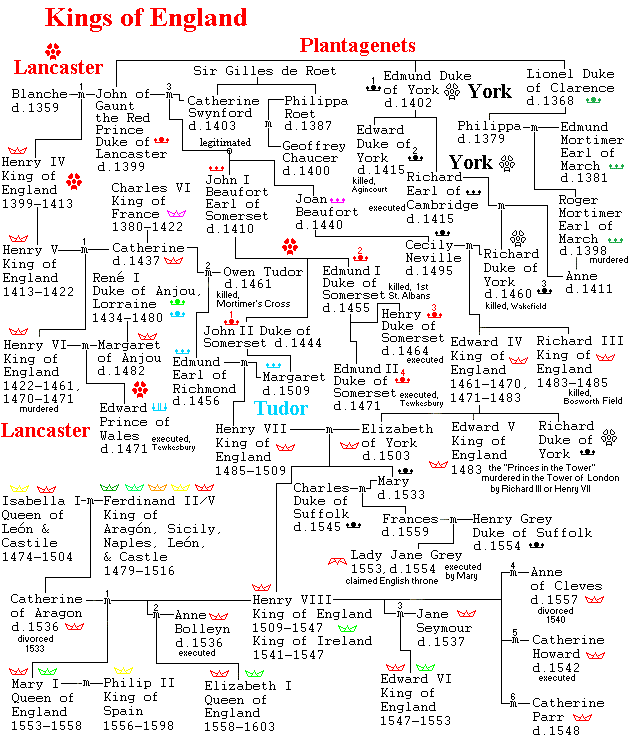
 |
|---|
| Jane Seymour, b.1951 |
No other heirs, of either sex, were subsequently produced by Edward's generation. Mary's marriage to Philip II of Spain was barren, and then Elizabeth did not marry at all. There is some irony in all this, since so much of the earlier conflicts resulted from Edward III fathering many sons. More than were needed.
The succession of Mary and Elizabeth had involved a glitch. The will of Edward VII condemned both of them as illegitimate and out of the Succession, with the added fear that Mary would try to restore Catholicism, as indeed is what she did try. Edward designated that the Succession should pass to his cousin, Lady Jane Grey. The Privy Council agreed; and when Edward died, Jane was duly announced to be Queen.
This didn't last long. Only nine days. Forces were gathering around Mary, and a threat of Civil War was looming. The Council chickened out, deposing Jane and proclaiming Mary to be Queen. Jane was kept in the Tower, until Mary had her executed, for "treason," which sounds very odd. The will of Edward VII apparently did not count.
Mary did try to restore Catholicism, burning Protestant leaders, and others (some 287), thereby earning her the name "Bloody Mary," and marrying Philip II, the leader of the European Catholic cause. The Privy Council continued its cowardly ways, along with Parliament and the Courts, in failing to resist Mary's judicial murders, indeed in facilitating them.
Meanwhile, Elizabeth lived in daily fear of being condemned for "treason" herself. In a marvelous scene in the movie Elizabeth [1998], Cate Blanchett receives a messenger from the Queen, half expecting it is her death sentence, only to be greeted as the Queen herself, since Mary has just died (of cancer).
Since Henry VIII's divorces produced a break with the Church of Rome, these family doings were all intimately intertwined with religious conflict. Elizabeth's reign represented a final repudiation of Rome and support for the Dutch Revolt against Spain.
The failure of the Spanish Armada, sent by Mary's old husband, Philip II, to conquer, or even to land in, England in 1588 was the first clue that England (through the Royal Navy) might become a Great Power. With the death of Elizabeth, the Throne passed to James VI of Scotland, a great-great-grandson of Henry VII through his daughter Margaret. James's mother, the deposed Queen Mary of Scotland, had been executed by Elizabeth, or she would have inherited England; and, as we know, Jane Grey had previously been removed, with similar finality, from the Succession.
The descent of English Kings through the wife of James, Anne of Denmark, and of Scottish and English Kings through his great-great-grandmother, Margaret of Oldenburg, meant that they are descendants, through the Kings of Denmark, ultimately from the Roman Emperor Constantine IX Monomachus (1042-1055). This is rarely noted in public discourse, although sometimes descent is falsely said to be from the Emperor Basil I (867-886). At least they get the right dynasty, the Macedonians. The genealogy is discussed below in relation to the many lines of descent of Queen Elizabeth II.
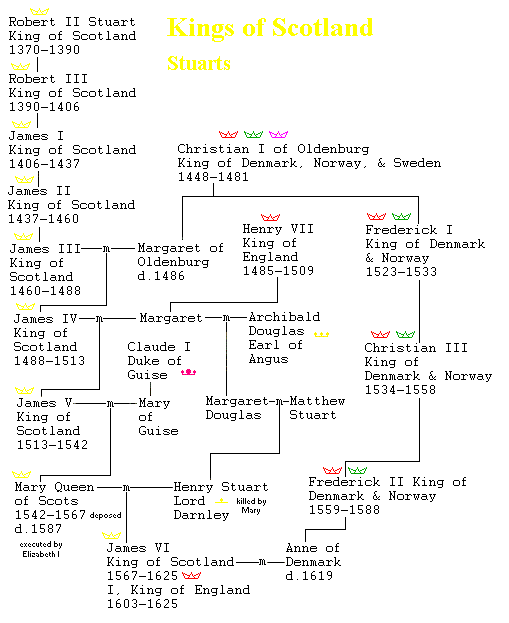
The disappearance of vinyards in England, which previously had competed with France at a level that aroused concern there, is one bit of evidence for the arrival of the Little Ice Age, which would involve a colder climate until the 19th century. Most vinyards were gone by the 1440's. Warming since the 19th century, although now creating alarm in political circles, has still not quite returned to the levels of warmth that were experienced in the 11th and 12th centuries (the Mediaeval Warm Period).
Between 1200 and 1600, i.e. from the later Plantagenets to the time of the Stuarts, the English language had been changing from Middle English, the language of Chaucer, to New English. One of the most conspicuous features of this was the Great English Vowel Shift, which I have considered on a separate page through the link. It was with the later Plantagenets, of course, that the Kings of England began speaking English rather than French -- though many of them were claiming to be Kings of France as well. The language of Shakespeare is New English, though I must confess I have a great deal of difficulty understanding it. That is not a problem a century later with John Locke, who often favors us with charming archaisms, but they pose no difficulty to intelligibility.
| Stuart | |
|---|---|
| Charles I | 1625-1649 |
| Civil War, 1640-1649; Commonwealth, 1649-1653; First Dutch War, 1652-1654; Protectorate, 1653-1660 | |
| Oliver Cromwell | Lord Protector, 1653-1658 |
| Richard Cromwell | 1658-1660, d.1712 |
| Charles II | 1660-1685 |
| Second Dutch War, 1664-1667; New Amsterdam acquired, becomes New York, 1664; the Plague in London, 1665; the Great Fire of London, 1666; Third Dutch War, 1672-1674 | |
| James II | 1685-1688, d.1701 |
| Glorious Revolution, James flees to France, 1688; Bill of Rights, 1689 | |
| [interregnum] | 1688-1689 |
| Mary II | 1689-1694 |
| William III | Stadholder of the Netherlands, 1672-1702 |
| 1689-1702 | |
| War of the League of Augsburg, 1688-1697; Battle of the Boyne, 1690; | |
| Anne | 1702-1714 |
| War of the Spanish Succession, 1701-1713; England and Scotland united as Great Britain, 1707 | |
) Cromwell's body was exhumed and desecrated, but his son Richard, cooperative with the Restoration, lived out his life unmolested.
Cromwell's body was exhumed and desecrated, but his son Richard, cooperative with the Restoration, lived out his life unmolested.
This is where the undercurrent of religion comes in, for Charles had become sympathetic to Catholicism and began to tilt towards France (with the help of a secret subsidy, including women, from Louis XIV) and against the Protestant Netherlands, which Louis had invaded (1672). Otherwise, the exuberance of the Restoration, and the infamous philandering of Charles, all look more libertine than Catholic.
Some sense of this can be gleaned from the movie Restoration [1994]. However, actor Sam Niell did not make a very good Charles II. Charles, very tall and dark, with long black hair (click on image for larger version), not to mention productive of multiple illegitimate children, would be more like a dead ringer for "shock jock" radio personality Howard Stern. I don't know what kind of actor Howard would make, but it looks like type-casting.
 |
| Nell Gwynne (1650-1687); Pray good people be civil, I am the Protestant whore. |
|---|
Charles is said to have converted to Catholicism on his deathbed; and then his openly Catholic brother, James II, became King. This produced the beginnings of modern political parties: The Tories, who were for James, and the Whigs, against him -- originally in the dispute whether James would even be allowed to succeed Charles.
While James talked of no more than toleration for Catholics, his actions soon were for the persecution and suppression of Protestants. This was more or less tolerable as long as James's heirs were his Protestant daughters, Mary and Anne; but when he fathered a (Catholic) son on his new (Catholic) wife, Mary of Modena, resistance began to stiffen. William of Orange, husband of Mary, landed with a Dutch Army, the English Army went over to him, and James fled -- a bloodless transaction consequently called the "Glorious Revolution."
With James gone, the wisdom of King Charles pays off. Despite the preferences of James, Charles required that his daughters be raised and then married Protestant. This is why the Dutch army that landed against James represented the legitimate succession; and Englishmen, like John Churchill, who began as a Tory retainer of James, could justify going over to it. Finding Catholic sympathy and support in Ireland (and, of course, from France), James was finally defeated at the Battle of the Boyne, 11 July 1690. 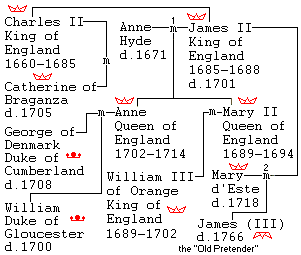
William could then go on to organize the great alliances against France in the War of the League of Augsburg (1688-1697) and the War of the Spanish Succession (1701-1713). These wars at least contained France, but more importantly exhausted her finances. This reduced French power for the rest of the century and finally led to the French Revolution.
Lack of heirs bedeviled the dynasty. William and Mary had no children, and speculation ranges from them not liking each other to William being a homosexual. But we don't know what the problem was. With Anne, the problem was not from lack of trying. She endured 17 pregnancies, where every single one of even the live births predeceased her. One boy, Prince William, looked very good during his childhood, but then died on the edge of puberty, at eleven. Meanwhile, James had a son and grandsons, but none of them would renounce the Catholic Church for the Church of England, which is really all they needed to do -- and, really, the rites are so similar that Anglican priests are even now accepted as priests of the Catholic Church on conversion. "Bonnie Prince" Charles landed in Scotland and led the Highlanders to ruinous, if romantic, defeat. It is not clear how he intended to square his Catholicism with the militant, grim, Calvinist Kirk of Scotland. The final Stuart, Henry (IX), became a Catholic priest and Cardinal; and so the male Stuart line ended with a celibate. See the Stuart succession through female heirs below.
 This might remind us of similar dynastic problems in Mediaeval Romania, where the celibate Emperor Basil II, for all his heroism and accomplishments, nevertheless allowed his nieces to become nuns, rather than marry and provide for the continuation of the Imperial family. After the death of Basil's brother, Constantine VIII, Zoë left the convent and married a suitable candidate for the Throne.
She was already too old to have children, so with his death she subsequently married twice again to legitimize Emperors. When she allowed the nephew of her second husband, Michael IV, to succeed him, the vicious and ungrateful beneficiary, Michael V, attempted to remove Zoë as co-ruler. The City of Constantinople and even the Varangian Guard rose against him. He was blinded and sent to a monastery. This is romanticized and muddled in King Harald's Saga. In the confusion, Zoë's sister Theodora was persuaded to ascend the Throne herself, although she never married. After Zoe and then her third husband, Constantine IX, passed away, Theodora reigned alone for a year as the last of her dynasty, just like Anne in Britain.
 |
|---|
| Elizabeth Thompson, Lady Butler (1846-1932), "Scotland for Ever!" 1881; Leeds Art Gallery; depicts the cavalry charge of the Royal Scots Greys at the Battle of Waterloo, 1815; "Scotland Forever!" is also what the music "Scotland the Brave," Alba an Àigh, is sometimes called. The tune was first attested in 1878. Many examples played at YouTube, with bagpipes. |
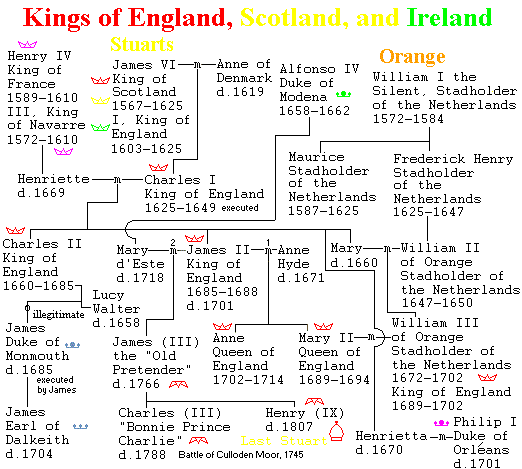
With a sad irony, considering her failed pregnancies and the crippling gout she endured, Anne was the last British Monarch who exercised what were believed to be the healing powers of the Royal Touch -- though by Anne's day this was supposed only to be effective for scrofula, tuberculosis of the lymph glands. Presumably, this is not what afflicted her children -- although it did afflict Samuel Johnson (1709-1784), who was touched by the Queen but not healed.
Unwilling to countenance the Catholic Stuart Pretenders (the "Jacobites"), Parliament, by the Act of Settlement in 1701, designated George I of Hanover, a great-grandson of James I through his daughter Elizabeth and granddaughter Sophie, as the Heir of Britain. For all Anne's Tory sympathies, which led her to turn on both Marlboroughs, she never opposed this "Hanoveran Succession."
 One of the most interesting Stuart marriages is in the doomed Jacobite line. A granddaughter of the Polish King John III Sobieski (1674-1696) marries the "Old Pretender," James III, which means that the romantic "Bonnie Prince Charlie" is Sobieski's great-grandson. Sobieski, denied a dynasty by the self-destructive institutions of Poland, would thus also be denied a dynasty in Great Britain. Charles had a illegitimate daughter, who had an illegitimate son. This added nothing to the Jacobite cause.
While the male line of the House of Stuart ended with the grandsons of James II, there are nevertheless other heirs. Henrietta, the youngest daughter of Charles I, married Philippe I, Duke of Orléans. She has living descendants, as we see in the genealogy at left.
This takes us on a bit of a fun ride through the royal houses of Europe. Henrietta's daughter married Victor Amadeus of Savoy, who, as the result of the War of the Spanish Succession and its consequences, becomes the first King of Sardinia. When Henry "IX" Stuart dies in 1807, Charles Emanuel IV of Sardinia, who had actually abdicated by then, becomes the presumptive Stuart Pretender.
The House of Savoy follows the Salic Law, so the succession of Sardinia jumps from Victor Emanuel I to a collateral line. For a Stuart Heir, however, the Salic Law doesn't apply. Victor Emanuel's daughter, Maria Beatrice, marries the Hapsburg Duke of Modena. A daughter of one of her sons, with the very Hapsburg name of Maria Theresa, then marries the actual King of Bavaria, Ludwig III.
Ludwig, however, will be the last King of Bavaria, losing his throne in the aftermath of World War I. His son, the Crown Prince Rupprecht, grandson, and great-grandson could thus be Pretenders to Bavaria, but even their title as "Duke of Bavaria" is by courtesy only. It involves no legal basis or claims. The current "Duke," Franz, is nevertheless the Heir of the House of Stuart.
Of course, the Hanoveran Succession to the Throne of England and Scotland is through Elizabeth, the sister of Charles I. Elizabeth was the aunt of Henrietta, but ordinarily the Succession would not revert to her unless Henrietta were without heirs. She is not. Thus, Franz of Bavaria could claim to be the legitimate Heir to England and Scotland. Evidently he doesn't; but any remaining Jacobites do affirm his legitimacy. Beginning with Charles Emanuel IV, I have marked Stuart Heirs with a numbered, yellow icon of a reversed crown. This also turns up (unexplained in place) in the separate genealogies for Sardinia, Modena, and Bavaria.
Because the House of Wittelsbach follows the Salic Law, Sophie is not the Heiress of Bavaria. That will be her cousins, descendants of Prince Rupprecht's brother Franz, who continue the male line.
An unlikely Jacobite would be Peter Geach (1916-2013), who was a student at Oxford in 1937, and a convert to Catholicism. Peter organized a group of "Jacobite rebels" to dispute the succession of George VI, in favor of the former Crown Prince and the current Heir of Bavaria and Stuart, Rupprecht Wittelsbach. He told a journalist, "We hope for the restoration of the true monarchy with the same power which the Stuarts had before 1688." After the abdication of Edward VIII, Geach said, "I'm afraid there will have to be some violence -- though a lot can be done by propaganda. If the King cannot be restored except by bloodshed, blood must be shed." All this constituted treason; and Geach might have been in some trouble if everyone had not regarded him as a crackpot (reminding us again of Grand Fenwick). Nevertheless, he was still a Jacobite when applying for exemption from British conscription in 1940. He also contended that Britain was not engaged in a "just war," using arguments that had been formulated by Elizabeth Anscombe, also a Catholic convert, whom he would marry in 1941. His exemption was granted, and, working in service as a lumberjack, he learned Italian and Polish from refugees and prisoners. But Geach was not a pacifist. Perhaps because his mother was Polish, he tried enlisting in the Polish army and even tried obtaining Polish citizenship. These efforts failed, perhaps fortunately, considering the fate of Poland after the War.
Meanwhile, Rupprecht did not get along with the Nazis and by 1939 ended up in exile in Italy, a guest of the King. Captured by the Nazis in 1943, he and his family were actually sent to the Dachau concentration camp, where he was liberated by the Americans. Living out his life back in Bavaria, there was some Monarchist sentiment, but not enough to make any real difference. He was accorded considerable honors at his death in 1955. Meanwhile, I am not aware that he ever had any dealings with, or even any awareness of, any English Jacobites. Similarly, I am not aware of any English connections currently for Duke Max or Princess Sophie, although there definitely is awareness of them on the Internet as the Stuart Heirs. Since there is a movement for Scottish independence, I would also expect some involvement of Stuart loyalists.
After the War, Peter Geach's work, much like his wife's, seems like a odd combination of Aquinas, Frege, and Wittgenstein; and his principal academic appointment was at the University of Leeds, 1951-1981. I have no indication whether his Jacobite sentiments, if they were ever really serious, continued or not. He would have had the chance to pay his respects to Rupprecht after the War, but I am not aware that he did. Subsequent Thus, there are different versions of when William Pitt the Elder was, if ever, Prime Minister. These assignments are based on Langer's An Encyclopedia of World History, mentioned above, the Britannica descriptions, the assignments and descriptions at the Encyclopaedia Britannica (which lists Palmerston as a Tory, which he certainly was not after 1830), the Encyclopedia of World History edited by Patrick K. O'Brien [Facts on File, 2000, p.522], and The World Amanac and Books of Facts, 2001 [World Almanac Books, 2001, p.490]. The latter two sources list Coalition ministries, which were especially common in wartime. Be that as it may, Lloyd George was a Liberal, and Winston Churchill was a Conservative, and that is how they are given here.
 Since Franz never married, his own heir is his brother, Max. Max has a daughter, Sophie, who is actually married to the Heir, Alois, of the Principality of Liechtenstein. Alois is currently the Regent of Liechtenstein for his aging father. But the son of Sophie and Alois, Joseph Wenzel, is now the Heir both to Liechtenstein and to the House of Stuart. Modern Jacobites might entertain the fantasy of uniting the Thrones of Great Britain and Liechtenstein. A bit like The Mouse That Roared [book 1955, movie 1959]. After all, they already speak English in Grand Fenwick.

 The Union of England and Scotland in 1707 produced the "United Kingdom," with a single Parliament, and the Union Flag, at left. A separate Scottish Parliament has been recently reestablished, even as in 1996 the Stone of Scone was returned to Scotland and is now kept in Edinburgh Castle.
 Formal Union with Ireland in 1801 added the familiar diagonal red stripes to the present Union Flag. These were based on red "saltire" cross of the Fitzgerald family, now a very old Irish family (cf. John Fitzgerald Kennedy) but originally among the Normans who conquered Ireland for England in the 12th century. Thus, the cross is usually not viewed as a genuine Irish national symbol. Sometimes Anglo-Irish families other than the Fitzgeralds are cited as the origin of this cross.
 Kings are listed
| Hanover | |||
|---|---|---|---|
| George I | 1714-1727 | Prime Ministers | |
| Whig/Liberal | Tory/Conservative | ||
| Sir Robert Walpole | 1721-1742 | ||
| George II | 1727-1760 | ||
| War of the Austrian Succession, 1740-1748 | |||
| Jacobite Revolt, Charles Stuart defeated, Culloden Moor, 1745 | |||
| Lord John Carteret/
Earl of Wilmington | 1742-1743 | ||
| Henry Pelham | 1743-1754 | ||
| Duke of Newcastle | 1754-1756, 1757-1762 | ||
| Duke of Devonshire | 1756-1757 | ||
| Seven Years War, 1756-1763 | |||
| George III | 1760-1820 | Earl of Bute | 1762-1763 |
| George Grenville | 1763-1765 | ||
| Marquis of Rockingham | 1765-1766, 1782 | ||
| William Pitt the Elder | 1766-1768 | ||
| Duke of Grafton | 1768-1770 | ||
| Lord Frederick North | 1770-1782 | ||
| American Revolution, 1775-1783 | |||
| Earl of Shelburne | 1782-1783 | ||
| Duke of Portland | 1783, 1807-1809 | ||
| William Pitt the Younger | 1783-1801, 1804-1806 | ||
| Henry Addington | 1801-1804 | ||
| Lord William Grenville | 1806-1807 | ||
| Abolition of Slave Trade, 1807 | |||
| Spencer Perceval | 1809-1812 | ||
| Earl of Liverpool | 1812-1827 | ||
| George IV | 1820-1830 | ||
| Last "Frost Fair" on frozen Thames, 1814 | |||
| George Canning | 1827 | ||
| Viscount Goderich | 1827-1828 | ||
| Duke of Wellington | 1828-1830, 1834 | ||
| Catholic Emancipation, 1829 | |||
| William IV | 1830-1837 | Earl Grey | 1830-1834 |
| First Reform Bill, 1832; Abolition of Slavery, 1833 | |||
| Viscount Melbourne | 1834, 1835-1841 | ||
| Sir Robert Peel | 1834-1835, 1841-1846 | ||
| Victoria Empress of India, 1876 | 1837-1901 | ||
| Great Irish Potato Famine, 1845-1849 | |||
| Abolition of Corn Laws, 1846 | |||
| Lord John Russell | 1846-1852, 1865-1866 | ||
| Earl of Derby | 1852, 1858-1859, 1866-1868 | ||
| Earl of Aberdeen | 1852-1855 | ||
| Crimean War, 1854-1856 | |||
| Viscount Palmerston | 1855-1858, 1859-1865 | ||
| Jewish Emancipation, 1858 | |||
| Second Reform Bill, 1867 | |||
| Benjamin Disraeli | 1868, 1874-1880 | ||
| Purchase of Suez Canal shares from Egypt, fincanced by loan from Rothschilds, 1875 | |||
| William E. Gladstone | 1868-1874, 1880-1885, 1886, 1892-1894 | ||
| Occupation of Egypt, 1882; Third Reform Bill, 1884; First Home Rule Bill, 1886; Second Home Rule Bill, 1893 | |||
| Marquis of Salisbury | 1885-1886, 1886-1892, 1895-1902 | ||
| Boer War, 1899-1902 | |||
| Earl of Rosebery | 1894-1895 | ||
George III, however, wished to reassert Royal power, and was able to engineer a Tory coalition of the "King's Friends" in Parliament. Thus, Tory governments predominated in the eras of the American and French Revolutions, both of which had Whig sympathizers, though some Whigs, like Edmund Burke, liked the former but not the latter.
By 1830, the Whigs were reemerging as the Liberal Party, while the Tories, no longer simply supporting the King, were reorganizing as a modern Conservative Party, which often passed Liberal reforms, such as Catholic Emancipation in 1829 and abolition of the Corn Laws in 1846.
In 1845 a blight hit the potato crop in Ireland. While potatoes, brought by the Spanish from Peru, were originally viewed with suspicion in Europe, they turned out to be more nutritious than the staples of the Mediaeval European diet (oats, barley, rye, etc.). Introduced into Ireland, they soon became the basis of improved diet and expanding population. Yet this was a perilous condition.
Most of the Irish were tenant farmers engaged in little better than subsistence agriculture. Until Catholic Emancipation, Irish Catholics were not allowed to own land, which means they had no incentive and little opportunity to improve agriculture or accumulate capital. This left them in precarious dependency on the potato, with the further dangers of any monoculture.
When the crop failed (20% of potatoes are still lost to blight today), they had nothing. In the industrialized world now, a farmer who loses a crop may lose some money, may even lose the farm, but he is unlikely to lose his life. This is because the agriculture workforce is actually small (now less than 2% of the workforce in the United States), surplusses elsewhere can make up for local losses, and farmers or their families, let alone anyone in the population at large, usually have no difficulty finding alternative sources of income.
In Mediaeval Europe, none of these ameliorating circumstances held true. Surplusses were small, overland transport was ruinous, and there was little in the way of employment or income apart from agriculture (which held 85+% of the workforce).
Relatively little had changed from Mediaeval conditions in Ireland -- indeed, a century earlier, Scotland endured similar conditions -- yet in its response, the British Government was often confused about what this meant. The Peel Government understood that the abolition of the Corn Laws and the establishment of Free Trade would lower the price of food. It did.
But when you are an Irish tenant farmer with no money as well as no food, it doesn't matter how low prices fall. You can't pay anything. Well meaning British figures had a good understanding of how a modern economy would operate, but they often failed to understand that the advantages enjoyed by England, where there had been no famine in centuries, did not help in Ireland. Nothing much could ever be done about Mediaeval famines, and nothing needed to be done in modern economies; but Ireland fell between the stools in that respect, belonging to circumstances where Mediaeval evils could be assuaged by modern wealth from elsewhere. Since those evil circumstances would pass in time (although Ireland remained underdeveloped until the 1990's), some British opinion was that nothing extraordinary really needed to be done.
The result was a very nasty muddle, which left over a million Irish to starve and at least a equal number to flee the country. There are still accusations that this was a deliberate policy of genocide against the Irish people. The famine is also still used as a reproach against laissez-faire Capitalism, to which the British Government was now ideologically committed. The latter is closer to the truth, and in these terms British economic thinking is certainly vulnerable to the reproach that the subsistence conditions in Ireland were not amenable to what otherwise would have been the restorative functions of the Market. Yet the Government did not consistently assume that the Market would take care of the Irish. Provisions of famine relief and public works came and went, without the scope, purpose, or focus that were necessary. Even the Sultan of Turkey sent food to Ireland, to the embarrassment of the British.
Ireland was not alone in providing a school for the British understanding of famines. The Monsoon failed every so often in India, resulting in crop failures and famine. Before the British had any governing role in the country, they were aware of these periodic calamities. There had never been much anyone could do about them, and the impression that they were Acts of God, if not the Judgment of God, persisted (in Ireland also) well after conditions had changed and opportunities for alleviating starvation developed.
India posed greater challenges than Ireland, since many large areas long remained remote from modern communication or transportation. Thus, when the Monsoon failed in Orissa in 1865, the principal difficulty was understanding that famine was even occurring. The Viceroy, Lord Lawrence, had sent Sir Cecil Beadon to investigate; but Sir Cecil, through inexperience or incompetence, reported that there was sufficient food on hand. In 1866, Lord Lawrence, at the summer Hill Station of Simla, was reduced to discovering the reality of the famine because of reports in Calcutta newspapers.
Even though rice was then shipped in from Burma, the return of the Monsoon meant that Orissa was cut off by land, from rising rivers, while ships were unable offload in the stormy conditions. When supplies got through in September, many, pehaps a million, had already died, i.e. on the scale of the Irish Famine [cf. Sir Penendrel Moon, The British Conquest and Dominion of India, Duckworth, Indiana University Press, 1989, pp.805-807].
Confusions similar to what occurred in the Irish Famine occurred when the Monsoon failed in 1874 in Bihar and north-western Bengal. Nevertheless, the Viceroy, Lord Northbrook, was acutely aware of how matters had been botched in Orissa (and perhaps in Ireland also), and a massive amount of rice was brought in, mainly from Burma, in a timely fashion. With the more remote and isolated areas still out of reach of railways, "thousands of bullock carts, mules and ponies were mobilised to transport the grain" from the railheads [Moon, p.826]. Since there was subsequently little starvation, some critics then wondered if the effort had been necessary in the first place, especially as the Government was left with a surplus of over 100,000 tons of rice, which were sold off at a loss.
 |
|---|
| Amelia, the new icon of English patriotism. |
Some would not believe the counterfactual that famine would have occurred without the relief. Also, observers noticed that grain was being exported while the Government was importing it: "So for many days 'the strange spectacle was seen of fleets of ships taking rice out from the Hooghly [i.e. at the Port of Calcutta] and passing other ships bringing rice in'" [Moon, p.827]. This was exactly what was seen during the Irish Famine, that, incredibly, food was being exported from the country even while thousands of Irish were starving.
It was proposed in both cases that the export of food simply be prohibited, which would result in its price falling in the local market. That the British did not do this in either case can now be chalked up to laissez-faire ideological rigidity, which it probably was. But in these circumstances, the rigidity may have been justified. First of all, even if the local price of food were driven down, subsistence farmers still may have no money at all, which means they are still not going to be able to buy food. They still need the free food of famine relief. Second, from the experience of famines that have occurred in Africa in our own day, we notice the unfortunate dynamic that free food from international charity can drive the local price of food so low that local farmers who are able to produce are put out of business.
This means that when the conditions of the famine have passed, even productive local agriculture may have suffered from abandonment. Thus, allowing the export of food during famines, may mean that more famine relief is needed, but it also means that farmers may remain in business, ready to produce after the famine and the relief are gone, by taking advantage of higher prices in the export market. Thus, the remedy for famines was not to fool with the Market (except to have Free Trade), but to charitably provide for those in primitive conditions who will starve without relief, while allowing agriculture to find its best price (i.e. through international Free Trade).
If one wanted to ideally manipulate the market, the solution would be to fix prices to farmers high (and buy some of the famine relief food directly from them) but fix prices to consumers low (or zero, in the famine). The resulting gap, however, would need to be made good by the Government -- a practice not unlike farm subsidies in American politics, which protect farmers but are compensated for by food stamps to sufficiently poor consumers -- all supported by the taxpayers. Abolishing both would be best economically, even though it would put out of business farmers operating at the margin, who unfortunately may be politically accomplished rent-seekers.
A Government with a great deal of experience with famine was that of China. The Chinese had no commitment to laissez-faire capitalism. Quite the opposite. It was the duty of the government to "Manage the world, aid the people," 


 . Yet there was a saying in China, "there are no good policies for famine relief" [Timothy Brook, The Troubled Empire, China in the Yuan and Ming Dynasties, Belknap Press, Harvard, 2010, p.122].
This is because of the hard experience of unintended and perverse consequences that were encountered over time. Distributing money for relief meant that corrupt local officials would be tempted to steal it. Distributing grain meant that prices could be driven down and local produce would be shipped away to where there were higher prices. Consequently:
The idea that the commercial economy does a better job of redistributing grain than does the state became a key element in the administrative reform that Qiu Jun (1420-1495) laid before the Hongzhi emperor in 1487. In the same vein, Lin Xiyuan (ca. 1480-ca. 1560), who undertook to reformulate famine policies in the sixteenth century, argued against the expectation that the state should provide relief. [ibid. p.125]
If, after centuries of experience, the Chinese were still trying to get it right in the Ming Dynasty, it is perhaps not surprising that the British experienced their own muddles in Ireland and India.
If the Conservatives sometimes furthered the Liberal agenda, the Liberals sometimes helped further Conservative goals. For instance, Benjamin Disraeli flattered Queen Victoria by making her Empress of India in 1876. This was regarded by Liberals as a dangerous aping of the recently (1871) created German Empire. Imperialism did not represent anything good to the Liberals, since it involved subjugating foreigners abroad and undermining civic equality at home. However, the Liberals were also particularly solicitous of the British taxpayer.
These principles came into conflict in 1882. In 1875 Disraeli had purchased Egypt's shares in the Suez Canal Company to help the Khedive out of debt. This famously involved Disraeli soliciting a loan from Lionel Rothschild, the first Jewish Member of Parliament, for £4 million. Lionel asked what the security or collateral for the loan would be, and Disraeli answered that it would be no more than the full faith and credit of the British Government. That was good enough, although the Liberals complained that such a loan had not been authorized by Parliament.
But the Egyptian government continued to be fiscally incompetent, and domestic turmoil was beginning to endanger Britain's stake in the Canal. This put the great Liberal Prime Minister, William Gladstone, in a dilemma. Either let revolution or anarchy endanger the British investment in Egypt, or engage in a bit of Imperialist adventuring. Adventuring won out, and Gladstone put a British Army into Egypt, suppressing a nationalist revolt.  The French, who had always owned the other shares in the Canal Company, got cold feet. This made Egypt a de facto part of the British Empire, but the de jure fiction of local rule and Turkish sovereignty was preserved until 1914. The British Consul General, particularly Evelyn "Over" Baring, Earl of Cromer, effectively ruled Egypt, but the Turkish flag flew and Egyptians carried Turkish passports.
 Meanwhile, a local revolt in the Sudan, long ruled from Egypt, had begun in 1881. Gladstone saw no reason why Britain should help preserve Egyptian rule over the Sudanese, so in 1883 he decided to withdraw the garrison and appointed Charles Gordon to manage the business. Gordon, known as "Chinese Gordon" after he helped the Chinese government suppress the Taiping Rebellion, or "Gordon Pasha,"
  from his Turkish military rank, had already been governor of the Sudan, down to 1880. He knew the country well, and this may have been Gladstone's miscalculation. Gordon did not want to abandon the Sudan to the forces of the messianic Mahdī.
Gordon refused to leave Khartoum. Gladstone did not want to send help. In the face of public uproar, Gladstone gave in, but it was too late. Gordon was killed when the Mahdī stormed Khartoum on 26 January 1885. The relief force was only two days away down the Nile -- newspapers had actually already prepared drawings of Gordon welcoming the relief force. Gordon's death was a sensation, one of the supreme moments in British Imperial history, and the Government fell.
Readers of Sherlock Holmes will recall the picture of Gordon that hung at 221B Baker Steet. In 1899, on the high tide of Imperialism, the Sudan was reconquered by Lord Kitchener, with a young Winston Churchill along. The large army of the Mahdī's successor, the Khalifa, was mowed down with machine guns.
One of the great English political issues of the later 19th century was Irish Home Rule. The Irish Parliament had been dissolved in 1801 and Irish members elected to the British Parliament. Catholic emancipation in 1829 even meant that Irish Catholics could be elected to Parliament. However, the Parliamentary program of the Irish Members quickly became Irish independence. William Gladstone's Liberal government fell over a Home Rule Bill for Ireland in 1886 (having just returned to power after the fiasco of the Sudan), splitting the Liberal Party into Home Rule and Unionist factions.
After a second Home Rule Bill was defeated in the House of Lords, Gladstone resigned in 1894 from his fourth and last ministry. A Home Rule Bill was finally passed in 1914, but its suspension for World War I resulted in open Irish rebellion in 1916 and years of terrorism by the Irish Republican Army (IRA).  When Irish independence came, it was compromised by partition, as the Protestants of Ulster secured a separate regime for themselves.
The "Red Hand of Ulster" flag was official until the Ulster Parliament was itself abolished in 1972, in British response to the "troubles" in Northern Ireland, which began with Catholic civil rights demonstrations in 1968 and expanded into IRA bombings and Protestant retaliation. Although several peace plans have been formally accepted by Britain, the Irish Republic, and most factions in Ulster, it is not clear that the situation is anywhere near real resolution. The recent economic awaking of the Irish Republic itself may help undercut some of the basically Marxist inspiration of the IRA (which was always illegal in the Irish Republic).
| Saxe-Coburg-Gotha (Windsor) | |||
|---|---|---|---|
| Edward VII | 1901-1910 | Prime Ministers | |
| Liberal | Labour | ||
| Tory/Conservative | |||
| Arthur J. Balfour | 1902-1905 | ||
| Sir Henry Campbell-Bannerman | 1905-1908 | ||
| Herbert H. Asquith | 1908-1916 | ||
| George V | 1910-1936 | ||
| Third Home Rule Bill, 1914; World War I, 1914-1918 | |||
| David Lloyd George | 1916-1919/ 1919-1922 | ||
| Irish Easter Rebellion, 1916; Irish Rebellion, 1919-1921; Irish Free State, 1921 | |||
| Occupation of Constantinople, 1918-1923 | |||
| Andrew Bonar Law | 1922-1923 | ||
| J. Ramsay MacDonald | 1924, 1929-1931/ 1931-1935 | ||
| Stanley Baldwin | 1923-1924, 1924-1929, 1935-1937 | ||
| Edward VIII | 1936 | ||
| Women's Suffrage, 1928 | |||
 | |||
| George VI | 1936-1952 | Neville Chamberlain | 1937-1940 |
| Winston S. Churchill | 1940-1945, 1951-1955 | ||
| Clement R. Attlee | 1945-1950/ 1950-1951 | ||
| Partition of India, Independence of India & Pakistan, 1947; Independence of Ceylon, 1948 | |||
| Elizabeth II | 1952-2022 | Sir Anthony Eden | 1955-1957 |
| Harold Macmillan | 1957-1959/ 1959-1963 | ||
| Sir Alec Douglas-Hume | 1963-1964 | ||
| Harold Wilson | 1964-1970, 1974-1976 | ||
| Edward Heath | 1970-1974 | ||
| James Callaghan | 1976-1979 | ||
| Margaret Thatcher | 1979-1983/ 1983-1987/ 1987-1990 | ||
| John Major | 1990-1992/ 1992-1997 | ||
| Tony Blair | 1997-2001/ 2001-2005/ 2005-2007 | ||
| Gordon Brown | 2007-2010 | ||
| David Cameron | 2010-2016 | ||
| Vote to Leave European Union, 2016; opposed by both Conservative and Labour Governments, which dishonestly obstruct implementation. | |||
| Teresa May | 2016-2019 | ||
| Boris Johnson | 2019-2022 | ||
| Elizabeth "Liz" Truss | 2022 | ||
| Windsor-Mountbatten | |||
| Charles III | 2022-present | Thatcherite promises, sabotaged by the Ruling Class and her own Party. | |
| Rishi "Richie Rich" Sunak | 2022-2024 | ||
| Keir Rodney Starmer | 2024-2026 | ||
| Andrew Murray Burnham | 2026 | ||
The children and descendants of Victoria and Albert then married into most of (it seems) the royalty of contemporary Europe. This can be inspected in part on the genealogies above and below, but the whole story can be seen on a popup.
Albert's German origin eventually became something of an embarrassment when Britain and Germany went to war in 1914. As anti-German feeling rose, George V adopted the name "Windsor" for the Royal Family. The future Queen Elizabeth II married Prince Philip of Greece, who renounced his claims to the Greek Throne and adopted his mother's family name, "Mountbatten."
The Mountbattens were another German family, the Battenbergs, that had also changed its name in Britain during World War I. Charles, now the present King, is the first King of the House of Mountbatten. Charles regarded the World War II hero, Lord Mountbatten of Burma, his great-uncle, as his "honorary grandfather." Queen Elizabeth indicated her preference that it be styled the House of "Windsor-Mountbatten"; but what Charles calls it is presumably up to him.
In one line, Queen Elizabeth II is in the 40th generation from Charlemagne. This can be examined in a popup. In the male line, Elizabeth is from Saxony (hence "Saxe-Coburg-Gotha"), which is the House of Wettin. Her grandfathers back to Burchard, Duke of Thuringia (907-909), can be examined on this popup. This only covers 34 generations, failing to reach back to Charlemagne by about a century. It may only be 33 generations, because of an uncertainty about whether there was a second "Thimo" at the beginning of the 12th century.
Elizabeth's descent can also be traced back to the Macedonian Dynasty of Romania. This is often said to mean that she descends from the founder of the Dynasty, the Emperor Basil I. However, I can only verify a line that begins with the Imperial in-law, Constantine IX Monomachus, as can be seen on this popup.
We get 31 geneations from Constantine, or 32 if we go by way of Mary Queen of Scots. Surprisingly, this line of descent also includes King Harold II of England, who was killed at Hastings by William the Conqueror. We thus do not expect Harold to be an ancestor of subsequent monarchs of England. However, Harold's daughter Gytha married Vladimir II of Kiev, through whom the descent from Constantine passes.
Charles's private life, like many earlier Royals (George IV, Edward VIII), has served to stain his image. His 1981 marriage to Lady Diana Spencer, a cousin of Winston Churchill, seems to have been arranged mainly to procure a virgin. They never looked quite right together and ended up with an actual divorce in 1996. Later it turned out that almost simultaneously with the wedding Charles was falling in love with someone else. This was Camilla Shand, who had married in 1973 and become Camilla Parker-Bowles. Camilla also divorced in 1996.
Unfortunately, Diana, sweet and glamorous, and always a darling of the media, was killed in an auto accident in 1997. With the taudry details of the Camilla-Charles affair, and the tragedy of Diana's death, this rather cast a pall over the whole business. There was also the problem of Charles marrying a divorcée, the very thing that had cost Edward VIII the Throne. Nevertheless, people, and the Queen, got used to the idea, and Charles and Camilla married in 2005. With their luck, the wedding had to be postponed a day because the funeral of Pope John Paul II. At their age, we are not likely to expect children from Charles and Camilla, so the throne will actually pass to Diana's son William, a handsome and golden boy with more the cast of his mother than his father. Some think that Charles should renounce the Throne in William's favor.
In 2011, William married a commoner, Catherine Elizabeth "Kate" Middleton. William and Catherine had been involved for some years and have even gone through a break-up and reconciliation. Hopefully this means that they are a proper, loving couple, unlike Charles and Diana, and will have a successful marriage. Although already balding, William still has an appealing look, and he and the lovely Kate make a handsome couple. If they come to the throne at a reasonable age, the Monarchy will at least have a very good look for the Press. If they represent the Line of Succession, this will now go back in patrilineal descent, by way of Greece and Denmark, to the early Counts of Oldenburg. This can be examined in a popup. As discussed, this line has been renamed more than once, twice to adopt the matrilineal houses, of Mountbatten and then Windsor.
As an actress, Meghan Markle, now the Duchess of Sussex, had a memorable part on the television series Fringe (2008-2013). She was introduced in the first episode of the second season and appeared in at least one subsequent episode. It looked like she was being groomed to become a permanent presence on the show. One of the earlier characters, "Charlie Francis," an FBI agent who had worked closely with the rest of the cast, had recently been killed off. Meghan Markle's character, "Amy Jessup," also an FBI agent, was clearly slipping into the role that "Charlie Francis" had vacated, complete with details about how she had found out about what the "Fringe Division" of the FBI was doing. She had inserted herself informally into working with the other agents. In the original viewing of the series, I only remembered her as having a bit part in one scene. Looking at it now, it was a lot more than that. But then she abruptly disappeared from the show, without reference or explanation. Indeed, in the episode with her last appearance, it was not even a speaking part. Since the role filled by Francis and Jessup was not replaced for another year, I wonder what ended up happening. Markle would have been a nice addition to the show.
One never knows in Hollywood. Mysterious things happen for which there is never a public explanation. Why did Linda Fiorentino not continue as a character in Men in Black II (2002)? Why was Bill Schulz suddenly gone from Red Eye (2007-2015)? Why did Rip Torn (1931-2019) only have an uncredited cameo in Men in Black III (2012)? We've never learned. How this can work in Hollywood, against a background of betrayal, envy, jealousy, dishonesty, and petty crime, is explored by David Mamet, with fury and bitterness, in his fine 2008 movie Redbelt, starring a brilliant Chiwetel Ejiofor. In Fringe, there may have been some conflict, incident, or judgment about Markle to which we will never be privy. Or it may have just been, innocently enough, about money.
 If Prince William married an interesting commoner, his brother Prince Harry has gone one further. In 2018 Harry married an American divorcée, Meghan Markle, an actress who is of mixed race. Joan Rivers once joked that Queen Elizabeth was the "whitest woman" in the world. Well, if the Succession, for some reason, goes through Prince Harry, there may be a Monarch of England for whom that would no longer be true. Meghan and Harry already have a son, Archie Harrison, born 6 May 2019.
 |
|---|
| Amelia, the new icon of English patriotism. |
The actor who played "Charlie Francis," Kirk Acevedo, did not actually leave the show, since his character was still alive in the alternate universe that figures in much of the plotline of the series. We see him again, quite a bit. Also, in the other universe there was an agent, "Lincoln Lee" (actor Seth Gabel), who ended up actually in command of the Fringe Division, but who we never saw in our universe. However, a "Lincoln Lee" FBI agent was introduced in our universe in the third season, and then he seems to be more permanently added in the fourth, as the result of his own intrusive initiative, just like with "Amy Jessup." So "Charlie Francis" has a replacement, from existing cast members, after all.
So the budget may just have not had room for a permanent Meghan Markle. But it is a shame. At least we got a good look at her. She seemed like a fine and engaging actress. I liked her.
With Harry and Meghan, they make a handsome and (apparently) loving couple, but we are not far from Hollywood here, and Royal marriages lately seem no more permanent than a lot of high profile Hollywood ones. Brad and Angelina are now gone with the wind. And Harry already has a bit of a wild reputation. So I hope it is the real thing and we will be seeing a happy family for a good while. It works for me.
As it happens, Harry and Meghan may still be good, but life with the Royals was not their cup of tea. It is not clear what all was going on; but the couple got the idea that they would like Hollywood better, and that they could parlay their celebrity into an independent income. Whether this will work out remains to be seen -- although it is off to a start that looks misconceived if not stupid. Neither Harry nor Meghan had previously made money just from being famous, like some other underachieving "celebrities." Even the Kardashians, although a mystery to us all, actually had a show, where they appeared on camera. I can't say why people watched it, but it did make money, like other shows. I doubt that Harry and Meghan will appear as the "Real Royals of Brentwood"; and it is not clear how, without their royal stipend, they are supporting themselves now.
Unfortunately, Harry and Meghan's venture into Hollywood and independent celebrity would not be working out well, especially after they decided to trash their relatives, the Queen, and the experiences in the Royal Family. It seems foolish to turn against the institution and the people who are the only reason for their celebrity in the first place; and, frankly, neither of them seems talented enough in their own right to develop entertainment careers independent of their titles and origin. Since I rather liked Meghan in Fringe, I am genuinely sorry to see it. They have both now come to look like narcissistic and perhaps arrogant fools.
By the 1970's, Britain was being called by some the "Sick Man of Europe," on analogy to the 19th century Ottoman Empire (a bitter irony, since British policy in the 19th century had succeeded in preventing the Empire from being overthrown by Egypt or conquered by Russia). The main problem was the "British Disease," namely labor unions which absolutely froze innovation in industries and which perpetuated money losing government industries, like coal, which had been nationalized by the Laborites after World War II. Britain was turning into a stagnant Soviet kind of economy.
 The problem with socialism is that eventually you run out of other people's money. The problem with socialism is that eventually you run out of other people's money.-- Margaret Thatcher |
 The trouble with socialism is that it would take too many evenings. -- Oscar Wilde |
Margaret Thatcher, the "Iron Lady," came to office and completely turned this around, actually breaking unions and privatizing state industries. What used to be the industrial heartland of England, in the North, became a Rust Belt, and the South became the center of growth, innovation, and Tory voting strength.
Thatcher became the longest serving Prime Minister of the 20th century, only to be deposed through an internal Party coup. The work was left unfinished, with welfare state white elephants, like the National Health Service, left untouched, though even now British unemployment is far from the double digits familiar in Euro-socialist France and Germany.
The bland and supine John Major could live off Thatcherite capital for another seven years, until well earned electoral catastrophe in 1997. The Labor Party, which had been openly and insanely pro-Soviet in the 1980's, has been transformed into a close copy of Bill Clinton's dissimulating, Trojan Horse Democratic Party, whereby socialistic goals could be masked with simple paternalism -- which means, appallingly, that paternalism now appeals to both American and British voters. Nevertheless, like Clinton, Blair has done a creditable job of keeping the British economy in reasonable shape, poised between booming Ireland and stagnant France. Despite brief furry over high gasoline prices, which in Britain cannot be blamed on private "corporate greed" (prices are fixed by the government, despite North Sea oil, at the second highest rate in the world, almost twice the world average), Blair was resoundingly reelected in 2001 and the Conservatives reduced to a rump.
The collapse of the Conservatives curiously coincides with the social consequences of decades of "progressive" policy in Britain. One aspect of this can be found in Life at the Bottom: The Worldview That Makes the Underclass by Theodore Dalrymple [Ivan R. Dee, Inc., 2001], where the irresponsibility and criminality encouraged and subsidized by the welfare state is exposed by a psychiatrist who works in a Birmingham hospital and prison. One hardly knows whether to laugh or cry at the tales of violence, folly, and hopelessness.
British crime now outpaces the United States in all categories except murder, though that category is growing rapidly. In tandem with the willingness of criminals to commit crimes, and the ideological disinclination of the state to punish them, has been the project of disarming the citizenry. This is examined in Guns and Violence: The English Experience by Joyce Lee Malcolm [Harvard University Press, 2002]. While before the early 20th century, when the murder rate had been declining steadily since the Middle Ages, there were really no gun control laws in England, and killing a person who was in the commission of a felony was justifiable homicide, now the British have not only been prohibited from owning guns, or even carrying "offensive" [i.e. defensive] weapons, but they have effectively been deprived altogether of the right of self-defense -- the kind of right that English law and philosophers had always said a person could not be deprived of. Yet now, there has been one case of a man sentenced to prison for having a couple of knives in his car -- which he used to cut the string on newspaper bundles as part of his job. In another case, a homeowner who held two burglars with a toy gun was arrested when the police arrived, for threatening and frightening the burglars.
Guns, thoroughly prohibited, now are involved in an increasing percentage of crime, as they are apparently smuggled in from elsewhere. Australia has experienced a similar dynamic after new draconian restrictions on gun ownership. The results of these "progressive" social experiments in Britain (and Australia) stand as a cautionary tale in the face of welfare statists and gun-control advocates in the United States. Since there has been little in the way of second thoughts on the part of such advocates either in Britain or America, it becomes more obvious that their agenda follows more from a desire to render citizens helpless and the state powerful than from their own stated purposes.
One response to the increase in crime has been to propose abolishing historic protections concerning double jeopardy, self-incrimination, and even habeas corpus. These unbelievably vile proposals certainly further the project of creating a police state, and so are fully consistent with the tendency of earlier attacks on rights of armed self-defense. Whether they effectively address crime is perhaps irrelevant. If that were really the concern, well, we know what the laws were like in Britain when crime was steadily declining for decades. Restoring them is not an option, not because they didn't work, but because they give too much power to citizens vis à vis the state.
In 2018, for the first time ever, the murder rate in London surpassed that of New York City. This wasn't even mainly due to guns, but to an increase in the use of knives -- such as the knives used by a terrorist to stab people on Westminster Bridge. As we might imagine, one British politician has consquently proposed a systematic dulling of kitchen knives in all of Britain. Perhaps knife sharpening will rate a life sentence. This serves to highlight the truth that "progressive" politics doesn't want to acknowledge, that crime is a cultural phenonomen, and not a function of the availability of weapons -- which is why crime rates among people from India in Britain are far higher among Muslims than among Hindus (with Sikhs in between), a very uncomfortable truth that the bien pensants treat as bigotry and slander.
In the United States, crime went up in the '60's as gun laws began to be passed. Crime eventually went down, especially in States that had no restrictions on non-criminals owning guns and that even provided for "shall issue" conceal carry laws, which allowed any non-criminal to carry a concealed weapon. Crime in Britain has stealing increased, as noted, under a regime of virtual firearm prohibition. Yet in the age of Sherlock Holmes, when there were no guns laws, and Holmes would instruct Watson to carry a concealed weapon as they would go out on a dangerous case, crime was declining steadily. Yet we also know from the Holmes stories that it was a crime to be in possession of "housebreaking tools," which seems rather vague.
When I returned to London with my wife in 2005, all of Downing Street was blocked off with iron gates, and the police presence involved more people than I would have thought of counting. We could not even get within sight of the door of 10 Downing Street. The difference, of course, was Terrorism, where fanatical Jihadists in Beirut, Israel, and elsewhere had adopted the tactic of suicide attacks, first with vehicles full of explosives, later with concealed suicide vests. Consequently, public buildings began to be fortified. In the United States, the White House became surrounded with concrete barriers and closed streets, gravely altering the feel of the City. A later tactic was for a terrorist just to drive a vehicle through crowds on sidewalks or, at it happens, closed streets. Now, from London to New York, barriers of concrete and steel posts protect sidewalks and other pedestrian ways -- especially after incidents of lunatics, not just terrorists, using the tactic. Although for many years looking like the Bill Clinton of Britain (without the philandering and perjury), Tony Blair, with a moderate but pious leftism, found himself in the uncomfortable position of the loyal ally of George W. Bush in the overthrow of Saddam Hussein in Iraq. After the 9/11 attacks Blair, indeed, did not want to join France (again) and Germany in appeasing what was shaping up as a new form of fascism in militant Islam -- a fascism already waging war on the cheap through international terrorism. Blair was not going to be the Neville Chamberlain of the 21st century. This was a wise thought, but as no good deed goes unpunished, it made Blair the target, along with Bush, of the fury of the Left, which has effectively become the ally of Islamic fanaticism -- the marriage of anti-globalization and the Sharīʾah. While this threatened to end Blair's career, things had been looking up since the reelection of John Howard in Australia and Bush himself in the 2004 Presidential election. The ire of the Left has not abated, but they were playing a poor hand. Now Blair has won reelection in 2005, though with a reduced majority, against muddled Conservatives and an anti-war Labour opposition some of whose members, it now appears, had been receiving money from Saddam Hussein.
Where Britain originated the Industrial Revolution and became the "workshop of the world" in the 19th century, its decline since then has been out of proportion to its decline in resources. Perhaps no one expects Britain to be a "superpower" when there are states, like America, Russia, China, etc., that are vastly larger. Yet the British economy actually is larger than that of Russia or China -- and still about three times larger than the former Imperial Crown Jewel of India. Well, most of the problem is that people no longer believe in the advantages of the Victorian Era, i.e. the classical liberalism -- free markets as well as social tolerance -- articulated in the course of Britain's ascendency by people like Adam Smith, John Stuart Mill, and Herbert Spencer. In a way, they didn't even believe it at the time. After all, being "in trade" is not something the ambitious Englishman ever really aspired to. Being a member of the "better sort," a "gentleman," meant not having a regular trade or profession and having a living off of rents or endowments.
Nothing shows this more clearly than the old meanings of "amateur" and "professional," which originally signified the disinterested (good) and the mercenary (bad), respectively, rather than the incompetent (bad) and the accomplished (good) as they do now. Capitalist Britain thus always suffered from an internal struggle between utility and privilege. The British class system was not essentially a Marxist polarity of workers and capitalists, for real industrialists and financiers were themselves members of the "working class" to those who did not need to make a profit or put in a working day to make a living. A proper "living" made itself.
 Especially striking is the tale that young hoodlums who tattoo themselves with swastikas often don't even know who the Nazis were, what they did, or when -- the product of the kind of politicized but incompetent government education also familiar in the United States. The British, who once were famous for a polite, civil, and non-violent society, now are among the leaders of the industrial world in crime and are especially well known for the rude and riotous soccer fans who regularly terrorize European cities that host games.
 The official residence of the Prime Minister of Britain is the apparetnly modest house at 10 Downing Street. When I was first in London in 1970, I wandered down there, and found the scene in the photo at right. We see no more than a couple of police officers outside the door. Two young tourists, my impression was that they were Americans, asked me why everyone was standing around looking at that door. They didn't know that this was where the Prime Minister lived.
) Where Britain suffers by comparison is with its European peers, like Germany, France, and Italy, which differ little in size and resources. It suffers by being so comparable, having lost any of the real moral, cultural, legal, and political advantage it had at the height of the Victorian Era.
Where Britain suffers by comparison is with its European peers, like Germany, France, and Italy, which differ little in size and resources. It suffers by being so comparable, having lost any of the real moral, cultural, legal, and political advantage it had at the height of the Victorian Era.
 |
|---|
| Amelia, the new icon of English patriotism. |
To those who barely knew how to make a living, whether like the indigent and parasitic Karl Marx or the genuinely privileged, society would be better off without the money grubbers and drudges (and, well, Jews) whose motives and methods where probably neither noble nor, they imagined, really necessary. The class that made Britain so unique and powerful thus was squeezed between the disdain of the "better sort" and the resentment of those who understood neither business, production, nor finance but thought that they understood it well enough to do without. The class that made the Industrial Revolution was not squeezed out of existence, to be sure, but it lost the respect and admiration it was owed.
Now one often aspires to better oneself merely through politics, the continuing poisonous modern fruit of Rousseau, the French Revolution, and Marx, or by dropping out into the uncouth, nihilistic, anarchistic riot evident among Britain's notorious soccer fans and their ilk. The bourgeois solidity and earnestness of the Victorian Era now is commonly taken as either sinister or a joke, but sadly the joke is only on modern Britain, which has lost its birthright.
In the 2010 election, Labour had definitely worn out its welcome, but the Conservatives tried to get by with vague generalities. But then it didn't help Labour when Gordon Brown called an old lady a "bigot" (into what he thought was a dead mike) just because she asked a question about immigration. The wild card turned out to be the Liberal Democrats, whose leader, Nicholas Clegg, made the Labour and Conservative leaders look bad in the debates that were held between them. Clegg's appeal may have been instrumental in denying both Labour and the Conservatives a majority in the new Parliament. With a plurality of the seats, Conservative David Cameron has become Prime Minister, but in coalition with Clegg and the Liberal Democrats.
The origin of the Liberal Democrats was itself in a coalition between the venerable Liberal Party, which hasn't had a Prime Minister since 1922, and the Social Democrats, who split off from Labour in the 1980's, when that Party had essentially become pro-Soviet.  That in itself may have been an example of what we might call "Thatcher Derangement Syndrome," where Mrs. Thatcher's success drove the Leftist opposition insane -- not unlike the "Bush (now Trump) Derangement Syndrome" that has recently turned the American Democratic Party into a kind of pro-Soviet, pro-Islamic Terrorist, and anti-American party itself (which unfortunately obtained power in both the Presidency and the Congress in 2008 and then again in 2020 and has been able to implement its vicious socialist agenda). What effect the Liberal Democrats would have on the conduct of the Government remained to be seen -- nothing really came of it. With its Social Democrat element, it was not a pure Classical Liberal influence. Either way, some conflict could be expected with the Conservatives.
The British expected Boris to revive and grow the British economy, after leaving the European Union, with more Margaret Thatcher-like measures, i.e. tax cuts and regulatory relief.
That is not what they got. Boris was suddenly a born-again Climate Change warrior, like Arnold in California and Macron in France, both of whom were elected with positive economic expectations. Instead, the voters got attacks on energy, more taxes, and all the heavy economic weight of government.
Suddenly, Boris was no longer a Thatcherite Conservative, and it seemed like he was hardly even pretending to be one. Britain was overwhelmed with the worst of "woke pieties," including inflation and soaring energy prices. It has been said that for "the last 12 years of Tory governance," we have seen "a leftward tilt that culminated in the Johnson fiasco of ruinous climate pledges and tax increases." The Tories became "another party of redistribution instead of standing as Britain's party of prosperity" [cf. "Foreign Desk: Truss' Tough Task," New York Post, September 6, 2022, p.27].
On top of that, Boris embraced the ruinous economic lockdowns that the Left prescribed for the Wuham Covid Pandemic, furthering their agenda of destroying small business, to fulfill the pledge of Karl Marx that Capitalism would do that -- but then didn't. So now the State can do it. Pubs across Britain are warning that they may go out of business because of energy costs. Then, in the midst of the lockdowns Boris threw and attended parties at 10 Downing Street, violating the prohibitions that he had put in place for everyone else. Although largely symbolic, this outraged people almost more than anything more substantial.
Boris had come to seem so empty, broken, and useless that people began to wonder what had happened to him. In 2020, he had indeed contracted Covid, and afterwards he did suddenly seem different, like the Chinese Virus was a bioweapon that had invaded his mind with Leftist propaganda. Whatever it was, Boris's tenure collapsed in failure and protest, especially from his own party. Beginning with so much hope, promise, and trust, Boris Johnson has to have been one of the biggest, and most astonishing, disappointments in British political history. It is stunning.
So in 2022, the Conservatives have now replaced Boris with Liz Truss, who begins, again, with Thatcherite promises. Whether she has the will and gumption to follow up on that remains to be seen. The promise that we saw with the election of Donald Trump in 2016 and of Boris Johnson in 2019 now is in eminent peril of being totally destroyed by the Left, who are equiped with the Chinese Communist playbook to destroy all political opposition and create a One Party State, like in California. Economic collapse and crime just doesn't matter to them; and they have conceived the Satanic project of mutilating children and invading women's private spaces with biological men, many of whom are rapists. So Liz Truss has her job cut out for her.
We should pause to reflect, however, on the disaster of Boris Johnson. Johnson came to office with an extraordinary amount of political, moral, and personal capital, and with a dominant position in Parliament. Yet he squandered all of it, and his Ministership collapsed in utter failure and betrayal. It staggers the mind, and it is hard to imagine many other examples of a political leader who so dramatically effected his own downfall. Margaret Thatcher was stabbed in the back by her own Party, but Boris Johnson stabbed himself in the back.
After such a along life, the final blessing for the Queen was a quick and easeful death. Here, she is still standing, even with a cane. Liz will also be distinguished by being the first Prime Minister since Winston Churchill to serve under two monarchs.
Liz is off to a good start by immediately allowing fracking in Britain, which means that domestic energy production now may help mitigate the mess than Boris Johnson made of energy policy. The now King Charles may not be happy with this, as more than a bit of a Climate Change warrior himself, but his power does not extend beyond offering advice.
For his faults, Charles is a dignified and personable character. He enjoys meeting crowds and shaking hands. He can't go wrong with that. But it will seem strange to have a King again instead of the Queen. Seems rather Mediaeval now. While he apparently has occasionally wondered whether he should reign as "Charles," it was announced within an hour of the Queen's death that this was the name he would use. Some wondered if the nature and fates of Charles I and Charles II may have been too much for the continuation of the name. But the judgment of history has pretty much been that Charles I was murdered and that Charles II was a rather good King -- as well as being a lot of fun. Our Charles is not likely to be as much fun, and a lot of the old fun might not be tolerated anyway. Charles seems happy with Camilla, and there aren't going to be any Nell Gwynnes.
Liz didn't last, becoming one of the shortest serving Prime Ministers ever. The Ruling Class didn't like her, which shows us what has happened to Britain's Conservative Party since Margaret Thatcher. One complaint was that Liz's tax cuts were not "funded." Since tax cuts pay for themselves, complaining about them being "unfunded" (where the Left is perfectly happy to just borrow for their spending) is no more than a Leftist talking point, which tells us where it is coming from.
But this got financial markets to "panic" and Liz couldn't take it. She was replaced with Rishi Sunak, derisively labeled "Richie Rich," who is an Establishment technocrat and globalist, gushing about "digital currency," which will enable governments to monitor the spending of all citizens -- especially if they are buying things that are not "environmentally friendly." And we're going to raise taxes again. So this is a disaster. Liz was stabbed in the back, and British voters will likely decide that they might as well elect Laborite communists, who are at least honest about what they will do -- i.e. destroy the lives of Britons and let Putin conquer Europe.
There seems to be a trend with Western voting. Politicians can manifestly betray their voters and their trust and not only get elected, but reelected. In France, Macron, who sparked a whole popular movement against him, nevertheless was reelected as President. In the United States, the Democats, who manifestly hate America, do not believe in Constitutional government or civil rights, and who promote crime and the pauperization of Americans, somehow avoided the electorial wipeout that they so richly deserved in the 2022 elections. The usual suspects in California, Illinois, and New York voted for crime, corruption, poverty, and racism, but they took over the State governments of several States that had held out, somewhat, against them. Fortunately, Florida and Texas didn't give them in inch.
Thus, while Iranians and the Chinese protest for freedom, and the Ukrainians fight for their very existence against the Russians, Western voters want their lives and their nations destroyed, generally on the basis of Marxist ideologies like "Critical Race Theory," to the extent that any real causes can be discerned. Otherwise, it is bewildering, almost sounding like a Freudian "Death Wish" instead of any sensible understanding of events. As Moon Zappa said in "Valley Girl" [1982]: "Yeah, right; Hurt me, hurt me; I'm sure!" This is the modern voter, or at least what the modern politician wants voters to be like.
And certainly, the "college educated" voter is more likely to want to be a slave of the state, even a sex slave of the state (i.e. the government, with unlimited power, can f*ck them whenever it wants), because that is what colleges teach them now, under the fiction that the police state somehow is their police state. When these elites have someone killed by criminals, i.e. the militia of the Democrat Party, they can comfort themselves that they deserve it, as payback for their "privilege." At this point, they probably do. Unfortunately, they are not in general the victims of crime, which is largely visited on the minorites who are supposedly protected by "progressive" politics. At the same time, the "college educated" have now turned out to be neo-Nazi anti-Semites, rejoicing that the Terrorist organization Ḥamās killed, raped, and mutilated hundreds of Israelis on October 7, 2023. The rot at American universities has suddenly ruptured, enabling everyone to see how corrupt and vicious "higher education" has become.
Update: 2022; Boris, Liz, & Richie
 Boris Johnson, a political maverick with disordered hair, became Prime Minister in 2019 after a crushing defeat of the all-but-communist and anti-Semitic Labour Party. He also achieved a large majority in Parliament. In the end, however, he squandered his mandate and put his Conservative Party into an awkward position.
 When Liz Truss was formally made Prime Minister by Queen Elizabeth II, neither knew that the Queen only had two days to live, or that Liz would be the 15th and last Prime Minister to serve under her.
 |
|---|
| Amelia, the new icon and "meme" of English patriotism, actually derived from a government propaganda "game," Pathways, which demonized patriotism and conservative principles as the kind of "extremism" that leads to terrorism (not Islamic terrorism, of course). The Amelia character represented an "extremist" influence on students, which, of course, immediately made her the heroine of English patriots. Media are now flooded with parodies of the "game" and avatars of Amelia, in AI and cartoons, sometimes in Japanese, of all things. |
In a curious coincidence, days of riots followed the stabbing deaths of three girls at a July 29 Taylor Swift-themed dance class in Southport. Since the police did not disclose the identity of the perpetrator -- which is often their practice when they think that public reaction may be negative -- rumors immediately spread that it was a Muslim immigrant; and mobs in various locations began attacking Muslims and mosques.
When the police finally did disclose the identity of the stabber, it was the son of African parents from Rwanda, named Axel Rudakubana, with his religion and motive otherwise unknown. This did not necessarily help, since much of British resentment is against immigrants in general, many in the country illegally, which the "Conservative" government had been favoring, much like the Biden Administration in the United States.
Since the Labour Government will be no more strict than the "Conservative" about immigration, the response of the Establishment in Britain is to condemn the rioters, and the public sentiment behind them, as "far-right" extremists, and racists too. Many of them may well have been, but public resentment is widespread; and, obviously, "Conservative" and Leftist agreement on the issue has left no legitimate representation for the public.
However, Nigel Farage, who led the Brexit Party from 2019 to 2021, was just elected to Parliament under the new "Reform UK" Party. Since Farage is an articulate and resolute leader, this may prove to be the way get around the corruption and faithlessness of the "Conservative" Party. Meanwhile, Labour will have its chance to further the destruction of the United Kingdom, as Democrats want to do to the United States.
Extraordinarily, rioters in Belfast were both Catholic and Protestant, together, waving both Irish and British flags. Indeed, it is heartwarming to see something that brings old enemies together.
  |
|---|
 |
Below at left are images that are a parody of the Macintosh ad. Instead of "Big Brother," we have Keir Starmer, and the young woman is our very own Amelia, with her purple hair, although otherwise dressed like the woman in "1984." From the stills, we can guess that she will throw her hammer and explode the image of Starmer, awakening the zombie-like audience of prisoners. It is high time.
Meanwhile, Starmer had decided to use a new, steep inheritance tax to destroy, not the old aristocracy, but..... farmers. The tax on aristocrats had been used by Labour after World War II to break up the wealth of aristocrats, who actually were often not all that wealthy, which we see in aristocrats, like the Duke of Marlborough, marrying American heiresses, but who might have a good bit of land.
 |
|---|
| Amelia burning Starmer's photo, echoing a similar image from Irān. |
So land had to be sold, which included a lot of old country houses. When many of these ended up in the hands of the Government, which had no real use for them, they didn't by themselves add much value to the Treasury. The idea now that this needed to be done to family farms was gratuitous and senseless, and it set off a revolt.
Tractors were used to block market warehouses all over the country. Supermarkets had to close from lack of food. But the public supported the farmers nevertheless. Starmer had to back down -- not to abolish the tax, would be to denature the ideology of Labour, but to just raise the limit of the value vulnerable to taxation. It was all pointless, vicious, and stupid. Biased news reports, of course, said that this "cost the Government money," when all it did was limit the power of the Government to steal. But we know that is the way the Left thinks: If you keep your money, which is properly all theirs, you have withheld it from them. It is a government that is all theft and predation.
Keir Starmer finally ran out of support in the middle of 2026; and a New Prime Minister, Andrew Burnham, was installed on July 20. The Reform Party had been winning local and bye elections; and another new party, Restore, also looks to have appeal. The lesson that Burnham seems to take from all this is: More Socialism. His very first statements were about nationalizing industry. Since the British economy hasn't been doing all that well, Burnham's answer is to return to the post-War doldrums by crushing free enterprise. He explicitly rejects "Thatcherism," i.e. doing things like cutting taxes. Heaven forbid. Well, if Americans are electing Communists these days, why not?
What he would do about the issue of both Reform and Restore, i.e. illegal immigrants and Islamism, seems to have been unstated. The leader of Reform, Nigel Farage, was caught in some kind of scandal, which I can't say I understand. He resigned from Parliament but plans to run again for his same seat. The leader of Restore, Rupert Lowe, has come out explicitly to deport anyone illegally in the UK. This is an issue across Europe and in the United States.
Vigilante groups are beginning to form to interfer with landings by aliens and with the government accepting such aliens, housing and feeding them. Labour, of course, ignores mass demonstrations against these practices, as "Conservative" governments did previously. Thus, many in Britain begin to think that vigilantism and civil disobedience are the only recourse for the citizens, since the Government doesn't need to call an election until 2029. Of course, strictly speaking, a Vote of No Confidence, or a unilateral Act by the King, could require an earlier election. It is not clear where the King's sympathies lie, although we know he has bought into Climate Alarmism.
The Children of Queen Victoria & Prince Albert
Descent of Queen Elizabeth from Charlemange
Male Descent of Queen Elizabeth from Burchard of Thuringia
Descent of Queen Elizabeth from the Emperor Constantine IX Monomachus
Dukes of Buccleuch, Grafton, & St. Albans, 1663-Present
Dukes of Marlborough & Earls of Spencer, 1702/1765-Present
Dukes of Berwick & Fitzjames, 1687-Present
Dukes of Devonshire, 1694-Present
Bibliography and Suggested Reading
The Sun Never Set on the British Empire
British Coins before the Florin, Compared to French Coins of the Ancien Régime
The full passage from Ordericus Vitalis looks like this in the 1854 translation of Thomas Forester, with the sections in red that correspond to the quoted translation above. The occasional expressions in Latin are drawn from The Ecclesiastical History of Orderic Vitalis, Volume II, Books III and IV, edited and translated by Majorie Chibnall [Oxford Medieval Texts, Clarendon Press, 1969, 1990, 2002, pp.202-204]:
This passage has two footnotes by Forester that warrant our attention. The first follows the mention of Alexius Comnenus:
The curious thing about his passage is that Forester seems unaware that the origin of the Varangian Guard was in mercenaries that were provided to the Emperor Basil II by St. Vladimir of Russia, as part of the agreement by which Vladimir converted to Christianity and married Basil's sister. Even if Forester meant to say that the Guard became mainly Danish and Norwegian, rather than Russian and Swedish, by the time of Michael the Paphlagonian, it would have been better to have actually said that rather than make it look like he doesn't know that the Guard was originally Russian. Of course, now, with us, the situation is quite the opposite; and even attentive readers of Byzantine histories may be unaware that the Guard was ever Danish and Norwegian -- although it is hard for any Byzantine historians to avoid mentioning the Englishmen at the Battle of Dyrrhachium in 1082. However, except for that, the presence of Scandinavians and Englishmen in the Guard may otherwise escape notice -- despite the fact thare there are indeed "Greek" writers who later "speak of the Varangi as exclusively English" -- at least under the Palaeologi.
The second footnote adds to the mix of our questions about the location of Nova Anglia:
While we are otherwise given to understand that Alexius settled the English on the coast of the Black Sea, this reference puts them in the Sea of Marmara instead. If Forester has derived his information from Villehardouin, the chronicler of the Fourth Crusade, then it is not a source I have otherwise seen drawn on for this purpose, but nevertheless involves someone who might be thought to have some relevant information. It is not, as it happens, actually Ionia, but it is more in that direction that Black Sea locations would be.
Nevertheless, I have found positive statements at Wikipedia that in England St. George had along been revered and the red cross on white had long been associated with him even before the Third Crusade, and that the white cross on red was assigned by the Pope to England but then switched with France at the 1188 meeting between Richard and Philip II.
I suspect that claims for the antiquity of the specifically English "Cross of St. George" are ahistorical, nationalistic, and fantastical in motivation. A sensible treatment of this used to be found at the "Flags of the World" (FOTW); but the URLs or ownership of FOTW seem to have changed. Hopefully the offending Wikipedia page has been reedited -- it does not merit revisiting.
It is not surprising to discover that a citizen of Czechoslovakia has been carrying in his heart the words that Jefferson wrote in 1776. For people around the world have just spent 10 years discovering the value and the excitement of independence. The Wall Street Journal, December 28, 1989Successors of Rome:
The Periphery of Francia, 445-Present; Note 1Meanwhile the English were oppressed by the insolence of the Normans, and subjected to grievous outrages by the haughty governors who disregarded the king's injunctions. The chiefs of inferior rank, who had the custody of the castles, treated the natives, both gentle and simple, with the utmost scorn, and levied on them most unjust exactions. Bishop Odo himself, and William Fitz-Osbern, the king's lieutenants, puffed up with pride, gave no heed to the reasonable complaints of his English subjects and disdained to weigh them in the balance of equity. They screened their men-at-arms who most outrageously robbed the people and ravished the women, and those only incurred their wrath who were driven by these grievous afforts to be loud in their remonstrances. The English deeply lamented the loss of their freedom, and took secret counsel how they might best shake off a yoke so insupportable, and to which they were so little accustomed. They accordingly sent a message to Sweyn [II, 1044-1074], the king of Denmark, entreating him to take measures for recovering the crown of England, which his ancestors Sweyn [I, Forkbeard, 986-1014] and Canute [II, the Great, 1016-1035] had formerly won by their victorious arms. Some went into voluntary exile, either to free themselves from the domination of their Norman masters, or for the purpose of obtaining foreign aid to renew the contest with their conquerors. Some, the very flower of the English youth, made their way to distant regions, and served valiantly in the armies of Alexius, emperor of Constantinople [Alexius imperator Constantinopolitanus],* a prince of great sagacity [multum sapiens] and astonishing munificence [mira dapsilitas]. Being attacked by Robert Guiscard, duke of Apulia [Apulia & Calabria, 1059-1085], with all his force in support of Michael [VII, Parapinakes, 1071-1078], whom the Greeks had expelled from the imperial throne for the despotism of his government, the English exiles [exules Anglorum] met a favourable reception, and were arrayed in arms against the Norman bands with which the Greeks were unable to cope. The emperor Alexius [Augustus Alexius] laid the foundations of a town called Chevetot,** beyond Byzantium, for his English troops, but as the Normans gave them great annoyance in that post, he recalled them to the imperial city, and committed to their guard his principal palace and the royal treasure [principale palacium cum regalibus thesauris]. In this way the Anglo-Saxons [Saxones Angli] settled in Ionia, they and their posterity becoming faithfully attached to the holy empire [sacrum imperium], and having gained great honour [cum magno honore] in Thrace, continue to the present day, beloved by the emperor, senate, and people [Cesar et senatus populusque]. [Book IV, Chapter III; The Ecclesiastical History of England and Normandy, Volume II, Henry G. Bohn, London, 1854, p.9-10]
*There is no more certain fact than the existence of a corps of Danes, Norwegians, and English in the service of the Greek emperors, who formed their body-guard. They were armed with battle-axes, were exceedingly brave and faithful, and possessed great privileges. They are called by the Greek historians Varanges or Baranges, a word of northern derivation, signifying warrior (waring), and found in Normandy as a family name, and in names of places, as Warrene, Varingeville. This body of Varangi were employed at Constantinople so long back as the reign of emperor Michael [IV] the Paphlagonian, 1034-1041, and consequently at a time far preceding that in which our author places the English exiles among them, or the battle of Hastings. No doubt, the original band were Danes or Norwegians, and the English were incorporated with them, as they successively withdrew from the Norman yoke. Besides, the great body of the English who adhered to Harold were of Dano-Norwegian extraction, as indeed two thirds of the inhabitants of the north of England then were, and it was quite natural for them to join their countrymen at Constantinople with the allurements of high pay and distinction. In the end, their numbers became so great, that several Greek writers speak of the Varangi as exclusively English. [ibid., p.10]
**The Chevetot of our author is called by Villehardoun, Chivetoi, and he informs us that it was situated on the Gulf of Nicomedia, in the neighbourhood of Nice [i.e. Nicaea]. The true name is Κιβωτος. Ducange thinks that Alexis Comnenius [sic] only rebuilt the city, which was of older date. [ibid.]

Successors of Rome:
The Periphery of Francia, 445-Present; Note 2This is inconsistent with my sources (e.g. Whitney Smith, Znamierowski, or elsewhere at Wikipedia), does not seem to be attested by the evidence -- we don't hear of a red on white in England until 1277 -- and in general is not consistent with the understanding that the use of crosses originated with the Crusades, at a time when national flags or settled national colors did not exist, involved variable colors for many years (Scotland and France both switched between red and blue), and that the veneration of St. George was a Middle Eastern cult that was brought back by the Crusaders.
The Kings of Bohemia
 , Poland
  , and Hungary
  , 845-1795
Last month in Prague, Czechoslovakia, a brewery worker climbed on to a platform to address his fellow workers with words that will serve as the most eloquent summation of this decade. Zdenek Janicek said, "We hold these truths to be self-evident, that all men are created equal, that they are endowed by their creator with certain unalienable rights, that among these are life, liberty and the pursuit of happiness."
 By the year 1000, the Slavic kingdoms of Bohemia-Moravia, Poland, and Croatia and the Magyar kingdom of Hungary, had all become sufficiently organized and Christianized to enter European history. The earliest organization visible may be that of the Czechs under Samo (c.623-658), who succeeded in defeating the Franks (631). This state disintegrated with his death, however.
| Kings of Great Moravia | |
|---|---|
| Mojmir I | 830-846 |
| Rastislav | 846-870 |
| Sviatopluk | 870-894 |
| Mojmir II | 894-906 |
 an alphabet to write this first attested Slavic language. The alphabet was originally the "glagolitic" script, which was, however, gradually replaced by the familiar "Cyrillic" alphabet, which was adapted from existing alphabets, mainly Greek but also Armenian. The tradition arose that the latter script was the one originated by St. Cyril -- hence the name. Before long, of course, the Czechs shifted allegiance to Rome (which brought with it the Latin alphabet), and it was Bulgaria that established Eastern Christianity and used the new alphabet. Great Moravia did not long survive Sviatopluk. The Kingdom disintegrated after a defeat by the Magyars (at the urging of the Franks) in 906 and subsequently becomes a dependency of the Dukes of Bohemia.
Where a vowel doesn't come after a consonant, as at the end of a word, two unpronounced letters are used, Ъ to indicate a hard consonant, Ь a soft one -- the former is now rarely used, a hard consonant being assumed without the use of the soft signs. In the Latin alphabet, The most distinctive diacritic is the háček, a wedge or upsidedown circumflex placed, in different languages, on top of c (č), s (š), z (ž), t (ť), d (ď), n (ň), or r (ř) -- these are typically "soft" consonants. The term is from Czech, which uses the háček the most, and is the only language with ř -- though the spelling in English of "Czech" itself uses a Polish digraph! But the háček is widespread in the languages of the area. It isn't used in Hungarian, which is not even an Indo-European language, but Uralic -- note "Mohacs," the battle where King Louis II was killed by the Turks in 1526, is pronounced "Mô-hach." Surprisingly, the háček isn't used in Polish, which is the Slavic language with the largest number of speakers in Francia (44 million as of 2000).
The chart at left is a sample of consonants with special values, diacritics, and digraphs in various Eastern European languages. Vowels in these languages are also dense with diacritics, but these are at least comparable, and often identical, with those used in French, German, and other Western and Northern European languages. A frustration of doing this webpage is that basic HTML codes, although accommodating Western European languages, even Old English, have no provision for Eastern diacritics. Also, there are many historical sources that don't bother giving full diacritics, especially for Polish. Now, I have begun using Unicode to provide diacritics and characters for Eastern European and Slavic languages. It may take a while to get this all fixed. Note that Croatian is the same language as Serbian, but that Serbian is written in the Cyrillic alphabet and spoken by Serbs, who are Orthdox rather than Catholic and historically part of Romania rather than Francia.When the Latin alphabet was adopted for the languages of Catholic Eastern Europe, there was the problem that the Slavic, Baltic, and Uralic languages of the area had phonetic systems that were not well represented by the alphabet. Where the Cyrillic alphabet had been created to write Slavic languages, the Latin alphabet had to be reworked to do the job. The principal challenge in the Slavic languages is the difference between "hard" and "soft," i.e. palatalized, consonants. In Russian, with the Cyrillic alphabet, two complete sets of vowels are used, one to go with the hard consonants, the other with the soft. For instance, the famous backwards "R", Я, read "ya," is simply the vowel "a" but also indicates that the preceding consonant is soft.
 nothing anywhere near as elegant or systematic was formulated.
  Instead we get a combination of dedicated vowels, diacritics, and digraphs to indicate the varieties of consonants.
| Dukes & Kings of Croatia | |
|---|---|
| Viseslav | Duke, c.800-c.810 |
| Borna | c.810-821 |
| Vladislav | 821-c.835 |
| Mislav | c.835-c.845 |
| Trpimir I | c.845-864 |
| Zdeslav | 864, 876-879 |
| Domagoj | 864-876 |
| Iljko | 876 |
| Branimir | 879-892 |
| Mutimir | 892-910 |
| Tomislav I | 910-924 |
| King, 924-928 | |
| Trpimir II | 928-c.935 |
| Kresimir I | c.935-c.945 |
| Miroslav | c.945-c.949 |
| Kresimir II | c.945-c.969 |
| Drzislav | c.969-997 |
| Suronja | |
| Svetoslav | 997-1000 |
| Kresimir III | 997-1030 |
| Goislav | 997-1020 |
| Stephen | 1030-1058 |
| Kresimir IV | 1058-1074 |
| Slavic | 1074-1075 |
| Dimitar Zvonimir | 1075-1089 |
| Helena | 1088-1091 |
| Stephen II | 1089-1091 |
| Almos | 1091-1093 |
| Peter | 1093-1097 |
| to Hungary, 1097 | |
Early Poland contended with the Germans for the intermediate territories (Lusatia and even Bohemia) but later steadily lost ground to the German move to the East, and to Bohemia, though in recent time much of this territory was abruptly recovered thanks to Soviet dispensation at the end of World War II. Pagan holdouts Prussia and Latvia were conquered and converted by the Teutonic Knights. By the 14th century, the last pagan holdout in Europe, the Grand Duchy of Lithuania, finally converted and by a historic marriage joined its fate to Poland.
Poland, Hungary, and Bohemia form a natural unit as they often had ruling dynasties in common. Later, however, the intermarriage of these dynasties with those of Francia, and the Polish election of kings from Francia, delivered the kingdoms to external possession. The Hapsburgs ended up in permanent possession of Bohemia-Moravia and Hungary (until World War I), while Poland was surrounded and devoured by Prussia, Austria, and Russia. Bohemia, with a large German population, came to be considered part of Germany, and the King of Bohemia became an Elector of the Holy Roman Emperor. When Bohemia and Moravia then passed to the Hapsburgs, the King of Bohemia typically was also the actual Holy Roman Emperor. The Germans of Bohemia are now gone, since Hitler used them as a pretext to occupy Czechoslovakia in 1938, and they were expelled after World War II (something that has come back to haunt the Czech Republic as it seeks to join the European Union, since the Union would not recognize the legality of such expulsions).
| 2. Bans & Kings of Bosnia | |
|---|---|
| Boric | Ban (viceroy), 1154-1163 |
| to Romania, 1163-1180 | |
| Kulin | 1172-1204 |
| Stephen | 1204-1232 |
| Matthew Ninoslav | 1232-c.1253 |
| Prijezda I Kotromanic | 1254-1287 |
| Prijezda II | 1287-1290 |
| Stephen I | 1267-1302, d. 1313 |
| Mladen I Subic | 1302-1304 |
| Mladen II | 1304-1322 |
| Stephen II Kotromanic | 1322-1353 |
| Tvrtko I | 1353-1376 |
| King, 1376-1391 | |
| Stephen III Dabisa | 1391-1395 |
| Helena the Crude | 1395-1398 |
| Stephen IV Ostoja | 1398-1404, 1409-1418 |
| Tvrtko II | 1404-1409, 1421-1443 |
| Stephen V Ostojic | 1418-1421 |
| Stephen VI Thomas | 1443-1461 |
| Stephen VII Tomasevic | 1461-1463 |
| Ottoman conquest, 1463 | |
 intermediate and ambiguous position between Francia, Romania, and Islām. The worst strife in the breakup of Yugoslavia, with the Serbs against Catholics (Croats) and Moslems (Bosniacs), and then Serbs and Catholics both against Moslems, resulted from these divisions. Only UN Peacekeeping forces restrain the communities now. Herzegovina ("free duchy") began as a dependency, sometimes less than dependent, of Bosnia. The two have generally been treated as one territory since the Turkish conquest.
 A genealogy of some of the Kotromanic Bosnian Bans, with marriages to Serbian and German royalty and nobility is given at right. By way of Cilly, this even leads to Elizabeth of Hungary, who marries into the Hapsburgs. Further marriage connections extend to Poland, Serbia, the Palaeologi, and even the Ottomans. The connections and doings of the Austrian House of Cilly in the region are of great interest. These end up with Ulrich II, who for a while is appointed by the Emperor Albert II to be Regent of Bohemia, and then in 1456 forces himself, against János Hunyadi (Iancu of Hunedoara in Romanian), Prince of Transylvania, as Regent of Hungary for Albert's son, Ladislas Postumus.
  This doesn't last long, since he is soon killed by Matthias Corvinus, Hunyadi's son and King of Hungary after 1458. These connections thus involve a great deal of the history of the region in the era.
Matthias Corvinus is noteworthy for several reasons. After the death of Ladislas Postumus, the Hapsburgs retained the Crown of St. Stephen, which Corvinus needed to be properly crowned King of Hungary. This was obtained by diplomacy, but war resulted anyway between Corvinus and the Hapsburg Emperor Frederick III. The dramatic result of this was the siege and capture of Vienna in 1485, which the Hungarians then occupied until the death of Corvinus in 1490. The Hapsburgs doubtlessly retained uneasy memories of this when the Ottomans arrived at Vienna in 1529.
Matthias accomplished his victories against Austria with the standing army he created, called, for some reason, the "Black Army" (Hungarian, Fekete sereg; Latin: Legio Nigra). This was an advanced conception that promised to match the Janissaries of the Ottomans. However, it consisted of paid mercenaries, whose expense the Hungarian State, with its limited resources, could not long sustain. The conquest of Hungary by the Ottomans in 1526 was probably the result of the decline of this institution.
Otherwise, Matthias Corvinus has entered into the recent mythology of vampires because of his dealings with Vlad the Impaler of Wallachia, whose father (or Vlad himself), on some accounts, had married a sister of Corvinus. Matthias had also imprisoned Vlad for a number years (1462-1472), before helping him to return to Wallachia, in opposition to the Ottomans, in 1476. Mention of Corvinus in the Underworld movies, however, involves no genuine historical detail.
| Dukes or Princes of Transylvania, Hungarian Suzerainty | |
|---|---|
| Lorand Lepes | 1415-1438 |
| János Hunyadi (Iancu of Hunedoara) | 1441-1456 |
| Regent of Hungary, 1446-1456 | |
| Prince of Wallachia, 1447 | |
| to Ottoman Empire, 1526-1699 | |
| John Zapolya | 1526-1540 |
| King of Hungary, 1526-1540 | |
| John Sigismund | 1540-1571 |
| Gasnar Bekesy | 1571-1572 |
| Polish Occupation, 1572-1576 | |
| Christopher Bathory | 1576-1581 |
| Sigismund | 1581-1598 |
| Andrew | 1599-1600 |
| Michael the Brave | 1600-1600, d.1601 |
| Moldavia, 1600 | |
| Wallachia, 1593-1600 | |
| Moyses Szekely | 1602-1603 |
| Austrian Occupation, 1602-1605 | |
| Stephen Bocskai | 1605-1606 |
| Sigismund Rakoczi | 1607-1608 |
| Gabriel Bathory | 1608-1613 |
| Wallachia, 1610-1611 | |
| Gabriel Bethlen | 1613-1629 |
| Stephen Bethlen | 1630 |
| George Rakoczy I | 1630-1648 |
| George Rakoczy II | 1648-1660 |
| Achatius Bocskai | 1658-1660 |
| Johann Kemeny | 1661-1662 |
| Michael Apafi I | 1661-1690 |
| Emerich Tokoli | 1682-1699 |
| Michael Apafi II | 1690-1699 |
| to Austria-Hungary, 1699-1919 | |
| Francis Rakoczy | 1704-1711 |
| to România, 1919 | |
The small map of Eastern Europe above also shows the "Catholic Russias," meaning parts of Belorussia and the Ukraine. They acquired that religious character through long possession by Lithuania and union with Poland and were recovered for Russia first by the Tsars and then again, after another period of rule by Poland (1920-1939), by the Soviet Union (in the coordinated invasion and partition of Poland by Hitler and Stalin). Those who have held to their Catholicism have been troubled both under the Tsars and under the Communists.
| Grand Dukes of Lithuania | |
|---|---|
| Mindaugas | 1236-1263 |
| Treniota | 1263-1264 |
| Vaisvilkas | 1264-1267 |
| Svarnas | 1267-1270 |
| Traidenis | 1270-1281/2 |
| Pukuveras | c.1283-1294 |
| Viten / Vytenis | 1295-1316 |
| Gediminas | 1316-1331 |
| Ivan I of Moscow | 1331-1341 |
| Jaunutis | 1341/2-1345 |
| Olgierd / Algirdas | 1345-1377 |
| Jogaila / Jagiełło | 1377-1434 |
| converts to Christianty; marries Jadwiga; becomes Władysław V of Poland | |
| Vytautas / Witold the Great | regent, 1392 Grand Duke 1401-1430 |
| defeated by Crimean Tartars at River Vorskla, 1399 | |
| Swidrygiello | 1430-1432 |
| Zygmunt | 1432-1440 |
| Duchy passes to Casimir IV | |
As the power of the Golden Horde declined, Lithuania was the power to take the most advantage of it, expanding vigorously into the Ukraine. The Lithuanians, however, happily continued the raiding and slaving practices of the Horde and its successors, often in alliance with them, and procuring some captives for purposes of human sacrifice. This is what was faced by the Poles and Teutonic Knights.
Jagiełło converted to Christianity with his marriage to the Anjevian heiress of Poland, Jadwiga. He ended up ceding Lithuania proper to his cousin Vytautas. But both of them were present at the catastrophic defeat of the Teutonic Knights at Tannenberg (also "Grunwald") in 1410. As at Adrianople, a losing battle was turned to victory with the lasting minute arrival of cavalry, in this case Lithuanian rather than Visigothic.
Jagiełło had undertaken to stop enslaving and murdering Poles, and this seems to have been enough to reconcile the Poles to turning against their previous allies. The immediate issue of the Tannenberg campaign was the territory of Samagotia and its recently pagan population. Needless to say, this involved no national interest of Poland. But this transfer of alliance represented a major change in the balance of power and held the promise of a dominant position in Eastern Europe. The final conversion of Lithanuania rounds off the Christianization of Europe.
When Vytautas's brother Zygmunt (Sigismund) was murdered in 1440, uniting Poland and Lithuania, this produced a large and powerful country -- on display in the career of King John III Sobieski -- but over time the promise slipped away in the chaotic "Republican" institutions of Poland -- i.e. the privileges of the nobility, the Electors of the King. As we will see, this is celebrated in the story of Polish nationalism, despite the total destruction of the Nation that it effected.
With each
In Transylvania the prince/duke was called voivode. This is no longer used in either Hungarian (where the familiar Germanic herceg now does for both, but formerly we had vajda) or Romanian (Latinate print, and duce respectively, formerly voievod).  It was Slavic, and it turns up, in whole or part, in surrounding Slavic languages.
Thus, in Croatian vojvoda is "duke" and voða "leader"; in Slovak, vodca is "leader," vojna "war," and vojak "soldier"; in Polish, przy-wódca is "leader." Voivode thus scans as "war" (voi) "leader" (vode) -- very much like the structure of German herzog, which looks like a translation of Greek stratêlatês, στρατηλάτης, as discussed elsewhere.
These terms would translate Latin dux in both primary ("leader"), secondary ("frontier military commander"), and tertiary ("ethnic/tribal chieftain") senses. There is also a quaternary sense, were voivode declines to merely meaning "governor." This seems to have happened in Polish, which still contains the term województwo, translated as "voivodeship," i.e. "province."
Most interesting, however, is the entry in the Concise Oxford Russian Dictionary (Paul Falla, Oxford University Press, 1984, 1998, p.41) for voyevoda, воевода, "(hist.) voivode (commander of an army in medieval Russia; also, in Muscovite period, governor of a town or province)." Thus, while voivode begins as an equivalent to dux and takes on the sovereign associations that go with the ambiguity of knyaz words in Eastern Europe, the decline of Principalities like Transylvania, Wallachia, and Moldavia to the status of provinces, brings down the word with them.
In Poland and Hungary, conversion to Christianity brought with it a royal crown from the Pope. Bohemia, as it became part of the East Frankish Kingdom, qualified less obviously for its own status as a Kingdom, which came later. In Poland, the royal title came and went for a while, with concessions to German sovereignty.
With each of these, however, the word for "king" is noteworthy. In Czech it is král, in Polish król, and in Hungarian király. Similarly, in Croatian it is kralj, in Slovakian král', in Russian король [korol], and in Lithuanian karalius. We see the word in Greek, κράλης [králês], written on Hungary's Sacred Crown of St. Stephen, the lower part of which, the Corona Graeca, was obtained by King Béla III, who had spent some years in Constantinople.
A version of the Hungarian word was used in Greek, just as Latin rex, ῥήξ, was used for Western kings, because the Greek word for "king," βασιλεύς, was used in Mediaeval Greek to mean the Roman Emperor. Just as the Latin name Caesar gives us the word for "emperor" in many of these languages (and in German), here it looks like Carolus Magnus, Charlemagne, has given us the word for "king." Since the Slavic languages had not diverged very much in the 9th century, the title could have been borrowed into all of them virtually simultaneously, and then into Hungarian (which isn't Slavic, or even Indo-European) when the Magyars arrived.
The background colors in the table below (not above, except for Lithuania) are coded for dynasties rather than countries, since the overlapping of rulers is one of the conspicuous features of the histories of Bohemia, Hungary, and Poland. In the genealogical charts, however, red is used for Poland, green for Hungary, and blue for Bohemia. Note that "Wenceslas" and "Ladislas" are the Latin versions of, respectively, Václav in Czech and László in Hungarian (or Władysław in Polish).
| Duke & Kings of Bohemia & Moravia | Dukes & Kings of Hungary | Dukes & Kings of Poland | |||
|---|---|---|---|---|---|
| Przemysls | |||||
| Borzivoi I Przemysl | Duke, c.850-894 | Arpads | |||
| Spytihniev I | 895-c.905/15 | Árpád | Duke, Prince, or Voivode, c.896-907 | ||
| Vratislav I | 905/15-921 | Zoltan | 907-946 | ||
| St. Václav, Wenceslas, Wenzel (I) | 921-929/35 | Fausz/Val | 946-952 | ||
| Boleslav I the Gruesome | 929/35-967/72 | Tacsony | 952-972 | Piasts | |
| Boleslav II the Pious | 967/73-999 | Geza | 972-997 | Mieszko I Piast | Duke, 960-992 |
| Boleslav III the Red | 999-1002, 1003, d.1037 | St. Stephen I | 997-1001 | Boleslaw I the Brave | 992-1025; King, 1025 |
| Valdivoi | 1002-1003 | ||||
| Jaromir | 1003, 1004-1012, 1033-1034, d.1038 | King, 1001-1038 | |||
| Boleslav the Brave of Poland | 1003-1004, d.1025 | Duke of Bohemia, 1003-1004 | |||
| Udalrich | 1012-1033, 1034 | Mieszko II | 1025-1031, 1032-1034 | ||
| Brzetislav I | 1034-1055 | Peter Urseolo | 1038-1041, 1044-1046 | Bezprym | 1031-1032 |
| Samuel Aba | 1041-1044, d.1046 | Kazimierz I / Casimir I the Restorer | Duke, 1034, 1038/40/43- 1058 | ||
| Spytihnev II | 1055-1061 | Andrew I | 1047-1061 | ||
| Bela I | 1061-1063 | Rebellion, anti-German & Pagan, 1034; suppressed, 1038-1043 | |||
| Vratislav II | 1061-1085; King, 1085-1092 | Solomon | 1063-1074 | Boleslaw II the Bold | 1058-1076, King, 1076-1079 |
| Geza I | 1074-1077 | ||||
| St. Ladislas I | 1077-1095 | Władysław I Herman | Duke, 1079-1102 | ||
| Conrad I Otto | Duke, 1092 | Coloman (Kalman) | 1095-1114 | Boleslaw III Wrywouth | 1102-1138 |
| Brzetislav II | 1092-1100 | ||||
| Borzivoi II | 1100-1107, 1117-1121, d.1124 | Stephen II | 1114-1131 | ||
| Svatopluk | 1107-1109 | Pomerania vassal of Poland, 1121 | |||
| Vladislav I | 1109-1117, 1121-1125 | Bela II | 1131-1141 | Władysław II the Exile | 1138-1146 |
| Sobieslav I Udalrich | 1125-1140 | Geza II | 1141-1162 | Boleslaw IV the Curly | 1146-1173 |
| Vladislav II | 1140-1158; King, 1158-1172, d.1175 | Ladislas II | 1162-1163 | ||
| Stephen III | 1162-1172 | ||||
| Stephen IV | 1163-1165 | ||||
| Frederick | Duke, 1172-1173, 1178-1189 | Bela III | 1172-1196 | ||
| Sobieslav II | 1173-1178, d.1180 | Mieszko III the Old | 1173-1177 1194-1202 | ||
| Conrad II Otto | 1189-1191 | ||||
| Wenceslas (II) | 1191-1192 | ||||
| Ottokar, Otakar I | 1192-1193, 1197-1189, King, 1198-1230 | Emeric | 1196-1204 | Kazimierz II the Just | 1177-1194 |
| Henry Brzetislav | Bishop of Prague, 1182-1197; Duke, 1193-1197 | Ladislas III | 1204-1205 | Leszek I the White | 1202-1227 |
| Vladislav III Henry | 1197 | Andrew II | 1205-1235 | Władysław III Spindleskanks | 1228-1231 |
| Václav, Wenzel, Wenceslas I (II) | King, 1230-1253 | Bela IV | 1235-1270 | Henryk I the Bearded of Silesia | 1231-1238 |
| Henryk II the Pious | 1238-1241 | ||||
| Mongols defeat Poles & Teutonic Knights at Liegnitz, April 1241 | |||||
| Konrad I Mazowiecki | 1241-1243 | ||||
| Ottokar, Otakar II the Great | 1253-1278; Königsberg, Prussia, founded in his honor, 1255
| Mongols crush Hungarians at the River Sajó, April 1241; occupy Hungary, 1241-1242 | Boleslaw V the Chaste | 1243-1279 | |
| Stephen V | 1270-1272 | Leszek II the Black | 1279-1288 | ||
| Henryk IV Probus | 1288-1290 | ||||
| Ladislas IV | 1272-1290 | Przemyslaw | 1290-1295, King, 1295-1296 | ||
| Mongols invade, defeated, 1285-1286 | Mongols invade, defeated, 1287 | ||||
| Václav, Wenceslas II (III) | 1278-1305 | Andrew III last Arpad | 1290-1301 | Wenceslas II of Bohemia | 1300-1305 |
| Wenceslas III (IV) | 1305-1306, last Przemysl | 1301-1305 | Waclaw, Wenceslas III of Bohemia | 1305-1306 | |
| Rudolf of Hapsburg | 1306-1307 | Otto (III) of Bavaria | 1305-1307 | ||
| Henry of Carinthia | 1307-1310 | Charles I of Anjou | 1308-1342 | Władysław IV the Short, I, King | Duke, 1306-1320, King, 1320-1333 |
| John of Luxemburg | 1310-1346 | Kasimierz III / Casimir III the Great -- last Piast | 1333-1370 | ||
| Charles I Emperor, IV | 1346-1378, Emperor, 1347-1378 | 1342-1382 | Louis I the Great Ludwik | 1370-1382 | |
| Wenceslas IV, Wenzel | 1378-1419, Emperor, uncrowned 1378-1400 | Mary of Anjou; marries Emperor Sigismund | 1382-1385 1386-1395 | [interregnum] | 1382-1383 |
| Charles II of Naples | 1385-1386 | Jadwiga of Anjou marries Jagiełło | 1383-1399 | ||
| 1434-1437, Emperor 1410-1437 | Sigismund | 1387-1437 | Władysław V Jagiełło Grand Duke of Lithuania, II, King of Poland | 1386-1434 | |
| Jan Hus, executed, 1415; Hussite Wars, 1419-1434; Jan Žižka, Hussite general, d.1424; four "Crusades" against Hussites defeated. | |||||
| 1437-1439 | Albert of Austria | 1437-1439 | Teutonic Knights defeated at Tannenberg or Grunwald, 1410 | ||
| 1439-1457 | Ladislas I Posthumus, Ladislas V of Hungary | 1440-1444 | Vladislav/Ladislas Jagiełło/Wladyslav VI, III, King of Poland | 1434-1444 | |
| Crusade of Varna, János Hunyadi of Transylvania defeated, Vadislav killed by Murād II, 1444 | |||||
| 1444-1457 | [interregnum] | 1444-1447 | |||
| Jirzí Podebrady, George Podiebrad | 1459-1471 | Matthias Corvinus, Mátyás Korvin | 1458-1490 | Kazimierz, Casimir IV | Grand Duke of Lithuania, 1440 |
| contested, 1469-1490 | |||||
| Matthias invades Bohemia, Bohemian War, 1468-1478, attacks Vienna, 1483-1485; takes Vienna, 1485, occupied, 1485-1490 | 1446-1492 | ||||
| 1471-1516 | Ladislas II/ Vladimir Jagiełło Ladislas VI of Hungary | 1490-1516 | Kiev sacked by Crimean Tartars, 1483 | ||
| John I Albert | 1492-1501 | ||||
| 1516-1526 | Louis/ Louis II of Hungary | 1516-1526 | Alexander | 1501-1506 | |
| Battle of Mohács, killed by Süleymān I, 1526 | Sigismund I | 1506-1548 | |||
| 1526-1564, Emperor, uncrowned 1558-1564 | Ferdinand of Austria | John Zapolya, Duke of Transylvania | 1526-1540 | ||
| 1527-1564 | Sigismund II Augustus | 1548-1572 | |||
| Bohemia, Moravia, & Hungary continue with the Hapsburgs, 1564-1918 | Union of Poland & Lithuania, 1569 | ||||
| Frederick V | Palatinate, 1610-1623, d.1632 |
"Defenestration of Prague," Revolt of Bohemia, 1619-1620; Imperial Troops overrun Palatinate, 1622, dethrone Frederick, transfer Electorate to Bavaria, 1623 | |||
| "Winter King" of Bohemia, 1619-1620 |
|||||

Hungary is named after the Huns, who camped on the Hungarian plain in the 5th century. But the modern Hungarians are not Huns, they are Magyars, another steppe people speaking a Uralic language ultimately related to Finnish, Estonian, and other languages in Siberia. The Magyars arrived after being defeated by the Patzinaks in 892. They were encouraged by the Emperor Arnulf to attack Great Moravia, which they succeeded in overthrowing by 906. Unfortunately for the Franks, the Magyars then extended their attacks into Western Europe, adding to the misery of the "Second Dark Age" of that era, while the Vikings and Arabs raided from north and south.
"Prince" is probably not the right title for the earliest leaders (I don't know if they used the Turko-Bulgarian khan), like the eponymous Árpád, but it became more appropriate after the Magyars were tamed by defeats at the hands of King Henry I at Riade in 933 and then especially by Otto I at Lechfield in 955. Soon Christianity and a royal crown from the Pope were brought to Hungary by St. Stephen, producing one of the great constituent Kingdoms of Francia.
St. Stephen's sister even married a Doge of Venice, whose son then briefly succeeded Stephen. Some of the dates in the diagram are different from those in the table above. This reflects conflicts in the sources. The diagram also gives more of the Hungarian renderings of the names than in the table. The origin of the Bavarian, Bohemian, and Anjevian claims to the Hungarian throne are evident in the marriages shown.
My sources for some of the early material, especially Poland, show some conflicting information. Sorting out the Polish Kings has been a bit of a compromise, starting with Gene Gurney's Kingdoms of Europe [Crown Publishers, New York, 1982, pp. 521-522], and then expanding and correcting this list using Iwo Cyprian Pogonowski's Poland, A Historical Atlas [Dorset Press, New York, 1988, pp. 56-57], the Regentenlisten und Stammtafeln zur Geschischte Europas by Michael F. Feldkamp [Philpp Reclam, Stuttgart, 2002], and the Erzählende genealogische Stammtafeln zur europäischen Geschichte, Volume I, Part 1, Deutsche Kaiser-, Königs-, Herzogs- und Grafenhäuser I [Andreas Thiele, Third Edition, R. G. Fischer Verlag, 1997, for Bohemia], and Volume II, Part 2, Europäiche Kaiser-, Königs- und Fürstenhäuser II Nord-, Ost- und Südeuropa [Andreas Thiele, R. G. Fischer Verlag, Second Edition, 1997, for Poland and Hungary]. I was able to fill some gaps in the line of the Dukes of Lithuania from Bruce R. Gordon's Regnal Chronologies. The Kings of Croatia come from The Cambridge Medieval History, Volume II, c.700-c.900 [Rosmond McKitterick, editor, Cambridge, 1995, p.862] and from Gordon, as do the Kings of Bosnia. The German sources frequently only give German or Germanized versions of the Slavic names. The lack of diactrics in HTML originally often made it impossible to accurately render the Slavic, especially Polish, names -- this is now being corrected with Unicode diacritics, but this is an ongoing process. Appropriate diacritics can be shown in the genealogical diagrams.
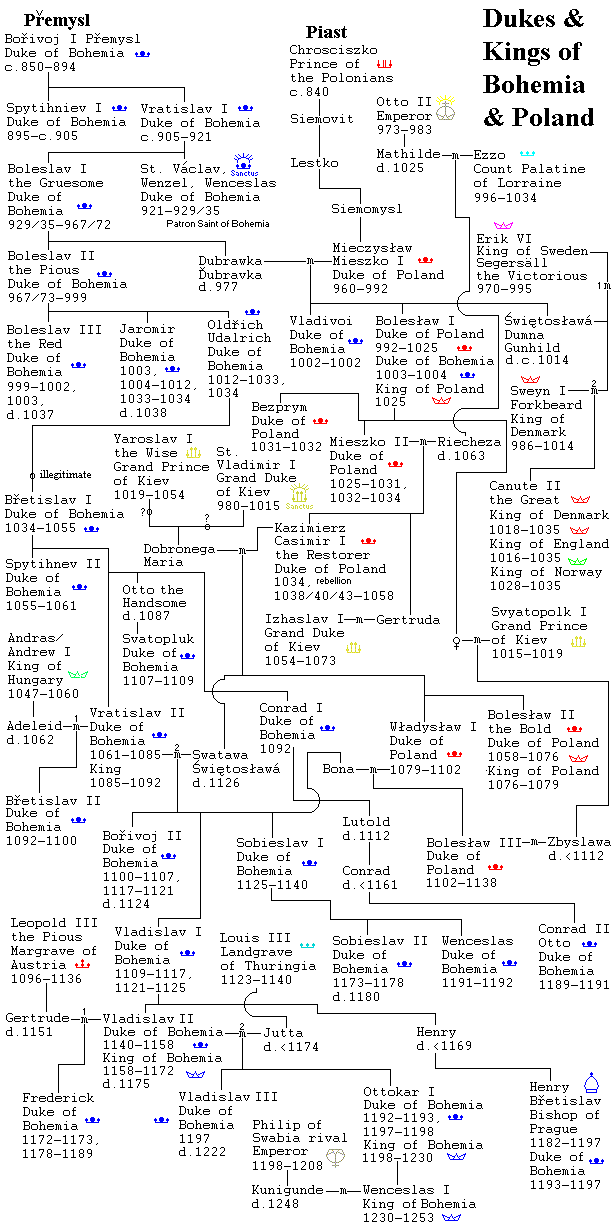
The genealogical diagram above for Poland ends neatly where the diagram below begins, with Boleslaw III. For Bohemia there is more overlap -- some relatives who ruled briefly in the days of Frederick and Ottokar I are shown in table above but not below.  After Boleslaw III, the succession of the Piasts is bewildering, as the Throne jumps from brother to brother and then cousin to cousin. This happens because the family actually divided up the country. The senior living dynast, ordinarily, is the one credited as being "Duke of Poland," but it did not affect the parts of the country directly ruled. For instance, all the Henryks were rulers of Silesia, regardless of where they figure in the succession.
After this, the Premsyls get involved in Poland, and then the houses of Luxemburg and Anjou. Later, as the Premysl and Piast male lines end, we get the entry of the Hapsburgs and Jagiellans (from Lithuania).  The Hapsburgs come and go and then come back, by the end to permanently acquire Bohemia and Hungary. Poland, with a sprinkling of in-laws or unrelated Kings, passes to the Vasa dynasty of Sweden. With the end of the Vasa Kings, the elective principle reigns supreme in Poland.
The Hapsburgs get their big break when the Jagiellan Louis II of Hungary is killed by the Turks in the Battle of Mohács in 1526 and his brother-in-law, Ferdinand of Austria, future Emperor and brother of the Emperor Charles V, pressed his claims to the kingdoms. The Hungarian monarchy had been undermined by the nobility just as in Poland, but the fruit of this for the Magyar Kingdom was catastrophic defeat and conquest by the Ottomans, rather than the slow dismemberment endured by the other Kingdom.
The victory at Mohács was followed by a rapid Turkish advance on Vienna, which has put under an epic but unsuccessful siege in 1529. Bohemia had quickly accepted Ferdinand as King, but Hungary was divided between the Hapsburg and John Zapolya. Even in those circumstances, the Hungarians held off a total Ottoman conquest until 1541. Transylvania, like Wallachia and Moldavia, remained under nominal local autonomy until the Turks were driven out in 1699. The Ottoman occupation kept Hungary out of the mainstream of European development for a century and a half. It is hard to say even now much damage this may have done to the political, cultural, and economic development of the Kingdom.

In New York's Central Park there is an equestrian statue of Władysław V Jagiełło, the Grand Duke of Lithuania who converted to Catholicism, married the heiress Jadwiga of Poland, and defeated the Teutonic Knights. How a dynastic marriage in a place and time where most people were unfranchised peasants or serfs constitutes "a Free Union" of peoples is mysterious. Furthermore, while his marriage and his military victory were a great political coup for Jagiełło, the Teutonic Knights were not "aggressors" in any comprehensible modern sense. The Knights and Poland together had withstood Lithuania when it was a pagan power engaged in the slaving and even the human sacrifice of Christians. The city of Königsberg, Although the Order of the Knights was indeed founded for Germans, because of a sense that the French and English dominated the Hospitallers and Templars, the actual Knights in their army were few, with most of the ranks filled with volunteers from all over Europe, including, of course, Poland. Thinking of the "Teutonic" army as Germans in the manner of the armies of the Kaiser or Hitler is grotesquely anachronistic and absurd -- although this conceit was certainly as much a device of later German nationalism as of Polish, as the Germans celebrated the victory over the Russians at Tannenberg in 1914 as revenge for the defeat of the Knights there in 1410. Since the Russians had nothing to do with the battle in 1410, we must take the Germans to be thinking more in racial terms, as defeating the Slavs, than in relation to more conventional nationalism -- although the Lithuanians had not even been Slavs, but Balts. Hitler might as well have celebrated the occupation of Czechoslovakia as the defeat of Ottokar the Great. That Jagiełło could turn the tables in the Christian/Pagan conflict, by converting, marrying, and becoming the King of Poland himself, was a brilliant bit of statecraft, effecting a "reversal of alliances" such as that occuring between the War of the Austrian Succession and the Seven Years War (where Austria traded its British alliance for a French one), fully worthy of any student of Machiavelli. But it had nothing to do with freedom, the Polish people, or "Teutonic" aggression. It simply fulfilled the ambitions of the Lithuanian throne.
It did that marvelously, as well as inadvertently creating a propaganda tool that may have worked better in the 20th century than it did in the 15th. Of course, if Lithuania converted to Christianity, the Knights, as a Crusading Order, no longer had a mission. By inertia they become merely another local state, and it is not surprising that, as actually happened, they become a vassal of Poland -- a Poland, however, that soon becomes so weak, thanks to the "liberties" of its nobility, that the Knights are effectively independent until the Order is disbanded in the Reformation.
The statue in Central Park, on the other hand, is symbolic of a different era, as the modern Germans were about to invade Poland in 1939. That the Russians invaded Poland simultaneously, per agreement with the Germans, was all too characteristic of Poland's situation but finds no expression in the heritage of Jagiełło or in the inscription on the statue. That Prussia today is itself divided between Poland and Russia, with historic Königberg all but demolished by the Russians, and its population deported, itself represents an "aggression" that the Germans, indeed, brought upon themselves, but is based on no rights or history of either Poland or Russia in the territory.
That the Central Park statue is an expression of Polish nationalism alone we can tell from the name "POLAND" in block capitals on each side. That modern Lithuania's enemy has been Russia alone, whose treatment of the Lithuanian people would fall little short of the regard of the Nazis for the Poles, after the Germans were actually welcomed in World War II, would complicate and confuse the clarity of the message. Like the Dutch, many Lithuanians joined the Nazi SS. But where the Dutch had no execuse that the Germans were fighting enemies of the Netherlands, the Lithuanians did. They knew the Germans were fighting the Russians, who had already occupied Lithuania in 1940 and given them a taste of Russian benevolence. The misfortune of modern Poland and Lithuania was to always be between enemies, and one might be excused some suspicion if one of those enemies gets ignored.
Is the bias of the monument for Poland merely the result of the Polish nationality of its patrons? Is the bias of the monument against Germany alone, despite the oppressive occupation of Poland for a century by the Russians, and the massacre of Poles by the Russians in World War II, the result of someone (Poles!) adhering to Russian causes? Was there some reason or excuse to wink at Russian participation in aggression and crimes against Poland and Lithuania? Perhaps for ideological reasons? I wonder.
 The statue is a good example of how modern nationalistic biases distort the understanding of history. The inscription on the statue states that "King Jagiello" was the, "Founder of a Free Union of the Peoples of East Central Europe, Victor Over the Teutonic Aggressors at Grunwald [i.e. Tannenberg], July 15, 1410."
 The actual people of Poland and Lithuania had little to do with this. The invocation of freedom, however, is characteristic of nationalistic representations of the Polish State, where the privileges of the nobility, which crushed the people below and hamstrung the King above, are absurdly remembered as paradigms of the Rights and Liberties of Man, making Poland a "Republic" or a "Commonwealth" instead of a Kingdom.
 later the capital of the Knights and of Prussia, was named after Ottokar the Great of Bohemia to commemorate his participation in this Crusading effort to protect Christians and defeat the pagans.
 That this ignores Lithuania, despite the identification of Jagiełło as the Grand Duke thereof, might leave us wondering why that small country, soon, by Russia in 1940, to be invaded, conquered, terrorized, its people deported, and Russian colonists introduced, did not rate equal attention with Poland. After all, Jagiełło himself was not even Polish. But then the animus attested by the statue is clearly entirely for Germany -- Jagiełło is great because he defeated the Germans.
| Kings of Poland | |
|---|---|
| Henry of Valois | 1573-1574 |
| King of France 1574-1589 | |
| Stephen Bathory | 1575-1586 |
| Sigismund III Vasa | 1587-1632 |
| King of Sweden, 1592-1604 | |
| Council of Brest, Greek Catholic Church, 1596; Defeats Swedes, Battle of Kircholm, 1605 | |
| Władysław VII, IV, King | 1632-1648 |
| Tsar of Russia, 1610-1612 | |
| John II Casimir | 1648-1668 |
| Russian & Swedish invasion, 1654-1660 | |
| Michael Wisniowiecki | 1669-1673 |
| John III Sobieski | 1674-1696 |
| Commanded Christian Relief Army at Siege of Vienna, 1683 | |
| Augustus II the Strong (I of Saxony) | 1697-1706 1709-1733 |
| Saxony, 1694-1733 | |
| Great Northern War, 1700-721 | |
| Stanisłas Lesczynski | 1704-1709, 1733 |
| Lorraine, 1737-1766 | |
| War of the Polish Succession, 1733-1735 | |
| Augustus III (II of Saxony) | 1733-1763 |
| Saxony 1733-1763 | |
| Stanisłas Poniatowski | 1764-1795 |
| Poland partitioned between Prussia, Austria, & Russia: 1772, 1793, & 1795 | |
| Frederick Augustus (III/I of Saxony) | Grand Duke of Warsaw, 1807-1815 |
| Saxony 1763-1827 | |
| Polish remnant annexed by Russia, 1815 | |
A striking example of how the Polish nobility seem to have engineered the destruction of their own country came at the death of John III Sobieski. He was a monarch of European stature, having commanded the victorious Christian army that defeated the Ottomans and lifted the Siege of Vienna in 1683.
There are few moments such as could fill the Polish heart with pride as when Sobieski led the devastating charge of the legendary Polish cavalry, the "Winged Hussars."
 |
|---|
| "King John III Sobieski blessing Polish attack on Turks in Vienna, 1683," 1871, by Juliusz Kossak (1824 1899) |
As Sobieski sat his horse, wearing his great handlebar mustache (and a sort of ricebowl haircut), on the heights of the Kahlenberg, looking down on Vienna and the Ottoman army, he might even be said to have held the fate of Europe in his hands. The siege of Vienna was not just the High Water Mark of the Ottoman Empire, it was the pinnacle of Polish power, tipping the Balance of Power, not just in Europe, between Austria and France, but between Christendom and ʾIslām. For Poland, such a moment would not come again.
Yet Sobieski's success and accomplishments were resented as much as celebrated. When he died, he left his son as a competent heir, who, in the previous course of things, as with the Jagiellons and the Vasas, would have been elected King. But he wasn't. For the subsequent genealogy of the Sobieskis we must consult that of the Scottish Stuarts, into whose line John's granddaughter married.
Instead, the Polish electors, as they had previously tried a Frenchman, of the House of Valois, who left Poland to become the King of France, this time they went for, of all things, a German. After all the nationalistic huffing and puffing over the Teutonic Knights as the Germanic enemies of Poland and goodness, the election of Augustus of Saxony to be King of Poland must seem to be a most unpleasant slap in the face. Then it turned out that once you had German Kings, it was rather hard to get rid of them.
Trying to keep Stanisłas Lesczynski (1704-1709, 1733) as the Polish King ran into the Concert of Europe, who twice put Saxons back on the Throne -- finally in the War of the Polish Succession, 1733-1735. This meant that Poland was truly no longer its own master.
Since Lesczynski was "compensated" with the Duchy of Lorraine, this meant that Lorraine would pass to France, since his daughter and heiress, Marie, was married to Louis XV, King of France. France had long coveted Lorraine and had often occupied it during previous wars, so this whole arrangement was simply the French way of finally annexing the historic Duchy.
Meanwhile, the proper Duke of Lorraine, Francis, married to Maria Theresa of Hapsburg, and the Holy Roman Emperor, was "compensated" with Tuscany, which remained with the Hapsburgs until 1860.
After all this horse trading, it simply meant that the final Polish King, Stanisłas Poniatowski, got to watch the country partitioned into nothing. Oddly, it was Napoleon who put friendly Germans -- the same Saxon dynasty -- back in his revived "Grand Duchy" of Warsaw.
The Polish nobility did not intend or plan to destroy their country; but their jealousy of the power of their Kings came to the same effect -- a jealousy we still see in the habit of Polish nationalists and other historians in calling the Polish-Lithuanian state a "commonwealth" rather than the "Kingdom of Poland and Lithuania." No kidding. In the end, it was indeed not a monarchy worthy of the name.
The practical effect of the selfishness of the Polish nobility, however, we see repeated, after a fashion, in the hostility of the American elite and ruling class to their own country, their own people, and the principles of their own institutions. Some of the most educated and sophisticated and successful in American society think it is clever to be anti-American, reflecting the moral relativism, Nietzschean nihilism, and clueless Marxism -- the farcical English Department version of Marxism -- of American and European academic culture. Thus, they are fools, not proper sophisticates, and their "education" is a fraudulent mash up of sophistry and ignorance, even about Marxism -- the fruit of irresponsible academics in an unaccoutable system -- the trahison des clercs all over again.
The deep ugliness and evil of this ideology is now exposed after the appalling Terrorist attack on Israel on October 7, 2023, and all the radical Leftists emerge from their English and Ethnic Studies Departments as virulent, Neo-Nazi anti-Semites. The chants call for the eradication of Israel and death for the Jews. That is in the charter of the Islamist Terrorist organization, Ḥamās, about which many "anti-Israel" demonstrators seem to be ignorant. Or perhaps they know well what they endorse. The anti-Semitism was there already, just not as conspicuous.
Thoms Jefferson worried that the American Presidency might become the plaything of foreign influences, like the Monarchy in Poland. Little did he know that the problem would end up being faithless domestic, not foreign, enemies of America. At least with the Polish nobility we cannot say that they acted out of hatred of their own country. Their actions were stupid and foolish but not intentionally malicious. The same cannot be said about the Leftist enemies of America. Their malice is obvious, perhaps the fruit of their own narcissism, and the vindictiveness with which they turn on ideological heretics, let alone their favored ad hominem attacks on anyone, reinforces our impression.
 |
|---|
| King John III Sobieski sending Message of Victory to the Pope, after the Battle of Vienna, 1882/3, Jan Matejko (1838-1893), Vatican Museum |
At the Congress of Vienna in 1815, Poland was erased again. Russia ended up with most of the Prussian and Austrian shares of 1795, and some of Prussia's 1793 slice. Poland and Lithuania were not independent again until after World War I, only to have Poland partitioned again between Germany and the Soviet Union in 1939, with Lithuania absorbed by the latter in 1940. Stalin kept his part of Poland after World War II, compensating a communist Poland with large pieces of Germany. Lithuania only regained its independence with the fall of the Soviet Union in 1991. While the election of the Polish Kings is sometimes celebrated as creating a Republic, or a "Commonwealth," this was not only merely a government of self-interested nobility, the only electors, but it gives us the most sobering paradigm in all of history for the disaster that is invited in by a divided and hopelessly impotent government. Poland became a plaything, a joke, enslaved by Russia for a century, and then, after the German occupation in World War II, a place of incomprehensible crime and horror.
The Jews of Poland, some 10% of the population of Poland in 1939, brought in by the Mediaeval Kings to create a commercial class, and then resented by Polish peasants for their consequent wealth and status, were all but exterminated by the Germans. Forty years of Soviet rule then served to suppress such commercial instincts as existed elsewhere. Now, post-communist Poles, while hating Communism (not to mention the Russians), still know little better than to elect ex-Communists to the government.
Meanwhile, after World War I, Bohemia (and Moravia) became part of Czechoslovakia with the hitherto Slovak part of Hungary and the "Sub-Carpathian Ruthenia" that had also been part of Hungary and that now has been joined to the Ukraine. The most prosperous country in Eastern Europe, Czechoslovakia was first dismembered and terrorized by Nazi Germany and then fell to Communism through an internal coup -- with the probable murder, but official suicide, of Jan Masaryk, son of the first President of the Republic -- Eduard Benésh, the pre-War President, soon resigned and died himself -- the only country in Eastern Europe not to become Communist merely through Soviet occupation.  At left are the stages in the partition of Poland, by which Prussia, Russia, and Austria erased Poland and Lithuania from the map of Europe. The last two stages seem to have been in part defensive measures against the French Revolution, to whose enthusiasms Poland, with a weak monarchy, was seen as susceptible. Napoleon's later revival of a Polish state, with another Saxon as Grand Duke, confirmed the role of Poland as a subversive force.

Czechoslovakia Hungary Poland Thomas Garrigue Masaryk 1918-1935
Miháaly Count Károlyi 1919
Jozef Pilsudski 1918- 1922 Sándor Garbai 1919 Gabriel Narutowicz 1922 Eduard Benésh 1935-1938
Miklos Horthy 1920- 1944
Stanislaw Wojchiechowski 1922- 1926 Ignacy Moscicki 1926- 1939 German Occupation, 1938-1945 German Occupation, 1939-1945 Emil Hácha Bohemia- Moravia,
1938- 1945Jozef Tiso Slovakia
1939- 1945Ferenc Szálasi 1944- 1945 Eduard Benésh 1945-1948  Soviet Occupation,
1945-1991Zoltán Tildy 1946- 1948
Boleslaw Bierut 1947- 1952 Klement Gottwald 1948-1953 Árpád Szakasits 1948- 1950 Sándor Ronai 1950- 1952 Antonin Zápotocký 1953-1957 István Dobi 1952- 1967 Aleksander Zawadzki 1952- 1964 Antonin Nóvotný 1957-1968 Edward Ochab 1964- 1968 Ludvig Svoboda 1968-1975 Pál Kosonczi 1967- 1987 Marian Spychalski 1968- 1970 Soviet Occupation, 1968-1991 Jozef Cyrankiewicz 1970- 1972 Gustav Husák 1975-1989 Karoly Nemeth 1987- 1988 Henrik Jablonski 1972- 1985 Bruno Straub 1988- 1990 Wojciech Jaruzelski 1985- 1990 Václav Havel Czech
Republic,
1989- 2003Michael Kovác Slovakia
1993- 1998Árpád Goncz 1990- 2000 Lech Wałęsa 1990- 1995 Rudolf Schuster 1999- 2004 Ferenc Mádl 2000- 2005 Aleksander Kwasniewski 1995- 2005 Václav Klaus 2003- 2013 Ivan
Gašparovič2004- 2014 László Sólyom 2005- 2010 Lech Kaczynski 2005- 2010 P l Schmitt 2010- 2012, resigned Bronis  aw Komorowski
2010- 2015 Miloš Zeman 2013- present Andrej Kiska 2014- 2019 J nos der 2012- 2022 Andrzej Duda 2015- present Zuzana Čaputová 2019- present Katalin Novák 2022- present
 Occupation it became after the "Prague Spring" of 1968,
| Lithuania | |
|---|---|
| Antanas Smetona | 1919-1922, 1926-1940 |
| Alexandras Stulginskis | 1922-1926 |
| Kazys Grinius | 1926 |
| Soviet Occupation, 1940-1941, 1944-1991 | |
| German Occupation, 1941-1944 | |
| Vytautas Landsbergis | 1991-1992 |
| Algirdas Brzauskas | 1992-1998 |
| Valdas Adamkus | 1998-2003 |
| Rolandas Paksas | 2003-2004 |
| Arturas Paulauskas | 2004 |
| Valdas Adamkus | 2004-2009 |
| Dalia Grybauskaité | 2009-2019 |
| Gitanas Nausėda | 2019-present |
The saying was that it took ten years for Communism to fall in Poland, ten months in Hungary, ten weeks in East Germany, ten days in Czechoslovakia, and ten hours in Romania. A free Czechoslovakia then experienced its own internal crisis, the "velvet divorce," as Slovakia broke off to go its own way. This was a very bad deal for Slovakia, which was way, way behind Bohemia-Moravia economically. Reports of the situation in the new Czech Republic are mixed. Already with an industrial base, and after the most aggressive privatization program in Eastern Europe, the country is nevertheless troubled by the corruption characteristic of former Soviet regimes. Especially disturbing are the reports of a virtual slave trade of women who are brought or lured for forced prostitution from the much poorer countries to the east -- something the provides the background for the movie Taken [2009].
The cost that the Baltic States paid during the decades of Russian occupation is evident in a story related by Dave Seminara, "New Friends Changed My Mind About Ukraine" [The Wall Street Journal, Auust 29, 2023, A17]:
We saw evidence of Lithuania's resolve [about the Ukraine] at the Hill of Crosses, a pilgrimage site where believers have left hundreds of thousands of crosses. The Soviets bulldozed the site in 1961, 1973 and 1975 -- burning thousands of wooden crosses and confiscating metal ones for scrap. Many people were arrested, but each time the Soviets removed the crosses, more appeared until the Soviets eventually gave up.
There will probably never be a real accounting for the number of Lithuanians (as well as Latvians, Estonians, and Poles) who were executed or deported to the GULAG by the Russians. The Baltics are still dealing with the population of Russian colonists who were introduced into their countries, probably with the intention of ultimately overwhelming the native populations. As in the Ukraine and Georgia, these populations allow the Russians the pretext of conquest to "protect" ethnic Russians from the evils inflicted by the locals. This is why the Baltics, as well as Poland, know that the Ukrainians are already fighting for them, since a Russian occupation of the Ukraine will lead to all kinds of aggression, if not outright invasion, against all the others. This is why Poland may soon have the largest army in Europe.
When the Russian Army was in Western Europe in 1812, many were alarmed at the ferocity of the Cossacks, and were very glad to see them go home. Russian brutality, however, continued under the Czars, the Soviets, and now under Vladimir Putin and his attempt to conquer the Ukraine. And the Russians are as brutal to their own men as they are to Ukrainians. It is their ethos. Perhaps they learned from the Mongols. Russia may simply have never really recovered from the Mongol Conquest, just as we might say that Germany never recoverd from the Thirty Years War. After the defeat of the Nazis, it is hard to accept that real barbarism continues in modern Europe; but it does, and the Russians are displaying it every day. As it turned out, the Nazis and Communists were well matched in lack of humanity.
When Robert Heinlein visited the Soviet Union in 1960, he reported that the most deadly insult he could use against bad service was нет культурный, nyet kulturniy, "not cultured." He didn't get that quite right, since, grammatically, the expression should be не культурный, nye kulturniy. It was his wife, Virginia, who actually had learned Russian for the trip. Nevertheless, the sting of such an insult may betray a certain defensiveness. The Russian elite, as early as Peter the Great in the 17th/18th Century, had always aspired to something like French culture. That they would still fall short, amid Stalin's purges, tortures, murders, and prison camps, may reveal a consciousnes that the practice of the Mongols may still be closer than that of Louis XIV.
In the Czech Republic -- Česká republika -- there is some confusion about what to call the country. The "French Republic" corresponds to the proper name "France." What is the proper name for the Czech Republic? Well, the traditional names of its territory were "Bohemia" and "Moravia." Unfortunately, these were used by the Nazis during their occupation; and "Bohemia-Moravia" might not seem like a good name for a single country anyway. So a proper name was coined. That is "Czechia." A lot of Czechs don't like this, including the current (2020) Prime Minister. The President of the Republic, however, Miloš Zeman, does like it and has been using and promoting the name, which now will be used by the United Nations. Of course, the word "Czechia" is written with a Polish digraph ("cz") and so is not in the Czech language (čeština). The actually Czech version is Česko.
Confusion or ignorance about what the proper name of a country would be is conspicious with the Roman Empire. I often ask groups of college professors, for instance at academic conferences, if they know the proper name of the Roman Empire. No one ever has known. In fact, it was "Romania" in Latin and Ῥωμανία in Greek -- used at least from the 4th Century AD until the Fall of Constantinople in 1453. This name is not part of general knowledge or public discourse because of long standing biases against the history and identity of the Late Antique and Mediaeval Roman Empire. See the Note on "Romania". Another muddle is over the relation of the expressions "Ottoman Empire" and "Turkey," where foolish ideology can confuse the usage.
| Bosnia Herzegovina | |
|---|---|
| Yugoslavia, 1918-1941, 1945-1992 | |
| German Occupation, 1941-1945 | |
| Alija Izetbegović | Bosniak, 1992-2002 |
| Momcilo Krajišnik | Serbian, 1996-1998 |
| Krešimir Zubak | Croatian, 1996-1998 |
| Živko Radišić | Serbian, 1998-2002 |
| Ante Jelavić | Croatian, 1998-2001 |
| Sulejman Tihić | Bosniak, 2002-2006 |
| Mirko Šarović | Serbian, 2002-2003 |
| Borislav Paravac | Serbian, 2003-2006 |
| Dragan Čović | Croatian, 2002-2005 |
| Ivo Miro Jović | Croatian, 2005-2006 |
| Haris Silajd ić | Bosniak, 2006-2010 |
| Nebojša Radmanović | Serbian, 2006-2014 |
| Željko Komšić | Croatian, 2006-2014 |
| Bakir Izetbegović | Bosniak, 2010-2016 |
| Mladen Ivanić | Serbian, 2014-2017 |
| Dragan Čović | Croatian, 2014-present |
Of the Mediaeval Eastern European states of the Balkans examined above, two, Croatia and Bosnia- Herzegovina, ended up as parts of Yugoslavia after World War I.
| Croatia | |
|---|---|
| Yugoslavia, 1918-1941 | |
| German Occupation, 1941-1945 | |
| Tomislav (II, Aimone of Spoleto) | King, 1941-1943, d.1948 |
| Ante Pavelić | Poglavnik, 1941-1945, d.1959 |
| Yugoslavia, 1945-1991 | |
| Franjo Tudman | 1991-1999 |
| Vlatko Pavletić | acting, 1999-2000 |
| Zlatko Tomčić | acting, 2000 |
| Stjepan Mesić | 2000-2010 |
| Ivo Josipović | 2010-2015 |
| Kolinda Grabar- Kitarović | 2015-2020 |
| Zoran Milanović | 2020-present |
Croatia, unfortunately, was previously revived as a Italo-German puppet state during World War II. The head of the Croatian fascist or Ustaše Party, Ante Pavelić, after exile in Italy, was installed in Croatia, under his own Führer-like title of Poglavnik. He massacred Serbs, Jews, Gypsies, and Communists. After the War, the Catholic Church helped him flee to Juan Peron in Argentina, and he ultimately died protected by Franco in Spain in 1959.
Pavelić had gotten the King of Italy to name a cousin, Aimone of Spoleto, King of Croatia. The King, taking the Croatian name Tomislav, only paid one brief visit to Croatia because (1) it was too dangerous, (2) he had no real power anyway, and (3) he objected with nice scruple to Italy annexing Dalmatia, which was ethnically Croatian. After Italy surrendered in 1943, Aimone abdicated and renounced any rights he might have. He does not seem to have been accused of any war crimes, but left for Argentina anyway in 1947 and died there in 1948.
After the Croatian declaration of independence in 1991, the Serbs regarded the new state as essentially Neo-Nazi, though the subsequent behavior of both Serbs and Croats would make observers wonder if that didn't apply to both of them. The worst acts by both sides were in Bosnia, with Bosnian Moslems (Bosniaks) caught between them. Bosnia remains divided between the three groups, with foreign troops keeping the peace and a Presidency that rotates between members of each community. The whole country, indeed, is now formally partitioned between the "Federation of Bosnia and Herzegovina, for Croats and Bosniaks, and the "Republika Srpska," which is Serbian. Bosnia's position on the border between Francia and Romania, Francia and Islām (i.e. Ottoman Turkey), is no more painfully evident than in this ethnic strife, atrocities, and partition.
Heads of State for the post-World War I nations are originally taken from the Regentenlisten und Stammtafeln zur Geschischte Europas by Michael F. Feldkamp [Philpp Reclam, Stuttgart, 2002]. They have been updated as needed from print and on-line news sources.
Here the background colors in the table represent countries and combinations of countries. Denmark and Norway together appear as yellow; Norway and Sweden as blue; and all three together as white. The picture here is a compromise between several sources. The best discussion of the difficulties and uncertainties is in the Royal Families of Medieval Scandinavia, Flanders, and Kiev by Rupert Alen and Anna Marie Dahlquist [Kings River Publications, Kingsburg, California, 1997]. While the title of this book mentions Flanders and Kiev, it deals with them from the perspective of intermarriages with Norwegan, Swedish, and Danish houses. Additonal information, especially on Denmark, Norway, and the early legendary and mythic material, is from The Mammoth Book of British Kings and Queens by Mike Ashley [Carroll & Graf Publishers, Inc., New York, 1998, 1999].
These two books have been compared with the large genealogical chart, Kings & Queens of Europe, compiled by Anne Tauté [University of North Carolina Press, 1989], and with Kingdoms of Europe, by Gene Gurney [Crown Publishers, New York, 1982]. There is considerable disagreement between the sources, even for historical kings, not just on dates (which can be infuriatingly different) but even on the succession and the occurrence of various rulers. Priority is given to the sources as listed, but even Alen and Dahlquist are not always consistent in their own presentation -- e.g. they have one chart showing the Sweden King Inge II living and reigning until 1130, while otherwise placing Magnus Nielsson from Inge's death in 1125 to 1130.
On the other hand, Tauté also has Inge ruling until 1130 and doesn't show Magnus at all. And this is a confusion about rulers well within the historical period. Early in the chart it will be noted that Ragnar Lodbrok is listed both for Denmark and for Sweden, but at somewhat different periods -- and neither set of dates works if Ragnar is the Viking chief who sacked Paris in 845 and treated with Charles the Bald. This is a good indication of the uncertainties and mismatches that can occur in the early chronology.
That Erik I of Sweden occurs after Erik II is also a good clue. All the Swedish Eriks are, nevertheless, accounted for (with Erik the Victorious as Erik VI, not always the number he is given). What is not accounted for are Swedish Kings Charles (Karl) I-VI, who all appear to be mythic. The numbers really should be redone, but it is too late for that -- the present King of Sweden is Charles XVI. Sometimes earlier Swedish Knuts are numbered, but not here -- Knut I (1167-1196) is the first.
Noteworthy is also the connection to King Harold II of England, the Saxon King who was killed at the battle of Hastings in 1066, as William the Conqueror invaded England. While Harold did not have descendants in Britain directly, his descendants through Kiev and Denmark ultimately lead to the marriage of Margaret of Oldenburg to King James III of Scotland, from whom all subsequent Scottish and then British monarchs are descended.
The arrival of the Varangians (Βάραγγοι, singular Βάραγγος) at Constantinople in 839, after they had come down the rivers of Russia, added a new element to Roman history. In the Old Norse of the Sagas, Constantinople became to them Miklagarð, or Mikligarð (Mikligarðr with the nominative ending), but often rendered Miklagard or Miklagarth -- the "Great City."
The Kings of
 Denmark,
  Norway, and
  Sweden, 588 AD-Present
 Scandinavia forms a natural unit in the Periphery of Francia, not the least because Denmark, Norway, & Sweden, whose early history is scrambled together, were also eventually united, by the Union of Kalmar, in 1397. Otherwise, converting to Christianity at about the same time as the Eastern European peoples, the Scandinavian kingdoms had relatively little influence on European history in general after the great period of pre-Christian Norse raiding and conquest in West and East -- with the Norsemen known as "Vikings" in the West and "Varangians" in the East. This influence was considerable enough, even just noting the permanent foundations of Normandy, Norman Sicily and Naples, Norman England, and Varangian Russia. Gustavus Adolphus entering the Thirty Years War was then probably the last decisive Scandinavian intervention in European history.
 The Flags of the Scandinavian countries, as well as those of some dependencies, are based on the venerable, distinctively asymmetrical white cross on red of the Dannebrog, which is supposed to have been adopted by King Valdemar II, the Victorious, on 15 June 1219, establishing the earliest national flag in continuous use since.
  However, there is no real certainty that the flag was used before the reign of Valdemar III (1340-1375).
 These kingdoms pose a particular problem in listing the kings and giving the genealogy, since the historical rulers shade over gradually into the legendary, and then into the mythic, and it is very difficult to tell what kind of ground one is on. The table here begins with legendary rulers who are more or less historical, which means that they probably existed, even while dating them and identifying genuine events of their reigns involves considerable guesswork and uncertainty. Genealogy for the kings in the first table below, and for earlier legendary and mythic kings, is given separately at Legendary and Early Kings of Scandinavia. When that link is used, a new browser window will open for the page. If the window is reduced in size and positioned conveniently, the diagrams can be compared with the table in this window.
Kings of Denmark Kings of Norway Kings of Sweden Ivar Vidfamne 588-647 565-623 Harald I Hildetand 647-735, or d.c.750 Olaf the Tree-hewer 680-710 Harald Hildetand 647-735, or d.c.750 Sigurd Ring 735-750, or c.770-812 Randver c.750 Halfdan I 710-750 Ragnar Lothbrok/ Lodbrok 860-865, or 750-794 Eystein I 750-780 Eystein Beli 750 or 860-? Sigurd I Ring 735-750, or c.770-812 Björn Järnsida 794-804,
or c.856Horik I 850-854 Halfdan II Whitelegs 780-800 Erik II 804-808,
or d.c.870Horik II 854-? Gudrod the Magnificent 800-810 Erik III 808-820 Ragnar Lobrok c.860-865 Olaf Geirstade 810-840 Edmund I 820-859 Sigurd II Snogoje 865-873 Halfdan III the Black 840-863 Erik I d.c.870 Hardeknut
Canute I873-884 Civil War, 863-885 Björn 870-920 Frodo 884-885 Harald I
Fairhair885-933 Olaf I Ring 920-930 Harald II Parcus 885-899 Eric I
Bloodaxe933-934 Eric IV Väderhatt ? Gorm
the Oldc.900-950 Haakon I
the Good934-963 Erik V 930-950 Harald III
Bluetoothc.950-986 First Christian King Edmund II 950-965 First Christian King Harald II
Graypelt963-977 Olaf II 965-970 Sweyn I
Forkbeard986-1014 Haakon Jarl of Lade,
977-995Eric VI the Victorious 970-995 Olaf I Tryggvason 995-1000 Died, Battle of Svolder, against Danes, Swedes, & Wends, jumped overboard Olaf III Skötkonung 995-1022 Eric Jarl of Lade,
1000-1015Harald IV 1014-1018 St. Olaf II "the Stout" Haraldson1015-1028,
d.10301018-1035 Canute II the Great King of England
1016-10351028-1035 First Christian King Hardecanute,
Canute III1035-1042 Magnus I
the Good1035-1047 Anund Jakob Kolbrenner 1022-1050 King of
England,
1040-1042Edmund III Slemme 1050-1060 1042-1047 Stenkil 1060-1066 Sweyn II 1047-1074 Harald III
Hardråde1047-1066 Erik VII &
Erik VIII1066-1067 Serves in Varangian Guard, 1034-1044; defeated & killed invading England, Stamford Bridge, 1066 Magnus II 1066-1069 Harold V Hen 1074-1080 Olaf III
the Peaceful1066-1093 Inge I
the Elder1066-1080,
1083-1110Halsten 1066-1070 St. Canute IV
the Holy1080-1086 Magnus III
Barefoot1093-1103 Blot-Sven 1180-1183 Olaf IV Magnusson 1103-1115 Filip
Halstensson1110-1118 Olaf IV
the Hungry1085-1095 Eystein II 1103-1122 Eric I
the Evergood1095-1103 Sigurd
(Sigurðr) I
the Crusader1103-1130 Inge II the
Younger1118-1125 Earl of Orkney,
1099-1105goes on Crusade, entertained by Alexius I Comnenus, addresses Danish Varangians, dies in Cyprus, 1103 King of the Isles,
1099-1103Niels
the Elder1103-1134 King of Man,
1099-1103Magnus IV
the Blinded1130-1135,
d.1139Magnus
Nielsson1125-1130 Eric II 1134-1137 Harald IV Gillechrist 1130-1136 Sverker I
the Elder1130-1156 Eric III 1137-1146 Inge I 1136-1161 St. Eric IX1156-1160 Sweyn III 1146-1157 Sigurd II 1136-1155 Canute V
Magnussen1147-1157 Eystein III 1142-1157 Charles VII 1161-1167 Valdemar I
the Great1157-1182 Haakon II 1161-1162 Knut I 1167-1196 Canute VI
the Pious1182-1202 Magnus V 1163-1184 Sverker II
the Younger1196-1208,
d.1210Valdemar II
the Victorious1202-1241 Sverre 1184-1202 Eric X 1208-1216 Eric IV 1241-1250 Haakon III 1202-1204 John I 1216-1222 Abel 1250-1252 Inge II
Baardson1204-1217 Eric XI 1222-1229
1234-1250Christopher I 1252-1259 Haakon IV the Old 1217-1263 Knut II the Long 1229-1234  It has been noted that genealogical diagrams for the table above are given elsewhere. Genealogies for the following kings are given after their respective tables below. At right is a diagram for descent and marriages of some of the kings above that involve Emperors of Romania (Byzantium) and Grand Dukes or Princes of Kiev. This avenue of Romanian descent into subsequent European royalty and nobility is the best authenticated, despite the remaining uncertainty about the parentage of Irene. Otherwise, much less certain is the Romanian descent of the Counts of Savoy.
Vikings to Varangians, 839 AD
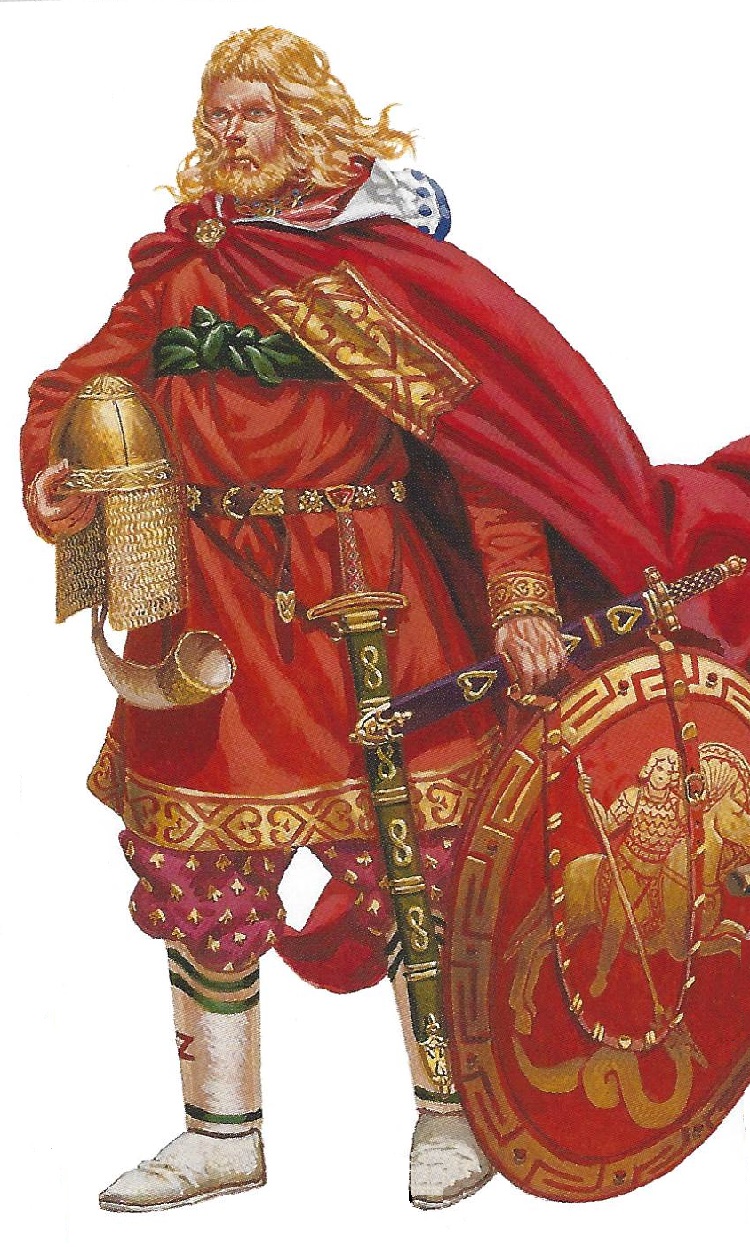 |
|---|
| "Bolli Bollasson," "the Elegant" Icelander in "his grandeur," The Varangian Guard, 988-1453, Raffaeli D'Amato, Illustrated by Giuseppe Rava, Men-at-Arms, 459, Osprey Publishing, 2010, p.26 |
The other element, gard (Old Norse garðr), "enclosed," is cognate to English "garden" and "yard" (and the name "Garth") as well as to gorod and grad, "city," in Russian -- as in Tsargrad, Царьградь, for Constantinople. The "Great City" (we could say "Mickleyard" with English words) could not have been more appropriate, since Constantinople was the largest city in Europe until at least the 13th century. The Norsemen certainly had seen nothing like it previously, and there probably wasn't a larger city in Scandinavia until modern times.
Relations between Romania and the Varangians rocked back and forth between war and trade, mainly depending on what the Norsemen thought they could get away with -- they would be prepared for both. The contact in 839 was an embassy, which had encountered sufficient difficulties coming down the rivers of Russia that it requested the good offices of the Emperor in negotiating passage back by way of the Frankish realm of Louis the Pious. Louis already knew about Viking raids and was suspicious that these travelers, although vouched for by Constantinople, were nevertheless of their kind. Assured (falsely) that they were not, the embassy was allowed to pass.
Soon, Varangians would have little fear of traversing Russia and would begin raiding Roman territory and even attacking Constantinople. As it happened, they were rather less successful against the Romans than they were against the Franks. They never had to deal with any state that could deploy a Navy and dedicated warships against them. Bouts of attacks were then usually followed by treaties -- where such reconciliation was rarely necessary in the West. These must have been sobering experiences, and it prepared the way for the later relationship.
Once they had converted to Christianity, the Varangians quickly perceived the Roman Emperor for what he was: The premier monarch of Christendom. The Emperor becomes in Old Norse the Stólkonungr, the "Great King," with "great" in this case borrowed from Old Russian (as in Stolnyi Knyaz, стольний князь, the "great prince" of Kiev -- stolnyi does not have this meaning in Modern Russian),  and "king" (konung) familiar from other Germanic languages (e.g. German könig, English "king"). This echoes Megas Basileus in Greek, the translation of the title of the Great Kings of Persia and the origin of the use of Basileus for "Emperor" in Mediaeval Greek.
Meanwhile, the Varangians had created a powerful state at Kiev; and, as the "Rus," Русь, their name came to be attached to it -- giving us "Russia" -- Ῥωσία in Greek, Россия in Russian. The alternation of war and trade that had characterized Roman relations with the Varangians, and which led to sharp defeats of Russia by John Tzimisces, took a greater turn toward friendship in Emperor Basil II's day with the conversion of St. Vladimir to Christianity (989).
Part of this process involved the marriage of Basil's sister Anna to Vladimir, and the provision by Russia of mercenaries for what now became the Emperor's "Varangian Guard," τάγμα τῶν Βαράγγων.  The Guard became the loyal shock troops and Life Guard of the Emperor, and are usually identifiable in historical accounts, even if not named as such, by their description as pelekophoroi (pelekyphóroi in Attic Greek), "axe bearers," from the single bladed axe (pélekys) they carried as their primary weapon (seen in the image at right from the history of John Scylitzes, c.1057). There also seems to have been some identification of this weapon with the fasces carried by the Lictors of the Roman Republic, and so of the Guard with the Lictors themselves, and so as heralds of the presence of the Emperor.
After the formation of the Varangian Guard, it quickly no longer became a matter of mercenaries provided by Russia. The fame of the unit spread quickly, and soon individual recruits were arriving, not just from Russia (and now of Slavic and not just Varangian origin), and not just from the immediate source of Russian Varangians, Sweden, but from as far away as Norway, Denmark, and even Iceland.
These included the very interesting Harald Hardråde (or Haraldr Sigurðarson, Haraldr Harðráði), the subsequent King of Norway who would die in 1066 at Stamford Bridge, while invading England. The deeds of Harald and others would be recounted in the Icelandic Sagas, often written much later with fabulous or fanciful additions, but with sufficient detail to pin down their historical origins.
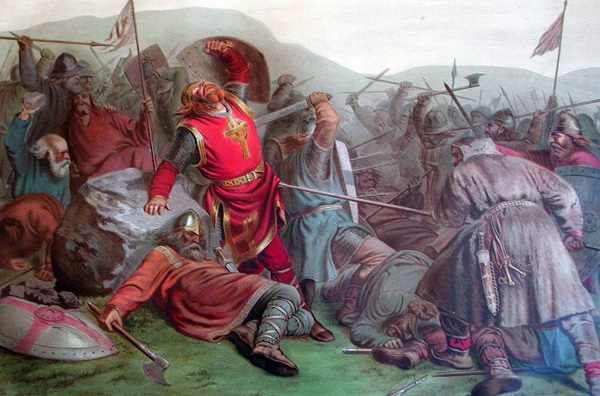 |
|---|
| Olav den Helliges død, the "Death of St. Olaf," killed by Tore Hund, Battle of Stiklestad, 1030; by Peter Nicolai Arbo (1831-1892), 1859 |
Harald himself fled Norway, with 500 retainers, after his half-brother, St. Olaf, was killed at the Battle of Stiklestad, while trying to regain the throne from the Danes. While the Danes, under King Canute, were themselves Christians, we may nevertheless suspect that some of the opposition to him was from remaining pagans -- a feature that would motivate his becoming the Patron Saint of Norway.
Indeed, Olaf's Norwegian opposition was a group of pagan nobility, in alliance with the opportunistic Christian Denmark -- on Judgment Day, King Canute may be asked why he supported pagans against the Christian King of Norway. A leading nobleman was Tore Hund -- Thorir Hund, Þórir Hundr -- who was among the persons credited with a death blow against Olaf, using a spear tipped with a point that one of Olaf's retainers had used to kill a nephew of Tore. Despite this success, which benefited only King Canute, Tore's fortunes did not prosper, and his fate is unknown. Olaf's son, Magnus I, soon retrieved the throne of Norway, followed by Harald.
 |
|---|
| The death of St. Olaf, Altarpiece from Trøndelag, early 14th century |
In Constantinople, Harald participated in some formative events, including the attempted coup against the Empress Zoë in 1041 and probably the Russian attack on the City in 1043. King Harald's Saga recounts visions that Harald had of his brother, including one supposedly on the site were a Church would later be founded for the Varangians (c.1122).
In Norse sources, but not Greek ones, this church was dedicated to St. Olaf as well as the Virgin, the Παναγία Βαραγγιώτισσα, the "all Holy" Lady "of the Varangians." The Church also held the sword of Olaf, called Hneitir. We might have expected the sword to have been brought by Harald himself, but we have a story in some detail that at the battle the sword was recovered by a Swede, who took it home with him. Several generations later, perhaps around 1152, a descendant of the Swede was in the Varangian Guard.
He found that the sword seemed to move of its own volition during the night. When this was brought to the attention of the Emperor Manuel, and its history explained, the Emperor purchased it "in gold three times the value of the sword" and placed it in the Varangian Church "above the altar" [according to Snorri Sturluson; The Varangians of Byzantium by Sigfús Blöndal and Benedikt S. Benedikz, Cambridge University Press, 1978, 1981, 2007, p.150].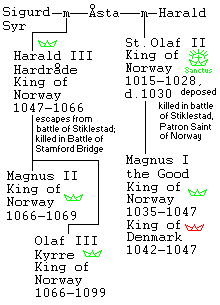
Also, numerous rune stones have been found in Sweden, often at churches for the now Christian Swedes, that stand as cenotaphs or commemorative monuments to men who left for Romania (Grikland, Kirkium, etc., "Greece") and never came back. Some were installed before leaving by the men themselves. Some, of course, may have been for traders rather than members of the Varangian Guard, but a few mention deaths fighting in Serkland, i.e. Islamic lands (where the "Saracens" are), or in Lakbarþland, i.e. Langobardia, "Italy." The drain of Swedes away to Romania seems to have led to a law being passed that the wills of sojourners were void unless they died in Sweden. It is not clear what effect this had, if any.
Norse recruits to the Varangian Guard continued as Alexius I Comnenus entertained Scandinavian monarchs on Crusade or pilgrimage, particularly the Kings Eric I the Evergood of Denmark and Sigurð I the Crusader of Norway. Alexius at first distrusted Eric, as he did all the Crusaders, and had him camp outside Constantinople. We are told, however, that his spies reported Eric urging the Danish Varangians to serve the Emperor faithfully. Eric was then invited into the City and honored -- at least according to the Norse sources. Unfortunately, the pious King never made it to Jerusalem but died and was buried on Cyprus. Alexius is remembered in the Icelandic Sagas as Kirjalax, evidently from Kyrios Alexios, "Lord Alexius." The name was also used, confusingly, for subsequent Comneni.
In 1195, the Emperor Isaac II, or the new Emperor Alexius III, sent three Varangians on a mission to Scandinavia to seek recruits for the Varangian Guard -- this is revealing when previously Danish and Norwegian monarchs had themselves come to Constantinople. We are told that Hreiðarr sendimaðr (i.e. "the Messenger") went to Norway (to King Sverre), Pétr illska went to Denmark (to King Canute VI the Pious), and Sigurðr grikker ("the Greek") Oddsson went to Sweden (to Knut I or Sverker II).
Hreiðarr had the toughest time that we know of, since Sverre, anticipating war, had no warriors to spare. Allowed to recruit among farmers and merchants, it is not clear that Hreiðarr, who became embroiled in local events, ever returned to Constantinople. On the other hand, Pétr may have returned with the actual Danes who were subsequently observed by Geoffroy de Villehardouin in 1203 --  he said there were still "Englishmen and Danes" defending Constantinople when the Fourth Crusade arrived. There are many stories about Sigurðr Oddsson, but it is not clear whether his mission was successful.
Since there are references to Englishmen but not to Scandinavians in the Varangian Guard of the Palaeologi (1259-1453), this may be last the time when Norse warriors actively traveled to Constantinople [cf. Blöndal and Benedikz, op.cit., pp.218-222]. When Constantinople fell to the Crusaders in 1204, some Varangians may have been perplexed about where their loyalty then lay and either gone home or joined the Latin Emperors. There are some references to them serving in the Greek successor states, such as at Nicaea; but it is not clear how many, if any, Norsemen were in the Guard of the Palaeologi. The Fourth Crusade thus may end a chapter in the history of Scandinavia as well as in that of Romania.
A curious thing about the participation of Scandinavians in the Varangian Guard is that we hear little or nothing about it in either popular culture or academic scholarship. Quite the contrary is the case when it comes to the earlier phase of Scandinavian activity: The ferocious violence, looting, and rapine of the Vikings, the Furor Normannorum, is the perennial stuff of intense interest, romance, fascination, and fantasy. It is a kind of Nietzschean wet dream. I remember myself the impression made by the movie The Vikings [1958, Kirk Douglas, Tony Curtis] when I saw it with my cousins at the theater on Holloman Air Force Base in 1962. Although we do not get a continuous presentation of Viking stories in Hollywood or elsewhere, it is kept up enough that people are familiar with the themes and images.
When the Norsemen become Christians, silence falls immediately -- continuing perhaps until Ingmar Bergman. That the Norse continued to fight, that they travelled to the other end of Europe to enlist with the Roman Emperor, is noted or remembered as little as that there was a Roman Emperor back then. Perhaps that is part of the problem. Indeed, if Romania had been expanding rather than failing at the time, this likely would make a difference. The whole business, however, was still of interest back home. King Harald's Saga is found in the ranks of other Viking stories, despite Harald being a Christian and not engaged as much in the traditional raiding, looting, and raping. That he died on a battlefield, while invading England, gives him a little of the old romance, which may be why he sometimes gets called "the last Viking." Hollywood might make something of that, as well as of the greatest European city of the Middle Ages, Constantinople. Whether Harald or Constantinople, this is all as novel to most Americans as Star Wars was in 1977.
The English Varangians, 1066 AD
The Arrival of the Varangians in Romania, 839 AD
| Kings of Denmark | Kings of Norway | Kings of Sweden | |||
|---|---|---|---|---|---|
| Eric V | 1259-1286 | Magnus VI | 1263-1281 | Valdemar | 1250-1275 |
| Eric VI | 1286-1319 | Eric II | 1281-1299 | Magnus I | 1275-1290 |
| Haakon V | 1299-1320 | Berger | 1290-1320 | ||
| Beginning of Little Ice Age, heavy rain for five years, famine, 1315-1320 | |||||
| Christopher II | 1320-1332 | Magnus (VII of Norway, II of Sweden) | 1320-1365 | ||
| Haakon VI | 1343-1380 | Eric XII | 1356-1359 | ||
| Valdemar III | 1340-1375 | Albert | 1365-1388 | ||
| the Black Death arrives in Norway, 1349, Denmark & Sweden, 1350 | Duke of Mecklenburg, 1379-1412 | ||||
| Olaf V (IV of Norway) | 1376-1387 | ||||
| Union of Denmark & Norway, 1380 | |||||
| 1387-1412 | |||||
| Union of Kalmar -- Denmark, Norway, & Sweden, 1397; last dated event in Greenland, before extinction of the colony, 1408 | |||||
| 1412-1439 | |||||
| 1439-1448 | |||||
| Charles VIII | 1448-1457 1464-1465 1467-1470 | ||||
| 1448-1481 | |||||
| 1481-1513 | |||||

In the chart above, the rebellious Charles VIII Bonde seems to drop in out of nowhere. The connection of Charles and of the later House of Vasa to the earlier Kings of Sweden may be examined on the following chart and on a separate popup. My thanks to Leon Pereira, O.P., for exploring the connections of Bonde and Vasa to earlier Kings and supplying the information to me, much of it from Swedish websites. I have only been able to confirm part of this using Andreas Thiele, and, indeed, there seem to be many uncertainties in the early period.

After the Viking era, Scandinavia rarely intrudes into the large events of European history. A spectacular exception was Her subsequent life was, if anything, more colorful than her reign. She immediately decamped to Rome (1655), converting to Catholicism along the way. There she became a patroness of theater, art, and music and sometimes a favorite of Popes. However, that blew hot and cold. Pope Alexander VII (1655-1667) described Christina as "a queen without a realm, a Christian without faith, and a woman without shame," although rumors of her affairs, especially with Churchmen, may have been malicious.
Otherwise, she traveled around a good bit and spent time at the French Court, engaging in some diplomacy that seems to have come to nothing. There she did something that damaged her back in Italy, which was the execution of her retainer, the Marchese Gian Rinaldo Monaldeschi, her master of the horse. She suspected him of "disloyalty" and exercised her sovereign right of life and death over her own Court. She returned to Rome in 1658, but Pope Alexander shunned her. She actually offerred herself for the Throne of Poland, but that came to nothing also. The resentment of the Italians seems to have faded over subsequent Popes, and she was buried in St. Peter's, only the third woman to be placed there.
The throne passed to her cousin, Charles X of the Palatinate. His grandson, Charles XII, the "Madman of the North," revived Swedish military fortunes and then saw them catastrophically collapse when he was defeated far inside Russia by Peter the Great at Poltava (1709). Charles' army disintegrated, and he was so far from any base that he had to escape as a refugee south to Turkey, making his way home by sea. After this extraordinary odyssey, he ended up killed in battle. This was the end of Sweden's great military adventures. This whole war was not to the liking of the King, Adolf Frederick (1751-1771), of the House of Holstein-Gottorp, whose Queen, Louisa Ulrika, was actually Frederick's sister. However, the King's power had been seriously limited by the Swedish Riksdag of the Estates. Twice he tried to restore royal power, in 1756 and 1768; but he was not able to accomplish this. Instead, the war decided the issue. With the help of Russia, the Swedes made some progress in Pomerania, but Frederick finally was able to hold them off. When the Empress Elizabeth of Russian died in 1962, and Russia abruptly left the war, the Swedes also gave up the project as hopeless. While the recent Kings of Sweden have all been of the House of Bernadotte, with no connection shown to earlier Swedish Kings, they nevertheless descend, like the previous Swedish dynasty, from the Margrave Frederick VI of Baden-Durlach -- actually by two different routes -- and so from the previous Palatine and Vasa dynasties. This can be examined on a separate popup.
Eugene de Beauharnais (on the popup, the father-in-law of Oscar I) was the son of Josefine de la Tascher de la Pagerie, the wife of Napoleon Bonaparte, by her first marriage, to Alexander Francis, Viscount de Beauharnais (d.1794). He was adopted by Napoleon and well married, to a daughter of Maximilian I of Bavaria. My thanks to Leon Pereira, O.P., for drawing these connections to my attention and supplying the information, which has been confirmed and expanded using Andreas Thiele.
 when Gustavus II Adolphus Vasa (Gustav Adolf) landed in Germany in 1630 determined to salvage the Protestant cause in the Thirty Years War. This won a subsidy from France, and Gustavus soon destroyed the Imperial army at Breitenfeld (1631), liberating northern Germany and the Palatinate. Another victory was won at Lützen (1632), but Gustavus himself fell in the battle. Although the Swedish army was then defeated at Nördlingen (1634), a compromise peace was reached in 1635 (the Peace of Prague). This would have ended the war if France had not then intervened directly to keep things going and reduce Imperial power further.
 Gustavus' daughter Christina (Kristina), the last of the House of Vasa, is best known for her learning, inviting people like René Descartes to her court. Unfortunately, the climate and Christina's early morning habits, distruptive to Descartes, resulted in his death from pneumonia (d.1650). Whether or not she felt guilty over this, she wearied of ruling and soon abdicated the throne (1654), joining the select company of rulers over the centuries to retire from their jobs.
Denmark Norway Sweden 1513-1523 Frederick I 1523-1533 Gustavus I Vasa 1523-1560 Christian III 1534-1558 Eric XIV 1560-1568 Frederick II 1558-1588 John III 1568-1592 Christian IV 1588-1648 Sigismund,
III of Poland1592-1604, d.1632 King of Poland,
1587-1632deposed as King of Sweden
because Catholic, 1604Charles IX 1604-1611 Defeated by Poles, Battle of Kircholm, 1605 Gustavus II Adolphus 1611-1632 Christina 1632-1654
d.1689Frederick III 1648-1670 Charles X 1654-1660 Christian V 1670-1699 Charles XI 1660-1697 Frederick IV 1699-1730 Charles XII
"Madman of
the North"1697-1718 Queen Ulrika 1718-1720 The Great Northern War, 1700 1721; Battle of Poltava, 8 July 1709 Christian VI 1730-1746 Frederick 1720-1751 Landgrave of Hesse,
1730-1751Frederick V 1746-1766 Adolphus Frederick 1751-1771 Seven Years War, 1756 1763, Pomerianian War, 1757-1762 Christian VII 1766-1808 Gustavus III 1771-1792 Gustavus IV Adolphus 1792-1809 Frederick VI 1808-1839 Charles XIII 1809-1818 Christian VIII 1839-1848 Norway & Sweden, 1814 Charles XIV
Bernadotte1818-1844 Oscar I 1844-1859 Frederick VII 1848-1863 Charles XV 1859-1872 Christian IX 1863-1906 Oscar II 1872-1907 Frederick VIII 1906-1912 Haakon VII 1905-1957 Gustavus V 1907-1950 Christian X 1912-1947 Frederick IX 1947-1972 Olaf V 1957-1991 Gustav VI Adolph 1950-1973 Queen Margaret II 1972-2024,
abdicatedHarald V 1991-2026 Karl/Charles
XVI Gustaf1973-present Frederik X 2024-present Haakon VIII 2026  Sweden entered the Seven Years War (1756-1763) against Prussia as part of a grand alliance put together by the Empress Maria Theresa to retrieve Silesia, which Frederick the Great had seized at the beginning of the War of the Austrian Succession. Sweden's goal, however, was limited, to retrieve the part of Hither Pomerania that Sweden had surrendered to Prussia in 1720, at the end of the Great Northern War (1700 1721). Thus, Sweden's particular part of the conflict is the "Pomeranian War" (1757-1762).

| Iceland | |
|---|---|
| Sveinn Björnsson | 1944-1952 |
| Ásgeir Ásgeirsson | 1952-1968 |
| Kristján Eldjárn | 1968-1980 |
| Vigdís Finnbogadóttir | 1980-1996 |
| Ólafur Ragnar Grímsson | 1996-2016 |
| Guðni Thorlacius Jóhannesson | 2016-2024 |
| Halla Tómasdóttir | 2024-present |
associated with Norway in 1262 and then with Denmark in 1380, became independent, with the King of Denmark still as the King of Iceland, in 1918, and then a republic, as Denmark was still occupied by Germany, in 1944. Iceland was at the time itself occupied as an important Allied base in World War II. It was also important for observation and logistics in the Cold War.
Icelandic surnames preserve active patronymic suffixes, "-son" and "-dottir," as can be seen in the names of the Presidents. The surnames are often not used as such -- the phonebook, for example, is arranged by first names.
By 2009, the economy of Iceland was badly damaged, and nearly destroyed, by the collapse of the mortgage market in the United States. Many Icelandic banks, it seems, had invested heavily in mortgage securities.
In 2010, the land itself of Iceland seems to have tried to strike back. The Eyjafjallajökull volcano (with a name few foreign newscasters have ventured to pronounce), which had been erupting for some weeks, began spewing ash clouds in mid-April. The ash was quickly blown over Western Europe and shut down air travel for more than a week. This not only stranded many travelers in Europe, and elsewhere, but it shut down the shipment of perishable and other urgent materials by air. As travel began to return to normal, the volcano continues to be active.
Geologists worry that this eruption may set off other, nearby volcanoes. As it happens, Iceland is one of the most volcanically active places on Earth. Its eruptions have affected the planet's climate, never perhaps so significantly as in 1783 -- the cold and crop failures may have helped preciptate the French Revolution. Negotiating the end of the American Revolutionary War in Paris in 1783, Benjamin Franklin speculated that the volcanoes in Iceland were behind the changes in the weather. That could not be proven until recently, but it does turn out that Franklin was right.
In May 2011 we have again experienced an eruption of an Icelandic volcano, near the 2010 eruption. This is the Grímsvötn volcano, under the Vatnajökull glacier. Grímsvötn has actually been the most active Icelandic volcano. The eruption has even been stronger than Eyjafjallajökull in 2010; but the international distruptions so far seem less serious than in 2010 -- although it was disrupting air travel for a few days. In Iceland itself, there has always been worry that substantial melting of the glacier can result in serious floods.
Heads of State for the post-World War I nations are taken from the Regentenlisten und Stammtafeln zur Geschischte Europas by Michael F. Feldkamp [Philpp Reclam, Stuttgart, 2002].
| Finland | |
|---|---|
| Per Evind of Svinhufvud | 1917-1918 |
| Carl Gustav Emil von Mannerheim | 1918-1919 |
| Carl J. Stahlberg | President, 1919-1925 |
| Lauri Relander | 1925-1931 |
| Per Evind of Svinhufvud | 1931-1937 |
| Kyösti Kallio | 1937-1940 |
| Risto Ryti | 1940-1944 |
| Carl Gustav Emil von Mannerheim | 1944-1946 |
| Juho Kusti Paasikivi | 1946-1956 |
| Urho Kekkonen | 1956-1981 |
| Mauno Koivisto | 1982-1994 |
| Martti Ahtisaari | 1994-2000 |
| 2008 Nobel Peace Prize | |
| Tarja Halonen | 2000-2012 |
| Sauli Niinistö | 2012-2024 |
| Alexander Stubb | 2024-present |
 Finland and Estonia (speaking closely related Uralic languages) enter history as dependencies of Sweden, then of Russia. Only in the 20th Century do they emerge as independent countries -- Estonia briefly in the 1920's and 30's and then only after fifty years of terror (1940-1991) under the Soviet Union.
| Estonia | |
|---|---|
| Konstantion Päts | President, 1938-1940 |
| Soviet Occupation, 1940-1941, 1944-1991 | |
| German Occupation, 1941-1944 | |
| Arnold Rüütel | 1991-1992, 2001-2006 |
| Lennart Georg Meri | 1992-2001 |
| Toomas Hendrik Ilves | 2006-2016 |
| Kersti Kaljulaid | 2016-2021 |
| Alar Karis | 2021-present |
Finland managed to preserve its independence continuously since breaking away from Tsarist Russia in 1917. This was no small achievement when the Soviet Union was right next door, with aggressive designs, and the worst consequences might have been expected from Finland being an open ally of Germany in World War II.
Oddly enough, Stalin settled for Finnish neutrality. This despite the outright humiliation inflicted on the Russians when they attacked the Finns in 1939 -- the "Winter War," 1939-1940. The Nazi-Soviet Pact had divided up Eastern Europe between Hitler and Stalin. Hitler was not happy when Stalin began making territorial demands on Finland, but he wasn't ready to do anything about it. When the Finns resisted, Stalin attacked.
This all made it obvious, at the time, that Stalin was as great an enemy of peace and freedom as Hitler (a matter confused in the minds of many when Stalin later joined the Allies thanks to Hitler's invasion of Russia). But Stalin was in for a surprise. The Finns, led by Carl von Mannerheim, well prepared for fighting in the snows of the north (and with the Soviet Army weaked by Stalin's purges), inflicted sharp defeats on the Russians -- leaving 68,000 Russian dead. The British began thinking of ways to get aid to the Finns across neutral Norway and Sweden.
| Martti Ahtisaari's Nobel Peace Prize [2008]...won't get European elites buzzing as in past years... In his diplomatic and political career, the former Finnish President brokered peace on various continents -- yet also recognized clear limits to good intentions...
In the early 1990s, he ran the U.N. mission to Iraq after the first Gulf War, watching Saddam Hussein's repression up close. Twelve years of frustrated diplomacy later, and against the grain of conventional European opinion, Mr. Ahtisaari found himself defending the U.S. invasion, the absence of nuclear or biological weapons program notwithstanding. "Since I know that about a million people have been killed by the government of Iraq, I do not need much those weapons of mass destruction," he said. [Wall Street Journal, 11 October 2008] |
| "Let's write about something we know nothing about & be smug, overbearing & patronizing: after all, they're just wogs...
"Guess a Nobel [i.e. Paul Krugman's] in trade means you can pontificate on fiscal matters & declare my country a 'wasteland'. Must be a Princeton vs Columbia thing." Toomas Hendrik Ilves, President of Estonia, a graduate of Columbia University, in response to a blog post by Princeton economist Paul Krugman, who favors Keynesian public spending and doesn't believe the evidence for Supply Side effects, about the "incomplete recovery" of Estonia from the European recession, 6 June 2012 |
Unfortunately, they have also adopted some particularly nasty socialistic ideas, like assessing traffic fines as percentages of income, which means a wealthy person can be fined thousands of dollars for the simplest driving infractions. The Finns seem to have forgotten that Ingmar Bergman stopped making movies in Sweden when the top tax rate became higher than 100%. Nevertheless, the Finnish economy shares in the somewhat sobered and liberalized prosperity of recent Scandinavia, with much better growth and employment than the heart of Euro-socialism in France and Belgium.
Equally unfortunately, Finnish prosecutors have decided to enforce atheism against Christians. According to the Alliance Defending Freedom:
Long-serving Parliamentarian and grandmother Päivi Räsänen has been fighting for the right to free speech since April 2021. That's when she was charged with "hate-speech" after expressing Christian beliefs on marriage and sexuality in a 2019 tweet. In April 2024, the Finnish Supreme Court decided it will hear her case. Its decision comes after the state prosecutor appealed the second unanimous court ruling that exonerated Päivi and Bishop Pohjola of "hate speech" allegations for sharing their faith-based beliefs. The prosecution is demanding tens of thousands of Euros in fines and insists that Päivi's and Bishop Pohjola's publications be censored.In a unanimous ruling on 14 November 2023, the Helsinki Court of Appeal acquitted Päivi and the bishop of the hate speech charges that the state prosecutor had levelled against them. The decision confirmed the District Court s March 2022 acquittal.
The Finnish Prosecutor General had brought three criminal charges against Päivi at the end of April 2021. The medical doctor, mother of five, and grandmother of eleven was accused of having engaged in "hate speech" for publicly voicing her opinion on marriage and human sexuality in a 2004 church pamphlet, for comments made during a 2019 radio debate, and a tweet she directed at her church leadership. The prosecution has dropped the charge regarding the radio debate in its appeal to the Supreme Court. Bishop Pohjola, the Chairman of the International Lutheran Council, was charged for having published the pamphlet that Räsänen authored.
This outrageous case, where American law would not allow these appeals by the prosecution, and where Päivi would be protected by the First Amendment, has unfortunately been resolved:
In a narrow 3-2 decision, on 26 March 2026, the Finnish Supreme Court found Päivi guilty of "hate speech" on one charge relating to the expression of her beliefs on marriage and sexual ethics in a twenty-year-old church booklet.
This outrageous attack on freedom and religion will be appealed to the "European Court of Human Rights," which, however, although winking at Islamism, cannot be trusted to defend freedom, when it is more important to enforce atheism and censorship, except, of course, against ʾIslām. This is a new, but not surprising, level of hypocrisy and folly for Europe. The United States needs to offer asylum to Päivi Räsänen, and sanction everyone involved in her "conviction."
The Scandinavian countries
Danish possessions began rather earlier and were more distant and durable. Greenland, discovered by Eric the Red in 982, became a possesson of Norway, but the Union of Kalmar brought all Scandinavian possessions into the hands of Denmark. The settlement in Greenland actually died out, but colonization began again in 1721. Greenland remains Danish today. The story is similar for Iceland, discovered in 874. In 1262, the local Icelandic assembly, the Althing, voted for union with Norway. The Union of Kalmar then brought them together with Denmark.  Denmark gave Iceland autonomy in 1874, and virtual independence in 1918, except that the King of Denmark was still the King of Iceland. This continued until Denmark was occupied by Germany in World War II. Iceland voted in 1944 to become a republic (which it had been from 930-1262).
The stories of Greenland and Iceland, of course, are part of the earliest explorations of the Vikings. It was also remembered that Lief Ericson had discovered lands beyond Greenland in about 1003, which he had named Vinland, and some efforts had been made at settlement there, but then the project lapsed, permanently -- largely because of the resolute hostility and ferocity of the natives, whom the Vikings called "Skrælings." With the end of these adventures, we might think that the Christianization of Scandinavia stilled the spirit of adventure and exploration. The explorations did stop, but the spirit continued and was merely directed elsewhere. Thus, as Christians, Swedes, Danes, Norwegians, and even Icelanders for some time joined the forces of the greatest Christian ruler, the Emperor of the Romans, in the elite Varangian Guard, whose history is detailed elsewhere.
In the later Modern Age of Discovery, the Danes ventured further. There were a couple of Danish footholds in India, Tranquebar and Serampore. A Danish fleet arrived at Tranquebar in 1616 and a colony was founded in 1620. It remained Danish and was sold to Britain in 1845. Serampore was established in 1658. The Nawabs of Bengal didn't like the presence of the colony and expelled the settlers. With the help of the French, the Nawabs allowed a colony back in 1755. Like Tranquebar, Serampore was sold to Britain in 1845.
Danish Guinea, in West Africa, at first consisted of coastal forts, Christiansborg (Osu, in Accra today), Augustaborg (Teshie), Fredensborg (Ningo), Kongensteen (Ada), and Prindsensteen (Keta). But then Denmark banned the slave trade, the first country to do so, in 1792 (effective 1803). This rendered the forts uneconomical, but inland concessions were obtained to establish some plantations. These did not do well, and so the colony was sold to Britain in 1850 for £10,000 and became part of the Gold Coast. Today, Christiansborg Castle is actually the official residence of the President of Ghana.
Several attempts were made by Denmark to colonize the Nicobar Islands. The first occured in 1723. The colony was then officially annexed by Tranquebar in 1756 and named "Frederiksøerne" (Frederik's Islands). But hundreds died of malaria and the colony was abandoned the following year. In 1768 Moravian missionaries reestablished the colony. This was more successful, but the missionaries left in 1787. The Danish Crown, which asserted sovereignty over the islands in 1777, nevertheless maintained a small garrison. The British occupied Tranquebar in 1801 and the Nicobars in 1809. In 1831 Denmark returned to the Nicobars, but the colony was abandoned in 1837. The British asked the Danes to suppress local piracy, and they returned in 1845, but then left again in 1848. Denmark tried to sell the islands, but even the British were unwilling to pay. The Danish claim was renounced in 1868, and Britain occupied the islands the next year.
The most durable Danish colony was in the Virgin Islands. Danish forces landed in 1666 on St. Thomas. The settlement failed, but the Danes were back in 1671 and expanded to St. John in 1717. St. Croix was purchased from France in 1733. British occupation of the islands in the Napoleonic period (1807-1815) introduced an English speaking population. Eventually, Denmark simply sold the islands to the United States in 1917. Thus ended the modern phase of the Scandinavian colonial experience.
Information about Danish colonies, and some of the wording above, has been provided, with thanks, by Kristian Jensen of Denmark.
Legendary and Early Kings of Scandinavia
 However, all it really did was make Spain the junior partner of France, which, in the epic War of the Spanish Succession (1701-1714), won little for Spain except breathing room -- and the epic loss of Gibraltar. A similar alliance with Napoleon only meant that the Spanish as well as the French fleet was destroyed by Nelson at Trafalgar in 1805, followed by Napoleonic betrayal and a French invasion of Spain.
)
)
)
)
)
)
)
)
)
)
)
)
)
)
)