
The Picts are the people we hear of from the Romans fighting in the north of Britain. In the days of Septimius Severus Pictish tribes of the Moeatai and Caledonii are identified. A century later we hear of the Verturiones and Dicalydones. These inhabited the Highlands north of the Antonine Wall (Murus Antonini), which was built from the mouth of the Clyde River (Clota in Latin) across to the Firth of Forth. The Picts never came under Roman control and, when the Wall was abandoned in 163/164, their influence spread south.
| PICTS | |
|---|---|
| Drust | 424-453 |
| Talorc | 453-457 |
| Nechtan Morbet | 457-468 |
| Drest Gurthinmoch | 468-498 |
| Galanan (Galam I) Erilich | 498-513 |
| Drest | 513-521, 529-533 |
| Drest | 513-529 |
| Gartnait | 533-540 |
| Cailtram | 533-541 |
| Talorg | 541-552 |
| Drest | 552-553 |
| Cennalath (Galam II) | 553-557, d.579 |
| Brude I | 556-584 |
| Converted by St. Columba, mission to Scotland, 563; d. 597 | |
| Gartnait | 584-602 |
| Nechtan II | 602-621 |
| Cinioch or Ciniath | 621-631 |
| Gartnait | 631-635 |
| Brude II | 635-641 |
| Talorc | 641-653 |
| Talorcen | 653-657 |
| Gartnait | 657-663 |
| Drust | 663-672 |
| Brude III, Bridei mac Bili | 672-693 |
| Northumbrians defeated at Nechtansmere or Dun Nechtain, 685 | |
| Taran | 693-697 |
| Brude IV | 697-706 |
| Nechtan III | 706-724, 728-729, d.732 |
| Drust | 724-726, d.729 |
| Alpin | 726-728, d.736 |
| Dal Riata, 733-736 | |
| Angus (Oengus) | 729-761 |
| Dal Riata, 736-750 | |
| accepts surrender of Dumbarton, kills (?) Eadberht of Northumbria, 756 | |
| Brude V | 761-763 |
| Ciniod | 763-775 |
| Alpin | 775-779 |
| Talorgen or Talorcen | 779-781 |
| Drust | 780-782 |
| Talorcen | 782-785 |
| Conall | 785-789, d.807 |
| Dal Riata, 805-807 | |
| Constantine | 789-820 |
| Dal Riata, 811-820 | |
| Angus (Oengus) II | 820-834 |
| Dal Riata, 820-834 | |
| Drust | 834-837 |
| Talorc | 834-837 |
| Eoganan (Ewen) | c.837-839 |
| Dal Riata, c.837-839 | |
| Ferat or Uurad | 839-842 |
| Brude VI | 842 |
| Kineth | 842-843 |
| Brude VII | 843-845 |
| Drust | 845-847 |
| Absorbed into Scottish Kingdom of Alba | |
We have the names of more than a score of legendary Pictish kings before
| BRITONS, Kingdom of Strathclyde | |
|---|---|
| Ceretic or Coroticus | c.450's-470's |
| Erbin | c.470's-480's |
| Cinuit | |
| Geraint | c.480's-490's |
| Tutagual | c.490's-500's |
| Caw map Geraint | c.490's |
| Dyfnwal or Dumnagual I Hen | c.510's-530's |
| Dlydno or Clinoch | c.530's-540's |
| Tutagual | c.559-580 |
| Rhydderch Hen (the Old) | c.580-612 |
| Nechtan | 612-621 |
| Bili I | 621-633 |
| Owen or Eugene I | 633-c.645 |
| Gwraid or Gureit | c.645-658 |
| Dumnagual II or Dyfnwal | 658-694 |
| Northumbrians defeated by Bridei map Bili at Nechtansmere or Dun Nechtain, 685 | |
| Bili II | 694-722 |
| Teudebur | 722-752 |
| Dumnagual II or Dyfnwal | 752-760 |
| surrenders Dumbarton to the Pict Angus (Oengus, Onuist) and Eadberht of Northumbria, 756 | |
| Owen or Eugene II | 760-c.780 |
| Rhydderch II | c.790's |
| Cynan | ?-816 |
| Dumnagual IV | 816-? |
| Arthgal | ?-872 |
| Dumbarton captured by Olaf the White, 870/871 | |
| Rhun | 872-877? |
| Eochaid | 877?-889 |
| King of Alba, 878-889 | |
| Absorbed into Scottish Kingdom of Alba | |
| Donald mac Aed? | 908-c.925, d.934 |
| Ywain, Owen, Owein Caesarius | c.925-937 |
| killed invading England, Battle of Brunanburh, 937 | |
| Donald mac Donald | 937-945 |
| occupied by King Edmund of England, 945 | |
| Indulf | 945-954, d.962 |
| King of Scotland, 954-962 | |
| Dub or Duff | 954-962, d.966 |
| King of Scotland, 962-c.966 | |
| Dyfnwal, Donald mac Owen | 962-973, d.975 |
| submitted to Edgar of England, 973 | |
| Malcolm mac Malcolm | 973-997 |
| Malcolm mac Kenneth | 990-995, 997-1005 |
| King of Scotland, 1005-1034 | |
| Ywain, Owen the Bald | 1005-1018 |
| died, battle of Carham, with Scots against the English, 1018 | |
| Duncan | c.1018-1034 |
| King of Scotland, 1034-1040 | |
| Malcolm mac Duncan | 1034-1058 |
| III, King of Scotland, 1058-1093 | |
| Maldred mac Duncan | 1034-1045 |
| SCOTS, Kingdom of Dál Riata | |
|---|---|
| Fergus I Mor (the Great) | c.498-501 |
| Domangart | 501-507 |
| Comgall | 507-538 |
| Gabhrán | 538-558 |
| Conall | 558-574 |
| Aedán | 574-608 |
| Eochaid Buide | 608-629 |
| Connad Cerr | 629 |
| Domnall Brecc | 629-642 |
| Ferchar | 637-650 |
| Dúnchad | 650-654 |
| Conall Crandomna | 650-660 |
| Domangart II | 660-673 |
| Maelduin | 673-688 |
| Domnall Donn | 688-695 |
| Ferchar Fota of Loarn | 695-697 |
| Eochaid II | 697 |
| Ainbcellach of Loarn | 697-698, d.719 |
| Fiannamail | 698-700 |
| Selbach of Loarn | 700-723, d.730 |
| Dúngal | 723-726, d.736 |
| Eochaid III | 726-733 |
| Alpin | 733-736 |
| King of Picts, 726-728 | |
| Muiredach | 733-736 |
| Eogan | 736-739 |
| Angus | 736-750, d.761 |
| King of Picts, 729-761 | |
| Aed Find, the Fair | 750-778 |
| Fergus mac Eochaid | 778-781 |
| Donncorci | 781?-791 |
| Domnall | 781-805 |
| Eochaid IV the Poisonous | 781-? |
| Conall mac Tarl'a (Tagd) | 805-807 |
| King of Picts, 785-789 | |
| Conall mac Aedán | 807-811 |
| Constantine | 811-820 |
| King of Picts, 789-820 | |
| Angus II | 820-834 |
| King of Picts, 820-834 | |
| Aed mac Boanta | 834-839 |
| Alpin | 834 |
| Eoganan | c.837-839 |
| King of Picts, c.837-839 | |
| Continued as Kingdom of Alba | |
Shortly after the beginning of historical Pictish Kings, we also get Kings, less historical and less well dated, from the kingdom of Strathclyde, also known as Cumbria. These are Britons, the Celts of Roman Britain. The first King, Ceretic, may have been of Roman origin (hence Coroticus -- his grandfather, Cinhil, may have been "Quintillius" in Latin), governing the local tribe of the Damnonii. He thus may be a bit like the King Arthur of Lowland Scotland. But he is also is supposed to have received a letter from St. Patrick complaining about his practice of selling Irish captives as slaves to the Picts (cf. The Mammoth Book of British Kings and Queens, pp.183-186).
The capital of the kingdom was at Ail Cluaide, the "Rock of the Clyde," but was later better known by its Scottish name, Dumbarton, the "Fort of the Britons." The rulers are not well documented enough to be fully historical until the 6th century. A recent and very through examination of this early kingdom may be found in Strathclyde and the Anglo-Saxons in the Viking Age, by Tim Clarkson [John Donald, West Newington House, 2014, 2016, 2022]. Clarkson scruples to even call the early kingdom "Strathcylde," or the site even "Dumbarton," using instead the name "Alt Clut" for both. The history is so poorly attested, from Clarkson's account, that one might wonder how we could call it anything. Much of Clarkson's discussions concern the varying interpretations of events that the poor historical record allows.
Eventually Dumbarton was besieged and taken (871) by the Norse of Dublin, and King Arthgal held prisoner. Arthgal was executed at the request of Constantine I, King of Alba. That made Arthgal's son Rhun, Contantine's brother-in-law, King, to be followed by Eochaid, Rhun's son but also Constantine's nephew. Eochaid, with the Scottish name, became a King of Alba himself.
With this event, Clarkson considers the kingdom of Strathcylde to have properly begun. However, he also thinks that Dumbarton was abandoned as the capital, which was moved up river to Govan and adjacent sites. At the same time, even this development is based on archaeology and obscure references more than explicit historical records. He has a long discussion about the obscure etymology even of the name "Govan." All of this serves to impress the reader with the obscurity and uncertainty of the whole business and that all the history that the king lists given here from The Mammoth Book of British Kings and Queens may leave us with a false impression of solidity and clarity. It seems that nothing could be further from the truth.
Apparently Strathclyde survived for a while as an independent kingdom, though in even greater obscurity. Dumbarton was again taken by King Edmund of England in 945, who then is supposed to have given the kingdom to Malcolm I of Scotland -- who bestowed it on his (2nd) cousin and successor Indulf. A Briton King, Dyfnwal (Donald mac Owen), kept disputing this, but submitted to Edgar of England in 973. The last Briton King of Strathclyde, Ywain (Owen the Bald), a son of Dyfnwal, died in battle in 1018, fighting for Malcolm II of Scotland; and the kingdom finally became a fief of Scotland -- although the southern end, Cumbria, ended up part of England, as Cumberland.
A detailed and evocative treatment of Strathclyde and related shadowy Briton kingdoms, with more emphasis on the uncertainties and gaps in the sources than one would gather from the Mammoth Book, as with Tim Clarkson, may be found in the chapter "Alt Clud: Kingdom of the Rock (Fifth to Twelfth Centuries)" of Vanished Kingdoms, The Rise and Fall of States and Nations, by Norman Davies [Viking, 2011]. Davies avoids the heavy going of Clarkson's discussions, where historical narrative dissolves into extended, but revealing, examinations of just how obscure the records are.
Scotland would be dominated, of course, by the Scots, who were originally, of course, Irish. From a kingdom of Dál Riata in Northern Ireland, a foothold of the same name was established in Argyll. In some fashion the affairs of the Picts and Scots began to intermingle. We start getting rulers who are kings of both domains, sometimes at different times. Exactly how this is happening, we don't seem to know.
Eventually, Kenneth MacAlpin, or Cenáed mac Alpín, who established a successor Kingdom of Alba, to Dál Riata, absorbs the Pictish Kingdom also. The language of the Picts probably was a Celtic language of the Brythonic group, related to Welsh and other languages of Roman Britain -- although the thesis is sometimes defended that it was a non-Indo-European language, like Basque in Spain, from the pre-Celtic population of Britain. Why this language appears to have died out and been replaced by the Gaelic of the Scots is unknown. There does not seem to be any evidence of the Picts being killed off or somehow deprived of their language. Perhaps Scottish, being the language of the Irish missionaries, achieved its predominance because it was the language of the Church.
In Strathclyde and the Lowlands we do not find a predominance of Scots Gaelic. Instead, we get a dialect of English, usually just called "Scots," or "Lallans." This process is also mysterious, and also results in the death of the Brythonic language of Strathclyde, Cumbric, one that would have been much more closely related to Welsh than Pictish, whatever the nature of the latter. However, I have never seen that the language of Strathclyde is attested at all -- apparently it isn't -- and it is generally ignored in treatments of the Celtic language family. There is no doubt that England, as noted, had a strong military and cultural presence in the area.
| # | Keswick, English | Ayrshire, Scots | Welsh | 1 | yan | yinty | un | 2 | tyan | tinty | dau | 3 | tethera | tetheri | tri | 4 | methera | metheri | pedwar | 5 | pimp | bamf | pump | 6 | sethera | leetera | chwech | 7 | lethera | seetera | saith | 8 | hovera | over | wyth | 9 | dovera | dover | naw | 10 | dick | dik | deg |
|---|
 Nevertheless, Scots took on such a unique tone, with its own phonology and vocabulary, often reflecting the English of a very early period (as in the North of England itself), that people sometimes, in ignorance of the true Gaelic, mistake Scots for the Celtic language.
Norman Davies [op.cit., p.45] cites some dramatic evidence about the range and survival of Cumbric. The numbers from that language have apparently surived for certain uses (by shepherds) both in Scots and in English dialects of Cumbria, as in the table at right. This is an extraordinary example of linguistic survival, and its presence reminds me of photographs that supposedly show the images of ghosts in the background of images of the living.
Although the Scots dialect of English has retreated before standard (Oxford) English, and many people may be under the impression that "Scots" simply refers to English spoken with the Scottish accent (familar in actors like Sean Connery), the poet Robert Burns (1759-1796) made a concerted effort to celebrate and preserve the traditional language, with the ironic result that one of his poems, set to music, is universally sung in the English speaking world on New Year's Eve:
Should auld acquaintance be forgot,
And never brought to mind?
Should auld acquintance be forgot,
And auld lang syne!For auld lang syne my jo,
For auld lang syne,
We'll tak a cup o' kindness yet,
For auld lang syne.
Despite the ubiquitous and popular character of this song, most people are bewildered by many of its words, especially the phrase that constitutes its name: "Auld Lang Syne." The phrase literally reads "old long ago" ("syne" is cognate to "since") but is taken to mean, apparently idiomatically, "good old times." The language of the rest of these verses is less obscure, but other difficulties occur in the remaining three stanzas of the poem.
An additional source for this page is The Kings & Queens of Scotland, by Richard Oram [Tempus Publishing, 2006]. The Kings of Scotland are continued with the Kings of England, Scotland, Ireland, and the United Kingdom.
A major branch of Indo-European languages is that of the Celtic languages. The area where Celtic languages were spoken once stretched across Europe from Ireland and Scotland all the way to Spain and Anatolia. There is an issue about the word itself. The Celts were the Celtae in Latin, and a common pronunciation of the name still follows the values of Latin, i.e. /kelt/ instead of the standard Anglicized /selt/. The earliest notice we have of the Celts is as nomadic invaders. They sack Rome in 390 BC, one of the benchmarks of early Roman history. They invade Greece in 279 BC, sack Delphi, and kill Ptolemy Ceraunus, the assassin of Seleucus I and the new King of Macedonia. In 277, however, they are defeated and driven from Greece and Macedonia by Antigonus II Gonatas.
Lingering in Thrace, by 270 three Celtic tribes have crossed over into Anatolia and founded a permanent domain, Galatia, Γαλατία. The capital of Galatia, Angora (or Ancyra), Ἄγκυρα, has given us the modern name of varieties of cat, goat, and rabbit, two of which are used for their hair.

The Celtic Languages
 Since then it has shrunk to the "Celtic Fringe" of Northern Scotland, Western Ireland, Wales, and Brittany. Most attested Celtic languages are now extinct, with the remaining ones under intense linguistic pressure, mostly from English, but with Breton from French.
 I don't know why this should be, except that, indeed, both the Irish and the Welsh pronunciation of "ce" would be /ke/. So that may be the explanation.
 |
|---|
| Brennus and His Share of the Spoils, Paul Joseph Jamin (1853-1903), 1893; Brennus, leader of the Gauls at Rome |
The idea of Celts in the middle of modern Turkey now seems strange indeed. I like to imagine a Monty Python skit in which British tourists in Turkey find people who seem to be Scots or Irish. Unfortunately, any ethnically identifiable Galatians disappeared in the Middle Ages.
These incursions by Celts reveal their presence in the hinterland of Europe. The Romans continued to deal with Celts in the Po Valley, which they called Cisalpine Gaul. These people spoke dialects of Gaulish now called "Lepontic," which are poorly attested and may or may not have been substantially distinct from Gaulish proper. Similarly, the presence of Celts in the East, in the Hungarian plain and perhaps up into Dacia, although certain from their presence further south in the Balkans, is even less well attested. We are better off with the Celts in Spain, the Celto-Iberians, and then rather well informed about the Gauls proper. The conquest of Gaul, of course, made the fortune of Julius Caesar. All these areas of continental Celtic settlement then, under Roman conquest, lost their linguistic character and became Latin speaking.
Celtic languages then survived in Great Britain and Ireland, even where Roman conquest also occurred. What subsequently imperiled the Celtic position were the Germanic invasions of the 5th century, which planted an English Kingdom that steadily drove the British, after Arthur's heroic resistance, into the "Fringe."
 |
|---|
| Vercingetorix Throws Down His Arms at the Feet of Julius Caesar, Lionel-Noël Royer (1852-1926), 1899 |
Wales itself in Welsh is Cymru, which is recognizable as the Roman name of the region, Cambria -- now the eponym of the Cambrian series of rock strata and the Cambrian Period in geological time. The Welsh name for "England," of course, antedates the Ango-Saxon conquest: Lloegr, which we see Latinized as "Logres," "Logris," or "Loegria." Britain as a whole was Prydain.
North of Wales, we get the British Kingdom of Strathclyde, whose language has been called "Cumbric" -- and whose extended existence, until the 11th century, seems relatively neglected by historians and entirely forgotten in public discourse. 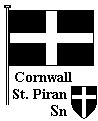 South of Wales, there was the Celtic settlement in Cornwall and the durable Kingdom and Duchy of Brittany on the Continent, which was actually settled by refugees from Britain. Of all of these, only the languages of Wales (Welsh) and Brittany (Breton) survive, precariously, today. Cumbric is only attested with a few words that have been borrowed into the local English.
In the North of Great Britain there were the Picts, who were never conquered by the Romans, and who probably spoke a language closely related to British. However, it is only attested through place names and other fragments, and its true status occasionally flares up in controversy -- the thesis is sometimes defended that Pictish was a non-Indo-European language from the pre-Celtic population of Britain, like Basque in Spain. But there is so little evidence, the dispute may never be resolved.

In Ireland we find a distinct branch of the Celtic languages. Indeed, it is not certain what the affinities are of all the Continental Celtic languages. They probably fall in the same family, the Brythonic, as the languages of Britain. In Ireland we have the source of the languages of the Goidelic family. This begins with Old Irish, which is at first attested in the unique "ogam" script, from the 5th century AD, which consisted of notches cut in stone.
The conversion of Ireland to Christianity brought with it the Latin alphabet and set off a significant period of brilliant, autochthonous cultural and literary development. This produces the most voluminous and historic material of any Celtic language and was flourishing at the very time that most of the rest of Western Europe was experiencing the economic and cultural collapse of the Dark Ages (when Gaul itself, while retaining Roman speech, lost its name to the Franks).
The Irish were so vigorous that they planted settlements, with missionaries and monasteries, in the North of Britain. As the Irish themselves were known as Scotae (or Scotti) in Latin, this name came to specifically refer to the settlers in Britain -- a matter of some confusion when several Mediaeval figures, who were Irish, were known by the epithet "Scotus" (e.g. John Scotus Eriugina, c.815–c.877). Similarly, the name of the "Gaelic" language, which can be used alternatively for "Irish," can also mean exclusively the Scots Gaelic spoken in Scotland. Both Irish and Scots Gaelic survive on the Western fringes of Ireland and Scotland, but another transplant of Irish, Manx, spoken on the Isle of Man, has died out. At the same time, the language called "Scots" is actually a dialect of English, introduced by the Normans after the Norman conquest of England.
One impediment to the survival of Celtic languages is their difficulty. Irish is highly inflected with confusing rules of spelling and pronunciation. Thus, Teach Yourself Irish, by Miles Dillon and Donncha Ó Cróinín [Teach Yourself Books, The English Universities Press, 1961], begins with five pages of "Rules for Aspiration" [pp.13-17], by which the grammatical addition of the letter "h" changes the function and pronunciation of a word. "Aspiration," however, usually does not mean what this ordinarily means in linguistics -- i.e. the addition of breath. Thus, "ph" and "bh" are pronounced, respectively /f/ and /v/, which are fricatives, not aspirates. "Fh" is silent, and "mh" may be silent, lengthening, diphthongizing, or /v/ depending on the environment.
Vowel clusters often say more about the pronunciation of adjacent consonsants than they do about the character of the vowel. Anyone who thinks that English spelling is difficult hasn't seen anything until they encounter Irish. A spelling reform in 1948 made things a little better. The old word for "Gaelic" was "Gaedhilge," the new one "Gaeilge." The old word for "Christmas" was "Nodlaig," the new one "Nollaig." The old word for "week" was "seachtmhain," the new one "seachtain." My own given name, "Kelley" (my grandmother's maiden name), is from the Irish surname, "Ó Caellaigh." "Ireland," of course, is "Éire" (in the nominative).
Welsh has a similar system of sound changes, although it is more a matter of environment than of grammatical inflection. Thus, Teach Yourself Welsh, by John T. Bowen and T.J. Rhys Jones [Teach Yourself Books, The English Universities Press Ltd., 1960, pp.166-167], has an appendix with a couple of pages on "The Mutations," which include "aspiration," like Irish, but also feature "soft mutation" (or "lenition") and "nasal mutation."
As in Irish, the changes actually involved are poorly indicated by the terminology. Thus, "soft" mutation (1) means both the voicing of unvoiced consonants ("c" to "g," "p" to "b," and "t" to "d"), voiced consonants becoming fricatives ("b" to "f," and "d" to "dd" -- which is "ð"), and some other irregular changes ("g" to zero, "ll" to "l," "m" to "f," and "rh" to "r"). "Aspiration" (2) means fricatives again ("c" to "ch" -- the fricative of German or Scots -- "p" to "ph" -- like "f" -- and "t" to "th" -- the θ as in English). And "nasal" mutation (3), while in fact indicating true nasalization (the voiced stops to "ng," "m," and "n"), also includes sounds, derived from the unvoiced stops, written "ngh," "mh," and "nh." I am unclear whether this series indicates true (voiced) aspiration of the nasals or the occurrence of unvoiced nasals, such as the unvoiced semivowel "wh" in English that occurs in "whale" and "where" (which are generally not pronounced like "wail" and "ware"). Welsh also writes "rh," about which I have the same question.
The famous Welsh "ll," /ɬ/, a lateral fricative (i.e. trying to say a "th/θ" with the tongue position for "l"), is a sound that may be harder to believe than to pronounce. But it also turns up in unexpected places, like Navajo.
While Gaulish apparently had retained seven Indo-European grammatical cases for the noun (like Russian), Irish has reduced this to five (like Greek),
| Irish | ||
|---|---|---|
| First Declension, Masculine | ||
| Case | "the boat" | |
| Singular | Plural | |
| Nominative & Accusative | an bád | na báid |
| Genitive | an bháid | na mbád |
| Dative | don bhád | dosna bádaibh |
| Vocative | a bháid | a bháda |
On the other hand, Welsh has lost a case system such as this for nouns. Instead, a matter of great interest in Welsh is its auxiliary verb system, e.g. "Yr wyf i yn darllen," "I am reading" [cf. Teach Yourself Welsh, p.16]. An auxiliary verb system seems to be characteristic of a Western European Sprachbund, in which English, French, and German all have similar grammars. The auxiliary system reaches its most elaborate and semantically rich form in English.
Yet there are features of the English auxiliary verb system that it shares only with Welsh, such as "do support," by which a semantically empty auxiliary verb is introduced just to bear a negation, as when the negative of "I saw that man yesterday" must be "I didn't see that man yesterday." "Do" can be used for emphasis, but that is not the case in ordinary negative formation. This sort of thing leads one to wonder if the grammatical device of auxiliary verbs was picked up by English from the British forebear of Welsh and hence spread through the Sprachbund -- or by French and German from a Celtic substrate on the Continent.
Thus, the British, driven back to the "Fringe" by Germanic invaders, may nevertheless have left their mark on the dominant languages, Germanic and Romance, of Western Europe. Nevertheless, another characteristic of the Sprachbund is the use of both definite and indefinite articles, which is a little unusual -- Latin, Russian, and Persian, for instance, have no articles at all. Irish and Welsh, like Greek, have a definite article but no indefinite. So they are not themselves in the Sprachbund in this respect.
None of the grammatical or phonetic complexities of Irish, Gaelic, or Welsh would be a problem were children raised speaking them as their first languages. In a world flooded with media in English, however, this has become both unusual and difficult; and English, despite its own spelling and pronunciation peculiarities, has a grammar reduced to the simplest forms. Irish independence led to a concerted effort to revive and use the Irish language; but this has been a challenging project, especially when, until recently, there were better employment opportunities for the Irish in Britain than at home -- while even the more robust recent Irish economy involves international connections where the Celtic language is of no use whatsoever. It is a matter of great concern, therefore, that the "Celtic Fringe" will continue to shrink.
The priests of the old pre-Christian Celts, the Druids, continue to be subjects of great interest, speculation, and fantasy. But there were indeed Druids (if not at Stonehenge), and we know something about them. The Romans tell us about sacred trees and groves (which also figured in Germanic religion -- Charlemagne cut them down during his conquest of the Saxons -- and which apparently survive as Christmas trees, first popularized in Britain by Prince Albert), and there is a great deal of mythology, legend, and lore that survives in authentic Irish and Welsh sources. Practices of human sacrifice, horrifying to the Romans, nevertheless are now sometimes even glorified by the neo-pagans.
Thus, a 1973 movie, The Wicker Man, became a cult favorite, even though it is the morally offensive and stupid story of burning a man alive in a modern pagan sacrifice. The victim is a policeman sent to investigate the disappearance of a young woman, whom he begins to suspect has herself been sacrificed by the local cultists. Actually, it is all a trap for him. Perhaps the Home Office will forget to investigate the suspicious disappearance of the officer they sent to investigate the original suspicious disappearance.
My own speculations concern the survival of the astronomical benchmarks that may be from Druidic religion, where the seasons apparently begin at the midpoints between the Equinxoes and Solstices, rather than, as in Babylonian astronomy, at those events themselves. We see the characteristic (Old) Irish "mh" in the name for the beginning of Winter at Samhain (which gets borrowed for a pseudo-Greek word, "samhainophobia," "fear of Holloween"). The details of all this are discussed elsewhere at "Groundhog Day and Chinese Astronomy."
We find a different kind of fantasy in Friedrich Nietzsche:
The Celts therefore come in for embarrassing celebration in Nietzsche's racism. Actually, my impression of Irish and Scots, including myself (I'm both), is that, with very fair skin, there is a great deal of auburn or red hair, and not so much of the really blond Blondkopfen. I'm not sure where red fits in Nietzsche's racial hierarchy, although I imagine that as long as one isn't "black-haired" (schwarzhaarig), that is just as good.
Nevertheless, in the often racial politics of the United States in the 19th century, the Irish were caricatured as monkeys or baboons, in both America and Britain, and their lack of economic or social development regarded as the result of their racial inferiority. In this 1867 cartoon, we see the Irish, with baboonish faces, celebrating St. Patrick's Day by attacking the police.
In the 1850's, half of all persons arrested in New York City were Irish, so that police wagons came to be called "Paddy Wagons," named after the "Paddies," i.e. the Irish. To the extent that the term "Paddy Wagon" is still sometimes used, its origin is clearly forgotten. It is not hard to imagine now the uproar were police wagons named after the ethnic or racial group most often arrested in a jurisdiction. Of course, once the Irish got into politics and began handing out political patronage jobs, police departments filled up with Irishmen, to the extent of establishing a stereotype of Irish policemen, rather than Irish criminals. The irony of this is long forgotten.
Nietzsche may or may not have known about the racial politics of Irish immigration. He could always attribute the problems of Irish criminality to a "pre-Aryan" element anyway.
A curious feature of these issues may be the name "Colleen." This is a common given girl's name, from Irish Cailín. However, cailín simply means "girl" or "woman," and it is a diminutive of caile, "woman." As such, "colleen" was often used in the 19th century to mean an Irish woman, at a time when many Irish woman got jobs as maids or cooks, and were often sexually exploited by their employers.
The general impression now is that specific terms for ethnic women are dehumanizing, such as Australian "lubra" for an Aborigine woman, "squaw" for an American Indian woman, or even "Jewess" for a Jewish woman or "Negress" for a black woman, where the latter two feature no more than a feminine ending, like "waitress." "Waitress" has survived, where "stewardess" for a woman "flight attendent" seems to have disappeared. The ending is from Latin, and we see it in words like "countess/contessa," etc.
In the same way, "colleens" for Irish women is now forgotten. At the same time, although "Colleen" is a common name, internet searches for "Irish girl's names" commonly seem to overlook it. So someone may think it has a stigma.
Another curious feature of Irish immigrant history, relevant to racial explanations, is that the negative stereotypes about the Irish are all but entirely about Irish Catholics. Indeed, much of their problem was thought to be their Catholicism. But there were other Irish, namely the Scotch-Irish. These were Protestants from Scotland, whose migration to Ireland had been prohibited by Queen Mary I. Queen Elizabeth first used the term "Scotch-Irish." But then Protestant migration was encouraged by James I. Since the Scots were themselves Irish, with some admixture of Picts, Britons, and perhaps English, one could not say there was a racial difference between them and Irish Catholics.
There were, however, economic differences, in curious ways. At first, the Scotch-Irish did better economically than Irish Catholics. As tensions arose between the communities, and riots resulted, the situation was defused as Scotch-Irish migrated to the Appalachians, looking for their own independent farmland. Unfortunately, they don't seem to have done that well as farmers, perhaps in part because of the difficulties of the mountain land, but also because of some of their own habits. One effect of that was for them to move on, first down the Appalachians from Virginia (including what would later be West Virginia) into Tennessee, North Carolina, and Georgia, and then later jumping over to Missouri and Arkansas, settling again in the mountains, in that case the Ozarks.
In that, they were never as prosperous as, say, German farmers in Pennsylvania, and their economic fortunes began to sink below the level of Irish Catholics, who tended to remain urban and to assimilate, not just into American politics, but into more general American economic habits. Between politics and Wall Street, the Boston Irish Joe Kennedy became wealthy and influential, sleeping with Hollywood starlets, and navigating one of his sons to become President of the United States. Other family members, however, fell into habits perhaps more characteristic of their origin.
The Scotch-Irish then developed their own stereotypes, as "Hillbillies" or "Rednecks." Although becoming one of the poorest ethnic groups in America, they would not be regarded as victims or the "oppressed," unlike other poor ethnic or racial groups. Instead, all the personal responsibility, from which the other groups have been exempted, is visited with full force on the Hillbillies: They are lazy, inbred, alcoholic, dirty, drug addicted, bigoted, racist, toothless, ignorant "Holy Rollers." It's obviously all their own fault. If Sociologists were honest, this would be a matter of great interest to them. In fact, the social stratum most contemptuous of Hillbillies, which they see as loosely characteristic of all white Christians, is that to which academic Sociologists themselves belong. They are thus little inclined to investigate their own bigotries, as they enjoy the sheltered life of the Ruling Class.
Nevertheless, the Scotch-Irish, although only rarely identified as such, remain a distinctively troubled demographic, while Irish Catholics have largely become lost in the American median, perhaps only noticed when something about the Kennedies comes up. Instead, we get Jeff Foxworthy and his "You might be a redneck" comedy routines. Otherwise, it is only the most daring comedian who mocks the disfunctions of their own ethnic group, although Chris Rock has been known to do it.
Treatments of the Celtic languages may be found in The Oxford Introduction to Proto-Indo-European and the Proto-Indo-European World, by J.P. Mallory and D.Q. Adams [Oxford, 2006, "Celtic," pp.15-18], An Introduction to the Indo-European Languages, by Philip Baldi [Southern Illinois University Press, 1983, "Celtic," pp.39-50], and Comparative Indo-European Linguistics, An Introduction, by Robert S.P. Beekes [John Benjamins Publishing, 1995, "Celtic," pp.26-27, map p.309]. Philosophy of Science, Linguistics
Irish Prime Ministers and Presidents
The latter, unfortunately, seems to stand in inverse magnitude to the paucity of actual historial knowledge about them. For instance, every year, enthusiasts, including modern would-be-Druids, show up at Stonehenge, on the Salisbury Plain in England. They still believe, as was long the general impression, that the vast megaliths had been erected and used by the Druids. Unfortunately, there now seems to be general agreement among archaeologists that Stonhenge was built long, perhaps more than a thousand years, before the Celts would have arrived in Britain. There were pre-Indo-European people in Western Europe, of whom we see a bit in the Etruscans, and who actually survive even now with the Basques. They may be responsible for Stonehenge and other megalithic sites, such as on Malta. This in itself is speculative, but with a bit more foundation than the certainty of neo-pagans for the ancient doings of the Druids.
 The movie did not even have the courage of its convictions, since its orgiastic naked revelers are obviously wearing body stockings. Some real nudity would at least have provided something of actual interest in the film. A 2006 remake with Nicolas Cage bombed (earning five Razzie Award nominations, for Worst Picture, Worst Actor, Worst Screenplay, Worst Remake, and Worst On-Screen Couple). The Druids really deserve better.
The Latin malus ["bad"] (beside which I place μέλας [mélas, Greek for "black"]) might designate the common man as dark, especially black-haired ("hic niger est"), as the pre-Aryan settler of the Italian soil, notably distiguished from the new blond conqueror race by his color. At any rate, the Gaelic presented me with an exactly analogous case: fin, as in the name Fingal, the characteristic term for nobility, eventually the good, noble, pure, originally the fair-haired [Blondkopf] as opposed to the dark, black-haired native population. The Celts, by the way, were definitely a fair-haired race [eine blonde Rasse]; and it is a mistake to try to relate the area of dark-haired people found on ethnographic maps of Germany to Celtic bloodlines, as Virchow does. These are the last vestiges of the pre-Aryan population of Germany. [The Birth of Tragedy and The Genealogy of Morals, Doubleday Anchor Books, 1956, p.164, boldface added]

Copyright (c) 2010, 2011, 2012, 2013, 2014, 2018, 2020, 2022, 2024 Kelley L. Ross, Ph.D. All Rights Reserved