
Taking everything together then, I declare that our city is the School [or "Education"] of Greece [τῆς Ἑλλάδος Παίδευσις, tês Helládos Paídeusis], and I declare that in my opinion each single one of our citizens, in all the manifold aspects of life, is able to show himself the rightful lord and owner of his own person, and do this, moreover, with exceptional grace and exceptional versatility. And to show that this is no empty boasting for the present occasion, but real tangible fact, you have only to consider the power which our city possesses and which has been won by those very qualities which I have mentioned. Athens, alone of the states we know, comes to her testing time in a greatness that surpasses what was imagined of her.The funeral oration of Pericles, speaking of Athens, in The Peloponnesian War, by Thucydides [Book Two, XLI:1, translated by Rex Warner, Penguin Books, 1954, 1964, p.119] -- see the comparison of Athens and the United States as commercial democracies in "Why the Greeks?"

Tzu-K'ung asked about government. The Master said, "Sufficient food, sufficient weapons, and the trust of the people." Tzu-K'ung said, "Suppose you had no choice but to dispense with one, which of these three would you forgo?" The Master said, "Dispense with the weapons." Tzu-K'ung said, "Suppose you were forced to dispense with one that was left, which of the two would you forgo?" The Master said, "Dispense with food; for from old death has been the lot of all men, but a people without trust will not endure."
Confucius, Analects XII:7, translation after James Legge [1893], Arthur Waley [1938], and D.C. Lau [1979]. The current United States Government, of unconstitutional usurpations and tyrannies, has lost my
, trust.
ἐλεύθεροι παῤῥησίᾳ θάλλοντες οἰκοῖεν πόλιν κλεινῶν Ἀθηνῶν.
Free, outspoken, and flourishing, let them live in the city of famous Athens.
Phaedra, Hippolytus, by Eurpides, lines 421-423, translated by David Kovacs [Loeb Classical Library, Harvard University Press, 1995, pp.164-165, translation modified].


τάδε λέγει Κύριος· ἐξαπόστειλον τὸν λαόν μου.
Haec dicit Dominus: Dimitte populum meum.
This the LORD says: Let my people go.Exodus 8:20, Septuagint 8:16
GEN. ROBERT E. LEE: It's good to see one real American here today.
LT. COL. ELY PARKER: General, we are all Americans today.
Exchange between Robert E. Lee and Ely Parker, a lawyer and member of the Seneca Nation, on the Staff of Ulysses S. Grant, who recorded the terms of Lee's surrender -- Appomattox Court House, Virginia, 9 April 1865.
This is America, Jack!
John Amos (as Cleo McDowell) to James Earl Jones (as King Jaffe-Joffer of Zamunda), Coming to America [Paramount Pictures, 1988]


The history of the United States may conveniently be divided into three parts, the "Old Republic," 1789-1861, the "Middle Republic," 1861-1933, and the "New Republic," 1933-2005. The length of the "New Republic" is suggested by the previous ones: 72 years, or 18 presidential elections. Now that 2005 has come and gone, it is clear that nothing significant, however, has changed in the form of American history in the "New Republic," whose defining characteristic is the New Deal. Politically prominent Republicans have questioned this no more than Democrats, though Democrats enjoy accusing Republicans to wanting to dismantle the New Deal. Whether by fear, dishonesty, or conviction, those prominent Republicans -- including Newt Gingrich or George W. Bush -- avow no such purpose. However, there can be no "Next Republic" until the spell and the mythology of the New Deal is exploded. There seems little prospect of that at the moment [2009] -- especially after the election of Barack Obama, who is widely expected to institute a "New New Deal," raise taxes, socialize medicine, and legislate or order other leftist desiderata. Contrary voices at least exist -- although the left, after eight years of wailing about their free speech being suppressed, now will eagerly resort to the "Fairness" rule and campaign finance laws to silence non-conformists -- but in the dominant paradigm of academia, the media, the literati, and main stream politics, our understanding of the world has not altered much since 1937. There is even a living and conspicuous apologetic for Communism.
| States and Territories of the United States at the Beginning of Constitutional Government, 1789, in the order of their ratifying the Constitution |
|---|
| +1. Delaware (Swedish 1638, Dutch 1655, English 1664), 7 Dec 1787; Slave State #1 +2. Pennsylvania (Swedish 1643, Dutch 1655, English 1664, William Penn, 1681), 12 Dec 1787; Free State #1, ended slavery 1780 +3. New Jersey (Dutch 1618, English 1664), 18 Dec 1787; ended slavery 1805, Free State #9 +4. Georgia (1732), 2 Jan 1788; Slave State #2 +5. Connecticut (1639), 9 Jan 1788; Free State #2, ended slavery 1784 +6. Massachussetts (1620), 6 Feb 1788; Free State #3, ended slavery 1780 +7. Maryland (1632), 28 Apr 1788; Slave State #3 +8. South Carolina (1629, separated from North Carolina 1729), 23 May 1788; Slave State #4 +9. New Hampshire (1629), 21 June 1788; Free State #4, ended slavery 1783 +10. Virginia (1607), 25 June 1788; Slave State #5 +11. New York (Dutch 1624, English 1664), 26 July 1788; ended slavery 1799, Free State #7 Northwest Territory, 1787; Free |
The politics of the "Old Republic," although witnessing the greatest growth and settlement of the country, was simply dominated by the issue of slavery, which in the end tore the nation apart. It is therefore no distraction to note for each new State or Territory whether it is slave or free. The Missouri Compromise (1820), the Compromise of 1850, and the Kansas-Nebraska Act (1854) were all about the distribution of States or Territories open to slavery, although it may not have been clear until the Missouri Compromise itself (Jefferson's "fire bell in the night") just how polarizing and dangerous the issue was going to be. The "American Colonization Society," to repatriate freed slaves to Liberia in Africa, was founded in 1821; and the Abolitionist "American Anti-Slavery Society" was founded in 1833. Thereafter, the ferocity of the recriminations and the insulting level of the rhetoric in the public debates, even the violence on the floor of Congress, is now hard to believe, though they still cast their shadows in the politics of the 2000's.
 The original flag for the 13 Colonies in 1775 had 13
  stripes but still used the British Union Flag in the canton. This is called the "Grand Union" or "Cambridge" Flag, and various other flags were in use at the same time. On 14 June 1777, the Continental Congress adopted a flag with stars as well as stripes for the colonies, as a "new constellation." The arrangement of the stars was not specified, and different versions were used. It is not known who actually designed this, though the legend is that Betsy Ross made the first one. The flag was first saluted by a foreign power on 14 February 1778 when French naval ships saluted John Paul Jones in the Ranger. At first different ensigns for merchant ships were contemplated,
  as British
  merchant ships customarily flew the Red Ensign, while British warships flew the Red, White, or Blue Ensigns. Cases of American flags that are all stripes are known, both with the familiar red and white stripes, and with red, white, and blue stripes. Soon, however, all American ships began to fly the standard Stars and Stripes.
Here I have included  links to two songs about the flag, "The Star Spangled Banner," written when the flag had 15 stars, which became the National Anthem, and "Marching Through Georgia," when the flag had 35 stars, which expresses the feelings of
  Union soldiers about freeing the slaves and punishing the South for Rebellion. Since the government has now imposed slavery on everyone, it is no surprise that we no longer hear much about "the Flag that makes you free." An audio file gives the tune for "Marching Through Georgia."
My only complaint about the early symbols adopted for the United States is the use of the Eagle. 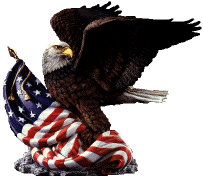 This was a Roman symbol. It was certainly associated with the Roman Republic by the Founding Fathers, but it had been used for many centuries for Empires, including the Roman Empire itself, the Holy Roman Empire, Russia, and later the French, Austrian, and German Empires. Usually the only alternative that gets mentioned for America is Benjamin Franklin's proposal that the Turkey be made the national bird. This is usually brought up now only as a joke, since Turkeys are pretty stupid. But there is still a very real alternative, and that is the Owl, the sacred animal of the goddess Athena, the goddess of wisdom and patroness of the city of Athens, the first classic democracy. Perhaps when we have learned again even a fraction of the wisdom of the Founders, this might be reconsidered. We have certainly become such fools as to merit no such symbol. In that sense, the Turkey is the national bird.
Of course, there is a further complication concerning the Owl. To the Navajo it is a bird of ill omen (as night birds have suggested death as far back as Ancient Egypt). At a time when an objection to anything by anyone regarded as an underprivileged or politically oppressed group is enough to prohibit it, and the politically correct are indeed removing owls from children's books lest a Navajo child be traumatized, this may be enough to ruin the case for the National Owl. Indeed, I might be willing to accept an objection by the Navajo, not because they are underprivileged or politically oppressed (where the "oppression" may be a traditional lifestyle that is self-imposed), but just because they are the Navajo. So that settles the case for the Eagle.
The carving of the heads of four Presidents on Mt. Rushmore, in the Black Hills of South Dakota, by Gutzon Borglum (d.1961), completed by his son, Lincoln Borglum (d.1986), is one of the great monumental sculptures in history. Conceived as a local project, it became national when Congress authorized the Mount Rushmore National Memorial Commission in 1925. President Coolidge, who vacationed in the Black Hills during his presidency, dedicated the project in 1927. Indeed, the son of Lincoln Borglum (who himself died in Texas), James, still lives in the valley watered by a stream that has been named after the First Lady -- Grace Coolidge Creek.
While Gutzon Borglum is said to have included Theodore Roosevelt on the mountain because he freed the working man through his Trust Busting, Roosevelt was also Borglum's personal friend. There was also the request of President Coolidge that two Republicans be featured. Borglum had previously begun the monument to the Confederacy at Stone Mountain, Georgia. This may have reflected some of his own questionable inclinations, since he had himself been involved with the Ku Klux Klan, which was all too popular in the early 1920's -- in part thanks, as we shall see, to Woodrow Wilson. Borglum, however, also created a monument to Sacco and Vanzetti [1928], the anarchist martyrs of the 1920's; and he greatly admired Abraham Lincoln. So he doesn't seem to have gotten quite the right idea what the Klan was all about. Lincoln, Teddy, Sacco and Vanzetti, and the Klan are a very odd mixture. In fact, he had a falling out with the sponsors of Stone Mountain and left the project.
With the Presidents on Mt. Rushmore, the project was conceived not long ago in the nearby urban center of Rapid City of populating the downtown area with free standing bronze statues of all the Presidents. This project is all but up to date, with statues placed on corners of the parallel Main (westbound) and St. Joseph (eastbound) Streets, from 4th Street west to 9th Street. Two intersections feature two Presidents; two intersections three Presidents; and eight intersections four Presidents. Only one President remains to be represented: Barack Obama. Three were added after I visited the city in 2010: Chester Alan Arthur, Bill Clinton, and George W. Bush. I include recent photos of all below. I had missed Rutherford B. Hayes in 2010, whose statue is now included. The statues do seem to generate considerable interest among tourists (like myself), as I have seen other similar, although non-Presidential sculptures do elsewhere. Multiple sculptors are responsible for the statues. Further information may be found on the "City of Presidents" webpage.
Mississippi Territory, 1798; Slave Jefferson's fight with Tripoli in the First Barbary War, 1801-1805, is curiously America's first clash with Islam, where principles we now see voiced by the "Islamic State" (ISIS or ISIL) were actually being practiced against American shipping and citizens. This would be little confort, for those paying attention, to those who deny that ISIS is "real" Islam. It is a sobering reminder of the age and depth of the problem.
+17. Ohio, 1 Mar 1803; Free #8 +18. Louisiana, 30 Apr 1812; Slave #9 +25. Arkansas, 15 June 1836; Slave #13 +28. Texas, 29 Dec 1845; Slave #15, last Slave State Kansas Territory, 1854; Free/Slave, Kansas Nebraska Act, 1954 Curiously, Buchanan is now generally believed to have been a homosexual; and thus the generally catastrophic course of his Presidency is redeemed, for some, by its symbolic value in gender politics. Tragic Prelude [1940], by John Steuart Curry (1897-1946). This is a mural in the Kansas State Capitol in Topeka, Kansas. A rather wild John Brown (1800-1859) dominates the center, leading Abolitionist forces in "Bleeding Kansas" -- i.e. the election whether Kansas would be Slave or Free. Brown lost, and Kansas was submitted to Congress as a Slave State. Admission was refused; but then Kansas was admitted as a Free State once the first group of Southern States had seceded in 1861. That was before Lincoln had even become President.
Grant and His Generals [1865], by Ole Peter Hansen Balling (1823-1906), National Portrait Gallery, Smithsonian Institution, Washington D.C., caption added -- click on image for a full popup. The "Grand Army of the Republic" is what the Union Army came to be called by the end of the Civil War. Subsequently, it became the name of the veterans organization of Union soldiers, which was politicially powerful for several decades. In this famous painting, we see Grant and his Generals, with Sherman to his immediate right (on the white horse) and the diminuative Sheridan, under the red and white flag, on our left.
In the twilight years of the Civil War veterans, the highway US 6, from Provincetown, Massachusetts,
A grateful Nation elected Grant twice, and he became the only President between Andrew Jackson and Woodrow Wilson to be elected to and serve two consecutive terms. It has become common for historians to say that he was not a very good President and that he allowed his Administration, through inattention or naiveté, to become riddled with corruption and scandal. This has now been forcefully disputed by Frank J. Scaturro in his President Grant Reconsidered [University Press of America, 1998]. The charges of corruption, beginning with the "Credit Mobilier" scandal, are either about things that occurred during Andrew Johnson's Administration, and which Grant's Administration prosecuted, about politically motivated and questionable accusations, or about matters that Grant fully understood and handled vigorously. In the latter category was the attempt of Jay Gould and James Fisk to corner to the gold market on September 24, 1869. They had hoped to neutralize the federal government by getting Grant's brother-in-law to influence him. Grant was not fooled or influenced, rebuking his brother-in-law, warning the Secretary of the Treasury, and then foiling Gould and Fisk's attempt by ordering the Treasury to sell gold. Nevertheless, this episode is often cited as an example of Grant's naiveté and gullibility. It is hard to imagine how historical facts could become so twisted.
Who Grant's enemies were, however, is not hard to discover. Grant vigorously enforced the Fourteenth and Fifteenth Amendments during the last years of Reconstruction. Georgia was temporarily returned to military rule until it ratified the Fifteenth Amendment -- it probably would not have been ratified at all without Grant's action -- fraudulent elections and race riots (a massacre of 300 blacks had occurred) were suppressed in Louisiana with federal troups, and habeus corpus was suspended and parts of the South Carolina put under martial law in order to suppress the Ku Klux Klan (enforcing the anti-Ku Klux Klan Act of April 10, 1871). The original Ku Klux Klan was actually destroyed by 1872 (not to revive until under Woodrow Wilson's apparent blessing), though other violent, racist groups continued to form. The growing unpopularity of Reconstruction in the North cost Republicans the House of Representatives in 1874. The lame duck Congress passed the Civil Rights Act of 1875 in a last effort to protect Southern blacks, but such a Congressional coalition would not exist again until the 1960's, and the Act itself was soon gutted by the Supreme Court. It is a significant lesson in historiography that presumably "liberal" historians after the 1960's should have continued a hostile and derisive analysis of Grant that had been formulated by Southern and Southern-sympathizing historians earlier in the Century. It has been a case of mere inertia comparable to the contempt of Western European historians for Mediaeval Romania, Ῥωμανία, better known (in fact mostly only known) by the dismissive Modern appellation "Byzantium."
Otherwise, Grant displayed the sound instinct of insisting on restoring United States money to its pre-Civil War standard. Although this made for deflation and economic difficulties, it was part of a discipline of fiscal responsibility that now seems all but saintly and miraculous -- it is hardly politically possible anymore. The Gold Standard was first offically adopted in 1873. In 1876, the Centennial of the Declaration of Independence, there was also the tragic denouement of the Indian Wars. Grant, who was sympathetic to American Indians and genuinely wished to protect them (one member of his Civil War staff, Ely S. Parker, was a full-blooded Seneca), was little able to control events, as gold seekers had flooded into the Black Hills on the great Dakota reservation. Grant's Civil War colleagues, Sherman and Sheridan, were determined to use force after Sitting Bull and Crazy Horse became "hostile" and famously defeated General Custer. Public opinion could hardly be resisted, as Grant was also aware that his military interventions in the South were costing the Republicans support in the North.
Even unpopular actions, however, did not cost Grant much personal popularity. He was almost nominated again for President in 1880, but he had little enthusiasm for it. After retirement, Grant was swindled out of his entire fortune by a crooked business partner -- like Jefferson, Grant was much better at the nation's finances than at his own. Then Grant discovered that he had fatal throat cancer. In a final act of determination and courage, Grant, in constant pain and hardly able to eat or talk, wrote the brilliant, best selling memoirs that provided for his family after his death (1885). Who is buried in Grant's Tomb (on the Upper West Side of Manhattan)? Grant and his dear wife Julia, who had endured all of the astonishing turns of fortune with him.
I regret to say that with preparations for the late election decided indications appeared in some localities in the Southern States of a determination, by acts of violence and intimidation, to deprive citizens of the freedom of the ballot because of their political opinions. Bands of men, masked and armed, made their appearance; White Leagues and other societies were formed; large quantities of arms and ammunition were imported and distributed to these organizations; military drills, with menacing demonstrations, were held, and with all these murders enough were committed to spread terror among those whose political action was to be suppressed, if possible, by these intolerant and criminal proceedings... I understand that the fifteenth amendment to the Constitution was made to prevent this and a like state of things, and the act of May 31, 1870, with amendments, was passed to enforce its provisions, the object of both being to guanantee to all citizens the right to vote and to protect them in the free enjoyment of that right. Many who approached him told me he was a silent man. To me, he was one of the best conversationalists I have ever met. -- Frederick Douglass
No American has carried greater fame out of the White House than this silent man who leaves it today. -- James A. Garfield, 1877
To [Grant] more than to any other man the negro owes his enfranchisement and the Indian a humane policy. In the matter of the protection of the freedman from violence his moral courage surpassed that of his party; hence his place at its head was given to timid men, and the country was allowed to drift, instead of stemming the current with stalwart arms. -- Frederick Douglass
During my two terms of office the whole Democratic press, and the morbidly honest and "reformatory" portion of the Republican press, thought it horrible to keep U.S. troops stationed in the Southern States, and when they were called upon to protect the lives of negroes -- as much citizens under the Constitution as if their skins were white -- the country was scarcely large enough to hold the sound of indignation belched forth by them for some years. Now, however, there is no hesitation about exhausting the whole power of the government to suppress a strike on the slightest intimation that danger threatens. -- Ulysses S. Grant, 1877 +38. Colorado, 1 Aug 1876 British philosopher Philippa Foot (1920-2010), Cleveland's granddaughter by way of his daughter Esther and her British husband, suggested the "Trolley Problem" in ethics. This remains a matter of current discussion, treated here under moral dilemmas and in the review of the book Would You Kill the Fat Man?. +45. Utah, 4 Jan 1896 McKinley immediately launched off into all the imperialistic projects that Cleveland had shunned: Annexing Hawaii and then acquiring a proper colonial McKinley was assassinated at the Pan-American Exposition in Buffalo, New York, by Leon Frank Czolgosz, the kind of violent Anarchist whose spiritual descendants have again become active in our time. As with Garfield, a hidden bullet was left in McKinley, despite the presence of an X-ray machine at the Exposition, which the doctors were reluctant to use. Also, despite the conspicuous presence of electric lighting at the Exposition, the doctors unemployed an unlit operating room, using sunlight reflected by pans. McKinley appeared to be recovering, but then rapidly failed from gangrene and sepsis.
Well thought of at the time, and hallowed by his assassination, McKinley's name ended up on the highest mountain in the United States and North America -- Mt. McKinley in Alaska. Although Barack Obama renamed the mountain "Denali," the name "Mt. McKinley" is actually established by an Act of Congress -- no worry to the lawless President Obama, but something that might fight back at some point. The sculpture of McKinley in Rapid City shows him using a telephone, the first President to do so.
Hawaii Territory, 1900 A more durable evil, in no way passed over by admirers, was his Progressivist "trust busting," which earned him a spot on Mt. Rushmore as the liberator of the "working man." Unfortunately, John D. Rockefeller, who probably worked a lot harder than most recent Progressivists, did more for the common man than Teddy Roosevelt ever had a hope of doing.
Roosevelt thus began the political tradition, now all but dominant in American politics, of attacking "Big Business," which produces the unprecedented wealth of the country, in favor of a Big Government which, parasitic on the productive, is supposed to make things both better and fairer for the whole. This was always a confusion, or a lie, but it didn't really gain leverage until the Depression, when the malfeasance of the Progressivist President (Hoover) and the Federal Reserve System created a crisis that henceforth could be blamed on businessmen and financiers.
Portrait of Theodore Roosevelt as a Rough Rider, in the White House Collection (the White House Historical Association), by Tadé (or Tadeusz, or Tada) Styka (1889-1954), painted c.1909. Joe Biden frequently spoke to the Press with this painting on the wall behind him, which seemed a bit curious since Roosevelt is not necessarily in good favor with the Left.
Roosevelt, of course, although born and raised in New York, spent much time in the West, and after he was President he participated in an expedition up the Amazon that damaged his health.
News stories about the statue often identified the African figure as an "African American," as though he was simply Black, even though, from his clothing, the person is obviously simply a proper African. Those who wrote the news stories clearly had not actually looked at the statue. Exhibits in the Museum on Africa and American Indians have been closed, gutted, or revised on the basis of objections to various of their features. Roosevelt himself thus got caught up in the anti-intellectual, anti-science, and anti-American "cancel culture"; and the Museum ended up requesting that the City of New York remove Roosevelt's statue, which it did.
While I remain a member of the Museum, I do not make further contributions to it ("No Teddy, No Money"), and I have not even visited the place since they removed the statue. What they did is a disgrace and shameful. The statue was sent to where the Theodore Roosevelt Presidential Library is being built in North Dakota, but the craven cowards in charge of these things have not even said whether it will be displayed. I don’t think any harm comes from the concentration of power in one man’s hands. -- Theodore Roosevelt
+46. Oklahoma, 16 Nov 1907 It is now hard to think of the portly Taft (who got stuck in White House bathtub) as a baseball player; but that is what he had been. Consequently, it is not surprising to find that he was the first President to throw out the first pitch of the baseball season.
Taft is the only President to have also been a Justice of the United States Supreme Court, and the Chief Justice at that (1921-1930).
+47. New Mexico, 6 Jan 1912 Wilson ushered in an Era in which the Confederacy was romanticized, rather than despised, by many Northern whites. The term "Great Rebellion," which is what Northerners used to call the Civil War, was (and is) no longer heard -- some writers are so ill advised as to say that the "War Between the States," the Southern name for the conflict, is, for some bogus reason, the "proper" name. Wilson himself is supposed to have provided the name for D.W. Griffith's ode to the Ku Klux Klan, The Birth of a Nation (1915) -- which may have inspired the actual revival of the Klan in the same year, by Colonel William Simmons of Atlanta -- in 1920, with advice from an Atlanta advertising agency, the new Klan spread rapidly to North and South.
If this was not bad enough, Wilson was also a "Progressive," which meant he favored a powerful, centralized government, run by "experts." What this meant when "he got us into war" in World War I, was the Federal seizure of large parts of the economy, including the railroads, and a virtual total suspension of civil rights, so that people were imprisoned for any public dissent over the war. This might even have been, in a perverse sense, excusable, if Wilson had known what he was doing in the war itself; but he didn't. His naiveté and utopianism in dealing with the aftermath of World War I and the Versailles Treaty make Thomas Jefferson's foreign policy look positively Machiavellian. The result was repudiation at home and the seeds of the Third Reich abroad.
Nevertheless, Wilson was a Ph.D. and the former President of Princeton University. And his desire to turn the U.S. Government into a system of irresponsible bureaucrats, ordering citizens around, has largely succeeded. Thanks a lot. To historians, he is one of their own; and so all his wickedness, racism, tyranny, and folly is happily overlooked, even when it is, by the way, mentioned.
This pass on someone who was quite possibly the most racist person ever to occupy the White House (or at least since Andrew Johnson) is noteworthy evidence of the hypocrisy of the Left, who otherwise use "racism" as a generalized smear to discredit everything about anyone with whom they happen to disagree and for whom they have no ad rem arguments -- as in 2010 the NAACP did with the Tea Party movement, or that the Democratic Party has done with Donald Trump. This sort of thing is as much of a disgrace as Wilson himself, or as the absurd adulation his fellow academics still heap upon him. The protests of students at Princeton University about the Woodrow Wilson School of Public and International Affairs, which hopefully doesn't train people to be as incompetent at diplomacy as Wilson, resulted in a small exhibit in the basement of the school about controversies generated by Wilson -- reducing a shameful disgrace to a bitter joke.
As it happened, after the George Floyd riots in 2020, Wilson's reputation collapsed; and his name was removed from buildings and institutions at Princeton University. The ugly facts finally caught up with his reputation, although the tide of cancellation carried smears to many others who didn't warrant it, including, bizarrely, Junipero Serra and Abraham Lincoln.
Mr. Wilson bores me with his Fourteen Points; why, God Almighty has only ten. -- Georges Clemenceau
Wilson's empire has no border because He does not govern territories. Rather He interprets the needs, the hopes, the faith of the human spirit, which has no spatial or temporal limits. -- Benito Mussolini, 1919
Wilson, when he got home from Versailles, was higher in the world than any other American had ever got. Multitudes of his lieges regarded him as the wisest man since Solomon, and there were plenty who suspected that he was actually divine. More than once, in fact, in 1919, I heard bold whispers that the Second Coming, after long delays, was at last upon us. If he had incarcerated himself in the White House, and confined himself to issuing vague bulls in the voluptuous camp-meeting rhetoric of which he was a master, he would have died to the accompaniment of well-authenticated natural portents, and miracles would be worked at his tomb today. But he insisted fatuously upon exposing himself to the plain people, and the result was catastrophe.... When they turned out by the thousands to feast their eyes upon a genius, a superman, an archangel, what they saw was simply a Presbyterian pedagogue in a long-tailed coat, giving his old show for sophomores. It was a bitter disillusion and it cost Wilson a pair of wings -- H.L. Mencken, American Mercury, October 1931 The sculpture of Calvin Coolidge in Rapid City almost looks like it was produced by some New Deal Democrat or New York literatus intent on making fun of the man. However, it is done instead with affection for Coolidge's local connection, since Coolidge vacationed in South Dakota as President. The saddle was made for him by a local saddle maker, Bud Duhamel; and the hat, of course, is the one he wore while riding. One story from my relatives in the area is that the Secret Service dropped Coolidge off in what now is Grace Coolidge Creek to go fishing. They drove down the valley to pick him up further down stream. Today, of course, the idea of a President walking alone down a rural creek to go fishing is inconceivable. Unfortunately, the Secret Service found themselves on the land of one of my in-laws, who ordered them off. Informed that it was the President fishing in the Creek, he still told them to get the hell out. Today he would probably be wrestled to the ground and arrested. Coolidge was simply picked up a little sooner than he expected.
Your assertion that the Commissioner was wrong cannot justify the wrong of leaving the city unguarded. That furnished the opportunity; the criminal element furnished the action. There is no right to strike against the public safety by anyone, anywhere, any time... -- Telegram from Calvin Coolidge, Governor of Massachusetts, to Samuel Gompers, September 14, 1919
I want the people of America to be able to work less for the government and more for themselves. I am convinced that the larger incomes of the country would actually yield more revenue to the government if the basis of taxation were scientifically revised downward. -- Calvin Coolidge, State of the Union message, December 3, 1924
It is only those who do not understand our people, who believe our national life is entirely absorbed by material motives. We make no concealment of the fact that we want wealth, but there are many other things we want much more. We want peace and honor, and that charity which is so strong an element of all civilization. The chief ideal of the American people is idealism. I cannot repeat too often that America is a nation of idealists. -- Calvin Coolidge, January 17, 1925
...for six years that man has given me unsolicited advice -- all of it bad. -- Calvin Coolidge about Herbert Hoover
If the day ever comes when Jefferson's warnings are heeded at last, and we reduce government to its simplest terms, it may very well happen that Cal's bones, now resting inconspicuously in the Vermont granite, will come to be revered as those of a man who realy did the nation some service. -- H.L. Mencken
Similarly, no one ever thought of President Calvin Coolidge as an intellectual. Yet Coolidge also read the classics in the White House. He read both Latin and Greek, and read Dante in the original Italian, since he spoke several languages. It was said that the taciturn Coolidge could be silent in five different languages. -- Thomas Sowell, "'Intellectuals' -- How are they wrong so often?" November 11, 2008 His intelligence, I suspect, has been vastly overrated. He belongs to a class of shiny, shallow go-getters who were much esteemed during the late Golden Age. They swarmed in the country, and were everywhere mistaken for master-minds. But now their essential vacuity is plain to all. Facing genuine difficulties, they have gone to pieces unanimously -- with Hoover leading the pack. -- H.L. Mencken, Baltimore Evening Sun, October 5, 1931 According to one way of thinking, the United States never had any colonial possessions. According to another, every square inch of the United States is a colonial possession. Either view involves judgments that are not very helpful in the case. The United States is not a colonial possession itself since it is ruled by the people who are in it. That most of them, or their ancestors, originated elsewhere doesn't matter much when most human beings are not living where they or their ancestors originated. American Indians, or, as many now prefer, Native Americans, although many of them believe they are literally autochthonous, nevertheless themselves moved into the New World from East Asia. Their isolation for so long after that is nearly unique, the exception to the rule (outside of Australia) of vast human movement across Eurasia and the Pacific, even much of Africa, from prehistoric all through historic times. With Imperialism in vogue, the United States now was not going to be left behind. The Filipinos were happy to be liberated from Spain, but not happy with the U.S. planning to stick around. The fighting to pacify the Philippines then was longer and harder than in the whole Spanish-American War. Next came plans for the Panama Canal. When a revolt started in Panama against Columbia in 1903, the U.S. was soon there to protect the revolution. An independent Panama then gratefully signed agreement for the building of the Canal, which would be United States territory, the Panama Canal Zone. Passages through the canal began in 1914, but it was not officially opened until 1920. For many years, until after World War II, U.S. warships were all designed to fit through the Canal. This was not too much of a problem for battleships, whose design evolved into narrower forms anyway, but it could not be maintained for post-War aircraft carriers. No provision was made originally for the The stepping stone islands of Wake and Guam made possible some of the first transoceanic passenger flights, all the way from San Francisco to Honolulu to Manila. This brief period of romance was cut short by World War II, when the Japanese showed up in Wake, Guam, and the Philippines. Having already promised the Filipinos independence, the Americans, with many Filipinos, then suffered terrible defeats at Bataan and Corregidor. The Bataan Death March of Allied prisoners, and the rigors of Japanese prison camps, then created an emotional attachment between Americans and Filipinos that may have been lacking earlier. Douglas MacArthur's signature line, "I shall return," then became one of the classic statements of World War II, and of American history. MacArthur did return, of course, and the Japanese were willing to destroy Manila in a useless last stand, and then the Philippines did become independent in 1946. Many American dead still lie in military cemeteries there.
The end of World War II brought the final addition to American territories. The island groups of the Marianas, Carolines, and Marshalls, after passing from Spain to Germany to Japan now ended up as the Trust Territory of the Pacific with the United States. Some of the Islands, the Northern Marianas, voted to stay with the United States (and Guam). Other islands voted for independence, the Marshalls (1986, though in "free association" with the United States), the Federated States of Micronesia (1990), and Palau (1994). The foreigner applying the word to a Southerner, however, may elicit a surprising reaction. They are no damn Yankees. Thus, within the United States, "Yankee" has different meanings. In the South, it means Northerners, all the way from Maine to California. We also find some play on this, as with the Louisiana (Cajun) storyteller and chef Justin Wilson (1914-2001), who said that anyone from north of Alexandria, Louisiana, was a "damn Yankee." Within that (Maine to California) Northern area, however, while everyone will be aware that all Americans are "Yankees" to foreigners, they will not all otherwise be applying the word to themselves. It has a different meaning. "Yankees" to Northerners tends to mean just inhabitants of New England -- the States, and sometimes simply the territory, including New York (with the eponymous baseball team), East of the Hudson River. They are the real Yankees. New Englanders have no difficulty applying the term to themselves and may even be proud of it. Thus we have A Connecticut Yankee in King Arthur's Court (1889) by Mark Twain -- no Yankee himself. Note that the span from New England to California is united by the route of US-6, Meanwhile, as Southerners forget the Civil War and become more sensible of Segregation as the ugly business that it was, the basis of their regional hostility fades. Notherners may still be "Yankees," but meant in a humorous or ironic sense. Often the irony is that the speakers are Northerners who have left the "Rust Belt," blighted by the socialism of Democrat rule, and relocated to the warmer climate and better economic growth in the "Sun Belt" of the South (where in recent history more jobs have been created annually in Texas than in the rest of the country put together). At the same time, if we want a disparaging term for unreconstructed Southerners, it probably would be "cracker," a term of obscure but possibly Scottish origin. A "cracker" is roughly equivalent to a "redneck," i.e. someone with a sunburned neck from stoop manual labor outdoors. What might have been a Marxist badge of honor (and, indeed, redrecks are expected to be poor) is instead used to mean someone who is probably a racist, as well as maintaining the anti-Semitic, anti-Catholic, and anti-Yankee sentiments of a member of the Klu Klux Klan. But today the average citizen is so much more inclined to question the New Deal and so much less willing to follow it blindly than he was in 1933 because he has had time to test its results upon his own affairs and, in the light of such incomplete but impressive results, to doubt its usefulness to the country as a whole. -- The Wall Street Journal, March 6, 1935
We have tried spending money. We are spending more than we have ever spent before and it does not work. And I have just one interest, and if I am wrong ... somebody else can have my job. I want to see this country prosperous. I want to see people get a job. I want to see people get enough to eat. We have never made good on our promises.... I say after eight years of this Administration we have just as much unemployment as when we started.... And an enormous debt to boot! -- Henry Morgenthau, Jr., Secretary of the Treasury, testimony to the House Ways and Means Committee, May 9, 1939 (17.2% unemployment)
If he became convinced tomorrow that coming out for cannibalism would get him the votes he sorely needs, he would begin fattening a missionary in the White House backyard come Wednesday. -- H.L. Mencken
... the greatest fraud this country has ever known. An amusing and charming fellow but a man entirely without a conscience.... Roosevelt was the perfect politician. -- H.L. Mencken, New York Sun, June 5, 1946
Two-thirds mush and one third Eleanor. -- Alice Roosevelt Longworth
The President who did the most to destroy Constitutional Government and turn American politics into a general racket of vote-buying and corruption nevertheless stands among the greatest of all Presidents in the estimation of most academic historians and intellectuals. No foreign enemies have ever so imperiled the future of America. -- Enklinobarangus (
Philippines Commonwealth, 1935 The kind of government action that would be called for in a serious economic emergency would not be appropriate now. -- Harry S Truman (1949)
The only thing new in the world is the history you don't know yet. -- Harry S Truman
Ultimately, [Alger] Hiss would be convicted of lying about these matters and wind up in a federal prison, so the vindication of [Whittaker] Chambers couldn't have been much more conclusive. None of this, however, impressed the alleged security hawk, Harry Truman. As late as 1956, he engaged in the following exchanges in a TV interview reprinted by U.S. News & World Report. Question: "Mr. President, is it true that you characterized Richard Nixon's investigation into the Alger Hiss case as a 'red herring'?" Answer; "No, but it was. I never characterized it that way but that's exactly what it was." Question: "Do you think that he [Hiss] was a Communist spy?" Answer: "No, I do not." -- M. Stanton Evans, Blacklisted By History, Three Rivers Press, 2007, p.324.
My choice early in life was either to be a piano player in a whorehouse or a politician. And to tell the truth, there's hardly any difference. -- Harry S Truman Puerto Rico Commonwealth, 1952 +49. Alaska, 3 Jan 1959 The sculpture of John Kennedy in Rapid City is based on a famous photograph of him playing with John Jr. It is poignant that the two representations of Presidents with their sons among the sculptures, Kennedy with John Jr. and Lincoln with Tad, include boys who also died, like their fathers, prematurely.
Being president is like being a jackass in a hailstorm. There's nothing to do but stand there and take it. -- Lyndon B. Johnson Well, when the president does it, that means that it is not illegal. -- Richard Nixon, to David Frost (1977), apparently invoking the principle of Roman Law that the will of the sovereign is law (Princeps legibus solutus est, "The sovereign is not bound by the laws"), without remembering that the People, not the President, are Sovereign in America
Quod principi placuit, legis habet vigorem: utpote cum lege regia, quae de imperio eius lata est, populus ei et in eum omne suum imperium et potestatem conferat; Whatever the Emperor has decreed [i.e. pleases the prince] has the force of law; since by a Royal ordinance which was passed concerning his sovereignty, the people conferred upon him all their own authority and power; A decision given by the emperor has the force of a statute. This is because the populace commits to him and into him its own entire authority and power, doing this by the lex regia which is passed anent his authority. -- Justinian, Digest, 1.4.1; S. P. Scott, The Civil Law, II, Cincinnati, 1932; Alan Watson, University of Pennsylvania Press, 1985, Revised English-language edition, University of Pennsylvania Press, 1998 If you're in the peanut business, you learn to think small. -- Eugene McCarthy At the same time, Reagan's Presidency was flawed by some of the same kind of evils as Coolidge's Administration. Prohibition had now become the "War on Drugs," and Congress began to creatively think up one Police State measure after another to keep drugs out of the hands of the people who wanted them. The abuses of the Fourth Amendment, the outrageous and despicable evasions of the presumption of innocence, of due process (the Fifth and Fourteen Amendments), of excessive fines (the Eighth Amendment), and of simple justice and decency have grown and expanded ever since. The prison population has tripled since the early Eighties, and as many as half of Federal prisoners were involved in some breach of the (actually unconstitutional) drug laws. Alcohol Prohibition never involved so many shameless violations of the Bill of Rights. At the same time, the Reaganite "social" agenda of his conservative religious supporters, newly emerged as the politicized "Religious Right," received a lot of emotional and rhetorical support from Reagan; but when it was all over, they had precious little to show for it. The Supreme Court somewhat compromised Roe v. Wade but did not overturn it, even when packed with Reagan and Bush appointees; and prayer in school, evidently supported by a large majority of Americans, never got off the ground. Reagan was a Believer, but actually rather too easy going to accomplish the social agenda he supported. Indeed, Reagan was ironically the first President who had been divorced. Thus, the "Reagan Revolution" ended up accomplishing not quite all that its supporters wanted or that its enemies feared. It did not undo the Great Society or the New Deal. Indeed, the rot of those programs continued, as Leftist attacks on private property and freedom of association were folded conformably together with the police state measures of the War on Drugs. In those terms, Reaganism turned out to be nothing like an agenda to restore Constitutional government. So, despite the virtues and accomplishments of Coolidge, Truman, Eisenhower, and Reagan, Grover Cleveland remains the Last Good President.
You and I are told increasingly that we have to choose between a left or a right. There is only an up or down: up to man's age-old dream -- the ultimate in individual freedom consistent with law and order -- or down to the ant heap of totalitarianism. And regardless of their sincerity, their humanitarian motives, those who would trade our freedom for security have embarked on this downward course. -- Ronald Reagan, Republican National Convention, 1964
Mr. Gorbachev, tear down this wall! -- Ronald Reagan, 1987, in front of the Berlin Wall, torn down by the Berliners themselves in 1989 All hat and no cattle. -- John Connally There is nothing this man won't do. He is immune to shame. Move past all the nice posturing and get really down there in him, you find absolutely nothing...nothing but an appetite. -- Jesse Jackson (1992)
I did not have sexual relations with that woman, Miss Lewinsky. I never told anybody to lie, not a single time; never. These allegations are false. -- Bill Clinton, I would be happy to give him a blowjob just to thank him for keeping abortion legal. I think American women should be lining up with their presidential kneepads on to show their gratitude for keeping the theocracy off our backs. -- Nina Burleigh (1998)
The president responded to plaintiff's questions by giving false, misleading, and evasive answers that were designed to obstruct the judicial process. -- Federal Judge Susan Weber Wright in contempt of court citation (1999)
Bill Clinton -- that ol' hound dog, that gifted pol who truly loves politics, who always loved figuring out exactly where the people were and then going to exactly that spot and claiming it. -- Peggy Noonan, "What's Changed After Wisconsin," The Wall Street Journal, Saturday/Sunday, June 9-10, 2012, p.A13
Or perhaps we don't. After winning Congress in 2006, perhaps because of weariness with the War in Iraq (as with Truman in 1952), the Democrats are back to their old tricks. Although the Republicans disillusioned their support with irresponsible spending, and the Democrats raged against such "corruption," we see them simply continuing in the same vein. The disgraceful "earmarks," which included infamous projects like the $398 million dollar "bridge to nowhere" in Alaska (i.e. to an island with only fifty people on it -- though it does include the heavily used Ketchikan Airport), the brain child of Republican Senator Ted Stevens, have simply been continued by the Democrats, with increasing levels of deception to try and conceal their existence, and who votes for them, from the public. But the public, who consistently rate Congress lower than the now unpopular George Bush, nevertheless seem prepared to vote more of the same.
In 2000 George W. Bush won the Presidency, in one of the closest elections in history. A minority of the popular vote, 48%, differing by decimals from Al Gore's 48%, translated into a majority of just one Electoral Vote. An election, in fact, much like 1960, where the Vice President of an apparently successful President loses by the thinnest of margins. The accusation of Democrats that the Republicans were trying to steal the election, and had stolen it, would be repeated ad nauseum for years, until some people believed it just because that is all they ever heard. The Democrats learned an important lesson from this. No lie was too outrageous or too obviously fraudulent not to be maintained and promoted with straight faces and moral outrage. This came in handy when they used the same recount strategy later to steal a Governor's race in Washington State, and the U.S. Senate race in Minnesota in 2008. Its ultimate expression, however, must be when Barney Frank, although shown video of he himself making statements about the solvency of mortgage disasters Fannie Mae and Freddied Mac, then simply denied that he had made any such statements! Bill O'Reilly called him a liar to his face. Yet Barney then got reelected in 2010, thanks to the voters of Massa-clue-less.
Later, however, we learned that someone had actually thrown a hand grenade at Bush during an official visit to the Republic of Georgia. Since the hand grenade didn't go off, it was not understood until later what had happened.
The events of the 2000 election were soon overshadowed by the terrorist attacks of 11 September 2001. Bush rose to the occasion with vigorous response and firm rhetoric, winning astronomical approval numbers in the public opinion polls. At the same time, Bush has shown himself to be a typical New Deal, Eisenhower Republican, not as much of a Country Club Republican as his father, and more of a real Texan (Clint Eastwood squint and all), even pushing through a kind of (largely symbolic) tax cut (although treated by the Democrats as the equivalent of burning money), but still perfectly willing to promote the destructive and unconstitutional role of the federal government in education, signing on with Ted Kennedy ("my friend") on another absurd federal education pork barrel bill, placing protective tariffs on steel imports, vasting expanding the farm subsidies which had previously been scheduled for elimination by a Republican Congress, and even promoting Bill Clinton's Hitler Youth "Americorps" program. Along with these indistinguishable-from-Democrat actions, the Bush Administration has come down like a ton of bricks on cancer patients who have been using marijuana for medical reasons, raiding one after another the buyers' clubs that had been legalized by State laws like California's Proposition 215. The drug warriors recruited for Bush's DEA are fanatics to an extent that raises questions about their sanity -- although in general federal drug policy, whether under Clinton or Bush, has not been something to remind anyone of any kind of sanity.
George W. Bush has grown a foot since September 11. His ears no longer stick out, and he's become a brilliant orator. I'm not kidding. -- P.J. O'Rourke
Thus the allegedly "far right" current Bush administration has merely slowed the growth of government rather than reversed it. It wrangles over the size of new middle-class entitlements, not whether there should be such new entitlements. It nods to the Supreme Court and accedes to the principle of affirmative action and thus to the priority of group over individual rights. -- Adam Garfinkle, "Peace Movements and the Adversary Culture," Understanding Anti-Americanism, Its Origins and Impact at Home and Abroad [Ivan R. Dee, 2004], p.305
He is a man who distrusts rhetoric and who is obviously not a great public speaker. As a friend of mine once said, watching Bush give a speech is like watching a drunk man cross an icy street. You really want him to get to the other side, but it's clear he won't be able to make it without a lot of stumbling. -- Tucker Carlson, Cato's Letter, Volume 4, Number 2, "The Decline and Fall of the Republican Party" [Cato Institute, 2006], p.4
...one should never permit a disorder to persist in order to avoid a war, for war is not avoided thereby but merely deferred to one's own disadvantage. [Niccolò Machiavelli, The Prince, Daniel Donno translation, Bantam Books, 1981, p. 20] Although the first Black President, Barack Obama's American background is Anglo-Hawaiian. His African background is directly from Africa, in the form of his Kenyan father. People derisively known as "birthers" believe that Obama was actually born in Kenya. The new Governor of Hawaii, long time activist and socialist Neil Abercrombie, tried to put this issue to rest by fetching the original birth certificate from the State Archives. An official in 2008 reportedly affirmed that such a record existed, although he was unwilling to release it to the public at the time. It is impossible for the citizen to know what claims or counter-claims on the Internet are credible. This is why the lesson from the "birther" issue should be that it is time for a Federal Court to acknowledge that someone has "standing" to require that proof be produced of the Constitutionally mandated qualifications of candidates for the Presidency. I have run for public office seven times, and I don't recall that the Los Angeles County Registrar ever asked me for so much as a driver's license, let alone more substantial proof of my citizenship. It is a sloppy business, just begging for abuse -- although of a piece with all the voting laws that appear to have been designed by Democrats in order to promote and protect voting fraud.
Besides growing up in Hawaii, Obama also spent part of his childhood in Indonesia, after his mother married an Indonesian second husband. There he was known as "Barry Soetoro" and apparently (?) was registered at school as a Muslim (another one of those claims). His mother then became disillusioned with her husband, who was a businessman and was not an anti-Capitalist as she thought a Third World person should be. Obama was sent back to Hawaii to the care of his grandparents. This raises other intriguing questions about the character and values of Obama's mother, Ann Dunham, who died in 1995 and about whom there has been precious little information in the press. Dunham, however, seems to have been a political radical, as was Obama's father -- the sort of African socialist who helped destroy the economies of multiple African countries after independence. Obama's book, Dreams From My Father, implies that such ideology inspired his own political thinking.
After this intriguing upbringing and a Mainland education, Even a new Depression, however, pales besides the damage that could be done with the equivalent of another Jimmy Carter Presidency in foreign policy. Talks on the debt ceiling will no doubt continue, but there is an Obama problem there, and it's always gotten in the way. He really dislikes the other side, and can't fake it. This is peculiar in a politician, the not faking it. But he doesn't bother to show warmth and high regard. And so appeals to patriotism -- "Come on guys, we have to save this thing" -- ring hollow from him. In this he is the un-Clinton. Bill Clinton understood why conservatives think what they think because he was raised in the South. He was surrounded by them, and he wasn't by nature an ideologue...
Barack Obama is different, not a political practitioner, really, but something else, and not a warm-blooded animal but a cool, chill character, a fish who sits deep in the tank and stares, stilly, at the other fish. -- Peggy Noonan, "Obama and the Debt Crisis," The Wall Street Journal, 4-5 June 2011 [boldface added]
President Obama, in a radio interview at a ballpark, was asked if he, as a Chicagoan, preferred the Sox or the Cubs. He claimed he was a Sox fan, twice mispronounced the name of Comiskey Park, twice referred to the umpire as "the judge," and, asked for his favorite White Sox, past or present, could not come up with one name. Sigh. -- David Mamet, The Secret Knowledge, Sentinel, Penguin, 2011, p.217, note
Now, what we're doing, I want to be clear, we're not trying to push financial reform because we begrudge success that's fairly earned. I mean, I do think at a certain point you've made enough money. -- Barack Obama, Qunicy, Illinois, 29 April 2010
It is wonderful to be back in Oregon. Over the last 15 months, we’ve traveled to every corner of the United States. I’ve now been in 57 states? I think one left to go. Alaska and Hawaii, I was not allowed to go to even though I really wanted to visit, but my staff would not justify it. -- Barack Obama, Beaverton, Oregon, 9 May 2008 [boldface added]; conspiracy theorists like to point out that the Organisation of the Islamic Conference (OIC), an international organisation with a permanent delegation to the United Nations, has 57 member states.
I am pleased with Obama. I think he’s brilliant. The Republican Party should get out of his way and stop trying to hurt him... it would be good... if [Obama] could be a dictator for a few years because he could do a lot of good things quickly. -- Woody Allen, in La Vanguardia, a Spanish newspaper [boldface added]
Hardly a month goes by without this administration coming up with a new anti-business policy -- whether directed against Boeing, banks or other private enterprises. Neither investors nor employers can know when the next one is coming or what it will be...
Such anti-business policies would just be business' problem, except that it is businesses that create jobs. -- Thomas Sowell, "Unknown unknowns of the economy," 12 July 2011
His view of business is that it should be a few major corporations which are totally unionized and working with the government, which should also be massive and reaching every level of American society. -- Harry C. Alford, President and CEO of the National Black Chamber of Commerce [quoted in The Amateur, Barack Obama in the White House, by Edwar Klein, Regnery Publishing, 2012, p.189]
The truth of the matter is that, as I said, we've created 4.3 million jobs over the last 27 months, over 800,000 just this year alone. The private sector is doing fine. Where we're seeing weaknesses in our economy have to do with state and local government. Oftentimes, cuts initiated by governors or mayors who are not getting the kind of help that they have in the past from the federal government and who don't have the same kind of flexibility as the federal government in dealing with fewer revenues coming in.
And so, if Republicans want to be helpful, if they really want to move forward and put people back to work, what they should be thinking about is, how do we help state and local governments and how do we help the construction industry. -- Barack Obama, Press Conference, 8 June 2012, boldface added
If Obama had a city, it would look like Detroit -- parody of Barack Obama saying, "If I had a son, he would look like Trayvon [i.e. Trayvon Martin]."
If you were successful, somebody along the line gave you some help. There was a great teacher somewhere in your life. Somebody helped to create this unbelievable American system that we have that allowed you to thrive. Somebody invested in roads and bridges. If you’ve got a business -- you didn’t build that. Somebody else made that happen. -- Barack Obama, 13 July 2012, Roanoke, Virginia, bolface added
No matter how we reform health care, we will keep this promise to the American people: If you like your doctor, you will be able to keep your doctor. Period. If you like your health care plan, you will be able to keep your health care plan. Period. No one will take it away. No matter what. -- Barack Obama What we said was, you can keep it if it hasn't changed since the law passed. -- Barack Obama From next year, insurers will be barred from charging people more because they are already ill. By itself, that rule would bankrupt insurance companies, but it is not alone. -- "Computer says no," The Economist, October 26th-November 1st 2013, Volume 409 Number 8859, p.34
Mr. Putin moved on Ukraine when Barack Obama was no longer a charismatic character but a known quantity with low polls, failing support, a weak economy. He'd taken Mr. Obama's measure during the Syria crisis and surely judged him not a shrewd international chess player but a secretly anxious professor who makes himself feel safe with the sound of his voice. -- Peggy Noonan, "Warning From the Ukraine Crisis," The Wall Street Journal, March 15-16, 2014, A13
[T]he truth of the matter is, is that the world has always been messy. In part, we're just noticing now [!] because of social media [!] and our capacity to see in intimate detail the hardships that people are going through. The good news is that American leadership has never been more necessary, and there's really no competition out there for the ideas and the values that can create the sort of order that we need in this world.
I hear people sometimes saying, well, I don't know, China is advancing [placing an oil rig, protected by warships, in Vietnamese territorial waters; harassing American aircraft; hacking American computer networks]. But I tell you what, if you look at our cards and you looks at China's cards, I promise you you'd rather have ours. (Applause.) People say that, I don't know, Russia looks pretty aggressive right now [occupying parts of Georgia, invading and occupying parts of the Ukraine] -- but Russia's economy is going nowhere. Here's a quick test for you: Are there long lines of people trying to emigrate into Russia? (Laughter.) I don't think so.
Yes, the Middle East is challenging [with a Terrorist state established in Syria and Iraq and Terrorist dominance in Gaza, Somalia, and Libya], but the truth is it's been challenging for quite a while. -- President Obama, at a Democratic Party fundraiser in Purchase, N.Y., August 29, 2014, "Notable & Quotable," The Wall Street Journal, September 3, 2014, A13
We don’t have a strategy yet. --President Obama on the Islamic State in Syria and Iraq, White House press conference, August 28, 2014
Right now, fortune for Mr. Putin comes, first, in the shape of Barack Obama. The Russian was bound to see the American president as the classic self-infatuated liberal, half as clever and twice as weak as he imagines himself to be. As a former KGB agent working in East Germany, Mr. Putin would have had training, and perhaps experience, in reducing these types to human rubble. -- Bret Stephens, "What Does Vladimir Putin Want?" The Wall Street Journal, September 9, 2014, A15
Actually the way the president increasingly comes across, and not only in this book [Leon Panetta's Worthy Fights], is as an eccentric -- a person drawn to political power who doesn't much like politics, or people, and who takes little joy from the wielding of power. Mr. Panetta suggests Mr. Obama isn't good at rah-rah. He's good at rah-rah for himself, just not for other causes. -- Peggy Noonan, "Is 'Worthy Fights' Worthy?" The Wall Street Journal, October 11-12, 2014, A13
So Paul Krugman, who once called on Alan Greenspan "to create a housing bubble to replace the Nasdaq bubble"; who, in a few months before the eurozone crisis erupted, praised Europe as "an economic success" that "shows that social democracy works"; who, as the U.S. fracking revolution was getting under way, opined that America was "just a bystander" in a global energy story defined by "peak oil"; and, who, in 2012, hailed Argentina's economy as a "remarkable sucess story" -- this guy now tells us, in Rolling Stone magazine, that Barack Obama has been a terrific president.
Which can onlly mean that the next two years are going to be exceptionally ugly. How to get through them? -- Bret Stephens, "Obama Survival Manual, Intl. Edition," The Wall Street Journal, Tuesday, October 14, 2014, A13 George W. Bush, John McCain, and Mitt Romney were all dignified, polite, kind, moderate men who always sought compromise, accommodation, and consensus with Democrats. Consequently, the Press and the Democrats beat them to a pulp, usually with distortions, lies, and smears. "Bush lied, people died." And they were too gentlemanly to fight back. Republicans found this frustrating. Not to worry. Ladies and gentlemen, meet Donald J. Trump. No criticism, no slight, no insult will go unanswered again. What's more, the obvious alliance between the mainstream press, starting with the New York Times, and the Democrats will now be constantly addressed. To the press, of course, this means that Trump is Adolf Hitler, and he is attacking the First Amendment itself. This is rich, especially when the Brain Trust of the Left at American colleges and universities openly despises, with obscenities, the First Amendment and harasses or openly attacks -- as in assault and riots -- speakers and faculty it doesn't like. The Hitler Youth on campuses play the victim, but a special word has been created for them: "Cry-bullies," since their "victimhood," whining how "unsafe" they feel, is often at the head of screaming mobs. The Democrat Party now consists of cry-bullies.
Thus, Trump, born, raised, and based in New York City, had dealt with politics for a long time, and not always in the best way, since he enjoyed using condemnations of private property, by eminent domain, to benefit his casinos in Atlantic City. Perhaps detecting the decline of gambling there, Trump later got out of those properties -- and sued, unsuccessfully, to get his name taken off the hotels. Otherwise, Trump seemed, as noted, to be a conventional Democrat, endorsing abortion and other familiar Democrat issues. Running for President in 2012 and 2016 as a Republican, Trump switched to views favored by Rebublican constituencies, including on abortion, without, however, displaying much familiarity with what Pro-Life groups actually advocate. Although one might expect him to have known better, with his experience, Trump fell for the tactic of hostile reporters of asking leading questions, giving him the wrong impression (e.g. about Pro-Life groups), and then effectively putting words in his mouth when he would naively agree. This also worked when reporters asked if Trump would put "American First," knowing, as he may not have, that this was a slogan of Isolationists and Anti-Semites before World War II. Yet, as articulated in his Inaugural address, it is indeed the duty of the United States government to put first the interests of the American people. Whatever its use or associations in the past, "American First" is the right idea; and the truth about the Anti-American Left is that it wants American interests and the American people damaged and punished, and the enemies of America, whoever they are, triumphant -- this is the heritage of the Democrats protecting Soviet spies and then cheering for an American defeat in Vietnam. We see the same thing when Leftists reject the 10th Amendment, not ostensively because they hate limited government (as they do), but because it was invoked by Segregationists to protect themselves from the 14th Amendment, which was adverse to Segregation. When someone's best arguments are clumsy guilt-by-association, aiming to establish a totalitarian government by a smear, some suspicion is warranted about their motives and honesty.
Nevertheless, Trump's election happened and was the greatest shock to the Establishment, of both Democrats and Republicans, perhaps since Andrew Jackson, whom Trump admires. The Unwashed were not exactly swarming over the White House furniture, but the attitude of Washington to Trump's supporters was well expressed by Hillary Clinton calling them a "basket of deplorables," guilty of a litany of political crimes ("racism, sexism," etc.) that Democrats and "Progressives" now use to smear everyone, indiscriminately, who disagrees with them. Where the Left was similarly shocked in 1980 and 2000, they have meanwhile developed tactics, not only to challenge and steal elections, but to turn out in demonstrations and riots, led by people who actually seem to think that the Revolutionary overthrow of the government is just one loud march away. Suggestions were soon common to assassinate Trump, blow up the White House, or stage a military coup -- despite the actual military, hated by the Democrats, voting heavily Republican. When demonstrations often featured signs saying "America Was Never Great," or burning American flags, the average American gets the message that these people really hate America, and them.
Trump may be seen as the apotheosis of the Tea Party and of the backlash against the Ruling Class of Washington Elites, including Democrats, Republicans, and the whole self-interested bureaucratic class. This apotheosis actually ran over the accredited representatives of the Tea Party itself, i.e. Senators Ted Cruz, Rand Paul, and Marco Rubio, who all ran for President but fell by the wayside, with Cruz the last hope of the anti-Trump forces. At the same time, Trump is the first person elected President who was actually a millionaire living on Fifth Avenue in New York, like the Vanderbilts -- albeit in a skyscraper, "Trump Tower," rather than in anything like the previous Gilded Age mansions (of which only the Frick Museum remains for us to see what they were like). Trump got little support from his home town or home State, but his billionaire credentials did not stand in the way of "working class" Americans in the Midwest from voting for him. How this worked the way it did is the lesson of the campaign.
Under the slogan, "Make American Great Again," which obviously in itself annoys the Left, the key issues that Trump ran on were (1) Protectionism, with accusations that American jobs and manufacturing were being taken by Mexico, China, etc., (2) Terrorism, with promises that Muslim immigration would be stopped or curtailed until we could be sure that Terrorists were not infiltrating with immigrants and refugees, and (3) Illegal Aliens, whom he at first simply promised to all deport.
As it happened, to the astonishment of all on election night, Trump not only carried battleground States, like Florida and Ohio -- whose fate had decided the elections in 2000 and 2004 -- with some ease, but the battle tipped decisvely when he won Pennsylvania and Wisconsin, places that had not gone Republican in some time. Eventually he also won Michigan, but not New Hampshire, which used to be reliably Republican but has edged toward the socialist principles of neighboring Vermont, probably because of voters who had moved there from New York or Massachusetts but kept voting as they had in the course of damaging those places.
The Left couldn't believe it; and even Republicans had difficulties, with Peggy Noonan, often a voice of substantial enlightenment and insight, dismissing him, on the eve of his prospective defeat, as a "nut." As it happens, Trump is a bit of a nut, with a habit of uncontrollable statements and petty personal disputes. However, many people found this refreshing, after hearing for so long the studied, bland, safe, and predictable statements of Establishment politicians. Many said that the vote for Trump became a repudiation of political correctness, whose excesses and outrages were all too evident in the previous year or so, with open attacks on free speech and political opposition at American universities. If anything, the excesses and outrages have become worse since the election, with our now familiar Anarchists rioting, students entering therapy, and professors screaming hysterically. Some Democrats seem to be aware that this business, with accusations of racism, fascism, and "white supremacy" against all white people and Christians, if not all Americans, only feeds Trump's support. But they can't help themselves, since they have little else to offer, apart from abortion and socialism. Trump voters are not going to think better of their preferences in the face of vicious insult and smears, against a background of anti-American ideology. Former Labor Secretary Robert Reich claimed that the Anarchists who rioted in Berkeley were Republicans in disguise, and since the police were ordered not to stop the rioters or arrest any of them, their identities conveniently could not be unmasked. However, over 200 Anarchist rioters were arrested in Washington, D.C. on Inauguration day, with their identities now on public record, and Reich apparently could not cite any of them as Republican agents provocateurs. So he is making up his own lies.
In line with their anti-American narrative of political crimes -- racism, sexism, homophobia, "trans"-phobia, and other evils that verge on comedy or incomprehensibility to most -- accusations against Trump and his voters are generally that Fascism is on the march and that Trump is already the moral and practical equivalent of Adolf Hitler. Two of his campaign issues fed into preexisting Leftist interpretations: First, that anyone against aliens illegally in the country being tolerated are actually just against all immigrants, and this only for reasons of racism. This is followed with paeans to immigration and platitudes about how we are all immigrants -- both totally irrelevant to the complaint. Second, that anyone worried about the infiltration of Terrorists among Muslim immigrants and refugees, or worried about the cultural values of Muslims, which are adverse to women, homosexuals, Jews, and things like freedom of speech (since blasphemy against Islam deserves death), has these worries only because they are racists and "Islamophobes," who are intolerant of other religions and, of course, non-whites. Accusations may also be made of anti-Semitism, despite the Jews in Trump's own family, the anti-Semitism running riot at American universities, with Columbia University now identified as the most anti-Semitic in the country, and the Obama Administration setting a record as the most anti-Israel in history, with a last minute stab-in-the-back for Israel at the U.N., when the United States failed to veto a resolution that, among other things, classified the ancient Jewish Quarter of Jerusalem as illegally "occupied" Palestinian territory.
Along with vicious and incoherent things like that, the other accusations display a familiar dishonesty, tendentiousness, and mendacity that we have seen for a long time. Thus, no one has been able to complain about illegal aliens in the country without Democrats immediately taking this to mean opposition to all immigrants -- ignoring the fine distinction between those here legally and those illegally -- with the following step to taking most "immigrants" being Hisplanics, which means opposition is race hatred of Hispanics. Those who would simply like immigration law enforced -- the same law that the Democrats left in place despite absolutely controlling the Federal Government for two years (2009-2011) -- don't much appreciate their concern being answered by willful distortion, misrepresentation, and smears. Yet Democrats rarely display concern for insulting millions of taxpaying voters -- who then voted for Trump. Next we get comical quibbles, that illegal aliens are really just "undocumented immigrants," who accidentially happen to be lacking "papers," while no human being should be called "illegal," or "alien," because these are dehumanizing or racist terms. No one takes this seriously apart from true believers in whatever the Left is believing in this matter, which is a little obscure. We get bizarre statements such as borders are racist and "imperialist," despite no nation in history ever having no concern for its borders, and certainly not the nations always favored by the Left, like the Soviet Union, Cuba, or North Korea, whose borders have been well defended, not to keep out enemies, but to keep their own citizens within their prison states, often on pain of death. To summarize, when the first statement out of the mouths of Democrats is always a lie, that Republicans are against "immigrants," we know how dishonest and fraudulent their whole approach is going to be.
However, even better are accusations of racist "Islamophobia." The Left, which vilifies anyone against "gay marriage," or in favor of traditional gender roles for women, or who think that Christians in business should not be forced to provide services, like catering, for functions, like gay "weddings," that they regard as immoral, nevertheless pay no attention whatsoever to what are going to be similar sentiments among Muslims. Homosexuality is punishable by imprisonment or even death in countless Muslim countries, like Iran, yet you would never know this from Leftist discourse. Certainly the Press never asks conservative Muslims if they think that anatomical males (the "trans-gendered") should be allowed in the bathrooms of girls and women. The answer they would get is all too obvious -- when such Muslims do not even believe that women should show their hair to strange men. Women who marry against the wishes of their families have been murdered, to few consequences, in Pakistan and elsewhere. Teenage girls who posted a video of themselves dancing, in modest dress, were executed by their families in Pakistan. People accused of blasphemy in Pakistan, or sometimes just complaining about the blasphemy laws, have been murdered by mobs, before the Government could even try them. In 2017, the Pakistani High Court has just outlawed Valentine's Day, because it is un-Islamic. Again, one would never know this listening to Leftist discourse -- even as Pakistan seems to rate as the most anti-American country in the world -- which perhaps is why its practices are winked at by the Left -- the enemy of my enemy is my friend, after all. Similarly, Muslim refugees in Europe have been responsible for significant increases in crime, especially sexual assault. Mobs of men, mostly Syrian Arabs, attacked women on New Year's Eve of 2016 in Germany, but the police and the Government of Germany actually tried to suppress news and reports of this, to the outrage of most people. Muslim neighborhoods in France, Sweden, and Belgium are now often so hostile to outsiders that the unwary are beaten if they enter, and even the police have abandoned trying to control them. Because of these things, Europeans, up to 55% in a recent poll, have turned against Muslim immigration in a big way, and nativist political parties, often of the worse sort (i.e. actual neo-Nazis), are threatening everywhere.
Few Americans wish these evils to develop in the United States, yet examples are not hard to find. An Egyptian immigrant father in Texas murdereed his two teenage daughters in an "honor killing" because they were dating black men. He escaped to Egypt before being apprehended. I bet, the New York Times did not call him a racist or sexist. Domestic Terror attacks have occurred with the bombing of the Boston Marathon and the slaughter of people at an office party in San Bernardino and at a gay nightclub in Florida. All were carried out by Muslim immigrants or their children, with the Left, for instance, trying to blame the Florida massacre on Christian "homophobia" and not on the quite open anti-homosexual sentiments in Islam. The Boston bombing was by Chechen brothers who in one way seemed culturally assimilated in America, but where the elder brother had suspiciously returned to Chechnya, with an actual warning from Russian intelligence about him. Many Muslim immigrants, of course, come to America seeking to escape the political and cultural oppression of Islamic countries, but then, most disturbingly, it is often the next generation that feels the loss of religious purpose and is radicalized to violence and Terrorism.
To the Left, however, any complaint about Islamic culture or the existence of Terrorism in radical Islam is a political crime in itself, "Islamophobia," whose only motive is racism or intolerance. This is dishonest to a degree that raises questions about motive. In their hatred of America, capitalism, white people, Christianity, Jews, etc. the Left is eager to accept any allies, even those from a Mediaevalizing, reactionary religious cause whose principles are otherwise the opposite of everything the Left professes in terms of feminism, gay rights, religion, etc. Thus, the Left, whose basic smear of Donald Trump is that he represents the march of Fascism, are happy to be allies with the genuine Fascism of radical Islam. But anyone familiar with the history of Communism knows how this works. Communists were always accusing liberal democrats of being fascists, right up to the day that Josef Stalin became an ally of Adolf Hitler in 1939, with an agreement to divide Poland and Eastern Europe between them. Stalin's share of Europe, of course, remained in Soviet hands until the Fall of Communism in 1991.
After his campaign promises and the worries of Americans about Terrorism and refugees, Donald Trump signed an Executive Order suspending travel and immigration from seven countries that are hot-beds of Terrorism, either because they are in conditions of anarchy and civil war (Libya, Yemen, Syria, Iraq, the Sudan) or because they are actual state sponsors of Terrorism (Iran). While Terrorists have often been nationals of other countries, such as Saudi Arabia or Egypt, those countries, as allies of the United States with their governments in control, are in a position to provide information about the background of travelers, immigrants, or refugees. Syria and Yemen are not in such a position, which means, when travel is allowed again, there must be a system of detention and interrogation in place to ascertain their purposes -- this was actually done even with refugrees from Communist Hungary in 1956. The order also anticipated screening people whose values militate against the assimilation to American society, with the potential for radicalization down the line. Thus, part of the order said:
One would think that good liberals would have no objection against such principles. However, Democrats and the Left went ballistic and immediatately begin looking for compliant judges. The found one in Federal Judge James Robart, in Washington State, who issued a stay of Trump's Executive Order on the grounds that it discriminated against Muslims and threatened harm to some institutions, like colleges, that relied on foreign nationals. All these points were irrelevant, since the Constitutional powers of the President and statutory law, unmentioned by Judge Robart, allow the President to exclude any class of people deemed a threat to national security. Foreign nationals are not covered by anti-discrimination law, or by protections of economic harm to someone relying on them; and, as it happens, the Executive Order exluded certains nationals, not Muslims, from hot-beds or sponsors of Terrorism. Robart's stay was subsequently upheld by a three judge panel of the Ninth Circuit Court of Appeals, Judges William C. Canby, Richard R. Clifton, and Michelle T. Friedland, who also ignored the statutes and Constitutional law specifiying the powers of the Presient -- powers that had actually been employed, without complaint, by Barack Obama.
While Trump was attacked, even by Republicans, for calling Robart a "so-called judge," the truth is that the decisions of all these judges make them guilty of treason. The Constitution says:
The judges have adhered to the Enemies of the United States, and given them Aid and Comfort, by offering them the chance to infiltrate combatants into the United States as fraudulent travellers, immigrants, or refugees, and by forstalling the power of the President to exclude or examine classes of aliens who may contain such infiltrators. Their rulings have no basis in relevant law or fact but are based on fictions that religion is excluded from "classes" that the President may sanction and that the Courts actually may second-guess the actions of the President in matters of national security.
Behind these rulings, and openly stated and advocated at American schools, is a deeply anti-American ideology, which sees Muslims in general and Terrorists in particular as victims and heroes, who should be given every chance to attack Americans and Jews and American and Jewish interests, which are the sources of evil in the contemporary world. Thus, the ideology, with these judges leading the way, thinks that Americans, especially white, Christian, or Jewish Americans, deserve to be killed or punished for the privilege, colonialism, and imperialism of America and Israel, against which they are simply fighting for liberation.
This has happened before. Chief Justice Roger B. Taney, the author of the infamous Dred Scott decision, began issuing rulings and opinions to prevent Abraham Lincoln from opposing the Secession of the Southern States in 1861. Lincoln ignored him and at one point even thought about arresting him, obviously as adhering to the Cause of the Rebellion. But since no one cared what Taney said, Lincoln decided to just ignore him altogether. Which he did.
Thus, President Trump should simply ignore the decisions of Judge Robart and the Ninth Circuit (often called "circus" for its bad decisions) Panel. At the least, a responsible Surpreme Court Justice should be solicited to issue a stay on these decisions, which would then remain in effect until considered by the whole Supreme Court, hopefully after Trump's nominee to the presently empty seat is confirmed. None of this has been done, and the Trump Administration acts like it must wait for a lengthy judicial process to play out. This is not the way to behave in the face of the threats of wartime. But to the Left, of course, a war against the United States is just and right, while anything the United States does to protect itself is a crime against humanity. But the cause of the Terrorists itself consists of crimes, not just against United States or even against humanity, but against all of civilization. Nor does the West owe any respect to the Mediaevalizing tendencies of radical or reactionary Islam, whose evils are on display every day, even among American allies, like Saudi Arabia, where only the practice of one religion, Islam, is tolerated. The Left, which mostly wishes to tolerate the practice of no religion, has put itself in the most curious and paradoxical, as well as thoroughly hypocritical, position in the matter.
The most troubling commitment of Donald Trump is not against illegal aliens or Terrorists. It is in favor of Protectionism, which means, contrary to the principles of Adam Smith, that the interest of consumers should be sacrificed to protect economic producers.
Since there is a actually a labor shortage in agriculture, and in other low wage parts of the economy, illegal aliens should be legalized as what in Europe are called "guest workers." Many migrants from Mexico and Central American, indeed, are more inclined to make money and go home rather than to become permanent U.S. residents. Their situation and usefullness should be accommodated. More importantly, it should be understood that, while increased labor supply can drive down wages, the measure of prosperity is not wages but production. This is the truth of Say's Law, whose importance is systematically ignored in politics and mainstream economics (the kind of economics we see published in the New York Times, which sets the tone for the "mainsteam" media). At the same time, employment is a function of wages, with unemployment only minimized by allowing wages to fall to a market clearing level. But politics gravitates towards driving wages up, not allowing them to drop. This is the problem, not illegal aliens.
Alain Juppé, former Prime Minister, 2016
Troubling to an equal or greater degree is the complacent or even benign attitude of Donald Trump towards Vladimir Putin, the first European ruler since Adolf Hitler to invade and conquer the territory of a neighbor -- a neighbor, the Ukraine, as it happens, whose borders were protected under a treaty signed by Russia, the United States, and Britain. Suddenly, the Democrats are alert to the dangers posed by Russia. That's rich, when the Obama Administration, apart for some economic sanctions, never did anything to provide relevant aid for self-defense to the Ukraine. Russian promoted "rebels" and Russian military infiltrators are currently fighting in the Eastern Ukraine, but former Secretary of State John Kerry gave us nothing but new lessons in the supine conduct of Appeasement. Putin must have gotten the impression that nothing serious would ever be done about his annexation of the Crimea. Obama himself was infamously caught on an open mike telling Dmitry Medvedev that he could be "more flexible" dealing with Russia after the 2012 election. He was. So the Democrats are in no position to complain about Trump being soft on Putin. In fact, Trump's new Secretary of State, and other officials, have not moderated the U.S. position on the Ukraine at all. This is, indeed, no improvement; but it is no worse that Obama.
What Trump thinks he will accomplish by playing nice with Putin we will have to see. He has not quite betrayed the Ukrainians yet, the way Obama did. Slow measures are being taken to counter Russian threats against the Baltic States. Hopefully, Trump will further that and become more resolute everywhere than Obama ever was. But again, as with his domestic policies, we shall see.
For helping the Ukraine with military aid, Trump was, of course, impeached by the Democrat controlled House of Representatives, doing the bidding of their masters in Moscow, if not in Hell. But that is another story.
Immediately on become President, Joe Biden revoked all the orders by which Donald Trump had secured the border. Immediately, people began flowing in, and Biden ordered that federal law be ignored and that all aliens apprehended should be treated with "catch and release," with a ticket for a court date years in advance to adjudicate asylum claims.
Thus, Biden's obvious policy has been to flood the country with illegal aliens, millions of them. He has never acknowledged that this was the goal, or explained why he would want to do that. Administration excuses have been that the flow is "seasonal," doesn't exist, or is the fault of the Republcians. None of it displays the slighted bit of honesty.
At the same time, instead of just allowing border crossers to enter the country, the Administration has been flying aliens in from foreign countries, positively enabling illegal entries, while dumping all the aliens on States and cities unprepared to deal with them. These are impeachable offenses. But the failure to give the American People an honest explanation is the worst. It is hard to imagine that anything like this has ever been done to this country before.
Biden said himself that he was not "threatening." However, his acts as President immediately began threatening almost everyone. After saying earlier that Executive Orders were "dictatorship," Biden immediately issued something like 50 Executive Orders, trying to undo everything that Donald Trump had done while President. One of the first Orders was to cancel the Keystone pipeline, which would bring oil from Canada down to refineries in Texas. This betrayed the Plumbers and Pipefitters Union, which had endorsed Biden, but hundreds or thousands of whose members were immediately put out of work. At the same time, where Donald Trump's first phone calls to foreign leaders were leaked by disloyal bureaucrats intent on sabotaging his Presidency, Joe Biden's two hour phone call to Chairman and President Xi Jinping of Communist China was not leaked to the press by anyone. Loyal, equally corrupt, anti-American bureaucrats. This was a call, of course, where Biden began the process of selling out American interests to China, to the continuing profit of the Biden crime family, and providing cover for the Chinese oppression in Hong Kong and genocide against the Uighurs and Tibetans.
In other words, all the people who said they were fighting "Fascism" were revealed as the Fascists themselves. Anyone paying attention would have known this already, since Marxism-Leninism and Stalinism were aleady rampant at American Universities, and their totalitariansim had already broken out into society in general in the summer of 2020. Much of that was also evident in the daily riots by anarchists in Portland, which Democrat politicians and the Media endorsed.
The ideology now ascendent and now being enforced is the Marxist "Critical Race Theory," promoted by "Black Lives Matter" (BLM) and the anarchist "Antifa" group (who were revealed, not as anarchists, but as Fascists, in many ways, but especially when they attacked demonstrators in Los Angeles protesting vaccine mandates -- i.e. dictatorial policies of government). This is all founded on lies and deception. Black lives actually do not matter to BLM since the black victims of crime, many, many more than anyone dying in police shootings or in police custody, justified or nor, are completely ignored. Meanwhile, almost nothing but lies are promoted when the police are involved.
We all that thought that George Floyd was killed because officer Derek Chauvin was knealing on his neck. We saw it. However, it then turned out the Floyd had ingested a fatal dose of Fentanyl, which is why he was complaining that that he couldn't breath before the police even touched him.
Officer Chauvin, who had previously been charged with criminal misconduct but was excused by Democrat Senator, Presidental Candicate, and then prosecutor Amy Klobuchar, obviously had no business being a policeman; but whether his actions caused or contributed to Floyd's death is a question that is apparently only going to be addressed at his trial -- although it wasn't, as Chauvin was convicted of first degree murder, despite the ambiguous evidence and the threats coming from mobs and politicians. In subsequent riots, it never mattered whether police shootings were justified or not.
Because of the "defund the police" movement and other idiocy, crime and especially murders have spiked in many cities. Black residents tell reporters that they were more police in their communities. However, black voters then seem to turn around and vote for Democrats, who apparently are indifferent to crime and black deaths from crime. Indeed, the ideology is that criminals are victims, and that white victims deserve it. However, most victims of street crime are not white. Recently, many victims have been Asians. There was a demonstration in New York on the weekend of February 20-21, 2021, promoting the claim that crimes against Asians were because of "white supremacy," ignoring the fact that all the perpetrators in recent cases were black -- also ignoring the blatant discrimination against Asians by elite institutions like Harvard, Yale, etc., who so far have gotten dishonest judges, and now the Biden Administration, to allow it.
Thus, many of the American people seem to have voted for crime and tyranny, and that is what all of us are rapidly getting. And when Joe Biden's mind decays enough that he cannot be trusted with any public statements, whoever is running this business will get rid of him, replaced by the unprincipled, absurd, and pliable Vice President, Kamala Harris.
In August 2021, that day may be approaching. The American withdrawl from Afghanistan, long planned by Trump, has been totally botched by Biden. With wishful thinking about the Afghan military, most American forces were abruptly removed, often to the surprise of the Afghanis, without evacuating American or NATO civilians, without evacuating friendly Afghans who had helped American forces, who might be targeted by the Ṭâlibân, and without removing or destroying American equipment and facilities.
When the Ṭâlibân essentialy invaded the country from their tolerated Pakistani bases, the Afghan government collapsed and all the major cities fell -- the Prime Minister of Pakistan congratulated them, exposing the duplicitous role Pakistan had been playing. The Afghan military seemed to evaporate. This left everyone, who should have been evacuated, stranded. And all the American equipment was taken, with much of it quickly moved out to Pakistan and Iran. Biden didn't seem to understand what had happened, and he could only repeat lies and confabulations. How bad this will get, at the moment remains to be seen.
Meanwhile, with literally millions of illegal migrants, many of them criminals, often Covid infected, being allowed across the border (now dominating by drug cartels), with murder and crime exploding in the cities, with school children smothered under ineffective masks, and with a 1970's-like inflation affecting all consumer products, Biden voters are certainly getting what they voted for -- whether they thought that's what they wanted or not. On September 1, 2022, Biden's "Triumph of the Will" moment, when he denounced Republicans as fascists, "white supremacists," etc., who are a "threat to democracy." One might think that the "threat to democracy" would be the one sending the Gestapo to raid the home of a former President, or arrest his lawyers and seize lawyer-privileged material. After a debate with Donald Trump in which Biden's senility was well on display, including long vacant stares on his face, a coup led by Nancy Pelosi, Chuck Shumer, and Barack Obama pushed Biden out of the 2024 Presidential race, in favor of empty-suit Vice-President Kamala Harris. His farewell speech to the Democratic National Convention on August 19th was pushed back well pass Prime Time in the East, part of what has been termed the "losers' day" at the Convention, with speeches by Hillary Clinton and others. Characterized as "bitter, angry, shouting," Biden was his current demented self. The Democrats, who had lied about Biden's mental disabilities for months, if not years, suddenly have no use for him, and Harris wants to run from his record, while advocating all the same kinds of policies, and more, that have produced the disasters of his Administration. The conceit is that inflation, an open border, and crime were already problems under Trump, not created by Biden Administration policies. Some people may fall for that. Others may not care and just want free stuff.
You were given the choice between war and dishonour. You chose dishonour and you will have war. -- Winston Churchill, to Neville Chamberlain, 29 September 1939, on the Munich agreement -- applicable now to Biden's actions in Afghanistan, allowing the country to return to the Ṭâlibân, encouraging the Russian invasion of the Ukraine. A curious feature of recent popular culture is what happens in the movie or video game industries -- where, to my surprise, video games are a bigger business than movies -- when movies or games do not do well. While the motto of business used to be, "The customer is always right," what we have often been seeing is that those associated with the production of certain movies or video games immediately, or sometimes even in advance of release, begin insulting and attacking their own customers, i.e. the fans of movie or game franchises.
The irrationality of this is stunning. A business wants to attract customers, not drive them away. So there must be something in particular going on. Indeed, what the content of the insults and attacks are is the accusation of political crimes.
This is obviously not a strategy to improve sales. Indeed, what accompanies the attacks is usually the claim that the racists, etc., are really only a loud "minority," whose existence, of course, should not damage sales all that much, as the majority enlightened audience should keep buying. Since this doesn't make any sense in light of poor sales, we then get the claim that this loud minority is somehow persuading the majority not to buy. Since the majority of the press and professional reviewers are politically reliable, it is a little perplexing how their influence can be overwhelmed by this minority. Nevertheless, this picture makes the insults and attacks a little more sensible, since the strategy is to inform the supposed majority of the evil of the loud minority.
Unfortunately, if movies or video games fail, it is because a majority doesn't like them. The loud critics of the products are reflecting the public, not manipulating it. The regime functionaries are the ones trying to manipulate the public. There is also a great deal of "gaslighting" and lying that goes on. For instance, the public doesn't like ugly women in video games. The response is often that they aren't ugly, or that women can't be made good looking in video games. All nonsense.
Instead, what is obviously the case is that good looking women, especially sexually appealing ones, violate feminist objections to the "male gaze," consistent with the anhedonic and anaesthetic principles of establishment feminism. In other words, good looking women are a political crime. Furthermore, we also get masculinized women and feminized men to satisfy the "trans-gaze," which denatures sexuality into indefinite, androgenous "genders."
Since the fight over movies and video games is essentially political, it is not surprising to see it writ large in actual politics. Thus, instead of trying to attract conservative or Trump voters towards Democrat candidates, Democrats insult, smear, and attack them. President Obama famously began this with remarks about "bitter clingers," i.e. that conservatives cling to their "guns and religion" and are hostile to "immigrants." Since conservatives generally are only hostile to illegal aliens being tolerated in the country, a distinction that Democrats never make or acknowledge, dismissing such hostiity as racism, there is nothing to persuade conservatives that there is anything wrong with their views -- while suspicion is aroused that someone like Obama is actually hostile to guns, religion, and legal immigration.
In 2016 Hillary Clinton famously continued Obama's approach by dismissing many, or most, of Trump voters as a "basket of deplorables," associating all the usual smears with them.
Again, the irrationality of this betrays nothing but contempt for the traditional American, or religious, values that conservative voters understand are anathema to the modern Democrat Party.
In the final days of the Kamala Harris Presidential campaign in 2024, President Joe Biden helpfully added that Trump voters, apparently all of them, are "garbage." Almost every Democrat immediately began fumbling all over themselves trying to walk this back, including the editing of the White House transcript of his remarks to try and make it look, with some punctuation, less offensive. It was hopeless. Most Americans may have gotten the drift by now that Democrats and the elite culture of the Ruling Class is basically anti-American.
For a long time, many Democrat politicians have given off the vibe that their charge is to represent the interests of foreigners, not Americans. Anyone disagreeing with them, anyone who thinks that the job of American political representatives is to represent the interests of Americans, is dismissed as "xenophobic," "fascist," or, of course, "racist." Democrats have also gotten the idea that Hispanic voters want the country flooded with Hispanic illegal aliens. However, Trump carried the majority of the male Hispanic vote; and Starr County, Texas, in the Rio Grande Valley, which is over 90% Hispanic, went Republican for the first time since 1898. Someone has been seriously out of their reckoning. In the post-mortem of the election, Democrat operatives and Leftist commentators continued to smear Trump voters, for instance that Trump wants to deport, not illegal alien criminals, but all "people of color," regardless of immigration status or even citizenship. This simultaneously ignores objections against Biden opening the borders to all and sundry, voiding immigration law altogether (for which he could have been impeached), and continues simple accusations of racism. Again, this will win no voters whose motives are innocent and reasonable. But the self-regard and self-flattery of the elite overwhelms all rationality. Bernie Sanders deviated from orthodoxy by pointing out that the Democrats and blown off and lost the "working class," i.e. anyone who is not among the comfortable Bi-Coastal elites who regard the people of the American "heartland" as ignorant yahoos. Indeed, the Democrats discounting the blue collar vote goes back to 2008, when the Obama team decided that the white "working class" was a lost cause. Since then, the Democrat Party has acted like the loyalty of labor unions was all they needed. But the leadership of labor unions, protected by labor law from being repudiated by their membership, and often corrupt and comfortable among the cultural elite, does not really represent their membership. It was a bad enough sign this time around that some unions, like the Teamsters, did not endorse Harris, or anyone, despite their membership expressing overwhelming support for Trump. Thus, by his own lights, Bernie Sanders was absolutely on target -- and totally misunderstood by establishment Democrats like Nancy Pelosi, who, from her San Fransico perch, would rather smear blue collar workers. A constant theme of the Biden Presidency was that Trump voters, or all conservatives, are "semi-Fascists" or "Fascists," while Trump himself is a "threat to democracy" and the full equivalent of Adolf Hitler. Yet it is Democrats and the Left who have been practicing censorship, often from threats by government, disparaging Free Speech or even openly attacking the First Amendment. In recent memory, John Kerry complained about the First Amendment protecting climate "disinformation." This was to the James Bond Supervillains at the Davos "World Economic Forum." Then Hillary Clinton attacked the First Amendment. Finally, we got the Democrat Vice-Presidental Candidate Tim Walz saying that the First Amendment does not protect "Hate Speech" or "Disinformation."
All this makes the Left and the Democrats the real Fascists. Fascists are the ones who don't like Free Speech and engage in censorship. Fascists are the ones who want to arrest the political oppositon. Harvard law professor Laurence Tribe has warned that Trump will arrest his political opposition. This is pure confabulation. When he was President, Trump never did that, even against Hillary Clinton, who had clearly violated Federal law. But the Democrats have been prosecuting Republicans for years, including Trump himself, even during Trump's own Administration. Trump supporter Roger Stone was arrested in a pre-dawn raid for "lying to Congress." He was bankrupted, convicted, and even sent to jail. But the whole prosecution was bogus, and Trump had to pardon him. But Democrats have been lying to Congress for years. John Brennan and James Clapper, leaders of the 51 "spies who lied," who called the Hunter Biden laptop, which had already been authenticated by the FBI, apparent "Russian disinformation," lied to Congress many times. Nothing has been done about them.
Biden's head of "Homeland Security," Alejandro Mayorkas, was actually impeached for lying to Congress and other crimes; but Chuck Schumer refused to go to the required Senate trial of him. Other Democrats have been cited for Contempt of Congress, but a Democrat dominated and corrupted Department of Justice has never done anything about them. Yet the Democrats have put Steve Bannon in jail for the same thing, even though he had a pending appeal on the grounds of Execute Privilege. In Democrat jurisprudence, the punishment comes before the verdict, as in their beloved Soviet Union. So the American people should know who the Fascists are. And a Kamala Harris who replaced Joe Biden in a backroom deal, without running in a single election primary, represents no recognizable form of democracy. At the same time, when the Democrats say "disinformation," they mean anything that contradicts government propaganda, by which they intend to silence all political opposition. Fascism again. And "Hate Speech," of course, means anything that violates Leftist political correctness.
As I have noted elsewhere, an autistic British girl was arrested for calling a police officer a Lesbian, even though it just meant she was reminded of a Lesbian relative. This is now "Hate Speech," and we know that Democrats want to arrest all Christians, but probably not Muslims, who regard homosexuality as immoral. They have been harrassing a Colorado baker for years, with lawsuits, for refusing to bake cakes that violate the principles of his religion, even though one of their cases has already gone to the Surpreme Court, where they lost. Hasn't stopped them. Fortunately, the baker has been represented pro bono, so the Democrat strategy of bankrupting their victims hasn't worked. That is, of course, much of their strategy, to destroy the lives of victims before any trial ("the process is the punishment"), or coerce plea deals out of them, or try them in Washington, D.C., before a jury of Deep State Democrat bureaucrats, who know their marching orders and have no conscience or principles. I now officially pronounce American politics to be hopeless. The choice of the 2008 Presidential election was between Socialism Heavy (Obama) and Socialism Light (McCain). The only significant difference I saw was that McCain was less likely to get us killed by Terrorists. With Obama, I suspect that much of his support wants us to be attacked by Terrorists, because we deserve it. McCain also might just have held the line on taxes, though I am not sure everyone trusted him on this. Meanwhile, we know that the Democrats are itching to raise taxes, indeed to retroactively collect the taxes they think they missed during the Bush years. And somehow socialized medicine has become all the rage. The ineptitude of the Republicans in this respect is evident in the movie that Ben Stein made, not to refute Michael Moore's mendacious movies about socialized medicine or gun "control," but to attack Charles Darwin. If this is the Republican Brain Trust -- and Ben Stein is indeed a smart guy -- they deserved to lose. Meanwhile, McCain as well as Obama want to turn control of the entire economy over to the government in order to fight Global Warming. Even Bush recently gave up on the issue. Whether there is Global Warming or not, it is not surprising that the response recommended by Al Gore and the UN is simply increasing power for the government, i.e. more socialism (a "convenient truth"). So that, apparently, is what we are going to get -- although, even without Global Warming, I expect there would have been some other pretext.
However dispiriting the elections were in 2008 and 2012, and whatever promise the election of 2016 may have held out, it is now all overwhelmed by the disaster of 2020. Americans endorsed crime, anarchy, poverty, and totalitarianism. Whatever they thought they were doing, that is what they voted for, with a political party that had become openly Anti-American. Since the Democrats have been openly promoting voter fraud for years, there may not be another honest election in America again, and we are left with questions how honest the election of 2020 was. Honest or not, there were certainly a lot of people who voted for the Democrats. What they thought they were getting is a good question -- a question we might also ask the voters of Venezuela, who voted for "democratic socialism" and got communist dictatorship. The ruin of the nation, and the ascendency of China and even Iran are now the prospect.
American politics is still a scene of false dichotomies. This would be bad enough if it were merely the result of inattention, but the effect is intensified because it is in the positive self-interest of the Right and the Left to perpetuate the impression that they are the only alternatives. Although the occasional figure is self-identified as "socially liberal, fiscally conservative," i.e. libertarian (at times, Jesse Ventura expressed himself that way, and then Arnold Schwarzenegger), the Press, the Republicans, and the Democrats cooperate between them to obscure the political alternative that the pursuit of such principles would imply. And then there are single issue voters. Many vote for Democrats simply because they identify with "abortion rights," while others vote for Republicans simply because they identify with the rights of the "unborn." What each of them then gets, of course, is a package, not a single issue. Perhaps they are happy with the package (tax-loving Democrats or drug-warrior Republicans), but it doesn't matter. Once the election is over, their bolt is shot, and the politicians are in there for a number of years, regardless of the voters. The politicians, of course, worry about reelection, but they understand well how that can be achieved through hot button single issues, especially if those are easily misrepresented.
What is worse is the package that the Republicans and Democrats have in common, which can be summarized this way: "Gimme, gimme, gimme! I want my benefits!" The New Deal lives, and there is no prospect for the Next Republic as long as the government is expected to provide a bunch of free stuff, to rob Peter to pay Paul. The only difference between the two parties when it comes to, for instance, a Prescription Drug Benefit, is that, characteristically, the Democrats want it larger than the Republians do. The Democrats simply don't care that Social Security and Medicare are already headed for bankruptcy, while the Republicans, even if they know better, are too cowardly to speak the truth, that none of these things are the responsibility, morally or Constitutionally, of the Federal Government. Indeed, after the terrorist attacks of 9/11/2001, New York Democrat Senator Charles Schumer exulted that the Era of Big Government is back to stay. This is doubly disturbing, since the kind of Big Government we are seeing in response to terrorism involves the kind of Police State measures that are common in wartime, while Schumer exploits the ambiguity in "Big Government" to imply that big spending welfare state measures are now necessary, proper, and desirable also. Since Schumer disgraced himself defending the police state actions at Waco in 1993, there is little doubt that he is four-square for Big Government in both police and welfare senses. Thus, the kind of crisis on the scale of the Civil War or the New Deal that could precipitate major and permanent changes in American government looks possible -- another large terrorist attack could do it -- but the tendency of such changes would only be increasingly adverse to Liberty and even further away from the principles of the Constitution and of Jeffersonian government.
The pronunciation of "Missouri" is one of the more interesting cases in the names of the States. It is generally understood by Americans that "Kansas" is pronounced with the final "s" while "Arkansas" and "Illinois" are pronounced without it. This can be very confusing for foreigners. "Hawai'i" involves issues that separate Mainlanders from Locals but also differences that reflect common Local usage and "corrections" that are ideological and proprietary in origin.
With "Missouri," there is a difference between the way the name is prounounced in the area and how it is pronounced everywhere else in the country. Thus, most Americans pronounce the name of the State, and the River, as /mǝzurî/, while anyone from Missouri or neighboring States pronounces it /mǝzurǝ/, with the reduced vowel, a "shwa," in the final postion. Calvin Trillin, a writer for the New Yorker magazine, who lives in New York, and whose interest in food is noted here elsewhere, nevertheless was originally from Kansas City, Missouri. He has written a piece about how the proper pronunciation of "Missouri" is /mǝzurǝ/. Chances are, few will pay attention to this.
Since my mother grew up in nearby Falls City, Nebraska, and frequently travelled to Kansas City, she always said /mǝzurǝ/. As a child, however, I did not pick up her pronunciation, which feels affected were I to say it. On the other hand, her father was an engineer for the Missouri Pacific Railroad. I have never heard the name of that railroad spoken with anything but /mǝzurǝ/ for "Missouri," which makes it feel affected if I don't say it that way in the name. This variation is doubtlessly a case for investigation in Linguistics.
A similar issue, although not about the name of a State, comes up in the pronunciation of "Appalachia," which means the area covered by the Appalachian Mountains that stretch from Georgia up to Canada. The variation is between /Appa-lætch-uh/, which is the local pronunciation, as opposed to /Appa-lay-shia/, which is typical elsewhere in the county.
"Appalachia" as a cultural description tends to be confined to the mountains south of Pennsylvania, covering West Virginia, Virginia, Tennessee, North Carolina, and Georgia, and some adjacent areas, as in Ohio. What is distinctive about this southern reach is the frequent proverty and the Scotch-Irish background of the people. This creates a certain sensitiveness, because of the negative stereotypes associated with the people and the cultural and economic conditions of the area. This is a source of parody and humor by comedian Jeff Foxworthy, who is himself originally from Atlanta, on the margins of the Appalachians. Foxworthy's routine is "You Might Be a Redneck" if one of the stereotypes, like marrying your cousin, applies to you.
However, the stereotypes of "rednecks" and "Hillbillies" are often meant and used with condescension, contempt, and hostility. This gets carried over into the question of pronunciation. It can be taken as a sign of contempt or "imperialism" when the general, not the local, pronunciation of "Appalachia" is used. However, no one outside Appalachia has a clue about that; and taking offense at the "wrong" pronunciation exhibits some ignorance about how dialect differences work. But it is certainly consistent with contemporary hypersensitivities about "microaggressions" and "offensive" language.
There is some irony in this, when the original "War on Poverty," begun by Lyndon Johnson, was supposed to focus on poverty both in the inner cities and in Appalachia. At some point, Appalachian poverty simply got forgotten, and solicitude for the victims of whatever economic forces made them poor was replaced with rather open malice. Thus, a black, inner city drug addict might be thought the victim of racism; but the Hillbilly addicted to oxycontin is obviously just a cretin -- just the sort of person about whom Oliver Wendell Holmes said "three generations of imbeciles are enough." These attitudes, among the ruling class, seem to persist.
This sort of thing really doesn't come up, as far as I've ever seen, in regard to the pronunciation of "Missouri," whose southern parts, stretching into Arkansas, in the Ozark Mountains, are culturally, ethnically, and economically similar to the Appalachians. Branson, Missouri, and Nashville, Tennessee, are centers of the country music industry. Indeed, my own paternal ancestors, Scotch-Irish all, moved from North Carolina and Tennessee through Missouri to Arkansas. I have no idea how they pronounced "Appalachia."

THE OLD REPUBLIC, 1789-1861, 72 years;
18 elections; 3 Federalist, 13 Democratic, 2 WhigFormative Events: Federalist/Jeffersonian Conflict, the Louisiana Purchase, the War of 1812, the End of the Bank of the United States, & the Mexican War
Ongoing Conflict: Slavery, Tariffs, Westward Expansion1788 1. George Washington; 1789-1797; Federalist, Virginia; won 2 elections, unopposed.
Anyone today saying, "Government, like fire, is a dangerous servant and a terrible master," would be dismissed as some "anti-government" extremist. However, since that was said by George Washington, the Father of the Country, we have the curious result that the modern media and intellectual elite, not to mention President William Clinton, who think of there being a contradiction between loving one's country and being "anti-government," must not understand what the country was supposed to be all about. Indeed, the Founding Fathers (except Hamilton) always worried about the tyranny of a government that had too much power, while the anointed today worry that the government doesn't have enough power to do all the good things it should be doing --
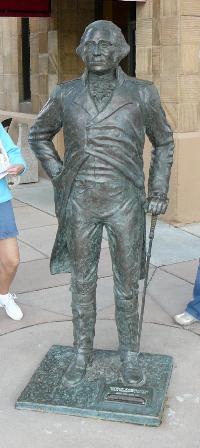 while all the squalid results of their do-gooding are merely taken as evidence that they didn't have enough power (and money). Thus, Washington, who could have been President for Life (as Hamilton wanted), retired after two terms, while it is characteristic of modern politicians (like FDR) to think that they are indispensable. The reason for Washington's views, as stated about one in his Farewell Address, is well given:
A just estimate of that love of power, and proneness to abuse it, which predominates in the human heart is sufficient to satisfy us of the truth of this proposition.
This already gives us a clue to Washington's personality, which today is hard to recover and appreciate under all the mythology, mystification, and ignorance. There is little doubt that the awe and love in which Washington was held was well founded on great virtues. He was resolute and brave in action, moderate and restrained in his judgment, yet passionate and committed, ferocious in his rare anger. As a general he did not win many battles, but he won the most important ones. He knew when to attack and when he had to retreat. He knew that the most important strategic goal was just to keep his army together and in the field, wear out the British, and then catch them at a vulnerable moment, as he did. He inspired unparalleled loyalty and love in his men, suffering with them, as through the nadir of their fortunes in the terrible winter at Valley Forge, as the British occupied Philadelphia (1777). After the war, Washington was as far from a demagogue as could possibly be. He often led, as when presiding at the Constitutional Convention, without even directly expressing his opinions, though he certainly had them. This was an ideal rather more like Taoism or Confucianism than the style we are familiar with today. But, in addition to the inactivity of the ideal Taoist ruler, Washington also embodied the qualities of the lesser kinds of rulers, to be "loved and praised," and, in a very healthy sense, to be "feared." And, let me end with a sentiment of the most extraordinary kind to come from the first military man to become President:
Hence likewise they will avoid the necessity of those overgrown Military establishments, which under any form of Government are inauspicious to liberty, and which are to be regarded as particularly hostile to Republican Liberty.
It is noteworthy that police departments did not exist in Washington's day, and even when they were introduced were originally prohibited from arming themselves. Today, an "overgrown Military establishment" must mean, not just a vast standing army, but the heavily armed paramilitary police establishment in each community, not to mention the multiple, extra-constitutional, often unaccountable, police agencies of the Federal government. The hostility and danger to Liberty of this establishment is palpable.
 +12. North Carolina (1629), 21 Nov 1789; Slave #6
+13. Rhode Island (1636), 29 Mar 1790; Free #5, ended slavery 1784
+14. Vermont (1777), 4 Mar 1791; Free #6
+15. Kentucky, 1 June 1792; Slave #7
+16. Tennessee, 1 June 1796; Slave #8
Territory South of the Ohio, 1790; Slave1792 1796 2. John Adams; 1797-1801; Federalist, Massachusetts; won 1 election, defeated.
A characteristic of Federalist government was tax rebellion. Under Washington, when Congress passed a direct tax on whisky, the result was the 1794 "Whisky Rebellion" in Pennsylvania, which had to be put down by the militia. Then in 1798,
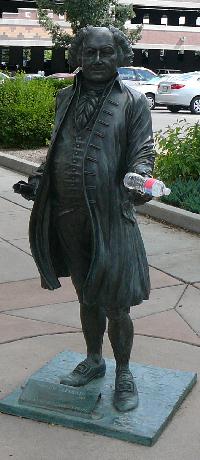 under Adams, Congress passed a direct tax on property, which set off the "Fries Rebellion," also in Pennsylvania. Again force was used, and the leader, John Fries, was convicted of treason and sentenced to death. As Washington had done with the leaders of the Whisky Rebellion, Adams pardoned Fries, much to the disgust of most Federalists. Adams, indeed, had had a bitter falling out with Hamilton and purged the Cabinet of Hamilton's friends. This reflects well on Adams, but it did not help him get re-elected against the tide of anti-Federalist (i.e. anti-tax) sentiment. The Federalist Party would never win the Presidency again. On the other hand, Adams, embittered by defeat, spent his last hours in office filling the judiciary with Federalist appointments. This would do great damage to the Republic in the long run, mostly because of just one appointment, John Marshall. Marshall, although usually revered with the Founders, was really the "Federalists' Revenge": He carefully laid the groundwork for future Federal power and, in the doctrine of Judicial Review, raised the Supreme Court itself practically above Constitutional checks and balances. As Jefferson understood, such a Court in the long run would act to promote the power of the Federal government and undermine the principle of limited and enumerated powers in the Constitution. It would be many years before the full effect of that was felt, but the fracture was already in the foundation.
I am persuaded, however, that Mr. Adams meant well for his country, was always an honest man, often a wise one, but sometimes and in some things, absolutely out of his senses. -- Benjamin Franklin
Indiana Territory, 1800; Free1800 3. Thomas Jefferson; 1801-1809; Democratic, Virginia; won 2 elections.
Thomas Jefferson effectively re-founded the country by putting in place a government and a Party that understood and mostly practiced the principles of limited government fought for in the Revolution and embodied in the Constitution.
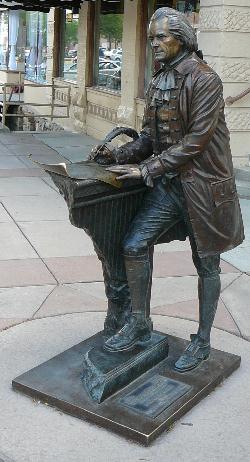 Thus, Jefferson got repealed all the direct federal taxes passed by the Federalists and boasted that ordinary Americans would never see a federal tax collector in their whole lives. A federal whisky tax, indeed, did not return until the triumph of Hamiltonianism in the New Deal. The two terms each of Jefferson, Madison, and Monroe, the only time in American history (until 1993-2017) that three successive Presidents, let alone from the same Party, were each elected to and served two full terms, served to solidify America as a Jeffersonian, rather than a Federalist/Hamiltonian, Democracy -- at least for the time being. Since Jefferson eloquently wrote about this, not just in the Declaration of Independence, but in a few lengthy essays and in a mountainous correspondence, anyone who cares to can still familiarize themselves with his thinking and principles -- as every American should in a day when Constitutional government has effectively been destroyed and a government of absolute power, beyond even what Hamilton wanted, is in place. The intellectual elite who are aware of how far we have fallen from Jeffersonian principles, tend to condescendingly dismiss Jefferson as at once both Utopian and anachronistic. This is pathetic and terrifying folly. American government now owes more to Otto von Bismark than to Thomas Jefferson; but far too many people, especially the political classes (lawyers, press, and bureaucrats) and intelligentsia (academics and commentators), are smugly satisfied with how "progressive" this is.
  The result is a powerful and growing police state, which is what Bismark had in mind himself. Naturally, if Jefferson himself were to return, he would find today's government far worse than the government of George III he denounced and helped throw off. At the same time, Jefferson saw the future well enough to know where trouble would come from. Thus, not only were there deficiencies in the Constitution, but it was clear to him that something would have to be done about slavery or there would be hell to pay. (And there was.) Jefferson today is easily faulted for racism and for not freeing his own slaves, but the Civil War would not have surprised him: He already saw it coming in 1820. Jefferson's life then ended in a moment of extraordinary synchronicity: Both he and Adams died on the same day, the 4th of July, 1826, the Fiftieth Anniversary of the Declaration of Independence. Only one other President would die on the 4th of July, Monroe; and only one President has actually been born on the 4th of July, Calvin Coolidge.
Orleans Terrritory, 1804; Slave
Louisiana Territory, 1805; Slave
Michigan Territory, 1805; Free
Illinois Territory, 1809; Free1804 1808 4. James Madison; 1809-1817; Democratic, Virginia; won 2 elections.
The wisdom of Thomas Jefferson, James Madison, and James Monroe makes most subsequent Presidents and politicians look like little more
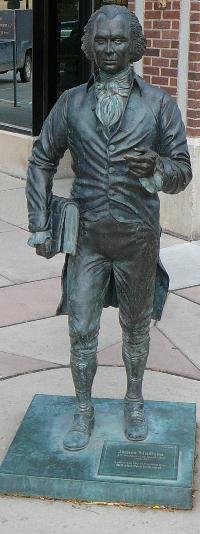 than clowns -- if not distressing examples of Schopenhauer's view that "the wicked and the fraudulent" dominate the sphere of action. But if Jefferson was the Philosopher President, Madison was the Law Giver, the one who had to make the Theory into a political reality. Madison's odyssey in that respect is instructive. As the Father of the Constitution and the author with Hamilton of many of the Federalist Papers, Madison might be expected to have been a Federalist. After a fashion he was. But he could not be a Federalist like Hamilton or even Adams. He understood that the limited and enumerated powers of the Constitution, and the system of checks and balances, were all indeed to limit the power of government. As the actions, ambitions, and intentions of the Federalists revealed themselves, Madison realized that Jefferson was his natural ally, not the Federalists. Thus, although he had originally argued against it, Madison was won over by the demand of Jefferson (and many States) for a Bill of Rights. So Madison became, indeed, the Father of the Bill of Rights. And into it Madison wrote the essence of American government itself: The Ninth and Tenth Amendments. The Ninth Amendment folds into the Constitution the Natural Rights doctrine of the Declaration of Independence. This is anathema to people who put obedience above freedom and duty above liberty, which pretty much means all the politicians, judges, and police who love the power that subverting the Constitution has given them. Heaven forbid that we should disobey a bunch of treacherous, lying, dishonest, power-mad, faithless tyrants and demagogues! Then the Tenth Amendment makes explicit what Hamilton had claimed was implicit in the Constitution, that the Federal government had no powers except what were explicitly enumerated in the Constitution. All other powers belonged either to the States or to the People. Today, of course, most of what the Federal government does is a persistent effort to evade the Tenth Amendment: When the "general welfare" clause is interpreted to mean that tax money can be spent on anything, and when the "interstate commerce" clause is interpreted to mean that laws can be passed about anything that "affects" interstate commerce (e.g. having a gun near a school, domestic violence, growing food, etc.),
  then it is clear that Federal laws can be passed about absolutely anything whatsoever. Thus Madison's handiwork has come to naught; but at least it took a long time; and, since the Ninth and Tenth Amendments have not actually been repealed, it calls for a very high level of dishonesty and hypocrisy in public life to maintain the current self-serving interpretations. Of course, there has never been a dearth of dishonesty and hypocrisy among politicians; but this does create a certain tension when people realize that more than 40% of their income is being looted and that a large part of their freedom is at the mercy of official thugs who can jerk them around for any reason at any time. The source of the corruption, and the maintenance of the dishonesty and hypocrisy, however, as P.J. O'Rourke perceived in A Parliament of Whores, is that too many people think they are getting a good share of the loot themselves (don't you dare take away my Medicare!), and they are also more than happy to think that certain other people (marijuana smokers, businessmen, etc.) are getting jerked around. This sort of corruption may be inevitable in a democracy, and it remains to be seen whether future Jeffersons and Madisons will understand and implement more effective checks and balances to remedy the failing and prevent its recurrence.
I cannot undertake to lay my finger on that article in the Constitution which granted a right to Congress of expending, on objects of benevolence, the money of their constituents.... With respect to the words general welfare, I have always regarded them as qualified by the detail of powers connected with them. To take them in a literal and unlimited sense would be a metamorphosis of the Constitution into a character which there is a host of proofs was not contemplated by its creators. -- James Madison, 1791
+19. Indiana, 11 Dec 1816; Free #10
Missouri Territory, 1812; Slave
Alabama Territory, 1817; Slave1812 1816 5. James Monroe; 1817-1825; Democratic, Virginia; won 2 elections.
James
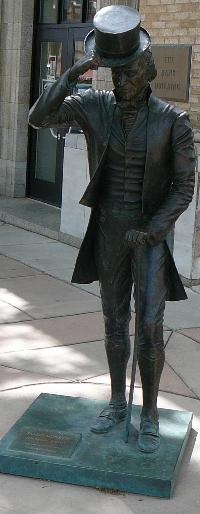 Monroe was the only President in American history, besides George Washington, to be elected without opposition (in 1820) -- during the the "Era of Good Feeling," the only period in American history of one party rule, after the well deserved demise of the Federalists. Monroe, like Jefferson and Adams, died on the 4th of July (1831). -- Just before Monroe's Presidency, in 1816,
  Congress decided to do something about the American Flag. The 15 stripe and and 15 star Flag had been used ever since 1795. It had clearly been impractical to keep adding stripes for each new state, but the task of even addressing the alternatives was delayed for twenty years after the admission of the 16th state (Tennessee).
  Then, in 1818, Congress decided that the American flag should revert to the 13 stripes of the original flag and add a single star for each new State, with the change automatically taking effect the following Fourth of July. This has been the rule ever since. There is no statutory rule about how the stars are to be arranged, but arrangement for the 48, 49, and 50 star Flags has been set by Presidential Order. Four more new States during Monroe's Presidency meant that the Flag changed three more times.


+20. Mississippi, 10 Dec 1817; Slave #10
+21. Illinois, 3 Dec 1818; Free #11
+22. Alabama, 14 Dec 1819; Slave #11
+23. Maine, 15 Mar 1820; Free #12, Missouri Compromise
+24. Missouri, 10 Aug 1821; Slave #12, Missouri Compromise
Arkansas Territory, 1819; Slave
Florida Territory, 1822; Slave1820 1824 6. John Quincy Adams; 1825-1829; Democratic, Massachusetts; won 1 election, defeated.
Until George W. Bush, the only son of a President (John Adams) to become President, John Quincy Adams, however,
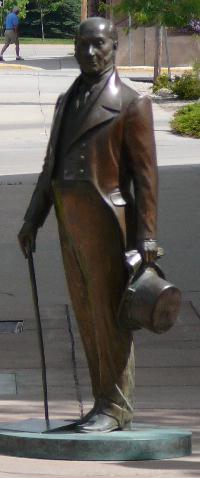 ended up abandoning the Federalists -- though idiosyncratically so. Adams turned out to be the end of the Jeffersonian Apostolic Succession to the Presidency. Although John Adams and Jefferson had both been Vice-Presidents who succeeded their Presidents, Jefferson had also been Secretary of State, and he was succeeded by his own Secretary of State, Madison. Madison was succeeded by his Secretary of State, James Monroe; and John Quincy Adams was Monroe's Secretary of State, largely responsible himself for the Monroe Doctrine. (The Vice-Presidents of the period, except for John C. Calhoun, were non-entities, but Jefferson probably considered the Vice-President more properly part of the Senate than of the Executive Branch.) Adams' most extraordinary diplomatic post was as American Ambassador to Russia at the time of Napoleon's invasion in 1812. Adams wrote to his mother, "The two Russian generals who have conquered Napoleon and all his Marshals are Famine and General Frost." Thus, Stalin's quip, in the context of Hilter's later invasion, that his best generals were January and February, may have an American antecedent. Nevertheless, Adams was a bit too grouchy, independent, and contrary to be a good leader. He began getting Federalist ideas about federally funded "internal improvements" as President, and the Democratic Party started to fragment. Adams had nearly lost to Andrew Jackson in 1824, and by 1828 Jackson was irresistible. After his defeat, Adams was elected to the House of Representatives, where he literally served the rest of his life, dying in the Capitol itself (1848). Indeed, Adams collapsed with a stroke in the old elliptical House chamber at the "whisper spot," one of the two focal points where voices can be heard from the opposite side of the room. During his years in the House, Adams was active in the cause against slavery. He is now famous, thanks to Steven Spielberg's 1997 movie Amistad, for his 1841 defense before the Supreme Court of the captured Africans who had broken free and seized the Spanish slave ship Amistad. The Africans were arrested by the U.S. Navy for piracy. Adams won their freedom.
1828 7. Andrew Jackson; 1829-1837; Democratic, Tennessee; won 2 elections.
Although
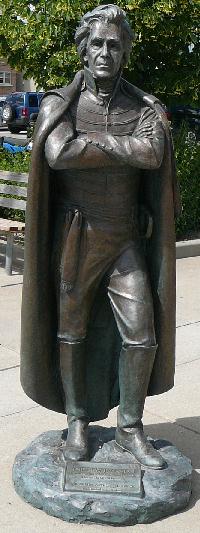 shamelessly driving the "Five Civilized Tribes," including his Cherokee allies from the War of 1812, out of their homes in the East, Jackson is nevertheless, in most other areas, one of the greatest Presidents. A fierce Unionist, Jackson let South Carolina ("too small to be a Republic, too large to be a madhouse") know in no uncertain terms that federal laws applied to it and that secession would not be tolerated -- although, as it happens, South Carolina's complaint about protective tariffs (which are unconstitutional), which hurt Southern agriculture, was just. This kind of Unionism remained characteristic of some other Southern Democrats, like Sam Houston (who became President of Texas in 1836). Most importantly, Jackson, against Congressional opposition, vetoed and killed the Second Bank of the United States, ending the specter of a Central Bank until the creation of the Federal Reserve System in 1913. A brainchild of the Federalists (in fact, Alexander Hamilton himself), and bitterly fought by Jeffersonians, the Bank of the United States was a breach in the system of limited government, successfully contained by Jackson, now entirely triumphant since the New Deal. One reflects that Jackson was not the sort of person to tolerate the sort of Government we have now.

+26. Michigan, 26 Jan 1837; Free #13
Wisconsin Territory, 1836; Free1832 1836 8. Martin van Buren; 1837-1841; Democratic, New York; won 1 election, defeated.
The "George Bush" of Jacksonian Democracy. Van Buren was the first President whose experience was exclusively as a politician. The Jeffersonian Presidents had all been Secretaries of State, and all except Madison had held important foreign diplomatic positions. Adams had also been a diplomat. Washington and Jackson, of course, were distinguished as military men. So van Buren was the first pure politician and, not surprisingly, had a reputation as a manipulator. Groomed as Jackson's successor, van Buren nevertheless could not manipulate himself into a second term against the war hero Harrison. Portrayed as an opportunistic fool in Amistad, van Buren was not that bad, but it did mean the first loss of the Presidency to an Opposition Party since Adams lost to Jefferson in 1800. So far, every Vice President to succeed his President by election (Jefferson, Adams, van Buren, Bush) has failed to be re-elected, except Jefferson (who was the last Vice President to be from the Opposition Party to his President).
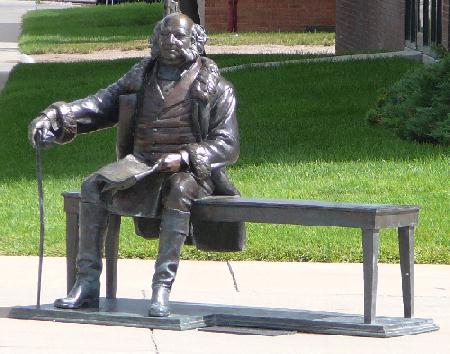
 Iowa Territory, 1838; Free
1840 9. William Henry Harrison; 1841; Whig, Ohio; won 1 election, died in office.
 Harrison was the first President to die in office. Hereafter, the President elected every twentieth year (marked with a red X) dies in office. Some regard this as the Curse of Tecumseh, the Shawnee chief defeated by Harrison at Tippecanoe in 1811. The only President to die in office without being elected in the twentieth year, Zachary Taylor, was the only other Whig, and the last, to win the office. No Democrats die in office until Franklin Roosevelt, who opens himself to the Curse only by violating George Washington's precedent and winning a third term in 1940. The first Republican subject to the Curse after Roosevelt, Ronald Reagan, although shot and badly wounded, nevertheless survived and fully recovered (blue X). It remains to be seen whether that represents the end of the Curse. The President elected in 2000 would be the test. That turned out to be George W. Bush.
 10. John Tyler; 1841-1845; Whig, Virginia; succeeded to office.
Tyler's principal claim to fame seems to be his inclusion in Harrison's famous campaign slogan: "Tippecanoe and Tyler Too."
+27. Florida, 3 Mar 1845; Slave #14
1844 11. James K. Polk; 1845-1849; Democratic, Tennessee; won 1 election.
The admission
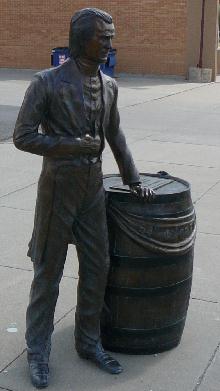 of Texas (1845) and the Mexican War (1846-1848) were bitterly opposed by many who thought it was all a plot to add more Slave States to the Union. Henry David Thoreau's protests over the War led to his classic essay, "On The Duty of Civil Disobedience" (1849). The Mexican Cession, however, ended up hurting the cause of slavery much more than helping it, since the first State ready for admission from the territory was California, which would permanently tip the balance in the Senate, previously so carefully maintained, in favor of the Free States. Texas turned out to be the last Slave State. The Mexican War was the first large military campaign outside the territory of the United States. Future Civil War generals, like Grant and Lee, cut their teeth on it. The total defeat of Mexico did not seem like a forgone conclusion at the time, and there was some very hard fighting. Zachary Taylor and Winfield Scott became the major war heroes. The Cession obtained from Mexico was the last large addition to the contiguous territory of the United States. There is a element in American politics, among the anti-American Left, that wishes to return the Cession to Mexico -- presumably so that Hispanic-Americans can enjoy all the advantages, freedom, and prosperity of life in Mexico.


+29. Iowa, 28 Dec 1846; Free #14
+30. Wisconsin, 1848; Free #15
Oregon Territory, 1848; Free
Minnesota Territory, 1849; Free1848 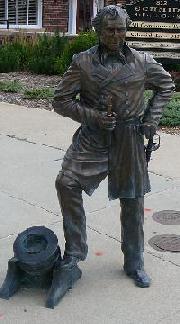 12. Zachary Taylor; 1849-1850; Whig, Kentucky; 1 election, died in office.
A hard charging general, it is hard to know what Taylor would have been like as President. He didn't last long enough. The Curse of Tecumseh is still pretty virulent.
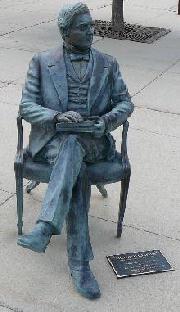 13. Millard Fillmore; 1850-1853; Whig, New York; succeeded to office.
Millard Fillmore seems to draw some interest and affection just for the humorous overtones of his name. Nevertheless, the Compromise of 1850 would light the fuse for the Civil War. With California admitted as a Free State, the balance between Slave and Free in the Senate was permanently upset. There would never be another Slave State, and this meant to the South that they would always be the minority in National politics. Otherwise, Fillmore would be the last Whig President.
 +31. California, 9 Sept 1850; Free #16, Compromise of 1850
New Mexico Territory, 1850; Slave, Compromise of 1850
Utah Territory, 1850; Slave, Compromise of 1850
Washington Territory, 1853; Free1852 14. Franklin Pierce; 1853-1857; Democratic, New Hampshire; won 1 election.
One of the greatest
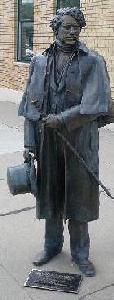 and most portentous political controversies of Pierce's day was the Kansas Nebraska Act, which created the Territories of Kansas and Nebraska out of land of the Louisiana Purchase. This precipitated some of the most explosive events leadings up to the Civil War. Under the Missouri Compromise, all of this area of the Louisiana Purchase should have been closed to slavery. The principle of the Compromise was somewhat abridged by the Compromise of 1850, which opened much of the land of the Mexican Cession to slavery, since that included land north of the line established by the Missouri Compromise as the limit of slavery. The Southern States wanted all of Kansas and Nebraska open to slavery. The "free soil" forces wanted none of it open. The compromise was that it became a matter of a vote in Kansas and Nebraska. This made for "Bloody Kansas," as opposing forces literally battled it out to suppress, expel, or kill each other. The slavers won the vote in Kansas, but Congress then refused to recognize it or admit Kansas as a Slave State. The Southern States consequently had to face the fact that they were not going to get their way and that there probably would be no more Slave States admitted to the Union. This broke the Democratic Party into Northern, Unionist, and Secessionist factions.
Nebraska Territory, 1854; Free/Slave, Kansas Nebraska Act, 19541856 15. James Buchanan; 1857-1861; Democratic, Pennsylvania; won 1 election.
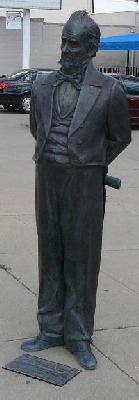 Kansas was the last chance for the South to get another Slave State into the Union. The fraudulent nature of the Territorial government -- the fruit of the violence of "Bloody Kansas" -- however, meant that its petition for Statehood was rejected by a Congress that now had a majority of Free States in both Houses. Kansas was not admitted, as a Free State, until after the Southern States began to secede and their representatives had left Washington. What set off secession, of course, was the election of Abraham Lincoln, an avowed Abolitionist, in November 1860. By the time Lincoln was inaugurated the following March, seven States had left the Union. Buchanan did nothing to stop them but did make one crucial and fateful decision: He did not willingly turn over federal installations to the seceding States. Thus, when Lincoln came to office, Fort Sumter in Charleston harbor was still held by the United States Army.
+32. Minnesota, 11 May 1858; Free #17


+33. Oregon, 14 Feb 1859; Free #18
+34. Kansas, 29 Jan 1861; Free #19
Colorado Territory, 1861; Free
Nevada Territory, 1861; Free
Dakota Territory, 1861; Free
-1. South Carolina Secession, 1860
-2. Mississippi Secession, 1861
-3. Florida Secession, 1861
-4. Alabama Secession, 1861
-5. Georgia Secession, 1861
-6. Louisiana Secession, 1861
-7. Texas Secession, 1861
)
 , and still extending today to Bishop, California,
  , was named the "Grand Army of the Republic Highway." It is still identified as such at points along its length, probably to the perplexity of many travelers. Originally continuing down to Long Beach, California, the highway traverses the United States, without crossing any part of the Country that had been controlled by the Confederacy. There is a very lonely stretch in the middle of Nevada.
THE MIDDLE REPUBLIC, 1861-1933, 72 years;
18 elections; 14 Republican, 4 DemocraticFormative Events: The Civil War, Reconstruction, the Spanish-American War,
Income Tax, the Federal Reserve System, World War I, Alcohol & Drug Prohibition,
& the Depression
Ongoing Conflicts: Immigration, Racial Segregation, & Progressivism1860 16. Abraham Lincoln; 1861-1865; Republican, Illinois; won 2 elections, assassinated.
On 12 April 1861, the forces of the Confederate States of America opened fire on Fort Sumter. That Lincoln responded to this as war and
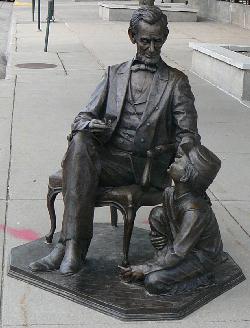 Rebellion set off the secession of four Border States, four years of terrible war, and the deaths of over 600,000 soldiers from combat and disease. Nothing quite like this slaughter would be seen again until World War I. Indeed, one might consider that the total Allied dead on D-Day in 1944 were 2,500 men, while this is only a third of the Confederate dead alone merely in Pickett's Charge at Gettysburg. Similarly, there were 47,357 American combat deaths (10,796 non-combat) in the entire Vietnam War, while there were between 43,000 and 51,000 casualties (dead and wounded) in the Battle of Gettysburg alone. Whether this all was a good idea depends on one's estimation of the value of the Union as such and of the degree to which the existence of slavery was tolerable. Did the North have the right to invade the South to free the slaves?
  Well, quite frankly, yes. Did the United States have the right to conquer the Southern States just to preserve the Union? Well, no -- if, that is, the principle of self-determination means anything. The problem with these evaluations is that it was no stated war aim of the United States to free the slaves. Lincoln raised armies on the basis of saving the Union, and a great many Northerners, and even some Southerners, who responded to that didn't even want to free the slaves, let alone allow full civil rights for freedmen. Of course, Southerners did not believe Lincoln's stated purposes. The Deep South States seceded because an Abolitionist President was intolerable to them, regardless of Lincoln's promises to leave slavery untouched in the current slave States. They didn't trust him. Similarly, Abolitionists were unhappy with Lincoln for apparently making such concessions to the slavers. As it happened, of course, Lincoln made the Emancipation Proclamation at the first decent opportunity, on September 22, 1862, and the War in fact became an instrument of radical Abolitionists, not only freeing the slaves, even in loyal Border States (Missouri, Kentucky, Maryland, & Delaware, by the Thirteenth Amendment), but amending the Constitution to guarantee civil and voting rights to them (the Fourteenth and Fifteenth Amendments, however poorly enforced after President Grant), which Lincoln himself had at first not supported. Thus Frederick Douglass, who had nearly been arrested as an accomplice of John Brown, and who was impatient with Lincoln at first, ended up in some awe at what was finally accomplished. Lincoln, in short, may simply have been a superb Machiavellian politician, using the necessary and sufficient means to achieving the good and just end. Lincoln freed the slaves and, by the way, saved the Union. There are still, to be sure, important arguments that the cost was not worth this result. Some of these have been examined in the review of Emancipating Slaves, Enslaving Free Men, by Jeffrey Rogers Hummel. Here, let me mention a couple of them. (1) Lincoln broadly abused civil liberties in his prosecution of the war and suppression of dissent in the North. True. Unfortunately, there is no side of the angels in that respect. The Southern States had actually been censoring mail before the War to suppress even private discussion of Abolitionism, and during the War, not only was the South the first to institute conscription, but Southern civilian Unionists, in several instances, were massacred by Confederate forces. If our concern is the preservation of civil rights, then neither slavery nor war are good circumstances in which to do this. The war in fact ended, but the regime of slavery was subsequently continued by other means in the Southern States. The primary sinner, then, was not Lincoln but the slavers and their racist Segregationist successors. (2) The failure of secession removed the only real check against unconstitutional usurpations of power by the Federal Government. Again, true. The fault, however, already existed in the original Constitution, which provided no means for its own enforcement. Both the final review authority of the Supreme Court, which Jefferson understood would promote Federal power, and the threat of secession by disaffected States were ad hoc devices which could only clumsily and imperfectly serve to preserve Constitutional government. Indeed, actual recourse to secession meant withdrawl from the Constitution altogether.
  That the withdrawl occurred over slavery and not over some noble, or at least honorable, purpose served to discredit the device altogether in retrospect. In our own day, when the rot of usurpation has destroyed Constitutional government altogether, the challenge again is the original one, of introducing such institutional, rather than ad hoc, checks and balances that will effect the original purposes of the compact. Since most Americans apparently don't even think this is necessary, the prospects for it are still poor. (3) Lincoln was in effect a Federalist, instituted many Federalist programs, like National Banks, and so prepared the way for the ultimate Federalist and Hamiltonian triumph in the putatively Jeffersonian Democratic Party of Franklin Roosevelt. Again, true. On the other hand, the post-War Federal government returned to a scale that was still all but Jeffersonian in comparison to anything that has existed since the New Deal. It was "Progressivism," not Lincoln, that really prepared the way for the muddled fascist/socialist welfare/police state that we have now. Indeed, the lapse of the Federal Government into pre-War limitations meant that the Segregation regime was allowed to rise in the South, as Federal powers to defend civil rights against the States were all but destroyed by, ironically, the Supreme Court, and the check against tyranny by the States recommended by James Madison himself, and passed as the Fourteenth Amendment, became, for a while, a dead letter. The consequences of this have been far more terrible than any Federal usurpations effected by Abraham Lincoln. Segregation ultimately became so discredited and hateful that its overthrow took with it not only the Tenth Amendment and the whole concept of enumerated powers, but also fundamental rights of private property and voluntary association. This violated not only the "takings" clause of the Fifth Amendment but even the hard won Thirteenth Amendment itself: any businessman who is required by Federal law to serve customers he doesn't want to serve is, indeed, in the thrall of "involuntary servitude." This deconstruction of the principle of civil rights into the means of destroying freedom was due, not to Abraham Lincoln, but to subsequent socialist propaganda and to the massive breach effected in property rights when Franklin Roosevelt finally got the Supreme Court to wave through key New Deal legislation (instituting "relaxed review" of property rights and infringement on "commercial" free speech). We may see Lincoln's Federalism as, ultimately, helping to prepare the way for this, but it was a small step compared to the damage done later, and none of the Civil War Amendments were in themselves unworthy. In comparison, freeing the slaves and saving the Union don't look so bad. I am a Union man, myself.
Marching Through Georgia
-8. Virginia Secession, 1861

-9. Arkansas Secession, 1861
-10. North Carolina Secession, 1861
-11. Tennessee Secession, 1861
+35. West Virginia, 20 June 1863
+36. Nevada, 31 Oct 1864
Arizona Territory, 1863
Idaho Territory, 1863
Montana Territory, 18641864 17. Andrew Johnson; 1865-1869; Republican, Tennessee; succeeded to office.
Andrew
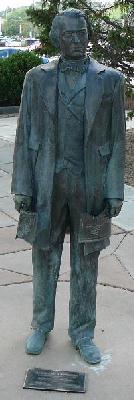 Johnson of Tennessee was picked for Vice President as a Republican tribute to Southern Democrat Unionists. Since there had actually been massacres of Southern Unionists, as far away as Texas, this was a nice touch. However, once Johnson became President, he was, like other Southern Unionists, not overly concerned to protect the rights of freed slaves. His theory was that the Southern States had never really left the Union, had the same powers that they had had before the War, and so could treat freed slaves any way they liked. He allowed reconstituted governments in the Southern States which passed "black codes" depriving freed slaves of citizenship and multiple civil rights. However, Congress was firmly in the hands of Republican "Radicals." They responded with the Civil Rights Act of 1866, which Johnson vetoed. For the first time in American history, a Presidential veto was reversed. Then the Supreme Court declared the Act unconstitutional, so Congress passed the Fourteenth Amendment to protect the civil rights and voting rights of blacks. The Southern State governments were deposed and new Reconstruction regimes set up. Johnson was not much more friendly to these Republican Reconstruction governments than most Southern whites were. Subsequent historians, sympathetic to the South, later portrayed Reconstruction as a terrible oppression and exploitation of the South, pushed by those who simply wanted revenge. Although the governments were often corrupt, and their black members often illiterate and unsuited to the task, we cannot overlook the fact that most Southern whites had no intention whatsoever of allowing political equality, or even the basic security of person, property, and contract, to the freed slaves. Even a President fully committed to black civil rights, like Grant, was only able to postpone, not to prevent, the subsequent Jim Crow and Segregation regimes. If Johnson had had his way, such a struggle would not even have been attempted, and nothing in the Constitution would protect anyone from attack by State governments. Today, when Johnson's role in this respect is unlikely to be celebrated by most, all that remains of sympathy for Johnson concerns his Impeachment and Trial in the Senate. Since Congress, knowing Johnson's sympathies, wanted to run the Executive Branch as well as the Legislative, it passed laws attempting to abridge Johnson's Presidential privileges, specifically to prevent him from firing Secretary of War Edwin M. Stanton, who, of course, was in charge of the Union occupation forces in the South. Johnson fired Stanton anyway and was Impeached over this act. Since the law preventing the firing was certainly unconstitutional, Johnson was truly innocent and was justly vindicated. However, the political anger at Johnson was fully justified, and the Radicals can hardly be blamed for doing all they could within their power to prevent unreconstructed Confederate sympathizers from depriving blacks of the freedom so lately and dearly won. The later triumph, indeed, of those to whom Johnson was sympathetic made for a century of Terror in the South for blacks, and for endless trouble (including the corruption of the whole idea of civil rights) in the years since the Civil Rights Act of 1964 abolished Segregation. Stanton, on the other hand, was no paragon of righteousness himself. His nominee to head the new Secret Service, William P. Wood, began arresting dozens of people for counterfeiting, getting corrupt judges to convict them, just so that he could collect the rewards offered by the Treasury Department. Informed of this by public outrage, Johnson began pardoning those who were thus convicted. This also angered Congress. A revealing episode. The kind of political corruption that later would get blamed on President Grant was among many of the same people who were on the side of the angels when it came to protecting Southern blacks, while Johnson, who was prepared to leave the South to its own devices, nevertheless could respond acutely to other kinds of injustice. It just goes to show the complexity of human character, and the element of truth that was used to smear the whole Radical project of Reconstruction.
Those sons of bitches! I know that damned [Frederick] Douglass; he's just like any ni**er, and he would sooner cut a white man's throat than not! -- Andrew Johnson, 1866

 +37. Nebraska, 1 Mar 1867
Wyoming Territory, 1868
+1. Tennessee Readmitted, 1866, Reconstruction Government ended, 1869
+2. Louisiana Readmitted, 1868, Reconstruction Government ended, 1877
+3. Arkansas Readmitted, 1868, Reconstruction Government ended, 1874
+4. Alabama Readmitted, 1868, Reconstruction Government ended, 1874
+5. Florida Readmitted, 1868, Reconstruction Government ended, 1877
+6. South Carolina Readmitted, 1868, Reconstruction Government ended, 1876
+7. North Carolina Readmitted, 1868, Reconstruction Government ended,
18701868 18. Ulysses S. Grant; 1969-1877; Republican, Ohio; won 2 elections.
U.S. Grant was
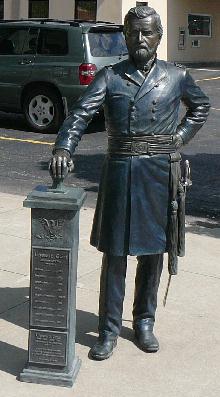 one of the greatest generals in history. He and his friend, William Tecumseh Sherman, essentially won the Civil War. Grant was the only Union general who would go head to head with Robert E. Lee (the Bishma and Drona of the Confederacy) and not back down. The result was immense slaughter; but we know that when Grant had the chance, he (like Sherman) preferred a war of movement with minimal casualties. It was the greatness of Lee as a general that foiled all of Grant's maneuvers and forced the bloody attempts at breakthrough in 1864, such as at Cold Harbor. The final act, indeed, catching Lee at Appomattox Court House, was the result of the maneuver and rapid movement that cut off Lee's retreat. And, for all the accusations of "butcher" at Grant, a larger percentage of Lee's soldiers died under his orders -- none more terribly and futilely than in Pickett's Charge at Gettysburg. Years later, a bitter Pickett himself reportedly said of Lee, "That old man had my division slaughtered."
 Grant earned the undying hostility of Southern whites, and of historians who later, until the 1960's, viewed Reconstruction as the oppression of the South. To this hostility was added that of Northern "reformers," often in league with Southern Democrats, who wanted to replace government patronage with a system of civil service examinations (expecting thereby to be selected themselves). Many of the charges of corruption leveled at the Grant Administration were simply complaints about a patronage system that had existed since Andrew Jackson. Nevertheless, in 1870 Grant himself called for civil service reform and established a civil service commission. He became disillusioned by 1875, saying that "...one of the most brilliant candidates before the civil service board was in jail very soon after his appointment, for robbery." Now, more than a century after a politically independent civil service system has been in place, and especially after bureaucrats have acquired the power of writing administrative regulations with the force of law, it is not clear that such an irresponsible authority is really an improvement over political patronage. Instead, we are aware of the rent-seeking corruption of bureaucratic authority described by Public Choice Theory.

Grant's Tomb, and the Riverside Church,
from below on the Hudson RiverWhat General Lee's feelings were I do not know. As he was a man of much dignity, with an impassible face, it was impossible to say whether he felt inwardly glad that the end had finally come, or felt sad over the result, and was too manly to show it. Whatever his feelings, they were entirely concealed from my observation; but my own feelings, which had been quite jubilant on the receipt of his letter, were sad and depressed. I felt like anything rather than rejoicing at the downfall of a foe who had fought so long and valiantly, and had suffered so much for a cause, though that cause was, I believe, one of the worst for which a people ever fought, and one for which there was the least excuse. I do not question, however, the sincerity of the great mass of those who were opposed to us. -- Ulysses S. Grant, Personal Memories of U.S. Grant, 1885 [Seven Treasures Publications, 2010, p.353, boldface added]
 Enjoined by the Constitution "to take care that the laws be faithfully executed," and convinced by undoubted evidence that violations of said act had been committed and that a widespread and flagrant disregard of it was contemplated, the proper officials were instructed to prosecute the offenders, and troops were stationed at convenient points to aid these officers, if necessary, in the performance of their official duties. Complaints are made of this interference by Federal authority; but if said amendment and act do not provide for such interference under the circumstances as above stated, then they are without meaning, force, or effect, and the whole scheme of colored enfranchisement is worse than mockery and little better than a crime. -- Ulysses S. Grant, State of the Union Message, 1874 [boldface added]
+8. Georgia Readmitted, 1870, Reconstruction Government ended, 1871
+9. Texas Readmitted, 1870, Reconstruction Government ended, 1873
+10. Mississippi Readmitted, 1870, Reconstruction Government ended, 1876
+11. Virginia Readmitted, 1870, Reconstruction Government ended,
18691872 1876 19. Rutherford B. Hayes; 1877-1881; Republican, Ohio; won 1 election.
Rutherfraud B. Hayes got into office,
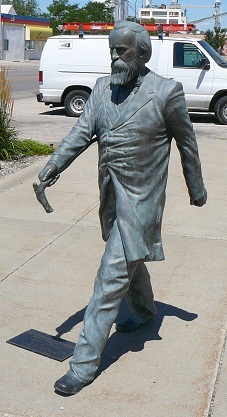 with a minority of the popular vote and a hung Electoral College, because of a deal in the House of Representatives to end Reconstruction with the withdrawal of Federal troops from the South. This freed the hand of Southern States to violate the Fourteenth and Fifteenth Amendments, stripping freed slaves of civil rights, voting rights, and any other rights they could think of. The institution of Segregation took a little while; but by the Plessy v. Ferguson decision in 1896 (after a year of 230 lynchings in 1892), which allowed Segregation laws, the regime was established -- to persist until 1964. This whole shameful transaction, however, was probably unavoidable at the time. Northern opinion had been strong against Southern seccession, and had even come around to effect Emancipation, but the project of constantly protecting freed slaves or deposing hostile Southern State governments with Federal troups very quickly became too burdensome. There would be hell to pay for this, as the Civil Rights Act of 1964 did as much to destroy civil rights as to enforce them (creating endless controversies about matters that are not public, legal, or government issues at all), but it is hard to imagine how anything short of prolonged military dictatorship could have stopped Southern whites in 1876.
  Grant himself had accepted victories by the Democrats in the South, as in Texas and elsewhere, when the elections were honest. All the trouble in Louisiana and South Carolina was because of the fraud and violence subverted what were, at the time, black majorities.
1880 20. James Garfield; 1881; Republican, Ohio; won 1 election, assassinated.
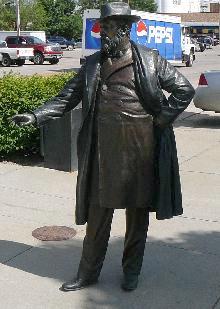 Garfield died of a gunshot wound, from a disgruntled office-seeker, that today would probably not be life threatening. They just couldn't find the bullet and get it out. Alexander Graham Bell's attempt to locate it electronically, with the first metal-detector, failed. The effort was confused by the metal springs of the bed, whose removal Bell had requested but Garfield's incompetent physician had failed to do. The physician was so incompetent that he did not believe in anasepsis, introduced infection into Garfield's wound, insisted that the bullet was where it wasn't, and did little to properly treat Garfield's condition. With no antibiotics, and no understanding, to control the infection, Garfield lingered painfully for more than two months. Even the public thought that the case discredited Bell's metal-detector. Bell himself, not believing that the physician had ignored his instructions, never understood why his effort had failed. Within ten years, the discovery of X-Rays would provide a technology that could have made finding the bullet easy, even routine. However, when the next President was shot, William McKinley, his physicians were unable or unwilling to use a nearby X-Ray machine on him.
 21. Chester Alan Arthur; 1881-1885; Republican, New York; succeeded to office.
Arthur succeeded after the death of Garfield. Seems to have been a decent enough guy, so the most characteristic thing they came up with for the Rapid City sculpture was him taking the oath of office. Arthur had actually been the creature of the Republican Establishment, as Garfield had not been, but he seems to have disappointed his patrons in terms of the patronage and corruption that they expected.
1884 22. Grover Cleveland; 1885-1889; Democratic, New Jersey; won 1 election, defeated.
The first
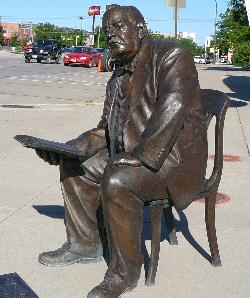 Democrat elected after the Civil War, the only President elected to non-consecutive terms, as the 22nd and 24th President, and the only northern Democrat, besides Franklin Roosevelt, John F. Kennedy, and Barack Obama to be elected since. On October 28, 1886, after it had taken ten years to build the pedestal for the gift of France in commemoration of the Centennial of the American Revolution in 1876, President Cleveland dedicated the Statue of Liberty, perhaps the greatest symbol of all of American freedom. He also was the President who dedicated the Washington Monument, in 1888. In 1886 Cleveland became the first President to get married while in office -- after the embarrassment of previously having fathered an illegitimate child. Cleveland otherwise seemed to spend much of his time vetoing bills. Civil War pensions had been getting out of hand. Originally intended for those disabled by war wounds, an 1887 bill would have provided a federal disability and/or old age pensions to all veterans, or even their parents. Cleveland's veto was sustained, though his work would be undone in the next administration. Cleveland also had a clear understanding of the damage that protective tariffs did to the poor.
  He said that a tariff was a tax on consumers "paid by them as absolutely...as if it was paid at fixed periods into the hands of the tax-gatherer." Other dramatic events were in his second term, below; but we find a classic statement of Constitutional government in the first term, when Cleveland vetoed a bill for drought relief in Texas in 1887 and enunciated again what James Madison had said in the 1790's, that the federal government was not authorized to spend money merely on "objects of benevolence." Madison could not have said it better. "Paternal care" is now commonly assumed to be the principal duty of the federal government. Above left is a room in the house where Cleveland was born, in Caldwell, New Jersey:
I can find no warrant for such an appropriation in the Constitution, and I do not believe that the power and duty of the General Government ought to be extended to the relief of individual suffering which is in no manner properly related to the public service or benefit.... The friendliness and charity of our countrymen can always be relied upon to relieve their fellow-citizens in misfortune. This has been repeatedly and quite lately demonstrated. Federal aid in such cases encourages the expectation of paternal care on the part of the Government and weakens the sturdiness of our national character, while it prevents the indulgence among our people of that kindly sentiment and conduct which strengthens the bonds of a common brotherhood. -- Grover Cleveland
1888 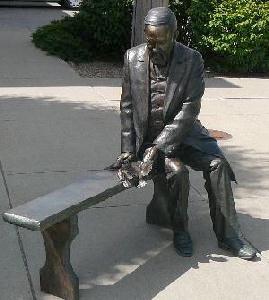 23. Benjamin Harrison; 1889-1893; Republican, Indiana; won 1 election, defeated.
The sculpture of Benjamin Harrison in Rapid City shows him feeding birds. This is probably not a good sign for what his Presidency was like, although a Taoist Sage might not have done any different. But Harrison was no Taoist Sage, following through on Republican promises to expand Civil War pensions, farm subsidies, and protective tariffs. The latter would help set set off an economic downturn that would then trouble Cleveland's second Presidency. But none of it was good.

 +39. North Dakota, 2 Nov 1889
+40. South Dakota, 2 Nov 1889
+41. Montana, 8 Nov 1889
+42. Washington, 11 Nov 1889
+43. Idaho, 3 July 1890
+44. Wyoming, 10 July 1890
Oklahoma Territory, 18901892 24. Grover Cleveland; 1893-1897; Democratic, New Jersey; won 1 election.
 The Last Good President -- perhaps the last true Jeffersonian -- Cleveland understood Constitutional Government, enforced it, and in 1893 snubbed the gang who overthrew Queen Liliuokalani in Hawai'i (although he did not see to it, as the British had done in a similar situation, that the native government was reinstalled). Cleveland appointed J. Sterling Morton of Nebraska to kill the farm subsidies that had grown into a massive source of corruption in the Agriculture Department (though such a department should not have existed in the first place). Morton's success was not undone until the New Deal. A "hard money" Democrat, in 1894 Cleveland effectively killed the Free Silver movement, whose real goal was the inflation of debts. The Panic and Depression of 1893 set off the inflationary radicals in the Democratic Party, who became disillusioned with Cleveland and nominated firebrand Williams Jennings Bryan in 1896. Bryan's defeat that year was the final collapse of the Free Silver movement. The Depression may have been due in part to the tariffs that the Republicans had passed in the Harrison administration, which had the same ill effect on trade as under Hoover in 1930.
 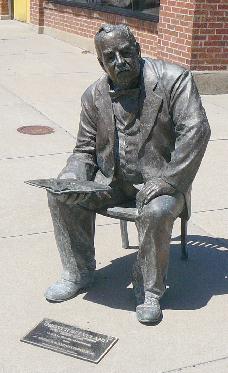 Labor trouble culminated in the Pullman strike of 1894, when Cleveland had to call out federal troops to keep the railroads running. Although he had been mayor of Buffalo and governor of New York State, Cleveland was from New Jersey, as we see above, and he retired to Princeton. He is buried there, with his wife and their child, under a modest monument, shown above, in the Princeton Cemetery. Cleveland was working in his law office in New York when he came down ill, and he insisted on being taking home to Princeton, where he died. Cleveland was the last truly Jeffersonian Democrat.

...though the people support the Government, the Government should not support the people.
-- Grover ClevelandGrover Cleveland was perhaps the last lonely survivor of the old days. He had his faults... but no one could have imagined him yielding to the mob in order to make votes. Right or wrong, he was his own man -- and never more surely than when, by popular standards, he was wrong -- H.L. Mencken, Baltimore Sun, March 15, 1926
1896 25. William McKinley; 1897-1901; Republican, Ohio; won 2 elections, assassinated.
Cleveland lost support of the Democrats over the Gold Standard and the poor economy. Unemployment was 18.4% in 1894. In his place, William Jennings Bryan appeared, with remarkable and epic eloquence, as the Savior of Free Silver. Given the mythic footprint of his campaign in American history, it is hard to imagine how he could have lost the election, but he did. One of my grandmother's cousins, who remembered the election of 1896, told me how her father gathered the family together (this was in Arkansas) to tell them that there were going to be hard times -- apparently because of the loss to the Democrats of federal patronage jobs, such as at the Post Office.
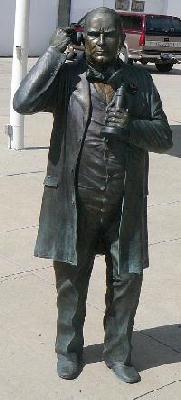 empire through war on doddering Spain. Since the people of the Philippines thought that they would become independent when liberated from Spain, the insurrection that resulted when they didn't cost more American trouble, fortune, and lives than the whole Spanish-American War.
1900 26. Theodore Roosevelt; 1901-1909; Republican, New York; succeeded, won 1 election.
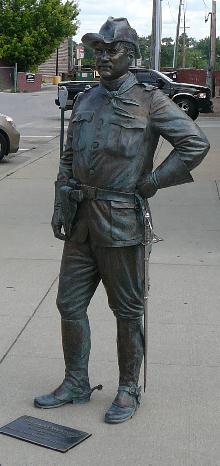 Teddy Roosevelt in many ways seems quintessentially American, vigorous, adventurous, optimistic, enthusiastic. Unfortunately, much of what he did was not for the best in the long run. His war to subjugate the Philippines, after the country was "liberated" from the Spanish in 1898, was certainly in tune with the imperialist projects of the day (as was the voyage of the Great White Fleet around the world), but now is an embarrassment most admirers would like to pass over in silence.

 Most notably, an equestrian statue of Roosevelt that stood in front of the American Museum of Natural History in New York City became a target of Leftist vilification. The statue included figures of an American Indian on one side and an African on the other. This symbolized Roosevelt's involvement with exploration, anthropology, and ethnology, all of which are matters of concern of the Museum itself, which is why Roosevelt is associated with the Museum in a number of ways -- including where Robin Williams played Roosevelt in the movie, Night at the Museum [2006], where the museum in question is clearly a version of the American Museum of Natural History.
 To the politically correct, however, the figures with Roosevelt somehow belittled them, as Anthropology itself has been under attack for not uncritically accepting the mythology and beliefs of "indigenous" peoples.

Now look -- that damned cowboy is President of the United States. -- Mark Hanna, Senator (R), New York
1904 1908 27. William Howard Taft; 1909-1913; Republican, Ohio; won 1 election, defeated; Chief Justice of the Supreme Court, 1921-1930.
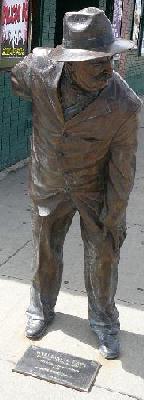 Since Teddy Roosevent thought that Taft was too conservative, he ran as a third party "Bull Moose" candidate. This divided the Republican vote enough to hand the election of 1912 to the appalling Woodrow Wilson.

+48. Arizona, 14 Feb 1912
Alaska Territory, 19121912 28. Woodrow Wilson; 1913-1921; Democratic, New Jersey; won 2 elections.
Although
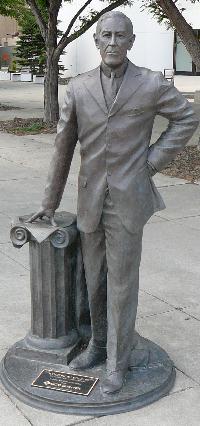 still ranking high in the estimation of most American historians, Wilson was a fool, a bigot, and a failure. The first Southerner (and only the second Democrat) elected President since the Civil War, Wilson immediately set out, purging black postmasters, to bring Southern Segregationism into the Federal government. He also purged all black people from the United States Navy, which in the Civil War had been 15% black -- leaving people with the later impression that there had never been blacks in the Navy. The Navy did allow Filipinos as waiters, etc.; but Alex Haley (1921-1992) ended up in the Navy in World War II because he had joined the Coast Guard, which allowed black stewards, and was folded into the Navy for the War -- and now the Coast Guard has named a Cutter after Haley (WMEC-39).
Segregation is not a humiliation but a benefit, and ought to be so regarded by you gentlemen. If your organization goes out and tells the colored people of the country that it is a humiliation, they will so regard it, but if you do not tell them so, and regard it rather as a benefit, they will regard it the same. The only harm that will come will be if you cause them to think it is a humiliation... If this organization is ever to have another hearing before me it must have another spokesman. Your manner offends me... -- Woodrow Wilson to Monroe Trotter, 1914
1916 1920 29. Warren Harding; 1921-1923; Republican, Ohio; won 1 election, died in office.
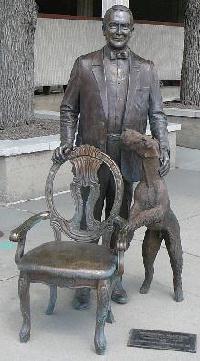 Although provoking only ridicule from most historians ever since (because of scandals over oil leases on federal land), Harding was a popular President who mostly ended the Red Scare, released Wilson's anti-war political prisoners, like Socialist Party leader Eugene Debs (inviting him to the White House), saw the country through the brief depression that had started under Wilson, and then set it on its way to the prosperity of the rest of the decade, with consistent budget surpluses to pay down the War debt. Not a bad record, actually. But, discouraged by the friends who had betrayed his trust in the Teapot Dome oil scandal, Harding's health declined, and he died, evidently of heart failure, after a trip to Alaska, at the (still existing) Palace Hotel in San Francisco.
30. Calvin Coolidge; 1923-1929; Republican, Massachusetts; succeeded, won 1 election.
Three Presidents
 have died on the Fourth of July -- the last was James Monroe -- but only one was born on the Fourth of July: That was Calvin Coolidge. Although a butt of jokes by the anointed, Coolidge was the last President of the Century who was within shouting distance of exercising truly responsible and Constitutional government (also the last who could read Greek and Latin -- not to mention Dante's Italian). He knew what his job was supposed to be and said so in plain and direct language -- rarely quoted by the historians who despise his Jeffersonian sense of government and his Calvinist sense of morality (his full birth name was John Calvin Coolidge). He also exercised Constitutional government, helping create an era of low taxes and unprecedented prosperity (more explosive than any time since; the economy grew by half again in size), with the help of able men like Andrew Mellon. But the prosperity of the "Roaring Twenties," like that of the Eighties, would provoke only derision from the Left -- the people who never liked capitalism, a consumer economy with goods that people actually wanted, or the principles of limited, Constitutional government in the first place. The real evils of the Twenties were the continuing revival, since Wilson, of racism (and even the Ku Klux Klan itself), the virtual ending of immigration out of confused economics (they take away jobs!), nativism, and political paranoia (of a piece with the Red Scare -- which, however, was not entirely just paranoia), and especially Prohibition, which created Organized Crime and fostered political corruption on a vast scale. Prohibition was another bitter fruit of paternalistic, big government "Progressivism" -- a bitter fruit we still eat, since the Prohibitionist laws and mentality merely moved over from alcohol to medicine ("drugs") and are now being directed against tobacco. Coolidge was uncomfortable with Prohibition and regularly made statements on civil rights issues, proposing federal anti-lynching laws (he even gave a commencement address at the historically black Howard University), but he did not change the set of the tide and seemed to accept the protectionism implied by high tariffs and the immigration laws. Although Coolidge was characteristically laconic and withdrawn, this was exaggerated in apocryphal stories.
 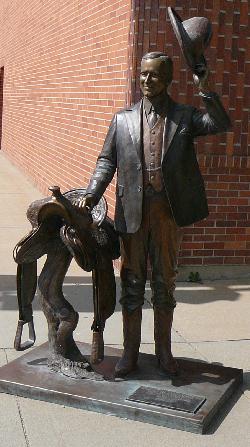 But most of the jokes about Coolidge were originally affectionate. In fact, he gave an average of 8 press conferences a month, had a very relaxed, friendly relationship with the press, and was the first President to address the nation by radio, which he did regularly. That doesn't quite fit the "Silent Cal" image. By one count, he ended up giving more speeches than any previous President, though they were not the kind of speeches that pushed great projects, hectored people, or even attacked anyone -- they usually just enunciated what he regarded as American principles: not the kind of thing to thrill the intelligentsia later on.
Men do not make laws. They do but discover them. Laws must be justified by something more than the will of the majority. They must rest on the eternal foundation of righteousness. That state is most fortunate in its form of government which has the aptest instruments for the discovery of law. -- Calvin Coolidge, to the Massachusetts State Senate, January 7, 1914
I want them to have the rewards of their own industry. That is the chief meaning of freedom. Until we can re-establish a condition under which the earnings of the people can be kept by the people, we are bound to suffer a very distinct curtailment of our liberty. -- Calvin Coolidge, State of the Union message, December 3, 1924
1924 1928 31. Herbert Hoover; 1929-1933; Republican, California; won 1 election, defeated.
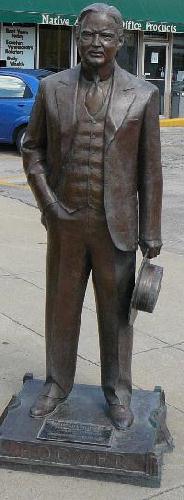 Hoover was an activist government "Progressive," and a famous engineer and philanthropist, scorned by Coolidge (who called him "Wonder Boy"), who almost singlehandedly destroyed the American economy (after wrecking the agricultural export market for the second time -- he had done it first back in the Wilson Administration) and, soon enough, Constitutional government. Since FDR merely continued and expanded Hoover's economic policies and initiatives, it has been necessary for historians to reinterpret Hoover as a laissez-faire economist, which he certainly was not, if they are to demonize him but simultaneously sanctify Roosevelt. Hoover's confusion, shared by most industrialists as well as by Roosevelt's "Brain Trust" (Roosevelt really didn't believe anything himself), was that workers' wages would have to be driven up to create prosperity. This violated Say's Law, not to mention the Economics 101 law of Supply and Demand, and merely created unprecedented unemployment, not prosperity. But he never thought better of it -- as American Democrats, elites, and bien pensants have not since then. The evils of the New Republic are thus squarely the doing of Herbert Hoover.
I have been called a socialist, a Bolshevik, a communist and a lot of other terms of similar nature, but in the wildest flights of my imagination, I never thought of such a thing as putting the government into business as far as this bill would put it in. -- Fiorello La Guardia, about Hoover's Reconstruction Finance Corporation
 The colonial possessions of the United States, however, were acquired in the same era and in much the same way as the imperial possessions of the European powers or of Japan. The first was Alaska, simply purchased from Russia in 1867. Alaska, administered by the Federal Government (through the War, Treasury, and Navy Departments in succession), did not have a local administration until 1884 and was not a properly a U.S. Territory until 1912. By then the other formative event of U.S. colonialism had occurred, the Spanish-American War (1898). This broke out over Cuba, where Spanish atrocities in suppressing local rebellion had attracted the attention of the world, and especially of sabre-rattling newspapers like those of William Randolf Hearst (1863-1951). When the battleship Maine blew up and sank in Havana harbor (evidently from an internal explosion), Spain was blamed and war was declared. Cuba and the Philippines were taken by force, and Spain then divested itself of other holdings, like Puerto Rico (to the U.S.) and its other Pacific Islands, the Marianas, Carolines, and Marshalls (to Germany). The United States, however, retained Wake Island and Guam in the Marianas, to form stepping stones between the Philippines and Hawai'i, whose American rulers, snubbed by Grover Cleveland, now had their desires of American annexation fulfulled. This interest in the Pacific continued. American Sâmoa resulted in 1900 from an agreement between the United States, Britain, and Germany. A few worthless atolls in between Sâmoa and Hawai'i are either owned or claimed by the United States. Owned outright are Johnston Atoll, Howland Island, Baker Island, and Jarvis Island. Jointly administered with Britain are Canton Island and Enderbury Island. Claimed by the United States but in the possession of Britain are the Phoenix Islands and the Line Islands (Christmas Island down to Flint Island). Claimed by the United States but in the hands of New Zealand are the Tokelau Islands (or Union Group), Takahanga Atoll, Tongareva Atoll, and Manihiki Atoll. Nobody seems to get too excited over these places, and their historical claim to fame is mainly as old sites for atomic bomb testing.
return of the Canal territory to Panama, but, after protests and riots over many years, a treaty for return to approved in 1978. Sovereignty and operation of the Canal would gradually be handed over to Panama. A significant bump in this process was the American invasion of Panama in 1989 to overthrown the dictator Manuel Noriega. In 1999, the United States finished withdrawing from the Canal, but retained the right to intervene if the operation of the Canal were interrupted. In the era of the building the Canal, the United States acquired another territory. In 1917 the part of the Virgin Islands that had been ruled Denmark (St. Croix, St. Thomas, & St. John) was purchased. This was the same year that Puerto Ricans were made citizens of the United States. In 1952 Puerto Rico was made a "Commonwealth," the only such designation for any possession of the United States. This arrangement basically meant local rule but federal tax money. This sounds ideal but was not good enough for some diehard partisans of independence, who over the years have thrown a bomb in Congress and carried out a few other acts of domestic terrorism. Meanwhile, Puerto Rico itself has the occasional vote whether to go for Statehood, which would probably increase taxes. The Statehood advocates keep losing.
The colonial possessions of the United States, however, were acquired in the same era and in much the same way as the imperial possessions of the European powers or of Japan. The first was Alaska, simply purchased from Russia in 1867. Alaska, administered by the Federal Government (through the War, Treasury, and Navy Departments in succession), did not have a local administration until 1884 and was not a properly a U.S. Territory until 1912. By then the other formative event of U.S. colonialism had occurred, the Spanish-American War (1898). This broke out over Cuba, where Spanish atrocities in suppressing local rebellion had attracted the attention of the world, and especially of sabre-rattling newspapers like those of William Randolf Hearst (1863-1951). When the battleship Maine blew up and sank in Havana harbor (evidently from an internal explosion), Spain was blamed and war was declared. Cuba and the Philippines were taken by force, and Spain then divested itself of other holdings, like Puerto Rico (to the U.S.) and its other Pacific Islands, the Marianas, Carolines, and Marshalls (to Germany). The United States, however, retained Wake Island and Guam in the Marianas, to form stepping stones between the Philippines and Hawai'i, whose American rulers, snubbed by Grover Cleveland, now had their desires of American annexation fulfulled. This interest in the Pacific continued. American Sâmoa resulted in 1900 from an agreement between the United States, Britain, and Germany. A few worthless atolls in between Sâmoa and Hawai'i are either owned or claimed by the United States. Owned outright are Johnston Atoll, Howland Island, Baker Island, and Jarvis Island. Jointly administered with Britain are Canton Island and Enderbury Island. Claimed by the United States but in the possession of Britain are the Phoenix Islands and the Line Islands (Christmas Island down to Flint Island). Claimed by the United States but in the hands of New Zealand are the Tokelau Islands (or Union Group), Takahanga Atoll, Tongareva Atoll, and Manihiki Atoll. Nobody seems to get too excited over these places, and their historical claim to fame is mainly as old sites for atomic bomb testing.
return of the Canal territory to Panama, but, after protests and riots over many years, a treaty for return to approved in 1978. Sovereignty and operation of the Canal would gradually be handed over to Panama. A significant bump in this process was the American invasion of Panama in 1989 to overthrown the dictator Manuel Noriega. In 1999, the United States finished withdrawing from the Canal, but retained the right to intervene if the operation of the Canal were interrupted. In the era of the building the Canal, the United States acquired another territory. In 1917 the part of the Virgin Islands that had been ruled Denmark (St. Croix, St. Thomas, & St. John) was purchased. This was the same year that Puerto Ricans were made citizens of the United States. In 1952 Puerto Rico was made a "Commonwealth," the only such designation for any possession of the United States. This arrangement basically meant local rule but federal tax money. This sounds ideal but was not good enough for some diehard partisans of independence, who over the years have thrown a bomb in Congress and carried out a few other acts of domestic terrorism. Meanwhile, Puerto Rico itself has the occasional vote whether to go for Statehood, which would probably increase taxes. The Statehood advocates keep losing.
 A common term for Americans is "Yankees." This is a word of obscure origin and may be from Dutch or an American Indian language. It is not always meant affectionately (as in Spanish Yanqui); but, more importantly, it has different meanings depending on where one uses it. To the world, all Americans are "Yankees." This may be shortened to "Yanks," as in the British usage, "You Yanks," which may be more affectionate than not.
 , the "Grand Army of the Republic" highway, commemorating Union veterans of the Civil War. The road begins in Provincetown, Massaschusetts, and used to run down to Long Beach, California. However, since California legislators have long hated America (no kidding, and it keeps getting worse in 2018), US-6 now ends in Bishop, barely across the State Line from Nevada.
 Crackers and/or rednecks are the kind of people who proudly display the Confederate Flag; but they are also considered by Northern Democrats (who happen to be anti-Catholic themselves, if not worse) to be representative of anyone in favor of limited, Constitutional Government, equality before the law, the right of armed self-defense, private property, etc. -- in short, anyone who does not subscribe to the socialist, authoritarian statism of the bien pensants Democrats.
THE NEW REPUBLIC, 1933-2005, 72 years;
18 elections; 10 Democratic, 8 RepublicanFormative Events: The Depression, the New Deal, World War II, the Korean War,
the Vietnam War, Oil Crises, & the Fall of Communism
Ongoing Conflict: The Cold War, Welfare Statism, Civil Rights, the Middle East Conflict, & the Growth of Government1932 32. Franklin Delano Roosevelt; 1933-1945; Democratic, New York; won 4 elections, died in office.
Running on a
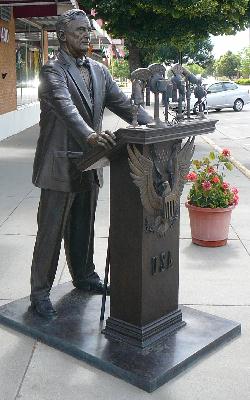 Democratic Party platform that made him sound like Grover Cleveland, which would have been great, Roosevelt instead was an unprincipled opportunist who had no intention of letting any tradition or precept of American government, or the Constitution, stand in the way of doing whatever seemed like a good idea at the moment. Mostly what seemed like a good idea was to continue Hoover's policy of driving up wages, which then kept unemployment above ten percent, and mostly above fifteen percent, for the rest of the decade. Thus, we have the rather awkward but undeniable truth that the beloved and celebrated New Deal failed to end the Great Depression, which was supposedly what it was for. Also, the other kind of thing that seemed like a good idea was to move to a planned and controlled Command Economy, such as Wilson had experimented with in World War I, and whose good results could be seen in the Thirties in the economic successes of Fascist Italy, Nazi Germany, and Communist Russia. Indeed, Roosevelt's Secretary of Agriculture, Henry Wallace, would have liked nothing better than to have collectivized farming as Stalin was doing so successfully in Russia (or at least so he, and countless acolytes, said -- the millions of people starving to death were perhaps just the eggs that needed breaking to make the omlette). When Roosevelt's Fascist style industrial plan, the National Recovery Act (NRA), was declared unconstitutional by the Supreme Court, Roosevelt realized that he needed a pliant Court to stand the Constitution on its head and give him the power that he wanted. His "court packing" scheme was a fiasco, but as time passed his judicial appointments accomplished what more direct methods had not: Soon the Supreme Court was conceding to the Federal government whatever power it wanted, to spend money or regulate anything. In retrospect, these powers seem to have been used modestly, but there was no longer anything in principle to stand in the way of their being used to their logical extreme, which would be the path promoted by subsequent activist Democratic, and even some Republican, Presidents -- as, for instance, in the expansion of the bogus and tyrannical power of administrative agencies. Also, even though Roosevelt enjoyed widespread support, his power base was still in the Solid South, which had voted Democratic since Reconstruction, and Roosevelt did absolutely nothing to alienate Southern white Segregationists. Indeed, New Deal public works and anti-business initiatives fit in with the kind of Populist (quasi-Fascist) anti-capitalism that was prevalent among many of just those Segregationists (e.g. Huey Long). Nevertheless, tears in the increasingly threadbare New Deal began to occur. Unemployment was back up to twenty percent in 1938, and New Dealers actually lost control of Congress in the 1938 midterm elections (to a coalition of Republicans and conservative Southern Democrats). There is no telling how disaffected the public might have become with Roosevelt had it not been for a deus ex machina: World War II and his death near the end made for the sanctification and apotheosis of Franklin Delano Roosevelt. The ironies of this outcome are multiple. First, the wartime economic policy of frozen wages and fiat money inflation to pay for the war absolutely reversed the persistent policy of a whole decade, since Hoover, to drive up wages. Real wages now went down to so low a level that when the war ended, even with millions of men suddenly demobilized, unemployment in 1946 and 1947 was only 3.9 percent, lower any anyone in the Nineties even thinks is possible. Thus, World War II destroyed the economics of the New Deal, even as people thought that the wartime Command features of the economy were pretty much the same sort of thing. The other irony is the credit Roosevelt gets for a political naiveté on the international stage that makes even Wilson look good: Roosevelt actually liked "Uncle Joe" Stalin, thought he understood him and could deal with him, and, all in all, saw Soviet Russia as a benign and democratic system. This credulous ignorance and folly endears him, of course, to the Left, from then to now, but it condemned Eastern Europe to forty-five years of tyranny, poverty, and murder, with a future still clouded by the expectations of people to have everything done for them. Thus, poor Poland, whose invasion by both Germany and Russia in 1939 started World War II, was left by the agreement of a sick and failing Roosevelt at Yalta, with Soviet spies at his side, to the non-existent mercy of Russia after the war was over. The whole grim and horrible record of Roosevelt's Presidency, of failure and deception, both domestic and foreign, of the end of Constitutional government, of the creation of the wholesale business of the Federal government to hand out subsidies and payoffs to large scale political constituencies, is nevertheless commonly viewed as the greatest achievement of America in the Twentieth Century, as the beginning of a new era to repudiate all the evils and failures of the old America. What the evils and failures of the old America were supposed to be, of course, was everything that made America different from countries like Britain, Germany, and France in Europe, everything that made America a place to which people flocked from supposedly more "progressive" regimes. That being the case, it is not surprising that one continuing characteristic of "progressive" thought is still just, very simply, to despise everything about the United States. Thus, some school districts have decided that schools should not be named after George Washington, because he owned slaves. This kind of hatred of America is implicit in the continuing myth of the New Deal, which is the formative myth behind most political trends for the rest of the century.
Social reform, which the country welcomed and still demands, seems to have been perverted by lesser members of the New Deal general staff to the purposes of making war upon the existing social and economic order, a war inspired by nothing so much as bitter malice against any measure of personal success.
 )
)1936
X1944 33. Harry S Truman; 1945-1953; Democratic, Missouri; succeeded, won 1 election.
Harry Truman mitigated some of the worse features of the New Deal. When it came to the economy, Truman did very little, which was just the right idea. For two years he also had a Republican Congress, but this does not explain all his inactivity --
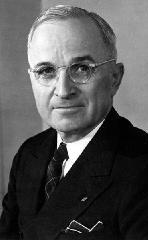 while he could blame the rejection of a nationalized health care plan on the "do nothing" Republican Congress elected in 1946, it was not passed either by the Democrat Congress elected, with Truman himself, in 1948. The result, however, was prosperity not seen since the Twenties. The horrible lie that Soviet Russia was more economically successful than the United States was soon to be decisively exploded. At the same time, Truman awakened to the Soviet threat. It was already too late for much of Eastern Europe, and it may have always been too late for China, but Truman drew a line, built an Alliance, and stopped Stalin's plans to infiltrate, corrupt, and take over the rest of Europe. This alienated the Left, and turned Henry Wallace into a "progressive" candidate for President against Truman in 1948 -- endorsed even by Albert Einstein. At the same time Truman had desegregated the United States military. This alienated the Segregationists, who then formed a Dixicrat Party and ran Strom Thurmond (50 years later still a U.S. Senator) for President. This made things look very bad for Truman, and Thomas Dewey more or less assumed that he would win the election. He didn't. Truman, disliked by both the Left and the Dixicrats, must have been all right. Indeed, Truman had a blunt style that makes other politicians sound like the con-men they mostly are -- Truman said he really didn't "give 'em hell" in 1948, but he just told the truth and "they thought it was hell." And Truman also knew how to tend certain political alliances. His recognition of Israel virtually the minute it was created is often thought of as complete political cynicism (he is supposed to have said, "Show me the Arab voters"), but Truman was probably sincerely convinced of Zionism by his friends in the substantial Jewish community in Kansas City. Truman was just not a very cynical guy, though this move certainly did not hurt him on election day. Nevertheless, soon things began to go wrong. Truman spent too much time playing catch up with the seriousness of the Soviet threat. He was genuinely surprised at Stalin's betrayals of post-war agreements, and incredulous that Americans might actually be spying for Russia right at the heart of our government. When Wittaker Chambers exposed Alger Hiss as a Communist and a Soviet spy, Truman called it a "red herring," and never quite got ahead of the issue that there were other Communists and spies in positions of trust and authority. It didn't help that Omar Bradley, then the Chairman of the Joint Chiefs of Staff, decided to withhold from him
  the fact that Soviet spy networks had been exposed through the decryption of wartime cable traffic (the Venona project -- whose existence, however, was known to the Soviets, thanks to their spies). Then North Korea invaded South Korea in 1950. The Soviet penetration of the Manhattan Project became public knowledge when the Rosenbergs were arrested. Convicted in 1951, they were executed, despite projests from incredulous "liberal" opinion, for giving atomic bomb secrets to the Soviets. After a brilliant recovery in Korea by Douglas MacArthur, the war settled down into a miserable stalemate. The apparently wild charges of Joseph McCarthy began to appear reasonable to many people. Truman, stymied in Korea and haunted by the specter of Communist sympathizers in Roosevelt's government, began to lose popularity. Firing MacArthur for insubordination, although reasonable, was a very unpopular act. He decided not to run for President again in 1952. Although Truman was hammered at the time from the Right, by the scandals and failures of dealing with Communism, today he is mostly disparaged from the other direction, by the mostly Leftist historians of present academia. These worthies (although thoroughly discredited now by Russian sources) tend to blame the United States for the Cold War, and they must therefore blame Truman, who did stand up to Stalin -- recent "histories" of the Cold War by organizations like Cable News Network (CNN) are essentially continuations of Soviet propaganda, dismissing Truman as "naive" in foreign affairs. Nor did Truman have any grandiose economic or social schemes to destroy the economy or corrupt society. This means that trendy historians are more inclined to see Truman as a failure than, say, Wilson or Roosevelt. However, the truth is that Truman was no fool and no failure, no bigot and no opportunist. From the perspective of history, our estimation of him must rise, as it declines (or should) for the likes of Wilson, Roosevelt, and Johnson.
President Truman told Congress that this nation intends to uphold the dignity of the individual and to insure that men can exercise their inalienable right to live under those social and political forms which they freely choose without coercion. If this country means anything less than that, it had best forget the whole matter. -- The Wall Street Journal, March 17, 1947
Philippines Independent, 19461948 1952 34. Dwight D. Eisenhower; 1953-1961; Republican, Kansas; won 2 elections.
The first professional
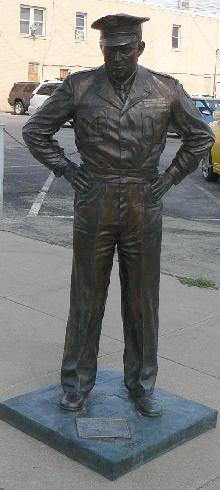 military man to be elected on his war record since Ulysses S. Grant, Eisenhower's Presidency was more successful than Grant's -- and the first one since Grant's to begin assaulting Segregation again in the South. Eisenhower was, in fact, much better prepared to be President. While Grant was out fighting battles, Einsenhower, as the Supreme Allied Commander in Europe, operated at a rarified level of strategy and politics not unlike the duties of the President. Eisenhower as President tended to give people the impression of doing little, relaxing at golf, and often answered questions with double-talk. It now appears that this was largely an act. Eisenhower was accustomed to working behind the scenes, and so his agency in events was often concealed, like the Taoist ruler who is a "shadowy presence," and whose accomplishments strike people as having "happened naturally." What Eisenhower was then able to accomplish is impressive, both absolutely and especially in retrospect. Accepting stalement in Korea, Einsenhower quickly ended the war. Subsequently, Eisenhower both held the line against Communism and kept the country out of new wars. After the later disaster in Vietnam, Eisenhower's determination to avoid land wars in Asia appears as wisdom indeed. Similarly, the apparent excesses of anti-Communism were reigned in with the Senate censure of Joseph McCarthy, which Eisenhower seems to have coordinated, in 1954. Meanwhile, the domestic economy represented a return to "normalcy" not seen since 1929. Low inflation, low unemployment, balanced budgets, steady economic growth, and a falling poverty rate were all indicators of prosperty such as would not be combined in the same way for the rest of the century. The entire post-War Baby Boom generation grew up thinking that prosperity occurred naturally and was their birthright. For many, the Fifties consequently were a somewhat boring time of safety, happiness, and conformity. Not entirely boring, with the threat of the Bomb present to the minds of most adults, at least, and domestic disturbances like the beginning of the Civil Rights movement. The intitiatives against Segregation that had begun under Truman continued and grew into a political movement under Eisenhower. Einsenhower's own appointed Chief Justice of the Supreme Court, Earl Warren, struck down Segregated schools in 1954, and Eisenhower had to call out the National Guard to preserve peace in Little Rock, Arkansas. At the same time, there was little hint that "Civil Rights" would later become an instrument of attacks upon freedom, private property, and Constitutional government, perpetrated by the Democrats and by Warren himself. Nevertheless, there was a deep flaw in the Presidency: Eisenhower determined to accept the New Deal as a fait accompli. The prosperity of the Fifties then concealed the swindle of Social Security and the diseconomies that had been built into labor law and other Federal economic regulation. These problems, however, and the high tax rates maintained by Eisenhower (for the sensible purpose of paying down the National Debt from the War), hobbled the economy somewhat and resulted in two recessions during the decade. The last recession occurred just in time to hamper Vice-President Richard Nixon in his bid for the Presidency. Nixon's awkward personality, and a fair number of stolen votes, then passed the Presidency to John Kennedy. Eisenhower's fatherly tenure was not a case of inspiring leadership, but he got the country rather solidly on track, did the job, consolidated the anti-Communist cause and alliance, and did not tilt at what, at the time, would have seemed like windmills. What could be done with this, for good or ill, in the future, could not have been foreseen. -- The 48 star Flag flew for 47 years (1912-1959), until recently the longest period for any of the 28 American Flags since 1775. The 49 star Flag only flew for 1 year (1959-1960). Although Alaska and Hawai'i were both admitted in 1959, Hawai'i was admitted after the Fourth of July that year, so the 50 star Flag was not raised until the Fourth in 1960. The 50 star Flag has now flown for more than 50 years (1960-2010).


+50. Hawai'i, 21 Aug 19591956
X35. John F. Kennedy; 1961-1963; Democratic, Massachusetts; won 1 election, assassinated
A young, witty,
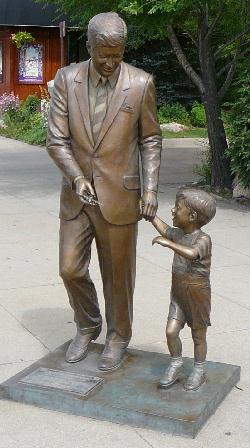 and appealing President, and a genuine World War II hero from PT Boat action near New Georgia in the Solomons, who, with his wife Jackie and their two children, presided over what Jackie herself, after his assassination, called "Camelot." Although Kennedy's father, Joseph Kennedy Sr., may have made some of his money during Prohibition by rum running (perhaps, indeed, a mark in his favor -- today it all would be seized under tyrannical "civil forfeiture" laws), the Kennedy White House, more so than any time since, had a patrician aura of Old Money. Some of the dark side of this was apparent at the time, e.g. the Bay of Pigs invasion in which anti-Castro exiles were left to be slaughtered and captured on the beach after Kennedy backed out on providing them U.S. air cover. While this project was not Kennedy's idea in the first place, his clumsiness in dealing with it can be chalked up to "on the job training." What seemed to be his inexperience, however, led Castro and Khrushchev into thinking that they could get away with placing nuclear missles in Cuba. This "Cuban Missle Crisis" was handled rather better by Kennedy, and he seemed to find his geopolitical feet. More of the dark side of the Kennedy years emerged later. Some of it was political -- e.g. giving the go-ahead for the assassination of Ngo-Dinh Ðien in South Vietnam -- some of it was personal -- e.g. the extensive use of prostitutes by Kennedy. The most curious thing about the Kennedy legacy, however, is how it is that this dedicated Cold Warrior and Anti-Communist, who said in his inaugural speech that we were prepared to "pay any price, bear any burden" for the cause of Freedom, whose most famous statement, at the recently constructed Berlin Wall, was "I am a Berliner," and who was assassinated by a loser would-be-Communist, has become the endless project of Leftists (aided, we now know, by the KGB itself) who want to convert him into a crypto- or about-to-become Leftist himself, the victim of a diabolical conspiracy by the forces of the Right, the Pentagon, and Lyndon Johnson, who suspected, or knew, that Kennedy was about to abandon the South Vietnamese into the hands of the Communists. This seems to come from people who can't believe that someone so charming and appealing could disagree with them about Communism -- perhaps they really don't know that old Joe Kennedy was a great friend of old Joe McCarthy, who was quite welcome at the Hyannis Port Kennedy "compound." They later found Kennedy's brother Robert, who had been an attorney for McCarthy (who became his first child's godfather), agreeing with them rather more, but then he was assassinated by, of all things, a Palestinian, who, since he didn't fit into leftist demonology either, could not, either, have been the real assassin. Although the remaining Kennedy brother, Ted, then became a consistent advocate of socialism and anti-American causes in the U.S. Senate (fighting, also, the kind of tax cuts like what had been his brother's own brain child), John Kennedy's own children, Caroline and John Jr., chose to live private lives. After Jackie died in 1994, John Jr. founded a quasi-serious political magazine, George, but now himself has tragically died, in a private plane crash with his wife and sister-in-law, in 1999. This has provided Americans with the emotional equivalent of the death of Princess Diana for the British. But the real heritage of the Kennedy Administration is still ambiguous. The Civil Rights Bill proposed by Kennedy was later pushed through (1964) by Lyndon Johnson, who, curiously, was rather less concerned about burning bridges with Southern white Democrats than Kennedy had been. The result has been the Republicanization of the white South. This all might have been avoided if Kennedy himself had gotten the Bill passed through a compromise that deleted the more egregious assaults on private property contained in it. This would have been better all around for the future. As it was, Johnson, with his popular mandate and legislative experience, railroaded through a bill that voided the Fifth Amendment (the "Takings" clause), destroyed the principle of freedom of association, alienated the white South, and cost the Democrats the 1968 election. On the plus side, Johnson also got the Kennedy tax cuts passed, the last serious tax cuts ever advocated by the increasingly socialist Democratic Party.
The enviably attractive nephew who sings an Irish ballad for the company and then winsomely disappears before the table clearing and dishwashing begin. -- Lyndon B. Johnson
36. Lyndon Baines "LBJ" Johnson; 1963-1969; Democratic, Texas; succeeded, won 1 election.
Karl Marx, in one of his more perceptive moments, said that history repeats itself, first as tragedy, next as farce. If Bill Clinton is the final repetition of the New Deal as farce, Lyndon Johnson was its first repetition as tragedy.
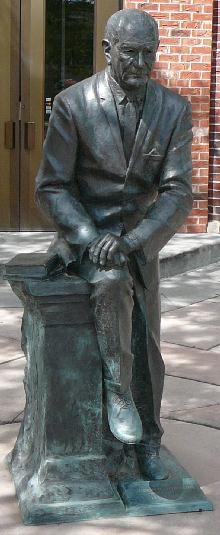 And it was tragic indeed. The President who ended Segregation through the Civil Rights Act of 1964, destroying the power of his own Democratic Party in the Solid South, also destroyed the rights of private property and freedom of association, guaranteed by the Fifth and Thirteenth Amendments, in the same Act. The President who finally enforced the Fourteenth and Fifteenth Amendments, undoing the shameful compromise of 1877 that ended Reconstruction, also created the Welfare State with its subsidies for illegitimacy that did what, as Walter Williams says, slavery and Segregation had not done: Destroy the black family -- or at least the family among the poorest and most vulnerable members of the black community. The President who decided to bite the bullet and do what it would take to resist another hydra head of Communism, by defending South Vietnam with the full might of America, ended up cursed, smeared, and reviled as few other American Presidents, stuck, not just with a Korea-like stalemate, but with a war that would go down as the only defeat in United States history (excepting the side that Johnson's own ancestors picked in the Civil War). Johnson declined to run again in 1968 and left office under a cloud that made Truman's leaving look like a Hawaiian vacation. Johnson never lived down the shame, neglected his health, and found an early grave (1973), ironically almost simultaneously with the aged and respected Truman (1972). The bitter fallout of Johnson's Presidency continues. The Left continues to dream that the squalid failure of the War on Poverty was just from lack of money (if more than five trillion dollars, enough to buy every business in the country, isn't enough, what is? -- Ah! I bet it would take all the money!). The Left also takes the failure of the war in Vietnam to have decisively discredited anti-Communism. Indeed, the standard account now is that McCarthyism already discredited anti-Communism, even though this is an anachronism of wishful thinking -- neither Einsenhower, Kennedy, nor Johnson saw Joseph McCarthy as doing anything of the sort. Consequently, the Democratic Party of the Seventies and Eighties became the anti-anti-Communist Party, thoughtlessly countenancing Soviet and Cuban penetration in Africa and Central America, until Jimmy Carter was rudely awakened, much too late, by the naked Soviet invasion of Afghanistan. The later Fall of Communism was an embarrassing anomaly still neither digested nor explained by the Left (except by absurd theories, like that the Soviet Union was actually a capitalist economy!). Hence, the Democratic Party in the Clinton Nineties still struggled to "build socialism." The damage done by the Johnson Presidency, even while trying, and sometimes doing, good, is thus staggering. There have been few more tragic and catastrophic Presidencies.
These Negroes, they're getting pretty uppity these days, and that's a problem for us since they've got something now they never had before, the political pull to back up their uppityness. -- Senator Lyndon B. Johnson, 1949
1964 1968 37. Richard Milhous Nixon; 1969-1974; Republican, California; won 2 elections, resigned under threat of impeachment.
The only President ever to resign from office. The Watergate burglary became the paradigm for official misconduct for years go come (contributing the suffix "-gate" to multiple scandals). Nevertheless, Nixon left his mark on formative events, which would affect the future deeply, for good and for ill. Campaigning in 1968, Nixon claimed that he had a "secret plan" to end the war in Vietnam.
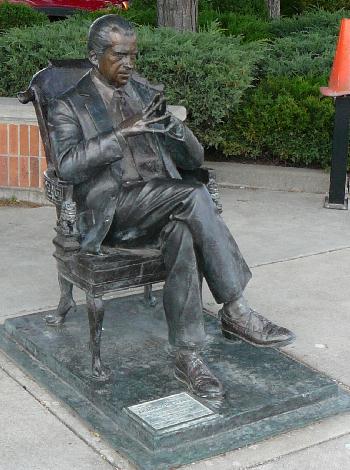 Although Nixon never publicly said what the plan had been, in retrospect it would appear to have involved undercutting North Vietnam's support from Communist China and the Soviet Union through Nixon's initiatives to normalize relations with them. This produced the era of "Detente," engineered by Nixon's National Security Adviser and then Secretary of State Henry Kissinger. This produced arms control treaties with the Soviet Union and, most dramatically, an opening to Communist China, which the United States had previously never dealt with. Since Nixon had always been a staunch anti-Communist, it was politically possible for him, as it would not have been for anyone who might have been suspected of weakness against Communism, to make the move to open relations with China and to actually visit the country and meet Chairman Mao. Thus, it was said, "Only Nixon can go to China." Before too long, Jimmy Carter recognized Communist China as the only government of China, dumping America's long time ally, the Nationalist Chinese on Taiwan, into limbo and giving the Communists China's veto seat on the U.N. Security Council. Nixon probably wasn't interesting in going that far. As a stategy for disengagement from Vietnam, however, the Soviet and China initiatives don't seem to have helped that much. Instead, Nixon focused on "Vietnamization," training and supplying the army of South Vietnam until it could hold its own against the Communists, while American forces withdrew. This worked to an extent. U.S. ground forces were withdrawn, and U.S. air support limited the gains made by an overt North Vietnamese invasion of the South in 1972 (the Vietcong as such were so badly battered by their 1968 offensive in the South that North Vietnam had to give up the fiction that they were fighting a "civil war" in the South on their own). Nixon was excoriated at the time and faulted ever since for expanding the war into Cambodia in 1970. However, Cambodian neutrality was already no more than a polite fiction when Cambodian territory had become a major invasion route and sanctuary for the Communists. The outrage over attacking that sanctuary simply came from people who didn't believe in winning the war or saving South Vietnam anyway and whose scruples were offended that prudent and appropriate measures would be taken to win it. As it happened, attacking the Communists in Cambodia resulted in a pro-Western coup there. The tragic result, eventually, was that as South Vietnam was abandoned to the Communists, Cambodia (and Laos) went down with it also. By the time the North Vietnamese decided to void the treaty negotiated by Nixon and simply conquer the South in 1975, Congress and, apparently, the American public, were in no mood to exert the force necessary to hold the Communists to their agreements. Thus, all of Indo-China, the "Dominoes," fell to the Communists. Fortunately, the line was held at Thailand, where no serious Communist insurgency ever developed. The valuable anti-Communist fruit of Vietnam may simply have been to buy time, to delay and exhaust the Communists (who probably lost well over a million men, in comparison to the 55,000 dead of the United States). Any future Communist expansion was then handicapped by a falling out among themselves. The Khmer Rouge in Cambodia, while proceeding to murder more than a third of the population of their own country, also began attacking the Vietnamese. The Soviets lined up with Vietnam, while China, long estranged from the Soviet Union, lined up with Cambodia. Eventually the Vietnamese invaded Cambodia and overthrew their erstwhile allies, installing a puppet government and, to the horror of the world, publicizing the genocide that had taken place. This showed the naked face of Communist terror such as previously never been seen so directly. This was embarrassing for the Leftists who had been arguing that the stories of murder in Cambodia were all CIA lies (as Stalin's mass murder is occasionally still said to have been). Some of the Left was also disillusioned that the Vietnamese instituted a regime of "reëducation" concentration camps in Vietnam, and that large numbers of people began fleeing Vietnam in small overcrowded boats. These were the "boat people," many of whom were taken in by the United States. Overall, more civilians died in Indo-China after the end of the war than in all the years of war preceding. While many of these events took place under the subsequent Presidencies of Ford and Carter, they vindicated Nixon's warning that the result of American defeat in Indo-China would be a "bloodbath." The response to that at the time was often little more than derision; but, when it proved to be the case, there was usually little acknowledgement that Nixon had been right and that the Communists were not entirely the popular, amiable, magnanimous, freedom fighters that the anti-war movement had made them out to be.
I wouldn't trust Nixon from here to that phone. -- Barry Goldwater (1986)
1972 38. Gerald Ford; 1974-1977; Republican, Michigan; appointed Vice-President, succeeded to office, defeated.
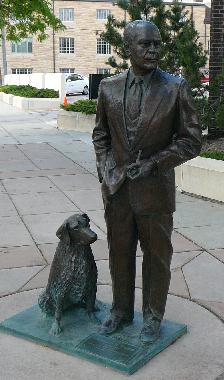 Only President never elected either President or Vice-President. When Vice-President Spiro Agnew resigned in disgrace in 1973, after it was revealed that he had been on the take for years, Gerald Ford was nominated under the Twenty-Fifth Amendment, which had been confirmed in 1967, to be Vice-President. Then, when President Nixon resigned, Ford succeeded to the Presidency. Ford was well meaning and amiable but had no abilities superior to his predecessor or successor. Thus, nothing was really accomplished about inflation or energy. Ford had the bad fortune to preside over the actual fall of South Vietnam in 1975, about which, with Congress determined to provide for no real help, he could do nothing. He also had the bad fortune to slip and fall in public more than once, which gave him a clownish reputation -- that on top of the often repeated observation by Lyndon Johnson that Ford had played football without his helmet too much. All this, and the fact that Ford had pardoned President Nixon from any possible prosecutions, led to Ford losing the very close election in 1976.
He looks and talks like he just fell off Edgar Bergen's lap. -- David Steinberg
1976 39. James Earl "Jimmy" Carter; 1977-1981; Democratic, Georgia; won 1 election, defeated.
Jimmy Carter
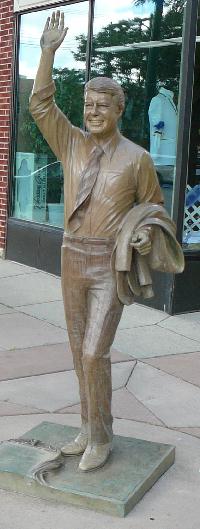 was an earnest, dedicated, intelligent, good, and well meaning man, a paragon of the post-Segregationist "New South," who, possibly for the last time, was able to carry all the Southern States for the Democrats. Martin Luther King Sr., at the Democratic National Convention in 1976, said that "God has given us Jimmy Carter." But Carter's Presidency did not turn out well. The Great Society programs had already obviously failed, to anyone bothering to look; the economy was limping along under high taxes and "stag-flation," which Carter inherited from Ford and Nixon but did little about; and, since it still seemed like a good idea, price controls were kept on oil products, which meant that shortages and rationing returned by 1979. The solution to all of these was outside of Carter's largely conventional universe... Except that Carter started the process of deregulation, as of the interstate trucking industry and the airlines, that began the trend to freer markets in the future, and that Carter appointed Paul Volker to the Federal Reserve. Volker would begin policies that later were able to kill inflation. However, Carter derived little benefit from these initiatives, whose good effects would be felt under Reagan (who would then get the credit from the economists and the blame from the Leftists). In foreign policy, Carter's decision to dump the right wing dictator allies of the United States out of human rights concerns, like the Shâh of Iran and Somoza in Nicaragua, became classic examples of why sometimes realpolitik is a good idea. When friendly dictators are just replaced with unfriendly dictators, who are also worse dictators, there is not a net improvement in the situation. The Shâh was replaced with the revolutionary Islâmic fascism, the mass murder, and terrorism of the Ayatollâh Khomeini. Somoza was replaced with the Sandinistas, clients of the Soviets and Cubans. There would be much grief to pay for this, as Carter himself was humiliated by the Iranian seizure of the American Embassy in Tehrân, and by the mortifying failure of the commando rescue team authorized by him. On the other hand, Carter had one great foreign achievement in his mediation of a peace treaty between Egypt and Israel, though the problem of the Palestinians was just papered over, to fester and explode later on. Carter was conservative enough that he spared the country a lot of Leftist brainstorms to reform society, but he did set out to seriously move on one issue: The "energy crisis." Unfortunately, the "energy crisis" all through the Seventies, with shortages, rationing, and lines at gas stations, was entirely an artifact of the price fixing instituted by Nixon. When Reagan became President, he immediately abolished oil price controls and the "energy crisis" disappeared as utterly as the morning dew. Carter, however, bought the conventional wisdom of the Seventies that oil was running out and decided that energy conservation was "the moral equivalent of war." Americans, however, were a little tired of war; and Carter's leadership style, despite his famous smile and his deliberate folksiness (rather forced, as when he insisted that he officially be called "Jimmy," rather than "James"), turned out to be sour, hectoring, and moralistic. When Americans didn't seem to respond much to his exhortations, Carter accused the country of suffering a "malaise" of spirit. This was Carter's political Waterloo. "Malaise" became the Republican title for Carter's entire Presidency, an effective one. In the 1980 Presidential debates, Reagan's own folksiness and humor threw Carter's personality into the worst light. With hostages in Tehrân and little to show domestically, Carter lost his reelection bid, the first time an elected incumbent President was defeated since Herbert Hoover. In retirement, Carter ennobled himself with work for Habitat for Humanity, a charitable organization dedicated to building low cost housing, mainly for the working poor. It was uncharitably suggested that building houses was more commensurate with Carter's abilities. However, what Carter's work there reveals is his own compromise between the Welfare State and the free market: The fruit of Habitat for Humanity is infinitely superior to the squalor of public housing, but it also presupposes that there is a "market failure" in the private provision of low cost housing. The latter, however, is not true, since the availability of low cost housing has historically been suppressed by zoning, slow growth initiatives, and rent control, all violations of private property rights and the "takings" clause of the Fifth Amendment (but all still beloved of the Left). Nevertheless, Carter's compromise might have made for a more successful Presidency in somewhat easier times, and without the fiascoes of the "energy crisis" and Iran.
Jimmy Carter as president is like Truman Capote marrying Dolly Parton. The job is too big for him. -- Rich Little
X40. Ronald Wilson Reagan; 1981-1989; Republican, California; won 2 elections.
Ronald Reagan was
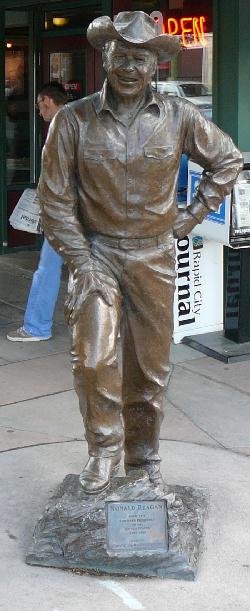 one of the better Presidents of the Century. The hardest thing for the media elite, the political classes, and the intelligentsia to accept about this bitter truth is that Reagan often appeared ignorant and confused. When he later came down with Alzheimer's Disease, many figured that he had actually suffered from it for years. It was galling that some second rate, nitwit actor could outwit the Wise and the Anointed and get elected President twice. Of course, they also figured that it was all an act, though how Reagan could be a second rate actor in the movies and a first rate actor in politics was a little confusing. Indeed, Reagan was the same kind of politician as he had been an actor: Absolutely sincere, unaffected, humorous, and upright. Reagan's personality often still seems strangely hollow just because it was absolutely all on the surface. No one was left in any doubt about what Reagan believed or wanted. And much of what Reagan believed and wanted was wise beyond the reckoning of Ph.D.'s, lawyers, and the literati. It was, indeed, an illustration of F.A. Hayek's principle that some of the most important knowledge is implicit, and that this can be superior to any sophisticated book learning. But Reagan could also articulate the simple truths he believed, and a hostile press, mortified that he could speak right through their filter to the American people, grudgingly began to call him the "Great Communicator." What Reagan then communicated was just the old Jeffersonian principle that the government that governs best, governs least. Because modern government since the New Deal has tried to govern everything, it is obviously the problem. Unfortunately, reducing government was not a goal where Reagan was able to accomplish much. Part of it was that he tended to go along with Congressional spending, which ballooned during the Eighties. Unlike Clinton, Reagan did not play quite the kind of political hardball where he could veto the budget, shut down the government, and then get away with blaming Congress (of course, Clinton would veto a budget for spending too little). Reagan, oddly enough, may have been just too easy going. At the same time, he was determined to cut taxes, and with growing support from economists, he did. Like Andrew Mellon in the Twenties, and then Johnson in the Sixties, Reagan rolled back (again) the ever increasing bite of the income tax. The economy, which had experienced "stag-flation" through the 70's, and went into a deep recession Reagan's first couple of years, then took off into a seven year expansion that broke the bank at the Soviet Union, shook up American business as it had not been in decades, and, as Mellon had predicted in the Twenties and Laffer had described in the Seventies, produced more revenues from lower taxes (for which Congress spent $1.50 for every $1 that came in). The Democrats, who worship taxes like the Holy Grail, have absolutely never lived this down. They are in denial so deep that they still respond to the idea of tax cuts with rhetoric so stale ("tax cuts for the rich," "trickle down economics") that a dying goat would have no taste for it (though far too many Americans still fall for it). Despite tax hikes under Bush and Clinton, income tax rates are still nowhere near back up to where they were before Reagan (after Wilson and Roosevelt, perpetuated even by Eisenhower, the top marginal rate had been over 90%). The growth and shake-up in the economy in the Eighties (the "Decade of Greed"), where whole new industries (like personal computers and the video industry) lept into being, were the object of a torrent of ignorant vilification from the press, academia, and Hollywood. Business and finance were repeatedly smeared in movies, from the anti-anti-Communist Oliver Stone's Wall Street (1987) to seemingly innocent fare like Pretty Woman (1990), which compared takeover buyouts to car theft. Breaking the Soviet Union was Reagan's other unforgivable accomplishment. When Reagan called the Soviet Union the "Evil Empire," the snickers among the intelligentsia were palpable. Had Reagan seen Star Wars too many times? How naive could this guy get? Didn't he know that the Russians loved and trusted their government, and that the Soviet economy was doing just great? Of course, Reagan didn't know anything of the sort, and nothing of the sort was true. The Soviet Union was a brutal dictatorship, which completely ignored Jimmy Carter's fantasy "human rights" Helsinki Accords, had built a huge navy, had steadily pushed its advantages through the Seventies, had plenty of credulous or treacherous "peace" activists in the West to try and disarm NATO, and was bankrolling wars from Angola to El Salvador, often fought with Cuban mercenaries. But Reagan went after them like a bulldog. He was no longer going to back down on anything, at one point walking out on Gorbachev at a summit in Iceland. He was going to out-build them and out-spend them; and, in fact, the Russian economy, devouring itself alive when wealth creation was prohibited by law, couldn't take it. Also, the Russians had made the strategic blunder (rare for them) of invading Afghanistan, where they had to take on a rebellion by some of the toughest people in the world, absolutely fearless Mujâhidin, fighters for Islâm in a Holy War. We will probably never know how many Russians died, often tortured and mutilated when captured -- the "Hanoi Hilton" may have been hell, but it is not clear how many captured Russians ever made it back home. Congress, which Democrats began to win back, soon lost stomach for the fight. But when anti-anti-Communist Democrats cut off funds to anti-government rebels in Nicaragua, the darling of the Left in the Eighties, people in the Reagan Administration worked out a deal with Israel to sell surplus weapons to Iran (which was drunkenly fighting off an Iraqi invasion in the "first" Gulf War) and then divert the profits to the Nicaraguan contras (i.e. the counter-revolutionaries). The press and the anointed pounced on this as the Great Scandal of the Reagan Administration -- the "Iran-Contra Affair." A special prosecutor eventually got some convictions, some of which were overturned (e.g. Oliver North), but most of the country refused to be particularly concerned or outraged. Reagan's enemies did not get their Watergate. The "Sandinistas," the Communists who ruled Nicaragua, got so self-confident and cocky that they actually decided to hold an honest election in 1990. Fidel Castro has never been so stupid. So, with international poll watchers on hand, the Sandinistas were voted out of office. The Contras had won. Meanwhile, Mikhail Gorbachev had decided to lift the dead hand of Soviet power a bit, and immediately governments began falling in Eastern Europe.
  The saying was that it took ten years for Communism to fall in Poland, ten months in Hungary, ten weeks in East Germany, ten days in Czechoslovakia, and ten hours in Romania, all in 1989, the bicentennial of the French Revolution. Reagan had challenged Gorbachev, "Mr. Gorbachev, tear down this wall," at the Berlin Wall. In 1989, the Berlin Wall was torn down by a tide of individual Berliners. Ronald Reagan had defeated Communism, in the same year after he left office.
The kind of government that is strong enough to give you everything you need is also strong enough to take away
 everything that you have. -- Ronald Reagan
1984 1988 41. George Herbert Walker Bush; 1989-1993; Republican, Texas; won 1 election, defeated.
 Bush was a poor successor to Ronald Reagan. A clueless, inarticulate Country Club Republican, Bush started off by calling for a "kinder, gentler America" (Nancy Reagan asked, "Kinder and gentler than what? Us?"), which meant he didn't want to be perceived as "mean" like the tax-cutting, welfare-cutting Reaganites. This made Bush a perfect dupe for the Democrats, who got Bush to break his only real campaign promise ("Read my lips, no new taxes") and sign off on tax increases, which helped put the economy into recession just as Bush was coming up for re-election. Then Bush signed more phony "civil rights" bills attacking property, business, and freedom, wanting to be liked. He wasn't. And so, even though it was a short and mild recession, even though Bush put together a Grand Alliance that freed Kuwait from Iraqi conquest in a lightning campaign, Bush ended up widely disliked, Ross Perot took 19% of the vote, and Slick Willy Clinton got into office with a 43% plurality. Bush, the first Vice-President since Martin van Buren to be elected to succeed his President, dropped the ball, with neither the same convictions nor abilities as his predecessor, and was defeated after one term. For the President under whose tenure Communism actually fell, Bush was totally devoid of ability to lead and articulate the aftermath. The Fall of Communism had little effect on the popular Marxist precepts that are still promoted in American politics, and it was the failure of George Bush that he did not attack and explode them when the iron was hot and the evidence obvious.
Read my lips: no new taxes. -- George H.W. Bush
 , 18 August 1988
1992 42. William "Bill" Jefferson Clinton; 1993-2001; Democratic, Arkansas; won 2 elections.
Only the second President in American history to be impeached by the
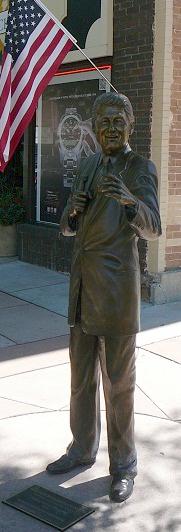 House of Representatives and tried by the Senate, and now the first President to be found guilty of contempt of court and fined ($90,000+) by a federal judge (Susan Weber Wright): A sickening, corrupt, unprincipled hypocrite, philanderer, and shameless, unrepentant liar, fresh from land and Savings and Loan swindles in Arkansas, Bill Clinton, like the Father of Lies, is gifted with savage and ruthless political instincts and a Satanic ability to ingratiate himself to voters and the "chattering classes." Thus, the only previously impeached President, Andrew Johnson, unpopular and bad but innocent of crime, was saved by the conscience of a single Senator, while Bill Clinton, guilty of certifiable felonies but popular, is saved by the shameless lack of conscience and the dereliction of duty of his Democrat lemmings and spineless "moderate" Republicans. Richard Nixon was condemned and recommended for disbarment by the American Bar Assocation (and resigned); but Clinton, found guilty of contempt of court for perjury, and recommended for disbarment by Arkansas authorities, was invited to deliver a keynote speech to the ABA. The hypocrisy and double-think of the Democrats and the ABA (a wholly owned subsidiary of the Democratic Party) certainly follows the paradigm of Clinton himself, who could manage to admit that he lied under oath in the Paula Jones case, and publicly to the American people, about his affair with Monica Lewinsky, while at the same time seeming to deny that he was lying or that he is culpable for perjuring himself (he just managed to give "a false impression") -- even as he previously finally admitted (also in the Paula Jones case) that he had had an affair with Geniffer Flowers while Governor of Arkansas, but denied that he had lied about it in 1992 when he said on Sixty Minutes to a national audience that he had not had an affair.
  In the Paula Jones case, Clinton and the Democrats are hoist on their own petard of the moralistic and totalitarian "sexual harassment" laws that have been cooked up over the last decade by feminists. If Clinton can claim that his perjured testimony in the Paula Jones case about his sexual activities was justifiable because it was all part of his "private life," and nobody else's business, then this would justify lying by any other defendant in a sexual harassment case also. It is unlikely that feminists and Democrats really want to allow that exception, for anyone else, in the perjury laws. But they do want to allow it for their guy. Instead of taking true responsibility by paying the penalty for his crimes, Clinton's constant strategy was to blame Kenneth Starr, the Special Prosecutor, and to send his supporters out to attack and vilify Starr, which is something that never occurred to Nixon or Reagan or Bush to do to the Special Prosecutors appointed to investigate them. Nixon fired a Special Prosecutor (Archibald Cox, in the famous "Saturday Night Massacre"), but he never launched an attack campaign against someone who, by law, cannot reveal the substance of his investigation. The only thing Clinton really seems to believe in is power, and he has done his best to extend the force of the Federal government into as many areas of American life as possible. This constant assault on the Bill of Rights is even acknowledged by Clinton defenders, like Alan Dershowitz. Although Clinton accomplished the extraordinary feat of losing both Houses of Congress to the Republicans for the first time in more than 40 years, he saved his own skin for reelection in 1996, and the Republicans, by choice, cowardice, and folly, have mostly gone along with the paternalistic and police state measures favored by him (as he cunningly went along with their "welfare reform") -- like a national identity card, with fingerprints, and Federal databases of all American workers and of the medical records of all Americans. Trying first to nationalize all of American medicine, and then at least to extend Medicare down to age 45, Clinton can still do no more that jerk to the socialist aspirations of his aging Sixties Radical friends (including the First Lady, Hillary Rodham Clinton), who have still not noticed that socialism failed. Although the Crown Jewels of the New Deal (Social Security) and the Great Society (Medicare) are both headed for bankruptcy, Clinton is a Pied Piper who is still able to lead most Americans down a path of further socialism and Federal power.
 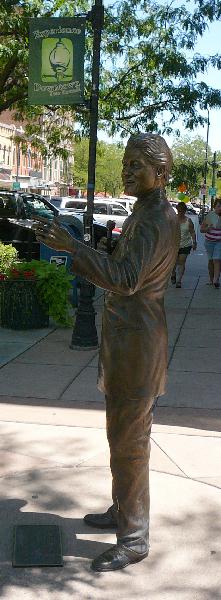 With the Senate Democrats unwilling to convict one of their own, Clinton is free to do so for the pathetic remainder of his term. Clinton, the Democrats, and their accomplices in the Press and Academia have succeeded in deceiving a credulous electorate through a successful smear and belittlement of the investigation into his crimes. Thus, Clinton's lies are dismissed as (1) deceptive but not perjurious, or (2) perjurious but "only about sex," or (3) seriously perjurious but not "rising to the level of an impeachable offense," or (4) perhaps even impeachable but excusable anyway because his removal from office would hand a victory to the "vast right-wing conspiracy" of "mad dog" white supremacists and religious fundamentalists. The layers of sophistry in this defense betray the dishonesty and desperation of the Democratic Party, whose constant accusations of "partisanship" describe their own zombie-like chorus far better than the often confused, tentative, and undisciplined forces of the Republicans, whose party unity could not be maintained in either the House or the Senate, while dissent was all but unheard among the Democrats. Like Clinton himself, the Democrats ultimately value nothing but power -- just as they have succeeded in destroying the Constitution to allow unlimited power to the federal government. Thus, in Marx's expression, the New Deal has finally been replayed as farce, though a bitter and dangerous farce it is. Francis Fukuyama's "End of History," with the Fall of Communism, is now clearly nothing of the sort. The Left, as Talleyrand said of the Bourbons, have "learned nothing and forgotten nothing." About Clinton himself, however, the words of Samuel Adams may be the most fitting, that this man has become "a monument of infamy and derision." Anyone who would give this person the time of day is contemptible.
I have never seen...so slippery, so disguisting a candidate. -- Nat Hentoff (1992)
, 26 January 1988
1996 2000
43. George Walker "W" Bush; 2001-2009; Republican, Texas; won 2 elections.
In 2004 American history was due for a big change -- if the same 72 year cycle held true, as from 1788 to 1860 or from 1860 to 1932.
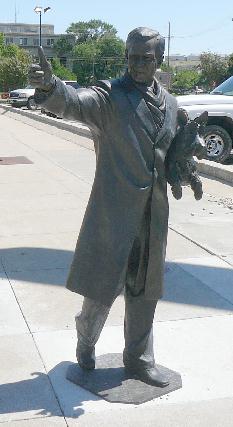 The terrorist attacks on 9/11/01 certainly signalled a change, but the institutional response to the crisis did not involve much in the way of basic changes and definitely nothing in the direction of the restoration of Constitutional government. The basis of the New Republic is the New Deal. This is nowhere near being directly challenged in mainstream American politics. George Bush is just as much a New Dealer as John Kerry. Indeed, when Bush defined his program as "Compassionate Conservativism," this made it sound like he was more of a New Dealer than the President who might have been thought of as not very "compassionate," i.e. Ronald Reagan. This seemed about on the level of the Mensheviks in political wisdom. Nevertheless, it seemed to work for Bush. On the other hand, the 2004 election did indeed signal a political trend: The Republicans controlled the House of Representatives since 1995 and the Senate for most of that time. The Republicans had won seven Presidential elections since 1964, the Democrats only three. Population has been moving from centers of Democrat power, like New York, to new centers of Republican power, like Texas. Texas is now the second largest State in the Union, after California. California, indeed, became more dominated by the Democrats than for many years -- until the surprise election of Arnold Schwarzenegger as Governor -- but this is just the problem: The Democrats have nothing to offer politically except more socialism. The best recommendation for George Bush may be the fury of the Left against him. Hollywood threw all it had against Bush in 2004, from a summer blockbuster movie (The Day After Tomorrow, which explicity lampooned Bush and Vice-President Cheney) to the no-holds-barred "documentary" that was a tissue of lies, distortions, and half-truths (ruled thus by a British court), Michael Moore's Fahrenheit 911. And then there was the money. The Democrats must hate to think of it, but the Republican Party got a larger number of small contributions, and a smaller number of large contributions, than the Democratic Party. No millionaire spent as much money on politics as George Soros, but it was all against Bush. The principal public complaint against Bush was the war in Iraq, which developed into a difficult campaign in urban warfare; but when the Democrats did not complain about Bill Clinton's war in Kosovo, and were happy to pass a resolution under Clinton that US policy would aim at the overthrow of Saddam Hussein, it begins to look like the use of the war as an issue is purely political, while the real objection to Bush is that he cannot be expected to push for the kind of socialism that the Democrats desire. Indeed, although Bush instituted a prescription drug benefit in Medicare (perhaps meaning bankruptcy faster than otherwise), and cooperated with Ted Kennedy on a fat (and unconstitutional) spending bill on education, the constant Democrat refrain was always "not enough." Like Edward G. Robinson in Key Largo, Democrat politics is always "more, more" -- unless, of course, with a Democrat President, when some limits have to be observed. But Bush also made noises about privatizing part of Social Security, and this was just enough of a threat, however modest, to the New Deal that the Democrats thought they could make a big issue out of it. It didn't work out that way. What the Democrats feared, and very properly, was a gradual drift of opinion away from the New Deal. When voters know that the Democrats will raise taxes, this doesn't help them either, whatever they say. We know them too well.
 Richard Nixon lost because of (1) a recession, (2) he looked bad on television (though, we now know, this was in part engineered by Kennedy sympathizers at the network who advised Nixon, badly, on his makeup), and (3) Mayor Richard Daley and Duval County Texas delivered the voting dead of Chicago and Texas to Kennedy. Al Gore did not have such problems. His burden was the shameful legacy of Bill Clinton, which, however, most Democrats stoutly denied was shameful at all. Indeed, the Democrats brazenly predicted that they would regain control of the House and Senate because of popular outrage that the great and glorious Bill Clinton was smeared and persecuted by nasty Republicans. There was certainly a Democratic base of voters who felt that way, but it was not enough to deliver a majority of the vote, and not a majority in enough States to win the Electoral College, or the House or the Senate (though the Senate ended up divided 50/50, where the Republicans, being chumps, allowed a 50/50 division of all committees and chairmanships, which they did not need to do with the VP, Dick Cheney, casting tie-breaking votes). Unlike Nixon, however, Gore never hesitated to challenge the result. On election night, the State of Florida was first declared to have gone for Gore (before all the polls were even closed in Florida, as it happened), and then, hours later, was declared to have gone for Bush, delivering the election to him. But in the wee hours of the morning Bush's margin of victory seemed to be eroding. It was already so small that a State-wide recount was required by law. Before that was even finished, Gore's strategy was already in operation. Frankly stated by a Democratic operative, it was to ask for recount after recount until the results came out "right." The recounts requested, of course, were in heavily Democratic counties, with mostly Democratic election officials. While the machine count of punchcard ballots was something without bias or ambiguity, designed to be so, hand recounts would turn on all sorts of ambiguities and imponderables. One Democratic election official baldly stated on television that a ballot with otherwise Democratic votes, but with only a "dimple" on the "chad" (the little piece of paper to be punched out) for Gore, should be counted as a Gore vote. Whether or not there actually was then a "dimple" was left to the judgment of the counters. The Democrats, who may have stolen the 1960 election with the traditional backroom techniques of their machine politics, thus found a way of trying to steal the 2000 election right out in the glare of the public spotlight. Even so, the clock was against them. The millions of ballots that helped promote the efficiency of machine counting now were a grave liability for hand counting, especially with Republican observers challenging the miraculous discovery of yet more Gore votes. The Florida Secretary of State, a Republican (a woman against whom Democratic partisans could freely direct misogynistic vitriol, without fear of reproach from feminists), was prepared to certify the election at the statutory deadline, long before the Democrats could have squeezed out enough Gore votes for a win. Thus, another tried and true Democrat strategy came into play: Find friendly judges. The Florida Supreme Court, consisting entirely of Democatic nominees, simply voided the statutory deadline and gave the Democrats another week to recount. This ruling was later vacated by the United State Supreme Court, which asked for a clarification of the grounds on which it was made, but by then the point was moot. Other strategies were in operation. Hundreds of absentee ballots from members of the Armed Services were thrown out as not having the postmark required by Florida law. This may have been legally correct by State law, but it was contrary to the stated Gore principle of "count every vote," and may actually have violated Federal law. There was no doubt, however, that this was a plus for Gore, since the military vote ran heavily for Bush. Similarly, a lawsuit was filed, by a Democratic contributor, to throw out the entire absentee vote in some heavily Republican counties, because Republican workers had been allowed to fill in a voter ID number, mistakenly left off, on absentee ballot applications sent out by the county. A black woman judge, passed over for promotion by Jeb Bush (brother of George W. and Governor of Florida), was found to rule in this case -- and she refused to recuse herself. A case was also filed challenging the decision of some heavily Democratic counties not to do hand recounts. None of this came to fruition, however, before the second deadline passed and the Secretary of State certified the election. None of the recounts completed by that time had given Gore the advantage. This meant that Gore would henceforth not merely be asking for recounts but for the election actually to be overturned. No hesitation, however. But then things really began to go wrong. The black woman judge did not do what was expected (by anyone). She unheld the absentee ballots. Similarly, the other suits for more and more recounts were firmly and resoundingly denied. This was then appealed to the Florida Supreme Court again. With only a few days until the Electors were to be ceritified for the Electoral College, the Florida Supreme Court, in a 4-3 decision with bitter dissents, ordered recounts all across the State. The Democrats were jubilant. The search for friendly judges, on the other hand, was a game at which two could play, and the Republicans immediately went to the United States Supreme Court, still heavy with 7 Republican nominees. Not only did the Court agree to hear the appeal, but 5-4 majority stayed the Florida Court ruling. That stopped the recounts, on a Friday, with the Court unprepared to hear the case until Monday. When the Court then did heard the arguments, a 5-4 majority again decisively reversed the Florida Court (on some points, the majority was even 7-2). The Democrats were busted. Losing at their own game was so galling that some Democrats and sympathizers went into rhetorical orbit. Jesse Jackson absurdly compared the case to the Dred Scott Decision. Winning, indeed, may be a mixed blessing for George W. Bush, the first President since John Quincy Adams to be the son of a previous President (and the only one to succeed the man who defeated his father). His Presidency was going to be tainted by the closeness of the vote and the questionable result, and it might have been better to have a discredited Gore than a discredited Bush -- and the next President, according to the Curse of Tecumseh, is due to die in office. However, power is power, the American people mostly don't seem to have noticed how Clinton was disgraced anyway, and it was high time to get the Democrats out of the White House, whatever Bush was able to do with it. The only consolation of a Gore win could have been that, with a Recession in view ahead, a Gore who could have positively plunged the country into a Depression really would have helped third parties, like the Libertarians, and perhaps discredited the Democrats for a long time.
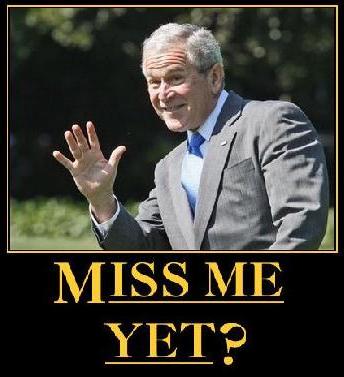 In one respect, George Bush had a charmed Presidency: He beat the Curse of Tecumseh. Reagan had already beat it in one respect, since he didn't die in office; but there was a serious assassination attempt against Reagan, and he sustained a wound from which he might have died, like Garfield, in earlier days. But the closest that George Bush came to assassination, despite the hopeful reveries (including a movie) of the Left, was when an idiot Iraqi journalist threw shoes at him. Even those missed. We were never told if the journalist had thrown any shoes at Saddam Hussein. He was probably not that big of a fool.
[voice from crowd: We can't hear you!] But I hear you, and the people who did this [waves around site of World Trade Center] will hear from us, soon. -- George Bush, 2001, before attacks in Afghanistan
2004 2008 44. Barack Hussein Obama (aka Barry Soetoro); 2009-2017; Democratic, Illinois; won 2 elections.
Barrack Obama won reelection in 2012 by running against the rich. Since "the rich" had nothing to do with any problem facing the Nation, this was a campaign strategy of complete fraud, dishonesty, demagoguery, and sophistry. That it was successful does not speak well for the American electorate nor bode well for the United States. Yet for all the commentary that this was the result of a new ethnic and racial electorate, which had become dependent on the Welfare State, this election was not so different, in form or danger, from that of 1936. Both Roosevelt and Obama could argue that, although the economy was bad, it was getting better and their policies were making it better. If a majority of Americans could buy that in 1936, when things were truly so much worse, it is not so surprising that they could buy it in 2012. Yet things should have been different. The Democrat playbook of tax and spend, and of demonizing wealth and Wall Street, should not still be working -- especially when the obvious Euro-socialist ideal of Obama and the Democrats is in visible decay and crisis, if not collapse, as the campaign and election were taking place. This may well be a case of be careful of what you wish for, because you might get it. Obama, like Jerry Brown in California, clearly has no intention of cutting spending or the size of government, regardless of the hopeless debt that is accumulating. The sorry example of Greece, where unemployment is 26%, so evident to anyone paying attention, is entirely lost on them; and they appear to really believe that raising taxes and spending and regulating more is the path to economic prosperity. There is no excuse in 2012 for such delusion -- however widespread it is among the "liberal" elite of press, academia, and the intelligentsia. But that is really just the problem. The Left is intellectually and morally bankrupt, ironically just at the moment when its influence and dominance may be the most complete -- with the clumsy and unintentional connivance of Republicans, whose political cluelessness reached new heights in 2012. Thus, the voices of reason and wisdom do not appear with sufficient exposure in public discourse. No major Republican politician has been articulate and cogent since Ronald Reagan; and the Press ignores anyone out of the mainsteam, unless they confirm "liberal" preconceptions of racist Rednecks, etc. So the Nation may need to learn its lesson in the School of Hard Knocks, and not just economically: The Jihad is alive and well just when Democrats, the new Isolationists, stung by the academic narrative of American "Imperialism," wish to withdraw the power and influence of the United States from the world, a world that often seems to have gone mad in volatile and dangerous places. Some begin to wonder whether the prospect of damage to American power and influence is the whole idea, considering Obama's anti-American background.
 Until 27 April 2011, an original, long-form Hawaiian birth certificate had never been publicly released. Regardless of the merits of the accusations about Obama's birthplace, what interested me was the question of who has standing in court to compel proof of natural American birth, a Constitutional requirement for the Presidency. Judges threw out lawsuits from "birther" citizens, including those from Hillary Clinton's Presidential campaign, on the basis that they had no standing. Well then, who does? And why would not any American citizen have such standing to see that the Constitution is enforced? And whose job is it to verify that a candidate for the Presidency actually is qualified for that office? These questions should be addressed and clarified on their own merits. And what is so hard about producing an original birth certificate? This may have just been a strategy to provoke the impotent fury of the "birthers," but why did Obama's friendly judges (where were Hillary's judges?) act like there was something to hide? And why did Obama supporters react with derision and contempt rather than just laying the issue to rest by seeing that the certificate was produced? Is it somehow impossible and inconceivable that Obama's mother gave birth in Kenya, her husband's own country?
 Then Abercrombie said that he was unable to find the certificate; and it was reported that "former Hawaii elections clerk Tim Adams has now signed an affidavit swearing he was told by his supervisors in Hawaii that no long-form, hospital-generated birth certificate existed for Barack Obama Jr. in Hawaii and that neither Queens Medical Center nor Kapi'olani Medical Center in Honolulu had any record of Obama having been born in their medical facilities." Then all these assertions were contradicted. And finally Obama called a press conference to release the long-form certificate, complaining that he had more important things to do -- right before flying off to appear on the Oprah Winfrey Show. Certainly the conspiracy theorists will claim that all this time was necessary for a suitably credible forged certificate to be created. However, by Donald Trump playing up the issue, it looked like a significant percentage of voters were beginning to wonder. There was suddenly more political cost to teasing the "birthers" than just coming clean, and Trump reasonably claimed that his brief Presidential candidacy had succeeded in shaking loose the long-from certificate.
 Obama settled down in Chicago and began making the social and political connections that would lead to his eventual election as President. Most of these Chicago connections are now an embarrassment, since they involved association with radical anti-Americans and former domestic terrorists, not to mention an unclear degree of involvement with the familiar corruption and machine politics of the Illinois Democrat Party. Obama's defenders decry "guilt by association" when these people are mentioned, and the voters seemed willing to give the benefit of the doubt and take him at his word. Since Obama's appeal was deliberately vague -- "hope" and "change we can believe in" -- it remains to be seen how the Administration will go, though so far the Democrats are fast out of the gate, using the recession as an excuse, with massive spending and borrowing, if not taxing, plans (with Michael Moore even announcing the "end of capitalism"). Again, far too many Republicans, including George Bush in his last days, went along with the idea that Federal spending will provide an economic "stimulus" (still ignoring Say's Law). Perhaps they are still thinking that, since the Democrats won the election, the best Republican strategy is to be more like Democrats. They may not have noticed that John McCain was the perfect "more like a Democrat" candidate -- a Republican, indeed, with not much patience for the Religious Right or Social Conservatives, that Democrats seemed to be saying they could vote for. But then they didn't vote for him, not even the disgruntled Hillary Clinton voters. So the New Deal Republicans are hoist on their own petard again, if they cannot argue that massive Federal borrowing, taxing, and spending sucks all the air (i.e. capital) out of the economy and retards recovery.
 The brainless "Bush lied, people died" level of analysis implied, or asserted, that (1) Iraq and the world would be better off if Saddam Hussein were still in power, (2) terrorists, who are not proteced by the Geneva Convention, actually are protected by the Geneva Convention (just "name, rank, and serial number," though terrorists don't have serial numbers, or much rank either, since they are not in a regular military establishment and, as terrorists, don't wear uniforms), and (3) terrorists, even when held abroad (e.g. Guantanamo Bay), can file habeas corpus in civilian American courts. This last remarkable assertion has even been upheld by the Supreme Court, although there are few things that the Bush Administration did that wartime Administrations, including those of Democrat icons Woodrow Wilson and Franklin D. Roosevelt, had not done, without Democrat objections, in their time. To hold an American citizen as an "enemy combatant" in the United States and try him before a "special military tribunal" under military law meant the End of the Constitution to Democrats and anti-war radicals: Yet this is precisely something that was done by Franklin Roosevelt, without complaint. Most of the attacks on Bush's anti-terror policies were therefore naive to a dangerous degree, disingenuous, or just naked political opportunism. Since Obama has undertaken to increase American commitment in Afghanistan, and he began his Presidency by authorizing an attack on terrorists in Pakistan, the sincere anti-war radicals already have cause for complaint. They (e.g. Michael Moore) were certainly complaining when Obama authorized a SEAL team to go into Pakistan and kill Usama bin Laden. As long as they keep complaining, we may be safe.
President Obama is the greatest hoax ever perpetrated on the American people. -- Clint Eastwood, The Carmel Pine Cone, September 7-13, 2012
, 15 June 2009
, 4 November 2013

2012 2016
45. Donald J. Trump; 2017-2021; Republican, New York; won 1 election.

 Donald Trump was the first person elected President of the United States who had never held elective office or military command. Yet Trump has been a major businessman and public figure for years. Almost everyone seemed to know him; but people he might even have regarded as friends, like the Clintons, now only have vilification for him. However, sometimes the vilification dates back a way. An entire episode of the television series Designing Women [1986-1993] was devoted to attacking Trump. This series was created and produced by Linda Bloodworth-Thomason, a friend of the Clintons from Arkansas -- evidently Trump had gotten under her skin. Yet at the time, Trump was a conventional Democrat.
Some mix of these issues got him elected, despite the polls and commentators sure that Hillary Clinton would win the election, perhaps even in Texas.

Singer Joy Villa (b.1991)
at the 2017 Grammy Awards
The United States cannot, and should not, admit those who do not support the Constitution, or those who would place violent ideologies over American law. In addition, the United States should not admit those who engage in acts of bigotry or hatred (including "honor" killings, other forms of violence against women, or the persecution of those who practice religions different from their own) or those who would oppress Americans of any race, gender, or sexual orientation.
Treason against the United States, shall consist only in levying War against them, or in adhering to their Enemies, giving them Aid and Comfort. [Article III, Section 3]
Since "producers" means businesses, which contribute campaign money, and their workers, who value their jobs and vote their interests, Protectionism has a powerful political appeal -- analyzed by Public Choice economics. Labor unions in private industry, which have always supported Democrats, who support their power, have been far more Protectionist that the official Democratic Party. Trump has not won them over yet, but he offers them more than the Democrats have for a while. He has already won over the coal miners, whose industry was openly targeted for destruction by Barack Obama and Hillary Clinton. But Protectionism (when it is not just reversing the Green and Leftist malevolence of the Obama years) is all a bad idea. Trump may well revive the economy by cutting taxes and removing regulatory barriers and harassment, but this will be in conflict with the diseconomies, the negative sum game, of Protectionism. It will be a race between mitigation and aggravation, with the outcome uncertain -- although the Trump Stock Market so far doesn't seem to be worrying much.

Donald Trump's head on the body of Rocky Balboa, displayed by pro-democracy protestors in Hong Kong, 2019. Unfortunately, the Chinese police state has now crushed all dissent in Hong Kong, imprisoning democracy leaders.
Europe is struggling with the same problems. The economic stagnation of France, like its Muslim immigrant problem, should be a lesson to the whole world, and especially to the United States. But it isn't, not even in France, where socialist ideas, even in the stark face of their failure, and even with this persisting for decades, die very hard. Of all the problems of political economy and government, the continued temptations of socialism, protectionism, and command economics pose the greatest challenge to wisdom. Many politicians and economists simply are unable, or unwilling, to articulate the truth. The ones that do, like Thomas Sowell, although popular and familiar, nevertheless have relative little effect on policy, political discourse, or even popular culture. We are more likely to read that the poor growth and people leaving the work force during the Obama years were the result of a permanent trend, and not of policies hostile to business, finance, and capital, all of which are necessary for economic growth -- and Hillary Clinton, perhaps in one of her famous moments of confusion, did say that businesses do not create jobs. The truth is not that hard to articulate, but often an attempt is not even made. When a permanent, indexed raise in the minimum wage was put on the ballot in New Jersey, political ads against it only complained that the State Constitution should not be subject to such manipulation, not that such laws would put youth, especially minority youth, permanently out of work. The poor growth and exodus of business and citizens from New Jersey (and from New York and Connecticut), perhaps even citizens who voted for that minimum wage law, is never considered as evidence of the hostility of these States for economic growth. But in many of these terms, Donald Trump actually finds himself on the wrong side of the matter. We shall see.
In France, we keep saying that we have tried everything -- except what has worked elsewhere.
At the same time, Trump is not continuing the complacency of the Obama Administration for China, Iran, North Korea, and other hostile powers. To this, the Democrats begin to fear a World War. But somehow it was the Obama Administration that allowed the Chinese to build a military base in the middle of international waters in the South China Sea. Nothing serious was done about that. Obama just went and played golf.

The mysterious Ray Epps. On both January 5, 2021, and January 6, he was recorded urging Trump demonstrators, not just to demonstrate, but to invade the Capitol. At the time, spectators called out that he was a "Fed," i.e. an agent provocateur, directed by the FBI, or whoever, to promote unlawful activity. He does not seem to have invaded the Capitol himself, which is odd, if he thought this was so important. Instead, he disappeared. Briefly listed as wanted by the FBI, his name was soon dropped and he was never arrested. Later, he gave closed testimony to the House "January 6 Committee," whose content remains unknown, but for which he was warmly thanked by the Democrats and RINOs on the Committee. There have been denials that he was employed by the FBI as an agent provocateur, but he still has not been publicly questioned by Republican investigators. He role in January 6, and that of other, unidentifed persons, thus remains obscure; yet his immunity from prosecution is anomalous in relation to the treatment of others from that day, let alone anyone openly and verifiably advocating law-breaking. This was the president putting the Republican Party on the side of the nobodies of all colors as opposed to the somebodies... This is a realignment I have supported and a repositioning I have called for and I'd be lying if I said it didn't please me to see it represented so effectively, and I very much regret that the president is a bad man[!] and half mad[!] because if he weren't I'd be cheering. -- Peggy Noonan, "The Democrat's Unserious Week," The Wall Street Journal, February 8-9, 2020 -- Noonan, if she has previously detailed how Donald Trump is either bad or mad, I seem to have missed it. Biased and lying Democrat talking points, which Noonan seems to have swallowed, were not good enough.
2020 46. Joseph "Joe" Biden 🤡; 2021-2025; Democratic, Delaware; won 1 election.


 In 2020 the American people apparently elected a corrupt, senile, mendacious, career politician. We might think that any one of those would have disqualified him from becoming a President of the United States -- a perfect storm of legal, medical, and political reasons. He has trouble expressing coherent thoughts, and he wanders off into bizarre statements that are suppressed by the Media. He has trouble finishing sentences. He barely had a Presidental campaign and generated no evident enthusiasm. Sensible persons wonder what has been going on.
 When Donald Trump decided to overrule one of Obama's orders suspending enforcement of immigration laws, his action was stayed by a federal judge, who said that the action was "arbitrary and capricious." Since seeing that the "laws are faithfully executed" is a principal duty of the President, this was a very odd ruling. And the cowardly or biased Supreme Court let the ruling stand. However, where cancelling the Keystone pipeline was certainly "arbitrary and capricious" (the companies involved, some Canadian, are suing), no one has been able to scare up any of the dozens of federal judges appointed by Donald Trump to stay such a ruling. It is all the cowardice and betrayal we expect from Republican appointees. Meanwhile, the oil gets moved anyway, by truck and train, which pose far greater environmental threats than pipelines.
 Meanwhile, having gotten rid of a President they called the equivalent of Adolf Hitler, the Democrats immediately began demanding censorship of all political opposition. What is now called "Big Tech," i.e. Amazon.com, Twitter, Facebook, and others, immediately began cooperating. Also, corporations and public authorities have begun firing people for their political views, demanding Leftist political "loyalty oaths" from the staff at schools, to corporations, to the military.
While riots were going on, this information was actually suppressed by the Attorney General of Minnesota, the anti-American Keith Ellison, who, like a lot of Democrats, was excused from the consequences of beating up his girlfriend and elected to his office anyway.


Joe Biden as Beavis playing "The Great Cornholio," from Beavis and Butt-Head, 1993-1997

Congresswoman Lauren Boebert (R-CO), with her "Let's Go Brandon" anti-Biden dress, in immitation of a dress worn by a Communist Congresswoman (known as "AOC," i.e. "aliens over citizens") that had said, "Tax the Rich." "Let's Go Brandon" became popular when an NBC reporter said that a crowd at a NASCAR race was chanting it, instead of the "F*ck Joe Biden" chant they were actually using.

 But, oh, that's what Biden does. Oddly, the pro-Democrat TV networks did not carry the speech live, which is unheard of with a Democrat President. They realized that this was not going to look, or sound, good. Meanwhile, of course, the speech ignored every single issue that worries Americans, like the price of gasoline, the general inflation, crime, out of control illegal aliens pouring into the country, the mutilation of children, etc. But one thing Biden does know: He does not want to "Make American Great Again." Instead, he continues with the program to destroy the country and the lives of its citizens. Meanwhile, Biden has spent 40% of his time in office on "vacation" in Delaware.


Daniel 5:252024
47. Donald J. Trump; 2025; Republican, Florida; won 1 election.

"People of the Philippines, I have returned,"
General Douglas MacArthur, October 20, 1944
Movies or video games fail in the market because of "toxic masculinity," "racism," "sexism," "homophobia," "transphobia," "lookism," and any other of the litany of political crimes that the modern Academy, mostly, has thought up.

Peanut the Squirrel, kidnapped and murdered by a full SWAT Team of anonymous thugs from New York State government. Seen by Trump voters as a symbolic instance of the blind and irresponsible malevolence of government bureaucrats, whether in New York or Washington.

Vice-Presidential Candidate and Minnesota Governor Tim Walz wished to demonstrate his gun-loving masculinity by arranging a photo op pheasant hunt with shotguns. Unfortunately, he seemed unfamiliar with his expensive Italian shotgun and had trouble figuring out how to load it -- reminding us of Elmer Fudd. Hunters, and men, were not impressed. Walz got called "Tampon Tim" for ordering that feminine hygene products be stocked in boys bathrooms in Minnesota schools, just in case "trans-men," i.e. girls, ever used the bathrooms. 


THE NEXT REPUBLIC, ? years
Formative Events: Restoration of Constitutional Government?, Colonization of Space?
Ongoing Conflict: Diehard statists, socialists, conservatives,
fundamentalists, eco-terrorists, communist, anarchists, etc.2020 ??. ?; 20??-?; Libertarian?!
Copyright (c) 1998, 1999, 2000, 2001, 2002, 2003, 2004, 2005, 2006, 2007, 2008, 2009, 2010, 2011, 2012, 2013, 2014, 2015, 2016, 2017, 2018, 2019, 2020, 2021, 2022, 2023, 2024, 2025 Kelley L. Ross, Ph.D. All Rights Reserved
The Great Republic: Presidents and States of the United States of America,
and Comments on American History, Note;
Pronouncing "Missouri" and "Appalachia."
| John Jay | 1789-1795, d.1829 |
| John Rutledge | 1780-1791 |
| acting, 1795, not confirmed, d.1800 | |
| William Cushing | 1789-1810 |
| James Wilson | 1789-1798 |
| John Blair | 1789-1796, d.1800 |
| James Iredell | 1790-1799 |
| Thomas Johnson | 1791-1793, d.1819 |
| William Paterson | 1793-1806 |
| Samuel Chase | 1796-1811 |
| Oliver Ellsworth | 1796-1800, d.1807 |
| Bushrod Washington | 1798-1829 |
| Alfred Moore | 1799-1804, d.1810 |
| John Marshall | 1801-1835 |
| Willian Johnson | 1804-1834 |
| Henry B. Livingston | 1806-1823 |
| Thomas Todd | 1807-1826 |
| Joseph Story | 1811-1845 |
| Gabriel Duval | 1811-1835, d.1844 |
| Smith Thompson | 1823-1843 |
| Robert Trimble | 1826-1828 |
| John McLean | 1829-1861 |
| Henry Baldwin | 1830-1844 |
| James M. Wayne | 1835-1867 |
| Roger B. Taney | 1836-1864 |
| Philip B. Barbour | 1836-1841 |
| John Catron | 1837-1865 |
| John McKinley | 1837-1852 |
| Peter V. Daniel | 1841-1860 |
| Samuel Nelson | 1845-1872, d.1873 |
| Levi Woodbury | 1845-1851 |
| Robert C. Grier | 1846-1870 |
| Benjamin R. Curtis | 1851-1857, d.1874 |
| John A. Campbell | 1853-1861, d.1889 |
| Nahtan Clifford | 1858-1881 |
| Noah H. Swayne | 1862-1881, d.1884 |
| Samuel F. Miller | 1862-1890 |
| David Davis | 1862-1877, d.1886 |
| Stephen J. Field | 1863-1897, d.1899 |
| Salmon P. Chase | 1864-1873 |
| William Strong | 1870-1880, d.1895 |
| Joseph P. Bradley | 1870-1892 |
| Ward Hunt | 1872-1882, d.1886 |
| Morrison R. Waite | 1874-1888 |
| John M. Harlan | 1877-1911 |
| William B. Woods | 1880-1887 |
| Stanley Matthews | 1881-1889 |
| Horace Gray | 1881-1902 |
| Samuel Blatchford | 1882-1893 |
| Lucius Q.C. Lamar | 1888-1893 |
| Melville W. Fuller | 1888-1910 |
| David J. Brewer | 1889-1910 |
| Henry B. Brown | 1890-1906, d.1913 |
| George Shiras Jr. | 1892-1903, d.1924 |
| Howell E. Jackson | 1893-1895 |
| Edward D. White | 1894-1910, d.1921 |
| Rufus W. Peckham | 1895-1909 |
| Joseph McKenna | 1898-1925, d.1926 |
| Oliver Wendel Holmes | 1902-1932, d.1935 |
| William R. Day | 1903-1922, d.1923 |
| William H. Moody | 1906-1910, d.1917 |
| Horace H. Lurton | 1909-1914 |
| Charles E. Hughes | 1910-1916, d.1948 |
| Willis Van Devanter | 1910-1937, d.1941 |
| Joseph R. Lamar | 1910-1916 |
| Edward D. White | 1910-1921 |
| Mahlon Pitney | 1912-1922, d.1924 |
| James C. McReynolds | 1914-1941, d.1946 |
| Louis D. Brandeis | 1916-1939, d.1941 |
| John H. Clarke | 1916-1922, d.1945 |
| William H. Taft | 27th President, 1909-1913 |
| 1921-1930 | |
| George Sutherland | 1922-1938, d.1942 |
| Pierce Butler | 1922-1939 |
| Edward T. Sanford | 1923-1930 |
| Harlan F. Stone | 1925-1941 |
| 1941-1946 | |
| Charles E. Hughes | 1930-1941, d.1948 |
| Owen J. Roberts | 1930-1945, d.1955 |
| Benjamin N. Cardozo | 1932-1938 |
| Hugo L. Black | 1937-1971 |
| Stanley F. Reed | 1938-1957, d.1980 |
| Felix Frankfurter | 1939-1962, d.1965 |
| William O. Douglas | 1939-1975, d.1980 |
| Frank Murphy | 1940-1949 |
| James F. Byrnes | 1941-1942, d.1972 |
| Robert H. Jackson | 1941-1954 |
| Wiley B. Rutledge | 1943-1949 |
| Harold H. Burton | 1945-1958, d.1964 |
| Fred M. Vinson | 1946-1953 |
| Tom C. Clark | 1949-1967, d.1977 |
| Sherman Minton | 1949-1956, d.1965 |
| Earl Warren | 1953-1969, d.1974 |
| John Marshall Harlan | 1955-1971 |
| William J. Brennen Jr. | 1956-1990, d.1997 |
| Charles E. Whittaker | 1957-1962, d.1973 |
| Potter Stewart | 1958-1981, d.1985 |
| Byron R. White | 1962-1993, living |
| Arthur J. Goldberg | 1962-1965, d.1990 |
| Abe Fortas | 1965-1969, d.1982 |
| Thurgood Marshall | 1967-1991, d.1993 |
| Warren E. Burger | 1969-1986, d.1995 |
| Harry A. Blackmun | 1970-1994, d.1999 |
| Lewis F. Powell Jr. | 1971-1987, d.1998 |
| William H. Rehnquist | 1971-1986 |
| 1986-2005 | |
| John Paul Stevens | 1975-2010 |
| Sandra Day O'Connor | 1981-2006 |
| Antonin Scalia | 1986-2016 |
| Anthony M. Kennedy | 1988-2018 |
| David H. Souter | 1990-2009 |
| Clarence Thomas | 1991-present |
| Ruth Bader Ginsburg | 1993-present |
| Stephen Breyer | 1994-present |
| John Roberts | 2005-present |
| Samuel Alito | 2006-present |
| Sonia Sotomayor | 2009-present |
| Elena Kagan | 2010-present |
| Brett Kavanaugh | 2018-present |
| Amy Coney Barrett | 2020-present |
The history of the Court is the history of the destruction of the Constitution and of the failure of the Rule of Law. The Court began with the ongoing debate between the Federalists (Hamiltonians) and Republicans (Jeffersonians) over the magnitude of the powers that were possessed by the Federal Government. Although Jefferson won the election of 1800, and the Federalists never controlled the Executive or Legislature again, John Adams got the Federalist John Marshall in as Chief Justice before he left office. In this way, Marshall's Court came to claim the last and final say, short of Constitutional Amendment, on the meaning of the Constitution, even though no such provision was in the Constitution, and then to give a Federalist twist to Federal powers, often through palpable sophistries. Henceforth, Supreme Court decisions were never far behind the ideology of the day and the expediency of the moment. There might be a delay, but eventually new appointments and the effect of learned, elite, or popular opinion were felt. The final triumph of the Hamiltonian interpretation of the Constitution came, with bitter irony, in a Democratic Administration, that of Franklin D. Roosevelt, that otherwise went out of its way to commemorate the Founder, Thomas Jefferson, of what would be the Democratic Party. The Hamiltonian interpretation, of course, is any power for the Federal Government that Federal officials happen to want, though even this may out-Hamilton Alexander Hamilton. The ultimate and obvious last step came when the Solicitor General of the Clinton Administration stated to the Supreme Court that the Federal Government had "plenary" powers. The Supreme Court had already stated, of course, that the 10th Amendment, limiting Federal Powers, was a "tautology," and of no more than "declaratory" force.
Jefferson himself saw this all coming:
It is not enough that honest men are appointed Judges. All know the influence of interest on the mind of man, and how unconsciously his judgment is warped by that influence. To this bias add that of the espirit de corps, of their peculiar maxim and creed, that "it is the office of a good Judge to enlarge his jurisdiction," and the absence of responsibility; and how can we expect impartial decision between the General government, of which they are themselves so eminent a part, and an individual State, from which they have nothing to hope or fear? We have seen, too, that contrary to all correct example, they are in the habit of going out of the question before them, to throw an anchor ahead, and grapple further hold for future advances of power. They are then, in fact, the corps of sappers and miners, steadily working to undermine the independent rights of the States, and to consolidate all power in the hands of that government in which they have so important a freehold estate. But it is not by the consolidation, or concentration of powers, but by their distribution, that good government is effected.... Were we directed from Washington when to sow, and when to reap, we should soonwant bread. |
What the Federalists wanted, and what was wrong with it, was already clearly seen by James Madison, as well as Jefferson:
I cannot undertake to lay my finger on that article in the Constitution which granted a right to Congress of expending, on objects of benevolence, the money of their constituents..... With respect to the words general welfare, I have always regarded them as qualified by the detail of powers connected with them. To take them in a literal and unlimited sense would be a metamorphosis of the Constitution into a character which there is a host of proofs was not contemplated by its creators. |
Now "general welfare" authorizes the Federal Government to spend taxes on what seems appealing, which means that any sense of limitation on authority "qualified by the detail of powers connected with" it is dead and void. Indeed, coupled with interpretations of the Interstate Commerce Clause that allow the Federal Government to regulate any economic activity, or any activity at all (activity that "affects" Interstate Commerce), anywhere in the country, and we have a Government of Absolute Power, whose Absolute Corruption and tryanny is already far, perhaps hopelessly far, advanced.
Arguments over the Constitution are now often framed in terms of "original intent" versus "the living Constitution." The original intent of all provisions, however, is now often difficult or impossible to determine. And it is true that circumstances change, and what may be considered "necessary and proper," can evolve. However, the American Revolution and the Constituion are founded on certain principles -- principles of Natural Law, Natural Rights, limited government, ennumerated powers, checks and balances, popular sovereignty, etc. It is not difficult to determine what these are. The problem is that it has become difficult for many to respect them.
And since a great deal of elite, and even popular, opinion has not respected them for some time, but these revisionist views are not popular enough to make amending the Constitution possible to institute them, the approach taken has been that of dishonest subterfuge and sophistry. The Supreme Court simply ignores parts of the Constitution (e.g. the Takings Clause), interprets things to be the opposite of what they ought to be (e.g. "civil rights" to increase the power of government and take away the freedom of individuals), passes prohibitive taxes, not to raise revenue, but to suppress or outlaw certain things (the origin of gun and drug laws, though now this device is forgotten and such laws are regarded as intrinsically within Federal legislative jurisdiction), or that infringes the right to "keep and bear arms," which "shall not be infringed," with baldfaced lies about the meaning of a "Militia."
These kinds of things are regarded by the anointed as "Progessive," not because they are consistent with the principles of the American Revolution or the plainly stated preferences of the Founding Fathers, but because they conform to the modern statist, socialist, authoritarian, and totalitarian ideologies that became popular and ascendant elsewhere for much of the 20th century. The system of government in the United States today truly owes more to Otto von Bismark than it does to Thomas Jeffeson. And that is the key. The origin of modern American government is European, not American, and has more often than not been promoted by people who dislike American principles and think that the United States should emulate European practices.
We might see the Last Stand of the Constitution embodied in the Justices who consistently voted, at the time, against FDR's New Deal legislation. These were the "Four Horsemen": Justices Van Devanter, McReynolds, Sutherland, and Butler. Their names are in boldface in the table. To New Dealers, they were the princes of darkness. But in fact they were the last glimmerings of light from the Founding Fathers, trying desperately to hold the line of Constitutional Government against the (Hobbesian) absolutism of the New Dealers. The true prince of darkness in this respect would be Justice Owen Roberts (in red boldface), who had been a swing vote in earlier cases but in 1937 began voting consistently with the New Dealers, "the switch in time that saved nine," i.e. saved the Court from FDR's court packing scheme.
Things were not always this way, and an understanding of American Government did not die with the original Jeffersonians. Grover Cleveland said it as well as Madison:
I can find no warrant for such an appropriation [drought relief] in the Constitution, and I do not believe that the power and duty of the General Government ought to be extended to the relief of individual suffering which is in no manner properly related to the public service or benefit.... The friendliness and charity of our countrymen can always be relied upon to relieve their fellow-citizens in misfortune. This has been repeatedly and quite lately demonstrated. Federal aid in such cases encourages the expectation of paternal care on the part of the Government and weakens the sturdiness of our national character, while it prevents the indulgence among our people of that kindly sentiment and conduct which strengthens the bonds of a common brotherhood.... Though the people support the Government, the Government should not support the people. |
Now, however, everyone knows that the main purpose of government is "paternal care" and that if we are missing something that we need, then, dammit, it is the duty of the government to give it to us. The "sturdiness of our national character" is thus destroyed. And, although many people are aware of what has happened and of how the Constitution has been voided, views that are easy to find on the World Wide Web, they very, very rarely are voiced in national or elite public discourse, not even by Conservatives. The "objective" and "neutral" national news media would evicerate any national politician that dared to voice truly Jeffersonian political or legal views. The idea that the "friendliness and charity of our countrymen can always be relied upon to relieve their fellow-citizens in misfortune" is now not only rejected, but replaced with the idea that no one even believes this, which means that Grover Cleveland actually didn't care about the misfortunes of his fellow citizens, and that the only way to handle such things to take take tax money (by the threat of force) and let the more enlightened and compassionate ones, i.e. politicians, relieve suffering by handing out money (keeping a healthy slice, of course, for themselves and for the enlighened, compassionate, and well-paid bureaucrats of the Federal Government).
The arrogance, deceit, and fraud of this is nauseating. But the American People, in general, buy into it and accept the slander and insult that is implied against them. So it is not just the sturdiness of our national character, it is plain self-respect that is gone. Now we have the guilt and whining grievance of the supplicant. We are all supplicants. Begging for "benefits." Begging for the use of our own land and income (but demanding that others don't have the use of theirs). Begging to be left alone -- unless of course we can get something from someone else by not having them left alone. The corruption of the Supreme Court is thus simply our own corruption, and our infantilization.
In 2005, two decisions throw an interesting light on the liberal/conservative division in the Supreme Court. In Ashcroft, et el. v. Raich, et al. (which became Gonzales v. Raich), the issue was whether patients using marijuana could be arrested under federal drug laws when the laws of the their own state made marijuana legal for medical purposes. One would expect this to be an issue of personal freedom, indeed, personal existence for cancer patients, easily covered by the 9th Amendment. However, not a single "liberal" Justice on the Court was willing to tolerate a limitation of the power of the federal government, and they carried the decision. On the other hand, one swing Justice, Sandra Day O'Connor, and two of the most conservative, William Rehnquist and Clarence Thomas, dissented, on the grounds that the 10th Amendment, indeed, thus limits the power of the federal government. To the "liberals," cancer patients will just have to be content to die in agony. Thus we are loved and protected by our paternal government.
In Kelo v. City of New London the issue was whether government could condemn land under eminent domain and just hand it over to private developers. Since such condemnations are only allowed, under the 5th Amendment, for "public use," the argument was made that this was "public use" because the new development would pay more taxes than the old owners -- turning "public use" into "public benefit."
Now since liberals have no respect for private property (except their own), they cannot be expected to protect any property rights.  In this case, however, there was some hope, since private property was being handed over, not to benevolent government, but to greedy private developers, the bêtes noires of much enlightened opinion. In this case, however, again, no "liberal" Justice had any desire to protect the little guy from a government acting on behalf of private interests. The principle, to them, must be that it is too important that government be allowed to do anything. Thus, O'Connor, Rehnquist, and Thomas again lined up, with the addition of another conservative Justice, Antonin Scalia, in a dissent which held that "public use" must actually mean a public project, not an indirect land grab by private interests.
Thus, in two important cases, we see the citizen, in body and home, in personal freedom and the property rights of small land owners, protected by the conservatives and stiffed by the "liberals." It was a season for disgrace for the so-called "liberals," whose true loyalty, to the state, is again revealed. Ruth Bader Ginsberg, Associate Justice, United State Supreme Court, interview on Egyptian Al Hayat television, 1 February 2012
If once [our people] become inattentive to the public affairs, you and I, and Congress and Assemblies, Judges and Governors, shall all become wolves.
Thomas Jefferson, letter from Paris, 1787 In 2012 we learn in more than one way how disinclined the Supreme Court is to restore the Constitutional limits of government. Obviously, the "liberal" justices support unlimited government power and have no business sitting in any American court, let alone on the Supreme Court. Some years ago, there was a story that Justice Ginsberg had stated that the United States needs to add "positive" rights, such as health care, education, housing, employment, vacations, massage therapy, etc., to the Constitution. She then denied that she had said this, and I even received a defensive letter from her office after I had written to her on the issue. However, in 2012, Ginsberg made public statements on Egyptian television disparaging the United States Constitution in comparison to that of South Africa. This exposed the trend of her thought and probably demonstrates that the earlier reports had been true -- she believes in a socialist government that will provide a variety of personal goods to the citizens, or force others, against their own will and welfare, to provide those goods. Ginsberg is clearly a practioner of the dissimulation characteristic of leftist politics.
There was no doubt how Ginsberg and the other "liberal" justices would vote on the health care bill of the Obama Adminstration, which was being challenged by 26 States and a host of other organizations. This arrived before the Court as National Federation of Independent Business v. Sebelius (Sebelius being the Secretary of the Health and Human Services cabinet Department). When the decision was announced on 28 June 2012, it turned out that the socialists got their way by suborning This may reveal the danger of conservatives embracing the judical positivism of people like Robert Bork, for attending that positivism is a strong inclination to defer to the positive law of the legislative branch, and Roberts clearly went far out of his way to find grounds not to overturn the law. In doing so, he not only perpetuated the destruction of the Constitution, but he stabbed in the back the President who nominated him, George W. Bush, the conservatives who had always supported him, and the American people, who were relying on him to enforce the Constitution. Conservatives and libertarians will now no longer give him the time of day; but perhaps he will instead be invited to fashionable Democrat cocktail parties. He has a hug coming from Michael Moore.
Roberts was thrown a couple of bones. The Federal Government cannot force the States to expand their Medicaid programs under the mandates of "Obamacare." Also, the individual mandate, forcing Americans to buy health insurance, was actually ruled unconstitutional. But this made no practical difference. The fine, which punishes those who do not buy insurance, was simply interpreted as a tax, which Congress has the power to collect. That the tax functions like a fine, and was called a fine in the bill and through its whole legislative and political history, doesn't make any difference. Also, if any part of the bill was found unconstitutional, as was the case, Roberts could simply have voted to throw out the whole bill, since the Democrats had neglected, in the 2000+ pages of the law, to include a "severability" clause, which would allow the whole law to stand if any part was found illegal. Not to worry. Roberts and the "liberals" simply assumed severability. Also, Roberts and the "liberals" ignored the long-standing principle that a tax law cannot be challenged until the tax is collected, which had not happened yet. Therefore, if Roberts decided that the fine was a tax, the case should have been dismissed as untimely.
So we have all the sophistry and dishonesty that we have sadly come to expect from a Supreme Court whose real job, from the evidence of their actions, is to destroy the Constitution and enslave the American people, as Jefferson anticipated, to the political class to which the Justices belong. The misuse of the taxing power is not without precedent. The Supreme Court ruled, in United States v. Jin Fuey Moy, 1915, that:
Using taxes that were designed not to be collected, but to function as a prohibition, was also used against marijuana in 1938. Now Justice Roberts has expanded this trick so that taxes will be used as fines in order to expand Federal power even further than it is already. Roberts thus becomes the Roger B. Taney of the 21st century, as National Federation of Independent Business v. Sebelius becomes the Dred Scott v. Sandford [1857] in the continuing destruction of the freedom of Americans. It is high time for the States to consider, if not rebellion, then certainly Nullification against a tyrannical Federal government. However, since the "tax" for not buying insurance is going to be (considerably) lower than the increasing cost of health insurance itself (inflated by the mandates and irrationalities of Obamacare), the dynamic is likely to be a collapse of the insurance system, which many suspect was the true purpose of the law in the first place.
Positve & Negative Liberties in Three Dimensions
I would not look to the U.S. Constitution, if I were drafting a constitution in the year 2012... I might look at the constitution of South Africa. That was a deliberate attempt to have a fundamental instrument of government that embraced basic human rights, have an independent judiciary. It really is, I think, a great piece of work that was done.
 Chief Justice John Roberts, despite the conventional wisdom that Justice Kennedy was the "swing" vote between the "liberal" (anti-American) and conservative (pro-American) factions. Kennedy voted with the dissent.
While the Opium Registration Act of December 17, 1914, may have a moral end, as well as revenue, the court, in view of grave doubt as to its constitutionality except as a revenue measure, construes it as such.
Copyright (c) 2002, 2004, 2005, 2006, 2010, 2012, 2016, 2019, 2020 Kelley L. Ross, Ph.D. All Rights Reserved


