

Dawn [Prabhāsa], the daughter of Prajāpati, took the form of a celestial nymph and appeared before them [Fire, Wind, Sun, & Moon, her brothers]. Their hearts were moved by her and they poured out their seed. Then they went to Prajāpati, their father, and they said, 'We have poured out our seed. Let it not be lost.' Prajāpati made a golden bowl, an arrow's breadth in height and in width, and he poured the seed into it. Then the thousand-eyed god with a thousand feet and a thousand fitted arrows arose.From the Kauṣītaki Brāhmaṇa, in Hindu Myths, translated with an Introduction by Wendy Doniger O'Flaherty, Penguin Books, 1975, p.31, cf. Hindu gods; 19th century photograph of barefoot model reproduced from Time magazine, 1981.
Ὢ ποδός, ὢ κνήμης, ὢ τῶν ἀπόλωλα δικαίως μηρῶν, ὢ γλουτῶν, ὢ κτενός, ὢ λαγόνων, ὢ ὤμοιν, ὢ μαστῶν, ὢ τοῦ ῥαδινοῖο τραχήλου, ὢ χειρῶν, ὢ τῶν μαίνομαι ὀμματίων, ὢ κατατεχνοτάτου κινήματος, ὢ περιάλλων γλωττισμῶν, ὢ τῶν θῦ᾽ ἐμὲ φωναρίων.
O
FEET, O legs, O thighs for which I justly died, O buttocks, O cunny, O flanks, O shoulders, O breasts, O slender neck, O arms, O eyes I am mad for, O accomplished movement, O admirable kisses, O exclamations that excite me!Philodemus of Gadara, Φιλόδημος ὁ Γαδαρεύς, Book V, "The Amatory Epigrams," 132, The Greek Anthology, Volume I, Books 1-6, Translated by W.R. Paton, The Loeb Classical Library, Harvard University Press, 1916, 1993, pp.190-191, translation modified [note].
Das niedrig gewachsene, schmalschultrige, breithüftige und kurzbeinige Geschlecht das schöne nennen konnte nur der vom Geschlechtrstrieb umnebelte männliche Intellekt: in diesem Triebe nämlich steckt seine ganze Schönheit. Mit mehr Fug könnte man das weibliche Geschlecht das unästhetische nennen.

Only the male intellect, clouded by the sexual impulse, could call the undersized, narrow-shouldered, broad-hipped, and short-legged sex the fair sex; for in this impulse is to be found its whole beauty. The female sex could be more aptly called the unaesthetic.
Arthur Schopenhauer, "On Women," Parerga and Paralipomena, Volume 2, §369, Oxford, Calarendon Press, 1974, p.619
And the sight which met my eyes was that of a slender, girlish figure, similar in every detail to the earthly women of my past life... Her face was oval and beautiful in the extreme, her every feature was finely chiseled and exquisite, her eyes large and lustrous and her head surmounted by a mass of coal black, waving hair, caught loosely into a strange yet becoming coifure. Her skin was of a light reddish copper color, against which the crimson glow of her cheeks and the ruby of her beautifully molded lips shone with a strangely enhancing effect.
She was as destitute of clothes as the green Martians who accompanied her; indeed, save for her highly wrought ornaments she was entirely naked, nor could any apparel have enhanced the beauty of her perfect and symmetrical figure.
Edgar Rice Burroughs (1875-1950), A Princess of Mars, 1912, Del Rey Ballantine Books, 1963, 1981, p.46; John Carter first sees the Princess Dejah Thoris [note]
She was so beautiful she caught me. I entered the room looking down at her chart, so when I raised my eyes I had no warning, no time to prepare myself. She was fifteen, and I was exactly twice her age. But I couldn't help it. She was oracular, the kind that leaps from the crowd. And she was used to it, I could tell, but she was shy anyway, and smiled a small embarrassed smile when she saw me.
Frank Huyler, "The Virgin," The Blood of Strangers, True Stories from the Emergency Room, Fourth Estate, London, 1999, p.145.

The erotic (慾, Mandarin yù; Cantonese yu̿k; Japanese yoku; Korean 욕, yok; Vietnamese dục, "desire, lust, passion, covetous"; 慾事 yùshì, "passion, lust"), both as representation and as response, can be classified as a separate aesthetic category, or axiomatic category of value in the polynomic theory of value, if it varies independently from other domains and if it contains specific characteristics to distingish it from other domains. The erotic qualifies in each of these respects.
 |
|---|
| Francesco Hayez (1791-1881), Susanna at her Bath, 1850; National Gallery, London |
The purpose of the erotic is sexual stimulation. This is the response, ranging from mild titilation to full arousal and to sexual relations of various sorts. As representation, the erotic can involve images or descriptions of the human body, of sexual attributes in particular, or descriptions of sexual activities, in isolation or as parts of larger stories. As a response, the erotic, leading to sexual intercourse and conception, is essential to the continuation of life. As representation, in art and literature, let alone in more vulgar presentations, sexual arousal is a purpose that is often condemned as inappropriate, represensible, or immoral -- a "prurient" interest, which arouses "lascivious" thoughts or desires, is supposed to be wrong, although I have never understood why.
While there is a time and a place for such things, their condemnation in general means there are no times or places for them, which is inhuman. And while nudes have been a classic art form, even in periods when public nudity was non-existent and the public display of any flesh (particularly female) was strongly restricted, what the nudes were never supposed to be was actually erotic.
I have never found Classical female nudes very erotic, but this does not seem to have been the contemporary response. The notorious Aphrodite of Cnidus, based on the beauty of the courtesan Phrýnē, is supposed to have provoked responses not unlike the celestial nymph Prabhāsa in the Kauṣītaki Brāhmaṇa, quoted above. Indeed, seeing Catherine Spaak (b.1945) largely naked in the movie The Libertine in 1969, when such nudity was still unusual, I nearly had the same reaction.
 |
|---|
| Levy (Vy Le) Tran, "race starter," Furious 7, 2015 |
There is no doubting the enduring appeal and popularity of the erotic, whatever is allowed, despite its rarity at different times and places. It is well known in advertising that "sex sells"; and after the dotcom crash, it looked like the only real profitable on-line businesses were those selling pornography. The condemnations of erotic art and of pornography in particular as cases of anhedonic moralism are considered separately. Here the erotic is considered in its own right.
As response and as representation the erotic has a dual existence as (1) "intuitive value," i.e. pleasure, the result of sexual response, arousal, and consumation, and (2) as an aesthetic feature of objects. The erotic is a natural feature of objects in that human bodies display physical sex differences, principally the secondary sex differences developed at puberty (including the maturation of primary sex organs, which have differentiated in the womb), whose display tends to effect an erotic response and which are the source of all erotic representations, even if sexual organs are not explicitly shown or described as such.  Where anhedonia suppresses sexual representation, the original presentation of physical sex differences may be suppressed also, with clothing that conceals or disguises the attributes, with the extreme of the veil or chador for women that even prevents display of the female face, let alone any recognizable characteristic of the female form. The male form can also be concealed in various ways, as in the ruling by some Islāmic jurists that trousers on men were immodest because they failed to sufficiently "gird the loins."
The fundamental form of aesthetic value is beauty, which is how the domain of value is defined in the polynomic theory (whose degree of obligation is the optative). However, Edmund Burke and Kant provided classic studies of the difference between beauty and the sublime. Also, Rudolf Otto identified the ways in which religious value, numinosity or the holy, differed from other aesthetic value. It is sometimes said that the sublime already provided for the characteristics that Otto identified in numinosity. This is not true. The sublime may be frightening, but it is not uncanny. The sublime may be dangerous, but it is not inauspicious or a portent of good or evil. Holy things may be beautiful, or sublime, or neither. The fetish objects of ancient or autochthonous religions can be quite unprepossessing, or positively ugly. If the holy can occur without being either beautiful or sublime, with its own characteristic valences,  like the uncanny or Otto's mysterium, then the numinous must be identified as a polynomicly independent category of value.
We see the same thing with the erotic. It is common to think of the erotic as necessarily associated with beauty, and certainly the most conspicuously successful and esteemed vehicles of erotic appeal are accompanied by beauty, but there is no doubt that vast amounts of erotic stimulation, and sexual activity, occur without what anyone would think of as out-of-the-ordinary beauty. Indeed, it is not clear that anyone has ever thought of rock star Mick Jagger as particularly handsome -- he comes in for identification as an example of the interesting category "sexy ugly" in the movie Kissing Jessica Stein.
"Sexy ugly" may overlap with the French expression jolie laide, "pretty/ugly," which is largely applied to women who are attractive but not conventionally beautiful. This is more a variation within the beautiful than it is conventional or flawed looks that are charged with erotic appeal. There will be examples going either way. Conventional beauty to me can be insipid, although I find the conventional beauty of Taylor Swift attractive -- but I have never found Marilyn Monroe particularly attractive, despite what seems to be everyone's sense that the erotic component of her appearance is significant. I don't see it. With women I have met, who have all but taken my breath away, I can never say what combination I'm seeing of beauty, jolie laide, and the erotic.
 Some things puzzle me. At right is the TV personality Annika Noelle, whose Nordic name nevertheless goes back to a birth in Boston. She is not my type -- pale, blond, thin lips... My preferences, in relationships and marriages, have been more Polynesian and Jewish, with some exceptions (as below). One of the most beautiful women I have ever seen was an Indian woman I saw at my college one day: Dark, very dark, with a great mass of black hair, as well as striking features. I gathered from her conversation with her teacher that she was actually an Untouchable. She had a complaint about something the teacher had said in her class, but I wasn't able to gather what that was.
So I am curious that I find Noelle the best looking women on her Soap Opera, The Bold and the Beautiful. So this is not jolie laide. She is conventially beautiful, just not what I would have thought of as particularly attractive for me. I can only think that the aesthetic issue is always the whole, not the parts. Beauty is concrete and individual, and it cannot simply be constructed, or analyzed, from abstract features. And, as I have noted, the features do not always seem attractive, at all, in isolation [note].
Another noteworthy example is the contrast between a men's magazine like Playboy, whose eroticism is tasteful, elegant, and restrained, with the most beautiful women possible (to Hugh Hefner's taste, anyway), and another magazine like Larry Flynt's Hustler, which is crude, vulgar, and tends, in short, towards the ugly. Perhaps more to the point, the less expensive prostitutes do not tend to be very good looking, but their ability to draw business is a continuing problem for locations where this is regarded as a nuisance, a crime, or a public health danger. This can also be seen in early, or even now in low budget, pornographic movies, where the willingness of actors and actresses to have sex on film, or their ability to maintain a performance, has little to do with their looks. One thinks of the legendary but very ordinary looking Ron Jeremy, while in the 1972 movie Behind the Green Door, Marilyn Chambers was billed as the most (perhaps even the first) beautiful porn star.
 |
|---|
| Much like my girlfriend K.H. |
The polynomic independence of the erotic from beauty led Schopenhauer to conclude, as a significant part of his misogyny, that female beauty was an illusion fostered by sexual attraction. "Only the male intellect, clouded by the sexual impulse, could call the undersized, narrow-shouldered, broad-hipped, and short-legged sex the fair sex; for in this impulse is to be found its whole beauty" [citation above].
If Schopenhauer simply promoted a general anaesthesia, a denial of beauty, this would not be surprising. But Schopenhauer is actually an aesthetic realist. Because of his world-denying philosophy, he does, however, promote a certain kind of anhedonia, a rejection of pleasure, precisely where this concerns the erotic, since actual intercourse and reproduction are to him sources of life and suffering. The beauty that is valued by Schopenhauer is the kind that quiets such natural impulses.
The expression of Schopenahuer's condemnation, at the same time, carries the paradoxes of his judgment. What is unaesthetic about being "undersized"? The delicate and gracile attributes of the characteristic female form are generally seen as contributing, not just to its own beauty, but to anything that displays such features, while the stockiness of the male body easily tends to the unappealing.
Also, why are we to agree that being "narrow-shouldered" and "broad-hipped" is visually inferior to being broad-shouldered and narrow-hipped? I don't see that there is anything intrinsically pulchritudinous to either. And while it is true that females tend to have relatively shorter legs, Schopenhauer lived in an era when women's legs were not generally displayed. Their emergence in public in the 1920's began an aesthetic history of fashion whose beauty, not to mention graceful delicacy, is unmistakable. As it is, women with long, gracile legs, not to mention soft and delicate shoulders, heavily populate fashion photography, something that didn't exist in Schopenhauer's day.
Schopenhauer was on solid ground with the early tradition of Greek art, with its homoerotic overtones, but by the Hellenistic Period, the Greeks had warmed to the female form, while the beauty of Aphrodite had always been remarked, in great measure in terms of her possessing a καλλίπυγος, "beautiful bottom." To be sure, fashion models may have narrower hips and smaller bottoms than in pornography, but in the 1990's thong bathing suits returned the "beautiful bottom" to public display, sometimes to the distress of authorities of public morality and television.
To the modern eye, Greek and Roman female nudes still look somewhat clumsy, with no improvement during the Middle Ages. I don't doubt that in the history of art, the artist has often been confused or distracted by the variable influences of beauty, eroticism,  and the misogynistic let alone anaesthetic and anhedonic moral judgments characteristic of traditional culture, religion, and philosophy. Representations that are at once morally guilt-free and enthusiastically both aesthetic and erotic may perhaps only be found in the modern tradition of "pin-up" art. Images on Allied aircraft in World War II, as on the restored B-25 at right, later were embarrassing to some; but their meaning to men flying into harm's way involved a complex message affirming life, beauty, and the erotic, in the midst of death and violence, that has a great power. Indeed, the feminine gender traditionally assigned to ships and aircraft, and condemned by the modern language police, bespeaks an appeal to maternal or amorous care and affection, if not a sympathetic magic that such vessels should be as safe and protective as the womb.
While the erotic varies rather freely across the spectrum of the beautiful and the ugly, which is preferred seems to be a matter of individual taste. Indeed, for some people, their conscious and reasoned preference for the beautiful, and for good taste, often seems to war with a desire for a much cruder and uglier eroticism -- one may think of the diffident English actor Hugh Grant, who strayed from his stunning girlfriend,  lovely actress Elizabeth Hurley, for the backseat ministrations of a street walker, Divine Brown (who then definitely got her fifteen minutes of fame).
The coolness of the merely beautiful, however, can be supercharged by the sublime or even the numinous. If beauty is great and charismatic enough, it begins to take on attributes of the sublime -- the nobility, the majesty, and awesomeness. Where the knees tremble and the breath becomes short, this may be an ordinary social awkwardness, or it can be a fear as in the presence of an overpowering natural phenomenon -- as when Ed Bundy met Jessica Hahn on the television series Married with Children (someone else with fifteen minutes of fame).
A divine and numinous eroticism is no longer familiar in religions without goddesses, but it is still perfectly identifiable in religions that have had, not only goddesses, but goddesses particularly of love and beauty, like Aphrodite, Ishtar, or Hathor. The uncanny or magical aspect of this is remembered in the word glamour, which now is trivialized into an aspiration for all beauty but tends to be applied particularly to those celebrities whose charisma seems to rise to superordinary levels, where glamour returns to its original meaning of a spell.
That the erotic may be expressed through either the beautiful or the ugly establishes its polynomic independence. On the other hand, it can easily share in all the features identified by Kant for both the beautiful and the sublime -- hence the tangled nature of the diagram here connecting the good, beauty, the sublime, the holy, and the erotic. It is rare that ordinary romantic sex does not express the fascinating/moving and laughing/delightful features of beauty, although the laughing part is more likely to be a part of courtship,  foreplay, and the post-coital phases of intercourse.
At the same time, we have already had some indication of the ways in which the sexual and the erotic can share in the terrifying, splendid, and even noble characteristics of the sublime, shading over into the numinous. Some, with no objection to the "terrifying," may hestate to see sex as "noble" or even "splendid." There may be better examples in art, but I do think that all three sublime characteristics may be seen in the scene where the three female vampires, the "Brides of Dracula" (including the stunning Monica Bellucci (at right), who appears in David Lynch's dreams, as well as in Matrix sequels), bare breasted, first set upon Jonathan Harker (Keanu Reaves) in Francis Ford Coppola's movie Bram Stoker's Dracula [1991].
With an uncanny aspect thrown in (they are vampires, after all), their beauty and terror are beyond doubt, but Coppola also gives them a splendor and dignity, even nobility, to match, as it happens, the noble origins of Dracula -- Prince Vlad III of Wallachia. The erotic power of the scene is properly a tribute to Bram Stoker himself, who is supposed to have written the novel after having a dream of such women, with their red lips, trying to kiss him. What may have been a simple Victorian male terror of women translates even now into a kind of recollection of the holy sexuality of which we rarely get a good picture, unless it is through Euripides, in the pagan love goddesses. But we insensibly recall the splendor and nobility of Venus every time we use the word "venerable."
Not only the nature of the physical response but the valence of erotic representations differs by sex. Most of the vast industry of popular sexual images caters to men, whether they are heterosexual men seeking images of women or homosexual mean seeking images of men. Women seem to appreciate a bit more social context and consequently patronize the publishing empires of romance fiction. These sex differences are considered in more detail in relation to the topic of gender.
 |
|---|
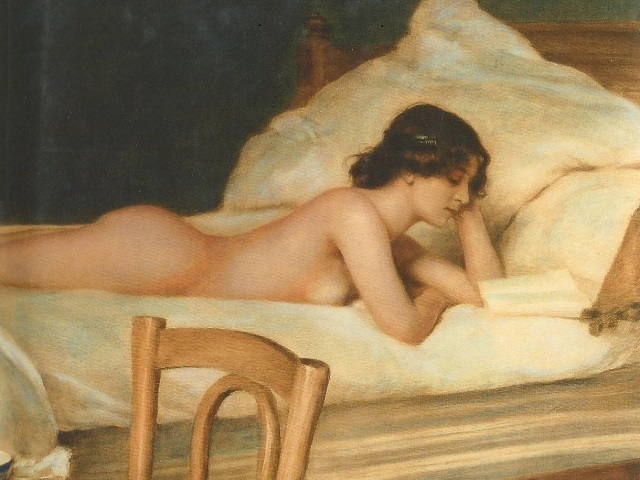
| Hermann Fenner-Behmer (1866-1913), The Bookworm, 1910, detail; complete painting in popup. I could find my first wife in this same pose, dress, and activity. She was sexually irresistable. |
An important feature of the erotic is how it varies across good and evil and even across pleasure and pain. The bondage and rape fantasies examined elsewhere represent practices that in the real world would cross over into crimes. Where crimes involve pain we get an overlap with the vast area of sadomasochism, where countless ways of inflicting or enduring sexual pain have been explored ever since the Marquis de Sade. Why pain should be sexually desirable may be explained by the circumstance that with sufficient sexual arousal, all stimulation, even pain, may be experienced as sexual pleasure. Tickling or spanking are mild versions of this that may be relatively common. However, sadomasochistic fantasies involve no actual contact or stimulation, and these often seem to possess an independent power, an action-at-a-distance, to effect arousal. This is not only puzzling but also the kind of thing that provokes the strongest moral and ideological backlash. That rape fantasies should please, either for women or for men, often seems improper, dangerous, or vicious.
What this shows, for one thing, is that the erotic as an aesthetic category does indeed vary independently from the other forms of value. Why it should, however, is then the question. Rape fantasies may be understandable in that they imagine away the barriers that ordinarily interfere with the consumation of sexual desires in the real world. Feminists, of course, claim that this shortens the distance between rape in fantasy and rape in fact. The awkward thing in that respect is that rape fantasies are not beyond the imagination of women also, as in Anne Rice's Sleeping Beauty triology of sexual bondage and slavery novels. For those, Feminists can only fall back on Marxist accusations of "false consciousness" -- where the oppressed identify with the ideology of the oppressors. The erotic imagination, however, has never responded well to ideology. Most rape fantasies, on the other hand, with both men and women, tend to involve the feature that the union is desired prior to the "rape" anyway, even if unconsciously. Again, this allows for a loss of the barriers that in ordinary life impede or even derail courtship and consumation.
 |
|---|
| Théodore Roussel (1847-1926), The Reading Girl, 1886-7, the Tate Britain |
| "Roussel's picture was exhibited at the New English Art Club in April 1887 and caused a mild scandal. The critic for the Spectator wrote: 'Our imagination fails to conceive any adequate reason for a picture of this sort. It is realism of the worst kind, the artist's eye seeing only the vulgar outside of his model, and reproducing that callously and brutally. No human being, we should imagine, could take any pleasure in such a picture as this; it is a degradation of Art' (Spectator, 16 April 1887)" -- from the Tate "Summary" |
If the loss of barriers, however, is what eros desires, this renders perplexing the literature in which bondage and other practices inhibit consumation. Where a victim of a rape fantasy is bound and helpless in order to be unable to resist sex, this is one thing. Where the bound and helpless victim, however, is denied sex, and perhaps bound even to prevent masturbation, is something else.
There is a genre of pornographic literature for men, "femdom," where "female domination" is frequently a matter of denying consumation to males. At its extremes, the fantasy may even be of permanent denial of consumation, where we get into the "forced feminization" variety of femdom, where men are unmanned with feminine clothing and discipline, hormones that inhibit erections, and even castration and sex changes.
There is actually such a story in the Thousand and One Nights, "The Tale of Azīz and Azīzah" -- not the kind that is excerpted for children or made into a Disney movie, but just the kind of thing that attracted Richard Burton to the Nights -- where a young man, عَزِيز, ʿAzīz, is pulled into a marriage by a forceful and independent young woman.
 |
|---|
| "Melissa," Youtube video channel Jack Video AI; video and channel taken down for "sexual content" -- may have moved to Rumble. |
Stories of sexual frustration may involve another aspect of the erotic response: Orgasm is more intense as arousal is more prolonged. The purpose of stories of sexual frustration is not indeed sexual frustration, but greater sensation in the consumation. The bondage or discipline fantasy thus may be the other side of the coin from rape fantasies -- the prolonged arousal rendered unnecessary in the latter returns in the former. Together they reveal desires and dynamics that in real life are sometimes contradictory. Thus, the married couple whose sex may become routine, dull, and infrequent, may need to construct a bit of play acting (or sample a bit of erotica) to revive something like the levels of arousal that for young lovers happen all but spontaneously. With the extremes of "femdom" fantasies, however, something more may be happening.
The experience of the erotic in art or literature (of whatever level of quality or taste) tends to the auto-erotic and narcissistic. This is because a partner is not necessary to achieve arousal from viewing pictures or reading, and consumation can be achieved through masturbation without ever having a partner present. 
 With no real partner, the unconscious is free to play. If the unconscious, as Jung believes, contains templates or archetypes of the opposite sex, this affects the kind of fantasies that are preferred and even makes it possible to imagine the responses and preferences of the opposite sex -- or to confuse everything together. Thus, Deirdre McClosky, in her story of becoming a transsexual, Crossing, a Memoir, relates how as a young boy she(/he) began to enjoy cross-dressing as a means of erotic arousal. For many years the pleasure of women's clothes was simply a private secret. The narcissism of this is obvious. Nor do I mean that as a condemnation, moral or otherwise. It was auto-erotic, and there is no particular reason, outside of a very conserative religious morality, why the auto-erotic should not be as enjoyable as other-directed eroticism.
 |
|---|
| Keith Garvey, Sweet Things, S.Q. Productions Inc., 2016; the model, although prepared for seduction, seems shy, tentative, or sweetly unsure of herself. |
Men now becoming "women" do not have wombs, menstruation, conception, or childbirth. Although plastic surgery now can do wonders to feminize a masculine face, some things are harder to deal with: large hands and feet, height, broad shoulders, and a deep rib cage. Women becoming "men" do not have semen or ejaculation, let alone a penis that is likely to function like a natural one. In time, the limitations probably will be overcome, but meanwhile some women's groups are actually rather hostile to the idea that male-to-female transsexuals, born without wombs or ovaries, are really to be considered women -- although this reluctance, in official feminism, seems to have passed, and anatomical male athletes now routinely defeat women in "women's" sports, to the approval of the bien pensants and the fierce condemnation of dissent [note].
While it is common now to say that transsexuals suffer from "gender-dysphoria," and psychologically are truly the mind of one sex in the body of another, which seems to me to be quite possible, given the variability of hormones acting on the brain in utero (where the fetal brain is sexualized, as is the fetal body), my interest here is in more general, ambiguous, and mixed cases. If Jung is right and the mind contains arechetypes of both sexes (even as the brain could be variably sexualized), which the imagination, dreams, and fantasy can energize and project, then the occurrence of more than simple gender-dysphoria is what I might expect. I would call such mixed cases the "Teiresias Syndrome," after the Greek seer who was turned into a woman (after encountering copulating snakes) and then, after eight years, was turned back into a male (after encoutering such snakes again).
The Teiresias Syndrome would cover cases like deliberate she-males (who carry physical feminization up to but not including genital surgery) or simple cross-dressers, like the 2003 winner of the Turner Prize for contemporary British art, Grayson Perry, who appeared to accept the award dressed as his little girl persona "Claire" -- appearing with his (presumably understanding) wife and son. The Economist of October 1st, 2011, in recounting a show by Mr. Perry at the British Museum, says he is "one of Britain's best-known transvestites, [and] plans to wear a pink satin blouse with red leather lederhosen," at the show's opening [p.91]. One wonders what Queen Victoria would have thought of all this.
Cross-dressers themselves can be relatively normal heterosexuals, like Perry, or homosexuals. A wide variety of preferences, practices, and purposes emerges in all this. In the Teiresias Syndrome, someone, without feeling alienated or unhappy with their own sex (unlike the dysphoriacs), may just like the other sex, its aesthetic and its experience, enough to feel rather deprived that life doesn't much allow for crossing back and forth and living, alternatively or in mixtures, both. This complexity seems to me to bespeak the psychological complexity of sexual archetypes and gender identity; and where we can never be in a body other than our own, the imagination strains against this limitation. Imagination can make us anything, and, even if a Teiresias Syndrome leads to no overt acts, literature can make us anything and put us anywhere. Whether Deirdre McClosky was born a true gender-dysphoriac or just acted out a strong Teiresias Syndrome seems to me irrelevant. Although physicians may only consider it ethical to treat the former, I don't think that morally there is a problem with sane and competent adults doing with their bodies what they like. They just better be sure, since Teiresias's own experience cannot (yet) be duplicated, that they know what they are doing.
 |
|---|
Erotic literature is thus bound to explore every possibility, even those possibilities that someone might regard as appalling, morally, socially, or psychologically, but that curiously contain the power to arouse. If this reveals something about the unconscious and about the natural terms of the erotic response, it would be wise to be aware of it and deal with it. Or, as Jung might say, the unconscious can become too energized with it, and acting out an irrational response becomes more possible.
Whether or not this is a real danger, it still behooves human curiosity to see what is going on and represent truths, however disturbing. The erotic as an aesthetic category does mean that, like other aesthetic categories, the requirements of morality, although independent, are not otherwise suspended. Art, literature, and fantasy are one thing, action is another. Some people confuse them, both that fantasy spills over into action, and that the limitations of action are thought to require the suppression of fantasy.
A good recent example of a fantasy that one really does not want to correspond to any reality is the 2000 movie The Cell, with Jennifer Lopez and Vincent D'Onofrio. This movie was reasonably well received critically but did not do very well at the box office. It contains dream images of stunning beauty, but it is also about a particularly sadistic necrophiliac, played by D'Onofrio. The images of his practices are stunning too, but also disturbing beyond what most audiences may have wanted to deal with (some stronger images and sequences were cut from the theatrical version). And the ending may be a little bit silly. The director, however, Tarsem Singh, clearly has a powerful aesthetic vision. That the movie was about a serial killer Singh says was perhaps an artifact of the 1990's. In the 70's it would have been about a burning building. A burning building, however, would not have had the erotic connection -- or provided a striking image of a nude, staring dead girl bleached white like a doll.
Singh's reference to serial killers in the 90's is supremely to Hannibal Lecter of the novel (by Thomas Harris, 1988) and Oscar winning movie Silence of the Lambs (1991). Hannibal himself does not seem very interested in sex, but the principal killers of Red Dragon (1981) and Silence of the Lambs, when Hannibal is mostly in jail, both were sex killers. What is noteworthy about the series is less the erotic dimension, though it is there, but the triumph of a moral aestheticism in the third book, Hannibal (1999). Hannibal goes from being the anti-hero of the first two books, contrasted with the goodness of the agents who had to deal with him, to being the out and out hero of the third, to the extent of converting agent Clarice Starling to his way of life. The makers of the movie Hannibal (2001, directed by Ridley Scott) recoiled from this development and released an ending in which Hannibal simply gets away again (selflessly sacrificing his hand for Clarice!). This was absurd. Harris has obviously lost it and been won over by his fictional villain; but if this is what has happened, it is ridiculous to try and patch it up in Hollywood -- though such cosmetics are not without precedent.
The danger of moral aestheticism when dealing with representations of wrong is well appreciated by Camille Paglia, who even celebrates the Marquis de Sade, but not without an understanding that right and wrong are not thereby suspended or superseded. But dispute over erotic representations is not at root about the extremes of representing sadomasochism or other paraphilia, but about erotic representation at all. In her book Sexual Personae, Paglia addresses this issue with a detailed argument that all Western art, from the prehistoric to the present,
 |
|---|
| Gian Lorenzo Bernini (1598-1680), "L'Estasi di Santa Teresa," 1647-1652, Cornaro Chapel, Church of Santa Maria della Vittoria, Rome, 2019 |
Most of the pornographic art found in Pompeii, however, was in private homes, often displayed in places of honor. Nor did this sort of thing, stretching back to the Golden Age of Greece, have much to do with where the civilization was on some sort of arc from dawn to decadence. The truth is that Greeks and Romans found human bodies, if not actually sexual intercourse, beautiful, interesting, and wonderful -- and funny. And if its representation effects an erotic response, so much the better -- a divine gift. This may not be agreeable to religions that mandate tightly circumscribed sexual expression, but, for better or worse, modern life has broken through such restrictions. Promiscuity and disease are not good effects of this, but then one discovers that the Greeks and Romans thought no better of promiscuity than we might. Their sexual explicitness did not imply sexual license, an accommodation and a balance that has not yet been struck anew in popular or elite culture. Mere disapproval or alarm at erotic representations will not do this job. An anhedonic moralism that would suppress them instead would contribute nothing to the richness of human life.
 Where a curious balance was struck in another historic culture was in India, where naked ascetics, Jains and Hindus (men only), have wandered the country, and Jain and Hindu temples have often been decorated with explicitly erotic sculpture, displaying sexual positions that are sometimes puzzling to the uninitiated. Prior to the advent of Islām, traditional Indian dress, as seen at left, did not even involve concealing female breasts. Nevertheless, other kinds of public eroticism are not allowed, and it was not long ago that romantic kissing wasn't even permitted in the movies -- elaborate dance numbers had to do the job. The balance, indeed, is between extremes, the erotic sculptures on one side and very serious asceticism on the other. The latter, although part of traditional Christian practices (with celibacy surviving in Catholic and Orthodox Churches), nevertheless tends to now be regarded as peculiar and unnatural in the West. The idea that there is a place for everything is what it takes to strike a balance. The modern West might be more comfortable with the erotic if its place were more settled, and perhaps if there were more respect for its opposite -- instead, celibate priests are now often expected to be child-molesters.
Finally, there is the question, which might have been addressed first, why the erotic would be in particular an aesthetic category. In the polynomic theory ) of value one might expect that the erotic would belong to euergetic or hortative value rather than the aesthetic or optative. Indeed. The aesthetic is usually characterized by disinterestedness, the hortative by interest. The horative, as part of ethics, is what is good-for human life. The erotic definitely qualifies there, as its interested character is conspicuous. Perhaps it is just that I am getting too old, so that for me the erotic is more of a spectator sport than a matter of participation, or even arousal. Very possibly. The point would then be, however, that it does indeed appear valuable to the spectator. This is an aesthetic quality. More importantly, the essence of the aesthetic is that it is good in itself. If the erotic is a matter of the beautiful and the sublime, as well as the good life, this earns it aesthetic status. Except for those frightened or moralisticly disapproving of the erotic, I think this is beyond doubt.
of value one might expect that the erotic would belong to euergetic or hortative value rather than the aesthetic or optative. Indeed. The aesthetic is usually characterized by disinterestedness, the hortative by interest. The horative, as part of ethics, is what is good-for human life. The erotic definitely qualifies there, as its interested character is conspicuous. Perhaps it is just that I am getting too old, so that for me the erotic is more of a spectator sport than a matter of participation, or even arousal. Very possibly. The point would then be, however, that it does indeed appear valuable to the spectator. This is an aesthetic quality. More importantly, the essence of the aesthetic is that it is good in itself. If the erotic is a matter of the beautiful and the sublime, as well as the good life, this earns it aesthetic status. Except for those frightened or moralisticly disapproving of the erotic, I think this is beyond doubt.
There is, as it happens, a broad overlap between the hortative and the aesthetic. The most humble utilitarian object, whose aesthetic value might be nil, can be made a thing of beauty as well. In subsequent years, when its instrumental value may vanish, it can qualify for an art museum as well as an archaeological or technological museum. The erotic tint of the aesthetic, however, involves an irreducible interest: the erotic is only really going to be erotic to those whose eros can be moved by it. Thus, human eros is only for humans. What apes or octupi or salmon find sexually attractive to each other doubtlessly is a powerful matter to them, but (perhaps fortunately) it is entirely lost on us. The idea that extraterrestrials, for instance, would want to mate with humans is all but an impossibility. As Carl Sagan used to say, a human being has a better chance of mating with a petunia than with an extraterrestrial. On the other hand, we do find petunias, and most flowers, attractive, even though they are the sexual organs of plants. Well, aesthetically attractive, not erotically attractive. There may be sexual fetishes involving flowers, but I haven't heard of them. The erotic as an aesthetic category, therefore, does have an essential connection to the hortative.
 |
|---|
| Amedeo Modigliani (1884-1920), Nu couché (sur le côté gauche), 1917; sold at Christie's for $26,887,500, November 2003, Private Collection |
The Skin I Live In (La piel que habito), 2011
Le déjeuner sur l'herbe, 1862-1863, Édouard Manet
Philodemus was a Roman period Epicurean, with many entries in The Greek Anthology, and with many of whose books found in the Villa de Papyri at Herculaneum. This epigram is directed to "Flora," Φλῶρα, who, we are assured, "does not sing Sappho."
The Loeb translator here, W.R. Paton, actually translates κτείς (genitive, as in the text, κτενός) as "cunt." But in tone this does not seem to fit, since the word in both American and even more so in British usage seems to be crude and hostile -- although "queynte" appeared in Chaucer without such overtones (some dispute that this is the same word, "cunte" otherwise being the Middle English form). But it is hard to say what would suit the tone of the passage, without being too clinical or too colloquial.
American usage of "cunt" is usually crude or hostile, the former if it is used for female genitals or the vagina, the latter if it is applied to a whole woman. British usage, however, seems far harsher. When the word is applied to men, the sense is about a hostile as it can get. This dimension seems missing from American usage. French, where "cunt" is le con, seems to begin with British usage, with multiple applications, but then tails off into relatively mild vulgarities, with meanings given as simply, "stupid, idiot, asshole, lousy, shitty, poor, silly," etc. Applied to women, we get la conne, translated "bitch," often with sale, meaning "dirty, filthy." Sale con is then given as "bastard." Various other usages occur. See La Vie Sexuelle de Catherine M. [2001] for the simple meaning of le con as "vagina."
Greek κτείς already seems to be a euphemism, unlike Latin cunnus (vagina itself is a euphemism, "cavity"), since the basic meaning of the word is a "comb," with extensions to "rake" and even "fingers." Those are actually the only meanings given in Liddell & Scott's Intermediate Lexicon [p.453]. Their Unabridged Lexicon continues on to "ribs," "virilia, pubes," "pudenta muliebria," and some other, inoffensive meanings [p.1001-1002].
Neither too clinical nor hostile might be "cunny," which may derive from either cunnus or "cunt," perhaps as a diminutive. This may be glossed as "vulgar slang," although it already occurs in the diary of Samuel Pepys. It is also thought that "cunny" may be a pun on the old word "coney," "rabbit," which may echo both historic comparisons of the vulva to an ("earless") rabbit (as used in the Thousand and One Nights) and the use of "pussy" for female genitals, borrowing a word that otherwise means, without vulgar overtones, a cat ("pussy-cat" can be innocently used by children). Since "cunny" is now little used, unlike "cunt" and "pussy," it evokes few of the overtones that the other words do.
John McWhorter thinks that the word "rabbit" replaced "coney" in polite language precisely because "coney" sounded too much like "cunny" [Nine Nasty W*rds, English in the Gutter, Then, Now, and Forever, Avery, Penguin, 2021, pp.170-171]. He cites cognates for "coney" as Spanish conejo and Greek κουνέλι [ibid.]. However, the latter occurs in Modern Greek but is not listed in the Unabridged Liddell & Scott Greek Lexicon. On line, we see that it is borrowed from Italian coniglio but that nevertheless there was a Hellenistic Greek word κύνικλος, glossed by Liddell & Scott as Latin cuniculus [Oxford, 1843, 1940, 1996, p.1010]. The evidence that the Modern Greek word is borrowed may consist in the fact that the Italian "g" is silent. The reduction of an "io" ending to "i" is also common in Modern Greek.
The Book of the Thousand Nights and One Night, rendered into English from the Literal and Complete French Translation of Dr. J.C. Mardus, by Powys Mathers, Volume III, Routledge & Kegan Paul, 1964, 1972, 1986, p.84. One of the most distinctive features of female secondary sexual characteristics are broad hips. "Broad" is a now archaic colloquialism for "woman." In the translation of W.R. Paton we don't see hips at all. He translates λαγόνες (singular λαγών, occurring in the text as genitive plural λαγόνων) as "flanks." I am unclear about the part of the body to which that refers. In Liddell & Scott, λαγών is "the hollow on each side below the ribs, the flank." But a "flank" sounds more like part of a horse or cow, from the shoulder to the rump, than of a woman. And "the hollow on each side below the ribs" actually sounds like the waist, which is otherwise not mentioned separately by Philodemus. The Latin version of λαγών, translating Galen, is ilium, which is the broad bone, one on each side, at the top of the hips.
Λαγών does not occur in my Modern Greek dictionary [Pocket Oxford Greek Dictionary, 1965, 2000]; and the translation for "waist" is just μέση, which literally means no more than "middle." An interesting case might be Mark 1:6, which is about John the Baptist living in the wilderness and wearing skins. He is said to have a ζώνη (i.e. "zone") around his ὀσφύς. Traditional translations, like the King James, render the former "girdle" and the latter "loins." Recent ones say "belt" and "waist." The Modern Greek dictionary glosses ὀσφύς as "waist, loins," but Liddell & Scott says "the loin or loins, the lower part of the back" -- as they say that ζώνη is "belt, girdle." In this case, we might consider the logic of the description. Why would John need a belt? He has no pants. No tools or weapons to carry. A "girdle" for his "loins" means that he wears something specifically over his genitals. But Philodemus has already taken care of that.
In Liddell & Scott, we get a specific reference to the hips in ἰσχίον (plural ἰσχία), At Wikipedia "the hip region is located lateral and anterior to the gluteal region, inferior to the iliac crest." The whole structure is "broad" to create a large, round space for a growing uterus and the birth canal. The broadness of hips then extends along the top of the femur bone itself, which angles into the hip joint. So hips are below the top of the ilium and around to the front of the buttocks. Measuring for clothes, there is a "high hip" measurement, and a "hip," which is lower. The waist creates a space at the top of the hips where women can rest small children. Men don't have that space. Women can also have a broad, shelf-like area above the buttocks, something particularly illustrated and celebrated by cartoonist Robert Crumb (b.1943).
Consequently, we might take λαγών as the waist and ἰσχίον as the (low) hip, and fix up Philodemus with, Ὢ λαγόνων, ὢ ἰσχίων, "O waist, O hips!" In Greek, "waist" could be plural because "the hollow below the ribs," in those terms, occurs on both sides of the body. Ὀσφύς is tempting but too ambiguous. Since what men might notice the most quickly about women's bodies, apart from breasts and legs, are a narrow waist and broad hips. It is hard to imagine Philodemus missing all that.
While we're at it with the body parts of Philodemus, I might note that Sanskrit कुच, kuca, is specifically "female breast" and "nipple." While we will see many Arabic words for "breast" at Human Breasts, we get Arabic إِسْت, ʾist, for "buttocks."
Return to text She was as destitute of clothes as the green Martians who accompanied her; indeed, save for her highly wrought ornaments she was entirely naked, nor could any apparel have enhanced the beauty of her perfect and symmetrical figure. Edgar Rice Burroughs (1875-1950), A Princess of Mars, 1912, Del Rey Ballantine Books, 1963, 1981, p.46; John Carter first sees the Princess Dejah Thoris After fans had literally been waiting a century for it, A Princess of Mars was finally made into a big budget Hollywood movie in 2012. As sometimes happens in Hollywood, everything that could go wrong, did go wrong. Disney studios, which ended up with rights to the property, didn't even like the title. Since Disney has made and does make a lot of movies about princesses, they didn't want another movie that, even while it inevitably involved a princess, advertised this in its title. Of course, the title existed before Walt Disney had drawn a single animated cartoon and Mickey Mouse wasn't even a twinkle in his eye. No matter. Fair enough, but a bunch of decisions by suits that have nothing to do with the history or appeal of the story was not a good sign. Unfortunately, they were just getting started. The whole story had to be rewritten and punched up to the overwrought standards of contemporary Hollywood action movies. For one thing, Dejah Thoris needed to be both a scientist and a warrior. While in the book it is questionable how much she was of the former, it is certain that she was nothing of the latter.
But obviously a movie now needs a female physicist and action hero. So Dejah Thoris becomes the equivalent of Xena, Warrior Princess, with Marie Curie thrown in. The idea of a warrior Dejah has caught on. At left is an image from an AI YouTube video that has a fantasy rewriting of A Princess of Mars, where Dejah is not just a warrior, but the actual Queen of Helium. She is also nicely sexualized, although this gets us further and further from Edgar Rice Burroughs -- where, talk about sexualization, as we will see below, Dejah Thoris ought to be naked. We don't get that at YouTube.
Meanwhile, John Carter himself in John Carter couldn't be the consistent straight arrow, confident, heroic character he was in the book. After all, as Joss Whedon would say, they're not making Air Force One [1997] -- we need a Harrison Ford (President "James Marshall" in Air Force One) who is more like Han Solo, a bad boy, or at least a damaged character, who rises to the occasion and turns good. Audiences, who are presumably mostly ignorant of A Princess of Mars, expect no less. Conflicted anti-Heroes, not Heroes, are what are "in" for a proper modern movie. So John Carter must be like every other Hollywood movie, except, of course, Air Force One. But the principle of "like every other movie" is a rule for lemmings, not for creativity. And much of the charm of A Princess of Mars is that it is a message from a different era. It even mentions ante-bellum slaves without a reflexive expression of guilt, shame, and self-hatred.
The idea not to use the original title of the material, A Princess of Mars, was the brainstorm of the director, Andrew Stanton. It was he who figured that the movie needed to be aimed at boys, while the "Princess" title would make it sound like a typical Disney princess movie for girls. That literally generations of readers knew the original title seems to have been irrelevant. However, one might wonder, if the point of the movie was not to represent Princess in its own terms, then Why bother? Disney was also on board with the target demographic, since, as with aquisitions like Marvel Studios, the suits wanted to focus on cultivating a young teen (10-15) boy audience. Thus, while the imagery associated with Princess had always been of John Carter and Dejah Thoris (as in the Frank Frazetta art at left), in the publicity materials for John Carter, Dejah Thoris, even in her Xena persona, is all but invisible. Unlike the "Touchstone" and other productions of Disney Studios aimed at adults (cf. Splash [1984], under Touchstone), John Carter would seem to be aimed at children.
The irony of these machinations is that Kathleen Kennedy and others would then contrive to make all future Star Wars and Marvel movies female-centric, subverting the very strategy behind the purchase of the studios. This is gone so far as to attack and smear the male Star Wars and Marvel fans, as sexist and racist bigots, when the feminized movies drew protest and didn't do well. The insanity of insulting paying customers has still not dawned on Kennedy, or on Disney President Bob Iger. The same mindset continued evident in the streaming Star Wars miniseries, The Acolyte, whose very purpose seemed to be drive off the male fans and attract a new audience of Lesbians, or something.
Andrew Stanton was also largely responsible for the rewritten characters and story line, pulling the movie further and further away from its roots. Thus, this all looks like Stanton actually did not really want to film A Princess of Mars. He wanted a different movie, a modern movie, responsive to all the expectations, as Hollywood saw it, of modern (teenage boy) audiences. This simply leaves out all those generations who had been waiting a century for the movie. It was not likely to please them very much, and it was a real gamble whether it would even appeal to those teenagers -- who probably had seen it all before in other movies. One of the challenges of ever making a movie of A Princess of Mars was going to be the depiction of the six-limbed Martian green men. That is why, in the 1920's, some of the first ideas about fliming the book were to do it as an animation. Today, no problem. John Carter, if nothing else, does a decent job of producing CGI green men (at hideous expense). On the other hand, considerable CGI resources were expended on the shape-shifting, conspirator villains of the story -- villains who didn't exist in A Princess of Mars but were borrowed from the second Mars book, The Gods of Mars. These were the evil priests of the Martian religion, which turns out to be entirely a fraud.
This was promising for a modern movie, with religion as a lie, and the only irredemably wicked race of Martians being the "white" race (the "Therns"), which lived off the bogus religion and contributed its priesthood. At the same time, Dejah Thoris belonged to the noble "red" race, while in The Gods of Mars, John Carter also manages to befriend the "black" race, once he exposes the fraud of the ancient woman who is their false goddess -- and who is then killed by her own followers. Similarly, in the third book, The Warlord of Mars, Carter encounters a "yellow" race and, after some adventures, befriends them also.
The magnanimous attitude of Burroughs about Martian races may be a little surprising, not just because of his background (partially from Virginia, like John Carter), but because, like the sainted Margaret Sanger (1879-1966), he was an advocate of eugenics. Some take this to mean that he thought of blacks as inferior; but this seems inconsistent with the presentation of Martian blacks, and the fact that Burroughs' most famous creation, Tarzan of the Apes, becomes the leader of a black African tribe, the Waziri -- humans, not apes -- which is portrayed in only the most positive way -- after the previous chief had been killed by Arab slavers (cf. The Return of Tarzan, 1915), whose very existence tends to be ignored in elite, politically correct company.
Indeed, when John Carter first encounters the Martian black race, initially as the "Black Pirates," we get an extended description:
The system of Martian races, especially the "marvelous beauty" of the black race, is all a curious construction for a story published in 1912; and Burroughs also never gives us any hint of a better religion to replace the one that Carter destroys -- a negative view of religion and priesthood that indeed seems to have been the conviction of Edgar Rice Burroughs. But this is all good stuff for a modern, politically correct movie, where the source of evil is religion (except Islām) and white people.
The racial aspect of the matter, however, is really untouched in the movie we get; and the use of the white priests (never identified as such) is made up out of whole cloth, seriously subverting and transforming the story of the original, with the added detail that the priests are shape-shifters, which is something unknown in the Edgar Rice Burroughs corpus, as well as I remember it.
The result is a fiasco, with little remaining of the original story, and much of the rest more or less absurd. Carter is treacherously returned to Earth by the priests, and not because he passes out while restarting the atmosphere plant, which has been left entirely out of the movie (not to worry; it's in Total Recall [1990] -- Arnold restarts the plant). Also, it is not clear that Carter has had any chance to enjoy married life with Dejah Thoris, who canonically had already produced one child -- well, an egg -- before he left. In the book, he's on Mars for more than nine years.
Audiences didn't think much of this either, with a domestic box office of only $73,078,100. The movie did rather better internationally, with a total box office of $284,139,100 -- but well below the production and marketing costs of $350 million, which seem excessive, especially given the absence of name stars in the title roles (Willem Dafoe is hidden in a CGI green man). With such a performance, and dismal critical reception (52% at Rotten Tomatoes), we are not likely to see a movie version of The Gods of Mars, where we have already met the villains and the racial aspects of the story would be harder to ignore. Carter's best friend in that book is a black man (Dotar Xodar), and it would have been great to see Denzel Washington do the part.
The surprising thing is that this generated no controversy back then, probably because the doings are otherwise entirely chaste and asexual. The wicked, brutal villian, after all, only wants to marry Dejah Thoris, a feature preserved in the movie. But in 1912 a villian who was an actual rapist was something that did not bear contemplation. Also, while Carter describes the lovely form of Dejah, this does not include any explicitly sexual features, such as we see in the epigram of Philodemus of Gadara above.
It remains to much later artwork, such as from Frank Frazetta (1928-2010), above, or by Gino D'Achille (1935-2017), above left, to remind us what nudity is really going to mean. At right, we have a more erotic pose of John Carter's daughter-in-law, Thuvia, from Thuvia, Maid of Mars [1916, Del Ray Ballantine, 1979], by artist Michael Whelan (click for popup of full painting). We have a hint of a G-string but otherwise nothing but ornaments. The view of her bare breast is strongly suggestive in itself, not to mention her sensuous pose against the Martian lion-thing (a "banth," ripped off as "bantha" in Star Wars) -- Thuvia, after all, is a beast master or, we would say now, a "whisperer."
The nudity in the original A Princess of Mars is curiously echoed in a previous movie of the story from 2009. This was a cheesy, low-budget, direct-to-video production, that was otherwise aired on the cable Syfy channel. It used the title Princess of Mars but was then re-released in 2012 as John Carter of Mars, The production values of this movie were dismal. No CGI green men. And the story was heavily rewritten, putting John Carter in contemporary Afghanistan, and removing Mars itself to a different solar system. It did, however, keep the atmosphere plant. But the point of greatest interest here is that, amid the otherwise no-name cast, Dejah Thoris is played by legendary porn actress Traci Lords.
This is what gives us a bit of recollection of the nudity of the characters in A Princess of Mars. Lords, of course, became famous as a porn star when it was discovered that every single movie she had made, except one, was made while she was underage. Thus, they are not legally available today. The producers of her movies were prosecuted for using an underage actress, on the grounds that they should have recognized her fake ID; but then the case collapsed when it turned out that she had obtained a United States Passport with her fake ID.
Curiously, Lords does not look very good in this Princess of Mars. I don't understand why. She had appeared just one year earlier in Zack and Miri Make a Porno [2008], and I don't think anyone would think she looked any the worse for wear in that movie. So either something bad had happened to her, or the production values of the later movie led to a very badly botched makeup job. I trust it was the latter.
Some people actually like the movie John Carter, even some who know how far it diverges from and rewrites A Princess of Mars. At Rotten Tomatoes, even though the movie only scores 52% ("Rotten") with critics, it rates 60% ("Fresh") with audiences. This compares with Oblivion [2013], a movie I rather liked (even though it stole its ending from Independence Day [1996]), which scored only 53% with critics but 61% with audiences. Similarly, Angel Has Fallen [2019], which I also rather liked, only rated 39% with critics (very Rotten), nevertheless scored an impressive 93% with audiences. It intrigues me when reactions diverge that much.
The controversy and negativity about John Carter was mainly due to its budget, over $250,000,000, and to behind-the-scenes events at Disney Studios. While the box office was unimpressive in the United States, better returns overseas would have made for a successful movie, except for the budget. Overall, the movie looks good enough compared to, say, The Last Airbender.
That movie, on a budget of $150,000,000, outperformed John Carter, with $131 million in the U.S. and $319 million internationally, which looks like a successful movie. However, it only gets 3% among critics at Rotten Tomatoes and 30% with audiences. The audiences, however, seem to have paid a lot for money for what they thought was a bad movie. This is a little confusing. John Carter looks better with critics and audiences but fell much shorter with box office. Both movies are regarded as catastrophic bombs.
Another movie with a $150,000,000 budget was Disney's The Sorcerer's Apprentice [2010]. I also rather liked this movie -- a good Nicolas Cage movie -- whose box office was $63,150,991 domestically and $152,132,612 internationally, a bit short of John Carter. But it did worse at Rotten Tomatoes, scoring only 40% with critics and 53% with audiences. This all rated it as a failure, but not nearly on the scale of John Carter.
Michael D. Seller, an independent movie producer, wrote his book to explain the history of John Carter. He was already an Edgar Rice Burroughs fan and eagerly anticipated the movie, and its prospective sequels. He still hopes for sequels or even a reboot of the franchise, which is why he wrote the book, which looks like a self-published, print-on-demand production. Most of the book is about the clumsy and half-hearted way that Disney produced and, especially, marketed the movie. There is a large and interesting story there, but it doesn't touch many of the cinematic problems with the movie.
When Seller finally got his chance to see the movie, he seems to have had mixed feelings. He did notice that the movie had trouble getting started, with three prologues. The "Barsoom" bit was non-canonical and particularly gratuitous.
But it didn't quite turn out as expected.
It was a thrilling ride -- no question about that. But the experience was not quite the uniquely Burroughsian ride I was expecting. I would later describe it as being as if I had gone to my hometown after decades away and made a pilgrimage to the Italian restaurant I had loved as a child. The restaurant was still there; it looked the same, the name was the same. But a new chef had taken over and the cuisine was no longer homestyle Italian, but a very delightful modern fusion cuisine, which tasted great and was presented beautifully -- but left you wondering: "Where's my lasagna?"
While this was a mild disappointment as a fan, as a film-maker I was conscious of how much [director Andrew] Stanton did retain of the original, and I found myself being mostly grateful for that. [p.27] To adopt Sellers' own comparison, my experience was more like my final visit to my childhood favorite restaurant in San Francisco, The Shadows. The old German cuisine was gone, replaced by a pink decor and some kind of nouvelle cuisine menu. It was a lot worse than just the missing Sauerbraten. Not just "Where's my Sauerbraten?" but "Where's everything else?" A lot more than just a "mild" disappointment. They had also torn out the charming bar on the third floor, with its view of the Bay.
Actually, Stanton did retain a lot of the original, but he had reworked it into an all but irrecognizeable form. Thus, the "Therns," which are borrowed from The Gods of Mars, are no longer even Martians, but some other kinds of Extraterrestrials, whose evil design is to loot Mars, and then Earth, of their "natural resources," much like the aliens in Independence Day [1996] and Oblivion [2013]. This makes them modern villains indeed. No wonder that they are shape-shifters. Who knows what their natural form actually is. They can also fly, which they are doing as we first see them on Mars.
Also, the Therns seem to have decided to support Zodanga because that city is already raping the natural resources of Mars, as we see in the first prologue of the movie. Zodanga is some sort of walking city, which ravages the countryside as it moves. Indeed, the implication is that Mars is dying because of what Zodanga has been doing. The Therns are all for it. That is why they are already on the Earth. Because we evil humans are raping and destroying the Earth, the Therns are going to join in. This, of course, has nothing to do with Edgar Rice Burroughs, or with much of what anyone thought in 1912. But we can't have a modern movie without some kind of Environmentalist propaganda.
This all would have posed a difficulty if The Gods of Mars was ever made into a movie sequel of John Carter; for the deception practiced by the Therns, the white race, on all Martians, with their fraudulent religion, was, as it happened, also practiced on them by the First Born, the black race who were the keepers of the Temple of Issus, the center of the religion that was recognized and respected by the Therns themselves. Was Stanton going to make the First Born into extraterrestrials also? Was John Carter going to make a friend, Dotar Xodar, among these beings? Were they even really black? Or was that part of shape-shifting also? Unless Stanton opens up about his plans for that, we may never know.
Stanton's idea of alien Therns helps answer a question that may have bugged him. In the book, John Carter "snaps" out of his body on Earth and then is drawn through space to Mars. It is never explained how that is supposed to work. So now in the movie it is technology. The Therns have a medallion, and you just push a putton to pass back and forth between planets. Carter takes a medallion off a Thern on Earth, and later there are various adventures losing and regained it, finally to have Carter throw it away, just before the Therns send him back to Earth. Later, he must use a trick to get another medallion off a Thern on Earth again, to return to Mars. Of course, whatever technology this uses is explained no more than anything is explained in the book. So we really are no better off.
On the other hand, Carter leaving his body and then finding it still lying there, comatose, sounds very familiar. Many people might recognize this as "astral projection," which I have heard mentioned at least once in treatments about John Carter on the Internet. The ultimate form of this would be for Carter to astral project to Mars and then "teleport" his physical body after him. Since he doesn't do that, this would mean that he travels to an astral Mars, not to the physical Mars seen by astronomers. I get no sense that Edgar Rice Burroughs knew anything about this, but astral projection would be the only phenomenon that sounds anything like the way John Carter got to Mars, and back.
Another major alteration that Stanton made in the story of A Princess of Mars was with the city of Zodanga -- besides the "Zodanga raping the planet" trope. In the movie, Zodanga and Helium are actively at war, and Dejah Thoris is introduced to John Carter in the middle of an air battle between the two belligerents. Carter joins the battle. The Therns are involved, because they have given Zodanga a superweapon, powered by the Burroughsian "ninth ray," that disintegrates its target. The Therns seem to want war because Dejah Thoris, as Marie Curie, has discovered the "ninth ray" herself. The Therns have already sabotaged her efforts, but they also want her killed. For some reason, this results in an elaborate plot to blackmail her father into getting Dejah to marry the ruler of Zodanga, who is going to murder her once the marriage is accomplished. I don't think I understand the point of all that.
In the book, Zodanga and Helium are enemies but are not actively at war until well into the story. We don't meet them for many chapters. The Therns, of course, have nothing to do with it; and the "ninth ray" in Burroughs is not a weapon. Firearms and motors in Burroughs all seem to involve radium, about which he had the sort of confused ideas that prevailed for many years after the discovery of the element. People didn't even know that the radiation from radium, or from X-rays, could hurt you.
There is an early air battle in the book, but it consists of the troop of green men, with whom Carter has found himself, attacking a number of airships of Helium, which are on a peaceful atmospheric research mission. One ship is so disabled that the green men are able to board it, finding only one survivor, Dejah Thoris herself. Carter is no more than a spectator. Zodanga soon begins an attack on Helium because most of the fleet of Helium is away looking for Dejah Thoris. It is a little mysterious why it cannot be recalled once it is needed at home. Burroughs, and Carter, knew about radio waves, sort of.
One problem with the story in the movie is that Carter for a long time only wants to get back to Earth, while we already know that, having (non-canonically) lost his wife and child, there is really nothing back on Earth for him to return to. In the book, as soon as Carter sees Dejah Thoris, his only real concern is her. It is love at first sight. The whole story is about rescuing her and winning her heart, which he does. This gives the book an unambiguous focus, while in the movie it is not at all clear, for much of the time, what it all means to Carter. Critical comment on the Internet highlights this narrative problem.
On the other hand, the book by Michael D. Sellars does not go into such details. Instead, we get the story of the movie, as betrayed by the "gods of Hollywood" -- gods who are no more benevolent or caring that those of The Gods of Mars. The principal villain is Disney chairman Robert Iger. His brainstorm seems to have been that Disney would not create its own properties and franchises but just buy those already created. This involved the purchase of other studios, including Pixar, Marvel, and eventually LucasFilm. The production history of John Carter was not part of this program, even though director Andrew Stanton has actually made his name at Pixar. But then the people at Disney with whom Stanton had gotten his project going were all fired by Iger.
There was more than one Saturday Night Massacre of Disney employees, especially those in marketing. And not all the new, young, promising managers even managed to survive very long -- although one survived long enough to pointlessly cut the title of the movie down from John Carter of Mars to John Carter. Thus, a movie like John Carter, surviving from the ancien régime, was not viewed kindly. It did not fit with the program. The strongest evidence of this may be that Disney declared John Carter a financial failure only ten days into its theatrical run. Such an act is unheard of, occurring before the movie had even opened in Japan and China, where much of the overseas revenue could have been expected. In retrospect, the "write down" (for $200,000,000) of the movie looks like nothing so much as outright sabotage. Management wanted John Carter to fail. Pontius Pilate wasn't any faster at washing his hands of his embarrassment.
At the same time, the studio did not really interfere with the production -- the bane of many movies. The neglect or hostility of managment was mainly manifest in the casual and often inept attitude toward publicity and marketing. This might not have been a problem with a better movie -- which I think Michael Sellers is reluctant to admit. Sometimes, good movies, in which their studio has little confidence, appear out of a quiet nowhere and then explode on release. I'm not sure who heard of Star Wars [1977] before it opened. I was alerted by a positive review in Time magazine. The rest is history.
But the publicity that John Carter did get was often of the worst kind. Various falsehoods got out to the press, such as that the shoot was over budget or out of control, which Disney then seemed to allow to circulate without contradiction. But again, a better movie should have shaken it off. Titanic [1997] was over budget and so delayed and troubled that Daily Variety began a "Titanic Watch" feature -- almost a kind of death watch. The industry expected the worst and then was astonished when Titanic became the most successful movie of all time. No such luck for John Carter. It just wasn't that good.
So perhaps it is that Michael Sellers "doth protest too much." The film made him uneasy, and he had to admit it wasn't the faithful Edgar Rice Burroughs that he anticipated. If it really was about as good as Oblivion, which is what it looks like at Rotten Tomatoes, then, even if some people really liked it, it just wasn't good enough to make back its budget and costs. It's fault was not in its stars, or in its studio, but in itself.
Science Errors in Science Fiction
The Bold and the Beautiful occupies a strange alternative universe. Thus, things like attempted murder, kidnapping, and assault with a deadly weapon no longer seem to be crimes. Similarly, anyone arriving at a hospital with gunshot wounds apparently draws no attention from the police, despite an investigation always being initiated in such cases -- in the real world. And it isn't just the disinterest of the police or the justice system. The other characters on the show are just fine in turn continuing to deal with someone who tried to murder them. I don't actually watch the show to know what jobs these people have, but nothing affects their presence among the rest of the cast. Forgive and forget, I suppose.
If Annika Noelle is not my type, I might say who is. At left is Sophie Silva. She is presented as "an actress and content creator," where the latter apparently means posting videos at Instagram and YouTube about clothing and costumes. Similarly fetching, at right, is a woman who goes by the handle "Snarky Jay Cosplay," on YouTube. Her videos run to movie reviewing and various kinds of commentary more than cosplay, although she does that too. I think her proper name is Jay Fett. Since she is half Cuban and half Puerto Rican, she comments on issues that come up in Hispanic politics, such as the offensiveness of the word "Latinx," where she gives us a blistering editorial. Some of that is in Spanish, such as we occasionally get in other contexts. You can learn a lot about the dialects of Spanish from her.
Both of these women display winning personalities, where with an actress like Annika Noelle we never know quite what we are getting. Actors, after all, act. In an extended video, which, after all may nevertheless be planned and scripted, we do get the sense of seeing more like the real person.
Some transsexuals have regretted the loss of their original genitals. There is a Swedish documentary, Regretters ( ngrarna) (2010), by Marcus Lindeen, about two transsexuals with second thoughts about their experiences. Part of some dissatisfaction with older sex changes can be that surgical procedures, for male-to-female transsexuals, originally may have simply amputated the penis. Now this is no longer as much of an issue, since newer techniques preserve the sensitive parts of the penis and use them to construct the vagina and clitoris.
This approach was not originated but was long employed, since 1969, and developed by Dr. Stanley Biber, whose practice in the remote town of Trinidad, Colorado, gave it the reputation of being the "sex change capital of the world." With radical and painful surgery, bone can be shaved from the skulls of transsexuals, resulting in dramatically feminized faces, but altering the other skeletal features is more problematic. One does see transsexuals with narrow shoulders and wide hips, but is not clear how much of this, if any, is owed to surgery rather than to the natural frame of the person.
Other transsexuals, for one reason or another, never go as far as the final "gender-reassignment" surgery, but remain, to one degree or another, hermaphrodites ("she-males" etc.). Natural hermaphrodites, the inter-sexed (☿), have challenges of a different sort. Some are born with ambiguous genitals which can merely be the result of developmental problems.
Genetic males whose bodies did not respond to testosterone in the womb can appear completely female on the surface and live out their lives without being aware of their condition -- whose only overt effect may be sterility. Rumors circulate about some female Hollywood stars being genetic males. There is a rare genetic disorder that has been studied in the Dominican Republic (called guevedoce) where genetic males do not respond to testosterone in the womb, who are born and live out their childhoods as girls, but then who develop both primary and secondary male attributes at puberty, living the rest of their lives as males.
This curious condition provides an excellent counter-example to the feminist thesis that masculine and feminine behaviors are learned and conditioned from infancy, rather than genetic. The adult males, who had been girls as children, typically exhibit normal male behaviors.
Other individuals have ambiguous genes, the ultimate form of which is the rare case of chimeras, whose bodies contain the complete genome of both a male and of a female in a single person. This extraordinary situation is the opposite of identical twins, where a single genome has split into two individuals (with incomplete splitting resulting in Siamese twins). Instead, the fertilized eggs for two siblings have unaccountably become combined and developed as one individual.
Where this happens with two female or two male fertilized eggs, the nature of a person as a chimera may be invisible, through apparently normal sex and reproduction, and go undetected without genetic testing. Or, bizarre effects can occur, such as stripes or even checkerboards of different skin colors. Where female and male genomes combine, the genitals may be male on one side and female on the other, posing the same challenges of identity, anatomy, and physiology as with developmentally ambiguous genitals.
While the Greeks and the Romans thought of hermaphrodites more as extraordinary and sacred than as abnormal or deformed, the modern judgment, until recently, has tended to the latter -- with the venerable word "hermaphrodite" itself avoided as inappropriate or politically incorrect. Surgical "gender assignment," however, which typically was performed on infants, now obviously does not always match the preferences of the adult person. One infamous case led to suicide.
The more enlightened policy recently is to leave the children alone, unless there is some painful or dangerous condition that needs addressing (e.g. an incomplete urethra or, later, menarche when there is no external vagina). It is then the choice of the adolescent or young adult whether surgery will aim for one sex or the other. Children are obviously then left for the time being with the embarrassment of not being exactly boys or girls, and this can create confusion, stress, and harassment. It is a shame, therefore, that the Classical status of the hermaphrodite is not better known, acknowledged, or respected, as this provides a ready and venerable answer to the challenging "Are you a boy or a girl?" question. Even the "inter-sexed" themselves seem to prefer the modern and clinical neologism, rather than the ancient and once respected identity -- which only exacerbates their own dilemma.
On top of all of the above, we get the recent ideology that "gender" is entirely a matter of conditioning and/or choice, to the point were fully anatomical males can "identity" as "women" and then, for instance, compete against biological women in athletics and sports, exposing their genitals in rest rooms and locker rooms -- something that otherwise would rate as a sex crime. This has produced a storm of controversy and ideological vilification, with establishment feminism often exposed as willing to allow men to determine who is a real "woman" and who isn't.
The New Speak of political correctness has moved to the actual elimination of words like "woman" and "mothers" in favor of offensive expressions like "menstruating person" or "birthing person," where women who have undergone partial or even no sex change surgery or interventions are regarded as "men." The public is overwhelmingly against this nonsense, but it is ignored by many activists and politicians, who are confident and self-righteous enough to make death threats against people like J.K. Rowling or Martina Navratilova, who are not with the program.
Oscar Wilde, The Picture of Dorian Gray, A dress makes no sense unless it Françoise Sagan, quoted by Viv Groskop, Au Revoir, Tristesse, Lessons in Happiness from French Literature Abrams Press, 2020, review of Bonjour Tristesse Clearly Oscar Wilde does not approve of those who find "ugly meanings in beautiful things" -- in the same place he also says, "They are the elect to whom beautiful things mean only Beauty" -- but exactly how this is bad is a little obscure. Is it acceptable to be "corrupt" as long as one is also "charming"? Wilde, who is an aesthete rather than a philosopher, has the wit but not the concepts to make the appropriate comment about those who find "ugly meanings in beautiful things," namely that they suffer from an anhedonic and anaesthetic moralism. In other words, they cannot let themselves simply enjoy what is beautiful, and they deny the independent value of art and beauty. They reduce the value of art, if any, to an instrument of morality, politics, or religion. This attitude may have begun, at least in a clear statement, with Plato.
The moment here, although comic -- with Anna Friel doing something that, literally, she is not dressed for -- nevertheless to me seems to involve a very lovely and elegant image of Others may disagree on the attactiveness of the image or the moment, but I also like it as exhibiting important features of aesthetic value. It is ephemeral, superficial, and unrelated to any serious purpose -- "All art is quite useless," as Oscar Wilde says again. I may as well think of the reveal of Life itself is ephemeral, and most of what we do will seem terribly superficial from the deathbed. If one feels much of this very strongly earlier in life, there are religions whose practice involves ascetic withdrawl from the world. But this is certainly not for everyone. It also seems rather sad, and a waste. But either way, there is no denying that beauty, like pleasure, is fleeting, and that this is essential to its character.
One of the supreme theorists of the aesthetic is Nietzsche, who says in the later Foreword to The Birth of Tragedy [1872] about the book:
In the foreword to Richard Wagner I claimed that art -- and not morality -- constituted the essential metaphysical activity of man, while in the body of the book I made several suggestive statements to the effect that the existence of the world is justified only as an aesthetic phenomenon.
[Francis Golffing, The Birth of Tragedy and The Genealogy of Morals, Doubleday Anchor Books, 1956, p.9; translation modified; Die Geburt der Tagödie, aus dem Geiste der Musik, Insel Verlag, Frankfurt am Main, 1987, 2000, p.17; for the umlauts in ästhetisches Phänomen, i.e. ἀισθητικὸν φαινόμενον, see here] The notion that "existence could be justified only in esthetic terms" errs only by the inclusion of the word "only." Nietzsche ruled out any moral justification of existence. I have considered this problem elsewhere, but whether existence is justified aesthetically and morally, or just aesthetically, what goes along with it is Nietzsche's pessimism. Such confusions simply involve the time scale. A joy or pleasure of the moment is merely of the moment. As consuming as it may be at its time, its value fades in comparison to the long and longer periods that follow. If there is only aesthetic justification to life, then the perspective of time will devalue its meaning to the individual, even while aesthetic accomplishment in art may be quite durable -- Ars longa, vita brevis -- or perhaps not, since the beauty of the moment, perhaps literally meaning Anna Friel or Rita Hayworth in the bloom of nulliparous youth, will fade itself.
There are consequently two points: (1) moral justification, and especially the value of the non-moral goods in ethics, not to mention the special purposes of religion, takes care of the temporally larger picture of life; and (2) the occasion of aesthetic value, limited by its momentariness, may be more valuable than we think. In Kantian metaphysics, space and time are "empirically real" and do not necessarily apply to things-in-themselves. For all we know, the Girl in a Dress or Rita Hayworth tossing her hair exist as durable monuments in eternity. They deserve it. This does perhaps no more than preserve a Greek sense of things that we see in the expression agathos kai kalos, "good and beautiful." These terms have rarely been joined so often in discourse subsequent to the Greeks, but it says so much. It reminds us that the Greeks did value beauty, which is something that Nietzsche gets from them, but that the good was at least equally important. Philosophers whom Nietzsche dislikes, such as Socrates, or Plato as noted above, focus on the good and begin to disparage the beautiful -- but this is no more or less an error than Nietzsche's exclusive focus on the aesthetic. Is it possible to hold to both? Undoubtedly, despite, to be sure, the combination being rare in theory, whether in philosophy or religion. These are all, including Nietzsche and Plato, reductionistic tendencies.
Ironically, Plato knew the power of beauty:
The drawback with beauty for Plato is just that it isn't good enough. It gets us started, but then our concern is to rise to higher things. Nothing wrong with that, so long as we don't expect the "higher things" to exclude beauty, which we then leave behind as insufficient. The problem, we might say, is that Plato doesn't respect beauty the next morning. In Kantian, or perhaps more Friesian, terms, the point could be that rational concepts, although carrying us to the eternal and universal, nevertheless are an abstract fragment of reality. What they are missing is something that actually is present in the moment and perception, namely the concrete and individual. While Plato could consign both to a lesser reality (as do Hegel and the "post-modernists" who have a political animus against the individual), Kant does not. The individual and the moment contain the existence of things-in-themselves as the rational, the eternal, and universal never do. We should take the hint. It is beauty through which the individual as individual, and the moment as the moment, shine most uniquely, engagingly, and joyfully -- like the Girl in a Dress.
The Erotic as an Aesthetic Category
The Erotic as an Aesthetic Category, Note 1

[The Princess Janharah] is sweet, gentle, appetising, and of a strange charm;
I do not think that there could be a complexion to equal hers, or hair, or eyes, or figure; I am sure at least that there will never be such a backside again, heavy, tender, firm and self-possessed, curved deliciously each way. Palm fronds are jealous of its balancing; when the girl turns it, antelopes and gazelles flee away; when she unveils it, the sun is put to shame; if she moves, she falls over; if she leans with it, she slays; if she sits down, the impression of her sitting may never be removed.

 Latin ischium (the bone around the hip sockets), which is "the hip-joint; the fleshy parts around the hip-joint, haunches, hams." In Modern Greek, ἰσχίο is just glossed as "hip." But if "haunches" generally means "buttocks to thighs," this goes right around the hips. Instead, what is around the hip-joint is actually the broadest part of what we ordinarily mean by a woman's hips.
And the sight which met my eyes was that of a slender, girlish figure, similar in every detail to the earthly women of my past life... Her face was oval and beautiful in the extreme, her every feature was finely chiseled and exquisite, her eyes large and lustrous and her head surmounted by a mass of coal black, waving hair, caught loosely into a strange yet becoming coifure. Her skin was of a light reddish copper color, against which the crimson glow of her cheeks and the ruby of her beautifully molded lips shone with a strangely enhancing effect.
The Erotic as an Aesthetic Category, Note 2
The Train Wreck of A Princess of Mars
 The movie became John Carter of Mars. However, while this movie was in production, another movie, entitled Mars Needs Moms, was released. It bombed. So Disney didn't want "Mars" in the title, lest people somehow associate the movies with each other; and their movie became simply John Carter.
 The actress cast as Dejah Thoris, Lynn Collins, was a Black Belt martial artist who had studied the sword in Japan -- skills not needed for the canonical Dejah Thoris. Dejah as Xena hardly needs to be saved by John Carter, although he is allowed an auxiliary role.
 A bunch of aging Baby Boomers who had read Burroughs back in the 60's was not going to be enough of an audience to make for a successful movie. So his attitude seems to have been, more or less, "f*ck you." Blow them off.
They were large men, possibly six feet and over in height. Their features were clear cut and handsome in the extreme; their eyes were well set and large, though a slight narrowness lent them a crafty appearance; the iris, as well I could determine by moonlight, was of extreme blackness, while the eyeball itself was quite white and clear. The physical structure of their bodies seemed identical with those of the therns, the red men, and my own. Only in the colour of their skin did they differ materially from us; that is of the appearance of polished ebony, and odd as it may seem for a Southerner to say it, adds to rather than detracts from their marvelous beauty. [op.cit., pp.56-57]
 Of course, even now, no Hollywood movie could reproduce one of the most appealing things about the John Carter books of Edgar Rice Boroughs: Everyone runs around naked. A big deal is made about this in the first book, and to a 12-year-old reading it in 1962, the thought of the naked Dejah Thoris probably had little less of the punch that it would have had in 1912.
) It is not clear that D'Achille's Dejah actually is wearing anything but ornaments, as described by Burroughs. We also get a hint, at least, of her "reddish copper" skin.
It is not clear that D'Achille's Dejah actually is wearing anything but ornaments, as described by Burroughs. We also get a hint, at least, of her "reddish copper" skin.
 picking up the title that Disney had not used.
John Carter and the Gods of Hollywood, by Michael D. Sellers [Universal Media, 2012]
Three beginnings, I thought, seemed a bit dangerous: Barsoom prologue, ERB frame story, then Carter in Arizona. But I found the opening captivating and when, fourteen minutes in, Carter awoke on Mars and began his comical attempts to adapt to the lower gravity there, I sat back and prepared to enjoy, for the first time in cinema, the thrilling ride of an Edgar Rice Burroughs novel brought to life on the screen.
The Erotic as an Aesthetic Category, Note 3

 There is a fair amount of "cosplay" there. She also recounts her challenges with an eating disorder.
The Erotic as an Aesthetic Category, Note 4
 In a fascinating twist, Dr. Biber has now largely retired and has left his practice to Dr. Marci Bowers (at right), originally a gynecological surgeon, who is herself a transsexual, apparently quite happy, articulate, and well adjusted, as well as reasonably good-looking -- I say "reasonably" because there is not much that even surgery can do about the larger masculine thorax, shoulders, and height of most(?) transsexuals.
The Girl in a Dress


in beautiful things are corrupt without
being charming. This is a fault.
Preface, 1891.
inspires men to want to take it off you.
 To address the meaning of beauty I would like to consider the image at left, the "Girl in a Dress." This is captured from a television program, Pushing Daisies, on the ABC television network in the Fall of 2007. We see Anna Friel, who plays Charlotte "Chuck" Charles in the series, pulling Chi McBride, who plays private detective Emerson Cod, out of a basement window. The show is a comedy, and we have here a comic moment, with McBride, who is not thin, in a fairly ridiculous situation. Since comedy often deals with things that are ugly or foolish, the scene qualifies in that respect. Pushing Daisies, however, is a little unusual for a comedy in that it has a striking visual style, with vivid images that could be called surreal or of a kind of hightened reality. Anna Friel is usually dressed well, often in quasi-50's Audrey Hepburn clothing.
 Friel herself -- arms extended, dress flaring, hair flying, and breasts nicely defined. Friel's face is hidden, but I think the moment has caught her whole form, perhaps absurdly, at a state of fine gracile beauty.
 Rita Hayworth tossing her hair in Gilda [1946], a moment that has taken the breath away of generations. All of these can easily be construed as damning to the nature of beauty. The moralist may only want things that last; and, especially with things that don't, at least they should have had some redeeming purpose. No, and no.
Bereits im Vorwort an Richard Wagner wird die Kunst -- und nicht die Moral -- als die eigentlich metaphysische Tätigkeit des Menschen hingestellt; im Buche selbst kehrt der anzügliche Satz mehrfach wieder, daß nut als ästhetisches Phänomen das Dasein der Welt gerechtfertigt ist.
 The Nietzschean goal of life is power, but Nietzsche explicitly denies that power implies happiness. This seems an odd attitude for someone rejecting religious moralism and apparently elsewhere affirming the joyful nature of life (although the joy may involve cruelty to others).
Now beauty, as we said, shone bright among those visions, and in this world below we apprehend it through the clearest of our senses, clear and resplendent. For sight is the keenest of the physical senses, though wisdom is not seen by it -- how passionate would be our desire for it, if such a clear image of wisdom were granted as would come through sight -- and the same is true of the other beloved objects; but beauty alone has this privilege, to be most clearly seen and most lovely of them all. [Phaedrus, 250D, after R. Hackford, Plato's Phaedrus, Library of the Liberal Arts, 1952, p. 93, and the Loeb Classical Library, Euthryphro Apology Crito Phaedo Phaedrus, Harvard University Press, 1914-1966, p. 485]

James (Jacques) Joseph Tissot (1836-1902), The Gallery of the HMS 'Calcutta' (Portsmouth), 1876, Tate Gallery, London; there may be a pun here between the name "Calcutta" and the French expression Quel cul t'as, "What a bottom you have."  Le déjeuner sur l'herbe, 1862-1863, Édouard Manet
Copyright (c) 2008, 2018, 2020 Kelley L. Ross, Ph.D. All Rights Reserved
)