
"Then we must go higher. We must go to him whose office is to put down tyrants and give life to dying kingdoms. We must call on the Emperor.""There is no Emperor."
"No Emperor..." began Merlin, and then his voice died away. He sat still for some minutes wrestling with a world which he had never envisaged.
C.S. Lewis, That Hideous Strength, 1945, Scribner, 2003, p.290; the fifth century contemporary emperors worth Merlin's regard could have been Leonines -- unless Justinian's sixth century subsidies to the British were to the equivalent of King Arthur himself.

Ἐπὶ τῶν ποταμῶν Βαβυλῶνος ἐκεῖ ἐκαθίσαμεν καὶ ἐκλαύσαμεν
ἐν τῷ μνησθῆναι ἡμᾶς τῆς Σιών.Super flumina Babylonis ibi sedimus, et flevimus
cum recordaremur Sion.By the rivers of Babylon, there we sat down, and we wept
when we remembered Zion.Psalm 137 (Septuagint & Vulgate 136); cf. tears.
The title of the 2007 movie by Joel & Ethan Coen, No Country for Old Men, is an allusion to the poem "Sailing to Byzantium" by William Butler Yeats (1865–1939). The poet finds where he is "No country for old men" in part because, "Caught in that sensual music all neglect,  Monuments of unageing intellect." Indeed, for most of the Middle Ages, if one wanted a thorough Classical education, including Greek as well as Latin literature, one would need to go to Constantinople, the capital of what was well understood then as the suriviving Roman Empire -- Romania -- but which now tends to be forgotten as such, obscured by the neologism "Byzantine Empire" -- something no contemporary ever heard of.
As it happened, there was another reason for Englishmen to travel to Constantinople. After 1066, dispossessed Saxon nobility began to join the Varangian Guard, previously composed of "Varangians," i.e. the Vikings who had come down the rivers of Russia. These were initially provided by St. Vladimir of Russia, when he converted to Christianity and married the sister of the Emperor Basil II. But in short order recruits arrived from all of Scandinavia -- Sweden, Norway, Denmark, and even Iceland. Slavic Russians also joined in. And then we start getting the Englishmen. They kept arriving in Constantinople for more than three centuries, and so became known by their own designation, the " English Varangians," Ἐγκλινοβάραγγοι, Egklinováraggoi (singular Ἐγκλινοβάραγγος, Egklinováraggos) in Greek or Enklinobarangi (sing. Enklinobarangus) in Latin.
The last reference to such Englishmen is from 1404. The banner of "Byzantium" or Romania at left contains specifically Constantinopolitan motifs quartered with the simple red cross of St. George. I suspect that this part was contributed by Genoa, the ally of Romania after 1267, which used it. It is also, as it happens, used even now as the flag of England. I doubt that the Cross of St. George here originated with an English reference, but I can also imagine the satisfaction of the later English Varangians fighting with its presence and protection. St. George is now the patron saint of England, but the church of the English Varangians in Constantinople was dedicated to Saints Nicholas and Augustine of Canterbury, who converted the English (not the philosopher). St. George came later, although it seems that some people don't like to think so.
All this has resonated with me as I get older and now retire. I will be leaving Los Angeles and moving to Princeton. It is not, to be sure, like joining the Varangian Guard, and Princeton is not a unique repository of knowledge the way Constantinople was -- though I have discovered some helpful material in the Firestone Library over the years. I don't find the Mediaeval World very attractive in its own right, but I have always been curiously drawn to Constantinople as for many centuries the redoubt of Classical Civilization --  ever since as a child I read a book, The Fall of Constantinople by Bernardine Kielty [World Landmark Books, Random House, 1957]. What Constantinople really was and meant in its day is now obscured and forgotten, not the least by "Byzantinists" who insensibly and unintentionally cooperate in the misconstruction of public perceptions.
However different the circumstances, my retirement is certainly a change in my own life of perhaps a comparably profound degree. Moving to Princeton specifically is also reminiscent of such a move by Albert Einstein (1879–1955). I have little hope or prospect, of course, of equalling Einstein's accomplishments or fame, but he did move to Princeton at 54 years of age (in the Fall of 1933). I'm already 61. What I would hope for is at least to live as much longer. Einstein never left the United States again after settling in Princeton and survived until 1955. If I have another 22 years to develop the project of The Proceedings of the Friesian School, I will have no complaint.
But I also have come to feel a particular affection for Einstein. I think that his use of geometry to reconstruct physics is one of the most brilliant ideas in the history of science, with profound implications for metaphysics and cosmology, as I have examined elsewhere. It dawned on me a couple of years ago how difficult it is to avoid talking about him when I was teaching a once-a-week night class in Modern Philosophy, and I realized after several weeks that I had discussed something about Einstein in every class session. Of course, part of the story of Einstein's years in Princeton, at the Institute for Advanced Study, is that he accomplished very little. Mathematicians and physicists notoriously do all their best work when young, and Einstein was no exception. Nevertheless, one feature of Einstein's years were philosophical discussions. Every day he would walk to work with Kurt Gödel, and evidently their talks were frequently on philosophical issues. This focus was particularly acute in one venue related by Palle Yourgrau:
While at the Institute for Advanced Study in Princeton, Gödel was for a time a member of an elite -- a very elite -- discussion group, consisting of himself, Einstein, the German physicist Wolfgang Pauli, and Bertrand Russell, one of the founders of modern "analytical" philosophy. Russell reacted badly to the discussions, finding them too philosophical in the "old fashioned sense." (The failings of an entire century are crystallized in this fact.) In an unpleasant aside he vented his frustration: "All three of the others were Jews and exiles, and in intention, cosmopolitans," he wrote later, "[who shared] a German bias for metaphysics." [A World Without Time, The Forgotten Legacy of Gödel and Einstein, Basic Books, 2005, p.13]
I read this with great frustration myself. Someone like Bertrand Russell was not the person to be discussing metaphysics, or even science, with Kurt Gödel and Albert Einstein! It is hard to know who, at the time, would have been, but Karl Popper, at least, would have represented a more sensible philosophical perspective -- and with Popper they all would have had a first language in common, German. I might have little hope that I could have made Kant, Fries, or Nelson more appealing to Gödel or Einstein, but I walk around Princeton conscious that the opportunity, wasted by Russell, is now long gone. I can, however, continue this project in this place whether they are still here or not. The problem of age for mathematicians and physicists does not apply to philosophers, and as Einstein was entering his last, relatively unproductive years, at 54, Immanuel Kant was just finishing the Critique of Pure Reason at that age and was just entering his most productive period, continuing for about the next twenty years in his own life.
Sailing to Byzantium, Los Angeles as no country for old men, joining the English Varangians, retiring to Princeton: somehow it all goes together for me.
The English Varangians I, 1066 AD
The English Varangians II, 1066 AD
Varangians and Englishmen under the Comneni, 1082-1176 AD
Varangian Recuitment by the Angeli, 1195 AD
| 0 | New Otani Hotel, Los Angeles; Morro Bay; Ventana Inn, Big Sur; San Francisco, California | 1991 |
| 1 | Brown Palace Hotel, Denver;
Boulder, Colorado | 1992 |
| 2 | Reiganji, Toyotashi; Tokyo, Japan | 1993 |
| 3 | Big Bear, California | 1994 |
| 4 | Niagara Falls, New York;
Punxsutawney, Pennsylvania | 1995 |
| 5 | Sands Hotel, Las Vegas, Nevada | 1996 |
| 6 | Nantucket, Massachusetts;
Newport, Rhode Island | 1997 |
| 7 | Lake Placid, New York; Burlington, Vermont | 1998 |
| 8 | Pocanos, Pennsylvania | 1999 |
| 9 | Lake Tahoe; Bishop, California | 2000 |
| 10 | Santa Barbara, California | 2001 |
| 11 | Algonquin Hotel, New York City, New York | 2002 |
| 12 | Grand Canyon; Flagstaff; Phoenix, Arizona | 2003 |
| 13 | Cape May; Atlantic City, New Jersey | 2004 |
| 14 | London; Dover; Oxford, England | 2005 |
| 15 | Montauk, New York | 2006 |
| 16 | Honolulu; Kailua-Kona; Hilo, Hawai'i | 2007 |
| 17 | Princeton, New Jersey | 2008 |
| 18 | Boston; Northampton, Massachusetts | 2009 |
| 19 | Algonquin Hotel, New York City, New York | 2010 |
| 20 | Montréal, Québec, Canada; Northampton, Massachusetts; Saratoga Springs, New York | 2011 |
 | ||
| 21 | Charlottesville; Williamsburg, Virginia; Gettysburg, Pennsylvania; Harper's Ferry, West Virginia | 2012 |
| 22 | Niagara Falls, Ontario, Canada; Locke, New York; Northampton, Massachusetts | 2013 |
| 23 | Santa Monica, Los Angeles, California | 2014 |
| 24 | The Tempest in Central Park; New York City, New York | 2015 |
| 25 | Salem, Northampton, Massachusetts | 2016 |
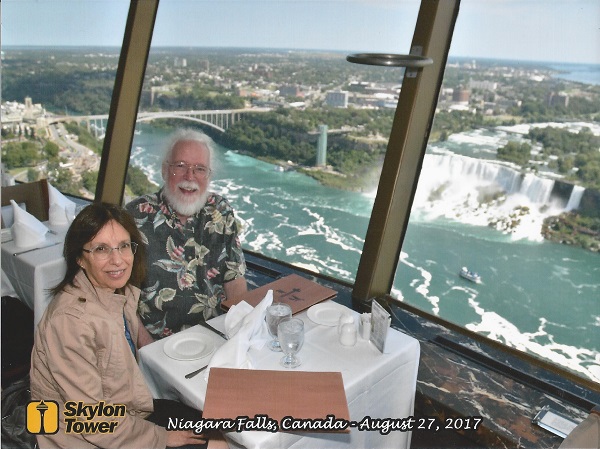
| 26 | Niagara Falls, Ontario, Canada; Locke, New York; Toronto, Ontario; Northampton, Massachusetts | 2017 |
| 27 | Princeton, New Jersey | 2018 |
| 28 | Beautiful, The Carol King Musical, New York City; then Vienna, Austria | 2019 |
| 29 | Princeton, New Jersey; pandemic restrictions | 2020 |
| 30 | New Hope, Pennsylvania | 2021 |
 | ||
| 31 | Los Angeles, California | 2022 |
| 32 | Los Angeles, California | 2023 |
| 33 | Princeton, New Jersey | 2024 |
| 34 | Princeton, New Jersey | 2025 |
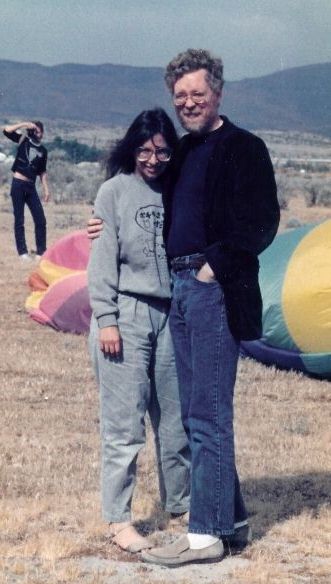
The photo is after a hot air balloon trip on June 22, 1988, outside Lancaster, California. This was on the wedding anniversary of my cousin Cheryl and her hot air balloon flying husband, Dave (so is the balloon hot, or Dave?). Cheryl had met Dave when she got a balloon ride as a birthday present, so for some years they celebrated by taking everyone up. Exactly three years later to the day Jackie and I would get married ourselves. Later Dave got out of the business, I think just because of the cost of insurance in the Workers' Paradise, the People's Republic of California; and we've never been back up.
Our wedding night was at the New Otani Hotel in Los Angeles, with the other destinations those of our honeymoon. We had a Japanese style room, with futons on tatami mats for sleeping, and a Japanese bathroom. We actually were back in that hotel in 2014 for a conference, but it was no longer a New Otani. As a Hilton Double Tree it no longer seemed to have the Japanese rooms, and the absence of Japanese wedding parties was conspicuous. It did not seem like the same place.
The principal destination on our Honeymoon was the Ventana Inn in Big Sur. We worked up our courage to go naked into the heated indoor pool, but when we got there, we were alone. Otherwise, we stopped in Morro Bay, visited friends in Palo Alto, and ended up in San Francisco, where I came down with a sore throat. An emergency room prescribed an antibiotic. On the way back to LA, we stopped for lunch at Anderson's in Buelton, and the split pea soup tasted good and felt good in my healing throat.
Our first anniversay was in the Brown Palace Hotel in Denner, where we would visit friends nearby afterwards. I didn't know that the "Unsinkable" Molly Brown (1867-1932) lived there for some years. We got a large corner room; and for our anniversary they gave us complimentary champagne and strawberries. I returned to the hotel for a night on a drive in December 2009. I arrived after dark and left before dawn; so I didn't see the place in daylight at all on that occasion. I did arrive in Kansas City before dark, ready to visit Arthur Bryant's.
Our 2nd anniversary in 1993 was in Japan, with friends at the Reiganji, a Soto Zen temple in Toyotashi. We awoke there on our anniversary but by the evening were in the Shibuya district of Tokyo, where we had our anniversary dinner of shabu shabu at a restaurant in Ikebukuro. Next to us was a table of Japanese and visiting Russian musicians. The only language they had in common was English, so we were understanding their conversation.
In 1995, for our 4th anniversary we were in Niagara Falls, New York; but on the way we stopped off in Punxsutawney, Pennsylvania -- largely because of the recent Bill Murray movie Groundhog Day. See more about Niagara Falls below.
Our 5th anniversary in 1996, kind of a key celebration, was in Las Vegas, which I had not visited since 1975 -- that was with my first wife, on our epic drive to Texas. Returning with Jackie, I made a reservation at the Sands, where I had stayed with my parents back in the 1950's. I soon learned that the hotel would close a month after our visit. So we were among the last guests at the Sands.  Memorably, we saw Gallagher (1946-2022) and realized that we were lucky not to be sitting close to the stage. The audience there was prepared to be hit with debris from his act.
The Sands would be featured in the climax of the movie Con Air [1997], with an airplane crashing into the casino. After the demolition of the hotel, it would be replaced with the Venetian, where I stayed several times after retiring in 2009. In 2012 I was able to see the act of Joan Rivers (1933-2014), not long before her untimely death.
Our trip to London in 2005 for our 14th anniversary was the first time I had been back there since 1970. They were no longer using shillings and Old pence. Besides many adventures in London, we took side trips to Dover and to Oxford. When I crossed the Channel on a ferry in 1970, I was hoping to see the White Cliffs. However, the ferry put in at Folkstone, not Dover, and it rained so heavily the whole way I couldn't see anything anyway. So we saw the White Cliffs from Dover itself. Up in Dover Castle we ran into another American couple, who were also teachers from California. Scouting out Oxford ended up being valuable reconaissance for when I returned there for Oxford Round Table events in 2006 and 2010, the latter when I read my "Lecture on the Good" at Hertford College. I've even recounted how in 2006 I got us baked beans for breakfast at Harris Manchester College.
Our 2011 anniversary in Montreal was our 20th. I had never liked the popular quiches in the 1970's, which were always rather like heavy blocks of cheese. However, the food in Montreal showed me something different. The quiches there were light and fluffy. Gave me a whole new perspective on this side of French cooking. Altogether an enjoyable experience; but I don't want to try getting into the City across the St. Lawrence River in rush hour traffic again.
A 20th anniversary present is supposed to be china, so I developed a personalized design for some anniversary plates, which is displayed here and in the table. The saying in Chinese is 千里姻緣一線牽, "Those destined to be married to each other, though a thousand lǐ apart, are drawn together by a single thread," has been appropriate to our situation, where we have long been separated by our jobs, both between Los Angeles and Japan (1988-1990) and Los Angeles and Princeton (1990-2013).
The translation is directly from Mathews' Chinese-English Dictionary [Harvard University Press, 1972], where it is actually given for the expression 
 , "the cause which produces effects in a future life (Budd.)" [character 7407:40, p.1109]. On the other hand, the expression
  is defined in Mathews' as "the fate or influence which brings lovers together" [character 7408:5]. The latter looks more appropriate for the translation given to the former. Indeed, the ABC Chinese-English Comprehensive Dictionary [John DeFrancis, Hawai'i, 2003], has a separate entry for the whole saying, using [p.710]. You can also Google the whole saying and get "true love will remain, despite separation of great distances, even if by only a single thread" at Wiktionary. I'm not sure that's the best translation, since 牽 is to "pull" or "drag" together, not just "remain."
Actually, a Chinese mile, the lǐ, 里, is only about half a kilometer. So "a thousand lǐ" is only 500 km, about 300 miles. But Los Angeles to Princeton is more like 2700 miles, 9 times as far. I've flown that many times but have driven it, every mile of it, eight times.
Our history here has a heavenly component. At the time of our actual wedding, there was a triple conjunction of Venus, Mars, and Jupiter. Venus ( ) and Mars (
 ) were, appropriately, very close to transiting.
In the star field at right we see nearby some interesting asteriods (minor planets). There is Parthenópê, Παρθενόπη, which means "virgin face." This may be a reference to Athena Parthenos, Athena the Virgin -- but it was also the name of a Siren who attempted to lure Odysseus, and the original name of Naples, Italy. Terpsichore, Τερψιχόρη, is the Muse of Dance; and it is the title of a set of music by Michael Praetorius (1571-1621).
Hekate, Ἑκάτη, is a goddess we can associate with Artemis and Selene in the three stages of female life. Since both Artemis and Selene are Moon goddesses (Selênê, the name of the lovely Kate Beckinsale in the "Underworld" movies, actually means "Moon"), we see the goddesses at left associated with the phases of the Moon. The diagram is read from right to left, like Hebrew and Arabic, because, facing South at sunset, the waxing Crescent Moon is on the right, in the West, while the waning Crescent Moon, before sunrise, is on the left. Sometimes novelists, and others, writing about the Moon, don't realize that particular phases of the Moon, at particular times of the day,  must be placed in specific locations in the sky.
Although the minor planets were invisible, this conjunction of Venus, Mars, and Jupiter was extraordinarily bright and conspicuous in the sky on our wedding day. We could see them as we came out of our wedding reception at the Sportsmen's Lodge at Ventura and Coldwater in Sherman Oaks.
I did not notice another conspicuous alignment until 2007. When we arrived in Hawai'i on June 20th, there was a row of bright objects in the sky. One of these was simply the star Regulus, the brightest star in the constellation Leo. The others were the planets Venus and Saturn. Regulus, Venus, and Saturn made a bright line in the sky.  By the 21st (the date of the diagram), the moon had moved past them. Mercury was also in the area, but I think it was too close to the horizon for me to notice it.
As noted above, these anniversary trips, like some other trips, have sometimes been associated with recent Hollywood movies. Such an inspiration was behind the trip to Montauk, New York, in 2006. This was because of the movie reviewed at this site, Eternal Sunshine of the Spotless Mind. Here Jackie can be seen at the Montauk train station, featured in the movie. Indeed, the Montauk scenes in the movie were generally filmed in or near Montauk.
I was surprised at the generally poor accommodations for tourists in the area. Travelocity and the AAA only listed two lodgings, the Yacht Club, which was booked, and an old motel, where we stayed.  There were several other motels or hotels in town, but they apparently didn't rate. Our motel was nice enough; but it must have been really nice in the 50's.
As it was, there were good dinner restaurants by the Yacht Harbor, and we enjoyed exploring the area. We had one breakfast in a restaurant featured in Eternal Sunshine and otherwise discovered a local preference for corned beef hash for that meal.
My impression was that while Montauk was indeed a popular tourist destination, it may have mainly attracted people from New York City and Long Island rather than more distant visitors. Indeed, getting through New York City out to Long Island was a bit of a battle. The Hamptons, which we passed on the way, probably handle the higher end trade.
At the time of our visit to Niagara Falls in 1995, I realized that actual views of the Falls were only available to hotels in Canada. The city of Niagara Falls, New York, was all behind the Falls. Finally, in 2013, we returned for three nights in a Canadian hotel, a Marriott in Niagara Falls, now Ontario instead of New York. 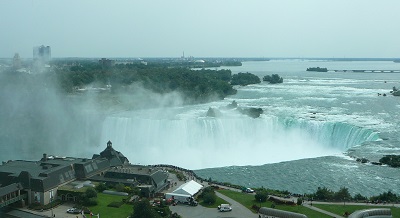 From out our window, we looked right down on the Horseshoe Falls and also had a front row seat for the fireworks that they set off on a couple of the nights.
The Canadian city seemed to be much changed from what we saw in 1995. Victoria Ave is a combination of restaurant row and amusement park. We dined Indian (actually, Pakistani), Korean, Arab (falafel), and Chinese for lunch and dinner, with a more domestic venue (Canadian?) for our anniversary. Otherwise, we would not have been lacking for Italian, Brazilian, Mexican, Japanese, or Steak and Lobster restaurants. But much loud, very loud, music in many of the places, including the "Jimmy Buffet" club, a bizarre transplant from Key West.
One whole block of Victoria Ave was places identified as "halal," including the Pakistani and Arab restaurants where we ate. Having traveled in the Middle East (1969-1970), I never saw any eatery identified as  . I suspect that this is part of the Islamic push-back, as the equal and opposite counterpart of kosher identification -- itself modestly represented by an old synagogue at the west end of the ḥalâl block, next door to "Afghan Kabob."
The ḥalâl eateries went with a conspicuous presence of Muslim tourists, at least in so far as they were distinguished by female dress. I did notice, however, that where we ate at the ḥalâl places, I did not get the indigestion (an increasing concern over the years) that has often gone with Indian food and even sometimes with falafel, in my experience. But then we also had Indian food in Northampton, Massachusetts, the following Tuesday night, in a restaurant conspicuously run by Sikhs (with an image of the Golden Temple of Amritsar on the back wall), and that digested well also.
In 1995, we had walked over to the Canadian side looking for a restaurant for our anniversary and actually were not able to find one -- we ate back in New York. We would have eaten in the Skylon Tower, but it was booked up. This time, when we asked at the concierge desk at the Marriott for reservations, the girl said, "You don't want to eat there." And we didn't. But while I remember Clifton Hill from 1995, which runs from the river up to Victoria Ave., I have a complete blank on what Victoria looked like back then and why we didn't see any inviting restaurants. Has it really changed this much? Perhaps. Back then, I would have been thrilled to eat at any of the Italian restaurants that are there now.
The room at the Marriott had a jacuzzi in the bathtub. Shutters gave a view from the bathroom, 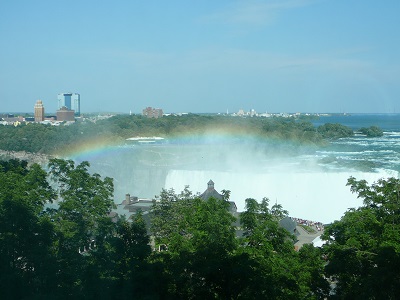 although, unlike the Cosmopolitan in Las Vegas, the tub was not immediately adjacent to the windows. Meanwhile, we drove by the hotel where we had stayed in New York in 1995. It was a closed and melancholy derelict, although still a clearly visible and conspicuous building even from the Canadian side -- evident in the photo at left as the brick building in front of the distant new sky-scraper (which is the Seneca Niagara Casino). It had had a heart-shaped tub in the hotel room, although obviously introduced since the original construction. But housecleaning never removed the spider webs from above our bed. Perhaps that tells the story. I didn't worry about it back then. Now I would have complained. Perhaps this was a sign that the hotel was on its way out, as visitors, like us, come to prefer the Canadian side, which consquently grows in terms of what it offers. Altogether a pleasant stay.
Having moved from Los Angeles to Princeton late in 2013, our first anniversary since then was, of course, a visit back to Los Angeles. This initially involved a couple of nights, for a conference, at the previously metioned Double Tree, formerly the New Otani, in Little Tokyo. The principal part of our Los Angeles stay was then at a Marriott on the beach in Santa Monica, just a couple of blocks from the Santa Monica Pier. Several of our meals, consequently, were on the Pier or nearby in Santa Monica. Otherwise we visited friends and revisited old haunts. These were my first plane flights in a year, confirming me in my preference for driving over flying -- although the plane does get you there fast.
The Marriott gave us a room with the view of the street rather than the beach; but I didn't complain, because it turned out that the view of the beach from anywhere in the hotel was blocked by another building. The Marriott was not on the beach. Now, with Google maps, I take more care to investigate the situation of our hotels.
In 2016, for our 25th anniversary, we traveled to Salem, Massachusetts. The association there, of course, is with the Witch Trials and executions of 1692-1693. 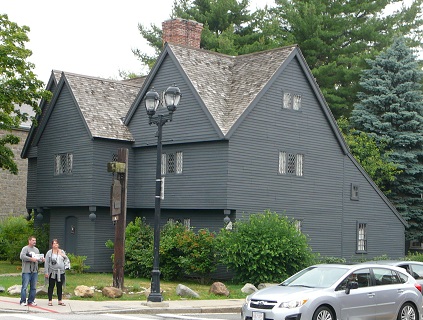 But only one building remains in Salem specifically associated with the Witch Trials, namely the home, shown at right, of Jonathan Corwin (1640-1718), who was a magistrate and judge involved with the trials. This house is now called the "Witch House" even though there never were any accused witches in it.
I also confused it with the house in the H.P. Lovecraft story, "The Dreams in the Witch House," of 1933. It turns out that Lovecraft's "witch house" was in his fictional location of Arkham and had nothing to do with the house in Salem. However, the events in Lovecraft's "witch house" take place in the attic, which in this house in Salem is not open to the public, even though it has windows (as can be seen in the photograph) and was used for sleeping. Even staff at the house had not been up to the attic. Thus, we are free to suspect that this is Lovecraft's "witch house," and that the attic is closed for the obvious, paranormal reasons. I half expected to see faces in the attic windows.
While little remains in Salem directly tied to the Witch Trials, part of the fortune of the modern city is tied, not just to the trials, but to witchcraft itself. Thus, the irony of the Witch Trials is that, while they were notoriously based on the supposed existence of non-existent witches, the city now boasts a great many self-proclaimed witches and multiple stores providing materials for witchcraft. In the middle of town there is a handsome bronze statue of Elizabeth Montgomery (1933-1995), star of the television series Bewitched [1964-1972], who played, of course, a witch. The 17th century Puritans would have been astonished.
There is a kind of schizophrenia at work in this, where one must simultaneously deny that there were witches at all but then affirm that there are indeed witches, which means that there must have also been some at the time. Lovecraft, of course, took it for granted, not only that there were witches, but that they did many of the things that the witches were accused of doing. The schizophrenia extends further, since the Witch Trials leave us with the idea of a "witch hunt," which is the pursuit of people for non-existent offenses.
When this was applied to the investigation of Communists, as by Joseph McCarthy, however, it was with the twist that the offenses -- that there were Soviet spies and Communists in the government and elsewhere -- which in a true "witch hunt" cannot have existed, in fact really did exist: The political imputation of the apologists, entirely Democrats, was that there weren't spies or Communists -- or that, like Elizabeth Montgomery's character -- they were only well meaning and innocent liberals.
But this was all entirely fraudulent. Democrats knew as well as anyone that there had been Soviet spies and Communists in the government; and some of the Democrats, like John F. Kennedy, were themselves serious anti-Communists (as John's brother Robert had actually been on McCarthy's staff). And Communist martyrs, like Alger Hiss and the Rosenbergs, had been prosecuted under Democrat Harry Truman -- which means that later Soviet apolgists, such as media Mogul Ted Turner, who (still) see the Cold War as imposed by capitalism on the innocent and well-meaning Soviets, view Truman as flawed, deceived, or naive.
Mercifully, I did not see Joseph McCarthy mentioned in Salem. But the play, The Crucible [1953], by Arthur Miller (1915-2005), was inevitably mentioned, since it is a dramatization of the Witch Trials. However, Miller's play was clearly written to imply that investigating Communists was a "witch hunt," and Miller himself was a sympathizer and apologist, if not for Soviet agents and Communists, but certainly for the Democrat narrative that sought to avoid blame for tolerating their existence, with the added motivation of anti-capitalist sentiments (evident in Death of a Salesman [1949]). None of this is a dead letter today, since the whole "witch hunt" narrative is revived to condemn suspicion that Muslims may be Terrorists. The careless admission to the United States of thousands of Syrian refugees, despite the certainty of the presence of Terrorist infiltrators, turns on the refusal of a Democrat President to exercise common sense, prudence, and caution about the matter.
Thus, Salem occasions reflections on a number of perennial and contemporary issues.
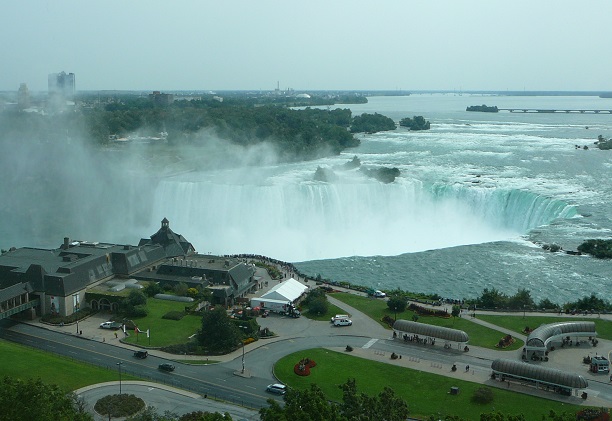 In 2017 we returned to Niagara Falls again, with a higher room at the Marriott and so a better view of the falls, as at left (and above). More hotels and restaurants were in evidence, with some curious developments. Steak houses have run rampant. The Pakistani restaurant where we ate in 2013 has disappeared, but there seem to be new Indian restaurants, and quite a few new Indian tourists. The Korean restaurant where we had eaten on Victoria Ave. was gone; but a new one, the Young Garden, was on Stanley Ave., not far from our hotel. It was large, busy, and had service call buttons at all the tables. The only Japanese restaurant nearby was one we had seen in 2013, Yukiguni ("Snow Country") on Fallsview Blvd. Fewer steakhouses would have been more to my taste. A little more variety on Victoria Ave. would have been nice, but there is still plenty to choose from.
 We happened to return to Niagara Falls so soon because Jackie had a conference in Toronto, where we spent six nights. Getting to Toronto turned out to be difficult, with traffic on the QEW freeway absurdly dense on a Sunday afternoon -- it was only slightly better when we were leaving. I spent my time investigating the city, including the Royal Ontario Museum, the CN Tower, and even attending a Toronto Blue Jays baseball game. I wanted to fit in, so I bought a Blue Jays cap and sweat shirt -- it was a little cool that night -- at hideous expense.
Although I had been in Toronto once before, I had not been up the CN Tower. The elevator ride and altitude gave me a touch of seasickness. I was a little puzzled by the name, the "Canadian National" Tower. Really? As it happened, we learned a lot about this talking to a waiter at our breakfast restaurant (Over Easy on Bloor Street). The tower is actually named after the Canadian National Railway, which had owned the land and built the tower, adjacent to Union Station. Since the CNR wasn't created until after World War I, the Toronto station and works were originally owned by the Toronto Terminals Railway (TTR). The waiter said that a relative of his, who had worked for the CNR, was given a lifetime pass to the Tower. He never used it until long after the CNR connection had ceased, but the new management did honor the pass. The old roundhouse nearby, which was used until 1986, survives and is occupied by a railroad museum, a restaurant, and a brewery, of all things. Wandering around at these sites, with the Blue Jays stadium, the Rogers Centre (previously "SkyDome"), next door suggested attending a game. I had not been at a baseball game since seeing the Dodgers in 1980. The Jays lost, but it was a good game and the fans didn't lose heart until after the 8th inning.
Our options for our anniversaries in 2020 and 2021 were limited by the Covid lockdowns and by our reluctance to travel under the circumstances. Thus, our significant 30th anniversary dinner in 2021 was in a restaurant on the Delaware River in New Hope, Pennsylvania. It was a lovely site, although it managed to rain heavily during our entire meal. It seemed like a sign of the times.
 In 2022, we returned to Los Angeles. For me, this was the first time since 2014. Jackie had been there in the meantime. While she attended a conference at UCLA, I drove around catching up on things. Breakfast at Canter's Deli was followed by breakfast the next day at the Du-par's in the Farmers Market, which we see at right.
I had rarely eaten at the Farmers Market Du-par's (opened in 1938), in preference to the one in Studio City (opened in 1948), which, however, closed in 2017. At Canter's, I chatted up the waiter about my experience with the now closed Carnegie Deli in New York.
For our anniversary celebration, we returned to where we actually met. At the time, that was Tampico Tilly's restaurant, 1025 Wilshire Blvd., in Santa Monica. Tilly's later closed, but it reopened as a branch of another Mexican restaurant, El Cholo, where we have now eaten a couple of times. A new entrance was opened directly into the bar, and the old entrance room, where we actually met, is a banquet room, although open to the rest of the restaurant.  We thought about eating at the Moonshadow's, along Pacific Coast Highway, but we had already driven out to Malibu that day, and I didn't want to repeat the drive. It was more appropriate to eat at what had been Tilly's anyway.
Speaking of Mexican restaurants, which, living in New Jersey, is a source of some frustration, friends took me to El Coyote Cafe, 7312 Beverly Blvd. I had wanted to go to Lucy's El Adobe Cafe, 5536 Melrose Ave, where Jerry Brown met singer Linda Ronstadt, but my friends informed me that it was closed, after a dispute between the heirs of the original owners. But El Coyote is good, and the menu seemed more varied than what we later found at El Cholo.
We also ate at an Indian restaurant in Los Angeles, India's Tandoori, 5468 Wilshire Blvd. My original discovery, with my friend Jill, who had lived in India, was India's Oven, whose first location, at Pico and Fairfax, was burned down in the 1992 LA riots. It reopened on Wilshire in West Los Angeles. I see a restaurant there now, listed as "Sham's India's Oven," and there is an "India's Oven" listed in Westwood; but I don't know how much these have to do with the original India's Oven. My understanding was that the "India's Tandoori" restaurants, three of them, broke away from the original India's Oven, but I can't find information about that now. I can't determine if the former India's Oven in Tarzana has been succeeded by another such restaurant -- although there is an Indian restaurant in that shopping center, but it is not in the same space where India's Oven was. In any case, the India's Tandoori where we ate was very good, and waiter was friendly and solicitous. He seemed to be impressed that we knew what we wanted to order and asked if we had been to India. I could have told him that a fair amount of India seems to have moved to New Jersey.
So, this was a memorable anniversary for us in Los Angeles, many of whose current evils we seem to have avoided.
We returned to Los Angeles in 2023 and celebrated our anniversary there again, and again at El Cholo in Santa Monica. A memorable moment was when we took Jackie's colleague, Lucia Dolce (who is from Sicily but now teaches at the School for Oriental and African Studies, SOAS, in London), to Norm's Restaurant on La Cienega Blvd. and Rosewood Ave. Coffee shops like Norm's have been closing around LA, and I wanted her to see one just like what was in Pulp Fiction [1994]. It was great fun, and I drove her around the neighborhood a bit, and on the Sunset Strip.
In both 2022 and 2023 we were in LA in the first place to attend retirement functions of a couple of Jackie's colleagues at UCLA.  Because of that, part of our stay was at the UCLA Guest House, which is a little hotel right on the University Campus. After that, in 2023, I moved us over to the Sheraton Universal hotel, in Universal City, becuase I had always been curious to stay there, after attending several functions, including high school reunions, there. The photo is looking out from our hotel room, towards the Verdugo Mountains, with Mt. Lukens of the San Gabriels peeking up from behind. See discussion of this in relation to the San Fernando Valley.
While in 2022 I had eaten alone at Dupar's in the Farmer's Market, and at Canter's Deli on Fairfax, in 2023 I had Jackie along. Unfortunately, Dupar's was crowded and the service was bad. Canter's was also crowded but otherwise went well, and we had my friend Jill Cogen along. Much enjoyed our lunch.
After all our travelling in 2023, including Japan, our anniversary in 2024 was at home in Princeton. Nevertheless, 33 years seems like a particular landmark. Marriages in Hollywood don't last that long.
As the old man got up to leave, I realized that he would be walking right by our table, so as he approached I got up and asked if he was Robert Easton. He was. In the face of fulsome praise and admiration, he sat down to talk to us for a while. It was great fun. Since I have a smattering of a lot of languages, from French and German to Arabic and Persian, and my wife speaks Japanese and Spanish, with an academic's knowledge of some other languages, like French, we actually had a lot to talk about with Mr. Easton. I hope he enjoyed it. He did stick around with us for a little while.
The last movie I remembered seeing Easton in was The Beverly Hillbillies [1993] with Jim Varney (1949-2000) -- where his long hair and beard gave him a sort of Ozarks look, although Easton was actually born in Milwaukee. Easton told us something that I did not know, that he was the dialect coach for The Last King of Scotland [2006], with Forest Whitaker (memorable in Ghost Dog [1999]) as Idi Amin. I was impressed that Easton had studied the languages in Uganda enough that he could coach Whitaker in his accent. He said that during the filming Whitaker would call him up from Uganda in character as Idi Amin to discuss the pronunciation of his lines.
My own abilities with accents are limited. I admire a couple of friends who've studied Hindi and Gujarati and can do marvelous Indian accents in English. The only person I have known like Easton, however, was my Persian professor at UCLA, Donald Stilo (most recently at the Max Planck Institute). Stilo had much broader knowledge and interests in linguistics than just Persian. And he could speak Persian the way an Armenian, Eastern or Western, would, or, for that matter, the way a Texan would. This had almost gotten him in some trouble when, speaking Russian and knowing how Bulgarian differed, he gave the impression of speaking Bulgarian while traveling to Istanbul through Bulgaria. In the days of the Cold War, this made the Bulgarians suspicious, especially when he got left by the train at a station, without his passport. Fortunately, his wife was able to rescue him with the document. My favorite story, however, Stilo's Persian class was about the most fun I ever had in a language class, although it used to annoy him when we came back from our break with things like chili-dogs from the Gypsy Wagon (which used to be the food service on the North Campus of UCLA). On the other hand, he would invite the class to his home, where he cooked for us in the tradition of his New Jersey Italian upbringing (Stilo is a historic city in Calabria). I am still sensible of his cooking, and have often spent years tracking down the favored pasta, fusilli lunghi bucati, that he used. Philosophy of Science, Linguistics
I had a dream not long ago (November 2019). During the day I had been thinking something about the Jane Whitefield books by Thomas Perry. Jane gives people in trouble new identities and places them in new lives, so that they can escape from trouble, which one of the books defines as, "not the kind of trouble where the police bring you into court, but the kind of trouble where the police find your head in a dumpster." She thinks of herself as a "guide" ( We hear about names, not in Thomas Perry, but in the Navajo Tribal Police stories by Tony Hillerman (1925-2008) and now continued by his daughter Anne Hillerman. A major character is Sergeant Jim Chee, who turns down opportunities for romantic involvement, and for law enforcement jobs, like at the FBI, if they mean moving away from the Navajo Reservation in Arizona and New Mexico. Chee seeks to juggle his responsibilities in the modern world of the Tribal Police with a vocation as a Hatááłii, a Singer or "medicine man," who performs the Chants or Sings that are the principal public rituals of Navajo religion -- which usually go on for days and involve elaborate sand paintings and other details. These rituals are purchased by individual families, for the benefit of one of their members, and are performed at the family's own hogan; but anyone is invited to attend, and all are fed -- no small thing on the Colorado Plateau. There are no public shrines or temples for such rituals.
Chee is being taught Chants by his maternal uncle, Hosteen Frank Sam Nakai, a respected Singer himself. Whether Chee can complete the training, especially before (or after) his uncle's death from cancer, remains a problem. Nakai has given Chee his secret, true name, only for relatives and religion, "Long Thinker." Although I learned some about Navajo religion as an Anthropology student at the University of New Mexico, in 1967-1968, which is certainly one of the places to go for that purpose, most of what I think I know now, I'm afraid, is from Tony Hillerman's books, which I only began reading years later in Austin.
The Navajo Conception of Hózhǫ́
The most elalborate treatment of secret names is an entirely fictional one, in Ursula LeGuin's "Earthsea" books, where everything has a "true" name, which enables wizards to do magic. A person's true name, therefore, must be carefully guarded.
The name "Far Walker" would be a good name for me. I've done a lot of walking over the years. In High School, I walked over the Santa Monica Mountains from Van Nuys to Beverly Hills, down Wilshire Blvd. to Westwood, and then back to the Valley. It looks like the walk to Beverly Hills would have been about 12 miles. So the whole walk added up to a good bit, although I know people who run 30 miles for sport. I also did the same trip by bicycle, although descending Beverly Glen on my bike, at 40 mph or so (I had a speedometer), with no helmet or anything in those days, was a bit scary.
As a Freshman at the University of New Mexico in Albuquerque, I didn't go anywhere, on my own, without walking. One of the walks was out to the East end of town, which was about 8 miles. Today it is hard to tell what was out there in 1967, since the city has grown and all the streets and buildings at the East end have changed. But the last street then was already up on the side of the Sandia Mountains, so the city actually hasn't grown any further East. But the area is irrecognizable.
Subsequently, I would walk around Paris, Beirut, Cairo, Damascus, Amman, Aleppo, Palmyra, Petra, Antioch, Smyrna, Ephesus, Athens, Mycenae, Olympia, Rome, Paris again, London, Honolulu, San Francisco, Washington D.C., Denver, Salt Lake City, New Orleans, Boston, Chicago, etc. Some of these places, like Aleppo, Hama, and parts of Beirut, have subsequently been blown to bits in warfare. And, of course, Palmyra has been vandalized by the savages of ISIS. I've visited other places, like Aqaba, Houston, Dallas, Kansas City, Atlanta, etc., but without a lot of walking.
Back in London with my wife for our 14th wedding anniversary in 2005, we walked from Tafalgar Square, where our hotel was, all the way to the Tower of London. Then we decided to figure out how to take the subway back, which we did. Meanwhile, since my wife visits Japan a lot, I have been with her there and done a lot of walking around Tokyo, Kyoto, Izu, Himeji, Hakata, and other sites. She's a walker too, and we've done long walks in New York City, like from the Metropolitan Museum down to Chinatown, although these days my walks there are usually no more than from breakfast on 44th Street up to the MET or the American Museum of Natural History.
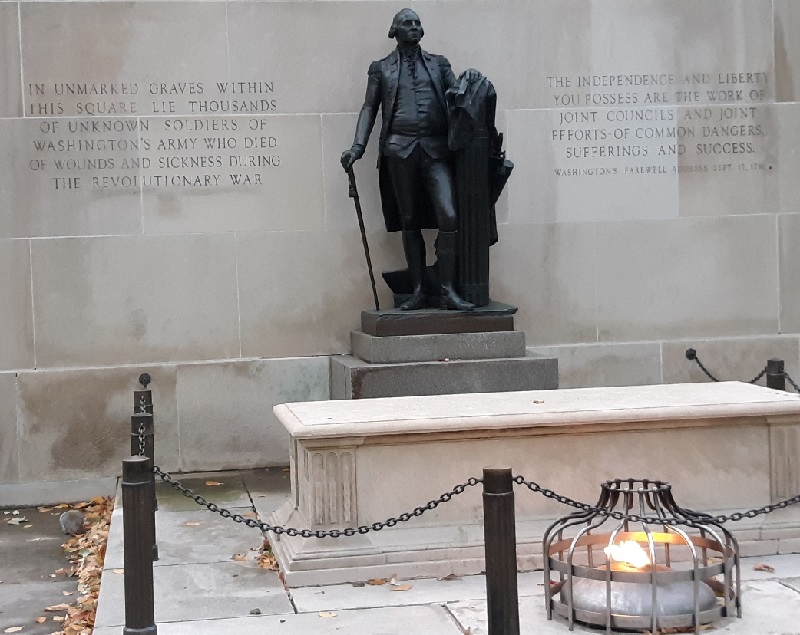
Since 2013 I've also done a fair amount of walking in Philadelphia. The subways don't go near the Philadelphia Museum of Art, so I end up walking from the 30th Street Station, down 32nd and 31st Streets, over a bridge on Spring Garden Street, to the museum. Walking back into town on the Benjamin Franklin Parkway, there are other museums to visit -- the Rodin Museum, the Barnes Foundation, and the Franklin Institute science museum.
Meeting Robert Easton
 In June 2007, my wife and I were getting ready in LA for a trip to Hawai'i for our 16th wedding anniversary. We were having breakfast at (the late) Jerry's Deli in Studio City when I noticed an old man with long white hair and beard sitting further back in the restaurant. After a while, I began to suspect that this was the actor and dialect coach Robert Easton (1930-2011), who I used to see years ago on the Tonight Show, talking to Johnny Carson about accents and dialects.
 was the Texan Stilo saw walking up the street towards his apartment house in Tehran, identifiable by full cowboy hat and boots, and then by the Texas accent with which he made inquiries at the building. As it happened, the fellow spoke fluent Persian, "but without a single concession to Persian phonology," as Stilo put it. I can do a little bit of that myself.
ὁ Τηλεπατητικός
 ). Jane's mother was Irish but her father was a Seneca Indian, and she was raised as such, speaking Seneca and looking not at all Irish, except for blue eyes. She lives in the fictional town of Deganawida, New York, which seems to be located about where Tonawanda, New York, actually is, across from Grand Island in the Niagara River. Thomas Perry himself was born in Tonawanda. Perry has been living in Los Angeles, and many of his stories now involve the San Fernando Valley, where I grew up. Instead of the "Hollywood detective," like Phillip Marlowe, Perry introduces the "Studio City detective." A recent book, The Bomb Maker [2018], has an early scene at the corner of Moorpark Street and Laurel Canyon Blvd, a location very familiar to me. We share dismay at the closing, on January 1, 2018, of the iconic Du-Par's resaurant on Ventura Blvd. nearby. It had opened in 1948.
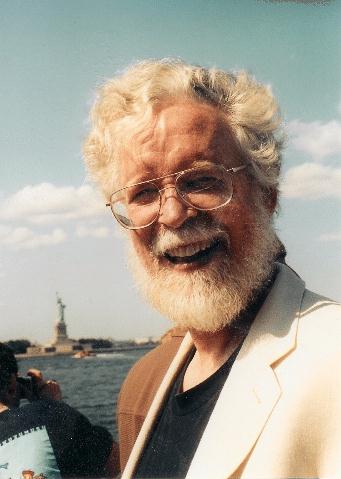 In any case, after thinking about Jane Whitefield during the day, I dreamed about Indians that night. I have no idea what most of the dream was about, since I've forgotten it; but I did retain the memory of one thing. A name. My name. This was "Far Walker."

 |
|---|
| Monument to Unknown Revolutionary War Soldiers, Washington Square, Philadelphia, 2019 |
There are some other museums I haven't gotten to yet, but I have visited the very creepy Eastern State Penitentiary. Centrally located is the Reading Terminal Market, whose opportunities for lunch are almost unlimited, but not so much for breakfast and, closing at 6 PM, not suitable for dinner. I never fail to note the corner of Market and 2nd Street, where Franklin tested how far away he could plainly hear the evangelist George Whitefield. I've also been to where Franklin lived in London, which is his only residence that has been preserved.
I don't go walking just for the sake of walking; and in Los Angeles and New Jersey, for exercise I tend to bike rather than walk -- with a marvelous bikeway on the Towpath of the Delaware-Raritan Canal, running from Trenton to the Raritan River, and even down to New Brunswick. Unfortunately, the pleasant biking days are far fewer in New Jersey than in Los Angeles, and the Towpath can be muddy after a rain. In Los Angeles, the city turned a railroad right-of-way into a dedicated bus lane, with a paved bike path along it.
I would ride on this bike path from where it is adjacent to Valley College all the way out to Reseda or Canoga Park. I would also use the bus lane to ride busses to the new "Red Line" subway station in North Hollywood. My last year in Los Angeles I used that to begin walks around in Downtown LA and in Hollywood, including the occasional breakfast at the venerable Original Pantry Cafe (since 1924). There used to be more to attract me to Hollywood in the old days of the Pickwick Bookshop on Hollywood Blvd. Now long gone (1931-1995).
So I do think I have Walked Far, and whatever it is that generates dreams seems to have taken note of it, putting a name in the form, from stereotypes, of something like an American Indian name. Well, I own Seneca, Navajo, and Cherokee grammars, but I have not yet gained any sense of the form and use of those languages; so for me the name will need to be in Greek. Classical Greek for "far" is τῆλε and "to walk" is πατέω, from πάτος, "trodden or beaten way, path."
In usage, however, "walk" seems to get modified, as we see in the important Biblical verse, 2 Corinthians 5:7:
Here πατέω has acquired as a prefix the preposition, περί, "round about, all around," giving us the verb περιπατέω, "to walk up and down, to walk about," and the noun περίπατος, "a walking about, walking," or "promenade," as we see it used in the Apology. Another Biblical use of περιπατέω is at John 8:12. The adjective of this, περιπατητικός, becomes a famous word, as the name of the members of the School of Aristotle, Περιπατητικοί, the Peripatetics, those who "walk around" as Aristotle was lecturing at the Lyceum. We also have the great Australian Aborigine expression, and book [1959, by Donald Payne (1924-2018)], and movie title, and movie [1971, by Nicolas Roeg (1928-2018)] Walkabout.
The transition of the verb περιπατέω from "walk around" to just "walk" results in the Modern Greek word for "walk," which is just περπατώ, losing a couple of vowels (although the Attic contract verb would already have been περιπατῶ). For my purposes, however, we can backtrack a bit. All we need is for πατέω to acquire a different prefix, not a preposition, but in this case an adverb, namely τῆλε, which is already very familiar from words like "telegraph," "telephone," and "television" (which, mixing Greek and Latin roots, alarms Classicists). So we get the verb τηλεπατέω, "to walk far," and the adjective τηλεπατητικός. This becomes the name "Far Walker," Τηλεπατητικός, Latinized to Telepateticus [note].
διὰ πίστεως γὰρ περιπατοῦμεν, οὐ διὰ εἴδους.
per fidem enim ambulamus et non per speciem.
For we walk by faith, not by sight.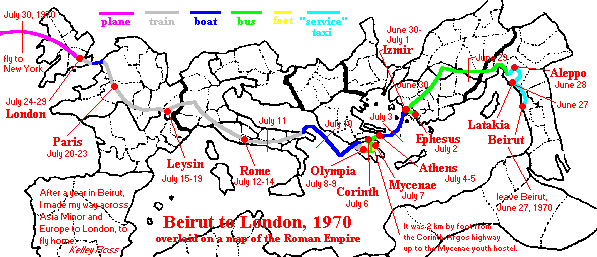
 |
|---|
| Der Wanderer über dem Nebelmeer, "ὁ Τηλεπατητικὸς above the Sea of Fog," 1818, by Caspar David Friedrich (1774–1840), Hamburger Kunsthalle |
At one point in advising me on my dissertation, my chairman, Doug Browning, exclaimed to someone nearby, "This guy believes in negative transcendence!" Indeed, one has walked far in terms of recent philosophy to have anything to do with metaphysics; and "far out" would probably be a response to expect to my current confession of Platonism. So "far" can be truly the far reaches of philosophy. Indeed, I always have felt that I was looking from a great distance to the mainsteam of academic philosophy, perhaps even from outer darkness towards some sort of bright carnival. But then I read what academic philosophers write, and I think better of my situation. Carnivals have clowns.
Of the pseudonyms or pen names I've used at this site, like Enklinobarangus (Ἐγκλινοβάραγγος) or, previously, Aegyptophilus (Αἰγυπτόφιλος), this is the one that begins with a particular and fitting reference to me. Thanks to whatever curious power it is that generates those dreams. Figuring that out is perhaps a job for Carl Jung.
We see another Greek word for "walk" in some Biblical texts. More than once, we are told, as at Deuteronomy 11:22, πορεύεσθαι ἐν πάσαις ταῖς ὁδοῖς, "to walk in all the ways," of the LORD.
The word there for "walk" is from the verb πορεύω, poreúō, which actually means "to carry, convey." To get "walk" or "traverse" we need it in the middle/passive voice, which is πορεύομαι, poreúomai. In the text we see the middle/passive infinitive, πορεύεσθαι, poreúesthai, "to walk."
A drawback for my purpose here is that πορεύομαι does not seem to have an adjective or verbal noun that could be used just to mean "walker." A participle could be used, πορευόμενος, poreuómenos, "walking"; but my objection there is that it would look too much like a passive, and in fact could mean "being carried." That's a little too ambiguous and headed off in the wrong direction. So I think Τηλεπατητικός will do just fine.
Another word I think of is French flâneur (feminine flâneuse), which means "stroller." This is certainly walking, but it is more a casual walking about, and it can also mean "loafing" or "lounging." That's not quite the right idea, since a "Far Walker" would seem to be going someplace definite and not just wandering around, as one might on the boulevards of Paris -- as a boulevarier. So I'll stick to the Greek form.
I was introduced to the restaurant as a child in the 1950's. My parents began eating there when they visited San Francisco. I never learned how they heard about the place. It always struck me as strange and magical. Strange because I didn't know anything about German food. I did like the Sauerbraten and really liked the potato pancakes. But the place was magical because, plastered on the mountainside and decorated like a Swiss chalet, it was just a very fun building and location.
At the time, dining out well in San Francisco meant dressing up. So I was always in my little pre-teen suit and tie. One of the few times I can even remember wearing such things as a child. I did love the old cufflinks and the pin through the collar. But I might add my own touches. In the '50's people didn't worry much about toy guns, even very realistic ones. One of my favorites was a snub-nose .38, such as used to be commonly carried by police. This toy gun was not only realistic, but it what it actually carried were little plastic bullets snapped into spring loaded cartridges. With a round cap on the end, the gun could thus shoot the plastic bullets with a cap pistol bang. I could carry it in a shoulder holster under my suit. This toy now strikes me as rather dangerous. Indeed, at the time I was reluctant to shoot it, especially at playmates, since I was concerned about the damage that flying plastic bullets might do ("You could put out an eye," was a common caution from parents in the old days) -- or just that the bullets might get lost. Now, of course, even a child carrying anything looking like a realistic gun would immediately throw everyone into a panic. The police would be called. It is certainly a shame that such fears and reactions reflect the experience with real shootings. There was nothing like that to worry about in my childhood. As an adult, I discovered a particularly appealing feature of The Shadows. On the third floor, there was a bar set under the large east window. This meant that you could sit at the bar and look out the window onto San Francisco Bay, The last time I ate at the old Shadows might have been about 1982. Then some years went by before I had occasion to return to the restaurant. The occasion came, happily, on my honeymoon in 1991. The Shadows was still in business, but when I eagerly made a reservation for my wife and myself, I was in for a rude surprise. The building was outwardly the same, but when we entered, the decor was radically different. Pink. Not very German. Indeed, the Swiss Chalet, and the German cuisine, was gone. So was the third floor bar. We did eat on the third floor, but it had simply been converted into extra dining. On some kind of Nouvelle Cuisine. I asked the waiter what had happened. He said that the old owners (internet sources say Carl and Mariza Rebmann) had died and that their son had a "dream" about how to update the restaurant. Not a dream, a nightmare. I am now alerted that The Shadows building has indeed been converted into a residence. The views of the Bay will now belong to some rich person, probably the sort of Ruling Class socialist who has taken over San Francisco, and California.
Over the years, I've noticed a wide range of treatment in hotel accommodations for reading in bed. At first, all one could expect would be lamps on bedside tables. Usually, but not always, there would be a table on each side of the bed. This was not very good light, but I had often (in my youth) put up with or gotten by with nothing better in my own homes and apartments. Sometimes I would encounter hotels or motels that were saving money by using really dim bulbs. These could be low wattage bulbs, or they could be bulbs that were rated high wattage but were designed to be dim in order to be long lasting, thereby saving the hotel money. This sort of thing was easily remedied by buying, or even bringing, more appropriate light bulbs. Usually the shades of the bedside lamps could be tilted to project light more directly towards the bed, but sometimes they were too tight or too loose (as when they are not screwed in place) for this to be done.
It was therefore a revelation in 2004 to go into a room in the Hilton in Atlantic City and find, not only bedside lamps, but spotlights in the ceiling, directly over the bed, that were separately controlled reading lights. This was an astonishing revelation, and I am still perplexed by it. Hotels in gambling cities don't want you hanging out in your room. They want you out losing money. Excellent provisions for reading in bed are not conducive to spending more time in the casino. Nevertheless, I have found the same thing in Las Vegas hotels, the Venetian and the Bellagio, both with special ceiling lights for reading.
Aside from this, my experience has been uneven. In London, I've had two hotels with reading lights in the ceiling, but they were not always properly adjusted to shine appropriately at the top of the bed. In New York, the Hilton on 6th Avenue had the interesting device of wall lights that contained separate reading lamps. I hope something of the sort catches on. Most interesting was the Marriott in Waikiki, which had a small reading light on a metal snake and so could be turned and aimed as desired and was so focused that one could read while one's partner could sleep in virtually complete darkness. At the same time, the Hyatt in Waikiki had no reading lights, and sometimes the rooms were designed with only the poorest of bedside lighting. Certainly, Hawaiian hotels may expect guests to be lying on the beach rather than reading in bed; but, unlike the gambling cities, it is not necessarily in their positive self-interest to get guests out of their rooms.
Recently, I've seen some interesting contrasts. The Best Western Gettysburg (Pennsylvania) Hotel only had bedside lamps, but they both had bright bulbs and easily directed shades. This contrasted with the Double Tree by Hilton in Charlottesville, Virginia, which, with dim bulbs and loose shades, made only the poorest provision for reading. I had to ask the hotel to change the light bulbs, but they were not able to provide anything truly appropriate. Our final stop on this particular trip was a Hampton Inn in Williamsburg, Virginia, which had wall lights between two beds, leaving the far side of each bed with no light whatsoever. Perhaps they expected couples to be sleeping in separate beds -- a totally unwarranted assumption on which to design the lighting of a hotel room.
In 2013, the Marriott in Niagara Falls, Ontario, had bedside lamps, one with a dim bulb, and both with loose shades. I realized that the shades could be tipped by the simple expedient of pushing the lamps up against the headboard. Returning to the New York Hilton on 6th Avenue, the bed had lights on the kind of metal snakes that I had otherwise only found in the Marriott on Waikiki. If that is the trend, it is to be encouraged.
It therefore seems to be largely a matter of chance how well a hotel or motel is going to accommodate people who read in bed. This should be something listed by websites and travel agencies among the services and benefits provided by hotels. Of course, to the extent that people may come to read mainly from things like iPads, perhaps the provision of appropriate lights will become moot.
On several visits to Manhattan the last few years, my wife and I began to come across a Bolivian band playing on the street. We liked the music a lot, and they were selling CD's of their albums. The group called itself Ch'uwa Yacu Bolivia and this is a clip from a song, "Muchacha de Ojos Tristes", from the first CD we bought, Clear Water, Volume IV.
The second time we saw them it was on a Sunday, and they were on 6th Avenue right by 49th Steet. There weren't many people around, and they looked a little forlorn. Last year however, August 2003, we found them on a busier day on 7th Avenue, just above 49th Street again. They had a larger and flashier operation, drawing large crowds. Although they had made (and were selling) a number of CD's beyond their Volume IV, they were actually, when we were there, playing the music from that album.
This year [2004], we found them on Saturday, August 21, playing right in Times Square. They seemed to be moving up in the world and were selling Volume VIII. They seem to have adopted an environmentalist theme -- Vol. VIII is called "Save Our Planet," and I do hope that they are not sending money to something like the Sendaro Luminoso; but it is marvelous music.
More recently, we had not been noticing this band, or any others, in Manhattan. Nevertheless, in the 12th season of South Park (2008) on Comedy Central, they had a two part episode involving "Peruvian flute bands" ("Pandemic," 22 October 2008, and "Pandemic 2: The Startling," 29 October 2008). The premise was that these were performing all over the country. If so, I was really not aware of it. Ch'uwa Yacu Bolivia is the only band we ever saw.
The Shadows
 There used to be an excellent German restaurant on Telegraph Hill in San Francisco. This was "The Shadows," which supposedly referred to the shadows of artists' models on the window shades of the studios on the Hill. I don't know if there ever have been many artists working on Telegraph Hill in my lifetime, but the restaurant dated back to 1932. Internet sources say that in the 1920's it was a "Bohemian" area that local artists wanted to turn into a San Francisco version of Montmarte. Today it is very upscale houses.
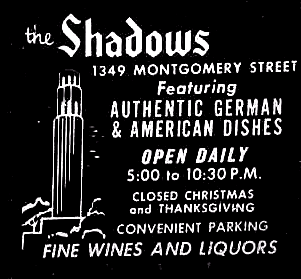 After I grew up and ceased visiting San Francisco with my parents, I began, of course, visiting on my own. The Shadows was still there, and I began going back, with different friends or dates. I ate there several times during the 1970's. Parking had always been a problem at its location, 1349 Montgomery Street. I remember my father trying to get there on what must have been our first visit. Streets that on the maps looked like they might go through, like Montgomery itself, actually dead-ended at steep cliffs on the hillside. So my father, figuring that you just drive up Montgomery Street to get to a Montgomery address, found himself stopped short. The only way to get there was by way of Union Street. I might not have remembered the occasion without that misadventure. But I do remember my parents actually parking in the neighborhood. In 1970, I could still park in the neighborhood (in my 1959 Triumph TR3). Later in the '70's, however, the neighbors were objecting to this. On one occasion, we were directed to park in a parking structure down the hill, with a shuttle going up to the restaurant. Later, there were simply valets who took the cars, as valets usually do, at the front of the restaurant. I have no idea where they then put the cars.
) with the Bay Bridge prominent to the right. This made the place like a particularly intimate Top of the Mark. I just loved it. Also, although I knew that there were steps going up the Hill next to the restaurant, I don't think I had ever actually gone up them until I was there with a woman I had meet in Beirut (and who turned out to be from South San Francisco). So on this occasion we walked up to Coit Tower and looked out over the City lights. On a current map, I now see that the steps next to The Shadows are apparently called the "Filbert Steps," since they continue the route of Filbert Street. Towards the end of Montgomery are the Greenwich Steps, which also go up to the summit.
with the Bay Bridge prominent to the right. This made the place like a particularly intimate Top of the Mark. I just loved it. Also, although I knew that there were steps going up the Hill next to the restaurant, I don't think I had ever actually gone up them until I was there with a woman I had meet in Beirut (and who turned out to be from South San Francisco). So on this occasion we walked up to Coit Tower and looked out over the City lights. On a current map, I now see that the steps next to The Shadows are apparently called the "Filbert Steps," since they continue the route of Filbert Street. Towards the end of Montgomery are the Greenwich Steps, which also go up to the summit.
 I've been back to San Francisco a number of times since 1991. For years I didn't even bother checking on what had happened to The Shadows. Then my wife and I were in town for a day on April 27th in 2008. We drove up to Coit Tower. While there, I thought about walking down the Hill to see what had happened to the restaurant. Evidently not a happy story. It was closed. Its final incarnation had not even been as The Shadows, since the name on the building was the D'Alla Torre, an Italian restaurant. That does sound a little more like San Francisco, but it was not a success anyway. There seemed to be some work going on to the building, so there is no telling what will happen next. The place could easily be turned into a residence, like most of the rest of the neighborhood. We shall see. But The old Shadows is long gone, and with it some of the magic of my childhood. I would now include it among the closed restaurants that I now call "Fallen Heroes."
Hotel Room Reading Lights
Ch'uwa Yacu Bolivia
Copyright (c) 2004, 2005, 2007, 2008, 2009, 2010, 2011, 2012, 2013, 2014, 2015, 2016, 2017, 2018, 2019, 2020, 2021, 2022, 2023, 2024, 2025 Kelley L. Ross, Ph.D., Postumus Friesianorum, All Rights Reserved

)
)