
| 3. KINGS OF ARMENIA | |
|---|---|
| Orontids | |
| Orontes/Ervand I | Satrap, 401-344 |
| Codomannus/ Darius III | Satrap, 344-336 |
| King of Persia, 336-330 | |
| Orontes/Ervand II | 336-331 |
| King, 331-c.325 | |
| Mithranes | c.325-c.317 |
| Orontes III | c.317-c.260 |
| Samus | c.260 |
| Arsames | c.260-c.230 |
| Xerxes | c.230-c.212 |
| Orontes IV | c.212-c.200 |
| Artaxiads | |
| Artaxias/Arashes | c.189-c.164 |
| Tigranes I | ? |
| Artavasdes/Artavasd I | 159-95 |
| Tigranes/Tigran II the Great | 95-55 |
| Roman influence, 69 | |
| Artavasdes II | 55-33 |
| Artaxes | 34-20 |
| Tigranes III | 20-c.8 |
| Tigranes IV | c.8 BC-1 AD |
| Artavasdes II | 1-c.2 |
| Ariobarzanes | c.2-c.4 |
| Artavasdes III | c.4-c.6 |
| Tigranes & Erato | ? |
| Vonones | 11-16 |
| Artaxias/Artashes I | 18-c.34 |
| Arsaces/Arshak I | c.34-36 |
| Mithridates | 36-51 |
| [Radamistus] | c.52-c.54 |
| Arsacids | |
| Tiridates/Trdat I | 51-60, 63-100 |
| Tigranes VI of Cappadocia | 60-62 |
| Axidares | c.110 |
| Parthamasiris | 113-114 |
| Roman annexation, 114-117 | |
| Sanatruces | c.115 |
| Vologases/Valarsh I | 117-c.142 |
| Pacorus | c.160-163 |
| Installed by Parthians, 161; Roman-Partian War, 161-166 | |
| Sohaemus | c.163-c.175 |
| Valarsh II | c.215 |
| Tiridates II/III/ Khosrov I | 217-252 |
| Tiridates III/IV, the Great | 287-330 |
| Christianity adopted, 301 | |
| Khosrov II/Kotak, the Young | 331-338 |
| Tigranes V/Tiran | 338-350 |
| Kidnapped by Shapur II, 350 | |
| Arsaces/Arshak II | 350-367 |
| Artashes III | d.428 |
| Persian Control, 364-428; Persian Rule, 428-633 | |
 the Bosporan Kingdom, the history of Armenia stretches from the Golden Age of Greece through the Hellenistic Period to protracted status as a Roman, and Persian, client. The differences are that (1) Armenia was not a Greek colony but the realm of an indigenous people of Anatolia, like the Phrygians and Cappadocians, and (2) Armenia outlived all the Greek colonies, all the other ancient kingdoms of Anatolia, and even Rome itself. Armenia was subject to a long military and diplomatic tug-or-war between Rome and Parthia, then Rome and Persia, and finally Rome and Islâm. Even today the Armenian language reflects strong Persian influence -- which has made it difficult to determine the affinities of Armenian with other Indo-European languages. Deep Roman influence is evident in the fact that Armenia converted to Christianity in 301 AD, more than a decade before Christianity had any official toleration or status in Romania itself. Armenia has thus traditionally been regarded as the first officially Christian country, though, with uncertainties in dating, Ethiopia may be able to challenge this. The conversion of Armenia, under Tiridates III, the Great, was effected by St. Gregory the Illuminator (or Enlightener), a Roman and Christian raised Armenian, who then became Armenian Patriarch (301-325, d.332) -- undoubtedly the first Armenian Patriarch, although later the line was reckoned back to the Apostles, as with most Patriarchates.
The traditional date of the conversion of Armenia, however, has now been questioned. A.E. Redgate, in The Armenians [Basil Blackwell, 1998, 2000, pp.116-117], says that it was more like c.314, after Constantine's own conversion. Backdating the event was a later fabrication, during the period of Persian rule, in order to assert that Armenian Christianity was independent of Roman, and that Chistianity therefore did not represent Roman sympathies and disloyality to the Sassanids. Redgate thinks that the conversion of Tiridates III (or IV) was precisely to display loyalty to Rome. If Redgate is right, then Ethiopia probably wins the priority debate.
The kingdom after the end of this period indeed passed for a time under Persian control, then Persian rule, Roman reconquest by Heraclius, and finally the Islâmic conquest. Later independence in the Middle Ages included the Kingdom of the Bagratids and the outlying Kingdom of Lesser Armenia in the Taurus Mountains. The Seljuk conquest ushered in many centuries of Turkish rule, and of course the history of Armenia in the 20th century is scarred by the genocide, less Islâmic than nationalistic, by the Ottoman Turks. During all this the Armenian Church was always independent -- often regarded as schismatic by the Roman Catholicism of both Constantinople and the Popes. Today the Armenian Catholicos, in a newly independent Republic of Armenia, has been able to travel and freely reestablish contact with Armenian churches around the world.
The alphabet is largely based on the Greek alphabet, but Mesrop Note that there is no letter for the vowel "u" in the table. This is written with the digraph ու (ow), like Greek ου. We also see something of the sort in Old Church Slavonic, which uses some elements of the Armenian alphabet.
My knowledge of Armenian is originally from my textbook at UCLA, Modern Armenian by Hagop Andonian (Armenian General Benevolent Union of America, New York, 1966). Many recent Armenian immigrants to the United States, however, coming from the former Soviet Armenia, speak a different dialect -- Eastern Armenian -- from what earlier immigrants, from Turkey, spoke -- Western Armenian. There are differences in pronunciation and vocabulary between the two dialects, but they are not so different that the speaker of one cannot accommodate themselves with some facility to the other.
There are some regular sound changes among stops and affricatives that are noteworthy between Eastern and Western Armenian. Eastern Armenian retains the distinctions that existed in Classical Armenian, and these correspond to what we see in the stops of Classical Greek (where there are no affricatives), i.e. phonemic differences between voiced, unaspirated, and aspirated. These sound changes answer a question I had when I knew a woman named "Aprahamian" in Beirut in 1970. Since her name was obviously based on "Abraham," I wondered why it had a "p" instead of a "b." Now we can see that it has been affected by the sound changes from Eastern to Western Armenian. It would still be "Abrahamian" in Eastern Armenian.
The phonetic values of the Armenian alphabet provide evidence for the pronunciation of Greek itself in the age of St. Mesrop. The Armenian alphabet roughly maintains Greek alphabetical order, and so even where the letters look very different, they can be confidently matched with their Greek counterparts and originals. Where in Modern Greek all the voiced and aspirated stops have become fricatives, the Armenian alphabet retains their character as stops, even in the sound changes that affect Western Armenian. Indeed, in the Middle Ages, the Greek phi, which by then had become an f, was borrowed as such and placed at the end of the Armenian alphabet, probably just to transcribe contemporary Greek words. A similar addition was made to the Cyrillic alphabet, of the Greek letter theta, although it was then actually pronounced f itself -- i.e. we get "Fyodor" for "Theodore." The Armenian "f" is heavily modified in form, since the Greek phi is already obviously used as the aspirated stop. Since Cyrillic obviously uses the phi for f, we may opine that the pronunciation of the Greek letter had changed in the days between St. Mesrop (5th century) and St. Cyril (9th century).
The contrast between aspirated and unaspirated affricatives in Classical and Eastern Armenian corresponds to no phonemic distinctions that I am aware of in European languages. It does, however, correspond to distinctions in Sanskrit and Mandarin Chinese. Sanskrit also has a voiced affricative, which Mandarin does not, although Sanskrit is missing the alveolar series (i.e. "dz," ec.). (Sanskrit does add the voiced aspirate or "murmur stop," "jh.") Also, in the Pinyin transcription for Mandarin, we see separate symbols for the retroflex ("zh, ch") and palatal ("j, q") initials, even though these are actually allophones, not separate phonemes, in the phonology. Lacking voiced stops and affricatives, the Pinyin transcription employs what would be symbols for voiced consonants elsewhere (e.g. "z, j") to indicate the unaspirated sounds. This is clever and efficient but very confusing for those unfamiliar with the language. Perhaps the Chinese should have borrowed these letters from the Armenian alphabet (!).
The Armenian sibilants may also be contrasted with those of Sanskrit and Mandarin. Here both of the latter lack the voiced sounds, while Sanskrit now makes a contrast between retroflex and palatal as phonemic, while Pinyin writes the difference ("sh, x") that is only allophonic again.
An Armenian taxidriver in Los Angeles recently told a friend of mine that the Armenian alphabet was derived from the Ethiopian alphabet The list of Kings is based on E.J. Bickerman, Chronology of the Ancient World [Cornell Univesity Press, 1968-1982, pp. 135-136], and M. Chahin, The Kingdom of Armenia [Dorset Press, New York, 1987, 1991, pp. 211-257]. Bruce R. Gordon's Regnal Chronologies displays several different names, sequences, and dates, but I have not tried to compare or reconcile them.
 After the advent of Persian rule, St. Mesrop (Mashtots, 360-440 AD) invented an appropriate alphabet for the Armenian language -- Հայերէն, Hayeren -- and another one for Georgian, at the beginning of the 5th century -- in fact possibly during the reign of Sassanid King Varahran V (421-439 AD).
 had to invent some letters for sounds that didn't exist in the Greek language. At least one of these was later used for the Cyrillic alphabet, which was invented by Saints Cyril and Methodius (d.885) to help convert the Slavs.
 In Western Armenian, the voiced series has become aspirated, and the unvoiced/unaspirated series has become voiced. The originally aspirated series remains unchanged, which means that Western Armenian has lost the unaspirated sounds altogether and has redundant series of aspirates. Armenian also has some true fricatives, indicated in yellow and orange above, but they are unrelated to the system of stops and affricatives.


 (actually, syllabary). This very astonishing notion would involve both dismissal of the historical record for Armenia and remarkable abnegation of national claims that usually only expand, not retreat -- as some Ethiopians say that their alphabet was invented autochthonously rather than derived from Old South Arabian, as it was. I am very curious how this notion got started and if Armenians who pass it on even know about St. Mesrop.
| 2. KINGS OF IBERIA/ GEORGIA | |
|---|---|
| Guaram I | 588-595 |
| Stephen I | 595-627 |
| Adarnase I | 627-639 |
| seige of Tiflis by Heraclius, 627, falls to Khazars, 628 | |
| Stephen II | 639-c.650 |
| Adarnase II | c.650-c.684 |
| Guaram II | c.684-695 |
| Arab Rule, 695-888 | |
| Guaram III | 695-c.748 |
| Nerse | c.748-c.760 |
| Stephen III | c.760-779/80 |
| Juansher | 779/80-807 |
| interregnum, 807-813 | |
| Ashot | 813-830 |
| interregnum, 830-843 | |
| Bagrat I | 842/3-876 |
| David I | 876-888 |
| independence, 888 | |
| Adarnase IV | 888-912 |
| to Abasgia, 912-923 | |
| David II | 923-937 |
| Bagrat II | 937-994 |
| Gurgen II | 994-1008 |
| Bagrat III | 1008-1014 |
| George I | 1014-1027 |
| Bagrat IV | 1027-1072 |
| Seljuk Rule | |
| George II | 1072-1089 |
| St. David II | 1089-1125 |
| Capture of Tiflis, 1122 | |
| Demetrius I | 1125-1154, 1155-1156 |
| David III | 1154-1155 |
| George III | 1156-1184 |
| Builds cliff city and monsastery of Vardzia, ვარძია | |
St. Tamar  | 1184-1212 |
| David Soslan | 1193-1207 |
| George IV | 1212-1223 |
| Rusudani (f) | 1223-1231, d.1245 |
| Mongol Rule, 1231-1295 | |
| David IV | 1250-1258, d.1293 |
| David V | 1250-1269 |
| Demetrius II | 1273-1289 |
| Vakhtang II | 1289-1292 |
| David VI | 1292-1310 |
| Vakhtang III | 1301-1307 |
| George V | 1307-1314 |
| George VI | 1299-1346 |
| David VII | 1346-1360 |
| Bagrat V the Great | 1355-1387 |
| George VII | 1355-1405 |
| Tumurid Rule, 1387-1405 | |
| Constantine I | 1405-1412 |
| Alexander I | 1412-1442, d.1446 |
| Vakhtang IV | 1433-1446 |
| Demetrius III | 1446-1453 |
| George VIII | 1446-1465, d.1476 |
| Bagrat VI | 1465-1478 |
| Constantine II | 1465-1505 |
| Persian rule, 1505-1516 & 1620-1683; Ottoman rule, 1516-1620 & 1683-1813; Kingdom of Kartli-Kakheti, 1762–1801; Russian conquest, 1801-1813 | |
Philosophy of Science, Linguistics
Armenia Continued
At the west end of the Caucasus Mountains, Georgia is the home of an ancient Christian kingdom, and of a people speaking a non-Indo-European language, which has affinities with other Caucasian languages, but none elsewhere. The Roman client states of Colchis/Lazica and Iberia had long been in existence when they converted to Christianity around 330.
| KINGS OF ABASGIA | |
|---|---|
| independence | |
| Leon II | 767-811 |
| Theodosius II | 811-837 |
| Demetrius II | 811-837 |
| George I | 872-876 |
| John | 876-880 |
| Adarnase | 880-887 |
| Bagrat I | 887-898 |
| Constantine II | 898-916 |
| George II | 916-960 |
| Leon III | 960-969 |
| Demetrius III | 969-976 |
| Theodosius III | 976-978 |
| Bagrat III | 978-1014 |
| union with Georgia, 1008 | |
 The modern alphabet, as seen above and at right, is a more recent creation. Unlike Monophysite Armenia, Georgia accepted the principles of the Ecumenical Councils, the Roman Catholic Church at the time, the Greek Orthodox Church now, or, strictly speaking, the doctrine of the Ecumenical Patriarch of Constantinople. Subsequently, like Armenia, Iberia was often under Persian control, while Lazica remained Roman in the ongoing Persian tug-of-war with Romania (and another Georgian state, Abasgia, was independent). This list begins about the time Iberia came back under Roman protection. Briefly under the Persians again, a much longer period of foreign rule commenced with the Islâmic conquest. Part of Georgia, Abasgia, became independent first. When Iberia followed, it was for a time even under Abasgian rule, but then Abasgia and Iberia were unified in what might be called the first complete state of Georgia.
| Catholicus-Patriarchs of Georgia | |
|---|---|
| Melkisedek I | Catholicos of Kartli, 1001–1010 |
| Patriarch, 1010-1030, 1039-1045 | |
| Okropir (Ioane) II | 1031–1039, 1045-1049 |
| Ekvtime I | 1049–1055 |
| Giorgi III (Taoeli) | 1055–1065 |
| Gabriel III (Safareli) | 1065–1080 |
| Dimitri | 1080–1090 |
| Basili III (Karichisdze) | 1090–1100 |
| Ioane IV (Safareli) | 1100–1142 |
| Svimeon IV (Gulaberisdze) | 1142–1146 |
| Saba II | 1146–1150 |
| Nikoloz I (Gulaberize) | 1150–1178 |
| Mikel IV | 1178–1186 |
| Teodore II | 1186–1206 |
| Basili IV | 1206–1208 |
| Ioane V | 1208–1210 |
| Epiphane | 1210–1220 |
| Ekvtime II | 1220–1222 |
| Arseni III | 1222–1225 |
| Giorgi IV | 1225–1230 |
| Arseni IV (Bulmaisisdze) | 1230–1240 |
| Nikoloz II | 1240–1280 |
| Abraam I | 1280–1310 |
| Ekvtime III | 1310–1325 |
| Mikel V | 1325–1330 |
| Basil V | 1330–1350 |
| Doroteoz I | 1350–1356 |
| Shio I | 1356–1364 |
| Nikoloz III | 1364–1380 |
| Giorgi V | 1380–1399 |
| Elioz (Gobirakhisdze) | 1399–1411 |
| Mikel VI | 1411–1426 |
| Davit II | 1426–1430 |
| Teodore III | 1430–1435 |
| Davit III (Gobeladze) | 1435–1439, 1443-1459 |
| Shio II | 1440–1443 |
| Markoz | 1460–1466 |
| Davit IV | 1466–1479 |
| Evagre | 1480–1492, 1500-1503 |
| Abraam II (Abalaki) | 1492–1497 |
| Efrem I | 1497–1500 |
| Doroteoz II | 1503–1510, 1511-1516 |
| Dionise | 1510–1511 |
| Basil VI | 1517–1528 |
| Malakia | 1528–1538 |
| Melkisedek II (Bagrationi) | 1538–1541 |
| Germene | 1541–1547 |
| Svimeon V | 1547–1550 |
| Zebede I | 1550–1557 |
| Domenti I | 1557–1562 |
| Nikoloz IV (Baratashvili) | 1562–1584 |
| Nikoloz V | 1584–1591 |
| Doriteoz III | 1592–1599 |
| Domenti II | 1599–1603 |
| Zebede II | 1603–1610 |
| Ioane VI (Avalishvili) | 1610–1613 |
| Kristefore I | 1613–1622 |
| Zakaria (Jorjadze) | 1623–1630 |
| Evdemoz I (Diasamidze) | 1630–1638 |
| Kristefore II (Urdubegisdze Amilakhvari) | 1638–1660 |
| Domenti II (Kaikhosro Mukhran Batonisdze) | 1660–1675 |
| Nikoloz VI (Magaladze) | 1675–1676 |
| Nikoloz VII (Amilakhvari) | 1676–1687, 1691-1695 |
| Ioan VII (Diasamidze) | 1687–1691, 1696-1700 |
| Evdemoz II (Diasamize) | 1700–1703 |
| Domenti III | 1704–1725, 1739-1741 |
| Besarion (Orbeliani) | 1725–1737 |
| Kirile | 1737–1739 |
| Nikoloz VII (Kherkheulidze) | 1742–1744 |
| Anton I (Didi) | 1744–1755, 1764-1788 |
| Ioseb (Jandieri) | 1755–1764 |
| Anton II | 1788–1811 |
| Subordinate to Russian Orthodox Church, 1811-1917; modern Patriarchs continue, 1917 | |
The Orthodox Church of Georgia was not unified under a single head until 1010,  as a result of the unification of the country under Bagrat III in 1008. Until then, there were two separate metropolitan centers, at Phasis and Sebatopolis, under the supervision of the Patriarch of Constantinople. The rite was Byzantine, in the Georgian language. But then there was another center, an older one, at Mtskheta. This has its own Archbishop of Mtskheta (335–467), who then became the Catholicus of Karti, or of Iberia (467–1010). This originally was subordinate to the Patriarch of Antioch, who appointed the bishops; and the rite employed was Antiochian. The elevation of the Archbishop to the status of Catholicus signfied substantial independence of the Georgian Church, but until the 740's the Catholicus still was confirmed by the Patriarch, and afterwards payments were still made to Antioch. Full independence came in 1010, with the establishment of a single Primate and Patriarchy for Georgia. The Church remained doctrinally in union with Constantinople, i.e. it was Chalcedonian, Dyophysite, Melkite, or Ecumenical, as it might alternatively be labeled. The Russian conquest of the region (1801-1813) changed this, with the Patriarch demoted to an "Exarch" in subordination to the Russian Orthodox Church, as a Metropolitan (1811-1834) and then simply an Archbishop (1832-1917). The Russian Revolution shook things loose long enough for the Patriarchate to be reestablished, although the Church then suffered from all the persecutions inflicted by the Soviet regime.
With the fall of the Soviet Union, Georgia is again independent. Its President ended up being the well known figure, formerly the foreign minister of the Soviet Union, Eduard Shevardnadze. Nevertheless life has not been easy. Abkhazia (the old Abasgia) fought a nasty civil war for independence and did gain autonomy. The Ossetians, descendants of the Alans, also have been aggitating, and fighting, for union with the other Ossetian region that remained in Russia.
Although Georgia now may be best known for Shevardnadze, the most important Georgian ever will always have a much more sinister fame: Josef Stalin, born Iosif Dzhugashvili. It is not clear that Stalin spared his homeland any of the ferocity that he consistently applied elsewhere. That would have been, in the finest Marxist-Leninist terms, "bourgeois sentimentality."
The Abkhazian language, as it happens, is not actually Georgian, but an unrelated language from another Causasian language group, of which there seem to be three. Abkhazian is related to Kabardian, better known as Circassian -- the source of famous slave troops, like the Mamlûks, in Mediaeval Islâm. The languages have extraordinarily large sets of consonsants and few vowels. The best known language in the third unique language group is probably Chechen, whose speakers have been fighting a nasty independence war against Russia. Georgian and these other related and unrelated languages of the Caucasus are the last examples of non-Indo-European and non-Semitic languages in the Middle East. They may be the remnants of once extensive ancient language families, which could have included the languages of the kingdoms of Sumer, Elam, and Urart.u, as well as of the Hurrians and the Kassites. Except for Sumerian and Elamite, however, these languages are poorly attested, and many years separate the last examples of Sumerian and Elamite from the first attested examples of the Caucasian languages. I have heard about some affinities, even with the Dravidian languages, but I do not have recent scholarly sources that express any confidence about such things. On the other hand, Georgian is an "ergative" language, like Basque, the surviving non-Indo-European language of Western Europe, which could well have been related to the known ancient non-Indo-European language, Etruscan. In ergative languages, the subject of intransitive verbs is marked in the same case ("absolutive") as the objects of transitive verbs. The subject of a transitive verb is then in the "ergative" case. This "ergative/absolutive" distinction contrasts with the "nominative/accusative" distinction of Indo-European (and Semitic) languages. That Basque could be related to Causasian languages is always possible, but nothing has been demonstrated with any certainty. All these mysteries highlight how much information was lost about human history before such things started getting preserved in historical records.
This list is based on Bruce R. Gordon's Regnal Chronologies. Some of the dates he gives seem inconsistent with other sources about Georgian history, and the numbering is a little mysterious (two David II's), but I have never seen any other list of Iberian or Georgian kings elsewhere. Good linguistic information about the Caucasus is in The Atlas of Languages (Facts On File, 1996, pp.50-52).
| 3. PRINCES OF ARMENIA | |
|---|---|
| Mzhezh | 628-635 |
| Roman Rule, 633-693 | |
| David | 635-638 |
| Toros | 638-643, 645-654 |
| Varaz-Tirots | 643-645 |
| Mushegh | 654-655 |
| Hamazasp | 655-658 |
| Gregory I Mamikonean | 662-684/5 |
| Ashot II | 686-690 |
| Nerseh | 690-691 |
| Smbat VI Bagratuni | 691-711 |
| Arab Rule, 693-885; Armenian nobility slaughtered, 705 | |
| Ashot III Bagratuni | 732-748 |
| revolt, 747/8-750 | |
| Gregory II Mamikonean | 748-750 |
| Mushegh II | 750-755 |
| Sahak III | 755-761 |
| Smbat VII | 761-772 |
| interregnum, 772-780; revolt, 774-775 | |
| Tachat Andzewats'i | 780-782/5 |
| interregnum, 782/5-806 | |
Republic of Georgia, 1991-present
The long period of Persian rule in Armenia comes to an end with the great war of Heraclius to recover the parts of Romania recently occupied by the Persians. The defeat of the Sassanids fortuitously frees Armenia also. This was to be short lived, however, since the Armies of Islâm soon arrived. The battle surged back and forth from 653 on, until the Romans were expelled and the Armenians definitely subjugated in 693.
This list is based on Bruce R. Gordon's Regnal Chronologies. M. Chahin's The Kingdom of Armenia does not give any kings for this period. That is probably because these figures were not kings, but "presiding princes," sometimes with rivals, as some were appointed by the Caliphs, others by the Emperors. The Bagratunis (often named "Ashot"), although later to lead Armenia to independence again, tended to be the Arab candidates, while other families, like the Mamikoneans, were the pro-Roman candidates. The complexity of this is described by A.E. Redgate, in The Armenians [Basil Blackwell, 1998, 2000, pp.166-175]. Redgate provides some genealogy but, like Chahin, gives no list of succession. He dispenses with attempting to number the names. Gordon's numbering is not entirely accounted for, since I do not otherwise find an "Ashot I" on the list. This may be because the numbering is by heads of family rather than by the office.
Armenian Patriarchs of Jerusalem
| 5. KINGS OF ARMENIA | |
|---|---|
| Bagratids | |
| Ashot IV | Prince, 806-826 |
| Smbat VIII | 826-855 |
| Bagarat II | 830-852 |
| revolt against Arabs, 830-855 | |
| Ashot I | 856-884 |
| King, 884-890 | |
| Armenian independence recognized by Caliph, 885 | |
| Smbat I | 890-914 |
| captured by the Amir of Azerbaijan, 913, dies in captivity | |
| Ashot II | 915-928 |
| restored to Armenia by Romans, 915 | |
| Abas | 928-951 |
| briefly submitted to Sayf ad-Dawla, 940 | |
| Ashot III | 951-977 |
| Smbat II | 977-989 |
| Gagik I | 989-1019 |
| Smbat III | 1020-1041 |
| Ashot IV | 1020-1040 |
| Gagik II | 1042-1045 |
| Roman Occupation, 1045-1064 | |
| Seljuk Conquest, 1064 | |
Ashot Bagratuni was recognized as King by the Caliph in 884, and by the Emperor shortly afterwards. This restored the Armenian monarchy after a lapse of 456 years (since 428). But in time, Armenia, at first an ally of Constantinople, became a victim of the Roman recovery. 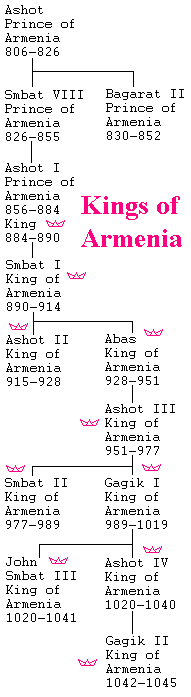 The foolish later Macedonian Emperors wasted strength reducing Armenia that would have been better spent against more threatening targets. Gagik II, invited to Constantinople, was imprisoned on his arrival.
But the dominion of Rome this time lasted barely 20 years, as Armenia was left stranded in a sea of Turks and Mongols for nine centuries, until during World War I the Turks killed or expelled nearly all Armenians from Turkey, leaving only the small domain ruled by Orthodox Russia, now the independent Republic of Armenia. The next Armenian Kingdom would actually not be in Armenia at all, but in the Taurus Mountains of Cilicia: the Kingdom of Lesser Armenia.
The list is based on M. Chahin, The Kingdom of Armenia [Dorset Press, New York, 1987, 1991, pp. 264-269]. The genealogy is from A.E. Redgate, The Armenians [Basil Blackwell, 1998, 2000, pp.198-199]. Where Redgate did not number the princely Bagratids, he does number the Kings.
Armenia Continued, Princes and Kings of Lesser Armenia
| 8. ARMENIA | |
|---|---|
| Levon Ter-Petrosyan | 1991-1998 |
| Robert Kocharian | 1998-2008 |
| Serzh Azati Sargsyan | 2008-2018 |
| Armen Vardani Sarkissian | 2018-present |
 After centuries dominated by Turkey, Iran, and Russia, the ancient Christian nations of the Caucasus emerged into independence with the break-up of the Soviet Union in 1991. This did not make life any easier. Quite the contrary.
Soon Armenia, Հայաստան, Hayastan, was involved in a war over the province of Nagorno-Karabakh, which had been an autonomous region in neighboring Azerbaijanistan but with a population over 75% Armenian (it had been ceded to Azerbaijan by Stalin for his own political purposes). The Armenians there declared independence at the end of 1991, and forces from the Republic were soon pushing across western Azerbaijan. By 1993 the province and a bridging salient from Armenia were secured. A cease fire in 1994 left the Armenians with their war gains.
| Historic Armenia |
|---|
| Armenia, 401 BC-428 AD Armenia, 628-806 AD Armenia, 806-1064 Lesser Armenia, 1080-1375 The Patriarchs of Armenia Armenian Patriarchs of Jerusalem |
Nevertheless, independence has been a harsh experience for Armenia. Surrounded on three sides by Turkish and more-or-less hostile Azerbaijanistan and Turkey, Armenia is isolated and the economy has been in terrible shape. With many people leaving, one of the best hopes for the Republic is that Armenian immigrants in places like the United States will be able to send enough money back to sustain the population, if not revive industry. Nevertheless, Armenian per capita income is larger than that of Georgia or Azerbaijanistan.
Armenian immigrants in America, initially fleeing Turkey, have been conspicuous for a century. In California, Armenian settlement in Fresno, in the San Juaquin Valley, led to Armenians being called, not always affectionately, "Fresno Jews" -- certainly because of their entrepreneurial and business traditions. Many of this early group of Armenians ended up coming by way of Lebanon, where many refugees had initially settled -- the town of Anjar was almost entirely Armenian. Since the fall of the Soviet Union, many more immigrants have come from Soviet Armenia.  These immigrants speak a different dialect of Armenian, Eastern rather than Western, and are culturally rather different, suffering from some of the ills that afflict all people who lived long under Communism. Nevertheless, Eastern Armenians are also more entrepreneurial than other ethnic groups. In the Los Angeles area, the city of Glendale, with lower business taxes and a less hostile business environment than the City of Los Angeles (politically dominated by socialists), has become a center of Armenian residence and activity. Unfortunately, some violence has occasionally occurred between Armenians, some bringing a penchant for lawlessness characteristic of much of post-Soviet Russia, and the Hispanic gangs common in the area -- where Hispanic immigrants tend to be less entrepreneurial, less economically successful, and so resentful in relation to the Armenians. Hispanic gangsters, notorious for their violence, sometimes don't seem to appreciate just how violent post-Soviet culture can be.
Armenian Americans are usually conspicous by the "-ian" or "-yan" patronomic suffixes of traditional Armenian names. However, some famous Armenians don't use their Armenian names. The most important of these would be the rock icon and actress Cher, who was born Cherilyn Sarkisian. Similarly, the actor Mike Connors (1925-2017), who played private detective Joe Mannix on the long running television series Mannix (1967-1975), was born Krekor Ohanian (in Fresno). While actors often change their names, the derivation of other Armenians in public life is usually more obvious, for instance as with the author and playwright William Saroyan (1908-1981), who was also born (and died) in Fresno.
Like more than one post-Soviet republic, Armenia fell victim to a Vladimir Putin-like strong man, Serzh Azati Sargsyan. Fortunately, peaceful protests in April 2018 led to his resignation. Whether a new batch of politicians will be any better remains to be seen. The track record of the post-Soviet states has not been impressive, with communists, like Putin, being foolishly returned to power, and then not giving it up. From communists, they simply became gangsters. For Russians who fondly remember Stalin, this may not be a problem; but it is no way to run a country.
| 9. GEORGIA | |
|---|---|
| Zviad Konstantines dze Gamsakhurdia | President 1990-1992 |
| Tengiz Kalistratis dze Kitovani & Dzhaba Aleksandres dze Ioseliani | 1992 |
| Eduard Shevardnadze | 1992-2003 |
| Nino Burdzhanadze | acting, 2003-2004, 2007-2008 |
| Mikhail Saakashvili | 2004-2007, 2008-2013 |
| Giorgi Margvelashvili | 2013-2018 |
| Salome Zourabichvili | 2018-present |
 Georgia, საქართველო, Sak'art'velo (
 , if you do not have the Georgian font), like Armenia, a kingdom with an ancient history, is not only poorer than Armenia but has lost territory rather than gained any. The northwestern province of Abkhasia and Southern Ossetia (where the only descendants of the Iranian Alans survive) on the north central border both broke away. The fighting involved in this was beyond the resources of Georgia, and in 1993 Russia itself had to be brought back in to restore some kind of order. This is still not all settled, and meanwhile fighting spills over the border from Chechnya, with Russians in pursuit.
  Recently, advisors arrived from the United States to help train the Georgian army. Not long after independence Eduard Shevardnadze, who had been Foreign Minister of the Soviet Union under Mikhail Gorbachev and a familiar international figure, became President of Georgia. His tenure must have seemed a sad and humiliating business, with the scope of his purview so reduced, and his country not even able to maintain its own integrity. This must seem an especially cruel irony when in the history of the Soviet Union itself, the most powerful and dominant ruler was himself a Georgian, Josef Stalin (Iosif Dzhugashvili). In November 2003, however, Shevardnadze resigned, after massive protests, the "rose revolution," against corruption and an alleged rigged parliamentary election. He was succeeded as Acting President by the Speaker of the Parliament, a woman, Nino Burdzhanadze. In January, 2004, Mikhail Saakashvili, an American educated lawyer, has been inaugurated as President.
  A new flag has accompanied Mr. Saakashvili, featuring the Cross of St. George and smaller smaller crosses in each quarter. Although the former flag had long symbolized an independent Georgia, and had not been used in the Soviet era, the overtly Christian symbolism of new flag has evidently come to be prefered. Other flags, with green, orange, and burgundy colors substituted for the red, are seen. Meanwhile, in the United States, a man of Georgian heritage, Gen. John M. Shalikashvili, was the Chairman of the Joint Chiefs of Staff from 1993 to 1997.
| Catholicus-Patriarchs of Georgia | |
|---|---|
| Kyrion II | 1917-1918 |
| Leonid | 1918-1921 |
 Georgia annexed to Georgia annexed toSoviet Union, 1921 | |
| Ambrose | 1921-1927 |
| Christophorus III | 1927-1932 |
| Callistratus | 1932-1952 |
| Melchizedek III | 1952-1960 |
| Ephraim II | 1960-1972 |
| David V | 1972-1977 |
| Ilia II | 1977-present |
| Recognized as Independent by Patriarch of Constantinople, 1990 | |
In 2008 the territorial integrity of Georgia is more compromised than ever. After an abortive attempt to reassert control in South Ossetia, Georgia itself experienced an open invasion by the Russians. Russian "peacekeeping" seems to have evolved into an intention to annex Ossetia and Abkhasia to Russia, under the guise of the "independence" of these hopelessly tiny states. After brutally crushing break-way Chechnya, the Russians adopted a wholly cynical concern for the oppressed minorities in the Georgian regions. Since South Ossetia and Abkhasia are recognized by the UN as sovereign possessions of Georgia, the actions of Russia are simply naked aggression, alarming to all of Europe and particularly to other small former-Soviet possessions like the Baltic States. Under only the thinnest of pretexts, Putin looks ready to recreate the Russian Empire, regardless of how blatant and threatening this is to the European Union and NATO. The mask is off. All that is lacking is now for the American Left to discover a friend and ally in the new brutal and aggressive Russia. Indeed, this cannot be far behind -- Hugo Chavez in Venezuela is already on the bandwagon. In Georgia proper, the Russians are withdrawing only slowly, if at all, despite assurances to the European Union and especially to President Sarközy of France that they had already done so. Reportedly, Putin has threatened President Saakashvili that Georgia will be reduced to a vassal of Russia. From the evidence of some public comment and my own e-mail, some ethnic Russians, even expatriots and emigrants, seem thrilled that Russia is asserting itself again, regardless of how this is being done, and by whom.
One wonders what the future holds for both Armenia and Georgia, as remote and isolated as they are, in an area with little history of economic development, democratic government, or liberal society. Yet it is a spectacular area. Tourism may seem like a trivial matter, but tourists bring a great deal of money. Although remote and obscure, the Caucasus nevertheless somehow became the eponym in traditional racial clasifications for the "white" race. For some time, the area was certainly a prefered source for white slaves for the Ottoman Empire, including Christian boys, typically Circassians, who were converted to Islam and impressed into the elite Janissary corps of the Turkish army. "Racial" classifications of the human race are now out of favor, but it has also become evident that the traditional division, between just "Caucasoid," "Negroid," and "Mongoloid," actually doesn't fit the facts very well. Modern genetic mapping shows that South-East Asians and Pacific Islanders form a group clearly distinct from other East Asians or American Indians. East Asians, American Indians, and "Caucasians" are all more closely related to each other than to South-East Asians and Pacific Islanders. Nevertheless, the traditional "Caucasoid" group, including people from Europe, North Africa, the Middle East, and India, does form an identifiable genetic branch of humanity, with the Caucasus roughly at the crossroads. Calling this "white," however, would be a misnomer, since people in India, although with identifiable "Caucasoid" features, can have very, very dark skins. Dark skin, indeed, occurs independently in Africa, in India, in Melanesia, and in Australia.
We have seen above the Russian invasion and victimization of Georgia. In turn, the ceasefire between Armenia and Azerbaijan broke down in 2020, and Azerbaijan succeeded in regaining the territory of Nagorno-Karabagh. Demolition subsequently began on Christian sites, as, we now discover, the Armenians had previously been demolishing Muslim sites. With the status quo now negotiated by Russia, there seems little prospect that Christians powers, like Russia or Georgia, will ever come to the aid of Armenia.
Chechnya is now a puppet state with Russian Quislings, particularly Ramzan Akhmadovich Kadyrov (b.1976), who, with his father, had gone over to the Russians in the 1999-2000 campaign, earning the friendship and patronage of Vladimir Putin.
But now the question of Chechnya has revived thanks to the Russian invasion of the Ukraine in 2022. Kadyrov provided Chechen troops for the invasion and even a special assassination squad to target Ukrainian President Zelensky. The assassination squad failed; and it is not clear what even happened to it. Meanwhile, the Russian drive on Kiev also failed; and now, in September, Ukrainian counteroffensives in the East and South are succeeding against Russian occupation.
There are reports and rumors that Chechen fighters, and even whole units, have gone over to the Ukrainians. This is unconfirmed; but there are also rumors that Chechen fighters with the Ukrainians are planning to return to Chechnya to renew the rebellion against Russia. Nothing seems to have come of this to date, and it is not clear there is even much dissent at the moment within Chechnya. Direct information, of course, is limited.
Meanwhile, Kadyrov is unhappy with the conduct and progress of the war. He wants Russian generals fired; and he has claimed that, were he in charge, the Russians would already be invading Poland. Since the Russians have suffered substantial loses in men and materiel, have difficulties with supply and production, and experience poor morale with recent, untrained recuits, including freed prisoners, it is not clear what Kadyrov thinks he could do better.
Thus, the fate of the Ukraine may now be tied to the fate of Chechnya. Since the Russians have been using a lot of ethnic minorities from the Russian Federation as, essentially, cannon fodder (with the actual ethnic Russian population of the country declining), and soldiers report home by cellphone on their situation and experiences, it might be more than the Chechens who become disaffected. We have also heard about recuits from Tuva in Central Asia, although this has not yet included any news of dissent.
Culmen Europae
Along the northern border of Georgia run the Caucasus Mountains, the highest mountain range in Europe, rising to the 18,510 ft. (5642 meter) Mt. Elbruz -- Russian El'brus, Эльбрус; Persian  , Ælborz, Latin Strobilus -- the "Roof of Europe," Culmen Europae in Latin and ἡ τῆς Εὐρώπης στέγη in Greek -- even though it is very remote from the centers of Europe and is no more easily accessible to Europeans today than it was to Jason and the Argonauts, whose journey took them there. This did not, of course, stop Stalin from putting a statue of himself at the summit, with the inscription, "On the highest peak in Europe we have erected the statue of the greatest man of all time." Similarly, on 21 August 1942, a team of German soldiers ascended the peak and planted a Nazi flag. With the contemporaneous assault on Stalingrad, this fittingly signified the high water mark of Nazi Germany and its aspiration to dominate Europe.
If the country were more peaceful and stable, it would be very attractive for travelers. Since the Caucasus mark the boundary between Europe and Asia, this means that Georgia lies almost entirely within Asia. In Armenia, from the capital, Yerevan, 16,854 ft. (5137 m) Mt. Ararat, Արարատ, is visible -- the spiritual and historic center of Armenia (the traditional site of the resting place of Noah's Ark -- although its name appears to derive from the ancient kingdom of Urarṭu), though now just across the border in Turkey. Some disaspora Armenians recently have thought about moving to the area in Turkey and investing money in local businesses. The Turkish government actually encouraged them, but local officials were so uniformly hostile, fearing Armenian claims on local land, that the enterprise became impossible.
, Ælborz, Latin Strobilus -- the "Roof of Europe," Culmen Europae in Latin and ἡ τῆς Εὐρώπης στέγη in Greek -- even though it is very remote from the centers of Europe and is no more easily accessible to Europeans today than it was to Jason and the Argonauts, whose journey took them there. This did not, of course, stop Stalin from putting a statue of himself at the summit, with the inscription, "On the highest peak in Europe we have erected the statue of the greatest man of all time." Similarly, on 21 August 1942, a team of German soldiers ascended the peak and planted a Nazi flag. With the contemporaneous assault on Stalingrad, this fittingly signified the high water mark of Nazi Germany and its aspiration to dominate Europe.
If the country were more peaceful and stable, it would be very attractive for travelers. Since the Caucasus mark the boundary between Europe and Asia, this means that Georgia lies almost entirely within Asia. In Armenia, from the capital, Yerevan, 16,854 ft. (5137 m) Mt. Ararat, Արարատ, is visible -- the spiritual and historic center of Armenia (the traditional site of the resting place of Noah's Ark -- although its name appears to derive from the ancient kingdom of Urarṭu), though now just across the border in Turkey. Some disaspora Armenians recently have thought about moving to the area in Turkey and investing money in local businesses. The Turkish government actually encouraged them, but local officials were so uniformly hostile, fearing Armenian claims on local land, that the enterprise became impossible.
Chechnya, 1991-2022
 Meanwhile, the question of Chechnya, Чечня (Chechen, Нохчийчоь, Noxçiyçö, with Turkish orthography), has been renewed. That Russian republic broke away from the new "Russian Federation" in 1991. The Russians attempted to regain control in 1994-1996 but failed. Finally, the Russians again invaded in 1999 and secured the country in 2000, after (1) assassinating many Chechen leaders, and (2) bombing Moscow apartment buildings and blaming it on Chechen terrorists. This got the Russian public behind a ruthless campaign. That involved the total destruction of the Chechen capital, Grozny, Грозный. There is no telling how many people were killed, but the Russian strategy seems to have been a willingness just to kill everyone, if necessary.
| South Caucasian, Kartvelian | Northwest Caucasian, Abkhaz- Adyghean | Northeast Caucasian, Nakh- Dagestanian |
|---|---|---|
| Georgian, Laz, Svan, Chan, Mingrelian | Abaza, Abkhaz, Adyghé (West Circassian), Kabardian (East Circassian), Ubykh | Chechen, Ingush, Avar, Chamali, Tsez, Lak, Dargwa, Lezgian, Tabasaran, Archi, Tsakhur |
 Confined to the Caucasus, these languages appear like islands in a sea of extensive and more familiar language groups -- as Basque is isolated in the Pyrenees. The Middle East, however, has a past with many more such unrelated languages. In a broad swath from the south, we have the ancient Elamites, Sumerians, Kassites, Guti, Hurrians, and Urartuans, all of whose languages are distinct from the Semitic, Indo-European, and Altaic languages that later dominate. They have all disappeared utterly. Since the Caucasian languages, except for Georgian, are poorly attested before the modern era, there are obstacles to comparing them with the ancient languages, however much we might suspect affinities. Speculation links Sumerian to the Dravidian languages in India, but this may have more to do with Indian nationalism than with the evidence, which is as thin for ancient antecedents of the Dravidian languages as it is for the Caucasian. The surviving Caucasian language families, if nothing else, testify to the linguistic complexity of the ancient Middle East and remind us how much information is lost in the march of history.
There is something strange about this. Attested phonetic systems typically make the minimum distinctions necessary to contrast phonemes from each other, building up from characteristics that seemed to be less "marked," somehow more basic, in human perception. Thus, Hawaiian, like Hittite, only has the unvoiced stops. But the proposed "voiced-aspirate" series does not do this. Only aspiration would be needed to contrast the third series from the others, and this is in fact what we see in Greek and Eastern Armenian. The voiced-aspirates only occur in Sanskrit, where a simple aspirate group is also present. A solution was proposed by in 1984/1990 by Thomas [Tamaz] V. Gamkrelidze and Vyacheslav V. Ivanov. They point out what is shown in the last row of the chart, While in the first place the Georgian example is suggestive for some reconceiving about the traditional Proto-Indo-European reconstruction, there may be more to it. The place of origin for Proto-Indo-European has tended to revolve around the Black Sea. In the table above, I have lined up the glottalized stops with the voiced-aspirates and the unvoiced and voiced stops with each other. But this was not exactly the theory of Gamkrelidze and Vyacheslav. However, something about this is news to me, since I have not otherwise seen the series in Shanghai characterized as voiced-aspirates, but simply as voiced. Indeed, if they are pronounced as aspirates, this is a non-distinctive feature, like the unvoiced and aspirated stops of English or Georgian. The problem with the *PIE reconstruction is that the voiced-aspirates don't need to be voiced at all, simply aspirated, as in Greek, which would contrast them with the other stops. So I'm not sure that Shanghai is a good counter-example.
Another language with glottalization worth noting is Classical Actually, there seem to be several ways in which a sound can be glottalized, and Navajo features what is called "ejective" stops, where I see "ejective" defined as a "glottalic egressive airstream." This is not familiar from European languages, and I cannot say what it sounds like to me. Navajo also has a lateral fricative, ɬ, which is rather like a θ (i.e. in "thin") pronounced with the tongue in the position for an l, a sound perhaps the most famous in Welsh, which it is written "ll" and often transcribed "fl." This sound also occurs in an African language like Zulu and may be the original pronuncation of Arabic ض, ḍād -- the only reasonable explanation why the Arabs should have called themselves "Sons of ḍād," out of all the other letters of the Arabic alphabet. In Navajo, this sound is also combined with the dental (actually, alveolar) stops that are aspirated and glottalized.
So Navajo is noteworthy in that it has no voiced stops, like Hawaiian or Mandarin, but then has the glottalized stops instead of the voiced stops. This would be like Shanghai Chinese, except with the glottalized stops instead of the voiced (aspirate) ones.
Now, since there seem to be relatively few attested languages with the glottalized stops in the first place, it seems to me that it is likely to be a wide open question what changes from them are likely or possible into the daughter languages. But considerations in this area certainly are way beyond my competence. Aronson's remark, however, does intrigue me; and I find the whole idea that Proto-Indo-European was part of a Caucasian Sprachbund, including the Semitic languaes, not only suggestive but probable. And there is more.
The Navajo Conception of Hózhǫ́
A large part of the linguistics of Proto-Indo-European concerns "laryngeal theory." It was suggested by Ferdinand de Saussure (1857-1913) when he was only 21 years old that there could be lost sounds in Indo-European languages that were articulated in the larynx or pharynx. Subsequent to his proposal, which was not taken very seriously, Hittite was deciphered and identified as an Indo-European language. The Hittites were writting "h" right where de Saussure had said there should be laryngeals. Since then, similar "h's" have been found written in other Anatolian languages. However, nothing of the sort survives in other Indo-European languages. Nevertheless, the theory is at the point now where it is believed that there must have been three, or even more, laryngeals used in *PIE. Unfortunately, apart from the Hittite "h," there isn't a clue what those sounds might have been. Linguists are reduced to writing h1, h2, h3, etc. for the postulated laryngeals. Or sometimes we get ǝ1,
ǝ2, and ǝ3, using the reduced "schwa," ǝ, vowel in place of the "h." As good as anything.
And all those unusual consonants disappear as Indo-European languages move away from the Caucasus, with the only attested examples of laryngeals in Anatolia, still nearby. So, with the possibility of glottalized stops, this looks like another area where there can be suggestive affinities between Caucasian languages and Proto-Indo-European, as we might expect from a Causasian Sprachbund. I am sure that Georgian linguists like Gamkrelidze are still busy with this, and I hope some progress will be made in this direction. John Colarusso says, "it is even possible that Indo-European itself is an aberrant outlier of Caucasian" [op.cit. p.2]. And we should keep in mind, it does not even need to be related to Caucasian languages for this to be true. Three groups of Caucasian languages are already unrelated to each other.
The list and discription of the language families in the Caucasus is mainly from The Atlas of Languages (Facts On File, 1996, pp.50-52).
"Knowing" Words in Indo-European Languages
Philosophy of Science, Linguistics
The Caucasus-Indo-European Connection
 Languages in the Caucasus may answer a question that arises in Indo-European linguistics. The resconstruction of the series of Proto-Indo-European (*PIE) stops, as seen in the diagram at left (which also shows the sounds these give rise to in daughter languages and groups, not always showing the full phonology in them, as we see in Sanskrit below), now stands with an unvoiced series, a voiced series, and a voiced-aspirate series.
 Not only does the voice-aspirate series not occur in other Indo-European languages, but a system such as that proposed for Proto-Indo-European may not occur in any other known languages in the world. So one wonders what is going on.
that Georgian (and "Gamkrelidze" is a Georgian name) contains stops in three groups, unvoiced, voiced, and glottalized. The latter is not a form of articulation familiar from later Indo-European languages. According to Howard I. Aronson, "These sounds are produced by simultaneously pronouncing a glottal stop [ʔ] and the corresponding stop" [Georgian, A Reading Grammar, Slavica Publishers, 1989, p.16; the brackets in the quote are in the original, with the undotted question mark, "ʔ," standing as the IPA symbol for a glottal stop]. What is noteworthy about this is that a glottal stop is at the same place of articulation that is responsible for both voicing, aspiration, and voiced-aspiration. The potential for such a sound to resolve into one, or any, of the others seems high. And Aronson has a very interesting remark to make about the sounds, "In fact, the acoustic impression one often gets from these stops is that of a voiced stop!" [ibid.], like, say, a voiced-aspirate? There is also the complication that "voiced-aspirate" sounds have been said to be more "properly" called "murmur" stops. Part of this seems to be the uncertainty that arises when such sounds occur in no European languages. But everyone should know what to make of them by now.
Today the favorite candidates are Anatolia or the Ukraine. In either place, as it happens, we can have populations adjacent to the Caucasus, which means that, just as Sanskrit and the unrelated but adjacent Dravidian languages share groups of retroflex stops, Proto-Indo-European may have been part of a Sprachbund where the use of glottalized stops similarly was shared across linguistic boundaries. As Proto-Indo-European speakers moved away from their place of origin, and people speaking very different languages learned Indo-European daughter languages as second languages, it is not surprising that the glottalized sounds would lapse into something a bit more congenial to the phonology of their original languages. As we can see in the table, the derivatives of the "voiced-aspirate" series shoot off in all different directions in the daughter languages.
Not only does the voice-aspirate series not occur in other Indo-European languages, but a system such as that proposed for Proto-Indo-European may not occur in any other known languages in the world. So one wonders what is going on.
that Georgian (and "Gamkrelidze" is a Georgian name) contains stops in three groups, unvoiced, voiced, and glottalized. The latter is not a form of articulation familiar from later Indo-European languages. According to Howard I. Aronson, "These sounds are produced by simultaneously pronouncing a glottal stop [ʔ] and the corresponding stop" [Georgian, A Reading Grammar, Slavica Publishers, 1989, p.16; the brackets in the quote are in the original, with the undotted question mark, "ʔ," standing as the IPA symbol for a glottal stop]. What is noteworthy about this is that a glottal stop is at the same place of articulation that is responsible for both voicing, aspiration, and voiced-aspiration. The potential for such a sound to resolve into one, or any, of the others seems high. And Aronson has a very interesting remark to make about the sounds, "In fact, the acoustic impression one often gets from these stops is that of a voiced stop!" [ibid.], like, say, a voiced-aspirate? There is also the complication that "voiced-aspirate" sounds have been said to be more "properly" called "murmur" stops. Part of this seems to be the uncertainty that arises when such sounds occur in no European languages. But everyone should know what to make of them by now.
Today the favorite candidates are Anatolia or the Ukraine. In either place, as it happens, we can have populations adjacent to the Caucasus, which means that, just as Sanskrit and the unrelated but adjacent Dravidian languages share groups of retroflex stops, Proto-Indo-European may have been part of a Sprachbund where the use of glottalized stops similarly was shared across linguistic boundaries. As Proto-Indo-European speakers moved away from their place of origin, and people speaking very different languages learned Indo-European daughter languages as second languages, it is not surprising that the glottalized sounds would lapse into something a bit more congenial to the phonology of their original languages. As we can see in the table, the derivatives of the "voiced-aspirate" series shoot off in all different directions in the daughter languages.
 They thought that the traditionally voiced *PIE were actually the glottalized ones, as seen in the table at left, while the voiced-aspirates were simply voiced (or actually still voiced-aspirates, but where aspiration is not a contrasting feature -- the way initial stops in English are aspirated). J.P. Mallory and D.Q. Adams [The Oxford Companion to Proto-Indo-European and the Proto-Indo-European World, Oxford, 2006, 2007] report that, "All of the proposed revisions, however, have their critics. All of them also force one to assume that the attested sounds in the various branches have undergone changes which have few or no parallels or are otherwise complicated" [p.52].
  Mallory and Adams also offer a counter-example to the original objection to the reconstructed stops, that the Shanghai or Wu language of China also has voiced-aspirates, which, as in Proto-Indo-European, is more than is needed for contrast with the rest of the stops.
 Mayan. Here, as in Georgian, we have a contrast of unvoiced, glottalized, and voiced. There is only one voiced stop, and it is also glottalized -- although this is not always written in Mayan transciptions, since it is non-contrasting. This is all rather far from the Caucasus and so cannot enter into considerations about the origins of Proto-Indo-European, but it does show what is quite possible in a phonetic system, meaning that Georgian, etc., are not unique.
 A little closer to home is a language I have heard several times on the radio driving across Arizona and New Mexico. That is
  Navajo. Navajo contasts unvoiced, aspirated, and glottalized stops. This is not obvious in transcription, since the unvoiced are written with voiced letters in English ("b," "d," and "g") and the aspirated with the unvoiced ("p," "t," and "k"). The glottalized are transcribed with an apostrophe ("t’" and "k’"). Thus the name of the Navajo "people," Diné, is not actuallly with the voiced "d." This is the transcription device we also see in Pinyin.

 Now, many Caucasian languages are consonant rich. There are strange things going on in the throat and the back of the mouth, just what we now expect for Proto-Indo-European. Kabardian has no less than five pharyngeals and laryngeals [John Colarusso, A Grammar of the Kabardian Language, University of Calgary Press, 1992, p.9].
  If we want to get some idea what all those placeholding symbols could mean for Proto-Indo-European, this is the place to start. Four of these also occur in Arabic (all except for the labialized glottal stop, ʔw). Only one (the plain "h") or two (with the glottal stop) are in English (where the glottal stop is not a phoneme except in some dialects). Note that the undoted question mark, for the glottal stop, is reversed, as "ʕ," for the "voiced pharyngeal fricative," i.e. the ʿayn, ع, in Arabic.
 Kabardian also has something that Georgian doesn't and that Proto-Indo-European does, the palatalized (with "y") and labialized (with "w") velars. In fact, Kabardian is missing a plain velars ("k," etc.). I didn't show the extra *PIE stops above because it wasn't necessary; but now its correspondence to this Caucasian language is striking. Kabardian also has glottalized stops, like Georgian -- an example of the Sprachbund in itself, since they are in different langauge families. Kabardian also has a number of uvular stops ("q"), which also occur in Arabic and other Semitic languages. Perhaps noteworthy is the circumstance that "q" in Classical Arabic is not voiced, as in Kabardian, but that it becomes voiced in some modern dialects of Arabic (e.g. the Gulf) and in Persian.
Copyright (c) 1996, 1998, 1999, 2000, 2001, 2002, 2003, 2004, 2008, 2012, 2013, 2017, 2018, 2019, 2020, 2021, 2022 Kelley L. Ross, Ph.D. All Rights Reserved