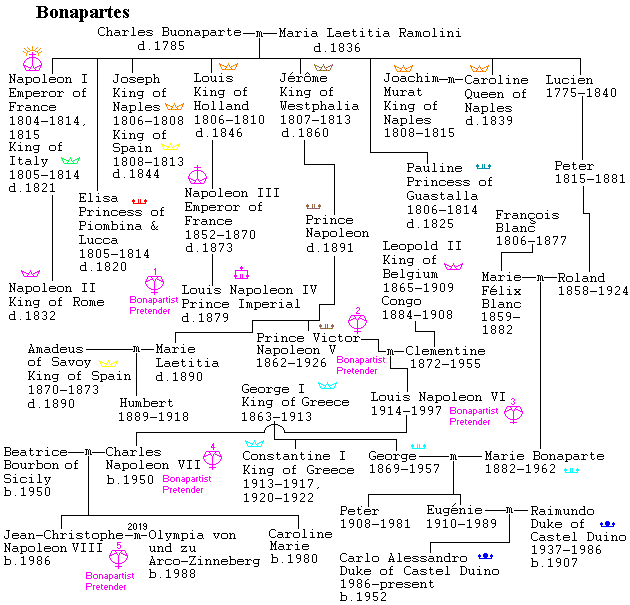
In the genealogy below, the Imperial crown for Napoleon is shown with an orange nimbus. This is to indicate that Napoleon was crowned by the Pope, Pius VII, as with the Mediaeval Emperors, but with the irregularity that it was not in Rome and, well, Napoleon actually took the crown out of the Pope's hands and crowned himself. This was to avoid the kind of claims that the Popes had made since Charlemagne, that the imperial title was the Pope's to bestow, but it was a bit gratuitous at a time when everyone knew that Napoleon was the kind of ruler who might have killed the Pope as easily as invited him to his nice coronation -- though at this point, to be sure, Napoleon was making a bid for legitimacy and trying to find a place for himself among the traditional families and authorities of Europe. David's great painting of Napoleon's coronation avoids the political act of Napoleon taking the crown and just shows him subsequently crowning Josephine -- with the Pope as a spectator. Bye and bye, Napoleon did end up having the Pope arrested -- he was kept in captivity and bullied by Napoleon from 1809 to 1814, which only added to his prestige.
By the time of Napoleon III, the Pope (Pius IX) was dependent on French troops holding Rome for him against the new Kingdom of Italy. When the French withdrew to fight Prussia in 1870, the Italians rolled in and made Rome the capital of Italy.  This officially ended the existence of the Papal State, after 1114 years (756-1870). The Popes then regarded themselves as hostages in the Vatican until, of all people, Mussolini worked out a treaty in 1929 establishing the independence and boundaries of the Vatican City.
After Napoleon III allowed himself to be tricked into declaring war on Prussia, and then abdicated after disastrous defeat, France, although few would have guessed it at the time, was through with both Kings and Emperors.
When Napoleon III's poor son was killed fighting the Zulus with the British, the succession of Bonapartist Pretenders jumped to the heirs of Napoleon's brother Jerome.  We are now down to Napoleon VIII, with a dispute about the succession. The father of Charles (Napoleon VII) disinherited him in a will, charging that he had "republican" sentiments and violated House law by divorcing and remarrying. His son, Jean-Christophe (Napoleon VIII), is the rightful successor. The will is disputed for various reasons; but, of course, this is all about essentially nothing. Charles will die and Jean-Christophe will be the heir anyway. Jean-Christophe recently married, and we can hope that there will be more little Napoleons running around soon.

With eight Napoleons, but only two who actually ruled France, that leaves us with six in name but not in fact. This calls to mind the Sherlock Holmes story, "The Adventure of the Six Napoleons" [1904, then in The Return of Sherlock Holmes, 1905]. This was only about statues of Napoleon, one of which contained a stolen pearl, and had nothing to do otherwise with the original Emperor. A key moment is when Holmes points out that a statue was broken under a street light, not because a drunk thought that the light was better to look for his keys, but because the thief wanted to see if anything was in the statue.  We might reflect, in turn, that the Bonapartist cause for the Throne of France may itself amount to little more than broken statues.
The cases of Napoleon II and Napoleon IV are a little different from the others. Both were children of the actual Emperors, Napoleon I and Napoleon III, respectively; they spent at least part of their childhoods in the shadow of power; both were, at least briefly, credible successors to their fathers; and both died young. Napoleon II, with a Hapsburg mother, Marie Louise, with a given name François, lived out his life as "Franz" among his Hapsburg family. He died of tuberculosis in Vienna at the age of 21. Buried in Vienna, his body was in the Hapsburg crypt but his heart, in the Hapsburg tradition, was placed in an urn in the crypt of the Augustinian Church of the Hofburg Palace, while the rest of his viscera were in an urn in the crypt of the Stephansdom Cathedral. Although Hapsburg hearts continued to be buried in the Hofburg, further separation of their remains was discontinued in the 19th century.
 |
|---|
| The Transfer of the Coffin of Napoleon II, by German Ambassador Otto Abetz, to the Vichi Government, 1940 |
|---|
For Napoleon II, however, "separation" came to have a whole new meaning. After conquering France in 1940, Adolf Hitler had the body of young Franz moved to join his father at Les Invalides in Paris, where he still is. This is a telling, if not bizarre, incident, revealing the respect for Napoleon by Hitler, continuing that of Friedrich Nietzsche (as we have seen above). Here is the eerie scene of the actual transfer in the photograph at left, with the coffin itself plainly in view. One wonders what French enthusiasts for Napoleon think of the whole business.
Although Napoleon's crimes rose to nowhere near the level of Hitler's, there were nevertheless many points of comparison between their lives, especially in their ambivalent origins. One difference now, of course, is that France honors Napoleon with a majestic tomb, while Germany does its best to forget Hitler, whose charred remains, if they still exist at all, are in the hands of the Russians.
Napoleon IV, although barely outliving Franz, enjoyed a much more eventful and colorful life, however short.  With the given name Eugène, he was known as "Loulou" to his family. Fleeing France and joining his parents in England in 1870, Eugène was well educated and entered the British Military Academy at Sandhurt. He was able to join British forces in South Africa during the Zulu wars, thanks to the support of his mother and even Queen Victoria. He was, however, supposed to be watched, guarded, and kept away from the fighting. These precautions, however, were undone, partly by chance, but also because of the Prince's own impetuosity. He was killed in a skirmish with the Zulus, separated from his companions, and suffering no less than 18 wounds from the Zulu assegai. He was only 23 years old. The Zulus treated his body with some respect, as they would honor a brave enemy; and they later claimed that, had they known who he was, they would not have killed him.
 |
|---|
| Napoleon's Tomb, 1970 |
|---|
Eugène's body was returned to England, where he was buried, with his father, in Saint Michael's Abbey, Hampshire, which was built by the Empress Eugénie (1826 1920) for just that purpose. The whole family is still buried there.
Of the later Pretenders, Napoleon VI, Louis, certainly had the most dramatic life. Refused enlistment in the French Army in 1940 -- all the Bonapartists were living in exile -- he actually joined the French Foreign Legion, which one does anonymously. Demobilized in 1941, he then became part of the Resistance, actually fighting and being wounded, arrested and imprisoned by the Germans, but then returning to exile in Switzerland after the War, until allowed back into France in 1950. Sounds like a pretty honorable record, much more so than Jean Paul Sartre, even if he still might not have been wanted as Emperor.

Meanwhile, the most interesting person in the genealogy may be a cousin of the Jeromist Pretenders, namely Marie Bonaparte (1882-1962), the great-granddaughter of the brother, Lucien, of Napoleon I, who married royalty herself, namely George,  the brother of King Constantine I of Greece.
Marie inherited money from her mother's family, which she used to good effect, including supporting the Greek royal family while in exile from the German occupation of Greece. However, her greatest claim to fame was as a patient and then a friend and colleague of Sigmund Freud. It is to Marie that Freud is supposed to have asked Was will das Weib? -- "What does woman want?"
Besides promoting and herself practicing Freud's psychoanalysis, Princess Marie helped pay the ransom demanded by the Germans for Freud to leave Vienna and take with him his papers, books, and other effects. That he was able to leave at all also depended on the diplomatic and political pressure that Marie could bring to bear. This may be among the most humane and valuable things that the House of Bonaparte ever accomplished, and Marie seems to be one of the more intriguing personalities of the era.
Unfortunately, Freud's sisters were left behind, and they were all murdered by the Germans.
 |
|---|
| The Eiffel Tower, 1889 |
|---|
With the Third Republic, France settled into, for a while, a modern democratic normalcy. Eventually the great enemy even ceased to be England. A dangerous and aggressive unified Germany drew France into alliances with Russia and then England.
| PRESIDENTS OF FRANCE |
|---|
| Third Republic, 1871-1940 |
|---|
| Adolphe Thiers | 1871-1873 |
Patrice M.
de MacMahon | 1873-1879 |
| Francois P.J. Grévy | 1879-1887 |
Marie François
Sadi-Carnot | 1887-1894 |
| assassinated by anarchist, 1894 |
|---|
Jean Casimir
Périer | 1894-1895 |
François
Félix Faure | 1895-1899 |
| Émile Loubet | 1899-1906 |
Clement Armand
Fallières | 1906-1913 |
| Raymond Poincaré | 1913-1920 |
| World War I, 1914-1918, recovery of Alsace-Lorraine, 1918 |
|---|
| Paul E.L. Deschanel | 1920 |
| Alexandre Millerand | 1920-1924 |
| Gaston Doumergue | 1924-1931 |
| Paul Doumer | 1931-1932 |
| Albert Lebrun | 1932-1940 |
| World War II, 1939-1945, conquest by Germany, 1940 |
|---|
| Henri Philippe Pétain | Chief
of State,
1940-1944,
d.1951 |
| Vichy State & German Occupation, 1940-1944 |
|---|
| Allied Liberation, 1944; Provisional Government, 1944-1947 |
|---|
| Charles de Gaulle | 1944-1946 |
| Félix Gouin | 1946 |
| Georges Bidault | 1946-1947 |
| Fourth Republic, 1947-1958 |
|---|
| Vincent Auriol | 1947-1954 |
| René Coty | 1954-1958 |
| Fifth Republic, 1958-present |
|---|
| Charles de Gaulle | 1958-1969 |
| Georges Pompidou | 1969-1974 |
| Valéry Giscard d'Estaing | 1974-1981 |
| François Mitterrand | 1981-1995 |
| Jacques Chirac | 1995-2007 |
Nicolas Sarközy
de Nagy-Bocsa | 2007-2012 |
| François Hollande | 2012-2017 |
| Emmanuel Macron | 2017-present |
Meanwhile, we have a period of peace and prosperity. The Belle Époche is something of serious moral, economic, and political significance that I have written about separately. It gave people a feeling at the time that perhaps war would never happen again, that Europe had simply become to successful and too civilized for such things.
Unfortunately, the 20th century would disabuse everyone of this in the most terrible ways. Indeed, the horrors of World War I would pale besides, not just what the Germans did to civilians in World War II, but what the Russians had been doing to their own people -- and what Communist countries would continue doing to their own people, perhaps culminating in the virtual auto-genocide in poor Cambodia. The world went from "civilization" to "Hell on Earth" as the "concentration camp" became the fully modern vehicle for slavery and murder on an industrial scale, justified by the theories of intellectuals. The simple religious fanaticism of revolutionary Iran almost seems comforting by comparison, if it had not actually borrowed so much from European Fascism. And the intellectuals are still at it, with much of the same inspiration, from Marx to Nietzsche.
Thus, we might be excused a bit of nostalgia for the pre-War Third Republic, when life seemed to be getting better by leaps and bounds -- with, in France, perhaps only the Dreyfus Affair as a dark omen of what was to come.
When the Germans attacked in 1914, the result was appalling carnage such as had not been seen in war before, and it took the Americans to win the war, but then Germany was defeated and, better, Alsace and Lorraine, taken in 1871, were returned.
Unfortunately, the job would have to be done all over again, and France was not quite up to it. Defeatism and even Fascist sympathizers drained the élan vital -- the brainstorm of philosopher Henri Bergson (1859-1941) -- that, in 1914, the French had once thought was all they needed to win wars. Enough it was not, but its absence altogether was disastrous. In 1940 Hitler accomplished the swift and crushing victory that the Kaiser had only dreamed about in 1914. Bergson himself died under the German occupation, mercifully before the Germans got around to taking any notice of him, since he was a Jew.
The humiliation and the mortification of the Germans marching into Paris was almost more than the  French spirit could bear, but, what's worse, there were plenty who were more than happy to welcome Fascism and cooperate with the German occupation and the harrowing of the Jews. The old anti-Semitism that had once framed Alfred Dreyfus as a spy for Germany now joined with Germany to continue the project. The Free French of Charles de Gaulle, who used the "Cross of Lorraine" as their symbol, were almost an embarrassment.
Indeed, when the British attacked elements of the French fleet in 1940, fearful that the Germans would gain control over them, many French may have remembered older fulminations about "perfidious Albion." But de Gaulle organized whole Free French units to fight with the Allies. They landed at Normandy and were later able to liberate Paris -- after the French had scuttled their own fleet in 1942 when the Germans moved to occupy all of France. With the Liberation, Vichi was gone and the French could rejoin the Allies as, more or less, equals -- although de Gaulle was really never treated as an equal, to his mortification. In the Allied propaganda poster at right, I have no difficulty making out the flags of Greece, Norway, Belgium, Poland and even Brazil and Mexico, but I don't think I see France.
| People who, like the present author, lived through the German occupation in Poland, later read French memoirs of the war years that seemed to describe a fairy-tale world. The French during the war continued to attend theatres, published without inhibition books and journals censored by the Germans, and gave each other literary prizes; high schools and universities functioned. Life was poorer, to be sure, but its continuity was not broken.
Leszek Ko akowski (1927-2009), Is God Happy? Selected Essays, Basic Books, 2013, p.47 akowski (1927-2009), Is God Happy? Selected Essays, Basic Books, 2013, p.47 |
Liberation was a confused combination of relief, joy, shame, and the dangerous temptation of a pro-Soviet French Communist Party. Disastrous defeat in Indo-China, another nasty war in Algeria, along with raging inflation, served to discredit the new Fourth Republic.
The solution, again, came from Charles de Gaulle, who created a Fifth Republic with a strong Presidency and abruptly cut loose the French colonial empire (1960), including even Algeria (1962). This actually led to a conspiracy of military men and attempts at a coup d'état and assassinations against de Gaulle. These failed, and the large French colonial population of Algeria left the country for France. This was very harsh medicine, but France came out the better for it under de Gaulle's firm hand. The worst was perhaps suffered by the French educated Algerians who ended up tortured and murdered by the new regime. Algeria has never been the better for that, and France now suffers tension over the Algerians who eventually followed the colonials, looking for a better life -- unfortunately finding it in a form that has created its own problems.
The tension over Algerian immigration, besides some inevitable cultural friction, has in great measure been the result of the high unemployment and poor to negative economic growth that have followed from the heavy burden of socialist economic policies. The 1990's (and now the 2000's and 2010's) were very nearly a decade that never happened for the French economy, despite all the fireworks over European unification and freer trade. This is perhaps France's greatest challenge today, a crushing tax burden (54% on as little as $45,000, plus 16% social security), labor unions that evidently would prefer a mediaeval guild system, and farcical policies like prohibiting people from working more than a certain number of hours (even for themselves).
What is missing in contemporary France and Germany both is an appreciation for classical liberalism -- i.e. free markets as well as social tolerance. It is noteworthy that "liberalism" (or "neo-liberalism") is a bad word in nearly all fashionable ideology, whether derived from Hegel, Nietzsche, or Marx. Napoleon's contempt for Britain as a "nation of shopkeepers" continues today in countries that could stand a great deal more shopkeepers; but the French and Germans know that the "Anglo-Saxon" model of liberalism is what contradicts their stupefying socialist institutions. They resent and envy it even as they feel a moral superiority for their own circumstances, however awkward for them those are. Since nearly every evil of the 20th century resulted from a rejection of liberalism, this all reflects a continuing unwillingness to learn from history that is astounding in its obstinacy and folly -- something not at all unfamiliar in the United States.
Ironically, the French seemed to like America best, despite their own socialist President Mitterrand, when Ronald Reagan was President, despite his standing for almost everything that France wasn't. While America had its Reagan, and Britain its Thatcher, France is still waiting for a leader who can save the country from itself. Meanwhile, the new woman to be chosen "Marianne," the symbol of France, model  Laetitia Casta (as seen at right), immediately moved to Britain to avoid French taxes. Smart girl. French resistance and obstruction leading up to the American campaign against Iraq in 2003 has resulted in considerable anti-French feeling in the United States, probably matched by anti-American feeling in France. It would not be so bad if French foreign policy didn't look so much like it did in 1938 -- and if terrorist attacks against synagogues, and other Jewish venues, and Jews, were not something considerably more frequent in France than in the United States.
Laetitia Casta represents something else of some danger to France. She is Corsican. Indeed, Napoleon's mother was named "Laetitia" also. Coriscan nationalism, or perhaps Italian irredentism as expressed by Corsicans (only part of France since 1768), simmers pretty constantly on the island, occasionally expressing itself in riots or minor terrorism, like Basque nationalism in Spain. Late in 2005 there were major strikes and riots on Corsica, which began with protests against the French government privatizing the ferry service that runs to the island, but quickly reached a severity out of proportion, even given the popularity of socialist principles, to such a proposal. As with similar ethnic separatism in Brittany, the French government is never in too tolerant a mood with such things, and any real autonomy or independence is probably beyond consideration.
For all that the trouble in Corsica might mean, it has now paled beside the riots of disaffected immigrants, and their children, that began on 27 October 2005. The dismal Stalinist housing projects that ring Paris, known as the cités or la Zone, the scene and source of an increasing French crime rate, and areas that the police venture into, if at all, only in force, became nightly scenes of burning and looting that continued through the middle of November.
 |
|---|
| The Place de la Concorde |
|---|
The violence also spread to over 300 other towns in France, with some incidents in Belgium, Germany, and elsewhere. Thus we see the glory of the welfare state, which supports people in a minimal and dismal existence, without jobs, ambitions, or hope. As many of the immigrants are Muslims, it is a ripe field for Islamic Fascism, and the looters have been heard chanting "Allahu Akbar!" It is also a case study in the activities of the press. The French press, eager to expose riots or disaffection in America, suppress the more provocative images of their own rioting. The (Francophile) American press, disoriented by the whole business, repeats leftist boilerplate about poverty, housing, racism, unemployment, etc., that it borrows from anti-American rhetoric, apparently without realizing that the French welfare state provides the housing and a minimal income, while also suppressing job creation. And I've read through more than one Associated Press story that did not use the words "Muslim" or "Islam" to describe people whose ideology and identity, to the extent that it exists at all, has little other inspiration. Most instructive events, and reactions.
In late March 2006 there were demonstrations in Paris, this time over a minor attempt by the government to reform labor law. The idea that workers younger than 26 might be fired without cause within the first two years of employment provoked great indignation, including sympathy strikes by transport workers across France.
When general unemployment in France hovers around 10% and youth unemployment is something like 22%, this popular response to so timid a liberalization is a tragicomic tribute to the level of folly in French political culture. The socialist rejection of liberal economics is now so instinctive and fundamental to French identity that there is even a word for it, dirigisme, "interventionism." The word is related to the word "dirigible," from Latin dirigere, "to arrange, direct" (an so by implication, "steer"). We get the word "direct" from the participle. Indeed, an image of the Hindenberg might be apt for the French economy and society. The demonstrators know, of course, that the success of a small initial reform might lead to others, and others, and perhaps ultimately to an American free market in labor. They can't have that.
In 2007 we now get something (entirely?) different, the election of Nicolas Sarkozy, a "conservative" of Hungarian Jewish ancestry, as President of the Republic. However much a free market reformer or friend of America Sarkozy may prove to be, socialists, anarchists, and Muslim radicals immediately rioted. Always a hopeful sign. It will be nice if Sarkozy has the courage to deal both with the radicals and with the follies of the French economy and foreign policy.
 |
|---|
| The Louvre Palace |
|---|
As of 2012, although forming a united front with Germany for the European debt crisis, France has not done nearly as well as Germany in the areas of economic reform and performance. French unemployment remains high (9.9% in December 2011), and growth poor (1.5% for 2011), in contrast to Germany, where unemployment is way down and growth way up. This continuing stagnation has made Sarközy unpopular, although I do not know whether he really tried reforms and failed or just didn't try very hard. Nevertheless, if the Socialists are returned to power in the next election, we can only expect more of the same, with snide dismissals of the cruelty of Anglo-Saxon(-German?) liberalism. Or the Socialists may quietly do a Nixon-goes-to-China and follow Germany in supply-side reforms.  That seems unlikely, as the Socialist candidate, François Hollande, has promised a 75% tax rate on the "rich" and publicly stated "We need more regulation everywhere," as though dirigisme were entirely new to him. We shall see.
Early in 2013, we are indeed beginning to see; and there is nothing of the "Nixon goes to China" about François Hollande. He is all about taxing and regulating, and the French economy has responded with unemployment up above 10% again. Meanwhile, actor Gerard Depardieu has left the country, quite openly to avoid the taxes. Premier Jean-Marc Ayrault faults Depardieu for lack of patriotism; but Depardieu thinks that enough is enough. At first the actor simply moved to Belgium; but his subsequent actions raise questions about his judgment in general, regardless of his patriotism. Russian dictator President Vladmir Putin offered Depardieu Russian citizenship. He went for it, which may mean that he has not been following the news from Russia very closely, or that he is as brainless as a lot of other actors, at least outside his own finances.
By 2014, unemployment in France was above 11% and the Socialists began losing elections. According to some polls, Mr. Hollande had become the most unpopular President of the Fifth Republic -- with an approval rating down to 16% (cf. "Vive la Reine!" The Economist, June 14, 2014, p.47). He was forced to accept a new Government with more market friendly politicians. Perhaps in response, unemployment by June of 2014 has dipped below 10% -- although back up again later in the month. This is an extraordinary business considering the lack of popularity of Capitalism in France, as we have seen above ("A bas le capitalisme!").
| Piketty is a member of the ruling class. Piketty's way puts Piketty and his friends in charge of everything. A one-time adviser to the Socialist politician Ségolène Royal, a star academic and a columnist for Libération, Piketty is a quintessential member of what the economist Joseph Schumpeter identified as the "new class"...
There is a reason the most passionate foes of income inequality tend to be very affluent but not super rich, intellectuals like Paul Krugman and other journalists eager to set the threshold for confiscatory tax rates just beyond their own income levels...
Piketty's argument... is a warrant to empower those who think they are smarter than the market -- and who feel superior to those most richly rewarded by it.
Jonah Goldberg, "Mr. Piketty's Big Book of Marxiness", Commentary, July/August 2014, p.29 |
The experience of Mr. Hollande is cold comfort for the Left in the United States. In the anti-American universe, the French are the good guys and know what they're doing. The persistent high unemployment and poor growth of the French economy, even before Mr. Hollande, is systematically ignored. But Hollande's experience has to be particularly galling, since we can say that he was doing no more than following the advice of French economist Thomas Piketty.
The American Left (and even the Papacy) has been getting the vapors over Piketty's book, Capital in the Twenty-First Century [in English, Belknap/Harvard University Press, 2014 -- Le capital au XXIe siècle, Seuil, 2013], which feeds their craving for high taxes, big spending, and big "redistributionist" government. Piketty's thesis fits in with the current Democrat Party Line that "income inequality" is the bane of the age -- a claim voiced by Barack Obama himself. Piketty, who evidently has not even left Paris in years (like Kant in Königsberg), argues that over time return on capital has outstripped the income of workers. So we have the Marxist thesis that the rich are getting richer, at least relative to everyone else. This should be corrected with something like an 80% income tax on high incomes and even a world-wide "wealth" tax on the general holdings of the rich. In its own way, compared to proper Marxism, these are modest proposals. That Mr. Hollande set out to put something of the sort into practice, almost contemporaneous with the publication of the book in France, to disastrous results, is equally disastrous to the whole Leftist worldview -- although the logical connection between Hollande and Piketty has not been highlighted in American public discourse, even by free market commentators.
But everyone should know that the evidence has long been in already. As noted, high taxes in France, and high unemployment, did not originate with Mr. Hollande. In the United States, high unemployment and poor growth have similarly characterized "Blue" States like New York, California, and New Jersey, while low unemployment, good growth, and substantial job creation have characterized low tax "Red" States like Texas and the Dakotas. Indeed, Stephen Moore and Richard Vedder recently cited statistics showing that income inequality, supposedly the fruit of laissez-faire capitalism,
| In Thomas Piketty's highly-praised new book, Capital in the Twenty-First Century, he asserts that the top tax rate under President Herbert Hoover was 25 percent. But Internal Revenue Service records show that it was 63 percent in 1932. If Piketty can't even get his facts straight, why should his grandiose plans for confiscatory global taxation be taken seriously?
Thomas Sowell, "Random thoughts on the passing scene," May 27, 2014 |
is actually lower in Texas than it is in New York and California ["The Blue-State Path to Inequality," The Wall Street Journal, June 5, 2014, p.A15]. This should not be surprising, since it ought to be evident to all that inequality has risen under the Obama Administration, whose tax-and-spend ways and relentless rhetorical and legal attacks on business and finance have resulted in historically slow growth and large numbers of people actually leaving the workforce, after jobs could not be found or welfare benefits exceeded earned income. Meanwhile, the wealth of those associated with government has increased, to the point where many of the wealthiest counties in the country form a ring around Washington, D.C. They are the home of people of the "ruling class," those wealthy off of government, such as Mr. Piketty himself.
Piketty's thesis that return on capital has increased has itself been disputed [Martin Feldstein, "Piketty's Numbers Don't Add Up," The Wall Street Journal, May 14, 2014], although even if Piketty were correct, the proper response should be "So what?" or even "Good!" By wishing to turn capital into politically distributed income, Piketty demonstrated a lack of understanding of what capital is even for.
| Economists agree that a large capital stock is a key ingredient for prosperity, as it expands our productive capacity and raises worker productivity, which in turns increases wages and consumer purchasing power. Our capital stock is comparatively much smaller today than it was before the Great Depression. The ratio of business-sector capital to output is about 30% smaller today than it was in 1929.
Thomas F. Cooley and Lee E. Ohanian, "The Bush Tax Cuts Never Went Far Enough," The Wall Street Journal, Wednesday, December 8, 2010 |
You need Say's Law for that. As it is, where the political talking point is about "income inequality," we might think that Piketty holds that returns on capital, i.e. profits, are simply spent as income, i.e. on the conspicuous consumption of the rich, instead of adding to the stock of capital. However, Piketty is aware of the difference between capital and profits, and his thesis is that the stock of capital increases over time. This means that the rich must reinvest rather than just spend their income, which will increase both capital and income and enable the rich to buy up everything. But then one would think that capital does nothing except generate income for the wealthy. Otherwise it just sits there, like the treasure of Smaug. But the truth is that productive capital is a necessary condition for the expansion of mass production, producing goods for the benefit of all consumers. Poor investments result in the loss of capital, not its growth. Capital is volatile. The Vanderbilts simply spent all their money and ceased to be among the super-rich, or rich at all, after Ibn Khaldūn's canonical four generations.
It remains to be seen whether the French will ever become sufficiently disillusioned with the follies evident in François Hollande and Thomas Piketty. In the United States, where there is fierce resistance to such ideas, and palpable evidence of their failures (e.g. Detroit), along with examples of the success of the free market, it is noteworthy that American intellectuals continue to be seduced by ideas from Europe that not only are anti-American in effect, but that tend to become discredited in Europe just as their American disciples get excited about them.
The black and white color of most American police cars, derived from the heraldric colors of the  Prussian police state, remain as enduring testimony to the poor judgment of 19th century American "reformers" who introduced police forces into the United States, which now have taken on the appearance of armies of occupation -- with drug raid SWAT teams throwing incendiary grenades into baby cribs.
| ...France's social crisis is owed in part to the country's economic failure. Growth is nonexistent. Unemployment remains above 10%. A quarter of French youth are unemployed. The most talented young French men and women are more likely to be working in Silicon Valley or London than in Paris. Foreign direct investment in France fell 94% over the past decade, thanks to the country's high taxes, labyrinthine regulations and rigid labor-market rules.
Sohrab Ahmari, The Weekend Interview with (French Prime Minister) Manuel Valls, "France's Anti-Terror, Free-Market Socialist," The Wall Street Journal, February 28-March 1, 2015 |
(Precisely to prevent this sort of thing, police in both Britain and America originally, at a time when there were no gun laws, were unarmed.) Similarly, in the 1980's, just as the French were rethinking their love affair with the Nazi philosopher Martin Heidegger, American academics suddenly discovered how wonderful he was.
Unfortunately, militarized police forces, Heideggerian Nazism, and Marxism are still with us in viciously large quantities, all promoted by American "education," where academics are happily shielded from real world evidence and consequences. The experience of France, or even of California, is meaningless to people able to make a living from pure sophistry (i.e. "literary criticism," or sociology).
In one area Mr. Hollande has surprised us. French forces have intervened in Mali to prevent a Jihadist takeover of the country and recover lost territory for the government. After liberating Timbuktu, it became evident that the Jihadists had been destroying the Mediaeval libraries preserved in the city. There had already been some evidence that this had been happening. Since these libraries were treasures of Islamic Civilization, this again exposes the ignorance, barbarity, and savagery of the Islamist movement. The French have also sent forces to some other African countries, perhaps in part conscious of their lack of action during the genocide in Rwanda in 1994.
In January 2016, François Hollande announced that France was in a state of "economic emergency." Indeed, France was facing an "uncertain economic climate and persistent unemployment," and there was an "economic and social emergency." The French unemployment rate is 10.6%, against a European Union average of 9.8% and 4.2% in Germany.
Our country has been faced with structural unemployment for two to three decades and this requires that creating jobs becomes our one and only fight.
This sounds like the first time that Hollande has noticed that employment in France has been a problem for "two or three decades" -- more like three or four, if not more. His big plan when coming to power, to raise taxes and crush the rich, not only didn't do any good but was not so different from the policies of the previous "two or three decades." High taxes and the stifflying regulations of dirigisme have been the French way for a long time.
Hollande may have given up on taxes, but his ideas are still all about spending. Thus, he wants to spend 2 billion for "job creation." Smaller businesses will get subsidies for hiring, and money will go into "vocational training." This is the sort of thing that has already never worked anywhere. French businesses, large and small, will hire again when French labor law is liberalized, so that people can be fired as well as hired, and when businesses can invest and benefit from their profits without the government looting it. Hollande doesn't seem to understand this sort of thing, or intend to do anything about it. The Japanese recently have been talking a good game about reform but also have been doing nothing that has made any difference -- except making things worse by raising taxes. Hollande at least may have understood that raising taxes again will not help, and his spending plans will supposedly be financed by cuts elsewhere, although governments have generally looked to borrowing rather than any spending cuts -- that would be "austerity."
| In France, we keep saying that we have tried everything -- except what has worked elsewhere.
Alain Juppé, former Prime Minister, 2016
|
As France plays out this tragedy, with the added problem of rampant murderous terrorists, American Democrats are still falling all over themselves proposing higher taxes and more regulation in the United States. As we know, every social and economic evil is because the government isn't spending enough money, is not controlling business and finance strongly enough, and is not taking enough money away from those evil capitalists and corporations. All the new spending, regulation, and taxation since 2008 apparently just isn't enough. More is always needed. And to justify this, the Democrats keep looking to Europe (or Cuba) as the shining City on the Hill, with all the practices that we should seek to emulate. Chances are, they tuned out Hollande's confession of "economic and social emergency." If they admitted that the French socialist "way" has failed, their whole world would collapse -- except for Cuba.
Les Gilets Jaunes
In 2017 the French voted in Emmanuel Macron as President. This was a rejection of the Gaulists, the Socialists, and the quasi-fascist followers of Marine Le Pen. Macron was seen as an independent "technocrat" who would have the knowledge and incentive to liberalize the moribund French economy. Unfortunately, this was not what Mr. Macron had in mind. His priority was Environmentalism, and one of his first, most conspicuous acts in 2018 was raising gasoline prices in order to discourage driving.
Thus, the French fell for a sort of "bait and switch." Macron was acting out of the fasionable ideology of the "liberal" ruling class, not in response to the economic needs of the French. This is much like what happened when Arnold Schwarzenegger was elected Governor of California. Schwarzenegger, a friend and admirer of Milton Friedman, and a self-made man, was expected to be libertarian in sentiment and economically liberal in practice. But someone got to Arnold, and he became a big friend of Democrats and Envirnomentalists, leaving California with laws that continue to gut its economy. Arnold still doesn't seem to realize the damage he left behind and is still enthusiastic about destroying modern life. Milton, in his Valhalla, must be weeping.
Macron, of course, didn't realize the numbers of the French who live suburban and rural lives, where automobiles and trucks are essential, as they are to most Americans. Macron probably has his apartment in Paris, where, like New Yorkers, he can take the subway, taxis, or, as a wealthy and important "public servant," limos. Cost is no problem. But this sparked a real revolt among suburban and rural voters. Demonstrators converged on Paris, wearing the yellow vests, the gilets jaunes, that drivers are required by French law to carry in their cars, and to wear in the case of breakdowns by the roadside. This became the symbol of the revolt. From October, 2018, demonstrations were a weekly phenomenon, often reducing much of inner Paris to chaos and anarchy.
Macron backed down some, but he obviously wasn't going to give up his ambition, let alone understand its effects on France. And with the purpose of his Presidency muddled, the gilets jaunes began to draw in all the Socialists and Fascists who had lost out in the 2017 election. The demonstrations became muddled with the "economic justice" agenda of the Left and the xenophobic and anti-Semitic complaints of the far Right. Demonstrations even continue into 2020, still with the ugly and vicious overtones they have acquired. This is an absolute disaster for France. There is no sensible focus in French politics, and Macron seems entirely unable to recover anything of the sort. He is clueless, and he continues to be encouraged by the international Environmental movement, while ignoring the people who elected him. This makes for a Presidency fully as much of a failure as those of Nicolas Sarközy and François Hollande. At least Hollande was consistent with his (idiotic) ideology. Like Sarközy, Macron, who ran on no ideology, actually has no one to blame but himself.
Despite Macron's betrayal of the voters and the Gilets Jaunes, Macron was reelected President in 2022. However, his party lost control of the Assembly, so voters did express dissatisfaction. The Presidental alternatives, including Marie Le Pen, evidently were not appealing enough.
The French Revolutionary Calendar
Francia Index
Philosophy of History
Home Page
Copyright (c) 1996, 1997, 1998, 1999, 2000, 2001, 2002, 2003, 2004, 2005, 2006, 2007, 2008, 2009, 2011, 2012, 2013, 2014, 2015, 2016, 2017, 2018, 2019, 2020, 2022, 2023, 2024, 2025 Kelley L. Ross, Ph.D. All Rights Reserved
FRANCIA MEDIA
 The central kingdom of the Emperor Lothar I did not survive him. Divided between his three sons, each part went its separate way. All, as it happened, end up for a while in the hands of the German Emperors, but only parts of Lower Lorraine are today part of Germany,
and there never was any particular cultural identity, either for the whole or for Lorraine or Burgundy individually. One idea was that whoever was Emperor should have Rome in his possession. Rome itself, however, was actually supposed to be the possession of the Pope. And the Popes were most uneasy about having Emperors hang around in the neighborhood too long. Once Kings of Italy or Burgundy were no longer Emperors, with the honor passing to the distant Germans, the Popes had it more like they wanted it. The German Emperors couldn't afford to spend too much time away from Germany. All this simply resulted in weakness and fragmentation, mostly to the benefit of France, but also for some small modern states, and for the ultimate unification of Italy.
Francia Index
FRANCIA MEDIA, BURGUNDY
"Burgundy" is a name that has applied to many things.  In his The Holy Roman Empire [1904, Schocken Books, 1961, 1964], James Bryce lists ten different applications. Bryce's list of ten Burgundies has been expanded to fifteen by Norman Davies, in the Burgundy chapter, "Burgundia: Five, Six or Seven Kingdoms (c.411-1795)" in Vanished Kingdoms, The Rise and Fall of States and Nations [Viking, 2011, p.143]. The five extra domains identified by Davies are shown below as sub-entries under Bryce's list. Note that in the schematic at right, the Duchy of Burgundy is not shown because is was part of Francia Occidentalis, while, inconsistently, Switzerland beyond the Reuss is shown, even though it was part of Francia Orientalis.
- The Kingdom of the German tribe of Burgundians, regnum Burgundorum. They were important players in the last days of the Western Roman Empire, but were then conquered by the Franks. It is possible to define two separate Kingdoms of the tribe in Roman territory. The first was established around Worms (Borbetomagus) on the Rhine, after the Burgundians crossed the frozen river on 1 January 407 with the Vandals, Suevi, and (the Iranian) Alans. This was eliminated by the Romans in 437.
- Soon, however, in 443, lands were granted in Sapaudia (Savoy), the tribe was accepted as Roman foederati, and a substandial Kingdom grew up around it, until the Frankish conquest in 532. This Kingdom was not only more durable, but its territory defined the heartland upon which most subsequent forms of Burgundy were based.
- The Merovingian Kingdom of Burgundy, regnum Burgundiae, one of the divisions of the larger Merovingian Frankish domain. This was shuffled around with Austrasia and Neustria, the other divisions, among the merry-go-round of Merovingian heirs. As founded by Gunthchramn (St. Guntram, Guntramnus) in 561, this Burgundian domain briefly dominated Francia and began to look like it would develop into an independent Kingdom. However, the line of separate heirs died out in 613, and Burgundy passed to the vigorous Chlothar II, whence it continued down the main line of Merovingian succession.
- The Kingdom of Lower Burgundy or Provence, regnum Burgundiae seu Provinciae, resulting from the breakup of the Carolingian Kingdom, shown as follows. Sometimes inaccurately called "Cisjurane" Burgundy.
- The Kingdom of Upper Burgundy or "Jurane" Burgundy, regnum Jurense. Although also called "Transjurane Burgundy," Burgundia Transiurensis,
the Kingdom actually straddled the Jura Mountains, which now form the border between France and Switzerland. Yes, the Jurassic Period is named after the Jura Mountains.
- The Kingdom of Burgundy, Arles or the Arelate, regnum Burgundiae, regnum Arelatense. This was the result of the union of Lower and Upper Burgundy, shown as follows.
- A distinct phase of the Arelate can be identified in the form and the history of the Kingdom after
it was inherited by the Emperor Conrad II in 1032. It came in for increasing neglect and fragmentation during this period, as the Emperors paid little attention to it, and it is a good question when it can be said to have expired altogether. The last Emperor crowned in Arles was Charles IV in 1365. A definitive terminus can be said to have occurred with the Treaty of Westphalia in 1648, when the Empire surrendered sovereignty over Italy, Switzerland, and the Netherlands. However, the capital of the Free County, Besançon, remained an Imperial City until 1651. This may have been the last area of Imperial jurisdiction in the Arelate Kingdom.
- The Lesser Duchy of Burgundy, Burgundia Minor, or klein Burgund, also called the "Duchy of the House of Zähringen." This was essentially modern Switzerland west of the river Reuss, excluding Geneva and French speaking Valais (the Rhône below Sion to Lake Geneva), and would most properly be "Transjurane" Burgundy, on the east side of the Jura Mountains. Bryce says that it "disappears from history after the extinction of the house of Zähringen in the thirteenth century" [p.464]. However, Zähringen holdings extended outside Burgundy from Basel up to Freiburg and Breisgau, and a collateral line did not become extinct but continued to rule the Margravate and then the Grand Duchy of Baden until the 20th century. The City of Bern (Berne), which had been founded in 1191 by Duke Berthold V of Zähringen, is the capital of the Swiss Canton of Bern, and the (de facto) capital of Switzerland. Bern, which joined the Swiss Confederation in 1353, is the second largest Swiss Canton, with an area of 5,959 km2, after Graubünden (Grisons, Grigioni, Grischun, at 7,105 km2), and the second most populous Canton, at 979,802 (in 2009), after Zürich (1,390,124). The Canton still looks a bit like the Lesser Duchy, minus peripheral areas that tend to fall away from feudal domains anyway.
- The Free County or Palatinate of Burgundy, the Franche-Comté, Freigrafschaft. This is more properly "Cisjurane" Burgundy, since it is over the Jura Mountains, to the west, from "Transjurane" Burgundy. By marriage, the Free County went to France, the Dukes of Burgundy, the Hapsburgs, Spain, and finally, by force in 1678, back to France.

- The Landgravate of Burgundy, Landgrafschaft. Bryce says this was "on both sides of the Aar [Aare river], between Thun and Solothurn" in Western Switzerland. This would largely be territory around the modern city of Bern (Berne). Part of the Lesser Duchy, it disappeared along with it.
- The Circle of Burgundy, Kreis Burgund. Established by the Emperor Charles V in 1548 as a division of the entire Empire, to try and organize the now fragmented autonomous states of the whole. Because of the possessions of the Dukes of Burgundy inherited by Charles, the "Circle" included the Free County and all the Hapsburg possessions in the Netherlands, whose origin was in Lorraine rather than Burgundy. As a political or administrative entity, this never amounted to much and in short order one hears nothing about it.
- The Duchy of Burgundy, Bourgogne. This was detached from the rest of the Kingdom of Burgundy early under the Carolingians and thereafter always remained a fief of Francia Occidentalis. In modern terms, this may be all that sources now mean by "Burgundy," and it is indeed the homeland of Burgundy wines. The capital, Dijon, is also associated with a style of mustard.
- The Valois Dukes of Burgundy amassed great holdings and became arbiters of the region North into the Netherlands in the 15th century. Their possession of the Free Country made them at once Dukes and Counts of Burgundy, stradling the boundary between Francia Media and Francia Occidentalis.
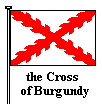 They even had ambitions of reviving the Arelate Kingdom proper and being crowned monarchs -- an aspiration that died on the battlefield at Nancy in 1477. Because of this period, Burgundian identity came to overlay much of what was properly Lower Lorraine. Although the Duchy proper reverted to France, most of the rest of the Burgundian holdings passing to the Hapsburgs, whose subsequent acquisition of Spain meant that elements of Burgundian identity, such as the knotty ("raguly") Cross of St. Andrew, ended up used by the Spanish. The Cross was even used as a patch on Spanish uniforms.
- When the Duchy of Burgundy reverted to the French Throne in 1477, it became a Province of the Kingdom that survived until the French Revolution. Then the country was divided into Departments, precisely to erase old regional loyalties and identities. For the time being, "Burgundy" entirely disappeared from the map of Europe.
- In 1982 France grouped its Departments into "Regions," which look a whole lot like the old Royal Provinces. The Duchy of Burgundy thus has become reborn as the "Region" of Burgundy (Bourgogne). The Franche-Comté has also been reborn as a Region, without, however, any recognition that it was a historic part of Burgundy also. That Western Switzerland, Savoy, the Dauphiné, Provence, and Monaco were also parts of the Burgundian heartland is almost entirely forgotten.
| Kings of Burgundy |
|---|
| Upper Burgundy | Lower Burgundy,
Provence |
|---|
| Boso | 879-887 |
| Rudolf I | 888-912 | Louis III
the Blind | 887-928
 Emperor, Emperor,
901-905 |
Italy,
899-905 |
| 912-937 | Rudolf II | Hugh of
Arles | Italy,
926-947 |
| 928-933 |
Italy,
922-926 | 933-937 |
| The Arelate Kingdom |
|---|
Conrad the
Peaceful | 937-993 |
| Fleet of Arab pirates destroyed by Romans off Provence, 941 |
|---|
| Rudolf III | 993-1032 |
| Burgundy Inherited by Conrad II the Salian |
|---|
The Kingdom of Burgundy, a feature of the area south of the Rhine and of the Rhône-Saône valley since the 5th century, when the Burgundians settled there, a common unit in the frequent redivisions of the Merovingian kingdom, and a significant part of the inheritance of the Emperor Lothar I, regained its independence with the breakup of the Carolingian Empire and remained so until the 11th century.
It is, however, not only mostly forgotten, but its name came to be applied to so many things, mostly thanks to the acquisitions of the French Dukes of Burgundy, that its identity has long been confused with many other domains. Intially divided into Upper (Jurane) and Lower Burgundy (Provence), the classic form of the unified Kingdom came about in 937, with its capital at Arles. The Roman name of Arles, Arelate, is then often used for the Kingdom.

It does not help that the history of the Kingdom is mostly during an exceedingly obscure and dangerous period, the "Second Dark Age," and that the Kings were not able to do a very good job of protecting it from the raids of Vikings from the North, Arabs from the South, and even Magyars from the East.
Luxeuil, in the far north of the Kingdom, was actually sacked by both Vikings coming up from the Seine and Arabs coming up the Rhône. On the map, we see that Magyar raids passed close by Luxeuil and might well have joined in the fun. The difference between the Magyars and the others, of course, is that they were on horseback. The raid of 910 had swung down from far in the north of Germany. Although Henry the Fowler defeated the Magyars at Riade in 933, the raids would not stop until Otto the Great inflicted a heavier defeat on them at Lechfeld (or Augsburg) in 955. There wasn't much the Burgundians themselves could ever do about any of the raiders.
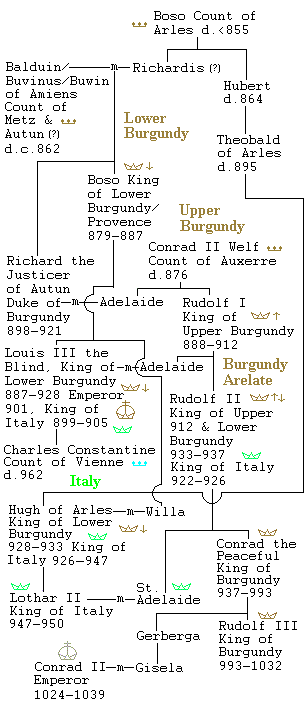
While it might sound nice to have been "Conrad the Peaceful" (Conradus Pacificus, Konrad der Friedfertiger), this was really not an era to have been peaceful in, and especially through such a long reign. However, Conrad may have been wiser than contemporaries gave him credit for, and not even entirely "Peaceful," since he seems to have arranged for the Magyars to attack the Arabs even while he was arranging for the Arabs to attack the Magyars. He then was able to clear out Arab bases in Provence with his own forces. Also, Conrad at one point received some unexpected help, from Constantinople. The Roman Navy destroyed an Arab pirate fleet off Provence in 941 -- although this was for the benefit of Hugh of Arles, who by this time was King of Italy. This may be the last time that serious power was projected from Romania so far west.
 Burgundy was never a strong kingdom, never had a distinct cultural or national identity, and was not much of a player in larger European politics, although geographically it may largely be defined by the Rhône/Saône system and their Eastern tributaries.
After the inheritance of the whole by the Emperor Conrad II, the most successful dynasty to come out of the area was the House of Savoy, which went on to unify Italy in the 19th century but, ironically, lose Savoy itself in the process. The role of the House in Italy, while the place of its origin passes to France, bespeaks the liminal or betwixt-and-between place of Burgundy in the histories of France and Italy. Modern nationalism demands a sharp break and boundary, but this is false to the history and to the cultural situation on the ground.
The story of the independence and unification of the Kingdom of Burgundy is a little complicated.  The Duchy of Burgundy had been detached, permanently, as part of the Treaty of Ribemont in 880 (or, already, in the Treaty of Verdun, in 843). The Lower Kingdom (or Provence) broke away with a Carolingian in-law, Boso (a son-in-law of the Emperor Louis II), in 879. Boso had trouble maintaining his position, and was not effectively in power for the last five years of his life. His son Louis was not able to secure the Kingdom until 890.
By then, the last unity of the Carolingian domains was lost with the death of the ineffectual Charles the Fat in 888, Upper Burgundy became independent under local nobility, Rudolf of Auxerre, a member of the house of Welf whose cousins continued for centuries as major players in German history.
Boso's son, Louis, ended up involved in Italy (899-905),  after King Arnulf of Germany had come and gone. This won him the Imperial crown from the Pope (901) and, according to some sources, a Roman wife, a daughter of the Emperor Leo VI in Constantinople.
  That was the extent of his good fortune, however. He lost the throne of Italy to one of the local players, Berengar I (a grandson of Louis the Pious), who also blinded him. Living out his years in Burgundy, he was unable to pass the throne to his son; and Lower Burgundy went to a cousin, Hugh of Arles (928). Meanwhile, Rudolf II of Upper Burgundy had entered Italy himself and overthrown Berengar (922), and Hugh had already made his own claim there too (926).
 The conflict between Rudolf and Hugh was fixed up amicably enough (933). Hugh kept Italy, Rudolf got Lower Burgundy, and Hugh's son married Rudolf's daughter. Ruldolf, however, seems to have been slow to exert authority over Lower Burgundy, where Hugh's brother Boso ruled as Count of Arles. After Hugh's death, however, Rudolf's son, Conrad, reunited the Kingdom (often called the "Arelate" after the new capital of Arles).
  Hugh also ended up with a Roman connection, with his daughter Bertha wed to the young Emperor Constantine VII. Hugh's son, King Lothar II of Italy (the Emperor Lothar I had been King Lothar I of Italy), was later overthrown by Berengar II, who, just like the villains of the old silent movie cliff-hangers, tried to force the widowed Queen, Adelaide, into marrying him. To prevent this outrage, the German King Otto I rode to the rescue, killed the villain, married the Queen himself, and then was crowned Emperor by the Pope. They became the ancestors of all the German Emperors until Conrad IV. Adelaide didn't get along with the Greek wife of her son, Otto II, and spent some years with her brother Conrad back in Burgundy. Later (1097), she was Canonized.
Burgundy lost its independence just because of the failure of the male line -- the sort of problem we see in monogamous Europe but not in  polygamous Islam or China. Rudolf III's heir became his niece, Gisela, who had married the Emperor Conrad II, who was himself a descendant of Adelaide and Otto I. This put together the classic Holy Roman Empire of the "four crowns," but
  it also made Burgundy a peripheral concern of its titular ruler.
The feudal fragmentation of the Kingdom began to erase its identity, and when parts of it began to be acquired by Aragon and then France, the process started whereby most of it would end up French. The House of Savoy, indeed, ended up with the throne of Italy, but Savoy itself was then lost to France. Only Switzerland and Monaco are today independent fragments of what had been the Kingdom of Burgundy.
The Franco-Provençal Language
There was one salient and distinguishing cultural characteristic about Burgundy. Mostly within its borders was one of the distinctive regions of the French language, consisting of the dialects of Franco-Provençal or Arpitan. These contrasted with the other principal linguistic regions of Mediaeval France, the Langue d'oïl of the North and the Langue d'oc (Lenga d'òc) or Occitan of the South. From the Langue d'oïl  (named after the word for "yes" which has become oui) of the North, we get the standard Parisian dialect of Modern French. The Langue d'oc, as "Languedoc," gave its name to a province or even to the whole South, particularly associated with the literary culture of the Provençal dialect and the political culture of the County of Toulouse.
The status of the language and the power of Toulouse were broken by the infamous Albigensian Crusade (1209-1229). The Franco-Provençal dialects (where "yes" is ouè) can be distinguished from both the Langue d'oïl and the Langue d'oc. The name "Franco-Provençal" was meant to indicate an intermediate position between French and Provençal but unfortunately tends to have the implication that the language is a form of Provençal. But the usage is now established.
On the map we see how the dialect area covers the central lands of Burgundy, including all of Savoy (the Savoyard dialect), the French speaking part of Switzerland (the Romand dialect), much of the Dauphiné and the Franche Comté, and a slice of the Duchy of Burgundy. The areas around Aosta and Susa, originally part of Burgundy and Savoy, and today in Italy, nevertheless retain, to some extent, their Franco-Provençal language. Indeed, Aosta has received autonomous status within Italy, with legal privileges and protections for its language -- Valdôtain. This is unique in the Franco-Provençal area, where the language often has little prestige or recognition.
Mostly, Parisian French has been replacing Franco-Provençal, even in Switzerland. The most prestigious form of Franco-Provençal was the dialect of Lyon (sometimes "Lyons" in English). Lyon is now one of the principal cities of France, but this has provided no leverage for the survival of its Mediaeval language. The political triumph of Parisian French leaves one with the impression that Burgundy, as a Francophone region, properly belongs, of course, to France. However, this is the result rather than the cause.
As with the Langue d'oc, what was originally a distinct language has been suppressed by the dominance of a government that was based in the North and imposed its language. The loss of the Franco-Provençal language is thus of a piece with the loss of Burgundian identity within the French State. I see that some dialect maps of France put the jurassien language with the Northern dialects rather than with Franco-Provençal. The dialect map of The Romance Languages, edited by Martin Harris and Nigel Vincent [Oxford University Press, 1988, map V, p.481], shows the Jura region within the Franco-Provençal area. Indeed, it shows more of the Franche Comté, all the way up to Alsace, with Franco-Provençal than I see on other maps. Otherwise, the Franche Comté has its own dialect of Langue d'oïl, the franc comtois, as the Duchy of Burgundy also has its own dialect, bourguignon.
As examples of the differences between Franco-Provençal and Parisian French, masculine "the" is lo, singlular, and los, plural, in Franco-Provençal rather than le and les as in French, "cheese" is fromâjo in Franco-Provençal but fromage in French, "brother" is frâre in Franco-Provençal but frère in French, "left hand" is man gôcho in Franco-Provençal but main gauche in French, "woman" in Franco-Provençal is fena but femme in French, and "moon" is lna in Savoyard but lune in French. A characteristic here seems to be that Franco-Provençal has retained clearer final vowels, as in Italian or Spanish, rather than reducing them, ultimately to silence, as in French.
Romance Languages
Culmen Franciae
A striking feature of the Kingdom of Burgundy is that it contained all of the highest mountains in Western Europe -- in Francia. They are the peaks of the Pennine Alps, the range south of the Rhône River before it flows into Lake Geneva (the Swiss Canton of Wallis/Valais). The highest point is Mt. Blanc (Monte Blanco in Italian), at 15,771 ft. (4807 meters), now on the border between France and Italy but formerly well within the County (later Duchy) of Savoy. As Mt. Blanc is the highest point in both France and Italy, the highest point in Switzerland is Mt. Rosa, Monte Rosa in Italian (the peak of the Dufourspitze in German), at 15,203 ft. (4634 m), about fifty miles east of Mt. Blanc. The origin of "Rosa" is not what we might expect, but it derives from the Franco-Provençal word rouese, "glacier," which at times has been rendered Bosa, Biosa, or Boso. From the Swiss, German speaking side, the mountain was formerly known as the Gornerhorn.
At Mt. Rosa the eastern boundary of Burgundy would more or less have followed north the present Swiss-Italian border, by the Simplon Pass and around the headwaters of the Rhône. Note that the valley of Aosta was part of Burgundy, and Savoy, though it is now in Italy. Sometimes Mt. Blanc is regarded as separate from the Pennines, although it is contiguous with that range and with no others. This is high country, perhaps not in comparison to the Andes or the Pamirs, but certainly in relation to Colorado or California. (Click on the  map for a better resolution popup.) There are at least five other peaks in the Swiss Pennines that are higher than the highest point in the 48 States (Mt. Whitney, 14,494 ft.): the Matterhorn (Mt. Cervino), 14,690 ft., Täschhorn, 14,733 ft., Weisshorn, 14,780 ft., Liskamm (Lyskamm), 14,852 ft., and Dom, 14,913 ft. Around Mt. Blanc are subsidiary peaks that can be counted also. Three of them are higher than Mt. Whitney: Mont Blanc de Courmayeur, 15,577 ft., Pointe Luis-Amadeo, 14,662 ft., and Mont Maudit, 14,649 ft. Mt. Rosa (whose principal peak in Italian is Punta Dufour) also has a subsidiary peak, Punta Ghifetti, 14,941 ft. On the other hand, Liskamm and the Täschhorn can be considered subsidiary peaks of Mt. Rosa and Mt. Dom, respectively. Burgundy also contained the Bernese Alps, north of the Rhône Valley, which rise to 14,026 ft. (4274 m) at the Finsteraarhorn (about the same height as Mt. Langley in the Sierra Nevada) -- though the Jungfrau at 13,642 ft. is more conspicuous from the north.
Apart from the Pennines and Bernese Alps, There are no other 14,000+ ft. peaks in Western Europe. If the Kingdom of Burgundy had survived until today, it could present itself as the Culmen Franciae -- in Latin, or ἡ τῆς Φραγγίας στέγη in Greek -- the "Roof" or "Summit" of Francia -- not the Culmen Europae, since peaks in the Caucasus are the highest in Europe as a whole, albeit at the very edge, between Europe and South-West Asia.
Just as noteworthy as the peaks are the passes. The Simplon Pass, at 6592 ft. (2006 m), is at the east end of the Pennines (to the east is the St. Gotthard Pass, near the sources of the Rhine, the Rhône, the Reuss, and the Aare, where a tunnel was completed in 1882 at a cost of 310 lives). My only visit to the area involved a train trip through the Simplon Tunnel, 12.45 miles long, passing from Italy to Switzerland. At the west end of the Pennines is the Little St. Bernard Pass, at 7170 ft. (2188 m). The only real road over the Pennines, even now, is the historic Great St. Bernard Pass, which reaches 8110 ft. (2469 m -- though a tunnel now bypasses the actual summit).  The comparison with the Sierra Nevada is interesting. The most famous Sierra pass is Donner Summit, at 7239 ft. This, however, is north of the really high parts of the Sierra. There, the last usable pass before a very long stretch south is Tioga Pass, at 9941 ft., which leaves Yosemite National Park to the east. I have driven across that and the Monitor Pass, at 8314 ft., which is roughly halfway between Yosemite and Lake Tahoe.
The higher passes are all, of course, closed in Winter. Keeping Donner Pass open often requires heroic snowplowing. I had long assumed that the St. Bernard passes were named after the illustrious St. Bernard of Clairvaux (1090-1153), but this is not the case. St. Bernard of Montjoux (c.996-c.1081), a much more obscure figure historically, is the eponym of the passes. A canon in Aosta, this St. Bernard had the care of the Alpine passes and did his job in a vigorous and epic fashion, founding hospices at the very summit of both St. Bernard passes and staffing them with Augustinian monks, who henceforth welcomed and rescued travelers. The familiar St. Bernard dogs were bred by the monks for help in their mountain patrols and rescues. These institutions still exist, though there is now certainly much less need for them. At the east end of the Bernese Alps, at the edge of the Kingdom of Burgundy, there is a knot of high passes that link the watersheds of the Rhine, the Rhône, the Reuss, the Aare, and the Ticino. These may be examined on a popup map linked in the treatment below of Switzerland. The highest of those passes is the Furkapass, at 7,969 ft. (2429 m), which crosses from the headwaters of the Rhône to those of the Reuss.
For a long time the 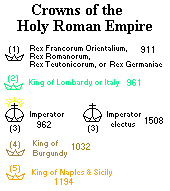 only book I could find for general information on Burgundy, both the Kingdom and the Duchy (also the County of Burgundy and Savoy), with lists, genealogies, and maps, was Phoenix Frustrated, the Lost Kingdom of Burgundy, by Christopher Cope [Constable, London, 1986; Dodd, Mead & Company, New York, 1987]. The large maps above and below are based on Cope. I could always, of course, have asked for more, but that would be ungrateful for the attention and love that Mr. Cope has devoted to a country that seems to correspond to no natural unit in modern Europe, whose memory is largely eclipsed, and whose very name has drifted elsewhere. A good narrative history of Burgundy, with genealogies, can also be found in The New Cambridge Medieval History, Volume III, c.900-c.1024 [Timothy Reuter, editor, Cambridge, 1999, pp.328-345]. Now there is also a detailed Burgundy chapter, "Burgundia: Five, Six or Seven Kingdoms (c.411-1795)" in Vanished Kingdoms, The Rise and Fall of States and Nations, by Norman Davies [Viking, 2011]. Davies is alert to the obscure and protean nature of Burgundian history and, like Cope, also devotes attention to the Franco-Provençal language.
The subsequent history of the Kingdom of Burgundy is covered by pages on the Counts of Burgundy, the Free County, the Counts of Viennois and Dauphiné, the Counts of Provence, the Counts & Dukes of Savoy and the Grimaldi Princes of Monaco. As it happens, Rudolf I of Burgundy was from the German House of Welf. In time, his cousins would play a large part in the history of Germany, become the Dukes of Brunswick and the Electors and Kings of Hanover, and finally Kings of England. The last British Welf was, of all people, Queen Victoria.
Boeuf Bourguignon
Burgundia Index
Culmen Mundi
Culmen Europae
Francia Media Index
Francia Index
Philosophy of History
Home Page
Copyright (c) 1996, 1997, 1998, 1999, 2000, 2001, 2002, 2003, 2004, 2005, 2006, 2008, 2009, 2010, 2011, 2012, 2017, 2022 Kelley L. Ross, Ph.D. All Rights Reserved
FRANCIA MEDIA, ITALY
| Kings of Italy & Emperors |
|---|
| Berengar I of Friuli | 888-891 |
| Wido (Guy/Guido) of Spoleto | Emperor,
891-894 |
| Lambert of Spoleto | Emperor,
894-896 |
| Arnulf, King of Germany | Emperor,
896-899 |
Louis III of Lower Burgundy,
III of Italy, Burgundy, & Emperor | 899-905;
Emperor,
901-905 |
| Berengar I (restored) | 905-922;
Emperor,
915-922 |
| Rudolf (II) of Upper Burgundy | 922-933 |
| Hugh of Arles | 933-947 |
| Fleet of Arab pirates destroyed by Romans off Provence, 941 |
|---|
| Lothair II of Arles | 947-950 |
| embassy of Liutprand of Cremona to Constantine VII, 949 |
|---|
| Berengar II of Ivrea | 950-961 |
| overthrown by Otto I, 961 |
|---|
Under Carolingian in-laws, Italy, meaning mainly the North of Lombardy,  reestablished a bit of an independent identity that had been lost when Charlemagne conquered the Lombards in 774. This continued to be complicated by the interests of the Popes, who wanted a strong protector but also one who would not desire the Papal enclave itself. A good protector could be honored with Imperial coronation, but a less than faithful one could find someone else called in against him.
The Popes were thus best served by external protectors -- too distant to threaten Papal independence, but ready to be called in against local threats. In this era, only one King came in from Germany, Arnulf, but there was then considerable involvement with nearby Burgundy. Crowning the local Italian princes Emperor now looks absurd and pathetic, but the practice does seem to have been abandoned after Berengar I, fighting his way back into power after being on a sidelines for a few years, was crowned in 915.
Berengar blinded Louis III of Burgundy. Just when it looked like another Burgundian house (Arles) might make Italy its own, another Berengar (the grandson of the first) took over (950). This time the German King Otto I was called in, to marry the widowed Queen (Adelaide, of Lothair II), and assume the crown of Italy (951-952). Berengar was left, however, with Italy as a fief of Germany. Predictably, he was not very obedient, and Otto returned, newly victorious over the Magyars (955), to dethrone (kill?) Berengar (961) and then be crowned Emperor by the Pope (962).
This ended the independent existence of the Kingdom of Italy, which would not be revived in similar form until Napoleon. Now the German Kings would 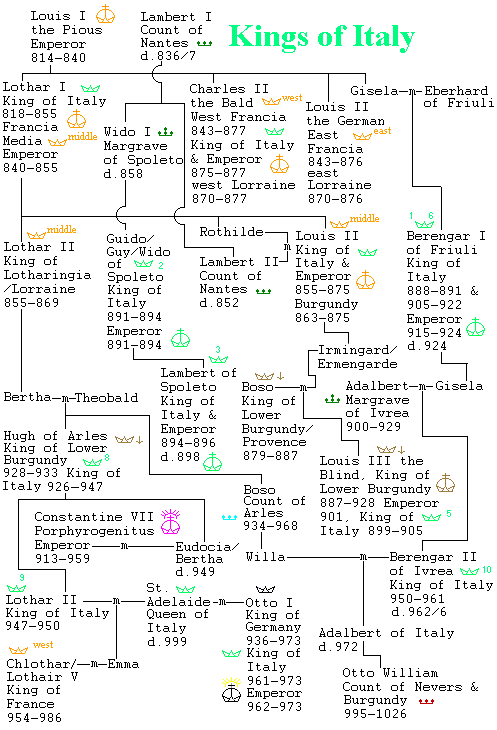 become the nearly permanent protectors and/or antagonists of the Popes, mainly serving in the long run to inhibit the growth of local power that might threaten Papal independence. This also served to keep Italy split between North and South, with the South continuing to interact more strongly with Romania and Islām.
The genealogical diagram leaves out the Emperor Arnulf and Rudolf II of Burgundy. Their descent can be examined under the Carolingians and Burgundy, respectively. St. Adelaide, it should be noted, was a daughter of Rudolf II. Since the succession jumps around so much, the Kings of Italy are numbered, next to the green crown, from Berengar I to Berengar II.
An anomaly I now find in my sources is that Gisela is listed as a daughter of Lothar I by The New Cambridge Medieval History, Volume III, c.900-c.1014 [Timothy Reuter, editor, 1999, p.702]. This contradicts Volume II of the History [Rosamond McKitterick, editor, 1995, p.858], which showed Gisela as the daughter of Louis the Pious. Now I have found confirmation of Gisela as the daughter of Louis the Pious in the Erzählende genealogische Stammtafeln zur europäischen Geschichte, Volume I, Part 1, Deutsche Kaiser-, Königs-, Herzogs- und Grafenhäuser I [Andreas Thiele, Third Edition, R. G. Fischer Verlag, 1997, p.9].
I had previously gathered that a daughter of Lothar, Rothilde, married Wido of Spoleto, King of Italy, but I now find this contradicted in that volume [p.9] and in Volume II, Part 2, Europäiche Kaiser-, Königs- und Fürstenhäuser II Nord-, Ost- und Südeuropa [Second Edition, 1997, p.169], where "Rotrud" is shown married to Lambert II of Nantes, an uncle of Wido.
| Kings of Italy |
|---|
| Victor Emanuel II | King of Sardinia,
1849-1861 |
King of Italy,
1861-1878 |
Franco-Sardinian War,
Lombardy ceded by Austria, 1859;
 Savoy & Nice ceded to France, 1860; Savoy & Nice ceded to France, 1860;
Rome occupied, Quirinal Palace official residence of the King of Italy, 1870 |
|---|
| Umberto I | 1878-1900 |
| assassinated by anarchist, 1900 |
|---|
| Victor Emanuel III | 1900-1946,
abdicated,
d.1947 |
Mussolini Dictatorship, 1922-1943;
German Occupation, 1943-1945 |
|---|
| Umberto II | 1946, d. 1983 |
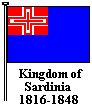 Italy remained divided until the 19th century, when unification was brought about by Sardinia. The Kingdom of Sardinia, however, was never really, by itself, a Great Power, and Austria and the other possessors of Italian territory could not be defeated without help. After disappointing results from the revolutions of 1848, help came in the form of the French Emperor Napoleon III, who could do the heavy lifting required to defeat the Austrians.
This won Milan for the House of Savoy (1859), but at the cost of Savoy itself, and Nice, ceded to France. Nice was named Nizza in Italian, was only partially French speaking, was actually the home town of Guiseppe Garibaldi (1807-1881), and so really had no business becoming part of France, as it still is. 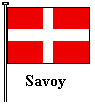 While Savoy was French speaking, this was in its own non-metropolitan, Franco-Provençal dialect, and, despite France exulting in the "reunification" of Savoy with France, it had simply never been part of Francia Occidentalis or the subsequent Kingdom of France. "Reunification" was a false and dishonest characterization of the transaction.
But now the stage was set for the unification of Italy, which was achieved in 1861. Garibaldi's conquest of the Kingdom of the Two Sicilies (1860) brought the North and South of Italy together for the first time since the invasion of the Lombards in 568 AD.  Florence became the capital of a united Italy, as Victor Emanuel II of Sardinia became the first King of an independent Italy since Berengar II in 961 -- exactly 900 years before. The country was not completely unified, however. The Pope still held out in Rome with the protection of the French Army. Napoleon III may even have thought of this as helping to secure the legitimacy of his Imperial crown. Venice also remained in the hands of Austria.
The problems of Venice and Rome would both be solved by Prussia. When Bismarck got Austria into a war in 1866, he told the Italians he could get them whatever they wanted. Just as well, since Austria was still able to defeat Italy on land and sea. So Prussia won the war anyway, and Italy got Venice. Then Bismarck got France into a war in 1870. Italy didn't join that one but benefited anyway. Napoleon III had to withdraw from Rome, and the Pope no longer could resist the Kingdom of Italy. Rome became the capital of a united Italy for the first time since perhaps the 3rd century.
Italian policy then continued to focus on Italia irredenta, "unredeemed Italy." 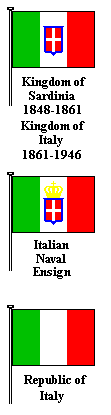 Thus, although one might think that Corsica would count as the last remaining part of historic Italy to acquire (not to mention Savoy and Nice), and even though Italy was actually an ally of Austria and Germany, it was Austria against which demands were made at the outset of World War I -- namely that any place in the Adriatic that had ever had an Italian name should be turned over. This absurd demand was rejected, and so Italy came in on the side of the Allies -- after all that Italy actually owed Prussia/Germany over the years.
Although again unable to defeat Austria in battle, the Allied victory delivered to Italy the Austrian provinces of Trent and Istria and part of the Tyrol. Much of Istria and some of the Tyrol, however, were not Italian speaking. This impropriety was corrected for Istria after World War II, but Austria was never in a position, as Yugoslavia was, to insist on such a correction. Hitler, indeed, had annexed all of the Austrian cessions after Mussolini was overthrown in 1943, but the postwar settlement restored the pre-war status quo.
Otherwise, World War II was a very bad time for Italy to return to the German alliance, and it turned out that Italy wasn't even strong enough to conquer Greece, much less contend as an equal with Germany or Britain. Clearly, it was time to focus on humdrum internal development instead of glorious adventures.
Unfortunately, as ideology had tempted the Italians into a disastrous love of Mussolini in the 20's, Italian development remained hampered by the popularity of communism after World War II. That the country has grown greatly anyway is a tribute, in part, to the ability of Italians to ignore the government and run entire businesses in an underground economy.  Because of this, it is hard to know exactly how large the economy is and what the true level of employment is. On the other hand, this does not make for as secure an environment as would be necessary for Italy to reach its true potential.
There is also the lingering problem of the cultural differences between North and South, where gangsterism, rather than entrepreneurialism, while troubling the North through its ideological political manifestations (both fascist and communist), troubles the South in the far cruder form of the continuing traditional Mafia. Extortion and blood feuds do not make for a modern economy, much less a liberal society.
The House of Savoy continues down to the present. The line of the Kings of Italy is now represented by two daughters, who would be barred from the succession by the Salic Law, which, however, has been set aside by Victor Emanuel IV, the current Pretender. At the same time, the leadership of the House is disputed by his cousin, Aimone, Duke of Aosta, who, like his father, now styles himself the "Duke of Savoy." Since that claim began in 2006, at the birth of Luisa, the second daughter of Emmanuel Philbert, the claim may rest on the issue of the Salic Law, although it would still be too early to claim priority on that basis. There are still two male heirs until the male line may be said to have lapsed. As in other such disputes between deposed nobility, this is all actually silly and pointless.
The Aosta line, however, now has the more interesting affinities, since Aimone married a Princess of both Greece and the Orléanist Pretenders to France. Through her Greek grandfather, Prince Christopher (d.1940), Olga is also related to the British Royal family -- she is a second cousin of Charles, the Prince of Wales. If one of the goals of noble marriages is to expand noble connections, Aosta has scored a solid hit in that respect. Of course, for whatever it is worth, it does not gain them any real politial traction in the modern world. Italy does not need to restore the monarchy, and there is little prospect that it ever will.
Meanwhile, we might be reminded that the Valley of Aosta (Italian Valle d'Aosta; French Vallée d'Aoste), which is an autonomous region in Italy, is one of the last fragments of the Duchy of Savoy that has not been attached to France -- although the French considered it at the end of World War II, ending an occupation at the insistence of Britain and the United States. It is the Val d'Outa in the Valdôtain dialect of the Franco-Provençal language otherwise traditional in Savoy and the South of Switzerland.
Queen Margherita, the wife and cousin of King Umberto I, 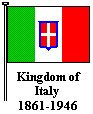 is curiously part of the history of food; and her name appears on the menu of probably every restaurant in Italy that calls itself a "pizzeria." In the United States, pizza customers ae accustomed to asking for any toppings they like on their pizzas. This is generally not the way it works in Italy. Particular toppings go with particular named pizzas. "Diavola" pizza, for instance, will have tomato sauce, cheese, pepperoni (or other spicy sausage), and perhaps even jalapeños on it. "Pizza funghi" has tomato, cheese, and mushrooms. "Pizza 4 formaggi" simply has four kinds of cheese. "Pizza al prosciutto" has tomato, cheese, and ham; etc.
The simplest pizza, often at the top of the menu, is the "Pizza Magherita," which will have just tomato sauce, cheese, and possibly visible amounts of basil on it. The legend now is that this pizza is named in honor the Queen, with the red, white,  and green elements symbolic of the flag of Italy. As with the history of many items of food, the legend does not seem to match the reality, or at least matters remain in dispute. There seem to have been pizzas, and pizzas of this type, well before the tenure, or even the life, of Queen Margherita. As a popular item of food, however, historical records about this may be thin -- although, since tomatoes come from the New World, we cannot have had tomato sauce back in the Middle Ages. Flat breads with toppings, however, can be very old, and still exist as things like the Man'ūshe in Lebanon.
On my first trip to Italy, in 1970, I found the institution of named pizzas very confusing. And the pizzas seemed small in comparison to what was familiar in the United States. My impression was that one might eat a pizza in addition to a pasta or some other dish. Now, of course, small pizzas "for one" can be found in the U.S.; and pizzas in Italy generally seem to have grown in size, perhaps under American influence. The named pizzas, however, have continued, and I see this custom maintained in Italian restaurants elsewhere, whether in Vienna or London, and now at a few even in the United States. With limited toppings, and with increased size, pizzas in Italy may not be too large to be eaten as a meal for one person. The variable there may be the thickness of the crust, which can vary. A thin crust Margherita, or even a diavola, would not be too much for one person.
Italy's first attempt to acquire colonial possessions netted Eritrea and Somalia (1889) but then encountered an ignominious check when defeated in an attempt to conquer Ethiopia in 1896. The threat to Ethiopia was renewed and conquest effected in 1936, but by then Ethiopia was a member of the League of Nations, which was supposed to prevent such aggression. Italy was then, not just one among many in a general scramble for Africa, as in the earlier era, but a nasty dictatorship waging unprovoked war against an innocent nation. The economic sanctions against Italy promoted by Britain and France were ineffective, and the whole business began to define the policy of "appeasement" which was going to give Hitler the chance to rearm Germany to a dangerous level and then to begin World War II on his own terms. After the earlier failure against Ethiopia, Italy had turned to the dismemberment of Turkey. War in 1911 won Libya, and in 1912 the Dodecanese Islands of the Aegean also.  The Italians had their hands full just subduing the Libyans. This turned out to be a mixed blessing.
When Italy entered World War II, the possession of Libya gave Mussolini an opportunity to invade Egypt and take the Suez Canal. The Italian army, however, was thoroughly defeated and driven entirely out of Cyrenaica. This embarrassment was redeemed by Hitler, who sent some German troups, henceforth the Afrika Korps, with a brilliant commander, Erwin Rommel. The great general was more than a match for the British, and more than once Rommel looked on the verge of taking Alexandria. The British knew how serious this threat was, but apparently Hitler didn't. North Africa was always a sideshow to him, despite the fact that it was the only place he was actually fighting British ground forces; and resources that would end up wasted in Russia were never diverted to a campaign that could have overturned the strategic balance in the Middle East and gravely affected the course of the War.
When the United States entered the War, and then invaded North Africa in November 1942, Rommel was overwhelmed both in Egypt and in his rear. Libya itself ended up abandoned as he retreated into Tunisia, where the final battles of the campaign were fought. Significantly, the Italians fought better under Rommel than they ever had under their own commanders. Meanwhile, Mussolini had tried invading Greece, jumping off from Albania, which he had conquered in 1939. Again, this was more than the Italians could handle, and Hitler delayed his invasion of Russia just to conquer Yugoslavia and Greece. This all was strategically a lot less important than North Africa, and it meant that the Germans did not come within sight of Moscow until snow started falling. Thus, Mussolini, through his ill considered attacks, brought Hitler one strategic opportunity, that was not sufficiency exploited, and perhaps fatally compromised Hitler's own (and ill considered) pet operation against Russia. Meanwhile, a British expedition in 1941 returned Haile Sellassie to power in Ethiopia. After the War, Italy was divested of all foreign possessions, except for a brief administration of Somaliland.
| Prime Ministers of Italy |
|---|
Count Camillo Benso
di Cavour | 1860-1861 |
| Baron Bettino Ricasoli | 1861-1862 |
| Urbano Ratazzi | 1862 |
| Marco Minghetti | 1862-1864 |
| General Alfonso La Marmora | 1864-1866 |
| Baron Bettino Ricasoli | 1866-1867 |
| Urbano Ratazzi | 1867 |
| Federigo Menabrea | 1867-1869 |
| Domenico Lanza | 1869-1873 |
| Marco Minghetti | 1873-1876 |
| Agostino Depretis | 1876-1878 |
| Benedetto Cairoli | 1878 |
| Agostino Depretis | 1878-1879 |
| Benedetto Cairoli | 1879-1881 |
| Agostino Depretis | 1881-1887 |
| Francesco Crispi | 1887-1891 |
| Marquis di Rudini | 1891-1892 |
| Giovanni Giolitti | 1892-1893 |
| Francesco Crispi | 1893-1896 |
| Marquis de Rudini | 1896-1898 |
| General Luigi Pelloux | 1898-1900 |
| Giuseppe Saracco | 1900-1901 |
| Giuseppe Zanardelli | 1901-1903 |
| Giovanni Giolitti | 1903-1906 |
| Baron Sidney Sonnino | 1906 |
| Giovanni Giolitti | 1906-1909 |
| Baron Sidney Sonnino | 1909-1910 |
| Luigi Luzzatti | 1910-1911 |
| Giovanni Giolitti | 1911-1914 |
| Antonio Salandra | 1914-1916 |
| Paolo Boselli | 1916-1917 |
| Vittorio Orlando | 1917-1919 |
| Francesco Nitti | 1919-1920 |
| Giovanni Giolitti | 1920-1921 |
| Ivanoe Bonomi | 1921-1922 |
| Luigi Facta | 1922 |
| Benito Mussolini | 1922-1943 |
| Marshal Pietro Badoglio | 1943-1944 |
| Ivanoe Bonomi | 1944-1945 |
| Ferruccio Parri | 1945 |
| Alcide De Gasperi | 1945-1953 |
| Giuseppe Pella | 1953-1954 |
| Mario Scelba | 1954-1955 |
| Antonio Segni | 1955-1957 |
| Adone Zoli | 1957-1958 |
| Amintore Fanfani | 1958-1959 |
| Antonio Segni | 1959-1960 |
| Fernando Tambroni-Armaroli | 1960 |
| Amintore Fanfani | 1960-1963 |
| Giovanni Leone | 1963 |
| Aldo Moro | 1963-1968 |
| Giovanni Leone | 1968 |
| Mariano Rumor | 1968-1970 |
| Emilio Colombo | 1970-1972 |
| Giulio Andreotti | 1972-1973 |
| Mariano Rumor | 1973-1974 |
| Aldo Moro | 1974-1976 |
Kidnapped & murdered
by Red Terrorists, 1978 |
|---|
| Giulio Andreotti | 1976-1979 |
| Francesco Cossiga | 1979-1980 |
| Arnaldo Forlani | 1980-1981 |
| Giovanni Spadolini | 1981-1982 |
| Amintore Fanfani | 1982-1983 |
| Bettino Craxi | 1983-1987 |
| Amintore Fanfani | 1987 |
| Giovanni Goria | 1987-1988 |
| Ciriaco De Mita | 1988-1989 |
| Giulio Andreotti | 1989-1992 |
| Giuliano Amato | 1992-1993 |
| Carlo Azeglio Ciampi | 1993-1994 |
| Silvio Berlusconi | 1994-1995 |
| Lamberto Dini | 1995-1996 |
| Romano Prodi | 1996-1998 |
| Massimo D'Alema | 1998-2000 |
| Giuliano Amato | 2000-2001 |
| Silvio Berlusconi | 2001-2006 |
| Romano Prodi | 2006-2008 |
| Silvio Berlusconi | 2008-2011 |
| Mario Monti | 2011-2013 |
| Enrico Letta | 2013-2014 |
| Matteo Renzi | 2014-2016 |
| Paolo Gentiloni | 2016-2018 |
| Giuseppe Conte | 2018-2021 |
| Mario Draghi | 2021-2022 |
| Giorgia Meloni | 2022-present |
The list of pre-World War II Italian Prime Ministers is from An Encyclopedia of World History; Ancient, Medieval, and Modern, Chronologically Arranged, compiled and edited by William L. Langer [Houghton, Mifflin, Company; the Riverside Press, Boston, 1940, 1948, 1952, 1960; pp. 1242-1243] and of post-World War II Prime Ministers from www.polisci.com (which now seems to have vacated its domain).
Of interest about the list of Prime Ministers is that the brief tenure so familiar in post-War Ministries has been consistently the case ever since the creation of the Kingdom of Italy. Few Prime Ministers have ever served more than a couple of years. The great exception, of course, was Benito Mussolini, who styled himself il Duce, "the Leader," but who constitutionally was never more than Prime Minister. This formally and de jure subordinate position later led Italians to blame the King for tolerating the dictatorship.
Tolerate it the King may have done, but it is not clear just what he was expected to do if he had not. King Constantine of Greece was blamed for the Greek dictatorship even thought he supported an attempted coup against it and had to flee the country. A frequent Prime Minister before Mussolini, Giovanni Giolitti (1842-1928), who never had tenure more than three years, was once asked whether it was difficult to govern Italy. "Not at all," he replied. "But it's useless." This remark is often attributed to Mussolini himself.
| Giacché, per il fascita, tutto è nello Stato, e nulla di umano o spirituale esiste, e tanto meno ha valore, fuori dello Stato.
Therefore, for the Fascist, everything is in the State, and nothing human or spiritual exists, much less has value, outside the State.
Benito Mussolini & Giovanni Gentile, Dottrina del Fascismo, "Doctrine of Fascism," 1932. |
The Italian experience in World War II was one of bitter defeats and occupation by the Allies, and then bitter defeats and occupation by the Germans. After the loss of Sicily to the Allies in 1943, Mussolini was overthrown and the new government immediately offered to surrender to the Allies. But despite this attempt to swtich sides, the Italians were at first not trusted by the Allies, who delayed accepting or helping them; but the Germans understood the situation better than their enemies. The scepticism and dithering of the Allies gave the Germans the opportunity to occupy most of Italy and restore Mussolini as dictator in the North -- he was even rescued from imprisonment by a daring German raid.
The Germans, however, now treated the Italians as enemies rather than allies, and many Italians who had fought with the Germans in North Africa and Sicily now actually found themselves in German prison camps (cf. the Lina Wertmüller movie, Seven Beauties, 1976). The results for the Allies, at the same time, were disastrous, with German resistance taking a terrible toll in central Italy, while the Italians began to experience all the joys of German rule and terror. And the Germans began to deport the Jews, although many (a greater percentage than, for instance, in the Netherlands) were protected by Italians and by the Church. Recriminations continue over this, mainly by Communists and other enemies of the Church.
The Italian surrender, however, did mean a continuity of government, unlike the later complete abolition of the government in Germany under the Allied Occupation. Mussolini himself met a grisly end, summarily tried and shot by partisans, then hung up by the heals, with his mistress, in Milan. Unlike Hitler, he was given a proper burial.  His granddaughter Alessandra, interestingly, has become active in Italian politics.
The post-War power of the Communist Party in Italian politics, together with the instability of the governments and the volatility of Italian politics in general, with periods of terrorist violence and kidnappings (like the kidnapping and then actual murder of former Prime Minister Aldo Moro in 1978), not to mention the grim reign of the Mafia in Sicily, has been a continuing source of concern for both all Italians and the Western Allies. The geopolitical danger of the Communists has passed, but their evil influence continues, and there really seems to be no more in the way of stability and consensus in Italian politics than there ever has been. Some regions, like Venice, are beginning to talk about independence.
After the tenure of a former Communist, Massimo d'Alema, in 2001 Italians voted back in colorful millionaire Silvio Berlusconi. As the Left in Italian politics reminds us of Communism, the Right reminds us of Fascism. Berlusconi was betrayed by Rightist allies in his first tenure as Prime Minister, and they actually lost power in the 2001 election. It was possible that Berlusconi would even push Liberal, free market policies, to the distress of the leftist governments in most of the European Union; but both the future and the man were very unpredictable. Italian Prime Ministers have typically failed to serve more than a year or two, but Berlusconi, serving five, seemed to spend most of his time staying out of jail.
| Presidents of Italy; Quirinal Palace official residence of the President of Italy, 1946 |
|---|
| Enrico de Nicola | 1946-1948 |
| Luigi Einaudi | 1948-1955 |
| Giovanni Gronchi | 1955-1962 |
| Antonio Segni | 1962-1964 |
| Giuseppe Saragat | 1964-1971 |
| Giovanni Leone | 1971-1978 |
| Alessandro Pertini | 1978-1985 |
| Francesco Cossiga | 1985-1992 |
| Giovanni Spadolini | 1992 |
| Oscar Luigi Scalfaro | 1992-1999 |
| Carlo Azeglio Ciampi | 1999-2006 |
| Giorgio Napolitano | 2006-2015 |
| Sergio Mattarella | 2015-present |
Just what Berlusconi was up against, besides himself, was evident after April 16, 2002, when an apparently effective general strike was staged in Italy, all to protest government moves to make it easier to fire workers. A sort of instinctive, idiotic socialism is thus revealed, despite years of experience and evidence all over Europe that the harder it is for businesses to fire workers, the more reluctant they are to hire them, or to create new jobs, giving countries with such forms of "workers' rights" persistent double-digit unemployment. This is not just an Italian problem, but the strike displays its popular basis there.
Berlusconi's finest moment may have been a statement he made, quoted below right, after the attack on America on 9/11/01, asserting the superiority of Western civilization in comparison to the present state of Islamic countries. This assertion of the plain truth was regarded as outrageous, however, both by the self-hating European Left and by those in the Islāmic world either self-deceived on the issue of its backwardness or infected with the poison of Islāmic Fascism (which had led to the attack itself). Berlusconi apologized, apparently for his ethno-centrism, but there is no good reason why he should have.
"We should be conscious of the superiority of our civilization,  which consists of a value system that has given people widespread prosperity in those countries that embrace it, and guarantees respect for human rights and religion. This respect certainly does not exist in the Islamic countries." which consists of a value system that has given people widespread prosperity in those countries that embrace it, and guarantees respect for human rights and religion. This respect certainly does not exist in the Islamic countries."
Silvio Berlusconi,
27 September 2001 |
Meanwhile, Berlusconi managed to get a law passed protecting him from judicial inquiry into his shady or corrupt business practices. This did not exactly strengthen his reputation, though it may have helped him stay in office. By late 2004 he had the longest serving Italian Government since World War II. Whether he accomplished anything substantial in reforming the economy is the question. His legal troubles ended up dominating the program of the government. In 2006, he was turned out, by a thin margin, but then returned in 2008. Afterwards, his agenda again mainly has seemed to consist of protecting himself from legal trouble, with little energy left over for constructive reforms. Quite the opposite. Italy was one of the "PIIGS," whose welfare spending has now placed it, with Portugal, Ireland, Greece, and Spain, in the sovereign debt crisis of the Euro zone. With all this going on, including a (marvelously titilating) sex scandal, it is remarkable that Berlusconi has stayed in office, although, perhaps the most like a gangster of anyone since Mussolini, that is precisely the trick.
 |
|---|
| Giorgia Meloni |
|---|
Berlusconi's luck finally ran out in 2011. Surviving no-confidence votes, he nevertheless resigned because of the continuing sovereign debt crisis involving the PIIGS. In 2011, this has now resulted in new governments in all the PIIGS countries, with changes of leadership in Greece, Italy, and Spain all within a month. Whether this will really make any difference remains to be seen. The temptation to raise taxes rather than cut spending or reform labor law and business regulation is politically viable on both sides of the Atlantic. In the United States, it is still possible to deceive the voters enough to make the privileges and undue influence of public employee unions acceptable, even though they represent an interest totally adverse to the citizens and supportive of the otherwise unpopular Big Government. The situation can only be worse given the political culture of Europe.
Conservative Giorgia Meloni has ushered in some more stable government. Sympathetic with President Trump, Meloni seems to represent more rational immigration and economic policies. It remains to be seen how far, and how successful, this will prove to be. We have already seen, as in the photograph below right, how she delt with the senile dementia of Joe Biden.
The good feeling between Meloni and Trump soured in 2026 over the war with Irān. Sensing, perhaps, public opposition, Meloni kept Italy out of helping the American effort, let alone participating, which no NATO power did. Yet, with others, Meloni is awaking to the threat of Islamism and uncontrolled immigration. The invasion of thousands of Moroccans into Spanish Ceuta in July 2026, with many shouting ʾAllahu ʾAkbar, led to Meloni suspending the right of Spaniards to cross freely into Italy. Trump has no patience for the socialists Spanish government.
 |
|---|
| Confused Joe Biden wandering off at a G7 Summit, fetched back by Giorgia Meloni |
|---|
While Mussolini's ambition was really to recreate the Roman Empire, it has often been noted that modern Italians seem to have little of the stoicism, discipline, and ferocity of the Romans. They seem, indeed, rather more like the Etruscans, as we know them from their tombs -- enjoying life, prizing decorative style, and, in general, just more excitable. Italy is now distinguished for art, architecture, music, food, and fashion, but also for the irrational vendetta, the Mafia, and even just for loud, demonstrative, hand waving arguments.
Why things should have come out this way, and Italian cultural habits developed the way they did, is a good question. As it happened, the Italians ended up as the most sensible members of the Axis. By 1943, when the cause was obviously lost, Mussolini was overthrown and surrender tendered, while the Germans and Japanese fought on until their countries were devastated. Most of the damage to Italy proper resulted from German resistance to the Allies, after the Italian surrender.
Indeed, Mussolini himself had seemed a responsible enough person that politically naive Americans, like Ezra Pound, were enamoured of both him and his regime. After developing an actual reputation as a socialist theoretician, favorably cited even by Lenin, it is hard to know exactly when Mussolini's present image as a buffoon began to take hold. His speeches, in uniform and helmet, were close to a parody of themselves.
Although originally hostile to Hitler's annexation of Austria, Mussolini was done in by his opportunism, stabbing France in the back after Hitler was clearly the winner in 1940. Hitler's genuine admiration for the founder of Fascism then temped Mussolini away from his own better nature, such as it was. With nothing whatever against the Jews, indeed at one time a bit of a Zionist, Mussolini eventually went along with Hitler's plans and allowed Italian Jews to be rounded up -- mainly after the German occupation, when Mussolini had almost no leverage against German wishes (as memorably seen in the movie, The Garden of the Finzi-Continis, 1971). He ended up paying a terrible price, as did all Italians -- not to mention Italian Jews -- though, as it happened, to the credit of Italians again, about 85% of Italian Jews were sheltered from the Nazis, including by the Church, which is given little credit for it.
Traveling in Italy in 2019, one thing was quickly noticed by our group: No trash. Yet Italy had been infamous, for decades, for trash on the streets. Somehow, without Mussolini, this had been taken care of. Venice, Florence, Rome... the cities had become as clean as Vienna.
Italia Index
Francia Media Index
Francia Index
Philosophy of History
Home Page
Copyright (c) 1996, 1997, 1998, 1999, 2000, 2001, 2002, 2003, 2004, 2005, 2006, 2008, 2009, 2010, 2011, 2013, 2014, 2016, 2017, 2018, 2019, 2022, 2025, 2026 Kelley L. Ross, Ph.D. All Rights Reserved
FRANCIA ORIENTALIS,
GERMANY
The eastern part of the great Frankish kingdom has undergone great ebbs and  flows in its fortunes, in its borders, in its identity, and in its reputation -- alternatively admired as a source of the highest culture (Mozart, Kant, Beethoven, Goethe, Thomas Mann, etc.) and the most nauseating tyranny and barbarism (Nazism).
| Fiefs of Germany |
|---|
Duchy, Electorate, & Kingdom of Bavaria
Kingdom of Prussia
Electorate & Kingdom of Hanover
Duchy, Electorate, & Kingdom of Saxony
Duchy & Kingdom of Württemberg
Margravate & Archduchy of Austria
Grand Duchy of Frankfurt
Grand Duchy of Würzburg
Margravate & Grand Duchy of Baden
County, Duchy, & Grand Duchy of Oldenburg
Principality, Duchy, & Grand Duchy of Mecklenburg
Landgravate, Electorate, & Grand Duchy of Hesse
Landgravate & Grand Duchy of Hesse-Darmstadt
Margravate & Electorate of Brandenburg
Landgravate & Electorate of Hesse-Cassel
Duchy of Brunswick
Duchy of Franconia
Duchy of Brunswick-Wolfenbüttel
Duchy & Landgravate of Thuringia
Duchy of Swabia
Principality & Duchy of Anhalt
Counts & Dukes of Berg, Jülich, Mark, & Cleves
County & Duchy of Schleswig & Holstein
County, Duchy, & Principality of Nassau
Margravate of Meißen
Archbishopric-Electorates of Mainz, Trier, & Cologne
Archbishopric of Salzburg
Principality of Liechtenstein
Principality of Hohenzollern Henchingen-Sigmaringen
County & Principality Electorate of the Palatinate
County & Principality of Lippe
County & Principality of Waldeck
County & Principality of Schwarzburg
County & Principtality of Reuß
County & Principality of Layen/Leyen
Landgravate of Hesse-Homburg
Princes of Sayn-Wittgenstein-Sayn
|
At first the most successful of the Frankish successor states, it claimed the same Imperial prize as Charlemagne did. This began to divert Frankish identity into Roman, and then German, even while the kingdom itself was clearly the least Roman part of Charlemagne's empire.
This came to seem increasingly odd as the Monarchy declined and control of Italy (let alone Burgundy) faded. But not until the Emperor Maximilian I was a formal claim made to Germania as the kingdom that had been East Francia: Das Heilige Römische Reich Deutscher Nation (1512) --  though popularly the term Dudesche Ryke (Deutsches Reich in modern German) had been used as early as the 13th century.
Meanwhile, by independent action, German settlement and conquest pushed east. Eastern German states, Brandenburg (later Prussia) and Austria, later became the nuclei for modern Great Powers, but they did not come together quickly enough to stop the march of France into Lorraine -- though they succeeded in denying her Belgium. When Prussia (or, more like it, Otto von Bismarck) did create around itself a reunified Germany, minus Austria, it had alone become more powerful than France and retrieved Alsace and part of Lorraine.
As German power waxed, however, it became too belligerent, made too many enemies (especially Britain), and finally brought down even distant America against it -- twice. The great Wars this involved, stretching from 1914 to 1945, I've called the "German Upheaval," on analogy with the surge of French power after the Revolution and under Napoleon.
At least to superficial inspection, however, the German upheaval had far more horrible and dramatic effects, the deaths of millions upon millions of people, both soldiers and civilians, including deliberate attempts at genocide, the shattering of Empires, and the passing into and out of existence of small nations. We derive the very idea of "crimes against humanity" from the behavior of Germany, in whose footsteps Putin's Russia now treads.
No Congress of Vienna ever tried to put the old pieces back together again. Indeed, the post World War II gathering corresponding to Vienna may have been the Nuremberg War Crime Trials, in which Germany's repudiation of all the standards of civilization and justice was exposed to examination. Napoleon committed his crimes, but he had no ideology of murder, as did Hitler.
All this cost Germany, not just reputation, but previous territorial gains, not only against France, but even much in the East, that dated to the Middle Ages. German unity itself was lost for 45 years in the ideological division between Free and Communist.
Now, however, Germany is again the strongest state in Europe, with a European Union coalescing around it. While this is not supposed to be a German project, many fear that Germany is very likely to end up as the senior partner in the business, however carefully arrangements are made to prevent it. Which Germany would it be? That of Goethe, or of Goebbels?
On the other hand, Germany has been weakening itself, both with damage to its energy economy, applying crackpot "Environmentalist" nostrums (especially wind turbines), and by tolerating the violence, crime, and misogyny that have been imported with refugees from Muslim countries. German Elites fear, more than anything, being called "racists" or "Islamophobes," and they are willing to sacrifice the German people and their prosperity on this politically correct scruple. This has energized the political Right, whose other complaints are not always salutary.
When Louis the Child died in 911, the Eastern Carolingian line came to a neat end. There were still Carolingians around who could have succeeded, but the German Princes elected one of their own instead.
| FRANCONIAN KING |
|---|
| Conrad I of Franconia | 911-918 |
This already was a portent for the future. The affirmation of the elective principle, athough something that might have been overcome later, wasn't; and we already have the seed of a Monarchy that ultimately would not be able to maintain even the unity of the state, much less organize its resources for the projection of external power. At the time, the defection of Lorraine on behalf of Carolingian legitimacy was not a good sign.
SAXON KINGS
& EMPERORS |
|---|
Henry I
the Fowler | 918-936 |
| defeats Magyars at Riade, 933 |
|---|
Otto I
the Great | 936-973;
King of Italy,
951;
Emperor,
962 |
| defeats Magyars at Lechfield, 955; Embassy of Liutprand of Cremona to Nicephorus Phocas, 968; Embassy of Liutprand to John Tzimisces, arranges marriage of Otto II to Theophano Scleraena, 971 |
|---|
| Otto II | 961-983;
Emperor,
967 |
| Defeated by Kalbī Amīr of Sicily at Stilo, 982 |
|---|
| Otto III | 983-1002;
Emperor,
996 |
 St. Henry II "the Saint" St. Henry II "the Saint" | 1002-1024;
Italy,
1004
Emperor,
1014 |
The weak start of East Francia, however, seemed to be soon remedied. Henry I and Otto I asserted Royal authority over the great nobles and gained great prestige, as well as an experienced fighting force, by defeating the Magyars,  who had been raiding deep into Francia for years. This was one of the tribulations of the Second Dark Age, with Magyars (a Uralic steppe people) attacking from the East by horse and Vikings and Arabs from the North and South, respectively, by boat. Henry first defeated the Magyars at Riade in 933; and then Otto did so again, decisively, at Lechfield in 955. The Magyars soon settled down as the Christian Kingdom of Hungary. Meanwhile, Charles the Simple of West Francia had granted what became Normandy to the Viking Rollo in 911.
Otto was strong enough to interfere in Italy, attaching its affairs to Germany for centuries, and to receive the Imperial Crown from the Pope. Thus, Otto created the classic Mediaeval Empire, whose very identity is a lesson in confusion and retrospection. The easiest thing is to call it "Germany," but that was not done at the time. The Kingdom was East Francia, and the Empire was the Roman Empire, both of which now sound confusing. More confusing, the Kingdom was soon called that of the Romans, as a way for the Kings to expess their claim on the Empire even before being crowned by the Pope, without which they were not legally Emperors. This is discussed more thoroughly below, but it is convenient to resolve that the Kingdom is what became Germany. The Empire is also conveniently called, retroactively, the "Holy Roman Empire" (Sacrum Imperium Romanum), though it was in practice, as the Germans themselves later thought, Germany also (claims to Italy and Burgundy were formally surrendered in 1648).

What was going to be the continuing problem for this new Empire was just money. Without much in the way of trade, cities, or industry, there just wasn't any. Without money there could be no paid army or paid administrators. For military force the Kings were thus dependant on feudal loyalty, which was rarely entirely reliable and depended on the personality of individual rulers.
For administration, however, the Kings could long use the Church, educated and self-supporting, until the Popes decided that the Church should be independent. Thus, feudalism came rather later to Germany than it did to France, but when it did come, it was with a thoroughness that made it all the more difficult for the monarchy to recover.
Even worse, where the male line of Capetians never failed in France (where even the last Kings, of the House of Orléans, were still direct male heirs of Hugh Capet), Germany was periodically left without a male heir. This preserved the elective principle of the Throne where, in the Middle Ages, nothing was easier than that any office or holding should become hereditary, as it did in France, as long as there was an obvious hereditary candidate.  The shift from the Saxons to the Salians and then to the Hohenstaufen was bad enough, but the end of the Hohenstaufen left the country without leadership altogether. The elective principle became permanent, even after the effective hereditary succession of the Hapsburgs. This rendered Germany as a whole ungovernable, as it would remain until 1871.
One might wonder what the problem was with the German Emperors failing to produce heirs. Part of it may have been their adventures in Italy, where the climate was not healthy for them and resulted in some early deaths, such as Otto II. The Capetians stuck close to home. Then there was Otto III, who failed to produce an heir in twenty years of reign. What was his problem? Was he sickly, celibate, attracted to men, distracted? We don't know, but the result was the end of the main Saxon line, and he was obviously far too distracted by Southern Italy, probably because of his Byzantine mother.
 The crown of the Holy Roman Empire is of particular interest. We see it at left, as it is preserved in the Hofburg Palace in Vienna -- since the last Emperors holding it were Hapsburgs. The oldest part of the crown seems to date from the era of the Saxon Emperors --
  although it is often said to be the Crown of Charlemagne -- and the design of the basic body of the crown is clearly of a Byzantine type, with eight vertical panels, some with images, with rounded tops.
We see much the same design in the later Crown of St. Stephen, which was given by the Emperor in Constantinople to the Kings of Hungary, who are identified thereon, in Greek, as the Kings of the "Turks."  But it is impossible that an Emperor of Romania would have made such a crown for the Ottonians, whose (Papal) claims to universal rule were not accepted. The cross seems to have been added later, and the arched bar on top no earlier than the 10th or 11th centuries. The arch was to signify, for the other monarchs of Francia, that this was an Imperial, and not just a Royal, crown. Of course, eventually the other monarchs added arches also, usually more than one, and this is now typical.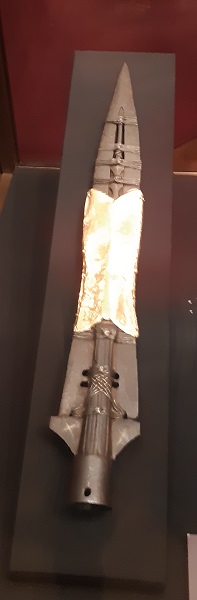
Held with the Crown in the Hofburg is a relic, variously called the "Holy Lance," the "Lance of Longinus," or the "Spear of Destiny." This is supposed to have been the spearhead that pierced the side of Christ on the Cross. However, there are other claimants to this status, and the form of the spearhead is not Roman, but Carolingian -- analysis of the metal does not date it any earlier either. This was previously held at Nuremburg, as a treasure of the Holy Roman Empire, and did not come into possession of the Hapsburgs until after the French Revolution.
Curiously, much of the lore about this relic now seems to come more from recent popular culture than from any Mediaeval traditions. The Germans had stolen it, together with the Crown, after the annexation of Austria in 1938; and what we hear now is that possession of the Spear was thought to confer invincibility. If so, that didn't work out very well, either for the Hapsburgs or for the Nazis.
But it is not clear that there was any such contemporary belief. Instead, we get comic books, leading to an interesting product like the movie Constantine [2005], starring Keanu Reeves, otherwise familar from The Matrix movies. There the Spear is said not to have been recovered after the War, but it ended up placed by the Germans under a ruined church in Mexico (perhaps stashed by the many Nazis who fled to Latin America), where it was fetched to help in a plot by the Son of Satan. Be that as it may, the power of the relic may only lie in this sort of modern confabulation.
Another version of the Spear turns up in an episode of the British-Austrian Vienna Blood television series (2019-2022). The "Darkness Rising" episode [24 December 2021] revolved around a relic held at a ficitonal monastery (the actual former monastery, the Kartäuse Mauerbach), said to be the Spear. No attempt is made to relate this artifact to the one held, at the time (which is supposed to be 1903) as now, at the Hofburg Palace. Guilt for the murder of a monk revolves around both Catholic monks and Jews, but the perpetrator turns out to be a curator at the Naturhistorisches Museum, although his concern, with historical artifacts, sounds more like a matter for the adjacent Kunsthistorisches Museum.
| SALIAN/FRANCONIAN EMPERORS |
|---|
| Conrad II the Salian | 1024-1039;
Emperor,
1027;
Burgundy,
1033 |
| Henry III the Black | 1039-1056;
Emperor,
1046 |
| Henry IV | 1056-1106;
Emperor,
1084 |
| [Rudolf of Swabia] | 1077-1080, rival |
| [Hermann of Luxemburg] | 1081-1088, rival |
| [Conrad of Franconia] | 1087-1093, rival,
d.1101 |
| Henry V | 1106-1125;
Emperor,
1111 |
| Lothar II of Saxony | 1125-1137;
Emperor,
1133 |
The Salian Emperors (from, as Dukes of Franconia, the "Salian" Franks) probably stood the best chance of maintaining Germany as a coherent and stable Kingdom, with a chance to progress easily to modernity. The domain attained its classic form when Conrad II inherited the Kingdom of Burgundy, rounding off the "four crowns" of the Emperor.
However, the use of the Church, with its literate clergy, as an arm of the government introduced a fatal flaw. The Popes wanted an independent Church, which they fought for in the Investiture Controversy of 1076-1122. An excommunicated Emperor Henry IV, standing penitently barefoot in the snow outside the Tuscan castle at Canossa, is one of the most striking images of the Middle Ages. To the Germans this would later be one of the most humiliating events in their history.
Actually, Henry was forcing the Pope's hand, since the Pope could not refuse a penitent. But the excommunication had legitimized rebellion in Germany. This, indeed, would be the pattern for many years, the Pope seeking allies in the rear of the Emperors, and it would end up gravely damaging the future of Germany. The country would enter modern times fragmented and backward. In the early 19th century this would often appear comical and harmless, but by the end of the century the country would finally reachieve unity in the most politically threatening and ominous way.
 Henry V achieved what looked like a favorable compromise to the Controversy, but the damage had been done and the precedents set. The Imperial grip in both Germany and Italy had been loosened, many concerns neglected, and the Popes knew what they could do to preserve their independence and powers, however little they were able to maintain themselves sometimes even against the people of the city of Rome.
The spirit of resistance in both Germany and Italy was heartened; the German Church began to exercise even its own territorial sovereignty (with independent states, like that of the Archbishop of Salzburg, that persisted until Napoleon); and subsequent history would be a steadily losing battle for the Monarchy. Just as bad, the lapse again of the male line perpetuated the elective principle of the Throne, which never became truly hereditary, as it had in France (in truth, nothing was easier in the Middle Ages than for things to become hereditary, if only obvious heirs existed). The elections then became a drain on the finances and even the powers of the Emperors, since sovereign concessions as well as money could be used to buy votes.
This all ended up as not much help for the Papacy either. The Pope would never command armies on the scale needed; and the pretentions of the Papacy would be punctured by the ruthless and cynical Philip IV of France. The Papacy at Avignon would become a puppet of France the way it had never been for the German Emperors. Even when the Court moved back to Rome, a line of anti-Popes kept being elected at Avignon, creating the Great Schism. Finally, a German Emperor again, Sigismund, help get things straighted out, at the Council of Constance (1415-1417).
SWABIAN/HOHENSTAUFEN
EMPERORS |
|---|
| Conrad III | 1127-1135, rival;
Italy, 1128;
1138-1152, uncrowned |
Defeats Welf VI at Weinsberg, 1140;
Second Crusade, 1147-1149 |
|---|
| Frederick I Barbarossa | 1152-1190;
Italy, 1155;
Emperor,
1155;
Burgundy, 1178 |
Defeat at Legnano, 1176;
Third Crusade, 1189-1192;
sacks Seljuk capital of Konya,
but dies fording a river, 1190 |
|---|
| Henry VI | 1169-1197;
Emperor,
1191 |
| Otto IV of Brunswick (Welf) | 1198-1212;
Emperor,
1209;
d.1218 |
| [Philip of Swabia] | 1198-1208, rival |
| marries Irene Angelina, 1197 |
|---|
| Frederick II | 1212-1250;
Emperor,
1220 |
| Fifth #2/Sixth Crusade, excommunicated both for not going on Crusade and then for going on one and negotiating the possession of Jerusalem (until 1244), 1228-1229 |
|---|
| [Henry Raspe of Thuringia] | 1246-1247, rival |
| [William of Holland] | 1247-1256, rival |
| Conrad IV | 1237-1254, uncrowned |
| [Manfred] | Regent of Sicily, 1250-1266 |
| [Conradin] | invades Italy, 1267-1268 |
| interregnum, 1254-1273 |
|---|
The Hohenstaufen (or Staufer), initially Dukes of Swabia, were the last chance to preserve a strong German Monarchy. The successes of the great Frederick Barbarossa ("Red Beard") in Germany (the defeat of Henry the Lion, the Welf Duke of Saxony and Bavaria, in 1180), however, were largely negated by the failure of his efforts in Italy. Times were changing, and northern Italian cities, developing a post-Mediaeval commercial culture, were becoming individually wealthy and powerful. Combined, as the Lombard League, their resources could easily contend with those of the whole of Germany. They defeated the Emperor at the Battle of Legnano in 1176. Since Henry the Lion had arrogantly refused any help to Frederick, he could be declared in default of his feudal obligations and, since he had made other enemies in Germany, Frederick was able to turn much of the country against him. This did not necessarily add to the strength of the Monarchy, but it did remove the greatest center of resistance to it. Unfortunately, not much was then done to pursue this advantage. Frederick went on the Third Crusade and died crossing a river in Asia Minor (1190). This remote death spawned the legend that Frederick had not died, but returned to sleep under the Kyffhäuser Mountains in Germany. In 1945 a desperate and delusional Adolf Hitler assured Germans that Frederick would awaken to deliver the country from the Allies. Frederick seems to have known better.
An Imperial Party, however, existed even in Italy, deriving its name, Ghibelline from the Waiblingen castle of the Hohenstaufen. The Papal Party, in turn, got its name Guelf, from the Welf house of Germany. When a Welf candidate, Otto of Brunswick (son of Henry the Lion), finally was elected Emperor, however, the Popes were not much better pleased at his pursuit of Imperial interests. This, however, paled beside the position of the next Hohenstaufen, Frederick II, who inherited the domain of the Popes' erstwhile allies, the Normans of Sicily and Naples. Frederick all but abandoned the position of the Throne in Germany, in order to take advantage of his powerful southern Kingdom. This worked well enough in his lifetime, but writing off Germany was of no benefit at all, and the southern Kingdom, eventually in the hands of his bastard son Manfred, was the target of every device that the Popes could bring to bear. Before long that meant Charles of Anjou, whose French invasion extinguished the house of Hohenstaufen.
 In the 12th century, which probably means under the Hohenstaufen, we get the appearance of the Vexillum Roseum Imperiale, the Blutfahne or Blutbanner, a red banner that signified the Blutgerichtsbarkeit (Jus Gladii, "Right of the Sword"), or the judicial and penal jurisdiction of the Holy Roman Empire. By the 13th century, the banner and its authority were bestowed on the Princes of the Empire, the feudal vassals and representatives of the Empire, but whose power, of course, would grow in time into virtual and then actual sovereignty. This authority was extended to the Free Cities of the Empire, and to the Canton of Schwyz in 1240 (which became the core and the eponym of the Swiss Confederation). The use of red in the various coats of arms and banners of the Empire often signified this Blutgerichtsbarkeit, as we see in the early banners of the
  Free Cities of Hamburg, Lübeck, and Danzig -- although Danzig itself was otherwise subject to the Teutonic Knights, signified by the crosses,
  and then to Poland. Poland's own flag looks like that of an Imperial state in this sense, not to mention of Switzerland itself. Indeed, the flag of Bohemia was initially identical to that of Poland, and Bohemia was an Imperial state. Unfortunately, the term Blutfahne later would refer to an artifact of the Nazi Party, a flag that supposedly was stained with blood during the failed Nazi Putsch of 1923. This "Blood Banner" was used at Nazi functions as a relic and touchstone for oaths and acts of reverence to the Party.
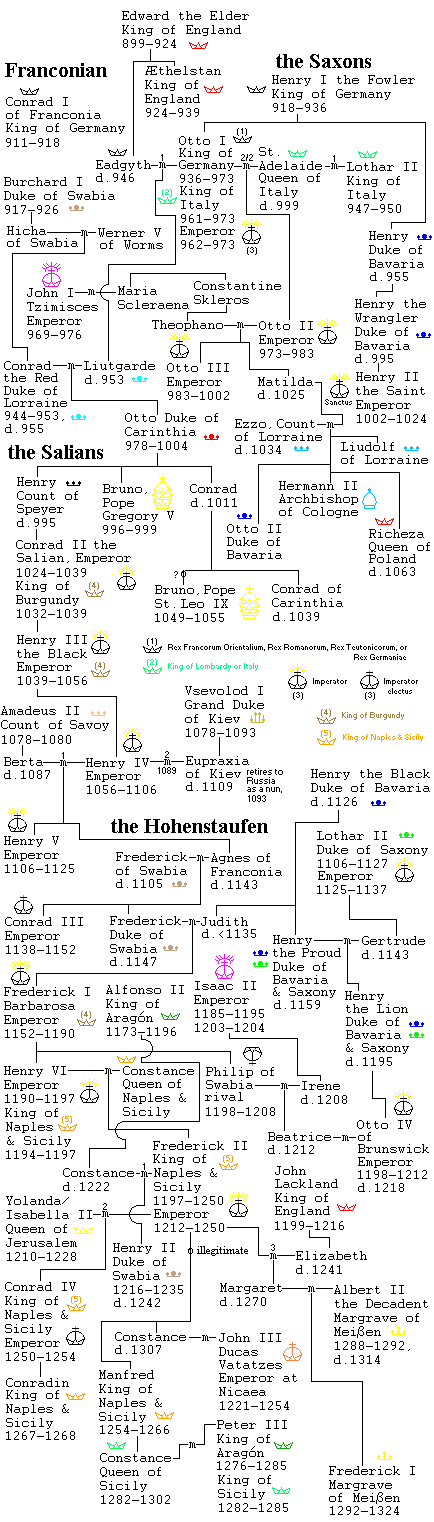 The end of the Hohenstaufen makes a natural break in the history of Germany and Italy. The German princes did not want to elect a new Emperor, and the Popes would just as soon not deal with one again. Also, the genealogy of all the Emperors to this point forms a natural unit, since they are all related, at least by marriage.
In 2023 this chart has been updated. My old sources seem to have contained some errors, and this now reflects what is given in the Erzählende genealogische Stammtafeln zur europäischen Geschichte, Volume I, Parts 1, Deutsche Kaiser-, Königs-, Herzogs- und Grafenhäuser I [Andreas Thiele, Third Edition, R. G. Fischer Verlag, 1997]. There are sometimes inconsistencies with other sources, such as at Wikipedia.
Recent changes in the diagram involve the descent of the Salians, which I thought came from Conrad I of Franconia; but now it seems they are not among his descendants. Also, Liutgard(e) of Saxony, who married Conrad the Red of Lorraine, is a daughter of Otto I by his first wife, Eadgyth of Endland, and not from Adelaide of Italy, who was his second wife. The descendants of Edward the Elder of England pass down through the Salians and Hohenstaufen and eventually to the Kings of Aragón and Spain, to the present day. The marriages of several daughters of Edward is examined under England.
A distinction is introduced in this chart not seen with the earlier, Carolingian and Italian, Emperors. The Emperors actually crowned by the Pope are indicated in the genealogical diagrams by a little yellow (Papal) nimbus around the cross of their Imperial Crown -- -- while those never crowned are shown without the nimbus. In the tables of rulers an icon of Crown and nimbus is only given with those actually crowned -- with date of coronation, usually somewhat later than the beginning of the reign, since a trip down to Rome was usually an involved and difficult undertaking. On the basis of the practice introduced with Charlemagne, no king was an Emperor without being crowned by the Pope.
While Charlemagne probably was not going to think of the Imperial dignity as contingent on the approval of the Pope (earlier, it was the confirmation of the Papal election that was contingent on the approval of Constantinople, the iussio), this is how the matter developed, in line with increasing claims of Papal authority.
As the Empire became traditional in Germany, however, the customary idea became established (no small thing, to say the least, in the Middle Ages) that the King was Emperor by right, with the crowning by the Pope a legal formality. It was never that much of a formality, since the Popes made demands, and it became increasingly difficult to exert authority in Italy, because of the resistance both of the Italians and of the Popes themselves. Consequently, so as to assert their claim without the presumption of prematurely calling themselves "Emperor," the Kings of the Eastern Franks began to call themselves "King of the Romans" (Rex Romanorum) on election. Between Henry II and Henry IV this became standard.
As the title "Rex Francorum Orientalium" lapsed, the "Rex Francorum Occidentalium" became increasingly, to himself and to others, simply the "Rex Franciae," King of France. By 1353 a German bishop was complaining about this presumption by the Western King. Eventually, the Emperors found themselves with no business and no interest in Italy, so in 1508 Maximilian I got permission from the Pope to call himself "Imperator electus." This became the official title on election from then on, and is in effect retroactively applied to the earlier uncrowned Emperors, just because we commonly call them "Emperors," which they would not have been by the practice of their own day.
Maximilian also, for the first time, called himself "Germaniae Rex," King of Germany, and so may be thought of as beginning the retrospective view that the Mediaeval Empire was the German Empire, i.e. the "First Reich," to be followed by the Hohenzollern "Second Reich" and the Hitlerian "Third." With more modest retrospection, we can simply equate "Germany" with the old East Frankish kingdom (Francia Orientalis).
The crown of Lombardy, or Italy, involved no Italian institutions or effective power and was assumed perfunctorily with the Imperial crown; so it is not indicated after Otto I acquired it through his marriage to the Italian heiress Adelaide, who had been imprisoned after her husband, Lothar II of Italy, had been murdered by Berengar II of Ivrea. Of potentially greater value was the crown of Burgundy, claimed by Conrad II by inheritance in 1032. The Kingdom, however, was off the beaten track and was neglected by the Emperors. Only four were ever actually crowned in Arles, ending with Charles IV in 1365. The other two, besides Conrad II himself, were Henry III and Frederick I, both indicated in the chart with the numbered Burgundian crown. Burgundy soon was largely in the hands of France, with Savoy and Switzerland heading for independence, though this was not formally recognized until 1648.
Crowns of the
Holy Roman Empire |
|---|
| 1 | King of Francia Orientalis,
or Germany  |
|---|
| 2 | King of Lombardy,
or Italy |
|---|
| 3 |  Emperor, conferred by the Pope Emperor, conferred by the Pope |
|---|
| 4 | King of Burgundy |
|---|
| 5 | King of
Naples & Sicily |
|---|
A fifth crown, obtained by Henry VI through marriage to Constance, daughter of Roger II of Sicily and Naples (the Regnum), was a great strategic coup. The Popes had been cultivating the Normans in southern Italy and Sicily as a counterweight to the Emperors, but now the Emperors would have that very power. The real center of the rule of Frederick II, the Stupor Mundi, "Wonder of the World," became Palermo.
Unfortunately, this meant neglect of Germany, where power flowed easily to local princes, and it persuaded the Popes that the Hohenstaufen must be destroyed at all costs. Eventually, Charles of Anjou was recruited and killed Frederick's son Manfred and grandson Conradin. Charles' triumph was brief, however, as one of the most dramatic events of the Middle Ages, the revolt of the Sicilian Vespers (1282), tore Sicily from his grasp.
Peter III of Aragón, who had married Manfred's daughter Constance, jumped in and was offered the crown of Sicily. There was little the Pope, let alone non-existent Emperors, could do about this. Sicily and Naples, never formally part of the Empire, now passed back into the dynamic of Mediterranean politics. An Emperor, Charles V, returned later only because both Sicily and Naples passed to him from his Aragonese inheritance.
The crowns of the Emperors, usually thought of as just the first three, were the subject of considerable symbolic discussion. The Sachsenspiegel (Saxon Mirror), a legal text of 1230, described them this way:
Dy erste ist tho Aken: dar kronet men mit der Yseren Krone, so is he Konig over alle Dudesche Ryke. Dy andere tho Meylan, de is Sulvern, so is he Here der Walen. Dy drüdde is tho Rome; dy is guilden, so is he Keyser over alle dy Werlt.
This is quoted by James Bryce [The Holy Roman Empire, 1904, Schocken Books, 1961, p.194], who doesn't bother to give a translation. Perhaps he thought everyone has on hand a dictionary for 13th century Low German.  The charm of the passage, however, is that it sounds just enough like English to make it look like a parody of modern German -- where Keyser over alle dy Werlt would be Kaiser über alle die Welt or Kaiser über die ganze Welt.
Of interest here is that the first crown is already said to be of the "Dudesche Ryke," i.e. the German Reich (here clearly "kingdom" or "realm," not "Empire") -- "Aken" is Aachen, the capital of Charlemagne. Italy is called "Wales" (Walen), for the same reason, being non-Germanic, as the word is used in Britain. Milan (Meylan), in Lombardy, was one of the places for the Lombard/Italian coronation. "Here" is Herr, originally "Lord," in Modern German.
Although the German crown is said to be iron and the Milanese silver, this was sometimes reversed, and the latter was typically called the "Iron Crown of Lombardy" in any case because it was supposed to contain a Nail from the True Cross. The Roman crown (gold) conferred rule of "alle dy Werlt." Unmentioned here, Burgundy was widely recognized as providing a "fourth crown"; but the Regnum of Sicily and Naples, although in effect providing a fifth crown for Henry VI, Frederick II, and Conrad IV, was not an Imperial possession long enough for this to become a traditional claim.
 Philip of Swabia, son of Frederick Barbarossa, who contended with Otto of Brunswick for the Empire, had no sons; but the marriages of his four daughters are among the most interesting in European history. In a reconciliation of their feud, his oldest daughter, Beatrice, married Otto himself. But they had no children.
The younger daughters, Kunigunde, Marie, and Elizabeth, married King Wenceslas I of Bohemia, Duke Henry III of Lower Lorraine and Brabant, and King & St. Ferdinand III of Castile and Leon, respectively. All of these marriages produced children with living descendants, especially among the Hapsburgs and the royal families of Spain, as can be traced at the linked genealogies. This is all of particular interest because of Philip's wife, Irene, who was a daughter of the Roman Emperor Isaac II Angelus. Isaac, a disastrous Emperor, himself was a great-grandson of the outstanding Emperor Alexius I Comnenus, the restorer of Romania after the Turkish invasion. This means that a large part of modern European royalty have been descendants of the Comneni. My impression is that Roman (Byzantine) Imperial descent for recent royalty has often been claimed through the Macedonians, but the only genuine line seems to be from Macedonian in-laws. On the other hand, descent from the Comneni appears to be well attested and with multiple lines, all from Irene Angelina.
| non-dynastic EMPERORS |
|---|
| [Richard of Cornwall] | 1257-1271, candidate,
uncrowned; d.1272 |
| [Alfonso X of Castille] | 1257, 1273, candidate,
uncrowned; d.1284 |
| Rudolf I of Hapsburg | 1273-1291, uncrowned |
 First Swiss Cantons, 1291 First Swiss Cantons, 1291 |
|---|
| Adolf of Nassau | 1292-1298, uncrowned |
| Swiss Confederation recognized, 1297 |
|---|
| Albert I of Hapsburg | 1298-1308, uncrowned |
| Henry VII of Luxemburg | 1308-1313;
Italy, 1311;
Emperor,
1312 |
| Swiss Confederation recognized, 1309 |
|---|
| Louis IV of Bavaria | 1314-1347;
Italy, 1327;
Emperor,
1328 |
| Swiss defeat Hapsburgs, Battle of Morgarten, 1315; Beginning of Little Ice Age, heavy rain for five years, famine, 1315-1320 |
|---|
| [Frederick of Hapsburg] | 1325-1330, rival |
Charles IV of Luxemburg
& Bohemia | 1347-1378;
Italy, 1355;
Emperor, 1355;
Burgundy, 1365 |
 the Black Death arrives at Lübeck, 1349, spreads to northern Germany, 1350 the Black Death arrives at Lübeck, 1349, spreads to northern Germany, 1350 |
|---|
Golden Bull, 1356
- Archbishop of Mainz Elector (until 1803)
- Archbishop of Trier Elector (until 1803)
- Archbishop of Cologne Elector (until 1803)
- King of Bohemia Elector
- Prince Palatinate Elector (except 1621-1648)
- Duke of Saxony Elector
- Margrave of Brandenberg Elector
|
| [Günther of Schwarzburg] | 1349, rival |
| Wenzel of Luxemburg | 1378-1400, uncrowned, d.1419 |
| Swiss defeat Hapsburgs, kill Duke Leopold III (1365-1386), Battle of Sempach, 1386 |
|---|
| Rupert of the Palatinate | 1400-1410, uncrowned |
| Sigismund of Luxemburg | 1410-1437;
Italy, 1431;
Emperor,
1433 |
| [Jobst of Moravia] | 1410-1411, rival |
| Swiss take Aargau, 1415 |
|---|
Eventually the Electors got back in action. Not long after the death of Conrad IV they had actually elected an Emperor, in fact two of them, both conveniently foreign and distant, Richard of Cornwall, brother of King Henry III of England, and King Alfonso X of Castille. There seems to have been a great deal in the way of bribery and divided electors. Richard took this seriously enough to try, hopelessly, to make a go of it. My information about Alfonso is conflicting. Either he knew better and simply stayed home to enjoy his new dignity, or his determination was distracted by domestic problems -- civil war in 1275 and rebellion by his son, Sancho, in 1282. But even Richard should not have bothered.
Rather than have Germany collapse in anarchy, a serious election and a serious candidate were finally, after 19 years, forthcoming. The fateful election of Rudolf of Hapsburg resulted. Despised by the fierce Ghibelline, Dante Alighieri, for exclusively pursuing the interests of his family and ignoring Italy altogether, Rudolf in fact did all that could be done at the time to retrieve the position of the German Monarchy. This meant promoting his family, first of all by obtaining the Duchy of Austria, henceforth absolutely identified with the Hapsburgs, but of course such a strategy eventually was vindicated by history, when the Hapsburgs became all but hereditary Emperors and had organized enough of a domain for themselves to be a Great Power, even if much of Germany was no more than nominally under their authority.
Dante would have been thrilled beyond words with Charles V, even though his power experienced frustrating limitations. For the time being, the Hapsburgs benefited from no hereditary principle, and the German Electors were suspicious enough of any revived authority of the Throne to alternate lines for a while.
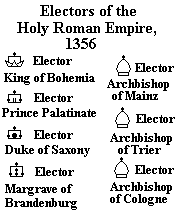 With the Elective principle of the German Monarchy now firmly established, Charles IV, through the Golden Bull, at least rendered the process regular and comprehensible. Seven Electors were specified, four secular and three ecclesiastical. As noted below, the Duke of Bavaria would eventually be added as an Elector (1623), initially as a replacement for the Prince Palatinate (1621-1648), who had been in rebellion at the beginning of the Thirty Years War. The Duke of Hanover would be made an Elector (1692), right in the middle of the War of the League of Augsburg (1688-1697).
The three ecclesiastical Electors served as "Archchancellors" of the three main divisions of the Empire. The Archbishop of Mainz for Germany, i.e. East Francia, the Archbishop of Cologne for Italy, i.e. Lombardy, and the Archbishop of Trier for "Gaul," i.e. Lorraine and Burgundy, both originally parts, with Italy, of Francia Media -- and both, of course, ultimately absorbed by France (West Francia), which was trying to restore the boundaries of Roman Gaul.
In the woodblock image from 1530, we see the Emperor in conference with the seven Electors. Curiously, all the Electors are dressed alike, and the churchmen are not in ecclesiastical robes. But they are distinguished and identified by the shields with arms at their feet.  I have added titles, color, and a popup (click on image) for clarity. Note the symmetry of the seating, with the Archbishops of Mainz and Cologne flanking the Emperor, Mainz on his right, and the Archbishop of Trier at the bottom of the image, facing the Emperor.
Without having any real effect on the history of the Empire, Napoleon added the Margrave of Baden, the Duke of Württemberg, the Landgrave of Hesse-Cassel, and the Archbishop of Salzburg, all as Electors in 1803. In the same year, however, the original eccelesiastical Electorates, Mainz, Trier, and Cologne, were all annexed by France. The Archbhishop of Salzburg was actually Ferdinand III, Duke of Tuscany, who had lost his realm in one of Napoleon's rearrangements. He would get rearranged again, as Napoleon removed him from Salzburg and installed him as Elector of Würzburg in 1806. Adding the Electorates was apparently in preparation for Napoleon being elected Holy Roman Empire, but then Napoleon simply crowned himself Emperor of the French and abolished the Empire in 1806. The Elector of Hesse-Cassel rather liked his new title and so kept it even after the end of the Empire. Ferdinand of Tuscany became Grand Duke of Würzburg until restored to Tuscany in 1814.
During this period we see the rise of the Swiss. The "Forest Cantons" of Schwyz, Uri, and Unterwalden united (1291) against the expansion of the Hapsburgs (remembered in legends like that of William Tell)  and soon were able to defeat them at Morgarten (1315). This may have seemed like a fluke, but then the Duke Leopold III was actually killed at the Battle of Sempach (1386).
What was going on? It was, indeed, the greatest triumph in history of "a well regulated Militia," and the proof of infantry with a new weapon, the pike, against the Mediaeval levy of cavalry. This created a sensation, and for more than a century Swiss mercenaries were considered essential for any serious army.
 |
|---|
| The "Cantonal Tree" in the "Swiss Court" at Leicester Square, London, to commemtorate 700th Anniversay of the Swiss Confederation, 1991 |
|---|
Swiss arms reached their peak of influence on European history when a Swiss army defeated and killed Charles the Bold of Burgundy at the Battle of Nancy (1477). Charles had been contemptuous of the Swiss peasants. This turned to the benefit of Charles' son-in-law, Maximilian of Hapsburg, who obtained most of the Burgundian lands and in short order, after another sharp defeat at Dornach (1499), accepted Swiss autonomy.
The prestige of Swiss arms reached a check when the Swiss were defeated by Francis I of France at Marignano in 1515. It was then agreed that the Swiss would henceforth only fight with France; but then Francis and the Swiss were defeated at Biocca in 1522. The Swiss decided not to fight for anyone. However, there has been an exception to this. The Swiss Guard of the Popes has continued to protect the Papacy, probably leaving many puzzled at the reason for their presence.
Since then, Switzerland has avoided external conflicts and has maintained its independence (recognized in 1648) and neutrality against all, except for occupation by Revolutionary France (1798-1815). Threats from Germany in World War II led to counter-threats to blow up the Alpine tunnels, which were the only practical reasons for Germany wanting Switzerland.
The President of Switzerland had made statements implying appeasment of Germany, but the commander of the Swiss Army firmed up and gave the Germans reasons to think twice. The Swiss Army continues, uniquely, to be the Militia of the whole citizenry; and reportedly one sometimes sees machine guns left on the street while soldiers in training take a break at a local bar. This institution is supposed to be what we see in the United States, but Congress unconstitutionally abandoned its responsbility for a "well-regulated militia" in 1903. Few American are aware of this continuing unlawfulness. Switzerland thus reminds us that a proper army of the citizens is possible in the modern world.
In legend, the actual Swiss Confederation is supposed to have begun in 1307 with an Oath by representatives of the Three Forest Cantons. This is called the Rütlischwur. It takes its name from the "Rütli," a meadow above Lake Uri near Seelisberg. Presumably, this sealed and formalized the alliance that began in 1291. However, while the Oath at Rütli is legendary, the Pact of Brunnen in 1315, after the Battle of Morgarten, is a historical treaty that accomplished the unification of the Three Cantons.
At the same time, Uri already had a special status within the Holy Roman Empire. In the 1230's, because of the opening of a route over the Alps up the Reuss River, Uri had been granted Reichsfreiheit, i.e. freedom within the Empire under only the direct authority of the Emperor, like many Free Cities and ecclesiastical domains. Once Hapsburgs began becoming Emperors, this status was apparently insufficient for the protection that the Canton desired.
There are different versions of the actual Oath at Rütli. What follows is the version of the Oath in the play William Tell [1804], by the poet and historian Friedrich von Schiller (1759-1805), famous for his "Ode to Joy" in Beethoven's Ninth Symphony, and whom I have noted in these pages for his contribution to Ethics:
 |
|---|
| Schwur auf dem Rütli, 1891, Jean Renggli (1846 1898) |
|---|
Wir wollen sein ein einzig Volk von Brüdern,
in keiner Not uns trennen und Gefahr.
Wir wollen frei sein, wie die Väter waren,
eher den Tod, als in der Knechtschaft leben.
Wir wollen trauen auf den höchsten Gott
und uns nicht fürchten vor der Macht der Menschen.
We shall be a single People of brethren,
Never to part in danger nor distress.
We shall be free, just as our fathers were,
And rather die than live in slavery.
We shall trust in the one highest God
And never be afraid of human power
Note that Knechtschaft literally means more like "servitude" and is not the normal German word, Sklaverie, for slavery.
The neutral policy of Switzerland has made it the headquarters over the years of various international organizations, such as the International Red Cross, the League of Nations, and certain United Nations agencies. The old reputation of the Swiss in battle, as we have seen, lingers in the "Swiss Guard" of the Popes, which has its costumed and symbolic function but is also the actual Vatican police force.
Since Switzerland has four official languages -- German, French, Italian, and Raeto-Romansch -- its name is often given in Latin, as the Confoederatio Helvetica (C.H.), from the local pre-Roman Celtic tribe of the Helvetii. The distribution of the languages can be seen in a popup map issued by the Swiss Federal Statistical Office in 2000. It should be enlarged to read the legend and examine the detail. Note that the area around the Walensee (which can be identified on the popup map of Swiss rivers given below), whose name implies Italian or Romance speakers, as discussed elsewhere, is now actually entirely German speaking.
The youthful principle of Thomas Jefferson, that "where annual election ends, tyranny begins," is manfest in Switzerland, where little international notice is taken of the annually elected Swiss President. You probably can't name even one.
In American politics, there is often some hand-wringing that electing Representatives every two years is too frequent. In 2021, however, it is clear that annual election would be better. Faithless legislators can do far too much damage in two years.
Only one Swiss Canton ever had a monarchical government. This was Neuchâtel, whose last Prince, Frederick William IV (1840-1848/57, d.1861), was deposed in 1848 and surrendered his claims in 1857.
| The Three Forest Cantons of 1 August 1291 | The Four Forest
Cantons, 1332 |
|---|
 Uri, 1291 Uri, 1291 |  Schwyz, 1291 Schwyz, 1291 | Unterwalden, 1291 |  Luzern, Lucerne, 1332 Luzern, Lucerne, 1332 |
 Obwalden Obwalden |  Nidwalden Nidwalden |
| The Eight Cantons of 1353 |
|---|
 Zürich, 1351 Zürich, 1351 |  Glarus, 1352 Glarus, 1352 |  Zug, 1352 Zug, 1352 |  Bern, Berne, 1353 Bern, Berne, 1353 |
| The Thirteen Cantons of 1513 |
|---|
 Fribourg, Freiburg, 1481 Fribourg, Freiburg, 1481 |  Solothrun, Soleure, 1481 Solothrun, Soleure, 1481 | Basel, Basle, Bâle, 1501 |
 Basel-Stadt, 1832 Basel-Stadt, 1832 |  Basel-Landschaft, 1832 Basel-Landschaft, 1832 |
 Schaffhausen, 1501 Schaffhausen, 1501 | Appenzell, 1513 |
 Appenzell-Innerrhoden, 1597 Appenzell-Innerrhoden, 1597 |  Appenzell- Ausserhoden, 1597 Appenzell- Ausserhoden, 1597 |
Treaty of Westphalia, Independent of the Holy Roman Empire, 1648;
French Occupation, 1798-1803, Treaty with Napoleon, 1803-1815 |
|---|
| The Cantons of 1815, Congress of Vienna |
|---|
 St. Gallen, 1803 St. Gallen, 1803 |  Graubünden, Grigioni, Grischun, 1803 Graubünden, Grigioni, Grischun, 1803 |  Aargau, 1803 Aargau, 1803 |  Thurgau, 1803 Thurgau, 1803 |  Ticino, Tessin, 1803 Ticino, Tessin, 1803 |
 Vaud, Waadt, 1803 Vaud, Waadt, 1803 |  Valais, Wallis, 1815 Valais, Wallis, 1815 |  Neuchâtel, Neuburg, 1815 Neuchâtel, Neuburg, 1815 |  Geneva, Genève, Genf, 1815 Geneva, Genève, Genf, 1815 | Canton of 1979 |
|---|
 Jura, 1979 Jura, 1979 |
Switzerland west of the Reuss River encompasses most of what remains independent of the Kingdom of Burgundy (other parts of which may be found in Monaco and a couple regions in Italy). It also encompasses most of the Culmen Franciae and the sources of the watershed of much of the Core of Francia. The Swiss rivers, lakes, principal mountain passes may be examined in a popup map. The Rhine and the Rhône both begin within a few miles of each other.
Lake Lucerne, or the Vierwaldstätter See, "Four Forest States Lake," is called that in German because it is surrounded by the original Three Forest Cantons of 1291, plus the City of Lucerne, which was the next Canton to join the Swiss Confederation. The Three Cantons alone defeated the Hapsburgs in 1315, but there were already eight Cantons by the Battle of Sempach in 1386. Some areas were actually conquered by the Swiss, like the Aargau in 1415 (including the ancestral Habsburg Castle itself), others were long time allies, such as Geneva, which freed itself from Savoy in 1526 but did not actually join the Confederation until 1815.
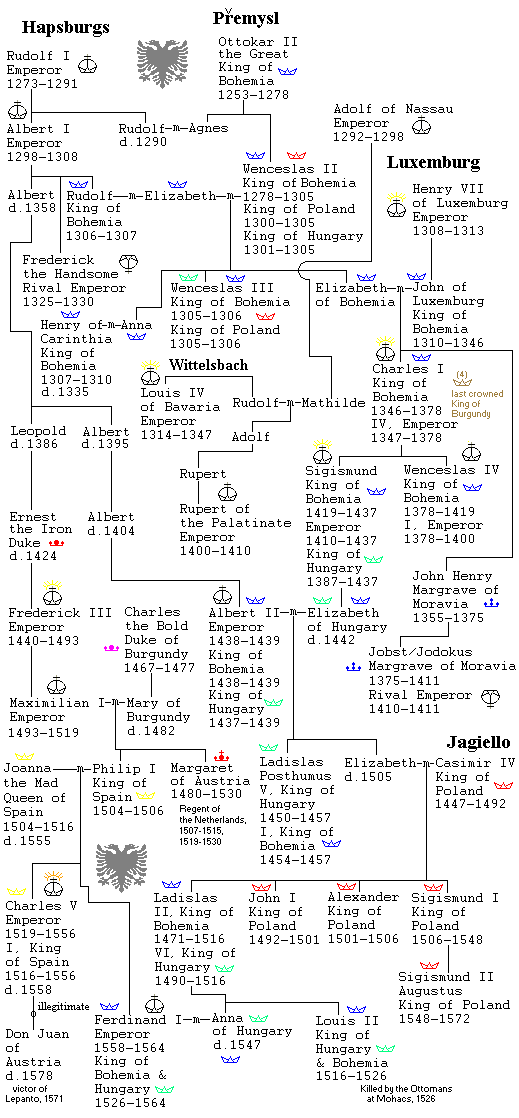 The principal rivals of the Hapsburgs turned out to be the house of Luxemburg. It was the Luxemburg Emperor
Charles IV who regularized the system of Election, and then his son Sigismund who revived the role of no less than Constantine in calling a general Church Council to end the Great Schism. All this came to naught, however, with the failure of the male line. The heiress of Luxemburg, Elizabeth of Hungary, then married a Hapsburg. That line of Hapsburgs also died out but, yes, there were others.
The principal rivals of the Hapsburgs turned out to be the house of Luxemburg. It was the Luxemburg Emperor
Charles IV who regularized the system of Election, and then his son Sigismund who revived the role of no less than Constantine in calling a general Church Council to end the Great Schism. All this came to naught, however, with the failure of the male line. The heiress of Luxemburg, Elizabeth of Hungary, then married a Hapsburg. That line of Hapsburgs also died out but, yes, there were others.
The election of Frederick III, who became the last Emperor crowned at Rome by the Pope, put the Hapsburgs in virtual hereditary possession of the title, with but one exception, for the rest of its history. The marriages then contracted for Maximilian and his heirs, with Burgundy, Spain, and Hungary, made the Hapsburgs for long the preeminant ruling family of all of Europe, turning Vienna into one of the great cities of history and one of the great centers in the history of philosophy.
As noted, Maximilian was the first Emperor to call himself Rex Germaniae, "King of Germany." We also now get the interesting characterization of the Empire as the Sacrum Imperium Romanum Nationis Teutonicae, the "Holy Roman Empire of the Teutonic [i.e. German] Nation" -- German Heiliges Römisches Reich deutscher Nation or das Heilige Römische Reich deutscher Nation.
These expressions, so full of portent for the future, are nevertheless ironic and misdirected for Maximilian, who moved the Hapsburg Court to the Low Countries -- the inheritance of his wife, Mary of Burgundy. This inaugurated a period in which the Empire was more of a European institution than it had been in several centuries,  with Emperors (Charles V, Ferdinand I) whose first language was not even German. Also, Maximilian, with no intention of being crowned Emperor by the Pope, received permission to call himself Imperator Electus, which was the de jure status of all subsequent Emperors, except, of course, Charles V.
The painting of Maximilian at right, from 1519 (Kunsthistorisches Museum, Vienna), is by Albrecht Dürer (1471-1528). Although Maximilian and his titles are identified in the inscription, we see him here without Imperial costume or signs of office. The significance of the pomegranate he holds is unclear, but otherwise he might be anyone, or a merchant, and his expression is relaxed and distant. We now see this as the genius of Dürer, but it evidently was not a hit with Maximilian himself, who might have wanted something with the loftier overtones one might expect in an Emperor. We get that in other paintings, but we may be left suspicious that this gives us more the character of the man.
HAPSBURG EMPERORS,
of "Holy Roman Empire of the
German Nation," German
"First Reich" |
|---|
| Albert II | 1438-1439, uncrowned |
| Frederick III | 1440-1493;
Italy, 1452;
Emperor, 1452;
last Emperor
crowned at Rome |
| Swiss take Thurgau, 1460; Hungarians attack Vienna, 1483-1485; take Vienna, 1485; occupied by Hungary, 1485-1490 |
|---|
| Maximilian I | 1493-1519, uncrowned:
Imperator Electus, 1508 |
| Defeat by Swiss, Battle of Dornach, Peace of Basle, de facto Swiss Independence recognized, 1499; Swiss Confederation of the "13 Cantons," 1513 |
|---|
Charles V,
I of Spain | King of Spain,
1516-1556 |
1519-1556;
Italy, 1530;
Emperor, 1530,
last German Emperor
crowned by Pope,
at Bologna; retired, 1556; d.1558 |
Conquest of Mexico, 1519-1521;  Sack of Rome, 1527; Ottoman Siege of Vienna, 1529; Conquest of Peru, 1532-1572; Peace of Augsburg, 1555: cuius regio, eius religio;
bankruptcy, 1557 Sack of Rome, 1527; Ottoman Siege of Vienna, 1529; Conquest of Peru, 1532-1572; Peace of Augsburg, 1555: cuius regio, eius religio;
bankruptcy, 1557 |
|---|
The Court of Maximilian, living off the commercial wealth of Flanders, was a center of Renaissance culture. Machiavelli did not think much of Maximilian's qualities as a ruler, but then the fruit of the actions of someone he thought of as a much better ruler, Ferdinand II of Aragón, ended up in Hapsburg hands thanks to the marriages arranged by Maximilian. This great accomplishment by dynastic marriages led to a clever poem:
Bella gerant fortes. Tu felix Austria nube.
Nam quae Mars aliis, dat tibi regna Venus. |
|---|
"The strong wage wars. You, happy Austria, marry. Thus the kingdoms that Mars gives to others, Venus gives to you." This put in the hands of Charles V the inheritance of Austria, Burgundy (meaning the French Dukes of Burgundy, of course), and the recently united Spain, with which came the empire and revenue of the New World. His own marriage to Isabella of Portugal led to his son, Philip II, claiming the throne of that country. His brother Ferdinand's marriage to Anna of Hungary led to his claim to Hungary and Bohemia.
With his vast inheritance, Charles, the last Emperor crowned by the Pope (in Bologna [1530], to avoid the awkward reminder that his Spanish army had recently sacked Rome [1527]), had to contend with France, with the Protestant Reformation, and with the Turks. The first Charles handled pretty well, even capturing King Francis I in battle at one point (1525), but did less well with the second, irritated that he had to mess with it at all, since he wanted the religious issues settled at a general Church Council (which became the Counter-Reformation Council of Trent, 1545-1563). As Emperor, he could have called his own Council, like Constantine or Sigismund, but he deferred to the Pope, who only wanted a Council to argue orthodoxy and defend the Church against heresy, not reconcile Protestants.
Charles defeated the Protestant League of Schmalkalden at the Battle of Mülhberg in 1547, but then suffered a surprise attack in the Tyrol by his own erstwhile (Protestant) ally, Maurice of Saxony in 1552. The Treaty of Passau restored the Protestant position in Germany, and then in the end Charles conceded, in the Peace of Augsburg (1555), that German princes could establish whatever Church they wanted (well, either Lutheran or Catholic, at first), on the famous principle cuius regio, eius religio, "of whom the realm, of him the religion."
 Here we see a great portrait, by Titian (d.1576) from 1548, of Charles V, the most powerful Emperor since Charlemagne, and the first, as well as the last, with vast Imperial possessions beyond Europe. He is showing some evidence of the large lower "Hapsburg Lip." Behind the lip, however, were some deformities of the jaw that led Charles to only eat in private, since he had difficulties chewing. Otherwise, his short hair and beard are characteristic of the 16th century -- long hair and goatees or Vandykes would take over in the 17th century.
Although Charles died in Spain and is thought of as German, he grew up in the Low Countries. His facility with the languages of his various possessions is commemorated in an interesting quote attributed to him, "I speak Spanish to God, Italian to women, French to men, and German to my horse" (Je parle espagnol à Dieu, italien aux femmes, français aux hommes, et allemand à mon cheval). German doesn't seem to come out too well in this. Indeed, Charles' German was never all that good.
While one might suppose that Charles learned Dutch (now called "Flemish" in Belgium) in his childhood, and indeed he is often known as "Charles of Ghent" or the Kezer Karel in Flemish, the first language of the Court was French. And not the Parisian French that is now the standard dialect for French, but the Burgundian French, le langue bourguingnonne, of the original Duchy of Burgundy, just as the distinctive Cross of Burgundy comes to be used for, of all things, Spain. Charles did learn some Dutch at the order of Maximilian, but it is not clear that he ever used it except when required for local ritual purposes in the Netherlands.
Nevertheless, the books that Charles is supposed to have kept by his bedside, besides the Bible (in Latin?), were The Courtier [1528], by Baldassare Castiglione, and The Prince [1532], by Niccolò Machiavelli. Both of these were in Italian -- Il Cortegiano and Il Principe, respectively. Presumably Charles was not discussing courtly manners and politics just with women. Charles did learn Spanish and Italian well, but Latin only poorly; and we learn that he had Castiglione's book translated into French. Even in retirement in Spain, the household language was French [cf. Emperor, A New Life of Charles V, by Geoffrey Parker, Yale, 2019, p.30].
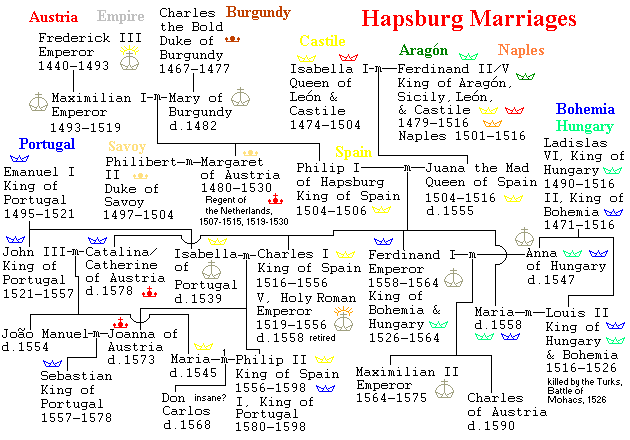
When Charles became King of Spain in 1516, he moved to Spain and founded his own capital, the hitherto unimportant town of Madrid, the meaning of whose very (Arabic) name (مَجْرِيط, Majrīṭ) is uncertain. This place had little to recommend it, except that it was centrally located. And Charles thought it would be healthy. Others weren't even sure about that, saying that it had "nine months of winter, three of hell."
Madrid began as an Omayyad fortress in the 9th century, overlooking the Manzanares River, to guard approaches to the Tagus (Tajo) valley, which contained the original Visigothic capital of Spain, Toledo, Latin Toletum. Madrid was then made the permanent capital of Spain by Philip II in 1561, although this seems odd for a place built to protect Toledo from the Christians. Nevertheless, the Archbishop of Toledo remains the Catholic Primate of Spain, Hispaniae Primas.
Meanwhile, Charles's brother Ferdinand had grown up in Spain, with a Spanish name. His eponymous grandfather, Ferdinand II of Aragón (V of Spain), toyed with the idea of leaving Aragón independently to Ferdinand, which was in his power to do. But his dislike of foreigners (Hapsburgs) ruling Spain was not as strong as his desire to preserve the unity and power of the country. Since Charles was now in charge in Spain (although his insane mother Juana, the last of the Trastámarans, remained the nominal sovereign until her death in 1555), he sent off Ferdinand to take over the German Hapsburg possessions (i.e. Austria).
Although Charles got Ferdinand crowned King of the Romans, making him Heir Apparent to the Empire, he may not have intended for Ferdinand to detach the German domains from the Spanish; but this is what happened, in part because Charles was unable pay much attention to Austria and its dependencies and also because the Germans wanted (the Spanish speaking) Ferdinand and not some foreigner(!). Also, Ferdinand, with claims to Bohemia and Hungary from his wife, Anna of Hungary, liked what he had.
Charles's third problem turned out to be a fiasco, since the Ottomans actually conquered most of Hungary (1526). This got the Hungarian and Bohemian inheritance, after some hard fighting, for Ferdinand, who had to withstand the epic siege of Vienna in 1529.
Ferdinand had occupied most of Hungary, driving back the rival King, John Zapolya of Transylvania, who had become a vassal of the Turks. The Sulṭān Süleymān I came to John's rescue, driving Ferdinand back himself. Ferdinand abandoned Vienna, but Charles sent enough troops for its defense. Süleymān was late. Heavy rains slowed his progress and forced the abandonment of much equipment, including proper siege guns. Still repulsed from the City in October, the Turks found themselves in an early snow storm. Süleymān withdrew.
Vienna thus stood as the high water mark for the Turks, as it had been centuries earlier for the Mongols (1242). But the Ottomans were at the time far too powerful to be really defeated or chased back whence they came. This would be an unsolved problem for some time -- more than a century and a half.
Charles' power, although considerable, turned out to be less effective than one might think, since his great inheritance was of many constitutionally independent realms, each with its own history, its own laws, its own local parliaments, and its own local tax systems. This made organizing a uniform and unified power a nightmare -- a problem that would persist all the days of the Hapsburgs, right down to the "dual monarchy" of Austria and Hungary.
| HAPSBURG EMPERORS |
|---|
| Ferdinand I | 1558-1564, uncrowned |
| Peace of Cateau-Cambrésis, 1559 |
|---|
| Maximilian II | 1564-1576, uncrowned |
| Rudolf II | 1576-1612, uncrowned |
| Matthias | 1612-1619, uncrowned |
| Thirty Years War, 1618-1648 |
|---|
| Ferdinand II | 1619-1637, uncrowned |
| 8. Duke of Bavaria Elector, 1623 |
| Ferdinand III | 1637-1657, uncrowned |
Peace of Westphalia, Swiss Independence,
Dutch Independence, separation of Italy
and Burgundy from Empire, 1648 |
|---|
| Leopold I | 1658-1705, uncrowned |
Second Ottoman Siege of Vienna, 1683; Conquest of Hungary, 1686-1697; Fall of Buda to Charles of Lorrine, 1686; War of the League of Augsburg (Nine Years War), 1688-1697;  Prince Eugène of Savoy (1663-1736), supreme commander of Imperial Armies, defeats Turks at Zenta, Vizier killed, Seal of State taken, 1697; War of the Spanish Succession, 1701-1713; Treaty of Karlowitz with Turks, 1699; Eugène defeats French in Italy, Battles of Carpi & Chiari, 1701 Prince Eugène of Savoy (1663-1736), supreme commander of Imperial Armies, defeats Turks at Zenta, Vizier killed, Seal of State taken, 1697; War of the Spanish Succession, 1701-1713; Treaty of Karlowitz with Turks, 1699; Eugène defeats French in Italy, Battles of Carpi & Chiari, 1701
9. Duke of Hanover Elector, 1692
|
| Joseph I | 1705-1711, uncrowned |
| Eugène defeats French in Italy at Turin, 1706 |
|---|
There were even limitations on the vast stream of silver that soon poured in from Mexico and Peru, since the Spanish economy literally was not large enough to absorb it, and a raging inflation resulted. Even so, Charles still had to borrow. This broke the Fuggers banking house when Spain defaulted on its debts in 1557. Wearied by all this, Charles retired, one of the few historic monarchs, and perhaps the first Emperor since Diocletian, to do so.
Since Charles was ruling when Mexico was conquered in 1521 and Peru in 1533, we might wonder what curiosity he might have had about these new civilizations, unknown to either the Ancient or Mediaeval worlds. It looks like he did have considerable curiosity about them; but when he was shown a great engraved golden plate from Mexico, he instructed that such things simply be melted down and not shown to him. Today this seems a shocking callousness and criminal vandalism.
But Charles, like the earlier Latin Emperors of Constantinople, needed the money. At the same time, nothing the Aztecs or Incas had to offer would have seemed like anything less than works of the Devil. In the same spirit Aztec priests, red with the blood of human sacrifice, were slaughtered, and Aztec and Mayan codices (bound books) were burned. The loss to history is appalling and incalculable, however unlikely it was that people of the era would have had a disinterested curiosity or respect for such things. Nevertheless, some did, which is why we have as much in the way of history and ethnography as we do. Codices were burned, but new ones were actually created, which we have.
With the Spanish inheritance left to his son Philip II, Charles also wanted him to receive the Imperial title and German lands. But neither the German Electors nor Ferdinand liked this; and Ferdinand did become Emperor as well as retaining Austria and its dependencies. The subsequent period continues the Golden Age of Spain, as the Spanish and Austrian Hapsburgs worked together for their own interests and for those of the cause of Catholicism.
The struggle with Protestantism, which for Spain mainly meant dealing with the revolt in the Netherlands, and then war with England, for Austrians came to mean the devastating Thirty Years War (1618-1648). This began with the marvelously named "Defenestration of Prague" in 1618. That meant throwing Austrian tax collectors out of windows. The Hapsburg response to enforce their authority became an opportunistic effort to suppress the heterodox religious practices that had been tolerated in Bohemia. The Bohemians called in Frederick V of the Palatinate to be their new King, but Frederick was defeated so quickly (1619-1620) that he came to be called the "Winter King." German Protestants did not do well in supporting the Bohemians.
 |
|---|
| "Albrecht Eusebius Wenzel von Wallenstein, Duke of Friedland and Mecklenburg," 1629, by Anthony Van Dyck (1599-1641), Bayerische Staatsgemäldesammlungen, Munich |
|---|
Imperial forces were led by able and flamboyant figures like Albrecht von Wallenstein (d.1634) and were on the verge of defeating the German Protestants more than once; but Imperial ambitions were checked first by the entry of Sweden, with her gifted warrior King, Gustavus Adolphus, and then by the cynical intervention of France, which thought that defeating the Hapsburgs was more important than defending Catholicism. It didn't help that the Emperor grew suspicious and jealous of Wallenstein and had him assassinated. See discussion of Wallenstein's name here.
When the French defeated the Spanish Army at Rocroi in 1643, it was, at the least, the symbolic end of Spanish hegemony and the beginning of French predominance in Europe. I sometimes see comments, and have repeated them myself, that the Spanish tercios were broken at Rocroi, when actually they held against both French artillery and cavalry and were allowed to leave the field with their flags and weapons. But the battle did mark the maturity of the French Army and the end of Spanish supremacy.
The end of the Thirty Years War with the Treaty of Westphalia is regarded by many as a major watershed in European history. The independence of the Netherlands and Switzerland was recognized; and the Emperor renounced the sovereignty of the Empire over Burgundy, Italy, and the Netherlands. This created a new diplomatic order, which many see as having survived perhaps all the way to the end of the Cold War, if not to the present. The possibiity that an Emperor like Charles V could restore the Empire of the Hohenstaufen, if not the Saxon Emperors, has now passed beyond retrieval. Nothing of the sort will look possible again until Napoleon.

The Siege of Vienna, 1683
In the aftermath of Westphalia, for Austria it then became a matter of holding off France, especially once Louis XIV began his wars. This was eventually effected in alliance with England, in the course of the War of the League of Augsburg (or Nine Years War, 1688-1697) and the great War of the Spanish Succession (1701-1713).
 |
|---|
| "King John III Sobieski blessing Polish attack on Turks in Vienna, 1683," 1871, by Juliusz Kossak (1824 1899) |
|---|
This was at the cost of the Spanish Hapsburg line; but the failed second siege of Vienna in 1683, directed in support of France, resulted in Hungary being liberated from the Ottomans and thus rebounded with new power, possessions, and prestige for the Hapsburgs, whose domain now grew into the "Danubian" Monarchy.
The siege of Vienna in 1683 reflected a renewed confidence by the Ottomans and the promise of aid from France. This was 154 years after the first attack on Vienna in 1529. But this turned into a disaster, suddenly revealing the relative weakness that had actually overcome the Ottoman state. At first the siege went well. The Austrians were hard pressed, and the Ottoman works, over two months, since July 14th, relentlessly approached and undermined the walls. The City could well have fallen, and would have.
Charges were set to open a large breach in the walls. Defenders were prepared to fight in the streets. However, Vienna in 1683 would have something that Constantinople in 1453 did not have, which was a significant relief and rescue force.
Every night, a rocket was fired from the spire of the Stephansdom Cathedral in Vienna. This was finally answered by a rocket from the arriving relief force.
| 𝄞 The Winged Hussars, 2016 𝄞 |
|---|
| 𝄞 When the winged hussars arrived
𝄞 A cry for help in time of need, await relief from holy league
𝄞 60 days of siege, outnumbered and weak
𝄞 Sent a message to the sky, wounded soldiers left to die
𝄞 Will they hold the wall or will the city fall
𝄞 Dedication
𝄞 Dedication
𝄞 They're outnumbered 15 to one
𝄞 And the battle's begun
𝄞 Then the winged hussars arrived
𝄞 Coming down the mountainside
𝄞 Then the winged hussars arrived
𝄞 Coming down they turned the tide
𝄞 As the days are passing by and as the dead are piling high
𝄞 No escape and no salvation
𝄞 Trenches to explosive halls are buried deep beneath the walls
𝄞 Plant the charges there and watch the city fear
𝄞 Desperation
𝄞 Desperation
𝄞 It's a desperate race against the mine
𝄞 And a race against time
𝄞 Then the winged hussars arrived
𝄞 Coming down the mountainside
𝄞 Then the winged hussars arrived
𝄞 Coming down they turned the tide
𝄞 Cannonballs are coming down from the sky
𝄞 Janissaries are you ready to die?
𝄞 We will seek our vengeance eye for an eye
𝄞 You'll be stopped upon the steps of our gate
𝄞 On this field you're only facing our hate
𝄞 But back home the sultan's sealing your fate
𝄞 We remember
𝄞 In September
𝄞 That's the night Vienna was freed
𝄞 We made the enemy bleed!
𝄞 Then the winged hussars arrived
𝄞 Coming down the mountainside
𝄞 Then the winged hussars arrived
𝄞 Coming down they turned the tide
𝄞 Storm clouds, fire and steel
𝄞 Death from above make their enemy kneel
𝄞 Shining armour and wings
𝄞 Death from above, it's an army of kings
𝄞 We remember
𝄞 In September
𝄞 When the winged hussars arrived
|
Raised by the tireless efforts of the Emperor Leopold I, 81,000 Polish, Austrian, and German troops (about half the size of the original Ottoman army) approached the city on 12 September 1683, led by the Polish King John III Sobieski (1674-1696), with his own forces, and to whom Leopold had given local command.
After a day of hard fighting, in which the Turkish Right was slowly pushed back, with Charles of Lorraine commanding the Christian Left -- as the Turks were still trying to break into the city. Sobieski, coming up later on the Christian Right, faced the Turkish Left.
The charge of Sobieski's legendary heavy cavalry, the "Winged Hussars," leading the whole cavalry force of the Christian army, was one of the largest, most dramatic, and certainly most effective cavalry charges in military history. It absolutely shattered the Ottoman army, precipitated its disorganized flight, and instantly raised the siege. There would be no organized withdrawal from Vienna for the Ottomans, as Süleymān had done in 1529. The army disintegrated in chaos. The long lances of the Hussars, against the mostly unarmored Ottoman troops, sometimes impaled more than one enemy. After the shock of the lances, the Polish cavalrymen then drew their special long swords.
The Ottoman camp was so large that it was looted for a full week. Among the booty, the victorious soldiers found coffee, from Ethiopia and Yemen, for the first time in Central Europe. The ability of the Turks to stay awake during the long siege was then attributed to this wonder drug.
The charge of the Polish Hussars seems to loom larger in recent consciousness. The Swedish heavy metal band, Sabaton, who focus on moments in military history, has done their own stirring song, at left. They have performed this to an appreciative Polish audience in Warsaw. The Poles are now alarmed and preparing for the new threat from the Russia of the hostile, criminal, and ruthless Vladimir Putin, dedicated to restoring the tyranny of the Soviet Union, which the Poles remember all too well.
We will never know what the charge of the Winged Hussars looked like. We aren't even sure they were wearing their "wings." In recent movies, the most dramatic cavalry attack may be in the third installment of The Lord of the Rings trilogy. In the Return of the King [2003], the Riders of Rohan attack the massed army of Sauron. We can see the whole formation of the cavalry of Rohan, some 6000 strong, in aerial CGI images.
However, the massed Christian cavalry at Vienna, led by the Poles, was some 18,000 -- a number that cannot be represented for movies with extras alone. Thus far, film or video has not shown us what it would have looked like, with a line that must have been some miles long. On some accounts, the Ottoman Vizir, "Black" Mustafa, was so disheartened that he already sought to call a retreat.
Unlike Sobieski's charge, this "Ride of the Rohirrim" doesn't win the battle, but it helps, and it is impressive. Th oden, King of Rohan, delivers a stirring exhortation to his army as he rides along the ranks. We have no sense that John Sobieski did this, but then Th oden doesn't bless his army, as we see Sobieski doing in the painting. Théoden is killed in the battle, while Sobieski was able to enjoy the fruits of victory. Unfortunately, this triumph engendered jealously and resentment, rather than gratitude, from the Polish nobility, who (incredibly) elected a German as the next King of Poland.
The St. Joseph s Church on the Kahlenberg heights, overlooking Vienna, was under construction in 1683. This is where the relief army formed up, the "mountainside" of the song, and its view over Vienna still draws many tourists, who otherwise may not even know about the Siege. Finished after the battle, the church has been staffed with Polish priests and now features a plaque, in German and Polish, dedicated to Sobieski.
 The characteristic French croissant, which we are expected to eat instead of a proper breakfast (although I like it fine for itself), is actually from Austria, not France. In legend, the pastry was created in a crescent shape to commemorate the defeat of the Ottoman siege of Vienna in 1683.
  However, the actual pastry, originally the kipferl, was much older, and was made in various shapes. One might argue, indeed, that the particular crescent shape originated in 1683; but there doesn't seem to be evidence for that. On the other hand, we apparently know that, in 1838 or 1839, an Austrian artillery officer, August Zang, founded a Viennese bakery, the "Boulangerie Viennoise," in Paris. The French name, croissant, then originated for what became the French pastry, whose dough formula began to diverge from the Austrian original. For the name, perhaps the French accepted the story that the shape originated in 1683.
The War of the League of Augsburg was the effort of Louis XIV to relieve pressure on the stumbling and retreating Ottomans. But this was to no avail. A succession of gifted commanders, including Charles V of Lorraine, who commanded the Left wing at Vienna (Sobieski was on the Right -- Charles would take Budapest in 1686), and culminating in the stellar Prince Eugène of Savoy, kept inflicting defeats on the Turks; and Louis made little headway against even the stolid tactics of William of Orange.
The War of the Spanish Succession
The infamous intermarriage of the Spanish and Austrian Hapsburgs can been seen on the genealogical chart below. After two Kings of Spain had married their own nieces, the result was the deformed, sickly, and sterile Charles II. It has been said that Charles V and Philip II were great Kings, that Philip III and Philip IV at least looked like Kings (with Philip IV immortalized by the great portraits of Velázquez), but that Charles II was scarcely a man. The intermarriages produced several infirmities, but most conspicuously exaggerated the swollen, even grotesque, "Hapsburg Lip" -- already evident in Charles V, even though his mother and paternal grandmother were not Hapsburgs. The lip concealed deformities of the jaw, which made eating difficult for Charles V and all but impossible for Charles II, who mostly required a liquid diet and whose speech was scarcely intelligible. The deformities suffered by Charles II might remind one of the tragic life of The Elephant Man [1980]. The end of the Spanish Hapsburg line was thus a blessing for the House of Hapsburg, which would not longer be tempted into what were really incestuous marriages.
 |
| Margarita Teresa in Mourning Dress, after the death of Philip IV, by Juan Bautista Martínez del Mazo, 1665 |
|---|
The older sister of Charles, Margarita Teresa, memorably painted many times by Velázquez and others, exhibited fewer deformities, and on his death she would have ascended the Throne of Spain. It would have complicated things that she married her uncle (again) Leopold I of Austria. But after four pregnancies, with only one child surviving, she died at 21. Since Leopold remarried, and produced male heirs, Margarita's daughter, Maria Antonia, was lined up for the Spanish Succession. Then when she died, there was her son, Joseph Ferdinand. But when he died in 1699, all bets were off.
The succession dispute could be seen coming a long way off; and when it came, as the War of the Spanish Succession, it was possibly the greatest European war until the Revolutionary Era, and comparable in some ways to the World Wars of the 20th Century. The Duke of Marlborough and Eugène of Savoy revolutionized tactics, winnng great victories against the French, but producing levels of casualties unfamiliar from previous European wars.
As the War of the Spanish Succession loomed, a nasty surprise came from Prussia -- which at the time bargained its feudal duty for the price of a royal crown, which it fixed on the Duchy of Prussia -- probably because it actually lay outside the boundaries of the Holy Roman Empire. With so much of Germany outside effective control of the Throne, it was inevitable that a rival to Austria should arise. At first, it looked like this would be Bavaria, which went over to the French in the War (until smashed by the Duke of Marlborough and Prince Eugène), and then which briefly obtained the Imperial Crown in the War of the Austrian Succession.
The last years of the Empire then left the Emperors uncomfortably sharing Great Power status with a Kingdom, Prussia, that was formally a vassal. But soon enough, the old system was swept away by Napoleon, and the Hapsburgs would reduce their pretensions to the possessions of Austria.
| HAPSBURG EMPERORS |
|---|
| Charles VI | 1711-1740, uncrowned |
| Peace of Utrecht, 1713; Eugène defeats Turks at Petrovaradin & Banat, 1716, & at Belgrade, 1717; Treaty of Passarowtiz with Turks, 1718; War of the Polish Succession, 1733-1735 |
|---|
| Maria Theresa | 1740-1780, heiress of Austria |
| War of the Austrian Succession, 1740-1748 |
|---|
| Charles VII of Bavaria | 1742-1745, uncrowned |
| Francis I of Lorraine | Duke of Lorraine, 1729-1737 |
| Duke of Tuscany, 1738-1745 |
| 1745-1765, uncrowned |
| Seven Years War, 1756-1763 |
|---|
| Joseph II | 1765-1790, uncrowned |
| Leopold II | 1790-1792, uncrowned |
| Francis II | 1792-1806, uncrowned;
last "Holy Roman" Emperor |
I, Emperor of Austria,
1804-1835 |
10. Margrave of Baden Elector, 1803
11. Duke of Württemberg Elector, 1803
12. Landgrave of Hesse-Cassel Elector, 1803
13. Archbishop of Salzburg Elector, 1803-1806
13. Duke of Würzburg Elector, 1806
Napoleon abolishes Empire, 1806
|
The Emperor Charles VI, originally the Hapsburg Pretender to Spain, after the death of Joseph Ferdinand, was left without male heirs, and spent a good part of his time getting everyone to agree to the "Pragmatic Sanction," whereby the Salic Law was set aside and his daughter, Maria Theresa, could inherit the possessions of Austria. Accepted by all, Maria Theresa's succession was nevertheless cynically disputed by Frederick of Prussia once it could be seen to provide a pretext for aggression.
When Frederick II fell on Silesia in 1740, starting the War of the Austrian Succession, on the (Machiavellian) pretext of disputing the female succession of Maria Theresa to Austrian possessions, it became clear who the real rival to Austria would be. It was because of Prussian arms that the Imperial election was subverted, with Charles VII of Bavaria becoming the only non-Hapsburg Emperor after Sigismund of Luxemburg -- later, a new Imperial Germany would be the creation of Prussia.
Despite the loss of Silesia to Frederick, the Empress otherwise maintained the Austrian position and proved herself a great leader in her own right, completely eclipsing her weak, or perhaps just ordinary, husband, Francis I. But, by marrying Francis, Maria Theresa joined a line of descent from the Emperor Andronicus II Palaeologus, by way of the Palaeologi of Montferrat and the Gonzagas of Mantua. This can be examined in a popup.
At the same time, with the previous marriage into the Spanish lineage, the Hapsburgs had joined an older line of descent from the Emperor Alexius I Comnenus. That can be examined in this popup. The key connection there was the marriage of Eudocia Comnena to the Count of Montpellier, and hence their daughter to Pedro II of Aragón. There were many such foreign marriages by the Comneni. Note that the Dicephalic Eagle was introduced by the Palaeologi, although it then came to used for both the Holy Roman, the Russian, and Austrian Empires.
Meanwhile, the first non-Hapsburg Holy Roman Emperor in a long time was elected, Charles VII of Bavaria, who was a half-brother of Joseph Ferdinand, but only closely related to the Hapsburgs through his wife, a daughter of Emperor Joseph I. With the end of the Empire, Austria continued as an independent Great Power, and Germany was reorganized as the German Confederation.
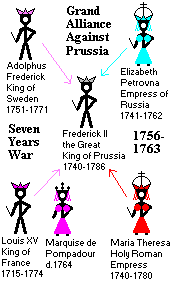 The Seven Years War
After retrieving the situation only at the cost of Silesia, Maria Theresa effected an epic "revolution in alliances," trading Britain for France, to surround Prussia with enemies -- including Russia & Sweden. The resulting Seven Years War (1756-1763) was a near thing for Frederick the Great of Prussia, but it did not defeat him. The King of Sweden was a reluctant participant, but the Swedish parliament wanted to retrieve Pomerania from Prussia. This resulted in an effort that was only threatening to Frederick when the Russians helped the Swedes, folding the "Pomeranian War" (1757-1762) into the larger conflict.
In the end, Frederick's lucky break was the death of the Empress Elizabeth of Russia, which took Russia right out of the War -- Tsar Peter III admired Frederick. What the War damaged the most was France, which lost its colonial empire and its solvency -- the seed of the French Revolution. In retrospect, one of the most striking things about the War was the alliance of three women -- Maria Theresa, Elizabeth, and with Madame de Pompadour urging on King Louis XV of France. She gets blamed for that; but on paper the business looked like a sure thing. It was just that no one could have reckoned on the genius of Frederick on the battlefield.
The Imperial crown shown for Charles V in the genealogy below has an orange rather than a yellow nimbus. This is to indicate that he was in fact crowned Emperor by the Pope, the last one, but there was the irregularity that this was done in Bologna rather than in Rome.
The lower part of the diagram shows the descendants of the Archduke Charles, Duke of Teschen. Visitors to Vienna will find two equestrian statues in the Heldenplatz, the "Hero's Plaza," that lies in front of the Neue Burg, the newest wing of the Hofburg Palace. 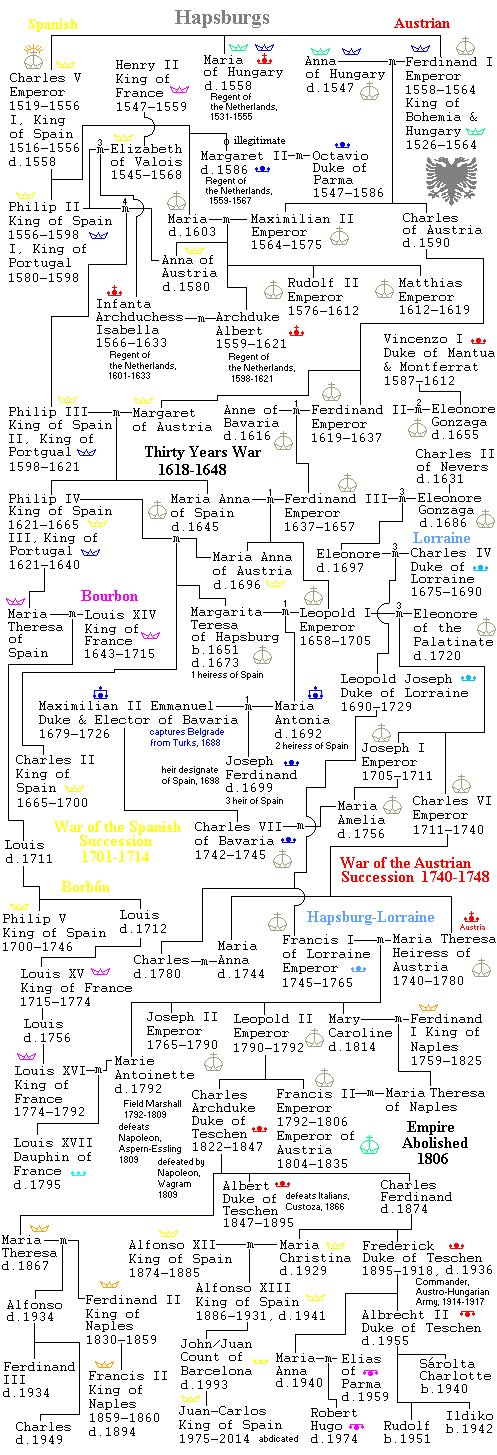 One is of the immortal Prince Eugène of Savoy, the other is of the Archduke Charles. Charles was the commander of Austrian armies against the French revolutionaries and against Napoleon. He was successful with the former and actually defeated Napoleon at the Battle of Aspern-Essling in 1809. Shortly afterwards, Charles was then defeated by Napoleon at Wagram. If one is going to be defeated by Napoleon, however, Wagram was not a bad way for it to happen. The Austrians were able to retreat in good order, and the causality count, perhaps 80,000 altogether, made the clash close to a Pyrrhic Victory for the French.
However, Austria, from her losses, was unable to continue the struggle, and Napoleon secured the favorable Treaty of Schönbrunn (1809). Austria was out of the War. Charles retired, either from disfavor or exhaustion. When the War started up again in 1813, he was not restored to command. In retrospect, Charles may have been too unimaginative to compete with Napoleon as an equal. He seems to have been more worried about holding positions than destroying the enemy's army. The latter involves more risk than many commanders are comfortable with, as when Eugène and Marlborough went straight at the French, to their astonishment, rather than waiting or maneuvering, at Blenheim.
If Austria wanted successful commanders, I might have preferred Albrecht von Wallenstein rather than Charles to be featured on the Heldenplatz. Of course, the Austrians had Wallenstein assassinated, and they can have felt guilty about that. But no more colorful and interesting a character ever commanded an Imperial Army, far more memorable than the Archduke Charles.
The descendants of Charles commanded later Austrian Armies, including in World War I, and they then intermarried with European royalty and nobility. King Juan Carlos of Spain, and the new King Philip VI, are thus descendants of Charles of Teschen. Spanish royalty visiting Vienna may see the Heldenplatz and reflect on their ancestor.
The Heldenplatz remains a bit of embarrassment to the Austrians, since the spacious balcony of the Neue Burg was used by Adolf Hitler to announce the union of Austria with Germany, the Anschluß, in 1938 -- before enthusiastic crowds. Only Elie Wiesel (1928-2016) has been allowed to speak from there since 1945, and it is not even open to the public.

The contempt and derision of historians for the Austro-Hungarian Empire is often palpable. The multi-national, polyglot personal domain of the Hapsburgs -- "despotism tempered by inefficiency" -- came to seem so anachronistic, unnatural, and absurd in the 20th Century that its continuation so long is taken as an offense against every rational criterion of history.
This attitude began before the demise of the Empire, since its "Royal and Imperial" (Königlich Kaiserlich) abbreviation, K.K. ("Ka Ka" in German), began to be used as a term for absurdity both in and outside the Empire. This then gets confused with kākā in Hawaiian, which can mean "excrement," though this is glossed by Pukui and Elbert as "a euphemism, taught to children" [Mary Kawena Pukui & Samuel H. Elbert, Hawaiian Dictionary, Hawaiian-English, English-Hawaiian, University of Hawaii Press, 1973, "kākā," pp.109-110].
The breakup of the Empire after World War I, however, led to consequences, down to the present, that hardly seem a vindication of the alternative political arrangements that followed. Instead, one might remember Tallyrand's remark that if Austria didn't exist, we would have to invent it. The messiness of states based on ethnicity or language, in an area of great mixtures and interpenetrations of ethnic, linguistic, and religious communities, has produced a record of conflict whose rationality is in no way evidently superior to the personal union of the communities under the venerable Hapsburgs.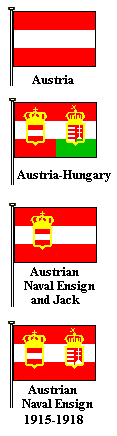
And while the Empire may be thought of as tottering, weak, and vulnerable because of its defeat by Prussia in 1866 and its collapse after World War I, a case can also be made that, although it was not a first rate power, it really wasn't all that weak. Thus, although quickly defeated by Prussia in 1866, Austria had no difficulty fighting a second front and inflicting decisive defeats, on land and sea, against Italy.
One of those 1866 victories was the most important naval battle that occurred between Trafalgar in 1805 and Tsushima in 1905: the Battle of Lissa, which was the first fleet action between armored and steam driven warships. The climax of the battle came when the Austrian flagship, the Erzherzog Ferdinand Max, rammed and sank the Italian flagship Re d'Italia.
HAPSBURG EMPERORS,
of "Austrian Empire" |
|---|
Francis (II)
/Franz | 1804-1835 | last
"Holy Roman"
Emperor |
| Ferdinand | 1835-1848, d.1875 |
| Franz Josef | 1848-1916 |
Empress Elisabeth of Bavaria
assassinated by anarchist, 1898 |
|---|
| Karl | 1916-1918 | last Austrian
Emperor, one
of last 2
Emperors
in Francia |
Provisional Government, 1918-1920;
Union with Germany, 1919 |
|---|
It was the general expectation that the introduction of armor and steam had restored the ancient tactics of oar driven ships. Battleships thus commonly came to be built with rams. Although these proved to be more difficult to use than expected, the climax of Lissa demonstrated the seriousness of the weapon, as earlier the ramming of United States ships by the Confederate ironclad Virginia had also.
Nevertheless, like Austria itself, the value of Lissa has subsequently been discounted. Since there weren't any more fleet actions until the Sino-Japanese (1894-1895) and Russo-Japanese (1904-1905) Wars, no real use of the weapon or its tactics could be made. Instead, the ram proved more of a danger to its friends, as in 1893 the British battleship Victoria was sunk in a collision with the Camperdown while on a routine maneuver.
When the next fleet action occurred, the development of slow burning powder, long barrels, and long ranges for naval guns in the meantime enabled battles like Tsushima to be decided long before the ships came anywhere near actual contact: The Russians opened fire at 18 kilometers and the Japanese at 14. Although this has nothing to do with the guns available in 1866, Lissa nevertheless gets belittled as somehow, anachronistically, involving the wrong tactics. No one, indeed, would ever expect the Austrian navy to have gotten it right. That the Austrians were later the first to introduce the self-propelled torpedo, ushering in a whole new dimension of naval warfare, is then conveniently forgotten.
If Austria did just fine against an arguably more "modern" state like Italy in 1866, its performance in World War I still looks reasonable. Unlike any other combatant, Austria-Hungary had to fight a war on three fronts: with the Italians again, the Russians, and against the Allied states, like Greece and Serbia, in the Balkans. Again, even after fifty years of development, the Italians made no headway. The Russians did rather better, but then German victories helped take off some of the pressure. 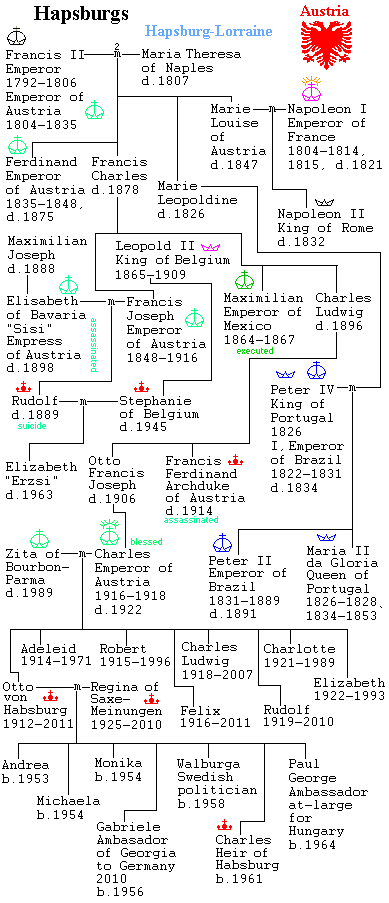 In the Balkans, Austria initially was unable to successfully invade Serbia -- a testament to weakness if ever we wanted one. German help was required; but then Austria and Bulgaria managed to occupy most of Romania and Albania, all of Serbia and Montenegro, and a bit of Greece.
This was rather better than what Italy alone would be able to do in World War II in the same area, and was accomplished despite what one might imagine as ethnic dissention, if not sabotage, in the Austrian army. Late in the war, the addition of a couple of German divisions on the Italian front made for a breakthrough that almost reached Venice.
Austria's constant need for German help, however, left the Germans with the feeling that Austria as a ally was almost as bad as Austria as an enemy. One bitter German remark was that it was like carrying a corpse. The end of the War, indeed, swiftly led to death being pronounced for the Empire.
One of the more interesting features of World War I for Austria was the Naval base in the Gulf of Cattaro, at the extreme southern end of Dalmatia -- marked on the map of Austria-Hungary below. The campaign around this point, adjacent to Montenegro, is recounted under the treatment of Montenegro. This interesting location, previously known by its Italian name, would have been Kotor if it had remained part of Dalmatia and ultimately gone to Croatia, and so spelled in the Latin alphabet, like Croatian. However, after World War I it was attached to Montenegro, as part of Yugoslavia and now independent, where the language is Serbian, using the Cyrillic alphabet, giving us the name Котор. Its story, like that of the Austrian Navy itself, is pretty much swallowed up by history.
If Austria managed to stumble through a few years of World War I without collapse, it began with a terrible failure in what used to be its forte -- diplomacy. The whole war started because Austria would not take "yes" for an answer from the Serbs. Serbia had been wisely advised by the Russians to accept the Austrian ultimatum that had followed the assassination, with Serbian complicity, of the Archduke Francis Ferdinand in 1914, however outrageous and humiliating it was. The Serbs did not unequivocally accept the whole ultimatum, but it was enough that it should have at least mollified the Austrians.
The Austrians, however, made outrageous and humiliating demands in the expectation that they would be refused. When they weren't entirely, Austria went to war anyway -- the Austrian ambassador had actually left Belgrade before the deadline of the ultimatum. This would be a war that was ultimately Germany's to lose and America's to win. No one, of course, knew how catastrophic the conflict would be, but it is hard to imagine the Austria of Metternich deliberately setting off a conflict of such proportions just to get something more than what had even been asked for. The real absurdity of the "Dual Monarchy" was not its incommensurability with nationalism (however much the tide of the age), but this finally embarrassing and blockheaded statesmanship. After Metternich had helped negotiate a century of general peace in 1815, the failures of 1914 and 1919 must have been particularly galling to his spirit -- even apart from the mass death that attended them.

Philosophical Vienna
It is hard now to think of the last days of Austria-Hungary without recollecting the intellectual and artistic productivity of Vienna,  although this was not always to good effect. The Logical Positivism of the "Vienna Circle," although of substantial and formative influence, was no blessing; and the heritage of Ludwig Wittgenstein was really little better. But both Karl Popper, who was sometimes confused with the Positivists, and F.A. Hayek were not only great philosophers but thinkers with a connection to the Friesian School -- and, despite the general sense of Logical Positivism being discredited, we should note the disparagment of Popper by Martin Gardner on behalf of the formidably dogmatic Positivist Rudolf Carnap (1891-1970) -- on my short list for the worst philosopher in history.
Carnap ended up at one of my own schools, UCLA, while I was actually there (1968-1969) -- though I never met him and wouldn't have known what to say if I had. Ludwig von Mises (1881-1973), whose personal papers were successively stolen by the Germans and then by the Russians, to reappear after the fall of the Soviet Union, shared much of Hayek's economics but had his own sort of Kantian axiomatic method in developing it.
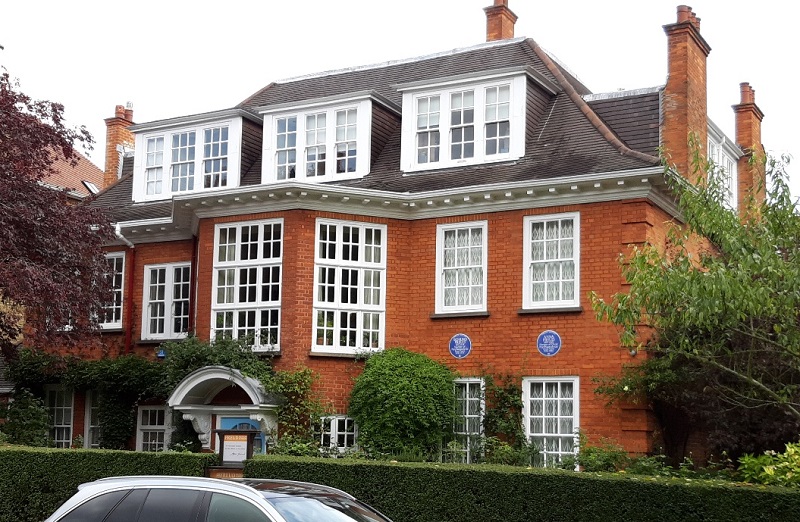 |
|---|
| The House of Sigmund Freud, London, 2019 |
|---|
Von Mises and Hayek were all but alone in predicting how the economy of the Soviet Union would fail. A striking incident was during World War I, when Wittgenstein and Hayek, both in the Austrian Army, met on a railway platform and realized that they were cousins. Wittgenstein had no interest in Hayek's work, but Hayek at least kept track of his relative, sometimes with alarm at his behavior.
Much of this philosophical activity, to be sure, was after World War I and the Fall of the Hapsburgs, but it was also something that only survived until the coming of the Nazis.
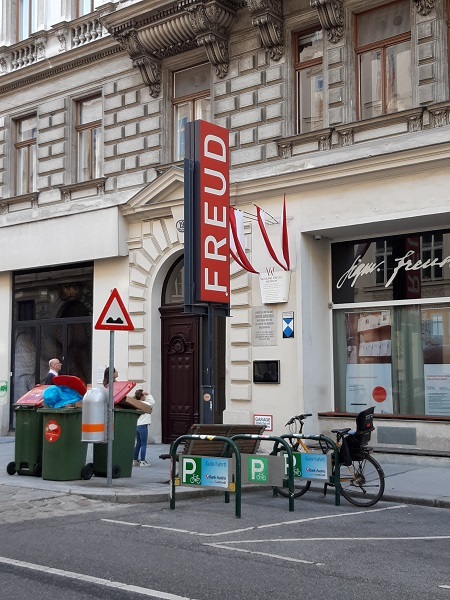 |
|---|
| The Apartments and Museum of Sigmund Freud, Vienna, 2018 |
|---|
It was in a Vienna that retained much of its pre-War status as a major European and cosmopolitan capital, in this form with a final intellectual flowering. The life of Hapsburg Vienna perhaps only really ended in 1938. It has not been quite the same since.
Before the War, considerable intellectual ferment revolved around Sigmund Freud (1856-1939), whose home, well marked, we see at left in Vienna. The psychoanalytic interpretation of dreams, and the treatment of mental illness thereby, involved daring and revolutionary ideas, deeply influential despite turning out to be almost completely wrong. As Theodore Dalrymple, himself a psychiatrist, says, "We owe incomparably more to improved sewers than to psychology" [Admirable Evasions, Encounter Books, 2015, pp.13-14].
Nevertheless, psychoanalysis opened up topics, like sexuality, previously avoided, and it was repurposed into a tradition of psychotherapy, which sought to address discontents and maladjustments of the human condition without the pretence of curing real mental illness, and in a way more aggreeable to modern irreligion. A disturbing sign of Freud's own irreligion was when he prohibited his young bride, Martha Bernays, from lighting Sabbath candles -- reported by her as "an upsetting experience."
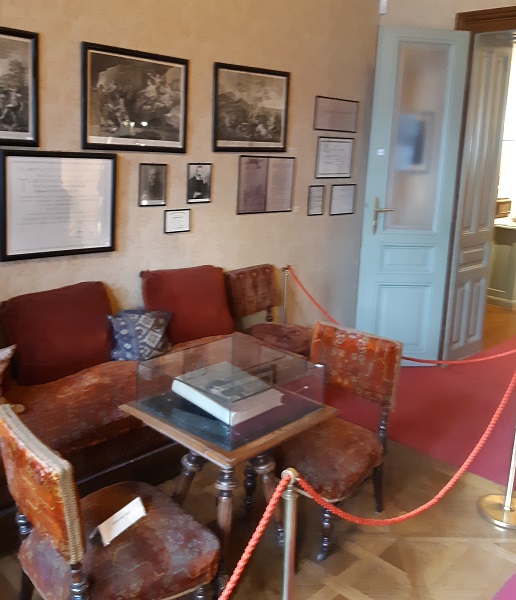 |
|---|
| Freud's Reconstructed Waiting Room, Vienna, 2018 |
|---|
In that way, Freud may survive as a philosopher of the human condition well beyond any practice of Freudian therapy -- and Freud's Moses and Monotheism [1939], although perhaps misconceived as an analysis of Jewish psychology or identity, does expose curious and provocative features about the story in Exodus -- a tribute to the restless, inquisitive, and informed mind of Sigmund Freud, who had his own large collection of Egyptian antiquities.
 |
|---|
| One of Freud's Curio Cabinets, with Egyptian Artifacts, London, 2019 |
|---|
Freud, of course, had to flee the Nazis and moved to London, where almost all his personal effects are now kept. He was only able to enjoy the house he bought for a year before his death -- he was already dying of cancer in Vienna -- but his daughter Anna (1895-1982) lived there the rest of her life. He essentially had to pay a ransom to the Germans, with the help of his friend and supporter Princess Marie Bonaparte, to take his possessions with him from Vienna, otherwise they would have been seized, as were the papers of von Mises.
Someone who was not Viennese, but who became a close associate of Freud in Vienna, C.G. Jung, again is someone with a connection to the Friesian School, someone whose Kantian background led him away from Freud's materialism,
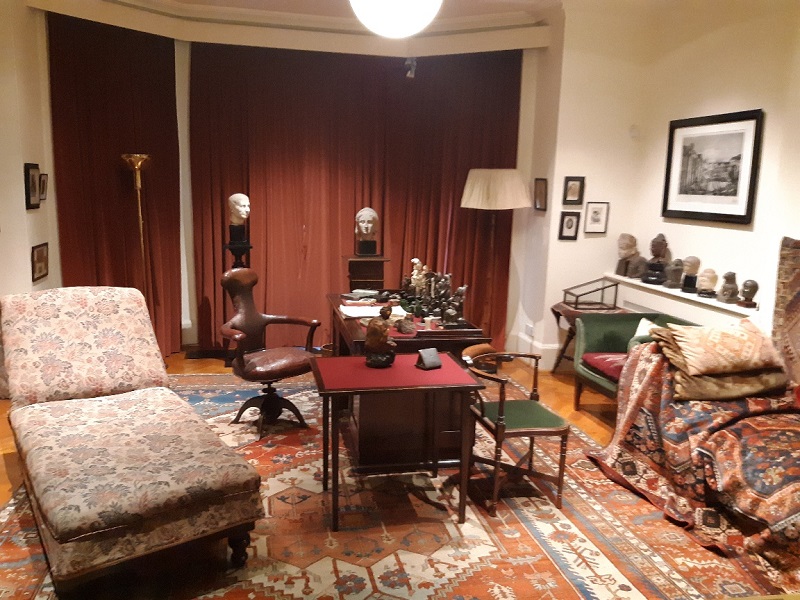 |
|---|
| Freud's Office, with desk, consulting couch, and day bed, where he died in 1939, London, 2019 |
|---|
and who pioneered concepts of "individuation" and "self-realization" that turned psychoanalysis away from pretentions of medical treatment into the more modest "lifestyle" psychotherapy. The philosophical Jung, like the philosophical Freud, becomes someone of more enduring influence and interest, especially with Jung's approach to mythology and religion (cf. Answer to Job). He thought a lot more was going on there than what seemed allowed by Freud's approach, which Jung characterized as reducing "all of civilization" to "a substitute for incest." This was not unfair.
The project of both Freud and Jung to understand the basis of dreams must be said to have failed; but their ambition cannot be faulted, especially when the matter remains mysterious and there is little in the way of new theories about it (apart from observations that dreaming apparently has some function in cognitive function and memory).
 |
| Francisco Goya, El sueño de la razón produce monstruos, "The Sleep of Reason Produces Monsters," Los Caprichos, plate 43, 1797 1799 |
|---|
At the same time, the business wasn't entirely fruitless, and dreams clearly are generated in unconscious proccesses hidden from the conscious mind. Freud can be said to have uniquely identified this. This alone has profound philosophical implications, exploding utterly the Cartesian doctrine that the mind was essentially conscious and that all mental functions were open, not just to conscious inspection, but conscious control. And while the "Will" of Arthur Schopenhauer can be said to be functionally parallel to the Freudian unconscious, with perhaps even the same Darwinian energies, Schopenhauer had little sense, and no investigation, of the phenomenology of dreams. Freud, and then Jung, could discern structures there, which Schopenhauer had never done. There was no couch in Schopenhauer's office.
Everyone thought better of living in Austria after the Nazis had taken over the country. Everyone mentioned here, except Jung, living in his native Switzerland, fled to England or America. Freud, already very aged and dying of cancer, was essentially held for ransom by the Germans. Although he escaped to Paris and then London with all his effects, he left four sisters in Austria who died in the Nazi genocide. An uglier end to a more enlightened Vienna cannot be imagined.
Although ultimately fleeing to America also, one of the major figures of philosophical Vienna was curiously relucant to do so. The mathematician Kurt Gödel (1906-1978) had been invited to join the Vienna Circle, and he did attend meetings, but he had little to say; for, as it happened, he did not agree with the empiricism and
 |
|---|
| Gödel and Einstein walking to work at the Institute for Advanced Study |
|---|
rejection of metaphysics that were characteristic of Positivist doctrine.  He was a Platonist. But people like Rudolf Carnap probably never knew that. Gödel would always be reluctant to speak up about his philosophical beliefs, and he may have just been intimidated by the uncompromising (and unwarranted) certainty of people like the Positivists. In turn, his reluctance to flee the Nazis became dangerous. Einstein, of course, never returned to Germany after Hitler came to power, and he already had accepted a position at the new Institute for Advanced Study in Princeton. Gödel visited there more than once, and elsewhere, but he kept returning to Vienna, long after it was even safe. He was actually once beaten by thugs who mistook him for a Jew. Finally, the War started, and Gödel was even in some danger of being drafted for the German Army. To get out, he and his wife Adele (1899-1981) had to travel East, all the way across Russia on the Trans-Siberian Railroad, to Japan, and finally by boat to San Francisco and train to Princeton. A reluctant refugee indeed. It is hard to say whether it was really love for Vienna, or just Gödel's own inertia that delayed him so awkwardly. He often did seem to have a frail grip on reality.
A century earlier, Vienna had a reputation for excellence in something else, namely, music. This is of philosophical interest mainly because of the dispute about music between Kant and Schopenauer,
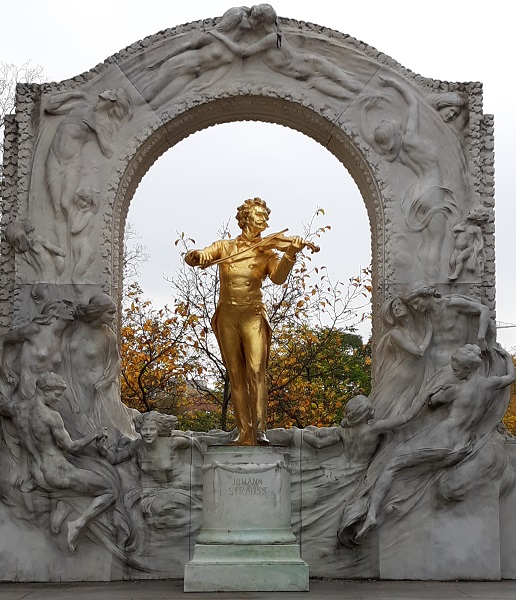 |
|---|
| Johann Strauss Monument, Stadtpark, Vienna, 2018 |
|---|
which played out as Vienna hosted its greatest composers: Wolfgang Amadeus Mozart (1756-1791), Ludwig van Beethoven (1770-1827), Franz Schubert (1797-1828), and others. One of Beethoven's apartments is discussed here.
Later in the century, music still seemed to be king in Vienna, continuing in the grand tradition with Johannes Brahms (1833-1897) and Gustav Mahler (1860-1911), but also in the lighter form of waltzes, as composed and played by Johann Strauss II (1825-1899), whose gilt monument in the Stadtpark of Vienna we see at left. In a nice touch, the arch around Strauss shows semi-drapped bodies of women and men rising into the air, with two meeting at the top in a kiss. Such enjoyment and romance put Vienna squarely into the Belle Époche -- although this also may suggest Dante's image of Paolo and Francesca on the whirlwind. Perhaps Dante would remind us, if only all this had not begun to go so horribly wrong in 1914. The whirlwind indeed.
Finally, the street names of Vienna contain an extraordinary tribute to philosophers. We find as adjacent streets the Fichtegasse, the Schellinggasse, and the Hegelgasse -- after the three principal German Idealists. Unfortunately, despite their fame and influence, these are all very bad philosophers; and the continuing heritage of G.W.F. Hegel in particular has long been of a nightmarish quality. Other streets are named after musicians, and we find a nearby Mahlerstraße, named after Gustav Mahler; but we must follow the Fichtegasse to its end to find a street appropriately named after Immanuel Kant. Then the Fichtegasse intersects the Kantgasse,  a short and inconspicuous street tucked away by the Beethovenplatz -- with the irony, of course, that Kant probably would have been bewildered by Beethoven's music. The intersection of the Fichtegasse and Kantgasse may imply the derivation of Fichte's philosophy from Kant's, with the Schellinggasse and Hegelgasse then crossing the Fichtegasse, perhaps implying that those two follow along behind Fichte. That is one way to look at the history, which may imply the progress of the Idealists over Kant -- a most mistaken construction of the business. So somebody with the ear of City government liked the Idealists, and there is no doubt that they have been idealized at different times and places, often for the worst reasons.
I have noticed only one other street name in Vienna commemorating a philosopher. That is the Schopenhauerstraße, which is on the opposite side of town from the four streets already mentioned. 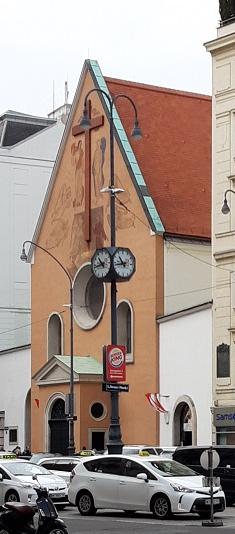 This leads to the substantial Café Schopenhauer, which I have not yet had the privilege of patronizing. Otherwise, there is the Haus Wittgenstein museum, where Wittgenstein actually lived, but I don't see a nearby street named after him.
Eating in Vienna
The Hapsburgs were lucky that the fall of their monarchy did not involve any revolutionary animosity or violence. In the French Revolution, the royal burials at St. Denis were all desecrated, the bodies exhumed, burned, and quicklimed in a mass grave. There was little left of the Kings and Queens of France to be rescued after the Restoration of the Bourbons.
The Hapsburg dead, however, were left in peace. They were already, as it happens, in relatively modest circumstances, buried in the crypt of the unassuming Capuchin Church in Vienna that had been founded in 1618 (seen at right, on the Neuer Markt, facing a car park -- an area that in mid-2019 has been thoroughly torn up, perhaps with the intention, hopefully, of turning the space into something more attractive). Charles V, of course, had been buried in Spain; and the next three Emperors, beginning with his brother Ferdinand, were buried in Prague. In 1618, however, Bohemia revolted, and Matthias and his Empress Anna, who had founded the church, were buried there in Vienna -- as have been most subsequent Hapsburgs, remarkably continuing to the present.
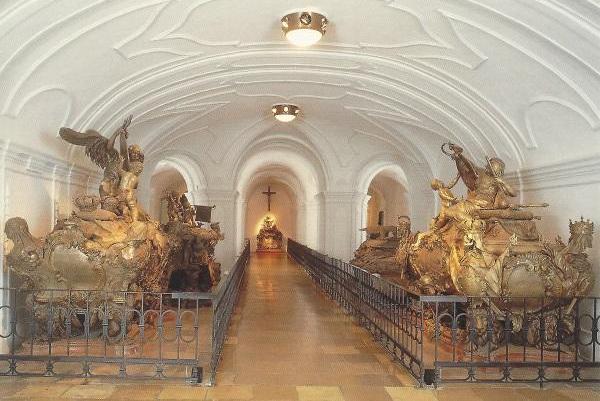 At left is the oldest part of the crypt, directly under the church. The 17th and 18th century Hapsburgs are lined up left and right, culminating in the larger lead sarcophagi of the Emperor Charles VI on the right and his wife, the Empress Elizabeth Christina, on the left. The burials are increasingly modest as we progress back, towards the front of the crypt. Margarita Teresa of Spain, discussed above, her childhood immortalized by Velázquez, is there, somewhat hidden behind a pillar.
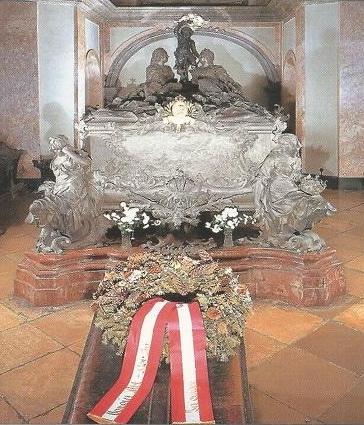 From where that photograph was taken, if we turn entirely around, we look into the next section of the crypt and see what is in the photograph at right. This largely consists of the sarcophagus of Maria Theresa, daughter of Charles VI, and her husband, Francis I of Lorraine. This is by far the largest monument in the crypt, with its top above head high, which is not obvious from the image. Figures of the Empress and Francis repose, lifelike, on top, something we otherwise do not see in the Hapsburg burials. The impression we are left with is that this represents a kind of acme of Hapsburg achievement. The reality was rather different, but it is hard not to see the reign of Maria Theresa as embodying a certain dignity, nobility, and even personality that later Hapsburgs lack. Maria Theresa's own son, Joseph II, himself exhibited the more modest self-regard of the Enlightment by chosing a simple copper coffin, which we see in the photo at the foot of the tomb of his parents, draped with Austrian colors.
Further burials of the Hapsbugs, which stretch off into rooms away from the axis of the Capuchin Church, are compromises of size and simplicity, with the Baroque elaborations left entirely behind. At the end, in what was originally a chapel, are burials of recent family members, such as Otto of Hapsburg, who only died in 2011, someone I could have met had I attended a certain event put on, I think, by the CATO Institute. The last Emperor, Karl I, is actually buried on Portuguese Madeira. His wife, the Empress Zita, who only died in 1989, lies with so many others (150, as it happens) in the Capuchin Hapsburg crypt, near her son Otto. There is room for many more.
Austria-Hungary had only one colonial possession.  This was grandly named Franz Josef Land, but its value seems commensurable with all the other absurdities customarily associated with the Dual Monarchy. For Franz Josef Land, as it happens, was a group of Arctic islands almost entirely above 80 degrees latitude, at the northern end of the Barents Sea, beyond Norwegian Spitsbergen and the long Russian island of Novaya Zemlya. This is about the same latitude as the northern end of Greenland and cannot have offered any advantages to its owner, unless as an advanced base for Arctic exploration. Merely surviving the winter would be a challenge for anyone staying there. After the breakup of the Austrian state, Franz Josef Land fell to the Soviet Union, and now to Russia.
Republic of Austria,
1920-1938, 1946-present |
|---|
| Presidents |
|---|
| Michael Hainisch | 1920-1928 |
| Wilhelm Miklas | 1928-1938 |
Occupation and Annexation by
Third Reich, 1938-1945 |
|---|
| Karl Renner | 1945-1950 |
| Leopold Figl | acting,
1950-1951 |
| Theodor Körner | 1951-1957 |
| Julius Raab | acting, 1957 |
| Adolf Schärf | 1957-1965 |
| Josef Klaus | acting, 1965 |
| Franz Jonas | 1965-1974 |
| Bruno Kreisky | acting, 1974 |
| Rudolf Kirchschläger | 1974-1986 |
| Kurt Waldheim | Secretary-General
of the
United Nations,
1972-1981 |
| 1986-1992 |
| Thomas Klestil | 1992-2004 |
| Heinz Fisher | 2004-2016 |
| Doris Bures, Karlheinz Kopf, Norbert Hofer | acting, 2016-2017 |
| Alexander Van der Bellen | 2017-present |
Post-Hapsburg Austria flirted with union with Germany. Why not? It was only the rivalry with Prussia that kept Austria out of the original unification of Germany. The Allies of World War I, however, did not want such an addition to defeated Germany, so the union was forbidden. Later, when union (Anschluß) was engineered by Hitler in 1938, the Allies were stuck in their dithering Appeasement mentality and were now prepared to complacently accept an addition to Germany's power that was dangerous in a way that it was not in 1919. Ironically, perhaps the most serious and worrisome opposition to Hitler came from Benito Mussolini in Italy. In one of his moments of prudence, Mussolini had mixed feelings about a revived Germany sharing a border with Italy. Nevertheless, Hitler got away with it, and Austria has been trying to figure out ever since just how popular the new regime was.
Were Austrians victims like the Czechs, or had they mostly just become "good Germans"? This question rose in particularly acute form in relation to what should have been a high point for post-War Austria: An Austrian diplomat, Kurt Waldheim, was made Secretary-General of the United Nations. Well thought of at the time, when Waldheim later ran for President of Austria, suddenly there were old pictures of him in a German uniform, possibly mixed up in some German war crimes. He perhaps had been less than forthcoming about what he had been doing in the War.
Since many people in Europe, including those in occupied countries like France and the Netherlands ("What did you do in the War, Daddy?"), would just as soon forget what they may or may not have been doing, even after 50 years have passed, there may have been many willing to overlook Waldheim's youth. Nevertheless, one term as Austrian President seemed like enough.
Now, with xenophobic, anti-foreign forces on the rise in Germany and Austria -- or just people alarmed at the violence, crime, and misogyny of Muslim immigrants -- and the movement strong enough in Austria to participate in the Government, the question arises again about the precedents for the kind of state or kind of society that Austria wants to be. When the reflex in Europe is still to disparage liberal individualism, the darker versions of collectivism, both nationalist and socialist, are still very menacing.
On Hollywood Boulevard, much of the material for tourists features James Dean (1931-1955, aged 24) and Marilyn Monroe (Norma Jean Mortenson, 1926-1962, aged 36). In modern Vienna, there is a similar emphasis on Wolfgang Mozart (1756-1791, aged 35) and the Empress Elisabeth of Bavaria, known as "Sisi" (1837-1898, aged 60).
All these figures have something in common: a tragic and untimely death. Dean died in an auto accident. Monroe died from a suspicious suicide or accidental overdose, rumored to be murder because of affairs with Robert and John F. Kennedy [note].
Mozart died, impoverished, of disease. And the Empress Elisabeth was assassinated by an Italian anarchist. The first three, of course, had creative credentials as actors or, with Mozart, a composer. They can all be appreciated even now for their work, although Dean, dying the youngest, was only in three movies.
The Empress Elisabeth, however, had no creative achievements, and she was not even particularly young at her death -- having been Empress of Austria for 44 years. Elisabeth's popularity, therefore, is of a different sort. The tragedy of her life went well beyond her death. 
At right we see a handsome painting of Sisi by Franz Xaver Winterhalter (1805-1873), Kaiserin Elisabeth in Balltoilette mit Diamantsternen im Haar, "Empress Elisabeth of Austria in Courtly Gala Dress with Diamond Stars" [1865], Kunsthistorisches Museum Wien.
First of all, it is hard to tell now whether her marriage to Franz Josef was itself simply unhappy, thanks to him, her mother-in-law, or other factors, or if Elisabeth experienced a clinical depression that might have occurred in any circumstances. She did not enjoy life in Vienna, and eventually began to simply wander around to different resorts, or to a palace she built on Corfu. On top of this, she experienced the deaths of two of her children, Sophie in 1857 and Rudolf, the Crown Prince, in 1889. Since Rudolf was a suicide (with his mistress), this may indicate some genetic depression in her family.
Like Queen Victoria after the death of Albert, Elizabeth wore black the rest of her life, until her assassination. Today, she is a major celebrity in the city, Vienna, for which she did not care much and escaped when practical. Her face -- of great beauty -- is everywhere. Things are named after her (if only with "Sisi"). And there is a small museum with her memorabilia, near her preserved apartments, in the Hofburg Palace. Much of her popularity, then, seems to involve sympathy, and some respect for her determination to live her own life, even if that did not obviously involve any particularly useful activities. And today she lies beside her husband and son, with fresh floral tributes, in a distinct room of the Hapsburg crypt.
 |
|---|
| Judith and the Head of Holofernes, 1901, Gustav Klimt, Österreichische Galerie Belvedere |
|---|
Mozart and Sisi are not alone in being featured in Vienna as local celebrities. The painter Gustav Klimt (1862-1918) can also be found with them; and he also qualifies as dying tragically young, aged 55, from the influenza pandemic in 1918 -- although, having suffered a stroke and then developing pneumonia, it may not actually have been the flu that took him away.
Klimt was part of a local artistic movement, the "Vienna Secession" (Wiener Secession), that began in 1897 -- solidly in the Hapsburg period. Klimt's style, "Symbolism," often used with gold leaf, can be very striking and seems very evocative of the era -- a literal example of the "Gilded Age." Klimt seems to have been inspired in his use of gold leaf by the mosaics he saw in Ravenna on a visit there in 1903. Klimt's father was a goldsmith, and so he was already familiar with the techniques necessary for its use.
Material for tourists in Vienna, like refrigerator magnets, tends not to be images of the artist, who is unprepossessing, but examples of his art. This gives a somewhat different impression than we find with Mozart or Sisi.
One of Klimt's most famous paintings now is one of his portraits of Adele Bloch-Bauer (1881-1925). He did more than one, and used Adele as a model for other paintings, incuding that of Judith with the head of Holofernes above. The attention this stunning painting gets is in part due to its history. It was stolen from the Bloch-Bauer family by the Nazis. Since the Nazis didn't care much for modern art, it came into possession of the Österreichische Galerie Belvedere, i.e. the former Belvedere Summer Palace of Eugène of Savoy,
 |
|---|
| Portrait of Adele Bloch-Bauer I, 1907, Gustav Klimt, Neue Galerie, New York |
|---|
which claimed that Adele's will, from when she died at age 43 of meningitis, gave them several Bloch-Bauer paintings. Thus, even though the paintings were stolen by the Nazis, the museum claimed to have a legitimate title to them.
After the War, this was all disputed by the heirs of the Bloch-Bauers, but the museum managed to hold on to most of the paintings. Austrian law changed, and the case was reopened in 2000 by Adele's niece, Maria Altmann (1916-2011), who hired the lawyer E. Randol Schoenberg, grandson of the Austrian composer Arnold Schoenberg (1874-1951), to litigate the matter.
The Bloch-Bauer claims were again rejected, now by the "restitution committee" instituted by the Austrian government. Schoenberg conceived the strategy of suing the Austrian government itself in American courts. This action, which might violate the sovereign immunity of Austria, went all the way to the United States Supreme Court, which allowed the lawsuit.
Austria, in the face of bad publicity over stolen Jewish art, allowed arbitration, which in 2006 actually found in Maria Altmann's favor. The Portrait of Adele Bloch-Bauer I was sold and is now exhibited in a small German-Austrian museum in New York City, the "Neue Galerie," on 86th Street at Fifth Avenue, under the condition that it always be exhibited.
Several films and documentaries about this Odyssey have been made, including the slightly fictionalized Woman in Gold [2015], with Helen Mirren and Ryan Reynolds (i.e. "Deadpool"!). Another Klimt portrait at this website is one he did of the sister, Margaret Stonborough-Wittgenstein, of Ludwig Wittgenstein.
Visiting the Neue Galerie, I am not sure that the painting is displayed in the best way. Lights shown on the painting reflect off the glass and thus interfere with the image. More generally, the lighting, as I see it, makes the gold look faded, which is impossible. Gold doesn't fade. Thus, the rich gold color of the image above here is not what we see in the museum. I would like to illustrate that with my own photo, but photography is not allowed in the museum.
The Wall Street Journal recently ran a review on Oskar Kokoschka (1886-1980), listing him with Klimt and another Viennese arist, Egon Schiele (1890-1918), who died tragically younger than Klimt, at the same time [WSJ, December 8-9, 2018, C18]. Another Vienna Sucession artist, Max Kurzweil (1867-1916), has been noted here elsewhere. Kurzweil actually committed suicide. Kokoschka outlived them all. His style, German "Expressionism" is not my favorite; but it certainly maintains interest and influence, with both museums and art collectors.
| Republic of Slovenia |
|---|
Yugoslavia, 1918-1941,
1945-1991 |
|---|
| German Occupation, 1941-1945 |
|---|
| Milan Kučan | 1991-2002 |
| Janez Drnovšek | 2002-2007 |
| Danilo Türk | 2007-2012 |
| Borut Pahor | 2012-2022 |
| Nataša Pirc Musar | 2022-present |
Slovenia was historically long part of Austria, occupying the provinces of Carniola and Istria on the map above. That is why it is shown here as part of the Core of Francia, rather than with Catholic Eastern Europe.  With the breakup of the Empire in 1918, Slovenia joined Yugoslavia. That was the situation, except for German occupation during World War II, until 1991, when Slovenia became the first constituent Republic to leave Yugoslavia.
Despite all the war and terror that followed, as other Republics left, Slovenia was largely insulated from the action, since the only border Slovenia shared in Yugoslavia was with Croatia. One might wonder how economically viable the tiny country can really be (with a population of less than two million), but other small states do quite well (e.g. Luxembourg), and in fact Slovenia has the highest per capita income of any of the former Yugoslavian Republics. Indeed, Slovenia has the highest per capita income of any Balkan country, including Hungary, outside of Greece. If it wants to join any other federation, that is likely to be the European Union -- as it has done in 2004. See treatment of Slavoj Žižek, a Slovenian defender of Hegel, and an insane partisan of terrorism, clearly oblivious to the success of Slovenia.
 HOHENZOLLERN EMPERORS, HOHENZOLLERN EMPERORS,
of German "Second Reich,"
only non-Catholic Emperors in Francia |
|---|
| Emperor | Chancellor |
|---|
| Wilhelm I | King of
Prussia,
1861-1888 | Prince Otto
von Bismarck | 1862-1890,
d.1898 |
| 1871-1888 |
Franco-Prussian War,
1870-1871 |
|---|
| Frederick | 1888 |
| Wilhelm II | 1888-1918,
d.1941
last German
Emperor, one
of last
2 Emperors
(with Austria)
in Francia |
Count Leo
von Caprivi | 1890-1894 |
Prince Chlodwig von
Hoh.-Schillingsfürst | 1894-1900 |
Prince Bernhard
von Bülow | 1900-1909 |
Theobald von
Bethmann-Hollweg | 1909-1917 |
| George Michaelis | 1917 |
Count George
von Hertling | 1917-1918 |
Prince Maximilian
of Baden | 1918 |
| Friedrich Ebert | 1918 |
World War I, 1914-1918; abdication of Kaiser,
loss of Alsace-Lorraine, West Prussia, etc., 1918 |
|---|
 Prussia, which became a Great Power as the nemesis of Austria, eventually came to dominate post-Napoleonic Germany. Under the leadership of Otto von Bismarck, Prussia defeated Austria (1866) and France (1871) and then created a new unified Germany, without Austria, as a new German Empire, a "Second Reich."
The genealogy of the Hohenzollern Emperors can be found under the treatment of Brandenburg and Prussia, with that containing the German Emperors repeated below. The further genealogy of the Hohenzollern family can be seen under The Descent of the Hohenzollern and Counts & Princes of Hohenzollern Henchingen-Sigmaringen.
After unification, Germany swiftly grew into the strongest state on the Continent. Although Bismarck wasn't enthusiastic, a modest colonial Empire was even assembled. Unfortunately, peace and prosperity evidently weren't good enough. A dream of crushing France again, apparently just for the hell of it, and something little short of envy against Britain, which had been an ally of Prussia since 1756, began to poison German policy and preparations.
Ironically, much of this began to flow from an Emperor who was actually the grandson of Queen Victoria, Wilhelm II. His father, Frederick III, who had married Victoria's eldest child, also Victoria, had all the liberal instincts of this English connection. Tragically, cancer took him after less than a calendar year on the Throne, and Wilhelm had no sympathy with British ways, except that he wanted a navy as big as his grandmother's.
This ill considered aspiration soon turned a traditional ally into a bitter rival in one of the greatest arms races in history, driving the British into the arms of their own traditional enemies, France and Russia. When the ball dropped, over some damn thing in the Balkans (as Bismarck had predicted), the Germans declared war on Russia and so, logically, attacked France, dragging a reluctant Britain into the war by invading Belgium (to get at France), violating guarantees of neutrality that had been in force since 1830.
This pointless exercise brought on the, until then, worst war in history, with more than a million dead each in France, Germany, Russia, and Austria, and nearly a million each in Britain and Turkey. For the first time ever, the United States became an active belligerent in a European war, throwing its weight decisively against Germany -- something that would be done all over again twenty-four years later.
Both winners and losers, except the United States and Japan, were all but destroyed. Russia collapsed into anarchy and then totalitarian terror for decades, Britain was hurt, staggered, and bankrupted as never before, and Austria disintegrated into a confusion of petty states. All this (very nearly) just so that the Kaiser could have boats like grandmother. Sadly, all the folly and horror of the war were merely a preview of what the 20th century had to offer. And the damn things are still going on in the Balkans.
Those Germans
Germany was quite late in the competition for colonial possessions, and it shows. It wasn't too late in the "scramble for Africa," however, and the most substantial acquisitions are found there. Tanganyika was probably the prize, and in German hands it foiled the British ambition for continuous territories from Cape Town to Cairo -- Cecil Rhodes had wanted to build a railroad between just those cities, something that has still never been done. Outside Africa, the Germans got a city in China and, otherwise, nothing outside the Pacific.  There, the most extensive acquisitions were simply a purchase from Spain of her three islands groups, the Marianas, Carolines, and Marshalls, east of the Philippines (which the United States took in 1898).
In 1884 Germany divided eastern New Guinea with Britain, taking the northeastern part, renamed Kaiser Wilhelmsland. The adjacent island group then became the Bismarck Archipelago, a name that has stuck since. To the Bismarcks Germany was able to attach the northernmost of the Solomon Islands, Bougainville.
In World War I, most German possessions were rapidly overrun. An exception was Tanganyika, where the German commander, Lieutenant Colonel Paul von Lettow-Vorbeck (d.1964), managed to elude defeat or capture for the entire period of the war, raiding into Portuguese Mozambique when the British made Tanganyika itself too hot for him, and in the process of invading Rhodesia when the war ended. This little known but striking episode bespeaks a remarkable devotion on the part of his African troups, whom otherwise we do not gather were treated so well by Germans.
That the Japanese scooped up most German islands in the Pacific was bad news for the future, since it gave them a strategically advanced position for expansion in World War II. Also, when the Japanese occupied the formerly German Bismarcks and Bougainville in that later war, they found the locals less hostile, as having only recently come under British rule (after World War I, of course), than further down in the Solomons.
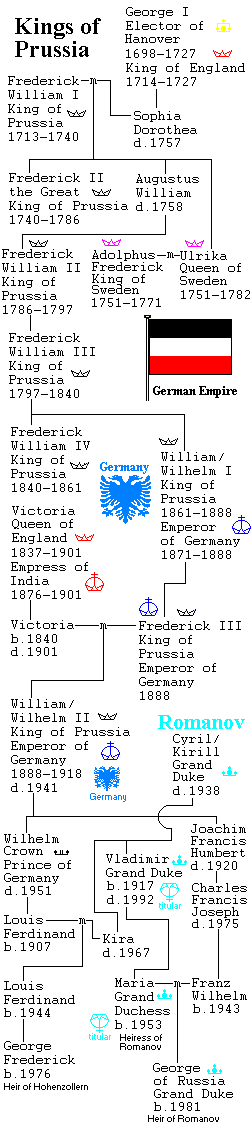 The Treaty of Versailles
The last days of World War I, with the men out of the trenches, retreating (Germans) and pursuing (Allies), were among the bloodiest of the War. While trench warfare is properly remembered as a horror, the trenches nevertheless did protect the men more than when they were just running around out in the open. This is why more than 100,000 Americans died (as much as in the Korean and Vietnam Wars combined), even though the United States was only in the War for 19 months. The slaughter was called to a halt at 11:00 hrs on 11 November 1918. The Armistice was more than just a cease fire, since it required Germany to withdraw from its occupation of France, Belgium, and Luxembourg and surrender its fleet for internment by Britain.
The subsequent Treaty of Versailles in 1919 may instructively be compared to the work of the Congress of Vienna (1814-1815) which had settled Europe in the wake of the French Revolution and the Napoleonic Era. Since there was not a general war in Europe for a century, the work of the Congress of Vienna in that respect may be considered a success. Since Versailles was followed within twenty years by a World War even more terrible than the first, it cannot be said to have been as successful.
The most conspicuous difference between Vienna and Versailles is the treatment of the defeated Power. France was restored to Louis XVIII with the full sovereignty and territory that it had had under Louis XVI -- in fact more, since Avignon was not returned to the Papacy. This made perfect sense. Louis XVIII was not responsible for what France had done under the Republic and the Empire, and it would not have helped his legitimacy or popularity to have been restored under punitive conditions. By the same token, the Germany that was represented at Versailles was no longer the one that had started and waged World War I. The Kaiser had abdicated, a Republic declared, and a parliamentary government sent representatives to the Allies. This was supposedly what Woodrow Wilson wanted out of the War: the triumph of democracy.
Unfortunately, France, Italy, and Britain wanted revenge and spoils, apparently against the German people, forgetting all about the Kaiser, who was in exile in the Netherlands. The peace would be punitive, and the Weimar Republic would suffer in legitimacy and popularity because of it -- providing more than enough ammunition of grievance for people like Adolf Hitler to discredit democracy and the Peace.
Where Louis XVIII was respected, helped, and protected, the new Sovereign People of Germany would not be. Indeed, the representatives of German democracy were not even allowed to attend at Versailles, and the Treaty was subsequently presented to them, in the words of people like Hitler, as a Diktat whose rejection would precipitate a renewal of the War, while meanwhile the blockade remained in effect and Germans went hungry.
How different from Vienna, where France was represented by the brilliant Talleyrand. Although the victorious Powers of 1814 did indeed contemplate marginalizing the French representative, in short order Talleyrand maneuvered himself into full participation. I doubt that the Germans of 1919 had a diplomat available of the genius of Talleyrand (who had survived and served all of the regimes since Louis XVI), but even a lesser man might have talked some sense into the Allies, or at least awakened Wilson to the spirit of his own promises.
Germany was deprived of territory through plebicites, but there was no appeal to popular will in the territories taken by France, Italy, or Britain. The sizes of the German Army and Navy were severely limited, with the Army forbidden tanks and aircraft, and the Navy forbidden ships larger than 10,000 tons. Louis XVIII labored under no such curtailment of his sovereignty.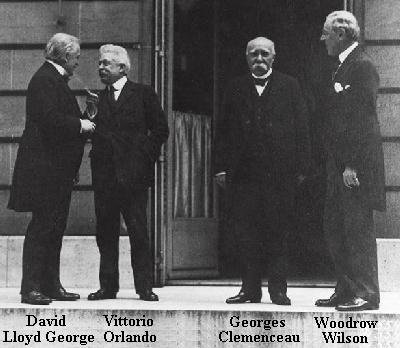
And Germany faced massive reparations. This reciprocated the reparations imposed by Prussia on France in 1871, but, of course, nothing of the sort had been expected of France in 1815. At the same time, the reparations imposed by Prussia had been proportional to the payments imposed by Napoleon on Prussia in 1807 after the Battles of Jena and Auerstedt in 1806. The best that can said about all this is that at least the Germans in 1918 had done a lot of damage to France, while France had suffered nothing from Prussia in 1807 or Prussia from France in 1871.
The reparations led the German government to a massive inflation of the currency, which broke the economy, wiped out the savings of the middle classes, and created the conditions that, with the addition of the Great Depression, produced a level of misery that popularized the previously insignificant Nazis. Ironically, much of the reparations ended up being paid with loans from the United States.
The approach at Versailles proved to involve a high order of folly. This was not unappreciated at the time. John Maynard Keynes, later an influential economist, called the Treaty a "Carthaginian" peace ("The Economic Consequences of the Peace," 1919) -- like the treaties imposed by Rome on Carthage, before her complete destruction. Keynes may not have known that German commanders were already speaking of a "Second Punic War," hoping, like Hannibal, to avenge the defeat of the First. Curiously, although later a staunch foe of Appeasement, Winston Churchill agreed with the assessment of Keynes. The terrible War that began with the folly of Austrian diplomacy thus ended with the folly of Allied diplomacy.
Having helped discredit democracy in Germany, the Allies then compounded the problem by choosing an Appeasement policy with Hitler. The British, especially, were having second thoughts about the justice of Versailles, and in conjunction with a popular Pacifist movement, this led to one folly being heaped upon the other.
| ...one should never permit a disorder to persist in order to avoid a war, for war is not avoided thereby but merely deferred to one's own disadvantage..
Niccolò Machiavelli, The Prince [Daniel Donno translation, Bantam Books, 1981, p. 20] |
Adolf Hitler was not the person to whom full German sovereignty should have been restored. He was no longer the representative of a democracy, but of a terrible, hostile, and aggressive ideology -- whose character was only recognized by unpopular politicians like Churchill -- who, in an extraordinary 1933 meeting, found himself in agreement with no less than the otherwise pacifistic Albert Einstein.
As it happened, Hitler, although finally losing as did Hannibal in the original Second Punic War, would prove to be a far more terrible enemy and would inflict an unprecedented level of suffering, destruction, and carnage on Europe and her peoples -- thanks in great measure to the advantages he enjoyed from the fecklessness of the Allies. The only consistent feature in Allied policy from Vienna to Versailles was, perhaps, a deference to autocrats, Louis XVIII and Hitler, in comparison to democratic representatives, who were cut off at the knees.
The Germans had often behaved badly under the Kaiser, but this was the merest foretaste of what would aptly be called the "crimes against humanity" of World War II. The taste for revenge of the Allies in World War I would thus rebound upon them with unimaginable ferocity. They had little taste for it after World War II, though by then they realized that they wanted a democratic Germany as an ally against the remaining, and triumphant, totalitarian power, the Soviet Union. Truncated by Russian conquest, the Federal Republic of Germany nevertheless emerged as a sovereign and equal Power in the modern world.
The Iron Cross -- -- came to be used to symbolize, not only the German Empire, but every single regime in modern Germany since then -- the Weimar Republic, Nazi Germany, and the Federal Republic of Germany -- with sole exception of Communist East Germany.  There actually had not been much call for such a symbol before the introduction of aircraft. Armies and navies had always used flags for recognition, as with the Imperial German Naval Ensign at right. A flag, however, is not going to work very well on an aircraft, and during World War I we see the introduction of special insignia painted on wings and fuselage. Considering the radical changes in regime, from Empire, to Republic, to Dictatorship, to Republic again, the Iron Cross represents an extraordinary constant in Germany identity despite all the other changes in symbolism.
As it happens, however, the Iron Cross has nothing to do with the earlier history of Germany in general. It was inherited by the Margravate of Brandenburg, as the Kingdom of Prussia, from the Duchy of Prussia, which itself derived from the domain of the Teutonic Knights. With the Knights, the Cross was simply the standard Cross of a Crusader, and the black on white colors were just a variation of those used by other Crusading Orders. For instance, the Hospitallers used white on red,  , or white on black,
  . There was no particular symbolism in the choice of colors for the Teutonic Knights. The only symbolism it would ever have, a particularly unfortunate one, would be for the Nazis with death. This has now been conveniently, and not inappropriately, forgotten.
Weimar
Republic |
|---|
| President | Chancellor |
|---|
Friedrich
Ebert | 1919-
1925 | Philip
Scheidemann | 1919 |
| Gustav Bauer | 1919-1920 |
| Hermann Müller | 1920 |
Konstantin
Fehrenbach | 1920-1921 |
| Joseph Wirth | 1921-1922 |
| Wilhelm Cuno | 1922-1923 |
| Gustav Stresemann | 1923 |
| Wilhelm Marx | 1923-1925 |
Paul von
Hindenberg | 1925-
1934 | Hans Luther | 1925-1926 |
| Wilhelm Marx | 1926-1928 |
| Hermann Müller | 1928-1930 |
| Heinrich Brüning | 1930-1932 |
| Franz von Papen | 1932 |
| Kurt von Schleider | 1932-1933 |
| Adolf Hitler | 1933-1934 |
no EMPERORS, of German
"Third Reich";
President & Chancellor = "Führer" |
|---|
| Adolf Hitler |
1934-1945 |
| Karl Dönitz | 1945, d.1980 |
Allied Occupation, 1945-1949;
German Democratic Republic, 1949-1990
(joins Federal Republic, 1990) |
|---|
While France's more conventional Second Empire followed her particular Great Dictator, history switched things around on Germany. The regime that had overthrown  Napoleon III foundered on its own foolish adventure in the uncharted realm of 20th century warfare. The bitterness of German defeat and the willingness of the Germans to accept dictatorship, since they had never known real democracy and widely disparaged the Liberal, capitalist society of Britain (as do modern leftists and many conservatives), made it possible for Hitler to revolutionize a fundamentally conservative country, which had never fully accepted the legitimacy of the Weimar Republic [note].
Unlike Napoleon, Hitler did not ride the whirlwind of the preexisting Revolution, he created his own whirlwind -- though most Germans probably did not quite have this in mind when they acquiesced to the Nazi regime: There were no celebrations when World War II started in 1939 as there had been in 1914.
Although Hitler was reviving the "Reich," and had the dying wish of President Hindenberg that the Kaiser be restored, he left the throne vacant  (as Fascist Franco did in the "Kingdom" of Spain), even though Wilhelm II was still alive at Apeldoorn in the Netherlands until 1941 and the former Crown Prince Wilhelm would live until 1951 -- and a direct Hohenzollern heir still lives. When Germany occupied the Netherlands in 1940, contact with the Kaiser was carefully prevented lest Monarchist sentiment be aroused. Wilhelm sent a telegram to Hitler that said, "I congratulate you and hope that under your marvelous leadership the German monarchy will be restored completely." Hitler's reported reaction was, "What an idiot!"
Thus, while Hitler was reactionary in the sense of wishing to revive Germany's Imperial fortunes, he was enough of a revolutionary, or even enough of a Marxist, to despise the system of aristocratic class privilege in the Second Reich. One of the bitter ironies of the German Army in World War II was that, within the limitations of its racial criteria, it was fairly effective at promoting talent and maintaining an egalitarian spirit. This made for a force far more formidable than it deserved to be. The British Army was probably more limited, and hampered, by class consciousness than the German.
Unlike the French Revolution and Napoleon, the theory and the practice already existed for what Hitler did. He had the venerable precedent of Mussolini for a nationalistic dictatorship with economic controls by the State (where the controls actually inspired Franklin Roosevelt's quasi-fascist  "National Recovery Act," wisely declared unconstitutional by the Supreme Court in 1935), but he also had the practice of Lenin in creating a totalitarian police state, where everything is expected to serve the political ends of the Party, and opposition is ruthlessly suppressed.
When Hitler started his great war, the boundaries of Europe again began to melt and run, as they had with the French.  Napoleon, however, although not above murders and massacres, by no means had the project of mass murder and genocide in mind that Hitler did. Thus, Winston Churchill said, "I certainly deprecate any comparison between Herr Hitler and Napoleon: I do not wish to insult the dead." Easy comparisons there are, however, between the two, as explored in Desmond Seward's Napoleon and Hitler, a Comparative Biography [Touchstone, Simon & Schuster, 1988].
  Comparisons are also easy between Hitler and the mirror image leftist dictator and mass murderer of the Soviet Union, Josef Stalin -- see Hitler and Stalin, Parallel Lives, by Alan Bullock [Alfred A. Knopf, 1992] and The Dictators, Hitler's Germany and Stalin's Russia, by Richard Overy [W.W. Norton & Company, 2004].
When Hitler came to power, Albert Einstein was visiting for a semester (for the third time) at the California Institute of Technology. He had already arranged to take up a position at the new Institute for Advanced Study in Princeton, but did return to Europe that summer. Hearing that the Nazis had already searched his residences, including his beloved summer house, Einstein never returned to Germany. His holiday, largely in the Netherlands, included a quiet visit to Winston Churchill in England. Churchill, who almost alone knew what Hitler was all about, was out of the government and out of favor at the time as some kind of warmonger. Yet, Einstein, a life long pacifist, agreed with Churchill's assessment and suspended his pacifism for the duration. I don't know if Einstein and Churchill ever met again. It must have been an extraordinary moment.
It is noteworthy that Hitler's outright territorial annexations to Germany in the west were relatively modest, just Alsace and Lorraine from France, as in 1871. He did not have the racial animus against his western enemies that he did against the eastern -- it is there, where Germans were supposed to find their Lebensraum (after enslaving or sweeping away the Slavic or Jewish Untermenschen who were there already), that the boundaries display the same degree of rearrangement conspicuous in Revolutionary Europe and that Germany assumes the same kind of bloated and unnatural outline as Napoleonic France. In a way, Hitler's heart just really wasn't in the project of subduing England. His restless ambition in the East is then what brought him down. He couldn't wait to invade Russia, but then ran into many of the same problems as Napoleon. Like Plato's classic case of the "tyrannical" personality, neither Hitler nor Napoleon had the patience to limit their goals and limit their risks. Stalin, in the end, did, and so became the most successful of all such dictators, despite the very same hatred of democracy and Liberal society.

On this 1942 map of the "high water mark" of Nazi Germany, several points of strategic failure are noteworthy. While Napoleon could not have invaded England without naval control of the English Channel for a few days, Hitler, with no strategic navy, could have accomplished the same job with air power. The air Blitz against England came close to doing this, by attacking Royal Air Force bases and the radar sites that directed British aircraft.
However, a British bombing raid on Berlin infuriated Hitler. He redirected attacks to London and civilian targets. Although spectacular, this was strategically ineffective, and spared the military means that the British had to preclude German air superiority. Without such superiority, an invasion could not be attempted. So Hitler turned on Russia.
Meanwhile, he regarded the only place where there was ground combat with British forces, in North Africa, as a sideshow. Deep in Egypt, within hailing distance of Alexandria and the Suez Canal, Erwin Rommel, the "Desert Fox," if he had had only a tithe of the forces in the Balkans, could have taken the heart out of British Imperial communications and put the whole Middle East, with its strategic oil reserves, into the hands of pro-Nazi Arabs. Instead, Rommel's own communications could not be secured, as the German airborne forces that could have taken Malta were ruined in a Pyrrhic victory on Crete.
Substantial German forces were only committed to North Africa after the Americans landed in Morocco and Algeria in November 1942. With Rommel already in retreat, the result was simply the surrender of another German Army (May 1943). Meanwhile, Stalingrad (16 September 1942 to 2 February 1943) had really broken the ability of Germany to mount any other large or effective offensives. Despite the undoubted importance of Stalingrad, where 250,000 Germans had been trapped and killed or captured, it should be remembered that a good 350,000 Germans and Italians had been killed or captured in North Africa.
Rommel himself is one of the more intriguing characters of the War. He made a name in the brilliant campaigns of 1940 and secured military immortality in North Africa; but he then was ineffective against the Allied landings in Normandy in 1944. Suspected of involvement in plots against Hitler, Rommel was allowed to commit suicide and then celebrated as a great hero of the Third Reich. In the end, he symbolizes the questionable moral commitments and futile genius of the professional German military.
If the Western Allies had lost their taste for revenge in 1945, quite the opposite would be the case in the East. If Keynes had been concerned about a "Carthaginian Peace," and if the German Army wanted a "Second Punic War," what Germany got from the Russians in the East was a Third Punic War and a genuinely Carthaginian "Peace," i.e.  the Russians actually treated East Prussia and Königsberg the way the Romans had treated Carthage.
That is how Whittaker Chambers saw it in 1952, when he referred to "the Carthaginian mangling of Europe" [Witness, Regnery, p.332]. Königsberg was largely destroyed, the population was deported or annihilated (perhaps 100,000 civilians were "disappeared"), Prussia was divided with Poland, and Russian colonists were brought in to give birth to a generation that often was not even told in the schools that where they lived used to be part of Germany (and had never been part of Russia). 
To be sure, this is no less than what the Nazis wanted to do to Russia; so if our moral principle is collective guilt and an eye-for-an-eye retribution, the Germans got what they deserved. However, if the Soviet Union was doing what the Nazis wanted to do just because that is the way they operated anyway, and we reject the collective guilt of the German citizens of East Prussia -- not to mention the other lands in Eastern Europe from which ethnic Germans were expelled or disappeared -- then World War II ended as it began, with the war crimes of two, not one, ruthless and totalitarian powers.
The Soviets were not even following their own ideology, since they did not distinguish between German capitalist warmongers and the innocent German proletariat. All Germans were blamed; all German women were raped; and so what it looked like was not good Marxist class enemies, but precisely the sort of race enemies already infamous from Nazi ideology. It was not a German class liquidated East of the Oder; it was the German people liquidated East of the Oder; and this only made sense in terms of the pan-Slavic ambitions that had already been expressed by Tsarist Russia in 1914, with practices that were already infamously associated with Russian Cossack cavalry. In short order, the democracies realized that the Soviet Union was simply picking up again the practice of the tyrannies in which it had been happy to cooperate with the Germans until June 1941.
And it was not only Germans who experienced Soviet terror in 1945. In the Baltic states, Poland, and elsewhere a police state apparatus shut down the restoration of pre-War governments. The Soviets deported many populations as well as those of Germans, both to create "realities" to match the post-war borders drawn by Stalin, and to punish populations, like the Crimean Tartars and Chechens, believed to have cooperated with the Germans.
Poland, an active Ally whose partition by Germany and Russia began the War, and whose citizens had fought heroically in Allied armies and air forces throughout, was left to the merciless process of transformation into a Soviet puppet state. That the democracies more or less acquiesced to Soviet domination in Poland rendered the casus belli of 1939 and the whole moral content of Allied war aims vacuous.
To rescue Poland from murderous German Nazis, it was betrayed to murderous Russian Communists -- even as Soviet and Marxist propaganda undermined the confidence of the democracies in their own principles, a process that, long after the fall of the Soviet Union, continues to corrupt and undermine the political, economic, intellectual, and moral health of the West. In other words, Leninism is alive and well in American universities; and American Communists who spied for the Soviet Union and betrayed, not just their country, but humanity and civilization, are celebrated as heroes and martyrs.
That a communist anti-Semite stands to become Mayor of New York City in 2025 is testimony to the rot in American "higher education." Rooting this out is a challenging, long-term project, for which many are not prepared. Indeed, the history of the Cold War still cannot be properly written until the United States Senate revokes its Censure of Senator Joseph McCarthy, whose betrayal tells us that the Eisenhower Administration was as embarrassed by Soviet espionage as the Truman and Roosevelt Administrations had been.
McCarthy's downfall was his investigation to find out who in the Pentagon had been reinstating security risks, including Communists, at the military laboratories of Ft. Monmouth, New Jersey, after the commanding officer had removed them. We still don't know the answer; and McCarthy's simple inquiry is still misrepresented, even by Republicans, as somehow a "war on the Army," or it is obscured by irrelevant issues. And we know, from Soviet records, that the laboratories were indeed compromised by Russian spies. Who, we might ask even now, is being protected by this? Why has a relatively simple question never been answered, or even properly addressed, by all the anti-Communists since? Didn't President Reagan, for instance, want to know who was protecting Communist spies at Ft. Monmouth?
Federal
Republic |
|---|
| Presidents | Chancellors |
|---|
| Theodor Heuss | 1949-1959 | Konrad Adenauer | 1949-1963 |
| Heinrich Lübke | 1959-1969 | Ludwig Erhard | 1963-1966 |
Kurt Georg
Kiesinger | 1966-1969 |
Gustav
Heinemann | 1969-1974 | Willy Brandt | 1969-1974 |
| Walter Scheel | 1974-1979 | Helmut Schmidt | 1974-1982 |
| Karl Carstens | 1979-1984 | Helmut Kohl | 1982-1998 |
Richard von
Weizsäcker | 1984-1994 |
| Roman Herzog | 1994-1999 | Gerhard Schröder | 1998-2005 |
| Johannes Rau | 1999-2004 |
| Horst Köhler | 2004-2010 | Angela Merkel | 2005-2021 |
| Christian Wulff | 2010-2012 |
| Horst Seehofer | 2012 |
| Joachim Gauck | 2012-2017 |
| Frank-Walter Steinmeier | 2017-present |
| Olaf Scholz | 2021-2025 |
| Friedrich Merz | 2025-present |
The Federal Republic of Germany (Bundesrepublik Deutschland, BRD) tried to pick up where the Weimar Republic had left off, with about half of the territory of Weimar Germany, a shattered economy, blasted cities, and a starving, humiliated, and (one hopes) shamed population.
Recovery was slow at first, until in June 1948 Ludwig Erhard removed wage and price controls, against the advice of nearly all, including the Occupation authorities, and the economy began to take off. Erhard would follow Konrad Adenauer, the father of modern Germany, as Chancellor in 1963. Germany soon rebuilt itself into the strongest economy in Europe, again.
Meanwhile, East Germans,  in the Communist "German Democratic Republic" (Deutsche Demokratische Republik, DDR), had been fleeing to the West, until the Berlin Wall was built in 1961. Once East Germany then settled down, it became the strongest economy in Eastern Europe. The level of success there led to it being called das kleine Wunder ("the little wonder") for many years. A "wonder" it may have been in Communist terms, but it was a miserable place indeed, with many buildings still showing the scars of World War II, and the prosperity of West Berlin visible right across the Wall.
The whole business began to collapse in 1989 when East Germans discovered that they could vacation in Hungary but then simply walk across the border into Austria, without the Hungarians trying anymore to enforce the prison discipline of Eastern Europe. Almost before the World knew it, the East German government had collapsed and the reunification of Germany had been voted. The Federal Republic was now the entire country.
Unfortunately, the flexibility that had enabled the German economy to recover from World War II was now gone, and the East Germans themselves, never part of the industrial heartland of Germany, had lost such drive and entrepreneurialism as they might ever have had. The East German economy grew very slowly indeed, dragging down a West Germany that was already stagnating under the burden of Welfare State costs and the stupefying power of the labor unions.
Unhappiness with all this in 1998 tempted the Germans, like the Americans, British, and French to turn further Left, asking for more of the policies that were causing the stasis in the first place. The Fall of Communism thus really wised up few voters. Meanwhile, the "temporary" capital of Bonn was abandoned and Berlin restored as the capital of Germany, with the Reichstag, which lay abandoned since burning down under Hilter, rebuilt with modern architecture amid the old building. This may have been inevitable, but it seems like a bad sign.
The poor economy has gravely stimulated protectionistic, nativistic, xenophobic, and even racist sentiments, especially in the East. An economically troubled socialist government, opposed by violent young racists, sounds rather too much like the situation in Germany in the early 1930's for comfort [note].
What is missing in contemporary Germany and France both is an appreciation for classical liberalism -- i.e. free markets as well as social tolerance. It is noteworthy that "liberalism" (or "neo-liberalism") is a bad word in nearly all fashionable ideology, whether derived from Hegel, Nietzsche, or Marx. Napoleon's contempt for Britain as a "nation of shopkeepers" continues today in countries that could stand a great deal more shopkeepers; but the French and Germans know that the "Anglo-Saxon" model of liberalism is what contradicts their stupefying socialist institutions. They resent and envy it even as they feel a moral superiority for their own circumstances, however awkward for them those are. Since nearly every evil of the 20th century resulted from a rejection of liberalism, this all reflects a continuing unwillingness to learn from history that is astounding in its obstinacy and folly.
As of 2012, Germany is in a curious positon. Angela Merkel has indeed effectively been reforming the economy, with good growth and unemployment down to 5.5% -- much better than the United States, which has regressed and stalled under the Welfare State and Keynesian tax-and-spend ideology of the Democrats elected in 2008 -- people who think that the older, stagnant Germany, or perhaps France, was a success to be copied. Curiously enough, reform in Germany had begun under Gerhard Schroeder, who, although perhaps elected for more socialism, did the opposite, even cutting back the power of the unions and reducing the time allowed for unemployment benefits -- a strategy successful elsewhere, such as in Denmark, but politically taboo in the United States. This even cost Mr. Schroeder his office, but with the ironic benefit of the election going to Merkel. The success of Germany is not lost on the new Prime Ministers of Italy, Mario Monti, and Spain, Mariano Rajoy.
At the same time, the success of Germany has saddled it with the European debt crisis, the responsibility for which has mainly fallen on Germany and France, which want to both guard against the collapse of Euro and protect their banks from the bad debt of the PIIGS -- Portugal, Italy, Ireland, Greece, and Spain. It looks like Ireland will have the least trouble recovering from the credit collapse set off by the mortgage bubble in the United States; and the leadership, and even the electorate, of Italy, Spain, and Portugal now look like they are ready for supply-side reforms of their economies. Germany, after all, has now obviously led the way in the emulation of Ronald Reagan and Margaret Thatcher. Greece may be another matter. The best strategy for the rest of Europe may be to let Greece become a "failed state," i.e. let it default, leave the Euro zone, and inflate its way out of its overpriced system of government. But Greece, although a headache, does not have a large enough economy -- about the size of Boston -- to seriously burden the rest of Europe. Without much effort, the EU can keep bailing out Greece for a while, in that hope it will sober up to real reform, before giving up and cutting it loose.
The Government of East Germany
Francia Index
Philosophy of History
Home Page
Copyright (c) 1996, 1997, 1998, 1999, 2000, 2001, 2002, 2003, 2004, 2005, 2007, 2008, 2009, 2010, 2011, 2012, 2013, 2014, 2017, 2018, 2019, 2020, 2021, 2022, 2023, 2024, 2025, 2026 Kelley L. Ross, Ph.D. All Rights Reserved
Francia, Note 1
 The fatal accident of James Dean occurred on what was then
  . This is now California State Highway 46, at the corner of State Highway 41, in San Luis Obispo County. This is still a dangerous intesection.
A small shrine to Dean exists in the parking lot of the nearby Jack Ranch Café (19215 E Hwy 46, Cholame, CA 93461), which, however, permanently closed in August, 2022, possibly a victim of the economic devastation of California visited by the malevolence of the Democrats. One wonders if the closing of the restaurant will endanger the existence of the memorial.
The death of Dean was restaged in the memorable 1996 David Cronenberg movie Crash, based on the book Crash by J.G. Ballard [1973].  The book was set in Britain, but the movie in Canada. Neither, of course, was in California.
The movie, starring James Spader, Deborah Kara Unger, Elias Koteas, Holly Hunter, and Rosanna Arquette, was about a group of people who had endured sometimes crippling car crashes and who, having found the experience sexually stimulating, then seek to repeat the experience, sometimes by restaging historical accidents.
This included, oddly, the assasination of John F. Kennedy, which, of course, occurred in a car, although the take on it was simply to have sex in the same model 1961 Lincoln Continental four-door convertible limousine in which Kennedy was riding. Thus, sex in cars occurred more frequently than actual accidents.
The progression of this project ultimately aimed at a peak experience of fatality. Two of the cast members are subsequently killed in deliberate crashes, one of them trying to reproduce the accident that killed Jayne Mansfield in 1967 -- mercifully sparing us the decapitation that actually killed her. The principal leads of the movie, however, Spader and Unger, still survive at the end of the movie. Unger, of a unique and intriguing beauty, has worked steadily but mostly in low profile roles down to the present.
I am unaware of anyone trying to reproduce James Dean's fatal crash for real, and certainly not at its actual site. Real fatal accidents at the junction of 41 and 46, however, are not unheard of. Dean was killed when a car, driven by Donald Turnupseed (of all things), made a left turn right in front of him, evidently without noticing the low sports car coming along. Turnupseed was not killed and lived until 1995. At least once, I've had someone turn right in front of me in a similar fashion, although at lower enough speed I could stop in time. Dean was pronounced dead on arrival at a hospital in Paso Robles -- itself the location for the modest 2018 movie Destination Wedding, with Winona Ryder and Keanu Reeves.
Wedding is a nice movie to show what the California landscape in the area looks like -- hills, green oaks, and yellow grass. We also get the contrasting Spanish (Ryder) and Anglicized (Reeves) pronunciations of "Paso Robles." That is also an interesting issue where people from the East Coast or Britain don't know the local, let alone the Spanish, pronunciations of "Los Angeles" and "Angeleño." We get a similar phenomenon with "Nevada," where advertisements for tourism often show the name with a breve -- Nevăda -- to try a convey the local pronunciation. It is widely ignored.
 Within a short walk of the junction of highways 41 and 46 is the turnoff to Cholame Valley Road, which then becomes Cholame Road as it passes from San Luis Obispo County into Monterey County, on the way to Parkfield, California. Cholame Valley is actually the scar where the San Andreas Fault runs from Southern California to Northern California.
Parkfield bills itself as "The Earthquake Capital  of the World," as we see emblazoned on the old watertank at the Parkfield Cafe. With only 18 residents, this is the town's claim to fame. There is a moderately large earthquake in Parkfield an average of every 22 years, most recently in 2004. The regularity of the earthquakes, and the visible creep of the fault on the edge of town, make Parkfield a seismic hot spot and a center of earthquake studies. A similar creep can be observed further North in Hollister, while the Fault is locked near San Francisco and down near Los Angeles, building up forces that could result in "The Big One" earthquake at some point in either place.
 The actual trace of the San Andreas Fault is along the bed of Cholame Creek, which, it being California, is dry most of the year. Leaving town, to the West, a bridge crosses the Creek and is marked at both ends with signs advising that one is crossing the Fault and entering the tentonic Pacific Plate, to the West, or the tectonic North American Plate, to the East. There are few places in California where the Fault is so well defined and marked -- although one dramatic location is along California Highway 14 (formerly
  ) just south of Palmdale, where the road passes over low hills, showing twisted strata in the road cut, into and across the Anaverde Valley that is the route of the Fault. The Valley is also the route of the California Aqueduct.
Thus, one might think this largely empty area of Central California is certainly worth a brief visit, for James Dean and for Parkfield. Otherwise, it is not that far back to Paso Robles, or on a long, lonely drive to Interstate 5 or Bakersfield, retracing James Dean's last drive.
Return to text
Francia, Note 2
I have received a complaint about this statement that Germany "had never known real democracy," since there had been Mediaeval commercial republics, like the cities of the Hanseatic League. This is true. And there is a modern descendant of Mediaeval German republicanism: It is called "Switzerland." But the Mediaeval republicanism was not particularly democratic -- more oligarchic. And Germany itself lost all historical connection to it. Modern German states owed more to 17th century absolutism, as found in Prussia and Austria, than to any form of republicanism. After the Congress of Vienna, when there were only four Free Cities left, Prussia and Austria moved to suppress nationalist and republican opinion and activism. 1848 didn't alter the success of that very much. The ideology of Imperial Germany and the German universities was all of statism, authority, and obedience. This was not good material for the Weimar Republic. Indeed, German statist ideology, as formulated from Hegel to Heidegger, has now compromised and undermined the liberal theory of government in states with real democratic traditions, like Britain and the United States. The practice of American government now owes more to Otto von Bismarck than to Thomas Jefferson.
Return to text
Francia, Note 3
2007
Another recent correspondent (April 2002) has informed me that the German economy is not in such bad shape and that conflict with immigrants is not a problem. Well, the German Federal Statistical Office shows national unemployment in February 2002 as 10.4%. Unemployment in the former East Germany is 19.2% and in the former West Germany 8.3%. These numbers are up from last year, since there has been a recession, and are slightly higher than in January 2001 (10.0%, 18.7%, and 8.0% respectively). The former East has thus been suffering depression levels of unemployment. There is going to be dissatisfaction and trouble over that, whether it is with immigrants or not. But even the original area of the Federal Republic has the typical Euro-socialist levels of high unemployment. When American unemployment was 6% in the middle of 1930, Herbert Hoover thought that drastic action was needed (so he drove it up to 18%). But now in European terms even 8% is looking good. Since it has been more than a decade since the reunification of Germany, something is clearly not working in East Germany. A decade after World War II, West Germany had very nearly rebuilt its industry and infrastructure, despite being bombed back to the Stone Age during the War. But the wisdom that removed price controls to allow Germany growth then has now been forgotten. Indeed, for six years, Germany has had one of the lowest growth rates in Europe (where the average annual European Union growth since 1995 has only been 2.6%), and there are actually laws prohibiting companies from cutting prices without government permission. Some are willing to eat the fines and cut prices anyway, but the insanity of such rules almost defies belief -- though it does sound like the miserable Nehruist "Licence Raj" regime that India has finally been trying to get rid off. Comparison with discredited Indian economics is something that should really trouble Germans.
After the reelection of Mr. Schröder late in 2002, he backed away from promises of labor and other economic reform. It was a "bait and switch" election, which has disillusioned many with the Social Democrats. The Economist [November 30th - December 6th, p.45] says, "only the unions seem happy," with slow growth, high unemployment, and high taxes. Indeed, a union leader, Michael Sommer, is quoted as saying, "The government is on the right path. Germany is now on the way to being modernised in a socially just way." The only way this makes any sense is if Mr. Sommer is looking forward to ever more socialism, if not sovietism. This is the "modernisation" that a rent-seeking labor movement looks for. Some have even begun to call Germany the "Sick Man of Europe" -- a term originally applied to the Ottoman Empire, and just over 20 years ago to pre-Thatcherite Britain.
In 2005 a more conservative government, with an implicit promise of reform, was elected, headed by Angela Merkel. While the German economy seems to be doing better (as of 2007), it is not clear how far reforms have, or are likely to have, gone.
Return to text


 (佛郞機). Initially, Christians and Jews coming to China where grouped with the
 (回回), meaning Turks, Uighurs, and Chinese Muslims.

 "Francisco/Francisca" in Spanish, and "François/Françoise" in French, to "Francis/Frances" in English, etc. The English abbreviation for "Francis" is, indeed, "Frank" -- a name that has retained a strong masculine tone even when "Francis" itself has begun to seem effeminate (probably because "Francis" and "Frances" have an identical modern pronunciation).


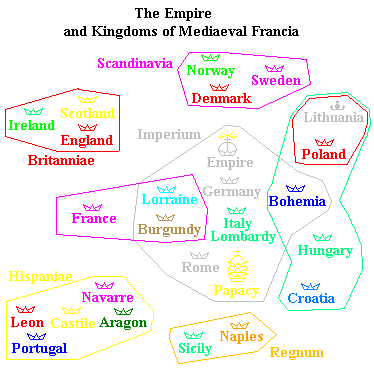 Mikolaj Kopernik as Nicolaus Copernicus, and an Italian like Christoforo Columbo (Cristóbal Colón in Spanish) as Christophorus(-er) Columbus. These men were even, significantly, figures getting into the modern period, not of the deep Middle Ages.
 In an age when alphabets went with religions, the only exception to this was the use of the Hebrew alphabet to write Spanish (Ladino) and German (Yiddish) by European Jews. Islām was not tolerated in Mediaeval Francia, except in unusual circumstances, mainly in Spain and Sicily.
 The alphabet that had been developed to write Gothic disappeared with its language. The old
  Runic alphabet also largely disappeared with the Christianization of Germany and Scandinavia, though its values were not forgotten. The use of Latin and its alphabet contrasts with the official use of Greek and its alphabet in Romania (together with other special alphabets, like Armenian) and the use of the Cyrillic alphabet in Russia and other Orthodox countries.
 in the heart of Francia. The balance of power then, however, ended up being determined by another Germanic speaking power, England, coming in on the side of Romance speaking France.
 are considered separately as the
  Periphery of Francia. Charlemagne himself ruled modern France, northern Italy, and most of modern Germany. After the death of Charles the Fat in 888, the imperial title was fitfully conferred on Kings of Italy, and then lapsed entirely in 922. The descent of King Otto I of Germany into Italy ushered in new combinations of territory and a new line of Emperors, as the Pope crowned Otto in 962.
 A duke is only inferior to a sovereign prince. The next highest title, marquis or margrave (Markgraf), signified the count (comes, Graf, or "earl" in English) of a march (Mark) territory. The marches were border territories that involved a great deal of fighting. In Charlemagne's day, that included marches in Spain contesting the Islāmic advance. Later, the German marches north and south of Bohemia extended German settlement far to the east. Brandenburg became the most famous northern march, remaining a margravate until becoming the Kingdom of Prussia. Austria (Österreich, the "eastern realm") was the most famous southern march, becoming a duchy, then the only "archduchy," and finally an empire.

) this flow chart. Of the eight modern states of the region (not counting Monaco, San Marino, and Liechtenstein), France has the most continuous historical tradition. The Mediaeval Empire at one point drew in all of Francia Media, except for the French Duchy of Burgundy, but then slowly broke up. Parts of Lower Lorraine, assembled by the Dukes of Burgundy, have come down as the Low Countries, the Netherlands, Belgium, and Luxembourg.
this flow chart. Of the eight modern states of the region (not counting Monaco, San Marino, and Liechtenstein), France has the most continuous historical tradition. The Mediaeval Empire at one point drew in all of Francia Media, except for the French Duchy of Burgundy, but then slowly broke up. Parts of Lower Lorraine, assembled by the Dukes of Burgundy, have come down as the Low Countries, the Netherlands, Belgium, and Luxembourg.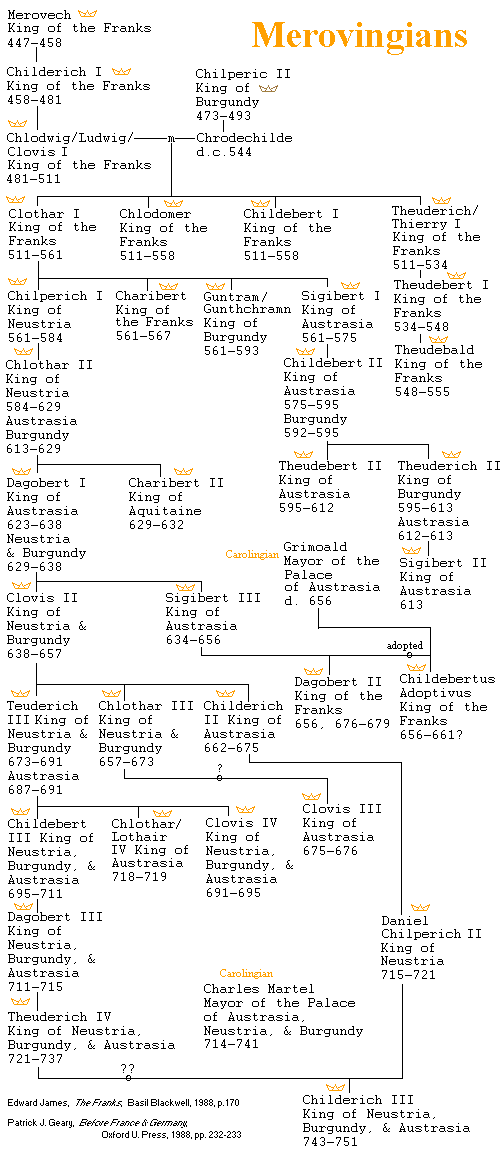 The division of the Kingdom, in time honored Germanic fashion, between the four sons of Clovis, fragmented Frankish power and slowed its growth. In the table above, sub-domains are abbreviated, "Aus" for Austrasia, "Neu" for Neustria, and "Bur" for Burgundy. After the conquest of the Thuringians (531), the Burgundians (534), Provence (536), and the Bavarians (555), there was little expansion of the Kingdom for the remaining period of the Merovingian Dynasty.
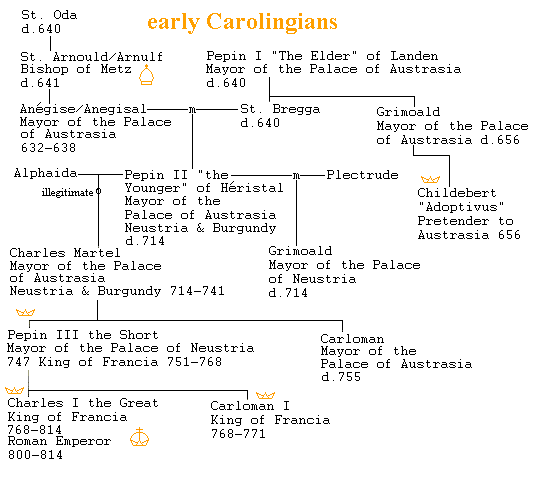
 The Lombards would not stay defeated, and Pepin's son Charles eventually had to conquer them and annex their kingdom (774). His conquest of the pagan Saxons (782-804) and expansion in other directions began to turn the Frankish Kingdom into a superstate. This gave Charles and the Pope ideas, especially when the Empress Irene deposed and blinded her son, Constantine VI, in 797, assuming sole rule:
  While Charlemagne himself supposedly never quite learned to read and write, there was a revival of learning at his Court, enough to earn the characterization "Carolingian Renaissance." One permanent effect that could not have been anticipated at the time is that when printing was invented centuries later in the actual Renaissance (1440's), the uncial characters written in the Carolingian period would be adopted as the font for lower case letters (minuscules) in printing, while block Latin characters became upper case letters (majuscules). Written characters as they actually developed during the Middle Ages are now dismissed as "Gothic" and used only for special purposes -- although they were widely used in Germany (Fraktur) until recently.
 coinage introduced by Charlemagne. This consisted of two coins, a silver denarius and half-denarius, the obolus -- which see at left in their later, British, copper versions, which are the direct descendants of Charlemagne's coinage.

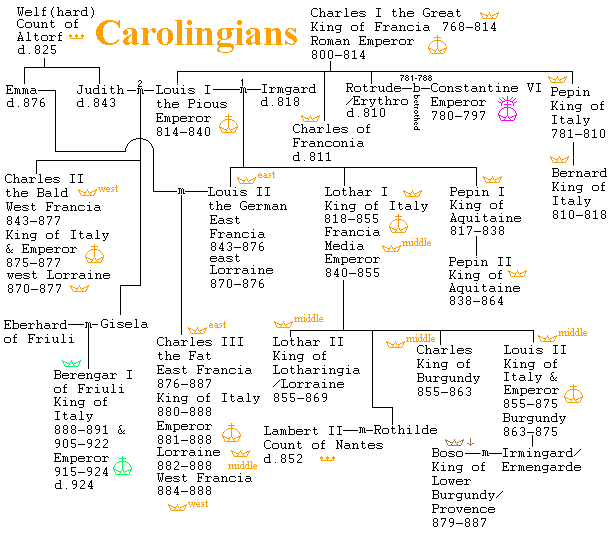

 Italy and Burgundy were prestigious possessions for Lothar, but they were not centers of Frankish power, and the northern area looks precariously and ominously sandwiched between the compact realms of his brothers. This turned out to be especially unfortunate when Lothar not only predeceased his brothers by a good margin but left behind him his own problem of multiple sons. Natural fragments were distributed between them.
 Germany was divided between three brothers, and the West Frankish kingdom, after the brief reign of Louis (II) the Stammerer, passed to his two young sons. Again, this was bad news for the strength and stability of the Frankish realm.

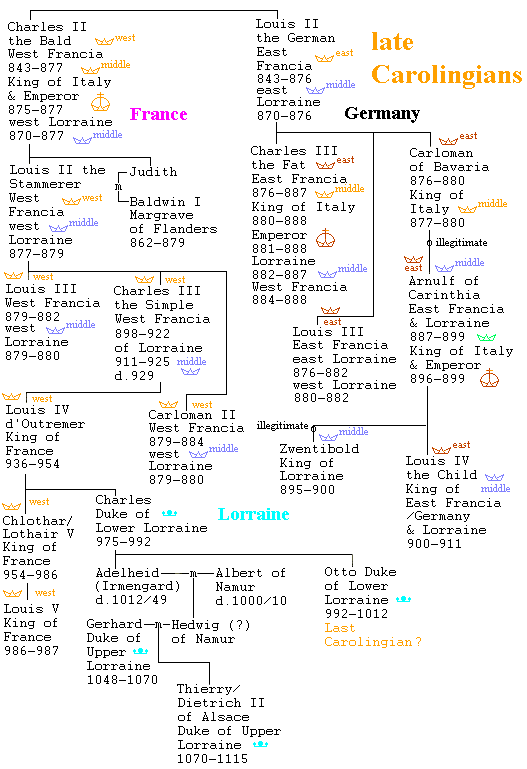 With the last of the main lines of the Carolingians, one connection that intrigued me involved the sister of Otto of Lorraine. Most histories don't even show a sister (if they even show Otto), but she originally came to my attention in From Scythia to Camelot by C. Scott Littleton and Linda A. Malcor [Garland Publishing, Inc., New York, 1994, p.298].
 Charles the Simple's most famous and important deed was to cede some land, which became Normandy, to the Norse chieftain Rollo in 911 -- an infamously humiliating business for Charles. This was also about the time that the last Carolingian in Germany, Louis the Child, died, and the Germans turned to Conrad of Franconian. That was the end of the Carolingians in East Francia.
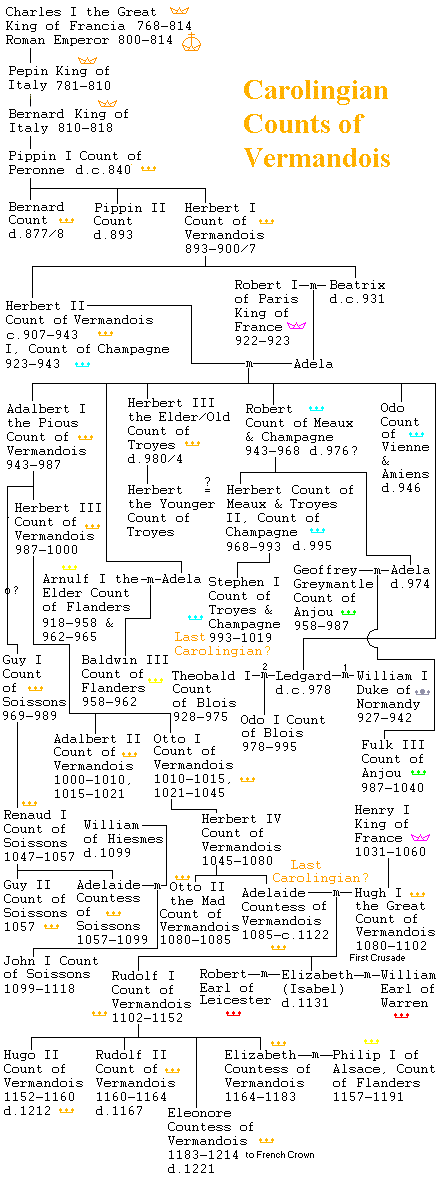

 The western part of the great Frankish kingdom is the domain to which the Frankish name ended up sticking, as "France" -- even rendered faithfully as Frankreich in German. There is some irony in this, since the Germanic Franks there came to speak the local Romance language, descended from Latin, a language which then took its name, like the kingdom, from the Franks, as Français ("French" in English).

 St. Louis IX
 We see a fictional version of Philip's interactions with Henry's family in The Lion in Winter. We even get the sense there that Philip was ready to take advantage of Henry's lesser sons, once Henry was gone.
 Initially, however, it was the French flag that was the red cross on white, which later fell to England. Some people have found this very confusing. See below for the subsequent evolution of the French flag, which changed its colors more than once, settling, before the Revolution, on the white of the Bourbons.

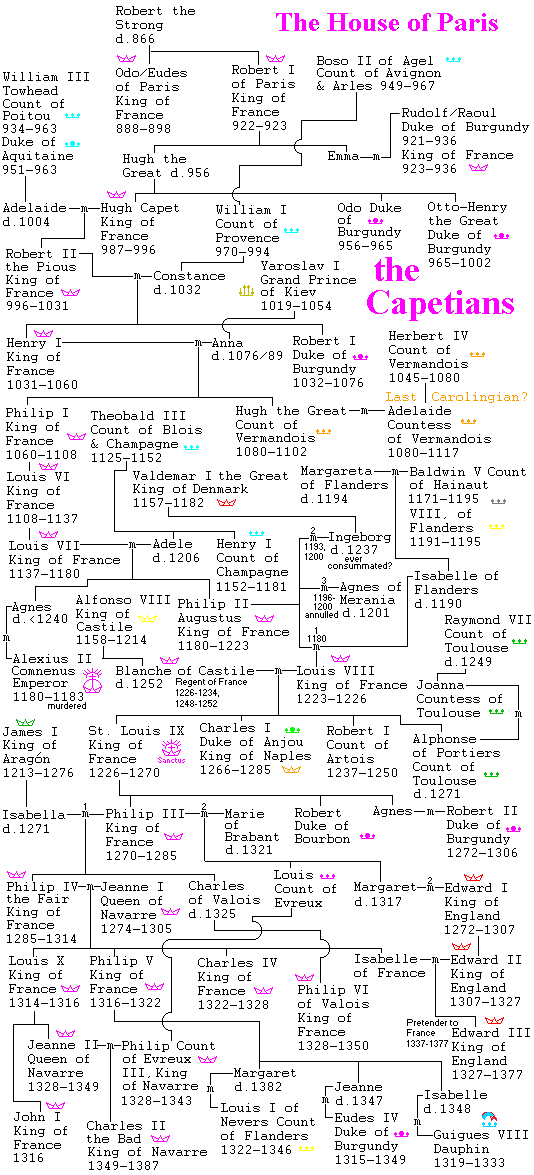
 Seeming to lose every major battle (Crécy, 1346, Poitiers, 1356, Agincourt, 1415), and with large parts of France sometimes occupied, the smart money for many years would have been on the English. Henry V was conceded the French Crown in 1420. But things turned around, Joan of Arc relieved Orléans in 1429, and England lost ground steadily afterwards. With all this not long out of the way, however, Charles VIII was predeceased by all his children. The succession passed, without too much dispute, to the Duke of Orléans.

 Later, Louis XIV got back the Free County and part of Artois but failed to secure more of what later became Belgium. The Hapsburgs became the principal enemy of France until 1756.
) The succession of Louis XII of Orléans and Francis I of Angoulême brought the possessions of their houses with them. During the reign of Francis I, the line of the Dukes of Bourbon then died out with the Duchess Suzanne and her cousin Charles III, returning their domains. Finally, the succession of Henry IV, to anticipate a bit, brings with it the remaining possessions of the Kingdom of Navarre and the Duchy and Counties of Vendôme, Foix, Albret, etc. By then, few fiefs within West Francia were left outside the control of the King. One noteworthy territory was that around Avignon, which had never been a fief of France (Imperial Burgundy, again), was the seat of the Papacy from 1309 to 1377, had been bought outright in 1348 by Pope Clement VI from Queen Joanna I of Naples, and remained a Papal State until nationalized by Revolutionary France in 1791. Encompassed by the Papal enclave was the Principality of Orange, independent until 1713, significant as one source of the house that would come to champion and then rule the Netherlands.
The succession of Louis XII of Orléans and Francis I of Angoulême brought the possessions of their houses with them. During the reign of Francis I, the line of the Dukes of Bourbon then died out with the Duchess Suzanne and her cousin Charles III, returning their domains. Finally, the succession of Henry IV, to anticipate a bit, brings with it the remaining possessions of the Kingdom of Navarre and the Duchy and Counties of Vendôme, Foix, Albret, etc. By then, few fiefs within West Francia were left outside the control of the King. One noteworthy territory was that around Avignon, which had never been a fief of France (Imperial Burgundy, again), was the seat of the Papacy from 1309 to 1377, had been bought outright in 1348 by Pope Clement VI from Queen Joanna I of Naples, and remained a Papal State until nationalized by Revolutionary France in 1791. Encompassed by the Papal enclave was the Principality of Orange, independent until 1713, significant as one source of the house that would come to champion and then rule the Netherlands.
 Following the precedent of Charles VIII, Louis XII invaded Italy again in 1499 to press his claim to Milan as well as to Naples. This was at first successful. The French held Milan 1499-1512. Louis then went on against Naples and obtained an agreement in 1500 to divide the Kingdom. But Ferdinand of Aragón was not going to leave that alone. He deposed his cousin, Frederick IV of Naples, in 1501 and then defeated the French at Garigliano in 1503. Louis was driven out of Italy altogether in 1512.
)
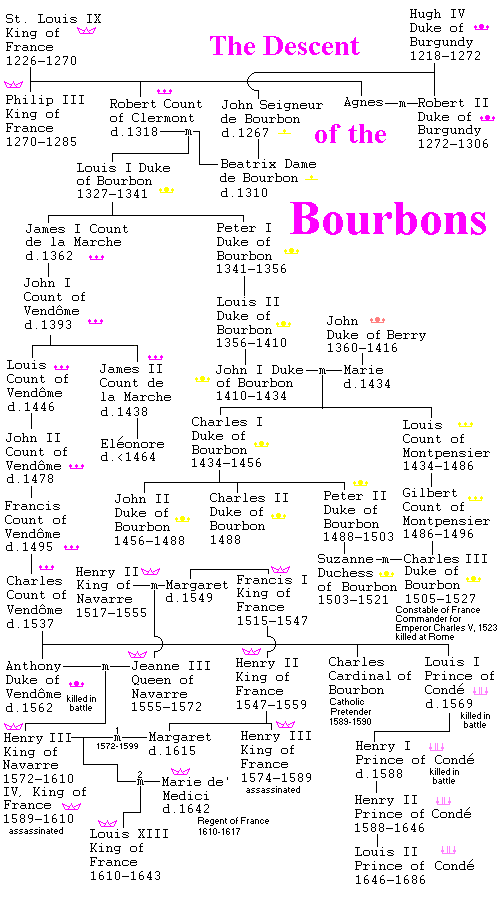 Not just civil war was the problem, but invasion by Spain.

 Under the Bourbons, France rose to be the most powerful state in Europe, and a paradigm of Royal Absolutism. Troubled by episodes of Huguenot and noble opposition under Louis XIII and Louis XIV, the Monarchy nevertheless went from success to success. Entering the Thirty Years War on the side of the faltering Protestants, under the advice of the Cardinal Richelieu, it became clear that raison d'état had trumped loyalty to the Catholic cause.


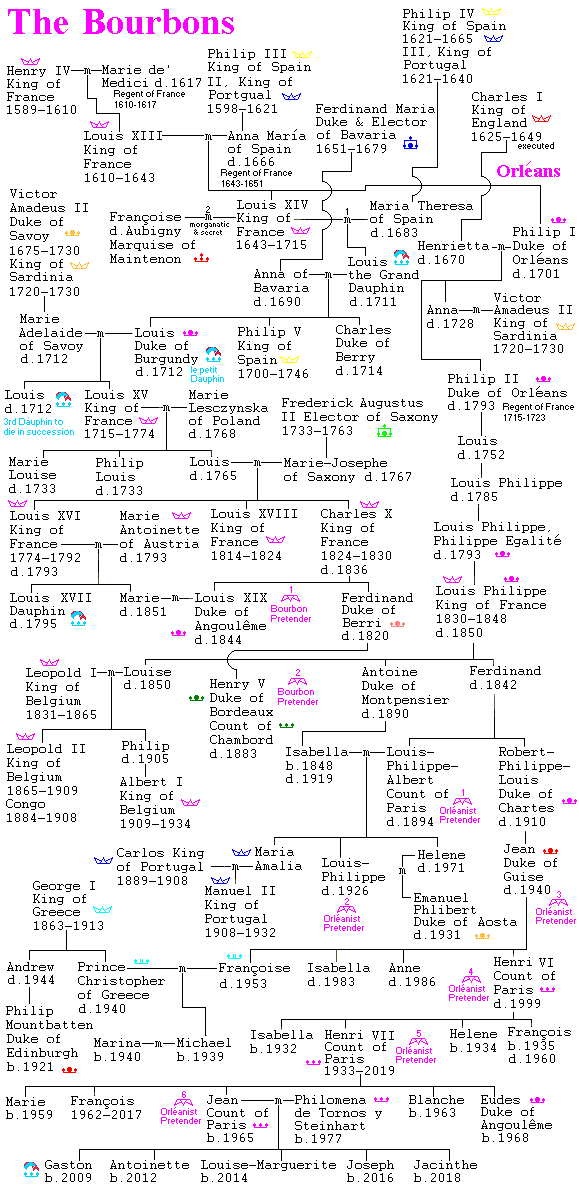
 In the Court of Louis XVI was the court painter Louise Élisabeth Vigée Le Brun (1755-1842), one of the great artists of the day. Le Brun lived a long and fascinating life. Of humble origin, her talent vaulted her to the most rarified level of portrait painting. The patronage of Marie Antoinette herself made her the principle Court artist but also put her in danger once the Revolution started.
 she did a fine portrait of one of Napoleon's sisters but otherwise did not seem to be a favorite, or perhaps a fan, of the Bonapartes. Her long life left a body of hundreds of extraordinary images of her contemporaries.
 Her portrait at left is of Charles Alexandre, Vicomte de Calonne (1734-1802). When I first saw this painting, it struck me that de Calonne was a dead ringer for political comedian Bill Maher, at right. Separated at birth? Reincarnation? You never know. The nose and mouth are a little different. Maher diverges from Leftist orthodoxy often enough that he might be in danger, from some, of the modern equivalent of the guillotine. Since Maher is willing to criticize ʾIslām as harshly as Christianity, the threats are not always theoretical.
 but rather as its meaning, its highest justification. Therefore it accepts with a clear conscience the sacrifice of an enormous number of men who, for its sake, must be suppressed and reduced to incomplete men, to slaves, to tools.
 ]," Analects, II:12.
 The French Revolution had two major unexpected results,
  The symbolism of the new tricolore flag of the Republic can have many explanations. However, one coincidence is that the three colors match the colors of the three principal dynasties in French history. The banner of Charlemagne and so the Carolingians was the red oriflamme. The Capetians may have begun with red, but blue became the background of their "Banner of France." Finally, the Bourbons quite formally and explicitly used white, even for military uniforms.
  It seems improbable that the Revolutionaries wanted a flag to commemorate the French monarchy, and they may have just liked the colors, but then the Kings had liked these colors also.

 In Napoleon's case this was in Spain, as in Hitler's it was in North Africa. The result in each case was to forfeit the Mediterranean theater of the general European War while taking on an impossible strategic task in Russia.

 The Seven Years War also broke the French position in India, where the project of establishing French control over native states was then taken over by Britain. France retained five cities in India, however, until surrendering them to the Republic of India in the 1950's.


 The French Second Empire developed when Napoleon's nephew, Louis Napoleon, transformed himself from the President of the Second Republic to the Emperor of the Second Empire. Napoleon III's France was a much more conventional, politic, and durable state than Napoleon I's. Napoleon III ironically obtained territorial additions to France from his ally, Sardinia, after defeating their mutual enemy, Austria. He was even an ally of England in the Crimean War (1853-1856), though there was otherwise a great deal of friction with France's ancient enemy. In short, the Second Empire was no upheaval of Europe the way that the First Republic and the First Empire had been. The end of Napoleon III, however, was the consequence of Otto von Bismarck's plan for the coming German upheaval. Defeated by Prussia, Napoleon abdicated and left France to its fate, but at least his last years of exile, in England itself, were rather more comfortable and honorable than Napoleon I's had been; but his son, sadly, died fighting the Zulus in the British Army.
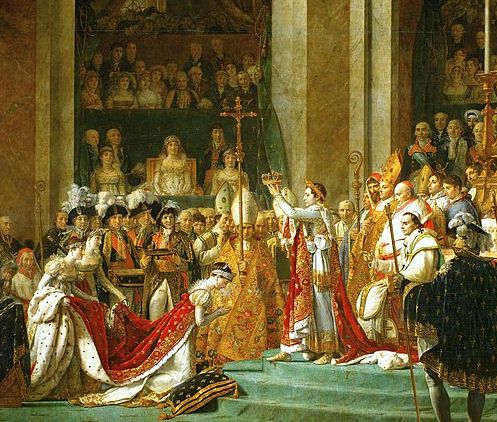
) Laetitia Casta
Laetitia Casta)
) map
map)
)
)
)
)
)
)
)