
ὅπερ γάρ τις ἔφη τῶν λογοποιῶν περὶ τῆς Ἀσίας, λέγων ὅσην ὁ ἥλιος πορούεται, ταύτης πάσης ἄρχειν ἄνδρα ἕνα -- οὐκ ἀληθῆ λέγων, εἰ δὴ πᾶσαν Λιβύην καὶ τὴν Εὐρώπην ἐξαίρετον ἐποιεῖτο τῶν ἡλίου δυσμῶν τε καὶ ἀνατολῶν -- τοῦτο νῦν ἐξενίκησεν ἀληθὲς εἶναι, τὴν ἴσην τε ἡλίου πορείαν εἶναι κτῆσιν ὑμετέραν καὶ τὸν ἥλιου διὰ τῆς ὑμετέρας πορεύεσθαι.Some chronicler, speaking of Asia, asserted that one man ruled as much land as the sun passed, and his statement was not true because he placed all Africa and Europe outside the limits where the sun rises in the East and sets in the West. It has now however turned out to be true. Your possession is equal to what the sun can pass, and the sun passes over your land.
Aelius Aristides, Αἴλιος Ἀριστείδης (117/18-180/81 AD), "To Rome," Εἰς Ῥώμην, 143 AD, The Ruling Power: A Study of the Roman Empire in the Second Century After Christ Through the Roman Oration of Aelius Aristides, James H. Oliver, The American Philosophical Society, 1953, p.896.
The sun never set on the British Empire because the sun sets in the West and the British Empire was in the East.
Anonymous Student
In large bodies, the circulation of power must be less vigorous at the extremities... This is the immutable condition, the eternal law of extensive and detached empire.
Edmund Burke, 1774
Far-called, our navies melt away;
On dune and headland sinks the fire:
Lo, all our pomp of yesterday
Is one with Nineveh and Tyre!
Judge of the Nations, spare us yet,
Lest we forget -- lest we forget!Rudyard Kipling, "Recessional," 1897
Poor loves. Trained to Empire, trained to rule the waves. All gone. Bye-bye, world.
Connie Sachs, Tinker, Tailor, Soldier, Spy, by John le Carré [David Cornwell], 1974, 1991, 2002, Pocket Books, p.114


In the animated GIF file above, not all British possessions of 1937 are represented, only select ones for each of the 24 time zones of the Earth. (All British possessions are listed below.) The information on the diagram is basically that shown on a commemorative plate that was produced for the coronation of George VI in 1937. An image of the plate is in The Horizon History of the British Empire, edited by Stephen W. Sears [American Heritage Publishing/BBC/Time-Life Books/McGraw-Hill Book Company, 1973]. The coronation year is also noteworthy for a handsome redesign of British coinage, where we get touches like a little wren on the farthing, a coin that sadly, because of inflation, was discontinued after 1956 and demonetized in 1960.
The time zones on the diagram themselves may be said to be artifacts of the British Empire,  since they are based on the Meridian of Greenwich -- at the original Royal Observatory, 1675-1953, in London (as seen in the image at right), where the building to the right contains the meridian transit instrument that defines the line of zero longitude.
Since 1884 this has been the internationally accepted prime meridian for the calculation of longitude. The animation may also be used to inspect the operation of the International Dateline, which divides the -12h/+12h time zone. (Animation may be stopped either with the "stop" key or the ESC key, although not all browers respond to these instructions.)
It is interesting to note that although several places in the Pacific might fall into the -12h time zone, the Dateline itself and the boundaries of the -11h zone are today drawn in such a way that no jurisdiction uses the -12h zone (Tonga, formerly British, uses +12h; Midway Island & the Aleutians use -11h). Some time zone boundaries have been changed since 1937. The Gambia no longer seems to be in the -1h time zone. Also, there have been several time zones that are at a half hour rather than a whole hour interval from Greenwich, including today India (+5h30m), Burma (+6h30m), and central Australia (+9h30m). My source for the 1937 zones, in the Atlas of the British Empire [edited by Christopher Bayly, Facts on File, 1989, p.246], does not clearly indicate these variations, so no attempt is made to represent them.
The "British Empire" was not a de jure entity (like the Roman Empire, German Empire, Austrian Empire, Russian Empire, or Japanese Empire), since Britain itself was a kingdom (the "United Kingdom" of Great Britain and Ireland,  or Northern Ireland in 1937). One British possession, however, was an empire, namely India, where British rule comes to be called the "Raj,"
  , or
, or  . Queen Victoria became "Empress of India" in 1876. The formal British adoption of India as an Empire, however, was seen at the time as a response to Bismark's creation of the German Empire (1871).
The "British Empire" usually means, on the other hand, not something in relation to the Empire of India, but the whole of British colonial possessions spread around the world. "Empire" had been used this way long before there was any 19th century ideology on the subject, for it or against it.
But as an "Empire," British possessions do not look much like Rome, China, or Russia, which were geographically continguous, with simple, continuous borders. Instead, the "British Empire" was functionally a bit more like the later Holy Roman Empire, whose fragmentation and particularism -- a "jury rig" in British nautical terms -- gravely compromised such power as we might expect of the whole. As John Darwin said recently: "The British presided over a ramshackle empire, full of contradictions and quirks, and with a control apparatus that was spasmodic at best" [Unfinished Empire, The Global Expansion of Britain, Bloomsbury Press, 2012, p.194].
The power of Britain at its height was almost entirely a function of that of Great Britain itself, as the power of the later Holy Rome Emperors was almost entirely a function of that of the Hapsburgs. Most would not consider this a flattering characterization of Britain's achievement, since the Holy Roman Empire was famously, in Voltaire's words, neither Holy, nor Roman, nor an Empire. Yet when Emperor Leopold I had to make a deal with the Margrave of Brandenburg just to get him to fulfill his feudal duty to support the Emperor in the War of the Spanish Succession (in 1701), this does not sound too different from the difficulties that Britain faced in World War I and World War II to obtain the full participation of the Dominions in those wars.
For World War II, it was not a foregone conclusion, especially for South Africa and Ireland, that they would participate at all. By 1939, Australia and New Zealand had long been expressing reservations about involvement in (another) European war, and this line of thinking was only cut short when it became clear that a direct threat from Japan was a reflex of the European situation. When Britain was then unable to stop the Japanese, Australia and New Zealand formed ties with the United States that soon rivaled in sentiment (at least) those for Britain.
Ireland had created a Presidency in 1937 and thus, by ordinary calculation, became a Republic. Since it was not offically called that -- just Éire -- its status remained ambiguous. Unambiguous Irish neutrality in World War II, however, pretty much cleared that up, especially when Prime Minister De Valera offered condolences at the German Embassy in 1945 for the death of Adolf Hitler -- without a comparable gesture for Franklin Roosevelt, which might even now continue to perplex us, since Ireland never had any complaints against the United States. Leaving the Commonwealth in 1949 removed any remaining ties to Britain.
 The growing and troublesome autonomy of the Dominions was a function of their geographical detachment and distance from the Mother Country. Their advance to self-government almost inevitably spelled functional alienation, first in principle and then increasingly in practice. Thus, John Darwin says, "the existence of so many dependencies over whose internal affairs London had almost no control, mystified both foreign observers and much opinion in Britain, for whom a colony, as they were still called, was a colony and 'responsible government' a constitutional riddle" [p.390].
What the hell kind of "Empire" is it when you don't even rule parts of it? The growth of the United States, for instance, during the same period, did not produce the same problems, since even distant new foundations, like California, remained politically and Constitutionally integrated with the whole, adding an unambiguous increment of wealth and power to the nation. But Britain barely considered constitutional intregration of colonies into Great Britain. Its initial instinct, to hold colonies in thrall, led to the American Revolution and the alienation of its first and most promising colonies. Its later approach, with gradual grants of autonomy, kept the Dominions happier and willingly faithful longer, but ultimately had the same practical effect, as, by the end of World War II, they were all functioning as fully independent states. The dynamic of this fragemenation I have examined elsewhere. Since India had never been granted self-government before independence, it is not surprising that it soon became a Republic.
While India was the "Jewel in the Crown" of the Empire, its role in British power was also unlike the possessions of more conventional Empires. It was not geographically, historically, culturally, racially, or religiously contiguous with Great Britain. It was the seat of an entirely different and ancient Civilization, with a vastly larger population than all the rest of British domains put together, and the British were always determined to maintain a distance and a separation from it.
The British Empire could therefore have never gone the way of the Roman Empire, where eventually all (free) inhabitants came to enjoy a common citizenship and a common participation in the political, military, cultural, and religious life of the whole. In time, Rome even underwent a religious revolution in the triumph of Christianity, which had grown up out of the disparate, non-Latin elements of the Empire. The British liked to think of themselves as modern Romans, but a fate comparable to Rome, where India would have dominated Britain demographically, politically, and perhaps even religiously, was not something they were willing to contemplate.
Yet the dynamic of British ideology and practice was headed in that direction and could only be forestalled by arbitrary and incoherent barriers. Thus, 19th century Britain, when it realized that it was not just out to make money but had come to assume the moral responsibility of ruling millions of people in their own interest, came to see itself as on a civilizing mission and soon began in earnest to educate and assimilate Indians (and later, Africans, Chinese, etc.) in all the terms of modern life -- science, liberty, free enterprise, democracy, etc. The historian Thomas Babington Macaulay looked forward to "a class of persons, Indian in blood and colour, but English in taste, in opinion, in morals, and in intellect." Liberals, like John Stuart Mill, could get behind this project and bless British India as a paragon of virtue and altruism. Christianity (ironically, in light of its Roman origin) was also thrown in there, but official support for conversions was toned down after the Mutiny (1857-1858).
It was not many decades, however, before a Western educated and alarmingly Anglicized Indian elite came into being. By all the ordinary dynamics of Empire (or at least Roman Empire), an educated Indian could be expected to circulate freely among Englishmen, possess the same dignity and freedom as other Subjects of Queen Victoria, and reasonably be expected to participate in the Government of his own country, as many British had already said that modernized Indians could be expected to do. Indeed, Queen Victoria's proclamation after the Mutiny included "the principle that perfect equality was to exist, so far as all appointments were concerned, between Europeans and Natives."
So if a barrier was to be maintained, how was that going to work? One approach was to deny that the Anglicized elite had any more business ruling the Natives than the British. Frederick Lugard, Governor-General of Nigeria, 1912-1919, thought that the British should rule indirectly, through traditional local rulers, and so he said:
It is a cardinal rule of British Colonial policy that the interests of a large native population shall not be subject to the will either of a small European class or of a small minority of educated and Europeanised natives who have nothing in common with them and whose interests are often opposed to theirs.
This policy, however perverse, could be partially maintained in India after the Mutiny, by way of the Princely States, but much of India already was ruled directly by the British Crown. What could possibly prevent Queen Victoria's promise of equal "appointments" from being fulfilled in that case? Unfortunately, the spirit of the age contributed the impediment: Racism. If the non-white races were inherently inferior, physically, morally, or intellectually, to whites, then an Englishman was not simply interchangeable with a modern, educated Indian (or African, etc.), however jumped-up and Anglophile their language, education, or appearance might be. There was still going to be something weak, nasty, and inferior lurking within.
It is easily forgotten now that this was the spirit of the age. "Social Darwinism" was not just a hostile label applied by the enemies of capitalism. In 1912, Karl Pearson, Professor of Eugenics at University College London, published Darwinism, Medical Progress and Parentage. Eugenics remained popular in some circles for decades, and not just in Nazi Germany. What sound like eugenic questions still arise over the results of IQ tests, although professor Pearson probably would have been disconcerted that Jews tend to score the best among whites, while Chinese, Japanese, and other East Asians tend to score the highest overall. This was not the hierarchy that Victorian, let alone Nazi, racists would have expected -- although nothing to surprise a particular kind of Japanese nationalist.
The ugly principle of race spelled the doom of the British Empire, for the British ultimately knew better; and there was the incoherent circumstance that Indian Subjects in Britain could actually be elected to Parliament, as was Dadabhai Naoroji (1825-1917) in 1892. If Indians were racially inferior and could not be trusted to rule their own country, how could one of them become a Member of Parliament in Britain itself? And then it was exceedingly awkward after World War II to maintain racial barriers and racist ideology when Britain had needed to rally support to defeat the ultimate exemplar and advocate of racist ideology, Nazi Germany. To the extent that Hitler actually admired the power (and racism) of the British Empire, he helped to destroy it.
Yet the racism was already doomed, as it was in the United States, by its inconsistency, as noted, with English principles of individual liberty, personal dignity, and natural rights, as already sharply ennunciated, contra slavery itself, by Thomas Jefferson. Someone like Mohandas Gandhi could feel this inconsistency in the most personal way, after he had enjoyed the easy equality and personal friendships of his life in London, while he was a law student in the Middle Temple, and then experienced the color barrier and personal insults, sometimes from the same individuals, after he had returned to India. Yet even Gandhi remained a supporter of British liberal principles, in the law and the Empire, for many years. Only slowly did he come to believe that the denial of independence to India rested only on the worse aspects of British ideology, but then he also realized that he could undermine British confidence and resolve precisely by appealing to the "better angels" of the British character. Prejudice and snubs against the "Wogs" and "N****rs" were not only rude, they were just not "fair play," something a gentleman should not tolerate. This proved to be a most effective strategy.
Ultimately, Britain would be troubled by something approaching the Roman dynamic. Immigration from India and other former possessions would introduce anomalous racial and religious elements into British society. This could have very serious consequences. On July 7, 2005, terrorist bombs were set off on subways and busses in London. The perpetrators turned out to be young adult Muslim men, who had all been born and raised in England. Their sympathies, despite their birth and education, had come to be in tune with Jihadist, anti-British, and anti-Western ideology.
The British suddenly realized that the "Empire" had come home in a way that was hostile to Britain and its traditions. Also, the crime rate in the Muslim community was significantly higher than among the native English or even in the Hindu community. Thus, there were cultural differences that had come along with the immigrants and had not been erased by assimilation, even in the new generations of native born. This is a problem elsewhere in Europe also, especially in France, and especially in terms of crime and unemployment. It is even a problem in Sweden, which has no former colonial population but which allowed in large numbers of Syrian and other refugees, whose culture has proved to be, to say the least, incommensurable with that of Sweden.
It was assumed by one and all that India added a substantial increment to British power and perhaps even constituted a major portion of what was needed by Britain for Great Power status. After all, hadn't the Moghuls been perhaps the greatest power of their day, because of the possession of India?
However, the economic development of the country, even after the growth fostered by British investment and modernization, was so relatively backward that there was little that India, which certainly had been, perhaps, without equal on the Earth in the 16th century, contributed in modern terms.
The most conspicuous symbol of British power of India was its Army, which in 1881 contained 69,647 British and 125,000 Indian troops [Darwin, op.cit. p.326]. Since this was the largest concentration of British troops anywhere in the world, surpassing Great Britain itself [with 65,809 troops], and it was paid for by Indian revenues, the British benefited in that they did not need to pay for these forces themselves. However, the British garrison in India was there in large part to secure India, and prevent another Mutiny, not to otherwise be used for British military purposes. In the sphere of influence of the Indian Government, the Indian Army, British and Native, could be used for local purposes. This sphere stretched from China, Southeast Asia, and Burma, to the Middle East, including the Persian Gulf and Aden, to East Africa. In those terms, Britain was riding an Indian Empire that might be functioning much as it would, as a regional Power, if the British weren't even there.
A few Indian troops were used in Europe in World War I, but the value of the Indian Army was otherwise within the range we might expect, in Mesopotamia in World War I and then Malaya and Burma in World War II. The independence of India in 1947 thus did remove a kind of keystone to the whole arch of British influence in South Asia and the Indian Ocean. India was not going to pay for any part of the British Army anymore. What this looks like in retrospect, then, is that if India had ever truly been integrated with Britain, and had ever achieved anything like the same level of economic development, the whole would have had the potential to be a Superpower on the level of the United States or, certainly, the Soviet Union. But there was never any realistic chance of anything of the sort; and even in 2013, India is still struggling to emerge as a Great Power in its own right, for the first time since the Moghuls. It hasn't quite made it yet, after seventy years of independence, and this puts in stark relief the limitations of what it could contribute to the British Empire in the days of the Raj.
Despite the informal and even confused nature of the larger "British Empire," the term "imperial" worked its way into various official terminology about British possessions, e.g. the "Imperial General Staff" and the "Imperial War Museum." When India and Pakistan became independent in 1947, the Indian Empire ceased to exist and both countries became, for a time, Dominions -- the category for previous British self-governing territories, starting with Canada (1867) and later coming to include the Commonwealth of Australia, New Zealand, the Union of South Africa, and, for a time (1926-1934), little Newfoundland (which did not join Canada until 1949). As the "Empire" faded, the British Commonwealth took over, though that organization seemed to offer less and less as time went on in terms of real economic, military, or political advantages. Indeed, if the Holy Roman Empire was in some ways analogous to the British Empire, then the Commonwealth may be compared to the German Confederation of 1815, where there was no pretense that the sovereignty of its members was in the least compromised by the largely symbolic organization of the whole.
In retrospect, "Empire" was never the best term for the constellation of British possessions. They were never continguous nor unified enough to match the structure, let alone the appearance, of any of the paradigmatic historical empires. But when we see the string of small naval bases stretching from Gibraltar, to Malta, to Aden, Singapore, and Hong Kong, this is reminiscent of something significant in Classical history:
The " This was a status of neither conquest nor rule, but it involved varying degrees of control and influence. And there were antecedents to such a structure. The domain of 5th century Athens at its height is often called an "Empire," despite the truly farcical inappropriateness of this term when applied to the scale and the structure that Athenian power possessed, which mostly consisted of the county-sized territory of Attica plus increasingly unwilling allies coerced into the fiction of the defensive League of Delos. But the Greeks knew what to call it; and the hegemony possessed by Athens then passed to Sparta, to Thebes, and finally to Macedonia. Roman rule, by contrast, would be direct and comprehensive, allowing local government only where this implied absolutely no political freedom of action and no independent military force.
A little different were the Fetters of ʾIslām. These were garrison towns for the Arab conquests, the أَمْصَار, ʾamṣār (singular, مِصْر, miṣr, which could mean "big city, metropolis, capital," or, curiously, "Egypt"). The root verb could mean "to colonize," which seems appropriate for the circumstances.
The ʾamṣār were ʾal-Baṣrah, أَلْبَصْرَة (in Iraq, founded 636), ʾal-Kūfah, أَلْكُوفَة (in Iraq, 639), ʾal-Fusṭāṭ, أَلْفُسْطَاط (later Cairo, 641), and ʾal-Qayrawān, أَلْكَيْرَوَان (in Tunisia, 670). These places soon formed the core, not just of a hegemony, but of conquest and rule, unlike the Macedonian garrisons but like some of the British outposts. One might wonder why there were two ʾamṣār in Iraq. The principle, evidently, was that Baṣrah looks out over former Persian possessions, while Kūfah, on the edge of the desert, keeps an eye on the Arab tribes, such as the Lakhmids, who had been clients of Persia. Indeed, the British possessions of Gibraltar, Malta, and Hong Kong did not lead to the conquest of adjacent hinterlands -- certainly impossible for Malta, an island. Aden and Singapore did lead to control of their hinterlands, mainly as protectorates. A similar dynamic sometimes occurred in Africa.
The British naval presence around the world and the whole Pax Britannica were marks of hegemony, not of empire. Colonies as isolated naval bases grew up as tentpoles of hegemonic power. In those terms, India, the Dominions, and then the substantial African colonies were anomalous -- except that in some ways, the Greeks had done that also. In America, Australia, New Zealand, and elsewhere, British emigrants settled and founded states, just as Greek cities founded new cities as colonies in the Mediterranean. Greek colonies, as it happened, immediately become autonomous; but then, with the lag of a few years, so did the British Dominions. The nineteenth century "scramble for Africa" fleshed out substantial possessions there, but this all was a late addition to the hegemonic power substantively founded on bases, Dominions, and that one true Empire, India.
The British Empire as consisting of something more like a hegemony is even more illuminating when we come to the predominant power that is widely seen as succeeding to the global status of Britain: The United States of America, itself a daughter of British hegemony. While the role and actions of the United States are routinely called "imperialism" by the Leninist Left and the Isolationist Right, the United States has none of the kinds of territorial possessions that were enjoyed by Britain.
The foreign bases of the United States, although many, and from which it can project its power, beyond what can even be done with its substantial naval forces, consist of no sovereign American territory -- except in the chain of islands, Midway, Wake, and Guam, that were acquired in the 19th century in imitation of Britain. Even something that was sovereign territory, the Panama Canal Zone, was nevertheless surrendered to Panama. One famous, or infamous, base, Guantanamo Bay in Cuba, is sovereign Cuban territory but was obtained on permanent lease at the time the United States freed Cuba from Spain.
The United States clearly does not have an Empire; but it is also, clearly, a hegemon, ἡγεμών. This status may be as fragile as it was for Athens, or for Britain, but the territorial heart of the United States is also a much greater source of power than was that of Athens, Britain, the Hapsburgs, Macedon, or the typical Spring and Autumn state. Also, NATO as the equivalent of the League of Delos, rather than coerced into paying tribute to the hegemon, finds that the defense of its members is subsidized by the American taxpayer. The attempt of the French to hold Vietnam against the Communists was funded by the United States, which then inherited the subsequent struggle after the French failure. Athens provided no such benefits.
Whether the United States can sustain such efforts, economically or politically, is open to question. Britain lost not just the will to Empire but the power for hegemony. As American strength is confused by internal "anti-imperialist" political opinion and socialist economics, even with the Soviet Union gone and Euro-socialism collapsing, one wonders if it will be moral failure alone that allows the emergence of the power waiting to be the next hegemon: China.
Many Americans are alert to all this, but much of the electorate still has its eye fixed on the Free Lunch and the class envy pushed by the orphaned but persistent Marxists of American education and the press -- people whose anti-Americanism is so perplexingly intense that they are willing to ally themselves with the grotesquely Mediaeval ideology of Islamic Fascism. But that is a separate topic in its own right.
We see quibbles about the very meaning of "empire" in complaints about calling the Emperor of Japan what the Japanese themselves call him, i.e. an "Emperor." To an extent, we also see this with Ethiopia. Most curiously, the issue arises in relation to the Roman Empire, whose attenuated Mediaeval State often does not encompass the "subject" peoples often considered essential to an "empire."
British Empire and Hegemony
 Fetters of Greece," Πέδαι Ἑλληνικαί, were the bases -- Piraeus, Πειραιεύς, Corinth, Κόρινθος, Chalcis, Χαλκίς, and Demetrias, Δημητριάς -- by which Hellenistic Macedonia enforced its hegemony over Greece. And there we find the words. Macedon was the hēgemṓn, ἡγεμών, and it possessed the hēgemonía, ἡγεμονία, over Greece.
 The status of a "hegemon" is something that we also find very far from Greece. In the Spring and Autumn Period of the Eastern Chou of Chinese history, the tradition arose that at various times there were dominant rulers among the many states of the era. These were, in succession, the 五霸, Wǔ Bà, or the "Five Hegemons." According to the historian Szu-ma Ch'ien, the five states involved were Ch'i, 齐, Sung, 宋, Chin, 晋, Ch'in, 秦, and Ch'u, 楚. Other lists occur, including Wu, 吴, and Yüeh, 越. The "Hegemons" are not so much particular states, as they are particular rulers of the states, who briefly dominated others in their time. They did not conquer or rule all the others. Indeed, that only happened in the following Warring States Period, when the King of Ch'in, 秦, rolled up the remaining states and made China, truly, an Empire. So the Hegemons were, briefly, predominant; but they did not create empires, however we understand them.
or area | 1900 | 1909-1913 average/year | 1914 | ||
|---|---|---|---|---|---|
| Import/Export, millions of £ | Investment, millions of £ | ||||
| Canada | 22/8 | 22.2/9.6 | 27.3/21.2 | 500 | 412 |
| United States | 139/20 | 138.8/37.4 | -- | 750 | 836 |
| India | 27/30 | 27.4/31.0 | 44.8/54.0 | 400 | 317 |
| Ceylon | -- | ||||
| Australia | 24/22 | 23.8/23.6 | 56.3/39.8 | 400 | 339 |
| New Zealand | 10/6 | 11.6/5.9 | 84 | ||
| West Indies | 2/4 | 1.8/4.7 | 2.9/3.4 | 750 | -- |
| South America | 28/24 | 287.3/216.5 | -- | -- | |
| Mexico | 81 | ||||
| Brazil | 172 | ||||
| Argentina | 349 | ||||
| Europe | 221/118 | 200 | -- | ||
| Russia | 139 | ||||
| Medi- terranean | 27/21 | -- | |||
| Middle East | 19/12 | 1000 | -- | ||
| Egypt | 66 | ||||
| East Asia | 20/26 | 22.7/12.2 | -- | ||
| China | 75 | ||||
| Japan | 78 | ||||
| Sub- Saharan Africa | 8/20 | 8.4/21.6 | 5.8/7.9 | -- | -- |
| South Africa | 10.7/19.6 | 262 | |||
| Source | Bayly's Atlas, pp.170-171 | Lloyd's British Empire, p.423 | Dalziel's Atlas, pp.94-95 | Lloyd's British Empire, p.258 | Darwin's Unfinished Empire, p.183 |
We get a hint of Leninism in Dalziel's heading for the chapter, "the country became increasingly dependent on foreign markets to absorb rising industrial output" [p.94] -- as though rising output required export. See below. The long term problem of the British economy would be lack of production, not lack of markets; and no country has ever become more prosperous by ignoring Say's Law.
Between all these sources, of course, the world gets divided up in different ways; and while Darwin helpfully gives investment numbers for more specific countries, other areas are left out -- e.g. for Europe and the Mediterranian, Darwin only has a number for Russia, although, if Lloyd's number if reliable, this accounts for more than half of British investment in the area, which means that the Russian Revolution (with all assests seized and bonds defaulted) was a grave financial blow. Since Lloyd doesn't give any numbers for Sub-Saharan Africa, this leaves us unable to guess what investment was in Nigeria, the Gold Coast, Kenya, etc. But it is nice to see the truly massive amount of British investment in Argentina, larger than both India and Australia.
Britain in this period is running a large trade deficit.  This is usually taken as a sign of British decline. However, as David Hume noted as early as 1752, this really just means that enough money is exported to make up the difference. This would cause a deflation, unless enough money is created or brought in (for investment) to make up the difference. Since Britain did not experience any deflation after the 1890's, it is fairly clear that the money flows were correcting the balance. This kind of thing was later thought to be indicative of American decline when the United States began to run large trade deficits and in the 1980's became a net debtor from foreign investment in United States securities. However, the dire predictions at the time gave no hint of the relative strength of the United States economy, with good growth, low unemployment, and negligible inflation in the 1990's, with the American advantage over Europe and Japan increasing in the course of the decade. By 1999, the United States economy was all but carrying, Atlas-like, the stagnant or shrinking economies of the rest of the world -- though it might be said that the financial collapse of 2008 raises new questions about the foundation of the prosperity after 2000.
The British balance of trade and balance of payments situation in 1900 thus need not have been an indicator of any real ill health. British decline ultimately had to be from other causes, like an absolute decline in innovation and investment at home. Indeed, when Americans in the 1980's worried about the Japanese buying up the United States, the largest foreign investors were actually British -- which for the future meant American growth rather than British growth.
Another lesson to be read off the trade figures is that a relatively small fraction of British trade involved colonies that would later constitute the "Third World." Indeed, the only trade surpluses in the table are with India, Africa, the West Indies, and the Far East, which might give some heart to Leninist claims that British colonies, especially India, were the outlet for Capitalist "excess production." However, the trade surpluses are small, and overall British trade with India and the other colonies is hardly larger than with the much, much smaller populations of Australia, New Zealand, and Canada. No serious argument can be made that the likes of Australia and New Zealand, with their own autonomous governments and protective tariffs, were being "exploited" by Great Britain. Instead the largest British export market is simply with the rest of Europe. Indeed, Europe, the United States, Australia, Canada, etc. are the places where more people would have enough money to buy British goods.
The figures for investment reveal the truth about the thesis first advanced by J.A. Hobson in 1902 (Imperialism), and later taken up by Lenin, that British conquest followed British investment. Hobson wished to explain the recent Boer War as the effect of £400 million of investment in the South African gold and diamond minds. Lenin saw British colonies as the necessary outlet for British capital, as well as for British capitalist "overproduction."
Unfortunately, if this thesis were true, then the British should have been conquering the United States, not South Africa, since the largest single destination of British investment was the Americas, but Canada was the only large scale British possession. But just as Hobson and Lenin were the kind of people who would never know how to invest capital productively, Britain itself was losing its previous genius in that area also. In the new gasoline economies of automobiles and airplanes, let alone the electronic industries of light and radio, Britain was never in the lead and never caught up.
The poster child for the "imperialism" thesis of people like Lenin was British textile exports to India. This gave rise to a whole mythology, that English textile production ran out of markets in Britain, so it was dumped on India, where the native Indian textile industry was then erased, putting everyone in it out of work. 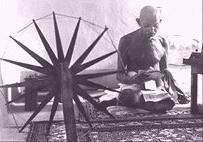
The power of this narrative was evident in the movement of Mohandas Gandhi for "home spun" production, i.e. that everyone should spin their own thread and weave their own textiles, to restore the industry to India and shut out British imports.
This went so far that Gandhi wanted a spinning wheel on the new flag of India; and politicians visiting Gandhi usually changed into home spun clothing when they went to see him -- often right in the train station that served Gandhi's Ashram. 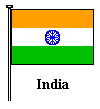 The flag, however, would feature the Buddhist "Wheel of the Law," the धर्मचक्र, dharmacakra, instead of a spinning wheel, with the other colors of the flag symbolizing Hindus, Jains, and Muslims.
However, all this was nonsense. In the first place, cheap textiles made life better for everyone in India; and this was only possible with modern, industrial production. Gandhi's idea would have returned everyone to helpless dependency on expensive, Mediaeval handicraft production. Thus, it was always a fantasy. At the same time, one might wonder why Indian businessmen could not start their own spinning and weaving mills and compete against the English ones.
With the proper amount of "anti-colonialist" paranoia, one might suspect that the British Government in India would have protected British imports and prohibited or inhibited native Indian competion. However, exactly the opposite was the case.
...when, in the mid-1870s, the viceroy of India, Lord Northbrook, found himself pressed by Lord Salisbury, the secretary of state for India, to concur with the imperial policy of free trade and remove Indian duties on British texiles, he commissioned an inquiry. This reported that the existing 5 per cent tariff was 'not absolutely prohibitive' of the purchase of imported coarse cloth. In response, and without first consulting London as expected, Northbrook proposed what would become the Indian Tariff Act 1875, which reduced duties on most imported items but still left those on cotton yarn and cotton cloth at 3.5 per cent and 5 per cent, respectively. Thus, the British viceroy refused 'to amend a tariff policy which, as he was rightly convinced, was seen in India itself as a defense of Indian industry against a powerful British interest'. [Nigel Biggar, Colonialism, A Moral Reckoning, William Collins, 2023, p.152]
Thus, the truth is that the British Government of India was protecting Indian industry, not British. And even when the Government was later persuaded to adopt the general Imperial policy of Free Trade, it was too late. An Indian textile industry was already competing just fine, thank you, against the British.
Even so, British cloth imports accounted for only a sixteenth of India's needs and did not deter Indian entrepreneurs from opening textile factories in Bombay and Ahmedabad, or prevent British India from becoming the world's fourth greatest cotton manufacturing nation by 1914. [ibid.]
Indian industry had a much harder time under Nehru's socialist "licence Raj" than it ever had under the British. And, while the British had left the Indian economy vastly larger than that of China, Indian business had to watch helplessly, for decades, while the Chinese economy, once freed from Maoism, grew into the second largest in the world. Meanwhile, Indian immigrants flooded into the United States, achieving the status, from census data, of the most prosperous ethnic group in the country.
Thus, while Gandhi wasted everyone's time sitting at his spinning wheel, India had quietly responded to the British Industrial Revolution:
However, even Karl Marx viewed this economic disruption and destruction as the inevitable side-effect of technological development and economic progress. And according to the Marxist economist Bill Warren, imported cottons only caused a relative decline in local handicrafts, since there was in fact 'an absolute rise in the volume and number of items of traditional production, because the market underwent a massive expensive during this period'. [ibid., pp.150-151]
One reason the market in India could expand, of course, is that the British built railroads all over the country, which allowed for the free and cheap movement of people and goods, such as could happen less well before.
And truly the Grand Trunk Road is a wonderful spectacle. It runs straight, bearing without crowding India's traffic for fifteen hundred miles -- such a river of life as nowhere else exists in the world. They looked at the green-arched, shade-flecked length of it, the white breadth speckled with slow-pacing folk...[Rudyad Kipling, Kim, 1900-1901]
Even the famous Grand Trunk Road (سَرَکِ أَعْظَم, Persian Sarak-e-Aʿẓam, "Greatest Road," and other names), from Bengal to Kabul, could not be improved or used properly until the British cleared away the bandits, the "dacoits" (Hindi ḍakait, डकैत, "bandit", from ḍākū, डाकू, "robber"), including the infamous Thugs (Hindi ṭhag, ठग), who used to plague it. But the railroads represented cheaper and faster transport than the Trunk Road ever could.
Yet, the myth of Indian industry being destroyed by British imports, which Lenin said was saving Capitalism from its "overproduction," is widely current among the economic illiterates of American "education" and socialist activism. The "anti-imperialism" and "anti-colonialism" industry relies blindly on Lenin, despite what Lenin actually did to Russia, and despite the piles of falsehoods about India that continue to stand unchallenged. Indeed, the "overproduction" nonsense still serves in public discourse as the explanation for the Great Depression.
I have recently noticed claims, not that Britain dumped textiles on India, but that the British actively suppressed the growth of Indian industry, with tariffs and other devices -- this supposedly came from the historian of philosophy Will Durant (1885-1981). However, after the Corn Laws were repealed in 1846, British policy was of Free Trade, and so British industry was not protected by tariffs. Meanwhile, the tariffs imposed by the Government of India, noted above, were not to suppress Indian industry, but to protect it. That's how tariffs work. Ask Donald Trump. Durant, of course, we have already seen making some absurd statements about Hellenistic and Roman history. Durant does not seem to have been better informed about British colonial economics -- although he is not alone.
I have had two friends who both wrote doctoral dissertations on British India. Yet both harbored no doubts about the Leninist fairytale. One of them, when I remarked on the admirable achievement of the Indian company Mahindra in becoming a major international manufacturer of tractors, responded with a flat and firm denial (this was his manner) that Mahindra was even an Indian company -- although it is. He never explained what it was, which gave me the impression that he wanted to believe that Indian industry was, perhaps, still being suppressed by the British -- although, if true, it would have been more like Nehru's Stalinism that had been doing it.
Today King Charles III is still the official Head of State of scattered former possessions, such as the Solomon Islands; but the British connection for the remaining Dominions (Canada, Australia, & New Zealand) has been increasingly compromised and questioned -- with even the term "Dominion" itself passing out of usage. Canada has come up with its own flag (losing the Union Jack canton), its own national anthem ("Oh Canada!"), its own constitution, and its own perhaps fatal political division between francophone Quebec and all the other, sometimes bitterly resentful anglophone provinces (resentful in part for the cost of bilingualism -- mandated for federal business everywhere, while Quebec restricts or prohibits public uses of English -- New Brunswick is the only Province that is officially bilingual).
Why Canada should then continue with a "King's Government" (formerly, of course, a "Queen's Government"), or even as a single country, is increasingly an open question. When I visited British Columbia as a child in 1959, there were Union Jacks as well as Canadian Ensigns on sale everywhere for tourists. On my last visits to Canada, in 1995 (at Niagara Falls), 2004, 2013, & 2017 (Toronto), and 2011 (Montreal), there were no Union Jacks to be seen at all -- but in a park in Toronto I did notice a statue of Edward VII that had been relocated from Delhi!
Meanwhile, Australia, always resentful of much of what happened in World War I (at Gallipoli) and in World War II (at Singapore and in Burma), contains a powerful movement to become a Republic. Recently, however (November 6, 1999), this was put to stand-up vote and lost; so Australia will remain a Dominion (or whatever) for a while yet. The British Empire, in one sense long gone, confirmed with the return of Hong Kong to Communist China in 1997, thus continues a slow fade everywhere. At the same time, British sovereignty in Britain itself becomes increasingly compromised by participation in the ill designed, ill considered, corrupt, and heavy handed Euro-government of the European Community, and by separatist movements in Scotland, Wales, and, as always, Ireland: And while "Brexit" meant that Britain left the European Union in 2020, the Conservative Party has wasted its mandate on Climate, Covid, and other follies, to the neglect of Thatcherite economic growth.
One artifact of British influence is the side of the road on which traffic moves. In Britain, you drive on the left, and cars have the steering wheel on the right. It was probably France and United States that established the larger international pattern of driving on the right, with the steering wheel on the left. In Europe, only Austria-Hungary, Portugal, and Sweden followed the British pattern. The successors to Austria-Hungary -- Czechoslovakia, Austria, and Hungary -- switched to the right, ironically, only under the occupation or influence of Nazi Germany. Portugal and Sweden, however, switched on their own.
Elsewhere, switches from left to right reflect the decline in British influence. This would appear to be the case with places like China, Argentina, and Ethiopia. In former British colonies, this is also understandable. However, three significant countries still drive on the left, without a heritage of British control: Japan, Thailand, and Indonesia (I once had a student who, after visiting Japan, positively affirmed that they drove on the right!). Otherwise, major former British possessions, like a large part of Africa, India, Pakistan, Australia, New Zealand, etc. preserve the British preference. The Indian Ocean still looks like a British Mare Nostrum in terms of driving preference.
So what went wrong with the British Empire? I have examined in detail elsewhere what went wrong with Rome, and here I have already compared the British Empire to the Holy Roman Empire, which might imply a parallel analysis. But if the reality of the power of the later Holy Roman Emperors was actually the power of the Hapsburgs, and the power of the British Empire was Britain, what happened to that power? Would Britain inevitably be ground down by the greater resources, human and material, of the superpowers? Perhaps. But Britain hurried its decline with the dynamic of its own attitudes. For the key to British power was the Industrial Revolution. This began in Britain, and in the 19th century it made her the "workshop of the world." But that advantage did not last. The spirit of invention and entrepreneurship was often only honored in the breach. The actual individuals responsible for the Industrial Revolution were typically Non-Conformists (i.e. Unitarians, Quakers, Presbyterians, etc.), Scots, foreigners, and other marginal types.
The stolid English squire, like "Uncle Matthew" Radlett in Nancy Mitford's books, had nothing to do with it. But even Uncle Matthew, with the experience of Mitford's father in India, was an internationalist compared to the greatest caricature of the English in English history, the "Hobbits" of J.R.R. Tolkein's The Lord of the Rings [1954-1955]. The Hobbits have all the stuffy, parochial, claustrophobic, self-referential xenophobia of the English squire. Yet the portrait is affectionate, and Tolkein's characters treasure the insularity of "The Shire" and are grieved when disorders spill over into it at the end of the books. Personally enduring two World Wars, Tolkein, happy in his Oxford college, clearly wished for a Little England without Great Power, Imperial, or other international complications. I tend to associate all this with English architecture and design, which outside, in a city like London, seems on a smaller, more intimate scale than the avenues of Paris or New York, while inside we have the jumble of overstuffed furniture and small, busy rooms with their floral wallpaper. What many prosperous English merchants really wanted was to make enough money to get out of "trade," buy land, and join the rural aristocracy -- an aristocracy to whom the "working class" meant, not the Marxian Proletariat, but all those in the grubby business of buying and selling. An English "gentleman" was, by legal definition, someone without a regular trade or profession. Neither capitalists nor proletarians need apply.
This was bad enough, and it had its effect. But the Empire itself exercised its own corrosive effect on British attitudes. The British Empire was said to have been won on the playing fields of Eton. But the education of a British Public (i.e. private) School like Eton was not an education in engineering or management or finance; it was an education in the qualities of command, leadership, and rule. The British were indeed properly educated to be Roman Proconsuls, and this was something often needed in the colonies; but it contributed nothing to the industrial or commercial strength of Britain, and its very prestige sapped, undermined, and degraded the material sources of British power. The Soviet mole in John Le Carré's classic Tinker, Taylor, Soldier, Spy [1974] was of a generation raised to rule, which then had nothing to rule. He really hated the Americans. But that tells the tale. The torch of innovation, invention, finance, etc. had been passed to the United States, and the British more or less forgot that they had simply dropped that torch, as it were, as they prepared to rule the Wogs for their own good. Thus, the true strength of Britain was in the principles fostered by the 19th Century Liberal Party. Yet now only the Tories and Labour remain, the former, despite Mrs. Thatcher, still remembering when the Sun Never Set and an Englishman could enjoy a good gin and tonic, brought by a native servant, on his veranda in Kenya, and the latter certain that those inventors, industrialists, and financiers were simply exploiting the workers. This became a folie à deux from which no good can ever be expected. In England today, it often seems like the most enterprising and hardest working people are immigrants from India.
But there is something else about the Empire. So much opprobrium towards "Imperialism" today arises either from the Leninist view of it, which ought to be (but isn't always) suspect, or from a simple moral principle that the British had no right to rule other peoples against their will. Against the Marxist-Leninist view that the exploitation of colonies was part of the larger capitalist exploitation of labor, there is the sobering truth, evident by the eighties, that many former British colonies, especially the African colonies, had been better off economically under the British than they were later. Colonies that nationalized industries and fixed prices saw the collapse of industries and the decline of their economies. Those that took the most up-to-date adivce, to keep out foreign capital, to adopt top-down Stalinist plans for development, and, in short, to go the Progessive route of socialism, typically ended up with dictators who practiced what was bitterly called "Swiss Bank Account Socialism." Eventually, anti-globalization protesters would be shocked to learn that what Third World countries wanted from the world economy was free trade -- their agricultural products were being kept out by the protectionism of the United States and the European Union.
But even if the British were better stewards of African economies, isn't it still true that they simply did not have the right to rule other people against their will? Well, I am presently, in a democracy, ruled by other people against my will. Indeed, since about 1988 I have not voted for anyone who ended up being elected, while those who were elected daily violate the Constitution, and criminally assault my rights, which they all swear an oath to uphold. There is a word for this: the tyranny of the majority. So this raises the question: Is it better to ruled by an irresponsible autocrat who nevertheless institutes justice and righteousness; or to be ruled by a corrupt political class that, with the justification of an occasional election, consists of liars, thieves, and looters? Of course the former is preferable, although the problem, since Plato, has always been to identify an autocrat who has the wisdom to rule and not be corrupted by wealth and power. There is no solution to that problem.
With the British Empire, the key question to ask is how it really got started, and why so much of it began, or continued to consist of, little bits like Bombay, the Gambia, Penang, Hong Kong, etc. These were all little defensive pockets in areas where life and property were not otherwise safe. Intervention in the hinterlands or with esablished states usually began with the same purposes, to secure peace, safety, property, justice, and any other conditions necessary for economic activity and development. The Pax Britannica, like the Pax Romana, may have involved some little wars going on someplace most of the time, but the overall effect was to render trade and travel safe in a way that they usually had not been previously. With the Royal Navy ruling the waves, pirates and sovereign predators better watch out.
There is also the fate of a place like Ceylon. The removal of the Imperial hand releases conflicts that sometimes have been created by the colonial power (e.g. Jewish immigration into Palestine) but usually involve much older, preexisting problems. Thus, the conflict between Tamils and Sinhalese in Ceylon long antedates, by centuries, the arrival of the British, or any Europeans. Under the British, however, the conflict had been minimized to the extent that most people were not even aware of it and in no fear of its returning. At independence, the future of Ceylon was hopeful and unclouded. The 1962 World Book Encyclopedia [Field Enterprises Educational Corporation, Chicago] said of the majority Sinhalese, "They have gentle habits" [Volume 3, p.277]. Yet by then this had all changed.
In 1956 a government hostile to the Tamils was elected. Soon the "gentle" Sinhalese would be burning people alive. The more than 50 years of history since then, of the country now called Sri Lanka, has consisted of legal ethnic discrimination, fierce riots, and a grim, nasty, protracted civil war, which only seems to have been put down in 2009 -- or at least the principal Tamil fighters have been destroyed. Although the end of imperialism has resulted in other ethnic conflicts, in Palestine, Cyprus, Kashmir, Rwanda, and elsewhere, the Sri Lankan conflict has been one of the worst, most protracted, and most perplexing -- perplexing to many since Sinhalese Buddhism is supposedly peace loving and tolerant and sympathetic towards all beings, including Tamils. It may not have entered the minds of the editors of the World Book Encyclopedia that the reality could have been any different. But no one familiar with Ceylonese history, where an ancient Buddhist judgment was that Tamils were not human beings, would be deceived about that.
A telling moment in the Ceylonese conflict was after monolingual Tamil bureaucrats were fired in 1964. Tamils appealed the discriminatory laws all the way to the Privy Council in England, which still had some residual judicial authority over the Dominion of Ceylon. The Council, of course, moved to protect the Tamils, but then the Ceylonese Government abolished the right of such appeals and quashed any remedy for the Tamils. This did not do anyone any good.
But that is what the British Empire used to be able to do, mediate conflicts that, unchecked, could become slaughters and civil wars. A bit of Imperial slaughter was sometimes necessary in such conflicts, and are now viewed with horror, but we can see the scale to which real slaughter can rise without the Empire to give all parties something to fear in common. The British are often blamed for the conflict that resulted from the Partition of India, but, again, the elements of the conflict long preexisted the arrival of any Europeans. Muslims do not like being ruled by non-Muslims, and from Maḥmud of Ghazna to the Moghuls, they were not. British rule was at least preferable to Hindu. In its absence, not only did we see the riots and slaughters of 1947-1948, but we subsequently have had several wars and now a nuclear stand-off between India and Pakistan -- a Pakistan which has generally been subject to military dicatorships in its history, and now to Islamic radicals and fundamentalism (from people the British were already calling the "Hindustan fanatics"). All this, again, begins to make the Empire look not so bad.
The ideal would have been something, as Hume might have said, "betwixt unity and number." Thus, local autonomy would address most issues involved in "self-rule," while some higher authority could have secured the peace and the rights of minorities. In short, the sort of Federal system that is supposed to characterize the government of the United States. Something of the sort was sought by perceptive advocates of Imperialism, like Joseph Chamberlain. Yet Chamberlain insisted on promoting his ideas in terms of the "Anglo-Saxon race," even though this completely excluded India and cannot even have sounded too good in the Dominions where elevated percentages of the population were Scots or Irish. Chamberlain forgot to include Celts in the "greatness and importance" of his "race." A federation of the Dominions with Britain never got off the ground.
Unfortunately, even if it had, this sort of structure for government has still not been perfected. If the United States government now assumes all the powers of government, and usurps the unlimited powers that were the horror of the Founding Fathers -- with an explicit program to do so from the treacherous Democratic Party -- it is not clear that the British Empire could have done any better. For a while, the balance of power between Britain and the Dominions was a rough version of this, but a federalism in theory or practice was never embodied in the relevant laws. Yet even in the United States, with federalism, enumerated powers, and limited government clearly and explicitly written into the Constitution, and the subject of wide discussion and explanation among the Founders, most political culture in the country, and certainly most politicains, do not take such things seriously, even if they are aware of them (and the most ignorant and arrogant politicians are not). James Madison himself said that "paper barriers" would not be enough to secure the system, but his particular design of divided authority and checks and balances has now manifestly failed, in the long run, to accomplish its purpose, with flaws that were aleady wisely discerned by Thomas Jefferson. In the absence of an effective such system, the actual fate of the British Empire, of the several independence of its members, may have been the best, as it was the inevitable, outcome.
It should be noticed that this crown uses cross pieces that originally signified the crown, The list of Princely States in India is complete according to Wikipedia, but I also see that there were something like 600 of them, which is nothing like what you see here. I have added the information Wikipedia also provides for the rank of the ruler and the number of salutes to be fired, as granted by the British (some rulers used higher numbers in their own domains), as of 1947. There are a few inconsistencies between the different lists, including differences in spelling. I could not identify some rulers on the salute list in the list of states, which confirms some doubts about completeness. But, with some possible anomalies, this will certainly give you the idea. Lists of rulers have now also been provided for several Princely States, linked from the index here.
The issue of the Princely States is of some interest. By the time of Independence, they were clearly an anachronism, and Indian Nationalist leaders often thought that the British kept them around like some sort of circus freaks for their amusement. However, the Princes were the forces on the ground from the dying Moghul Empire, and not at all anachronistic, in the 18th century; and the British were steadily liquidating them in the 19th when the Mutiny stopped the process. As time passed, it was inevitable that they became living fossils; but someone like Lord Mountbatten, the last Viceroy, who had genuine personal friendships with many of them, was sorely grieved to inform them that British protection was finished and they would need to go with India or Pakistan. He felt that this was a breach of faith; and perhaps it was -- but an inevitable one. The 81.9K animated GIF file on this page was originally 226.2K in size. Sven Mitsdörffer sent me a 43.8K version, which, however, did not seem entirely compatible with my assembler [the Alchemy Mind Works GIF Construction Set (32-Bit) 1.0Q, 1995]. The present 81.9K image is one that is redone using some of the techniques I found in Sven's version.
Prime Ministers of the Dominions
The Kings of England and Scotland
British Coins before the Florin, Compared to French Coins of the Ancien Régime
British Coinage of India, 1835-1947
The Fragility of Thalassocracy
Atlas of the British Empire, edited by Christopher Bayly, Facts on File, 1989
The Black Battlefleet, by Admiral G.A. Ballard, Naval Institute Press, 1980
British Battleships, "Warrior" 1860 to "Vanguard" 1950, A History of Design, Construction and Armament, by Oscar Parkes, Seeley Service & Co., London, 1957
The British Conquest and Dominion of India, Sir Penderel Moon, Duckworth/Indiana University Press, 1989
The British Empire, 1558-1995, by T.O. Lloyd, The Short Oxford History of the Modern World, general editor J.M. Roberts, Oxford, 1996
Castles of Steel -- Britain, Germany, and the Winning of the Great War at Sea, by Robert K. Massie, Random House, 2003
Crucible of War, The Seven Years' War and the Fate of Empire in British North America, 1754-1766, Fred Anderson, Alfred A. Knopf, 2000
Dreadnought -- Britain, Germany, and the Coming of the Great War, by Robert K. Massie, Random House, 1991
Empire: The Rise and Demise of the British World Order and the Lessons for Global Power, Niall Ferguson, Basic Books, 2004
End of Empire, by Brian Lapping, St. Martin's Press, 1985
Great Battles of the Royal Navy, as Commemorated in the Gunroom, Britannia Royal Naval College, Dartmouth, editor-in-chief Eric Grove, Naval Institute Press, 1994
The Horizon History of the British Empire, edited by Stephen W. Sears, American Heritage Publishing/BBC/Time-Life Books/McGraw-Hill Book Company, 1973
Jutland, An analysis of the fighting, by NJM Campbell, Naval Institute Press, 1986
The Oxford History of the British Empire
The Oxford Illustrated History of Britain, edited by Kenneth O. Morgan, Oxford, 1984
The Oxford Illustrated History of the Royal Navy, general editor J.R. Hill, Oxford, 1995
The Penguin Historical Atlas of the British Empire, Nigel Dalziel, Penguin, 2006
The Pax Britannica Trilogy, by James (later Jan) Morris, Harvest/HBJ/Helen Kurt Wolff Book
The Rise and Fall of the British Empire, Lawrence James, St. Martin's Griffin, 1994
The Royal Navy, An Illustrated History, by Anthony J. Watts, Naval Institute Press, 1994
To Rule the Waves, How the British Navy Shaped the Modern World, by Arthur Herman, HaperCollins, 2004
Unfinished Empire, The Global Expansion of Britain, by John Darwin, Bloomsbury Press, 2012
The term was suggested by S.L. Tilley of New Brunswick, who, while negotiating in London in 1866, found it in Psalm 72:8:
"May he have dominion" in the Revised Standard Version, 1952, or "He will rule" in The Interlinear NIV Hebrew-English Old Testament [Zondervan Publishing House, 1987].
In Hebrew, "have dominion" is indeed simply a verb meaning "rule" -- יֵרְדְּ, yērd, from רָדָה, rādāh, "to rule, oppress, enslave." This form looks like a jussive to me ("Let him rule"), but I am not confident enough about Hebrew grammar to be certain -- although the "May he have dominion" of the Revised Standard Version looks like the translation of a jussive.
The sense of "have dominion" appears to go back to the Greek text of the Septuagint, where we have the verb κατακυριεύσει, katakyrieúsei, "he will gain dominion." This is based on the Greek noun κύριος, kýrios, "lord." In turn "lord" in Latin is dominus, and in the Vulgate we again get a verb, based on dominus: Dominabitur, "he will rule, dominate, have dominion" (a future indicative, as in Greek, from dominor, "to rule, be lord or master, to domineer," a deponent verb with passive endings).
The King James translation, "he shall have dominion," is using the Anglicized form of a noun from dominus, namely dominium, "rule, power, ownership." Thus, although both the Hebrew and the Greek verbs simply mean "to rule," the form of the Greek verb contributes to the nature of the later translations in Latin and English.
Recently, official usage of "Dominion" seems to have been discontinued, though even Canadian correspondents are unclear about exactly when this was done, or if "Dominion" was ever legally abandoned at all. The Constitution Act of 1982, which "patriated" the British North America Act of 1867 (i.e. made it Canadian rather than British law), does not use the term, but neither does it say not to use it. Either way, Canada is now in practice simply "Canada," neither a republic nor a kingdom. If anything, it could end up being called a "federation" or "confederation," the way Australia has been a "Commonwealth" since 1901.
The Encyclopaedia Britannica says of "Dominion" that "after 1947 the use of the expression was abandoned because it was thought in some quarters to imply a form of subordination," though it does not say if any official act or legal instrument was involved in this. Since "Dominion" was coined and adopted by Canadians for Canada, it is a little sad if it is now abandoned for somehow implying colonial subordination to Britain. Designations like "kingdom" or "republic" traditionally indicate where sovereignty in a country resides, i.e. whether with a king, over a kingdom, or with the people, over a republic, respectively. Whether a monarch is a king, prince, emperor, etc. depends on whether the domain is a kingdom, principality, empire, etc. "Dominion" addressed a case where sovereignty resides in a monarch -- Canada is not a republic -- but the domain itself does not confer a particular title.
However, the official Motto of Canada remains A Mari Usque Ad Mare, "From Sea to Sea," as still taken directly from Psalm 72:8. Some have considered this inadequate, since Canada stretches from the Atlantic Ocean to the Pacific, but also to the Arctic Ocean. However, we might consider the rest of Psalm 72:8, "from the river unto the ends of the earth," where the "river" would mean the St. Lawrence and the "ends of the earth" certainly that same Arctic frontier, which would strike almost anyone as being "the ends of the earth."
Newfoundland did not join Canada until 1949, and for a brief period it was even a Dominion in its own right (1926-1934) -- though it was not regarded as a separate state for purposes of membership in the League of Nations.
Almost from the beginning Canada had to contend with comparison to, and influence from, the Great Republic to the south. Indeed, one of the first acts of the Dominion was to adopt a Dollar coin equal in value (in gold) to the United States Dollar. Canadian silver and bronze coinage, however, for many years was proportional in size to British coinage. Thus, Canadian silver dollars were smaller than American ones, but nearly equal in size to the British 4 shilling (double florin) coin, which was worth 97 US cents. Until after World War I, Canadian cents were equal in size to the British half-penny, which was worth about one US cent. Briefly, there were Canadian half-cents equal in size to the British farthing.
Expanding an identity for Canada separate from Britain (no one, indeed, ever would have confused them) became a goal in the 1960's. A Quebec did not like the Charter of Rights of the new Constitution because it might override laws in Quebec favoring the French language. In the election of 1993, when the "Progressive Conservative" Party, despite a woman Prime Minister, Kim Campbell, was all but annihilated, new power ended up going to regional parties. Canadian correspondents inform me that (1) Campbell was not regarded as a serious candidate by her party, which was expecting to lose, or
Stéphane Dion In January 2006 Paul Martin's Liberal Party has lost its plurality in Parliament to Stephen Harper's Conservative Party. This result occurred despite campaign ads that accused Harper of being a minion of George W. Bush. After the survival of other American supporters in Britain and Australia, this seems to be part of an interesting trend -- even as Marxists seem to be returning to power in South America.
Denys Arcand, Les Invasions Barbares, Scénairo, Les Éditions du Boréal, 2003, p.53 One of my favorite movies, which also happens to be Canadian, indeed From the beginning we see the miserable state of the hospital in Montreal where Remy is a patient. Eventually we learn something of why it is this way. Interviews with the union boss in the hospital look like something out of The Godfather, and hospital administration can only answer questions with meaningless bureaucrateese. As we meet him, Rémy is already being taken regularly down to Vermont for the radiation therapy that the Canadian system is apparently unable to provide in a timely manner. Now, since the Canadian medical system, as the ideal of socialized medicine, is one of the most sacred of sacred cows to the Left, and to the Democrats who are in rage to impose something of the sort on the United States, director Arcand has exposed some embarrassing and politically incorrect truths.
He doesn't let up. Rémy's son, Sebastien, who is a wealthy financier in London, first pays for a PET scan in Vermont that reveals Rémy's cancer to be terminal. Then he bribes all and sundry and hires union workers under the table to set his father up more comfortably in an unused room (on an unused floor) of the hospital. Sebastian first offers to move Rémy to Baltimore, where a friend of his will take care of him, but Rémy doesn't want to leave his friends, who mostly are not yet around, and proclaims, in the English subtitles, "I voted for socialism, and I'm willing to face the consequences." Of course, with Sebastian's help, he will not need to. As it happens, in the French dialogue, Réme actually says, as we see in the epigraph above, "I voted for the nationalization of the hospitals." I was for a long time unable to discern what he said in French. Neither could those I asked who actually spoke French and had seen the movie. I finally found it in the published screenplay.
If these goings on would warm the heart of any Republican, much of the rest will not. Sebastian obtains the best pain killer known for his father -- heroin. He does this with little help, but a great deal of tolerance, from the police, who apparently only arrest non-Canadian drug dealers. Eventually, there is enough heroin to enable Rémy to go out with an assisted suicide. The War on the Drugs thus fares little better than Socialized Medicine in the movie.
Meanwhile, the anti-Americanism implied in the title of the first movie, and in the reference of the title, to 9/11, in the second movie, now seems to be exposed as youthful posturing. Rémy reflects on the time he tried to impress a young woman visiting from China by praising Mao and the Cultural Revolution, not realizing, until it was too late, that the young woman and her family had suffered terribly under the Cultural Revolution. Rémy was revealed as an ignorant fool, naively expecting that his leftist bona fides would impress someone who had seen tyranny close up. Even the references to 9/11, comparing it to something like the Visigothic sack of Rome, has the overtone that, indeed, America represents civilization itself. The characters don't pay much attention to these themes, but it all fits into the somber and autumnal mood that attends Rémy's death.
Now, I don't just like the movie because I agree with the director's point of view on the medical system and drug legalization, but it certainly adds to the depths of the movie. The political themes and the personal stories are nicely woven together, but it is the personal stories that must in the end carry the weight. They do that marvelously.
A sobering moment in The Barbarian Invasions is the consideration of the collapse of Catholic piety in Quebec. The movie gives no statistics; but in 1960 attendance at mass was 88% of the population, and French Canadian families averaged four children. The priest in the movie compares this to Ireland or Poland but says that at some point in the 1960's people simply stopped coming to church. By 1980, attendance at mass was only 20%, and families were down to an average of only 1.5 children, well below the replacement rate.
Thus, Quebec suddenly conformed to metropolitan French culture (or, for that matter, recent changes in Ireland and Poland), both in irreligiosity and infertility. The grim demographic future implied by the lack of reproduction, whether in Quebec or France, might even be represented in the movie by the silence, shadows, and decay that we see in the surplus (and worthless) religious statuary languishing in storage. The movie does not mention the collapse of fertility, but one wonders about the director's awareness of it. In the political project to preserve Francophone culture in Quebec, one wonders what the response is, if any, to the threat of declining population.
Back then, we walked over to the Canadian city on one day. It seems to be much changed from what we saw in 1995. The center of tourist entertainment, then and now, has been Clifton Hill, which in places has the look of an amusement park. Walking up the eponymous street and hill, the street is intersected by Victoria Ave. This is now a kind of restaurant row, something I do not remember at all from 1995. We dined Indian (actually, Pakistani), Korean, Arab (falafel), and Chinese for lunch and dinner, with a more domestic venue (Canadian?) for our anniversary. Otherwise, we would not have been lacking for Italian, Brazilian, Mexican, Japanese, or Steak and Lobster restaurants. But much loud, very loud, music in many of the places, including the Jimmy Buffett Margaritaville club, a bizarre transplant from Key West.
One whole block of Victoria Ave was places identified as "halal," including the Pakistani and Arab restaurants where we ate. Having traveled in the Middle East (1969-1970), I never saw any eatery identified as ḥalāl, When we had walked over to the Canadian side in 1995, we were looking for a restaurant for our anniversary. And we actually were not able to find one -- we ate back in New York. We would have eaten in the Skylon Tower, but it was booked up. This time, when we asked at the concierge desk at the Marriott for reservations at the Skylon, the girl said, "You don't want to eat there." And we didn't. But while I remember Clifton Hill from 1995, which runs from the river up to Victoria Ave., I have a complete blank on what Victoria looked like back then and why we didn't see any inviting restaurants. Has it really changed this much? Perhaps.
Finally, we must remember "Whither Canada?" which was the title of the very first episode of Monty Python's Flying Circus in 1969. Canada actually wasn't even mentioned in the episode, so we still await the answer to the question.
When I lived in Hawai'i in the early 1970's, I was struck by a photo one morning on the front page of the Honolulu Advertiser. A volcano in New Zealand, Mt. Ngāuruhoe, was erupting. It was some years before I found an atlas detailed enough to show that particular mountain, one of several active volcanoes on the North Island. At the time, I was interested in Polynesian languages and ended up ordering Bruce Biggs's Let's Learn Maori, book and records, [A.H. & A.W. Reed, Wellington, Auckland, Christchurch, 1969, 1973] through Basil Blackwell of Oxford. It took many months for them to make their way from New Zealand to Oxford and then out to Hawai'i. I rather liked the idea of them going almost entirely around the world to get to me.
After I moved to Texas in 1975, one of my new neighbors, Donna, ordered something from New Zealand herself, a spinning wheel. It needed to be assembled and stained, and I helped her out. I even learned from her how to use it. I thought it was enough fun that I considered buying one myself; but the price, $50 back then, was far beyond my budget (and the price subsequently went up). I don't know what I would have done with the thread anyway, since I never got into weaving the way Donna did. Now, however, the question has arisen again. Donna bought other spinning wheels, and in 2000 decided that the original one was maybe more than she needed. So she offered it to me. It arrived at our house in January 2001, and I got to put it back together all over again. After 25 some years, I had forgotten how to spin, but Donna had retained, and sent, all the original documentation, including instructions on use, and the story of how these particular spinning wheels had been developed in New Zealand, a country with more sheep than people, during World War II so that women could make homespun clothing for the boys off in the War. Donna also sent a selection of materials to spin, including hair from the Angora rabbits that she keeps. As for what to do with the thread, she says that she even sells some of hers on eBay. I may settle for keeping it as a bit of historical New Zealand and a momento from my own youth.
Governors-General of New Zealand Foreigners know that Australians are called "Aussies." Americans, however (like me), tended to think of the "ss" as pronounced voicelessly, like, indeed, an "s." But it appears that Australians actually pronounce it as a "z": "Auzzie." The Crocodile Dundee movies were largely instrumental in correcting this misperception. The right pronunciation produces several happy puns, like calling Australia itself the "Land of Oz."
Australia may now be the Dominion most tempted by Republicanism. The relationship with Britain has been of a love-hate variety ever since the first shipload of prisoners arrived at Botany Bay. Real strain began in World War I. Britain declared War against Germany in the name of all the Dominions without actually asking them, or even telling them, first. This was an irritation that could be perhaps forgiven, once. Australians enthusiastically volunteered for the Army, and the ANZAC, "Australia-New Zealand Army Corps," entered combat. Unfortunately, the combat ended up being at Gallipoli, where Winston Churchill had gotten the idea of seizing the Dardanelles and putting Turkey out of the War. This was a good idea, but amphibious landings were a new thing, and the campaign ended up poorly conducted, and a failure. There was great slaughter on both sides, but many of the Allied dead were specifically Australians and New Zealanders. In 1981 Peter Weir released a movie, Gallipoli, starring Mel Gibson, who at that point was best known as Mad Max (1979). Weir had already made the iconically Australian movies, Picnic at Hanging Rock (1975) and The Last Wave (1977). Gallipoli does a good job of representing Australian experiences and attitudes in the Gallipoli campaign. It is a good movie. It does, however, leave out what might have been the high water mark of the effort, when British troops did get to the top of the ridge along the Gallipoli peninsula and could look down into the Dardanelles, the goal of the invasion. They were thrown back, but it did show that with somewhat better organization, timing, and luck, Churchill's idea could have paid off. This moment may have been left out of the movie because (1) Australians perhaps weren't involved, (2) Peter Weir wasn't aware that the event happened, or (3) even a brief triumphant moment would detract from the general message of failure and futility.
The postwar era got off to a bad start with the Washington Naval Treaty (1921), whereby Britain accepted naval parity with the United States and agreed with Japan to limit its military presence in the Pacific. This gravely compromised Britain's defense responsibilities to Australia and New Zealand; and, again, it looked like Britain was making its own decisions without concern or consultation about the Pacific Dominions, who were rather more alarmed about Japan than Britain was. Meanwhile, in the 20's and 30's, the Dominions were recognized as independent in all but name. In the Statute of Westminster of 1931, the British Parliament renounced all legislative, even constiutional, authority over the Dominions. This could not mean that they were simply on their own, however. Australia and New Zealand did not have the means to defend themselves against Japan and had no desire to do so alone.
In 2004 Prime Minister Howard was reelected, a result of some international interest, since he had supported the American war in Iraq, attracting the attention of Islāmist terrorists, who killed many Australians in a bombing on Bali. It was a good question whether Australians would go the way of the Spanish and vote in a Government bent on appeasement. It didn't happen, despite the presence of some American anti-war political activists during the election. One wonders about the dynamic of all this in Australian domestic politics, but it was a good sign. The election of Keven Rudd in 2007 does not seem the result of the same issues.
Arthur Upfield (1890-1964) was an English immigrant to Australia. Before World War I he immersed himself in the pastoral culture of the Australian Outback. During the War, in the Australian Army, he actually fought at Gallipoli. The inspector got his name because, as a child in an orphanage, and already literate, he became absorbed in a biography of Napoleon Bonaparte. He was so absorbed that he acquired the name itself as a nickname, which then became permanent. We never learn what he was called before then.
Bonaparte expects people to call him "Bony," which is what British cartoonists called the Emperor in his own time. However, neither the Inspector's personality -- especially when his asssignment was under cover -- nor his methods, which involve a lot of patience and waiting, seem to owe much to the Corsican. The Inspector very rarely pulls rank, is himself careless about authority, and rarely gives orders until the urgent culmination of an investigation -- meanwhile having made friends with all his local law enforcement colleagues. Conflicts may involve encounters with the occasional racist, or with his Queensland police superiors, who become impatient with his methods.
While such a name as Bonaparte bears was sometimes whimsically given by Europeans to Aborigines, or to slaves in the American Ante-Bellum South, and often did not represent much respect for them, and could be mocking, young Bonaparte, in effect, adopted his own name; and, since Napoleon was a great enemy of Britain, we might wonder if, to an extent, it reflects a judgment about Anglo-Australian culture and dominance. Indeed, we hear very little about what the Inspector admires in the Emperor; and, as I said, his own personality is very different. And since the name is actually given by Arthur Upfield, and not by Inspector Boneparte, we might wonder about what he was thinking.
The Bonaparte stories range across all of Australia, from East to West, as the Inspector is loaned out, because of his abilities, to other jurisdictions. A few are on the seacoast, including one where the Inspector becomes familiar with and enthusiastic about swordfish fishing. Others can be well in the middle of nowhere. Many include issues with local Aborigines, who are sympathetically treated, but not as writers would do it now, making them fully heroic and faultless martyrs to racism. Bonaparte himself occasionally endures some racism, but it is quickly overcome. Instead, Bonaparte is sometimes the target of some Aborigine hostility, since, as we know, Aborigines are human, and may have moral faults. Who would have thought?
The result of this seems to be a family curse, which has plagued the family with natural disaster, insanity, and homicide. In one sense, this story must be Upfield's own warning about the consequences, in terms of divine justice, for mistreatment of the Aborigines. We never get anything more direct or explicit on the issue, as, for instance, we might now from politicized, virtue-signalling writers -- as we see in the following review of the movie Australia, whose purpose seems to be to engender liberal guilt. Upfield doesn't inflict anything of the sort on us, but this story might leave the reader thinking. This is the sort of thing that we see played out, with considerable irony, in the modern world. ʾIslām and China, with their own historic civilizations, resent the success and dominance of the West, lust for revenge for the presumed evils of "colonialism" and "imperialism," and yet realize that no competition with the West is possible save with the help of Western technology -- by which their own thinly veiled ambitions for colonialism and imperialism can actually be effected -- after all, the Chinese concentration camps for Uighurs go back to German and Soviet practices, not anything in Chinese history. That the technology itself is the result of a certain cultural spirit, which ʾIslām and China might still be lacking, is something resistant to analysis. Indeed, the spirit of the scientific method and of liberal democracy is steadily under attack in the West itself, where many yearn for a Utopianism that is really more like a nostalgia for Mediaeval civilization, where the Ruling Class is able to exercise its own noblesse oblige. That is compounded by resentment over things like the history of slavery, which is seen as something originated and perpetuated, rather than inherited and abolished, by the West. Actual slavery in Africa now, or in ʾIslām and China, is generally ignored.
Whether it is with ʾIslām, China, or phony grievances over slavery, the prospective solution is always, curiously, the sort of totalitarian dictatorship developed by the West also, in Fascism and Communism. The irony of this is itself lost on Leftist ideologues, whose lust for power conceals infantile longings for wealth without effort, whose only economic theory is a primitive Cargo Cult economics, and whose only practice is what Ayn Rand called the "looting," whether with violence or taxes, of the productive members of the society, whether those are actual capitalists and entrepreneurs or just successful ethnic minorities with small businesses. There is no mercy for any of them, which is why Asian-Americans find themselves assaulted on the streets (typically by self-described victims of racism) and excluded from elite institutions (by white "liberals"), like the Jews before them. This ideology has all but accomplished the destruction of "higher education" in the West, and is far advanced in doing the same to all "education," leaving ignorant and illiterate students with nothing but mindless slogans to repeat.
In Bushranger, Upfield seems to have forgotten what it takes for a technological society to function. The "Bushranger" himself possesses a small airplane, which he uses to bomb people in the pursuit of his rebellion. Unfortunately, you cannot carry on such a campaign without supplies, and Upfield does not describe how the "Bushranger" is able to obtain gasoline, oil, amunition, or bombs without a logistical tail easily identified by Inspector Bonaparte or other police. Fuel for his airplane seems to materialize out of thin air. The solution to the problem, which in the book is found by shooting down the airplane, skips the part where the antagonist might simply be deprived of supplies. And you can't just buy bombs anywhere. Nevertheless, the book, as a study in how Bonaparte might have gone wrong himself in adapting to his ethnic situation, involves lessons easily applied in the modern world at large.
These are marvelous books, with only a handful that seem to involve improbabilities (like Bushranger). The best ones can stand with the best of any mystery fiction. Tony Hillerman, facing a comparable situation with his Navajo Nation policemen, was aware of Upfield's books and paid tribute to him. Upfield was a little more prolific -- 29 Bonaparte books against Hillerman's 18 Chee and Leaphorn stories.
There have been some treatments of the Bonaparte stories on Australian television. The challenge there, as with Hillerman's stories, is the casting. Upfield describes Bonaparte's appearance as essentially Caucasian, except for skin color. Although this has not been Aborigine enough for some, one of the actors playing Bonaparte was actually from New Zealand -- I don't know if he was even part-Māori, which would have been the wrong ethnicity anyway. While there have been several celebrated Aborigine actors in Australia, they don't match the half-ethnicity of Bonaparte. So his remains a problem, even as treatments of Hillerman's Navajos tend, now, to use actors who are "Native Americans," but not actual Navajos.
Unlike the high Colorado Plateau of the Navajo Reservation, the variety of landscapes in the Bonaparte books, despite the dry uniformity of much of Australia, is an education in its own right. And Upfield was intimately familiar with them all, and with the life he describes of the "swagmen" who used to populate much of the landscape. Some of the terminology can be a little confusing: an Australian "squatter" is not someone who has illegally occupied public or private land or buildings, but a substantial citizen who leases or owns vast lands for grazing or farming. We even hear about one in Waltzing Matilda.
In 2008 there was a movie, Australia, by director Baz Luhrmann, whose career began with the delightful Australian movie Strictly Ballroom (1992). The movie is framed, however, in terms of something entirely different. A young boy in the movie, played by young, charming Aboriginal actor Brandon Walters, is the child of a white father and an Aborigine mother. At the time, these mixed race children were considered shameful and were seized and institutionalized by the government. Walter's character, although protected by Kidman and Jackman, must hide from the authorities. He is eventually betrayed and taken away, but then Jackman saves him after the attack on Darwin. As the movie began with a description of the seizure and separation program, it ends by quoting the apology made by Prime Minister Kevin Rudd for this kind of former treatment of Aborigine and mixed race children.
Now, there is no doubt that overcoming racist ideology figures as an important development in the story of human progress. In Australia, however, one would get the impression that racism is the overriding issue in the epic of Australian history. This would be a rather sour and reductionistic reading of that history, but not an unfamiliar approach. It is the approach, indeed, of a political Left that wants to smear and damn everything about the history of places like Australia and United States, along with liberal democracy and capitalism, just because part of the history of these places includes the existence and application racist ideology.
The mistake of something like Keven Rudd's apology is that it will not make any difference. The racism of Australia is unforgivable and will never been forgotten. It is a stick with which to beat absolutely everything about Australia from now on. Rudd will not be able to resist any demands of the Left without being immediately branded an unrepentant racist. This dynamic is all too familiar in the United States. It doesn't matter that there is a fair amount of racism and anti-Semitism in Leftist politics, as it already existed in Karl Marx himself, or in the darling of radical philosophy, Friedrich Nietzsche. These embarrassments can simply be ignored, as Leftist thought tends to be characterized by a dishonest, dissimulating, and logically incohrent moralistic relativism.
Thus, viewers of Australia, and especially Australian ones, should be aware that the movie contains a strong dose of poltically correct propaganda, whose purpose, of course, is not to denigrate Australian history just for its own sake, but to promote the socialist and totaliarian goals of Leftist politics (as in Anti-American rhetoric). It is not that racists committed an intellectual or moral mistake, deceived by the spirit of former times, as we actually find expressed in Marx or Nietzsche. No, they are guilty of political crimes, rendering them sub-human demons, whose proper Stalinist punishment is simply death. At the moment the Left can't get away with a new Gulag, but there is little doubt, as we learn from their private and unguarded moments, as from their illiberal, intolerant, and sometimes violent conduct at American universities, what they would like to do. The story of Australia is thus not a story of racism, and it is a grave flaw with Australia that it lends itself to politically correct propaganda and gives this impression.
Commanders & Governors of the Dutch Cape Colony (1652-1806)
British Governors of Cape Colony (1806-1910)
The Boer Republics (1854-1902)
Governors-General of the Union of South Africa (1910-1961) The most colorful history is certainly that of the Zulus, who grew into an aggressive and dominant power under King Shaka, whose life was made into a popular movie not long ago. However, conflict arose with the British. At the Battle of Isandhlwana, 1879, the British ran out of
"KwaZulu" would have been the Zulu Bantustan, but it was never to be. The homeland consisted of even more fragments than the others, mostly surrounded by Natal province. It was obviously not worth it for Zulus to be confined to the equivalent of Grand Fenwick while losing all rights in the rest of South Africa. Zulu reluctance to go along with the idea was finally overtaken by the collapse of the whole project. When Nelson Mandela's government took over in 1994, the independence of the four Bantustans became a dead letter. KwaZulu is now identified with Natal province itself.
For all of its problems -- crime, AIDS, white flight -- South Africa so far has not suffered from any large scale ethnic conflicts. As the government adopts a more dictatorial manner, however, and the economy suffers from crime and crackpot socialist schemes, people like the Zulus, proud and self-conscious, may be the ones to act first.
The lists of the Zulu, Swazi, and Basuto Kings are from the Oxford Dynasties of the World, by John E. Morby [Oxford University Press, 1989, 2002, pp.237-238]. The Oxford Dynasties did not continue the line of Zulu Kings after the imposition of British rule. This has now been made up from Wikipedia. The expectation of many British colonial possessions, that they would suddenly become rich once the predatory British were gone, was repeated in Ireland. And consequently Ireland remained for many years one of the poorest countries in Europe. By 1986 unemployment was over 15%, inflation at 10%, growth only 0.4%, and the budget bleeding hopelessly. As in the days of the potato famine, people left Ireland for better lives elsewhere. The English, and even the Irish, told "stupid Irish" jokes. Then Ireland awoke. The supply-side, Reagan/Thatcher formula of tax cuts was adopted, and the economy took off like a rocket. Ireland is now growing at triple the rate of the European Union, 9.4% per year. According to The Economist's Pocket World in Figures, 2003, in per capita purchasing power Ireland is #13 in the entire world, just behind Hong Kong (#12) and ahead of Germany (#15), France (#19), the UK (#21), and Italy (#22). People now move into Ireland, not out of it. There is a budget surplus. American companies put their European headquarters there. Unemployment, at 15.7% in 1993, was down to under 5% in 2000. Public housing, which an audit discovered cost more to run than if it were just built and given away to tenants, is being sold off. Brussels, the statist headquarters of the European Union, which continues to love high taxes, is screaming; but Irish finance minster, Charlie McCreevy, is telling them where to get off. What a blessed day for what was so long a sad and suffering land. How wonderful what a little real capitalism will do. Erin go brah! As in the days of St. Columba, they now could use a little of the Irish formula in Great Britain, which has forgotten some of its Thatcherite wisdom. Never have I been more proud to be a Kelley.
Unfortunately, with Ireland's new prosperity, Irish politicians committed the error of many "active government" enthusiasts: with new revenues coming in, they consistently spent, and so borrowed, even more, with the expectation that revenues would increase indefinitely. With the collapse of the American mortgage bubble in 2008, a recession affected Europe and Ireland enough that revenues could no longer keep up with the debt. This made Ireland one of the "PIIGS" -- Portugal, Ireland, Italy, Greece, and Spain -- members of the European Union whose debt was out of control and in danger of undermining the Euro. At least with a place like Greece, we have seen nothing but unreleaved Socialism; but it is a shame the Ireland, with free market reforms, should have fallen into the same spending and debt trap. Ireland does seem to be handling its difficulties better that the other PIIGS, but it no longer has the status of income and prosperity that it briefly enjoyed.
Lords Lieuenant, Deputies, or Viceroys of the Ireland (1528-1922)
Governors-General of the Irish Free State (1922-1936)
Governors & Prime Ministers of Northern Ireland (1921-1973) Looming large in recent Indian history is not just Jawaharlal Nehru but his family. Nehru's daughter Indira dominated the country for nearly twenty years. When she arrested the opposition, India briefly lost its democracy. When she figured on a vote of confidence from the people in 1977, she was voted out of power instead. The opposition, however, was no more popular; and Indira returned to office in 1980. Ordering a military suppression of the Sikhs, she was assassinated by a Sikh guard in 1984. Her son Rajiv was also assassinated.
In 2004 Rajiv's wife, Sonia, led the Congress Party to a surprise victory. This seemed to rest on criticism of privatizations and other economic reforms, and was in alliance with the Communists. Stock markets fell in dread of what such a victory meant. However, Sonia excused herself from assuming the Prime Minister's post, because of protests over her Italian birth. The new Prime Minister instead would be Monmohan Singh, the very man who engineered the beginning of economic liberalization under P.V. Narasimha Rao. Stock markets recovered on this promising sign.
In 2008, the Indian Tata Group automobile manufacturers have bought Jaguar and Land Rover from the Ford Motor Company. This is a far cry from the dark days of the Indian economy when the gold reserves of the Republic, burdened by debt, were moved to the Bank of England. Now two quintessentially British companies are in Indian hands. Jaguar, to be sure, had been losing money and dragging down Ford. Land Rover perhaps accompanied the deal just so it wouldn't be just for a losing venture. The appearance of Indian manufacturers in the world market -- I have also noticed ads in America for the Mahindra tractor company -- is a hopeful sign indeed for the growth of the Indian economy. Governors-General of India (1947-1950) Pakistan left the Commonwealth for a while after India, and international opinion, supported the revolt of East Pakistan against the Western dominated central Government. The East then became Bangladesh, the "Bengal Nation," which retained its own Commonwealth membership. Unlike India, Pakistan has had long periods of military rule, but has distinguished itself as the only Islāmic country to have been led by a woman, the admirable Benazir Bhutto. Now sadly, in December 2007, Bhutto, after returning to Pakistan and apparently in line to be elected the new Prime Minister, has been assassinated. It is apparently an open question whether this was done with the connivance of President Musharraf, or, as Musharraf contends, was the work of Islamist radicals. Both are real possibilities. Bhutto's People's Party won the election anyway.
Some periods of outright dictatorship, under Ayub Khan, Yahya Khan, and Zia-ul-Haq, are evident from the absence of a Prime Minister. The secession of East Pakistan and the disastrous defeat by India over it led to the tenure of Zulfikar Ali Bhutto, who was later executed, supposedly for corruption under his rule. Benazir was his daughter and set out to vindicate him.
The current government under Pervez Musharraf began as another military coup and dictatorship. Musharraf has regularized his regime with election as President, but its military character is still evident. Meanwhile, Musharraf has become an ally of the United States in opposing the Taliban regime in Afghanistan and the Terrorism of their al-Qaʾida protégés. When the Taliban were driven out of Afghanistan in 2001, much of this became Pakistan's problem.
As of 2007, both the Taliban and al-Qaʾida are well entrenched in Pakistan's frontier area (where the British in their day never exercised much control over them), where Musharraf actually made an agreement with the local tribes to leave them alone. This has effectively meant leaving the Terrorists alone. This is an explosive situation, where American and Afghan forces do not like respecting a Pakistani sanctuary for these people, but where Musharraf is in danger of losing more popular support, as he has already, by moving forcefully against the radicals, or countenancing the Americans to do so.
As in Algeria and elsewhere, this is a situation where an unpopular military government may be a better force against Islamism and Terrorism than a more democratic and popular government. While Benazair Bhutto seemed to be in favor of more forceful measures against the Terrorists, and her Party has won the election early in 2008, it remains to be seen how much of this will really translate into decisive action. The Terrorists have taken to applying their tactics in Pakistan itself, with suicide bombings, and it is hard to imagine that they are really going to cultivate support in that way. In September 2008, Benazair Bhutto's husband, Asif Ali Zardari, has become President of Pakistan. While his Government has complained about American and Afghan cross-border raids against Terrorists, it is not clear that much of anything is going to be done to stop them.
On 9 October 2012, a Ṭālibān hit squad in Pakistan stormed onto a school bus and shot 15 year-old Malala Yousafzai in the head. This young girl had risen to national and international prominence by speaking out on the Internet and in the press, including the BBC, about the evils of Ṭālibān rule in her native Swat region of Pakistan and in support of education for girls, which the Ṭālibān did not allow. For this, the Ṭālibān decided that she should die. Fortunately, Malala was not killed and was soon evacuated to treatment in Britain. Some recovery seems possible. The Ṭālibān persist in asserting their intention to kill her. If they think that this is for the glory of Islām -- perhaps belonging on a list of "Great Moments in the History of Islām" -- they clearly are without the slightest genuine moral sense or conscience, and could not be doing worse for the reputation of Islām if they actually hated the religion with all their hearts. In turn, 50 Muslim clerics in Pakistan condemned the attack and there were even public demonstations in support of Malala. This sort of thing, however, demonstrates how vicious and savage the war of the Jihadists has become -- as though we didn't know already.
As of early 2013, it looks like Malala will substantially recover from the shooting, although no one ever recovers fully from such injuries. Meanwhile, naturally, pro-Islamist forces, realizing the embarrassment of the whole episode for Islām, have floated a typical conspiracy theory (like those about 9/11) that the whole thing was done by the CIA to justify the drone strikes in Pakistan that kill Ṭālibān and al-Qaʾida leaders. They should have thought of that before the Ṭālibān intially boasted of their mighty deed and their intention to finish the job. But, like Democrats, they rely on people not remembering things they've already said.
In general, the population of Pakistan itself seems to be fiercely Islamist and intolerant in its own way. Mobs attack people, especially Christians, supposedly guilty of "blasphemy," which includes politicians who have only objected to "blasphemy" laws, and others, like Christians, where accusations only reflect personal animosities. Since polling seems to show that Pakistanis are the most anti-American people in Earth, despite a very long history as an American ally, Pakistan does seem to be infected with pretty nasty and reactionary Islamist sentiments. And there has now been a long history of suspicions and evidence that Pakistani intelligence services have actually been acting in partnership with the Ṭālibān and other Terroists. Osama ben Laden was not really hiding but was sheltered by Pakistan, which is why in 2011 American forces raided and killed him without notifying the Pakistani government. In light of this, it is not surprising that Indian (or even Thai and Burmese) nationalism should have taken to more militant attitudes and practices.
Governors-General of Pakistan (1947-1956) Bandaranaike made Sinhalese the only official language of Ceylon (an exclusivism subsequently abandoned) and made Sinhalese the only language at state teachers' colleges. Tamil protests in 1958 were met with further Sinhalese mob violence. Bandaranaike himself began to think better of the polarization he had created, and he was assassinated by a Sinhalese for moderating his policy. Bandaranike's wife, Sirimavo Ratwatte Dias Bandaranaike, came to power in the elections of 1960.
Preferential policies for Sinhalese and discrimination against Tamils became further institutionalized. Private Christian missionary schools were nationalized in 1960 in order to Sinhalize them. In 1963, Sinhalese speaking bureaucrats were placed in Tamil speaking regions, and monolingual Tamil speakers retired in 1964. A Tamil bureaucrat then appealed this to the Privy Council in England, which, since Ceylon was still a Dominion, still had appellate jurisdiction over Ceylonese courts. The government then abolished the right of appeal to Britain and altered the Ceylonese constitution to eliminate minority rights. In the face of all this, the Tamils seem for many years to have been extraordinary patient. By 1973 patience was running out. Radicals began to push their way to front of Tamil leadership, and they began to think of a partition of the island.
Meanwhile, in 1972 Ceylon had become a Republic and officially changed its name, something that had already been suggested by Solomon Bandaranaike. The island was Lanka, Replacing English with Sinhalese and Tamil at the universities showed which students were Tamils, and policies began to be introduced to discriminate against them, arbitrarily reducing Tamil scores on exams (in the U.S. this was called "race norming"), and then limited admissions by district, which meant quota limits for Tamils. A Tamil guerrilla movement began to form -- the "Liberation Tigers of Tamil Eelam" (LTTE), "Tamil Eelam" being the name for a Tamil state in Ceylon. In 1977 Sinhalese rioters killed 150 Tamils and drove 20,000 out of their homes. By 1981, the police and the military seemed to be accomplices of Sinhalese rioters. Civil war began to threaten, and by 1983 it was in full bloom. Army units began to take reprisals against Tamil civilians for guerilla attacks on the army. This meant massacres of civilians.
India, the Tamil homeland, did not view these developments with complacency. By 1985 there were 40,000 Tamil refugees in India, and the Tamils were deriving support from their Indian brethren. In 1987 Rajiv Gandhi landed 50,000 Indian troops in Sri Lanka. Since the "Liberation Tigers" did not want to be disarmed by the Indians, and did not want any compromise at that point with the Sinhalese, the Indian army was stuck with fighting against them. And Rajiv Gandhi himself became the target of Tamil enmity. He was actually assassinated in 1991 by a female LTTE suicide bomber. The conflict in Sri Lanka thus had a major effect on political history in India itself.
Although there was a 1987 accord brokered by India, this was by no means the end of the matter. As the years went by, perhaps 64,000 people were killed, and 20,000 some Tamils "disappeared" while in government custody. In 1978 the constitution was changed and the Prime Minister was made answerable to the President rather than to Parliament. This gave the country a government more like that of the French Fifth Republic. In 1994, the (French educated & 1968 radical) daughter of Solomon and Mrs. Bandaranaike, Chandrika Bandaranaike Kumaratunga, was elected President. She appointed her own mother as her first Prime Minister, her third stint in the office.
In February 2002, a truce was arranged with the Tamils. However, since then the matter seems to be unravelling again. The LTTE has been identified as a "terrorist organization" by most countries, but its activities have been little inhibited. The Indonesian earthquake and tsunami of December 2004 resulted in 31,000 deaths in Sri Lanka, perhaps a majority of them Tamils. Since LTTE controlled some of the tsunami damage areas, President Bandaranaike signed an agreement with them over delivery of aid. This contact resulted in some political trouble with the President's supporters, but it also led to some negotiation with the LTTE. Nevertheless, since then any possibility of rapprochement has apparently passed, LTTE has continued with terrorist attacks and suicide bombers, with Sinhalese reprisals. Full Civil War could develop again.
As it did. In 2009, the Government has gone all out to eliminate the Tigers. The UN estimates that 8,000 civilians have been killed since January 20th [The Economist, May 16th-22nd, 2009, p. 46]. The Government admits 3,800 dead in its own army and claims 20,000 dead among the Tigers. Government dead are certainly higher, but there is no way of knowing about the Tamil dead. There do not seem to be many Tiger combatants left, forced into a small area, and the Government is confidently predicting and anticipating their annihilation. India seems to have thrown in the towel on protecting Sri Lankan Tamils. The LTTE was certainly never particularly helpful or grateful to India.
This appalling and pointless history is an excellent example of how wrong things can go when political means are employed for economic ends. In this case it is where the economically successful and envied group is itself an ethnic minority, unlike in the United States, where the public impression is that only minorities are economically oppressed -- because, obviously, they don't have majority political power. However, the most economically successful groups in the United States actually are minorities, namely Jews, Japanese, Chinese, Koreans, and (India) Indians, while elements of the majority "white" community, like the Scotch-Irish (in Appalachia in particular), are economically depressed. Wisdom in these matters is to be found in a book such as Preferential Policies, An International Perspective, by Thomas Sowell (William Morrow, 1990). Sowell's treatment of Sri Lanka (pp.76-87) is in a chapter significantly named "Majority Preferences in Minority Economies." This book is now out of print, but it is replaced by Sowell's new Affirmative Action Around the World: An Empirical Study, with an entire chapter, "Affirmative Action in Sri Lanka" (Yale University Press, 2004, 2005, pp.78-94).
The folly and horror of the history of Ceylon should thus be a lesson to us all -- though it is certainly ignored in American political debates about preferential policies and "affirmative action." A recent, controversial, book similarly about ethnic human capital in the United States is The Triple Package by Amy Chua and Jed Rubenfeld (The Penguin Press, 2014). Chua and Rubenfeld are able to update Sowell's information, including the extraordinary economic performance of (India) Indians, Cubans, Nigerians, Lebanese, Iranians, and Mormons in the United States. Indian immigrants are now the most economic successful ethnic group in the United States, as followed by the U.S. Census (which does not identify Jews, who likely are still really the most successful). I was astonished years ago (in 1982 in Artesia, New Mexico) to discover the presence of Indians in the hotel business in the United States; and later, at the Hyatt Regency in Chicago, where there was a hoteliers convention, I was told the saying, "Hotel, Motel, Patel," that reflected awareness of this presence.
The list of Prime Ministers and Presidents is simply from Wikipedia. Other information is from the Encyclopædia Britannica.
Governors-General of Ceylon (1948-1972) The red, white, and blue of the flags of Britain, Canada, Australia, and New Zealand contrast with the oranges and greens that turn up in the flags of South Africa, Ireland, India, Pakistan, and Ceylon.
The orange of South Africa and Ireland is actually of the same origin, the Dutch House of Orange, following the Dutch settlers of South Africa and the cause of the Protestants of Ireland, delivered from James II by William of Orange. The Republican tricolor of Ireland hopefully lays the white of peace between Protestant orange and Irish green.
The orange on the flag of India, like the orange on that of Ceylon, stands for Hinduism rather than Protestantism. The green of India, Pakistan, and Ceylon also has a common origin, for Islām, which India hopes to reconcile with Hinduism as Ireland hopes for the Protestants and Catholics. Pakistan, however, was founded to be a purely Islāmic state; and we can tell from the exclusive use of green on its flag. The flag of Ceylon/Sri Lanka, with its elements for Hinduism and Islam, nevertheless provides the lion's share of the field to the lion of the Buddhist Sinhalese Kingdom of Kandy. This is symbolic of the modern dominance of the Sinhalese, as examined, in the politics of that country.
Ceylon, Kings of Lanka & Kandy, Portuguese, Dutch, & British Governors
British Coins before the Florin, Compared to French Coins of the Ancien Régime
The Kings of England and Scotland

 After the withdrawl of the heavy Imperial hand, we have seen what often happens. The most dramatic recent development is the rise of Somali pirates after Somalia itself lapsed into anarchy. This is not unlike the situation in the Mediterranean for many centuries, when the Barbary pirates were only finally put down by the French occupation of Algeria in 1830. This was "imperialism" doing humanity a favor in the most unambiguous way. And if the Somalis, or Algerians, could not live their lives without preying on international shipping, it is not clear that they morally retain their right to independence and self-rule. In a day when states like Iran have returned to Mediaeval barbarism, it may be time to reconsider the easy (and often tendentious) self-righteousness with which imperialism has been condemned. Lenin, after all, had his own agenda, which was not for the welfare or prosperity of anyone.
 In the following list of present and former British possessions, current British possessions and dependencies are in boldface red, current members of the British Commonwealth are in plain red, and independent states in the Commonwealth that retain King Charles as their Head of State are followed by a crown,
  .
.
 , of the
  Holy Roman Empire. Such a structure, indeed, was then adopted by other monarchies, and is a feature of British crowns, although I have bent them downward to signify the difference. The development of monarchical rank and hierarchy is examined elsewhere.


 , 1898, to China 1930
 , 1841, to China 1997
Copyright (c) 1998, 1999, 2000, 2001, 2003, 2004, 2005, 2006, 2008, 2010, 2011, 2012, 2013, 2014, 2015, 2018, 2023, 2024, 2025, 2026 Kelley L. Ross, Ph.D. All Rights Reserved
Bibliography
for all British Empire pages
Prime Ministers of Canada Sir John A. MacDonald 1867-1873,
1878-1891Alexander MacKenzie 1873-1878 John Abbott 1891-1892 John Thompson 1892-1894 Mackenzie Bowell 1894-1896 Charles Tupper 1896 Sir Wilfrid Laurier 1896-1911 Sir Robert Borden 1911-1920 Arthur Meighen 1920-1921,
1926William Lyon MacKenzie King 1921-1926,
1926-1930,
1935-1948Richard Bennett 1930-1935 Louis Saint Laurent 1948-1957 John Diefenbaker 1957-1963 Lester Pearson 1963-1968 Pierre Trudeau 1968-1979,
1980-1984Joe Clark 1979-1980 John Turner 1984 Brian Mulroney 1984-1993 Kim Campbell 1993 Jean Chrétien 1993-2003 Paul Martin 2003-2006 Stephen Harper 2006-2015 Justin Trudeau 2015-2025 Mark Carney 2025-
present Canada was the first Dominion, a term invented for the specific purpose of referring to it as a self-governing possession of the British Crown, rather than having the country be a "kingdom" (orignally what John MacDonald wanted) or some other traditional territorial realm.
וְיֵרְדְּ מִיָּם עַד־יָם
וּמִנָּהָר עַד־אַפְסֵי־אָרֶץ׃καὶ κατακυριεύσει ἀπὸ θαλάσσης ἕως θαλάσσης,
καὶ ἀπὸ ποταμοῦ ἕως περάτων τῆς οἰκουμένης. [71:8] Et dominabitur a mari usque ad mare, et a flumine usque ad terminos orbis terrarum. (King James) He shall have dominion also from sea to sea, and from the river unto the ends of the earth.  new flag was adopted in 1965, eliminating the Union Jack canton. And a new National Anthem, "Oh Canada!" is now heard. Since the constitution of Canada was actually the British North American Act, Pierre Trudeau cut the last legal ties to Britain by "patriating" the old Constitution and adding to it with a new Constitution Act in 1982.
 In 1987 the "Meech Lake Agreement" was drawn up recognizing Quebec as a "distinct society." This was not agreeable to the other Provinces, however, and was defeated in a national referentum in 1990. This strengthened the nationalism in Quebec that threatens to break Canada apart -- though Separatists so far have failed to win a secession vote in Quebec and things have quieted down a bit.
(2) Brian Mulroney, widely disliked, passed over the favored leader for the Party, Jean Charest, and annointed Campbell to preserve his influence. Both correspondents attribute dislike of Mulroney to his negotiation of the North American Free Trade Agreement (NAFTA). NAFTA, however, has remained in effect. Other comment, as I recall from the time, was that the anglophone provinces turned against Mulroney for catering too much to Quebec.
RÉMY: À l'époque, moi, j'ai voté pour la nationalisation des hôpitaux. Je suis parfaitement capable d'assumer les conséquences de mes actes.
Les Invasions Barbares
French Canadian, is The Barbarian Invasions (Les Invasions Barbares) by Denys Arcand [2003]. This continues the story of the characters, mostly trendy and lustful academics, begun in The Decline of the American Empire (Le Déclin de l'empire américain) in 1986. One of the characters, Rémy, is now dying; and at one level the film is a moving account of his death and the manner in which he comes to terms with his friends, his son and daughter, and his ex-wife. At another level, however, the movie embodies a broad social and political commentary, with cold comfort for the political Right or Left, in Canada or in the United States.
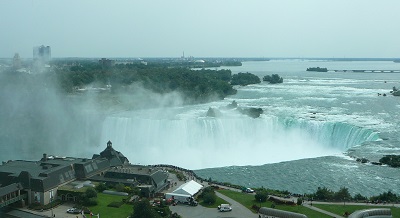 In 2013, my wife and I spent three very nice nights in Niagara Falls, Ontario, for our wedding anniversary. From out our window, we looked right down on the Horseshoe Falls and also had a front row seat for the fireworks that they set off on a couple of the nights. We had previously been at Niagara Falls in 1995 but had stayed on the American side -- although quickly realizing that the Falls are not visible from the hotels in Niagara Falls, New York. I understood that, if we ever returned, it would be necessary to stay in Canada, which we now have done.
 . I suspect that this is part of the Islamic push-back, as the equal and opposite counterpart of kosher identification -- with the latter modestly represented by an old synagogue at the west end of the halal block, next door to "Afghan Kabob." The halal eateries went with a conspicuous presence of Muslim tourists, at least in so far as they were distinguished by female dress. I did notice, however, that where we ate at the halal places, I did not get the indigestion (an increasing concern over the years) that has often gone with Indian food and even sometimes with falafel, in my experience.
Driving back into New York, we went by the hotel where we had stayed in 1995. It was a closed and melancholy derelict, although still a clearly visible and conspicuous building even from the Canadian side -- it is the lower of the tall two brick buildings on the left of the photograph at right (with a glass tower right behind it). It had had a heart-shaped tub in the hotel room, although obviously introduced since the original construction. But housecleaning never removed the spider webs from above our bed. Perhaps that tells the story. I didn't worry about it back then. Now I would have complained.
. I suspect that this is part of the Islamic push-back, as the equal and opposite counterpart of kosher identification -- with the latter modestly represented by an old synagogue at the west end of the halal block, next door to "Afghan Kabob." The halal eateries went with a conspicuous presence of Muslim tourists, at least in so far as they were distinguished by female dress. I did notice, however, that where we ate at the halal places, I did not get the indigestion (an increasing concern over the years) that has often gone with Indian food and even sometimes with falafel, in my experience.
Driving back into New York, we went by the hotel where we had stayed in 1995. It was a closed and melancholy derelict, although still a clearly visible and conspicuous building even from the Canadian side -- it is the lower of the tall two brick buildings on the left of the photograph at right (with a glass tower right behind it). It had had a heart-shaped tub in the hotel room, although obviously introduced since the original construction. But housecleaning never removed the spider webs from above our bed. Perhaps that tells the story. I didn't worry about it back then. Now I would have complained.
Prime Ministers of New Zealand Richard Seddon 1893-1906 William Hall-Jones 1906-1907 Joseph Ward 1907-1912,
1928-1930Thomas MacKenzie 1912 William Massey 1912-1925 Francis Bell 1925 Joseph Coates 1925-1928 George Forbes 1930-1935 Michael Savage 1935-1940 Peter Fraser 1940-1949 Sidney Holland 1949-1957 Keith Holyoake 1957,
1960-1972Walter Nash 1957-1960 John Marshall 1972 Norman Kirk 1972-1974 Hugh Watt 1974 Wallace Rowling 1974-1975 Robert Muldoon 1975-1984 David Lange 1984-1989 Geoffrey Palmer 1989-1990 Michael Moore 1990 Jim Bolger 1990-1996 Jenny Shipley 1997-1999 Helen Clark 1999-2008 John Key 2008-2016 Bill English 2016-2017 Jacinda Ardern 2017-2023 Chris Hipkins 2023 Christopher Luxon 2023-present  New Zealand contains a large Polynesian population, the Māori, but otherwise is like another Great Britain in the Antipodes. It also boasted the first officially socialist Government in the world. By the 1990's, however, decades of socialist attempts to control the economy and "protect" workers had done their damage. Growth was slow and unemployment high, inflation was at 19%, and "social" spending and government debt (67% of the GNP) were out of control. The heroic response was a volte-face that turned New Zealand into one of the freest economies anywhere, with a spurt of growth, investment, and prosperity -- in 2003 The Economist rated New Zealand as the 3rd freest economy in the world, after Hong Kong and Singapore. Suddenly, workers could no longer even be forced to join unions as the result of "collective bargaining." Two thirds of bureaucrats were let go or privatized. The Ministry of Transportation was reduced from 5,500 employees to just 56. This is a very basic reform when public employee unions in the United States have become rent seeking engines of poisonous political influence. The Ministry of Employment reduced 34 redundant and wasteful employment programs to just 4, but processed 300% more people, at 40% less cost. Income taxes were cut in half, with capital gains, sales, property, excise taxes and even tariffs simply eliminated. As we would expect from the Laffer Curve, revenues actually increased by 20% after the tax cuts. Not all state social entitlement programs, to be sure, were abolished, but it should be encouraging for all to see that the creep of social democracy can be dramatically reversed. A recent setback has been the return to power of the Labourites and the compromise of some reforms -- though the Labourites were the ones who started all of it -- but one does not expect the Opposition to be out of power forever. Hopefully, reform will eventually start up again and whole nasty lesson will not have to be learned all over.
Prime Ministers of Australia Edmund Barton 1900-1903 Alfred Deakin 1903-1904,
1905-1908,
1909-1910John Watson 1904 George Reid 1904-1905 Andrew Fisher 1908-1909,
1910-1913,
1914-1915Joseph Cook 1913-1914 William Hughes 1915-1923 Stanley Bruce 1923-1929 James Scullin 1929-1932 Joseph Lyons 1932-1939 Earle Page 1939 Robert Menzies 1939-1941,
1949-1966Arthur Fadden 1941 John Curtin 1941-1945 Francis Forde 1945 Joseph Chifley 1945-1949 Harold Holt 1966-1967 John McEwen 1967-1968 John Gorton 1968-1971 William McMahon 1971-1972 Gough Whitlam 1972-1975 Malcolm Fraser 1975-1983 Bob Hawke 1983-1991 Paul Keating 1991-1996 John Howard 1996-2007 Kevin Rudd 2007-2010 Julia Gillard 2010-2013 Kevin Rudd 2013 Tony Abbott 2013-2015 Malcolm Turnbull 2015-2018 Scott Morrison 2018-2022 Anthony Albanese 2022-
present Australia is actually a "Commonwealth" rather than a "Dominion," because individual Australian States were originally Dominions themselves. The six separate Dominions of the time federated as the Commonwealth in 1901. The form of the government, however, is still as a Dominion, with a Governor-General reigning in the name of the Queen. In 1986 both Australia and New Zealand followed Canada in removing the last vestiges of residual legislative authority of the British Parliament over them.
 Were the British really this careless? Or were they just careless with the ANZAC's? Well, that was World War I -- where much of the War looks like it was conducted with similar incompetence -- but the Australians can certainly be forgiven for some resentment about dying in a campaign that owed nothing to their direction or consent.

 When Japan entered World War II, Britain was already stretched thin. And the ANZAC force was in North Africa. The whole British position in the Pacific depended on the base at Singapore, with obsolete aircraft and few ships. The Japanese landed in Malaya, drove against Singapore and, in part by bluff against a larger force, compelled a British surrender. Many Australians ended up dying in Japanese prison camps, or suffering to build the infamous Japanese railroad from Thailand to Burma (as seen in The Bridge on the River Kwai [1957]). Britain had little left to offer for the defense of the South Pacific.
  Only America could help, and the war effort in New Guinea and the Solomons came to be a cooperative ANZAC-American effort. Henceforth, while Constitutional ties were retained with Britain, Australia would always be as much a partner of the United States as of the "Mother" country. Republican advocates, like the art critic and historian Robert Hughes, seem to spend as much time in the United States as Down Under. And the British ("bloody pommies") would never understand surfing.
He met and married his wife, Ann Douglass, in Egypt. After the War, he returned to Australia and spent some more time in the Outback before bringing Ann along with him and settling down. He began writing.
Only America could help, and the war effort in New Guinea and the Solomons came to be a cooperative ANZAC-American effort. Henceforth, while Constitutional ties were retained with Britain, Australia would always be as much a partner of the United States as of the "Mother" country. Republican advocates, like the art critic and historian Robert Hughes, seem to spend as much time in the United States as Down Under. And the British ("bloody pommies") would never understand surfing.
He met and married his wife, Ann Douglass, in Egypt. After the War, he returned to Australia and spent some more time in the Outback before bringing Ann along with him and settling down. He began writing.
 In 1929 this led to The Barrakee Mystery, a detective story for the first time featuring Upfield's character "Napoleon Bonaparte," a half-Aborigine orphan who had gone to college and become an Inspector in the Queensland Police Force. Twenty-nine Bonaparte stories, along with many other works, followed, until the postumously published The Lake Frome Monster in 1966.
 In the first Bonaparte story I heard about, The Bone is Pointed [1938], the Inspector is subject to an Aborigine curse, which is slowly killing him. He knows this was being formulated against him but ends up doing nothing to forstall or disrupt its force -- he must be rescued by others. I found this unpersuasive, given Bonaparte's knowledge; but when much the same thing happens in a later book, he does act to break up the placing of the curse. Since Bonaparte had been properly initiated among the Queensland Aborigines, he often displays his initiation scars to gain status among other tribes.
 While most of the Aborigines we see in the Bonaparte books are living tribes that, to one degree or another, are living peacefully adjacent to European settlement, in one book, Venom House [1952], we learn that the local Aborigines were wiped out by one family of white settlers.
 One of the books explores the dilemma of Bonaparte's own ethnic situation. This is Bushranger of the Skies [1940], where the eponymous antagonist of the title is, like Bonaparte, of mixed Aborigine and Anglo-European origin. Where the Inspector followed the white path of education, university, and professional status, he nevertheless feels the "call" of the Bush, both for its freedom, and because of what he (or the author) thinks of as the inner imperative of his blood. He often feels that he walks a thin line, and that if he ever failed to solve a case, he would need to return to an Aborigine life. Upfield himself, without any ethnic connection, felt the call of the Bush, which seems to be why he all but abandoned his wife for a while after World War I. On the other hand, the "Bushranger" of the title of this book has gone over to the old life, with the complication that he has learned white technology and wants to use it, not necessarily to improve the life of the Aborigines, but to lead a rebellion against white Australia.
Australia stars Australian actors but Hollywood heavy hitters Nicole Kidman and Hugh Jackman. It is presented as a tribute to Australia by Australians. I was privileged to see it at a special screening at Fox Studios in Los Angeles shortly before its release. I thought it was an enjoyable movie, beautifully shot. But it has not done very well at the box office, and it does have its peculiarities. It looks like two movies. The first involves a cattle drive, a sort of Australian Red River (1948). The second is during the Japanese air attack on the city of Darwin on 19 February 1942, which looks rather like the movie Pearl Harbor (2001). The frequent references to The Wizard of Oz (1939) in the movie play on "Oz" being used for the name of Australia itself, and on the idea that Australia is itself a kind of magical land of Oz.
One of the books explores the dilemma of Bonaparte's own ethnic situation. This is Bushranger of the Skies [1940], where the eponymous antagonist of the title is, like Bonaparte, of mixed Aborigine and Anglo-European origin. Where the Inspector followed the white path of education, university, and professional status, he nevertheless feels the "call" of the Bush, both for its freedom, and because of what he (or the author) thinks of as the inner imperative of his blood. He often feels that he walks a thin line, and that if he ever failed to solve a case, he would need to return to an Aborigine life. Upfield himself, without any ethnic connection, felt the call of the Bush, which seems to be why he all but abandoned his wife for a while after World War I. On the other hand, the "Bushranger" of the title of this book has gone over to the old life, with the complication that he has learned white technology and wants to use it, not necessarily to improve the life of the Aborigines, but to lead a rebellion against white Australia.
Australia stars Australian actors but Hollywood heavy hitters Nicole Kidman and Hugh Jackman. It is presented as a tribute to Australia by Australians. I was privileged to see it at a special screening at Fox Studios in Los Angeles shortly before its release. I thought it was an enjoyable movie, beautifully shot. But it has not done very well at the box office, and it does have its peculiarities. It looks like two movies. The first involves a cattle drive, a sort of Australian Red River (1948). The second is during the Japanese air attack on the city of Darwin on 19 February 1942, which looks rather like the movie Pearl Harbor (2001). The frequent references to The Wizard of Oz (1939) in the movie play on "Oz" being used for the name of Australia itself, and on the idea that Australia is itself a kind of magical land of Oz.
Prime Ministers of South Africa Louis Botha 1910-1919 Jan Christiaan Smuts 1919-1924,
1939-1948James Hertzog 1924-1939 Daniel Malan 1949-1954 Johannes Strijdom 1954-1958 Hendrik Verwoerd 1958-1966 South Africa
becomes a Republic,
leaves Commonwealth,
1961Presidents Charles
Robberts Swart1961-1967 Jozua
François Naudéacting,
1967-1968B. J.
Vorster1966-1978 Jacobus
Johannes Fouché1968-1975 Nicolaas
J. Diederichs1975-1978 Marais Viljoen acting,
19781978-1984 Pieter
Willem
BothaB. J. Vorster 1978-1979 Marais Viljoen 1979-1984 J. Christian Heunis acting, 1989 Frederik W. de Klerk 1989-1994 Nelson Mandela 1994-1999 Thabo Mbeki 1999-2008 Kgalema Petrus Motlanthe 2008-2009 Jacob Zuma 2009-2018 Cyril Ramaphosa 2018-present  The Union of South Africa was formed from the British colonies of the Natal and the Cape Colony, together with the subjugated Boer Republics of the Transvaal and the Orange Free State. The flag of the Union was, significantly, an archaizing Dutch flag, with an orange instead of a red stripe, and the flag of Britain, the Orange Free State, and the Transvaal on the middle stripe. Since the Boers never wanted to be ruled by Britain in the first place, and they had gone on the Great Trek into the interior to get away from them, it was perhaps only a matter of time before this was made good. Meanwhile, relations were cordial enough, and General Smuts became a familiar elder statesman of the British Empire, though in World War II South Africans refused to fight anyplace but in Africa -- little did they know that very serious fighting would actually occur in North Africa (though General Smuts himself had encountered tough fighting in World War I against the Germans in Tanganyika). In 1948, however, Boer nationalism seized the helm. The laws that had always been discriminatory and humiliating against non-whites, against which Mahātma Gandhi had already been fighting in the 1890's, were then expanded into the rigid, police-state-like system of Apartheid. By 1960, with African colonies becoming independent, and the harsh racist principles and rhetoric of the Boers all too reminiscent of Hitler, this had grown into an embarrassment, and worse.
  In 1961, after condemnation at a Commonwealth Conference, the Union was turned into a Republic, which left the Commonwealth, to live under international hostility through the 60's, 70's, and 80's, until a peaceful transition to majority rule in 1994. Whether the new South Africa will be able to remain peaceful is a good question. Already with a very high crime rate, the precedent of neighboring Zimbabwe, with one party rule and the increasing expropriation of white farms, usually by informal violence, is not reassuring.

The Republic of South Africa arose from four distinct original domains, the British colonies of the Cape Colony (originally Dutch) Kings of the Zulus Senzangakona 1781-1816 Sigujana 1816 Shaka 1816-1828 Dingane 1828-1840 Mpande 1840-1872 Cetshwayo 1872-1884;
exiled,
1879-1883Zulu War, Battle
of Isandhlwana, 1879Dinuzulu 1884-1887,
d.1913annexed by Britain, 1887;
joined to Natal, 1897;
revolt, 1907Solomon
kaDinuzulu1913-1933 Arthur
Mshiyeni
kaDinuzuluRegent,
1933-1948Cyprian
Bhekuzulu
kaSolomon1948-1968 Goodwill
Zwelithini
kaBhekuzulu1968-2021 Misuzulu Sinqobile Hlomesakhishlangu kaZwelithini 2021-present  and Natal, together with the Boer Republics of the Transvaal and the Orange Free State. However, other political units, of Africans, were in the area. Two of these, Swaziland and Lesotho (Basutoland until independence), were never integrated into South Africa and today are independent nations. Another, the land of the Zulus, lost its independence in the epic Zulu War of 1879. Both surviving kingdoms are landlocked, but Lesotho is also entirely surrounded by the Republic of South Africa. Swaziland does share a stretch of border with Mozambique.
ammunition (because of poor organization) and were all but wiped out by the army of King Cetshwayo (Cetewayo). The British had a habit of beginning colonial wars like this with embarrassing defeats. The same day, however, 100 some British soldiers nearby held off Zulu attacks at Rorke's Drift, which also entered, in its own way, Imperial mythology. A few months later the British moved on the Zulu capital, Ulundi, and calmly massacred the Zulu army as it attacked. In exile, Cetshwayo was received warmly in England (1882) and celebrated as a hero, with songs written about him. Nevertheless, not long after his death, the Zulu lands were annexed by Britain and later joined to Natal. A poignant footnote to the Zulu War was the death of Louis Napoleon of France, son and heir of the Emperor Napoleon III. Cetshwayo's son, Dinuzulu, lived in exile on St. Helena from 1890 to 1897. Later, he was tried for treason and sentenced to prison in 1908. However, the first Prime Minister of the Union of South Africa, Louis Botha, released him in 1910. The descendants of Shaka and Dinuzulu have been the titular Kings of the Zulu ever since, with prestige and some real power beginning to acrue to the office in the politics of the final days of Apartheid and the new Republic.Kings of Swaziland 
Sobhuza I 1815-1839 Mswati II 1839-1865 Ludvonga 1865-1874 Mbandzeni 1874-1889 Bunu 1889-1899 Sobhuza II 1899-1982,
regency,
1899-1921British Protectorate,
1903-1968Mswati III 1982-present,
regency,
1982-1986
The integration of the Zulus into South Africa placed them as one of the most important black political forces in the country. Zulu and Xhosa are the African languages with the largest number of speakers, about 9 million each. Under the Apartheid regime, the Zulus tended to be suspicious of Nelson Mandela and the African National Congress. Nevertheless, they were also reluctant to go along with the Boer plan for independent "Bantustans" by which blacks would become independent, like Swaziland and Lesotho, from South Africa (on often marginal lands with no right to live or work in South Africa proper). Transkei, Bophuthaswana, Venda, and Ciskei were formally granted independence. Transkei might have made a reasonable country, with a long coastline and an area larger than Lesotho or Swaziland, and an international boundary with Lesotho. At one point, Transkei actually broke off diplomatic relations with South Africa, even though South Africa was the only country in the world to recognize its independence! But Ciskei and Venda were tiny, and Kings of Basutoland Moshweshwe I 1828-1870 British Protectorate,
1868-1966Letsie I 1870-1891 Lerotholi 1891-1905 Letsie II 1905-1913 Griffith 1913-1939 Seeiso 1939-1940 Moshweshwe II 1940-1990;
regency,
1940-1960,
deposed,
d.1996Kingdom of Lesotho, 1966 
Letsie III 1990-present  Bophuthaswana consisted of no less than six landlocked and gerrymanered fragments, mostly surrounded by South Africa -- looking like something from early 19th century Germany. South Africa was obviously reserving for itself both political, territorial, and economic advantages over the Bantustan. Bophuthaswana got the most publicity, with a flashy Las Vegas-like resort called "Sun City." For a while it was a cause célèbre among international performers that they would not perform at Sun City.

Taoiseach, Prime Ministers of Ireland Eamon De Valera 1919-1922 Arthur Griffith 1922 Michael Collins 1922 William Cosgrave 1922-1932 Eamon De Valera 1932-1948,
1951-1954,
1957-1959Ireland becomes a
Republic, 1938;
leaves Commonwealth,
1949Uachtarán, Presidents Douglas Hyde 1938-1945 Sean O'Kelly 1945-1959 John Costello 1948-1951,
1954-1957Eamon De Valera 1959-1973 Sean Lemass 1959-1966 Jack Lynch 1966-1973,
1977-1979Erskine Childers 1973-1974 Carroll Daly 1974-1976 Liam Cosgrave 1973-1977 Patrick Hillery 1976-1990 Charles
Haughey1979-1981,
1982,
1987-1992Garret
FitzGerald1981-1982,
1982-1987Mary Robinson 1990-1997 Albert
Reynolds1992-1994 John Bruton 1994-1997 Mary McAleese 1997-2011 Bertie Ahern 1997-2008 Brian Cowen 2008-2011 Michael D. Higgins 2011-
presentEnda Kenny 2011-2017 Leo Varadkar 2017-2020,
2022-2024Micheál Martin 2020-2022,
2025-presentSimon Harris 2024-2025  Ireland gained independence as a Dominion -- though I have also seen this denied. The original idea was Home Rule, which would have made it an autonomous Kingdom within the United Kingdom of Great Britain and Ireland. Several Liberal British governments fell over Home Rule bills. When one finally passed, World War I led the British to delay its effect. Then in 1916 there was an Irish Rising. None of this made anyone any happier. When autonomy finally came in 1921, however, after another round of vicious fighting, the terms were the subject of bitter debate in Ireland. Britain expected there to be a Governor-General and a loyalty oath to the King. Acceptance of these terms led to near Civil War in Ireland. Michael Collins was killed by the Irish Republican Army, and Eamon De Valera was imprisoned by the Irish government. When De Valera came to power in 1932, the loyalty oath was abolished, the Governor-General was stripped of all power, and then in 1937 an office of President, Uachtarán, was created. Ordinarily, this would mean that Ireland had become a Republic, something which, at the time, was not thought possible for a Commonwealth country. David Lloyd George, who was Welsh and spoke that language, had told De Valera that there wasn't a word for "republic" in any Celtic language. Since the country was now officially just Éire, its form of sovereignty was left ambiguous. In practical terms, however, Ireland was now a Republic, just in time for a declaration of Irish neutrality in World War II -- although many Irish fought in the British Army nevertheless. Leaving the Commonwealth in 1949 clarified Ireland's status.
Prime Ministers of India Jawaharlal Nehru 1947-1964 India becomes a
Republic, 1950Presidents Rajendra Prasad 1950-1962 Sarvapalli
Radhakrishnan1962-1967 Sino-Indian War, 1962 Lal Bahadur
Shastri1964-1966 Zakir Husain 1967-1969  Indira
Gandhi1966-1977,
1980-1984Varahagiri
Venkata Giriacting,
1969Muhammad
Hidayat Ullahacting,
1969Varahagiri
Venkata Giri1969-1974 Fakhruddin
Ali Ahmed1974-1977 Basappa
Danappa Jattiacting,
1977Morarji Desai 1977-1979 N. Sanjiva Reddy 1977-1982 Charan Singh 1979-1980 Zail Singh 1982-1987 Rajiv Gandhi 1984-1989 Ramaswamy
Venkataraman1987-1992 Vishwanath
Pratap Singh1989-1990 Chandra Shekhar 1990-1991 Shankar
Dayal Sharma1992-1997 P.V.
Narasimha Rao1991-1996 H.D. Deve
Gowda1996-1997 Kircheril
Raman
Narayanan1997-2002 Inder Kumar
Gujral1997-1998 Atal Bihari
Vajpayee1998-2004 Dr. Manmohan
Singh2004-2014 Dr. A.P.J.
Abdul Kalam2002-2007 Pratibha
Devisingh Patil2007-2012 Pranab Mukherjee 2012-2017 Narendra Modi 2014-
presentRam Nath Kovind 2017-
presentIndia and Pakistan both became independent as Dominions, mainly because the procedures for doing this already existed and it could be done quickly. India then soon enough became a Republic. Bitterness, however, was minimal, and India remained a friendly member of the British Commonwealth. Although Mahātmā Gandhi was affectionately, reverently regarded as the father of Indian independence, he never had the slightest interest in exercising political power, and Nehru, a British educated Brahmin, had always been the logical choice. Unfortunately, Nehru had been educated in the fashionable socialism of the day and immediately applied to India the tried and true techniques of that paradigm of economic development, the Soviet Union. This, of course, condemned India to decades of continued poverty, even while Indian emigrants prospered mightily elsewhere. The day of reckoning may have come in 1991, when the new Prime Minister, P.V. Narasimha Rao, discovered that the country's gold reserves had been flown to London to cover an International Monetary Fund loan, itself sought because of the looming exhaustion of foreign reserves. Soon Rao's government was moving to liberalize the economy, allowing foreign investment and something approaching free, certainly freer, trade. Most importantly, the "Licence Raj," by which no business count start, or do much else, without the endless red tape of government permission, was in great measure dismantled. The economic acumen of Indians now could be manifest in India itself, not just in emigrant communities. The effects of the Nehruist folly have not been shaken off completely, however. The government itself is still a vast parasite on the economy, it is all but impossible to fire workers, and bankrupt or unproductive businesses cannot legally close or lay off workers. The State of Bengal remains in the grip of an actual Communist government, with monuments to Ho Chi Minh and the other luminaries of leftist murder and dictatorship. ) Since Bengal, like adjacent Bangladesh itself (with only about 4.7% of the per capita purchasing power of the United States), remains one of the poorest places on Earth (the poorest is Sierra Leone, with 1.4% of the per capita purchasing power of the United States, India itself has 6.9%, PRC China 11.5% -- but Taiwan 66.7%), one wonders when such people will give themselves a break.
Since Bengal, like adjacent Bangladesh itself (with only about 4.7% of the per capita purchasing power of the United States), remains one of the poorest places on Earth (the poorest is Sierra Leone, with 1.4% of the per capita purchasing power of the United States, India itself has 6.9%, PRC China 11.5% -- but Taiwan 66.7%), one wonders when such people will give themselves a break.
The map shows developments in South Asia since the partition of India and the independence of India and Pakistan. The wars between India and Pakistan began over Kashmir, but one of the most formative events was the war provoked by rebellion in East Pakistan. Ethnically very different from the West, East Pakistanis found themselves slighted by the military regimes that came to dominate the country. Without much of chance of their rebellion succeeding, India intervened and effected the independence of Bangladesh. Ceylon and Burma both became independent in 1948. Burma immediately left the Commonwealth and became a Republic. Ceylon remained a Dominion until 1972 and then became a Republic as "Sri Lanka." A nasty military dictatorship in Burma decided to display its nationalistic bona bides by changing the name of the country to "Myanmar" in 1991. They still don't seem to understand that this does not mitigate the scorpion sting of tyranny. Meanwhile one of the rudest of all awakenings for Jawaharlal Nehru was when China invaded India in 1962 -- he had thought of Mao as a kindred spirit in the new post-colonial era. This involved disputes over multiple border regions, disputes that of course only existed because China conquered Tibet in 1950 -- recreating the Imperium of the Manchus was not an aupicious start for a post-colonial era. The most serious conflict was over the North-East Frontier of India, the "McMahon Line," which had been negotiated with Tibet in 1913-14. China still claims essentially all of the modern Arunachal Pradesh province of India. The matter now seems quiescent, though one wonders if the factor ever enters the consideration of dictators that the actual inhabitants of Arunachal Pradesh might prefer not to be subject to the tender mercies of Communist China. On the map we also see the Portuguese colonies, Diu, Damão, and Goa, that were finally annexed by India in 1961.
Prime Ministers of Pakistan Liaquat Ali Khan 1947-1951 1st Indo-Pakistani War, partition of Kashmir, 1947 Khawaja Nazimuddin 1951-1953 Muhammad Ali Bogra 1953-1955 Chawdry (Chaudhri)
Muhammad Ali1955-1956 Hussein Shahid Suhrawardi 1956-1957 Pakistan becomes
a Republic, 1956;
out of Commonwealth,
1972-1989Presidents Iskander Mirza 1956-1958 Ismail
Chundrigar1957 Malik Feroz
Khan Noon1957-1958 1958-1969 Muhammad Ayub Khan 1958 2nd Indo-Pakistani War, 1965 1969-1971 Agha Muhammmad Yahya Khan 3rd Indo-Pakistani War,
Independence of East Pakistan as Bangladesh, 19711971-1973 Zulfikar
Ali Bhutto1973-1977 Fazal Elahi
Chawdry1973-1978 Muhammad
Zia-ul-Haq1978-1988 vacant Muhammad
Khan Junejo1985-1988 Ghulam
Ishaq Khan1988-1993 Muhammad
Aslam Khan
Khattak1988 Benazir
Bhutto1988-1990,
1993-1996Mustafa Jatoi 1990 Nawaz Sharif 1990-1993,
1996-1999Farouk Ahmed
Leghari1993-1997 Wasim Sajjad 1997-1998 4th Indo-Pakistani War, "Kargil War," 1999 Muhammad
Rafiq Tarar1998-2001 Pervez
Musharraf"Chief
Executive,"
1999-2002Pervez
Musharraf2001-2008 Zafarullah Khan
Jamali2002-2004 Chaudhry Shujaat
Hussain2004 Shaukat Aziz 2004-2007 Muhammad Mian
Soomro2007-2008 Yousaf Raza
Gillani2008-2012 Muhammad Mian
Soomro2008,
actingAsif Ali Zardari 2008-2013 Raja Pervaiz
Ashraf2012-2013 Mir Hazar Khan
Khoso2013 Mamnoon Hussain 2013-2018 Muhammad
Nawaz Sharif2013-2017 Shahid Khaqan
Abbasi2017-2018 Arif Alvi 2018-
presentImran Ahmed
Khan Niazi2018-
present With a slightly greater delay, Pakistan followed India to become a Republic. The first President of Pakistan in 1956, Iskander Mirza, was the son of Mohammad Fateh Ali, the grandson of Bahadur Syed Iskander Ali, and the great grandson of no less than the last titular Nawwāb of Bengal, Mansur Ali Khan.
Prime Ministers of Ceylon Don Stephen Senanayake 1947-1952 Dudley Shelton Senanayake 1952-1953 John Lionel Kotalawela 1953-1956 Solomon Ridgeway Dias Bandaranaike 1956-1959, assassinated Wijeyananda Dahanayake 1959-1960 Dudley Shelton Senanayake 1960 Sirimavo Ratwatte Dias Bandaranaike1960-1965 Dudley Shelton Senanayake 1965-1970 Sirimavo Ratwatte Dias Bandaranaike1970-1977 Ceylon becomes Republic
of Sri Lanka, 1972Presidents William Gopallawa 1972-1978 Junius Richard Jayewardene 1977-1978 Junius Richard Jayewardene 1978-1989 Ranasinghe Premadasa 1978-1989 Ranasinghe Premadasa 1989-1993, assassinated Dingiri Banda Wijetunge 1989-1993 Dingiri Banda Wijetunge 1993-1994 Ranil Wickremesinghe 1993-1994 Chandrika Bandaranaike Kumaratunga1994 Chandrika Bandaranaike Kumaratunga 1994-2005 Sirimavo Ratwatte Dias Bandaranaike1994-2000 Ratnasiri Wickremanayake 2000-2001 Ranil Wickremesinghe 2001-2004 Mahinda Rajapaksa 2004-2005 Mahinda Rajapaksa 2005-2015 Ratnasiri Wickremanayake 2005-2010 Disanayaka Mudiyanselage
Jayaratne2010-2015 Maithripala Sirisena 2015-2019 Ranil Wickremesinghe 2015-2018 Mahinda Rajapaksa 2018 Ranil Wickremesinghe 2018-2019 Gotabaya Rajapaksa 2019-2022 Mahinda Rajapaksa 2019-2022 Ranil Wickremesinghe 2022 All deposed in popular revolt, July 2022, after "Environmentalist" policies (recommended by the Davos World Economic Forum, i.e James Bond Supervillains & George Soros) curtailed food and energy supplies, leading to hunger, blackouts, and absence of gas and oil for cooking and transportation. Ranil Wickremesinghe 2022-2024 Dinesh Gunawardena 2022-2024 Anura Kumara Dissanayake 2024-present Harini Amarasuriya 2024-present  Ceylon stands as one of the most distressing stories of post-colonial history. About 74% of the population is Sinhalese, largely Buddhist but with some Christians. About 18% is Tamil, largely Hindu. The Tamils, speaking a Dravidian language, were originally from the South of India. There had been little strife between the communties, and at independence in 1948 Ceylon seemed poised to set an example of amiable relations between different ethnic populations in one historic state. The conflict that emerged can hardly be blamed, as many such post-colonial conflicts are, on a population introduced by the British that colaborated with colonial rule. The British did introduce a new population of Tamils, but these were brought to do plantation labor, and they remained the poorest population group on the island. It was Tamils who had lived in Ceylon long before Europeans arrived, the "Ceylon Tamils," who took advantage of Western education and became the most accomplished and prosperous group in the country. This doesn't seem to have excited much open enmity until a demagogue made an issue of it. That was Solomon Ridgeway Dias Bandaranaike, an English speaking, Oxford educated, Christian, who learned Sinhalese, converted to Buddhism, and ran on a platform of making Ceylon Sinhalese speaking and Buddhist, regardless of the wishes of the Tamils. Not only did this win him the Prime Ministership in 1956, but it stirred things up enough that there were riots where Sinhalese attacked Tamils, often burning them alive. The Sinhalese cause hardly qualifies as "nativist" in the most usual senses, since, not only had the most prosperous Tamils been in Ceylon for centuries, but the language and religion of the Sinhalese themselves both came from India also. Sinhalese is even an Indic language, a descendant of Sanskrit.
 , in Sinhalese and Ilange in Tamil. Now it was to be Sri Lanka, where sri is an honorific prefix from Sanskrit, meaning "famous" or "glorious." In fact, this is shrī,
  , in Sanskrit, which seems to be how the word is usually pronounced in "Sri Lanka."
Copyright (c) 2000, 2001, 2003, 2004, 2006, 2007, 2008, 2009, 2010, 2011, 2012, 2013, 2014, 2015, 2016, 2017, 2018, 2020, 2021, 2022, 2023, 2024, 2025, 2026 Kelley L. Ross, Ph.D. All Rights Reserved