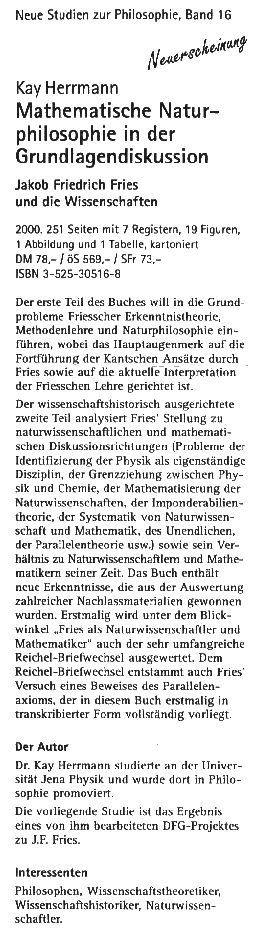
"Jakob Friedrich Fries
and the Birth of Psychologism,"
The Genesis of Neo-Kantianism, 1786-1880
by Frederick C. Beiser
Oxford University Press, 2014, 2017
 Die Welt ist meine Vorstellung.
The world is my representation.
Arthur Schopenhauer, Die Welt als Wille und Vorstellung, Band 1, §1 [Reclam, 1987, p.3], The World as Will and Representation, Volume I [Dover Publications, 1966, E.F.J. Payne translation, p.3]
Leonard Nelson spent his entire life fighting the accusations of "psychologism" made against Jakob Fries. "Psychologism" is the doctrine, more or less, that knowledge is subjective and relates to the human mind and human nature, not to the objective world. For example, we might even say that the later Ludwig Wittgenstein asserts a kind of psychologism, since "language games" impose a pattern and an order on the world that is not derived from the world but just from the particular human language that is being used. Wittgensteinians don't seem to worry that this is autistic, self-referential, relativistic, and nihilistic -- but that is the conceit of the "post-modern" mindset prevalent among the (largely narcissistic) academic and cultural elites -- people who are now marching in "Kill the Jews" demonstrations.
Nelson was let down by his own students, who, we have seen, abandoned Nelson's defense and accepted that Fries represented psychologism. Grete Henry even reduced Fries's psychology and anthropology to "Behaviour Study."
This was perhaps, in part, under the powerful influence of, if not B.F. Skinner, then Karl Popper, who had his own interpretation of the term, that "psychologism" represented a claim of subjective certainty for any kind of immediate knowledge, what Henry called "infallible insights," despite there being no such thing in Friesian philosophy. In general, however, Nelson's students simply went along with the nihilistic mainstream of Analytic philosophy.
Frederick Beiser's book is a history of Neo-Kantianism. Beiser gives Fries pride of place as the first Neo-Kantian, and he defends him against various unwarranted charges made by later Neo-Kantians. Beiser tries to be very fair to Fries, and we hear little about the embarrassment of his later political commitments. Thus, we don't get answers to some of the questions that arise, as we've seen above, about Fries's activities and influence. We do hear about Fries's anti-Semitism, and considering that Beiser had relatives who were murdered by the Nazis, as we hear from the dedication of the book [q.v.], it is a tribute to Beiser's restraint that we don't hear more about the issue.
However, Beiser does have a section on Fries's early political thought ["Early Political Philosophy," pp.54-63], as expressed in his Philosophische Rechtslehre of 1804. From this, despite its liberal Kantian origin and general principles, we learn that Fries nevertheless endorses absolute monarchy and rejects the principles of a separation of powers, checks and balances, enumerated powers, or any practical limitation of government.
Fries seems to see limited government as a good, but the only practical limit he envisions to the power of the monarch is "public opinion," without any explanation how this is to be expressed or even taken seriously by an absolute monarch. This is basically absurd, ignores the political philosophy recently developed in the Anglophone world, from Britain to the United States, and perhaps prepared the ground for the way in which Fries will jump the rails from liberal republicanism.
Also, today we see how easily "public opinion" can be throttled by a dictatorship, or even by influence in a democratic government, especially from unelected bureaucrats, on a pliable, biased, and partisan media, as in the "Russia collusion" hoax against Donald Trump in 2016 or the suppression of evidence of the corruption of Joe Biden and his family in 2020.
Beiser says:
The principle that we should treat all people equally became the principle that all people in a nation should be equal, having the same language, religion, ethnic origin. This understanding of equality, combined with a lack of tolerance for those who do not meet its requirements, was the basis for Fries' later anti-semitism, which remains an inexpungible stain on his reputation. [p.63]
This is as far as Beiser goes in condemning Fries, and it is damning enough; but it should also serve to warn us that it began with serious flaws in the "republicanism" originally described by Fries. Flaws in political philosophy continue with Nelson, who also seems insensible of the wisdom of republican government as described by Polybius, Machiavelli, John Locke, and then American Founders like Jefferson and Madison. Nelson's socialism and description of market economies as "anarchy" generally disqualifies him from our serious consideration. The proper "Friesian" political economist is F.A. Hayek. Nelson is guilty of the "Fatal Conceit" described by Hayek.
The "Fatal Conceit" of a wage and price "freeze" was tried by Richard Nixon to stop inflation. It didn't work. If prices are fixed below costs, then shortages and bankruptcies follow with all the necessity of gravity. Yet price fixing is still proposed by American politicians in 2024, in order avoid admitting blame for government policies that fueled inflation with massive spending. Fixing oil prices, and shortages, after Nixon, continued until Ronald Reagan ended it in 1981; and, instead of oil companies gouging customers down to their last penny, as predicted by the Left, oil prices fell and remained low for the next 25 years.
Yet the political rhetoric of shifting blame away from government and politicians is too attractive, and the hard lessons of history sometimes must be demonstrated and learned all over again. Some lessons, however, never get learned, such as the roll of the Federal Government in creating and perpetuating the Great Depression. The inflationary spending of the Biden Administration was only possible because Constitutional safeguards were destroyed by Franklin Roosevelt. Even Reagan was still praising Roosevelt.
While Beiser usefully alerts us to problems in the political philosophy of Fries, he strongly promotes the construction of Fries as representing psychologism. He is aware of Nelson's defense of Fries, and acknowledges that much of it is justified, but he still thinks it fails to go as far as Nelson thought.
While it is tangential to the main issue, there is a clue that Beiser may not have the best understanding of Nelson's arguments. Thus, in one footnote, Beiser says:
The fact that Fries begins with the same problem as Kant shows how misleading it is to claim, with Nelson, that Fries' work proves the impossibility of epistemology. See Nelson, Jakob Friedrich Fries und seine jüngsten Kritiker (Göttingen: Dieterich, 1909), pp.80-81. Fries himself would have found this a startling conclusion. Though Nelson is correct that Fries did not intend to provide an objective justification for the validity of knowledge, it hardly follows from this that he showed the impossibility of epistemology. Fries did intend to provide a subjective justification of synthetic a priori principles, which surely falls within the purview of epistemology. [note 108, p.73]
 But Nelson, no more than Fries, would want to prove "the impossibity of epistemology." What Nelson thought instead we can see in his essay, "The Impossibility of the 'Theory of Knowledge'" [Socratic Method and Critical Philosophy, Yale, 1949, Dover, 1965, p.185]. What Nelson addressed was a certain kind of Epistemology, where an Erkenntnistheorie is expected to prove the existence of knowledge. The temptation to do such a thing might be in response to the Greek tradition of "Skepticism," which, beginning with Pyrrho of Elis, denied the existence of knowledge -- reminding us that Greek "Skepticism" went far beyond merely having "doubts."
Nelson's argument about this is simple. If we have a proof that knowledge exists, its source and premises must be in some kind of knowledge, or it cannot prove anything. But then it already begs the question. Similarly, if the claim of Skepticism is that knowledge doesn't exist, then, if we cannot actually know this, because knowledge doesn't exist, there is no rational basis for saying so.
The practice of Pyrrho himself was to "suspend [ἐποχή] judgment in all things, either that they exist, or don't exist, or both exist and don't exist, or neither exist nor don't exist." We only know about Pyrrho's thought because of his followers, who were less consistent in their know-nothing-ism -- like the Zen teachers who tell all about the "Silent Teaching."
Thus, a project to prove that knowledge exists, or that it doesn't exist, already must presuppose that it does. Otherwise, we can see in Pyrrho's principle something that he brought back from his sojourn in India with Alexander the Great; for this is no less than the "Four-Fold Negation" of Buddhism and Advaita Vedānta, which applies to things -- all reality in Buddhism -- which are not amenable to systematic rational knowledge. But much the same thing is familiar to us in Kantian philosophy as Kant's Antinomies. The Antinomies and Kantian "Dialectical Illusion," by the way, are things Beiser does not mention in his (disapproving) consideration of the theory of things-in-themselves in Fries.
Thus, Nelson's argument about Erkenntnistheorie can lead off into serious and revealing considerations. But Beiser thinks that it somehow is about the "impossibility of epistemology," when "epistemology" just means talking about knowledge, which Nelson does all the time. So we might be warned here that Beiser can sometimes misread or misinterpret Leonard Nelson, let alone Jakob Fries.
This comes back to psychologism:
What is decisive in making Fries a psychologicist in this sense is his commitment to the Kantian theory of mathematics. Fries never questioned the Kantian doctrine that mathematics concerns the forms of human sensibility, space and time, and that it is therefore valid only for them. Mathematics gives us no insight, then, into some Platonic realm of being or nature as such. It is a common misake, Fries cautions in his Neue Kritik, to think that demonstration provides us with objective justification, as if we knew reality in itself simply by showing how principles are grounded in intuition. All that demonstration ever gives us is knowledge relative to our way of perceiving the world. Proof is therefore for Fries the only objective method to justify knowledge. [p.81, citations removed]
There are a number of things we must consider here. Most important is the Friesian theory of justification, the " Friesian Trilemma," where propositions are justified by "Proof," i.e. logical deduction, "Demonstration," i.e. by showing an intuitive ground, or "Deduction," where the problem is general propositions that are neither analytic nor self-evident nor justified by an intuitive ground. Kant believed, for instance, that the axioms of geometry are justified by an intuitive ground in "pure intuition," i.e. our imaginative visualization of space. Claims about the validity of this, or what even means, are examined here in the "Deuteronomy of Kant's Geometry."
But all the forms of Friesian justification are "objective"; and if they are not, then "Proof" itself cannot be objective, since its validity rests on the objective truth of its premises, which must be known either by self-evidence, intuition, or by Friesian "Deduction." Beiser's own argument discredits what he says about Proof, unless he wants to claim that the premises of valid Proof are all self-evident in an Aristotelian or Hegelian sense. Perhaps he does -- although this had already been effectively discredited by the disagreements among the Rationalists, not to mention the word salad of the Hegelians.
More important for the argument over Fries, however, is the statement by Beiser that, "All that demonstration ever gives us is knowledge relative to our way of perceiving the world." This would reduce geometry, and so a lot of physics, to a phantasmagoria of human consciousness. How could physics, or engineering, work if the human construction of the nature of space had nothing to do with the objective world? Physicists, indeed, including Einstein, have wondered how mathematics, which we seem to have just made up on our own, ends up apparently applying to the world, in ways where, if we got it wrong, we could get hurt.
But what Beiser has missed about a Kantian theory, whether of geometry or metaphysics, is the nature of Kant's "Empirical Realism," whereby phenomenal objects are themselves an "objective reality" and the true ὄντως ὄντα, the "beingly beings" of the phenomenal world. Beiser, indeed, does not mention "Empirical Realism" or the proper ontological status of phenomenal objects. He says that, "Mathematics gives us no insight, then, into some Platonic realm of being or nature as such"; but from that we would expect that mathematics, having generated an illusion in our consciousness, would not be a reliable guide to the behavior of the actual, external, physical universe. This has not been the experience of physicists, or of daily life.
So we must always ask in the end, are Kant's "forms of sensibility," space and time, merely constructs of the human mind? Kant does not make that clear. He does not even make it clear if the "forms of sensibility" might instead belong to any rational mind. Or, even better, what if we do substitute Plato for Kant. Mathematicians, after all, tend to be Platonists. And, as I have considered, what if our "pure intuition" is simply an intermediate step between consciousness and things-in-themselves? That depends, of course, on the significance of consciousness as such in the nature of things.
 Since consciousness seems to turn the quantum wave function into discrete particles, physicists have had a tough time trying to make sense of this, or find a way to preserve their Democritean materialism. They are especially unnerved by Einstein's "spooky action at a distance," where quantum effects can propagate instantaneously, ignoring both spatial distances and the velocity of light. Einstein hoped that this would falsify quantum mechanics, but it did the opposite; and this implies, as Kant might have thought, that there is a level of reality more fundamental than space and time. But none of it is just a construct of the human mind.
Returning to the main issue, Beiser implies that, like space and time, all of metaphysics, or ethics, would be for Fries only a characteristic of human consciousness or human nature. This overlooks something fundamental, clearly identifed and emphasized by Nelson. Thus, synthetic a priori propositions of metaphysics or ethics are not within the logical system or language of Kantian or Friesian Critique.
Beiser sometimes seems to be aware of this, but I notice that he doesn't use the modern terminology. Thus, he speaks of Critique as a "second order" system, where now it would be clearer to say that it is the "meta-language" of the "object languages" of metaphysics or ethics. Nelson was acutely aware of this because of his familiarity with the theory of "meta-mathematics" developed by his friend, patron, and mentor David Hilbert. If Beiser does not use this terminology, we might wonder how aware he is of the issues involved. Yet Beiser does seem to be aware that metaphysics can be rational and a priori, while Critique is empirical and a posteriori. Nevertheless, he doesn't draw the conclusions that follow from this.
Thus, the whole focus in Fries with psychology and anthropology is directed to the meta-language of Critique. This comes up particularly, or exclusively, in relation to the Friesian "Deduction" of a priori knowledge; yet Beiser seems to confuse, or overlook, the difference between Critique and its object languages. The object languages are unaffected by whatever subjectivism, psychology, or "anthropology" Fries attributes to Deduction.
Nelson himself quotes Hermann Cohen (1842-1918), one of the later Neo-Kantians, confusing Critique and Deduction with the object language of metaphysics:
If one could describe transcendental deduction as an investigation that "belongs" to psychology, then the metaphysical discipline a a whole would disappear in the psychological. [Leonard Nelson, Socratic Method and Critical Philosophy, Dover, 1965, p.136]
Wenn man die transzendentale Deduktion als eine der Psychologie »angehörige« Untersuchung bezeichnen dürfte, so wäre die Disziplin der Metaphysik überhaupt in die der Psychologie aufgelöst. ["Die kritische Methode und das Verhältnis der Psychologie zur Philosophie," 1904, Die Schule der kritischen Philosophie und ihre Methode, Band I, Gesammelte Schriften, Felix Meiner Verlag, Hamburg, 1970, p.43]
If Cohen, whose version of Kant Beiser may prefer, confuses the meta-language of Critique with the object language of metaphysics, I am left to suspect that Beiser does the same.
Beiser quotes Fries:
Even for the ideal of a perfect scientific form of our knowledge, the highest possible justification is only a subjective one which relates to merely the inner laws of the activity of our reason. It is always only a question of what human reason knows and recognizes, and never immediately about how things are in themselves. [pp.80-81]
Selbst für das Ideal einer vollendeten wissenschaftlichen Form unserer Erkenntniß[sic] ist also jede oberste Begründung nur eine subjektive, die sich bloß auf die inner Gesetze der Thätigkeit unsrer Vernunft im Erkennen bezieht. Es ist immer nur von dem die Rede, wie die menschliche Vernunft weiß und erkennt, und nicht unmittelbar von dem, wie die Dinge an sich find. [Jakob Friedrich Fries, Neue oder anthropologische Kritik der Vernunft, Verlag „Öffentliches Leben“, Berlin, 1934, Erster Band, §71, p.354]
Fries, doing his own argument no good, leaves out a kind of "middle term" here, which is the objectivity of phenomenal objects, without which he would only be a "subjective idealist," like Berkeley, which is exactly how some sympathetic interpreters, like Schopenhauer, had seen Kant -- Schopenhauer, whose first words in the text of The World as Will and Representation, are Die Welt ist meine Vorstellung, "The world is my representation." This is Kant's "Empirical Realism" with a vengeance, without the ambiguity that we get with Kant, Fries, Nelson, and others.
Otherwise, Fries is speaking about the psychological nature of Critique. But his leap directly to the Dinge an sich at the end of the quote might definitely give someone the wrong idea -- unless Fries has confusedly gotten the wrong idea, for the moment, himself. Of course, Kantian theoretical knowledge is limited to phenomena. If, in turn, Critique is limited to empirical psychology, the objective nature of the object languages of Critique can be lost in the shuffle. This can be overlooked even by sympathetic readers. It is less of a problem, for instance, with Schopenhauer, who never sees things in themselves as a separate order of objects. Indeed, a version of that is proper. Things in themselves are phenomenal things, in themselves, not a separate order of objects.
Since Beiser ends up giving little credit to the defense of Kantian things in themselves, doubtlessly in sympathy with later Neo-Kantians, who junked that whole side of Kantian philosophy (generating paradoxes to which they seem unaware), it is worth noting how the Kantian transcendent (of things in themselves) actually continues in phenomenal objects, whether conceived by Kant, Schopenhauer, or Fries.
In the first place, it is obvious that the inspection of our empirical perception does not reveal the atoms and molecules, let alone the subatomic particles and fields, which are, according to modern physics, the physical constituents of material reality. Even worse, if fundamental particles are Dirac Point Particles, then matter is actually entirely empty space, filled only with "fields," whatever those are (i.e. either a Relativistic deformation of space itself, or a flux of virtual particles, which have no real mass or energy).
Our inability to do so was the basis of the rejection of the atomic theory by Ernst Mach (1838-1916), whom some consider, not just to be a great scientist, but something like an important philosopher of science. Thus, he rejected the idea that there could be physical realities within material objects, concealed from our senses (something Hume, a proper Empiricist, would never consider possible either). That concealment would be one version, and an obvious one, of "things in themselves." So we could say that Ernst Mach, like Hegel or the later Neo-Kantians, rejected things in themselves (as he certainly would have, in any sense). It is just that Mach was thinking in terms of material objects, denying a key discovery of 19th century science, despite all the evidence for it.
Kant's sense of things in themselves is mainly how objects would exist entirely separate from our perception and consciousness. Of course, most of the material universe does that already. So Kant meant something a little different. Is there something about, perhaps, the inner nature of things, and not just in physical terms, that cannot be present to the senses, that cannot appear in "a possible experience"? Indeed, yes. Kant even has a general principle about this. Phenomenal reality consists of things that are mutually conditioned by the laws of nature. Nothing exists independently, or in an unconditioned way. As it applies to causality, this means, not just that everything has a cause, but every cause has a cause also, in a continuing sequence, ad infinitum.
In a way, there is nothing new about that. Buddhist metaphysics also construes the phenomenal world as mututally conditioned. This is the doctrine of "relative existence," and the specifically causal version of that is " dependent origination," whose cycle we see in the diagram at right -- in India, time generally has been seen as cyclical rather than linear. Salvation is to be free of those conditions, in an unconditioned reality, i.e. Nirvāṇa, निर्वाण. This renders one free of suffering.
As in Buddhism, Kant envisions a level of reality free, in different ways, of conditions. If our will, for instance, causes things but is not itself caused, it is what we call "free will." We cannot account for that in the phenomenal world, as indeed science does not. Similarly, an immortal soul, an unconditioned substance, is invulnerable to material causes, while otherwise Kant places the characteristics of substance in phenomenal objects, that they are durable, separable, and identical. Whether they have unconditioned characteristics is hidden among things in themselves.
Kant can explain the conditioned nature of phenomena as an artifact of the thoroughgoing synthesis that is carried out by the mind in the course of the construction of consciousness. Time is stitched together with the rule of causality, without limit. But this has two sides. One is the subjective construction of consciousness. The other is the objective character of the world. Images in perception do not cause each other, but phenomenal events do cause each other, even as they may cause sensations that are used for perception. This duality will become important for the nature of Friesian Deduction, as I will consider.
There is a key boundary here. If the object of our study is consciousness as such, then this is introspective and, in the Friesian sense, psychological. However, if the object of our study is the world of phenomenal objects, then the object language for which this is the reference is not introspective or psychological. Also, Kantian synthesis does not generate the world, which would require an "intellectual intuition," where knowledge causes its objects, which would make us God. For all I know, perhaps the later Neo-Kantians did think they were God (as Hegel did). But I won't accept that. If I were God, there are some changes around here that I would make.
This creates a bit of a dilemma, certainly for Frederick Beiser. Kant's empirical realism (or Schopenhauer's) would mean that the objective world consists of these phenomenal objects. But, on the one hand, this would mean that the theory of Fries cannot be a form of psychologism. Also, on the other hand, we have the paradox that representation is both subjective and objective, internal and external. This is hard to accept for common sense, and in analyzing Kant or Fries, it may be a benefit that the dilemma can get lost in the shuffle, and someone like Hermann Cohen or Beiser can ignore one part of it and reduce the whole philosophy, whether of Kant or Fries, to what is subjective and psychological (i.e. to "psychologism"). Kant's use of the term "transcendental idealism," which I have considered elsewhere, introduces some confusion and misdirection which also helps conceal and muddle the dilemma.
Only Schopenhauer presents us with no ambiguity over the phenomenal presence of the objective world. I don't think even Nelson is clear enough about the issues involved. I don't think there can be an easy answer to everyone's satisfaction. I have described the dilemma under the problem of "Ontological Undecidability." For the purpose of this essay, however, it must be affirmed that the existence of the object languages, not just of metaphysics and ethics, but even of physics and ordinary experience, subverts and falsifies Beiser's reduction of the philosophy of Fries, if not Kant, to the subjective and psychological content of the Critique of Reason. What Fries says about Deduction in the quote above is irrelevant to the existence of synthetic a priori knowledge and even factual a posteriori knowledge of the world. This is what thrilled Nelson about Hilbert's construction of the object language/meta-language distinction in mathematics.
What it looks like is that the emphasis by Fries on the psychological nature of Critique and Deduction served to completely distract people from some of the essential points, both in his day and now in ours. Indeed, I think he went way too far -- the confusion is not entirely the fault of people like Beiser. If we look at the way Fries wanted to construe psychology as a kind of empirical science, we can't help notice that this is very different from what psychology, any psychology, looks like today. We can't even say that William James (1842-1910) represents a kind of psychology in good standing now. He is of greater value just as a philosopher -- a fate into which Freud and Jung may be sliding.
But if the kind of psychology described by Fries is dated and abandoned, doesn't this demolish the Friesian project, all by itself? The concern of Fries with the "faculties" of the mind is pretty much forgotten; and, we might notice, that our inability to discern "faculties" in the stream of consciousness, while perhaps giving them the status of scientific hypotheses, nevertheless leaves them as a dead letter in the progress of actual science. As I have already noted, the appeal of Grete Henry to "behavior," while in step with the trendy contemporary psychology of her day, also represented a false step and a dead end in the development of Friesian philosophy.
A clue about where things have gone wrong perhaps can be seen in a key term used by Fries and Nelson.  This is die nicht-anschauliche unmittelbare Erkenntnis, "Non-intuitive immediate knowledge," such as we see on Nelson's axiomatic diagram at right ["Die kritische Methode und das Verhältnis der Psychologie zur Philosophie," cited above, p.54; translated in Socratic Method and Critical Philosophy, p.146]. With eight vertices, this diagram can be redrawn as a cube, making for a 3-D analogue to the logical "square of opposition," which has four vertices. A cube of opposition has been used here to illustrate kinds of rights.
The expression, "non-intuitive immediate knowledge," goes unmentioned, not just by Grete Henry in the cited essay, but also by Frederick Beiser. Yet it is hard to understand how it could be overlooked or neglected in a presentation of Friesian epistemology; and we might suspect that its absence means that something essential has been misunderstood or overlooked. Something about it, perhaps, puts off advocates of the "psychologism" of Friesian philosophy. And, of course, that is precisely the point.
Thus, "non-intuitive immediate knowledge" is an epistemological conception, not a psychological one, although perhaps an argument could be made. But then Beiser thinks that Nelson has rejected "epistemology." Indeed, Nelson's entire axiomatic diagram looks like an epistemological argument. And it is. Indeed, as Nelson appreciated, it goes back to Plato. And I would say, a Platonic version here is going to be better than the "psychological" critique. With an addition. Since the psychology of Fries begins with something that is out of favor with psychology, namely introspection, we might consider another version of introspective philosophy, namely the Phenomenology of Franz Brentano (1838-1917) and Edmund Husserl (1859-1938). Husserl's Pyrrhonian ἐποχή leaves out worries about things in themselves, and so leaves us with nothing but representation as mental content. Psychological enough for you?
But Husserl's Phenomenology was intuitionistic, and he personally tried to block Nelson's academic career, until Nelson was rescued and protected by David Hilbert. Nelson, indeed, had no patience with Husserl's intuitionism, though he would have been appalled at Husserl's anti-Semitic betrayal by Martin Heidegger -- which happened after Nelson's death. Indeed, if we worry about the influence of anti-Semitism in Fries, we might be reminded that Nelson is buried in a Jewish cemetery.
So if Nelson didn't like intuitionism, and he did like Plato, how can that be reconciled? The whole concept of non-intuitive immediate knowledge, indeed, is that it is immediately present and used without our initially being aware of it. Just like Platonic Recollection, which was based on the experience of Socrates in discovering that people used ideas that they were not aware of and that they might even denying using. Nothing else in the history of philosophy could duplicate that case until Fries and Nelson.
Yet the idea of convert knowledge, which is nevertheless applied, is now quite familiar in linguisitics, where people use natural languages fluently, often with only the vaguest ideas about their grammar. Yet I find people who profess bewilderment at the idea we could possess knowledge and not be aware of it. But simply asking them the rules for the formation of a regular plural in English will probably find them equally bewildered, proving the Friesian point. Also, Noam Chomsky (before he ascended to a political Cloud-cuckoo-land, Νεφελοκοκκυγία) argues persuasively that there is an a priori compenent, a "universal grammar," behind the rules of individual languages. That most lingusitic rules are learned as well as used unconsciously, is another curious aspect of our abilities.
Thus, without changing the essentials of Fries's argument, we can do some simplification and substitution. The form of intentionality, described by Brentano and Husserl, presents us with mental contents, on the one hand, but a perceived world, on the other hand, as mental contents are spontaneously projected onto, or into, a world. Schopenhauer describes much the same thing. Introspection, which we might call "psychological," addresses mental contents as such, while experience presents us with the objects of the intended world. As Hume would remind us, introspection really doesn't reveal anything that is not already displayed in the objects. Thus, Hume denied we have an inner experience of a soul, and Kant agreed with him.
We then must consider what Fries would mean by saying, "The highest possible justification is only a subjective one which relates to merely the inner laws of the activity of our reason." But the "inner laws of the activity of our reason," which Kant would have regarded as the rules of synthesis, are no more than the subjective, inner side of the same rules that appear objectively in our representation of the world. As I said above, causality, which Kant uses as a rule of synthesis, does not mean that our mental contents cause each other, but instead that events in the world cause each other. Thus, Kant had an argument that we call the "subjective Deduction," while he also had an argument we call the "objective Deduction." As Fries says, the inner, psychological perspective on mental contents may only give us a "justification" that "is only a subjective one."
This precludes an "objective Deduction." And perhaps Fries has made a mistake. We might consider that something has been forgotten, namely the objective character of the object languages of Critique. Also, even Brentano and Husserl did not think of intentional objects as the world itself -- Husserl, with his ἐποχή, explicitly exempted himself from such a claim. But that would be the meaning of Kant's "empirical realism," so clearly stated by Schopenhauer: Die Welt ist meine Vorstellung.
If that is the case, then an objective Deduction is no longer about the "activity of reason," the rules of synthesis, or any speculative or hypothetical psychological furniture of faculties. The subjective rules of synthesis are now the objective laws of the world; and their covert presence in our empirical intuition is no less that the equivalent of the Platonic Recollection of the real intuition we had in the Platonic "interim state" (to use Buddhist terminology) between lives, now rendered invisible as non-intuitive immediate knowledge.
With Plato and Husserl folded into the mix, is this still properly Friesian philosophy? It is, because Husserl's intentionality covers the "psychological" side of Friesian Critique, conveniently leaving out dated 19th century psychology, while Plato's covert Recollection covers both the presence of Friesian non-intuitive immediate knowledge and Kantian empirical realism. Most importantly, the Friesian conception of non-intuitive knowledge is unique to Fries and Nelson, even rejected by Nelson's own students, and Kant's empirical realism is a principle poorly understood by all Kantians, all Neo-Kantians, and even well enough by Fries and Nelson. Only Schopenhauer hits the target squarely, although he then went too far, rejecting the possibiity of unconditioned realities, like free will, among things in themselves.
A fault in the subjective Deduction of Fries is that "the inner laws of the activity of our reason" are things, let alone the activity, that are not available for our inspection. Fries doubtless thought that the way we employ concepts like causality was testament to the activity and the principles of our reason. We can certainly look at them that way. But to mean anything, causality must apply to actual causes. If we just make it up and then rubber stamp it on Nature, we might as well order up the Houris, حُورِيَّات (ḥūrīyāt), of Paradise while we're at it. That would be a lot more fun.
Hume could not explain the necessity of causal connections except as an artifact of the regularity of experience. That was a "subjective Deduction." If Kant could only explain the necessity of causal connections as an artifact of the "transcendental unity of apperception," that was also only a "subjective deduction," since the unity of our consciousness is logically unrelated to the necessity of causal connections between events.
So, the objective necessity of causal connections can only be because of the inherent necessity of those connections. And we know about that because, on examination and reflection, that is what we find. We might even say Hume did something of the sort, since he understood that "constant conjunction" was insufficient to prove "necessary connection." Hume himself says, "There is a step taken by the mind which is not supported by any argument or process of the understanding." So either the "mind" has just made this up, like any lunatic imagining that he is Napoleon, or we have discerned the necessity in the object.
Because this discernment is falliable, we know that our understanding is not intuitive. We must formulate the understanding on examination and reflection. It is tested by, as Karl Popper might say, falsification. With causality, we look for exceptions. In the early days of quantum mechanics, it was thought that quantum indeterminacy, spontaneous particle decay, and the random collapse of the wave function were violations of causality. Yet the rules of quantum behavior are as mathematically lawful as any other laws of nature. Some atoms or particles decay because they are unstable, and this instability can be given a precise value. A lot depends on it.
Of course, this kind of examination looks like it is about the quid facti. Nelson would agree, and that is generally what Socratic Method is used for, something Nelson made his specialty. But with Deduction, we are concerned about the quid juris, the second part of the "discovery and justification" procedure we often hear about.
A clue comes with Hume saying, "There is a step taken by the mind," which is undoubtedly a psychological observation, but it highlights the gap between between the quid facti of something like causality and the nature of the principle as a priori and necessary. So what is the quid juris Deduction? It is nothing less than the theory of nicht-anschauliche unmittelbare Erkenntnis, non-intuitive immediate knowledge. That is not psychology; it is epistemology. And it means that non-intuitive knowledge carries its own justification, just as if it were the "intellectual intuition" to which the likes of Ficthe, Schelling, and Hegel all appealed. If they can do it, then Friesians can do it, in their own way, avoiding the paradoxes and absurdities of intuitionism. After all, "intellectual intuition" not only makes us God, it makes us (or the Idealists, as they wished) infallible. But infallibility is actually about the quid facti, which must be continually tested by reflection and Socratic Method.
Of course, that infallibility is what Popper wanted to accuse the Friesians of, since his version of "psychologism" was the subjective certainty supposedly attending immediate knowledge. But Fries and Nelson didn't even think that empirical intuition was infallible, since truth and falsehood attend propositions, and propositional knowledge is mediate knowledge, i.e. conceptual knowledge formulated to refer to a ground in immediate knowledge, whether intuitive or non-intuitive. Mediate knowledge is always fallible and corrigible -- something else that Grete Henry and Frederick Beiser don't seem to ever mention. The fallibility attending empirical intuition is something we experience every time we aren't sure what we have seen. The infamous unreliablity of "eyewitness accounts" means that we must go back and look again, or solicit or consult other testimony and evidence.
In the end, Frederick Beiser's misconstruction of Friesianism can in one sense be well taken. The Neue oder anthropologische Kritik of Fries distracts from the nature of his own meta-language/object language distinction, to the point where the latter, as we see in the quotation above, gets lost in the shuffle. We can't blame Beiser for being deceived by this. It is all too easy. Not even Nelson has repaired that sufficiently, especially since he appeals to the "self-confidence of reason":
This self-confidence of reason is the universal principle that transforms the psychological conclusions of the theory of reason into critical deductions... [Socratic Method, etc., p.125, color added]
Dies Selbstvertrauen der Vernunft ist das allgemeine Prinzip, das die psychologischen Ableitungen aus der Theorie der Vernunft zu kritischen Deduktionen macht... [op.cit., Gesammelte Schriften, pp.31-32, color added]
But the "psychological conclusions" are still a "subjective Deduction." Reason can have all the "self-confidence" you like, and this still doesn't reassure us about the world. What claim does reason have to earn that trust? What does reason even mean when it comes to something like the principle of causality? Kant's "metaphysical Deduction," to derive the principle of causality from the form of the logical conditional proposition, is basically ridiculous, relying on the ironclad logical principle of free association -- the ground and source of almost all of Hegel's philosophy.
Thus, the "confidence" due to causality must reside in the principle and the objective connection, not in our mental states. The "intellectual intuition" of the Idealists would account for that -- I don't think Hegel has ever been accused of "psychologism" -- but the Friesians modestly construe the relevant form of immediate knowledge as merely non-intuitive. As I have just said, this has the added benefit of adding fallibility and corrigibility to what was the purported certainty and infallibility of Idealist philosophy.
The only thing in the history of philosophy that compares to the Friesian theory is Platonism -- not Neoplatonism, which is intuitionistic. Nelson was sensible of the Platonic precedent, but he still thought that the "self-confidence of reason" was needed. Of course, even Plato's Recollection is from an internal source, namely memory. But what Plato relied on was the ability of Socrates to discover that people used certain principles even when they were unaware of them and denied using them. We saw this in Beiser's very own appeal to "Proof" as objective, when this begs the question of premises, and ultimately of First Principles.
Part of the problem with the evaluation of Fries may be in Nelson's failure to appreciate the full significance of Kant's empirical realism. Schopenhauer, who did, was not someone Nelson seems to have taken seriously enough, any more than Nelson could have taken hints from Husserl, with whom, as we know, there was a personal conflict.
Perhaps with some irony, Kant's empirical realism would have worked better with Neoplatonism, although Plato himself may have felt uneasy with his explanation, or non-explanation, of how objects in the world "participate" in the Forms, and derive their character and reality from them, separate from our own Recollection of them. There is a lot there to work with, and it is not so surprising, after all, that we should take the Kritik of Jakob Fries as a work in progress.
It may be that Frederick Beiser can be forgiven for not seeing the way beyond the misdirections in Fries, but he does fail to appreciate some of the issues, and his horizon may be artificially narrowed by his target on the later Neo-Kantians, whose own approach to Kant seems to have met a dead end in 20th century philosophy. Even Ernst Cassier (1874-1945), who is remembered for his Kantianism -- and who went out of his way, as Beiser recounts, to attack Fries and Nelson -- nevertheless was swamped in popularity by the tide of enthusiasm for irrationalists like Martin Heidegger, with whom Cassier had a famous (pathetic) debate in 1929.
While it may be said that Fries and Nelson also represented a dead end in 20th century philosophy -- while Nelson's life work was confusedly both promoted and undermined by his students -- that is not quite right, since Rudolf Otto and Karl Popper both rely on Friesian concepts. That may not amount to much, and Otto is widely misunderstood and associated with Existentialism and other irrationalities, and Popper, as I have noted, represents serious misunderstandings of Fries; but the material is still there, and popular. Philosophy of science cannot be conscientiously discussed with Popper's name coming up. In philosophy of religion, Otto can be ignored, but not conscientiously, where sentiment against him might merely reflect materialist contempt for actual religion.
So, we shall see. I don't find The Proceedings of the Friesian School turning up in public discourse, or academic conferences, but it is available.
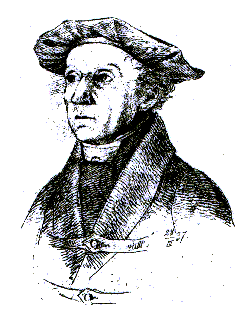
 Jakob Friedrich Fries (1773-1843)
Leonard Nelson (1882-1927)
Fries on Home Page
History of Philosophy
Epistemology
Philosophy of Religion
Home Page

 Thus, while it is sometimes said that Otto's theory of numinosity was already covered by the earlier category of the sublime, we do not see in the description of the phenomena of the sublime in Edmund Burke or in Kant (the previous best theorists) the characteristic features that Otto discerned in numinosity. The numinous may be at times terrifying, which was a classical feature of the sublime, but the uncanny is a form of the frightening or terrifying that has a very different sense and valence from anything merely in aesthetic value. The respect owed to holy things is unique of its kind and is not to be found among merely natural objects, to which the phenomena of the sublime are otherwise confined. Indeed, the uncanny strongly bespeaks something supernatural, which escapes the judgment of both moral and aesthetic realms.
 Belgium in 1830 (more yellow than gold), in the Frankfurt National Assembly in 1848, by the
  Weimar Republic, and by both post-War German Republics. But these tendencies were not agreeable to Austria or Prussia, and Fries endangered himself by conspicuously associating with radical students and the Burschenshaften student fraternities -- which the Encyclopaedia Britannica still describes as "the Allgemeine Deutsche Burschenschaft (Young Germany Movement), a liberal, idealistic student association" -- a characterization that can be disputed but in some respects was accurate for the time.
 In the aftermath of the Kotzebue assassination, Jahn was arrested, his gymnastic societies were closed, and he was subsequently imprisoned. This was much harsher treatment than what Fries and the other academics received. Also arrested was a noble military supporter of Jahn, Hans Rudolf von Plehwe. This man introduced jogging, which really only came into general vogue, of course, in the 1970's. Von Plehwe had been at Wartburg and was arrested after participating in a rally in support of Jahn.


 Terrorist attack
 thus promoted, later co-opted German nationalism for its own purposes, grafting onto the same horrifying tendencies of German nationalism all the unlimited power and absolute authority of Hegel's Geist. This separated Republican Schwarzrotgold from the Nationalistic Schwarzweißrot -- black, white, and red -- the colors of the
  Nazi
Nazi Similarly, the Presidents of the University of Pennsylvania and Harvard were forced to resign after Congressional testimony in which they allowed that calling for the "Genocide of the Jews" might not violate their University "speech codes." The President of the Massachusetts Institute of Technology managed to hold on, despite giving similar testimony.


 , Ummah, the "Nation," of Islâm (such suspicions would be "