
 Flanders (Vlaanderen in Flemish, Flandre in French) is historically significant for a number of reasons. Perhaps the most important reason, in the long run, was that it became the site of the first major development of commercial culture in Northern Europe. By the 13th century, the largest cities in Francia north of the Alps were, with Paris and London, Ghent (Gent or Gand) and Bruges (Brugge, German Brügge -- preserving much of its Mediaeval look even today), which led northern Europe in the development of trade and manufacture.
Since nothing of the sort had happened there under the Romans, it gives us a milestone in the emergence of Europe from under the Roman shadow, and from the economic nadir of the Dark Ages. This economic development and power is what made Burgundy under its Valois Dukes a Great Power in the 15th Century -- by the end of which, i.e. in the Renaissance, development had spread to the nearby cities of Antwerp (Antwerpen, Anvers), Brussels (Bruxelles, Brüssel), and Lille. By then a few German cities had become significant, like Cologne, Lubeck, and Nuremberg; but the economic centers of Francia were definitely in what would later be Belgium and, the real powerhouse, the North of Italy.
Another reason for the significance of Flanders, of less significance in the long run but rather spectacular (if sordid) at the time, was that a Count of Flanders, Baldwin IX, was installed by the Fourth Crusade as the Roman Emperor in Constantinople. This turned out to be a brief and miserable business -- Baldwin himself was soon captured in battle with the Bulgarians, dying while a prisoner -- but it was certainly a long way to come just from being Count of Flanders. Finally, Flanders passed by marriage first to the Dukes of Burgundy and then to the Hapsburgs.
Because of the inheritance of the Hapsburgs, Flanders ended up, uniquely, as the only territory that began Middle Ages as part of France but ended them, as it still is, alienated from France. This was not for want of French efforts. In 1701, Louis XIV had effectively occupied all of the Spanish Netherlands, including Flanders. The decisive moment, however, came with the Battle of Ramillies in 1706, when John Churchill, the 1st Duke of Marlborough, completely destroyed a French army and was then able to overrun Flanders, which thus passed to Austria. Except during the French Revolution, France never had a realistic chance of recovering the territory. Today, most of historical Flanders, except for Picardy, is part of Belgium, the successor of the Spanish and Austrian Netherlands.
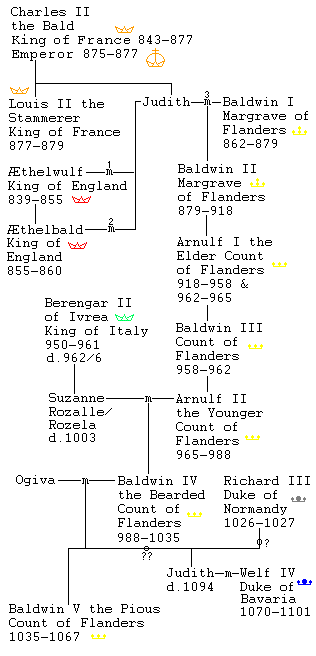
The County of Flanders begins with a bit of romance. Judith, daughter of the Emperor Charles the Bald, was married off twice to English Kings; but she returned and eloped with Baldwin Iron Arm. Charles disapproved, but Judith could not be induced to forsake him. So Charles relented and granted Flanders to the two of them. At first a "march county" (Margravate), Flanders soon reverted to a simple county.
| Baldwin I, Iron Arm | 862-879 |
| married Judith, daughter of Charles the Bald | |
|---|---|
| Baldwin II | 879-918 |
| Arnulf I the Elder | 918-958 & 962-965 |
| Baldwin III | 958-962 |
| Arnulf II the Younger | 965-988 |
| Baldwin IV the Bearded | 988-1035 |
| Baldwin V the Pious | 1035-1067 |
| Baldwin VI of Mons | 1067-1070 |
| Arnulf III | 1070-1071 |
| Robert I | 1071-1093 |
| Pilgrimage to Jerusalem, 1089 | |
| Robert II | 1093-1111 |
| appeal from Alexius Comnenus(?), leads to First Crusade, 1095 | |
| Baldwin VII | 1111-1119 |
| Charles the Good | 1119-1127 |
| William Clito of Normandy | 1127-1128 |
| son of Robert II, Duke of Normandy | |
| Thierry/Dietrich/ Dirk/Didrik of Alsace | 1128-1157 |
| brother of Simon I, Duke of Upper Lorraine | |
|---|---|
| Philip I of Alsace | 1157-1191 |
| On Crusade, 1177-1178; dies on Third Crusade, 1191 | |
| Baldwin V of Hainault | 1191-1195 |
| Baldwin IX | 1195-1205 |
| Emperor of Romania 1204-1205 | |
| Henry, Emperor of Romania | 1206-1216 |
| Yolanda, Empress of Romania | 1217-1219 |
| Joanna | 1206-1244 |
| Fernand of Portugal | 1211-1233 |
| Thomas of Savoy | 1237-1244 |
Two flags for Flanders are associated with Philip of Alsace. Preparing to go on the Third Crusade in 1188, Philip agreed with 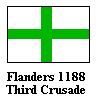 Richard of England and Philip Augustus of France that knights of Flanders would wear a green cross on white. Philip, however, already was using arms that became characteristic of Flanders, a black lion on a gold field -- Vlaenderen die Leu, "Flanders the Lion."
 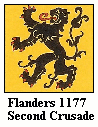 There are different versions of the origin of this. The traditional story is that it was seized from the Muslims while Philip was on the Second Crusade in 1177. However, a seal of Philip exists from 1162, antedating the Crusade, showing the lion already. It may have been adopted from William of Ypres, who was using it in 1158. See Flags of the World for more details.
It is the sons of Margareta and her husband (and cousin), Baldwin of Hainault, who embarked on the Fourth Crusade and ended up in Constantinople. The feudal division of Romania and successes by the Bulgarians and Greeks of Nicaea and Epirus soon reduced their position to impotence, and neither started a line in Constantinople. However, the throne fell to their sister Yolanda, who had married a grandson of Louis VI of France, Peter de Courtenay. Neither Peter nor Yolanda lasted long, but their sons, Robert and Baldwin, were more durable. Indeed, Baldwin's reign comprised half the entire history of the Latin Empire at Constantinople. It was Baldwin who was finally driven out by the Greeks in 1261. His granddaughter Catharine married Charles of Valois of France, son of Philip III. Had she had a son, she could have then been the mother of the Valois House of French Kings. As it was, her daughter, called Catherine of Valois, who could not succeed to the throne of France because of the Salic Law, became the Latin Imperial Pretender and also Princess of Achaia. Meanwhile, Flanders had been left to the daughters of Baldwin IX, Joanna and Margaret, both of whom enjoyed long reigns. Joanna's first husband, Ferrand, son of King Sancho I of Portugal, was captured by King Philip II of France in the defeat of Emperor Otto IV at the battle of Bouvines in 1214.
Joanna failed to leave an heir, but Margaret did -- in fact two, one for Hainault (from her first husband, Burchard of Avesnes) and one for Flanders (from her second husband, Guy of Dampierre). 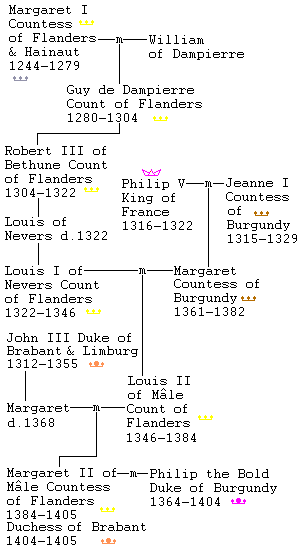 Much of the subsequent history of the house is then consumed with conflicts between, on the one side, France and England in the Hundred Years War, and, on the other side, the newly prosperous Flemish burgers, who were ready and able to overthrown feudalism and establish their own commercial republic.
| Margaret I | 1244-1279 |
| Guy de Dampierre | 1280-1304 |
| captured by Philip the Fair, 1300; Matins of Bruges, Battle of the Golden Spurs, 1302 | |
|---|---|
| Robert III of Bethune | 1304-1322 |
| Louis I of Nevers | 1322-1346 |
| Louis II of Mâle | 1346-1384 |
| Margaret II of Mâle | 1384-1405 |
| marries Philip the Bold of Burgundy, 1368 | |
The power of the burgers was revealed in 1302, when the citizens of Bruges massacred the French garrison and then defeated (and massacred again) the French army sent against them. The former event is the Matins of Bruges, while the latter was the Battle of the Golden Spurs -- after the trophies stripped from the dead French knights. As with the Swiss, these events demonstrated the power of a disciplined citizen army against feudal cavalry. For a while, a commercial republic was actually established, under the rule of Jacob van Artevalde, the "Brewer of Ghent," 1337-1345; but Artevalde was killed by his own people, and eventually the tide of war turned for the French against Flanders, even when the English were winning.
Count Louis I was killed fighting for the French King Philip VI at the battle Crécy, the great victory of Edward III of England, in 1346. The power of the Counts was ground down between the French King and the burgers. The independent line of the Counts of Flanders came to an end with Margaret of Mâle. Margaret was first betrothed to Philip of Rouvre, Duke of Burgundy. Philip, however, died of the Plague in 1361, bringing the Capetian line of Dukes of Burgundy to an end. Margaret then married Philip the Bold, who became the first Valois Duke of Burgundy in 1364, as his brother succeeded to the throne of France as Charles V. Thus, the fortunes of Flanders pass into the House of Burgundy and ultimately to the Hapsburgs.
Today the phrase "Flanders' fields" conjures visions of the slaughter of battles in World War I, like Ypres, that occurred there. This unfortunately continued the long history of the area as a battlefield, as at the great battle of Oudenaarde in 1708. Today, free of French Marshalls and German panzers, the land is happily a peaceful and prosperous one.
The project of reproducing lists and genealogies of rulers in these pages began when I found the succession of the Counts of Flanders given in Kingdoms of Europe, by Gene Gurney [Crown Publishers, New York, 1982]. I had never come across anything like that before and found it very intriguing. But it was not the easiest thing to track down better information. Some mistakes and gaps in Gurney I was able to correct by consulting the Histoire de Flandre et des Flamands au Moyen Age by Edward Le Glay [Imprimateurs des Facultés Catholiques de Lille, 1886] and The Murder of Charles the Good -- Galbert of Bruges, translated & edited by James Bruce Ross [University of Toronto Press, 1982]. Now, internet sources, like Brian Tompsett's Royal and Noble genealogy, cover this material.
Index for Francia Occidentalis, France
While Artois was not about to become a player, let alone a power, and Robert failed to snag the larger domains that his brothers did, his descendants nevertheless intermarried into the house of Narvarre, the Free County of Burgundy, the Duchy of Burgundy, Flanders, and, twice, Kings of France. The County ended up in the inheritance of Flanders and finally of the Valois Dukes of Burgundy. It passed to the Hapsburg heirs of Burgundy but was recovered by Louis XIV in 1659 in the Peace of the Pyrennes, which finally ended the Thirty Years War with Spain (which thus actually had been a 41 years war). The infamous "Flanders' fields" of World War I were, as often as not, actually in Artois.
The genealogy here is a brief run and often simply connects lines found in other tables, as linked. I have now included it because a list of Counts is given in the Oxford Dynasties of the World by John E. Morby [Oxford University Press, 1989, 2002, p.94]. The genealogical details have been supplied from the Erzählende genealogische Stammtafeln zur europäischen Geschichte, Volume II, Part 1, Europäiche Kaiser-, Königs- und Fürstenhäuser I Westeuropa [Andreas Thiele, R. G. Fischer Verlag, Third Edition, 2001, pp.114-115]. Index for Francia Occidentalis, France
Counts of Artois, 1237-1382 AD
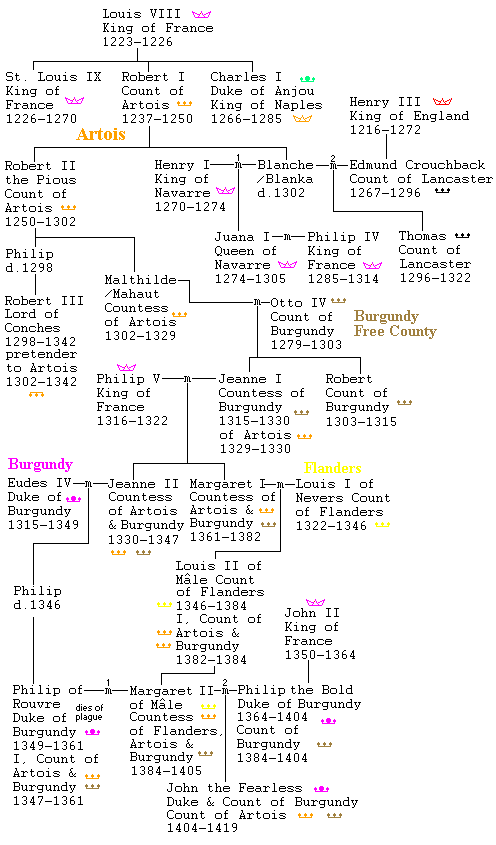 The County of Artois lay between the Counties of Flanders and Vermandois, fronting on the English Channel.

Louis VIII of France granted Artois to his son Robert, just as he granted Anjou to Charles (who became King of Naples and Sicily) and Portiers to Alphonse (who then also become Count of Toulouse). His eldest son, of course, became St. Louis IX of France.
Copyright (c) 2004 Kelley L. Ross, Ph.D. All Rights Reserved
Kings & Dukes of Brittany, c.450-1491 AD
| Kings of Brittany | |
|---|---|
| Cynan Meriadoc | King, c.450 |
| Gradlonus /Gratian | c.480 |
| Salomon I | c.500 |
| Aldroenus /Audren | c.510 |
| Budic I | c.516- 556? |
| Chanao | c.560 |
| St. Gildas "the Wise," Gildas Sapeins, c.500-c.570 | |
| Macliaw | c.570 |
| Cunomorus /Chonomor | c.550 |
| Theodoric /Tewdrig I | c.570 |
| Hoël /Riwal I | c.570s |
| Waroc | c.577- 594 |
| Canao | c.594 |
| Hoël II | c.590s |
| Alanus /Alain I | c.600s |
| Hoël III | c.610s |
| Salomon II | c.620- 632 |
| Judhael /Judicael | 632-640 |
| Alain II | c.660s |
| Cunobertus | c.680s |
| Budic II | c.700s |
| Theodoric II | c.720s |
| Raulhonus /Romulus | c.740s |
| Daniel Dremrost | c.760s |
| Aregstanus | c.780s |
| Maconus /Morvan | c.790s |
| Dukes of Brittany | |
| Frodaldus | 795-826 |
| Nomenoë | 826-851 |
| Viking attacks begin, 836, 843, 847 | |
| Erispoë | 851-857 |
| Viking attacks, 854 | |
| Saloman III | King, 857-874 |
| Viking attacks, 862, 867-869, 872; Vikings are allies in attack on Le Mans, 865 | |
| Gurvand | Duke, 874-877 |
| Pasquitan | 874-877 |
| Viking attacks, 875 | |
| Judicael | 877-888 |
| Viking attacks, 882, 886, 888, 891 | |
| Alain I the Great | King, 888-907 |
| Viking attacks intensify, 891, 912; defenses collapse, Nantes taken by Vikings, 919 | |
| Raoul | King, 922-923 |
| Breton revolt against Vikings, 931 | |
| Alain II Barbetorte | Duke, 936-952 |
| invasion by Breton exiles, 936; Nantes retaken, 937; Vikings expelled, 939, raid, 944 | |
| Drogo | 952-958 |
| Counts of Rennes | |
| Judicael- Berenger | 958-970 |
| Conan I the Crooked | 970-992 |
| Geoffrey/ Godfrey I | 992-1008 |
| Alain III | 1008-1040 |
| last Viking attack, 1014 | |
| Eudes/ Odo I | 1040-1056 |
| Conan II | 1056-1066 |
| Hoël IV of Nantes | 1066-1084 |
| Alain IV | 1084-1112 |
| Conan III the Fat | 1112-1148 |
| Hoël V | 1148-1156 |
| Bertha | 1148-1156 |
| Eudes II | 1148-1156 d.1170 |
| Conan IV | 1156-1171 |
| control by Henry II of England, 1166 | |
| Constance | 1171-1187 d.1201 |
| Geoffrey II | 1181-1186 |
| son of Henry II, marries Constance | |
| Arthur I | 1187-1203 |
| murdered by his uncle, John of England | |
| Alice | 1203-1221 |
| daughter of Constance | |
| Peter I of Dreux | 1213-1250 |
| marries Alice | |
| John I the Red | 1221-1286 |
| John II | 1286-1305 |
| Arthur II | 1305-1312 |
| John III the Good | 1312-1341 |
| John IV | 1341-1345 |
| Charles of Blois | 1341-1364 |
| War of the Breton Succession, 1341-1364 | |
| John V | 1364-1399 |
| John VI | 1399-1442 |
| Francis I | 1442-1450 |
| Peter II | 1450-1457 |
| Arthur III | 1457-1458 |
| Francis II | 1458-1488 |
| Anne | 1488-1514 |
| marries Charles VIII of France, 1491; marries Louis XII of France, 1499 | |
| Claude/ Claudia | 1514-1524 |
| marries Francis I of France; Brittany annexed, 1532 | |
 during the German invasions of the 5th century. The Roman name of the Brittany peninsula had been "Armorica." There was also a tradition that Celtic soldiers had stayed in the region after crossing over from Britain with the usurper Magnus Maximus in 383. Their leader in 388 was said to be "Cynan [or Conan] Meriadoc." The same name occurs in the first more-or-less historical ruler of Brittany around 450. Following this later Cynan Meriadoc is a continuous list of local kings, as in Ireland and Britain, until the first ruler, Frodaldus, for whom there are more than just vague and conjectural dates.
Readers of J.R.R. Tolkien's Lord of the Rings triology who study Breton history will notice that, as with Anglo-Saxon and Norse literature, Tolkien took some names, like Meriadoc and Rohan, from Brittany. Otherwise, thanks to its era and origin, Brittany figures in Arthurian stories. "Conan," of course was borrowed into other fantasy literature.
In the early mediaeval period, Brittany was usually all but independent under its own Kings and Dukes. Both titles, sometimes used simultaneously or interchangeably, related to Brittany's ethnic and independent nature, where "Duke," Dux, was the Latin title, derived from a Roman frontier military commander, that tended to settle on ethnic rulers of substantial domains within the larger Germano-Roman successor states. Thus, Basque Dukes ruled Gascony, and, most importantly, the tribal lands of Germany developed into the Stem Duchies, around which German history would revolve for some centuries. In its practical independence, Brittany is often not even shown as belonging to the Empire of Charlemagne.
Breton independence began to erode largely thanks to Viking raids and occupation. Raids began in 836, and in 843 Nantes, the capital at the mouth of the Loire, was attacked for the first time. At the death of Saloman III the country was largely overrun for ten years. Alain I held things together again, but then in 911 Normandy was ceded to Rollo, who took a dim view of Viking brethren raiding his new Norman domain. The raiders moved west, and Brittany came under heightened attack. The defenses collapsed, Breton nobility fled to England and Francia, and Vikings occupied Nantes in 919. Their leader I find variously identified as Rognvald and William Longsword. They made no particular attempt to organize their rule as Rollo was doing in Normandy. After a revolt, Alain Barbetorte returned from England and landed with an army in 936. He defeated the Vikings and expelled them from the country by 939. However, the damage had been done. Breton independence had been fatally compromised, and the Duchy drifted under the influence of Normandy.
As often happened in the Middle Ages, Brittany became a pawn to larger forces when the Duchy fell to an heiress, Constance. Her marriage would determined the fate of the domain. With King Henry II of England dominating northern and western France, his son Geoffrey was married to Constance. Their son Arthur succeeded to the Duchy but was murdered by his uncle, King John, to eliminate his claim to the English Throne. The Pope put England under an interdict for this crime. The next heiress, Alice, was the daughter of Constance by her third marriage. Her marriage led to the house of Dreux ruling the Duchy from 1213, with a brief interlude, the War of the Breton Succession, between 1341-1364, when Charles of Blois was Duke.

The ultimate fate of Brittany was a matter of the marriages of other heiresses. The Duchess Anne, the eighth generation after her namesake, married both King Charles VIII and King Louis XII of France. The agreement was that Brittany would be enfeoffed to a younger son or an elder daughter, which had been the practice of the French Throne with such large peripheral domains (especially and disastrously with Burgundy). There were no surviving sons from either marriage, but her daughter Claudia (by Louis XII) then married her second cousin King Francis I, who, after her death, simply annexed the Duchy to the Royal domain. The French Kings now thought better of dividing up the Kingdom between brothers, and with a growing modern economy, they now had the money for soldiers and administrators who made such divisions -- and all of feudalism -- unnecessary.

Today the Breton language is the last Celtic language spoken on the mainland of Europe (though not originating there), and Breton separatism is still a thorn in the side of French politics. Regional languages are not given much toleration, let alone promotion, in French education. And so in the absence of strong agitation, Breton may be doomed. The flag, with its distinctive motif, is modern. And, yes, its colors are simply black and white.
The earliest rulers of Brittany, from its legendary origin, are given in The Mammoth Book of British Kings & Queens, by Mike Ashley [Carroll & Graf Publishers, Inc., New York, 1999, pp.727-729]. Later Dukes as given here, beginning with Frodaldus, were originally assembled from Brian Tompsett's Royal and Noble genealogy and the The Mammoth Book of British Kings & Queens. Now the genealogy is principally from the Erzählende genealogische Stammtafeln zur europäischen Geschichte, Volume II, Part 1, Europäiche Kaiser-, Königs- und Fürstenhäuser I Westeuropa [Andreas Thiele, R. G. Fischer Verlag, Part 1, Third Edition, 2001, pp.123-130]. Some variation exists in the numbering of the rulers. Numbers for names like Hoël and Alain frequently start over with the fully historical dukes (as here with Alain). The data on the Viking raids and occupation is from The Penguin Historical Atlas of the Vikings, by John Haywood, "The Vikings in Brittany" [Penguin, 1995, pp.82-83]. The brief historical notes in The Mammoth Book do not match up real well with the narrative of The Penguin Atlas.
Index for Francia Occidentalis, France
 The Duchy of Burgundy began in 880 when part of the Kingdom of Burgundy was detached and assigned to France (West Francia). This was part of the Treaty of Ribemont by which the young West Frankish Kings, Louis III and Carloman II, were deprived of most of Lorraine. Or this may have already happened with the Treaty of Verdun in 843. The first Duke, however, was Richard the Justicer (or Justiciar) of Autun in 880.
 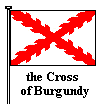 Robert I was the first Capetian Duke of Burgundy, founding a line that lasted until 1361. The next line, the Valois Dukes, starting with Philip the Bold, ushered in the classic era of Burgundian power. Marrying Margaret, the heiress of Flanders, Philip began a process of adding, by marriage and conquest, to the Burgundian domain, expanding it into a rival to the throne of France itself. This process ended abruptly in 1477 with the death in battle of Charles the Bold, but it then became part of the process of Hapsburg expansion when Charles's daughter Mary wedded the future Emperor Maximilian. The Duchy of Burgundy itself passed to the French Throne in that transition, but most of the rest of the Burgundian domain became a long term addition to the House of Hapsburg. The Court of Mary and Maximilian was one of the jewels of the Renaissance; and the Burgundian knotty ("raguly") Cross ("saltire") of St. Andrew became a feature of flags in the Low Countries and later of Hapsburg Spain.
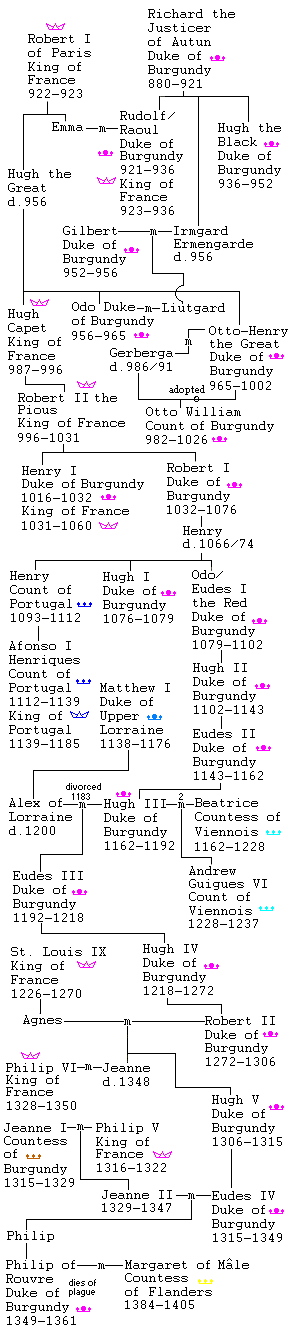
| Dukes of Burgundy | |
|---|---|
| Richard the Justicer of Autun | 880/ 911-921 |
| brother of Boso, King of Burgundy | |
| Rudolf/Raoul | 921-923 |
| King of France 923-936 | |
| Hugh the Black | 923-952 |
| Gilbert de Vergy | 952-956 |
| Odo of Paris | 956-965 |
| Otto/Eudes Henry the Great | 965-1002 |
| Otto William | 1002-1004/5 |
| Count of Burgundy, 995-1026 | |
| Duchy reverts to French Throne, 1004/5 | |
| Henry, I of France | 1015-1032 |
| King of France, 1031-1060 | |
| Robert I | 1032-1076 |
| brother of Henry I | |
| Hugh I | 1076-1079 |
| Odo/Eudes I, the Red | 1079-1102 |
| Hugh II | 1102-1143 |
| Eudes II | 1143-1162 |
| Hugh III | 1162-1192 |
| Eudes III | 1192-1218 |
| Hugh IV | 1218-1272 |
| Robert II | 1272-1306 |
| Hugh V | 1306-1315 |
| Eudes IV | 1315-1349 |
| Philip I of Rouvre | 1349-1361 |
| betrothed to Margaret of Flanders, but died of the Plague first | |
| Duchy reverts to French Throne, 1361-1364 | |
In the last days of the line, things were in the works to reverse the tendency of alienation and greatly expand the domain of the Dukes. Eudes IV married the heiress, Jeanne, of the Free County of Burgundy, and then his grandson Philip was preparing to marry the heiress, Margaret, of the County of Flanders. Philip, however, died of the plague before the marriage could be effected. This setback, however, only delayed the project. While the Duchy reverted to the French Throne, the Free County passed by separate inheritance to the Countess Margaret herself, who then married the new Valois Duke of Burgundy, Philip the Bold.
This list and genealogy of the Dukes of Burgundy is from Phoenix Frustrated, the Lost Kingdom of Burgundy, by Christopher Cope [Constable, London, 1986; Dodd, Mead & Company, New York, 1987] and from the Regentenlisten und Stammtafeln zur Geschichte Europas, by Michael F. Feldkamp [Philipp Reclam, Stuttgart, 2002], with some modifications from the Erzählende genealogische Stammtafeln zur europäischen Geschichte, Volume II, Part 1, Europäiche Kaiser-, Königs- und Fürstenhäuser I Westeuropa [Andreas Thiele, R. G. Fischer Verlag, Part 1, Third Edition, 2001], and the Portail Histoire de la Bourgogne et de la Franche-Comté. The Portail lists Hugh the Great of Paris as a Duke of Burgundy, even though his dates overlap Gilbert de Vergy. The Portail does not list Otto William at all, as the Regentenlisten does, even though this partially fills the gap between Otto Henry and Henry I of France.
| Valois Dukes of Burgundy | |
|---|---|
| Philip II the Bold, Philippe le Hardi, Filips de Stoute | 1364-1404 |
| Free County of Burgundy, 1384 | |
| marries Margaret of Flanders, 1368 | |
| John the Fearless, Jean sans Peur, Jan zonder Vress | 1404-1419 |
| captured, Battle of Nicopolis, ransomed from the Turks, 1396; murdered near Paris by the Dauphin of France, 1419 | |
| Philip III the Good, Philippe le Bon, Filips de Goede | 1419-1467 |
| acquires Namur, 1421; Hainault, 1427; Brabant & Limburg, 1430; Holland & Zeeland, 1424-1433; & Luxemburg, 1443 | |
| Charles the Bold, Charles le Téméraire, Karel de Stoute | 1467-1477 |
| killed, Battle of Nancy, 1477 | |
| Mary of Burgundy | 1477-1482 |
| marries Maximilian of Hapsburg, 1477 | |
| Duchy of Burgundy & Artois revert to French throne; Hapsburgs retain other territories | |
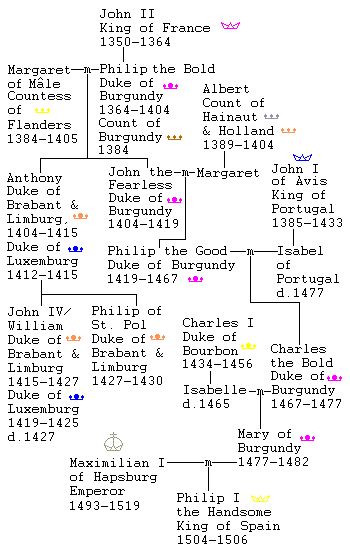 It became a goal of the Dukes to be recognized as King of Burgundy by the Emperor, although most Burgundian acquisitions were in the historic Duchies of Lorraine (Upper and Lower).
The proximity of Flanders to England also put the Dukes in a position as active allies of England in the Hundred Years War (1337-1453), which is why they were the ones to arrest Joan of Arc.
After initial acquisitions by marriage, the Dukes move on to more forceful means. As a grandson of Count Albert of Holland and Hainault, the Duke Philip the Good pushed aside the proper heiress, Jacqueline of Holland. The claim was even more tenuous for other territories, like Luxemburg.
This increasing resort to force, however, came to a bad end. As Charles the Bold tried to effect the Burgundian conquest of Lorraine, under its Duke René II, he was defeated and killed in the Battle of Nancy in 1477. This was a battle that counted as one of the first modern battles, since it was won by an infantry of Swiss pikemen, i.e. commoners defeating mounted knights -- forces just hired by René in Switzerland.
 |
|---|
| The Battle of Nancy, 1831, by Eugène Delacroix (1798-1863); the death of Charles the Bold, below left |
The project of Burgundian aggrandizement, although here again suffering a considerable setback, and the loss of the Duchy itself to the French Throne (it could not be inherited by the heiress of Burgundy, Mary, under the Salic Law), again only experienced a kind of delay. The fortunes of Mary now became attached to her husband, Maximilian of Hapsburg, soon to be elected Emperor.
Maximilian, who moved to live with Mary in the Netherlands, and presided over a brilliant Renaissance Court, held the Hapsburg lands of Austria, and then their son Philip married the heiress Joanna (Juana) of Spain. The Burgundian ambitions, after a fashion, and with the symbol of the Cross of Burgundy then found on even Spanish uniforms, thus culminated in Mary and Maximilian's grandson, the Emperor Charles V, to whom the Free County, most of Lower Lorraine (i.e. the Netherlands), Austria, Spain, Naples, Sicily, and Spanish possessions in the New World all passed, enabling him to dominate the age and become the arbiter, if not exactly the hegemon, of Europe. His power was challenged at one's peril, as the Pope and the King of France both learned.
Meanwhile, the Duchy of Burgundy, reverting to the King of France, was never again to be enfeoffed elsewhere. Today its name may be the most familiarly associated with the characteristic dark red wine of the region. Similarly, the capital, Dijon, has become a famous name in mustard. The Kingdom of Burgundy, which the Dukes sought to revive, has disappeared from both maps and memory.
Before long, the initial line of descent ends with an heiress, Matilda, who marries Landerich (or Landri) of Monseau. Henceforth the succession is untroubled for six generations, until we begin to get one heiress after another, in fact six successive generations of them. This is unusual enough that on the chart below I have identified and numbered the heiresses. This number is only beat, in my experience, by Navarre, which, over a longer period, had seven heiresses. The marriages of these women begin to generate considerable interest, with connections to larger events and more significant domains in Europe. The first heiress, Agnes, married Peter de Courtanay, a grandson of Louis VI of France, who, after her death, would be elected one of the Latin Emperors of Romania. As part of that arrangement, he then married Yolanda of Flanders, the Latin heiress. While he was then able to father the heirs to the Latin Throne, he never made it to Constantinople. He became the second Latin Emperor to be captured by enemies, in this case the Despot Theodore of Epirus (who later would be captured by the Bulgarians), and die in captivity. Yolanda became Regent for their sons.
Meanwhile, the daughter, Mathilde, of Agnes and Peter was the heiress of Nevers. She married relatively obscure noblemen, but her daughter Agnes, the next heiress, would marry a more noteworthy husband, Guy of Châtillon, whose house was tangled with the Counties of Blois and Champagne and also with nobility and princes of the Crusades -- including the infamous Reynald of Châtillon, whose treacherous behavior so angered Saladin, the Sulṭān of Egypt and Syria, that when Reynald was captured at the Battle of the Horns of Hattin in 1187, the Sulṭān, despite his reputation for mercy, reportedly killed him with his own hand.
Agnes predeceased her mother, as did her daughter Yolande, who nevertheless seems to have been been made co-regent with Mathilde I. Thus, Mathilde, with an extraordinary long reign of 65 years, and outliving her husbands, was predeceased by both her daughter and granddaughter (not too surprising in the Middle Ages), and when she died her great-granddaughter, Mathilde II, was the heiress of Nevers. The new Mathilde then made an important marriage indeed, to the House of the Dukes of Burgundy, the (nominal?) de jure suzerains of Nevers. Nevers was then briefly tangled in the affairs of Burgundy, with judgments required about her own heirs, who were all daughters, among whom the fiefdoms of Nevers were distributed. Perhaps the most fateful marriage was then made by her eldest daughter, Yolande II, heiress of Nevers, which was to Robert III, the Count of Flanders, one of the more important and venerable feudatories of Francia. The began a joyright of inheritance much like that of the Hapsburgs, and, indeed, it would finally lead to the Hapsburgs.
Thus, Yolande's grandson, Louis I, would marry one of the heiresses, Margaret, of the Free County. His granddaughter, Margaret II, then the heiress of Flanders and Nevers, would marry Philip, the first Valois Duke of Burgundy. This fatefully united Never, Flanders, and Burgundy. All that was lacking was one more marriage to unite Flanders and Burgundy (with the Emperor Maximilian).
However, the Duke Philip had meanwhile detached Nevers, bestowing it on a younger son, also Philip. This led to another heiress, Elizabeth, who married John I, the Duke of Cleves-Mark. John himself separated the domains, so that Cleves-Mark and Nevers-Auxerre continued under their own lines.
In those terms, Nevers continued for four generations until another heiress, Henriette, and another fateful marriage, to the Gonzagas of Mantua. This was not the main lineage of Mantua, but when that itself came to an heiress, Maria, she married Charles, the heir of Nevers, who nevertheless predeceased his father, who himself had to fight a bit of a war (of the Manuan Succession, 1628-1631) to claim the inheritance. Two more Dukes of Mantua ended in the extinction of the line and the reversion of the Duchy of Nevers to the French Throne in 1708. Meanwhile, intermarriage with the Hapsburgs and the House of Lorraine put this lineage at the head of subsequent Hapsburgs, where perhaps one of the most noteworthy features is that the Gonzagas were descended from the Dynasty of the Palaeologi Emperors in Constantinople. It was late in the game, but Nevers joined in that connection.
The information for the genealogy here is from Bruce R. Gordon's Regnal Chronologies (which, however, gives succession but not genealogy), several pages at Wikipedia on individual Counts and Countesses (which do give genealogical information but in a fragmented way, sometimes with missing links), and the Erzählende genealogische Stammtafeln zur europäischen Geschichte, by Andreas Thiele. This source includes Volume I, Parts 1 & 2, Deutsche Kaiser-, Königs-, Herzogs- und Grafenhäuser I & II [Third Edition, R. G. Fischer Verlag, 1997], Volume II, Parts 1 & 2, Europäiche Kaiser-, Königs- und Fürstenhäuser I Westeuropa & II Nord-, Ost- und Südeuropa [R. G. Fischer Verlag, Part 1, Third Edition, 2001, Part 2, Second Edition, 1997], and Volume III, Europäiche Kaiser-, Königs- und Fürstenhäuser, Ergänzungsband [R. G. Fischer Verlag, Second Edition, 2001]. Volume III contains a general index, which was needed more than usual, since the many heiresses of Nevers jump the lineage from one entry to another, often across different Volumes of the work.
Counts & Dukes of Nevers, 887-1708 AD
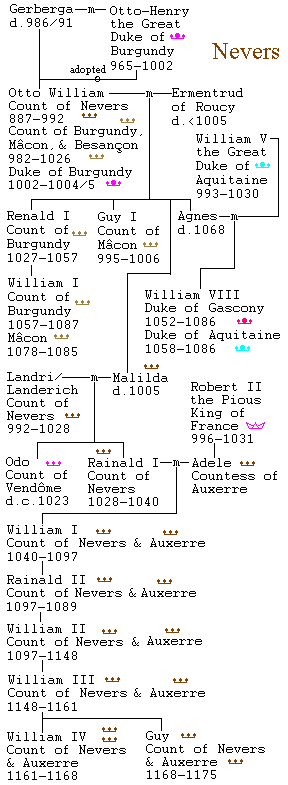 Nevers was a feudatory of the Duchy of Burgundy, at the West end of the domain, as can be seen on the map below. The city of Nevers was actually on the Loire River, which we would think of as very much in the center of modern France. The fief began to be bestowed on vassals from an early date, initially by the Capetian Duke Otto-Henry, who was actually a brother of Hugh Capet, the King of France. Nevers was usually a package with the County of Auxerre, along with some other fiefs, although at times these could also be separated. As we can see, Otto-Henry begins by favoring his wife's son, Count Otto William of the Free County of Burgundy, which was itself a feudatory of the Kingdom of Burgundy, not of France at all. Otto William seems to have had his finger in a lot of pies, and he was himself briefly the Duke of Burgundy. Subsequent Counts of Nevers are all descendants of Otto William.

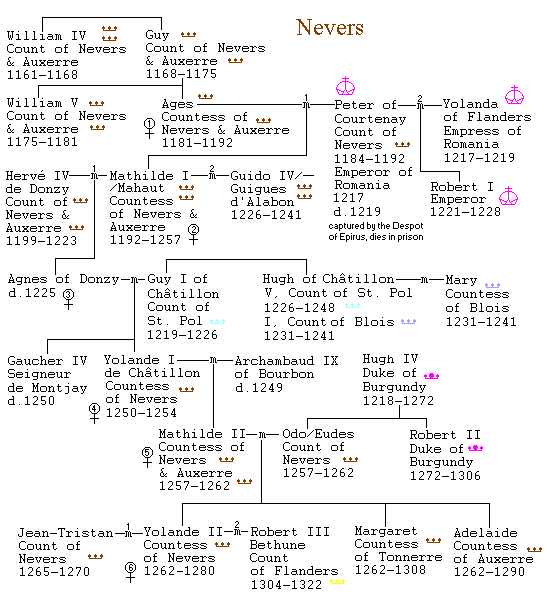
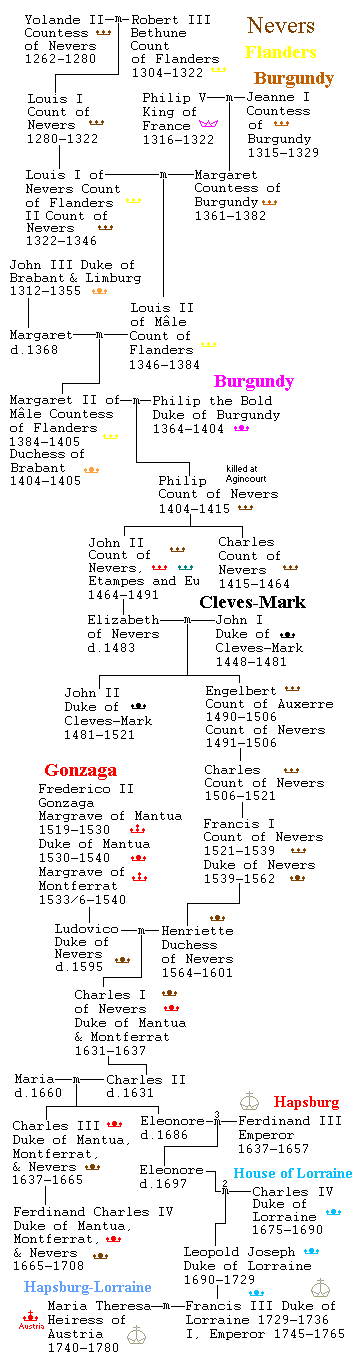 This results in some confusion, since Agnes is not included among the rulers of Nevers, and Yolande sometimes is not either. So the reported succession jumps directly from Mathilde I to Mathilde II.
Copyright (c) 2018 Kelley L. Ross, Ph.D. All Rights Reserved
| Counts of Anjou | |
|---|---|
| Ingelger, Viscount of Orleans | c.870-898 |
| Fulk I the Red | 898-941 |
| Fulk II the Good | 941-958 |
| Geoffrey I Greymantle | 958-987 |
| Fulk III the Black | 987-1040 |
| Geoffrey II Martel | 1040-1060 |
| Geoffrey III the Bearded | 1060-1067 |
| Fulk IV the Bad Tempered | 1067-1109 |
| Geoffrey IV | 1098-1106 |
| Fulk V the Young | 1106-1129 |
| King of Jerusalem, 1131-1143 | |
| Geoffrey V Plantagenet | 1129-1151 |
| Duke of Normandy, 1144-1150 | |
| Henry I, II of England | 1151-1189 |
| Duke of Normandy, 1150-1189 | |
| King of England, 1154-1189 | |
| Henry II | 1170-1183 |
 The County of Anjou ends up playing a significant role in the history of France and England. Perhaps the larger impact begins with Fulk V going off on Crusade and ending up King of Jerusalem, married to the heiress Queen Melisende. His son Geoffrey then marries the daughter, Matilda, of King Henry I of England, who had recently lost her husband, the Emperor Henry V -- so she is often called the "Empress." There was a dispute over the Kingship of her cousin Stephen -- she had disputed it herself in 1141. Geoffrey took Normandy from him in 1144. Then Geoffrey's son Henry succeeded Stephen as the first Plantagenet King of England, Henry II.
The term "Plantagenet" comes from planta genesta, a yellow flower, a species of gorse, that grows in the area. The name got attached to the family because Count Geoffrey used to wear the flowers on his helmet. His direct male descendants would rule England until the Tudors -- the Houses of Lancaster and York simply derived from younger sons of Edward III.
The last Plantagenet to formally bear the title Count of Anjou was the eldest son, Henry, of King Henry II. The young Henry predeceased his father. Although Anjou was subsequently held by King Richard and King John, they did not assume the title. Then Anjou as lost to Philip II of France in 1204.
Anjou was revived as a Duchy for Charles, the brother of King Louis IX of France, in 1246. The line of these Dukes of Anjou is not given here, because Charles went off and became King of Naples and Sicily, which then became the effective seat of the Anjevian family -- the genealogy is given there. Charles lost Sicily, but his descendants would rule Poland and Hungary as well as Naples, until the death of Joanna II in 1435.
The end of the Capetian Anjevians meant that the Duchy was available for a new Royal brother. This ended up being Louis of Valois, brother of King Charles V. Louis also inherited Provence, which Charles of Anjou had acquired through his wife, Beatrice, Countess of Provence. The special association of the Valois Dukes of Anjou, however, soon became Lorraine, 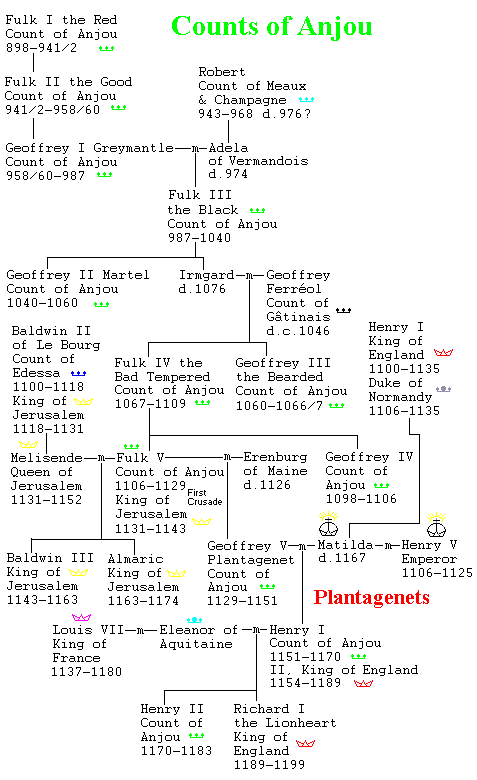 when the grandson of Louis, René the Good, married Isabel, the heiress of Lorraine. At the death of Joanna II, René tried to press Anjevian claims to Naples, but Alfonso V of Aragón simply conquered the Kingdom for his family. When René died in 1480, all of his male heirs had predeceased him. His daughter Yolande's right to inherit was denied by King Louis XI. This royal claim was made good in 1481; and Anjou, Provence, and Maine reverted permanently to the French Crown. Yolande, however, was left with Lorraine and Bar, to which was added the County of Guise, the possession of her husband. Later Guise was broken off as a separate Duchy for her grandson Claude. All this genealogy, and its subsequent history, can be examined at Lorraine.
When Anjou fell to the King of France, so did the Anjevian claims to Naples. This led to the invasion of Italy by Charles VIII, who occupied Naples 1494-5 but could not keep it. The Aragonese heirs of Naples were soon pushed aside (1501) by King Ferdinand II of Aragón, King of a united Spain with his wife, Isabella of Castile. Ferdinand integrated Naples into the many Spanish possessions, and Spain was then the predominant power of the day. Until the French Revolution, France never returned to Naples -- though Spanish Bourbons did.
Index for Francia Occidentalis, France
| Hrólfur/Rollo/Rolf/ Rollon | Count of Rouen, 911-927 d. 932 |
| receives Upper Normandy from Charles III the Simple of France, 911; Rollo converts to Christianity, 912; Middle Normandy added, 924 | |
|---|---|
| William I Longsword | 927-942 |
| Cherbourg Penninsula added to Normandy, 933 | |
| Richard I the Fearless | 942-996 |
| Richard II the Good | Duke of Normandy, 996-1026 |
| Richard III | 1026-1027 |
| Robert I the Devil | 1027-1035 |
| William II, the Bastard, the Conqueror | 1035-1087 |
| England 1066-1087 | |
| conquers England, 1066 | |
| Robert II Curtnose, Shortshanks | 1087-1106 d. 1134 |
| Henry I | 1100-1135 |
| 1106-1135 | |
| Stephen | 1135-1144 |
| England, 1135-1154 | |
| Geoffrey of Anjou | 1144-1150 |
| Henry II | 1150-1189 |
| 1154-1189 | |
| Richard the Lionheart | 1189-1199 |
| 1189-1199 | |
| John Lackland | 1199-1204 |
| 1199-1216 | |
| John declared contumacious, 1202; Duchy occupied by Philip II Augustus, 1203-1204 | |
Along 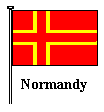 with Naples, Sicily and Russia, Normandy was one of the great enduring foundations of the age of Norse expansion. With the decline of Carolingian power, there wasn't much that Charles the Simple of France could do about Viking raiding, so the idea seems to have been that if you can't beat 'em, join 'em, or at least have them join you. So someone who was essentially a pirate leader, Rollo, a son of Ragnald I the Wise, Earl of Orkney, was enfeoffed with some of the land that he had been raiding. This grew into a large domain, and entered into normal feudal and marriage relations with the rest of Europe, though for many years with little effective supervision of the Kings of France.
The flag is modern, proposed by local separatists and based on the common design of other Scandinavian flags.
 The Normans, although retaining their name and a considerable share of Viking aggressiveness, nevertheless assimilated to the culture of their new land. They began to speak French and before long they even denied landing to further Viking forces.
As the Northern Vikings quieted down a bit, Normandy itself launched new conquests. In 1035 the de Hauteville brothers arrived from Normandy in Southern Italy. Driving out Arabs and Romans, no less than six brothers would eventually rule in Apulia, Calabria, and Sicily, all assembled as the Kingdom of Naples and Sicily in 1130. Just as the de Hautevilles were beginning, Duke William II the Bastard came to the throne of Normandy. He would conquer England in 1066 and acquire a more auspicious name for posterity: William the Conquerer.
Normandy subsequently became part of the story of the relations of England and France. England itself became the center of power of the Dukes, although their French culture was imposed there. English Kings spoke French for many generations and the English language was permanently altered by French. Pure Norman French words still echo in some British and American legal usage, as with "voir dire," the examination of prospective jurors. This is noteworthy today when France fights a desperate battle to prevent the assimilation of a few English words picked up from television, movies, etc. into French, while English itself, since Middle English, reflects the most profound French influence. This greatly enriched English vocabulary; but the French Academy would rather coin "pure" French neologisms than simply borrow them from English. The absurdity of this was revealed in a debate on French television over some new law to limit the use of English words. The moderator, frustrated at the heated cacophony of argument, simply shouted, "Shut up!" -- much punchier than Latinate periphrasis.
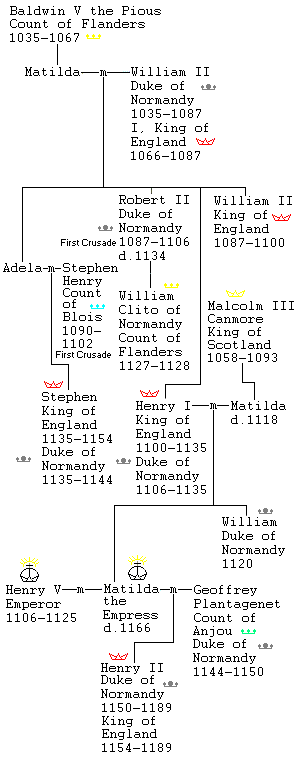
William did divide England and Normandy between two of his sons, but Robert II, Duke of Normandy, took out a loan from his brother, William II of England, secured by Normandy itself, so that he could go on the First Crusade (1096-1099). He returned with no money from the Crusade, so his other brother, Henry I, who meanwhile had succeeded to the Throne of England, repossessed Normandy in payment. This left Robert's son William with no inheritance, but he ended up acquiring Flanders, thanks to his great-grandfather having been Count Baldwin V of Flanders. William, however, was killed in battle in 1128, otherwise he would have inherited England in 1135, instead of his cousin Stephen of Blois. The succession of Stephen, however, was disputed by Henry's daughter Matilda. After a fruitless marriage to the Emperor Henry V, Matilda had married the energetic Count of Anjou and Maine, Geoffrey Plantagenent. Matilda and Geoffrey invaded England, and then Normandy. Normandy they got away from Stephen, who then agreed in 1153 to the succession in England of Maltida's son Henry, who thus founded the Plantagenet House of England. Henry's son John later lost Normandy (1202-1204) to Philip II of France, thus returning to the King of France the domain ceded by Charles III to Rollo back in 911.
Later, King Edward III claimed the Throne of France, and in the course of the Hundred Years War (1337-1453), the English sometimes occupied Normandy. At the end of the War, the only mainland territory that was held was Calais, later lost by Henry VIII. The King of England, however, continued to claim the French Throne right down to the Napoleonic Era, when British support for the exiled Louis XVIII would not have been consistent with continuing English claims. However, part of the Duchy of Normandy did actually remain in English hands: The Channel Islands. Those remain British, even until today, after the curious episode of being the only part of England occupied by Nazi Germany.
Index for Francia Occidentalis, France
| Counts of Blois | Counts of Champagne | ||
|---|---|---|---|
| William | d.834 | ||
| Odo/Eudes | 834-865 | ||
| Robert | 865-866 | ||
| Warnegald | 878-906 | ||
| Gello | d.928 | Herbert I of Vermandois | 923-943 |
| Theobald, Thibaut I | 928-978 | Robert | 943-968 |
| Odo/Eudes I | c.978-995 | Herbert II | 968-993 |
| Theobald II | 995-1004 | Stephen I | 993-1019 |
| 1004-1037 | Odo/Otto/Eudes I, II of Blois | 1019-1037 | |
| 1037-1089 | Theobald III, I of Champagne | Stephen II | 1037-1047/8 |
| Odo II | 1047/8-1063 | ||
| 1063-1089 | |||
| Stephen | 1089-1102 | Odo III | 1089-1093 |
| 1102-1152 | Theobald IV, II of Champagne | Hugh | 1093-1125 |
| 1125-1152 | |||
| Theobald V | 1152-1191 | Henry I the Liberal | 1152-1181 |
| Louis I | 1191-1205 | Henry II the Younger | 1181-1197 |
| King of Jerusalem, 1192-1197 | |||
| Theobald III | 1197-1201 | ||
| marries Blanca, heiress of Navarre | |||
| Theobald VI | 1205-1218 | Theobald IV the Singer, I, of Navarre | 1201-1253 |
| Margaret | 1218-1230 | King of Navarre, 1234-1253 | |
| Gauthier of Avesnes | 1218-1230 | ||
| Marie | 1230-1241 | ||
| Hugh I of Châtillon | 1230-1241 | ||
| John I | 1241-1279 | Theobald V, II, of Navarre | 1253-1270 |
| King of Navarre, 1253-1270 | |||
| Jeanne | 1279-1292 | Henry III the Fat, I, of Navarre | 1270-1274 |
| King of Navarre, 1270-1274 | |||
| Jeanne, I of Navarre | 1274-1285 | ||
| Queen of Navarre, 1274-1305 | |||
| Hugh II | 1292-1307 | marries Philip IV, King of France, County reverts to Throne | |
The County of Champagne was on the east side of the French Royal Domain, the Île de France, while the County of Blois was on the west side. The earliest Counts of Champagne here are the Carolingian Counts of Vermandois. With the end of that line, Champagne passed to the Counts of Blois.

The list of the counts is from Bruce R. Gordon's Regnal Chronologies and the WW-Person, A WWW Data base of European nobility. The genealogical diagram is based on Brian Tompsett's Royal and Noble genealogy. Tompsett does not include all of the Counts, either of Champagne or Blois, and the numbering is a little confusing. Tompsett leaves out Theobald II of Blois and all the higher numbers are one less than in WW-Person. Gordon does not have a chronological list for Blois, but WW-Person does, which is not entirely consistent with Thompsett's genealogy. WW-Person does not list Gello and leaves a chronological gap between Robert and Theobald I; the earlier Eudes/Odo is not numbered in the later sequence; and Odo II of Champagne is left out. There are many disagreements or discrepancies about the dates. I have not indicated all the alternatives. See below for some new information.
Champagne remains famous, of course, for the sparkling wine which is now de rigueur for all occasions of significance in the Westernized world, from marriages to New Year's Eve. Although there are other comparable sparkling wines, by law, in the increasingly dictatorial European Union, only those from grapes grown in Champagne can be called "Champagne."
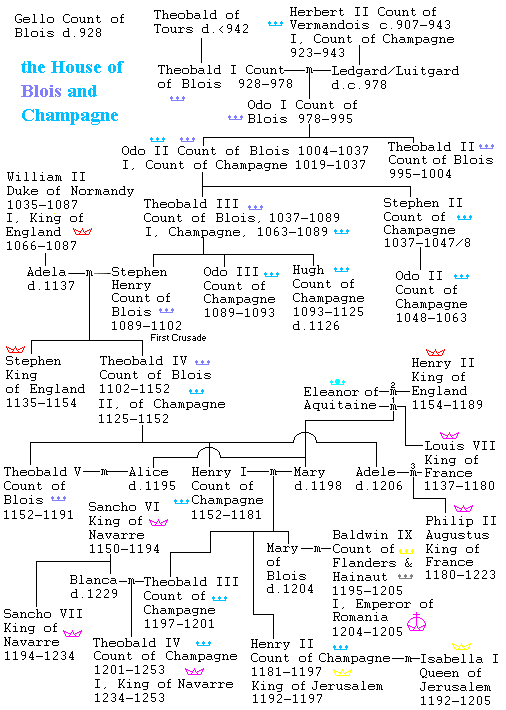
The genealogical chart highlights the history of interesting marriage alliances of the House of Blois and Champagne, which contributed a King of England (Stephen) and especially had two sons marrying daughters of King Louis VII of France by Eleanor of Aquitaine, while their sister married Louis himself and became of the mother of the great Philip II Augustus. Then two cousins of Philip married Isabella the Queen of Jerusalem and Blanca the heiress of Navarre.
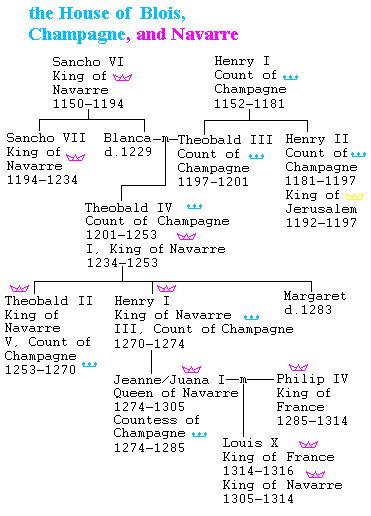 From Blanca (more commonly called "Blanche" in the French context), we get the entire subsequent line of Navarre, whose heiresses later married the French King Philip IV, the French counts of Evreux, Foix, and Albret, King John II of Aragón, and finally Anthony Duke of Vendôme, the heir of the Bourbons. The son of Jeanne III of Navarre and Anthony was then King Henry III of Navarre, who became King Henry IV of France. The County of Champagne, however, once in the hands of Philip IV, reverted to the French Throne.
At left is the succession to the throne of Navarre by the Counts of Champagne, leading to the ultimate marriage of Jeanne/Juana I to Philip IV. The succession of their children to France and Navarre can be examined on those pages.
While Champagne reverts to the French Throne, the succession to Blois continues below.
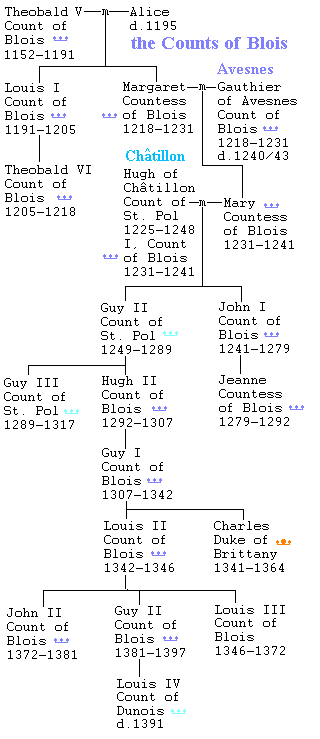
| Counts of Blois | |
|---|---|
| Guy I of Châtillon | 1307-1342 |
| Louis II | 1342-1346 |
| Louis III | 1346-1372 |
| John II | 1372-1381 |
| Guy II | 1381-1391 |
Tompsett does not show the genealogy for Blois after Theobald V. I was then provided by a correspondent in the Netherlands with this information, gleaned from Volumes II (tables 46 & 47), III (table 50), and VII (tables 17 & 18) of the Europäische Stammtafeln, Stammtafeln zur Geschichte der Europäichen Staaten, Neue Folge, edited by Detlev Schwennicke (Verlag J.A. Stargardt, Marburg, 1979 & 1984). Hugh I is of the House of Châtillon, and is a relative of Reynald of Châtillon, Prince of Antioch. WW-Person's page on Châtillon is blank, and Tompsett does not give any genealogical connection for Reynald besides his marriage to the heiress of Antioch. The correspondent in the Netherlands, however, has sent along information from the Europäische Stammtafeln, detailed below. After Guy II, the County was purchased by Louis, the first Valois Duke of Orléans, whose grandson became King Louis XII, whereby Orléans and Blois became Crown lands.
I have now been able to make some additional corrections from the new Erzählende genealogische Stammtafeln zur europäischen Geschichte, Volume II, Part 1, Europäiche Kaiser-, Königs- und Fürstenhäuser I Westeuropa [Andreas Thiele, R. G. Fischer Verlag, Third Edition, 2001]. My previous information was that Louis I of Blois was another son of Henry I. However, this source shows his parents, and those of Margaret of Blois, as Theobald V and Alice of France, which is tidier, since it means that Blois and Champagne split permanently between Theobald V and Henry I. Using these Stammtafeln, I have made some other corrections in the material above -- and will continue to do so as I examine the tables.
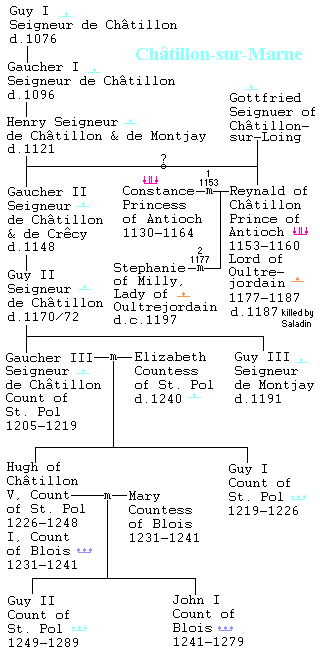 The Lords of Châtillon lead to a number of historically important marriages. Reynald (or Renaud) of Châtillon, as noted, becomes Prince of Antioch through marriage to the heiress, Constance, of Prince Bohemond II. They had no issue, and Reynald was even repudiated by Constance. Reynald's subsequent mischief so angered the Sulṭān of Egypt, Saladin, that he was killed, in some accounts, at the hand of the Sulṭān himself, after being captured at the Battle of the Horns of Hattin in 1187.
Next, we get the marriage of Gaucher III to Elizabeth, Countess of St. Pol. The succession to St. Pol eventually included Philip of Burgundy (1415-1430) and Peter I of Luxemburg (1431-1433). I have a list of the succession to St. Pol but no information on how those connections all worked.
After this, of course, we get the marriage, as recounted above, of Hugh of Châtillon to the heiress, Mary, of Blois, from whom subsequent Counts of Blois and St. Pol derive.
A correspondent in the Netherlands provided this information from the Europäische Stammtafeln, Stammtafeln zur Geschichte der Europäichen Staaten, Neue Folge, Volume VII, edited by Detlev Schwennicke (Verlag J.A. Stargardt, Marburg, 1979), Table 17. I have now been able to make some corrections, and anticipate making others, using the Erzählende genealogische Stammtafeln zur europäischen Geschichte, Volume III, Europäiche Kaiser-, Königs- und Fürstenhäuser Ergänzungsband [Andreas Thiele, R. G. Fischer Verlag, Second Edition, 2001]. Unfortunately, this source does not show Reynald of Châtillon as the brother of Gaucher II. Under the Princes of Antioch, Reynald is identified as the son of the Seigneur Gottfried of Châtillon-sur-Loing, but this line does not seem to be included on the table for Châtillon.
Index for Francia Occidentalis, France
| County of Toulouse | |
|---|---|
| Torsin | 778-790 |
| William I of Aquitaine | 790-812/3 |
| Raymond | 812/3-818 |
| Berenger | 818-835 |
| Bernard I | 835-844 |
| Warin | 844-845 |
| William II of Aquitaine | 845-850 |
| Fredelon | 850-852 |
| Raymond I | 852-c.862 |
| Humfrid | c.862-865 |
| Bernard II | 865-875 |
| Odo/Eudes /Otto | 875-918/9 |
| Raymond II | 919-923 |
| Raymond III Pons | 923-961 |
| William III | 961-1037 |
| Pons | 1037-1061 |
| William IV | 1061-1094 |
| Raymond IV I of Tripoli | 1094-1105 |
| Count of Tripoli, 1203-1205 | |
| Bertrand | 1105-1112 |
| Alfonso Jordon | 1112-1148 |
| Raymond V | 1148-1194 |
| Raymond VI | 1194-1215, 1218-1222 |
| Albigensian Crusade, 1209-1229 | |
| Simon de Montfort | 1215-1218 |
| Raymond VII | 1222-1249 |
| Jeanne | 1249-1271 |
| Alphonse of Poitiers | 1249-1271 |
| reverts to French Crown, 1271 | |
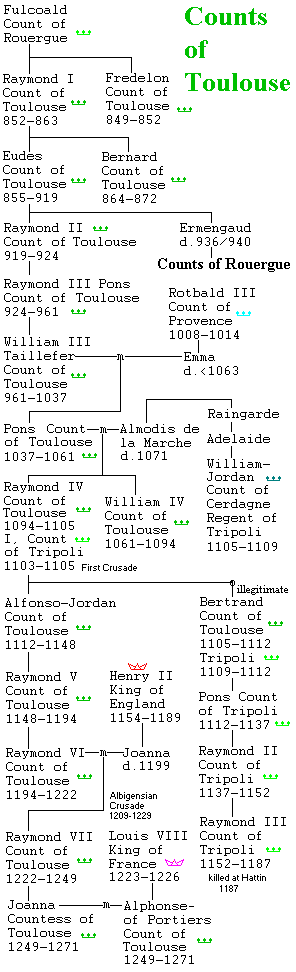 The County of Toulouse was the legendary center of the special culture of the Languedoc, the South of France where the language, also "Languedoc," rather close to Catalan today, was distinct from the North of France, Languedoil. The names come from a difference between the words for "yes": "hoc" in the South and "oil" in the North -- "oil" became "oui" in Modern French. Now, the language of Toulouse is a regarded as a dialect of Languedoc, Languedocien, which as such extends right across the South of France from Provence to Gascony. See the full discussion of the languages and dialects under Provence.
Under the influence of the love poetry of Islāmic Spain, the Troubadours introduced the idea of romantic love into Western Europe. Unfortunately, other things were introduced as well. The Cathari (the "Pure," or Albigensians) reportedly practiced a form of religion reflecting Manichean dualism. For tolerating this heresy, in 1207 Count Raymond VI was excommunicated and his domains were placed under an interdict by Pope Innocent III.
Raymond was eager to appease the Pope, but when the Papal legate Castelnau was murdered in 1208, Raymond was blamed and sterner measures were considered necessary. Innocent declared a "Crusade" against the heretics and the, at least, dilatory Count. Led by Simon de Montfort, the Crusade visited widespread destruction. In one infamous incident, after the fall of one city, Béziers, in 1209, all the inhabitants, heretical or not, were put the sword. One Crusader, Amal Ulric, reportedly instructed his men Neca eos omnes. Deus suos agnoscet, "Kill them all. God will recognize his own." Raymond VI was defeated in 1213 and temporarily deprived of his fief.
 After the death of de Montford in 1218, the Count's fortunes revived. His son Raymond VII recovered the core of Toulouse. Nevertheless, the settlement of 1229 ceded much of the domain of Toulouse to the Crown. The daughter of Raymond VII was married to a son, Alphonse, of King Louis VIII of France. This might have led to a flourishing house of Poitiers in Languedoc, but the couple were childless, and in 1271 the remaining County reverted to the Throne.
The domain of Alphonse compares favorably with that of his brother, Charles of Anjou. Like Alphonse, Charles was married to an heiress, in his case of Provence. More importantly, Charles was offered Naples and Sicily by the Pope. He got them, but then lost Sicily. The House of Anjou then ruled Naples, and later Hungary and Poland, until 1435.  The domain of Alphonse in France is more impressive than that of Charles, but it was not, of course, the possession of any enduring house.
Meanwhile, some years before, Count Raymond IV had gone on the First Crusade. After Jerusalem was taken, his job was to reduce the city of Tripoli, today in northern Lebanon. He died before the city surrendered, but was nevertheless credited as the first Count of Tripoli. When the city finally fell in 1109, his (perhaps illegitimate) son Bertrand took over, and his descendants ruled as the Counts of Tripoli until 1187, the year, as it happens, that Jerusalem was retaken by Saladin. This was well before the sad destruction of the culture and prosperity of Languedoc.
The chronology of the Counts is from Bruce R. Gordon's Regnal Chronologies and WW-Person, A WWW Data base of European nobility, and the genealogy from Brian Tompsett's Royal and Noble Genealogy, with modifications from The New Cambridge Medieval History, Volume III, c.900-c.1024 [Timothy Reuter, editor, Cambridge 1999]. All these sources have sometimes wildly different names, sequences, and dates. I have tried to reconcile things somewhat, but I have left other inconsistencies, of dates and identities, in place out of frustration. Gordon lists "Humfrid" as of a different House than the other Counts (he doesn't appear at all in WW-Person), so I assume he would not appear in the genealogy; but Tompsett's overlapping dates otherwise seem to cover the period, and he doesn't give anyone who might be "Bernard II" (Gordon has the two Bernards in sequence, while WW-Person separates them by some 20 years). So, not being familiar with the sources, and having in hand only general histories that don't bother with such details (the Cambridge History only covers a limited period), I threw up my hands and left it. Now I hope to improve this with information from the Erzählende genealogische Stammtafeln zur europäischen Geschichte, Volume II, Part 1, Europäiche Kaiser-, Königs- und Fürstenhäuser I Westeuropa [Andreas Thiele, R. G. Fischer Verlag, Part 1, Third Edition, 2001] but have not yet analyzed the Toulouse pages [pp.171-173].
Index for Francia Occidentalis, France
| Dukes of Aquitaine | |
|---|---|
| Chram | 555 560 |
| Desiderius | 583 587 |
| Bladast | 583 587 |
| Gundoald | 584/585 |
| Austrovald | 587 589 |
| Sereus | 589 592 |
| Chlothar II | 592 629 |
| Charibert II | 629 632 |
| Chilperic | 632 |
| Boggis | 632 660 |
| Felix | 660 670 |
| Lupus I | 670 676 |
| Odo the Great | 688/692/715 735 |
| Battle of Tours, Poitiers, with Charres Martel, Arabs defeated, 732 | |
| Hunald I | 735 745 |
| Waifer | 745 768 |
| Hunald II | 768 769 |
| Lupo/Lupus II | 768 781, Duke of Gascony |
| opposed Charlemagne's rule and Hunald's relatives; Carolingian conquest | |
| Pepin I | King, 817-838 |
| Pepin II | King, 838-864 |
| Ranulf/Ramnulf I of Portiers/Poitou | Count of Portiers, 841-867; Duke of Aquitaine, 860-866 |
| Ranulf/Ramnulf II | Duke, 886/7-890 |
| Ebalus/Ebles Manzer of Poitiers | 890-893, 927-935 |
| William I the Pious of Auvergne | 893-918 |
| William II | 918-926 |
| Ecfrid/Alfred/Acfred | 926-927 |
| William III of Poitiers | 935-963 |
| William IV Ironarm | 963-995 |
| William V the Great | 995-1030 |
| William VI | 1030-1038 |
| Otto/Odo/Eudes | 1038-1039 |
| William VII the Eagle | 1039-1058 |
| William VIII | 1058-1086 |
| Gascony, 1052-1086 | |
| William IX | 1086-1127 |
| William X | 1127-1137 |
| Eleanor | 1137-1204 |
| Louis, VII of France | 1137-1152 |
| France, 1137-1180 | |
| Henry I, II of England | 1152-1172 |
| England, 1154-1189 | |
| Richard I | 1172-1199 |
| 1189-1199 | |
| John I | 1199-1216 |
| 1199-1216 | |
| Henry II, III of England | 1216-1254 |
| 1216-1272 | |
| Edward I | 1254-1306 |
| 1272-1307 | |
| Edward II | 1306-1325 |
| 1307-1327 | |
| Edward III | 1325-1362, 1375-1377 |
| 1327-1377 | |
| Edward IV the Black Prince | 1362-1375, d.1376 |
| Richard II | 1377-1390 |
| 1377-1399, d.1400 | |
| John II of Gaunt | 1390-1399 |
| Henry III, V of England | 1399-1422 |
| 1413-1422 | |
| Henry IV, VI of England | 1422-1449 |
| 1422-1461, 1470-1471 | |
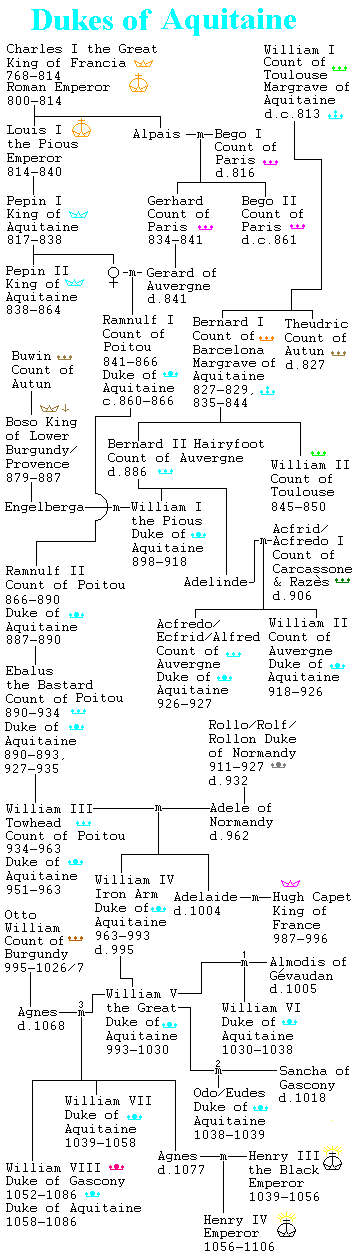
The chronology here is drawn from The Mammoth Book of British Kings & Queens, by Mike Ashley [Carroll & Graf Publishers, Inc., New York, 1999, pp.729-731], with many of the early figures filled in from Wikipedia. There are several differences between this and the genealogy, which is constructed from Brian Tompsett's Royal and Noble Genealogy, Bruce R. Gordon's Regnal Chronologies, and The New Cambridge Medieval History, Volume III, c.900-c.1024 [Timothy Reuter, editor, Cambridge, 1999]. I have no idea how to reconcile the differences, especially between Ashley and the Cambridge History. Some material at the top of the genealogy has now been added from the Erzählende genealogische Stammtafeln zur europäischen Geschichte, Volume II, Part 1, Europäiche Kaiser-, Königs- und Fürstenhäuser I Westeuropa [Andreas Thiele, R. G. Fischer Verlag, Part 1, Third Edition, 2001].
The early period seems to involve a tug-of-war between the Counts of Poitiers (Poitou), Auvergne, and Toulouse for possession of the Duchy. There seem to be some confusions and disagreements between the sources. The Encyclopaedia Britannica, for instance, says that William I the Pious, Count of Auvergne and Duke of Aquitaine, died in 926. However, Ashley, Tompsett, Gordon, and the Cambridge History all agree that William II died in 926, and William I the Pious in 918. It should be noted that William III of Aquitaine is sometimes reckoned to begin a new sequence of numbering, as William I, which means that Eleanor's father,  William X, is also found called William VIII.
Almost every map I have seen for this period shows different boundaries for the domains. Since I doubt that much was done in the way of accurate surveying (or even definition) of boundaries, or that such records would even survive, this is not surprising. The map abovve right is mainly based on Donald Matthew, Atlas of Medieval Europe [Equinox, Facts on File, New York, Oxford, 1983, 1989, p.98]. The domain of the House of Anjou is in red, with Normandy, already ruled by Henry Plantagenet before the end of the reign of King Stephen of England, in blue.
William L. Langer's An Encyclopedia of World History; Ancient, Medieval, and Modern, Chronologically Arranged [Houghton, Mifflin, Company; the Riverside Press, Boston, 1940, 1948, 1952, 1960] shows Toulouse as part of the "lands held or claimed [by Henry II of England] through marriage with Eleanor" [p.192], but Toulouse apparently was not "held" and the "claim" was not realized, which makes it puzzling why that should be included on the map.
| Counts and Dukes of Gascony | |
|---|---|
| Genial | 602-626 |
| Aeghyna | 626-638 |
| Felix | 660's |
| Lupus I | 670-676/710, Vasconia |
| Odo the Great, or Eudes | 688/692/715-735 |
| Hunald I | 735-748 |
| Waifer (Gaifier) | 748-767 |
| Hunald II? | 767-769 |
| Fled to Lupus II of Gascony and was handed over to Charlemagne | |
| Loup I | 768-774 |
| Loup II | 774-778 |
| Adaric | 778-812 |
| Loup III Sancho | 778-c.823 |
| Siguin I | 812-816 |
| Loup IV Siguin | 812-c.819 |
| Garcia Siguin | 816-818 |
| Aznar | c.823-836 |
| Totilon | 819-? |
| Siguin II | ?-846 |
| William I | 846-848 |
| Sancho Sancion | 848-864 |
| Arnaud | 864-872 |
| Sancho I Mitarra | 872-? |
| Sancho II Sánchez | ? |
| García II Sánchez | Margrave, Duke, 886-920 |
| Sancho III Garcés | 920-? |
| Sancho IV Sánchez | Count, ?-977 |
| William Sánchez | Duke, 977-984 |
| Bernard William | 984-1010 |
| Sancho William | 1010-1032 |
| Berenger | 1032-1036 |
| Eudes | 1036-1039 |
| to Navarre; to Aquitaine, 1052 | |
The contradictory information about Aquitaine seems much worse for Gascony. To the sources cited above is now added WW-Person, A WWW Data base of European nobility, which gives most of the Dukes before Sancho I Mitarra -- with earlier names now added from Wikipedia. The dates that Person gives before 1010 (or 1009) are often substantially different from those in the other sources. The dates in the table are  largely his, while those in the genealogy are more those of Brian Tompsett and others. Some key dates are simply unknown. There also seems to be some question about the sequence of Arnaud (Arnold) and Sancho I Mitarra.
A significant marriage here is of Sancha of Gascony to Duke William V of Aquitaine. However, her name is also given as "Prisca," and her father is variously given as Sancho William, William Sancho, and William Sánchez. Sancha's children, however, did not give rise to the subsequent Dukes of Aquitaine. Duke William V had three wives, and subsequent Dukes were descendants of William VIII, son of William V and Agnes of Burgundy.
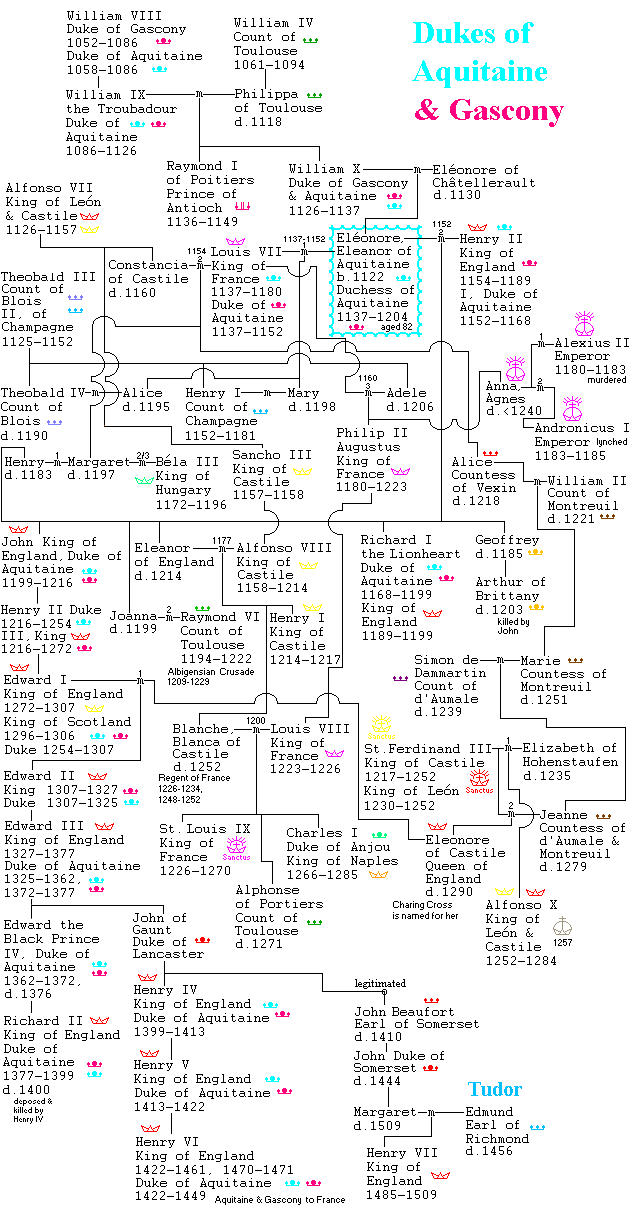
The brother of William X married the heiress of the Crusader Principality of Antioch. That marriage and the succession to Antioch can be examined at the genealogy for the Sicilian Normans. The most complicated part of the chart covers the marriages, not just of Eleanor, but of her first husband, Louis VII of France. Louis ended up marrying the sister-in-law of his own daughters by Eleanor (Adele, sometimes given as Alice).
The great movie The Lion in Winter [1968] gives us a picture of the family of Eleanor of Aquitaine and her husband Henry II of England. We get Katharine Hepburn (1907-2003) as Eleanor and Peter O'Toole (1932-2013) as Henry -- where O'Toole, of course, may be the most memorable as Lawrence of Arabia. Equally interesting is the supporting cast. Prince Richard is played by no less than Anthony Hopkins, most famous later as Hannibal Lecter. King Philip II of France is played by Timothy Dalton, who starred as James Bond in two James Bond movies. Noteworthy is Nigel Terry as Prince John, a most unsympathic character, and later regarded as the worse King in English history; but Terry himself would later memorably play no less than King Arthur in John Boorman's movie Excalibur [1981]. Since Prince Henry died in 1183, and Prince Geoffrey in 1185, this "Christmas Court" of the movie would most likely be in 1184. In the movie itself, however, Eleanor and Henry both say that the year is 1183. Considering the recent death of Prince Henry, I find it a little unlikely that there would be so little comment about him at Christmas 1183. We also have the anachronism of a Christmas tree, which was unknown to the English Court until introduced by Prince Albert, bringing the custom from Germany, after he married Queen Victoria.
What would have been fun could have been some discussion of the letter that Henry received in 1176 from the Emperor Manuel I in Constantinople. This was about the performance of English recruits, the Engklinovarangi, in Manuel's army at the battle of Myriocephalum, some of whom may have been returning to England with the letter. Manuel also expressed some curiousity about conditions in England and even Wales. Henry saw that Manuel was supplied with some of this information. However, chances are that the producers and writers of The Lion in Winter didn't even know about the English Varangians, who, to Anthony Kaldellis, have been "written out of history." Although a careful reading of Edward Gibbon would inform anyone, the business is generally overlooked.
At the beginning of the movie Alice has become the lover of King Henry -- as seems to have been the actual rumor at the time -- even though she had been raised in his Court and is betrothed to Prince Richard. Pope Alexander III (1159-1181) is supposed to have threatened Henry with an Interdict if the marriage was not performed. It wasn't, and Richard married Berengaria, daughter of Sancho VI of Navarra. Alice's brother, King Philip, suggested that Alice marry John, but Eleanor rejected the offer.
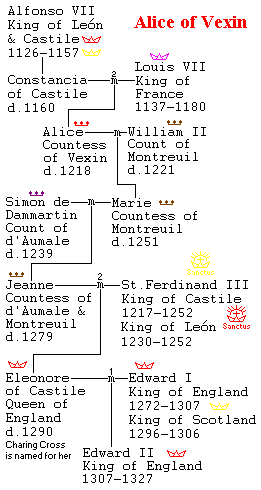
In fact, the historical Alice never married any of the Princes, but she will marry a relatively obscure nobleman, William of Montreuil and Ponthieu. However, their line does not remain obscure. Alice's granddaughter, Jeanne (Joanna, etc.) will be the second wife of King Ferdinand III of Leon and Castile, after whom the San Fernando Valley of Los Angeles is named -- his first wife, Elizabeth of Hohenstaufen, was a granddaughter of the Emperor Isaac II Angelus of Romania. Their daughter, Eléonore, marries Edward I of England and bears most of his children.
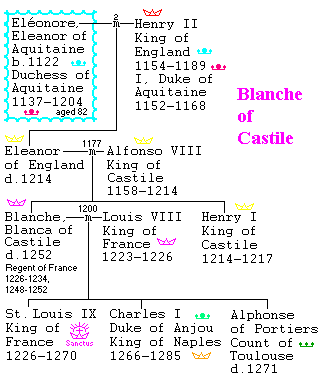
When she dies in 1290, Edward erected monuments where her funeral cortege stopped every night on the way to burial at Westminster. The monument of Charing Cross (the "Eleanor Cross") has been recreated and slightly relocated (from Tafalgar Square) to the front of the Charing Cross train station, and it is traditionally regarded as the geographical center of London. In this way, all subsequent rulers of England are descendants of Alice of Vexin, and we might be reminded of this every time we see or hear of Charing Cross Station. One of the most extraordinary chapters in the life of Eleanor of Aquitaine may be the journey she undertook at age 77. She went to Spain to escort a daughter of King Alphonso VIII to marry a son of King Philip II of France. The choice was between Urraca, the elder, and Blanca, younger. Eleanor chose Blanca, who consequently became "Blanche of Castile," the mother of St. Louis IX of France. Eleanor may have recognized a kindred spirit, since Blanche began to display a will and personality comparable to that of her grandmother.
The journey was not without its difficulties. Eleanor was captured on her way by a robber baron, Hugh IX of Lusignan. Disentangled from him, Eleanor also had difficulties on the way back with Blanca. Resting in Bordeaux, an English possession, the women acquired a champion, called Mercadier, to escort them. He, however, was then killed by enemies. Reaching the Loire, Eleanor entrusted Blanca to the Archbishop of Bordeaux, who completed the trip. From this, we might imagine that it was all too much for Eleanor. But she lived another four years, although, as we might expect, in varying health.
Later, on Blanche herself fell the task of raising and leading armies in defense of her minor son, Louis IX, while she was Regent and opposed by nobles and Henry III of England. She won battles and is even said to have helped collect firewood for the encampments. Blanche also negotiated the Treaty of Paris of 1229, which ended the Albigensian Crusade and lined up her son Alphonse as the next Count of Toulouse. Eleanor would have been proud. Blanche returned as Regent while Louis was off on his disastrous Crusades.
So there are many extraordinary stories here around Eleanor of Aquitaine, and The Lion in Winter seems to just scratch the surface. Eleanor outlived all of her children, save for King John and Queen Eleanor of Castile.
Index for Francia Occidentalis, France
 On the other hand, Eleanor's daughter, Eleanor also, by Henry II, married the nephew of Louis VII's second wife (Constancia of Castile). Their daughter Blanca (Blanche in French) was fetched from Spain in 1200 by a 78-year-old Eleanor herself to marry Louis VII's grandson, Louis VIII. Blanche became the mother of St. Louis and Charles of Anjou. Subsequent Dukes of Aquitaine were all heirs or Kings of England, until all English possessions in France (except Calais) were lost in the last days of the Hundred Year's War.
The Lion in Winter
 In a way, the most intriguing person in the movie is Princess Alice (Alys, Alix, Alais, etc.), Countess of Vexin and sister of Philip II (played by Jane Merrow -- who otherwise would mainly be familiar from British television, appearing in The Prisoner and The Avengers). There is some question about her parentage. Andreas Thiele shows her as the daughter of Louis VII and his third wife, Adelheid (Adele) of Champagne, born around 1170 [Erzählende genealogische Stammtafeln zur europäischen Geschichte, Volume II, Part 1, Europäiche Kaiser-, Königs- und Fürstenhäuser I Westeuropa, R. G. Fischer Verlag, Third Edition, 2001, p.56]. However, Wikipedia says she was born in 1160 to Louis's second wife, Constance of Castile, who died in childbirth. Now, Thiele does say that Constance died in childbirth (Kinderbett), but then lists no child born in 1160 -- although, to be sure, the child might have died with the mother. Nevertheless, it makes more sense that Alice was the child. If she was born in 1160, and if movie is in 1183, then Alice was 23 years old at the time, which looks about right. Eleanor at the time would have been 61 years old. Katharine Hepburn already shows some of the tremors of the Parkinson's Disease she developed. In the movie Henry mentions being 50.
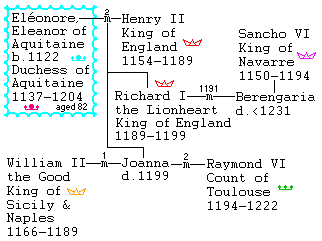 Eleanor's trip to Spain in 1199 was not the first time she traveled so far for a dynastic marriage. In 1191, when she was only 69 years old, she went to Sicily to drop off a bride for her son Richard, recently become King, who had stopped off in Messina on his way to the Third Crusade. Richard's sister Joanna had lately been the Queen of Sicily, until her husband, William II, died. His illegitimate cousin, Tancred, had become King; and relations, we might say, were a little strained. And Richard wasn't getting along with Philip II of France, who was along, either. There was some violence in Messina. Eleanor did not linger for any of that, but headed home quickly. Meanwhile, poor Berengaria of Navarra was faced with a husband who, apparently, was not interested in her, in any women, or, as far as we can tell, anyone at all. So there was no issue to this marriage, and we get nothing remotely like the epic fruits of Eleanor's matchmaking in Spain.
Copyright (c) 2000, 2001, 2002, 2007, 2017, 2018, 2022, 2025 Kelley L. Ross, Ph.D. All Rights Reserved
| Lords & Counts of Foix | |
|---|---|
| Arnaldo | Lord, d.957 |
| Roger I | 957-1011 |
| Bernard Roger I | Count, 1011-1037 |
| Peter Bernard | 1037-1071 |
| Roger II | 1071-1124 |
| Roger III | 1124-1147/8 |
| Roger Bernard I the Fat | 1147/8-1188 |
| Raimund Roger | 1188-1223 |
| Roger Bernard II the Great | 1223-1241 |
| Roger IV | 1241-1265 |
| Roger Bernard III | 1265-1302 |
| Gaston I | 1302-1315 |
| Gaston II | 1315-1343 |
| Gaston III | 1343-1391 |
| Matthew | 1391-1398 |
| Archimbald of Grailly | 1398-1423 |
| John | 1413-1436 |
| Gaston IV | 1413-1472 |
| Union with Navarre | |
| Francis Phoebus | 1472-1483 |
| King of Navarre, 1479-1483 | |
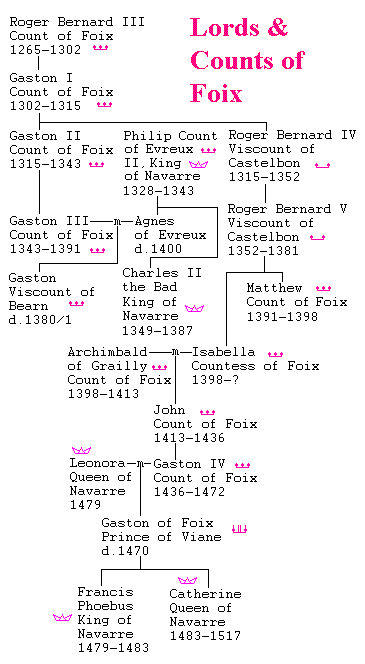
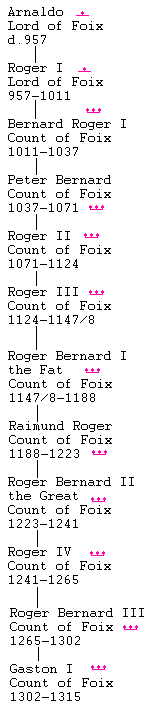 In the foothills of the Pyrenees between Toulouse and Andorra, with the 10,305 ft. Pic Montcalm rising to the south, the County of Foix passes most of its history in relative obscurity. The destiny of Foix ends up in association with the Kingdom of Navarre. Count Gaston III marries the sister of King Charles the Bad of Navarre, but this relationship comes to naught when Gaston, the son of the Count and the only legitimate heir, is starved to death by his father. The succession then jumps to Gaston's second cousin, Matthew, who himself has no heirs. So the succession passes to Matthew's sister Isabella, who marries Archimbald of Grailly. Their grandson, Gaston IV, then marries the heiress of Navarre, Leonore. Leonore is briefly Queen of Navarre in 1479, after her husband and son have predeceased her, and so both Foix and the Throne of Navarre pass to her grandson, Francis Phoebus. Eventually, when Henry III of Navarre becomes King of France, Foix passes to the French Throne.
This list and genealogy is taken entirely from the Erzählende genealogische Stammtafeln zur europäischen Geschichte, Volume III, Europäische Kaiser-, Königs- und Fürstenhäuser Ergänzungsband [Andreas Thiele, Second Edition, R.G. Fischer Verlag, 2001, pp.166-171]. When I originally consulted Brian Tompsett's Royal and Noble genealogy about this line, I think it was impossible to trace it beyond Gaston III.
I originally thought there might have been an association of the County with the cult of St. Faith -- Foi in French (or Ste. Foy) and Santa Fé in Spanish. "Foix" isn't exactly "Foi," but it might have been enough to get the association, if there was one, started (the "x" is not going to be pronounced in French). Since the capital of New Mexico takes Santa Fé as its name, the popularity of the Saint stretches all the way to the New World. Now I discover that the principal shrine of St. Foi is in the area, but not in Foix. It is at Conques, just about due north of Carcassonne and slightly south of east from Bordeaux. The closest larger town is Rodez, which was a County itself in early Capetian days. As far as I can tell, this ended up in the hands of the Counts of Toulouse (or of Auvergne). Also not far away are two towns actually named after St. Foi, Ste-Foy-la-Grande, in between Conques and Bordeaux, and Ste-Foy-l'Argentière, further afield near Lyon. St. Foi has only been resident at Conques, as it happens, since 877, when her relics were actually stolen from their original home, at the nearby Agen (Aginum). Foi herself was supposed to have been a martyr from the reign of Diocletian. The most famous incident in the stories about her is probably that, having been taking bread from her family's kitchen to give to the poor, carrying it in a fold of her dress, she was one day confronted by her (non-Christian) father over what she was carrying. She told him "flowers," but he insisted on seeing. As she opened the dress, flowers indeed, not bread, fell from it.
Index for Francia Occidentalis, France

The most durable of the ancient Celtic Kingdoms, Man, a large island in the Irish Sea, poised between Ireland, Wales, England, and Scotland, remains a constitutional anomaly in the United Kingdom. Man has its own parliament, the Court of Tynwald; and laws passed by the British Parliament in Westminster only apply to Man if it is specifically mentioned in the law.
The name "Man" seems to be derived from a legendary King Manannán, who may also have been a god. The adjective of "Man" is Manx, and this word can denote an inhabitant of Man (a "Manxman"), the remnant Celtic language, or the distinctive tailless Manx cat.
The  Manx flag contains a unique and striking device of three rotating legs, the trinacria or triskelion. This is a very old image, but may have come to Man with the Vikings. It also turns up in Norman Sicily and is sometimes said to have come from there. The legs must always be seen rotating clockwise, so Manx flags must have two layers. Since 1968 the flag has been officially flown on public buildings in Man.
| Kings and Lords of Man | |
|---|---|
| Godred I Crovan | King, 1079-1095 |
| Lagman | 1095-1099, 1111? |
| Sigurd the Crusader, III of Orkney, I of Norway | 1099-1103 |
| Earl of Orkney, 1099-1105 | |
| King of Norway, 1103-1130 | |
| Domnall macTeige | 1103-1114?, d.1115 |
| Oalf I the Red | 1114?-1153 |
| Godred II the Black | 1153-1158, 1164-1187 |
| Somerled | King of the Isles, 1156-1164 |
| 1158-1164 | |
| Ragnald I | 1187-1226, d.1229 |
| Olaf II the Black | 1226-1237 |
| Godred the Brownhaired | 1230 |
| Harald I | 1237-1248 |
| Ragnald II | 1249 |
| Harald II | 1249-1250 |
| Ivar | 1250-1252 |
| Magnus | 1252-1265 |
| to Scotland, 1264-1290, 1293-1296, to England, 1290-1293, 1296-1333 | |
| William I de Montacute/Montague | 1333-1344 |
| William II Montague | 1344-1392, d.1397 |
| William III le Scrope | 1393-1399 |
| Henry Percy | 1399-1405, 1408 |
| John I Stanley | 1405-1414 |
| John II | 1414-1437 |
| Thomas I | 1437-1459 |
| Thomas II | 1459-1504 |
| Thomas III | Lord, 1504-1521 |
| Edward | 1521-1572 |
| Henry | 1572-1593 |
| Ferdinando | 1593-1594 |
| to England, 1594-1612 | |
| William I | 1610-1612, d.1647 |
| Elizabeth | 1612-1627 |
| James I | 1627-1651 |
| Lord Fairfax | Governor, 1651-1660 |
| Charles | Lord, 1660-1672 |
| William II | 1672-1702 |
| James II | 1702-1736 |
| James Murray | 1736-1764 |
| John Murray | 1764-1765, d.1774 |
| sold to Britain, 1765 | |

At the end of this period, Man was fought over by Scotland and England. Edward I of England, who annexed Wales and briefly even Scotland, seized Man in 1290. Except for some brief episodes, the Island has remained under English suzerainty ever since. In 1333, however, Edward III granted Man, with full sovereign rights, to William de Montacute (or Montague). This gave Man a status rather like the French Duchies, such as Burgundy, something otherwise rare to unheard of in English possessions. Montague actually had to invade the Island, against local resistance, in 1341 in order to be crowned King.  Then he left. No King returned to Man until John II Stanley. Meanwhile, two of the official Kings fell victim to the Wars of the Roses. William le Scrope, who bought the island from William II, was a retainer of King Richard II and was executed by Henry IV. Henry Percy, who received Man from Henry, was then killed in battle after he rebelled. Henry bestowed Man on John Stanley in 1405. His family remained sovereigns of Man until 1736.
In 1660, the Stanleys gave up the ancient title of "King" and became merely "Lords of Man." Queen Elizabeth II is still simply "Lord of Man." There were two major glitches in the Stanley tenure on Man. A dispute about the succession resulted in a hiatus from 1594 to 1612. More significantly, James I, called the Great Stanley, was executed, as a Royalist, in the English Civil War. His wife Charlotte held the Island until betrayed to Parliamentary forces. A Commonwealth Governor, Lord Halifax, ruled the Island until the Restoration, when the Stanleys returned. The Stanley line finally died out 1736; and James Murray, Duke of Atholl, became Lord. His nephew and son-in-law, John Murray, surrendered the sovereignty of the Island to the British Crown in 1765 for £70,000 (today perhaps approaching $7,000,000), while retaining the title of Man until his death.
The list and genealogy here is almost entirely from The Mammoth Book of British Kings and Queens by Mike Ashley [Carroll & Graf Publishers, Inc., New York, 1998, 1999]. The history of the Manx flag and discussion of the triskelion can be found at Flags of the World. The genealogy of the Murrays is not given in the Mammoth Book but can be found in the Erzählende genealogische Stammtafeln zur europäischen Geschichte, Volume IV, Die Britische Peerage, ein Auszug [Andreas Thiele, R. G. Fischer Verlag, 1996]. Oddly enough, the actual connection between the Stanleys and the Murrays is not given in either source. I did find it in Brian Tompsett's Royal and Noble genealogy.
Aubrey de Vere was a retainer of William the Conqueror and became part of the Norman administration of England. His son, also Aubrey, was made "Master Chamberlain" of the King, which apparently became the office of "Lord Great Chamberlain" with the subsequent Earls. In 1539, this office, of no real power, nevertheless was recognized as "fifth in formal precedence among the officers of state," and so figured in coronations and other major rituals of the monarchy.
The third de Vere, Aubrey again, was made Earl of Oxford, in a line that continued until the failure of the male heirs in 1703.
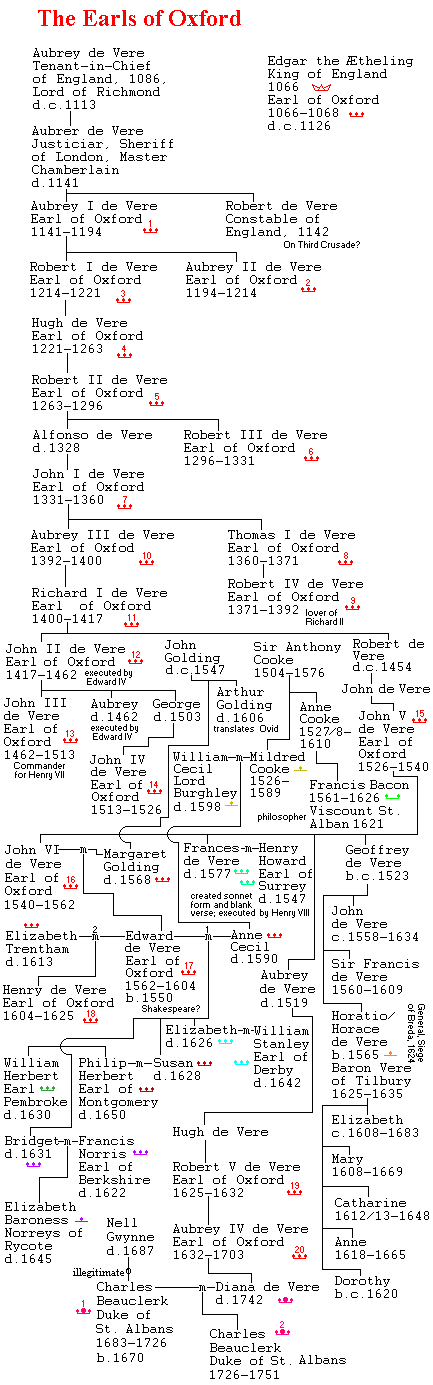 At that point, the heiress, Diana, of the 20th Earl, married Charles Beauclerk, the first Duke of St. Albans, who was the natural son of King Charles II and his flamboyant actress mistress, Nell Gwynne. Thus, the line of de Vere continues in the living descendants of St. Albans, Charles, and Gwynne. Murray de Vere Bleauclerk, the present 17th Duke of St. Albans, uses the surname "de Vere," and his son, Charles Francis, is an exponent of Edward de Vere as the author of the Shakespearian corpus. Charles also protested the disenfranchisement of the Hereditary Lords in 1999 as "treason."
Earlier de Veres had been executed for "treason." The 12th Earl, John II, had fought for Lancaster in the War of the Roses. He and his eldest son, Aubrey, were executed by Edward IV as part of his extermination of the Lancaster cause. Edward spared the younger son, John III, who consumated Lancaster revenge by generaling for Henry VII at Bosworth Field, where Richard III was defeated and killed.
The genealogy here is assembled mainly from Wikipedia but with the backup resource of the Erzählende genealogische Stammtafeln zur europäischen Geschichte, Volume IV, Die Britische Peerage, ein Auszug, by Andreas Thiele [Third Edition, R. G. Fischer Verlag, 1996].
One thing that interests me is whether any of the younger sons of the line went to join the Varangian Guard in Romania, whose such members became the Ἐγκλινοβάραγγοι, Egklinováraggoi, the "English Varangians." This would have been a possibility from some time after 1080, when Saxon refugees were noticed arriving in Constantinople, until the period of the letter we have from the Emperor John VII to King Henry IV in 1402. Constantinople, of course, fell to the Ottoman Turks in 1453, but meanwhile the Hundred Years War (1337-1453) seems to have drawn off much of the attention of English nobility.
Thiele's genealogy is very full for the family, and although he himself may not have been aware of Englishmen in the Guard, he might have noted that some family members died in the Middle East, and not always on Crusade. However, I have examined the two pages of Thiele that cover the proper era (pp.224-225), and I count twelve sons who were out of the line of succession. Thiele either describes them as deeply involved in the events of the kingdom, which we might expect from an important family, as dying young, becoming monks, or with no information. Thus, there are some possibilities, maybe a couple, but no positive indication that any sons of the family went to the Guard, or even on Crusade.
Indeed, it is a little suprising that none of the family ever seems to have gone on Crusade. Aubrey, the first Earl, did not go with Richard I on the Third Crusade, but Thiele does say that he assembled the ransom when Richard was held by Duke Leopold of Austria. Earl Aubrey II fought with Richard, but it was in France, not on the Crusade. On the other hand, Mark Anderson, while mentioned the ransom collected by Aubrey I, speculates that his brother, Robert, made Constable of England in 1142, may have been on the Crusade with Richard. I don't know what basis there may be for this, but perhaps it would seem strange if both de Vere brothers simply had remained in England while Richard was away [Shapespeare by Another Name, The Life of Edward de Vere, Earl of Oxford, The Man Who Was Shakespeare, Gotham Books, 2002, 2006, p.87].
Yet Shakespeare scholars can be contemptuous and dismissive of doubters:
This tosses Walt Whitman, et al., into the basket of "eccentrics" and "cranks." But they certainly are "heretics." In this, Schoenbaum himself sounds more like the "boor."
Since a lot of orthodox scholars like to think that Shakespeare authorship cannot be doubted without mental illness, one of them tried to psychoanalyze Freud himself to explain his doubts. Such an approach seems even less promising when it comes to Mark Twain or (most) of the other doubters. But not, perhaps for the "Stratfordian" psychoanalyst himself, whose arrogance and conceit may be at what are pathological levels -- see "The 'Byzantium' Derangement Syndrome."
Notice that none of the doubters cited were established in "higher education." That certainly makes them "amateurs." Academic Shakespeare scholars seem to be the staunchest defenders of William of Stratford, often accusing doubters of being ignorant, when the scholars themselves may ignore the evidence and argument of the doubters and exhibit an irrational adherence to their ideological "paradigm" of authorship. In our day, this is no longer surprising. But it has been going on for a long time.
I used to point out to my classes that Modern Philosophy was not started by anyone in the universities. Descartes, Spinoza, Liebniz, Berkeley, and Hume were all outsiders. None of them were academics. The only case like an exception was that of John Locke, who earned degrees at Oxford and became a resident there. But Locke's studies were in medicine; and once a bit of surgery made him a political retainer to the Earl of Shaftesbury, he never returned to the university. Immanuel Kant may have been the first original Modern philosopher with a university career, but he had to wait many years to obtain an independent position; and meanwhile he was expected to teach material he was handed. The "system" did not allow him to be an original thinker.
The universities now harbor remarkable reserves of sophistry, not to mention political orthodoxies; and the most au courant professors may claim that logic, rationality, and science are themselves the fruit of racism, sexism, and other kinds of "oppression." This gives them license to, in fact, say anything, without fear of refutation or debate. That could be used to express originality, but it rarely is, since conformity is what is rewarded.
Because Shakeskpeare is often himself rejected as racist and Eurocentric, the best they can get out of this is sometimes only the "classism" of snobbish doubters rejecting William of Stratford for his humble origins. But the ideological corruption is systemic, and it empowers the complacent to engage in irrelevant ad hominem attacks, the bread and butter of the Left, against doubters. How far that can go, and as fully as nasty and vicious as the mindset can be, is when we see doubters accused of being like "Holocaust deniers" -- i.e. Nazis -- as though they are ready to hustle William of Stratford off to the gas chambers. This discredits, not the doubters, but the accusers. But it is just the kind of smear tactic we see elsewhere, as with skeptics about "global warming."
The sobering truth is that partisans of William of Stratford are often the real snobs, denying that amateur doubters have no right to an opinion in all this because they do not have the academic credentials and position of the orthdox. Of course, some of them do, but this is actually no more than an ad hominem attack, giving the orthodox an excuse to ignore the evidence and arguments of the doubters, which they are eager to do.
Speaking of class snobbery about "humble origins," that accusation falls very flat with, say, Mark Twain, whose origins were humble indeed. But that is precisely what got Twain's attention. He knew what it was like to come from nowhere, work for a living, and then achieve literary success and fame. And his experience didn't match, at all, that reported about William of Stratford. He was especially struck by the circumstance that the locals in Stratford had no memory of "Shakespeare" until a couple of generations later, when living memory had actually died out. Yet people Twain knew from his childhood in Hannibal, Missouri, kept popping up even in Twain's old age, with stories about him. Stories that were true.
To Mark Twain, who of course wrote under a pen name, the official biographies of "Shakespeare" rang false. And Twain had never returned to live in Hannibal, as William did in Stratford. With success, Twain became a "Connecticut Yankee" and the friend of people like Ulysses S. Grant. William of Stratford not only retired back home but in all his years in London he was still conducting business there, while none of his presumed fellow paywrights seem to have ever visited the remote Stratford-upon-Avon.
As this sinks in, we should read how Diana Price ends her book:
Certainly the historial record attests to Schoebaum's description. Nobody in Stratford had anything to say about any famous poet in their midst. It is enough to make you think there was no poet in their midst. [op.cit., p.307] Samuel Schoenbaum seems to make, not just "Shakespeare," but the whole of the worthies of Stratford into his "boors."
A 2011 movie, Anonymous, presented a version of the theory that "Shakespeare" was Edward de Vere, with an introduction by Sir Derek Jacobi, a Shakespearean actor himself (and certainly not an academic), and memorable for playing the Emperor Claudius in the BBC series, I, Claudius [1976]. However, the movie badly confused the issue by introducing irrelevant claims that de Vere himself was an illegitimate child of Queen Elizabeth I, was being blackmailed by the actor William Shakespeare, and that Elizabeth was also the mother of Henry Wriothesley, the Earl of Southampton (1573-1624), who may have been the lover of de Vere and the object of the Sonnets attributed to Shakespeare. These sorts of imaginings about Elizabeth really don't help the "Oxfordian" case [note].
The fantasy and lunacy, not always confined to the doubters, that creeps into this debate is thankfully missing from a book by Joseph Sobran (1946-2010), Alias Shakespeare, Solving the Greatest Literary Mystery of All Time [The Free Press, 1997]. The evidence and argument laid out by Sobran should give pause to any open minded person. He avoids what he himself calls "crankish excesses," like stories (fantasies?) about Elizabeth's illegitimate children [p.222]. I do not wish, of course, to revisit any substantial part of that. What I do wish to examine are a few points that ground reasonable doubts about the authorship of William Shakespeare, some of which troubled me before any careful reading of Sobran's book.
For years, what bothered me was the will of William of Stratford. Almost nothing is known about the personal life of William "Shakespeare." Our information is almost entirely legal notices, such as his birth in 1564, his marriage in 1582, his purchase of a house in 1597, his lawsuits against loan defaulters, stock holdings in theater companies, a deposition he gave in London in 1612, and his death in 1616. There are no letters by William, not to his wife, business partners, or anyone, although there is one letter that survives addressed to him.
The will is the only document in his own voice. We know from it that he ended up modestly wealthy, with considerable property, including an interest in the Globe theater, wealthy enough that he had obtained the social status of "gentleman" (perhaps helped by a bribe to obtain a coat of arms), which meant that legally he had no trade or profession. This was only possible after he had ceased being an actor, which not only was a trade or profession, but a lowly and socially stigmatized one at that -- actors were legally classified as "vagabonds."
The Question of Shakespeare
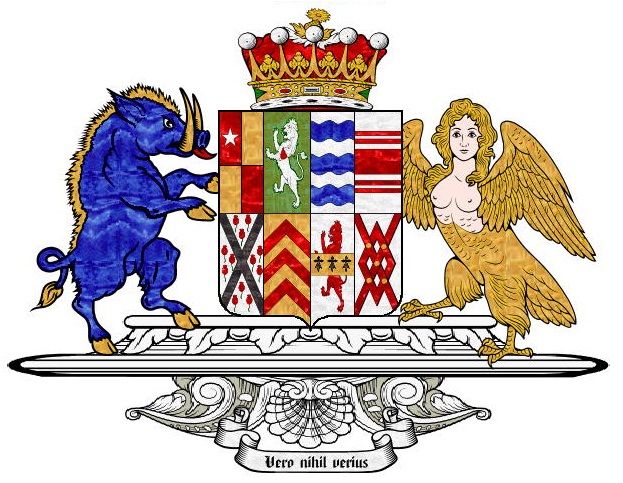 The occasion of my immediate interest in these Earls of Oxford, however, is the possibility that the plays attributed to William Shakespeare were actually written by Edward de Vere, the 17th Earl. This issue of the authorship of the plays of Shakespeare has attracted, for more than a century, a range of opinion, often of a mentally marginal sort, with, for instance, claims that Francis Bacon (1561-1626) wrote the plays in a code, a "cryptogram," that, when deciphered, proves his authorship. Some serious people, however, including Walt Whitman, Mark Twain, Henry James, Charlie Chaplin, Sigmund Freud, Daphne DuMaurier, Orson Welles, John Gielgud, and several Supreme Court Justices (including good ones), have doubted that the actor from Stratford-upon-Avon wrote the plays attributed to him.
And then one must reckon with the amateurs, the eccentrics, the cranks with theories. Of these the worst would be the heretics, alert to conspiracies, who saw a sinister plot to take away the plays from their true progenitor, Bacon or Marlowe or some Earl or other, and bestow them instead on the Stratford boor. [Samuel Schoenbaum (1927-1996), quoted by Diana Price, Shakespeare's Unorthodox Biography, New Evidence of an Authorship Problem, Greenwood Press, 2012, p.224]
Schoebaum had this to say about the good folk of Stratford-upon-Avon:
What did fellow townsmen make of the distinguished playwright of the Chamberlain's company and admired poet of love's languishment who sojourned each year in their midst? They probably[?] troubled their heads little enough about the plays and poems. Business was another matter; they saw Shakespeare as a man shrewd in practical affairs...
 |
|---|
| Anne Hathaway |
Diana Price has some harsh words about the husband of Anne Hathaway:
Yet William of Stratford never lived as anything but a lodger in London. The house he bought was in Stratford. So he may have been living a bit of a separate life in London in the theater for some years, but his roots remained where his wife was. But the only clue we have about how he felt about her is not encouraging. In fact, we may have a couple other clues. William seems to have moved to London shortly after Anne gave birth to twins in 1585, including a son who died young -- in addition to an earlier child, with whom Anne was pregnant when they were married.
This could easily be construed as something like abandonment. However, actual abandonment would not have gone unnoticed by the authorities. The whole matter admits of a very different interpretation. William went to London on business, and he kept doing so. He was never a proper resident there. His whole involvement with the theater was almost entirely as a financier and investor, which is how he is mainly noticed.
Anne was eight years older than he was, and they never had any other children. His coolness towards her is otherwise indicated by the side of his life about which we are rather well informed: Money. Thus, even though his businesses prospered, and his affairs in both London and Stratford generated respectable wealth, he refused to pay off a debt of 40 shillings (£2) that Anne had incurred.
Diana Price gives us the rather shameful details of this:
Thus, no one seems to think that the "Shakespeare" marrriage was a very happy one, even if William retained and returned to his roots in Stratford. It also shows us a man who, while suing those who owed him, was more casual about paying debts to others. And we know the tax collectors were sometimes after him.
While Whittington, a shepherd living in Shottery, with many dealings with the Hathaway family (who owed him other monies), directed that recovered monies be donated to the poor, the Shakspere will in itself contains only one charitable bequest, of £10 "unto the Poor of Stratford." This could easily have covered the debt to Whittington, and it even would have gone to the same purpose. Thus, William of Stratford does not seem to have been a generous or terribly conscientious person, not even to his wife. This may be why, although the will was discovered in 1747, its full publication was suppressed until 1851. It had been immediately recognized as an embarrassment.
William Shakspere's "retirement" back to Stratford, perhaps as early as 1604, is something that has troubled and perplexed orthodox scholars. We see no evidence there of literary activity, or any surviving connection with anyone from theater or literary circles in London. William of Stratford becomes, or continues as, a small businessman, a successful one, but nothing more -- and not entirely honest at that. The will itself is almost entirely about disposing of his wealth. Curiously, bequests to actor friends are inserted, by a different hand, between two existing lines of text. This interpolation looks at best like an afterthought and at worst like a forgery. Neither bespeaks much interest by William in his former comrades of the theater.
And about that letter to him. Reading the Shakespearian plays, one does not come away with a good feeling about moneylenders. But the letter we have to William is asking for a loan. And we know that he did loan money. Later he would sue people to recover even petty sums (like two shillings, although this might be two days worth of wages). So however much we dislike moneylenders from the plays, the man himself was a moneylender, one unwilling even to cover a debt of his wife. Consistent? At the same time, the letter asking for a loan may never have reached the man. Where he lived in London tends to be elusive. He was elusive there when tax collectors were after him. His only secure address ended up being in Stratford, after he had come into enough money to pay his debts, but not those of others.
But William's treatment of his wife is not what bothered me the most about the will. For a man who wrote extensive poetry and many plays, there is no mention of them in the will. There are no instructions about manuscripts. No instructions to a publisher, literary agent, or his executors, even though by the time of his death in 1616 things had been published by "William Shakespeare" for more than 20 years. We would know absolutely nothing about that from the will. Similarly, from the evidence of the plays, Shakespeare was well read. But the will mentions no books. Since there were no public libraries in 16th century England, we must wonder how he did this reading.
Orthodox scholars like the idea that William of Stratford picked up a lot of his knowledge, of law or of Italy, by questioning random drinkers and travelers in taverns, especially the "Mermaid" tavern, whose owner William knew, or the "Oliphant," which was near the Globe Theater. There is no evidence or testimony that he was ever even in the Mermaid, or the Oliphant, let alone pumped lawyers for a legal education or Italians for local geographical knowledge. Thus, Frederick A. Keller ("an actor, producer, director, writer, and educator presently living in Los Angeles") says:
Absent any evidence that "Shakespeare" ever entered the Oliphant, or did anything there, Alexander Waugh looked into the basis of this "catered to Italian customers" claim. It goes back to a single letter from 1591, where an Italian traveler says that an acquaintance of his frequents "the house of the Elefante," casa dell' Elefante. Unfortunately, a casa is not a pub, "Elefante" is the name of an Italian family, and the reference is to their home in Barletta, Italy ["Keeping Shakespeare out of Italy," Beyond Doubt?, The Shakespeare Authorship Coalition, 2013, 2016, p.81].
But this is all part of the fantasy of "Shakespeare" biography, whose authors like to imagine William with his (unattested) drinking buddies. Like other confabulations, everyone must decide for themselves how credible it would be.
Biographers assume that "Shakespeare" had a solid education at school in Stratford. However, although there was a school in Stratford, and William Shakspere might well have attended, we have no positive information that he did, and certainly nothing about what he would have learned. Nor would an elementary, suburban education have involved the depth of information that turns up in the plays. Yet "Shakespeare" biographies are filled with suppositions and confabulations about his education, based on nothing but what is in the plays. As evidence of authorship, this is no better than circular reasoning.
We do have one solid report about education of "Shakespeare" from someone whose familiarity with the man no one can deny. In his prefatory poem to the First Folio, Ben Jonson famously said that Shakespeare had "small Latin and less Greek." Yet the evidence of the plays is that their author knew several languages well, including Latin, Italian, and French, at least. Indeed, the source material for several plays, including Othello, did not exist in English translation. Biographers are driven to the expedient of speculation that some English translations existed, which are now lost and for whose existence no evidence is available. This kind of thing wears its desperation on its face.
The will of William of Stratford's son-in-law, John Hall (1575-1635), unlike William's own, mentions his books, but Hall was not someone who made a living by the kind of information that shows in the plays. He was a physician. Perhaps Hall's books were inherited from William, but we don't know that from either direction. Hall's diary barely mentions his father-in-law and gives not the slightest indication that he was a famous playwright or poet or writer of any kind. Yet Hall was thrilled to meet other literary figures, like Michael Drayton (1563-1631), whom he treated and noted as "an excellent poet." From this biographers assume that Drayton must have known William Shakspere; but there is no indication of that, although Drayton does mention "Shakespeare" once in passing, as with many other writers.
There is no evidence that anyone in William Shakspere's immediate family was literate. And the surviving examples of William's signatures, as on his will, leave many people wondering if he was even literate himself. He always seemed to have some difficulty writing his name, although his father had only been able to make his "mark" on documents. We see no such trouble with any other contemporary English writers.
Mark Twain, Is Shakespeare Dead?, 1909 If we know nothing about William of Stratford's actual education, which biographers fill in with little but speculation -- although based on what is known about instruction in other schools -- we know quite a bit about Edward de Vere's. The young de Vere was tutored by his own uncle, Arthur Golding, and others. Golding would translate Ovid's Metamorphoses, which figures as the source of much in the Shakespearean plays; and he would actually dedicate other translations to de Vere.
His mean streak is found in his most infamous bequest, that of the second-best bed to his wife. Whereas most wills of the day made bequests to well-beloved wives, or appointed them as executors, Shakspere [sic] humiliated his wife from beyond the grave. The provision of the second-best bed is not even in the body copy; it is an interlineation stuck in at the end of the section in which Shakespere bequeathed all his real estates holdings to his daughter and son-in-law. The bed is Shakespere's one and only bequest to his wife, whom he did not even mention by name. [op.cit., pp.303-304] [note]
Thomas Whittington's will of 1601, specifying Mrs. Shakspere's outstanding debt to Whittington, suggests that Shakspere did not provide sufficient funds to support his family, because his wife was reduced to borrowing from a former employee. Whittington pressed for collection from "the said William Shaxpere" [actually spelled "Shaxspere"] as a matter of principle; his will specified that moneys recovered be given to the poor. Shakspere's avaracious persona is reinforced by the outstanding debt of £20 "owing by Mr. Shakespre" in Ralph Hubaud's will of 1608. [op.cit., p.302]
[Shakespeare] might have acquired all the geography necessary for his "Italian" plays in his own back yard. The Oliphant, a Bankside inn, sat close by the Globe and largely catered to Italian customers. Shakespeare must have passed it every day on his way to work and perhaps[!] he knew it well. [Spearing the Wild Blue Boar: Shakespeare vs. Oxford: The Authorship Question, iUniverse, 2009]
If I had under my superintendence a controversy appointed to decide whether Shakespeare wrote Shakespeare or not, I believe I would place before the debaters only the one question, Was Shakespeare ever a practicing lawyer? and leave everything else out.
 |
|---|
| "Portrait of Edward de Vere, 17th Earl of Oxford," 17th century copy of lost original work of 1575, painters unknown, National Portrait Gallery, London, Lent by a private collection, 1964 |
De Vere was granted a bachelor's degree from Cambridge [1564] and a master's from Oxford [1566]. It is not clear how long he maintained actual residence at the schools, and the degrees may in part have been "honorary," although commensurate with his actual learning. But then de Vere did read law at Gray's Inn [1567], one of the four "Inns of Court," which housed and trained lawyers. We see the Inns linked with Oxford and Cambridge as the universities of England.
There is so much legal language in the plays, and it is so detailed and accurate, that, as Sobran says, "many scholars have surmised that Mr. Shakspere [sic] spent his 'lost years' as a legal clerk" [p.111]. With Edward de Vere, we do not need to "surmise." He was formally educated in the law. Nor is it possible that William Shakspere could just drop in out of nowhere to work as a "law clerk." Decisively, law clerks were frequently called upon to witness documents, which means that William's name should turn up wherever he was clerking, in Stratford or London. No such document witnessed by him has ever been found.
But books are not the sorest point in the will. There had to be manuscripts. The "First Folio" collection of Shakespeare's plays was published in 1623, seven years after William Shakspere's death. They needed manuscripts for that, especially since many of the plays, like The Tempest, had never been performed or published -- unless they had been performed at Court and were in fact originally written for that venue, something only de Vere would have been doing. There is no direct information about who was holding the manuscripts or what happened to them. The will, as I have said, doesn't mention them.
As it happens, Sobran provides a couple of clues, without raising the issue or putting the clues together. One involves an edition of the play Troilus published in 1609. This is well before the death of William of Stratford, but after the death of Edward de Vere. The anonymous preface refers to some "grand possessors" as evidently having provided the manuscript. This does not sound like a living playright "William Shakespeare." Who could such "grand possessors" possibly be, and why "grand"? Sobran discusses the mystery of this preface [pp.144-145], but he does not get into what persons, plural, would be in possession of the Shakespeare manuscripts -- well before the death of Shakspere.
The next clue comes with the First Folio. Sobran has a lot to say about the meaning of this edition [pp.218-223]. One of its peculiarities is its dedication to William and Philip Herbert, the Earls of Pembroke and Montgomery, respectively. 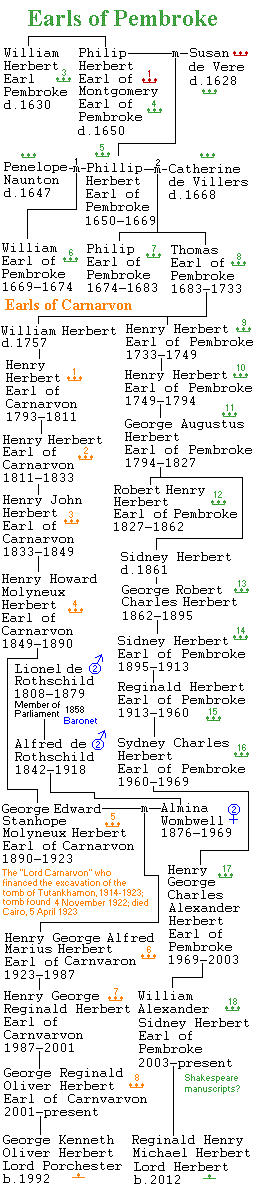 They are eulogized as "the incomparable pair of brethren" and "patrons." William Herbert had become Lord Chamberlain in 1615, giving him oversight of English theater. But the dedication seems to involve more than that; and we are given no information what they, the two of them, had to do with the First Folio in particular.
 |
|---|
| Susan de Vere Herbert (1587-1629); variously misidentified; Wilton House, Wiltshire, country seat of the Earls of Pembroke [note] |
And what had they to do with the First Folio? Well, what if they were the "grand possessors," plural, who previously provided the manuscript for the 1609 Troilus? That would fit quite nicely. They are indeed "grand." And it would not be too surprising if family documents passed through the hands of Susan de Vere Herbert -- who may actually had a lot more to do with the publication of the First Folio of Shakespeare than we will ever be able to know. What the Herberts then did with the "Shakespeare" manuscripts, if they ever had them, is hidden from history. Perhaps they lie in some dark closet of a Pembroke estate, such as Wilton House. The alternative is that, without the "grand possessors" reference, and without the "patrons" of the Herberts, there is no clue about whatever happened to the manuscripts, at any point between their creation, whenever that was, and 1623. They had to exist, but they never leave a solid trace, or any trace, before or after the folio.
I had thought that the identity of the "grand possessors" might have been my own idea, but now I see that others were way ahead of me:
That all resonated well with the Oxfordian conjecture that the "grand possessors" were the aristocratic Herbert brothers -- yes, the very same "imcomparable pair of brothers" to whom the First Folio was dedicated in 1623 -- and Philip Herbert's wife Susan Vere, who, yes, did just happen to be the youngest and probably favorite of Edward de Vere's three daughters. As with many, many other aspects of Oxford's life, family, and known writings, could this just be yet another amazing coincidence? [Early Shakespeare Authorship Doubts, by Bryan H. Wildenthal, Zindabad Press, San Diego, 2019, p.261]
At the beginning of Anonymous, Ben Jonson is desperately trying stash the manuscripts, lest they be seized and destroyed. This is entirely a fantasy, but it touches on a very sore point. Ben Jonson (1572-1637) wrote the dedication to the First Folio. If anyone knew what was going on, it would have been him. But we can't question him any more.
A different idea about the manuscripts is suggested at the origin of the Oxfordian theory. J. Thomas Looney (unfortunate name) wrote 'Shakespeare' Identified in 1920 [Veritas Publications, 2018, 2019]. This was the first time that de Vere was proposed as the author of the Shakespearean corpus, and Looney approached the matter by first developing a "profile," as is now done by police investigators, based on the attitudes and knowledge in the plays. Then he looked for someone who fit the profile. De Vere matched all the requirements.
Looney believed that Horace de Vere, Baron de Vere of Tilbury (1565-1635), Edward de Vere's 1st cousin, who was a successful general in the Netherlands and during the Thirty Years War, held Edward's papers and manuscripts. Edward admired Horace for the military career that Edward himself had been denied by his guardian (who we shall see shortly). Horace was present at the epic Siege of Breda, which I have elsewhere had cause to note.
I don't see that Looney has any direct evidence of Horace's role in this matter, but he does make a striking argument. The relationship of Hamlet to his friend Horatio, and the display of Horatio's character, matches Horace de Vere quite closely. Indeed, "Horatio" is the Latinate form of Horace's name and was often used for him. So Looney concludes that, as Hamlet himself reflects some features of Edward de Vere, Horatio stands in for Horace [pp.277,362-363, 407-409]. If Edward were looking for anyone to administer his postumous affairs, maintaining his secrets, the best candidate perhaps would be his sons-in-law, as I have suggested, or Horace de Vere, whom he would have known from childhood, being just three years his senior. As Hamlet charges Horatio with the task of protecting his memory, this might well be de Vere's own appeal to Horace.
To Joseph Sobran, the First Folio contains a profound clue about the whole business. And the clue is that it includes none of the published poetry of "William Shakespeare." It presents him as a playwright and nothing else. This makes it possible to bury important clues about his identity; for "William Shakespeare," over many years, was mainly known as a poet, not a playwright. The first things published under the Shakespeare name were two long poems, Venus and Adonis in 1593, and The Rape of Lucrece in 1594. These were popular, even respected, and remained so for many years, with many editions. It would be a long time before any plays by "Shakespeare" would overwhelm the impression they made. But the First Folio went a long way towards accomplishing that. Sobran thinks this was deliberate.
But what did that accomplish? Well, both of the poems were openly dedicated to Henry Wriothesley, the Earl of Southampton (1573-1624). Aye, there's the rub. Southampton was only 19 years old in 1593, and there is not the slightest clue what a parvenu actor from the Midlands would have to do with him. Biographers try the claim that Southampton was a patron of William of Stratford's theater; but there is no evidence of that. The fall-back position is that "Shakespeare" was at least appealing for patronage. But as a 19-year-old, Southampton was not yet in a position to patronize theaters -- as he would later. So why would "Shakespeare" think of him in particular as a patron?
Southampton actually would become the patron of John Florio (1552-1625), whose A Worlde of Wordes of 1598, an Italian-English dictionary, expressed fulsome thanks to Southampton, now 25-years-old, for the attention and income that he provided to Florio. This did not come out of nowhere. Florio had been the young Southampton's tutor. The Shakespeare of Venus and Adonis gave no hint that the dedication had anything to do with patronage or any other connection, whether actual or solicited.
But if not William Shakspere, Edward de Vere had a lot to do with Southampton. He was, as de Vere himself had been, under the guardianship of William Cecil, Lord Burghley, one of the principle and most powerful advisors of Queen Elizabeth I. In 1590, Burghley proposed that Southampton marry Elizabeth de Vere, Edward de Vere's daughter and Burghley's own granddaughter. At the time, Southampton was seventeen and Elizabeth fourteen. It was a proper match, but Southampton didn't like it. Eventually the business fell through, and Burghley actually fined Southampton £5000 for refusing the marriage, an enormous sum of money for those days (at least $750,000 now). Both Southampton and Elizabeth eventually married elsewhere, Elizabeth becoming Countess of Derby.
So we know how Edward de Vere would have known the young Henry Wriothesley, while it is both unattested and incredible that William Shakspere would. But why would the poems be dedicated to the young man? It took a while for a clue to that to come out. In 1609 a book was published called Shake-speares Sonnets. How this made it into print is unknown, but it looks pirated -- and the hyphen often indicates the use of a pseudonym. There were no further printings, and only fourteen copies of it survive.
When the collecton appeared in print again, in 1640, in another pirated edition, the publisher, John Benson, rewrites them with a specific end in view. Thus, most of the Sonnets were addressed to a young man, but Benson fixed it so that they appeared to be addressed to a woman instead. Again, there's the rub. The Sonnets were homoerotic love poems. This was troubling enough at the time, when homosexual acts could get you executed, but it would remain scandalous and shocking until quite recently -- unless you read Plato's Symposium at university -- and in Iran can still get you executed [note].
But, as they say, there's more. The Sonnets, a form originated by Edward de Vere's uncle, Henry Howard, the Earl of Surrey (who also created the "blank verse" used in Shakespearean plays), are not just love poetry. They begin by urging their young beloved to marry, like, for instance, the way young Southampton was supposed to marry Elizabeth de Vere. Edward de Vere was an interested, indeed an involved, party to this. But if the Sonnets were written by William of Stratford, it is unbelievable that he would have any interest in any of it, or even know about the affairs of a 17-year-old nobleman. Even if a homosexual love affair were involved here, no one would think at the time that this precludes the duties of nobility to marry, conventionally, and have children. So there was nothing incongruous about a homosexual lover being urged to marry. As all of the players here had or would.
So the business cuts a couple of ways. It is unbelievable that the Sonnets have anything to do with William Shakspere; and, at the same time, they involve issues that everyone involved would want to see suppressed. Henry Wriothesley was quite alive in 1623, and a close friend of Edward de Vere's son, Henry, the 18th Earl of Oxford. Edward himself had been openly accused of "buggery," and this was something no one wanted drifting their way -- the accusations were specific enough to include a young boy, a singer, Orazio Cogno, whom Oxford had brought back from Venice, perhaps reminding us of Lord Bryon's gondolier boy, Tito, whom he had also acquired in Venice. But Byron was quite frank about his pederasty, at least to friends, while with Oxford it is not clear how far any of it went.
The disappearance of the 1609 Sonnets, and the exclusion of any poetry from the 1623 First Folio, served to suppress any connection of the Earl of Southampton to the name "William Shakespeare." This ended up working very effectively, although the Sonnets remained a puzzle to Shakespeare scholars, who rarely made the connection between the Sonnets and the dedications of the earlier poems, and who thus often wanted to think that they were completely fictional, despite the specificity of the issues -- the older poet complains of being "lame," an odd thing to put in fictional love poetry.
Suspicions and accusations of homosexuality are not the only scandal that might explain some of the later treatment of de Vere. He had a tense relationship with his guardian and father-in-law, Lord Burghley. While de Vere does seem to have been free and improvident with his money, there is also the possibility that Burghley was profiting from, if not looting, the estate. Burghley certainly became very rich during his tenure, and he governed the estates of many wards, from which he can have derived a good bit of his wealth.
Without mentioning Burghley, Bryan Wildenthal implies this kind of misconduct:
Vere also may well have recalled how [Queen] Elizabeth, either herself or by allowing some of her favorites and top officials [like Burghley] to do so, had essentially robbed him as a result of the royal "wardship" to which he was subjected after his father's death, when he was not yet of legal age. Vere, fairly or unfairly, has been called an extravagant spendthrift. But the abusive wardship system that the queen carried over from her own father, Henry VIII, helps to explain how he lost most of his inherited wealth. [op.cit., p.201]
While Oxford was in Italy, 1575-1576, rumors were circulated that his wife, Anne, Burghley's daughter, was unfaithful. These seem to have been malicious and unfounded, but de Vere evidently gave them some credit. Anne had given birth to their first daugher shortly after de Vere left, and he might have thought that the dates didn't add up.
 After he returned, de Vere shunned Anne, but then himself fell into a love affair with Anne Vavasour, a maid of honour of Queen Elizabeth, who we see at right. Vavasour even gave birth to a son, later called "Edward Vere." The Queen was furious and sent all of them to the Tower of London. In one good turn, Burghley got them sprung. But it took a while for de Vere to return to the favor of the Queen that he had once enjoyed. It helped that in 1581 de Vere became reconciled with his wife. We can imagine that this story conributed to the device of false accusations of adultery in Othello and elsewhere.
But consequences of the affair with Vavasour continued. In 1582 there was a brawl between de Vere, with his retainers, and Sir Thomas Knyvet, Vavasour's uncle, with his retainers. Oxford was wounded and a retainer killed. There were further such fights, and deaths. So this business did not go away easily. Hard feelings persisted. De Vere's injury may be the origin of later descriptions of him as "lame." Details of the fights, however, may have added color to those described in Romeo and Juliet.
The whole business with de Vere's wife and his affair may have resulted in long term hostility from Lord Burghley. The reconciliation made things better, especially when Anne had further children, but then Anne's death in 1588 removed that healthy influence, which left de Vere fighting over money with Burghley. This wasn't helped by the portrayal of the character Polonius in Hamlet, which many saw as a parody of Burghley. Scholars now suspect that postumous defamations of Oxford, and active efforts to suppress his memory, may have been the doing, not just of Burghley himself, but of his heirs.
In 1586 de Vere was reconciled with the Queen, with curious and intriguing features. In June, Elizabeth granted him a mysterious pension for £1000 a year (perhaps more than $150,000 now) -- not enough for a really luxious lifestyle but a handsome addition to any other income, and a far higher stipend than enjoyed by many of Elizabeth's retainers. This was at a point where de Vere had about exhausted his own sources of income and, like King Lear, had ceded the ancestral seat of the de Veres to his three surviving daughters.
What was this £1000 annuity for? We are really left with nothing but speculation. A good possibility is that, with hostilities breaking out with Spain, and de Vere actually recalled from military command in the Netherlands, the Queen was recuiting him for propaganda. The Shakespeare historical plays are heavy with Tudor legitimacy and patriotic themes, just what a monarch might want in wartime, against a foe denying the legimacy of the monarch and her religion. We know that historical plays were performed at Court, and the titles can easily indicate what later are familiar from Shakespeare. And we know that Philip II of Spain complained about his portrayal on the English stage -- although we don't see that in a Shakespearean play.
The whole story may be given away by something quoted by Mark Anderson in his book, "Shakespeare" by Another Name, The Life of Edward de Vere, Earl of Oxford, The Man Who Was Shakespeare:
In the mid-seventeenth century, a vicar from Stratford-upon-Avon named John Ward recorded some of the legends he'd heard about Will Shakspere -- by then widely accepted as the author of the works of Shake-speare. In his private diaries, Ward recorded:I have heard that Mr. Shakespeare... supplied the stage with plays every year and for that had an allowance so large that he spent at the rate of £1000 a year, as I have heard.The vicar never, however, wonders how "Shakespeare" could have paid out such a tidy sum of £1000 per year: William Shakspere's cash estate never exceeded £350. [Gotham Books, 2005, 2006, p.212]
We might now think that Vicar Ward was actually rather well informed; but there is no evidence of a generous Royal stipend for William of Stratford, but one indeed for the Earl of Oxford. And Elizabeth had granted his money, in 1586, before William had ever left Stratford for his business in London, and before anything had ever been published in the name of "William Shakespeare." And de Vere enjoyed his income for the rest of his life, even into the reign of James I. For what esteem or what services was this owed to him? It is really one of the greatest mysteries, and probably one of the best clues, about the whole "Shakespeare" affair.
On top of possible homosexuality and issues of de Vere's and his wife's faithfulness, another scandal involved the Succession. Oxford was not in favor of the Throne passing to James of Scotland. He seems to have done nothing overt about this, since he did not get in the kind of trouble that others did over the matter. But it cannot have helped with his standing. At Oxford's death, tributes to him, although later made, seem to have been curiously delayed, perhaps to allow the political issue to cool off and become moot.
Thus, if we wonder why Oxford's anonymity with respect to his plays continued after his death, we have at least four different issues: The scandals of possible homosexual affairs, the scandal of his adultery and illegitimate son, the danger of Oxford's views on the Succession, and the hostility of Lord Burghley and his family. If Burghley had been looting the Oxford estate, I wonder if this actually may have added to the hostility, since the bad conscience of criminals is sometimes manifest as contempt or hatred for their victims.
A fifth scandal also looms. The mysterious "Dark Lady" of the Sonnets is identified by Alexander Waugh as Lady Penelope Devereux Rich Blount (1563-1607), whose scandalous amours, illegitimate children, and actual confession of adultery ultimately landed her in court, described as "an harlot, adulteress, concubine and whore." Her brother was the Earl of Essex who was executed for treason. She seems to have been involved with both Edward de Vere and Henry, the Earl of Southampton; but I do not see the identification as the "Dark Lady" except by Waugh.
Waugh even thinks that the exhortations in the Sonnets, read by Sobran as Oxford urging Southampton to marry his daughter, are actually Oxford urging Southampton to have a child with Penelope Rich, a child who Oxford would present as that of his own wife, Elizabeth, and the legitimate heir to the Oxford title.
I think this is going a bit far. Elizabeth might have something to say about it; and if this kind of scandal were well known, which Waugh thinks it was, it is hard to believe that the Queen or others would tolerate an illegitimate child becoming heir to the Oxford title. But Waugh seems to ignore the scandal of illegitimacy that is actually historically documented, that of Anne Vavasour, for which she and Oxford were thrown in the Tower.
How could the reaction to the affair with Vavasour have been so overt and dramatic, while de Vere presenting a bastard that wasn't even his, born of a notorious woman, as the heir of Oxford, is officially unnoticed? I find that unbelievable. No, one genuine Oxford bastard is well attested, and never considered for a moment as the heir of Oxford, while de Vere's exortations to Southampton are about the proposed marriage that is also historically attested.
Waugh also believes that what seem to be pirated texts of the Sonnets, in 1609 and 1640, were actually "in on the joke," and contain dedications that cryptically acknowledge the authorshiop of Edward de Vere.
Be that as it may, there was plenty of scandal to go around there, all among de Vere's circle of friends. In the Sonnets, the author himself asserts that his name will be forgotten because of the scandals associated with it. Since that is meaningless in relation to William of Stratford, this is what drives orthodox Shakespeare scholars to the conclusion that the Sonnets are fictional exercises -- another brick in the wall of conventional scholarly know-nothing-ism.
Unrelated to law or manuscripts or scandals, there is one other thing I might mention. A number of Shakespeare's plays are set in Italy. As with the law, they seem to presuppose some intimate knowledge of the place, which is difficult to explain in relation to someone, like William Shakspere, who never left England.
But Edward de Vere did leave England, and he visited Italy for more than a year, 1575-1576. Attempts have been made to find errors in local knowledge, such as a stay-at-home William of Stratford might make; but these turn out not to discredit "Shakespeare," since they are not errors at all but facts that actually presuppose direct experience of the place -- things not easily gleaned from books, if Shakspere had even had access to a proper library.
A striking case concerns The Two Gentlemen of Verona, where we find the gentlemen in question traveling from Verona to Milan by boat. Since both cities are landlocked, and on separate rivers, scholars pounced on this as a serious error in local knowledge. However, both cities easily communicated by canals, some of which still exist. And travel by canal boat was more convenient, comfortable, and safe, for those who could afford it, than overland travel, which was plagued with bandits and involved dirty inns. This would easily be obvious to the visiting Earl of Oxford. Other scholars must imagine imaginary conversations where William Shakspere learned about it all at the Mermaid tavern from long (unattested) conversations with Italian travelers.
See another example that involves the Dukes of Athens and Sabbioneta, Italy, in A Midsummer Night's Dream.
Joseph Sobran's sober "Oxfordian," theory, derived from that of J. Thomas Looney before him, provides an explanation for all the puzzles and most of the obscurities in the story of "William Shakespeare." Meanwhile, Shakespeare scholars, in order to fill out all the voids in William Shakspere's life, resort to imagination, fantasy, and confabulation, often persuading themselves of the factuality and certainty of their speculations. Visitors to Stratford-upon-Avon are thrilled to see the school that "Shakespeare" attended, and even the desk where he sat, when this is all pure fantasy. The visitors may not believe that there is no evidence for any of it.
Noteworthy in the genealogy of the de Veres is the presence of the philosopher Francis Bacon (1561-1626). Bacon was actually a 1st cousin of Edward de Vere through de Vere's first wife, by way of the Cooke family. Our first concern with Bacon is his status as a philosopher. Although credited with promoting Empiricism in scientific method, especially through the Novum Organum [1620], Bacon actually did little more than recycle Aristotle's principles of induction. That had not worked well in the Middle Ages, and the reverence paid to Bacon in modern philosophy has resulted in confusion about its method for the following three centuries.
We can see how the progress of modern science required breaking Bacon's rules in the example of the Great Devonian Controversy, a history where all the scientists thought they were doing Baconian science, but they weren't. That the case for Baconian induction was exploded by Karl Popper has still not sunk in with all academic philosophers, many of whom keep trying to salvage induction -- despite all of them knowing that it was already fatally wounded by David Hume. I remember one of my own professors, the logician Irving Copi (1917-2002), simply expressing puzzlement over what to do about the Problem of Induction. Yet Popper, let alone Hume, was already well known at the time.
For our present purposes, J. Thomas Looney realized that the case for Francis Bacon as the author of the Shakespearean plays, a possibility even considered by Mark Twain, is refuted by the events of "Essex's Rebellion" of 1601. Named after its leader, Robert Devereux, Earl of Essex (1565-1601), an accomplice of Essex was no less than Henry Wriothesley, the Earl of Southampton. This is the same Earl of Southampton to whom, as we have seen, the two epic poems of William Shakespeare were dedicated, and who seems to be the subject of the Shakespearean Sonnets.
But Francis Bacon was in the faction and on the team that condemned both Essex and Southampton to death for treason. Essex was executed, but it was Edward de Vere who helped get the Queen to commute the sentence of Southampton, who nevertheless remained imprisoned in the Tower of London until the death of Elizabeth in 1603. Southampton was freed when James I became King. He then staged a play for the entertainment of the new Queen, Anne of Denmark. Another enemy of Essex, and of de Vere, Sir Walter Raleigh (1552-1618), was eventually executed by James; but Bacon escaped any such retribution.
Thus, how could "Shakespeare," who loved Henry Wriothesley, have contrived at and promoted his death? Unless we imagine Bacon as a scorned and vengeful homosexual lover, this doesn't work. On the other hand, when Edward de Vere's second wife gave birth to a son in 1593, he was named "Henry," a name that otherwise had never occurred in the descent of the de Veres but which, of course, was the given name of Southampton. So it is around Southampton that, simultaneously, the Shakespearean identity of Bacon is refuted and Oxford affirmed.
Composer William Byrd (c.1540-1623) wrote a piece of music for Edward de Vere. This was The Earl of Oxford March, which is found in a manuscript, The Fitzwilliam Virginal Book (Fitzwilliam II 402), which was willed to Cambridge University by Richard FitzWilliam, 7th Viscount FitzWilliam (1745-1816), in 1816.
De Vere was a friend and patron of Byrd for many years. The March may be based on a particular musical flourish that was played to announce the arrival of an aristocrat or person of high rank, rather like the way "Hail to the Chief" is played for the President of the United States. This was call a tucket, and there are references to such things in Shakespearean plays, although, of course, we don't know what was used at actual performances.
The Earl's March is a very popular piece of music, and countless performances of it, not much more than three minutes long, are posted at YouTube. It seems to be particularly popular in Japan. Performances are often entirely of brass instruments, but full orchestras can also be found. I find it very attractive, and one might hope that its majesty might give us some clue about the character of the Earl of Oxford, as interpreted by William Byrd. Schopenhauer, indeed, might have said that music could do this in a particular way, as words, perhaps, could not.
The line of the Earls of Pembroke which we have been seeing, comes to include the Earls of Carnarvon (Caernarvon, Welsh Caernarfon). That leads to the 5th Earl, George Edward, who financed the excavations in the Valley of the Kings that led to the discovery of the tomb of King With a settlement of a fantastic £500,000 (at least $75,000,000 now), Carnarvon had married Almina, the illegitimate daughter and only child of Alfred de Rothschild, who otherwise never married. Thus, subsequent Carnarvons are both descendants of Edward de Vere and Mayer Amschel Rothschild; and it was Rothschild money that found Tutankhamon.
Carnarvon's death, from what was no more than an infected mosquito bite, led to extended speculatons about the "curse" of the tomb. Also, the death of Carnarvon's dog, back in England, simultaneous with his death in Cairo, raises questions about psychic connections or synchronicity. Almina continued financing the excavation after Carnarvon's death, until Egypt bought the rights from her.
The Shakespeare Authorship Coalition
The Tempest, by William Shakespeare
Not to be outdone by the Baconians, there are now Oxfordians who have been finding cryptograms. Perhaps foremost among them is Alexander Waugh, who is actually the grandson of the immortal Evelyn Waugh (1903-1966). Waugh is, curiously, the author of a book about the family of Ludwig Wittgenstein, The House of Wittgenstein: A Family at War [2008]. But Waugh is not an academic.
Waugh does not look for cryptograms in the plays of Shakespeare. He seems to focus on the inscriptions on the Shakespeare monuments in Stratford-upon-Avon, at Westminter Abbey, and on a copy of the Westminster monument that was kept by the Earls of Pembroke -- whose role in all this we will see above. The Pembroke statue has a curiously different inscription from the one in Westminster Abbey. And Waugh sees significance in the pose of the statues, whose legs are crossed. In Mediaeval burials, this always signified persons who had been on Crusade, examples of which can be inspected in the Temple Church in London. How far Waugh wants to go with the possible Templar associations of that, I don't know.
Waugh also uses the dedication pages of the First Folio and even the 1609 publication Shake-speares Sonnets, which otherwise seems to be a pirated edition. Thus, Waugh would not accept the 1609 edition as pirated but as part of a larger project of coding Edward de Vere's identity into all these texts.
Waugh's reading and decoding are heavy with Masonic principles and imagery. He seems to think that both de Vere and Francis Bacon were serious Masons (who like to trace themselves to, of course, the Templars) and that the whole project of encoding de Vere's identity is Masonic, with Bacon in on it. So Bacon gets his due here.
But I was under the impression that Free Masronry really got going in the 18th century, although it claimed much older roots. Indeed, Waugh often uses expression like "pre-Masonic," perhaps to distance himself from stronger claims.
With great industry, Waugh has also combed through contemporary literature looking for hidden references to Edward de Vere. This is posted as a series of YouTube videos, "Who Knew?" A lot of it is persuasive and impressive, with no other explanations for many obscure or even senseless references. Others may seem a bit of a reach. But if Waugh is going for volume, he is getting it.
A nice example of Waugh's investigations, in a video called "John Davies Knew," concerns an epigram in a book, The Scourge of Folly, by John Davies (1565-1618). The epigram is addressed, "To our Engliſh Terence Mr. Will: Shake-ſpeare" (using the archaic "long s"). The initial puzzle here, which is all I will address, is why Davies would call Shakespeare "our Engliſh Terence," when Terence, the Roman playwright, was exclusively a writer of comedies, unlike Shakespeare, who also has many tragedies and historical dramas, which together greatly outnumber the comedies. Also, we have many more comic plays by Plautus, who Waugh, at least, regards as a better playwright. So it seems an odd and inappropriate comparison. Other contemporaries referred to Shakespeare as the "English Seneca," after the Roman playwright and Stoic philosopher who wrote tragedies.
It is a curious image, in which two apparent Africans are holding up a mirror (mirrors of this form survive, which suggest a genuine Roman provenance), in which we see Terence, who himself was of some kind of African derivation, where, at the time "Africa" could mean no more than what is now Tunisia.
But the "Africans" don't seem to really be Africans. They have blond hair and white hands, so they must be wearing masks (common in Greek and Roman theater). Terence, in turn, although he was brought to Rome as a slave and then freed, is wearing the toga of a Roman citizen. Not what freedmen wear. So things are not what they seem, but the opposite.
Waugh, reasonably, takes this scene to express certain reports about Terence, that some of his plays had actually been written by others, like the noble Scipio Africanus Aemilianus (185 129 BC), and published under Terence's name. There is no certainty about this, but Roman historians repeat it. True or not, this is enough to suggest the situation with William Shakspere, whose name may have been put to plays written by another. So John Davies, by invoking Terence, implies that this is the case with "Shakespeare." Other issues come up in the text of the epigram.
I'm not sure how well all of Waugh's decryptions help the Oxfordian case, and sometimes they may only serve to remind us of the fantastic theories about Bacon's authorship; and invocations of the Masons remind us of all the fantasies about that movement, the Illuminati, etc. But it is fun; and if by some extraordinary chance Waugh is correct, this means that de Vere, whose own burial is now missing, and who is thought by others to be anonymously buried in Westminter Abbey, is actually indeed buried there, under, no less than, the Shakespeare monument. Talk about poetic justice.
Indeed, Waugh believes that the monument was deliberately put there in 1740 by people who knew the truth -- with an statue of Shakespeare that doesn't look like the bust in Stratford or the etching in the First Folio. Waugh finds the number "1740" all over the place, used by many writers as a code for Edward de Vere himself.
One other factual claim may eventually be investigated. Waugh says that the purported "Shakespeare" burial in Stratford-upon-Avon is actually empty. He says the evidence for this is from ultra-sound investigations and from the unauthorized opening of the tomb in the 19th century by church staff, who found a 3-foot by 3-foot space, too small for a body, that was, in any case, unoccupied. The truth of this, of course, does not rely on any Masonic principles or cryptograms.
This does, however, raise a question. If William of Stratford was not buried in the floor of Holy Trinity Church in Stratford, where was he buried? Waugh touches on this. Today, behind the Shakespeare monument on the wall of the church are windows. However, that was not always the case. There used to be a building beyond the wall, a charnel house or ossuary. The door in the wall below the Shakespeare monument led to it, and there were no windows around the Shakespeare monument. As we know from the play Hamlet, the bones of the dead were often dug up after a while, to free up a grave site, and then moved to an ossuary.
If Shakespeare's bones were in the ossuary, perhaps from the beginning, then a puzzling part of the inscription makes sense. Thus, the wall monument says, "DEATH HATH PLAST WITH IN THIS MONVMENT SHAKSPEARE." But his burial is supposed to be in the nearby floor, not "within this monument." However, if the monument is actually the ossuary behind the wall, then the inscription makes more sense.
The ossuary, of course, is now gone, and the wall is fixed up to look like a continuation of the regular church walls and windows. The door in the wall now goes nowhere. When the ossuary was removed, the bones would have been buried somewhere. Perhaps we need to find out.
The epitaphs with the ostensible tomb of "Shakespeare" in Stratford-upon-Avon, which Waugh interprets as Masonic cryptograms, are thought by Diana Prince to be the work of William Shakspere himself [Shakespeare's Unorthodox Biography, New Evidence of an Authorship Problem, Greenwood Press, 2001, pp.161-175]. The marker on the floor, presumably over the actual burial, says:
This bit of doggerel doesn't bother to give the name of the person in the grave, and so it could actually mark any grave. The fear it expresses may address the real practice, as noted, of removing burials to an ossuary after a while. Perhaps the plea was ignored and William of Stratford's bones were moved, or perhaps he had never actually been buried there, as is claimed.
In the inscription, the abbreviations with "y," which stands for the Old English letter "thorn," þ, which meant "th," signify "the," "that," and "that," respectively. It is a little hard to credit it to the author of Hamlet.
The wall monument above the grave, which contains some Latin, and a sculpted image of "Shakespeare," also fails to give the full name of the person to whom it is dedicated. It just says "Shakspeare," with one of the variant spellings that we see in Stratford.
Price points out that the Latin contains some misspellings [p.170], with the inscription itself obscure and close to gibberish. Thus, Price says:
The word transcribed as "since" is actually written "sieh," which Price footnotes, since there is disagreement about what this means -- "since" or "see." The bracketed "that" is her own.
Alexander Waugh, of course, takes advantage of an "incomprehensible" or "cryptic" text, deriving hidden messages by unscrambling the syntax. Waugh also gets some mileage with reasonable interpretations of the references ("Socrates"?) in the Latin inscription.
But Price seems to have the advantage by noting that the stonework was done by the same stonemason, Gheerart Janssen, of Southwark, London (near the Globe theater), who did the slightly earlier monument for John Combe, William Shakspere's fellow moneylender, to whose nephew Shakspere willed his own sword -- overtly in thanks for a £5 loan that Combe once made to him [p.173-174].
This might seem to reflect more regard than William of Stratford had for his own wife. The wills for Shakspere and Combe were drawn up by the same lawyer. This bespeaks more of a personal relationship than we have for William with any contemporary literary figure, including Ben Jonson, who biographers like to imagine as one of Shakespeare's drinking buddies.
 Tutankhamon, the most sensational archaeological discovery of the 20th century -- "wonderful things," which I like in Greek: θαυμαστά.
Copyright (c) 2020, 2021, 2022, 2023, 2024, 2026 Kelley L. Ross, Ph.D. All Rights Reserved
The Question of Shakespeare, Note 1
 But there may be a good reason for the comparison. Waugh approaches this by way of the image at right, from a Vatican manuscript, which has a look of Late Antiquity about it, but is attested no earlier than the 9th century.
Good frend for İesvs sake forbeare,
To digg the dvst encloased heare.
Bleste be ye man yt spares thes stones,
And cvrst be he yt moves my bonesMost importantly, the epitaph does not commemorate a dramatist. The phrase "Since all, [that] He hath writt, Leaves living art, but page, to serve his wit" is almost incomprehensible, and the abundance of commas does not help. Few biographers attempt to paraphrase it, and they generally pass up the opportunity to quote those who do. Stanley Wells interpeted the epitaph as "a cryptic remark...." [p.172]
 |
|---|
| Etching of "Shakspeare" monument, Holy Trinity Church, Stratford-upon-Avon, Dugdale's Antiquities of Warwickshire, 1656, Wenceslaus Hollar (1607 1677) |
Thus, Price thinks that the inscriptions with the Stratford tomb, whose obscurity is grist for Waugh's cryptograms, simply reflect what was the limited poetic ability of William of Stratford himself. This calls for less suspension of disbelief than Waugh's cryptograms, but it is equally deadly for the identification of the Stratford man with the author of the Shakespearean corpus.
Price's view that the whole Shakespeare monument was contemporaneous, however, is damaged by the observation of Waugh and others that the style of mustache on the bust is anachronistic, reflecting a fashion that was not current until later in the century. We might add that the bust also has a narrow goatee, while other early images of "Shakespeare" have a full beard (as on the Westminster Abbey statue), or none (as in the First Folio etching).
Also, early drawings of the monument seem to show Shakspeare's hands resting on a woolsack, not on paper, and without a quill in his hand. The woolsack, of course, would be appropriate for William of Stratford as a wool merchant, which he was. This all supports the claim that the monument later had a kind of upgrade, in which the bust was modified. Why that was done is either lost, or concealed, to history.
    |
|---|
| Will the real Will Shakespeare please stand up! |
The second image in the table is the "Chandos Portrait." There is no evidence who painted this or who it is supposed to represent. It was donated to the National Portrait Gallery in London by the 3rd Duke of Chandos in 1856. It is thought to be a portrait of William Shakespeare just because it is taken to look like the First Folio image, or even that the First Folio image is based on it. Perhaps so. However, we can see that the Chandos portrait has a full beard, and, perhaps most significantly, we do not see the asymmetries of the eyes that are examined above.
Other painting of obscure provenance have also been suggested as portraits of Shakespeare.
 Hat, lofty Shakespeare, art againe reviv'd? Hat, lofty Shakespeare, art againe reviv'd?And Virbius like now ſhow'ſt thy ſelfe twiſe liv'd, Tis love that thus to thee is ſhowne, The labours his, the glory ſtill thine owne. Theſe learned Poems amongſt thine after-birth, That makes thy name immortall on the earth, Will make the learned ſtill admire to ſee The Muſes gifts ſo fully infus'd on thee. Let Carping Momus barke and bite his fill, And ignorant Davus ſlight thy learned skill: Yet thoſe who know the worth of thy deſert, And with true judgement can diſcerne thy Art, Will be admirers of thy hightun'd ſtraine, Amongſt whoſe number let me ſtill remaine. |
Alexander Waugh was not the first to notice these anomalies. Even some orthodox Shakespeare scholars realized that a name seemed to be missing from the third line; and they supplied "Benson's," attributing the "love" of the line to him.
However, since Benson's name is on the facing page, it is not clear why his name here would need to be concealed. And the result is odd anyway. Saying, "Tis Benson's love that thus to thee is ſhowne," presumably by the preparation of the edition, while "The labours his, the glory ſtill thine owne," means that the author, of course, gets the credit. Well, yes.
But this doesn't make a lot of sense. In a tribute to the author, the publisher or the editor is not usually credited with the "labor" of the work. This makes it sound like the ostensible author, William Shakespeare, actually did not do the real "labour" of writing the Sonnets.
Waugh, of course, thinks that is precisely the point. Shakespeare didn't write the Sonnets, and Warren is letting us know in a way that might be overlooked by the casual reader.
There are other points here. If the third line is brought out to the margin, we notice that four lines in succession begin with the letter "T." This has a Hermetic meaning to Waugh, where the "T" stands for one version of the Cross of the Crucifixion, and three invokes the Trinity. The fourth "T" has some reference to human divinity. These four "T's" might remind us that, in the commemorative poem on the monument to "Shakespeare" in Stratford-upon-Avon, the paragraph ends with a conspicuous box of four "T's."
Otherwise, we see the poem here end up with some sort of issue where the "learned Poems" are attended by complaints that slight "thy learned skill." That may remind us, of course, of Ben Jonson's "small Latin and less Greek,"
| Hat, lofty Shakespeare, art againe reviv'd? And Virbius like now ſhow'ſt thy ſelfe twiſe liv'd, Tis love that thus to thee is ſhowne, The labours his, the glory ſtill thine owne. Theſe learned Poems amongſt thine after-birth, That makes thy name immortall on the earth, Will make the learned ſtill admire to ſee The Muſes gifts ſo fully infus'd on thee. Let Carping Momus barke and bite his fill, And ignorant Davus ſlight thy learned skill: Yet thoſe who know the worth of thy deſert, And with true judgement can diſcerne thy Art, Will be admirers of thy hightun'd ſtraine, Amongſt whoſe number let me ſtill remaine. |
But then back at the beginning, there is the curious case of calling Shakespeare "Virbius." In some versions of the story, after Hippolytus is unjustly killed by Aphrodite, his protector, Artemis, brings him back to life in Italy, now with the name "Virbius." This introduces a notion of dual identity, which we may suspect reflects the duality of William of Stratford with the actual author of Shakespeare's works. And the name itself will remind us of "Vere." It is "de Vere's" or "Oxford's" that would be the missing name in the third line of the poem.
The final joker in this business may be the name of the publisher, "John Benson." It is possible that this is a pseudonym concealing no less than "Ben Jonson," who previously guided the First Folio to publication, with all its own attendant deceptions and paradoxes. Since we don't even know who "John Warren" was, there is no telling how far the deceptions and misdirections go here. Jonson was a clever man who enjoyed this sort of thing, and all his work in the matter seems to be commissioned by the Earls of Pembroke.
Dukes of Marlborough, 1702-Present,
Earls of Spencer, 1765-Present
| John Churchill, 1st Duke | 1702-1722 |
| Henrietta Churchill, 2nd Duchess | 1722-1733 |
| Charles Spencer, 3rd Duke | 1733-1758 |
| George I Spencer, 4th Duke | 1758-1817 |
| George II Spencer-Churchill, 5th Duke | 1817-1840 |
| George III Spencer-Churchill, 6th Duke | 1840-1857 |
| John Winston Spencer-Churchill, 7th Duke | 1857-1883 |
| George Charles Spencer-Churchill, 8th Duke | 1883-1892 |
| Charles Richard John Spencer-Churchill, 9th Duke | 1892-1934 |
| John Albert Edward William Spencer-Churchill, 10th Duke | 1934-1972 |
| John George Vanderbilt Henry Spencer-Churchill, 11th Duke | 1972-2014 |
| Charles James Spencer-Churchill, 12th Duke | 2014- |

Marlborough fought ten campaigns. All successful. Among them were four great battles, Blenheim (1704), Ramillies (1706), Oudenarde (1708), and Malplaquet (1709), all victories. In each battle, Marlborough would launch an attack on one part of the French line, to which the French sent reinforcements, and then he would try to break through another, weakened part of the French line with reserves, or with forces transferred, often in a concealed way, from other parts of the army. This worked perfectly at Blenheim and Ramillies, although it is not clear to me if the strategy was planned at Blenheim, but hit upon with the exigencies of the moment.
After a dramatic and almost unprecedented long distance march across Germany and a sharp battle at the Schellenberg (where the Margrave Louis of Baden received a wound that later proved fatal), Marlborough, linking up with Eugène, with inferior forces, went straight into an attack on the astonished French army. With Marlborough breaking through the French center, the French right ended up surrounded and either surrendered, like their commander, or died. The French left, engaged by Eugène, who sent reinforcements to Marlborough at the height of the battle, withdrew, at first, in relatively good order.
The French Army, some 60,000 strong, which was going to advance on Vienna, withdrew as a broken remnant across the Rhine. The retreating French left was harrassed along its retreat, to the point that only 12,000 survivors finally crossed the Rhine to safety. Bavaria, allied with the French, was lost to the Elector Maximilian II, who had previously led armies for the Emperor against the Turks, for the rest of the war -- of the 4,500 French and Bavarian officers in the Army, only 250 were not killed, wounded, or captured. The French commander, the Marshal duc de Tallard (1652-1728), with many other officers, was held prisoner in rural England until 1711 -- diverting himself with his own cooks, he may have introduced celery into English cooking.
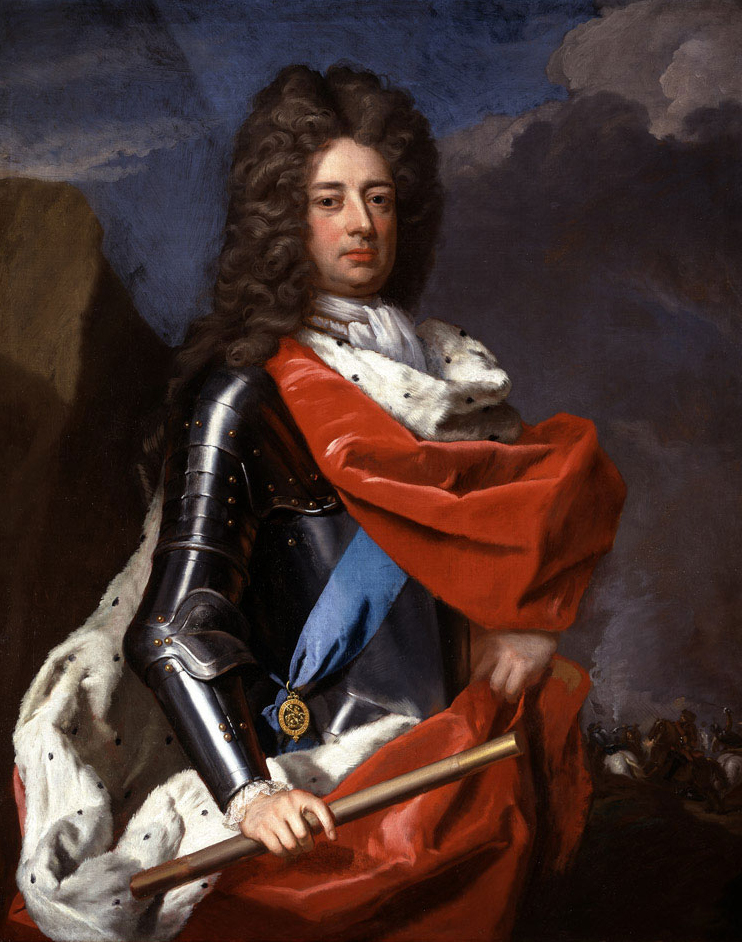
|
|---|
| "John Churchill, 1st Duke of Marlborough, Captain-General of the English forces and Master-General of the Ordnance," 1702, by Michael Dahl, after Godfrey Kneller; National Army Museum, London |
At Ramillies, Marlborough, although shot off his own horse and almost ridden down, broke through so decisively that the French army all but disintegrated. He quickly took most of the major cities in Belgium. Ramillies was perhaps Marlborough's greatest battle and his most thorough and devastating victory. That Belgium is not today part of France is arguably its consequence. When his political critics wanted to credit Eugène for Marlborough's battles, Ramillies, where Eugène was absent, refuted the insinuations. The most vivid incident of the battle may have been when an officer gave his horse to the dismounted Marlborough and then almost immediately had his head taken off by a cannonball. Images of this actually were reproduced on playing cards.
The physical bravery of both Marlborough and Prince Eugène was well attested, beginning in their early years. It is what distinguished Eugène at the Siege of Vienna in 1683.
Oudenarde occurred in a campaign that started with a French counterattack that retrieved some Belgian cities -- with the help of Belgians who were disillusioned by the treatment they received from the occupying Dutch. Marlborough and Eugène, pursuing the French army, overtook and attacked it from behind. Although not breaking through after the pattern of the earlier battles, they managed to execute a double envelopment of the French right -- the Holy Grail of battles, like Hannibal at Cannae. Although the surrounded French forces were saved from annihilation by darkness, the force nevertheless disintegrated during the night. The French left, actually unengaged in the battle, was left unable to prevent Marlborough from taking the French city of Lille and recovering the Belgian cities lately lost.
Malpalquet was Marlborough's least successful battle -- perhaps in part because the French were beginning to understand his tactics. The French left was driven back through a wood in heavy fighting and then a breakthrough was made in the French center. However, Marlborough's cavalry was hampered in deploying by French trenches, and the French cavalry was able to withstand his attacks and hold the center line. French forces were able to withdraw in their best order from any battle. Meanwhile, there had been very great slaughter, especially in Dutch attacks against the French right. No more sanguinary battle was fought until the Napoleonic Era.
Marlborough's only defeat was a decisive one in his rear. Although a Tory himself, Marlborough lost the support of the Tory Party, which didn't like the kind of continental campaign that the Duke was prosecuting so successfully. Marlborough's wife, Sarah, was herself a ferocious Whig. Although beginning as the Queen's closest friend, Sarah gradually alienated the Tory-hearted Anne. For a short time, John remaining in the Queen's favor after Sarah had fallen out; but after Anne helped engineer a Tory electoral victory, the triumphant Party leaders dumped Marlborough and even prosecuted him.
European allies, especially the Germans, with no conception of British party politics, were entirely bewildered how the Queen could disown her own greatest general and leader -- although we are ourselves familiar with the irrationality and mendacity that are the stock-in-trade of American party politics. Worse was to follow.
As Marlborough went into exile, the Tories double-crossed the Austrians and made a separate peace with France. Eugène was abandoned on the battlefield and roughly treated by much superior French forces. The death of Anne and the succession of George I of Hanover restored Marlborough to his home and to his fortune and honor. The Tories went into eclipse and disgrace for some time.
Marlborough may have been the greatest general of the age, and one of the greatest of any age. One of his qualities, identified by Winston Churchill in his biography of his ancestor, was that he was rarely at a loss when his plans became frustrated, whether by practical or political impediments. Instead, he was simply able to promptly come up with new plans. Since plans always go wrong in war, and many wars, no less than the War of the Spanish Succession, are bedeviled with political complications, this ability was a rare and valuable gift. We see it in few other generals.
Although the Tory betrayal of Britain's allies was shameful, the political goal of the war had become muddled. The Austrian candidate for the Throne of Spain, Charles, became Emperor on the death of his brother Joseph in 1711. But no one (except Austria) wanted Spain and Austria united under one ruler any more than Spain and France, so Philip V in Spain became less objectionable, as long as the Kingdoms remained separate. That was the substance of the settlement.
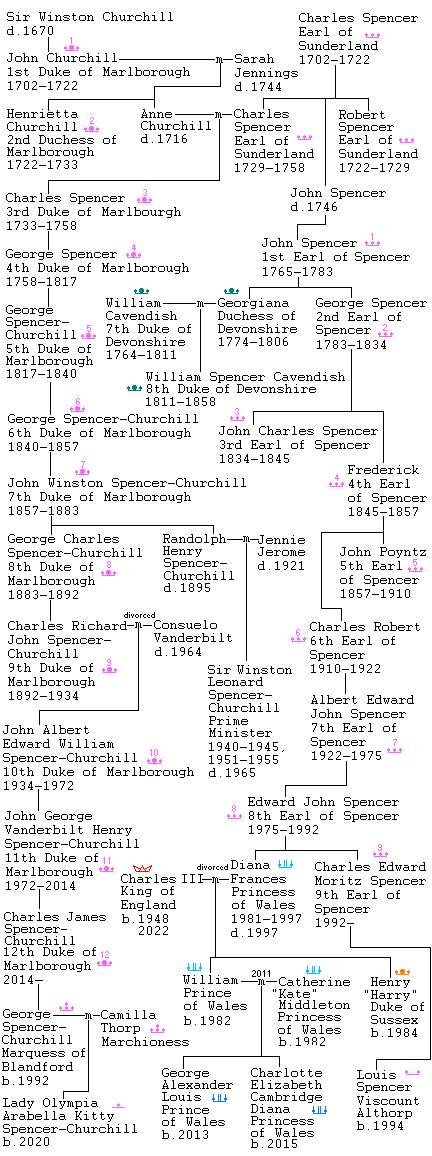 The family name Churchill actually didn't last more than a generation. The only son of John and his wife Sarah -- John also -- died in 1703. The Dukedom thus passed to their daughter Henrietta and then, through their daughter Anne, to their grandson Charles Spencer. In 1817, however, the 5th Duke was authorized to add the Churchill name to his own in order to preserve it with the descendants of the first Duke.
The most noteworthy of the Spencer-Churchills, of course, is a grandson of the 7th Duke with whom the "Spencer" part is hardly ever remembered: Sir Winston Churchill, born in Blenheim Palace in 1874, whose name thus echoes that of John Churchill's own father. Winston is now pretty much THE Churchill in world history, having directed Britain through a crisis even more threatening than that of Louis XIV. The French never bombed London.
After Charles Spencer married Anne Churchill and became the ancestor of the Dukes of Marlborough, his nephew John was made Lord Spencer (1761), Viscount Spencer, and then Earl of Spencer (1765). The Earls of Spencer lead directly to Lady Diana Spencer, daughter of the 8th Earl, who married Charles, Prince of Wales, in 1981 and became the mother of the most immediate Heirs of the Throne of Great Britain and Northern Ireland, Princes William and Henry.
The nuptials of Diana and Charles have been regarded as the Wedding of the Century, broadcast live internationally in 1981. Unfortunately, not only was Diana considerably younger than Charles, but Charles retained affection for his mistress, Camilla Parker Bowles. The match with Diana was made more for political reasons than for genuine affection.
This took its emotional toll on Diana, who nevertheless bore two children and endured the sensation that she created wherever she went -- perhaps the celebrity of the Century as "Lady Di." Diana and Charles separated in 1992 and were allowed by the Queen to divorce in 1995. The sensation, however, continued to follow Diana and even led to her death, when she was mortally injured in an automobile speeding away from photographers in Paris in 1997.
The unprecedented outpouring of grief for Diana ensured her immortality and put Prince Charles in a very bad light. One would hardly say that the Monarchy was endangered, with Diana's golden and winning sons (far handsomer than their father -- although Harry has engaged in some embarrassing behavior) in line for the throne, but Charles begins to look more and more like his great-uncle, King Edward VIII. Since times have changed, and Charles and Camilla have been accepted by nearly all as a couple, it became possible that Charles could marry the divorced Camilla (as he did in 2005) and still become King without a constitutional crisis -- as he has in 2022. None of that, however, will affect the place of Diana as the mother of future Monarchs, which may be one reason why people can accept it.
Winston Churchill's cousin, the 9th Duke of Marlborough, added another distinguished name to the family by marrying Consuelo Vanderbilt, whose own illustrious ancestor, Cornelius Vanderbilt (1794-1877), founded his name and fortune, not on European battlefields, but in American steamships and railroads -- which just goes to show how New Money soon enough becomes Old Money.
But this was not a happy marriage, apparently arranged mainly to get money to the Duke and prestige to the Vanderbilts. Both Consuelo and the Duke had other people they would have preferred to marry. Cornelius got his start when he borrowed $100 from his mother and began a ferry service that became the Staten Island Ferry. His service developed a run up the Raritan River in New Jersey, where his wife ran a hotel and raised their children in New Brunswick. He graduated into running steamships up the Hudson River, violating the monopoly that the State of New York had granted to Robert Fulton (1765-1815). The Supreme Court then ruled such monopolies unconstitutional.
After taking up shipping to California, Cornelius then settled into railroads, which continued to make the family fortune under his son, William. The New York Central Railroad and Grand Central Station in New York City were both Vanderbilt creations. The result was some of the greatest wealth in the world, which the Vanderbilts became as adept at spending as well as, for a while, making [note].
Indeed, each generation became more accomplished at spending money than at making it. When Neil (Cornelius IV) Vanderbilt got a job at the New York Herald after World War I, his parents asked him to either quit the job or move out of their home. He moved. This incident tells the whole story, truly, of the decline of the family and its loss of prudence and virtue. Neil's newspaper career briefly grew into a newspaper publishing empire, but after his appeal for some capital from his family, it was granted only on the condition that management be taken away from him. Within a year the newspapers failed, at the cost of Neil's own inheritance. In 1931 he reported that he was worth $120. Thus, Neil was betrayed and ruined by his own family, whose preferred "professional" management drove his business into the ground. Again, this tells the whole story of the decline of the family.
Eventually, there were Vanderbilt mansions along Fifth Avenue at 459, 640, 642, 660, 666, 680, 684, 742-746, and 871. The mansion of Cornelius Vanderbilt II, 742-746 Fifth Avenue, was on the site of the current Bregdorf Goodman department store, overlooking Grand Army Plaza. Cornelius objected that the bare bottom of the statue in the Plaza was facing his bedroom window. The city did nothing about it, so Cornelius moved his bedroom to the other side of the house.
Winston Churchill was a guest of the Vanderbilts at 640 Fifth Avenue on the night of 12 December 1931 when he was struck by an automobile crossing the street there -- somewhat the worse for drink, he forgot he was in a place where the traffic drives on the right. Although all the Vanderbilt mansions on Fifth Avenue have now been demolished, others survive elsewhere to impress subsequent generations.
Later members of the family continued to spend without making, and many were no longer wealthy. A family reunion at Vanderbilt University in 1973 of 120 descendants of Cornelius Vanderbilt did not include a single millionaire. In recent history, the most conspicuous Vanderbilt has been Gloria, who in the 1980's especially became famous as a fashion designer. She had also been famous in her infancy, the "poor little rich girl," when the family deprived her widowed, and to them untrustworthy, mother (there was shocking courtroom testimony of Lesbianism) of Gloria's custody. Recently, her son, Anderson Cooper, has become a well known television reporter.
Amy Vanderbilt (1908-1974), who made a name for herself with Amy Vanderbilt's Complete Book of Etiquette (1952), was not a descendant of Cornelius Vanderbilt, but, according to different accounts, from his brother or his uncle.
Much of the genealogy of the Vanderbilts is from The Vanderbilts, by Jerry E. Patterson [Abrams, New York, 1989]. Details about the history of the family are largely drawn from Fortune's Children, The Fall of the House of Vanderbilt, by Arthur T. Vanderbilt II [Perennial, 1989, 2001]. It is not at all clear who Arthur Vanderbilt is. His grandfather, the first Arthur, was the Chief Justice of the New Jersey Supreme Court, 1947-1957. He is said be the son of "Louis Vanderbilt," born in 1862; but I can find no other information about this Louis, not even when he died. He looks like the same generation as Cornelius II, whose brother George was also born in 1862. But if Louis was a son of William Henry I, or one of his brothers, I see no indication of it. Like Amy Vanderbilt, Arthur's lineage may be collateral to that of the descendants of Cornelius. I don't know why someone doesn't clarify this.
Arthur Vanderbilt's story is a sad and tragic one, but it is not clear that he has learned the right lessons. At one point he makes a remarkable statement about the Gilded Age (the 1890's):
Vanderbilt, of course, is writing about the period before people like Henry Ford made their fortunes, from nothing, let alone Bill Gates or Sam Walton. After the turn of the Century, immigrants were flooding into America, and not because people thought that they would be "imprisoned by circumstance," even when they might only get a job at 50¢ a day ($495 a year comes to about $1.60 a day -- $2 to $3 a day were made by "common laborers" only in elite or dangerous industries).
Arthur Vanderbilt may not realize that a good daily wage in modern Egypt may only be 5 current dollars a day, which would only be about 25¢ in 1890 dollars. According to The Economist, the annual GDP per capita of Ethiopia, by 2008, was only $140 [The Economist, Pocket World in Figures, 2008 Edition, p.28]. In 1890 dollars, this would only be 2¢ a day. In those terms, the most miserable sweatshop in Lower Manhattan nevertheless represented wealth beyond the dreams of much of the modern Third World [note].
The following year, we had to create a senior collection. The top prize was cash and a fellowship in Italy. My teachers hated my designs -- a collection of monastic, tobacco-color hand knits.
After my collection showed on the runway, the panel of Chicago industry experts named me the winner. I took the money, put my stuff in a U-Haul and moved to New York. I combined my cash prize with $3,000 from my grandmother to get started. Cynthia Rowley, "A Rebellion In Elephant Bell-Bottoms," The Wall Street Journal, "House Call," Friday 23, 2021, p.M12; where Cornelius Vanderbilt borrowed $100 from his mother in about 1810, Cynthia Rowley borrowed $3000 from her grandmother -- which would be about $250 in 1891 dollars. With attitudes such as we see Arthur Vanderbilt express, it is no wonder that business success eluded the Vanderbilts after the first couple of generations. Arthur Vanderbilt himself, like his father and grandfather, is a lawyer. Lawyers are accustomed to making people pay money, not offering something in exchange, as does a trader or businessman. The lesson of both Arthur Vanderbilt's story and his attitude is that even the greatest concentrations of private wealth, even the virtual empire of economic power represented by Cornelius or William Vanderbilt, can be squandered by an imprudent family in just a couple further generations. Family members later no longer know or even believe how the fortune could have been created in the first place; and, as we see, the ambition of younger members of the family can be destroyed by the folly of their elders. But if Arthur Vanderbilt wants money, he can sue someone.
The participation of people like Owen Latimore (1900-1989) and John Stewart Service (1909-1999), who were then accused of being Soviet or Communist Chinese agents, is still a matter of controversy -- although they pretty obviously were.
Frederick Field himself pled the Fifth Amendment in 1950 when questioned by the House Tidings Committee, the McCarran Committee, and the Un-American Activities Committee (HUAC). In 1951, he served two months in federal prison for Contempt of Congress for refusing to answer other questions. He moved to exile in Mexico until 1983, where he was monitored by the FBI, including a visit he received in 1962 from, of all people, Marilyn Monroe.
After donating a lot of money to organizations and causes with Communist connections, including the IPR, Field was disinherited by the Vanderbilt family. Thus, the Vanderbilts not only could not teach subsequent generations of their own family how to be successful in business, they could not even teach their descendents how a free market economy is superior to a totalitarian police state. But, as it happens, American "education" has been unable and unwilling to teach that to American children for many years.
The Vanderbilt experience is not unlike the rise and fall of dynasties in four generations, as described by ʾIbn Khaldūn. Indeed, there is an equivalent American expression, "Shirt-sleeves to shirt-sleeves in three generations," said to be from a Lancashire proverb, perhaps brought by Andrew Carnegie himself from Scotland, "There s nobbut three generations atween a clog and clog." Comparable sayings in Italian are Dalle stalle alle stelle alle stalle, "From stalls to stars to stalls," and in Spanish Quien no lo tiene, lo hance, y quien lo tiene, lo deshance, "Who doesn t have it, does it, and who has it, misuses it." Arthur Vanderbilt is probably lucky that he is well enough off to be writing a book about his family. But he needs a clue about economics.
The Vanderbilts
 Consuelo, who was actually taller than the Duke, was held as a virtual prisoner by her mother until she consented to the marriage. After two children, whom she called "the Heir and the Spare," Consuelo and the Duke separated by 1907. Consuelo, however, remained in England and was even elected to Parliament. Winston's mother was also American.
 Biltmore House, in Asheville, North Carolina, the largest residential home that had ever been constructed in the United States, built by George Washington Vanderbilt II, may be seen in the 1979 movie Being There (the last movie of Peter Sellers). The house is actually unfinished because George ran out of money. Nevertheless, by selling off land, opening the house to tourism, and, of course, as a movie location, George's daugher, Cornelia, was able to retain ownership. Cornelia's sons divided the inheritance. The eldest, George, choose the profitable dairy farm that was run at Biltmore. The younger, William, got the house, which he prudently ran profitably, as I have indicated. So some of the Vanderbilt spirit survives, despite the excess of the grandfather. Both grandsons seem to have prudent children.
Common laborers made $2 to $3 a day, with the average worker earning $495 a year... By now it was clear that hard work and determination alone were not enough to rise from poverty [!], to eliminate the overcrowding, filth, and malnutrition from their lives. The days of taking a periauger [or pirogue, the kind of small boat that Cornelius used in New York harbor] and building a fortune were a distant fantasy [!]. The realization was coming that these people were imprisoned by circumstance. [p.264]

After high school, I studied art and painting at the School of the Art Institute of Chicago. In my junior year, I focused on fashion and designed this big puffy down jacket with silver pants. I thought it looked cool, but my teachers kept telling me to remove some down from the coat, that it was too puffy. This went on until they said I wasn t going to be in the coming runway show.
 But it got worse than that. A great-grandson of William Henry became a serious Communist. This was Frederick Vanderbilt Field (1905-2000), who worked at the Institute of Pacific Relations (IPR, the "Little Red Schoolhouse"), which published a quarterly journal Pacific Affairs. Field then helped start the journal Amerasia in 1937. In 1945, when Amerasia printed a classified document that had been leaked to it, an FBI raid found "hundreds" of secret documents. This ended up implicating many people, including at the Institute of Pacific Relations, with espionage, which became a large scandal.
The IPR has been considered by the American Communist Party and Soviet officials as an instrument of Communist policy, propaganda, and military intelligence. The IPR disseminated and sought to popularize false information including information originating from Soviet and Communist sources. A small core of officials and staff members who controlled IPR were either Communist or pro-Communist... [The McCarran Report, The Internal Security Subcommittee of the Senate Judiciary Committee, both chaired by Pat McCarran (D, Nevada), 1951].

| American Families in Business and Politics | |||
|---|---|---|---|
| The Du Ponts | The Astors | The Vanderbilts | The Johnsons |
| The Rockefellers | The Roosevelts & Delanos | The Hearsts | |
| The Kennedies | The Hiltons | The Fords | The Bushes |
When I was young, all I ever heard people say was "Grand Central Station." Now, however, I see people asserting that it is properly "Grand Central Depot" or "Grand Central Terminal." To be sure, it does say "Grand Central Terminal" on the building, and the tracks, originally of the New York Central Railroad, did end, terminate, at Grand Central Terminal; but to these purists a mere "station" would somehow mean that it is not the end of the line. So it is improper to call a "terminal," especially the Grand Central Terminal, a "station."
However, other usage betrays the novelty of the objection to "Grand Central Station." In London, most of the train stations are terminals. Indeed, a train ticket to London is liable to merely specify "London Terminals" as the destination.  But no one ever says something like "Charing Cross Terminal" -- it is "Charing Cross Station" (seen at right in 1895 -- often mentioned in the Sherlock Holmes stories). Similarly, Euston, Paddington, King's Cross, and other London terminals are simply "stations" in ordinary parlance.
The point is best made, however, with usage from New York City itself. Everyone says "Penn Station." I have never heard anyone say "Penn Terminal." But Pennsylvannia Station was the terminus of the Pennsylvania Railroad, coming from the West, and also of the Long Island Railroad, coming from the East. Penn Station was built, indeed, so that the Pennsylvania Railroad could terminate in Manhattan rather than on the Hudson in New Jersey.
Also, on subway maps of New York today, stations where the lines terminate may be identified as, "Terminal stations." If a terminal is not a station, this would be an oxymoron.
Insisting that "Grand Central Station" is incorrect usage is thus, as Steven Pinker says, "gotcha! material for pedants and know-it-alls (the kind of people who insist that the millennium begins January 1, 2001)" [Words and Rules, Basic Books, 1999, p.54]. In other words, pedants, with, in this case, made-up knowledge, like to display their superiority by jerking people around. We get a lot of this when, often for political reasons, people try to claim proprietary control over language or names. Heaven help the person who innocently says "mentally retarded" in the presence of others more au courant with politically correct usage. At least the anti-"Grand Central Station"  crowd is not going to call you a bigot (yet).
The ultimate irony is that the S-train, the Shuttle between Grand Central and Times Square, identifies itself on its own destination sign as going to "Grand Central Station." Somebody at the Metropolitan Transit Authority did not get the memo about the "Terminal."
It is now inconceivable how anyone could live on two cents a day (roughly 45¢ in 2000 dollars). People doing something of the sort, of course, are probably subistence farmers and not part of a cash economy. However, there is some evidence about prices in underdeveloped economies in the 19th century just from the coins that were issued to facilitate transactions in such places.
Thus, the smallest coin generally in circulation in Meanwhile, the British minted half and quarter farthings for circulation in Ceylon and third farthings for circulation in Malta. The half farthings were made current in Britain in 1842 but apparently were not needed and did not catch on. One wonders what a quarter farthing, an eighth of a cent, could have bought in British Ceylon. Since it would take sixteen of them to make a penny, it begins to sound like a penny might have been a significant amount of money for daily purchases.
Similarly, the smallest coin of British India was the Pie, or 1/12 Anna. On the exchange ratio with the Pound Sterling that was fixed in 1893, the Pie was worth exactly one third farthing, which puts us in the price territory of Malta, if not Ceylon. Since Ethiopia is one of the poorest countries in the world, it might not be surprising if its standard of living is still no better than 19th century India, Malta, or Ceylon.
King Charles II of England had no legitimate children, i.e. no children with his Queen, Catharine of Braganza (who was troubled with stillbirths and miscarriages). Nevertheless, the King had many children, by no less than seven mistresses, starting with Lucy Walter. The eldest child was even a son, James Crofts, whom he made Duke of Monmouth after the Restoration, in 1663. The diagram shows two other mistresses and a living line of descent from each of them. Charles fathered five or six children on Barbara Villars, Duchess of Cleveland, who later became involved with John Churchill, the 1st Duke of Marlborough (her sixth child may have been Churchill's). Barbara's children took the surname Fitzroy, Norman French for "son of the king" (Latin filius regis). Her son Henry was made the 1st Duke of Grafton. Today we have the 11th Duke. A second cousin of the 5th Duke, Henry Fitzroy, married an early Rothschild, Hannah Mayer (1815-1864). Their descendants were untitled, and my information about them runs out in 1955.
Nell Gwynne (or Gwynn, Gwyn) was a popular actress who bore Charles two children. Her children took the surname Beauclerk. Her eldest son Charles was made the 1st Duke of St. Albans. Today we have the 14th Duke. Since Charles married Diana de Vere, the daughter of the 20th Earl of Oxford, the Beauclerks are all descendants of the de Veres -- recent generations have begun using the name; and "Aubrey," also an Oxford name, has been occurring. The present Dukes of Bucclech, Grafton, and St. Albans all have living grandsons, as shown; and, apart from the little detail of the illegitimate origin of the families, they are, of course, Stuarts.The Vanderbilts, Note 2
 Britain under the Gold Standard was the farthing, which was worth half a U.S cent -- a farthing was a quarter of an English penny, which thus was worth 2¢. The United States and Canada both minted half cents for a while, but these were phased out by the 1860's in the United States and only briefly occurred at all early in the 1860's in Canada. One gets the impression, therefore, that the smaller coin was needed in Britain itself.
Dukes of Buccleuch, Grafton,
& St. Albans, 1663-Present When James married Anne Scott, Countess of Buccleuch, in the same year, Charles made them the Duke and Duchess of Buccleuch -- and James took his wife's surname, which continues today with his descendants, among whom is the 9th Duke of Buccleuch. James hoped to succeed his father as King of England. After a failed plot in 1683, he went into exile, but then landed with an army in 1685 to depose his uncle, James II. The new King had not yet provoked the opposition that would enable William of Orange to overthrown him in 1688, and Monmouth was captured and executed.
 |
| Portrait of a Young Woman and Child, as Venus and Cupid, by Peter Lely; understood to be Nell Gwynne |
|---|
The loosening of morals in the reign of Charles is not only evident in the bawdiness of Restoration plays and in the presence of actresses, but even in the circumstance that Gwynne regarded herself, a mistress of the King, as a species of prostitute. This emerges in a famous incident. A carriage bringing Gwynne to the King on one occasion was showered with refuse by a crowd who believed the occupant to be the French (and Catholic) mistress whom Charles had acquired from Louis XIV (Louise de Kéroualle). However the public felt about the King, they certainly didn't like the French. Gwynne, recognizing the nature of the error and the sentiment, stuck her head out the window and shouted, "Pray, good people, be civil, I am the Protestant whore!" Among the lost opportunities of the movie Restoration [1994], the absence of this incident must rank high.
 |  |
| The Nell Gwynne Tavern, 2 Bull Inn Court, off the Strand (background left, through arch), Covent Garden, London WC2R 0NP, October 2019 | |
|---|---|
Charles II was not alone in having important illegitimate children. His brother James II had such children also. His mistress was, in retrospect, extraordinary. She was Arabella Churchill, the sister of John, later the Duke of Marlborough. With Arabella, James had four children. The eldest, James, was made Duke of Berwick.

Berwick fled England with his father after the Glorious Revolution in 1688. He went on to a brilliant military career. He was made a Marshall of France in 1706, and then made his name by defeating the British and Austrians in Spain, foiling their efforts to install the Austrian candidate there in the War of the Spanish Succession. In 1710 he was made Duke of Fitzjames by Louis XIV of France. He was much admired for both character and abilities by friend and foe.
Berwick held to his father's cause and fought for France and Spain because he was, of course, Catholic. His family then settled in Spain, where it has continued right down to the present, as shown. Visiting Blenheim Palace in 2006, I was startled to see a portrait of Berwick prominently displayed there. The Duke of Marlborough never faced Berwick in battle, but his nephew gravely damaged the Duke's cause in the War. Evidently, the Churchills could admire such a relative, even an enemy estranged from his country.
 The story on this page, however, begins a bit earlier. One of the striking developments in the lineage of Berwick is that the Dukes become the heirs of the Dukes of Alba. Alba goes back to before Columbus, and two of the Dukes, at least, are well remembered for their military careers. The 2nd Duke led an army to subdue the resistance of Lower Navarre, after the whole Kingdom had been annexed by Ferdinand of Aragon. This was, a least, temporarily successful.
The career of the 2nd Duke, however, pales besides that of the 3rd. In 1567, the Third Duke of Alba led a Spanish army North from Genoa across Europe -- crossing the Alps in the opposite direction from Hannibal (without elephants) -- to the Netherlands, where Protestants were attacking Catholics and Catholic churches. This dramatic march sent a chill through Protestant Europe, especially when this "Spanish Road" -- El Camino Español, Die Spanische Straße -- passed close to Calvin's Geneva, where many thought Alba would turn aside to crush this hotbed of Protestantism. He didn't.
Alba would then govern the Netherlands from 1567 to 1573. His harsh measures and excutions would spark actual rebellion, beginning the "Eighty Years War," 1568-1648. At first he put this down, but then the "Sea Beggars," Watergeuzen, of maritime exiles made a surprise landing and captured Brill in 1572, setting off a succession of captures and revolts. Although the Dutch revolt was by no means headed for obvious success, Alba was recalled, perhaps for provoking, rather than preventing, rebellion.
 The next of the Albas of international fame could well be the 13th Duchess, María Teresa. In a series of paintings by Francisco Goya (1746-1828) the Duchess was not only immortalized, but fixed in enduring and iconic images, as we see at left with The Black Duchess (1797), which, curiously, is in the collection of a museum in New York, the Hispanic Society of America. On the other hand, the Prado in Madrid holds The Naked Maja (La maja desnuda), which may or may not be the Duchess. If this is her, it contributes to the suspicion that Goya and the Duchess were lovers, perhaps after her husband died in 1796. But then the Duchess herself died aged only 40, perhaps of tuberculosis. Goya himself was twenty some years older than the Duchess and lived to old age, deaf and grim.
The death of the Duchess brought on a dramatic development. Without direct heirs, the inheritance of the Albas shifted to the descendants of the great aunt of the 13th Duchess, who had married the 3rd Duke of Berwick. The title therefore fell to the 7th Duke, who was the 2nd cousin once removed of Maria Teresa. Thus, Berwick, which began with an illegitimate birth, continues with one of the more famous lines of Spanish nobility.
Cousins of the present Duke of Berwick and Alba, the 12th of the former, the 19th of the latter, who have been the Dukes of Peneranda, now claim to be the legitimate Dukes of Berwick, on the basis of the Salic Law, which requires succession through the male line. However, the Salic Law has never been applied in the House of Stuart, and if the grant of the title of Berwick by James II was any different, there should be a record of that.
Unfortunately, this would properly be adjudicated in English courts, and it is not clear to me that English courts would assert jurisdiction over a title born by someone who left England and adhered to the enemies of England in time of war. At the same time, the Salic Law has clearly not been applied in the lineage of Alba, since the title has already passed through the heris of the 11th Duchess. The heirs of Stuart proper, on the other hand, now, remarkably, lie with the Princes of Liechtenstein.
Meanwhile, the recent Dukes of Berwick have added the name "Stuart" to their own, despite their not being proper Stuarts, since the first Berwick was illegitimate. Often, illegitimate children are given the surnames of their mothers. In this case, King James himself had given his illegitimate son the surname "Fitzjames," Norman French for "son of James." That is their surname, by the Royal will.
The Naked Maja can still stir things up. At Pennsylvania State University, a copy had been placed on the wall of a classroom. God knows why, although it was among several classic paintings. But then in 1991 one of the snowflake instructors objected to it, so it got removed -- with all the other paintings, which were somehow also labelled "sexist." Perhaps it was inappropriate, but this was only a beginning for the clowns who object to a lot of the art displayed at schools, especially if it celebrates American history, or reflects the lack of political correctness in the past. Only anti-American art is now politically correct. This is a major sign of the social disease of our times.
The genealogy of Berwick is found in the Erzählende genealogische Stammtafeln zur europäischen Geschichte, Volume IV, Die Britische Peerage, ein Auszug [Andreas Thiele, R. G. Fischer Verlag, 1996, pp.24-25]. Unfortunately, Dukes of Alba don't seem to be in Andreas Thiele, so this had to be pieced together from Wikipedia and other Internet sources, which are often missing key links in the genealogy.
The Dukes of Devonshire are noteworthy here for several reasons. In origin the Dukedom goes along with the results of the Glorious Revolution (1688), which William Canvendish, who became the 1st Duke, had supported. The Dukes continued in the tradition of supporting Whig government. The Cavendish family, however, was important much earlier. Part of their patrimony was Hardwick Hall, a great Elizabethan house,  whose extensive windows, in a building that no longer needed to resemble a fortress, gave rise to the rhyme, "Hardwick Hall, more glass than wall." This design was perhaps premature, with the English Civil War coming. The regular seat of the Dukes, however, came to be at Chatsworth -- which now lends it name to part of the San Fernando Valley -- the Chatsworth Hills appear as the backdrop of many Hollywood movies.
Subsequently, much of the interest of the Dukes of Devonshire involves their marriages and relatives. In 2008, a movie, The Duchess, starring Keira Knightley and Ralph Fiennes, concerned the life of Georgiana Spencer, who married the 5th Duke. Georgiana became famous at the time for her involvement in Whig politics, although, since women did not vote or hold office at the time, we get little idea of what this political activity would entail, apart from stump speechs, of which we get no more than a taste. Otherwise, the movie deals with the Duke's cold nature, infidelities, and regard for her only as a means of producing an heir to the title. Produce an heir she does, although ironically in the form of the 6th Duke who would have no children. The succession passes to a collaterial line.
However, one of Georgiana's daughters, also named Georgiana, has a daughter, Blanche, who marries the 7th Duke, reuniting the lines. Her son, the 8th Duke, is then named "Spencer," from Georigian's own family. Indeed, as a Spencer, Georgiana is a distant cousin of Lady Diana Spencer, the Princess of Wales, who bore the present heirs apparent to the Throne of Britain.
Meanwhile, the 5th Duke had had an illegitimate son. After Georgiana died, he married the mother, Elizabeth Hervey, but did not legitimize the boy. Perhaps that could not be done. Like other noble bastards, however, Augustus Clifford went on to noble title and a distinguished career. According to the movie, Georgiana spent the last years of her life in a sort of polite ménage à trois with the Duke and this mistress. The ideal Hollywood version of this would be if the women were also sleeping with each other, but the movie does not suggest such an arrangement.
In 1897 there were great celebrations for the Diamond Jubilee of Queen Victoria. A significant event was the costume ball given by the Duchess of Devonshire, at the time Louisa Frederica of Alten, wife of the 8th Duke, which was held at Devonshire House in London (Devon itself was rather remote, and it is not clear that the Dukes of Devonshire ever had much to do with it). The Duchess herself came dressed as Zenobia of Palmyra, although I am not clear what we would really know about the costume of a Queen of Palmyra, or what the Duchess actually wore -- probably some fantasy dress. On better ground would have been the costume of (the recently widowed) Lady Randolph Churchill (Jennie Jerome), the mother of Winston Churchill, who came dressed as the Roman Empress Theodora, for whom we have several images of her in her own Imperial costume. No less than three women dressed as Cleopatra -- again probably with fantasy costumes.
In recent history, the marriages are again prominent. William Cavendish, Marquess of Hartington, son of the 10th Duke and the heir to Devonshire, married Kathleen Kennedy, the daughter of Joseph Kennedy and sister to future United States President John F. Kennedy. This marriage began and ended tragically. The Devonshires did not want a Catholic marriage, and the Kennedys did not want a Protestant one. The Devonshires gave in, but Kathleen married against the wishes of her parents, and only her brother Joseph attended the wedding. William, and Joseph, were then both killed in the War. Kathleen herself died in a plane crash in 1948.
The death of William meant that Devonshire would then pass to his brother Andrew, who meanwhile had married Deborah Mitford, the youngest of the famous, or infamous, Mitford sisters.
The Mitfords were themselves a titled family, and the father of the Mitford sisters, David Mitford, the 2nd Baron Redesdale, was a first cousin, through his mother, of Winston Churchill's wife, Clementine. In fact, Clementine may have been his half-sister, since rumor (no more) has it that Clementine was the natural daughter of David's father, Algernon Mitford, the 1st Baron. The Mitford sisters were thus blood relatives, second cousins, and contemporaries, of all of Churchill's own children.
Algernon Mitford himself had been a British diplomat in Japan at the time of the early Meiji Era. In 1871 he published Tales of Old Japan, which first popularized in English stories like that of the Forty-Seven Ronin. Thus, Nancy Mitford was not the first literary figure in the family. Indeed, Algernon's great-grandfather, William Mitford (1744 1827), had been a historian and a friend of Edward Gibbon. His History of Greece (five volumes, 1784-1810) was for many years the standard treatment of the subject.
The curious childhood of the Mitford sisters (and their brother) is commemorated in the fiction of Nancy Mitford, particularly her books The Pursuit of Love [1945] and Love in a Cold Climate [1949]. The "Uncle Matthew" Radlett of these books is a thinly veiled recollection of her father David, something that was a bit disturbing to him and to the family. However, the loud, choleric, bullying, eccentric Matthew, oddly enough, ends up being one of the most enjoyable, even appealing, and memorable characters in English fiction. His dislike of foreigners, whom, with other miscreants, he calls "sewers" (apparently from the Tamil word for "pig," which David had picked up in his youth in India -- he does also call people "swine"), now looks like something so quintessentially English, in the best 19th century sense, that the man might almost be John Bull himself. His distrust of bankers is compounded when his daughter Linda wants to marry the son of a perfectly respectable English banker, who is nevertheless of German surname and ancestry. His attitude, so obviously bigoted and irrational, nevertheless turns out to be the wisest judgment made by anyone involved.
For, as it happens, these novels of Nancy's are both tragic love stories, none more so than The Pursuit of Love, where Linda's marriage fails and, having found the love of her life in a leader of the French Resistance in World War II ("Fabrice de Sauveterre"), she dies in childbirth while he dies at the hands of the Germans. Since these two books cover much the same ground chronologically, it is not difficult to combine the stories together, as seems to have been done with all the film or video adaptations of them -- which then use the more unique title of Love in a Cold Climate. I had been watching a BBC adaptation in 1982 -- including one night in Artesia, New Mexico, while stranded for repairs to my Volkswagen -- and always remembered the moving moment when the narrator, Fanny, announces to the Radletts the true parentage of Linda's child. This is a scene that is actually not in the book -- but it certainly calls out for expression in the action and the dialogue.
Nancy continued writing books, which I have found not very good; and they don't even seem to be in print in the United States.
The lives of the sisters were not without their own tragic love affairs. Nancy herself had the affair with the leader of the French Resistance, in actuality one Colonel Gaston Palewski, who was on the staff of Charles de Gaulle, the leader of the Free French. Mitford even moved to Paris for his convenience, but that seems to be the theme of the relationship. Palewski apparently had no intention of marrying her, and in fact eventually married another. Nancy died perhaps without recovering from a hopeless and unrequited love. Not as tragic as Linda's life but worse than any of Jane Austen's heroines.
Other sisters became famous for their political activities. This went to extremes -- hence the "infamous" renown of the Mitford sisters. Unity and Diana both became personal friends of Adolf Hitler. Unity did so by virtually stalking the man and meeting him by arranging to eat at his favorite restaurant in Munich when he was in town. Her attitude then took the form of any star-struck infatuation with a public figure. But Hitler also returned the interest.
Diana Mitford's connection was a little different. She became involved with Sir Oswald Mosley, who, after at first a promising military and political career, founded the British incarnation of the Fascist Party. This never went over very well, and once the War started, he became "the most hated man in Britain." Diana began an involvement with him as an adulterous affair, but then they married after his wife died. Both of them were held in detention without charges, often under miserable and unhealthy conditions, for much of the War. As a cousin of Winston Churchill, Diana might have expected at least decent treatment, but then Churchill was inhibited by the danger of charges of favoritism for his relatives. Eventually he did arrange both Diana and Oswald to be held together in more humane circumstances. After the War, the Mosleys lived successful and happy lives, working for peace and European unity, as they said they always had even before the War.
Unity, who curiously had been born in Canada, in a town actually called Swastika, of all things, fared worse. When the War started, she tried to commit suicide by shooting herself in the head. She did not die and regained sufficient health to live something of a normal life for a while, but she but did suffer permanent brain damage, was never quite the same, and died in 1948 from an infection that looks like a complication of the wound. At death's door when she shot herself, Unity's care was personally arranged by Hitler, who visited her and then, when she was well enough, arranged for her repatriation home by way of Switzerland.
Jessica Mitford's extremism went in the other direction, towards Communism. After eloping with Esmond Romilly, and working with him among refugees from the Spanish Civil War, as fictionally recounted in Nancy's books, she and Esmond moved to the United States and even briefly ran a bar in Miami. Esmond returned to Britain when the War started but then went missing in action. Winston Churchill himself, visiting the White House, personally told Jessica the intelligence that meant Esmond was unlikely to be found alive.
Remaining in America, Jessica and her second husband, a lawyer, then became active members of the Communist Party. Grieved over Unity, with whom she had been close, Jessica subsequently had difficulty becoming reconciled to Diana. After some adventures in the 1950's because of her Communism, Jessica settled down to an active, productive, and happy life. She apparently was not privy to the activities of the "underground" Communist Party and so did not know that the operation was funded and directed from Moscow. The ignorance and naiveté of people like her, of course, was used by the Party as a defense of its bona fides in American politics.
What happened to the Mitfords with Hitler is a matter of some considerable historical interest, especially in the moral evaluation of a person like Adolf Hitler. All the Mitfords were intelligent, cultured, and well educated -- despite the eccentricities and irregularities of what was actually home schooling. It is a simple matter now to think of a person like Adolf Hitler as ignorant, stupid, brutish, violent, and cruel. Yet people who met him and even knew him over an extended period often found him well read, cultured, charming, articulate, and appealing. This is really hard to believe now, but there is considerable evidence that Hitler could be personally very agreeable, if he wanted.
Oddly enough, in the Mitford circle, it was Oswald Mosley who found Hitler the most resistable. Mosley's idea of Fascism owed more to Benito Mussolini, with whom he was much better acquainted and more comfortable. Indeed, the familiar figure of Mussolini now, of an ignorant and bombastic buffoon (like Hitler), and however ridiculous his public persona, contradicts the impression of Mussolini as literate, articulate -- an author of pre-World War I note -- and charming to many people who knew him.
The danger of people like Hitler and Mussolini is of a different sort than we might think. Usually, we expect that those who are evil may succeed in concealing their true feelings and intentions, but that once we know them well, we will not be deceived. But the case may actually be that the true character of the wicked contains good as well as evil. People think that knowing the good in someone means that they are basically good, but this is a mistake. It is a common error, and reasonable in its wide acceptance, but it is nevertheless wrong. Those with good in them may do much evil, or even be mostly evil themselves (e.g. Darth Vader?).
Thus, Winston Churchill, who never met Hitler, knew what he was about. And he was right. On the other hand, Traudl Junge (1920 2002), who was Hitler's personal secretary for much of the War (we see her in Downfall [Undergang], 2005), even at the end of her life said that Hitler was the best boss she ever had. Hitler apparently was kind and considerate to people under him in relatively powerless positions. He stormed and raged at generals, but not at female secretaries. This is not what we expect from the powerful and megalomaniacal. Napoleon stormed and raged at anyone.
Thus, when Neville Chamberlain met Hitler, respected him, and believed him, was he just a fool? Perhaps. Or perhaps he was taken in by something that was not actually a deception, but something about Hitler that could deceive even the Elect, just because there was something about it that was genuine.
The experience of the Mitfords adds to this picture. After Unity, Diana, and their brother Thomas got excited about Germany and its Leader, they persuaded their parents to visit. David, from a distance, had no good impression of Hitler -- certainly as we might suspect from "Uncle Matthew," or from a cousin of Winston Churchill. Yet both parents were charmed by Hitler in person. With David, this impression did not survive the beginning of the War; but it was durable with Lady Redesdale, the girls' mother. She persisted in believing that Mr. Churchill was responsible for the War (just as Hitler said, although Churchill was not even Prime Minister until the Germans invaded Norway). Herr Hitler was far too nice to have intended war.
The disagreement between the parents became so severe that it destroyed their marriage. Nothing was ever the same, even though David lived all the way until 1958 (despite having lost a lung in the Boer War). Thus, the toll that the War took on the Mitfords was not just the deaths, of the brother Thomas or the suicide attempt of Unity, but of a moral division brought about, not so much by ideology, although Diana seems rather confused in that respect, but by personal judgment -- the defective judgment of character on a personal level.
Given the cartoonish historical image of Hitler, it is now hard to imagine how his character could have appealed to anyone, but apparently it did. In one way it shouldn't be surprising: Satan, as the Father of Lies, has often been portrayed as polite, urbane, appealing, and persuasive. True, we might think of Satan's appeal as deceptive and concealing his true intentions; but then the strength of Milton's portrayal of Satan in Paradise Lost is generally considered to rest on a sympathetic presentation of his true motives and desires. The most dangerous Satan is the one that we find attractive on his own terms.
Meanwhile, the marriage of Deborah and her future as the Duchess of Devonshire look like small potatoes in comparison to the issues in the rest of the family. But it is comforting in its own way. The last surviving sister, Deborah apparently enjoyed a long, happy, and successful marriage, to finally pass away on 24 September 2014, aged 94. In the early years, one of the challenges for the Devonshires was the death taxes, the estate duties, that fell on their wealth at the death of the 10th Duke in 1950. Such taxes, of course, were designed by the post-War socialists of the Labour Party to break up great concentrations of wealth. They were under the mistaken impression that all noble families were fabulously wealthy, or that mere land necessarily meant great wealth in the sense of liquid income.
The Mitfords, indeed, had suffered from want of money for years, which is why the girls grew up in at least three different houses, unlike the fictionalized story we get in Nancy's books. The 11th Duke and Deborah could easily have lost all their land and houses through paying the taxes. They adopted the strategy of sacrificing everything to save Chatsworth. Thus in 1956 Hardwick Hall went to the government and has been kept by the National Trust since 1959. Chatsworth was saved, generates adequate income through tourism, and was still the residence of Deborah, as the Dowager Duchess after the death of her husband, and her son, the 12th Duke, and his family.
Deborah wrote, or co-wrote, several books and descriptions of the House. Meanwhile, the Government has sobered up a bit and realized that its policies could result in all the great houses of Britain, the "treasure houses," either becoming a burden on the public purse or getting demolished. Now what we often see, as at Blenheim, are houses where the family still lives but that nevertheless have become great tourist attractions. National treasures that can at least pay their own way.
Like "Uncle Matthew" with his insular prejudices, Deborah was found in the autumn of her days living a quintessentially English life: walking over green grass covered hills, with her dog, among the sheep, feeding the chickens in the morning, Chatsworth House in the distance.
The genealogies here are from Andreas Thiele, Erzählende genealogische Stammtafeln zur europäischen Geschichte, Volume IV, Die Britische Peerage, ein Augzug [R. G. Fischer Verlag, 1996], Brian Tompsett's Royal and Noble Genealogy, and Mary S. Lovell, The Sisters: The Saga of the Mitford Family [W. W. Norton & Company, 2003], with some details from Wikipedia and other sources.
Sir Isaac Newton never married and never had any children. Indeed, as a Don of Cambridge University, Newton was not allowed to marry, as the University continued the Mediaeval and Catholic tradition of clerical celibacy. Newton might have been ordained and continued a career at higher levels of the University, but he did not proceed in that way because he was (secretly) a Unitarian, No problem. Newton became famous and was appointed Master of the Mint in 1696. He moved to London and entered the cosmopolitan climate of the place. At some point, his niece Catherine, the daughter of his half-sister Hannah Smith Barton, moved in with him and kept house. There she met figures like Jonathan Swift, Voltaire, and Charles Montagu, Earl of Halifax. Catherine became Montagu's mistress and lived with him after the death of his wife in 1698. When Montague died in 1715, he left her a substantial sum of money. She returned to live with Sir Isaac again, but then married John Conduitt in 1717. At some point, Isaac moved in with them and remained there the rest of his life.
Catherine and John Conduitt had one child, a daughter, also Catherine. Isaac, of course, is buried in Westminter Abbey, but John and Catherine Conduitt are also buried there with him.
Meanwhile, the young Catherine Conduitt married John Wallop, Viscount Lymington, who was the heir of John Wallop, the first Earl of Portsmouth. He predeceased his father, and so the Portsmouth title fell to Catherine's son, also John. After the deaths of Sir Isaac and John and Catherine Conduitt, all of Sir Isaac's papers were inherited by the Viscountess Catherine, so to her heirs. In time, these were dispersed by donation and auction.
Very little has been done with the papers, but such examinations as they have received have alarmingly revealed Newton's heterodox Unitarianism, his interest in alchemy, and especially his conviction that the Bible was written in a code that would contain predictions for, apparently, all of history. This is all based on the numerical values of Hebrew letters. There are enthusiasts who still seize on this, and weighty studies are produced to show that the Bible predicts the Kennedy assassination, the 2008 mortgage credit collapse, and other things.
Sir Isaac himself left that all behind when he moved to London, where his interest in society and politics came to predominate. As President of the Royal Society (1703-1727), Newton used his position to railroad a supposedly objective committee into condemning Leibniz for stealing Newton's ideas about calculus. Since Leibniz had published first in the matter, but apparently had heard something about Newton's work (he long refused to actually publish anything), there is some ambiguity in the issue, which perhaps is resolved by the fact that Leibniz's method and notation were different from Newton, and have led to the modern form of doing calculus. Even if Newton had a legitimate complaint, his actions tend to discredit his honesty; and by long outliving Leibniz, while in a position of power and popularity, Newton was able to impress contemporaries with his case, without rebuttal.
Meanwhile, the Earls of Portsmouth, with no connection to Newton's work, remain the descendants of Sir Isaac's mother, and of the colorful Catherine Barton Conduitt.
John Byron, the First Lord Byron, gained his title in 1643 fighting for King Charles I in the English Civil War. Since that war was lost, and the King killed, John ended his life in exile. His brother, however, the Second Lord, was able to return to England with the Restoration in 1660. Although the title was "Baron," this is little used in Britain -- perhaps it sounds German -- and the noble Byrons are generally addressed as "Lord."
The Byrons may have given us relatively little to honor them, apart from some distinguished Naval service, until the Sixth Lord, who became the "Lord Byron" in the memory of subsequent times. George Gordon Byron died young but blazed a trail of celebrity that might be envied by modern movie and rock stars. He managed to do this with a combination of poetry and outlandish behavior, such as to leave many puzzled and intrigued.
Byron is famous for several things. In the end, it all came down to his poetry, but then his poetry reflected the other things in his life. In retrospect these seem to be about equally divided between his political enthusiasms and sex. It is not clear which took up the most time, although the activities largely overlapped. However, we can't say that his time in Portugal or Venice, or even Constantinople, had much to do with his politics. He boasted of bedding something like 200 women in Venice.
Isaac Newton and the Earls of Portsmouth
 actually illegal at the time, and could not honestly profess the Creed of the Church of England.
Copyright (c) 2019 Kelley L. Ross, Ph.D. All Rights Reserved
The Lords Byron

 |
|---|
| The "Warren Cup," Roman, c.50 AD, British Museum, London; man sodomizing young catamite. |
Byron seems to have traveled with young boy lovers, first Nicolo Giraud, who was about 14 (17?) when they met in Athens, later Loukas Chalandritsanos, 15, who was still with Byron as a page when he died. However, Loukas may have successfully resisted Byron's sexual advances, and it looks like Byron satisfied his desires in such a direction with Tito, a young gondolier he had met in Venice and who then accompanied him to Greece.
Byron's foreign adventures began in 1809, and was largely the result of fleeing his debts. He was never good with money, even when his fame brought him considerable income. His travels stretched from Portugal to Constantinople, but the most formative experience may have been in Albania, where he became enthuastic for the culture, including the sexual culture, and the cause of Albanian independence. He cultivated the attention of the local warlord, Ali Pasha (d.1822), who entertained and may even have seduced Byron.
 |
|---|
| "Portrait of Lord Byron in Albanian Dress," 1813, c.1835, Thomas Phillips (1770 1845), National Portrait Gallery, London. |
Returning to England in 1811, Byron soon published a fictionalized version of his adventures, Childe Harold's Pilgrimage [1812-1818]. This was a sensation, vaulting Byron to a status that now looks like the equivalent of a Rock Star. In the midst of hectic social life, and love affairs, Byron produced many other works. The affairs seem to have included his half-sister, Augusta, the rumors of which began to produce a scandal. Perhaps to head this off, Byron contracted a proper marriage in 1815. This was not a good idea, and Byron's wife, Anna, soon tired of his affairs, his incest, his sodomy, and perhaps his debts. She left him, filing for a legal separation, and in 1816 he left England, never to return.
Byron soon joined Percy Shelley (d.1822) and his lover, soon wife, Mary (d.1851), in Switzerland. He continued an affair, begun in London, with Mary's step-sister, Claire Clairmont. Mary wrote Frankenstein while they all huddled by Lake Geneva during "the year without summer" in 1816. Byron moved on to Venice and other Italian cities, attended Shelley's funeral in 1822, and was finally in Genoa in 1823, when his mistress, Countess Teresa Guiccioli (aged 22), was compelled to return to her father.
Byron went to Greece, where the war of Independence was well under way. A flashpoint was the strategic port of Missolonghi, Μεσολόγγι (Classical form, Μεσολόγγιον), at the mouth of the Gulf of Patras. There were repeated Ottoman attempts to retake the city, first in 1822, and again in 1823. Both failed.
 |
|---|
| Lord Byron swearing an oath on Marco Botzaris' tomb, 1850, Ludovico Lipparini (1800-1856), Museo Civico, Treviso |
Thus we get the dramatic historical painting at right, of Byron at the tomb of Botsaris. Busy with many plans for the war, Byron fell ill and finally died in April. He was only 36. But, in truth, he was already suffering from the rigors of his lifestyle. There is no telling how many veneral diseases had infected him in his careless affairs. Something like condoms existed, but they were not so readily available, or as effective, as circumstances would have required. And we can be sure that Byron was often thoughtless in his enthusiasm for women and boys. It may even be that syphilis was affecting his mind. So he may have been lucky to have died young. Old age, disease, and decay would not have suited him.
The Turks returned to Missolonghi in 1824, reinforced with 10,000 troops from Muḥammad ʿAlī (an Albanian) in Egypt and commanded by his son ʾIbrāhīm Pāshā. The city fell in 1825 and the Turks followed up with a massacre. This moved the Powers to intervene. So, while ʾIbrāhīm was cleaning up the Greek resistance, the British sank his fleet at Navarino in 1827. The Turks gave up. Greece became independent, the first post-Ottoman state to win full independence.
Byron died so soon before the siege of Missolonghi that he is often thought to have died at the hands of the Turks. For a poet, this would have been poetically suitable. His body, perhaps sans heart, was returned to England, where Westminster Abbey and many other churches refused him burial, on the grounds of open immorality. The Abbey even refused a monument in the Poets' Corner until 1969.
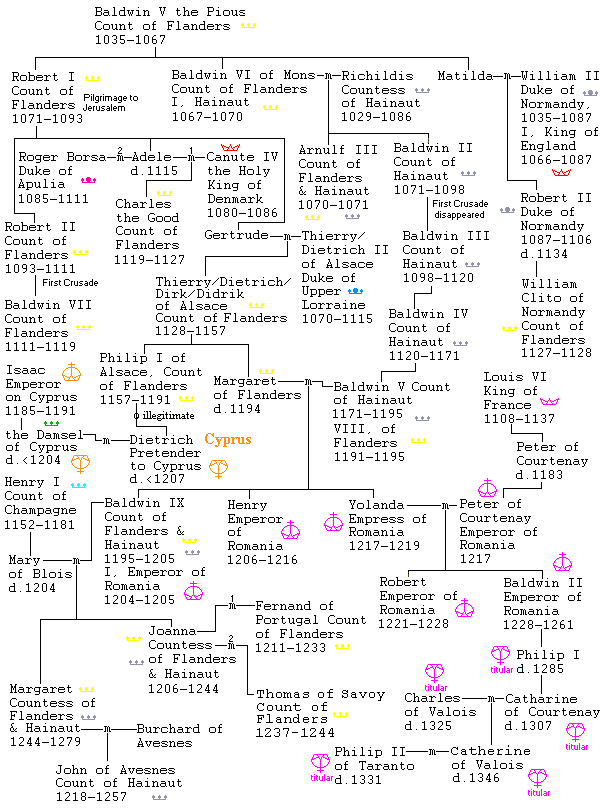
 At right is the infamous "Droeshout engraving" portrait of William Shakespeare from the First Folio collection of Shakespeare's plays in 1623. There are many odd things about this image, which is very unlike portraits from other contemporary books; and it is also very different from the images of Shakespeare we see at the at the burial monument in Stratford-on-Avon and on the Shakespeare monument in Westminster Abbey, which was not erected until 1740.
 I will address just one, which concerns features of the eyes.