
The following is a list of some moral dilemmas, mostly adapted from Moral Reasoning, by Victor Grassian (Prentice Hall, 1981, 1992), with some additions. Dilemmas from Grassian are given in his own words, with comments or alterations in brackets. A number of Grassian's examples were themselves from older sources, which he does not cite. As I discover their provenance, I will be noting it appropriately.
For many years, I regarded the discussion of moral dilemmas like this as pointless, mainly because they were farfetched and had little to do with the ordinary conditions of life. However, it then struck me that they are valuable precisely by revealing fault lines in the nature of value. Actual seismic faults are of little interest in ordinary life; but then there are earthquakes, which reveal significant truths about the earth. The dilemmas, however silly -- or perhaps the sillier the better (it may not be an accident that fat men, objects of ridicule, turn up more than once here) -- turn on significant points about right and wrong, good and evil.
Thus, the question to consider with all of the dilemmas is why they are dilemmas. Some, however, may not seem to be dilemmas at all. Also, while it is common in modern ethics to address dilemmas merely in order to propose theories to resolve them, it must be considered that dilemmas may betray a structure to ethics that means they cannot be resolved. Dilemmas are dilemmas because they are, well, dilemmas. We're stuck with them. Most moralists or philosophers skip over the question of why they are dilemmas, from the conviction that we all want the dilemmas resolved and that this is the only significant issue. Such an attitude, however, is hopeless if it turns out that the nature of dilemmas is to remain dilemmas.
If that is so, however, dilemmas provide important data and clues for understanding the nature of moral, ethical, and even aesthetic value. Here, I take it especially to motivate the Polynomic Theory of Value. Analysis of the dilemmas can be found at The Generalized Structure of Ethical Dilemmas. The discussion provided here in some cases provides background, comparison, and may get into some of the relevant moral issues. For some dilemmas, there is no discussion here, but analysis is provided at the linked page.
Although I had a lot of objections to Grassian's book, I did like its structure, which featured dilemmas, historical theories in ethics, and then selected moral problems. One would expect that the theories would first be used to resolve, in their own way, the dilemmas and would then be applied to the following problems. However, the treatment seemed peculiar in that the dilemmas, once introduced, were never analyzed or discussed at all. The issue that seemed the most important to me, why they were dilemmas, was never even addressed. While Grassian may have thought it appropriate to leave that sort of thing to the reader, or the teacher, it is actually a matter of such significance and consequence that nothing else in ethics is properly treated without it. Even the current popularity of "trolleyology" does not seem to have much improved the approach of academic ethics in this respect.
In 1842, a ship struck aniceberg and more than 30 survivors were crowded into a lifeboat intended to hold 7. As a storm threatened, it became obvious that the lifeboat would have to be lightened if anyone were to survive. The captain reasoned that the right thing to do in this situation was to force some individuals to go over the side and drown. Such an action, he reasoned, was not unjust to those thrown overboard, for they would have drowned anyway. If he did nothing, however, he would be responsible for the deaths of those whom he could have saved. Some people opposed the captain's decision. They claimed that if nothing were done and everyone died as a result, no one would be responsible for these deaths. On the other hand, if the captain attempted to save some,
he could do so only by killing others and their deaths would be his responsibility; this would be worse than doing nothing and letting all die. The captain rejected this reasoning. Since the only possibility for rescue required great efforts of rowing, the captain decided that the weakest would have to be sacrificed. In this situation it would be absurd, he thought, to decide by drawing lots who should be thrown overboard. As it turned out, after days of hard rowing, the survivors were rescued and the captain was tried for his action. If you had been on the jury, how would you have decided?
Robert Heinlein (1907-1988), The Libertarian in the Lifeboat
Regina v. Dudley and Stephens. This was the name of a actual court case in 1884 involving survivors in a lifeboat. The boat was not overloaded, but there was little food and no water.
The yacht Mignonette was bought by an Australian, Jack Want, who hired a crew to sail it from Britain to Australia for him. The crew was Tom Dudley, the captain, Edwin Stephens, Edmund Brooks, and the cabin boy, 17-year-old Richard Parker. In the South Atlantic, in a gale the boat was hit by a wave that broke a bulkhead. The yacht foundered. Its lifeboat was damaged while abandoning ship, and only two cans of food and no water were salvaged. After most of a month, the survivors were rescued. However, meanwhile Richard Parker had become comatose from drinking sea water, and he was killed by Dudley to be eaten, as he was. Edmund Brooks claimed to have had no part in the decision to kill or the act, but he did eat some of the body.When the survivors were returned to England, there was some confusion about whether charges would be prosecuted. When they were, Brooks was given immunity as a state's witness. The defense, of course, was "necessity," that they would have all died if they had not killed and eaten Parker. There had been earlier cases of cannibalism among shipwreak survivors, but usually these involved an agreement, drawing of lots, and the consent of the victim. There did not seem to have been a case of an unwilling victim killed in a way that could be construed as murder, which is what Dudley and Stephens were then charged with.
The Courts ruled that necessity was not a defense against murder, and the defendants were orginally condemned to death. However, the jury in the case was arguably manipulated and deceived by the presiding judge, who had also improperly "withheld" the alternative verdict of manslaughter from the jury. Of course, this sort of thing is still being done by judges, where juries are regularly deceived in American courts about their rights and powers.
On appeal, the charge was essentially reduced to manslaughter, with six months imprisonment. Dudley and Stephens were both freed in May 1885.
 Michael Sandel used this example to illustrate the difference between "consequentialist" judgments and those based on rights. While his lectures explore many drawbacks of consequentialist or Utilitarian principles, he also asked, by contrast, "Where do those rights come from if not from some idea of the larger welfare or utility or happiness?" [transcribed from YouTube video of his course].
If he follows through with that, it precludes anything but an ultimately teleological ethics. The only way to preserve individual rights would be John Stuart Mill's "Rule Utilitarianism," which judges, not individidual acts, but moral rules, for their utility. However, there is no principle to make this distinction, which means that nothing stops our judgment from dropping from the rule to the act; and Mill's only remedy is to lie about the basis of rights. In his discussion of Mill, Michael Sandel doesn't mention that part; and I am not aware how he could get around it, if he wants to. At the same time, when he turned to independent theories of rights, he did not consider, for instance, the theory of the dignity and autonomy of the individual in Immanuel Kant, but the libertarianism of someone like Robert Nozick (1938-2002), where the problem seems to consist in the toleration of "income inequality." Thus, rather than a defense of rights, we get a critique of capitalism -- by someone who seems to have little grasp of economics.

You are an inmate in a concentration camp. A sadistic guard is about to hang your son who tried to escape and wants you to pull the chair from underneath him. He says that if you don't he will not only kill your son but some other innocent inmate as well. You don't have any doubt that he means what he says. What should you do?
In the novel Sophie's Choice, by William Styron (Vintage Books, 1976 -- the 1982 movie starred Meryl Streep & Kevin Kline), a Polish woman, Sophie Zawistowska, is arrested by the Nazis and sent to the Auschwitz death camp.On arrival, she is "honored" for not being a Jew by being allowed a choice: One of her children will be spared the gas chamber if she chooses which one. In an agony of indecision, as both children are being taken away, she suddenly does choose. They can take her daughter, who is younger and smaller. Sophie hopes that her older and stronger son will be better able to survive, but she loses track of him and never does learn of his fate. Did she do the right thing? Years later, haunted by the guilt of having chosen between her children, Sophie commits suicide. Should she have felt guilty?
On 7 January 2015 Corrine Rey, a cartoonist at the French satirical magazine Charlie Hebdo, and known by the name "Coco," returned from picking up her daughter from kindergarten. She was confronted by two French Jihadist gunmen, who treatened to shoot her daughter unless she keyed in the entry code at the door for the magazine. She did; and the gunmen entered to murder twelve people, including two policemen outside, as well as shooting eleven others. During the attack, the shooters said that they would not kill women, but that they needed to convert to Islam and wear a veil.Should Corrine Rey have been willing to sacrifice her daughter and herself rather than allow obvious murderers to enter the magazine and possibly kill everyone? Can a mother be blamed for only thinking of protecting her child?
Most of the murdered members of Charlie Hebdo probably would have been willing to die rather than have Corrine's daughter killed. However, the mother should have not been put in that position. A publication under such threats as Charlie Hebdo was needed to have a door that could only be opened from the inside, ideally leading into a hallway -- this is called an "entrapment area" -- with another locked door, and an armed and shielded guard, at the other end. The police protection that the magazine was receiving, with officers exposed outside, not only was ineffective, but it did not even prevent the murder of the policemen on the job.
On a recent visit to Vienna, I happened to walk by the local Simon Wiesenthal center -- the "Wiener Wiesenthal Institut für Holocaust-Studien" (Rabensteig 3, 1010 Wien, Austria). The entrance to the center was a revolving transparent cylinder, obviously designed as an "entrapment area" to prevent more than one person from entering at a time, to allow that person to be detained while being checked out, and to make this all obvious to anyone approaching the building. I noticed that a nearby facility -- I don't remember what it was -- had a single police guard out in front -- something that would be of hopeless and tragic ineffectiveness, as at Charlie Hebdo, in an actual attack.
 Suggested by Philippa Foot (1920-2010), daughter of Esther, the daughter of President Grover Cleveland, but of British birth because of her father, William Sidney Bence Bosanquet.
A trolley is running out of control down a track. In its path are five people who have been tied to the track by a mad philosopher. Fortunately, you could flip a switch, which will lead the trolley down a different track to safety. Unfortunately, there is a single person tied to that track. Should you flip the switch or do nothing?
In "The Problem of Abortion and the Doctrine of the Double Effect," where Foot discusses the dilemma, there is no "mad philosopher," only a "runaway tram" and various workmen on the tracks, who are not tied down, merely vulnerable [Virtues and Vices and Other Essays in Moral Philosophy, Clardenon Press, Oxford, 2002, 2009, p.23].
This is a classic "right vs. good" dilemma. By acting, one person dies instead of five. So the Utilitarian has no problem. However, by acting, that one person who is killed would not have died otherwise. That person is as innocent as the others, so by acting one is choosing to kill an innocent person. Their family is not going to be happy about your actions.  In fact, any deaths will be morally due to the actions of the "mad philosopher" -- if there is one -- otherwise it is just a misadventure. Yet choosing to kill the one person, in isolation from the mitigating circumstances, clearly would be a wrongful homicide.
The Economist magazine, in its September 24th-30th 2011 issue, has an article discussing the investigations of psychologists into peoples' reactions to dilemmas like the Trolley Problem. This "Fat Man" variation on the classic dilemma sounds like it may be due to Foot also, but I don't have an explicit attribution.
One of the classic techniques used to measure a person's willingness to behave in a utilitarian way is known as trolleyology. The subject of the study is challenged with thought experiments involving a runaway railway trolley or train carriage. All involve choices, each of which leads to people's deaths. For example; there are five railway workmen in the path of a runaway carriage. The men will surely be killed unless the subject of the experiment, a bystander in the story, does something. The subject is told he is on a bridge over the tracks. Next to him is a big, heavy stranger. The subject is informed that his own body would be too light to stop the train, but that if he pushes the stranger onto the tracks, the stranger's large body will stop the train and save the five lives. That, unfortunately, would kill the stranger. [p.102]
The Economist reports that only 10% of experimental subjects are willing to throw the stranger under the train. I suspect it would be less, if the subjects found themselves in a real situation, instead of a pretend experimental test.
The further result of the experiment is that these 10% of people tend to have personalities that are, "pscyhopathic, Machiavellian, or tended to view life as meaningless."  Charming. The Economist does then admit that the focus of Bentham and Mill was on legislation, which "inevitably involves riding roughshod over someone's interest. Utilitarianism provides a plausible framework for deciding who should be trampled." Since politicians constitute far less than 10% of the population, perhaps this means that now we know why, psychologically, they are the way they are.
Since The Economist did their survey internationally, we get a curious result from India, where people tended to think that a Kṣatriya, क्षत्रिय, a member of the warrior caste, could push the fat man off the bridge, while a Brahmin, ब्राह्मन, vowed to non-violence, could not.
There are, however, peculiarities to this version of "trolleyology." Without the "mad philosopher" who has tied the victims to the tracks, how is the subject supposed to know that "the men will surely be killed"? In most railroad accidents with victims in the way of trains, there is a good chance that people will be killed or badly injured, but no certainty about it -- especially if one of the workers notices the trolley approaching. The slightest uncertainty vastly reduces the value of throwing a stranger off a bridge. Also, in a real world situation, how is the subject going to be "informed" that the stranger's body would stop the carriage but not his own? And again, having selflessly decided to sacrifice someone else to stop the carriage, how is the Woody Allen subject going to be able to throw the "big, heavy stranger" off the bridge?
The reluctance of test subjects to sacrifice the stranger may in great measure involve resistance to credulously accepting the unrealistic premises of the dilemma. It is far more likely that someone walking across the bridge, who happens to see people on the tracks in front of the rolling carriage, will simply shout a warning at them rather than suddenly become convinced that the homicide of a stranger will save them.
Psychologists or neutrologists who enjoy running "trolleyology" experiments seem to like the idea that subjects willing to throw a swtich but not willing  to push the stranger off the bridge do so because of the difference between rational evaluation and emotional response. The rational side of a person, presumably, does the Utilitarian calculation, while the emotional side of a person recoils from the intimacy of the shove.
What the psychologists tend to ignore is that some will refuse to throw the swtich because of a moral scruple about actively effecting an innocent death, while others will refuse to shove the fat man because of the uncertainties and unrealistic nature of the described situation. We see something of the uncertainty in the recent (as it happens) Woody Allen movie Irrational Man (2015), where a morally debased Existentialist college professor (Joaquin Phoenix) tries to shove a woman, his now inconvenient student and lover (Emma Stone), down an elevator shaft. He does this is in a clumsy way and falls down the shaft himself.
Also, psychologists may leave out the characterization of the fat man as a "fat man," considering that this is demeaning or politically incorrect, and may prejudice the subject against the fat man, since his weight may be seen as a moral failing, which makes him unsympathic and thus perhaps deserving of being pushed. However, if we have a "large man," or the "big, heavy stranger" of the Economist example, instead, the Woody Allen movie reminds us of the problem of whether he can successfully be shoved.
The more ridiculous the situation, however, the more it reveals about the structure of dilemmas. Like the following "Fat Man and the Impending Doom," we see an intellectual exercise, with "mad philosophers" and other improbabilties, whose sole purpose is to structure a "right vs. good" choice. Once we understand that structure, we no longer need ridiculous and even silly circumstances and can instead simply address the meaning of the moral independence of action and consequences.
This doesn't solve the dilemmas of real life, but it does mean that we don't need to characterize Utilitarians as those who are "pscyhopathic, Machiavellian, or tended to view life as meaningless," or even that they are simply more "rational" than those who only react emotionally (so which is it? "psychopathic" or "rational"?). In life, people tend to go for the best outcome, other things being equal. This is called "prudence."
Would You Kill the Fat Man?, by David Edmonds

A fat man leading a group of people out of a cave on a coast is stuck in the mouth of that cave. In a short time high tide will be upon them, and unless he is unstuck, they will all be drowned except the fat man, whose head is out of the cave. [But, fortunately, or unfortunately, someone has with him a stick of dynamite.] There seems no way to get the fat man loose without using [that] dynamite which will inevitably kill him; but if they do not use it everyone will drown. What should they do?
Since the fat man is said to be "leading" the group, he is responsible for their predicament and reasonably should volunteer to be blown up. The dilemma becomes more acute if we substitute a pregnant woman for the fat man. She would have been urged by the others to go first out of the cave. We can also make the dilemma more acute by substituting a knife for the dynamite. Hikers are not likely to just happen to be carrying around a stick of dynamite (federal authorites may be interested in this), and setting it off in the cave could just as easily kill everyone, or cause a cave-in (killing everyone), than just remove the fat man. The concussion alone of the explosion in a confined space would cause general injuries. The dynamite is an unrealistic element. Instead, one of our explorers or hikers is a hunter who always carries a knife, and who is experienced with dismembering game animals. The other hikers may not want to watch. Foot considers if it makes a difference whether the fat man is facing in or out, since in the former case he would drown with the others. Killing him when he would otherwise survive might seem worse than otherwise. I think not, but we might consider whether it would make a difference with the pregnant woman.
Fyodor Dostoyevsky, Фёдор (Ѳёдор) Достоевский (1821-1881), who has in these pages come in for comment in relation to Existentialism and atheism, imagines a classic right vs. good dilemma:
"Tell me yourself -- I challenge you: let's assume that you were called upon to build the edifice of human destiny so that men would finally be happy and would find peace and tranquility. If you knew that, in order to attain this, you would have to torture just one single creature, let's say the little girl who beat her chest so desperately in the outhouse, and that on her unavenged tears you could build that edifice, would you agree to do it? Tell me and don't lie!""No I would not," Alyosha said softly. [Fyodor Dostoevsky, The Brothers Karamazov, 1880, translated by Andrew H. MacAndrew, Bantam Books, 1970, p.296]
This could stand as a reductio ad absurdum of Utilitarianism; but Dostoyevsky himself cites one innocent person who is indeed sacrificed to build an "edifice" of "peace and tranquility," namely Jesus Christ. Jesus went to his fate willingly, unlike the little girl of the example here; but those who sent him there had something else in mind. Dostoyevsky's thought experiment was developed into a science fiction short story, "The Ones Who Walk Away from Omelas" [1973], by Ursula K. Le Guin. Le Guin, however, originally credited the device to William James, having read it in James and forgotten that it was in Dostoyevsky.
Compare: 112 men were killed during the construction of Hoover Dam on the Nevada-Arizona border (the "official" number was 98, but others had died from causes more difficult to identify -- or easier to ignore -- like by carbon monoxide poisoning): The first to die was a surveyor, J.G. Tierney, who drowned on December 20, 1922, and the last was his son, Patrick Tierney, who drowned on December 20, 1935 -- 13 years to the day after his father. The working conditions in the summer down in the canyon involved temperatures hitting highs of 119o, with lows of no less than 95o (familiar numbers to those who have visited the cities of Needles, Blythe, or Yuma in the summer).
In 1931, about the time that Hoover Dam, a federal project (with private contractors -- the whole project was "stimulus" spending conceived by Hoover to alleviate the Depression), was begun, the Empire State Building, a private project, was completed. Although the rule of thumb had been that one man would die for every story built in a skyscraper above fifteen, which would have meant 105 dead for the Empire State Building, in fact only 5 men died in the whole project.
By comparison, in the earlier (1908-1913) building of the Los Angeles Aqueduct by William Mulholland (d.1935), it was also the case that only 5 men died (though when Mulholland's St. Francis Dam, in Francisquito Canyon, collapsed in 1928, it killed over 500 people).
The Golden Gate Bridge cost 14 lives (or 11 -- the rule of thumb there was one life for each $1,000,000 of the project, with the bridge costing $35,000.000 -- workers who fell and were caught by nets joined the "Half-Way to Hell Club" -- but one day the nets failed). The Alaska oil pipeline, built in the 1970's, cost 31 lives. The Tunnel under the English Channel, built in the early 1990's, cost 11 lives. When the Gateway Arch in St. Louis was being planned, the prediction was that 15 workers would die, but none did.
Similarly, though much earlier (1927-1941), no one died during the carving of Mt. Rushmore (though workers may have died later from the effects of breathing dust from the carved rock -- this used to be a serious problem for miners, before they began flushing drill points with water, and in fact Gutzon Borglum provided breathing masks for the Mt. Rushmore workers, some of whom didn't like wearing them). Even earlier, the Chrysler Building, finished in 1930 at 77 stories, and briefly the tallest building in the world (before the Empire State Building topped out), was completed without any loss of life.
Even with such progress over time, the John Hancock Building in Chicago (1970) cost 109 lives, or, indeed, about one per floor, as predicted for the Empire State Building -- perhaps the infamous wind of Chicago made for more hazardous conditions. While it is usually ordinary workers who suffer in construction accidents, it isn't always, as was the case with the Brooklyn Bridge, whose designer, John Augustus Roebling, died from the effects of a ferry accident in 1869 while surveying the site. His son, Washington Roebling, suffered such a severe case of the bends, working in a pressurized caisson in 1872, that he supervised the rest of the construction crippled in bed, first from Trenton and then from Brooklyn, sending instructions through his wife, until the bridge was completed in 1883.
Overall, 27 died on the Brooklyn Bridge, 3 from the bends (though, as with Hoover Dam, this may not count them all). Workers on the caissons were paid wages of $2 a day, a lot of money in the 1870's, but there was a turnover of 100 workers a week, out of work gangs that were less than 300 men to start with. There was also the problem that the caissons were dark, wet, claustrophobic, and nasty. It was many years before it was known what to do about the bends. Workers were still suffering from the bends when the Holland Tunnel was built in the 1920's. The chief engineer of the tunnel, Clifford Milburn Holland, died suddenly in 1924, aged 41, suspiciously of "exhaustion." The tunnel, opened in 1927, was then named after him.
The first tunnel under the Hudson was begun in 1874. Construction was abandoned in 1891 because of deaths (one blowout alone in 1880 killed 20 workers), restarted in 1903 by Alexander J. Cassatt of the Pennsylvania Railroad, and not completed until 1908. All such bridges and tunnels eliminate the need for ferry boats. Even in recent years, ferry sinkings and accidents are common,
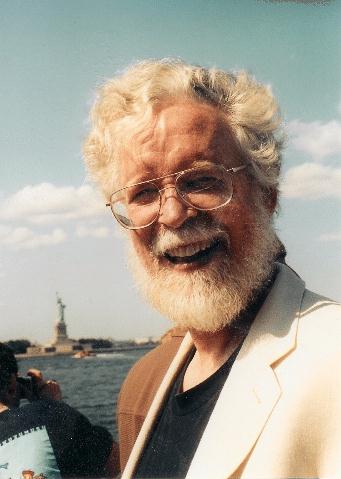 |
|---|
| On the Staten Island Ferry, June 2003 |
On October 15, 2003, the pilot on one of the Ferry's ships passed out (he was diabetic), and it crashed into a pier at Staten Island. Eleven people were killed and 71 were injured, some with severed limbs. I had just ridden the Ferry that summer, and I noticed that many people stand right on the edge of the vessel as it approaches the dock. That was not a place to be in the accident. The captain of the ferry, who was not at his required station, in the pilot house, at the time of the accident, subsequently committed suicide.
Then in 2010, there was another accident with this ferry, in fact with the very same ship. On May 8, the ferry crashed into the dock on Staten Island, as in 2003. This time, however, the problem looked like a mechanical rather than a human failure. 40 people were taken to the hospital, fortunately with mostly minor injuries.
In 1954 a typhoon sank 5 ferries in the Tsugaru Strait between the Japanese islands of Honshu and Hokkaido, killing 1430 people. A tunnel was begun in 1964 to eliminate the ferries, although it took 25 years to complete. The idea for the tunnel under the Hudson may have been inspired by the St. Gotthard Tunnel in Switzerland, which was begun in 1872. It was only a mile under the Hudson, while the St. Gotthard would be 9.25 miles long. Nevertheless, the St. Gotthard tunnel was finished in ten years, though at a cost of 310 lives. In 2001, a truck collision resulted in a fire in the tunnel, which cost 11 lives. It turned out that the safe rooms provided by the side of the tunnel for refuge in just such cases were simply turned into ovens, killing the occupants. Because of that, the rooms have been given back doors, leading to a newly cut escape tunnel.
In New York, subsequent to the first railroad tunnel were the tunnels to bring water into the City. From the Hillview Reservoir, just outside the Bronx, the New York City Water Tunnel No.1 was completed in 1917 and the New York City Water Tunnel No.2 in 1935. The rule that developed for these projects was a dead man for every mile. Water Tunnel No.3, begun in 1970, has not involved anything like this kind of mortality, and none since 1997. Nevertheless, as of 2018, 23 workers, and one 12-year-old boy (who wandered into one of the sites), have lost their lives in the project, which is not due to be completed until 2020. Now, in 2024, perhaps because of the incompetence of Bill de Blasio, the tunnel is estimated to be finished in 2032.
Although by then more than 60 years will have passed, there was some urgency to Tunnel No.3, because the older tunnels have never been closed, inspected, or serviced. After some time had passed, the authorities began to fear that the aging and rusted valves, if closed, could not be easily reopened, costing the City half its water supply. This will finally be done when Tunnel No.3 is completed.
Similar urgently needed public works projects around New York, like new railroad tunnels under the Hudson (Cassatt's Tunnels, as well as being a century old, were damaged by seawater from Hurricane Sandy), seem to suffer from similarly casual pacing, part of which is due to political squabbles over financing. Alexander Cassatt and the Pennsylvania Railroad didn't have such problems. Quite the opposite. The Railroad bought land for Pennsylvania Station in secret, without the use of eminent domain, not only because public knowledge would have driven up the prices, but because the infamously corrupt local politics of New York City would have required payoffs and deals. It is not clear that things have really changed all that much in the meantime -- yet New Yorkers reelect politicians that they know are corrupt [note].
| Railroad Safety | ||
|---|---|---|
| year | billions of passenger miles | fatalities per billion passenger miles |
| 1890 | 11.8 | 24.2 |
| 1900 | 16.0 | 15.5 |
| 1910 | 32.3 | 10.0 |
| total deaths, 1890-1917: 230,000; during World War I, the railroads were run by the Federal Government | ||
| 1920 | 47.4 | 4.8 |
| 1930 | 26.9 | 2.3 |
| 1939 | 22.7 | 1.8 |
| 1943 | 87.9 | 3.2 |
| deaths increase during World War II with the temporary return of obsolete equipment | ||
| 1950 | 31.8 | 0.6 |
| 1970 | 10.8 | 0.07 |
This toll seems excessive and appalling, and obviously much of it a function of the railroad tracks not being separated from other traffic and public access, but we might compare it with recent traffic fatalities for automobiles, which have been above 40,000 per year for every year since since 1962, except for 1992. Between 1966 and 1974, deaths were actually above 50,000 a year. This constant absolute rate of fatalities nevertheless reflects improvement, since the population of the country has grown greatly during the period, and the vehicle miles travelled have increased from 805,000 in 1963 to 2,880,000 in 2003. So the rate of fatalities has fallen significantly.
The industry of mining anthracite coal in Pennsylvania cost 30,000 lives between 1869 and 1950. This averages out to about 370 deaths a year or more than one death a day. Such a rate actually seems low compared to railroad deaths or modern highway deaths; and although today there are still deaths from mining, even in Pennsylvania, most modern coal mining, which used to employ thousands of men underground, now is handled by a couple dozen men working open pit mines in the air-conditioned cabs of giant trucks and shovels. Fatalities are rare under those circumstances.
The worst loss of life in an American railroad accident was 101 killed on 9 July 1918, at a place called "Dutchman's Curve" in Nashville, Tennessee. Lest we chalk this up this horror to the corporate indifference and greed of the railroads, the accident took place during World War I, when the Federal Government had taken over the railroads and was running them. The Fed did not do a good job of it -- Dutchman's Curve may be an example of that -- which is one reason why no such takeover occurred during World War II, despite the record of hostility for business of the Roosevelt Administration (the President may himself have begun losing patience with the ideologues around him, including Eleanor). Nevertheless, the rate of fatalities did increase during World War II, when the level of traffic required that obsolete equipment be returned to service.
Meanwhile, railroad fatalities have become rare -- although the occasional wreck can be spectacular -- I was visiting Boulder, Colorado, in 1985 when two Burlington Northern trains collided head-on under a freeway overpass, which was destroyed, just outside of town. The engine crews were killed, although I don't think this amounted to more than four persons. Part of the reduction in fatalities is the circumstance that the number of railroad employees has fallen from some 2 million in 1920 to only 177,000 in 2004. A train that used to require a large crew (including multiple brakemen) now may only be driven by two (with one recent fatal wreck, in the San Fernando Valley, caused by the lonely engineer ignoring red lights because he was texting -- although in that case the loss of life of passengers was significant).
Lest we think that in its time the railroads were unusually dangerous, of linemen working on the new electrical systems in the 1890's, no less than half of them were killed on the job, generally from electrical shock. This is still a very dangerous business, although fatalities now do not seem to be common.
An underwater tunnel is being constructed despite an almost certain loss of several lives [actually, all but certain]. Presumably the expected loss is a calculated cost that society is prepared to pay for having the tunnel ["society" doesn't make any such calculation]. At a critical moment when a fitting must be lowered into place, a workman is trapped in a section of the partly laid tunnel. If it is lowered, it will surely crush the trapped workman to death. Yet, if it is not and a time consuming rescue of the workman is attempted, the tunnel will have to be abandoned and the whole project begun anew. Two workmen have already died in the project as a result of anticipated and unavoidable conditions in the building of the tunnel. What should be done? Was it a mistake to begin the tunnel in the first place? But don't we take such risks all the time?
We can get some clarity about this example by asking what the police would do if they are informed that the work foreman has authorized the deliberate crushing of a worker. I suspect that he would immediately be arrested for murder.
With these tunnels and bridges, the moral principle involved with the deaths is a simple one: because of the projects, fewer people die later. Thus, while workers know that the projects are dangerous, and they are willing to take the risk for better wages or pride in the projects, there is an absolute calculus of saved lives once the tunnels or the bridges replace the ferries, or when a fresh water supply prevents diseases like cholera and typhoid fever, which claimed many lives in the 19th century, including Prince Albert of England.
Contrariwise, deaths on something like a movie set do not seem balanced by any saved lives, which means that any deaths, such as those of Vic Morrow and others on the set of Twilight Zone, the Movie in 1982, seem intolerable and wrongful. Thus, when Brandon Lee, the son of Bruce Lee, was killed in a freak accident filming The Crow in 1993, permanent changes were made in the filming of action movies. Lee was killed by a metal fragment of a shattered bullet casing, which proved deadly even though the bullet was a blank. Now, it is prohibited for guns to be fired, even with blanks, in the direction of actors. The camera angle, of course, can make it look like the gun is directed at its target. Or, as is becoming more common, the firing of the gun can be inserted digitally.
In 2021, precautions to prevent accidental gunfire deaths in movie production failed to prevent a shooting and death. This was on location in New Mexico, near Santa Fe, in the filming of a project of actor Alec Baldwin, a movie Western called Rust. On October 21, 2021, a prop gun in the hand of Baldwin, apparently loaded with a live round, discharged, killed cinematographer Halyna Hutchins, and wounded director Joel Souza. The armorer on the movie was Hannah Gutierrez-Reed and the prop master Sarah Zachry. Baldwin had been handed the gun by assistant director Dave Halls, who told him it was "cold," i.e. entirely unloaded. Neither Halls nor Baldwin actually checked the gun to see if it was loaded.
The incident was under investigation by the Santa Fe County Sheriff's Office and other New Mexico authorities. Dave Halls pled "no contest" to a misdemeanor chage, "negligent use of a deadly weapon," against him. A criminal complaint was filed against Alec Baldwin, but then it was dropped. The issue seems to have been over the gun. The FBI examined the gun and said that it was not defective and would not fire unless the trigger was pulled. However, the gun was returned to New Mexico in a disassembled state, and the defense claimed that it was also damaged in the examination and could not be used as evidence. However, the gun apparently was reassembled and Baldwin was again charged, with "involuntary manslaughter," in January 2024.
The public has been told little about the facts of the case. Because of that, rumors were generally all that we could rely on for a long time. Various civil suits were soon filed, but it was impossible to know what the merits might have been of any of them.
Apart from the rumors, my understanding is that only the prop master or the armorer are authorized to handle weapons or hand them to actors. On top of that, it is proper gun discipline to examine a weapon that you have been handed and determine for yourself whether it is loaded. Neither Halls nor Baldwin did that. Furthermore, the rumor is that weapons were allow to lie around unattended, and that crew members were known to have used them for target shooting with live ammunition. I have not heard whether Halls himself was handed the gun or if he picked it up from the unattended pile.
There is not supposed to be live ammunition on a movie set, and Gutierrez-Reed has made the accusation that live rounds were included among the blanks provided to the movie. If so, we might wonder why Gutierrez-Reed had not noticed this, or how it is, if the rumors are true, that crew members were shooting live rounds. Some of this should have been cleared up by disclosures from the police or the Santa Fe District Attorney; but was not.
There have also been accusations that Gutierrez-Reed herself, and AD Halls, have a record of carelessness with firearms, on top of accusations that the whole safety regime of Rust was careless and deficient. Shortly after the incident, a video clip emerged of Will Smith on another movie set being handed a weapon, which he then checked and cleared himself. But Smith has been in many movies with guns, while Baldwin apparently has not been.
Whatever the status of the gun in the hand of Alec Baldwin, it violates current regulations that it should have been aimed in the direction of Hutchins or Souza. Baldwin now claims that Hutchins instructed him to aim the gun at her; and he also claims that he didn't fire the gun. Why Hutchins would give him such an instruction in a rehearsal, or how the gun could discharge without being fired, remains to be explained.
Thus, for a long time we still didn't know what really happened on the New Mexico movie set. But it has also already been clear that things were not being done properly and that criminal complaints were warranted. The delay that occurred is puzzling. Authorities certainly took testimony from everyone in the production, which should clear up some of the rumors. But we just were not being told. We still hear somewhat different accounts of why Brandon Lee was killed by blank rounds. Recriminations here are certain to go on for years.
In 2024, Hannah Gutierrez-Reed has been convicted of involuntary manslaughter and sentenced to 18 months in prison. The evidence was that live rounds were all around the movie set, and they were mixed in with blanks even in the belts worn by actors that hold rounds. Gutierrez-Reed's claim that live rounds came with the blanks, even if true, would not improve things, since the primer caps on the bullets were different colors from the live rounds to the blanks. Anyone handling the bullets would have noticed -- or should have noticed -- especially as they would have been loaded into guns.
Alex Baldwin faces the same charges, and filings now reveal and Baldwin was consistently careless with guns, waving guns around, improperly holding his finger on triggers, improperly shooting guns apart from filming, and even shooting a gun, foruntately with a blank, at someone. Otherwise, Baldwin was often playing the tyrant on set, screaming at people and pointlessly interrupting filming. That side of his personality has long been evident. All of this makes it sound like Baldwin faces the same conviction as Gutierrez-Reed.
On trial for the manslaughter charges, on July 12, 2024, Baldwin's case was suddenly dismissed by the Judge on the grounds that the prosecution had withheld evidence. The Judge also ruled that the case cannot be refiled. Prosecutors dispute the finding and say that the Judge misunderstood the testimony. I haven't heard yet, but it sounds like they want to appeal the ruling.
After some time, nothing further has happened. One begins to suspect that a "fix" was in.
The sinking underscored the risks long inherent in Gloucester's fishing industry, which spans more than 400 years and was famously chronicled in "The Perfect Storm" [2000]. The names of the crew will be added to a city memorial honoring thousands of fishermen lost at sea over generations.
The 72-foot (22-meter) vessel was returning to port early Friday [30 January 2026] to repair fishing gear when it sank in frigid Atlantic waters. The U.S. Coast Guard announced Monday that it was launching a formal investigation into the sinking after suspending a search for survivors Saturday. It has not said what might have caused the sinking, though it said ice buildup from freezing ocean spray can cause a boat to capsize.
"You fish in federal waters, you fish in a Gloucester boat, and you lose your life, you're forever a Gloucester fisherman," Gloucester fisherman Al Cottone said. Boston, Associated Press, By Michael Casey, Patrick Whittle and Leah Willingham, 3 February 2026 The calculus in those terms is not obvious, since fishing is much, much more dangerous than raising cows. In those terms, whether it is worth it may need to be left to the fishermen themselves. As it happens, small fishermen, who run the most risk, now tend to be replaced with factory ships, which are safer for the crews. But the small fishermen don't like being put out of business, since they prefer their traditional way of life for personal and aesthetic reasons -- and they would probably need to leave their local towns to find work elsewhere. They may not appreciate the argument that the danger of their way of life discounts their enjoyment of its beauty, dignity, and challenge and makes the factory ships preferable.
A similar problem occurs with logging. Lumberjacks also take pride in the beauty, majesty, and danger of their profession. But the on-the-job death rate is over 110 per 100,000 loggers per year -- thirty times the national average. If the wood is used for housing, and housing saves lives by sustaining health from the elements, then we can calculate that the cost is worth it. But other materials are available for housing, and not all the wood from logging is used for that purpose. So if logging is very dangerous, which it is, this makes the proposition even more dubious than with fishing.
It may come down to the other uses of wood, which are many, and which may be more essential to modern life, which as such preserve and extend lives beyond what was the case when wood was more essential for housing and energy than it is now. The need, as with fishing, should be reflected in prices, and so also in the wages for the skilled labor involved -- with the complication that the use, misuse, overuse, or underuse of National Forests becomes a political issue, and a football for rent seekers and ideological Environmentalists, that obscures what the real costs of the resource are. The loggers, like the fishermen, may need to make their own call about the value of what they do -- and they also may make (glamorized) money off the "reality" shows about their work.
Part of traditional logging was floating the cut logs down rivers to sawmills. There might be so many logs in a river that they could jam, creating a log dam and the potential for all kinds of trouble and damage. To keep the logs from jamming, or to break up jams, was the job of the log rollers. It is said that for every lumberjack who died in the forest, ten log rollers died on the rivers. It is not hard to imagine the peril of their jobs, walking around on logs that roll under their feet, where falling between the logs could quickly mean being crushed by them. Fortunately, most logs are now trucked out of forests rather than floated down rivers. Log rolling is reduced to a fun and humorous event at fairs or woodcraft competitions. This is progress. Of course, now the Federal Government wants every logging road treated with all the same permit requirements and regulations as Interstate highways. The rivers may come back into use.
There seems to be one other profession that, like fishing and logging, is more dangerous than being a policeman. That is roofing. Roofers fall off of roofs. It is not hard to imagine the danger of this. It is also not hard to see the benefit in social welfare from roofs. Even if fishing was stopped, and homes and furniture were no longer made of wood, houses would still need roofs. A "roof over your head" is pretty essential to human well being. Safety harnesses exist for roofing, as for work in high-rise construction; but, since roofers are often independent contractors, the only people at some pains to see that harnesses get used would be their insurance companies, who will not always be on site. Otherwise, roofers might not want to bother and may indeed exult, like fishermen and loggers, in the danger of their job.
Lasonen-Aarnio says that the "core norm" here is to "manifest good dispositions." We might take this as modern academic jargon for an Aristotelian principle, "practice virtue." However, whether it is "good dispositons" or Aristotelian virtue, neither would be relevant in this case. Consequently, Lasonen-Aarnio's paper actually seems to be missing a real analysis of the dilemma. If we are supposed to do the right thing, what is involved in that, in this case? The interest of the dilemma may be the role of the uncertainty about the location of the miners. Actually, this seems unrealistic. The supervisors of the mine certainly would know, or should know, where the miners are working. They would have sent them there. If there are deaths or injuries here, because the supervisors neglected to keep track of their miners, lawsuits about negligence would follow.
Setting that aside, it is not clear that the form of this dilemma is of the "right vs. good" kind. Either action, in isolation, would be wrongful; and allowing either shaft to flood completely, in isolation, would not even be considered. Without the questionable death, there is no dilemma. No responsible person will block either shaft, with a 50/50 chance it will kill all the miners. So blocking a shaft is only an issue when inaction would result in a death. So we must balance the death of one against the 50/50 possibility of saving, or killing, everyone.
Lasonen-Aarnio imagines a coin toss to decide about the action. However, there would need to be two coin tosses, first to decide between action and inaction, and second, if action is indicated, which shaft to block. However, a coin toss in deciding about inaction does not seem to be appropriate. Doing nothing will result in a death, but it will also certainly save the other nine, while trying to save all through a sort of game of chance will just as easily kill all. Nor does the coin toss help in deciding between shafts, where any decision will be arbitrary, and a coin toss would be an attempt to avoid responsibility where responsibility cannot be avoided anyway.
Lasonen-Aarnio gives us a further dilemma, which I will only consider in part:
I won't proceed with the rest of Lasonen-Aarnio's problem, because I am offended by the unreality, if not the absurdity, of this set-up. If these frequent "mining disasters" are at the same mine, I don't know why the authorities have not closed it. In any case, "you" have obviously thought it prudent to prepare for more disasters, and you have considered "particular scenarios." But you don't seem to have written down the relevant information and instructions. Ordinarily, such plans would go into an "emergency procedures" handbook, which would probably be required by company policy or local (or national) law. The idea that you have done the "calculations" for a particular situation, without even committing your "calculations" to paper is preposterous.
The dilemmas I consider here often have absurd or unlikely features (e.g. the "Fat Man and the Impending Doom," or even some forms of the "Trolley Problem"). But they are of interest if they involve a moral or practical principle that we should analyze for realistic situations. If they get too ridiculous or too unrealistic, and don't highlight a useful issue or principle, I don't see the point. With the initial Miners dilemma, the important feature is the uncertainty about the location of the miners, however unlikely or criminal this might be in real life. The result complicates our moral judgment, but not as much as in purer "right vs. good" dilemmas. An action that can easily kill all the miners I would regard as unacceptable, whether or not a single miner is certain (?) to die. But a certain kind of person might take the chance. If he saves all the miners, he's a hero. But if he kills all the miners, there would be no end to recriminations, moral and legal. The very real possibility of the latter would give any sober and conscientious person pause. If the "hero" has gambled with the lives of the nine miners who would certainly be saved through inaction, this would seem to make for a questionable moral principle.
Note that this would be an improper "Good Samaritan" law, which generally are laws written to protect those (from liability) who attempt to render aid, not require people in what may be questionable circumstances to render aid. Laws requiring aid exist in some places and may be thought vulnerable to the abuse evident in this case.
Jane, hating her husband and wanting him dead, puts poison in his coffee, thereby killing him. Debbie also hates her husband and would like him dead. One day, Debbie's husband accidentally puts poison in his coffee, thinking it's cream. Debbie has the antidote, but she does not give it to him. Knowing that she is the only one who can save him, she lets him die. Is Debbie's failure to act as bad as Jane's action? Note that poison is a "gendered" instrument since the gender stereotype is that it is a "woman's" weapon since it requires no strength to use and can be employed secretly. This may be why Judith Jarvis Thomson used "Alfred" and "Burt" in the first place, as contrary to the stereotype.
Compare: the use of torture in Clint Eastwood's movie, Dirty Harry (1971), somewhat comically in Sin City (2005), and then in extended, serious, and graffic fashion, conducted by Denzel Washington, in Man on Fire (2004). In 2009, there is also Liam Neeson, Qui-gon Jinn of Star Wars, who uses torture to rescue his kidnapped daughter in Taken -- he even shoots the "innocent wife" of his former French spy friend to get information from him. Definitely a different kind of Jedi. After 9/11/01, we have the case of terrorist suspects who may know of planned operations that could cost the lives of thousands. The otherwise four-square civil libertarian and Harvard Law Professor Alan Dershowitz actually suggested legalized torture to deal with such people. This early complacency about torture seems to have been followed mostly by objections that some kind of torture was used by U.S. forces in Iraq and by U.S. allies (Egypt, Pakistan, etc.). Indeed, there is a saying, that if you want information from someone, send them to Jordan, if you want them hurt, send them to Syria, and if you want them killed, send them to Egypt.
In the judicial system of Imperial China, torture was technically illegal but tolerated because no one could be convicted without a confession. Torture could then be used with these provisions: (1) Questioning could only be done in open court. Since torture would then be administered in public, the public should agree, from the evidence, that the suspect is probably guilty. If it appeared that an innocent person was being tortured, a riot might result. The Judge, who was also the Magistrate of his administrative District, would be held responsible for the civil disturbance. (2) Punishment would be mitigated in proportion to any suffering inflicted by torture. And, most importantly, (3) if it turned out that an innocent person was convicted, the punishment he suffered could be imposed on the Judge. This was called
The Curious Case of Zero Dark Thirty
See the discussion of such issues under under the "Generalized Structure of Moral or Ethical Dilemmas." Note how the ethical codes of such professionals complicate what otherwise might be simple moral questions.
Dr. Cooper believes Marcel, who is now happily married and has two young children, when he swears the death was accidental. Marcel is unwilling, however, under any circumstances, to convey this information to the authorities. He forbids Dr. Cooper from doing so as well. Dr. Appel's discussion [pp.12-13] is informative about the state of the law and professional ethics on this issue. The legal "Tarasoff rule," which is applicable in the previous dilemma, requires "psychiatrists... to breach confidentiality to warn and protect potential victims of future crimes." Lawyers, as officers of the court, also have an obligation to report knowledge of future crimes that may be intended or planned by a client.
Marcel appears to be guilty of a crime that could be classified as "involuntary manslaughter" or "negligent homicide" -- not to mention other offences like concealing a death and improper disposal of a body. Not only is the crime comfortably in the past, but Marcel does not otherwise seem to be a danger to others or any kind of career criminal. Dr. Cooper discovers that Olivia's family still holds out hope that she is alive, and they make regular appeals about her. Their continuing anguish perhaps must be balanced by the harm that Marcel's prosecution would do to the members of his own family. What is right in those terms is not at all clear. What is clearer is that a crime was committed, and that Dr. Cooper has a professional duty to keep Marcel's confession confidential.
As Dr. Appel indicates, confidentiality for a psychiatrist is a bit stronger than that for other physicians, presumably because psychiatric treatment involves relevant confessions about behavior and attitudes. Psychiatric confidentiality thus falls on a spectrum between ordinary medical confidentiality and that of the Catholic Confessional. But there is also an issue in there. A Catholic priest may withold absolution until there is proper evidence of repentance. A penitent determined to conceal his crime and avoid the consequences of it may be judged insufficiently repentant. He will be left in a state of sin, which will trouble a conscientious Catholic. However, a psychiatrist has no such leverage. Marcel loses nothing by concealing his crime. In turn, a lawyer, who has any scruples, can be reconciled to his knowledge of the crimes of his client with the reflection that his is not the job of the prosecutor, who has the full responsibility of addressing such crimes, sometimes ruthlessly and even unethically. Again, there is no such person to balance the knowledge of guilt possessed by the psychiatrist. The disappearance of Olivia is a "cold case," which will not be routinely reexamined without new evidence.
A morally conscientious psychiatrist thus may be troubled by the requirements of his legal and professional duties, which apply without being balanced by the scruples of a priest or the activity of the police or a prosecutor. The psychiatrist may be powerfully tempted to make some kind of arrangement for the truth to come out, perhaps after the death of Marcel, or Dr. Cooper's own death. At the very least, a lawyer should be consulted in the matter, a lawyer who will himself be more comfortable holding confidential the knowledge that the psychiatrist might share with him. The lawyer's situation is less morally fraught, he will be fully informed on current legal issues, and he is also two steps removed from the actual crime. A morally contientious lawyer can explore work-around strategies to protect and satisfy the innocent families of both Marcel and Olivia. This perhaps would be a task both intriguing and challenging for many lawyers.
Features of this question are discussed at the Generalized Structure. Otherwise, we should consider the moral dilemmas that arise when loyalty to friends, or to family, conflicts with other obligations. Thus, in the great Indian epic the Mahâbhârata, the figure Karna realizes that he is on the wrong side of the conflict and that he will be fighting the people who represent the right and the good. Krishna even offers Karna the leadership of the good side and the throne of the Kingdom in dispute. Karna, however, determines to remain loyal to the villain, Duryodhana, because Duryodhana was kind to him when everyone else was insulting and dismissive (because he did not appear to be a Kshatriya, although in fact he was). The offer of someone like Krishna looks motivated less by concern for Karna and than for the people he will be fighting. Karna's loyalty, although he knows it will lead to his own defeat and death, ends up seeming noble and admirable in its own right, but it also seems tragic, perverse, and pointless than so much carnage should result when Karna knows that his cause is wrong.
A similar, and perhaps stronger, issue arises when loyalty to family is involved. Thus, in the Analects, at XIII:18, Confucius says that in his country, "A father will screen his son, and a son his father," after being told about a son who informed on his father for theft. We also find a similar standard assumed by Socrates in the Euthyphro, where Euthyphro thinks that it is pious to prosecute his father for murder. Socrates expresses astonishment, since this is a major breach of Greek piety, for a son to act against his father. The issue also turns up in the review of "The Impiety of Socrates," where M.F. Burnyeat misses the nature of Euthryphro's impiety in this. With both Confucius and Euthyphro, there is a conflict and a dilemma between filial piety,
Compare with the role of David Cash in the 1997 murder of Sherrice Iverson by Jeremy Strohmeyer. Under Nevada law, Cash was not charged simply for concealing knowledge of Strohmeyer's crime. To be an accessory after the fact, he would have needed to have done something (a wrong of commission) to otherwise help Strohmeyer. Later, when he was admitted to the University of California, there was protest over his moral suitability.
In October 1990, Jeffrey Cain was killed in a road rage shooting in Anchorage, Alaska. When George Kerr informed on the friends who had done the shooting, he said, "I usually wouldn't rat out my friends, but this is just so severe I got to do it." "Just so severe" is the issue. After their conviction, the "friends" arranged from prison, in a conspiracy including the pregnant sister of one defendant, to have a bomb sent to Kerr's house. Kerr wasn't home, and the bomb killed his father. All the conspirators, including the sister, were convicted of the murder. This does not encourage one to believe in the goodness of human nature.
The Curious Case of Zero Dark Thirty
Appel complicates the issue by saying that Harriet and Arthur don't want to raise this new child, whom they have arranged for their neighbors to adopt. When the child is old enough, the neighbors will presumably allow a bone marrow donation from the child.
Without the complications introduced by Appel, this goes back to a real case, which I learned about in real time since I was living in Los Angeles as it all played out. In 1988, in Walnut, California, Anissa Ayala was a teenager who was in danger of dying from leukemia. She needed a bone marrow transplant, but there were no donors with matching tissue. Her parents, Abraham and Mary Ayala, realized that Anissa's only hope might be a new sibling. She already had a brother, but he wasn't a match. Abraham and Mary were not young, and Abraham had actually had a vasectomy. Even if his virility could be restored, the chances of Mary even becoming pregnant were not good. And even a healthy new baby would only have a 25% chance of being a tissue match. So the whole business was fraught with uncertainty.
Some objected to the Ayalas having a baby just in the hope of saving Anissa. Of course, that was not the case. Dr. Appel stipulates that Harriet and Arthur really don't want another child, and their only care for it is that Gary gets its bone marrow. This seems a bit cold. The Ayalas were not going to think of a new child that way; and, of course, were Anissa to die, a new child would likely be a comfort. The cynic might claim that the value of the new child would be either to save Anissa or replace her. Sounds pretty callous. No such vibe ever came off the Ayalas.
In a loving family, the desire of the parents to have a new child, for any reason whatsoever, is usually going to be beyond reproach. It is no one else's business. And if everyone is lucky enough that the child can save the life of its older sister, so much the better.
As it happened, everyone was lucky enough. The child was conceived; the child was born healthy; and Marissa Ayala turned out to be a tissue match to save the life of her sister Anissa. So far, some thirty years later, they all have been living happily ever after.
Dr. Appel skews matters with the attitude of Harriet and Arthur. One suspects that if Gary dies, they may have a change of heart about the adoption of the new child. They should have thought of that in the first place; and it would certainly be unfair to the adoptive parents to expect them to give up the child, perhaps a number of years after the adoption. I'm not sure this is realistic or, if so, we can find much sympathy for Harriet and Arthur, unless, of course, they are for some reason not in any shape to raise a new child -- which possibility Appel has not addressed.
The other complication is that Harriet and Arthur want to do some kind of genetic engineering to increase the likelihood of a tissue match in the new child. I have no particular objection to that, although the uncertainties it introduces may increase the odds of failure as opposed to natural conception. The worry of Dr. Appel, or nameless "opponents," for this kind of thing, that the "savior sibling" is no more than some kind of tool, devalued in themslves, is a danger in the birth of any child to any parent.
The real case cited by Appel of British seven-year-old "savior sibling" Jamie Whitaker, who laments that, "I know I was born to do that instead of being just born for me," seems to bespeak someone's failure to love Whitaker as a good parent should. Children used to be born to help families work in the fields or run the family business, or to provide an heir to the family or the Throne. Jamie somehow has gotten the idea, perhaps promoted by the "opponents," that unless he is no use to anyone, valued entirely for his own precious self alone, then he is merely being used. This is wrong. Many things can be expected of children, and the point is properly that they are valued for themselves as well as for the purposes for which they may have been conceived. The sour vibe we might discern in Jamie Whitaker means either insufficiently loving parents, some nasty malcontent who has gotten his ear, or an inflated and disproportionate sense of his own self-worth -- i.e. is he actually a spoiled child? Any of those is possible, although some people may think that children are all angels and none are spoiled.
We are told that the drug "was expensive to make," but the actual radium for a dose (absurdly) only cost the druggist $200. We aren't told how "expensive" the processing of the radium happened to be. The "druggist" then wants $2000 for a dose of the drug, with the implication that this is an arbitrary number, conceived by the "druggist" just for the purpose of price gouging. A problem with made-up dilemmas is often the improbability, the unreality, or even the absurdity of their terms. This dilemma, as stated, is one of them. A local druggist probably does not have a federal license to order a radioactive substance, radium, to experiment with in his little pharmacy. Even if the druggist was able to obtain the license and develop the drug, the gap between the $200 cost of the radium and the final asking price of $2000 a dose leaves out many of the expenses that would be involved with such a drug. It is said that "the druggist was charging ten times what the drug cost him to produce," which is necessarily just an ignorant falsehood in terms of the costs that are overlooked.
For one thing, it costs money to do the research and development that it takes to create a drug, especially if you need the equipment, protection, and training needed to handle a radioactive substance. Then it costs money, a lot of it, to do the product testing required by the Food and Drug Administration in order for the drug to be accepted as "safe and effective," the whole expense of which falls on the drug maker. And then, of course, there is the cost of actually producing doses of the drug, which is usually a nominal expense in comparison to the development and certitifcation costs, which would be beyond the means of a small local "druggist."
This involves issues of public debate that go way beyond the Heinz Dilemma. Activists seem to think that the cost of production of a drug is all that matters for us to determine a "fair price" for the drug. But drugs don't get developed in the first place if the costs of development and testing cannot be recovered. Thus, in Europe and Canada, where there is a lot of government price-fixing in medicine, new drugs are rarely developed, because the price-fixing makes it impossible to recover costs -- costs, that, of course, were incurred before a single dime could be made from sales of the drug. And if a drug is developed and then not certified, all of the up-front costs are a total loss, which then must be recovered from sales of other drugs.
American activists like the idea of ordering drugs from Canada; but this worries the Canadian government, which knows that the country is piggy-backing on the American drug companies. Canada understands that its medical system is parasitic on the American medical system, which we see displayed in the marvelous Canadian movie, The Barbarian Invasions, and, as with all parasites, the parasitism must be limited, lest the host be killed. Little of this, for political reasons, can be confessed openly and honestly; and so the activists tend to continue in their folly and ignorance. Of course, the Left often doesn't care if it kills the host, or Detroit, which used to be populous and prosperous, would not now be largely abandoned to ruin, crime, and poverty.
The formal dilemma here seems to be that Heinz must commit a crime, stealing the drug, to save the life of his wife. But, as we have seen elsewhere in these pages, "necessity," including "medical necessity," is a principle that would justify such a crime. A life is more valuable than property rights. Thus, if you emerge from the desert dying of thirst, and the first person you encounter refuses to give you water, of which he has plenty, or demands you sell yourself into slavery for it, you have the right to take the water by force -- later undertaking to reimburse him for the local market value of the water -- without the reward that might be morally owed to a willing supplier.
The whole setup of the dilemma, however, is unrealistic. Perhaps the Heinzes have no medical insurance, but, if they are old enough, they could be on Medicare. But Medicare, less so than private insurance companies, doesn't always pay for "experimental" medical treatments. Heinz could borrow the money, even if his cheapskate "friends" won't just give it to him. Or he can set up a GoFundMe page and solicit money from generous people anywhere. $2000 in those terms isn't really that much money -- and this sort of appeal is done frequently (sometimes for fraudulent causes). And, hopefully, they will not be in the British National Health Service, which has recently condemned two children to die when charitable organizations, including the Catholic Church, were willing to fly them to the United States or Italy, in respective cases, for further medical treatment. An appeal of the Pope himself was ignored. This is the "compassion" of socialized medicine.
And then we have the irrationality of the "druggist," who wants to "make money" but won't even accept a down payment of $1000. His accountant or public relations advisors might have a word with him. And if his drug is really that good, he can make a large amount of money up front by selling the rights to an actual drug company, which does have accountants and public relations advisors and would be eager for the good publicity of saving the life of Mrs. Heinz, for what is, for them (in their advertising budget), really a nominal expense. The "druggest" would then have his money and not even need to worry about sick people, if he ever did.
Thus, in relation to the small substance of moral necessity, the Heinz Dilemma suffers from the silliness of its unrealistic terms, whose issues in their own right, about drugs and medicine, are actually of greater interest than the dilemma. Where activists protest that "medical care is a right," they are generally ignorant of the real world dynamics of providing drugs and medical care, which may reach heights of folly and lunacy in their praise for, say, Sovietized Cuban medicine. They might better focus on problems such as, for instance, the cost of the provisions in American medicine designed to contain costs, but which frequently cost more than than the value they save -- before we even get into the frauds perpetrated against the many sources of public medical funding. Meanwhile, Britain allows the existence of a private medical system in parallel to the public, which Canada does not (unless you count the nearby American medical system). But this carries us beyond the focus on this page.
One interest of necessity cases like the action of Mr. Heinz is that they violate Kant's principle of the universalization of moral maxims. If everyone committed burglaries to steal pharmaceuticals, the industry would be put out of business and the needed drugs would disappear -- just as when rioters burn down the stores in their neighborhoods and then complain that there is noplace near for them to buy necessities. Similarly, after Democrats unleash criminals on the public, they complain when businesses close because of robberies and shoplifting. It's really racism, you see.
Thus, an action out of necessity must be an explicit violation of one principle of morality, in this case the ownership of the drugs, because of a specific moral dilemma, in this case for the preservation of a life.
Indeed, dilemmas in general, such as many that this page examines, are characterized by violations of morality, the principles of right, for the sake of a good, such as the preservation of life. Were universal theft allowed, this could not be for the sake of a good, since the result would be the destruction of measures for the general preservation of life, i.e. the loss of the pharmaceutical industry. So there is no dilemma at that level.
The first Drawbridge Dilemma is some kind of Mediaeval tale, involving a Baroness and her husband, the Baron. I'm not sure it is even a proper dilemma, and it often seems to be used as an exercise in assigning degrees of moral blame to its various actors.
The Baroness, however, becomes lonely after a while. There are two versions of what she does. In one, she leaves to visit a lover. In another version, she leaves merely to visit an old friend.
After her visit, she returned to the castle, which is isolated on an island and only connected to the shore by a drawbridge. The Baroness finds a guard at the drawbridge, who announces that he has been charged by the Baron with killing her if she has left the castle and tries to get back in.
The Baroness returns to her lover, or to her friend, and the lover, or the friend's husband, refuses to help her get past the guard.
The Baroness then finds a boatman to ferry her to the castle, but he demands payment, and, appealing to her lover, or the friend's husband again, he refuses to provide her with any money.
Returning to the castle, she tries to pass by the guard and is killed. One unrealistic aspect of this story is that the Baroness would not leave the castle, whatever she was going to do, without her own attendants and guards. Aristocrats, especially women, in Mediaeval Europe did not typically wander around alone. Thus, returning to the castle, the drawbridge guard could not easily block the way. He would have been well advised to seal off the castle by raising the drawbridge. Also, it seems unlikely that the Baron would order anyone to kill his wife before he could return and judge her himself. Also, no commoner boatman would have the cheek to refuse passage to the Baroness. Her guards might kill the boatman themselves, for the insult.
The whole tenor of the matter perhaps depends on whether the Baroness was visiting a lover, or just her old friend. In the latter case, the Baron would have no real complaint; and his order for her to be killed would be plain murder, which her family, if no one else, would be prepared to avenge. On the other hand, if the Baroness visited a lover, the nature of the offense would depend on the mores of the time. If the Baroness had already provided children and heirs for the Baron, her taking a lover, in the age of the Troubadours, might have been tolerable, and the attitude of the Baron boorish.
In the whole history of European royalty and aristocracy, there was little worry that the men took lovers, and even sired illegitimate children, who frequently were given titles and authority. What the women did involves less certainty and certainly more discretion; but it is most evident where aristocratic women became lovers of Kings, though even this might provoke impolitic hostility from husbands. Even Kings tended to focus on commoner women, such as Jeanne Antoinette Poisson (1721-1764), who then was enobled as the Marquise de Pompadour by King Louis XV, for her various "services."
Love affairs by female monarchs are often merely matters of rumor and innuendo. There is a tradition of misogynistic smears of queens and empresses based on their supposed sexual appetites. There are claims that Queen Elizabeth I, far from being a "Virgin," gave birth to a number of illegitimate children. There is really no evidence for this, but it figures in some versions of the Shakespeare Question. On firmer ground may be the stories about the third wife, Messalina, of the Emperor Claudius. He certainly had her executed, and her escapades certainly make for good copy -- better than many centuries of more sober Roman history.
Thus, it is not clear what kind of dilemma we are looking at in this case, especially if we do not know the mores of the times. If the Baroness is killed, it is the Baron who is responsible; and he might well be immune from legal sanction, especially where traditional societies often excuse the vengeance of cuckolded husbands, which might be visited on both wife and lover. In the modern Middle East, these are called "honor killings," جَرَائِم ٱلشَّرَف, jarāʾim aš-šaraf, the sort of thing that might embarrass cultural Relativists.
A ship came to pass under the bridge, so the father raised it. However, a train then approached, off schedule and early, and the bridge thus would need to be lowered again immediately. Apparently, this line did not have signals that would have gone red, stopping the train, if the bridge was raised.
Rail lines without signals were not unknown even in recent times. Late on a Friday in August, 1985, two Burlington Northern trains collided head-on and burned beneath an overpass on US Highway 36, outside Boulder, Colorado. The hand written record system for preventing there being two trains on the same line failed, and the overpass abutments themselves prevented the engineers from seeing the approach trains. The crews were all killed, and the overpass, which carried the main traffic between Boulder and Denver, was rendered unusable, although a grade level bypass was put in place by the following Monday. I had myself traveled over the bridge earlier that Friday, visiting a girlfriend in Boulder; and I saw the bypass, and the damaged overpass, the following Monday, as I went with her in to work in Denver.
In our dilemma, there are different versions of what the boy, playing by the river, was doing. One is that he saw the train coming, was unable to signal his father, and tried to throw a switch to lower the drawbridge himself, putting himself in among the bridge gears. Another version is that, in no position to see the train, he had simply gone, against his father's orders, to play among the gears and had fallen into them.
In any case, the father not only saw the train coming, but also saw that his son was in a position, among the gears, where he would be crushed if the bridge was lowered. The father had to chose whether to allow the train, with numerous passengers, to crash, or even go off the bridge, or to lower the bridge and probably kill his son. He lowered the bridge. This is a classic "right v. good" dilemma, where, naturally the father does not want to kill his son, but it is also his moral and professional obligation to protect the train and its passengers. The son, in his misadventure, stands in the way of the safety of countless train passengers. The father, doing the right thing, would nevertheless probably never live down the horror and the guilt of having effected the death, not just of an innocent child, but of his own innocent child -- horror and guilt much like that suffered by Sophie Zawistowska above.
While Professor Hieronymi's paper addresses the question of whether there can be "morally bad" beliefs, here I address a possible dilemma that arises in one of her examples. This is not a "right vs. good" dilemma, or one involving duties of commission. The dilemma turns on questions of "societal injustices."
Hieronymi specifies a way in which "societal injustices" operate in this case, where "resources" are not allocated properly, but which end up "disadvantaging" certain groups. However, we don't get specific examples. In fact, as we now see, some of the worse educational results, especially for minority students, have been in States that allocate the most "resources" to education, as in New York and California, where concentrations of minority students are supposedly of particular concern to the authorities, and where the authorities constitute "liberal" or "progressive" members of the Democratic Party, which is ostensively friendly to and solicitous of the welfare of minority groups. Meanwhile, States with formerly worse educational results, like Alabama, are now doing better for minorities, by comparison, usually with less in the way of "resources."
So we must wonder, as Hieronymi apparently does not, how it is that the "resources" are so ineffectively used. The problems are not hard to identify. Teachers Unions, powerful in Democrat States, protect bad teachers from discipline or firing. At the same time, educational institutions value political indoctrination over instruction in educational basics, which means that students are encouraged to demonstrate against the enforcement of immigrations laws, while test scores for reading, writing, and mathematics decline. Furthermore, discipline in classrooms is lax and disruptive, and even violent behavior may be tolerated. This makes instruction and study much more difficult, not to mention often dangerous for students and even teachers.
We might speculate that Hieronymi leaves the nature of the "societal injustices" vague because she does not want to admit what the educational problems actually are in high spending States, with plenty of "resources" applied with politically correct principles. We may be left to conclude that she means that things like "racism" or "white privilege" are what produce the "societal injustices." It can all be fixed with programs that (1) spend more money, (2) teach "multiculturalism," (3) browbeat white and Asian, or even just male, students as "privileged" and "racist," (4) exclude whites and Asians, or males, from positions of control and authority, and (5) implement similarly doctrinaire Leftist approaches (e.g. "DIE," "diversity, equity, & inclusion" programs). Such things, of course, prove divisive and ineffective, which simply calls for more money and more ideological rigor, especiallly to induce as much guilt as possible among whites and Asians, or males, and especially Jews.
Let us further stipulate that you take all due care in reaching your evaluation of each submission. The approach to grading, therefore, is purely merit-based and color-blind. These are sins, if not crimes, to the political Left, since everyone knows they will expose the failure of Establishment educational approaches. The result, indeed, is what we see described by Hieronymi:
Hieronymi allows that the procedure of the nature and with the result that we see is all in good faith. There are no "bad beliefs" involved. However, this is probably not what a lot of politicized educators and politicians would say. They would say that the purely merit-based and color-blind approach is inherently racist, that the C+ grade, which is "a vehicle of societal injustice," is the direct result of the racism of the teacher, who thus possesses beliefs that are bad and criminal altogether. The teacher should be disciplined or fired, or harassed until they resign.
Although Hieronymi doesn't say so, we are left to conclude that the proper thing to do in the circumstances is for the teacher to artificially inflate the grade of the student, in order to compensate for the "societal injustice" of their education, and to encourage them. If they are discouraged by a bad grade, this magnifies and perpetuates the injustices they have endured.
This is the dilemma that we an see arising. Do we give the honest grade? Or do we inflate the grade to make up for the injustice suffered by the student? Not to do so continues the injustice and is malicious.
There are at least three aspects to this. First, we may have a dilemma because of a conflict of duties, one of which is to grade honestly, the other is to compensate for "societal injustices."
Second, we have the question of what the "injustices" have been: either the racism of merit-based and color-blind standards, or the incompetence and folly of the political ideology that degrades educational standards and decorum.
Third, whatever our decisions about the "injustices," we must consider the consequences and motivation for possibly inflating the grade of the student. Will it really help them in their education? Or will it simply perpetuate the folly of the educational practices that degraded the quality of their education in the first place?
The latter is a possibility that "liberals" and "progressives" do not wish to consider, since it impeaches their entire approach to "education." Raising the grade of the student thus would itself perpetuate the "societal injustices" that disabled the student in the first place.
However, a fourth consideration may warrant our notice. Cultural Relativism is axiomatic among "liberals" and "progressives." All cultures are just as good. However, this is not the lesson of history. Chinese immigrants in the Philippines and Southeast Asia are both economically and educationally more successful than the local native populations. Immigrants from India are economically and educationally more successful than the local native populations in Africa.... and in the United States.
The Leftist explanation is that these immigrants are successful in these ways because they have "privileges" or political power that the locals do not have. Historically, however, it is almost always the opposite. Immigrants in Africa and Southeast Asia have often been legally disadvantaged and frequently the targets of violence, even explusion. Chinese immigrants in 19th Century California were driven into "Chinatowns" and legally excluded from citizenship, property rights, and the ability to reunite their families with them in America. Yet the Chinese, and then Japanese immigrants, prospered.
Thus the teacher in Hieronymi's example may have read Thomas Sowell and can be aware that "societal injustices" may have nothing to do with the educational problems of the C+ student. From their homelife and family culture they may not have grown up learning the skills needed for economic success, and they may not have been expected to study hard and achieve success in education. We see that Jewish, Japanese, and Chinese students may face the high expectations of their parents, who impose the discipline necessary for academic success, and with the discipline of a small family business going on around them.
The sort of example of an ethnic minority that earns from the Left, not concern and attention, but derision and spite, in American history, is the case of the Scotch-Irish, especially in Appalachia and the Ozarks -- people who have been fiercely independent in spirit but poor and ignorant by all criteria of economics and education. This makes them "Hillbillies" and "rednecks," which as such are not victims of "society injustices" but failures, to the Left, from their own inherent racism, sloth, incest, religion, and stupidity, earning them no sympathy from people who would go out of their way to excuse the failures of almost any other ethinic group.
As it happens, the second poorest Congressional District in the country is the 5th District of Kentucky, where J.D. Vance used to visit his grandparents. The District is also 93% white. This is why Vance's book was called Hillbilly Elegy. Noteworthy in Vance's book is the circumstance that not a single person mentioned in his family ever started a business. Vance's own success came from a military and then a professional career. He personally never had to open a store in the morning.
The first and third poorest Districts in the country are in the South Bronx and Detroit, respectively, where we can be sure that the local economies were destroyed by the Democrats, and the educational Establishment never taught anything useful. The poor whites of Kentucky, however, are more likely to be victims of culture, rather than racism (or "liberal" Democrats).
Thus, our final question for Professor Hieronymi might be a version of the one asked, in a comedy routine, by Jeff Foxworthy: "Might your C+ student be a redneck?"
At the climax of the great, classic movie Fargo [1996], one of the principal achievements of the Coen Brothers, Police Chief Marge Gunderson, played by Frances McDormand, arrives at the site where the stupid murderer of the story, played by Peter Stormare (whom we would then see as -- a considerably smarter -- Satan in Constantine [2005]), has murdered the hostage he has been holding, has murdered his partner in crime, played by Steve Buscemi, and is in the process of feeding his partner's body into a wood chipper. If he thought this was a way of disposing of the body, he has failed to consider that the machine is spewing blood and tissue all over the landscape. This is one of the most enduring images of the movie. When Stormare sees Gunderson, he flees across an adjacent frozen lake. Gunderson carefully shoots him. This brings him down, but not so seriously wounded that he cannot be transported in Gunderson's police car.
In old movies, when criminals flee from the police, they are typically warned, "Stop, or I'll shoot!" Criminals who persist in fleeing are then shot. This is no longer proper police practice, if it ever was. The use of force by police officers is always supposed to be proportional to the threat that is involved. Thus, if the lives of officers, or anyone, are threatened, deadly force is appropriate. A suspect, however, fleeing a traffic stop or even a burglary, does not constitute a threat that calls for deadly force. Officers should pursue such suspects and attempt to physically apprehend them.
This creates dilemmas. It is not always easy to judge whether a suspect constitutes a deadly threat. People carry concealed weapons, and any person making a threatening move with a weapon, or what may be a weapon, is a deadly threat. This is usually how "suicide by cop" works. You point a gun, or something like a gun, at police, and they shoot you. Also, a suspect fleeing the scene of a murder, or what may be a murder, can be presumed to constitute a deadly threat to others if he gets away. This is where, "Stop or I'll shoot!" may still be appropriate.
All such situations, however, involve large elements of uncertainty. Honest and conscientious police officers can make mistakes and shoot or kill suspects who did not actually constitute deadly threats. Separating them from corrupt or violent offices is not always easy. Certainly not in the press, where the character of any officer can be presented in many ways for many, often political, reasons. Thus, months of riots and controversy erupted over the August 9, 2014 shooting of Michael Brown in Ferguson, Missouri. The claim that Brown was an innocent victim, shot in the back or shot while surrendering by the police officer ended up refuted by the forensic evidence and by witnesses, many of whom testified despite threats against them. Brown had attacked the officer, even breaking his eye socket. He was a deadly threat. But the political, social, and moral damage was done, promoted with the help of dishonest politicians, despite the vindication of the officer by the Justice Department of President Barack Obama himself.
Was the shooting by Madge Gunderson justified? For one thing, she could not easily pursue the suspect, since she was alone and heavily pregnant. Even so, that would not justify a shooting. On the other hand, there was more than enough "probable cause" that the suspect was himself a murderer and consituted a deadly threat to others. If he was allowed to get away, his history would leave us suspecting that he would not be above killing anyone to facilitate his escape. The probability of his being the perpetrator in a string of murders was near certainty given that he was at the site of two new murders and was literally caught "red handed" in disposing the body of his most recent murder victim.
Our take-away from these kinds of situtations, however, and what makes them dilemmas, is simply uncertainty. The greater the uncertainty -- does the suspect have a weapon? -- the more often judgments must be made that can easily turn out to be wrong. Usually for political reasons, this uncertainty may be overlooked or misrepresented. Ironically, the politicians or activists who often interpret every action of the police as wrongful, are often at the same time people whose own political program is to create a police state, as in Cuba, China, or even North Korea. They are rarely open about this, but the tell is usually whether they want to disarm innocent and peaceful citizens, depriving them of the right of self-defense. Since they otherwise act as though innocent citizens need to defend themselves against the police, the result is a contradiction and a paradox that reeks of dishonesty.
Silence is a 2016 move based on the 1966 historical novel of the same name by Shûsaku Endô, himself a Japanese Christian. The story is loosely based on the life of Giuseppe Chiara (1602-1685), who was a Jesuit missionary in Japan in 17th century, after the Japanese, under the Tokugawa Shoguns, had prohibited Christianity and begun actively persecuting Japanese Christians and European missionaries. The movie was a personal project of director Martin Scorsese, long in the works.
After meeting hidden Japanese Christians, Rodrigues and Garupe are captured and discover that, after a period of executing Christians, the Japanese decided that it was better to demoralize them by forcing the Jesuit missionaries themselves to renounce their faith and become apostates. Ferreira himself was tortured to the point where he was broken. Garupe himself drowns while trying to help Japanese Christians who are being drowned. Rodrigues, as the new strategy is politely explained to him, is forced to watch as the Christians he has known personally are horribly tortured, even though they themselves have obeyed the requirement to step on images of Christ or the Virgin Mary.
Rodrigues is required to step on an image of Christ to save his parishioners. As it happens, Christ in the image speaks to him, tells him to step on the image, and explains that this is the kind of sacrifice that Christ himself would do. Although told that this symbolic renunication is of no real significance, after Rodrigues does it, he is not allowed to practice Christianity ever again, even in private, is closely monitored, and is compelled to help expose Japanese Christians for the rest of his life.
In the movie, but not in the book, we are shown that at his burial, the Japanese wife of Rodrigues, whose sympathies we do not know, surreptitiously buries a cross with him. The dilemma of Rodrigues is of a "right vs. good" form. Unlike the "A Father's Agonizing Choice," Rodrigues is not being asked to kill anyone. Instead, with his impious act, he saves the lives and ends the suffering of his Japanese Christians. At first, he seems to be asked less than the Christians persecuted under Diocletian. They were not told to renounce their faith but simply to pour a libation, an act of pagan worship. They regarded this as the equivalent of apostasy. Under threat of torture and execution, many did, but afterward, when the persecution was over, they then returned to Christianity. There was intense controversy over whether such people should hold positions of honor or authority in the later Church. In North Africa, the "Donatists" never accepted that the temporary apostates could return to authority, and in general they decided that the value of the Sacraments depended on the righteousness of the priests administering them. They were declared heretics for this, beginning in the reign of Constantine, who called a council at Arles to deal with it; but they continued holding to their doctrine until the Islamic Conquest.
The Japanese persecution did not end; and, as noted, Rodrigues was required to renounce any overt practice of his religion. We should be sensible of the legal principle that no contract executed under duress is valid. For Christians, martyrdom under such circumstances may be admirable, but it cannot be morally required of anyone. And, of course, Rodrigues does not face conventional marytrdom, but it is the innocent Japanese Christians who suffer in these circumstances. The sacrifice of Rodrigues is of a spiritual nature; but, as expressed, as we see, by Christ himself, this is not so different from the foundational sacrifice on the Cross. Rodrigues may endanger his soul, but this will save the others from suffering.
The "silence" of the title of book and movie seems to have two meanings. One is the silence of God, which is truly broken for few believers, even as it nevertheless actually is for Rodrigues. But the other silence is that to which Rodrigues himself is condemned, as he is prohibited, despite the apparently assurances of the authorities, from ever expressing his faith again. The dilemma of Rodrigues is acute enough, but we cannot forget that is decisively resolved, and properly so, by God himself (unless Rodrigues is hallucinating), albeit at the cost of remaining silent for then on.
When the Meiji Government, at European insistence, legalized Christianity, communities of Japanese Christians, silent for three centuries, revealed their existence. From the movie, it is hard to believe that they survived, but they did. Although required to step on Christian images every year, they believed that they could be absolved for these acts. The Catholic Church disagreed, but it should not have. Repenting an act done under duress is morally not the same thing as repenting an act done freely. I repeat, no Christian can be required to be a martyr.
Passengers is a 2016 science fiction movie directed by Morten Tyldum.
Thirty years into the voyage, the ship passes through an unrealistically dense field of asteroids and its defenses are overwhelmed. The ship is holed by a meteorite, which inflicts serious damage on its operating system. However, the computers are programmed with the assumption that the ship is invulerable to such impacts. The diagnostics are unable to recognize the damage, which sets off a slow cascade of malfunctions, which soon take down the diagnostic system itself. Meanwhile, the first sign of trouble is that one of the hibernation pods wakes up its sleeper, just as though the end of the voyage were approaching. Preston discovers that he cannot awaken any of the crew and cannot access the command decks or operating system of the ship. For a year, he wanders about, slowly losing his sanity, falling into the habits of a naked hermit, aware that no one else will be awakened for 90 years. However, he has noticed one of the other sleepers, Aurora Lane (Jennifer Lawrence of the Hunger Games movies). Looking at her and able to review her application videos, he is soon infatuated. He is tempted to awaken her. Nevertheless, he is driven to wake her up, leading her to think that she has been revived by the same kind of malfunction that awakened him. Thus, her initial distress is no different than what was his at the comprable moment. After getting over that, she and Preston actually begin to enjoy each other, taking advantage of the enterainment features of the spaceship. They fall in love, and things become fairly hot and heavy. Meanwhile, more things begin to go wrong with the ship, a process that seems improbably protracted given the nature of the damage, about which they of course do not yet know. However, a crew member is finally then awakened, played by Laurence Fishburne, of The Matrix fame. He has access to the ship's computers, discovers how bad things are, and gets some notion of what has happened. The two of them are thus thrown together by necessity, and Fishburne, who knows what Preston has done, recommends some sympathetic understanding to Lane. After desperate, melodramatic, and perhaps improbable adventures, Preston and Lane are able to discover and repair the damage to the ship, which neither of them would have been able to do alone.
Thus we arrive at the final dilemma of the story. Critics apparently didn't like the idea that the previews of the movie made it look like both Pratt and Lawrence had been awakened accidentially. Of course, divulging that they weren't would have given away a major plot point. Previews often do that, but it is usually the sign of a bad movie. Feeling deceived in this respect, reviewers then dismissed the end of the movie as an example of the "Stockholm Syndrome," whereby kidnap victims or hostages are deluded into identifying with their kidnappers.
However, Aurora Lane is not a kidnap victim, Now, a fortunate consequence that results, unintentionally, The final dilemma for Lane is also understandable without recourse to the Stockholm Syndrome. The alternatives there are a brief experience of "Homestead II," This kind of dilemma, of course, is not really a moral dilemma at all. It involves weighing the value of two kinds of life, qualified only by the original wrongfulness of Preston awakening Lane. But then, as we see, that turned out to be fortunate for all.
The story of a large colony ship, headed for the stars, where something goes wrong, has a long history in science fiction. I first encountered it through a short-lived television series in 1973, called The Starlost, written by Harlan Ellison. This was produced in Canada and syndicated on American television. The Earthship Ark contains colonists who are not in hibernation but are expected to live their lives and leave subsequent generations to arrive at their stellar destination. However, the crew is dead from an accident, and the passengers, in their own dedicated habitats, now have forgotten that they are in a spaceship. The story is of some colonists who begin to explore the ship and learn the facts of its nature and purpose.
I enjoyed the shows, but Ellison dissociated himself from it after some disagreements, and it was cancelled after its initial run. The ship had a computer system that responded to inquiries by asking, "May I be of assistance?" It was never much assistance (like the computer system in Passengers), but I still like using the line.
Later I discovered that Robert Heinlein had written stories about a very similar ship. In 1941 he produced two novellas, "Universe" and "Common Sense," which eventually were published together in 1963 as Orphans of the Sky. Here the colony ship is the Vanguard, and again, after most of the crew was killed in a mutiny, subsequent generations of passengers have forgotten they are on a ship that is travelling through space to a colonial destination. In this case, Heinlein has our protagonists escaping from the ship rather than restoring it to its proper function and purpose.
Neither The Starlost nor Orphans of the Sky are built around the kinds of dilemmas or choices that are central to Passengers. But the context is a venerable science ficiton motif. In Passengers, we particularly wonder about the naivety or incompetence of the designers and engineers of the spacecraft -- they certainly have not read their science fiction -- and we might also wonder about how enterprises function when round trips to colonies take more than a couple of centuries. Previously, in the history of the Earth, even much less than a century produces changes that can render the place all but irrecognizeable.
As part of the training, each recruit is given a dog to raise and keep. This might get the attention of World War II buffs, since the same thing was done in the Nazi German SS (Schutzstaffel). At "graduation," SS recruits were instructed to kill the dog. This also turns out to be the final test with the Kingsmen, when "Eggsy" is handed a gun by the head of the organization, known as "Arthur" (no less than Michael Caine -- the code names are all King Arthur characters) and instructed to shoot the dog. He refuses to do this, and even briefly points the gun at "Arthur." So he is rejected from the Kingsmen. Of course, it turns out that "Arthur" betrays the organization, and "Eggsy" is brought back in by his own recruiter, "Galahad" (Colin Firth), before "Galahad" is killed by the villain, played by Samuel L. Jackson. "Arthur," falsely welcoming "Eggsy" back, actually tries to poison him. "Eggsy," however, uses his street smarts to switch the drinks, killing "Arthur." The subsequent adventures of the movie do not concern us here. Instead, the choice presented to "Eggsy" displays a familiar problem. The German SS, of course, wanted recruits to be without mercy, sentiment, or affection. Killing something they had grown to love would be a way of demonstrating this. But why would the Kingsmen want something like this of their agents? After a fashion, they don't. Loading the guns with blanks means that men like "Arthur" and "Galahad" don't really want the dogs killed. But this is dishonest. They have passed the same test themselves, which means they were indeed willing to kill their dogs. Now they can congratulate themselves that the test was a fraud, that they weren't really expected to kill their dogs. But this is a retrospective rationalization; and, as it happens, were a recruit so cold blooded, or furious, as to hold the gun right to their dog's head, even the blank would actually kill the animal -- from the force of the expelled gasses. No congratulations in that case. Actually, in the movie he is holding the gun rather close to the dog's face. The blast, even with a blank, could blind the dog.
So "Eggsy" is the one to emerge morally blameless (until, of course, he takes advantage of the Swedish princess). More blameless than either Abraham or God. He has not demanded the commission of a crime, and he has not jerked anyone around by only pretending to demand it. If he knew his history, he could have asked "Arthur": "So you want your recruits to be willing to act like Nazis?" That is, indeed, what they were asking.
But the movie is perhaps too clever by half. "Eggsy" has not observed the firearms safety rules in which he certainly would have been instructed. If you acquire or are handed a weapon, you first of all check to see if it is loaded. And in the business of a military or paramilitary organization, you also check to see what the weapon is loaded with, since there is a variety of types of ammunition, with different functions and purposes. If "Eggsy" found his gun loaded with a blank, then he could happily and easily have taken the shot at "Arthur," to no harmful effect (if he was not too close). In fact, I would have aimed at his knee and asked, "Are you particularly fond of this knee?" Truly would serve him right.
These issues have come up in a tragic incident in 2021. Actor Alec Baldwin was handed a prop gun by an Assistant Director (AD) on a movie set in New Mexico. While rehearsing a scene, Baldwin shot and killed the cinematographer, Halyna Hutchins, and wounded the director. The AD had indicated that the gun was unloaded. However, according to Hollywood rules, (1) only the prop master or the armorer is supposed to hand guns to actors, (2) the armorer had actually left guns unattended and unsecured on a table, (3) no gun is supposed to be pointed at anyone, whatever state it is supposed to be in, and (4) the gun had apparently been loaded with a live round, even though live ammunition is not supposed to be on a movie set.
There have been no endictments or arrests in this case, as of December 2021, so there is no official word about what happened. We can see, however, multiple violations of the official safety rules for handling firearms. There was indeed live ammunition on the set, and crew members reportedly were target shooting the prop guns for fun. If this was during the period when guns were left unattended on the table, we do not know yet. In a way, most importantly, was the fact that Balwin was handed a gun that he then did not check for himself whether it was loaded, and with what -- the AD had not checked either. As in Kingsman, this violated general rules of firearm safety, in which all actors and crew are supposed to be instructed before production begins on such a movie.
Subsequently, a video surfaced of actor Will Smith on a movie set, where someone rather carelessly hands him a gun. Smith removes the ammunition clip from the weapon, clears the gun, and hands it back to the crew member. He does this with such ease and familiarity that we are left with the impression that this is a well practiced routine. Smith has been in many movies with guns. Alec Baldwin, apparently, has not been.
Return to Text in "Rudolf Otto in Lenn E. Goodman's Judaism"
Note that the issue here, although the politics is somewhat dated, is over the use of sexual harrassment laws. The support of the Paula Jones lawsuit by Catherine MacKinnon -- "When Paula Jones sued
Bill Clinton, credibly accused of sexual harrassment, sexual assault, and rape, continues to be protected by the Press, while enjoying immunity from any accountability. This became worse with the case of Jeffrey Epstein (1953-2019), who, after already being convicted of sex offenses, Supposedly a suicide, while supposedly on a suicide watch, all the safeguards for this mysteriously failed in Epstein's case. He was left without a cellmate. He was not regularly checked on by guards, who supposedly fell asleep. The security cameras were not working. Paper sheets were not substituted for cloth sheets, with which he was said to have hung himself. Independent reviews of the autopsy findings disputed that the injuries were consist with hanging, rather than manual strangulation. And Epstein then joined a long list of Clinton associates who have experienced untimely and/or suspicious deaths. All this, to the Press, is a matter of "debunked" conspiracy theories. But then, in 2021, the new President, Joe Biden, seen on video inappropriately touching women at public events, also openly accused of sexual assault, and hip deep in his family's corrupt influence peddling to foreign governments, is not likely to have the Justice Department go after Clinton. It is the two standards of justice, where the ruling class enjoys blanket immunity, on full, shameless display.
Meanwhile, there was never so effective a conspiracy theory as the "Russia Hoax" that accused Donald Trump and many, or most, of his staff, of being Russian agents. This was never more than a colossal dirty trick of the Hillary Clinton campaign; but with the corrupt cooperation of the FBI, the CIA, the Justice Department, and the Media, it consumed years of resources and public time, only to reveal, from the Democrat's own hand-picked special counsel, that it was all a fraud. Yet Democrats (like Nancy Pelosi and Hillary Clinton) still invoke it, including recent accusations by former Democratic National Committee Chair Tom Perez that Florida Hispanics voted for Trump because of "Russian disinformation." But Cuban Americans didn't need any help recognizing that the "democratic socialism" of the Democrats is simply the totalitarian communism of Cuba and Venezuela. As the Democrats now try to silence dissent, it is all too obvious.
The seven victims of a marine disaster that devastated a storied Massachusetts fishing town included a fifth-generation fisherman, a young federal fisheries observer and a father-and-son crew duo. All died when their fishing boat, the Lily Jean, sank in waters off America's oldest seaport.
 Other professions pose more of a moral challenge. One of the deadliest professions of all is simply commercial fishing. Dealing with heavy equipment, including chains, ropes, hooks, nets, booms, etc., on a wet heaving deck, in the dark, cold, ice, etc., is an obvious formula for injury, maiming, or death. Is this worth it just so people can eat fish? Well, the provison of food obviously saves lives by sustaining life in the first place, and many people think that fish is a healthier source of protein than something like red meat.
Miners. 10 miners are trapped in one of two shafts (shaft 1 or shaft 2), and floodwaters are rising. You must decide which shaft to block before finding out where the miners are. They are no more likely, given your evidence, to be in 1 or 2. You are able to block the water from reaching one of the shafts, but you don't have enough sandbags to block both. If you manage to completely block the shaft where the miners are, they are all saved; if you block the other shaft completely, they all drown. If you do nothing, letting both of the shafts fill halfway with water, one miner will drown in any case. [reference to Regan, Utilitarianism and Cooperation, 1980]
 In dilemmas, one can easily have good dispositions and virtues, and "manifest" them, by some conscientious behavior, and yet do the wrong thing. Similarly, one may have a bad disposition, or be vicious, and yet do the right thing. These could also be cases of the failure of good intentions, or the paradoxical better result of bad intentions. Thus, Lasonen-Aarnio's principle does not take into account the polynomic independence of the categories of value involved -- especially the venerable maxim that the path to Hell is paved with good intentions. This may be an artifact of the epistemological focus of the paper, rather than on the metaphysics of value, coupled with some of the tangled obscurantism of modern academic philosophy.
The closest we get to an action resulting in a positive harm or evil is that inaction in the case will result in a death. Actually, this seems unrealistic also. If half flooding the shafts will result in one death, how do we know that? especially when we don't even know where the miners are? Probably a scenario could be imagined where one miner would be vulnerable to death in either shaft, perhaps because of the nature of his job (locked, prone in a cage?), but his addition to the dilemma here looks to be made only to make it a dilemma, with no thought to how this situation would be possible.
In dilemmas, one can easily have good dispositions and virtues, and "manifest" them, by some conscientious behavior, and yet do the wrong thing. Similarly, one may have a bad disposition, or be vicious, and yet do the right thing. These could also be cases of the failure of good intentions, or the paradoxical better result of bad intentions. Thus, Lasonen-Aarnio's principle does not take into account the polynomic independence of the categories of value involved -- especially the venerable maxim that the path to Hell is paved with good intentions. This may be an artifact of the epistemological focus of the paper, rather than on the metaphysics of value, coupled with some of the tangled obscurantism of modern academic philosophy.
The closest we get to an action resulting in a positive harm or evil is that inaction in the case will result in a death. Actually, this seems unrealistic also. If half flooding the shafts will result in one death, how do we know that? especially when we don't even know where the miners are? Probably a scenario could be imagined where one miner would be vulnerable to death in either shaft, perhaps because of the nature of his job (locked, prone in a cage?), but his addition to the dilemma here looks to be made only to make it a dilemma, with no thought to how this situation would be possible.
Another Mining Disaster: You often find yourself in situations involving mining disasters. To prepare, you spend your evenings analyzing particular scenarios, and calculating the expected values of various actions. You now find out there has been another accident. Luckily, just last night you calculated the expected values of the available actions in the very situation you now face. But alas, you have forgotten the exact results of those calculatons! There is no time for calculations -- if you don't act quickly, all miners will die with certainty...
In Victor Hugo's Les Miserables, the hero, Jean Valjean, is an ex-convict, living illegally under an assumed name and wanted for a robbery he committed many years ago. [Actually, no -- he is only wanted for breaking parole.] Although he will be returned to the galleys -- probably [in fact, actually] for life -- if he is caught, he is a good man who does not deserve to be punished. He has established himself in a town, becoming mayor and a public benefactor. One day, Jean learns that another man, a vagabond, has been arrested for a minor crime and identified as Jean Valjean. Jean is first tempted to remain quiet, reasoning to himself that since he had nothing to do with the false identification of this hapless vagabond, he has no obligation to save him. Perhaps this man's false identification, Jean reflects, is "an act of Providence meant to save me." Upon reflection, however, Jean judges such reasoning "monstrous and hypocritical." He now feels certain that it is his duty to reveal his identity, regardless of the disastrous personal consequences. His resolve is disturbed, however, as he reflects on the irreparable harm his return to the galleys will mean to so many people who depend upon him for their livelihood -- especially troubling in the case of a helpless woman and her small child to whom he feels a special obligation. He now reproaches himself for being too selfish, for thinking only of his own conscience and not of others. The right thing to do, he now claims to himself, is to remain quiet, to continue making money and using it to help others. The vagabond, he comforts himself, is not a worthy person, anyway. Still unconvinced and tormented by the need to decide, Jean goes to the trial and confesses. Did he do the right thing?
Roger Smith, a quite competent swimmer,
 is out for a leisurely stroll. During the course of his walk he passes by a deserted pier from which a teenage boy who apparently cannot swim has fallen into the water. The boy is screaming for help. Smith recognizes that there is absolutely no danger to himself if he jumps in to save the boy; he could easily succeed if he tried. Nevertheless, he chooses to ignore the boy's cries. The water is cold and he is afraid of catching a cold -- he doesn't want to get his good clothes wet either. "Why should I inconvenience myself for this kid," Smith says to himself, and passes on. Does Smith have a moral obligation to save the boy? If so, should he have a legal obligation ["Good Samaritan" laws] as well?
The cast of Seinfeld, Jerry, Elaine, George, and Kramer, have a layover in a small New England town. They witness a robbery in broad daylight. The robber has his hand in his pocket, and the victim shouts that the man has a gun. As soon as the robber runs away, a policeman appears on the scene; but instead of pursuing the robber, he arrests Jerry, Elaine, George, and Kramer for having violated the new "Good Samaritan" law of the town. Since the four of them spent the time of the robbery making fun of the victim, who was fat, their role in the matter doesn't look good, and at their trial everyone who has ever felt wronged by them in the course of the television series testifies against them. They are convicted. Is this just? What were they supposed to do during the robbery? Should they have rushed the robber, just in case he didn't really have a gun?
Tom, hating his wife and wanting her dead, puts poison in her coffee, thereby killing her. Joe also hates his wife and would like her dead. One day, Joe's wife accidentally puts poison in her coffee, thinking it's cream.
 Joe has the antidote, but he does not give it to her. Knowing that he is the only one who can save her, he lets her die. Is Joe's failure to act as bad as Tom's action?
A madman who has threatened to explode several bombs in crowded areas has been apprehended. Unfortunately, he has already planted the bombs and they are scheduled to go off in a short time. It is possible that hundreds of people may die. The authorities cannot make him divulge the location of the bombs by conventional methods. He refuses to say anything and requests a lawyer to protect his fifth amendment right against self-incrimination. In exasperation, some high level official suggests torture. This would be illegal, of course, but the official thinks that it is nevertheless the right thing to do in this desperate situation. Do you agree? If you do, would it also be morally justifiable to torture the mad bomber's innocent wife if that is the only way to make him talk? Why?
 , "reversed judgment." I think that this is a fine legal principle -- where with us misbehavior by judges, prosecutors, or police is generally not liable to criminal sanction. A person not even under oath lying to a federal agent is guilty of a crime, but prosecutors can lie in court and the police can lie to suspects (in the United States but not in Britain) with impunity. The Chinese legal system is discussed and illustrated by the Dutch diplomat and scholar Robert van Gulik in his Judge Dee books.
You are a psychiatrist and your patient has just confided to you that he intends to kill a woman. You're inclined to dismiss the threat as idle, but you aren't sure. Should you report the threat to the police and the woman or should you remain silent as the principle of confidentiality between psychiatrist and patient demands? Should there be a law that compels you to report such threats?
During a routine session with his longtime psychiatrist, Dr. Sarah Cooper, thirty-five-year-old Marcel confesses to a crime from his college years: While arguing with a neighbor, Olivia, over loud music, he lost his temper and shoved her. Olivia fell down Marcel's kitchen staircase and broke her neck -- dying instantly. Marcel panicked and buried the body in a state park many hours away. When pressed by Dr. Cooper, he reveals the precise location. The body has never been found, and Olivia remains listed as a missing person.
Jim has the responsibility of filling a position in his firm. His friend Paul has applied and is qualified, but someone else seems even more qualified. Jim wants to give the job to Paul, but he feels guilty, believing that he ought to be impartial. That's the essence of morality, he initially tells himself. This belief is, however, rejected, as Jim resolves that friendship has a moral importance that permits, and perhaps even requires, partiality in some circumstances. So he gives the job to Paul. Was he right?
 , the duty to protect parents, and righteousness,
  , the duty to see that justice is done.
A friend confides to you that he has committed a particular crime and you promise never to tell. Discovering that an innocent person has been accused of the crime, you plead with your friend to give himself up. He refuses and reminds you of your promise. What should you do? In general, under what conditions should promises be broken?
Harriet and Arthur have a teenage son, Gary, who suffers from leukemia and requires a bone marrow donor. Unble to find a suitable match through existing donor databases, they decide to conceive a second child through in vitro fertilization, using new technologies to make sure this child is a potential match.
The wife of a man we will call "Heinz" is dying of cancer. Her case is terminal, but (absurdly) there is a drug based on a "form of radium" that could cure her. A "druggist," not a drug company, who just happens to be in Heinz's own town, has (again, absurdly) developed this drug.
Mr. Heinz did not have the $2000 needed to pay for the drug. His appeals to the "druggist" were fruitless, as he was told, No, I discovered the drug and I'm going to make money from it. So Heinz canvassed his "friends" for money, but could still only come up with $1000. So Heinz broke into the lab of the "druggist" and stole a dose of the drug. We aren't told if this actually cured his wife.
The problem begins with the Baron leaving home for a tour. He is jealous and suspicious of his wife, the Baroness, and forbids her from leaving their castle, or he will punish her when he returns.
The father was in charge of a railroad bridge over a river, and he raised the bridge when a boat on the river needed to pass under the bridge. One day, he brought along his son, after school, and instructed him to play by the river.
Let us start with a familiar case. Suppose that you are teaching a college class which includes certain students who are underprepared for the course due to societal injustices. Resources have been allocated to primary and secondary schools in ways that systematically disadvantage certain groups relative to others, along lines that create systematic, morally arbitrary, structural disadvantages.
Let us make some important stipulations. First, let us stipulate that fairness requires that you apply a single, uniform standard to the entire class. Your grade for the assignment is to reflect the quality of the work submitted, measured against that impersonal standard. To ensure fairness, you grade student work anonymously.
Suppose, then, that one of your disadvantaged students earns a C+ on their assignment. In such a case, your belief may be both accurate and also a vehicle of societal injustice. Unless you refuse to reveal it, the belief will perpetuate the injustices that explain the substandard quality of the submission. Yet we have stipulated that the belief is fully justified -- or, if you prefer, fully "epistemically" justified. You have taken all due care in reaching it (the threshold was raised sufficiently high) and it is well supported by the considerations that bear on it.
In Portuguese Macao, the Jesuit Superior, Alessandro Valignano (Ciarán Hinds) receives news that Father Cristóvão Ferreira (Liam Neeson), in Japan, has renounced his faith. Sebastião Rodrigues (Andrew Garfield) and Francisco Garupe (Adam Driver), students of Ferreira, cannot believe this; and they journey to Japan to find him.
 It is not right, of course, that he is being coerced into renouncing his faith; and the Japanese authorities, like the Nazi guards, cannot honestly claim that they are being forced to torture or murder innocent people. It is all their choice. Nevertheless, Rodrigues must weigh the suffering of the Christians against his outward adherence to his faith.
The colony ship Avalon is on its way to a distant star and the planet "Homestead II," with a crew of a couple hundred and 5000 passenger colonists. The passage will take 120 years, all on board are in hibernation, and the ship is under the automatic control of its computers.
 This sleeper is (helpfully) a mechanical engineer, Jim Preston (played by Chris Pratt). The computers have also been programmed with the assumption that the hiberation pods cannot malfunction, which leaves Preston ignorant of what has really happened or what can be done about it. Wandering the ship alone, his only companion turns out to be a robot bartender, "Arthur" (Michael Sheen), who also initially denies that a pod can malfunction or that anything can be wrong. Thus, we see serious design flaws in the construction of this ship; and it is hard to believe that future engineers have really forgotten Murphy's Law, which is that anything that can go wrong will go wrong.
 This is our first dilemma. Preston is clearly aware of the wrongfulness of waking her, and thus condemning her, with himself, to a long, miserable life and ultimate death on the Avalon. On the other hand, he also feels that the only alternative is suicide. This is a case where wrongful action leads, not to a greater good, but to something that is really only good for him -- which is generally the motive already for less outlandish kinds of wrongful action.
 However, "Arthur" then inadvertently divulges that she was not awakened by accident, but deliberately. Naturally, she is furious, comes close to killing Preston, and then shuns his presence.
 Unfortunately, his hibernation pod has harmed him in the course of his awakening, and he soon falls into a fatal decline. At least he is able to pass on his command authorizations, so Preston and Lane have a chance to discover and repair the damage.
 Preston discovers that he can put Lane back into hibernation using the diagnostic pod in the medical bay. There is only one of these, so only one them can take advantage of it. Lane must then decide whether to use this and continue with her former plans, which were to witness the colonization effort and then return to Earth, after 240 years, to report on it, or to stay with Preston and live out a life on the Avalon. She chooses to stay. At the end of the movie, all the crew and passengers awaken normally, to find that the couple, long gone, made a life for themselves on the ship.
 and she falls in love with Jim Preston with the understanding that the two of them are in the same circumstances for the same reasons. When she learns better, her choices are limited by their very presence on the ship. As Samuel Johnson said, being on a ship is like being in prison, with the chance of drowning. In this case, with the certainty of a future death, it turns out that an earlier death looms, thanks to the meteorite damage to the ship. Thus, if Preston had not awakened Lane, both of them would have died anyway, as the ship would soon explode. So quite by accident, the wrongful action of Preston waking Lane becomes fortunate, saving, regardless of their own fate, the entire rest of the crew and passengers of the ship.
 from a wrongful action, does not excuse the wrongfulness of the action, but, in our understanding of dilemmas, it does mitigate the evil of the action. At the same time, the wrongful action of Preston is, at least, understandable, given the alternatives of suicide or solitary insanity. This is the sympathetic construction that Lawrence Fishburne recommends to Lane.
with a return to a completely unfamiliar Earth, against what seems to be genuine love for Preston, with a life in what actually are rather comfortable circumstances in the spaceship. Since her real ambition is to write, the Avalon is as good a place to do that as anywhere. And now she does have a dramatic story to tell, one that saves the life of every person on board.
from a wrongful action, does not excuse the wrongfulness of the action, but, in our understanding of dilemmas, it does mitigate the evil of the action. At the same time, the wrongful action of Preston is, at least, understandable, given the alternatives of suicide or solitary insanity. This is the sympathetic construction that Lawrence Fishburne recommends to Lane.
with a return to a completely unfamiliar Earth, against what seems to be genuine love for Preston, with a life in what actually are rather comfortable circumstances in the spaceship. Since her real ambition is to write, the Avalon is as good a place to do that as anywhere. And now she does have a dramatic story to tell, one that saves the life of every person on board.
 The recent movie Kingsman: The Secret Service [2015] is about a private British spy or black operation organization, the "Kingsmen," whose HQ, James Bond fashion, is located underneath a Savile Row men's clothing store. The protagonist of the story, Gary "Eggsy" Unwin (played by Taron Egerton) is recruited into the organization; and with several other recruits, he undergoes a period of training and testing. Only one recruit will eventually be accepted.
 Why do the Kingsmen want recruits to shoot their dog? As it happens, the guns are loaded with blanks, so the dogs aren't actually killed. But the recruits are expected to pull the trigger, which goes a little bit further than Abraham needs to go. The knife doesn't actually touch Isaac's throat, after all.
 Bill Clinton, male dominance quaked" -- seemed merely to result in the marginalization of MacKinnon from elite opinion -- her earlier Stalinism and anhedonic political moralism had not been sufficient. Clinton continues to be treated as a serious political influence, appearing extensively in television promotions for California Proposition 87 in the 2006 election. That the proposition failed should cause some enthusiasts to reevaluate Clinton's influence. Nevertheless, he continues to act and be regarded as a venerated elder statesman [note].
A long time Governor of a Southern State is elected President of the United States on a platform that includes strong support for laws against sexual harassment. After he is in office, it comes out that he may have used State Troopers, on duty to protect him as Governor, to pick up women for him. One of the women named in the national press stories as having been brought to the Governor for sex felt defamed because she had actually rebuffed his crude advances, even though he had said that he knew her boss -- she was a State employee. She decides to clear her name by suing the now President for sexual harassment. The Supreme Court allows the suit to proceed against the sitting President. Because the sexual harassment laws have been recently expanded, over the President's own signature, to allow testimony about the history of sexual conduct of the accused harasser, the President is questioned under oath about rumors of an affair with a young White House intern. He strongly denies that any sexual relationship had ever taken place, and professes not to remember if he was even ever alone with the intern. Later, incontrovertible evidence is introduced -- the President's own semen on the intern's dress -- that establishes the existence of the rumored sexual relationship. The President then finally admits only to an ambiguous "improper relationship." So the dilemma is: Is it hypocritical of the President and his supporters to continued to support the sexual harassment and perjury laws if they do not want him to be subject to the ordinary penalties for breaking them? Or, are the political purposes of the President's supporters in keeping him in office more important than this?
was accused of pedophilia and sexual trafficking. Clinton admitted to traveling to Epstein's private island, Little St. James in the Virgin Islands -- "Lolita Island" -- but not that this was more than two dozen times, sometimes free of his Secret Service bodyguard, and in the company of under-age girls. The Press, again, is singularly incurious about this. The death of Epstein raised other questions.


The Generalized Structure of Ethical Dilemmas
Robert Heinlein (1907-1988), The Libertarian in the Lifeboat; or, Heinlein's Freehold
Machiavelli and the Moral Dilemma of Statecraft
Return to Valley College Index
Although off topic for issues here of mortality, the slow pace of public works in New York City is also evident in the story of the Second Avenue Subway project. This was first proposed in 1929, at a time when the existing Second Avenue elevated line was privately owned (the INT system). Although everyone believed that public works spending would help unemployment in the Depression, as we have seen above with Hoover Dam, work on New York's subway projects was instead postponed. The whole Second Avenue project was delayed indefinitely in 1939.
All the subway system in New York City was taken away from private owners in 1940 -- in great measure because of scare stories that the private companies wanted to raise the 5¢ fare (in 2018 it is now $2.75 -- a 55x increase, well in advance of the general inflation rate) -- and the elevated Second Avenue line was demolished between 1940 and 1942, apparently in anticipation of the existence of a Second Avenue Subway, for which, however, there were no concurrent plans. Various proposals popped up in the 40's, 50's, and 60's; but nothing was done about it. Meanwhile, the Third Avenue elevated line was closed in 1955 and demolished in 1956, and subway traffic on the East Side of Manhattan was being handled by the Lexington Avenue line alone -- eventually making it the most heavily traveled line in the City.
A Bond was passed in 1967 for the Second Avenue Subway, and construction actually began in 1972. It was supposed to be completed by 1980. The fiscal problems of the City of New York, however, resulted in all construction being stopped in 1975. After further muddles, proposals, and conflict, construction finally began again in 2007. The first segment, up to 96th Street, was opened in December 2016. This immediately helped crowded conditions on the Lexington Avenue line. Promises are made about the extension of the line, which is held up with fights over funding, while the existing segment doesn't go anywhere. As we have seen, promises are something to be believed only when the results are seen.
At the same time, visitors to London or Tokyo over the last 30 years will have noticed that new subway lines seem to get built with some regularity. The newest lines in Tokyo are constructed at frightening depths, requiring long, long escalator rides to get up and down. Boring machines in London thread their way precisely between existing lines and stations, sometimes leaving only a few feet to spare. So one might wonder: Why the contrast? Well, the story in New York is always corruption, in great measure involving projects as sinecures for politically connected labor unions. New Yorkers will have noticed construction workers often standing around doing nothing -- or entirely absent from job sites, which stand vacant at times when one might think industrious activity would be called for -- which evidently is how things are done, or not done.
And everything costs much, much more than it would anywhere else, increasing the strain on public finances, which otherwise are needed for useless, white elephant projects like the "Oculus" station in Lower Manhattan, which cost $4 billion for no evident benefit -- although it looks nice (Godzilla's rib cage), with a cathedral-like, vast open space where one person has already fallen to her death off the escalator. And the roof leaks.
And then there is the actual corruption of politicians, who grandstand on their "progressive" principles, even while they help their friends and patrons, enjoying the full good life of the ruling class. And New Yorkers vote for them, perhaps demonstrating the principle that people get the government they deserve. Recently they deserved Bill de Blasio, as corrupt and worthless a Mayor, not to mention a lazy dope-head, as New York has ever had, who also entertained the delusion that anyone would ever want him for President. But, from the City Council, to the New York State Legislature, to the Governor's office, New Yorkers voted for crime, corruption, and poverty; and that is what they are getting.
People have run the numbers. Even in The New York Times, America's answer to Pravda, where a reporter calculated that the Second Avenue Subway had cost $2.6 billion per mile. Meanwhile, subway tunnels in Europe or Japan range between $100 million and $1 billion per mile -- usually less than $500 million. Even in the United States, the most expensive projects otherwise were $920 million per mile in both San Francisco and Los Angeles. In notoriously "socialist" Sweden, three subway projects have ranged from only $150 million to $400 million per mile. And the impression of workers doing nothing also seems accurate. It was calculated that 200 out of 900 subway jobs in New York were unnecessary. The answer of New York politicians to all this, of course, is to raise taxes. As in California, sensible persons have been leaving the State.
As of 2024, fights over funding have prevented work from continuing, on "Phase 2," on the 2nd Avenue Subway, by which the line is supposed to continue up North. At the same time, no funding has been provided for "Phase 3" or "Phase 4" of the line, which is supposed to continue all the way Downtown. I had long thought that "Phase 2" was already under construction, but apparently not. There is no telling when something that hasn't even been started yet can be expected to be completed: the whole story, as it seems, of the 2nd Avenue Subway.
On analogy with the Gibson and Pinnochio Scales, which rate general folly or craziness and lying, respectively, here is a "Clinton Scale" for sexual misconduct.
(Some Moral Dilemmas, Note;
The Second Avenue SubwaySome Moral Dilemmas, Note 2;
The Clinton Scale) This begins modestly, with Gennifer Flowers, who announced during the 1992 Presidential Campaign that Bill Clinton had conducted an extended sexual affair with her. Clinton and his wife Hillary then went on national television to deny what Flowers said.
| The Clinton Scale | |
|---|---|
| Gennifer Flowers -- extra-marital affair |
| Monica Lewinsky -- sexual encounter with White House Intern |
| Paula Jones -- sexual harrassment, exposed himself |
| Kathleen Willey -- groping, sexual assault, mashing |
| Juanita Broaddrick -- rape |
 However, this was a lie. In a later deposition in the Paula Jones case, Clinton admitted that Flowers had told the truth. Thus, although there was nothing intrinsically wrongful about Clinton having a sexual relationship with Gennifer Flowers, apart from its being adulterous, it did result in a blatant lie to the American people.
() The next level, named after Monica Lewinsky, also involved a consensual relationship with an adult. However, this was also adulterous, and Monica Lewinsky was a young (twenty-ish) White House intern. At least Clinton did not coerce her into it, since Lewinsky had already told friends that she was going to the White House with ambitions of seducing the President. That Clinton allowed her to do so, in a room right next to the Oval Office, was shameful; but, as with Gennifer Flowers, it became more serious when Clinton denied, again, on national television, that it had ever happened ("I did not have sexual relations with that woman, Miss Lewinsky. I never told anybody to lie, not a single time; never. These allegations are false"). But Monica had saved her blue dress, stained with Clinton's semen. Despite this evidence, the remarkable claim was made by Clinton defenders that Clinton had not lied because oral sex, which stained the dress, is not sex. Polls were commissioned and learned experts were all lined up to claim that oral sex is not sex. Such a thing, of course, has never been heard before or since, and all this proved was the insincerity and dishonesty of Clinton apologists. But the Lewinsky affair might never have become public if it had not gotten caught up in the Paula Jones case.
() The next level, named indeed after Paula Jones, ended up involving legal issues. This began with a press report about how Clinton, as Governor, had used Arkansas State Troopers to procure women for him. Jones realized that one of the women mentioned in the story, from the details of the circumstances, was actually her, and she went public to clarify that Clinton had not succeeded in seducing her but had exposed himself and implied that what she did could affect her job with the State. This sounded like sexual harrassment, and Clinton exposing himself ("Just touch it"), apart from the impropriety (at least) of having the police bring her to him, was both shameful and indecent. This was grounds for a sexual harrassment lawsuit, which the Supreme Court allowed to go forward against a sitting President. Details are given in the dilemma above. Eventually, Clinton settled the lawsuit but was then disbarred for having delivered perjured testimony. Again, the attendant circumstances of the case were revealing. A Clinton apologist, James Carville, famously asserted that Paula Jones was the sort of accuser that one could find by "dragging a hundred-dollar bill through a trailer park" -- evidently relying on Jones's Southern accent to mark her as ignorant and dishonest "white trash" -- despite Carville's own accent from his own proud Cajun background. Carville even made personal attacks against the Special Prosecurtor, Kenneth Starr -- something that even Richard Nixon and his defenders had never done against prosecutors investigating him. It also came out that Hillary Clinton had run a division of the 1992 Clinton campaign charged with suppressing "bimbo eruptions," i.e. women, like Gennifer Flowers, who went public with stories of Clinton's sexual affairs. Mrs. Clinton had called Monica Lewinsky a "stalker" and mentally unstable -- until the evidence of the blue dress.
() The next level, named after Kathleen Willey, involved a modest, perhaps, sexual assault. Willey, who already knew Clinton personally, had gone to him looking for a job, since her husband had just committed suicide, leaving her without means of support. Clinton, with his "I feel your pain" sensitivity, decided to grope her instead. She rebuffed him, and he desisted; but she does not seem to have gotten that job. Gloria Steinem actually excused Clinton's boorish behavior just because he stopped when Willey said no. However, there are overtones of sexual harrassment here, since Willey was looking for employment -- the groping may have been a "quid pro quo" job offer -- and at the very least, in the old days, Clinton would have earned a good slap in the face, a response that seems to have dropped out of the modern woman's defenses. It used to be that such a man, who couldn't keep his hands to himself or made rude, suggestive comments, was a "masher," warranting the slap. Feminists claim that traditional sex roles made women passive; but that is not always what we see in old accounts, when some women, for instance Italians especially, thought that their virtue might be worth their life.
() Finally, we get the case of Clinton simply raping Juanita Broaddrick. She allowed him into her hotel room because he was the Attorney General of Arkansas and because she was a Democrat campaign worker and supporter. When she finally told her story, the Democrats and the Press almost literally yawned about it -- despite telling us before and since that the mere testimony of a sexual assault victim and "survivor" is enough to prove the credibility, if not the veracity, of such an accusation. Broaddrick has said that Democrat politicians have never been willing to give her the time of day. Nevertheless, the Press and Democrat politicians and activists continue to voice this principle ("Women don't lie") and yet also continue to ignore all of the testimony, evidence, and admissions of sexual misconduct by Bill Clinton. And, of course, the Clinton strategy was not just to discount or ignore accusers, but to defame and smear them, often under the direction of Hillary Clinton. The open and jarring hypocrisy of the Democrats in this really doesn't seem to even shame them, and they mindlessly repeat their slogans with some sort of confidence that people will not notice their inconsistency and dishonesty.