
A year before, at Trinity, Cambridge, Wittgenstein had been involved in a row with Karl Popper, and had reputedly threatened him with a poker. On this evening, too, Wittgenstein's behavior le[d] to a row, with an elderly philosophy don. No poker was flourished. But the don dropped dead a few days later.Paul Johnson, Magdalen College, Oxford, 1948, Brief Lives [Hutchinson, 2010, p.293, spelling error corrected]
But the philosophy that killed off truth proclaims unlimited tolerance for the 'language games' (i.e., opinions, beliefs and doctrines) that people find useful. The outcome is expressed in the words of Karl Kraus: 'Alles ist wahr und auch das Gegenteil.' 'Everything is true, and also its opposite.'
Leszek Kołakowski (1927-2009), "Our Merry Apocalypse," 1997, Is God Happy? Selected Essays [Basic Books, 2013, p.318; cf. Protagoras]
Ludwig, or Lucki to the family, has become an icon of the twentieth century -- the handsome, stammering, tortured, incomprehensible philosopher, around whose formidable personality an extraordinary cult developed in the years that followed his death in 1951 -- a cult, incidentally, whose membership includes many who have never opened his books or tried to understand a single line of his thought.
Alexander Waugh, The House of Wittgenstein, A Family at War [Doubleday, 2008, p.32]
I once (foolishly of course) asked [Richard] Montague [1930-1971] about Ordinary Language. He snapped at me: "Don't read those idiots!"
Harold Ravitch, while a student at UCLA, personal recollection.
Awful fellow. Never stopped talking.
Paul Dirac on Wittgenstein, quoted by Graham Farmelo, The Strangest Man, The Hidden Life of Paul Dirac, Mystic of the Atom [Basic Books, 2009, p.220]
This consequence of his doctrine is recognized by Wittgenstein himself, for he writes (p.189): 'My propositions are elucidatory in this way: he who understands me finally recognizes them as senseless . .' The result is important. Wittgenstein's own philosophy is senseless, and it is admitted to be so. 'On the other hand', as Wittgenstein says in his Preface, 'the truth of the thoughts communicated here seems to me unassailable and definite. I am, therefore, of the opinion that the problems have in essentials been finally solved.' This shows that we can communicate unassailably and definitely true thoughts by way of propositions which are admittedly nonsensical, and that we can solve problems 'finally' by propounding nonsense.
Karl Popper, The Open Society and Its Enemies, Volume II, The High Tide of Prophecy: Hegel, Marx, and the Aftermath, 1945, 1962, Fifth Edition, 1966 [Princeton University Press, 1971, Chapter 11, Note 51, p.297]
Die Grenzen meiner Sprache bedeuten die Grenzen meiner Welt.
The limits of my language mean the limits of my world.
Ludwig Wittgenstein, Tractatus Logico-Philosophicus, 5.6 [1922, Routledge & Kegan Paul, 1961, p.114]. This is quite false. The perception I have just looking out the window contains more of a world than any language could ever express, just because language is an abstraction, and the world, even the world just in my own experience, is not. I may not understand all the world I see, but then my understanding can be improved, limitlessly. The old saying, "A picture is worth a thousand words," is only the beginning of it, since a picture is already itself an abstraction. The difference between the world of experience and the world of one's understanding is the source of Wonder, θαύμα. It is hard to imagine Wittgenstein beginning a book, as Aristotle does the Metaphysics, with ἀγάπησις, "affection" or "esteem," or Confucius the Analects, with 說, yuè, "pleasure," and 樂, lè, "delight." Instead, we will see characterizations of Wittgenstein as "furious, indignant" or with "intense rage." Since Wittgenstein didn't write about religion, politics, or ethics, and we have no record of him ever talking to anyone about these things (except some comments about the Soviet Union, and a little to his cousin, F.A. Hayek, below), it is not at all obvious what he would have to be "furious" or in a "rage" about -- if it was not his own inner demons.
Wittgenstein held H.G. Wells, Albert Einstein, and Bertrand Russell to be three of the greatest vendors of nonsense of his time.
Joseph Epstein, "Stop Your Blubbering," review of Witcraft by Jonathan Rée, The Wall Street Journal, August 17-18, 2019, C8 [note]
καὶ τὰ μέν γε ἄλλα οὐκ ἂν πάνυ ὑπὲρ τοῦ λόγου διισχυρισαίμην· ὅτι δ᾽ οἰόμενοι δεῖν ζητεῖν, ἃ μή τις οἶδε, βελτίους ἂν εἶμεν καὶ ἀνδρικώτεροι καὶ ἧττον ἀργοὶ ἢ εἰ οἰοίμεθα, ἃ μὴ ἐπιστάμεθα, μηδὲ δυνατὸν εἶναι εὑρεῖν μηδὲ δεῖν ζητεῖν, περὶ τούτου πάνυ ἂν διαμαχοίμην, καὶ λόγῳ καὶ ἔργῳ.
Most of the points I have made in support of my argument are not such as I can confidently assert; but that the belief in the duty of inquiring after what we do not know will make us better and braver and less helpless than the notion that there is not even a possibility of discovering what we do not know, nor any duty of inquiring after it -- this is a point for which I am determined to do battle, so far as I am able, both in word and deed.
Socrates, Plato's Meno, 86bc, Plato: Laches, Protagoras, Meno, Euthydemus, translated by W.R. M. Lamb, Loeb Classical Library, Harvard University Press, 1924, 1962, pp.322-323.
I do not insist that my argument is right in all other respects, but I would contend at all costs both in word and deed [καὶ λόγῳ καὶ ἔργῳ] as far I could that we will be better men, braver and less idle, if we believe that one must search for the things one does not know, rather than if we believe that it is not possible to find out what we do not know and that we must not look for it.
Socrates, Plato's Meno, 86bc, Five Dialogues: Euthyphhro, Apology, Crito, Meno, Phaedo, translated by G.M.A. Grubbe, Hackett Publishing, 1981, p.76.

 Ludwig Wittgenstein has been considered by many to be the greatest philosopher of the 20th Century. I think not. I am not sure that he was even a good philosopher, and one of the principal effects of his influence has been the largely sterile shambles to which 20th Century philosophy was reduced.
This effect was not unlike what he actually wanted, since there was for him in fact little for philosophy to do except to undo the damage that philosophy had done by existing in the first place. This explains why, according to David Edmonds, "Wittgenstein persuaded many of his most talented students to abandon the discipline."
Wittgenstein had one and only one doctoral student, Alice Ambrose (1906-2001), with whom he had a falling out:
Alice's relationship with her supervisor was fatally damaged when Wittgenstein tried to stop her publishing her paper 'Finitism in Mathematics' in the journal Mind. When he couldn't persuade her to withdraw it, he tried to convince G.E. Moore, who was the editor, to reject it. Alice had courage enough to tell Wittgenstein where to go. 'It is doubtful whether what I wrote at the end of further discussion with you will be satisfactory to you,' she wrote to him, '-- unless you dictate the material. This latter I refuse to be partner to. If you want to write an article, that is your affair; but there is no point in giving a quotation from you with my name to it.' She told him that he was an 'egoist' and ought not to use his 'power over people to extract worship.'That was in 1935; and Wittgenstein, domineering to the end, then cut her off. Nevertheless, she finished her Doctorate (her second, after one at the University of Wisconsin in 1932) in 1938 under the supervision of G.E. Moore himself. Meanwhile, in 1935 she had taken up a teaching position at the University of Michigan [note].
That a philosopher who grounds his entire thought on truths about language should actually know so little about language, while denying that there are truths external to particular languages at all, is at least ironic. That the result is both incoherent and nihilistic, as well as ignorant, is a disturbing reflection on the adulation accorded to the whole business by professional philosophers. But that is just the point.
In Twentieth Century philosophy, the pointless and the empty are regarded as the pinnacle of wisdom. When obscure, hermetic verbiage becomes a means of political rent seeking, without the slightest attempt to address the issues of being and value that draw the young or the sincere and curious to philosophy, but with a message of detachment and unconcern for everything (or of trendy devotion to causes that are logically unrelated to any content of philosophy and may even promote totalitarian tyranny), it is not surprising that its cultivation flourishes, or that Ludwig Wittgenstein should be regarded as a great philosopher.
It now seems to be a pattern, where modern philosophers, and especially academic philosophers, embrace theories whose point is, not just to "end" philosophy, but to render all philosophy inquiry unnecessary and superfluous. And this is from people who who expect a secure and comfortable living from what they do, while supervising Ph.D. students who will continue in such a profession.
At least Wittgenstein was impatient with an academic vocation, left it twice, and discouraged students from a career in philosophy. But a sinecure is what professional philosophers want. Many of them are undoubtedly intelligent and even witty, but their wit, excellent in debate, frequently enables them to simply fill the void, futility, and nihilism of their thought with distracting mists of verbiage, whose jargon, evasions, and deceptions they can teach to students.
Wittgenstein's "edifying" version of philosophy thus becomes a most unedifying, irrelevant, and dishonest livelihood. Schopenhauer saw this already, when the university philosophy of his day lapsed into the mentality of bureaucracy, perpetuated with the smoke screen generated by people like Hegel, whose serious purpose was actually to supply an ideology to support the State.
This precisely continues now, when all the irrationality, nihilism, moral subversion, and even anarchism of trendy philosophy and "Theory" nevertheless functions as an apologetic for the political authoritarianism and totalitarianism of the Left, whose terms are daily evident at American universities, where real dissent is no longer tolerated, in either principle or fact, and administrators, who now outnumber faculty, repeatedly demonstrate their own cowardice and debasement by tolerating or encouraging students who violate every norm of civility, academic freedom, conscientiousness, and honesty. The police state beckons to academics, who, as even Nietzsche would have said, dream of power in their condition of impotence. While someone like Wittgenstein would be excluded from such company, his own furious attitude to disagreement would not be out of place.
Wittgenstein crossed paths with the Friesian School in two minor but noteworthy ways. He was actually a relative of Friedrich A. Hayek (1899-1992). They happened to meet on a train station platform while both were serving in the Austrian Army in World War I. They did not know each other but seemed so familiar that they assumed they must be related. They were, in fact, second cousins once removed, with Hayek exactly ten years younger in age. Wittgenstein's maternal grandmother was the sister of Hayek's maternal great-grandfather [note].
 |
|---|
| Portrait of Margaret Stonborough-Wittgenstein, 1905, Gustav Klimt (1862 1918), Neue Pinakothek, Munich |
| Margaret (1882-1958) didn't like the painting. During World War I, living in Switzerland, she became friends with Marie Bonaparte. Working with Americans to provide humanitarian food relief for Austria, Margaret also met Herbert Hoover, who was in charge of the project. |
After the father, Karl, of the Wittgensteins died in 1913, all the children inherited a great deal of wealth. Ludwig, known as "Lucki" in the family, soon donated considerable sums to "artists" of various kinds. Everyone in the family was musical, and Ludwig's brother Paul (1887-1961) became a concert pianist, continuing even after he lost his right arm in World War I.
During the War, Ludwig, who for a while was stationed with artillery, himself invested money in the development of larger artillery pieces. The Austrian Skoda Works in Bohemia had developed the great howitzers that the Germans used to reduce the Belgian forts at Liège at the beginning of the War. For some reason, Wittgenstein thought that bigger guns were needed; but the project came to nothing.
After the War, Ludwig gave up his share of the family inheritance, passing it on to his surviving siblings, apparently under the influence of the idiosyncratic form of Christianity promoted by Leo Tolstoy in a redacted version of the Gospels, which Ludwig had discovered during the War. So he surrendered his wealth on the basis of the injunction of Christ to do so, and this was when he decided to become a country school teacher. It is noted, however, that Christ said to give one's money to the poor, and Ludwig did not do that.
There was not, of course, much in the way of a philosophical connection between Wittgenstein and Hayek -- only in their very last conversation, in 1949, did they begin to find some common political ground after Wittgenstein was shaken and disillusioned by the behavior of the Russians occupying Vienna. [See Hayek's "Remembering My Cousin Ludwig Wittgenstein (1889-1951)" in The Fortunes of Liberalism, Essays on Austrian Economics and the Ideal of Freedom, The Collected Works of F.A. Hayek, Volume IV, The University of Chicago Press, 1992, pp. 176-181].
It was probably about time for Wittgenstein to become disillusioned. He had been pro-Soviet for years and had said "I am a communist at heart." In 1935 he went on an enthusiastic trip to the Soviet Union. His folly, if it be that, was of a certain kind. He was not deceived about the nature of the regime. He knew that a person could live there, "only if one was aware the whole time that one could never speak one's mind." That was OK with him. The "important thing" was that "the people have work." That being the case, "Tyranny doesn't make me feel indignant" [Waugh, op.cit. p.192]. Wittgenstein probably didn't live long enough to hear the bitter Russian motto, "We pretend to work, and they pretend to pay us." He also may not have known enough to reflect in 1935 that a great deal of the "work" was slave labor. But perhaps that didn't make him "feel indignant" either. While there was suspicion about his dealings with Soviet agents, he was never drawn in or associated with the infamous five Cambridge spies and traitors. He also died before any of them were exposed.
Wittgenstein's brother Paul, who had been a prisoner of war in Russia at the beginning of World War I, always hated the Russians. The prisoners were already being treated in many ways that would remind us of practices under the later Soviet regime. Paul's prisoner exchange back to Austria was delayed because the Russians were stealing money that his mother had been sending him, and they wanted to keep it up. His attitude only hardened after he later went on a concert tour of the Soviet Union. In the War, Ludwig himself, after constantly requesting to be sent to the Front, was captured by the Italians late in the War and sat out its last days as an Italian prisoner. His treatment was better than Paul's had been, even as he refused the privileges that were afforded to officers and requested to be kept with common soldiers. This was ironic, since the common soldiers under Wittgenstein always hated him.
Just as with Hayek, there was not much of a philosophical connection either, between Wittgenstein and Karl Popper, but there was a famous and characteristic encounter between them, when Popper was invited to give a talk at the Cambridge "Moral Sciences Club" in 1946 (as recounted in his Unended Quest, An Intellectual Autobiography, Open Court, 1985, pp. 122-124). The talk rapidly turned into an argument between the two, with Wittgenstein making his characteristic claim that there are no philosophical problems, just confusions about language. Any number of problems that Popper cited were rejected, and finally, when Popper turned to questions of moral justification, Wittgenstein asked for an example of a moral rule.
Since Wittgenstein had happened to pick up a poker from the fireplace and was waving it around while making his points (was this, as analytic philosophers like to say, "hand waving"?), the example Popper offered was, "Not to threaten visiting lecturers with pokers!" Wittgenstein then threw down the poker and stormed out of the room, slamming the door (the rumor quickly spread that they had even come to blows). The historian Paul Johnson, who saw Wittgenstein at Oxford in 1948, is still, even now, under the impresson that Wittgenstein actually was threatening Popper with the poker. But I think that Popper was simply making a bit of a joke, which Wittgenstein, obviously, was in no mood to countenance.
After Popper finished his talk, R.B. Braithwaite approached him, with apologies, or perhaps congratulations, that Popper was "the only man who managed to interrupt Wittgenstein in the way in which Wittgenstein interrupted everyone else." Hayek, as it happens, had earlier seen Wittgenstein wielding the poker while correcting another speaker at Cambridge. His concerned impression was that the furious, indignant, and "rampant" philosopher was not quite sane. Hayek's description has led some to infer that he was at Popper's talk, but he wasn't. Wittgenstein's behavior seems to have been quite customary, and one of his students also later said that slamming the door didn't necessarily mean he was even angry. He just slammed doors all the time.
This behavior was customary enough that measures were taken to be sure that it didn't happen all the time:
Presumably it was not "starred" sessions of the Moral Sciences Club that were attended by Popper and Hayek.
His behavior in these cases is revealing of a significant feature of Wittgenstein's life: They displays few of the customary features, such as civilities (in general publications), that now are considered necessary and proper for an academic career. The trajectory began conventionally enough. Wittgenstein traveled to study in Britain as an engineering student. But, when his interests turned more to pure mathematics, and then to logic and the foundations of mathematics, he gave up engineering and went to study with Bertrand Russell instead -- sometimes showing up at midnight, preventing Russell from going to bed, and harranguing him for hours. If rebuffed from these impositions, Wittgenstein might threaten suicide. Less moved by such histrionics, G.E. Moore's wife, Dorothy Ely, limited Wittgenstein's visits to sixty minutes, in fear of her husband's health.
When World War I broke out, Wittgenstein returned to Austria to serve, as noted, in the Army. He volunteered for this, but his family was very patriotic; and Wittgenstein's own motives seem to have been of the same sort. While on duty he wrote a book. When the War was over, he sent the manuscript to Russell, with whom he had had a falling out in 1914, subsequently patched up. Russell decided that it would do as a doctoral dissertation.
Considering the circumstances, this was perhaps not so extraordinary. Then Russell saw to it that the book was published -- as the Logisch-philosophische Abhandlung (1921, in German) and the Tractatus Logico-philosophicus (1922, in English). This became the only thing actually published by Wittgenstein in his entire lifetime. The rapproachement with Russell, of course, didn't last.
Since today a publication of nothing but one's dissertation, through the influence of a celebrated mentor, does not sound like (and could not possibly be) much of a career, it would not be surprising that Wittgenstein had no interest in a career, did not return to Britain, and instead busied himself with relatively humble tasks in Austria, including becoming an ordinary school teacher -- apparently a bad one, although some students liked him. What is surprising is the turn things took later.
The Tractatus is the essence of the "early" Wittgenstein. He apparently figured that it was all he ever needed to say in philosophy, until later he began changing his mind. The "later" Wittgenstein then leaves the Tractatus in an awkward position. It became a very popular work, the foundation of Wittgenstein's influence, and was still being read by many as his last word, even after he had long rejected it, since his newer ideas were not on the public record until after his death.
Despite the fact that many people were presented with the Tractatus as their first introduction to philosophy, indeed, for some, as their only introduction to philosophy, from professors who didn't think that anything else was worth considering, the book is, as it happens, one of the saddest monuments of modern philosophy, and perhaps one of the formative influences on one of the most miserable schools of modern philosophy, or of any philosophy, Logical Positivism. The fundamental principle for both was scientism, the notion that science encompasses all knowledge and can solve all "real" problems.
The way the Tractatus expresses it is that the only meaningful statements are those made by science: "The totality of true propositions is the whole of natural science..." (Tractatus, translated by D.F. Pears & B.F. McGuinness, Routledge & Kegan Paul, 1961 & 1972, §4.11). The details that go with this, like Wittgenstein's logical atomism (i.e. that there are fundamental "atomic" statements that picture "atomic" facts in the world), or the development of truth tables, are by comparison of relatively minor importance. Thus, propositions of metaphysics, ethics, or religion are, strictly speaking, meaningless: "Philosophy is not one of the natural sciences" (§4.111). This became the inspiration and the lifeblood of the Positivists.
Wittgenstein himself, however, realized that there was a little problem with this. Were the propositions of the Tractatus itself statements made by science? Well, no. So they must be meaningless. Rather than trying to weasel out of this inconsistency, Wittgenstein decided to accept it and stated, "My propositions serve as elucidations in the following way: anyone who understands me eventually recognizes them as nonsensical..." (§6.54).
This started another baleful tradition in modern philosophy, the approach of "edifying" or "therapeutic" philosophy, which denies that it really possesses knowledge or certainty, but nevertheless expects everyone to act as though it did possess knowledge and certainty -- or denies that philosophy does anything significant, or should exist, but nevertheless expects others to accept this school of philosophy as existing and significant, indeed decisive (the "end of philosophy"). So the Tractatus was like a ladder which, "He must, so to speak, throw away" (§6.54) once used to scale the heights. But what is at the heights?
The Positivists were not so eager to pronounce their own statements nonsense, though they were hopelessly caught in the same kind of inconsistencies, but it was a major part of the long appeal of the Tractatus that it made this admission. As Popper soon would say (in a long footnote to The Open Society and Its Enemies), if the Tractatus is useful and important nonsense, then why can't other kinds of nonsense, like metaphysics, be useful and important too? Indeed. Wittgenstein seemed to leave the door half-open to this by implying that there was, after all, other important stuff in life besides science, and that the value of the world cannot be in the world: "The sense of the world must lie outside the world....in it no value exists..." (§6.41). And while, "What we cannot speak about we must pass over in silence" (§7), it nevertheless looks like there is something there that one can be in touch with, somehow.
To some this seemed like a positive endorsement of mysticism. Indeed, Wittgenstein actually says, "Feeling the world as a limited whole -- it is this that is mystical" (§6.45). Others thought that Wittgenstein might have had someone like Schopenhauer in mind, with things like the Will, art, and music expressing things that science and language could not. Since Wittgenstein rather liked music, a philosopher of music like Schopenhauer could have been appealing. Also, the world as "limited whole" would be its conception as a transcendent object in Kant, which makes it subject to Antinomies, which defeat consistent discourse. This could be the equivalent of Wittgenstein's notion. These questions and uncertainties might have been cleared up by Wittgenstein, but he didn't.
A distinctive feature of the Tractatus, apart from its doctrine, was simply its manner. The book consists of aphoristic, even Delphic, statements with little argument or exposition. This would seem to be a reversion to an earlier, pre-Parmenidean era of philosophy,
Wittgenstein's absences gave essential respite to members of the Cambridge philosophy department, dons, spouses and undergraduates alike, whose classrooms, clubs, living rooms and sleep were thrown into chaos when he was around. He so dominated the Cambridge Moral Sciences Club, the philosophy department's regular colloquium, that the following convention was introduced: certain meetings would be 'starred' and would appear in the programme as such*; Wittgenstein was not permitted to attend starred meetings. [Mac Cumhaill & Wiseman, op.cit., pp.100-101]
|
(Matthew 7:28) And it came to pass, when Jesus had ended these sayings, the people were astonished at his doctrine: (7:29) For he taught them as one having authority, and not as the scribes. |
The personal component of this was the domineering, dictatorial, and furious attitude that was so famously displayed in the encounter with Popper. Since Wittgenstein never published anything after the Tractatus, he never had to respond to anyone in print or engage in the kind of discursive give-and-take that now can be carried out swiftly by e-mail and is a feature of various Internet fora, let alone panels at philosophy conferences.
Despite this unusual detachment and isolation, Wittgenstein retired in 1947 just so he could be alone more and not have to talk as much to anyone. What the world knew before his death of Wittgenstein's later thought was largely by hearsay, from his students or the others (like Popper or Hayek) who had occasion to witness examples of his instruction.
But, it turned out, he had work that had been written down for years; and it was in pretty much the same style as the Tractatus, i.e. oracular and enigmatic, even if somewhat more argumentative, without much overall or systematic organization.
With Wittgenstein away [in 1942], Elizabeth [Anscombe]'s first exposure to his post-Tractatus philosophy may well have come from Margaret Masterman. Along with Alice Ambrose, Margaret had been part of a small cluster of six undergraduates who, between 1933 and 1935, produced an 'official' record of his new thinking. Their work began at 9.30 a.m. in the tower in Trinity College's Whewell's Court, with no interruption except for a morning coffee... Dictation occupied up to four hours a day, four days a week. On days when he also lectured, the group were with Wittgenstein for up to seven hours. They were exhausted... They would try to carve out a moment's relaxation -- something that was impossible in Wittgenstein's company -- but also compare notes. Margaret recorded hers in a large yellow notebook. After two years of exhausting work, Wittgenstein declared the task over. Three notebooks existed: yellow, brown, blue. But once again he refused to let them be published. Instead, limited copies of these notes began to circulate, sometimes with his permission, sometimes without, and the rumor mill continued to turn. [Mac Cumhaill & Wiseman, op.cit., p.102]
Wittgenstein had returned to philosophy in 1929. His career as a country school teacher, which he supplemented with the occasional job as a gardiner, had not gone well. He hated the people in the small towns where he taught, and he was sometimes actually violent with his students. After he knocked one student unconscious, he was prosecuted for assault. The case was quietly allowed to lapse, perhaps under the political influence of the Wittgenstein family. But Ludwig did not return to country teaching. For one thing, no one would hire him.
He was hired at Cambridge, of course, simply on the basis of his reputation as a genius, entirely based on the impression of the Tractatus and the influence of people like Russell. His career for the next twenty years, while conducted consistently on the assumption of that genius, nevertheless provided none of what now would be considered the indispensable evidence of it, i.e. publications. Wittgenstein told others what was what, and to an extraordinary degree people, whether they really believed that that was what really was what, actually accepted that it must nevertheless be important. It is hard to know what would be made of him now if his papers had been lost (or, in some fit of misosophy, he had destroyed them).
Whether or not Wittgenstein deserved this respect and privileged treatment, it must be cold comfort for those who tend to respect him most, when they are caught in (and have even helped create) a "publish-or-perish" academic system that would have had no place whatsoever for so unproductive, uncollegial, and domineering a person as Ludwig Wittgenstein. Indeed, Wittgenstein's detour into ordinary life during the 1920's, with nothing at all written beyond his dissertation, would now kill a career in academic philosophy more thoroughly than anything else -- and anyone emerging from such isolation and expecting to be hired anywhere, let alone at a prestigious research university, would hardly be given the time of day.
To be sure, the change in academia is due in great measure to the flood of subsidized philosophy degrees, and philosophy departments, created by post-World War II prosperity and the government-directed expansion of even esoteric or useless academic disciplines. The result has been bureaucracy and conformity, both deadly elements to eccentric and erratic characters like Ludwig Wittgenstein -- as they also are to genuine education. This has still got to be one of the most striking features of Wittgenstein's life as a philosopher: The whole "system" is now rigged against his kind and might be expected to snuff out a career for any such person.
After Wittgenstein's death, his papers were prepared for publication. First out were the Philosophical Investigations (Philosophische Untersuchungen, 1953), in two volumes. The material for this had actually been assembled, often quite late, some of it while Wittgenstein was already dying of cancer. Elizabeth Anscombe helped organize (and translate) a vast collection of unsystematic notes, some of which Wittgenstein kept supplying during the process. Thus, at his death, manuscripts were already close to ready for publication; and Anscombe herself was one of the literary executors. Philosophical Investigations was followed by Remarks on the Foundations of Mathematics (1956), The Blue and Brown Books (1958), and Notebooks 1914-1916 (1961).
The Investigations revealed to the world the new "later" Wittgenstein. The scientism was gone, and the standard was now "ordinary language" and "forms of life." Philosophy was still something that was basically superfluously troubled with unnecessary concerns over imaginary issues, such as was pitched to Karl Popper in the famous confrontation.
Language was no longer something to represent a world of facts but a self-contained activity that determines itself. Languages, Wittgenstein famously decided, are "games"; and playing the particular language game is to engage in a certain "form of life." The rules of the language game are not determined by the nature of the world, but by the training provided by the corrections and example of other speakers. One cannot simply determine the truth for oneself, because it is not external reality, but the interaction with others that determines the correct statements. The role of this interaction rules out either a "private language" or an absolute truth independent of the standards of a linguistic community. Meaning, indeed, is just usage, and there are no independent senses which are to be matched up with reality to determine truth or falsehood. The theory of language is just a kind of human "natural history," describing one form of human behavior. [note]
This theory suffers from paradoxes very similar to those of the Tractatus. Does the Philosophical Investigations consist of ordinary language statements? Well, no. It consists of Wittgenstein's own, rather esoteric philosophical theory. The very feature of calling languages "games" is contrary to the usage of ordinary language -- a natural language, or even an artificial one, is not a game, even though games can be played with a language. What linguistic community has trained Wittgenstein in the standards that are expressed in the Philosophical Investigations? Well, none. Wittgenstein has made it all up himself, like any other original and creative philosopher. But it all is then, unfortunately, by Wittgenstein's own principles, a private language.
And what is it that founds the truth of Wittgenstein's theory? Well, it is the matters of fact about language. But the foundation is then not just usage (certainly not Wittgenstein's unusual and original usage), but the meaning and reference of the theory, which Wittgenstein has figured out and discovered for himself. Thus, Wittgenstein's own discomfort, even hostility, towards others who disagree with him, his own solitary reflections and unique genius, all are falsifying counterexamples to his own theory. He cannot be a unique truth-finding genius on the basis of his own philosophy. The disagreement of others should be "training" him in the norms of the language of the community, and his solitary reflections are missing an intersubjective "form of life" context in which alone meaningful statements can be generated.
We might compare Wittgenstein with Isaac Newton. Both were difficult personalities. Both were reluctant to publish. With Newton, it was because of the failure of critics to understand his treatise on Optics. He was disgusted with them. With Wittgenstein, it seems more like a reluctance to expose his later thought to public debate. This seems strange. Unlike the experience of Newton, Wittgenstein's Tractatus had been received with something like ecstasy. The Vienna Circle studied it like Holy Writ.
Despite the existence of several manuscripts of his later thought, produced by dictation, Wittgenstein firmly prohibited publication. When motivated by Edmund Halley, Newton wasn't even able to find the work he had done earlier on gravity. After Halley provoked him enough, Newton wrote it up all over again and finally published the Principia Mathematica. That was received with ecstasy. Wittgenstein, in turn, never wrote up his own later work. It was left to editors like Anscombe to do it, although in consultation with Wittgenstein while he still lived. So Wittgenstein never needed to face critics, although we know what it was like when he encountered them face to face.
The later Wittgenstein could never acknowledge the paradoxes of his theory as could the Wittgenstein of the Tractatus. Like many advanced to his age, it is too late to change his mind. Wittgenstein himself can only be, and can be the only, prophetic and supernatural exception to his own arguments about meaning, linguistic community, and private language. The only refuge for subsequent Wittgensteinians, or those who have borrowed this nihilistic mode (e.g. Richard Rorty), is to disclaim any interest in knowledge, certainty, or truth, in favor of the "edifying" and "therapeutic" approach, whereby everyone is supposed to be dissuaded from caring about such things.
The only compelling reasons, however, why one should be so dissuaded can only be in the form of reductio ad absurdum arguments against the theories of meaning and truth which the "therapists" oppose. If such arguments are successful, however, one would think that, given the forms of logic, this would have established the truth of whatever principles the "therapists" have that are contradicted by the objectionable principles of those other theories of meaning and truth. If their principles can thus be established, one would then have to ask why the paradoxes and incoherence of their theory does not then count as a reductio ad absurdum in turn?
In truth, they just don't care. They are happy to use logic against philosophers who take logic seriously, but they are not bound by any criteria of meaning or truth themselves, since they actually reject, for reasons that cannot be held up to logical rigor, any such criteria. Nevertheless, their reductio ad absurdum critique is bound to be taken seriously by the conscientious, even if its failure, or a logical turnabout, will effect no persuasion or enlightenment on its originators.
Wittgenstein's arguments, like those of Protagoras, Pyrrho, or Hume, therefore enter into the mix of serious philosophy, even when we know that they will be productive of no positive results and represent no truly credible theory. Thus, it was once seriously put to me that Wittgenstein's entire linguistic philosophy was vindicated by no more than his paradox of "rule following." This is the sort of thing, then, that can be usefully addressed, despite the supremely paradoxical and incoherent nature of the theory it was (paradoxically) presumed to establish.
Wittgenstein's paradox of rule following is thoroughly addressed by Jerrold Katz in The Metaphysics of Meaning ("Wittgenstein on Rule Following," pp. 135-162). Wittgenstein says:
This was our paradox: no course of action could be determined by a rule, because every course of action can be made out to accord with the rule. The answer was: if everything can be made out to accord with the rule, then it can also be made out to conflict with it. And so there would be neither accord nor conflict here.... What this shews is that there is a way of grasping a rule which is not an interpretation, but which is exhibited in what we call "obeying the rule" and "going against it" in actual cases. [Philosophical Investigations, translated by G.E.M. Anscombe, Prentice Hall, 1958, §201, p. 81]
The point has two parts. The latter one is that following a rule is different from understanding it or talking about it. This is certainly true and is easily demonstrated when speakers of natural languages use the rules of those languages without even being aware of what they are, or claim that they follow rules of elevated usage ("Whom do you trust?") even when they actually persist in following common usage ("Who do you trust?"). This side of the matter is still somewhat paradoxical but already a familiar suggestion even in Plato.
The former part of the point, however, is that there is no fact of the matter that would determine whether a rule is properly applied as we understand it. In other words, explicit, conscious application cannot do, because the truth of the matter cannot be determined, what implicit, tacit application can. This claim is the heart of a reductio ad absurdum, destructive paradox but rests on other arguments, arguments against essences and for the underdetermination of interpretation.
"Essences" are rejected by Wittgenstein in favor of his nominalistic "family resemblance" theory, and the underdetermination of interpretation is promoted as revealing the determination of truth by linguistic usage rather than by objective reference. Such arguments are now the bread and butter of non-cognitive, deconstructive, and nihilistic philosophy. They are, however, simply false.
In grammar, let alone mathematics, logic, or computer programing, it is altogether common to determine whether a course of action, an instance of usage, is to be "made out to accord with the rule" or not. If your computer program does not follow the rules, it doesn't run, or it generates rubbish ("garbage in, garbage out"); and you need to "debug" it, i.e. recognize where it has gone wrong. You can offer different interpretations of the program, but that will not determine, or even influence, whether it runs or not. If your idea is "every course of action can be made out to accord with the rule," you are never going to be able to debug your program. You will see no need to do so and will be perplexed that your program doesn't run. There are no "family resemblances" here. You have things precisely right, or you don't.
The principle of the underdetermination of interpretation may now be said to be a truth of hermeneutics. However, there is a profound difference between a relative and an absolute degree of underdetermination. If there are limits on ambiguity, then objective reference can be sufficient for interpretation. Also, Wittgenstein's argument unfortunately proves too much, for if there is nothing in objects to determine particular interpretations, then it is not clear how the speaker of a language is supposed to be aware of what is being corrected when he is (linguistically) corrected by another speaker who is training him in proper usage. Usage of what, about what?
To correct a speaker, we must be able to recognize when usage is in accord with the linguistic rule or not. The statements made, and their external context, must, by Wittgenstein's theory, be subject to the same ambiguity and underdetermination as the original reference of the statements. This can be seen in training a dog. Unless the dog is rewarded or punished immediately for a particular behavior, it cannot know what the reward or punishment is about, and will merely become confused and upset. In Wittgenstein's world, where real objects and behavior cannot be denoted in the traditional sense, everyone would be in the situation of the dog who has lost the association of the moment.
Similarly, there is an element of truth in the "family resemblance" theory, which is that words cannot be unambiguously defined by clear and specific attributes, but that usage represents a train of associations which pass through one similarity after another. This reveals no hard core of meaning, an essence -- the sense that makes the thing what it is.
The proper answer to this is "yes and no." There are such associations, and there are also clear attributes and definitions. Part of progress in mathematics, science, and philosophy is to propose or clarify such definitions. This issue in modern linguistics is wisely discussed by Steven Pinker in his Words and Rules, The Ingredients of Language [Basic Books, 1999].
Pinker points out that the brain uses rote memory (where recall is quick) for the fuzzy "resemblance" associations, but likes to simplify its task with clear rules in areas where the demands of rote memory would be prohibitive (with the recall delayed slightly by the application of the rule). His classic, paradigmatic example of the difference is the contrast between irregular and regular verbs. Irregular verbs betray all the stigmata of family resemblances, but regular verbs obey rules whose clarity and application are the falsifying counterexample to Wittgenstein's thesis.
Ironically, the Positivists, and perhaps even the Wittgenstein of the Tractatus, condemned natural language for its ambiguities and looked forward to artificial languages where words would have only one clear-cut meaning. This was impossible, since the metaphorical applications that people spontaneously originate would immediately begin changing any such meanings.
In rejecting the Tractatus and Positivism, however, Wittgenstein merely went to the opposite extreme, where there are no unambiguous meanings whatsoever. This is part of the mystery of the appeal of Wittgenstein, why it was so difficult for 20th Century philosophy to recognize that both extremes hold an element of truth, even while that promoted by the later Wittgenstein makes nonsense of a great deal of what mathematics, science, and philosophy try to do in clarifying concepts and principles.
As with Wittgenstein himself, it is hard not to conclude that a lot of people in philosophy actually don't like philosophy all that much, or at least don't expect to get all that much out of it. Like the Byzantinists who do not seem to like Mediaeval Romania, their own object of study, we could call them "grumpy philosophers." Indeed, "grumpy" is as apt a word for Wittgenstein as any other adjective I can think of.
Curiously, part of Wittgenstein's argument against essences and for the underdetermination of interpretation uses an example from mathematics.
What really comes before our mind when we understand a word? -- isn't it something like a picture? Can't it be a picture?Well, suppose that a picture does come before your mind when you hear the word "cube", say the drawing of a cube. In what sense can this picture fit or fail to fit the use of the word "cube"? -- Perhaps you say: "It's quite simple; -- if that picture occurs to me and I point to a triangular prism for instance, and say it is a cube, then this use of the word doesn't fit the picture." -- But doesn't it fit? I have purposely so chosen the example that it is quite easy to imagine a method of projection according to which the picture does fit after all.
The picture of the cube did indeed suggest a certain use to us, but it was possible for me to use it differently. [ibid., §139, p. 54]
This  entire passage begs the question, for it is not by means of a "picture" (a theory carried over from the Tractatus) that anything is understood. Only the very crudest Empiricism would have it so. This gives Wittgenstein's demonstration no more force that Locke's refutation of "innate ideas" by way of his own definition of "ideas" as images. A "triangular prism" may be the projection of a cube, but then every "drawing of a cube" is a projection of a cube. In fact, nothing drawn on a flat surface can be a cube, which is a three dimensional object. We tend to identify a drawing like the one at right as a cube because we in fact see things by means of two dimensional projections, onto the retina.
 |
|---|
| La Trahison des Images, "The Treachery of Images," 1928-9, René Magritte (1898-1967), Los Angeles County Museum of Art |
Katz (pp. 139-141) realizes that the ambiguity and underdetermination that Wittgenstein sees in an "essentialistic" view of meaning is due to his confusion between the abstract nature of actual meaning and the concrete nature of the images, etc. through which Wittgenstein chooses to construe "essentialism." Since a concrete object cannot be defined as an individual by even an infinite number of abstract predicates, it is not surprising, as I have heard in one version of Wittgenstein's rule following argument, that it is impossible to specify all the rules to explain a particular usage of a word. Well, yes, but then that is not necessary. The full specificity of any usage is, in the best Aristotelian terms, accidental.
Wittgenstein's popularity may be explained by the skepticism and nihilism that still reign in modern philosophy, even sometimes in awkward conjunction with scientism. Perhaps it is natural enough, for people who can't think of anything new to explain the nature of knowledge, to retreat into views that it cannot be explained and that knowledge in the traditional sense simply doesn't exist (or only exists, in some form, in science). This attitude, interestingly, does not seem to exist in science itself, where problems and mysteries are taken as challenges, rather than as discouragements, and where most expect someone eventually to propose theories to deal with them. This sanguine expectation is rather rare in philosophy, where the demands on the imagination are relatively greater and where not much new in the way of observational data can be said to have been produced. Philosophers often seem in a surprising hurry to end philosophy, not just because they think they have discovered the truth, but because the enterprise is to be shown as flawed, futile, or mistaken.
Wittgenstein, on the other hand, acted more like a traditional philosopher than one would expect from his theory. He seems to have expected treatment like a solitary creative genius, and he was so treated. He gave up philosophy at one point because he had said everything, but then he came back and had considerably more to say. He proposed a theory that meaning only existed in relation to the usage of a linguistic community, but then he always went his own way, kept his own counsel, and was often in positive conflict with those who disagreed. In all this, as in so much of life, it seems wiser to note what he did, not what he said.
I am always intrigued by what it is that people seem to see in Wittgenstein, such as in the example cited above, when I was told, by a graduate student, that Wittgenstein's rule following argument justified or explained his whole philosophy -- when the very existence of mathematics and computer science completely explodes the whole theory (which is not supposed to be a "theory," just grammar).
We get a somewhat different story from Ray Monk, Professor of Philosophy at the University of Southampton, who writes a review of the book, Ludwig Wittgenstein: Ein biographisches Album [edited by Michael Nedo] in The New York Review of Books of June 6, 2013 ["Looking for Wittgenstein," Volume LX, Number 10, p.54]. As the author himself of books on Wittgenstein and the execrable fool Bertrand Russell, we might be cautioned that Monk's treatment will be absurdly hagiographic in nature, as it is.
The review begins with a ridiculous rapsody about photographs of Wittgenstein's face, as the book under review is itself simply a photo album. We get a reference, by Colin McGinn, to "imploring eyes yet with intense rage flaring just behind the iris" [p.54, color added]. Both the review, and apparently the reviewed book, dwell on this sort of nonsense -- Eventually Monk gives us this summary explanation:
Central to his new method is the emphasis he gives to seeing things differently and the associated notion of "family resemblances." [p.58] I might have thought that language games, not family resemblances, were "central" to the "new method." Be that as it may, the interest of this passage is in what has already been presented; for in a roundabout way Monk says that, far from removing confusions about mind or number, Wittgenstein's method is to eschew any theory about them whatsoever. As an account of Wittgenstein's philosophy, I think that is quite correct; but Monk manages to convey the idea that Wittgenstein has paved the way for a proper understanding of things like mind and number, even while the upshot of the business is that there is no philosophical understanding of them to be had at all. This is at best a muddled way to say it, and at worst deceptive and misdirecting. I think that Monk exhibits some confusion, but the confusion then conveniently conceals Wittgenstein's disappointing and perhaps disturbing nihilism and sterility.
The example of how philosophy has gone wrong seems to indicate that Monk has missed some fundamental points about Wittgeinstein's thought. Thus, I don't see that Wittgeinstein's critique has anything to do with "the tendency to regard the meaning of a word as the object for which it stands." I believe that for Wittgenstein the object or reference of a word is quite beyond the reach of philosophical discourse. His philosophy thus cannot give us a proper understanding of objects. Meaning, in turn, is simply the usage of the word in a language game, which need have nothing to do with objects, truth, or reality and cannot be verified, validated, or inspected in those terms anyway, certainly not by philosophy.
If what Monk means is that Wittgenstein is criticizing the theory of many Positivists and logicians that meaning is literally the logical extension, the objects of reference, of words, then he has not made this clear or narrowed that point to anything so specific. Nor has he explained that Wittgenstein's complaint is with reference in general and not with any specific Positivist view of meaning and reference. Language games, after all, are autistic, self-contained, and self-referential, not unlike the "imploring eyes" and "intense rage" of Wittgenstein's own personality.
Indeed, McGinn and Monk may have inadvertently hit upon the key to Wittgenstein's whole philosophy, that, trapped in his own autistic theory, he implores us to deliver him, to rescue him, even while, with "intense rage," he knows he has imprisoned himself all too successfully -- in a private language where such things are supposed to be impossible. Why someone like Ray Monk should consider this a "greatest achievement" is bewildering, until we understand that it is fuctionally identical to the very similar blind alley treasured by the typical modern nihilistic, atheistic, and materialistic intellectual. Dante's "Abandon every hope, you who enter" [Lasciate ogne speranza, voi ch'intrate] is the catechism of their own terrible confession. They seek, as Wittgenstein was, to be trapped in their own private hells.
Similar to the problems with Ray Monk, I recently heard that one of the most profound insights in Wittgenstein was that we are a "dream of our language," which suggests a parallel with Buddhism, where the world is also a "dream." Similarly, if the "edifying" program of Wittgensteinian philosophy, which frees us from attachments to false philosophical concerns, is compared with the edifying purpose of the Buddhist dharma, which frees us from attachments to the world, we must ask into what we are thereby liberated. In Wittgenstein, we are left with the multiple language games of ordinary language. In Buddhism, we are liberated into Nirvâṇa and are then free of birth, death, disease, and old age. Thus, Buddhism has a clear and distinct soteriological goal, which will transform the nature of our existence, while Wittgenstein can specify no positive or concrete benefit whatsoever, leaving the field to whatever language game or "form of life" is authoritatively ruled as "ordinary" and unpolluted by philosophy. His is not a genuinely soteriological probject, and he leaves us with all the puzzles and discontents of life that philosophy since Socrates, at its best, has attempted to address, or that the Buddha expressed in the First Noble Truth. In these terms, the shallowness of Wittgenstein as a philosopher, and of many, if not most, of his admirers, is painful.
Recently, a correspondent wrote about this webpage:
It would have been nice to know, in any form, what the correspondent thought was appalling about most Wittgenstein scholarship, or what the specific problems would be with this page that Peter Hacker's work would correct. However, if a proper interpretation of Wittgenstein's "fully developed views shows many parallels with Kant," then I might ask where, in parallel with Kant, we find Wittgeinstein's moral and aesthetic theory, his treatment of the metaphysical presuppositions of science (e.g. substance, causality), or his theory of the clues we have about the nature of the transcendent.
Of course, there is nothing of the sort in Wittgenstein, and the only real parallel with Kant is the idea that a meta-inquiry can discern the limits of knowledge, in Wittgeinstein's case that there is no philosophical knowledge at all. Since Kant was alarmed at the Skeptical or Nihilistic implications he saw in Hume's philosophy, where he knew that Hume nevertheless had no doubt about the quid facti of morality or metaphysics (i.e. causality) that was in fact open to philosophical examination, it is not hard to imagine his reaction to the quite open nihilism and deconstructive project of Wittgenstein, in which, as I have said above, there is nothing for philosophy to do but undo the damage that it has done by existing in the first place.
Wittgeinstein, I would say, is a cheap knock-off of Kant, by which the "linguistic turn" is incoherently substituted for the Cartesian epistemological turn in modern philosophy. Kant's notion that the misuse and "dialectical illusion" of reason is all but necessitated by the structure of reason and of reality, i.e. something like the "Ideas" of reason are necessarily generated by it, is wholly alien to Wittgenstein's "parallel" conception that philosophical problems evaporate when seen as linguistic confusions. No. Not only is the Idea of free will, like the poor, always with us, but Kant believes it turns out that its reality is required by morality. We have not the slightest bit of wisdom from Wittgenstein in such a matter.
But since the correspondent has (evasively?) not favored me with an explanation of where I have gone wrong in this, I will turn to the suggested corrective, P.M.S. Hacker's Wittgenstein's Place in Twentieth-Century Analytic Philosophy [Blackwell, 1996, 1997]. Thus, we have the section, "Criticisms of Wittgenstein" [pp.239-264]. There are the Wittgensteinian theses, such as "(i) The atheoretical conception, and purely descriptive method, of philosophy" [p.240], with its criticism, and then Hacker's defense, e.g.:
There has to be a certain level of self-deception in this. There is an element here of the practice of children in claiming exemption from the rules they wish to apply only to others -- something we might think psychologically consistent with the "furious" attitude with which Wittgenstein confronts those disputing his theory (which, not being a theory, perhaps does not need to be argued in a conventional, rational way). I have already noted that the insight by which Wittgenstein had discerned the self-contradictory nature of the Tractatus was something he never achieved in relation to his later thought, despite it's possessing the same sort of incoherent character.
To talk about "grammar" the way he (or Hacker) does, Wittgenstein perforce has a theory, implicit or explicit, of grammar; and this is not the kind of grammar that is otherwise familiar from language learning or from Chomskian linguistics (which is elsewhere disparaged by Hacker). In other words, "grammar" to Wittgenstein is part of his own private language about language; and he uses it, whether as "premises" or "conclusions," to beat down the desire of people to talk about metaphysics or ethics, which historically have belonged to the discipline of philosophy, or to late night sessions in dorm rooms, with or without alcoholic assistance. The way that the Logical Positivists wanted to pack their verificationism and reductive empiricism into an overinterpretation of "logic," Wittgenstein wants to do with the same sort of thing with "grammar." The Positivists, as pretty much a dead school, can no longer get away with that; but Wittgenstein, with the help of his apologists, can.
How Wittgenstein knows about the "rules ('conventions governing our use of language') for the use of their constitutent expressions" that he invokes is a good question. Indeed, the question -- although, paradoxically, the idea of having a novel theory about grammar is only a problem for someone with a theory (or purported non-theory) like that of... Ludwig Wittgenstein. Hacker's next rebuttal thesis says:
But the actual study of grammar is part of the empirical science of linguistics, which has made great progress since Wittgenstein's day, while Wittgenstein denies that his use of "grammar" is part of an empirical science -- "They are not empirical theses" (an absurd and even dishonest statement). And in fact his use of "grammar" does something that linguistics does not do: which is to deny the legitimacy or meaningfulness of certain natural language sentences, such as "Not to threaten visiting lecturers with pokers!"
The point here warrants a pause for reflection. Wittgenstein claims to know certain things, about language, which puts him in so authoritative position that he can prohibit philosophers, or anyone, from talking about certain other kinds of things, especially the truths of Being and Value, that are not only the matters that generally attract people to philosophy in the first place, but that philosophy takes up because of people's concern and questions about them in ordinary life, i.e. in "ordinary language." But what kind of knowledge is this that Wittgensgtein claims to have? Where does it fit in the universe of "knowledge"? It is not part of the science of linguistics (which did not exist in the modern form in Wittgenstein's day anyway), since we have the denial, from Hacker if not from Wittgenstein, that his knowledge consists of "empirical theses." Nor does it consist of "theories," which don't exist in philosophy at all and are entirely confined to empirical sciences, which is not what Wittgenstein is doing.
So what exactly are Wittgenstein's "extensive grammatical investigations"? If they consist of discoveries and knowledge about language, Wittgenstein literally has provided nowhere to put them among disciplines of knowledge. They are not philosophy, and they are not science. They are not theories or theses in science -- and obviously cannot be falsified if we are to imagine that they were -- and they cannot be theories in philosophy, which doesn't have any. There is nowhere to put them; and we are only left with the previous affirmation of the Tractatus, that with Wittgenstein's propositions, "anyone who understands me eventually recognizes them as nonsensical [unsinnig]" [6.54]. But if they are nonsense [Unsinn], then they are in no better a position, as Karl Popper long ago pointed out, than the other "nonsense" of metaphysics or ethics [The Open Society and Its Enemies, Volume II, The High Tide of Prophecy: Hegel, Marx, and the Aftermath, 1945, 1962, Fifth Edition, 1966, Princeton University Press, 1971, Chapter 11, Note 51, pp.296-299].
And if Wittgenstein wants them to be "important" nonsense, unlike metaphysics or ethics, he must explain why my existence and its value are somehow less important than some philosophical theory (that isn't a philosophical theory) that no one, or at least no one confined to "ordinary language," understands anyway. No, Wittgenstein is a sophist and a cheater. His knowledge of language is the sole prophetic and supernatural exception to his own theory (which isn't a theory, but Revelation), which everyone better just shut up and accept because it is immune from criticism or revision from science, philosophy, or even ordinary language -- which Wittgenstein contradicts at every turn, even while maintaining that it is "perfectly ordered." It is a form of dishonest philosophy that really has not risen above the level exhibited in Plato's Euthydemus.
If we allow Wittgenstein his "grammatical" knowledge, he can only get substantive effects from this "grammar" because, in the terms expressed by Jerrold Katz, it is a conflation of language and theory. Katz says, "Natural languages do not contain principles of substantive domains of knowledge" [Sense, Reference, and Philosophy, Oxford University Press, 2004, p.189]. Yet Wittgenstein's "grammar" means that philosophy -- which apparently includes Socrates asking people questions on the street -- cannot state propositions of metaphysics or ethics.
Natural languages are transparent to truth, which means that anything can grammatically be affirmed or denied. But Wittgenstein's "grammar" is opaque to truth because it dictates "principles of substantive domains of knowledge," i.e. that questions of metaphysics or ethics are only the result of confusions of language. But if science in turn cannot deal with questions of metaphysics or ethics, which it cannot, these are then left to "ordinary language," concerning whose questions, confusions, mysteries, and conflicts philosophy has no place in discussing, let alone adjudicating. The Athenians were correct to pull Socrates off the street -- and since he wasn't going to shut up, they had to kill him. And if ever anyone in philosophy was the polar opposite of Socrates, instructing and bullying, rather than asking questions, it was Ludwig Wittgenstein.
Wittgenstein also makes the same mistake that we see in the Whorfian Hypothesis. Thus, Wittgenstein and Whorf suppose that meaning depends on grammatical forms, which must be obeyed. Thus, if a proposition of metaphysics or ethics violates Wittgenstein's rules of "grammar," it is not legitimate. However, neither Wittgenstein nor Whorf noticed the empirical truth that in the use of language, people break the rules.
"We was robbed," was the famous objection attributed to manager Joe Jacobs (whose boxer, Max Schmelling, lost a 21 June 1932 fight by a decision to Jack Sharkey). Much of the force of this expression comes from its violation of grammar, although we are also free to say that it was grammatical in a non-standard dialect, probably that of Brooklyn. So if for Wittgenstein, his truths of "grammar" rule out metaphysics and ethics, any other philosopher should be perfectly happy and perfectly justified to break his rules and speak in the non-standard (in Wittgensteinian terms) dialect of traditional philosophy.
This is also where Wittgenstein's theory of "language games" -- of language as a game -- breaks down. Since the rules of a game are (usually) entirely conventional, breaking the rules simply means that you cannot play the game. You break the rules of baseball or poker and people accuse you of cheating and will cease playing with you -- or with harsher responses in the case of poker cheating. But if you break the rules of language, it may be seen as delightful creativity, or just as uneducated ignorance. Being understood may not be at all a problem.
Thus, something very different goes on in language than with genuine games; and Wittgenstein might have known better if he knew about pidgin languages, where the rules of grammar have broken down completely. But, of course, Wittgenstein didn't know much about actual languages, despite rejecting the contempt of the Positivists for natural language. Why we can break the rules of grammar and still be understood is because of the dependence of language on reality, while the thrust of Wittgenstein's philosophy is to substitute games for reality.
Grammar has neither the necessity of natural law nor the imperative of morality on its side and consequently provides no more than the Biblical "bruised reed" [2 Kings 18:21] upon which Wittgenstein can rest his philosophy. Since Wittgenstein does not have the authority to enforce his own grammar, and the very idea that his grammar is authoritative is preposterous, his whole project evaporates like the morning dew. Yet, since there was so little to it in the first place, very little, or nothing, is lost.
There is no equivalent in Wittgenstein for the sagacious advice that Socrates or Franklin gave for the benefit of our souls or our worldly fortunes. Wittgenstein did not even accomplish what suspension of judgment was supposed to do in Hellenistic Skepticism: Effect tranquility of spirit. He is a man whose cousin worried about his soundness of mind. And if he was pursued by demons, we might wonder if this was so different from what drove several other members of his family to suicide.
Indeed, in this we see the problem of Wittgenstein's whole later philosophy, that, like a Prophet of God, Wittgenstein is privy to the Law (of language), which other philosophers, the Philistines and Jebusites, have been carelessly violating. His furious Jeremiads bespeak no less. And we can say of the whole business what Thomas Sowell says of the system of Karl Marx, that "it was an elaborately sophisticated structure erected on the foundation of a primitive misconception."
Since the "atheoretical conception... of philosophy" is foundational for all of the later Wittgenstein, even as it depends on the sophistry that it does something that is exempt from its own valorization of science and evisceration of philosophy, I suspect that the whole impressive opus of Peter Hacker will not throw a very different light, or contravene any serious conclusions, of the analysis I present on this page. I certainly have no intimation that there would be value in wading through all of it. It is rather like what Raymond Chandler's Hollywood dectective Philip Marlowe says of the chess problems he likes to study: The most elaborate waste of human intelligence outside an advertising agency. On the larger perspective, Wittgenstein's place in "Twentieth-Century Analytic Philosophy" sinks together with the sterility and futility of that whole dismal phase of the history of philosophy. To the extent that he was responsible for much of its character, from its scientism to its bogus "linguistic analysis," his is a real, dark, and formidable guilt.
Buddhism in Translation, by Henry Clarke Warren, "The Mind Less Permanent than the Body," translated from the Samyutta-Nikâya (xii.62) [Antheneum, New York, 1982, p.151]
Otherwise he proceeds blindly, and after manifold wanderings must come back to the same ignorance from which he started.
...weil er sonst blind verfährt und, nachdem er mannigfaltig umher geirrt hat, doch wieder zu der Unwissenheit zurückkehren muß, von der er ausgegangen war. Immanuel Kant, Kritik der reinen Vernunft, 1, A88/B121, Herausgaben von Wilhelm Weischedel, Suhrkamp Taschenbuch Wissenschaft, Erste Auflage, 1974, 1956, 1995, p.128; translation Norman Kemp Smith, Critique of Pure Reason, 1929, St. Martin's Press, 1965, p.123; color added Where with Peter Hacker we needed to wade through a mass of material about Wittgenstein to get to the point, in A Short History of Modern Philosophy, From Descartes to Wittgenstein, by Roger Scruton (1944-2020) [Routledge, 1981, 1995, 2002], the matter is much simpler. We have a succinct treatment of Wittgenstein, no more than 13 pages, in a larger history of philosophy, where it is also presented as the culmination and payoff of the entire business. Indeed, Scruton thinks that Wittgenstein has completed the whole problematic of Modern Philosophy that began with Descartes:
Scruton seems to think that this "ambition" of Kant, completed by Wittgenstein, really perfects Kantian philosophy:
This is an extraordinary conclusion to draw from the work of Ludwig Wittgenstein, although we have already seen how some like to think that Wittgenstein is "like" Kant; but the very idea that we could end up talking about "the objective world" on the basis of Wittgenstein's system, which looks like a strong, realistic, metaphysical claim to me, is preposterous. Wittgenstein hasn't the slightest interest in Kant or Hegel, or in the kind of positive results in epistemology, metaphysics, ethics, political economy, and aesthetics that they were looking for, or thought that they had achieved. We draw a complete blank looking for such results in Wittgenstein.
At the same time, there is the irony and paradox of this treatment that Scruton is "considered to be one of the world's leading conservative philosophers" -- which is what it says on the cover of his own book. Now I see Scruton called "Our greatest living conservative thinker," by Daniel Hannan (an "author, journalist, and politician"), and "One of the most eminent philosophers in the world," by Robert P. George (a Princeton University professor of jurisprudence). But "conservative" thinkers are not generally happy with the cognitive and moral relativism, if not nihilism, that follows from anything like Wittgenstein's thought, and even from, as we shall see, Scruton's own analysis of Wittgenstein's thought. This is particularly surprising given the devastating critique in Scruton's Fools, Frauds and Firebrands, Thinkers of the New Left [Bloomsbury, 2015], which exposes the irrational "nonsense machine" of "post-modernism" and "Critical Theory" Marxism. But even in that book, and in the passage I have just quoted, there is a clue to what is going on and to what kind of "conservative" Scruton may be. And that is, in the former, his benign and complacent attitude towards Hegel, and, in the latter, the impression he gives that the "ambition" of Kant and Hegel is comparable or even equivalent.
But the project and principles of Hegel are quite alien to those of Kant; and so we must worry what Scruton seems to think they have in common. Well, we have just seen it. Removing "the 'self' from the beginning of knowledge" is where Scruton puts Kant, Hegel, and Wittgenstein all together. There is a sense, indeed, that we can construe Kant as having done this, but everything else is so different that it shocks the conscience to have Scruton's affirmation of some kind of identity. Thus, the moral principle of the dignity and autonomy of the individual self, defined and established by Kant with such clarity and emphasis, is entirely missing from Hegel's heteronomy, and, of course, it is not to be found, with any other principle of morality or ethics, in Wittgenstein, where the possibility of any such philosophical discipline is (famously, or infamously) ruled out. That Scruton seems insensible of this allows the suspicion that his "conservativism" is of the sort of Hegel himself, with Wittgenstein's own silence on the subject defaulting to the existing moral and political order otherwise valorized by the Hegelian judicial positivism that made the authoritarian Kingdom of Prussia, if not its totalitarian spiritual successors, the paradigm of ideal government.
We can begin to unravel the deep error that Scruton makes by looking at a particular passage in his treatment:
This kind of reflection led Wittgenstein towards a highly sophisticated form of nominalism: a denial that we can look outside linguistic practice for the thing which governs it. The ultimate facts are language, and the forms of life which grow from language and make language possible. [p.290, color added] Now, I think that this is an accurate and honest presentation of Wittgenstein's thought, except perhaps for the notion of "an independent world," which sounds like a metaphysical assertion; but it also makes it look like Roger Scruton has fallen into the same kind of dark well as the "nonsense machine" of post-modernism that he examined in his other book.
First of all, if we have decided that the "emphasis" of Frege on truth is now to be replaced with the "more fundamental demand" that our language conform to "correctness," alarm bells should go off. There is in fact nothing more fundamental than truth, if we are talking about knowledge or logic (and not just "communication"); and "correctness" could mean anything, varying with the standard that is applied to judge it. But we quickly get what the standard of "correctness" is, and that is the "common usage" that has "created the rules," outside of which we cannot "look," to govern our linguistic practice. These are rules that the invididual cannot decide for himself but that somehow "we," collectively, in our "form of life" have created.
Key points there are that the autonomous individual and the "independent world" have both dropped out of the treatment. Scruton, as we might suspect for a Hegelian, does not speak up for the individual, but even his explicit invocation of the "independent world" is immediately voided by the assertion that only language itself, in its practice, correctness, and form of life, determines what is going to stand as the equivalent of truth. Thus, the chilling absurdity is that "the ultimate facts are language," while, naively, we might think that facts are characteristics of the "independent world" that determine truth, as the Early Wittgenstein himself had said. In an objective world without facts, language is the substitute (whose status is somehow established by facts about the world).
A nice thing about this passage from Scruton is that it demonstrates two basic fallacies in Wittgenstein's thought: (1) the conflation of language and theory; and (2) the self-referential nature of language, which means that language does not refer in the sense familiar from Frege, Aristotle, Kant, Tarski, etc. We can see this in the terms of Scruton's treatment. If "correctness," i.e. to the rules of language, replaces "truth," as "communication" replaces knowledge, then the world is irrelevant to the correctness of any utterance. Such a doctrine leads everyone into a consideration of the ways in which language (in its vocabulary, at least) biases statements about the world, which is a valuable addition to the theory of hermeneutics, but pushed to its extreme, as Wittgenstein or deconstruction does (with the notion that grammar itself contains unavoidable biases -- the Whorfian hypothesis), it implies a cognitive (and moral) relativism in which the world is whatever language makes it. At the same time, if "correctness" is conformity to the rules of language, then language self-referentially determines its own "truth." It is disturbing to find Roger Scruton, who otherwise seems a bastion against recent nonsense, stumbling to the endorsement of such doctrines.
Just as significant as what Scruton says is what he does not say. The idea that a "form of life" includes the rules to determine the "correctness" of language is part of Wittgenstein's theory of "language games," which somehow does not get mentioned by Scruton. Yet this is essential to Wittgenstein's theory of language, and when Scruton overlooks or avoids it, our suspicions should be aroused. Indeed, one might well avoid it to prevent its triviality and absurdity from exploding the whole (non-)system of (non-)philosophy.
Wittgenstein says, as though it were an argument, that languages are games because they are "played," and we have the anecdote that this came to Wittgenstein as he walked by a field where children or students were playing rugby, or soccer, or something. Unfortunately, language is not a game just because, in great measure, it is not played. You cannot play a game if you break the rules -- whoever owns the ball and bat will just go home, or the other poker player may shoot you -- but people, especially children and foreigners -- or poets and other vivid, creative speakers -- break the rules of grammar all the time, and languages with vocabulary but no grammar actually do exist. They are called "pidgin" languages, which were pretty much neither recognized nor studied in Wittgenstein's day -- certainly not by Wittgenstein himself. And it is not hard to see how they work.
A student who studies and knows the grammar of a language, but possesses little vocabulary, will be at a grave disadvantage trying to speak it (je suis "hungry"). But a person with the vocabulary but not the grammar of a language will need to deal with a lot of ambiguity (as in variations between VSO [verb-subject-object], SVO, or SOV alternatives, where Greek or Latin could actually go OSV, OVS, etc.), but he stands a good chance of soon being understood, especially if his interlocutor is in the same situation (faim, pointing at self).
Thus, a theory of "language games" strongly embodies and expresses the fallacies of Wittgenstein's philosophy just noted. The game is free from outside determination and as such combines its own grammar and "truth," in a self-referential and self-determining fashion. So why has Roger Scruton swallowed this mess? It must be for the reason we saw in the first quoted passage above, i.e. it "removes the 'self' from the beginning of knowledge," and this is supposed to resolve the problematic of Western philosophy that began with Descartes and the Problem of Knowledge. This is why Scruton ignores the arguments about language games or rule following and focuses on the argument against "private language," which he discusses in a section devoted to the same [pp.291-293], and in the following "The Priority of the Third Person" section [pp.293-294], which completes the whole book.
Now, the point of all such arguments is to overcome the solipsism into which the epistemology of Descartes appears, reasonably, to have been driven. Wittgenstein's approach is a clumsy and unsatisfactory way to accomplish this. Scruton says, "For words in a public language get their sense publicly" [p.291]. Such a statement threatens to imply a circular definition, or a circular argument. Languages are public, therefore they get their sense publicly. This doesn't prove, or even explain, anything. If we accept the move that somehow the self-evident "publicity" [p.289] of language (like Dr. Johnson's table) requires the public existence of its meanings, this still leaves the epistemological and metaphysical questions how that is going to work.
But neither Ludwig Wittgenstein nor Roger Scruton offer any such explanations, with Wittgenstein explicitly rejecting philosophical epistemology or metaphysics. If this is supposed to answer Descartes, no one sensible of the original problem is going to be satisfied. So there one can only rely on Wittgenstein's thesis that there are no real problems in philosophy in the first place. The self-evidently public nature of language must handle that. If this is the greatest philosopher of the 20th century, as Scruton seems to agree [p.281], the only way it is going to satisfy anyone is if they happily agree to give up philosophy.
"Suicide is painless, and it brings on many changes," but Wittgenstein would not stop Socrates from asking his questions. Most distressing, Wittgenstein's theory merely substitutes one kind of solipsism and autism for another. It is language that now contains the Cartesian prison. And while we can jump from one language game to another, the relativism of the theory stops us from getting beyond masturbation to the "independent world" pointlessly, if not dishonestly, referenced by Scruton. "...for Wittgenstein, what is 'given' is not the contents of immediate experience, but the forms of life which make experience possible" [p.293].
Since "immediate experience" is what in many forms of epistemology, including the Empiricists, Kant, and the Phenomenologists, connects us to the world (real, phenomenal, or putative), while "forms of life" (which Scruton has absurdly tried to hang on Kant with his reference to "the 'forms of life' of Kantian philosophical anthropology" [p.289]) only institute the self-referential rules of language games, Wittgenstein and Scruton leave a version of the Cartesian prison firmly locked.
The Master said, "Learning without thought leads to confusion, 子曰、學而不思則罔、 Confucius, Analects II:15, translation after James Legge [1893], Arthur Waley [1938], D.C. Lau [1979], and Joanna C. Lee & Ken Smith [2010]
Gedanken ohne Inhalt sind leer, Thoughts without content are empty; Immanuel Kent, Kritik der reinen Vernunft, 1, A51/B75, Herausgaben von Wilhelm Weischedel, Suhrkamp Taschenbuch Wissenschaft, Erste Auflage, 1974, 1956, 1995, p.98; translation Norman Kemp Smith, Critique of Pure Reason, 1929, St. Martin's Press, 1965, p.93. Roger Scruton's best chance to get out of the Cartesian prison was with Kant, and he seems to have some sense of how that would work. His understanding, however, is compromised by some confusion about Kant and an unwarranted urge, as we have seen, to lump Kant and Hegel together, with a Hegelian bias undoing Kant's insights.
Thus, the Hegelian universe is also a kind of Cartesian prison, with Spirit and the Dialectic containing all reality in a kind of meta-consciousness, "Overmind," or Spinozist God (although Hegelian apologists now want to evade commitment to such metaphysics -- they want their Hegel to be as anti-metaphysical as the Positivists or Wittgenstein, something that Hegel himself would simply find astounding). The Absolute Spirit is itself self-contained and self-referential, which makes its comparison or assimilation to the autistic Wittgenstein not that difficult. And, of course, there is no transcendent God and so no concession to traditional Judaism, Christianity, or Islâm.
We get a clue about what goes wrong in a phrase used by Scruton: "Kant's attack on the noumenon" [p.292]. There are two problems here. One is that, while terms like "noumenon" (νοούμενον, singular) and "noumena" (νοούμενα, plural) are used by Kant in the Critique of Pure Reason [1781], this terminology is really an artifact of Kant's Inaugural Dissertation [1770], signifying something that has been rejected in the Critique. Thus, the theory of the Dissertation was that, if we strip away predicates of space and time from phenomenal objects, we will be able to veridically think and know the objects as they are in themselves. They are thus "things thought," νοούμενα [neuter plural present passive participle].
However, in the Critique Kant decided that this procedure did not result in knowledge and so "noumena" did not consist of objects of knowledge in the same way that phenomenal objects, phaenomena (φαινόμενα, "things appearing"), stood as the basis of empirical knowledge. Thus, in a sense, "noumena" no longer existed (and Schopenhauer does not use the term). However, Kant continued, occasionally, to use "noumena" to just mean things in themselves; and he retained the idea that we continued to think about transcendent objects, only, without a datum for them, they could not become knowledge.
In those terms, Kant never expressed, in Scruton's words, an "attack on the noumenon." All he did was limit the nature of human knowledge with respect to things in themselves. This is the other problem with Scruton's statement. The use of the term "noumenon" and notion of an "attack" on it both should make us wonder if Scruton has properly understood Kant, even as people who casually toss around the word "noumenon" (or "intellectual intuition") often don't. This is especially important when we realize that ultimately we do come across a datum for things in themselves, namely the Moral Law. This development extends the application of one of Kant's most famous sayings:
Gedanken ohne Inhalt sind leer, Anschauungen ohne Begriffe sind blind.
[A51/B75, Kritik der reinen Vernunft, 1, see above; color added] In these terms, thoughts are empty without some datum to provide content. For experience and for science, that datum is empirical intuition (Anschauungen, "the contents of immediate experience" as Scruton puts it), while for the thoughts we have about the transcendent, about things in themselves, the datum is the Moral Law, which leads to the Ideas of Reason -- God, freedom, and immortality -- as Postulates of Practical Reason.
In Wittgenstein, the Gedanken actually do not need the Aschauungen because a "form of life" provides the language game and all the rules that we need to determine the "correctness" of our linguistic statements. The idea that there might be some kind of "truth" that means a correspondence with phenomenal or transcendent objects is some silliness from which we can "move away" and now abandon. This picture is not much different from Hegel, where the Dialectic generates the whole world, except for the irrational and self-contradictory particularity of individuals, which are blown away as "in [their] death the class shows its power over the immediate individual." Stalinism, now with chapters at every American university, is happy to perform that service on behalf of the ruling "class."
An "attack on the noumenon" is something we would expect from Hegel, or the Neo-Kantians, who rejected things in themselves, but not from Kant. Instead, things in themselves are what stand between Kant and some sort of "Mind Only" metaphysics (like the Yogacara school in Buddhism), which is exactly what was intended and achieved by Hegel.
Wittgenstein, we might say, has a "language only" metaphysics, where no reality outside of language is intelligible or communicable (with the "mystical" of the Tractatus implying that there is perhaps, after all, something out there). So, in what sense might Kant be said to have removed "the 'self' from the beginning of knowledge," as Scruton eagerly wants to see him in agreement with Hegel and Wittgenstein?
Kant, indeed, wants to argue, in effect, that cognitively the object is prior to the subject. This is not what he thought at first. In §13 of the Critique of Pure Reason, Kant says:
Erscheinungen würden nichts destoweniger unserer Anschauung Gegenstände darbieten, denn die Anschauung bedarf der Funktionen des Denkens auf keine Weise.
[A90-91/B123, op.cit., p.130; Kemp Smith, p.124; color added] Here the Cartesian independent self watches the arrival of empirical objects in perception. However, Kant then changed his mind. In the full argument of the Critique, "appearances" do not enter the mind until they are taken up by the activity of synthesis (σύνθεσις, "putting together"). Intuition does stand in need "of the functions of thought," otherwise they would not belong to consciousness and would be nothing to us -- although we get the hedge that synthesis is really a function of imagination more than thought. Something else to create confusion.
Kant changed his mind because he realized that the unity of the contents of consciousness (the "Transcendental Unity of Apperception"), which Hume could not account for at all, was something that needed to be done to the contents, using rules that otherwise are native to thought. Scruton seems confused by this, since he says, "The precondition of self-knowledge (of the Transcendental Unity of Apperception) is, after all, knowledge of others, and of the objective world which contains them" [p.294]. But the "Transcendental Unity of Apperception" (curse Kant for this clumsy term) is not "self-knowledge" as Scruton implies (unless the statement is ambiguous). It is the unity of consciousness that requires synthesis to happen, which then posits objects (not "knowledge of others") in perception. We are thus aware of it on reflection, but its job has meanwhile been done.
In a sense, synthesis is a "precondition of self-knowledge," since it is a precondition of all knowledge. But perception of the phenomenal world, the product of synthesis, is itself a precondition for "knowledge of others." Scruton is trying to sneak in Wittgenstein's principle that language is inter-subjective, which is not Kant's theory.
Consequently, if the awareness of the unity of consciousness is at the beginning of Kant's argument in the Transcendental Deduction, it is quite false to say, as Scruton does above, that "The assumption that there is first-person certainty, which provides a starting-point for philosophical enquiry... has been finally removed from the centre of philosophy." Kant, despite the occasionally overblown and clumsy terminology (e.g. the "Transcendental Unity of Apperception"), is able to express himself with some clarity, as we see in one of the more famous passages of the Transcendental Deduction:
Es ist aber klar, daß, da wir es nur mit dem Mannigfaltigen unserer Vorstellungen zu tun haben, und jenes X, was ihnen korrespondiert (der Gegenstand), weil er etwas von allen unsern Vorstellungen Unterschiedenes sein soll, vor uns nichts ist, die Einheit, welche der Gegenstand notwendig macht, nichts anders sein könne, als die formale Einheit des Bewußtseins in der Synthesis des Mannifaltigen der Vorstellungen. [A105, boldface added] Here we are reminded that the "starting point for philosophical enquiry" is "the formal unity of consciousness," which is presupposed by synthesis, by the synthesis of the manifold (of sensations, etc.) in representations, and by "that x (the object)," which corresponds to the synthesis and to which the synthesized manifold is attributed. Thus, far from the Kantian starting point being "knowledge of others," it is knowledge of my consciousness that begins knowledge. It is just that my consciousness immediately presents objects, not the self. This is not quite what Scruton wants his philosophers to accomplish.
At the same time, there is a point floating around here that is more amenable to Scruton's enthusiasm. While "philosophical enquiry" begins with the unity of consciousness, this is not how experience begins. Thus, if experience begins with the object, not the subject, then Kant gives us an argument against solipsism and against Cartesian epistemology. We must make a distinction, as Scruton does not, similar to the familiar philosophical division between discovery and justification.
Thus, the unity of consciousness is discovered only on reflection, but the justification of empirical knowledge begins with this discovery. A perennial confusion in reading Kant is a failure to completely divest the interpretation of the assertion of §13 that "appearances would none the less present objects to our intuition," which implies the mental functions like synthesis are unnecessary for conscious perception. As it happens, we get a nice, clear denial of this from Kant:
Das erste, was uns gegeben wird, ist Erscheinung, welche, wenn sie mit Bewußtsein verbunden ist, Wahrnehmung heißt (ohne das Verhältnis zu einem, wenigstens möglichen Bewußtsein, würde Erscheinung vor uns niemals ein Gegestand der Erkenntnis werden können, und also vor uns nichts sein, und, weil sie an sich selbst eine objektive Realität hat, und nur im Erkenntnisse existiert, überall nichts sein). [A119-120; color & boldface added] So, without synthesis (where the Categories are applied as rules), which admits contents to consciousness, there would be no objects of perception, and no perception. This is a stronger statement than another that is a bit more poetic:
Diese würden aber alsdenn auch zu keiner Erfahrung gehören, folglich ohne Objekt, und nichts als ein blindes Spiel der Vorstellungen, d.i. weniger, als ein Traum sein. [A112, boldface added] "Less even than a dream" is a nice, if imprecise, expression. But the precise thrust of these passages is to preclude interpretations of Kant where synthesis is entirely a matter of thought (as the statement of §13 implies) or, for that matter, entirely a matter of language. Thought and language are both logically and temporally subsequent to perception in the same way as is reflection on the unity of consciousness.
But the rules that emerge in thought and language, and which philosophically can be identified (in a way Wittgenstein would never do) with concepts like substance and causality, are initially used preconsciously in the activity that introduces perceptual objects to consciousness in the first place. This is something that, as it happens, Kant does not explicitly assert, and the very idea of "preconscious,"das Vorbewußte, activities may not antedate Sigmund Freud, but when we see the drift of Kant's argument, it turns out to be a strong conclusion of the system, and something with which Schopenhauer, in his own terms, thoroughly agrees.
Wittgenstein preserves a version of this in which the language game provides the rules for a kind of synthesis, but the result is not perceptual objects, but an entirely linguistic, self-referential, and relativistic "form of life." Scruton seems to accept that this makes some kind of sense, even if it really excludes considerations of perception, as opposed to thought, altogether. But then, as we have seen, the idea that perception might convey novel information that could actually contradict something in the "form of life" is rejected with the defunct ideas of "truth" and "immediate experience."
Confusion here is perhaps not surprising, and it is the rare commentator on Kant who does not suffer from it, not to mention subsequent philosophers, who have their own agenda, of which faithfulness, accuracy, and honesty are not always characteristics. For Kant's theory turns out to be that "immediate experience" is actually mediate, mediated by the mental activity of synthesis, but then it appears to us immediately because that activity itself introduces perceptual objects to consciousness, in which case the activity is hidden, preconsciously, vorbewußtliche, in whatever happens before the introduction takes place. I have never seen a commentator explain this.
Kant's argument, that experience begins with the object, but then logically begins with something only recognized on reflection in the subject, namely the unity of consciousness, is where Scruton goes astray, thinking, as Hegel might, that "synthesis" all happens in the object, to which the subject and the self are both experientially and logically derived. Since this is certainly what we get in Wittgenstein, where the intersubjective functioning of language seems to owe nothing to the subject (or, for that matter, to real external objects), perhaps we can confidently attribute such a view, and such a misreading of Kant, to Roger Scruton.
As it happens, subsequent philosophy provided an alternative way to state Kant's theory. Thus, the principle of intentionality in Brentano and Husserl enables us to reformulate Kant with some simplicity. If consciousness is, as Husserl says, "consciousness of," then the contents of consciousness are spontaneously projected (in terms very similar to what Schopenhauer says) onto objects. The subject is left, after a fashion, empty. But then, on reflection, we realize that the contents of consciousness, while projected and attributed to objects (through a process Kant described as "synthesis," but which is not essential for the picture at this point), nevertheless only exist as mental contents, which means they are not substantively separate from the self. This means that, as in Kant, experience begins with objects, but logically, after reflection, the matter begins with the mental contents in the subject.
This kind of theory, like Kant's, raises metaphysical questions such as would not be touched with a ten fool pole by Ludwig Wittgenstein, or by Roger Scruton in his agreement with him. Thus, Husserl worried that the question of the existence of external objects, as in Descartes, could not be decided by his approach. So Husserl practiced the Pyrrhonian move of suspending judgment, the famous epoché, ἐποχή, by which Pyrrho of Elis decided to make no judgments about anything. Consequently, a phenomenological method does not worry about existence.
This problematic reflects back onto Kant, who had said that his philosophy of phenomenal reality was a form of empirical realism. Yet if we think that phenomena may only be mental contents, then we do not have an ontological realism, but only what Kant himself would have called "idealism," as in George Berkeley or, for that matter, Hegel. But Kant's empirical realism is reinforced by his characterization of Descartes as representing "transcendental realism," where real objects are entirely separate from our experience and representation, leaving the Cartesian Problem of Knowledge.
Only Schopenhauer seems to have gotten the point of this; and it is not clear that in subsequent philosophy anyone else ever has. Schopenhauer's world consists of "Will and Representation," where representation contains real phenomenal objects, and the Will does not. This is why Schopenhauer always carefully said the "thing in itself" and never the plural "things in themselves." Actually, this goes too far, since what Kant's theory allows is that while phenomena are real objects, in themselves they may contains features, like unconditioned realities, which can never directly appear in the representations of consciousness. This perhaps is obvious when it comes to things like God or the soul, but it is also true about the universe itself, which, as a whole, is not an object of experience, cannot be, and generates the same kinds of Antinomies as other unconditioned realities. It is also something that we can say is evident in modern science, where quantum mechanics attributes to objects things like wave phenomena, which cannot be directly observed and which, indeed, are destroyed and replaced by something else, particles, when observation occurs. This inspires the treatment here of Kantian quantum mechanics, where Kant's distinctions can be matched with those in physics.
In a larger sense, however, we do have a paradox. Mental contents have what Robert Paul Wolff called, in the equivalent of intentionality, the "dual nature of representation," i.e. that they are both substantially dependent on the subject but then consist of the perceptual and conceptual contents of independent objects. Which is it really? What really exists? The internal mind? Or the external world?
In a non-reductionistic philosophy we must, as it happens, say both; but then this seems unresolved, and reason continues demanding that we say one or the other -- internal or external, subject or object, Idealism or Materialism. But this is precisely what we cannot do and retain essential features of our experience of reality, of self and world. So we must accept what I have called the principle "ontological undecidablity." This is the only thing that does justice to Kant, Schopenhauer, and Husserl; and it can be resolved in a certain ontological theory.
How that matter is resolved is summarized elsewhere. Here, it goes far beyond our concern with Wittgenstein and Roger Scruton, where much attention has been devoted to what appears to be Scruton's misuse or misconstruction of Kant. Since a misrepresentation of Kant contributes to the ridiculous notion that Wittgenstein bears anything but the most superficial resemblance to Kant, or has anything like the same goals or ambitions in mind, some careful consideration of it is warranted; and since Scruton provides a bit more to go on than the correspondent above, this afforded an opportunity to deal with in more detail.
Questions remain about Roger Scruton, and more familiarity with his political writing perhaps would explain, or illustrate, a "conservatism" with a preference for Hegel, and where, in the book under discussion, political philosophy seems to end with Hegel and Marx, ignoring modern, liberal political philosophers like Karl Popper and F.A. Hayek, a pair who also makes substantive contributions to philosophy of science and economics, respectively (with a connection to the Friesian School) -- in other words, people who should not be left out of a history of modern philosophy, although this is not unusual, as I have considered elsewhere. As it is, we can see here where Scruton has jumped the rails in a proper evaluation of Ludwig Wittgenstein.
Lǐshēn jiěwēi [Chinese]; Rijin gemi [Japanese]
The principle is profound, but [human] understanding is limited. Dàochuò, 道綽 (562 645), Chinese Patriarch of Pure Land Buddhism; in reference to the profound teaching of the Lotus Sutra, which Dàochuò thought was of little soteriological value to ordinary people. In general, we may say that a truth may be known, but not well understood. There is usually more to understand, about almost anything -- something denied by Wittgenstein. All of my time in academic philosophy, mainly as a graduate student, listening to Wittgenstein apologists, one thing I do not remember them mentioning was that Wittgenstein had rejected Gödel's Proof of the Incompleteness of Mathematics. Not disproved, of course -- no one has done that -- but just rejected. Because he didn't like it.
As it happens, this is not surprising. Gödel's Proofs require that the ground of mathematical truth, and of future mathematical truths, lies outside any actual or possible formal system of mathematics. But in Wittgenstein's philosophy, Early or Late, there can be no such ground outside of language, whether the language of science or the later language games.
Thus, in Wittgenstein's own Remarks on the Foundations of Mathematics [postumous, of course, in 1967]:
Almost everything in this paragraph is nonsense, but also transparently characteristic of Wittgenstein's thought. In the first place, senses are usually incomplete. We find Thomas Jefferson saying:
The more something is understood, the more sense we get out of it. And this is because we can indeed understand something, but not, it is likely, very well. We wish to improve our understanding, and we can endeavor to do so, and get more sense out of it. We can be reasonably sure that we never completely understand anything. Yet this is exactly what Wittgenstein asserts, that we understand everything "completely" just by understanding it at all. There is no extra meaning "out there" that needs to be fetched or apprehended. This flies in the face of no less than "ordinary language." No sensible person talks like that. Wittgenstein has been corrupted, as he accuses everyone else, by a philosophical theory. His own.
And it is obvious why he must say such things. A sense cannot be incomplete, and mathematics cannot be incomplete, because there is nothing beyond the self-contained and self-referential language game that is mathematics, or anything else. It defines itself and makes itself true. What you see is what you get. If we ever wondered whether Wittgenstein really believed such nonsense, then this passage asserts it quite openly. "My language is in order just as it stands," and this means that I never need to improve my understanding about anything. No analysis will add to its meaning; and if we do anything to improve clarity, this does not add meaning or extend its sense. Again, something no perceptive person would say. But Wittgenstein says it. As Elizabeth Bennet asks her father, "Can he be a sensible man, sir?" And the answer is, "No, my dear; I think not" [Jane Austen, Pride and Prejudice, 1813, Penguin Classics, 1972, 1986, p.108].
And this is, of course, "the fact," even though in Wittgenstein's mature thought, there is no fact of the matter, only the rules of language games -- the sort of view of the world that is liable to get you hurt. So here we get the central have-my-cake-and-eat-it-too sophistry of Wittgenstein's thought. He knows facts about language; but we don't know facts about anything -- since there are no facts about anything -- except for Wittgenstein's understanding of language. Which he never needs to improve, even though Gödel's Proofs, among other things, tip it all into the scuppers.
But at least Wittgenstein is clear that he has a problem -- "Mathematics cannot be incomplete" -- which is something that seems to make his apologists uneasy, since they never tumpet this as one of the great achievements of Wittgenstein's insight and philosophy. Since they do not, we know that there is some dishonesty lurking in their promotion of it all. They do not have the courage of their convictions. Gödel's Proof -- that mathematics is in fact incomplete and in prospect uncompletable -- exposes and falsifies the whole of Wittgenstein's system, but it's easier for Wittgensteinians to simply ignore this, rather than denounce Gödel like the man himself, which reveals the failure of his philosophy too starkly.
If ever anyone thought that they had understood anything with "complete clarity," it was Ludwig Wittgenstein. The arrogance of this is not surprising, however far it is from the attitude of Socrates, that, "if I learn [ἐὰν μάθω] better, I shall cease [παύσομαι] to do what I am doing unwillingly" [Apology 26a]. We might say that Wittgenstein himself thought that he had "learned better" when moving from his early to his late thought, but this transformation did not in the least dent the conviction, constantly maintained, that at any moment he had understood everything fully and knew exactly the way it was. He never thought that anyone else could ever help improve his understanding for him, and he cleverly came up with a system of philosophy -- an epistemological autism -- that explained why this was so. I am perfect just as I am -- because my own language game is complete, in order, and blessed with complete clarity. So saith the Preacher.
Philosophy of Science, Linguisitics
Joseph Epstein has come in for attention in these pages for some quotes and for his book Charm, The Elusive Enchantment. I would have to classify him an as "essayist," with far ranging interests, which in this case of the cited article includes philosophy. The book he reviews surveys the history of philosophy in the English language. That the book ends with "150-or-so pages" on Wittgenstein does not give me any confidence in its value.
The interest of the Epstein quote, however, is the reference to Wittgenstein, which seems to be a quote or paraphrase, without, however, any citation -- which we would not expect in a newspaper article. Wittgenstein's dismissal of Wells, Einstein, and Russell would need to arise from different considerations. Wells was himself an essayist, novelist, and historian. He was known to many people as a historian (as even referenced in The Maltese Falcon), as the author of The Time Machine [1895] and other proto-science fiction, and for his political views. What Wittgenstein would have had against Wells, I cannot say, although now he hardly seems like a significant enough figure to warrant Wittgenstein's attention.
The dismissal of Albert Einstein raises the most intriguing questions, although, again, I cannot say what would have drawn Wittgenstein's condemnation. Einstein was not a philosopher, and he is generally considered one of the greatest scientists in all of history. How his views would then amount to "nonsense" is mysterious. But as in Wittgenstein's rejection of Kurt Gödel, my suspicion would be that Wittgenstein's reasons for this characterization would not reflect well on his understanding of science, Einstein's science, or much of anything in modern physics. As Wittgenstein was writing the Tractatus, Einstein was formulating the General Theory of Relativity. For the comparison of the two, the Russell quote below may suffice.
Finally, Wittgenstein's personal debt to Bertrand Russell was considerable, and while there is plenty in Russell to warrant its dismissal as "nonsense," we don't get a hint here what that might be. There was little in the later Wittgenstein that appealed to Russell, which, however, is in his favor. Epstein's article contains more than one Russell quote, the first is:
This is unfair. The whole of science, for which Russell had unlimited respect, derives from philosophy; and it wasn't much before Russell's lifetime that scientists were still being called "philosophers." Russell's own Principia Mathematica left out the rest of Newton's title, Philosophiae Naturalis. Thus, philosophy is left holding the bag on the more difficult questions, for which Russell's own philosophy provided little help. We might remember this quote, however, if we are asked to compare the enduring value of Wittgeinstein's Tractatus and Einstein's contemporary General Relativity.
Epstein's other Russell quote is about Wittgenstein himself, that "Mr. Wittgenstein manages to say a good deal about what cannot be said." However, we will see that Wittgenstein did give up talking about philosophy twice, and both periods of his activity did allow him areas where he could indeed say a great deal. So the injunction to "silence" that we might derive from Wittgenstein's views was not as general as that recommended, for instance, by the Tao Te Ching. Indeed, we might gather from the Later Wittgenstein that his speech largely consisted of telling other people that they couldn't talk about what they wanted to talk about. And Wittgenstein did not seem to take advantage of his own allowance that "ordinary language" is "perfectly ordered," which should have enabled him to talk about ethics, religion, and perhaps even metaphysics as long as it was in the mode of "ordinary language." But we don't get that. Indeed, we ought to know what that would have looked like.
The David Edmonds reference is from his book, Would You Kill the Fat Man [Princeton University Press, 2014, p.20]. The book examines moral dilemmas, which are of concern here.
The quotation about Alice Ambrose is from Metaphysical Animals, How Four Women Brought Philosophy Back to Life, by Clare Mac Cumhaill and Rachael Wiseman [Doubleday, 2022, p.101-102]. Further information from Mac Cumhaill and Wiseman will occur below.
On one account, comedian Steve Martin (b.1945), who for a while majored in philosophy at California State University, Long Beach, gave up philosophy for theater and comedy after learning that, according to Wittgenstein, there was really nothing for philosophy to do anyway.
Someone who was not discouraged by Wittgenstein, and fortunately already a graduate student elsewhere, at Oxford, was Elizabeth (G.E.M.) Anscombe (1919-2001), who helped entrench "linguistic analysis" in the analytic traditon -- even as, with people like J.L. (John Langshaw) Austin (1911-1960) and others, linguistic analysis, in other forms, was already popular at Oxford.
While generally celebrated, this "linguistic turn" has been a very mixed blessing for philosophy. As Karl Popper said, it consisted of a "concentration upon minutiae (upon 'puzzles') and especially upon the meanings of words; in brief.... scholasticism." It's heritage has proven generally sterile and empty.
Anscombe not only edited, translated, and published much of Wittgenstein's later work but identified so strongly with him that she is buried next to him. One source says that this was a decision of her family and mainly a problem of available plots; but Benjamin Lipscomb says that she had requested it [The Women Are Up To Something, How Elizabeth Anscombe, Philippa Foot, Mary Midgley, and Iris Murdoch Revolutionizeed Ethics, Oxford, 2022, p.263]. Nevertheless, her devotion to Wittgenstein was obvious in her attention to him during his last illness and at his death. Buried more closely to Anscombe is her husband, Peter Geach (1916-2013), who shares her grave, even as he shared her idiosyncratic objections to World War II.
Anscombe's devotion had visibly taken an awkward form when she got him to speak at Oxford and literally sat herself on the floor at his feet during his talk. Even so, she was an independent thinker, whose thought often seems at odds with Wittgenstein, never so much as when it came to religion and ethics. Nevertheless, much of her philosophical career was consumed with attention to Wittgenstein.
Wittgenstein was not her dissertation advisor, which might have been a disaster, as it was with Alice Ambrose -- in fact, she never actually finished her doctorate -- something that was not that unusual at the time -- John Locke never had a doctorate. Instead, we discover another feature of the Wittgenstein story:
The Vienna Circle had treated the Tractatus as a sacred text; and now Wittgenstein has discarded it, along with the people who had devoted themselves to it. This was not the end of evils for Waismann (1896-1959). His wife committed suicide in 1943, and then his son, only 16 years-old, in 1952 [ibid., pp.119-120]. No one deserved this experience, either from his old idol or from fate. Ironically, when I attended UCLA in 1968, the Tractatus was still being treated by many as the definitive statement of Wittgenstein's philosophy -- with some quotations, say about the "mystical," eliciting "oohs" and "aahs" from classes.
It throws a particular light on Wittgenstein and his manner of doing philosophy that Anscombe was a devout Roman Catholic and remained strongly opposed to abortion and breaches of traditional sexual ethics long after they had become legal in Britain. Her arrests while demonstrating at abortion clinics would have made her, in elite "liberal" political circles in the United States today, a moral and political pariah -- where only "extremists" of the "religious right" demonstrate at abortion clinics. When Anscombe discovered that Philippa Foot's favorite charity, Oxfam, founded to fight global poverty, promoted birth control and abortion, she stormed in on Foot and denounced her so heatedly and the women were estranged for some time.
When we consider the move of some Wittgensteinians to consider religion part of "ordinary language" and thus immune from the assaults of philosophical skepticism, Anscombe's overt religiosity would seem to justify the point. Indeed, we know that Wittgenstein gave "Philosophy of Religion" lectures at Cambridge, but their content seemed to have vanished from the record.
On the other hand, Anscombe's extensive work in ethics implies that something like Catholic morality has a rational basis, which seems entirely out of line with what otherwise is the non-cognitive or nihilistic thrust of Wittgenstein's philosophy, in which philosophical ethics has no place. This may reflect some confusion or uncertainty on matters of foundational epistemology. At the same time, it is obvious that Anscombe never abandoned the foundation in Aristotle and Aquinas that she had acquired in the run-up to her conversion to Catholicism. She retained that despite enthusiasm for Wittgenstein.
In fact, we can make a connection. The "form of life" moral relativism of Wittgenstein is commensurable with the moral positivism and heteronomy of Aristotle. Aristotelian ethics is also about a "form of life"; but Aristotle might have thought he was refering to something common to all human beings, because of a single nature common to all human beings. As a Catholic, Anscombe could have accepted that. However, Aristotelian ethics would not change much if we dropped out a common human nature. We still acquire our virtuous habits in imitation of others, and it is going to be from those near to us. Wittgenstein would accept that also, as we acquire a "form of life" from imitation; but there is nothing in Wittgenstein's "forms of life" to imply a common human nature. So Anscombe was skating a thin line; and it is not clear to me that she appreciated how close this was to Wittgenstein's moral relativism, if she even understood it in those terms.
Anscombe can benefit from an Aristotelian patch for Wittgenstein's relativism, but there is no help for its positivism. The reference is always to a community of "usage," and this precludes a transcendent standard of value. Of course, as a Catholic, Anscombe could rely on a transcendent moral standard from Revelation, but I get no hint that she would. After all, St. Thomas still relies on a "rational" standard of morality from Aristotle, and it generally seems to have escaped the notice of Thomists or "Analytic Aristotelians" that this standard is positivistic. The issue passes without notice.
For a Christian, however, positivism really cannot survive Matthew 5:48: ἔσεσθε οὖν ὑμεῖς τέλειοι,
ὥσπερ ὁ πατὴρ ὑμῶν ὁ ἐν τοῖς οὐρανοῖς τέλειός ἐστιν, "Be ye therefore perfect, even as your Father which is in heaven is perfect." There is no standard of perfection in Aristotelian ethics. You do not learn perfection by the imitation of anyone, except those generally unavailable, like Christ or the Saints. This sinks the positivism of Aristotle and Wittgenstein.
There is also a certrain paradox about the whole treatment of Elizabeth Anscombe by Clare Mac Cumhaill and Rachael Wiseman. Their entire book is represented as how the "Four Women" of Oxford restored ethics and metaphysics to philosophy after they had been rejected by the Logical Positivists. Their book is actually titled Metaphysical Animals, refering both to human beings and to these women.
However, Mac Cumhaill and Wisemen never mention, in the entire book, that Wittgenstein also rejects a place in philosophy for metaphysics -- while ethics can only be covered by his "forms of life" discourse. While this specifically concerns Anscombe, the treatment of Wittgenstein is generally positive throughout the book, without any particular notice taken how the other women might have had problems with him -- with the rare contrary insight like the story of Alice Ambrose. Yet Iris Murdoch was pretty much a Platonist, very far indeed from Wittgenstein's system (although once calling herself a "Wittgensteinian Neoplatonist," which I find confusing). Even with the Aristotelianism of Anscombe, we don't hear how this might involve metaphysical commitments contrary to Wittgenstein's principles. There is some confusion or evasion involved with all this.
There was more than a bit of self-righteousness in Anscombe's morality. In 1956 she objected to Oxford University presenting an honorary degree to Harry Truman, on the grounds that he was a murderer for dropping the atomic bombs on Japan -- despite her admission that more lives were probably saved by ending the War abruptly than were lost in the bombings. This may simply expose her ethical sense as having little appreciation of moral dilemmas, especially political ones. That is not unusual in academic philosophy, where dilemmas mostly seem to be regarded as a (pesky) speed bump on the way to a single and consistent system of ethics.
Michael Foot, the husband of Anscombe hangs up on the principle that ordering the deaths of the innocent is a crime. However, this implies that those who would die in the invasion of Japan, especially the Japanese, would not be innocent. Dilemmas like the traditional Lifeboat or Foot's famous Trolley are problems of choosing one set of innocent lives over another, typically that more die through inaction than will die through some (morally suspect) action taken. Thus, Truman's action probably resulted in fewer deaths. The Japanese had already demonstrated on both Saipan and Okinawa that they were willing to fight to the last civilian, as well as to the last Japanese soldier, in order to show their determination. American soldiers saw Japanese civilians, including women with babies, jumping off of cliffs on Saipan, rather than surrender to the Americans. This site is still pointed out to visitors to Saipan.
On the other hand, Anscombe might appeal to the principle of war that civilians are really innocent, are "non-combatants," while soldiers, "combatants," can be killed without moral qualm. Unfortunately, World War II had evolved into "Total War," where civilians were treated as part of the capacity of a nation to make war, qualifying them as, after a fashion, combatants. Neither Anscombe nor anyone else needs to like that; but it also a principle of war that when the enemy gains an advantage by violating accepted rules, you are not obliged to handicap yourself by still observing the same rules. By targeting civilians, the Germans (originally in Spain, famously at Guernica) and the Japanese (at Nanking, if not earlier) invited responses in kind. Billy Mitchell (1879-1936) was not allowed to bomb German cities late in World War I, but the Germans had begun the War by bombing Liège, and later they bombed London with Zepplins. They did little damage with such raids, but they did demonstrate their contempt for traditional scruples. Stephen Gay Gould (1941-2002), researching William Jennings Bryan (1860-1925), was intrigued to learn that high ranking German generals derived such contempt from Nietzsche.
Since Anscombe had argued in 1939 that, according to Catholic theology, fighting Hitler was not a "just" war, publishing a pamphlet that the Church actually requested be withdrawn, she already had a history of questionable, or at least anomalous, judgment. Where some people, like Gandhi, have always beeen willing to die rather than kill, a sincere Pacifism may be owed some respect. But it is not clear that Anascombe actually was a Pacifist. The theology of a "just" war does allow that there are such wars; and so we are left wondering that if fighting Hitler and the Nazis was not "just" enough for Elizabeth Anscombe, what would be? Adolf Hitler sets a pretty low bar.
In The Women Are Up To Something, How Elizabeth Anscombe, Phillippa Foot, Mary Midgley, and Iris Murdoch Revolutionized Ethics, by Benjamin J.B. Lipscomb [Oxford, 2022], we get a treatment of Anscombe's objection to the honorary degree for Truman. In fact, the book is named after this, since the University administration warned the faculty that "The women are up to something," i.e. were going to object to the degree.
Lipscomb begins with a reference to Anscombe's earlier claim that fighting Hitler would not be a "just war":
First we might ask what the "stated aims" of the Allies were in 1939 that implied killing civilians. Lipscomb doesn't explain, as Mac Cumhaill & Wiseman did not. However, we may be able to guess. Between the wars, advocates of air power claimed that wars could be fought and won with bombers, which seemed to imply bombing enemy cities, i.e. civilians. This had not been allowed in World War I, even though Germany had begun the war by bombing Liège from Zepplins and later bombed London by the same means -- until British fighters could rise to the altitude of the airships and shoot them down.
And, as it happened, in World War II, the British did not bomb German cities until the Germans began bombing London and other British cities. After that, all bets were off, and the bombing advocates were generally persuasive that the whole economically productive population of a modern country was engaged, after a fashion, in combat, since modern war could only be waged with modern production. We don't hear that Anscombe worrying about any of that.
Instead, her arguments in 1939 seem perverse. Hitler might conquer Europe and annihilate whole nations, but it would not be a "just war" to fight him. Without real pacifism, this would strike most people as insane. As Justice Robert H. Jackson said in 1949, "The Constitution is not a suicide pact," and we must say the same about international law and the laws of war.
Elizabeth Anscombe might be willing to let Hitler plunge Europe into a Dark Age of Nazi tyranny and kill her for her moral beliefs, but this seems to go beyond a matter of principle and into being a self-righteous prig. We're all dead or enslaved, but at least I am pure!
When it comes to Truman and World War II, Anscombe's argument and heated language are devoid of context and qualification. Anscombe said of a degree for Truman, "if you do this... what Nero, what Ghengis Khan, what Hilter or what Stalin will not be honored in the future?" [p.156]. But comparing Truman to these people, or the war crimes at Nuremberg, is, again, perverse and absurd. Truman was not gratuitously killing people for conquest or domination. This is a clueless and, really, irresponsible comparison.
I have examined above some of the issues. Most important in general terms is the problem that more "innocent civilians" would have died if the Allies had needed to invade Japan, as the Japanese had already made clear that they were willing to fight, not just to the last soldier, but to the last civilian -- as they had just done on Okinawa. Then there is the particular duty of Truman, from his office, to prevent the unnecessary loss of American lives. Ending the War abruptly thus saved all the lives of American soldiers headed for Japan, as well as all the Japanese lives that would have been thrown away in the suicidal defense of Japan. How serious many Japanese were about that we see in the fact that, after the Emperor had recorded his surrender message, there was an attempted coup to seize the government and destroy the recording. Pointlessly fighting to the death was part of the Samurai ethos.
Elizabeth Anscombe was either ignorant or just unconcerned about much of this. The problem that there are dilemmas in ethics, and that sometimes choices must be made between the right and the good, was certainly something that her Catholicism and Thomism were unprepared to address. Unlike her colleague Philippa Foot, she never attempted to develop a system of ethics, although generally invoking Aristotle. None of that was up to the job addressing the use of the atomic bombs, or even the previous bombing campaigns of World War II. The whole history of her objections to World War II thus expose her in a very bad light; and, like many of the self-righeous, she did not need to worry about the consequences of her moral claims. As we have seen, her husband had claimed a status as a conscientious objector, yet at the same time he had also wanted to enlist in the Polish army. This seems like a morally confused person, and we cannot exempt Anscombe from a similar judgment.
On 2 February 1948 Anscombe debated C.S. (Clive Staples) Lewis (1898-1963). This encounter is mentioned by David Edmonds but not described in detail [cf. Edmonds, p.179]. He leaves us to wonder what was at issue. While Anscombe apparently attacked Lewis's proofs of God and miracles (from his book Miracles, 1947, 1960), this apparently did not mean that she, as a Catholic, did not believe in such things. Lewis himself was formally but vaguely an Anglican, with a great deal of the idiosyncratic theology that we would expect from someone who argued himself into his own Christianity. The autodidactic character of this left him vulnerable to someone like Anscombe with a philosophical background.
We get some details about the debate from Philip Zeleski and Carol Zaleski in The Fellowship, The Literary Lives of the Inklings: J.R.R. Tolkein, C.S. Lewis, Owen Barfield, Charles Williams [Farrar, Straus and Giroux, 2015], where Anscombe is described as "arguably the most brilliant moral philosopher of her generation" [p.362], something that is hard to process for a Wittgensteinian, if she really was, albeit with the Aristotelian or Thomist admixture.
Specifically, Anscombe disputes Lewis's argument from Miracles that "Naturalism," by which he means Determinism, involves an epistemic self-contradiction. Lewis apparently was not prepared for this challenge, despite his history of scrappy and extemporaneous disputation, and was shaken (the Zaleskis say "bruised") by the experience. In the 1960 edition of his book he rewrote the relevant chapter, changing its title from "The Self-Contradiction of the Naturalist" to "The Cardinal Difficulty of Naturalism." The Zaleskis say that Anscombe was "unconvinced" by the revisions but that other philosophers, such as Alvin Plantinga, accept Lewis's argument.
In fact, Lewis's argument is quite sound, at least as I have been able to examine it in the 1960 edition. It is based on a problem with Determinism, the doctrine that everything that happens is determined by causes, which Lewis narrowed down to "Naturalism," by which he meant that everything that happens is determined by natural causes. This qualification is helpful, since there are forms of theology, especially in ʾIslâm, where God is the cause of everything. That doctrine is Occasionalism; and, excluding free will, it is arguably a form of Determinism. In turn, we should distinguish between a methodological Naturalism and a metaphysical Naturalism. Methodological Naturalism is appropriate and unobjectionable as the practice of science. Metaphysical Naturalism is unnecessary for science and, as a claim that everything is determined by natural causes, is false.
Lewis's argument thus involved metaphysical, naturalistic Determinism. It is a version of an argument that I have already made in these pages, that Determinism, based on its own doctrine, cannot assert the truth of that very doctrine. As such, the argument targets an epistemological problem that arises with this doctrine. First of all, we should be clear about what is involved in cause and effect. The relation of cause and effect is not an epistemic relation, i.e. effects in relation to causes do not refer and do not represent, as cognitive contents must, in order to be true or false. That is because, as Hume observed, a cause does not need to resemble its effect. So we can't say that things caused by something will resemble it. An effect does not refer to or intend its cause.
Stone eroded by water does not resemble, let alone represent, water; nor does stone broken by a hammer resemble a hammer -- althrough both water and hammers may leave clues, i.e. characteristic effects, that enable us to guess or reconstruct their presence and actions. What goes along with this is the circumstance that a cause is only sufficient to its effect, which means that a given effect can possibly have many different causes. Who let the dogs out? Thus, where the water came from, or who was wielding the hammer, may be good questions. A murder victim possibly could have been killed by many different people. Narrowing that down may be difficult and even impossible -- although Sir Arthur Conan Doyle has Sherlock Holmes saying, at one point, remarkably, that it is "easy." But this asymmetry is precisely what gives rise to the Problem of Knowledge, when Descartes realized that his perceptions could have been caused by a number of things, including the Deceiving Demon.
The epistemic problem with naturalistic Determinism is then that beliefs, such as the belief in Determinism, exist only because of natural causes. Thus, whether or not the beliefs are true, whether or not evidence or argument, sound or otherwise, exists for the beliefs is all irrelevant. That will not be why Determinism is believed. Determinism is not believed because of evidence or argument, which, even if they were psychological causes of belief, would not be causes because of their cogency, groundedness, or veracity, but entirely because of empirical grounds (not grounds of abstract logic or epistemic cogency) -- which can be freely supplied, in their own terms, by Freudians, Marxists, or others who are actually eager to impeach beliefs as being due to irrelevant factors -- now enshrined as "Critical Theory," according to which race, class, and gender bias determine the beliefs of all (yes, all) advocates of non-Progressive causes, such as capitalism or individual liberty.
Arguments that may be given by believers, or evidence cited by them, are no better than confabulations, however good they sound (and usually even the good ones can be disputed ad rem anyway). We cannot even say they are rationalizations because rationalizations imply that the dishonest advocate actually has some appreciation of the truth but wishes to conceal or obscure it. But naturalistic Determinism gives us no means to appreciate the truth, since the only means available, ex hypothese, are natural causes, which are not cognitively germane and can be anything.
Determinism is thus left unable to argue for the truth of its own doctrine, since that doctrine itself precludes the factors needed for epistemic, or rational, justification. The Determinist does not know why the Determinist believes in Determinism. Indeed, we often might suspect that the belief of the Determinist or the Materialist, like the malevolence of George Soros, has a Satanic or demonic cause. Elizabeth Anscombe knew people who had done Exorcisms and was not adverse to their possibility.
A key paragraph of Anscombe's critique of Lewis, quoted by the Zaleskis, reveals the errors in her thinking and her failure to understand the argument:
Anscombe is wrong that, "Just because that is how we are considering them, our description has in itself no bearing on the question of 'valid'," etc., because ex hypothese the causal explanation is the only one available to us in a Determnistic theory. Considerations of "'valid,' 'invalid,' 'rational,' 'irrational, and so on" have been excluded by Determinism itself. Anscomble is correct to say, "Whether [a man's] conclusions are rational or irrational is settled by considering the chain of reasoning that he gives and whether his conclusions follow from it," but the problem is that this kind of evaluation is not open to the naturalistic Determinist and so is actually irrelevant to the point. It would require a kind of relation different from cause and effect, namely the relation of intentionality, which can represent and refer, to evaluate logical validity, evidence, etc.; but this is not allowed by the doctrine.
If Anscombe appeals to our judgments of rationality based on intentionality, then she has conceded Lewis's argument against Determinism; and she has committed a sophistry by introducing a relation of intentionality without admitted that this contradicts the hypothesis of Determinism. If she wants to say that her Determinism allows both causality and intentionality, she can do that; but doing it surreptitiously is dishonest.
Indeed, proper Determinists, if they ever notice intentionality, are derisive and dismissive of it (cf. the "Eliminativism" -- i.e. eliminating consciousness and its features -- of people like R. Scott Bakker in "The Last Magic Show: A Blind Brain Theory of the Appearance of Consciousness" -- the sort of thing John Searle is commendable for opposing).
Even worse, if Anscombe is actually a Wittgensteinian, which at this point I begin to doubt, there is the problem with that philosophy that language is not allowed to refer itself. In the later Wittgenstein, "truth" is determined by the relation of language to a "language game" in a "form of life" and not by any cognitive relation to its ostensive objects. Of course, Wittgenstein's own language game must refer to its objects, namely language games, to mean anything, which sinks his philosophy about as decisively as Lewis's argument sinks Determinism.
So we may begin to wonder why Elizabeth Anscombe is at pains to discredit C.S. Lewis's argument. What are her biases? But if the bias is Roman Catholicism, its theology has no love for Determinism or any kind of Naturalism. And if the bias is Wittgensteinian, she is no more able to argue for objective truth than is the Determinist. So either I am missing something big or Anscombe has misunderstood Lewis's argument and simply thinks she is upholding philosophical rigor, even on behalf of things she doesn't even believe herself.
Another perspective on the Anscombe-Lewis debate is provided by Mac Cumhaill & Wiseman:
But, says Elizabeth, this does not show that beliefs have no rational explanation. 'If we have before us a piece of writing which argues for an opinion, we can discuss the question: "Is this good reasoning?" without concerning ourselves with the circumstances of its production at all. We can consider the validity of the argument without knowing whether it was written with a typewriter, on a metro ticket or sung in the bath. Our question 'Why?' has different applications -- sometimes we are looking for a causal explanation, sometimes a rational one. So, 'a belief in the validity of reason' is perfectly consistent with the idea that there can be a causal explanation of human thought.
Elizabeth's point that evening was not anti-science, nor anti-naturalist. Indeed, part of what was at stake in her dispute with Lewis was the meaning of 'natural'. Lewis supposed that human reason could be natural only if it is reducible to causal explanation. But Elizabeth countered that 'natural' does not mean 'reducible to causal explanation'. Nothing is more natural for animals like us than to think and reason, to question and explain. It is part of our nature to do so. We are the sort of creatures who draw conclusions from evidence, and who ask: 'Why did that happen?', 'Why do you think that?', 'What are your reasons?' It is part of our way of being, our nature, to make these enquiries and seek out these patterns. Lewis is right to note that we cannot explain the rationality of human thought and action using the scientific tools we have developed to explain brain waves; but this does not show brain waves are natural and reason is not. [Mac Cumhaill & Wiseman, op.cit., pp.199-200] But "Elizabeth's point that evening" needed to be either pro-Determinism or anti-Determinism, not invisible to both. What Mac Cumhaill & Wiseman say makes it sound like either Anscombe was making Lewis's argrument for him, or each of them was arguing at cross-purposes.
The most glaring problem here is the broad sense in which Anscombe takes "natural," missing the stipulation that "Naturalism" to Lewis means a reductive Determinism in which only natural causation is allowed to connect knowledge and its objects. If Anscombe asserts that "'natural' does not mean 'reducible to causal explanation'," then she has missed the point of Lewis's whole treatment, which was about Determinism.
The assertion that "Lewis supposed that human reason could be natural only if it is reducible to causal explanation" substitues a general meaning for "natural" for the kind of theory Lewis was addressing, namely one that does indeed reduce "human reason... to causal explanation." There are names for such theories, and the Marxist who dismisses the reasoning of anyone because they belong to the wrong economic class, or the "Critical" Marxist because they belong to the wrong race, belongs to one such.
Though Elizabeth found C.S. Lewis confused about cause and reason, she sympathized with his motivation. He thought that it was only by defeating naturalism that a place for miracles could be found in human life. But Elizabeth saw no conflict. [ibid., pp.202,203] Lewis may have seemed "glib" and playing "tricks" as he was trying to pull Anscombe back to the issue he meant to address. He obviously was unable to do that. In the end, it was not Lewis who was "confused about cause and reason," but Anscombe. Since they both allow for both causes and reasons, and miracles, what they were disagreeing about seems to have been confused.
We get no clue that Anscombe was even aware that reductive Determinists even exist, or what she would say about them if she knew of them. Whether Elizabeth "sympathized" with Lewis or not, if she did not recognize that Determinism would preclude miracles (not to mention free will), the way that Hume did, she had not understood the first thing about Lewis's argument. Too caught up in Anscombe's approach, Mac Cumhaill & Wiseman miss the point also.
In The Women Are Up To Something, How Elizabeth Anscombe, Phillippa Foot, Mary Midgley, and Iris Murdoch Revolutionized Ethics, by Benjamin J.B. Lipscomb, which we have seen above, we get a treatment of the Anscombe v. Lewis debate. Lipscomb summarizes one part of the debate as:
Of course, a Kantian will allow "both physical explanations and rational explanations"; but the Determinism targeted by Lewis will not. That is the point, which is now missed by both Anscombe and Benjamin Lipscomb.
However, we get a follow-up from Lipscomb that we did not from Cumhaill and Wiseman:
Her criticisms of Lewis were not just, but it is to Anscombe's credit that she was left with an uneasy feeling about them, as though there was indeed something wrong about her response to Lewis. Although Lewis had a good reputation as a debater, my suspicion is that Anscombe took advantage of her own formidable debating skills and disposed of Lewis by, indeed, being glib. She may have never quite understood the whole point, but here we get an admission that perhaps she had missed something.
Also noteworthy here is the reference to Anscombe's worry about the causal principle: "must everything that happens have a cause?" Lipscomb relates how the young Anscombe spent much time trying to prove this principle. Where we might wonder is that Lipscomb mentions nothing about Hume or Kant in the history of the examination of the principle. Does this mean that Anscombe wrote her proofs in ignorance of Hume and Kant? We are not told. Nor are we enlightened by Lipscomb, as here, about whether Anscombe ever addressed the treatments of Hume and Kant. I can believe that Wittgenstein didn't know his Hume or Kant, since he was an autodidact, but a philosophy student at Oxford, like Elziabeth Anscombe? Very curious.
At the same time, the quoted passage may involve a certain confusion. Lewis was not concerned about the truth or basis of the principle of causality. He was accusing Determinism of not allowing for the rational determination of its own truth. According to Lipscomb, does this mean that Anscombe failed to distinguish between the two issues? That is unclear; but it adds to our questions about Anscombe's understanding of Lewis's argument.
Eventually from Lipscomb we do learn of Anscombe speaking of Hume, but this is on the issue of the "is/ought" distinction, not about causality [pp.164-167]. I have addressed that issue elsewhere.
As we see, Wittgenstein's paternal great-grandfather was Moses Meier, a Jewish land agent who lived in the County of Wittgenstein (up to the left of the larger Note that the County of Wittgenstein is separated from the (fragmented) lands of the County of Sayn by lands of the larger County of Nassau, part of whose name is off the map. This confusion is typical of Germany of the Holy Roman Empire.
The father of Moses Meier was Aron Meier Moses (d.1804). The names seem to sometimes be confused, with two generations of "Moses Meier" posited. But a Jewish son cannot be named after a living father, and Aron Meier Moses had died by 1808 anyway. Moses Meier's son, Hermann Christian Wittgenstein (1802-1878), with an added name indicating conversion to Christianity, was Ludwig's grandfather -- his father being Karl Otto Clemens Wittgenstein (1847-1913), who became a rich industrialist. Jakob Kallmus also converted to Christianity; and his wife Marie was already Catholic, Ludwig Wittgenstein's only grandparent who was not in origin Jewish.
This became an issue in 1938. When the Germans occupied Austria, the Nazification of everything meant that, with three Jewish grandparents, the Wittgensteins were classified as racially Jewish. This seriously endangered their status, their wealth, and, of course, ultimately their lives. Margarethe, fortunately, was an American citizen. Unfortunately, her husband had managed to lose a large part of her wealth when the Stock Market Crashed in 1929. But there was a lot left, especially property, art, and other valuables (like musical manuscripts of Beethoven, etc.). Also, much of the family wealth had been put into a trust in Switzerland, which could not be broken until 1947 without the agreement of every single Wittgenstein heir. Since the Germans had been stealing up to 90% of the wealth of Jews who wanted to leave Austria, this gave the family considerable leverage.
Ludwig was already in Britain, and in short order he obtained a British passport. Ludwig's brother Paul was caught in Austria, but he got permission to travel to Britain for a professional engagement, and then he just did not return, ultimately leaving for the United States. Margarethe had guaranteed his return and so felt betrayed; but it was the best thing Paul could have done. That didn't matter nearly as much as the ill advised action of Margarethe to obtain fake Yugoslavian passports for her sisters. The Yugoslavs informed the Gestapo, and everyone was arrested.
But the fulcrum of the whole business was that the Germans wanted a lot of the Wittgenstein money. The sticking point for the Wittgensteins was that Hermine and her sister Helene simply didn't want to leave Austria. Their hope in that respect was an old rumor that Hermann Christian Wittgenstein was not really the son of Moses Meier Wittgenstein but actually the illegitimate child of a member of the house of Sayn-Wittgenstein. If the Nazis would accept that Hermann's father was actually "Aryan," then, with only two Jewish grandparents, the Wittgensteins would be exempt from most of the anti-Semitic Nazi laws.
The negotations about this ended up taking place in New York City, where Paul had settled. Margarethe was pretty much willing to give the Nazis the entire trust, and Paul, losing his temper, was on the verge of letting her do it. But Paul's new American lawyer, wise in the way of these things, and of the Germans, abruptly stopped the meeting. Paul and Margarethe would never meet or speak again. Paul also became estranged from Ludwig, who half-heartedly made one effort at reconciliaton, which Paul wasn't even aware of.
The matter was settled through the lawyers. The Germans got about a third of the trust. Hermann Wittgenstein was declared to have had an Aryan father, on a decree signed by no less than Adolf Hitler himself -- an Adolf Hitler who, the same age as Ludwig, had briefly been in school with him when they were children. Neither had been good students. This settlement secured the status of Hermine and Helene, and they lived through World War II in Vienna, unmolested by the Nazis. Meanwhile, the sisters of Sigmund Freud -- Regina Debora (1860-1942), Marie (1861-1942), Esther Adolfine (1862-1942), and Pauline Regine (1864-1943) -- were deported to concentration camps and murdered.about quite ordinary photographs of blank and perhaps hostile stares -- and are thin when it comes to any substantive account of Wittgenstein's thought. Why would Wittgenstein be expressing "intense rage"? For the people who disagreed with him? Who failed to see his genius? Instead, such unfocused "rage," over some philosophical issue incomprehensible to the laity, might make us wonder if Hayek's concern for his cousin's sanity might have something to it.
In 1929, Wittgenstein returned to Cambridge and from then until his death in 1951, he developed an entirely new method of philosophizing that is in my opinion, and that of most people who admire his work, his greatest achievement. Just as in his early work, Wittgenstein understood philosophical problems to arise through linguistic misunderstandings, but now he offers a more profound and more plausible analysis of the kind of misunderstandings that result in philosophical confusion. For example, the tendency to regard the meaning of a word as the object for which it stands, though relatively harmless in connection with words like "table," "chair," etc., results in much misguided philosophical theorizing when applied to words like "mind" or "number." Indeed, in his new method of doing philosophy Wittgenstein abandoned theorizing altogether.
 However, in Buddhism our world is generated by karma, merit, sin, desire, and ignorance, which are rather more than matters of "language," and which are also described by a doctrine that, if we are to take it as philosophy -- the preferred interpretation of secularists who don't like to think of Buddhism as religion -- puts it in a category, of philosophical discourse, whose worth and validity are utterly rejected by Ludwig Wittgenstein.
Peter Hacker's Wittgenstein
I enjoy aspects of your website and find some of your positions well argued. It is understandable that your views on Witt. would be so flawed given the appalling nature of most Witt. scholarship. I won't go into specific problems, but urge you, in the strongest terms, to read Dr. Peter Hacker's work on Witt. - his Analytic Commentaries, Witt.'s Place in 20th Century Philosophy in particular. All of his work is worth reading. A proper interpretation of Witt.'s fully developed views shows many parallels with Kant.
(a) What may appear to be 'theses' in Wittgenstein's writiting are either grammatical propositions or synopses thereof. They are not empirical theses. Nor do they claim to be metaphysical truths. They are, rather, expressions of rules ('conventions governing our use of language') for the use of their constituent expressions, sometimes expressed synoptically at a high level of generality. Such apparent 'theses' are never invoked by Wittgenstein as premises in argument, but occur as conclusions of extensive grammatical investigations. [p.240].
(b) Wittgenstein denied that there can be any theories in philosophy. Theory construction belongs to the domain of the empirical sciences, and characteristically involves hypothetico-deductive explanation of phenomena. [p.241; question: does this mean that Hacker sees the scientism of the Tractatus carrying over into the later Wittgenstein?]

But it were better, O priests, if the ignorant, unconverted man regarded the body which is composed of the four elements as an Ego, rather than the mind. And why do I say so? Because it is evident, O priests, that this body which is composed of the four elements lasts one year, lasts two years, lasts three years, lasts four years, lasts five years, lasts ten years, lasts twenty years, lasts thirty years, lasts forty years, lasts fifty years, lasts a hundred years, and even more. But that, O priests, which is called mind, intellect, consciousness, keeps up an incessant round by day and by night of perishing as one thing and springing up as another.
Roger Scruton's Wittgenstein
One thing is certain, however. The assumption that there is first-person certainty, which provides a starting-point for philosophical enquiry, this assumption which led to the rationalism of Descartes and to the empiricism of Hume, to so much of modern epistemology and so much of modern metaphysics, has been finally removed from the centre of philosophy. The ambition of Kant and Hegel, to achieve a philosophy which removes the 'self' from the beginning of knowledge so as to return it in an enriched and completed form at the end, has perhaps now been fulfilled. [p.294]
So, in a startling way, the argument of Kant's Transcendental Deduction is found. The precondition of self-knowledge (of the Transcendental Unity of Apperception) is, after all, the knowledge of others, and of the objective world which contains them. [ibid.]
The social perspective [i.e. in a "form of life"] caused Wittgenstein to move away from Frege's emphasis on the concept of truth, or rather, to see this emphasis as reflecting a more fundamental demand that human utterance be answerable to a standard of correctness. This standard is not God given, nor does it lie dormant in the order of nature. It is a human artifact, as much the product as the producer of the linguistic practices which it governs. This does not mean that an individual can decide for himself what is right and wrong in the art of communication [?]. On the contrary, the constraint of publicity binds each and all of us; moreover that constraint is intimately bound up with our conception of ourselves as beings who observe and act upon an independent world [?!]. Nevertheless, it is true that there is no constraint involved in common usage other than usage itself. If we come up against truths which seem to us to be necessary, this can only be because we have created the rules that make them so, and what we create we can also forgo. The compulsion that we experience in logical inference, for example, is no compulsion, independently of our disposition so to experience it [!].

thought without learning is perilous."
思而不學則殆。
Anschauungen ohne Begriffe sind blind.
intuitions without concepts are blind.Kant's "Attack on the Noumenon"
Thoughts without content are empty; intuitions without concepts are blind.
But since intuition stands in no need whatsoever of the functions of thought, appearances would none the less present objects to our intuition.
But it is clear that, since we have to deal only with the manifold of our representations, and since that x (the object) which corresponds to them is nothing to us -- being, as it is, something that has to be distinct from all our representations -- the unity which the object makes necessary can be nothing else than the formal unity of consciousness in the synthesis of the manifold of representations.
What is first given to us is appearance. When combined with consciousness, it is called perception. (Save through its relation to a consciousness that is at least possible, appearance could never be for us an object of knowledge, and so would be nothing to us; and since it has in itself no objective reality, but exists only in being known, it would be nothing at all.)
These perceptions would not then belong to any experience, consequently would be without an object, merely a blind play of representations, less even than a dream.
 Something of the sort, indeed, often becomes evident in the common experiences of perception. Gestalt illusions, in which an image is perceived first one way and then another, sometimes back and forth, are not the result of any activity of thought, language, or will -- even when we can see that the perception first of a vase, second of faces, can only happen if we are familiar with vases and faces and, indeed, have concepts (if not words) for them. This raises fascinating questions of which Wittgenstein was probably unaware or uninterested, but for which Kant, in the visionary form of his philosophy, actually provides a psychological mechanism.
Gödel's Proof and Wittgenstein
Mathematics cannot be incomplete; any more than a sense can be incomplete. Whatever I can understand, I must completely understand. This ties up with the fact [!] that my language is in order just as it stands, and that logical analysis does not have to add anything to the sense present in my propositions in order to arrive at complete clarity. [cf. Rebecca Goldstein, Incompleteness, The Proof and Paradox of Kurt Gödel, W.W. Norton, 2005, p.189]
...the more a subject is understood, the more briefly it may be explained. [letter to Joseph Milligan, April 6, 1816]
Copyright (c) 2000, 2002, 2003, 2004, 2010, 2013, 2014, 2015, 2016, 2017, 2019, 2020, 2021, 2022, 2023, 2024, 2025 Kelley L. Ross, Ph.D. All Rights Reserved
Ludwig Wittgenstein (1889-1951), Note 1
"Philosophy, from the earliest time," Bertrand Russell wrote, "has made greater claims, and achieved fewer results, than any other branch of learning." [C7]
Ludwig Wittgenstein (1889-1951), Note 2;
Elizabeth Anscombe (1919-2001)Friedrich Waismann (now Elizabeth's doctoral supervisor) had lodged at 58 Bateman Street along with his wife Hermine and their infant son Thomas when they first arrived in England in 1937 as refugees, penniless and guilt-ridden, having left behind their parents, siblings and other family members. In his suitcase, Friedrich carried a draft manuscript of his magnum opus, Logik, Sprache, Philosophie -- an introduction to, and defense of, Wittgenstein's Tractatus, written by Friedrich when he was a member of the Vienna Circle. But by the time he and his manuscript arrived in Cambridge, Wittgenstein had rejected the work around which Friedrich had built his intellectual life and turned fiercely against his old 'high priest'. In Lent Term 1938, Wittgenstein had warned his students not to attend Waismann's lectures. And when Friedrich published a short paper based on the conversations he and Moritz Schlick had shared with Wittgenstein in Vienna before the rise of Hitler, Wittgenstein accused him of plagarism. In Michaelmas Term 1939, a devastated Friedrich, along with Hermine and Thomas, fled to Oxford, just in time for him to appear briefly in the Oxford Gazette ('Philosophy of Mathematics') before being arrested and interned as an enemy alien. [Mac Cumhaill & Wiseman, op.cit. p. 101]
The Truman Grandstanding
 Philippa Foot, herself a theorist of dilemmas, calculated for himself that one and a half million lives might be lost in an invasion of Japan, largely Japanese. And Harry Truman, of course, was faced with the calculus that no Allied lives at all would be lost if the War could be ended quickly, as it was. His first responsibility, as President, was to minimize the loss of American and Allied lives. Any soldier, having fought across Europe, who found himself in a troop ship, headed for the Pacific in 1945 (unlike Elizabeth Anscombe), would never have forgiven Truman if he had had the means of ending the War and didn't. That would have been politically, and indeed morally, intolerable.
Anscombe was no pacifist, but she and [Norman] Daniel predicted -- rightly -- that, given the Allies' stated aims, they would eventually descend to intentional killing of civilians. This, she said, could not be squared with the tradtional criteria of justice in warfare, which require that only just means be used to prosecute a war. Intentional killing of civilians, she wrote, is not a just means. Intentional killing of civilians is intentional killing of the innocent -- that is, murder. Anscombe would press the same objection against Truman's degree a decade and a half later. Truman had authorized the incineration of two cities. These weren't raids on military targets with incidental civilian casualties. These were attempts to terrorize the Japanese into surrender by targeting civilians. [p.156]
In a pamphlet Anscombe circulated after the May 1 vote but before the awards ceremony, she remarked drily of [Alan] Bullock [who was charged with defending the nomination on the day of the vote] that he had to "pretend to show that a couple of massacres to a man's credit are not exactly a reason for not showing him honour." "The defense," she concluded, "would not have been well received at Nuremberg." [p.157]
Anscombe v. Lewis
Whether [a man's] conclusions are rational or irrational is settled by considering the chain of reasoning that he gives and whether his conclusions follow from it. When we are given a causal account of this thought, e.g. an account of the physiological processes which issue in the utterance of his reasoning, we are not considering his utterances from the point of view of evidence, reasoning, valid argument, truth, at all; we are considering them merely as events. Just because that is how we are considering them, our description has in itself no bearing on the question of "valid," "invalid," "rational," "irrational," and so on. [Zaleski & Zaleski, pp.362-363]
A scientist who gives a causal explanation of the physiological processes involved in an instance of someone's reasoning, she said, does not consider the content of the reasoning at all. He does not, cannot, consider those processes from the point of view of 'validity' or 'truth' or 'evidence.' For him the processes are simply physiological goings-on, and because he is considering them from this point of view, questions of 'rationality' and 'irrationality' have no bearing on his explanation.
The day after her encounter with Lewis, Elizabeth wrote to Wittgenstein to tell him how it had gone. Lewis was 'much more decent in discussion than I expected', she wrote, 'though he was glib and played all sort of tricks to obscure the issue -- but he wasn't really objectionable'...
There is no reason they can't have both physical explanations and rational explanations. But then "the self-contradiction of the naturalist" dissolves. [p.147]
Is is noteworthy that the question Lewis raised remained with Anscombe. It was the question that first drew her into philosophy: must everything that happens have a cause? It returned in the inaugural lecture she gave upon acceding to Wittgenstein's Chair at Cambridge in 1971. And recalling the debate in 1981, in the introduction to a volume of her collected papers, Anscombe wrote: "reading...my criticisms [of Lewis]... it seems to me that they are just. At the same time, I find them lacking in any recognition of the depth of the problem." She went on to contrast her own remarks unfavorably with the revised argument in the 1960 edition of Miracles, which corresponded "more to the actual depth and difficulty of the questions being discussed." She concluded, "I think we haven't an answer yet to [Lewis's] question...." Glibness, for Anscombe, was the great intellectual vice; recognition that a problem is hard, the great virtue. [p.148; brackets in text]
Ludwig Wittgenstein (1889-1951), Note 3;
The Wittgensteins; Princes of Sayn-Wittgenstein-Sayn
 Landgraviate of Hesse, Landgrafschaft Hessen, on the map). In 1808, Napoleon ordered everyone, including Jews, to adopt a family surname. Moses took the name of his employers, the Sayn-Wittgensteins, and became Moses Meier Wittgenstein (1761-1822).
 |
|---|
| Portrait of Leonilla, Princess of Sayn-Wittgenstein-Sayn, 1843, by Franz Xaver Winterhalter (1805 1873), Getty Center, J. Paul Getty Museum |
Prince Ludwig Adolph Friedrich, whose mother was Polish, married Leonilla in 1843. He had made his fortune in Russia and was an aide de camp of Tsar Nicholas I, but he fell from favor, and the family left Russia in 1848.
King Friedrich Wilhelm IV of Prussia gave them the ancestral Scholß Sayn, not far from the Rhine, and they settled in Germany. There is some information on the Web about Schloß Sayn. Destroyed in the Thirty Years War, it was then rebuilt by Ludwig and Leonilla. The Prince also bought other ancestry lands, which upgraded him from Count to Prince in 1861. Leonilla herself lived to the remarkable age of 101, outliving all but one of her sons.
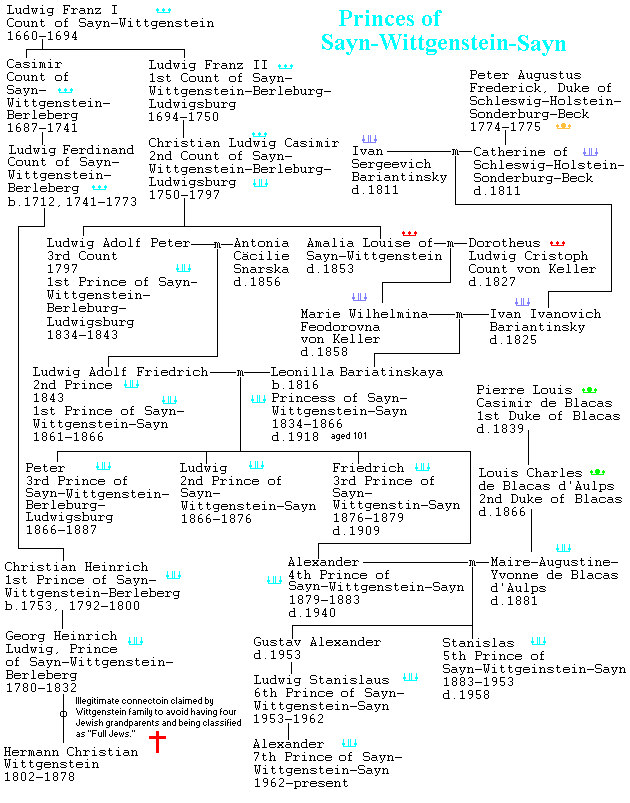
In the diagram, we see where the Wittgensteins claimed that their grandfather Hermann was actually the illegitimate son of a Sayn-Wittgenstein prince. This was from a collateral line of the Princes of Sayn-Wittgenstein-Sayn.
For a long time, I had not seen any explanation of the connection of "Sayn-Wittgenstein-Sayn" to Ludwig Wittgenstein's family, but a correspondent sent me some information that was in the Wittgenstein of William W. Bartley III (1934-1990) [1973, Open Court, 1994] and has recently been posted at Wikipedia. Curiously, Bartley was an editor of works by F.A. Hayek and Karl Popper. The Web now, of course, has many genealogical sites, through which one can trace all these lines. There are other lines of the Sayn-Wittgenstein family, which I have not, of course, covered here.
The Grandmother of Leonilla, the Princess Catherine Bariantinskaya, was of the House of Schleswig-Holstein. This made Leonilla a relative of much of European nobility and royalty, including the Throne of Great Britain. Queen Elizabeth II is a descendant of Catherine's brother, Karl Anton Augustus.
Wikipedia says that the wife of Alexander, the 4th Prince, Marie-Augustine de Blancas, was a descendant of James, the 1st Duke of Berwick, the natural son of King James II of England and Arabella, the sister of John Churchill, the 1st Duke of Marlborourgh. It provides no more information than that, and I have not yet been able to trace any line of descent. James had a lot of descendants, and Marie-Augustine had a lot of ancestors. So it may take a while.
Many distinctive features of the Tractatus seem to be owing to the influence on Wittgenstein of a single book, The Gospel in Brief, Краткое Изложение Евангелия, by Leo Tolstoy [1902]. Wittgenstein, who was often in dispair about the meaning of his life, and frequently thought of suicide, found this book during World War I; and it had a profound influence on him.
This was Tolstoy's redaction of the Gospels. Like a similar effort by Thomas Jefferson, it mainly leaves out the miraculous elements in the story, including the Resurrection. Christians might wonder how, without the Resurrection, there is any point to the exercise. However, the result looks a good deal more Christian than what we end up with in Jefferson, whose mild Epicureanism is very far from Tolstoy's takeaway.
Thus, all the asceticism, self-denial, and even morifications of Christian teaching and practice are promoted by Tolstoy. This was in great measure what appealed to Wittgenstein. It is perhaps why Tolstoy retains the Crucifixion while rejecting the Resurrection and promise of eternal life. The suffering of Christ, and of us, seems to be its own reward. Wittgenstein could get behind that with enthusiasm.
Immortality is rejected in this with a bit of sophistry. Wittgenstein will say:
While the present is always present, it is not therefore timeless; and eventually in the life of every person, time runs out and death catches up with them. Indeed, people are therefore apprehensive about the "experience of death," and every single person indeed will live until they experience death. If Wittgenstein means that we do no live our lives just for the purpose of experiencing death, that is different. But that does not seem to be what he means. And, of course, our visual field is limited at every moment, confined to the images projected onto the retinas. The limits are obvious.
So the sophistry here is that somehow the "present" is what Jesus means by the promise of eternal life. With his rejection of metaphysics, Wittgenstein cannot exactly be a materialist, but he may as well be, since, no less than with Jefferson, this life is all that we have -- and he has dabbled here in a bit of fast and loose metaphysics anyway, about time. But the result is not a life that Wittgenstein seems to enjoy very much anyway; and the asceticism promoted by Tolstoy fits into that just fine. Nothing Epicurean about it.
Wittgenstein might have found Spinoza congenial. There is a similar rejection of salvation and immortality, and of pious devotion, but at the same time something more like a mystical rapport with God. The atheist Bertrand Russell realized that something like that was going on with Wittgenstein, and he found it disturbing. It also is what attracts some people to the Tractatus. Yet it amounts to nothing more than Wittgenstein's "silence." Yet, with all the hints, God is mentioned.
A proper Christian, for whom God is definitely in the world, through Christ, or for that matter any monotheist believing in prophecy, revelation, and miracles, would sharply disagree. So, no one would call Wittgenstein a "God intoxicated man," like Spinoza -- although the indifference of God to the world, meaning all individual things actually in it, would be very Spinozist. The intoxication, like the thrust of the whole of the later philosophy, seems self-referential.
Otherwise, Wittgenstein's aphoristic and prophetic style is a look and a vibe that all but matches the way Tolstoy wrote his book. It is not the way Russell or any other recent philosophers had written. If we wonder why Wittgenstein's philosophy might remind us of Matthew 7:29, or why the text looks like Pāṇini's Sanskrit grammar, the Aṣṭādhyāyī, Tolstoy provides the direct connection.
Hearing about and reading about Wittgenstein over many years, since 1967 or 1968, I never heard about the influence of Leo Tolstoy, not just on Wittgenstein's thought, but on his manner of writing. The first I've seen of it is in The House of Wittgenstein, A Family at War, by Alexander Waugh [Doubleday, 2008]. Waugh devotes some attention to comparisons between The Gospel in Brief and the Tractatus, in both form and substance [pp.98-101].
And Waugh only came to my notice because of his industry in working on the authorship question about William Shakespeare. We might even say the two things have something in common. Seeing Wittgenstein portrayed over the decades as a sober logician or scientist of language, and seeing all of it upended by Tolstoy's peculiar Christianity, is not unlike William of Stratford being overturned as the author of the Shakespearean corpus.
The book by Wittgenstein apologist Peter Hacker, addressed further down this page, only manages one mention of Tolstoy, and that only in relation to Isaiah Berlin, with no connection to Wittgenstein. So either Hacker was unaware of that large part of Wittgenstein's life, or we may suspect an evasion. A prophetic, ascetic, and mystical Wittgenstein is not the picture Hacker wants to present to us, just the sober analyst of language -- albeit with results that cannot be questioned because they are neither a philosophical "theory" nor empirical science.
In linguistics, the idea that language, rather than reality, determines truth is associated with Edward Sapir and Benjamin Lee Whorf. Their idea was mainly that grammar provides the structure which is attributed to the world. Languages do have significantly different systems of grammar, and Whorf was fascinated with the grammar of isolated languages like Hopi. However, the burden of meaning about the nature of the world in languages is largely carried by vocabulary.
Grammar doesn't prevent statements about reality with the relevant vocabulary. Since vocabulary is easily borrowed from one language to another (as from Greek and Latin into English, or from Arabic and Persian into Turkish, or from Chinese into Korean, Vietnamese, and Japanese -- all in the superior/subordinate relation with Classical languages), it becomes difficult to argue that something about a particular language determines the nature of the world.
Indeed, the difference between grammar and vocabulary creates an important ambiguity in Wittgenstein's idea of language. Since vocabulary can be borrowed, or coined, and any proposition can be expressed as an affirmative or negative, a natural language is a very flexible instrument that radically underdetermines truth.
A "language" that determines truth, as part of a language "game" and a "form of life," thus means a particular vocabulary and the particular paradigm (in Kuhn's terms) that a certain community, using the vocabulary, endorses. This is the sense in which Wittgenstein ends up himself with a private language, since it is his own, and not anyone else's, vocabulary and paradigm that he uses.
The autistic and self-referential view of language and grammar in both Wittgenstein and people like Sapir and Whorf is also echoed in the now popular linguistics of Ferdinand de Saussure, whose principal ideas, like those of Wittgenstein, were only published postumously. This is all red meat for the nihilism and relativism that is popular now in academic "Theory," which is largely used to support political views whose incoherent and vicious nature must be protected from logical examination and argument. All the better to reject the very meaning of truth, logic, and argument.
Philosophy of Science, Linguistics
Ludwig Wittgenstein (1889-1951), Note 4;
Wittgenstein and Tolstoy
6.4311
Der Tod is kein Ereignis des Lebens. Den Tod erlebt man nicht.
Wenn man unter Ewigkeit nicht unendliche Zeitdauer, sondern Unzeitlichkeit versteht, dann lebt der ewig, der in der Gegenwart lebt.
Unser Leben ist ebenso endlos, wie unser Gesichtsfeld grenzenlos ist. Death is not an event in life: we do not live to experience death.
If we take eternity to mean not infinite temporal duration but timelessness, then eternal life belongs to those who live in the present.
Our life has no end in just the way in which our visual field has no limits.Tractatus Logico-Philosophicus, 1922, Routlege & Kegan Paul, 1972; German p.146; English p.147.
6.432
Wie die Welt ist, ist für das Höhere volkommen gleichgültig. Gott offenbart sich nicht in der Welt.
How things are in the world is a matter of complete indifference for what is higher. God does not reveal himself in the world. ibid., p.148; English p.149. Ludwig Wittgenstein (1889-1951), Note 5